

An ecommerce digital agency is not just a team that “runs ads” or redesigns a Shopify store. At its best, it is the growth system behind an online business: strategy, acquisition, conversion, retention, analytics, creative, automation, and technical execution working together.
That matters because ecommerce is no longer easy traffic plus a decent product page. Online retail is still growing, with ecommerce expected to represent more than 20% of worldwide retail sales in 2025, but competition is sharper, acquisition costs are less forgiving, and customers compare every buying experience against the best stores they have ever used.
A strong ecommerce digital agency helps brands close that gap. It turns scattered marketing activity into a repeatable operating model: clearer positioning, better landing pages, cleaner funnels, stronger email and SMS, useful analytics, and campaigns that do not depend on guesswork.

Article Outline
- Why an Ecommerce Digital Agency Matters Now
- The Ecommerce Growth Framework
- Core Services An Ecommerce Digital Agency Should Own
- How Professional Implementation Actually Works
- How To Choose The Right Ecommerce Digital Agency
- Tools, Workflows, Mistakes, And FAQs
Why An Ecommerce Digital Agency Matters Now
The old ecommerce playbook was simple: launch a store, run paid traffic, send a few emails, and optimize when something obviously breaks. That approach is too thin now. Most brands need sharper execution because the buyer journey has become more fragmented across search, social, marketplaces, email, SMS, influencers, and direct website visits.
The real issue is not that brands lack tools. Most ecommerce teams already have too many tools. The issue is that the tools are rarely connected to one clear strategy, so the brand ends up with campaigns that look busy but do not compound.
An ecommerce digital agency matters when it can bring order to that complexity. The agency should help the brand understand what is actually limiting growth: traffic quality, offer clarity, product page trust, checkout friction, poor retention, weak creative, bad tracking, or an operations problem hiding behind marketing metrics.
The Ecommerce Growth Framework
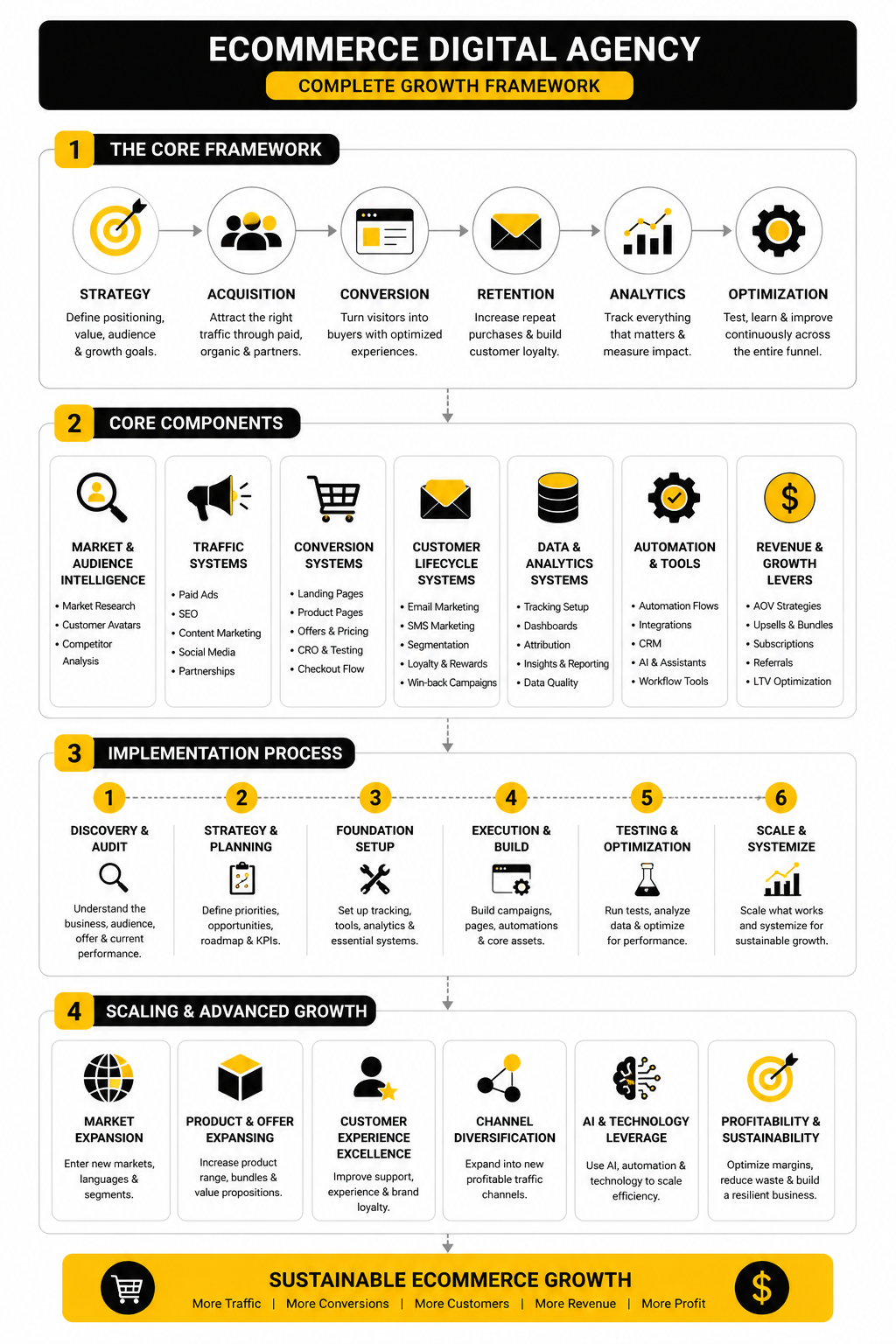
A useful ecommerce digital agency thinks in systems, not isolated tasks. The framework should connect four layers: demand generation, conversion, retention, and measurement. If one layer is weak, the entire business feels it.
Demand generation brings qualified people into the store. Conversion turns more of those people into buyers. Retention increases repeat purchases and lifetime value. Measurement keeps the whole system honest, so the team can see what is working instead of arguing from opinions.
This is where agency quality becomes obvious. A weak agency sells activity. A strong agency builds a framework the brand can understand, inspect, and improve over time.
Core Services An Ecommerce Digital Agency Should Own
An ecommerce digital agency should not be judged by the length of its service menu. A long list can look impressive, but it often hides weak thinking. The better question is simple: does the agency control the parts of the customer journey that actually affect revenue?
That usually starts with positioning and offer strategy. Before ads, emails, landing pages, or automations matter, the brand needs a clear reason to buy now instead of later. If the product is good but the offer is vague, every channel becomes more expensive than it should be.
From there, the agency should connect acquisition, conversion, retention, and reporting into one practical system. This is where the work becomes more serious than “posting content” or “launching campaigns.” It becomes a disciplined process for finding profitable traffic, converting more visitors, and increasing customer value after the first order.
Acquisition Strategy
Acquisition is the front door of ecommerce growth, but it is also where many brands waste the most money. Paid social, paid search, creator campaigns, SEO, affiliate partnerships, and marketplace traffic can all work, but none of them work equally well for every brand. A good ecommerce digital agency chooses channels based on margin, buying intent, product education needs, and how quickly the brand can test creative.
This matters because customer acquisition has become harder to treat casually. Klaviyo’s 2025 B2C marketing research notes that 73% of B2C marketers say customer acquisition costs are rising, which means brands need better economics, not just more reach. When traffic gets more expensive, weak offers and messy landing pages become painfully visible.
The agency’s job is to make acquisition measurable without becoming narrow. Not every valuable customer buys on the first click, and not every campaign should be judged only by same-day return. The right approach blends direct-response discipline with enough brand-building patience to avoid starving the business of future demand.
Conversion Rate Optimization
Conversion rate optimization is where an ecommerce digital agency turns existing traffic into more revenue. That does not mean changing button colors and hoping for magic. It means studying how real shoppers move through product pages, carts, checkout, reviews, shipping information, guarantees, and post-click landing pages.
Checkout deserves special attention because it is one of the highest-leverage areas in ecommerce. Baymard’s long-running checkout research shows that around 70% of online shopping carts are abandoned, which is a brutal reminder that purchase intent does not automatically become revenue. Many customers are close to buying, then friction, doubt, cost surprises, or poor usability gets in the way.
A professional agency should look for those leaks systematically. The work may include improving product detail pages, simplifying checkout, clarifying delivery expectations, strengthening trust signals, testing bundles, rewriting offer sections, and building landing pages for specific campaigns. For brands that need fast page production without constantly waiting on developers, tools like Replo can fit naturally into a landing page and testing workflow.
Retention And Lifecycle Marketing
Retention is where ecommerce profit often becomes clearer. First purchases are important, but repeat purchases, replenishment, referrals, subscriptions, loyalty, and win-back campaigns can change the economics of the entire business. A strong ecommerce digital agency should understand that lifecycle marketing is not just “send more emails.”
Email and SMS need segmentation, timing, creative discipline, and a real understanding of customer behavior. Welcome flows, abandoned cart flows, post-purchase education, replenishment reminders, review requests, and VIP campaigns should each have a clear job. If every message sounds like a discount blast, the brand trains customers to wait for cheaper prices.
This is where automation helps, but only when strategy comes first. Platforms like Brevo, Moosend, and ManyChat can support useful customer journeys, but the agency still needs to decide what should happen, when it should happen, and why the customer would care.
Analytics And Decision Making
Analytics is not a dashboard decoration. It is how an ecommerce digital agency decides what to fix first. Without clean measurement, teams argue about opinions, chase noisy metrics, and give too much credit to whatever channel shouted the loudest.
Good analytics connects store data, ad data, email performance, customer cohorts, product margins, and creative learnings. The agency should be able to explain what changed, why it probably changed, and what decision comes next. That is very different from sending a monthly report full of screenshots and vague commentary.
The key is practical clarity. A founder or marketing lead should be able to look at the reporting and understand the current growth constraint. Is the store short on qualified traffic, losing people at the product page, converting poorly at checkout, underusing post-purchase flows, or scaling an offer that does not have enough margin? A serious agency makes that answer easier to see.
How Professional Implementation Actually Works
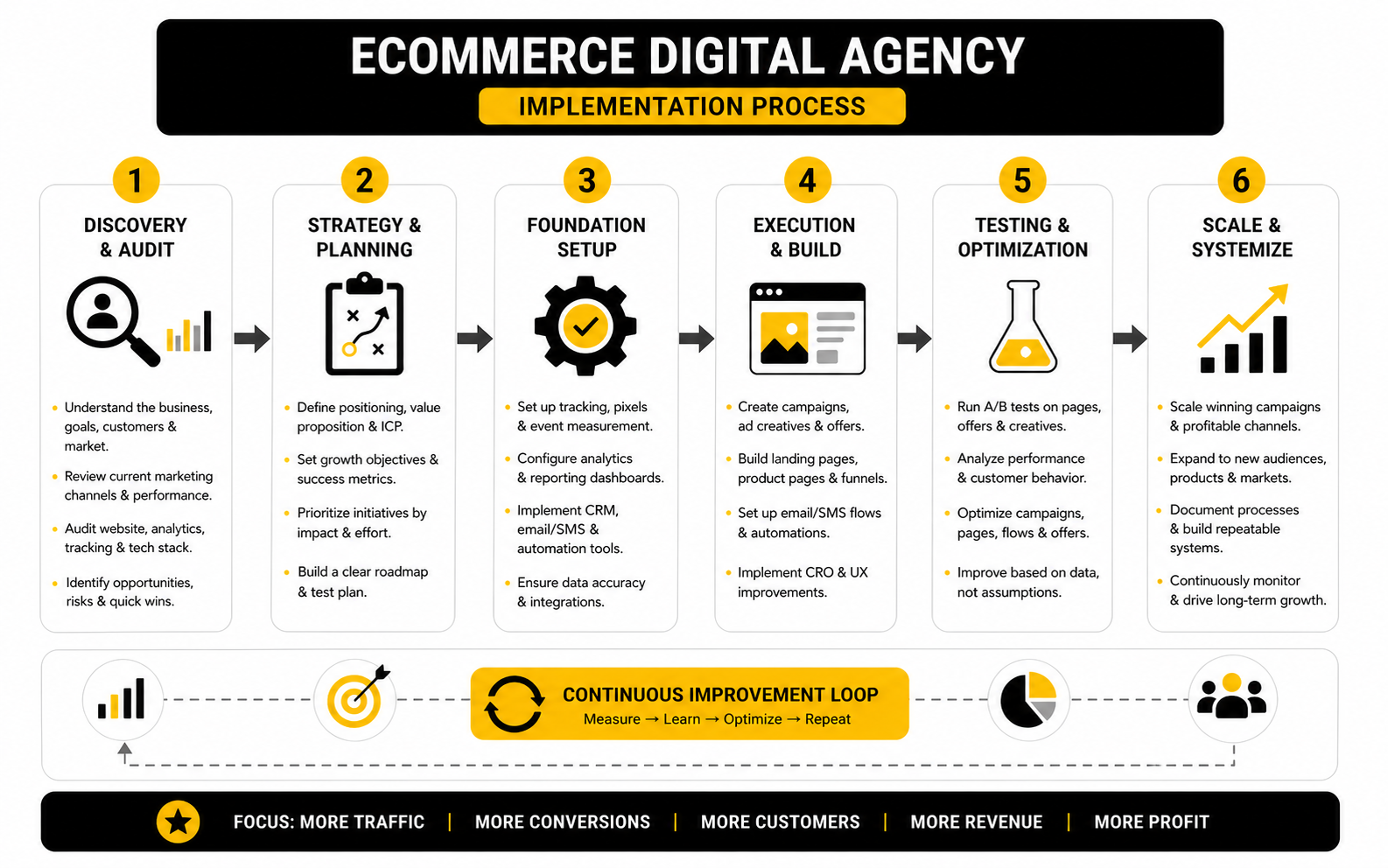
Professional implementation is where strategy becomes real work. This is the part where an ecommerce digital agency stops talking about growth and starts building the operating system behind it. The goal is not to create a perfect plan on paper; the goal is to move from diagnosis to controlled execution without breaking the store, confusing the team, or wasting budget.
A good agency starts by separating symptoms from causes. Low revenue might look like a traffic problem, but the real issue could be weak product-page messaging, poor checkout usability, unclear shipping costs, or no post-purchase follow-up. This matters because fixing the wrong problem can make a brand feel busy while the numbers barely move.
The implementation process should feel structured but not stiff. Ecommerce changes quickly, so the agency needs enough discipline to avoid chaos and enough flexibility to respond when the data says the original assumption was wrong.
Step 1: Audit The Current Growth System
The first step is a practical audit of the store, traffic, offer, analytics, creative, and customer journey. This is not a generic checklist. It should identify where the business is leaking money and which problems deserve attention first.
The audit should look at acquisition channels, conversion paths, email and SMS flows, product economics, merchandising, checkout behavior, and reporting quality. Checkout is especially important because research from Baymard shows that cart abandonment remains a major ecommerce problem, and many losses happen after shoppers have already shown buying intent. That is painful, but it also means there is often real upside hiding inside the existing traffic.
A serious ecommerce digital agency should leave this phase with clear priorities. Not twenty vague recommendations. A small number of fixes that can improve revenue, reduce waste, or make future testing more reliable.
Step 2: Clarify The Offer And Customer Journey
Once the audit is done, the agency should tighten the offer. This includes the main promise, product positioning, pricing logic, bundles, guarantees, shipping message, urgency, and objections. If the offer is unclear, every downstream tactic has to work harder.
The customer journey should then be mapped from first touch to repeat purchase. A shopper might discover the brand through a social ad, compare products through search, read reviews, visit a product page twice, abandon the cart, return through email, and finally buy after seeing a stronger offer. If the agency only optimizes one touchpoint, it misses how people actually buy.
This is also where landing pages and funnels become useful. For campaign-specific traffic, tools like Replo can help teams build focused ecommerce pages faster, while platforms like ClickFunnels can make sense when the selling motion depends on a guided funnel rather than a standard collection page.
Step 3: Build The Execution Roadmap
The roadmap turns strategy into scheduled work. It should define what gets built, who owns it, what success looks like, and what happens if the test fails. This is where professional implementation starts to look different from random marketing activity.
A strong roadmap usually mixes quick wins with deeper infrastructure. Quick wins might include rewriting hero sections, fixing trust gaps, improving abandoned cart flows, or cleaning up campaign tracking. Deeper work might include lifecycle segmentation, creative testing systems, new landing page templates, product feed improvements, or a better reporting model.
The best roadmaps are simple enough for everyone to understand. They show the next sprint, the reason behind each task, and the metric that will prove whether the work mattered. Without that clarity, the agency-client relationship becomes a stream of updates instead of a growth process.
Step 4: Launch Controlled Tests
Testing should not mean changing everything at once. A good ecommerce digital agency isolates variables where possible, documents the hypothesis, and gives each test enough room to produce a useful signal. The point is not to “win” every test; the point is to learn faster than competitors.
This can include ad creative tests, landing page tests, product page improvements, pricing presentations, bundle structures, email timing, SMS copy, checkout messaging, and post-purchase offers. The agency should be careful with claims, discounts, and urgency so the brand does not damage trust while chasing short-term lift. Growth that weakens customer confidence is not really growth.
AI and automation can support this process, but they should not replace judgment. Salesforce’s 2025 shopper research found that 39% of consumers already use AI for product discovery, which means ecommerce teams need to think carefully about discoverability, relevance, and customer experience. Tools can speed up execution, but the agency still needs to decide what is worth testing.
Step 5: Automate The Parts That Should Not Depend On Memory
After the core journey is mapped, automation should remove manual gaps. That includes lead capture, abandoned cart recovery, post-purchase education, review requests, replenishment reminders, support routing, and sales follow-up. The purpose is not to automate everything; it is to make sure important moments do not get missed.
For agencies managing multiple client funnels, GoHighLevel can be useful for CRM, pipeline, follow-up, and automation workflows. For ecommerce brands using conversational channels, ManyChat can support automated interactions across chat-based customer journeys. For forms, onboarding, quizzes, and zero-party data collection, Fillout can fit naturally into the implementation stack.
The rule is simple: automate repeatable steps, not strategic thinking. If the message is bad, automation only sends bad messages faster. The agency still needs to understand the customer, the offer, and the timing.
Step 6: Review, Learn, And Reprioritize
Implementation does not end at launch. The agency should review results, compare them against the original hypothesis, and decide what changes next. This is where many teams get lazy, because launching feels productive while reviewing requires honesty.
The review should answer a few practical questions. Did the change improve the target metric? Did it affect margin, average order value, repeat purchase, or support volume? Did it reveal a bigger problem that needs to be solved before scaling?
A strong ecommerce digital agency uses this review cycle to keep the work grounded. The brand gets smarter every month because decisions are tied to evidence, not mood. That is the real value of professional implementation: better execution, better learning, and fewer expensive guesses.
Statistics And Data That Actually Matter
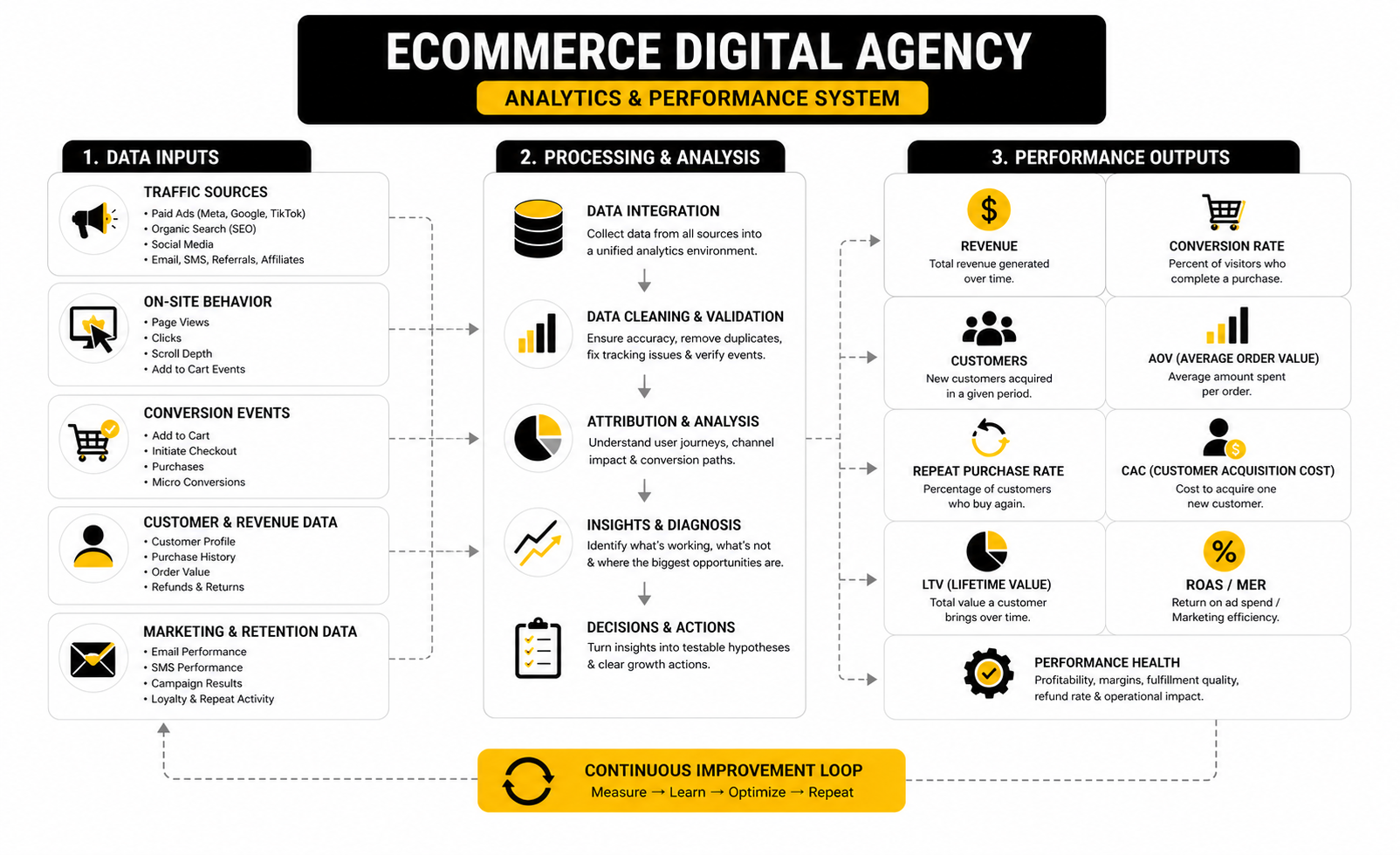
Data only helps when it changes what you do next. A benchmark is not a trophy, and it is not a reason to panic by itself. For an ecommerce digital agency, the job is to turn numbers into decisions: what to fix, what to test, what to scale, and what to stop doing.
The most useful ecommerce data usually falls into five groups: market demand, traffic quality, conversion performance, retention strength, and measurement reliability. If a brand only watches revenue, it sees the result but not the cause. If it only watches channel metrics, it may optimize campaigns while the store experience quietly leaks money.
This is why professional measurement has to connect the full journey. The agency should know whether the business is growing because more people are visiting, because more visitors are buying, because average order value is rising, because customers are returning more often, or because attribution is over-crediting one channel. Those are very different situations, and they require very different actions.
Market Growth Is Real, But It Does Not Guarantee Your Growth
Ecommerce is still gaining share, but the headline growth numbers can create false confidence. U.S. ecommerce sales reached an estimated $1.2337 trillion in 2025, up 5.4% from 2024, while total retail sales grew more slowly. That tells you online buying behavior is still expanding, but it does not tell you whether a specific brand has a strong offer, clean tracking, or profitable acquisition.
This is where an ecommerce digital agency needs to be careful. Market growth can lift demand, but it also attracts more competitors, higher ad pressure, and more sophisticated customer expectations. A brand should not read broad ecommerce growth as proof that its current strategy is good enough.
The practical action is to compare market growth against the brand’s own growth. If the category is growing and the brand is flat, the issue may be positioning, channel mix, product-market fit, or conversion quality. If the brand is growing faster than the market but margin is falling, the agency needs to inspect discounting, shipping costs, acquisition efficiency, and repeat purchase behavior before celebrating.
Conversion Rate Needs Context
Conversion rate is one of the most watched ecommerce metrics, but it is also one of the easiest to misread. A low conversion rate can mean weak traffic, poor product pages, high prices, slow delivery, low trust, checkout friction, or simply a longer consideration cycle. A higher conversion rate can also be misleading if it comes from heavy discounts that reduce profit.
Benchmarks are useful as a starting point, not a verdict. Current ecommerce benchmark reporting often places average conversion rates in the low single digits, with some 2025 analysis putting global ecommerce conversion around roughly 2% depending on market, device, and category. That number should push a brand to ask better questions, not blindly chase someone else’s average.
The action is to segment conversion rate by traffic source, device, product type, returning versus new visitors, and landing page. If mobile traffic converts far below desktop, the issue may be mobile usability or page speed. If paid traffic converts poorly while email traffic converts well, the offer may work for warm customers but fail with cold audiences.
Cart Abandonment Shows Where Intent Breaks
Cart abandonment is not just a checkout metric. It is a trust metric, a pricing metric, a shipping metric, and sometimes a UX metric. When someone adds a product to cart, they have shown intent; when they leave, something made the purchase feel less worth completing.
Baymard’s checkout research continues to show that around 70% of carts are abandoned, which makes checkout one of the clearest places to look for lost revenue. The exact rate will vary by store and category, but the lesson is consistent: purchase intent is fragile. Small doubts at the wrong moment can kill a sale.
The action is not to spam every abandoner with the same discount. A good ecommerce digital agency should inspect the reasons behind abandonment first: unexpected shipping costs, required account creation, unclear delivery timing, limited payment options, weak trust signals, or a checkout that feels too long. Then the recovery flow can match the problem instead of treating every abandoned cart like a coupon request.
Acquisition Cost Should Be Judged Against Customer Value
Customer acquisition cost is dangerous when viewed alone. A high CAC can be acceptable if customers repeat, buy bundles, refer others, or subscribe. A low CAC can still be bad if the customers are bargain hunters who never come back.
This matters more now because acquisition pressure is not going away. In 2025 B2C marketing research, 73% of marketers said customer acquisition costs are rising. That does not mean brands should stop acquiring customers; it means they need better economics around every acquired customer.
The action is to measure CAC beside contribution margin, first-order profitability, repeat purchase rate, payback period, and lifetime value. An ecommerce digital agency should help the brand decide whether to optimize for profitable first orders, faster payback, higher lifetime value, or a deliberate short-term investment in customer growth. Those choices should be explicit, not hidden inside a blended ROAS number.
Retention Turns Performance Marketing Into A Business
Retention is where many ecommerce brands either protect margin or slowly bleed it out. If customers rarely buy again, the brand is forced to keep replacing them with new customers. That makes the business more exposed to ad costs, algorithm changes, and seasonal volatility.
The measurement should go beyond total email revenue. A useful retention view looks at repeat purchase rate, time between purchases, cohort revenue, subscription behavior, loyalty participation, review generation, and win-back performance. These numbers show whether the customer relationship is getting stronger after the first sale.
The action is to build retention around the product’s natural buying cycle. A consumable product needs replenishment timing. A fashion brand may need new-arrival segmentation and style preferences. A higher-ticket product may need education, warranty support, accessories, and referral prompts. The agency’s job is to make the second purchase feel like the natural next step, not a desperate follow-up campaign.
AI Traffic And New Discovery Channels Need Separate Reporting
Discovery is changing, and ecommerce teams need to measure it before it becomes a blind spot. Salesforce reported that 39% of consumers use AI for product discovery, while Adobe has tracked sharp growth in traffic from generative AI sources to retail sites through its AI traffic research. This does not mean every brand should rebuild its strategy around AI tomorrow, but it does mean old reporting categories may miss emerging demand.
AI-assisted shoppers may behave differently from search, social, or email visitors. They may arrive later in the research process, compare products differently, or expect clearer product data. If those visitors are grouped into broad referral buckets, the brand may not understand how discovery is actually changing.
The action is to create cleaner reporting around new traffic sources, product feed quality, structured content, FAQs, comparison pages, and on-site search behavior. An ecommerce digital agency should help the brand see whether AI-driven discovery is creating awareness, consideration, or actual revenue. Without that separation, the team is guessing.
The Best Dashboard Is A Decision System
A dashboard should not be a wall of numbers. It should tell the team what is happening, why it might be happening, and what needs attention next. If nobody changes their behavior after reading the dashboard, the dashboard is probably too decorative.
A practical ecommerce measurement system should include:
- Revenue, contribution margin, and profit signals
- Sessions, traffic source mix, and traffic quality
- Product page conversion, add-to-cart rate, checkout completion, and cart abandonment
- Average order value, bundle performance, and discount usage
- CAC, payback period, ROAS, MER, and channel efficiency
- Repeat purchase rate, cohort revenue, email and SMS performance, and lifetime value
- Tracking health, attribution gaps, and major data anomalies
The point is not to track everything forever. The point is to know which metric explains the current growth constraint. A strong ecommerce digital agency uses data to narrow the next decision, not to impress the client with complexity.
How To Choose The Right Ecommerce Digital Agency
Choosing an ecommerce digital agency is not about finding the flashiest portfolio. It is about finding a partner that understands your economics, your customer journey, your constraints, and your next stage of growth. A great agency for a seven-figure Shopify brand may be completely wrong for a marketplace-heavy operator, a subscription brand, or a founder-led product business still proving demand.
The right agency should be able to explain how it thinks before it explains what it sells. If the conversation immediately jumps to ad spend, retainers, or a list of deliverables, slow down. Strategy should come before the package.
This is especially important when growth starts getting more complex. Once a brand has multiple channels, multiple products, returning customers, and a real cost structure, the agency needs to optimize the business, not just the campaign account.
Match The Agency To Your Growth Stage
An early-stage ecommerce brand usually needs clarity, speed, and practical execution. The agency may need to help sharpen the offer, build landing pages, set up basic lifecycle flows, test acquisition channels, and make reporting usable. At this stage, overcomplicated strategy can become a distraction.
A scaling brand needs a different kind of partner. The work becomes more about margin control, testing discipline, creative production, retention, attribution, merchandising, and operational coordination. This is where an ecommerce digital agency needs stronger systems because small mistakes become expensive when traffic, inventory, and team size increase.
A mature brand may need even deeper specialization. The agency might focus on retail media, international expansion, advanced personalization, technical SEO, feed optimization, CRO, or lifecycle segmentation. The mistake is hiring a generalist agency for a specialist problem just because the sales call felt smooth.
Look For Commercial Thinking, Not Just Channel Expertise
Channel expertise matters, but commercial thinking matters more. A paid ads expert who ignores margin can scale a brand into a cash problem. A CRO specialist who only chases conversion rate can recommend discounts that make the store look healthier while profit gets worse.
A serious ecommerce digital agency should ask about gross margin, contribution margin, inventory, fulfillment, return rates, product mix, payback period, repeat purchases, and seasonality. Those questions may feel less exciting than creative ideas, but they reveal whether the agency understands the business behind the dashboard. That is where trust starts.
The best agency conversations sound practical. They include tradeoffs. They make clear what the agency can control, what the brand must own internally, and which assumptions need to be tested before big budget decisions are made.
Understand The Tradeoff Between Speed And Control
Fast execution is valuable, but speed without control creates mess. Brands often want new campaigns, new landing pages, new emails, new automations, and new reporting immediately. That urgency is understandable, but if everything launches without a clear owner and measurement plan, the team just creates more noise.
A good ecommerce digital agency knows when to move quickly and when to slow down. It should move quickly on low-risk improvements, obvious friction, broken flows, weak copy, missing trust elements, and reporting cleanup. It should slow down on major pricing changes, brand repositioning, migration work, aggressive discounting, and anything that could affect customer trust.
This is the difference between momentum and chaos. Momentum creates useful learning. Chaos creates activity that nobody can interpret later.
Watch For Scaling Risks Before They Become Expensive
Scaling problems often appear after things start working. That is what makes them dangerous. A campaign may drive revenue, but fulfillment may struggle, returns may increase, support tickets may pile up, or inventory may run out before the brand can capture demand.
An ecommerce digital agency should not ignore these issues just because they sit outside the ad account. Marketing creates operational pressure. If the agency pushes harder without understanding stock levels, shipping promises, margin, or customer support capacity, growth can turn into a customer experience problem.
This is where brands need honest conversations. If the store cannot handle a promotion, do not force one. If a hero product is low on inventory, shift the plan. If customer complaints reveal a product education issue, fix the pre-purchase messaging before scaling spend.
Avoid Agencies That Sell Certainty Too Early
No agency can honestly know the perfect strategy before seeing the data, the store, the customer behavior, and the economics. Confidence is good. Fake certainty is not.
Be careful when an ecommerce digital agency promises a specific revenue outcome without context. Be careful when it guarantees performance based only on ad spend. Be careful when it cannot explain what happens if the first strategy does not work.
The better agency will talk in hypotheses, priorities, and decision rules. It will explain what it expects to happen, how it will measure the result, and what it will change if the data disagrees. That might sound less glamorous, but it is much closer to how real growth works.
Decide What Should Stay In-House
Not every function should be outsourced forever. Some work belongs close to the brand because it depends on product knowledge, founder insight, customer feedback, or internal speed. The agency can support those areas, but it should not become the only source of truth.
Brand voice, product roadmap, customer service insights, inventory planning, and long-term positioning usually need strong internal ownership. The agency can turn those inputs into campaigns, pages, flows, and tests. But if the brand has no internal point of view, the agency ends up guessing.
The best setup is collaborative. The brand owns the customer and the business direction. The ecommerce digital agency owns the execution system, testing rhythm, channel expertise, and performance feedback loop.
Build A Tool Stack That Supports The Process
Tools should make the agency-client workflow clearer, not heavier. The stack needs to support campaign planning, landing page creation, automation, CRM visibility, customer feedback, and reporting. If the tools do not reduce friction or improve decisions, they are just another subscription.
For funnel-heavy campaigns, ClickFunnels can help structure guided sales journeys. For broader CRM, follow-up, and agency-managed automation, GoHighLevel can be a useful operating layer. For support and on-site customer questions, Chatbase can help turn repeated questions into a more scalable customer experience.
The tool stack should follow the strategy, not the other way around. Do not buy software because it looks powerful. Choose tools because they help the team execute the next stage of the growth system with less confusion and better accountability.
Tools, Workflows, Mistakes, And FAQs
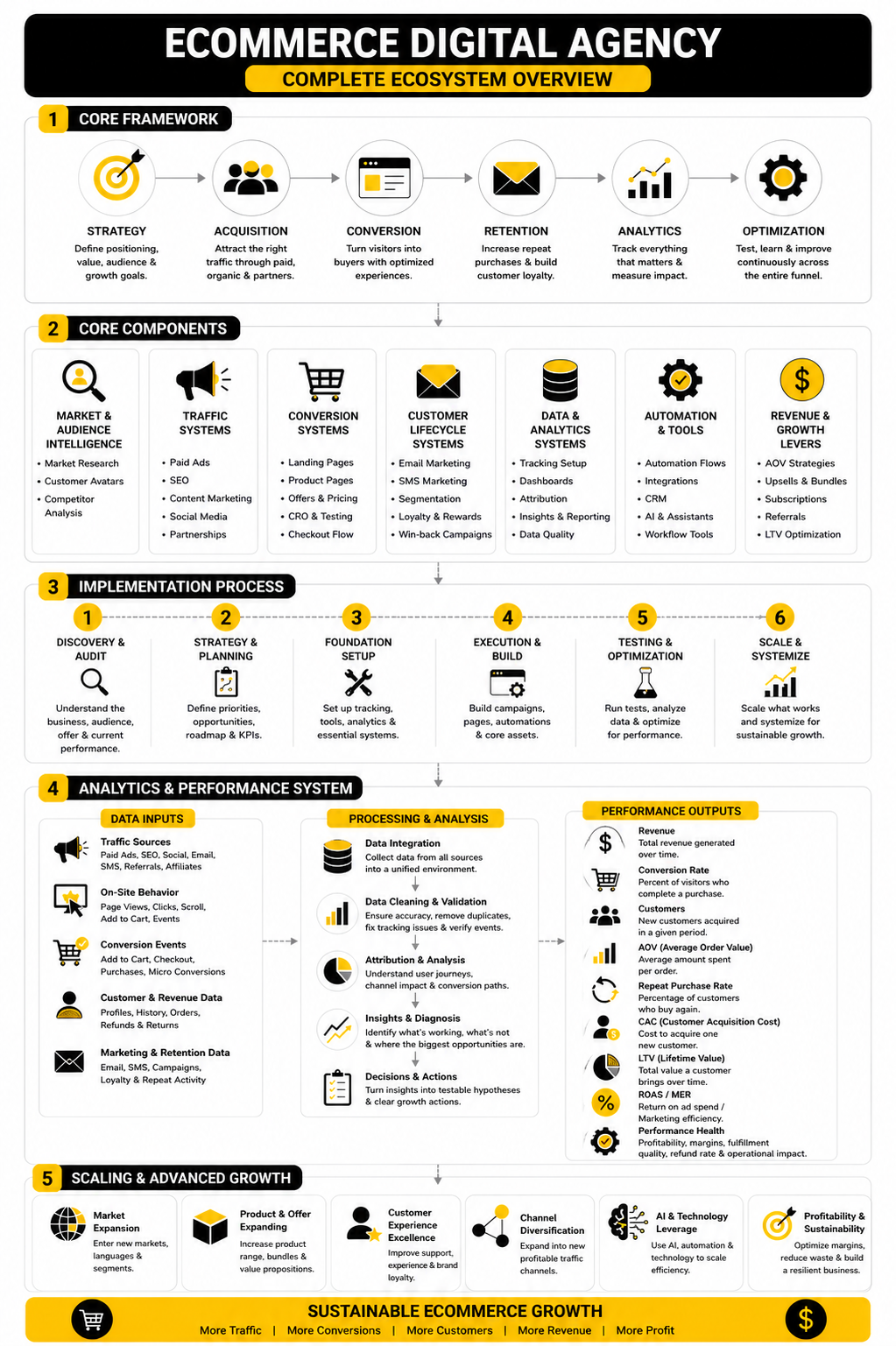
By this point, the pattern should be clear. An ecommerce digital agency is not valuable because it owns a few marketing tools. It is valuable when it can connect tools, people, strategy, data, and execution into one working growth system.
That system needs to be practical. It should help the brand attract better traffic, convert more of that traffic, retain more customers, and understand which actions actually move the business forward. When those pieces work together, the agency becomes more than a vendor; it becomes a serious operating partner.
The final layer is the ecosystem around the work. The right software, workflows, reporting habits, and talent model can make the agency relationship faster, cleaner, and easier to scale. The wrong setup creates confusion, duplicated work, messy handoffs, and decisions nobody fully trusts.
The Workflow Should Be Simple Enough To Repeat
A strong workflow does not need to be complicated. In fact, the more complex it looks, the more likely it is that nobody will follow it consistently. The best ecommerce agency workflows are clear enough that every stakeholder understands what is being worked on, why it matters, who owns it, and how success will be measured.
A practical workflow usually includes discovery, prioritization, execution, measurement, review, and reprioritization. That rhythm keeps the team from drifting into random tasks. It also makes the relationship easier to manage because expectations are attached to a visible process.
This is where tools should support the work quietly. Landing page tools, CRM systems, automation platforms, form builders, and reporting dashboards should reduce friction. If the tech stack creates more meetings, more confusion, or more manual cleanup, it is not helping.
The Biggest Mistake Is Treating The Agency Like A Magic Fix
An ecommerce digital agency can improve execution, but it cannot replace a weak product, unclear positioning, poor margins, broken operations, or a team that refuses to act on data. This is important. Agencies can amplify a business, but they cannot magically turn every business into a scalable winner.
The healthiest agency relationships are honest from the start. The brand brings product knowledge, customer insight, operational context, and decision-making authority. The agency brings strategic structure, channel expertise, implementation skill, and performance feedback.
When both sides do their part, the work compounds. When one side hides behind the other, the relationship gets slow and frustrating. That is usually when teams start blaming ads, tools, algorithms, or dashboards instead of fixing the real constraint.
FAQ - Built For Complete Guide
What does an ecommerce digital agency do?
An ecommerce digital agency helps online brands grow by improving the systems that drive revenue. That can include acquisition strategy, paid ads, SEO, landing pages, conversion optimization, email and SMS marketing, retention, analytics, automation, and technical implementation. The best agencies connect those services instead of treating them as separate tasks.
The real value is not just execution. A strong agency helps the brand decide what deserves attention first. That means identifying the current growth constraint and building a practical plan around it.
Is an ecommerce digital agency only for Shopify brands?
No. Shopify brands are a common fit, but an ecommerce digital agency can also work with WooCommerce, BigCommerce, Magento, custom stores, marketplace sellers, subscription businesses, and funnel-based ecommerce brands. The platform matters, but the business model matters more.
A good agency should understand how the store makes money before recommending tactics. A subscription brand, a high-ticket product business, and a low-margin catalog store need different strategies. Platform experience helps, but commercial thinking is what makes the difference.
When should a brand hire an ecommerce digital agency?
A brand should consider hiring an ecommerce digital agency when growth is becoming too complex to manage casually. That usually happens when traffic sources multiply, conversion issues become harder to diagnose, retention needs more structure, or the internal team cannot execute fast enough. It can also make sense when the founder is still making every marketing decision and needs a more reliable operating rhythm.
The key is readiness. If the brand has no clear product demand, no margin room, and no ability to implement decisions, an agency may struggle to create meaningful results. If the brand has traction but needs better systems, an agency can be a strong lever.
How much does an ecommerce digital agency cost?
Costs vary widely depending on scope, expertise, market, and business stage. Some agencies charge a monthly retainer, some charge project fees, some charge performance fees, and some use a hybrid model. The important question is not only what the agency costs, but what business problem the fee is meant to solve.
A cheap agency can become expensive if it wastes budget, damages tracking, or creates work that has to be rebuilt. A higher-priced agency can be worth it if it improves profit, saves internal time, and creates a more reliable growth system. Price should be judged against capability, fit, and expected leverage.
What should I ask before hiring an ecommerce digital agency?
Start with questions that reveal how the agency thinks. Ask how they diagnose growth problems, how they prioritize work, how they measure success, and what they do when a test fails. Ask who will actually work on the account, not just who appears on the sales call.
You should also ask about margins, attribution, retention, reporting, and operational constraints. If the agency only talks about traffic, it may be too narrow. Ecommerce growth depends on the full journey, not one channel.
What are the warning signs of a weak ecommerce agency?
Weak agencies often promise certainty too early, focus only on vanity metrics, avoid commercial questions, or push one channel as the answer to everything. They may also hide behind complicated reports that do not lead to clear decisions. If every update sounds busy but the business is not getting smarter, that is a problem.
Another warning sign is poor ownership. If nobody can explain what was tested, why it was tested, and what changed because of the result, the agency is not running a disciplined process. Activity is not the same as progress.
Should an ecommerce digital agency manage paid ads?
It can, but paid ads should not be isolated from the rest of the business. Ad performance depends on the offer, creative, landing page, product page, pricing, reviews, shipping expectations, and post-click experience. If the agency only manages the ad account, it may miss the real reason performance is stuck.
Paid media works best when it is part of a wider growth system. The agency should use campaign data to improve messaging, offers, pages, and retention. That is how ad spend becomes learning, not just expense.
How important is conversion rate optimization?
Conversion rate optimization is very important because it improves the value of traffic the brand already has. But it needs to be handled carefully. A higher conversion rate is not automatically better if it depends on excessive discounting or attracts lower-quality customers.
Good CRO looks at product pages, landing pages, carts, checkout, trust signals, offers, and customer objections. The goal is not to manipulate shoppers. The goal is to remove friction and make the buying decision clearer.
What tools should an ecommerce digital agency use?
The right tools depend on the agency’s workflow and the brand’s needs. Common categories include analytics, landing page builders, CRM systems, email and SMS platforms, customer support tools, form builders, creative testing tools, and project management software. Tools should make execution faster and decisions clearer.
For example, Replo can support ecommerce landing page production, GoHighLevel can support CRM and automation workflows, and ManyChat can support conversational customer journeys. The tool should always serve the strategy, not replace it.
How long does it take to see results from an ecommerce agency?
Some improvements can show up quickly, especially when the store has obvious friction, broken flows, weak pages, or poor tracking. Other improvements take longer because they depend on testing cycles, customer behavior, creative iteration, retention, and product economics. The timeline depends on the problem being solved.
The better way to judge progress is by learning velocity and decision quality. Is the agency identifying constraints faster? Are tests becoming more disciplined? Is the team making better decisions each month? Those signals often appear before the full financial impact compounds.
Can an ecommerce digital agency help with retention?
Yes, and it should. Retention is one of the most important parts of ecommerce growth because repeat customers can reduce pressure on acquisition. An agency can help with email flows, SMS campaigns, post-purchase education, replenishment reminders, win-back campaigns, loyalty strategies, referrals, and customer segmentation.
The important part is relevance. Retention does not mean sending more promotions to everyone. It means understanding the customer lifecycle and creating messages that fit the timing, product, and reason to buy again.
What is the difference between an ecommerce agency and a general digital agency?
A general digital agency may serve many types of businesses, while an ecommerce digital agency focuses specifically on online selling. That focus matters because ecommerce has unique pressure points: product pages, carts, checkout, inventory, fulfillment, margins, returns, repeat purchases, and attribution. A general agency may understand marketing but miss the operational details that affect ecommerce profit.
That does not mean every ecommerce agency is automatically better. The agency still needs strategic discipline and strong execution. But ecommerce specialization can shorten the learning curve and reduce avoidable mistakes.
Should I hire freelancers instead of an agency?
Freelancers can be a great choice when the need is specific and well-defined. For example, a brand may hire a landing page designer, email copywriter, media buyer, analytics specialist, or SEO consultant. This can be more flexible than hiring a full agency.
The tradeoff is coordination. An agency usually provides a more integrated system, while freelancers may require stronger internal management. If the brand can manage strategy and coordination internally, freelancers can work well. If not, an agency may provide more structure.
How do I know if the agency is actually improving the business?
Look beyond surface metrics. Revenue matters, but so do contribution margin, CAC, payback period, repeat purchase rate, conversion quality, average order value, customer complaints, and operational pressure. If revenue rises while profit, customer experience, or fulfillment quality gets worse, the agency may be scaling the wrong thing.
A good agency should make the business easier to understand. You should know what was done, why it was done, what happened, and what decision comes next. That clarity is one of the strongest signs that the relationship is working.
Work With Professionals
Explore 10K+ Remote Marketing Contracts on MarkeWork.com
Most marketers spend too much time chasing clients, competing on crowded platforms, and losing a percentage of every project to middlemen.
MarkeWork gives you a better way. Browse thousands of remote marketing contracts and connect directly with companies desperate to hire skilled marketers like you, without platform commissions and without unnecessary gatekeepers.
If you're serious about finding better opportunities and keeping 100% of what you earn, explore available contracts and create a profile for free at MarkeWork.com.