

Ecommerce marketing looks simple from the outside. Launch a store, run some ads, send a few emails, post on social, and hope the numbers climb. In reality, the brands that grow consistently are usually the ones that treat ecommerce marketing as a system instead of a pile of disconnected tactics.
That matters more now because the market is bigger, noisier, and less forgiving than it used to be. Shopify notes that ecommerce is expected to account for 20.5% of global retail sales in 2025, while McKinsey has argued that profitable growth depends on getting much tighter about channel mix, customer value, and operational discipline in digital commerce (profitability in e-commerce). More shoppers are online, but more brands are fighting for the same attention.
The real shift is that performance no longer comes from one hero channel. Google’s retail research keeps pointing toward an omnichannel customer experience where discovery, validation, and purchase happen across multiple touchpoints, while Klaviyo’s 2025 online shopping report shows that social often creates demand before email, SMS, and other owned channels close the loop. Good ecommerce marketing is really about building that loop on purpose.
- Why Ecommerce Marketing Matters
- The Ecommerce Marketing Framework
- Traffic Acquisition Channels That Actually Compound
- Conversion Systems That Turn Visits Into Revenue
- Retention, Loyalty, and Customer Lifetime Value
- Professional Implementation, Measurement, and Scaling
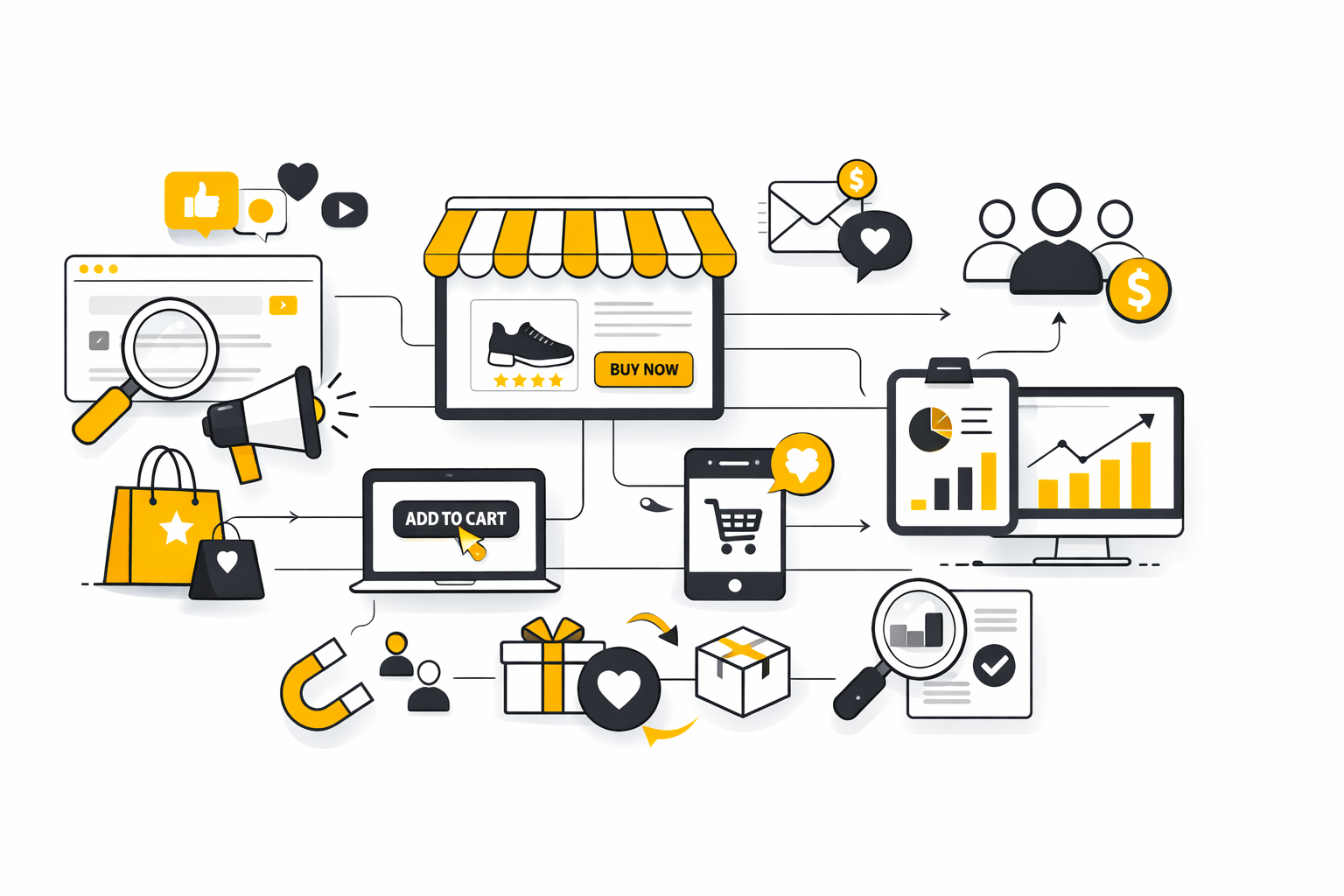
Why Ecommerce Marketing Matters
Ecommerce marketing matters because traffic alone does not create a durable business. A store can buy clicks all day and still struggle if those visitors do not trust the brand, understand the offer, or come back after the first purchase. The difference between a fragile store and a scalable one is usually the quality of its marketing engine, not the existence of its catalog.
That engine has to do four jobs at once. It has to attract the right people, convert them efficiently, keep them engaged after the first order, and generate enough margin to fund the next round of growth. Shopify’s work on customer acquisition costs and customer lifetime value makes the point clearly: acquisition and retention are connected, and the brands that win are not just buying customers cheaply, they are extending value after the sale.
The pressure on marketers is also rising because shopper expectations keep moving. McKinsey reports that 71% of consumers expect personalized interactions and 76% get frustrated when they do not receive them. At the same time, Mailchimp’s benchmark data shows ecommerce email performance still depends on disciplined execution, with an average 29.81% open rate and 1.74% click rate for ecommerce campaigns, which means there is still room for strong operators to outperform average brands by a wide margin.
The Ecommerce Marketing Framework
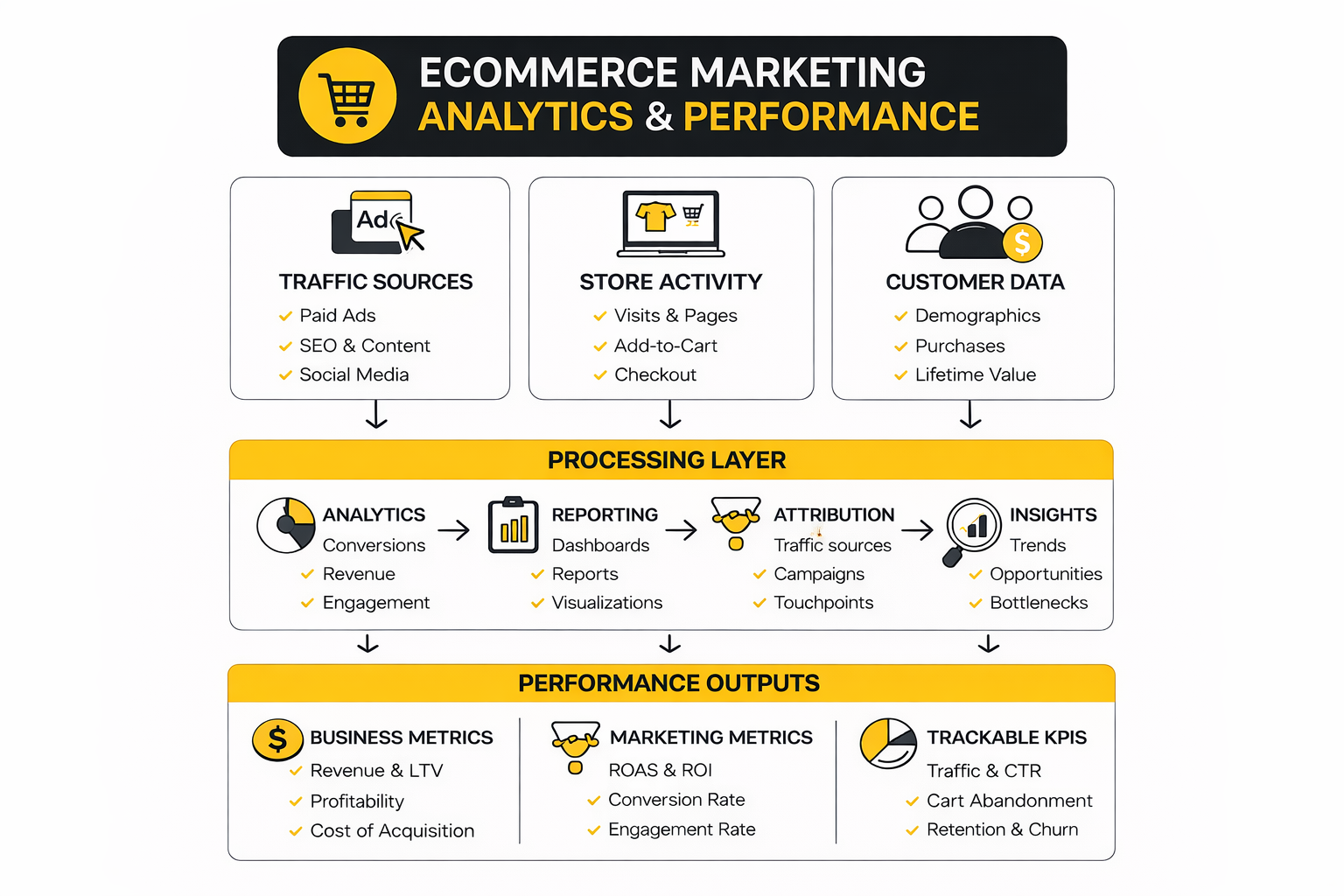
The simplest way to understand ecommerce marketing is to see it as a connected framework rather than a checklist. At the top, you have demand creation through channels like search, paid social, creators, content, and marketplaces. In the middle, you have conversion through product pages, merchandising, offers, reviews, and checkout experience. After that, you have retention through email, SMS, loyalty, post-purchase flows, and customer experience. Then everything feeds back into measurement so the system gets smarter over time.
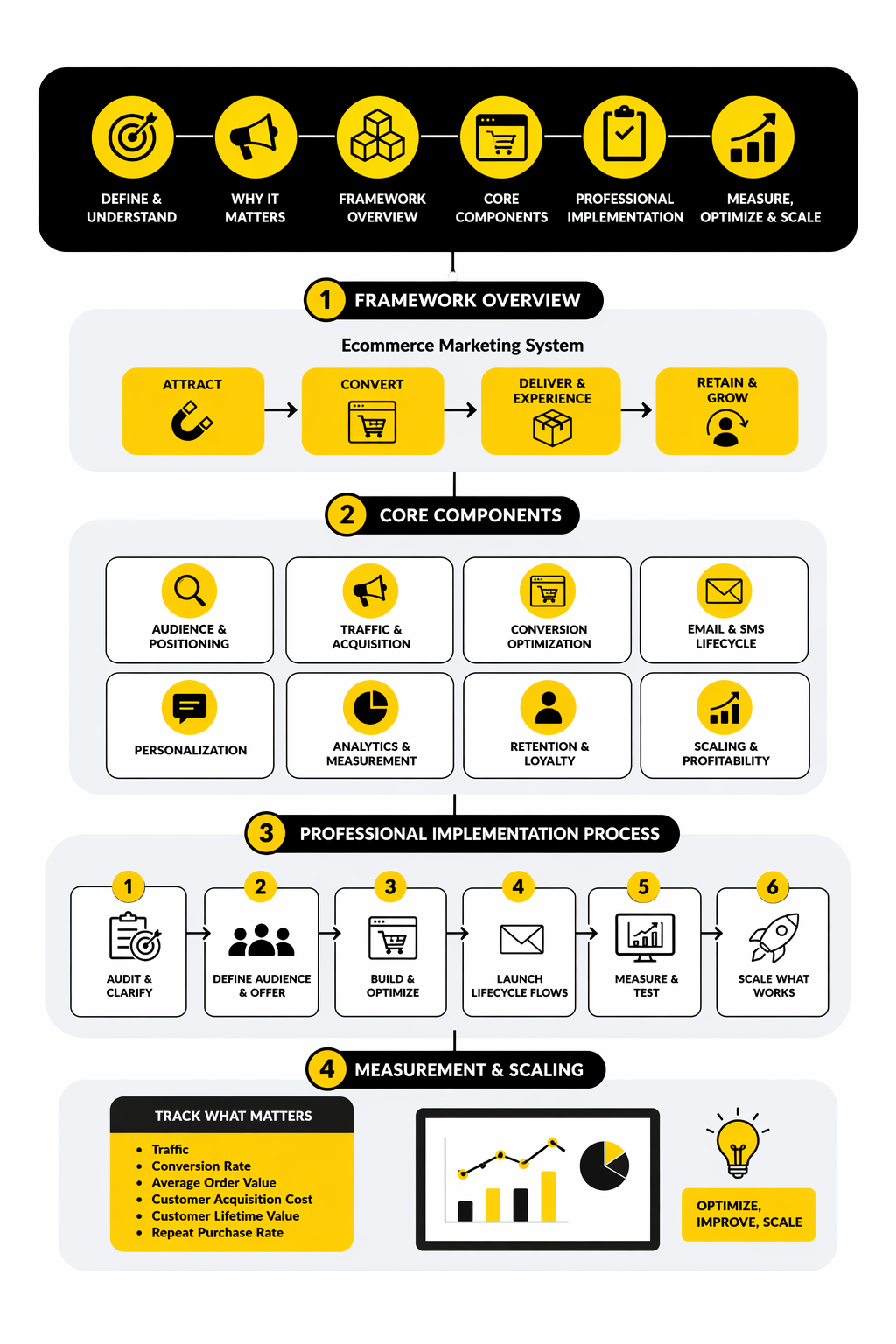
This framework works because each layer solves a different business problem. Traffic channels answer how people discover you. Conversion systems answer why they buy now. Retention programs answer whether the first order becomes a relationship. Measurement answers which parts deserve more budget, more creative attention, and more operational support.
The practical implication is that brands should stop asking which single channel is best and start asking which combination creates momentum. A strong stack might use ManyChat for conversational capture and automation, Replo for faster landing page testing, Brevo for lifecycle messaging, or Buffer for content distribution, but the tool choice only helps when it supports a coherent strategy. The framework comes first. The software is there to make execution faster, cleaner, and more measurable.
I’ve moved into the next section of the article: the acquisition layer. I’m checking current primary sources on search, social, creator content, and marketplace behavior so Part 2 stays useful instead of generic.
Conversion Systems That Turn Visits Into Revenue
Getting traffic is only half the job. In ecommerce marketing, the real leverage often shows up after the click, because that is where attention either becomes revenue or quietly leaks away through weak messaging, confusing navigation, and unnecessary checkout friction. A store does not need more visitors if the current experience is already failing the people who were ready to buy.
That is why conversion work deserves its own section instead of being treated like a design cleanup project. Baymard’s ongoing ecommerce research shows that 70.19% of online shopping carts are abandoned on average, and its more recent benchmark work argues that the average large ecommerce site could gain a 35.26% increase in conversion rate through better checkout design. Those numbers are blunt, but they are useful because they make one thing obvious: many ecommerce brands do not have a traffic problem first. They have a systems problem.
Shopify’s current benchmark framing is also a good reality check. A “good” ecommerce conversion rate often lands around 2% to 3% globally, but that number moves based on industry, device mix, offer strength, and traffic quality. So the smart question is not whether your store is hitting some magical average. It is whether the page, offer, and checkout experience are doing justice to the demand you already paid to create.
Product Pages Should Answer Buying Questions Fast
Most product pages still underperform for a simple reason: they make visitors work too hard. People land on a page and immediately start asking silent questions. What exactly is this? Why is it better? Will it fit my use case? When will it arrive? Can I trust this brand? If the page does not answer those questions quickly and clearly, people leave.
Baymard’s product page benchmark found that up to 62% of sites show mediocre or worse product page UX. That matters because product pages are where interest becomes intent. If the structure is vague, the imagery feels weak, or the value proposition is buried under generic copy, even qualified traffic starts acting cold.
The best product pages reduce cognitive load instead of adding to it. They lead with a clear promise, strong visuals, transparent pricing, relevant proof, delivery expectations, and obvious next steps. For brands moving fast on landing page iteration, Replo’s page builder and testing stack is worth a look because speed matters here. If your team cannot launch, test, and revise pages quickly, your ecommerce marketing gets trapped behind design bottlenecks.
Category Pages and Navigation Quietly Shape Revenue
A lot of brands obsess over product detail pages and forget that the path into them matters too. Category pages, filters, search behavior, and collection organization all shape whether a shopper keeps moving or bounces back to Google. Baymard’s latest product list benchmark found that 58% of desktop sites and 78% of mobile sites have mediocre or worse product list UX. That is a massive warning sign for stores with large catalogs or multiple product lines.
This matters because poor merchandising creates hidden friction before checkout ever begins. A visitor might want to buy, but not if the filter logic is frustrating, the sort order feels random, or the collection page makes comparison difficult. In ecommerce marketing, every unclear step increases the odds that your paid traffic will end up enriching a competitor instead.
Good category design helps shoppers self-select with confidence. It makes price ranges clear, highlights bestsellers or use cases without clutter, and gives people enough context to keep exploring. That is not glamorous work, but it is highly commercial work. The smoother your browse experience, the more efficiently your acquisition spend turns into qualified product views.
Checkout Is Where Small Mistakes Become Expensive
Checkout problems usually look tiny in isolation. A forced account wall. A delivery message that feels vague. A coupon box that triggers second thoughts. An awkward mobile quantity selector. On paper, none of these looks catastrophic. In practice, they stack up and kill momentum right when purchase intent is strongest.
Baymard’s checkout benchmark found that 64% of leading desktop sites and 63% of mobile sites perform mediocre or worse in checkout UX. Even more specifically, 62% of sites do not make guest checkout the most prominent option. That is not a minor UX footnote. It is a revenue leak hiding in plain sight.
A good checkout keeps the customer moving. It makes guest checkout obvious, presents delivery information in plain language, shows total cost clearly, supports common payment methods, and avoids creating new decisions at the final moment. This is one of those areas where discipline beats creativity. Your checkout does not need to be clever. It needs to be friction-light, trustworthy, and boring in the best possible way.
Personalization Only Helps When It Clarifies the Decision
Personalization gets overhyped because brands hear the word and immediately think about AI-generated complexity. But the practical version is much simpler. Show the most relevant offer, message, product bundle, or recommendation to the person in front of you. That is it. The point is not to feel futuristic. The point is to reduce hesitation.
McKinsey’s work on the next stage of personalized marketing argues that consumers want more tailored online interactions and that companies are using AI to scale more relevant experiences (personalized marketing in 2025). The risk is that brands hear that and start adding complexity faster than they add clarity. Personalization should simplify the buying decision, not bury it under endless dynamic content.
In ecommerce marketing, the most useful personalization is often situational. Returning visitors can see recently viewed items, email traffic can land on message-matched pages, and high-intent shoppers can see stronger offer framing than cold traffic. Keep it commercially grounded. If a personalized element does not make the decision easier, it is probably just noise.
A Practical Conversion Implementation Process
The reason many stores never improve conversion meaningfully is that they treat optimization as a collection of random ideas. Someone changes a headline, someone else tweaks a color, another person installs an app, and then the team debates outcomes without a clear operating model. That is not conversion work. That is guesswork with a prettier label.
A better process is sequential and brutally practical. First diagnose friction, then prioritize changes by expected impact, then implement fast, then measure hard, then keep only what proves itself. This is where ecommerce marketing starts looking like an operating system instead of a campaign calendar.
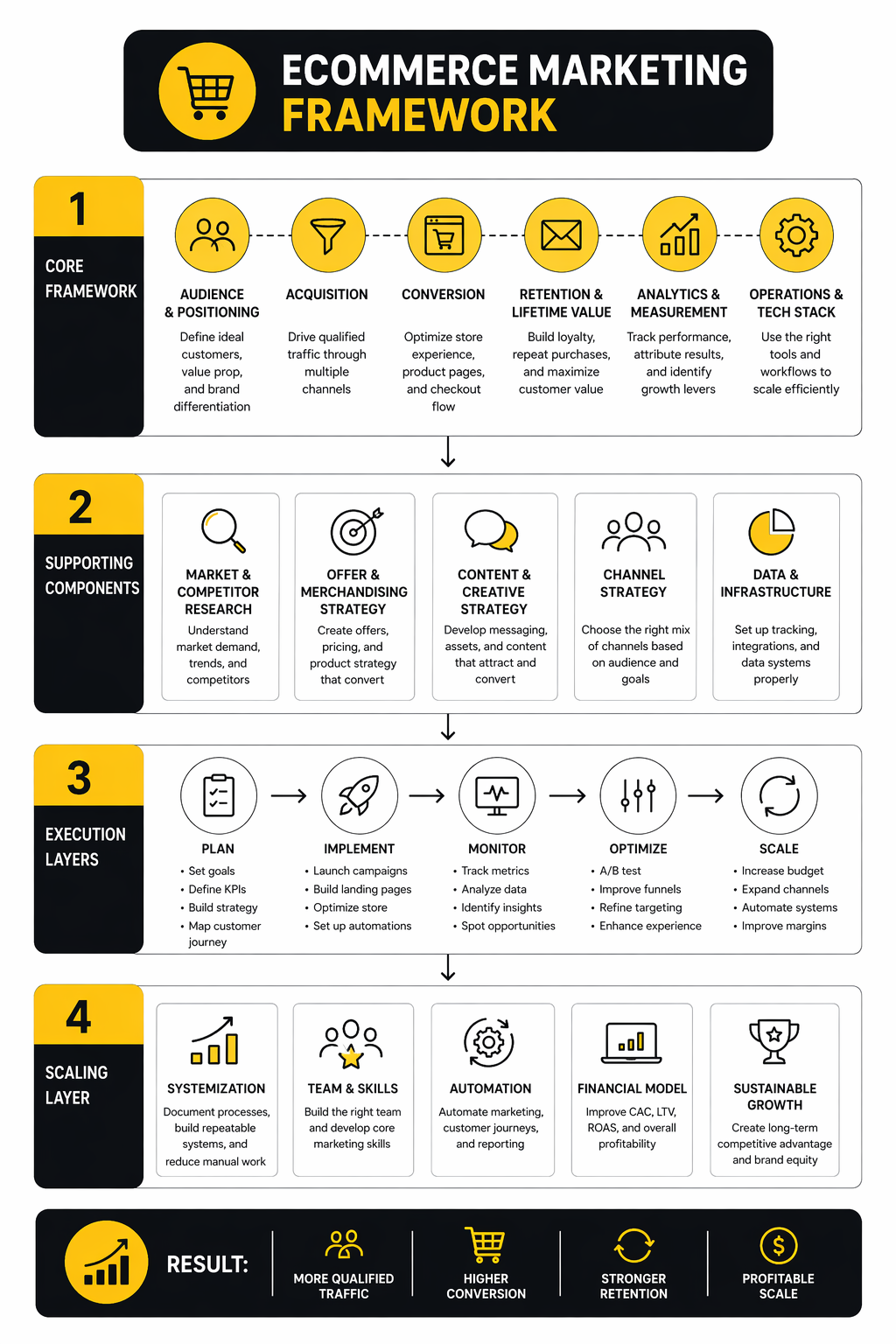
- Audit the journey from ad click to order confirmation. Review the entire path, not just the product page. Match ad promise to landing page, landing page to offer, offer to cart, and cart to checkout. Most conversion leaks happen at the handoff points where one message stops and another begins.
- Fix the highest-friction pages before chasing new creative. Start with top landing pages, best-selling product pages, collection pages that get paid traffic, and checkout steps with the largest drop-off. Baymard’s benchmarks are useful here because they show how often avoidable UX mistakes still appear on major stores, which means smaller brands usually have even more room to improve.
- Tighten the offer before redesigning the interface. Sometimes the page is not the main problem. The product may need a stronger bundle, clearer differentiation, better shipping communication, or more relevant proof. Replo’s published work on offers that convert across 150-plus landing pages is a useful reminder that the commercial structure of the offer often matters as much as the visual layer.
- Launch changes in a testable way. This is where operational speed matters a lot. If your team needs weeks to update a landing page or deploy a merchandising change, you will lose tempo. Tools like Replo help because they reduce the lag between idea and deployment, which is exactly what a serious ecommerce marketing team needs.
- Connect capture and follow-up, not just page performance. Not every visitor buys on the first session. Some need a question answered, some need a reminder, and some need a reason to come back. This is where conversational capture and automation can matter. ManyChat fits naturally when you want to turn social attention or onsite questions into recoverable leads instead of one-and-done sessions.
- Measure by commercial outcomes, not just engagement. A prettier page that does not improve revenue per session is not a win. Watch add-to-cart rate, checkout initiation, purchase rate, average order value, and revenue per visitor. Those numbers tell you whether your ecommerce marketing is becoming more efficient or just more active.
That process sounds simple because it is simple. The hard part is consistency. Teams usually know they should test more, move faster, and clean up friction, but they get distracted by channel novelty. The brands that improve conversion steadily are usually the ones that stay close to fundamentals and repeat this cycle without getting bored.
Conversion Is What Makes the Rest of the System Worth Funding
This is the point too many teams miss. Better conversion does not just increase sales from existing traffic. It changes what the business can afford to do everywhere else. If more clicks turn into orders, paid acquisition becomes more resilient, content becomes more valuable, and retention has a larger base to work with.
That is why conversion work should sit near the center of any serious ecommerce marketing strategy. It multiplies the value of traffic you already have and creates room to scale more aggressively without wrecking margin. Once that system is working, the next layer becomes even more important: getting first-time buyers to come back, buy again, and grow customer lifetime value instead of forcing the business to start from zero every month.
Statistics and Data That Actually Help You Decide
A lot of ecommerce marketing reporting looks impressive and still fails to help anyone make a better decision. Dashboards get packed with sessions, impressions, likes, clicks, assisted conversions, and platform-specific charts until the team forgets the real question: which numbers actually explain profitable growth, and which ones are just activity dressed up as insight.
That distinction matters because bad interpretation leads to bad action. A spike in traffic can hide falling conversion quality. A strong email open rate can distract from weak revenue contribution. A rising return on ad spend can look healthy right up until customer acquisition costs, discount dependency, or repeat purchase weakness start eating the margin. Good measurement is not about collecting more data. It is about building a system that tells you what to do next.
Start With the Metrics Closest to Revenue
The cleanest analytics setup begins with a small set of commercial metrics. Replo’s guidance on landing page analytics that matter for your store puts the right numbers near the center: conversion rate, average order value, customer lifetime value, customer acquisition cost, and related purchase signals. That is a much better starting point than staring at vanity metrics and hoping a pattern reveals itself.
These numbers matter because each one answers a different business question. Conversion rate tells you whether your page and offer are turning intent into action. Average order value tells you whether merchandising, bundles, and upsells are doing enough work. Customer acquisition cost shows what it takes to win a buyer. Customer lifetime value tells you whether the customer relationship is strong enough to support future acquisition. When you read them together, the business becomes easier to understand.
The trap is looking at any one metric in isolation. A higher conversion rate is not automatically a win if it came from aggressive discounting that crushes margin. A better average order value is not always helpful if it reduces purchase rate too much. Ecommerce marketing gets sharper when metrics are treated like connected signals, not trophies.
Benchmarks Are Useful, but Only When You Read Them Correctly
Benchmarks are supposed to create perspective, not pressure. Brevo’s 2025 email marketing benchmarks found that ecommerce campaigns averaged a 38.58% open rate, 2.08% click-through rate, and 0.25% unsubscribe rate across a dataset of more than 44 billion emails. Those are helpful reference points because they tell you whether your program is dramatically underperforming, but they do not tell you whether your email marketing is actually helping the business grow.
That is the key. If your open rate looks great but your click-through rate is soft, the subject line may be doing its job while the offer or message inside the email is not. If clicks are strong but revenue is weak, your email may be sending people to the wrong destination or failing to match landing page intent. Numbers only become useful when they push you toward a specific diagnosis.
The same thing applies to social benchmarks. Buffer’s live Instagram benchmark dataset says it is built from more than 27 million posts across 273,000 active Instagram accounts, and its broader 2026 social media engagement report shows platform-level engagement patterns moving year over year. That kind of data is valuable because it helps you avoid unrealistic expectations, but it still does not replace context. A brand account with a strong customer relationship and focused product niche should not be judging itself the same way as a broad media publisher or creator account.
The Best Measurement System Follows the Customer Journey
Most ecommerce teams do not really have an analytics problem. They have a fragmentation problem. Ad data lives in one place, site data lives somewhere else, email performance lives in another dashboard, and CRM outcomes are separated again. When those systems do not speak to each other, interpretation gets fuzzy fast.
HighLevel’s recent product updates around tracking code and attribution for external sites and its push toward dashboards with ad metrics tied to CRM outcomes point in the right direction. The real goal is not prettier reporting. It is tighter visibility from first click to lead, purchase, and follow-up value. Once that chain is visible, teams stop arguing about channel performance in the abstract and start seeing where momentum is actually coming from.
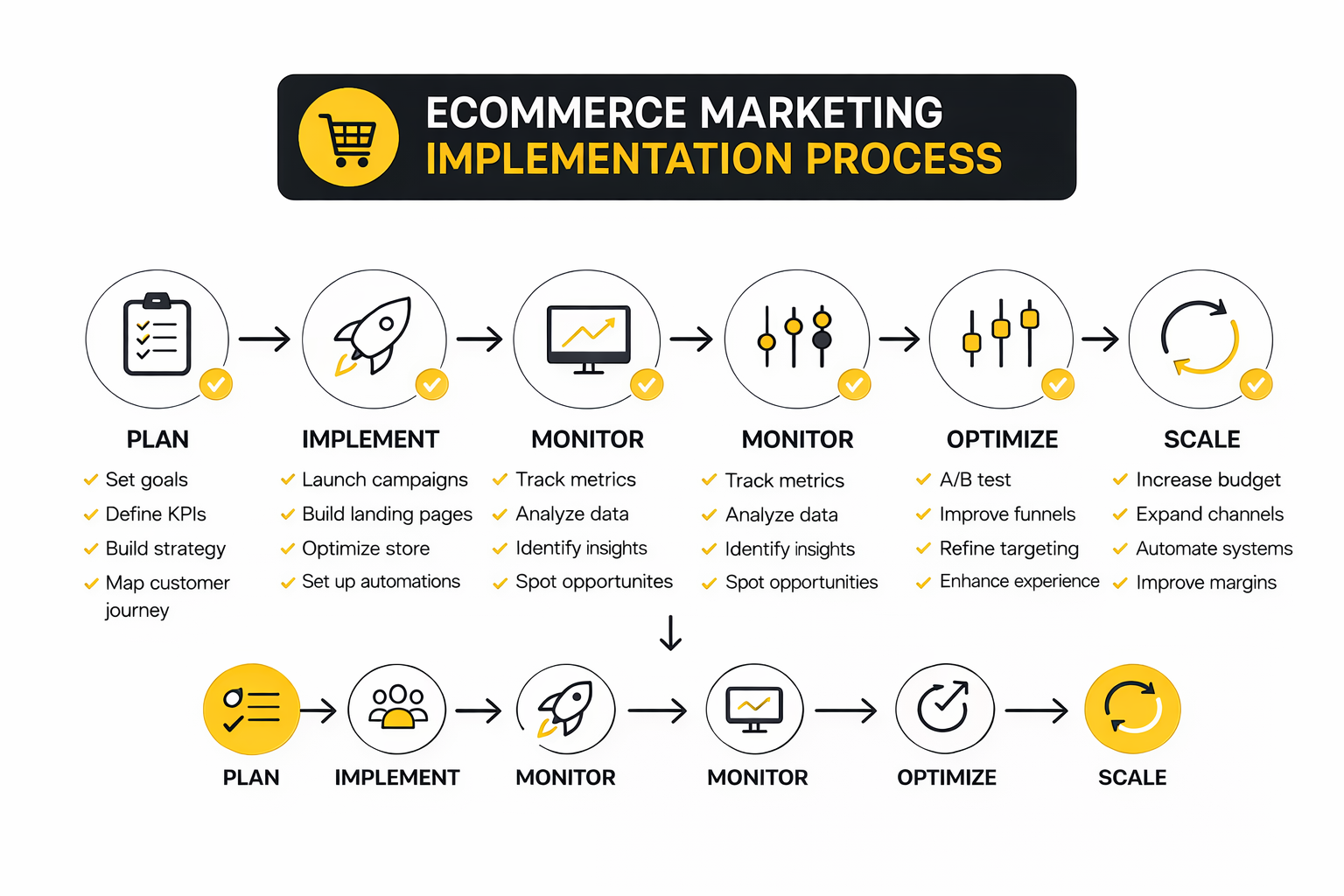
A practical analytics system for ecommerce marketing should answer five questions clearly:
- Where did the customer come from? You need reliable source and campaign tracking, not guesswork.
- What did they do on the site? Landing page behavior, product views, cart activity, and checkout progression matter more than top-line session totals.
- Did they buy, and how much did they spend? Revenue, average order value, and units per transaction tell you whether the commercial outcome was strong enough.
- Did they come back? Customer lifetime value and repeat purchase signals show whether acquisition is building an asset or just renting one-time buyers.
- Which touchpoints actually influenced the sale? Attribution will never be perfect, but it needs to be good enough to improve budget allocation.
When those answers are visible in one operating rhythm, decision-making speeds up. Teams can cut weak campaigns faster, protect high-performing segments sooner, and move budget based on evidence instead of platform bias.
Some Metrics Are Leading Indicators, and Some Are Outcome Metrics
This is where interpretation gets a lot better. Not every metric deserves the same weight at the same moment. Some numbers are leading indicators that tell you whether a campaign is gaining traction before revenue fully shows up. Others are outcome metrics that confirm whether the business result was worth the effort.
Engagement rate is a good example of a leading indicator when it is used correctly. ManyChat’s take on engagement rate analysis makes a fair point: engagement says something about the relationship quality between your brand and your audience. That matters in ecommerce marketing because weak interaction often shows up before weak demand becomes obvious in sales reports.
But engagement is not the finish line. A post can generate comments, saves, or DMs and still fail commercially if the offer, landing page, or follow-up sequence is weak. In the same way, email open rate can function as a directional signal, but revenue per recipient tells the harder truth. Strong operators respect early signals without mistaking them for business outcomes.
Revenue Per Visitor Is One of the Most Honest Metrics in the Stack
If there is one metric more ecommerce teams should take seriously, it is revenue per visitor. It forces traffic quality and conversion quality into the same conversation. Instead of asking only how many people visited or what percentage converted, it asks how much value each visitor generated on average. That makes it one of the most commercially grounded ways to evaluate campaigns, pages, and offers.
Replo’s testing guidance on A/B testing for ecommerce landing pages explicitly points to revenue per visitor as a metric worth tracking alongside conversion rate, average order value, and bounce rate. That matters because some changes improve conversion by attracting lower-value purchases, while others improve overall visitor value even if raw conversion rate barely moves. Revenue per visitor helps expose that difference.
Its case study with VaynerCommerce and POSSIBLE is a good example. Replo reports a 10.25% lift in revenue per visitor alongside a 9.91% increase in conversion rate after testing landing page variants for one month (case study details). The point is not that every test will produce those gains. The point is that the right measurement framework lets you spot wins that are commercially meaningful, not just cosmetically interesting.
Statistical Confidence Matters More Than Internal Opinions
One of the fastest ways to ruin testing is to stop the moment a page “looks better.” That usually means someone checked results too early, saw a small edge, and declared victory before the data had enough time or volume to mean anything. Replo’s A/B testing guidance recommends looking for 95%+ confidence before calling a winner on landing page experiments (testing guidance). That is not a guarantee of truth, but it is a much stronger discipline than making decisions off instinct.
This matters because ecommerce marketing teams are full of strong opinions. Founders have opinions. Designers have opinions. Media buyers have opinions. Copywriters definitely have opinions. None of that is a problem until opinion starts outranking evidence. A decent testing culture gives the team a shared rulebook so performance decides what stays.
The best use of data is not to remove judgment completely. It is to stop weak judgment from dominating the room. When a team knows which metric matters, how long to test, and what threshold counts as meaningful, execution gets much cleaner.
What the Numbers Should Push You to Do Next
Data should create action, not just awareness. If conversion rate is healthy but average order value is low, the next move may be bundle design, cross-sells, or pricing architecture. If traffic is high but add-to-cart rate is weak, the page or product-market fit likely needs work. If email engagement is fine but repeat purchase is flat, the issue may be with timing, segmentation, or the underlying product cadence rather than the channel itself.
That is why measurement belongs inside the operating system of ecommerce marketing, not at the end of it. Good analytics helps you decide what to fix first, what to ignore, and where extra budget will actually compound. It turns reporting from a weekly ritual into a decision engine.
And once that engine is in place, the next step becomes easier to see. Growth stops depending on constant reacquisition and starts leaning more on something much more durable: retention, loyalty, and customer lifetime value.
Retention, Loyalty, and Customer Lifetime Value
Once acquisition, conversion, and measurement are working, the next level of ecommerce marketing is retention. This is the part that separates a business with momentum from a business that has to re-buy its customers every month. Shopify notes that online retailers have an average repeat customer rate of 28.2%, which is useful not because it gives you a target to worship, but because it reminds you how much room most brands still have to improve.
Retention matters because it changes the economics of everything upstream. When more first-time buyers come back, customer acquisition cost becomes easier to tolerate, paid media gets more resilient, and merchandising decisions can be made with longer-term value in mind. McKinsey’s latest work on personalized marketing and next best experience systems points in the same direction: the brands that build loyalty are getting better at using customer data to make each interaction more relevant, timely, and useful.
This is also where lazy ecommerce marketing gets exposed. A lot of stores are good at selling the first order because they are willing to discount hard, push urgency, or spend aggressively to create demand. But those same tactics can leave the customer relationship thin. If the post-purchase experience feels generic, the brand promise gets forgotten fast, and the business goes right back to paying for attention from scratch.
Retention Starts Before the First Order Is Even Delivered
A lot of people think retention begins with a welcome flow or a points program. It actually starts much earlier. It begins with whether the product matches the promise, whether the shipping expectations are clear, and whether the first purchase feels like a smart decision instead of a risky one. If the buyer feels uncertainty right after checkout, retention has already become harder.
That is why lifecycle marketing should be designed as one continuous journey, not a separate department. Klaviyo’s holiday shopping reporting showed that in 2025, 42% of BFCM GMV was driven by CRM revenue from email and SMS, and that repeat-buyer revenue was growing faster than new-buyer revenue during that period. The lesson is not “send more campaigns.” The lesson is that owned channels become much more powerful when they are aligned with real customer behavior instead of blasting the same offer to everyone.
The first post-purchase sequence should reduce buyer anxiety, reinforce product value, and prepare the second order intelligently. That means delivery updates, setup or usage education, replenishment timing when relevant, and message timing that matches the product category. A beauty brand, a supplement brand, and a furniture brand should not be running the same retention logic. The interval between orders, the emotional drivers, and the friction points are different.
Loyalty Programs Work Best When They Reinforce Behavior You Already Want
Loyalty gets misunderstood all the time. Too many brands build programs that feel like extra discount infrastructure and then wonder why margins shrink without much strategic upside. A stronger loyalty system does not just reward spending. It reinforces the behaviors that make the customer relationship more valuable over time.
McKinsey’s analysis of loyalty and pricing is useful here because it frames loyalty as part of a broader value strategy, not a coupon engine. That is the right way to think about it. A loyalty program should make customers feel recognized, reduce friction, and create reasons to stay connected even when they are not actively checking out.
For ecommerce marketing, the strongest loyalty mechanics are usually simple and commercially grounded. Early access, faster support, exclusive product drops, referral rewards, point structures tied to meaningful behavior, and better post-purchase experiences tend to age better than endless price cuts. Shopify’s current guide to customer loyalty makes the core point well: loyalty helps brands get more value from customers they already paid to acquire.
The strategic tradeoff is important. If a loyalty program trains customers to wait for rewards before every purchase, you may create dependency instead of attachment. If it deepens connection, improves retention, and increases purchase frequency without crushing margin, then it is doing its job.
Segmentation Beats Volume in Lifecycle Marketing
One of the biggest mistakes in retention is assuming more sends automatically create more value. They do not. Poorly segmented lifecycle marketing usually increases list fatigue, trains customers to ignore the brand, and makes unsubscribes or opt-outs more likely. Brevo’s 2025 email marketing benchmark data is a reminder that engagement benchmarks only become useful when you look at them in context. A decent open rate does not mean your lifecycle strategy is healthy if the wrong people are getting the wrong message.
Good segmentation is less about cleverness and more about timing, relevance, and purchase state. New buyers need reassurance and onboarding. Lapsed customers need a reason to care again, not the same promotional creative they ignored last month. High-value repeat buyers may respond better to exclusivity than to discounting. Customers with strong browse behavior but no purchase history need different follow-up than customers who have already bought twice in the last quarter.
This is one reason platforms that connect messaging, automation, and customer data can matter so much in ecommerce marketing. Brevo is useful when a brand wants more coordinated lifecycle messaging across channels, while GoHighLevel becomes relevant when the team wants broader funnel and CRM visibility tied to follow-up and attribution. The tool itself is never the strategy, but once retention becomes a real operating priority, fragmented systems start slowing everything down.
Scaling Creates New Risks That Smaller Stores Do Not Feel Yet
A lot of early ecommerce success comes from intensity. The founder knows the product deeply, the ad account is still manageable, the customer base is small enough to understand intuitively, and decisions happen quickly. Scaling changes that. More SKUs, more campaigns, more audiences, more regions, and more channels usually create operational drag long before they create strategic clarity.
That is where ecommerce marketing gets more technical and more political. Teams begin debating attribution, channel ownership, creative velocity, discount policy, and who controls the customer data. None of this is glamorous, but it matters because the brand can start losing efficiency without noticing immediately. A business may still be growing while becoming less healthy underneath.
McKinsey’s broader State of the Consumer 2025 reporting is useful context here because consumer behavior is not standing still. Value expectations, trust patterns, and channel behavior keep shifting. That means a retention system that worked when the brand had one hero product and one primary acquisition channel may break once the assortment broadens and the audience mix changes.
Scaling usually creates four predictable risks:
- Discount drift. Promotions that were once occasional become routine, and customers learn to delay purchases.
- Message dilution. The brand starts saying too many things to too many people and loses commercial sharpness.
- Operational lag. Teams gather more data but act on it more slowly because approvals, tools, and workflows become messy.
- Retention blindness. Leadership keeps celebrating top-line growth while repeat rate, purchase frequency, or CLV quality quietly weakens.
These are not side issues. They are the points where profitable ecommerce marketing often starts slipping into expensive growth theater.
Advanced Teams Optimize for Customer Quality, Not Just Customer Count
At some point, a mature ecommerce brand has to stop asking only how many new customers it can acquire and start asking what kind of customers it is attracting. That shift changes everything. A channel that looks efficient on first-purchase ROAS may be weak on second-purchase behavior. A promotion that drives huge volume may attract bargain-only customers who never come back. A creator partnership may generate fewer orders upfront but produce better long-term retention because the fit is stronger.
This is why customer lifetime value should influence channel decisions earlier than most teams think. It should not sit in a quarterly spreadsheet that nobody uses. It should shape creative testing, audience expansion, offer design, and even inventory planning. McKinsey’s work on next best experience is effectively pushing in that direction: use customer signals to decide what the person most likely needs next, instead of treating every customer like a fresh acquisition target forever.
Operationally, this means advanced ecommerce marketing teams begin segmenting performance by customer quality. They look at which campaigns bring in customers with better repeat behavior, which product bundles create stronger downstream value, and which lifecycle flows actually increase purchase frequency rather than just lift short-term campaign revenue. That is a much more useful game than trying to inflate topline numbers with broad discounts and aggressive retargeting.
The Best Retention Strategy Feels Valuable, Not Desperate
Customers can feel when a brand is trying too hard to claw back another order. Desperation shows up as constant discounts, irrelevant messages, over-sending, and loyalty mechanics that feel transactional rather than rewarding. Strong retention feels different. It feels like the brand understands the customer, respects their timing, and has something worth returning for.
That is where personalization becomes powerful again, but only when it stays practical. Better recommendations, smarter replenishment timing, relevant bundles, and contextual follow-up all help because they reduce the effort required to buy again. Weak personalization just creates noise with a customer’s name pasted on top.
The bigger point is that retention is not just a marketing function. It is the combined effect of product quality, fulfillment reliability, customer support, lifecycle messaging, pricing discipline, and brand memory. Ecommerce marketing can amplify that system, but it cannot fake it for long. When the underlying experience is strong, retention compounds. When it is weak, every campaign starts working harder for less.
That sets up the final piece of the puzzle. Once you understand acquisition, conversion, measurement, and retention as one connected system, the last step is building a professional implementation model that keeps the whole machine aligned as the business scales.
Putting the Ecommerce Marketing System Together
By this point, the pattern should be clear. Ecommerce marketing works best when acquisition, conversion, retention, and measurement are treated as one connected operating system instead of separate campaigns run by separate teams with separate dashboards. That matters even more now because commerce is getting more distributed across search, social, marketplaces, email, SMS, AI-assisted discovery, and post-purchase channels that all influence the same buying journey.
The next shift is that discovery itself is changing. Google has been expanding shopping experiences inside Gemini with retail partners, while Salesforce reported that AI and agents influenced 20% of all retail sales during the 2025 holiday period and drove $262 billion in revenue through personalized recommendations and deeper engagement (Google’s shopping expansion in Gemini and Salesforce holiday data). That does not mean every brand needs to chase every new tool. It means the brands that win will be the ones with clean data, strong merchandising, better creative, and a system flexible enough to show up wherever the customer actually wants to buy.
Professional implementation is really about maturity. The team knows which channels are creating demand, which pages are converting that demand, which lifecycle programs are driving repeat value, and which metrics deserve action. Once that operating rhythm is in place, ecommerce marketing stops feeling chaotic and starts becoming a compounding asset.
FAQ
What is ecommerce marketing, really?
Ecommerce marketing is the full system a brand uses to attract visitors, convert them into buyers, and bring them back often enough to grow customer lifetime value. It includes search, paid media, social commerce, email, SMS, creator partnerships, conversion optimization, retention, and analytics working together instead of in silos. Google’s own ecommerce guidance frames discoverability and customer relationship building as core growth drivers, which is the right lens to use here (Google ecommerce best practices).
Which channel should a new ecommerce brand prioritize first?
The answer depends on product category, margin structure, and how people typically discover the product. In most cases, the smartest starting point is one intent-capture channel, one demand-creation channel, and one owned retention channel, because that gives you both short-term traction and long-term learning. For many brands, that means search or shopping visibility, paid social or creator-led content, and email or SMS flows rather than trying to master everything at once.
Is SEO still worth it for ecommerce marketing in 2026?
Yes, but not in the lazy “publish a few blog posts and wait” sense. SEO still matters because product, category, comparison, and educational pages can capture high-intent demand and keep compounding long after the content is published, and Google continues to emphasize structured ecommerce data and strong site architecture for discoverability (SEO starter guidance and ecommerce-specific documentation). The bigger shift is that brands now need to think about visibility across classic search, shopping surfaces, video, and AI-assisted search behavior at the same time.
How important is social commerce now?
It is no longer a side channel for experimental brands. Shopify’s commerce coverage keeps reinforcing that social commerce matters because it lets customers discover and buy without leaving the environments where they already spend time, which reduces friction and expands reach (social commerce trends and social shopping overview). In practice, it works best when the creative is native to the platform and the follow-up system is strong enough to turn attention into revenue.
What metrics matter most in ecommerce marketing?
The most important metrics are the ones closest to commercial reality: conversion rate, average order value, customer acquisition cost, customer lifetime value, repeat purchase rate, and revenue per visitor. Those numbers matter because they tell you whether demand is becoming profitable revenue instead of just generating activity. Replo’s analytics guidance is useful here because it keeps the focus on metrics that actually change decisions rather than dashboard clutter (landing page analytics that matter).
What is a good ecommerce conversion rate?
There is no universal number that guarantees success, because conversion rate depends on traffic quality, product type, price point, device mix, and offer strength. Shopify’s benchmark framing that a good ecommerce conversion rate often falls around 2% to 3% is useful as a reference, but it should not replace analysis of your own business model (Shopify conversion rate guide). A lower conversion rate with strong average order value and repeat behavior can be healthier than a higher conversion rate built on heavy discounting and weak retention.
How much should brands rely on AI in ecommerce marketing?
AI is becoming important, but it should be treated like leverage, not strategy. McKinsey’s 2025 personalization work and Shopify’s 2026 enterprise AI coverage both point to the same opportunity: use AI to improve relevance, speed, forecasting, and execution rather than to automate generic marketing at scale (McKinsey on personalized marketing and Shopify on enterprise AI). If your positioning, offer, and customer experience are weak, AI just helps you spread mediocrity faster.
Should brands focus more on acquisition or retention?
Early on, acquisition usually gets most of the attention because without customers there is nothing to retain. But once a brand has repeat purchase potential, retention becomes one of the most important levers in ecommerce marketing because it improves economics across the whole system. Shopify’s current retention reporting puts the average online retail repeat customer rate at 28.2%, which is a reminder that most brands still have real upside here if they execute well (customer retention guide).
Are marketplaces hurting or helping branded ecommerce stores?
They can do both. Marketplaces help when they expand reach, create new customer entry points, and support category discovery among shoppers who would never have visited your site directly. They hurt when the brand treats them as a substitute for owned customer relationships instead of a feeder into a broader ecommerce marketing ecosystem.
How often should an ecommerce brand test landing pages and offers?
More often than most teams do now. Replo’s testing guidance argues for disciplined experimentation with clear commercial metrics and at least 95% confidence before calling winners, which is a far better standard than changing pages based on internal opinion (A/B testing landing pages). The right pace depends on traffic volume, but the broader principle is constant: if your team cannot launch and learn quickly, your growth ceiling arrives earlier than it should.
What role do email and SMS still play when social and AI discovery are growing?
A huge one. Discovery channels may introduce the customer, but owned channels are often where brands recover carts, onboard buyers, drive repeat orders, and protect margin over time. Klaviyo’s 2025 holiday reporting showed that 42% of BFCM GMV came from CRM revenue through email and SMS, which is exactly why owned channels remain central to serious ecommerce marketing (Klaviyo holiday shopping trends).
What is the biggest mistake brands make when scaling ecommerce marketing?
The biggest mistake is adding complexity faster than they add clarity. More channels, more campaigns, more audiences, and more tools can make a brand look sophisticated while quietly weakening message quality, attribution discipline, and retention performance. Scaling works when the underlying system stays simple enough to manage: clearer offers, tighter reporting, faster testing, better segmentation, and stronger follow-up.
Do tools actually make a big difference, or is strategy what matters?
Strategy matters first, but the wrong tool stack absolutely slows down execution. Once a brand knows what it is trying to do, the right software can reduce launch time, unify data, improve follow-up, and make testing much easier to sustain. That is why tools like ManyChat for conversational capture, Brevo for lifecycle messaging, Replo for landing page speed, and GoHighLevel for broader CRM and funnel workflows become useful when the business is ready for operational discipline.
What does a healthy ecommerce marketing ecosystem look like now?
It looks integrated, not fragmented. Search and social create qualified entry points, landing pages and product pages convert that interest, owned channels deepen the relationship, and analytics tell the team where to invest next. The ecosystem is healthy when each part makes the next part stronger, and when no single channel failure can collapse the whole growth model.
Work With Professionals
Explore 10K+ Remote Marketing Contracts on MarkeWork.com
Most marketers spend too much time chasing clients, competing on crowded platforms, and losing a percentage of every project to middlemen.
MarkeWork gives you a better way. Browse thousands of remote marketing contracts and connect directly with companies desperate to hire skilled marketers like you, without platform commissions and without unnecessary gatekeepers.
If you're serious about finding better opportunities and keeping 100% of what you earn, explore available contracts and create a profile for free at MarkeWork.com.