

Hiring an ecommerce PPC agency is not about finding someone who can “run ads.” Almost anyone can launch campaigns now. The real value is in knowing what to test, what to ignore, when to scale, and when to stop wasting money.
That matters because paid acquisition is getting more complex. U.S. digital ad revenue reached a record $294.6 billion in 2025, while Google continues pushing advertisers toward AI-assisted campaign systems like AI Max for Search campaigns. More automation does not remove the need for strategy. It makes weak strategy more expensive.
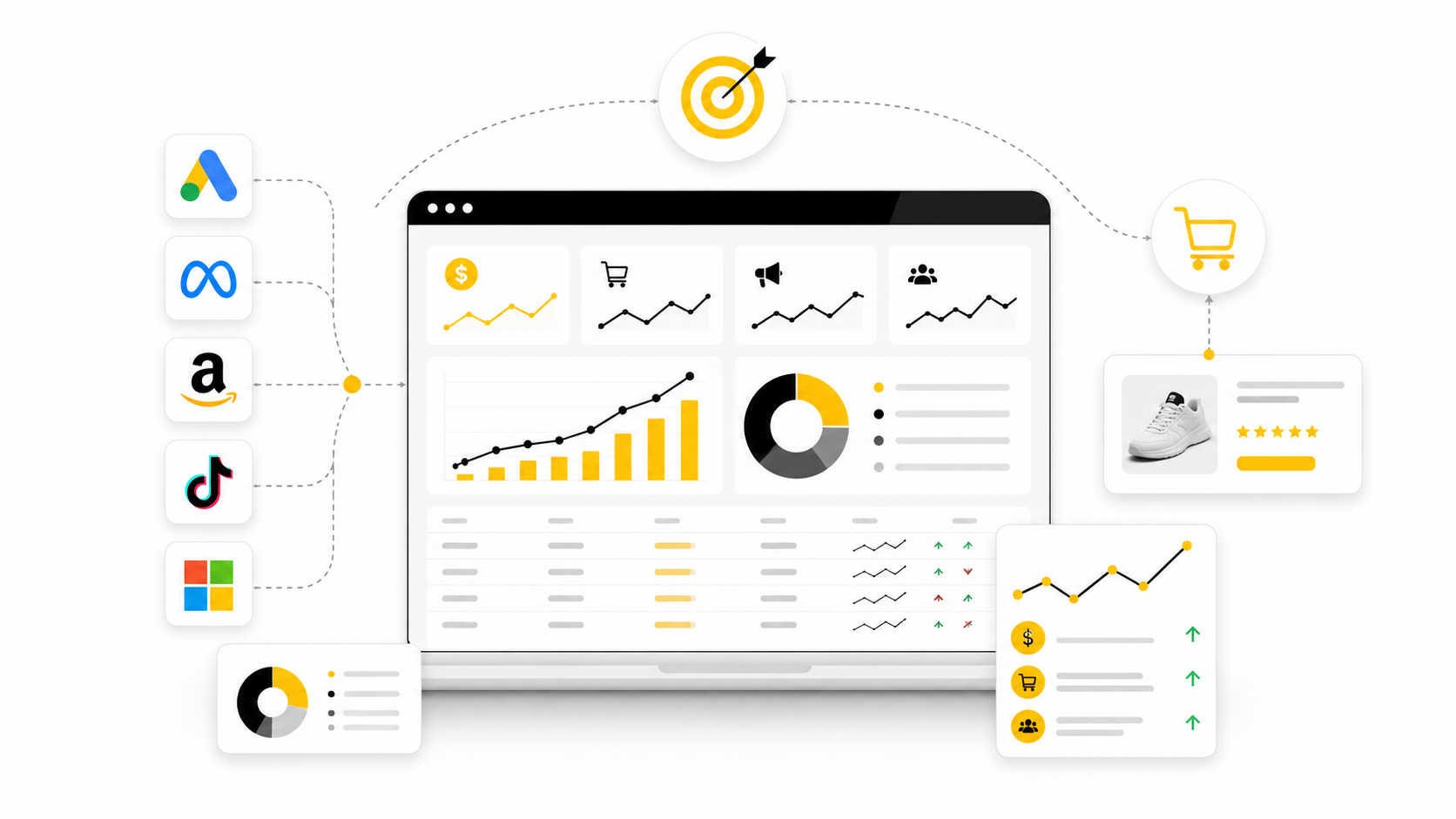
This guide breaks down what a strong ecommerce PPC agency actually does, how the best ones think, and how to choose one without getting trapped by vanity metrics or vague reporting. We will look at the operating system behind profitable paid media, not just the surface-level checklist of platforms, dashboards, and campaign names.
Article Outline
- Why an Ecommerce PPC Agency Matters
- The Ecommerce PPC Growth Framework
- Core Components of High-Performing PPC Management
- How Professional Implementation Actually Works
- How to Evaluate and Hire the Right Agency
- FAQs About Working With an Ecommerce PPC Agency
Why an Ecommerce PPC Agency Matters
An ecommerce PPC agency matters because paid ads sit directly between your cash flow and your growth targets. If campaigns are managed loosely, you do not just lose traffic. You lose margin, inventory planning accuracy, customer acquisition confidence, and the ability to forecast growth.
The hard part is that ecommerce PPC is no longer one clean channel. A serious agency may need to coordinate Google Shopping, Performance Max, Search, YouTube, Meta, Amazon, TikTok, landing pages, product feeds, email capture, attribution, and post-purchase economics. That is why a good agency talks about contribution margin, new customer revenue, creative testing, and payback windows instead of hiding behind blended ROAS.
This is also why ecommerce brands should be careful with “cheap” PPC management. Low-cost execution can look attractive, but poor structure usually creates expensive learning cycles. A better ecommerce PPC agency protects your budget by building a system where each test has a reason, each campaign has a job, and each decision connects back to profit.
The Ecommerce PPC Growth Framework
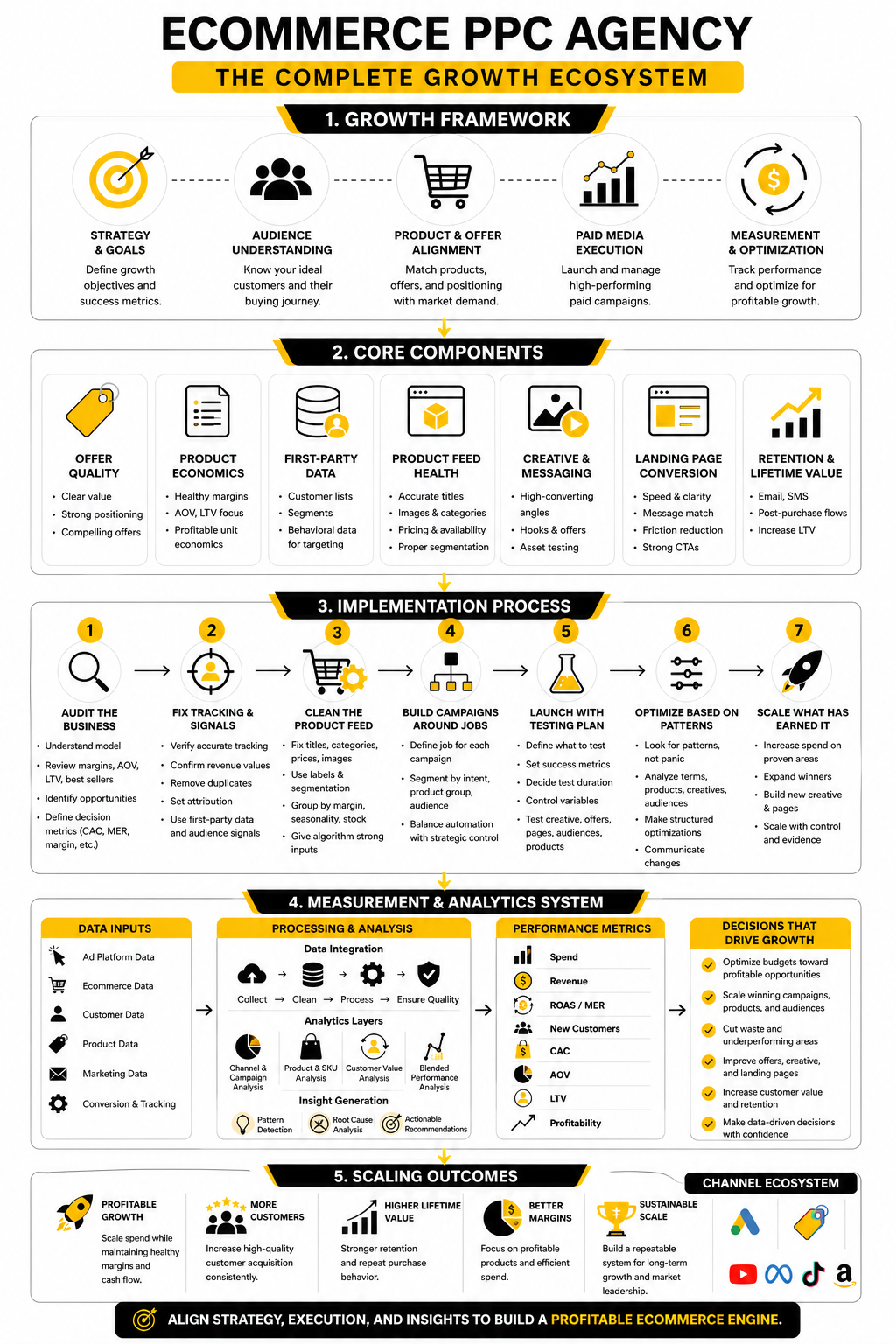
The best way to understand ecommerce PPC is as a growth framework, not a pile of campaigns. Traffic is only one layer. The real system includes offer quality, product economics, feed health, creative angles, landing page conversion, customer retention, and clean measurement.
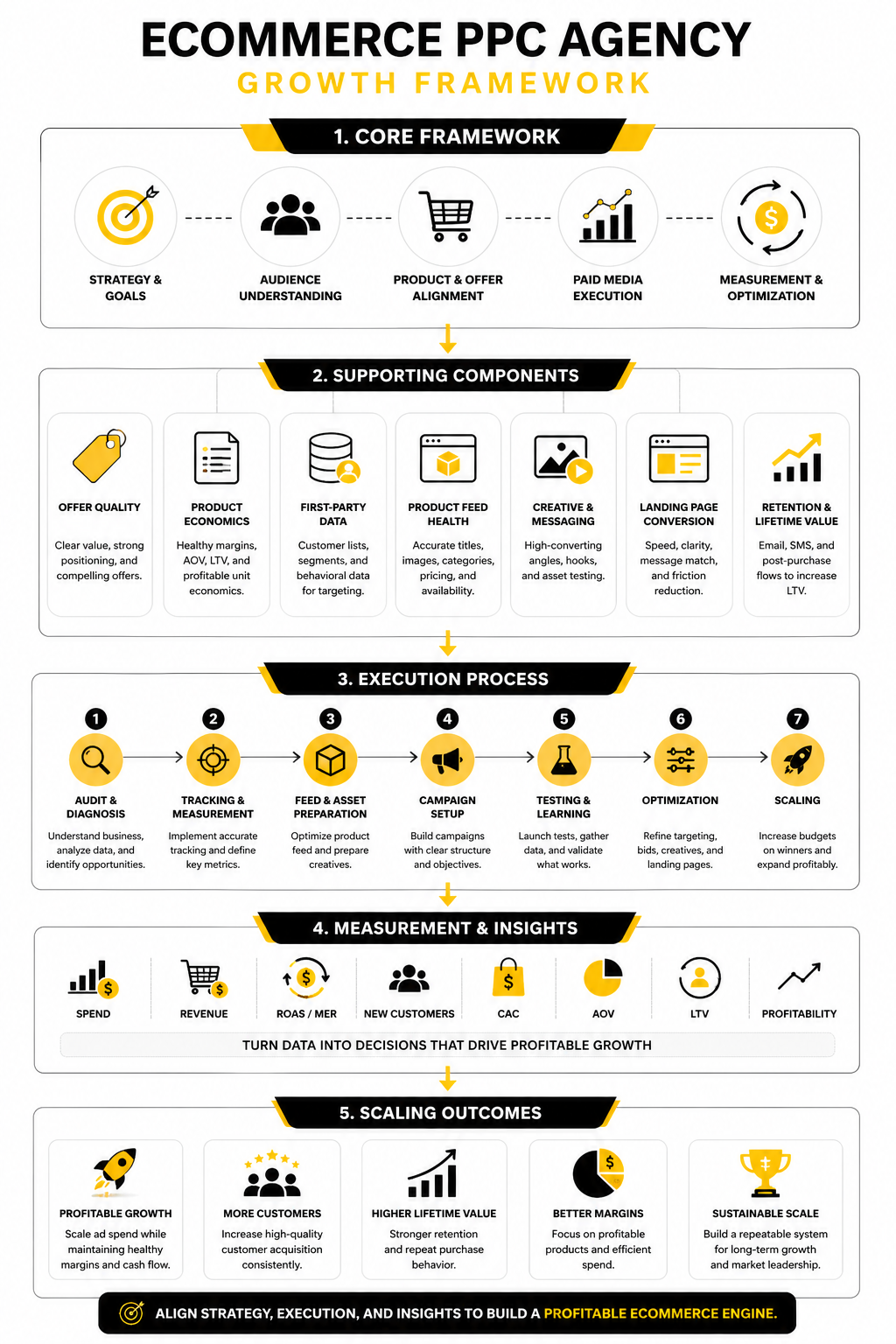
A strong ecommerce PPC agency should be able to explain this framework in plain English. They should know where your account is constrained before they ask for more budget. Sometimes the bottleneck is bad campaign structure, but often it is a weak offer, poor product page, thin creative testing, messy tracking, or a landing page that does not match buyer intent.
This is where tools can help, but only when they support the strategy. A Shopify brand testing dedicated landing pages may use Replo for faster page iteration, while a brand trying to capture and convert paid traffic through chat may use ManyChat. The point is not to add more software. The point is to shorten the distance between ad click, buyer intent, and profitable purchase.
Core Components of High-Performing PPC Management
A strong ecommerce PPC agency does not start by asking, “How much can we spend?” It starts by asking, “What can this business afford to pay for a customer?” That single question changes everything because it forces the conversation away from surface-level ROAS and toward actual profit.
The core components are simple to name but difficult to execute well. You need clean tracking, strong product economics, usable first-party data, a healthy product feed, sharp creative, conversion-focused landing pages, and a testing process that does not panic after three bad days. When these pieces are weak, even a technically skilled media buyer ends up fighting the business model instead of scaling it.
The ecommerce PPC agency you hire should understand that paid media is not isolated from the rest of the store. Google reported that its newer AI-powered ad systems are being built around Search, Performance Max, Demand Gen, YouTube, creative, and measurement together through its 2025 Google Marketing Live updates. That does not mean you hand the keys to automation and hope for the best. It means the agency needs stronger inputs, clearer guardrails, and better judgment than ever.
Tracking and Measurement
Tracking is the first serious test of an ecommerce PPC agency. If they cannot explain how purchases, revenue, new customers, repeat customers, refunds, discounts, and attribution windows are being handled, they are not ready to manage meaningful spend. You do not need a 40-page analytics lecture, but you do need clarity.
Good measurement answers practical questions. Which campaigns are bringing in first-time buyers? Which products create profitable acquisition instead of just cheap conversions? Which channels look strong in-platform but weaker when compared against blended revenue, margin, or post-purchase behavior?
This matters because ad platforms naturally grade their own homework. A campaign can look great inside Google Ads or Meta while the business still feels cash pressure. A good agency does not blindly reject platform data, but it also does not treat platform ROAS as the final truth.
Product Feed Quality
For ecommerce brands, the product feed is not admin work. It is one of the most important PPC assets you have. Titles, descriptions, images, product types, custom labels, availability, pricing, and promotions all shape how shopping systems understand and serve your products.
Performance Max and Shopping campaigns rely heavily on feed quality. Tinuiti’s Q1 2025 benchmark report found that Performance Max adoption among retailers running Google shopping listings was 93% at the end of Q1 2025. That level of adoption makes feed discipline less optional because many ecommerce accounts are competing inside heavily automated environments.
A serious ecommerce PPC agency will not treat the feed as something to check once during onboarding. They will segment products by margin, seasonality, inventory depth, price competitiveness, and conversion potential. That is how you stop wasting budget on products that generate clicks but do not support the business.
Campaign Structure
Campaign structure should make decision-making easier. If an account is split into too many tiny campaigns, the data gets thin and the team starts guessing. If everything is thrown into one broad campaign, the agency loses control over budget allocation and product-level learning.
The right structure depends on the brand. A catalog with hundreds of SKUs needs different segmentation than a focused store with three hero products. A brand with strong repeat purchase behavior needs different measurement than a brand selling high-ticket one-time purchases.
The agency’s job is to build structure around business logic, not just platform defaults. That means separating testing from scaling, protecting winners from experimental noise, and giving the account enough conversion volume to learn. Simple is good. Lazy is not.
Creative and Messaging
Creative is now a performance lever, not just a branding layer. The agency needs to understand what the buyer believes before the click, what they need to see after the click, and what objection might stop them from buying. This is especially true when paid traffic is cold, expensive, or coming from channels where intent is weaker.
For ecommerce PPC, creative includes product imagery, hooks, comparison angles, offer framing, video, search copy, shopping assets, and landing page message match. The best agencies do not just ask for “more creatives.” They define the angle being tested and explain why it should move the buyer closer to purchase.
This is where many accounts quietly stall. The bids are fine, the campaign settings are fine, but the message is tired. When that happens, spending more simply accelerates fatigue.
Landing Pages and Conversion Paths
Paid traffic should not always go to a standard product page. Sometimes that is enough, especially for high-intent Shopping traffic. But when the offer needs more explanation, the product is new, or the audience is colder, a dedicated landing page can make the buying path easier.
A good ecommerce PPC agency will look at the full conversion path. That includes page speed, offer clarity, reviews, comparison tables, bundles, guarantees, checkout friction, email capture, SMS capture, and post-click consistency. If they only talk about campaigns and never talk about the page, they are missing half the job.
For brands that need faster testing, tools like Replo can help teams build dedicated ecommerce landing pages without waiting on a full development cycle. That does not replace strategy, but it can make testing faster when the agency has clear hypotheses.
Budget Control and Scaling Discipline
Scaling is not just raising budgets. Real scaling means increasing spend while protecting the economics of the business. That requires patience, clean tests, and a willingness to say no when the data is not good enough.
A disciplined ecommerce PPC agency will separate profitable growth from inflated platform numbers. They will watch MER, CAC, contribution margin, payback period, new customer percentage, and product-level profitability. They will also understand that a brand can be “profitable” on paper while still creating cash flow problems if inventory, fulfillment, or refund rates are ignored.
The best agencies are not reckless with budget. They push when the signal is strong, hold when the account needs more data, and cut when a test is clearly not working. That sounds basic, but in ecommerce PPC, basic discipline is often the difference between controlled growth and a very expensive mess.
How Professional Implementation Actually Works
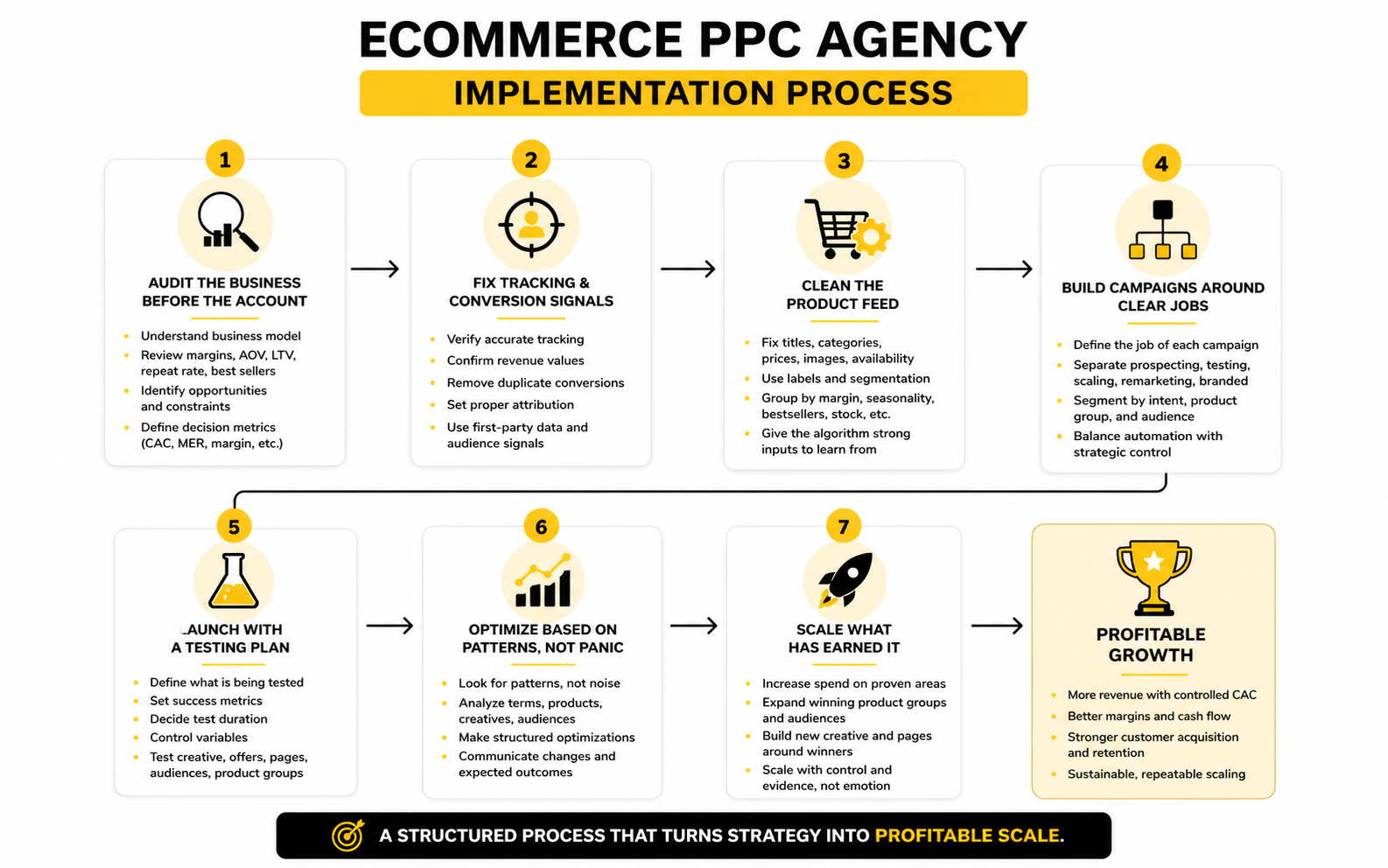
Professional implementation is where the promises get tested. A good ecommerce PPC agency can sound smart on a sales call, but the real question is whether they can turn strategy into a repeatable operating rhythm. That means the work needs to move through diagnosis, setup, launch, learning, optimization, and scaling without becoming chaotic.
The process should also make the brand smarter over time. Every test should teach the team something about the buyer, the offer, the product mix, or the channel. If three months pass and the only update is “we adjusted bids,” the agency is not managing a growth system. It is babysitting campaigns.
This is especially important now because Google’s Performance Max setup depends heavily on assets, audience signals, conversion goals, product feeds, and campaign guardrails. Google’s own help documentation explains that Performance Max asset groups are built around creatives tied to a theme or audience, and those assets are used to assemble ads across placements. That makes the setup process more strategic than it looks from the outside.
Step 1: Audit the Business Before the Account
The first step is not opening Google Ads. It is understanding the business model. A serious ecommerce PPC agency should review margins, average order value, repeat purchase rate, best-selling SKUs, inventory depth, refund issues, shipping constraints, and current revenue mix before touching the campaign structure.
This prevents a common mistake: optimizing for revenue that does not actually help the business. A product with strong click volume may be a bad acquisition product if margins are thin, stock is unreliable, or return rates are high. Paid media should push the products that can support growth, not just the products that look exciting in a dashboard.
The agency should also define the decision metrics upfront. ROAS may still matter, but it should not stand alone. Better scorecards include CAC, MER, contribution margin, new customer revenue, payback period, and product-level profitability.
Step 2: Fix Tracking and Conversion Signals
Once the business logic is clear, the next job is measurement. The agency should confirm that purchase events fire correctly, revenue values are accurate, duplicate conversions are not inflating results, and attribution settings match the way the brand wants to judge performance. This is basic, but it is not optional.
Conversion quality matters because automated bidding systems learn from the signals they receive. Bad signals create bad optimization. If the platform is told that every purchase is equally valuable, it may chase cheaper conversions while ignoring the customers and products that create real profit.
This is also where first-party data becomes useful. Customer lists, email segments, SMS audiences, and high-value buyer groups can help guide campaign learning and remarketing. For ecommerce brands building stronger owned channels around paid traffic, tools like Brevo or ManyChat can support the follow-up layer after the click.
Step 3: Clean the Product Feed
The product feed needs attention before major Shopping or Performance Max scaling. Titles should be clear, product categories should be accurate, pricing should match the site, and availability should update properly. Weak feed hygiene creates wasted impressions and messy learning.
A good ecommerce PPC agency will also use labels and segmentation to make better budget decisions. Products can be grouped by margin, seasonality, bestseller status, stock level, discounting strategy, or customer acquisition role. That makes it easier to push budget toward products that deserve it instead of treating the catalog like one flat list.
This step becomes more important as automation takes over more of the auction mechanics. If the system has poor product data, poor creative assets, and unclear conversion goals, automation simply makes bad decisions faster. Better inputs give the algorithm something useful to work with.
Step 4: Build Campaigns Around Clear Jobs
Every campaign should have a job. Some campaigns exist to capture high-intent demand. Some exist to test new products. Some exist to scale winning SKUs. Some exist to defend branded demand, build remarketing pools, or introduce the brand to colder audiences.
The problem starts when one campaign is expected to do everything. That usually leads to unclear budgets, noisy results, and arguments about performance that cannot be solved because the structure was vague from the beginning. A professional setup makes it clear what each campaign is supposed to prove.
This is also where the agency should decide how much control to keep. Google’s Performance Max best practices encourage advertisers to provide strong assets, audience signals, and properly organized asset groups, but the agency still needs to decide how campaigns are segmented and judged. Automation is powerful, but it still needs a strategy.
Step 5: Launch With a Testing Plan
A launch should not be a random collection of ads and budgets. The agency should know what is being tested, what success looks like, how long the test should run, and what decision will happen afterward. Without that plan, teams overreact to early data or keep weak tests alive for too long.
The testing plan should cover creative, offers, landing pages, audiences, product groups, and campaign structure. It should also define what will not be changed during the test. Too many simultaneous changes make results hard to interpret.
For landing page tests, the goal is not to make the prettiest page. The goal is to remove friction and improve message match. A tool like Replo can be useful when the team needs to test dedicated product pages, bundles, advertorial-style pages, or paid traffic landing pages without slowing everything down through development.
Step 6: Optimize Based on Patterns, Not Panic
The first days after launch are usually noisy. A weak ecommerce PPC agency reacts to every spike and dip. A better agency looks for patterns across spend, conversion volume, product performance, search terms, asset groups, creative fatigue, and customer quality.
Optimization should be structured. The agency might exclude poor-fit search themes, adjust product segmentation, refresh weak assets, shift budget away from low-margin products, or create new tests around proven buying angles. The point is to make changes because the data points somewhere specific.
This is where communication matters. The brand should know what changed, why it changed, and what the team expects to happen next. Vague updates create distrust, especially when spend is high.
Step 7: Scale What Has Earned It
Scaling should happen only after the account has earned more budget. That does not mean waiting forever. It means increasing spend when the signal is strong enough and the business can support the extra demand.
A professional ecommerce PPC agency will scale in layers. It may increase budgets on proven campaigns, expand winning product groups, build new creative around winning angles, test broader prospecting, or create more focused landing pages for high-potential products. The important part is that scaling follows evidence.
This is where many brands get hurt. They see one good week, push hard, and then watch performance collapse because the system was not stable enough. Real scaling is not emotional. It is controlled pressure applied to the parts of the account that have already shown they can handle it.
Statistics and Data That Actually Matter
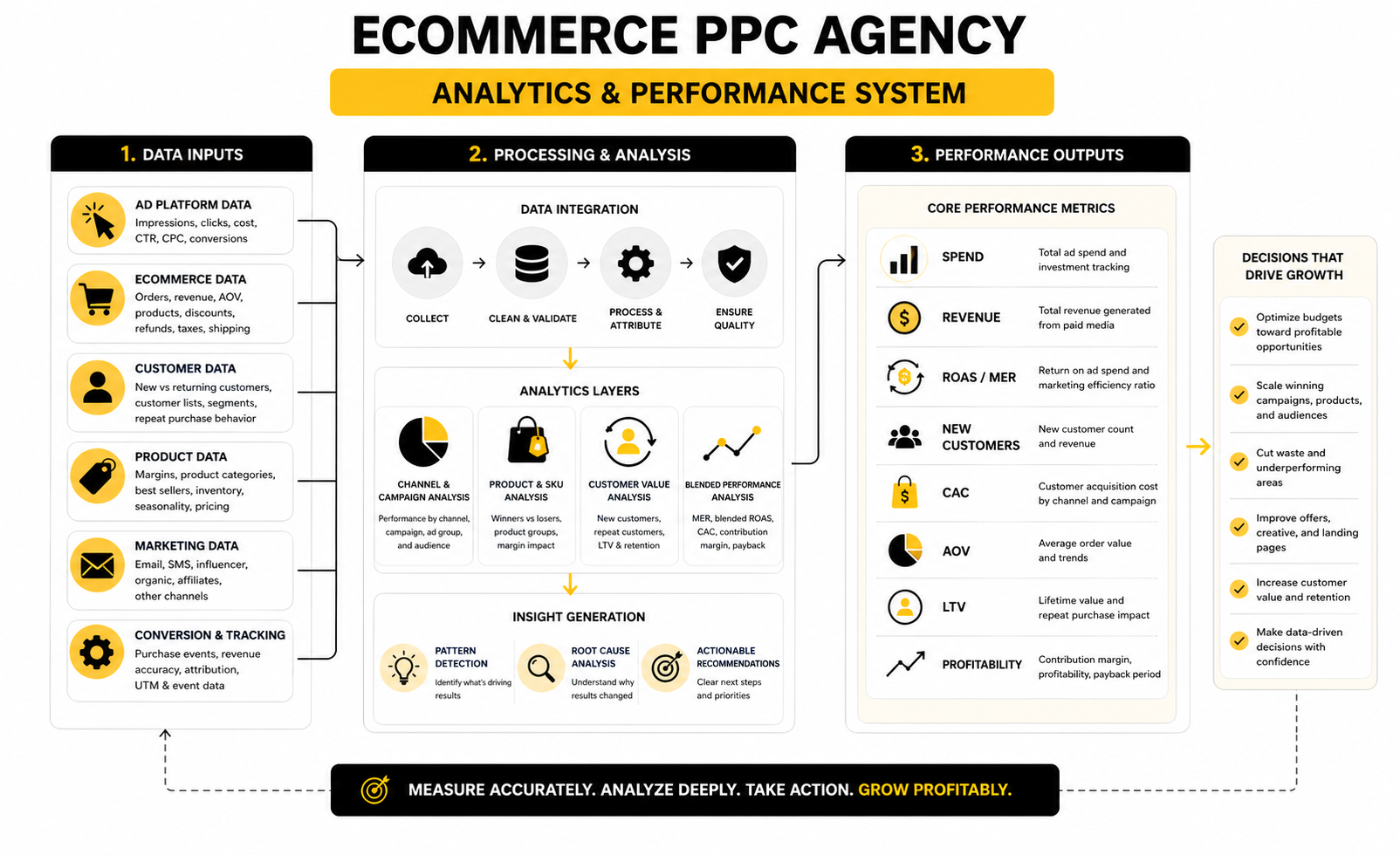
Data only helps when it changes the decision. A weak ecommerce PPC agency reports numbers because the dashboard has them. A strong agency explains what the numbers mean, why they moved, and what action should happen next.
The goal is not to collect every possible metric. The goal is to build a measurement system that shows whether paid traffic is creating profitable growth. That means separating platform performance from business performance, because those two things are related but not identical.
The Metrics That Deserve the Most Attention
The core PPC metrics still matter, but they should not be treated equally. CPC tells you what it costs to enter the auction. CTR tells you whether the ad is getting attention. Conversion rate tells you whether the click turned into a customer. ROAS tells you how much tracked revenue came back from ad spend.
Those are useful signals, but they are not the full truth. Ecommerce brands also need MER, CAC, gross margin, new customer percentage, payback period, refund rate, and inventory availability. If an ecommerce PPC agency only talks about ROAS, they may be optimizing for the platform instead of the business.
This distinction matters because paid media can look healthy while the company feels unhealthy. A campaign can drive revenue but still damage cash flow if it sells low-margin products, attracts discount-only buyers, or creates demand for items that are about to go out of stock. The numbers have to be interpreted through the business model.
Benchmarks Are Directional, Not Personal
Benchmarks are useful for context, but they are not commandments. WordStream’s 2025 Google Ads benchmark analysis reviewed more than 16,000 campaigns running from April 2024 through March 2025, which makes it helpful for spotting broad directional patterns across search advertising. But your ecommerce store is not an average of 16,000 accounts.
A benchmark can tell you whether your CPC looks unusually high or your conversion rate looks unusually weak. It cannot tell you whether your product margin supports the target CAC, whether your offer is strong enough, or whether your best customers buy again in 45 days. That is why a good ecommerce PPC agency uses benchmarks as a diagnostic tool, not as a strategy.
The right question is not, “Are we above or below the average?” The right question is, “What does this number mean for our economics?” A 2.5 ROAS can be excellent for a high-retention consumable brand and terrible for a low-margin one-time purchase brand.
Performance Max Needs Deeper Reporting
Performance Max changed how ecommerce teams read paid search and shopping data. In many accounts, more spend now runs through automated campaign systems, which means reporting must go deeper than campaign-level ROAS. Google’s 2025 Ads updates added more visibility into channel-level Performance Max reporting, giving advertisers more ways to see how results are distributed across Google inventory.
That visibility matters because one blended number can hide very different realities. A campaign may look profitable overall because branded demand, remarketing, or high-intent Shopping traffic is carrying the result. At the same time, prospecting may be weaker than expected.
A sharp ecommerce PPC agency should break down performance by channel, product group, asset group, audience signal, search category, and new versus returning customers where the data allows it. The goal is not to micromanage the algorithm. The goal is to understand what is actually driving the result before scaling.
Shopping and Product-Level Data Are Critical
Ecommerce PPC is product-led. That means product-level reporting often matters more than campaign-level averages. A campaign can look fine while a handful of SKUs produce most of the profit and the rest quietly burn budget.
Tinuiti’s retail advertising benchmarks showed that Performance Max represented a major share of Google Shopping advertiser activity, with Q4 2025 reporting summarized by Karooya noting that Performance Max drove 62% of retailer spend on Shopping ads. That shift makes product segmentation, feed labels, and margin-aware reporting even more important.
The action is simple: stop treating every product equally. Bestsellers, high-margin products, seasonal products, clearance items, and low-stock products should not all receive the same budget logic. Your agency should know which products deserve more exposure and which products are only creating noise.
Conversion Rate Should Be Read With Intent
Conversion rate is one of the easiest metrics to misunderstand. A low conversion rate is not automatically bad, and a high conversion rate is not automatically good. It depends on traffic intent, offer strength, device mix, price point, landing page quality, and how the campaign is being used.
Smart Insights’ 2025 ecommerce conversion rate guidance points to Dynamic Yield and IRP as useful sources for retail conversion benchmarking, while broader ecommerce benchmark summaries often place global ecommerce conversion rates around the low single digits. That is helpful context, but it should not become an excuse. Paid traffic is too expensive to accept weak conversion paths without investigation.
The action is to diagnose by segment. Compare branded versus non-branded traffic, Shopping versus Search, mobile versus desktop, new versus returning visitors, product page versus landing page, and full-price versus discounted traffic. One blended conversion rate hides too many different buyer situations.
ROAS Is Useful, but It Can Lie
ROAS is popular because it is simple. Spend $1 and get $4 back sounds easy to understand. The problem is that ROAS ignores margin, customer quality, future purchases, discounts, returns, and whether the revenue came from new demand or demand that already existed.
This is why some brands scale themselves into trouble. They chase a ROAS target that looks safe, but the underlying revenue is not profitable enough. Or they lower the target to grow faster, then realize too late that cash flow cannot support the acquisition strategy.
A good ecommerce PPC agency will ask for the real break-even point. That includes cost of goods sold, shipping, payment fees, agency fees, discounts, and expected repeat purchase behavior. Once that number is clear, ROAS becomes a useful guardrail instead of a misleading trophy.
MER Keeps the Team Honest
MER, or marketing efficiency ratio, compares total revenue against total marketing spend. It is not perfect, but it is useful because it keeps the team from over-trusting platform attribution. When platform ROAS improves but MER gets worse, something is wrong.
MER is especially useful when multiple channels overlap. Google, Meta, email, SMS, influencers, affiliates, and organic traffic all influence the same buyer journey. Platform dashboards will often claim partial credit for the same sale, so the brand needs a blended view.
The agency should not use MER as an excuse to avoid campaign-level accountability. It should use MER as a reality check. Campaign data explains where to optimize, while MER shows whether the total paid media system is actually working.
The Best Reports Lead to Decisions
A good report should make the next move obvious. It should show what changed, what caused the change, what the agency is doing about it, and what the brand needs to decide. Anything else is decoration.
A practical ecommerce PPC report should include:
- Spend, revenue, ROAS, CAC, and MER
- New customer revenue versus returning customer revenue
- Product-level winners and losers
- Campaign changes made during the period
- Creative and landing page test results
- Budget recommendations for the next period
- Risks, constraints, and decisions needed from the brand
This is where reporting becomes management instead of documentation. The best ecommerce PPC agency does not bury the client in dashboards. It turns data into decisions, decisions into action, and action into better performance.
FAQ - Built for Complete Guide
What does an ecommerce PPC agency do?
An ecommerce PPC agency manages paid advertising for online stores across channels like Google Ads, Shopping, Performance Max, Search, YouTube, Meta, Amazon, TikTok, and sometimes Microsoft Ads. The real job is not just launching campaigns. The agency should connect ad spend to product economics, margin, customer acquisition cost, conversion rate, and profitable growth.
When should an ecommerce brand hire a PPC agency?
You should consider hiring an ecommerce PPC agency when paid media has become important enough that mistakes are expensive. That usually means you already have proven products, real sales data, and enough margin to support customer acquisition. If the store has no offer-market fit yet, an agency can help with testing, but it cannot magically fix a weak product or unclear offer.
How much should an ecommerce PPC agency cost?
Agency pricing usually depends on ad spend, account complexity, scope, and whether creative, landing pages, tracking, and strategy are included. Some agencies charge a flat monthly retainer, some charge a percentage of ad spend, and some use hybrid pricing. The important thing is not finding the cheapest option; it is making sure the fee structure does not reward reckless spending without accountability.
What is a good ROAS for ecommerce PPC?
A good ROAS depends on margin, average order value, customer lifetime value, discounts, shipping costs, and repeat purchase behavior. A 3x ROAS might be excellent for one brand and unprofitable for another. A serious ecommerce PPC agency should calculate your break-even ROAS before setting performance targets.
Is Performance Max good for ecommerce?
Performance Max can work well for ecommerce when the product feed, conversion tracking, assets, and campaign structure are strong. It can also waste money quickly when the inputs are poor or the account is judged only by blended campaign-level results. The agency should understand how to segment products, evaluate asset groups, and read performance beyond one top-line ROAS number.
Should ecommerce PPC send traffic to product pages or landing pages?
It depends on the traffic source and buyer intent. High-intent Shopping traffic may work well on product pages, especially when the page has strong reviews, clear pricing, good images, and low friction. Colder traffic often needs a more guided landing page, and tools like Replo can help brands test dedicated pages faster.
What metrics should an ecommerce PPC agency report?
A useful report should include spend, revenue, ROAS, CAC, MER, conversion rate, average order value, new customer revenue, product-level performance, and the actions taken during the reporting period. It should also explain what changed and what will happen next. A dashboard full of numbers is not enough if it does not lead to decisions.
How long does ecommerce PPC take to work?
Some improvements can appear quickly, especially when tracking, feed issues, or obvious campaign waste are fixed. Bigger growth usually takes longer because the agency needs to test creative, offers, landing pages, product segments, and bidding strategies. The first goal should be cleaner learning, not instant scale.
What makes an ecommerce PPC agency different from a general PPC agency?
An ecommerce PPC agency has to understand product catalogs, Shopping feeds, margin, inventory, promotions, bundles, repeat purchase behavior, and conversion paths. A general PPC agency may be strong at lead generation but weaker at product-level profitability. Ecommerce paid media is more operational, because ads are tied directly to stock, pricing, fulfillment, and customer economics.
Should the agency manage creative too?
The agency does not always need to produce every creative asset, but it should influence creative strategy. Paid media performance depends heavily on angles, hooks, offers, product positioning, and message match. If the agency has no view on creative, it will eventually run out of optimization levers.
How do I know if my current PPC agency is underperforming?
Warning signs include vague reporting, no clear testing plan, no discussion of margin or CAC, repeated excuses without action, poor feed management, and overreliance on platform ROAS. Another red flag is when the agency cannot explain what it changed and why. You should not need to chase clarity every month.
Can an ecommerce PPC agency help with retention?
A PPC agency may not own retention, but it should care about it. Repeat purchase behavior affects how much you can afford to spend to acquire a customer. If paid traffic is supported by email, SMS, chat, and post-purchase flows through tools like Brevo or ManyChat, the economics of acquisition can improve.
What should I prepare before hiring an ecommerce PPC agency?
Prepare your margin data, best-selling products, average order value, repeat purchase rate, current ad account access, conversion tracking setup, product feed, creative assets, and past campaign results. You do not need everything perfect before the first conversation. But the more honest data you bring, the faster a good agency can diagnose the real opportunity.
Work With Professionals
Explore 10K+ Remote Marketing Contracts on MarkeWork.com
Most marketers spend too much time chasing clients, competing on crowded platforms, and losing a percentage of every project to middlemen.
MarkeWork gives you a better way. Browse thousands of remote marketing contracts and connect directly with companies desperate to hire skilled marketers like you, without platform commissions and without unnecessary gatekeepers.
If you're serious about finding better opportunities and keeping 100% of what you earn, explore available contracts and create a profile for free at MarkeWork.com.