


Ecommerce SEO is the process of making an online store easier for search engines, shoppers, and AI-assisted discovery systems to understand. It covers category pages, product pages, technical performance, internal links, structured data, content, reviews, merchandising, and conversion paths. Done properly, ecommerce SEO does not just bring traffic; it brings shoppers who already know what they want.
The game has changed, though. Google now blends organic listings, shopping results, product snippets, reviews, merchant data, and AI-style answers into the same buyer journey. That means
Why Ecommerce SEO Matters More Than Ever
Ecommerce SEO is not just about getting more visitors. That is the beginner version. The real goal is getting the right buyers to the right pages before they compare ten competitors, click an ad, or disappear into a marketplace.
This matters because ecommerce search behavior is painfully specific. Someone searching “running shoes” is browsing. Someone searching “men’s waterproof trail running shoes size 11” is much closer to buying. Your SEO system has to serve both people without treating them like they are in the same stage of the journey.
That is where many stores lose money quietly. They optimize the homepage, publish a few blog posts, add generic product descriptions, and wonder why organic traffic does not convert. The problem is not effort. The problem is that the effort is pointed at the wrong pages.
Search Is Still One Of The Cleanest Ecommerce Acquisition Channels
Paid ads are useful, but they get expensive fast. Marketplaces can bring demand, but they control the customer relationship. Social can spike attention, but it is rarely stable enough to carry the whole business.
Organic search is different because strong ecommerce SEO compounds. A well-built category page can keep attracting qualified buyers for months or years. A useful buying guide can support discovery, internal links, email campaigns, and retargeting without needing a new budget every morning.
That does not mean SEO is free. It takes technical cleanup, better page structure, content planning, product data, and consistent improvement. But when it works, it gives your store something ads alone cannot give you: durable visibility for searches that already show intent.
The Buyer Journey Is Bigger Than Product Pages
A common mistake is thinking ecommerce SEO starts and ends with product pages. Product pages matter, obviously, but they are usually not enough on their own. Most stores need a stronger ecosystem around them.
Category pages often carry the biggest commercial opportunity because they match how people search when they know what they want but have not chosen a specific product yet. Product pages capture deeper intent when buyers are comparing details, specs, variants, reviews, shipping, and price. Educational content supports earlier searches, especially when customers need help choosing between options.
That journey needs to feel connected. A buyer should be able to move from a guide to a category, from a category to a product, and from a product to a checkout path without hitting dead ends. Ecommerce SEO is not only ranking pages; it is building routes to revenue.
Why Thin Stores Struggle To Rank
Search engines do not have much reason to rank a store that looks like every other store. If your category pages are just product grids, your product descriptions are copied from suppliers, and your internal links are random, you are asking Google to trust a very weak signal. That is not a strategy.
Thin ecommerce pages also create a poor buying experience. A shopper lands on a page, sees little context, cannot compare options easily, and has to work too hard to make a decision. Even if the page gets traffic, that traffic may not turn into sales.
This is why content depth matters, but not in the lazy “add 2,000 words everywhere” way. Useful depth means helping the buyer choose. It means clear filters, helpful copy, unique product information, comparison support, internal links, schema, reviews, and page layouts that make the next step obvious.
Framework Overview
A strong ecommerce SEO framework has four jobs. It helps search engines understand the store, helps buyers find the right products, helps important pages earn authority, and helps commercial pages convert. Miss one of those jobs and the whole system gets weaker.
The framework is simple on paper, but serious in practice:
- Build a clean store architecture.
- Map keywords to the right page types.
- Strengthen category and product pages.
- Fix technical problems that block crawling, indexing, speed, and usability.
- Add supporting content where it helps buyers make decisions.
- Measure rankings, revenue, and page-level performance instead of vanity traffic.
The point is not to do random SEO tasks. The point is to create a system where every page has a purpose, every important page is reachable, and every search query has a logical destination.
Start With Store Architecture
Your store architecture decides how authority and users move through the site. If the structure is messy, everything else becomes harder. Search engines need to understand which pages are important, and shoppers need to move through the catalog without thinking too much.
A clean structure usually starts with the homepage, then major categories, then subcategories, then product pages. That sounds basic, but the details matter. Categories should reflect real buyer language, not just internal merchandising labels that only your team understands.
For example, a store might internally call a category “Performance Series,” but buyers may search for “waterproof hiking jackets.” SEO should usually follow the customer’s language first. Branding can still exist, but it should not hide the terms people actually use when they are ready to buy.
Map Keywords To Page Types
Keyword research for ecommerce SEO is not about collecting the biggest list possible. It is about deciding which page should rank for which intent. That decision controls the whole strategy.
Broad commercial terms usually belong to category or collection pages. Specific model, SKU, brand, or product terms usually belong to product pages. Comparison and problem-based searches often belong to guides, buying advice, or supporting content.
This prevents cannibalization. You do not want three blog posts, two categories, and five product pages all fighting for the same query. You want one clear best page for each important search intent, with supporting pages linking toward it.
Treat Category Pages Like Revenue Assets
Category pages are often the most underbuilt pages in an ecommerce store. Many brands treat them as simple shelves. That is a waste.
A strong category page should help shoppers narrow choices quickly, understand the range, and move confidently toward a product. The SEO copy should support that experience, not interrupt it. You do not need a wall of text above the product grid; you need useful context in the right places.
Good category pages usually include a clear heading, concise buying guidance, crawlable product links, useful filters, internal links to relevant subcategories, and enough unique copy to explain what the page is about. When these pages are built properly, they can become some of the most valuable organic landing pages in the business.
Professional Implementation
Now the strategy becomes practical. Ecommerce SEO only works when it turns into a repeatable process, not a one-time cleanup. You need a workflow that tells you what to fix first, what to build next, and how to avoid creating new problems as the store grows.
Start with the pages that can make the biggest commercial difference. That usually means category pages, high-margin product pages, best-selling products, and pages already ranking near the bottom of page one or top of page two. Those pages already have some traction, so improving them is usually faster than trying to rank a brand-new page from nothing.
Do not begin with random blog posts unless the blog is clearly supporting a product journey. Blog content can be valuable, but ecommerce SEO should first protect and grow the pages that can directly produce revenue. That is the practical difference between “doing SEO” and building an organic sales channel.
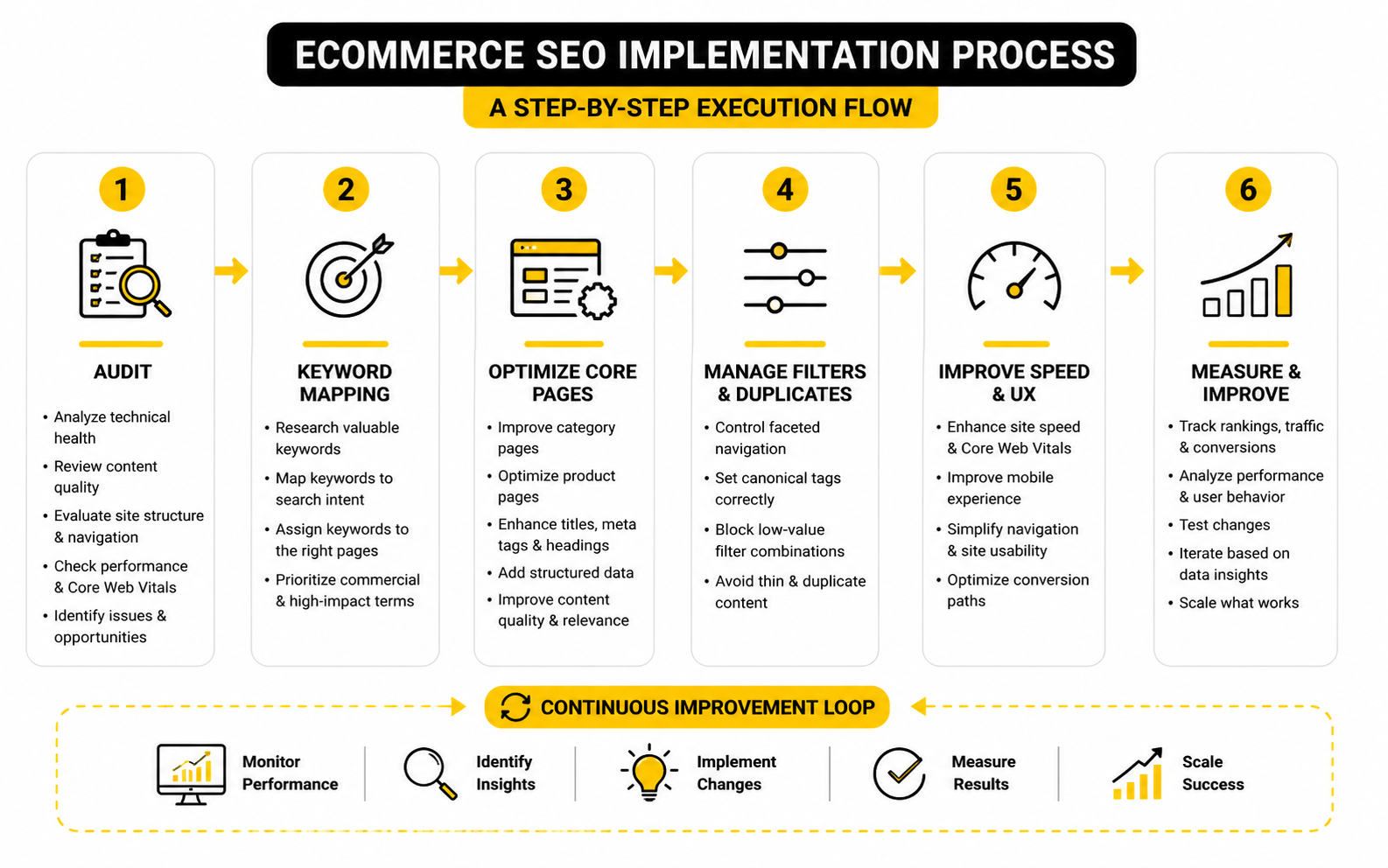
Step 1: Audit The Store Before You Change It
The first step is not writing more content. The first step is understanding what is already happening. A proper audit shows which pages are indexed, which pages are blocked, which pages are competing with each other, and which pages search engines can barely understand.
Look at your category structure, product page templates, internal links, crawl depth, duplicate URLs, canonical tags, sitemap quality, and product feed consistency. Google’s own product structured data guidance makes it clear that product pages can qualify for richer search result features when they include accurate information such as price, availability, ratings, and shipping details through structured data. That makes your product information part of the search experience, not just the page experience.
The audit should also separate technical issues from business decisions. A missing canonical tag is a technical issue. A category page targeting the wrong keyword is a strategy issue. Treating both the same way creates messy priorities and slow progress.
Step 2: Build A Keyword Map Around Search Intent
Once the audit is done, build the keyword map. This is where ecommerce SEO becomes organized. Every important keyword should have a page type, a search intent, and a clear destination.
Commercial category terms should usually map to category or collection pages. Product-specific terms should map to product pages. Informational searches should map to guides only when the guide can naturally lead the shopper toward a category, comparison, product, or email capture.
This is also where you prevent internal competition. If a category, a buying guide, and a tag page all target the same query, Google may struggle to decide which one matters most. Your job is to make that decision obvious through page targeting, internal links, headings, and content depth.
Step 3: Improve Category Pages First
Category pages deserve priority because they often match strong buying intent at scale. A shopper searching for a category usually knows the type of product they want but has not chosen the exact item yet. That makes the category page the perfect place to guide the decision.
Improve the page by tightening the heading, adding useful buyer-focused copy, organizing subcategories, and making filters genuinely helpful. Baymard’s product finding research found more than 1,000 medium-to-severe usability issues across ecommerce product discovery tests, which is a blunt reminder that shoppers often struggle before they even reach the product page. Better product finding is not just UX polish; it supports SEO because search traffic has to convert after the click.
Keep the copy practical. Explain how to choose, what differences matter, and when one product type is better than another. The page should help someone make progress without burying the products under a giant block of text.
Step 4: Strengthen Product Pages With Unique Detail
Product pages should answer the questions a buyer has right before purchase. That means the page needs more than a product name, image, price, and manufacturer description. It needs useful details that reduce hesitation.
Add unique descriptions, specifications, size information, use cases, compatibility notes, materials, care instructions, shipping details, return information, reviews, and frequently compared alternatives where relevant. Google’s product structured data documentation specifically highlights search enhancements for product details such as price, availability, review ratings, and shipping information, so the data on the page and the structured data behind it should match cleanly.
This is also where product page templates matter. If every page has the same weak layout, every product inherits the same weakness. Fix the template once, then improve the most valuable products manually where human judgment matters most.
Step 5: Control Faceted Navigation Before It Bloats The Site
Filters are great for shoppers and dangerous for SEO when they are unmanaged. Size, color, brand, price, rating, material, and availability filters can generate thousands of URL combinations. Some deserve to be indexed, but most do not.
The goal is not to block everything. The goal is to decide which filtered pages have real search demand and which ones only create crawl waste. For example, “black leather backpacks” may deserve an indexable page if people search for it, while a random combination of price, sort order, and availability probably should not.
Use canonical tags, noindex rules, parameter handling, internal linking, and sitemap discipline carefully. Do not let every filter become a new SEO landing page by accident. Large ecommerce sites often lose crawl efficiency because they create more URLs than they can actually support with unique value.
Step 6: Fix Speed, Stability, And Mobile Friction
Technical SEO is not separate from buying experience. If a store loads slowly, shifts around while someone taps, or feels clumsy on mobile, rankings and revenue both suffer. Google describes Core Web Vitals as real-world experience metrics for loading performance, interactivity, and visual stability, and recommends strong performance for both Search and users.
For ecommerce, this usually means compressing images, reducing unnecessary scripts, improving theme performance, delaying non-critical apps, cleaning up tracking code, and testing key templates on mobile. Product pages, category pages, search result pages, and checkout paths should be checked separately because each template can have different problems.
Be especially careful with apps and plugins. Many stores slow themselves down by stacking popups, review widgets, chat tools, analytics scripts, personalization tools, and upsell apps without measuring the damage. Keep what helps revenue, remove what creates friction, and test the difference like an operator, not a collector of shiny tools.
Statistics And Data
Ecommerce SEO data only matters when it changes what you do next. A ranking report that looks impressive but does not connect to revenue is just decoration. A traffic spike that brings the wrong visitors is not a win either.
The useful numbers are the ones that explain movement through the buying journey. You want to know which search queries bring qualified shoppers, which landing pages move them forward, which pages leak buyers, and which technical issues make the whole store harder to use. That is the difference between reporting and decision-making.
Good measurement also protects you from bad conclusions. If organic traffic rises but revenue stays flat, the problem may be intent, page quality, product fit, stock availability, pricing, or conversion friction. You do not fix all of those with more content.
Measure Search Visibility By Page Type
Do not measure ecommerce SEO as one big traffic bucket. Break it into page types because each page type has a different job. Category pages, product pages, buying guides, comparison pages, and brand pages should not be judged by the same expectations.
Category pages should be measured by impressions, rankings, clicks, product engagement, assisted revenue, and direct revenue. Product pages should be measured by clicks, add-to-cart behavior, conversion rate, revenue, stock issues, and rich result eligibility. Guides should be measured by qualified entrances, internal clicks to commercial pages, email capture when relevant, and assisted conversions.
This makes the data more honest. A guide may bring more visitors, but a category page may bring more buyers. If you only reward traffic, you will accidentally push the team toward content that looks good in reports and does very little for sales.
Track The Metrics That Show Commercial Intent
The most useful SEO metrics for ecommerce are not always the loudest ones. Rankings and traffic matter, but they are early signals. The real question is whether those signals turn into commercial behavior.
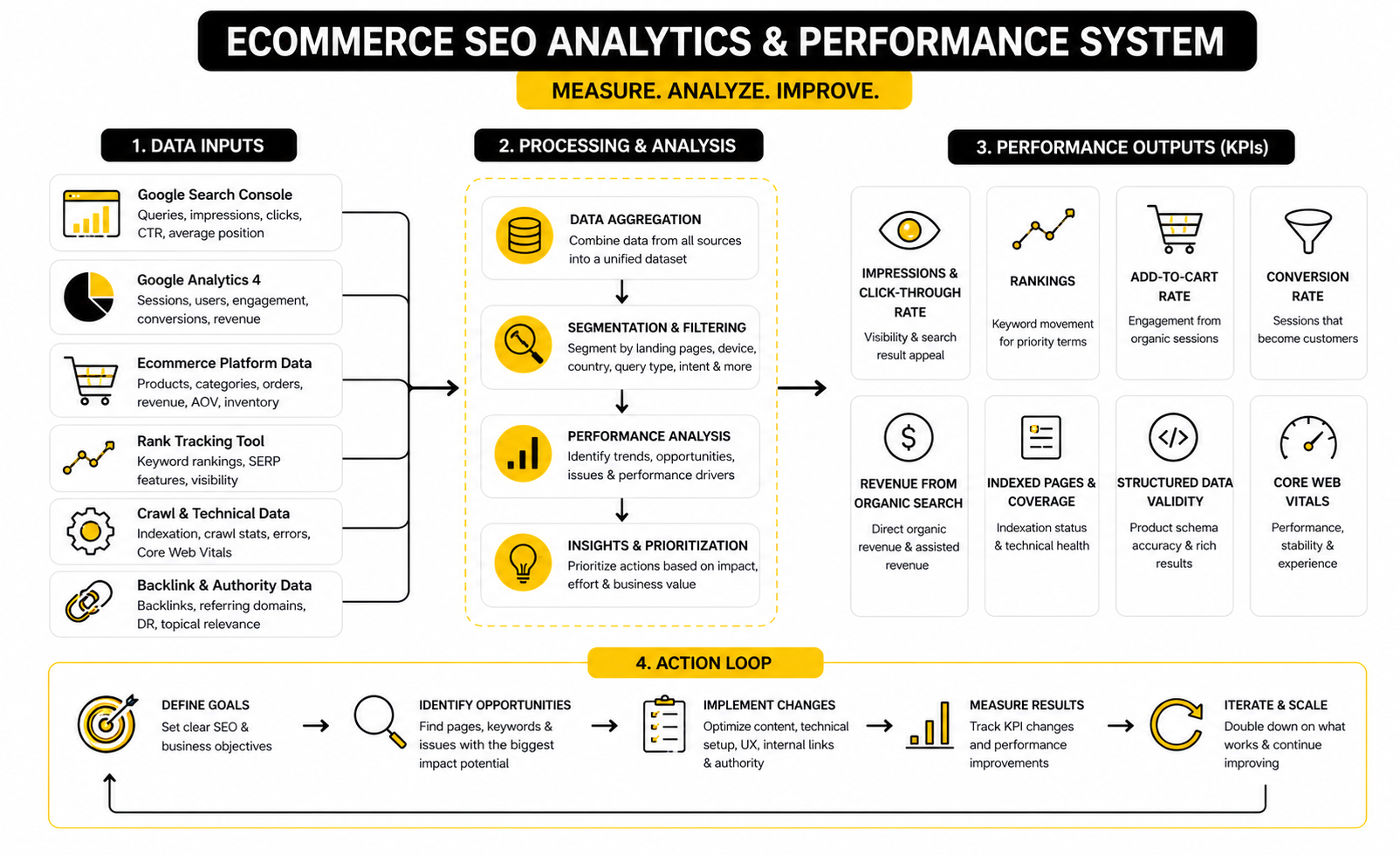
Track these numbers together:
- Organic impressions by page type
- Organic clicks by query and landing page
- Click-through rate for priority pages
- Average ranking position for commercial keywords
- Add-to-cart rate from organic landing pages
- Organic conversion rate
- Revenue from organic search
- Assisted revenue from informational content
- Indexed pages versus submitted pages
- Pages with valid product structured data
- Core Web Vitals status by template
- Out-of-stock traffic on organic landing pages
Each metric should lead to an action. Low impressions can mean weak targeting or poor indexation. High impressions with low clicks can mean the title, meta description, price, availability, or rich result appearance is not compelling. Strong clicks with weak conversion usually means the page did its SEO job but failed the buyer.
Read Benchmarks Without Copying Them Blindly
Benchmarks are useful for context, not for excuses. A store selling expensive furniture will not behave like a store selling low-cost skincare. A returning customer searching for a branded product will not behave like a first-time visitor reading a buying guide.
Still, benchmarks can show where the market is moving. Adobe’s Digital Economy Index tracks U.S. ecommerce activity across more than one trillion visits, 100 million SKUs, and 18 product categories, which is a useful reminder that ecommerce performance should be viewed through product category, seasonality, and demand shifts rather than one generic average. Contentsquare’s 2025 benchmark also reported a 6.1% drop in conversion rate, which matters because acquisition gains can be wasted when the on-site experience fails after the click.
Use benchmarks to ask better questions. If your organic traffic is growing but conversion is falling, check whether the new traffic matches commercial intent. If mobile rankings are improving but mobile revenue is weak, inspect speed, filters, product images, checkout friction, and trust signals before blaming SEO.
Watch Product Discovery Signals Closely
Product discovery is where ecommerce SEO and user experience overlap. If shoppers land on a category page and cannot narrow the range, SEO has only done half the job. The click happened, but the buying journey stalled.
Baymard’s product list and filtering research found that 58% of desktop ecommerce sites and 78% of mobile ecommerce sites had “mediocre” or worse product list UX performance. That matters because many organic visitors land directly on category or collection pages, not the homepage. If those pages do not help people compare, filter, and choose, ranking improvements will not produce the revenue they should.
The action is simple but not easy. Review your highest-traffic category pages and look for weak filters, unclear sorting, missing product attributes, thin category copy, poor mobile usability, and confusing product cards. Then improve the category template before you create another batch of content.
Connect Structured Data To Search Performance
Structured data is not magic, but it helps search engines understand product information more clearly. Google’s product structured data documentation explains that product pages can show richer details in Search, Google Images, and Google Lens, including price, availability, review ratings, and shipping information. For ecommerce SEO, that means structured data should be part of the product page quality system, not a technical afterthought.
Measure this with practical checks. How many product pages have valid product structured data? How many have missing prices, mismatched availability, invalid reviews, or incomplete shipping information? How often do search snippets show useful product details for your priority pages?
The action is to keep page content, structured data, and merchant feed data consistent. If a product is out of stock on the page but marked available somewhere else, that inconsistency can damage trust and create avoidable visibility problems. Clean product data is boring until it starts costing you clicks.
Separate SEO Problems From Conversion Problems
This is where many ecommerce teams waste months. They see weak sales from organic search and assume they need more rankings. Sometimes they do, but not always.
If a page has low impressions, you likely have a visibility problem. If it has impressions but no clicks, you likely have a search result problem. If it has clicks but no engagement, you likely have a page relevance or user experience problem. If it has engagement but no purchases, you may have a pricing, offer, trust, stock, shipping, or checkout problem.
That diagnosis matters because each issue needs a different fix. More backlinks will not solve a confusing size guide. More blog posts will not fix a slow mobile product page. Better metadata will not save a category page with poor filters and weak product cards.
Build A Monthly SEO Revenue Review
A monthly review keeps ecommerce SEO tied to business reality. It should not be a giant dashboard nobody reads. It should be a short decision meeting built around what changed, why it changed, and what gets improved next.
Review these areas every month:
- Which organic landing pages gained or lost revenue?
- Which commercial keywords moved meaningfully?
- Which category pages need copy, filters, links, or product changes?
- Which product pages get traffic but fail to convert?
- Which technical issues affect crawlability, structured data, or performance?
- Which content pieces assisted sales instead of only attracting visits?
- Which pages should be refreshed, merged, redirected, or removed?
This creates accountability. Ecommerce SEO becomes a performance system, not a content calendar with rankings attached. The goal is not to report more numbers; it is to make better decisions faster.
Advanced Ecommerce SEO Tradeoffs
At a basic level, ecommerce SEO is about making important pages easier to find, understand, and rank. At an advanced level, it becomes a tradeoff game. You are constantly deciding which pages deserve indexation, which templates deserve custom work, which products deserve content depth, and which technical fixes are worth developer time.
That is why mature SEO does not treat every page equally. A store with 300 products can often improve pages manually. A store with 300,000 products needs rules, templates, data quality checks, and smart prioritization. The strategy has to match the size and complexity of the catalog.
This is where many teams get stuck. They copy advice meant for smaller stores, then wonder why it collapses at scale. A larger ecommerce site needs a system that can handle inventory changes, variant logic, filtered URLs, seasonal demand, out-of-stock products, and thousands of page updates without turning the site into a crawl trap.
Indexation Is A Business Decision
Not every page should be indexed. That sounds harsh, but it is true. If a page does not serve a unique search intent or help search engines understand the store, it may be creating noise instead of value.
For ecommerce SEO, indexation should be tied to demand and usefulness. A category page for “men’s black leather boots” may deserve to be indexed if it matches real searches and contains a strong product set. A filtered URL for “men’s black leather boots sorted by price descending” almost certainly does not.
Google’s faceted navigation guidance warns that filter-generated URLs can cause overcrawling and slower discovery of useful URLs, especially when crawlers spend time on combinations with little or no search value. That means crawl budget is not just a technical concept. It affects how quickly important products, categories, and updates can be discovered.
Handle Out-Of-Stock Products Carefully
Out-of-stock products create one of the most common ecommerce SEO dilemmas. If a product is temporarily unavailable, deleting the page can waste existing rankings, links, and buyer demand. If it is permanently gone, keeping a dead page alive can frustrate shoppers and weaken the site experience.
For temporary stock issues, keep the page live when there is meaningful demand. Show the stock status clearly, offer restock notifications, recommend close alternatives, and keep the page useful. This protects the page while giving shoppers a next step instead of a dead end.
For discontinued products, make a cleaner decision. If there is a near-equivalent replacement, redirect the old URL to the best alternative. If there is no replacement and no meaningful search value, retiring the page may be the better move. Do not let thousands of dead product pages sit around just because nobody wants to make the call.
Scale Content Without Creating Template Spam
Scaling ecommerce content is dangerous when the process is lazy. If every category page has the same paragraph with a swapped keyword, you are not building value. You are manufacturing sameness.
The better approach is to scale structure, not generic writing. Use templates for layout, comparison modules, product attributes, internal links, FAQs only where they genuinely belong, and buying guidance blocks. Then reserve manual editorial work for the pages with the highest commercial opportunity.
This matters even more as AI content becomes easier to generate. More content is not automatically better content. If the page does not help the buyer choose, compare, trust, or act, it is just noise with headings.
Use Automation Where It Reduces Friction
Automation can be useful in ecommerce SEO, but only when it supports judgment instead of replacing it. Product data cleanup, internal linking suggestions, schema validation, metadata generation, crawl monitoring, and reporting can all benefit from automation. The mistake is using automation to publish weak pages faster.
For example, an AI assistant can help draft product description variations, but a human still needs to check accuracy, claims, compliance, and usefulness. A crawler can flag duplicate titles, but someone has to decide whether the duplication is actually harmful. A dashboard can show ranking movement, but it cannot tell you the business priority without context.
If your store depends heavily on funnels, follow-up, and lead capture around ecommerce offers, tools like ClickFunnels, Systeme.io, or GoHighLevel can support the post-click side of the journey. They are not replacements for SEO fundamentals. They are useful when the organic visitor needs a clearer path into email, offers, booking, or remarketing.
Protect SEO During Redesigns And Migrations
A redesign can improve conversion and still damage SEO if it is handled badly. New templates, URL changes, navigation changes, JavaScript changes, and content rewrites can all affect rankings. The site may look better while search performance quietly drops.
Before any migration, map old URLs to new URLs, preserve important content, test redirects, check canonical tags, validate structured data, and crawl the staging site. After launch, monitor indexation, rankings, organic landing pages, server errors, and revenue from organic search. Do not wait a month to discover that top category pages were removed from navigation.
This is one of those moments where process beats optimism. A store redesign should have an SEO checklist before launch, not an emergency audit after traffic falls. The larger the store, the more expensive that mistake becomes.
Build Internal Links Like A Merchandiser
Internal links are not just for crawlers. They are also merchandising paths. A good internal linking system helps users move from broad interest to specific products without getting lost.
Link from guides to relevant categories, from categories to important subcategories, from product pages to compatible products, and from discontinued products to current alternatives. Use descriptive anchor text that sounds natural and helps the shopper understand what comes next. Do not stuff exact-match links into every paragraph like it is 2012.
The best internal links usually make commercial sense before they make SEO sense. If a buyer reading a sizing guide should naturally see the product category next, that link belongs there. If a link only exists to manipulate keywords, it probably does not.
Balance Brand Building And Search Demand
Search demand tells you what people already want. Brand building helps create demand they may not have yet. A strong ecommerce SEO strategy needs both, but it should not confuse them.
Category pages and product pages usually follow existing demand. Brand stories, campaigns, founder content, and editorial pieces may shape trust and differentiation. Both can support revenue, but they should be measured differently.
This distinction keeps expectations clean. Do not judge a brand story only by immediate organic sales. Do not judge a commercial category page only by engagement time. Each page has a job, and the metrics should match that job.
Know When Not To Chase A Keyword
Some keywords look attractive until you inspect the intent. High search volume can hide weak buying intent, impossible competition, or search results dominated by marketplaces, publishers, videos, maps, or informational content. Chasing those terms can waste months.
A better question is simple: can your store create the best destination for this search? If the answer is no, move on or choose a more specific angle. Ecommerce SEO is not about ranking for every possible keyword; it is about owning the searches where your store can genuinely satisfy the buyer.
This is where confidence matters. A focused store with strong category pages, useful product content, clean technical foundations, and consistent measurement can beat a bigger competitor in the right pockets. But it will not happen by chasing every shiny keyword in the spreadsheet.
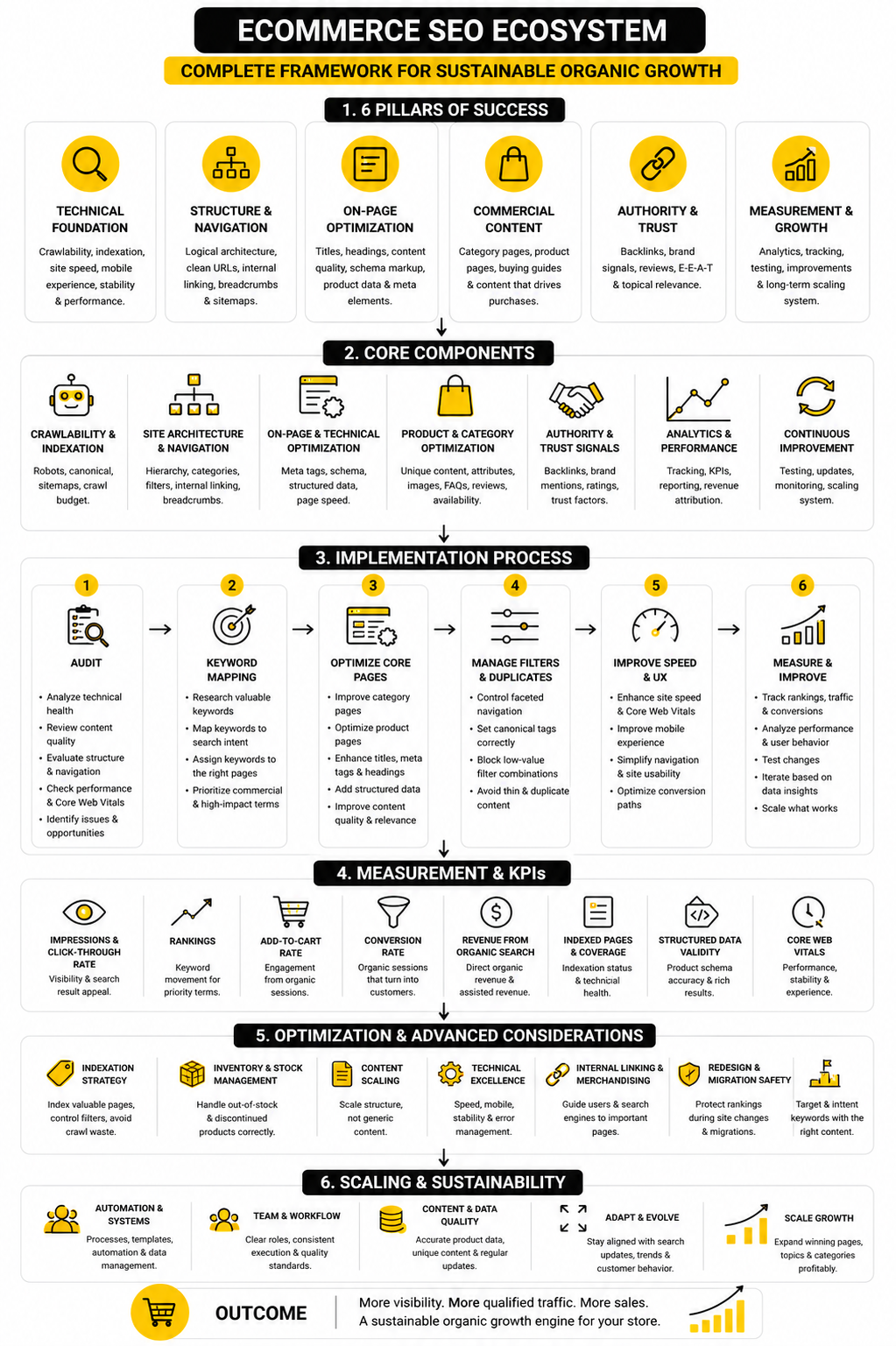
Build The Final Ecommerce SEO System
The best ecommerce SEO systems do not depend on one heroic audit or one big content sprint. They depend on habits. The store gets cleaner, smarter, and more useful every month because the team knows what to check, what to improve, and what to leave alone.
At this stage, the work becomes a loop. You improve important pages, measure what changed, fix the next constraint, and keep strengthening the path from search to product discovery to purchase. That loop is what turns SEO from a traffic project into a growth system.
The final system should connect technical SEO, product data, content, merchandising, analytics, and conversion. When those pieces work together, organic search becomes more predictable. When they are disconnected, every improvement feels temporary.
FAQ - Built For Complete Guide
What Is Ecommerce SEO?
Ecommerce SEO is the process of improving an online store so its products, categories, and supporting content can be found through organic search. It includes technical SEO, keyword mapping, product page optimization, category page improvements, structured data, internal linking, and content that helps buyers make decisions. The goal is not just more traffic; the goal is more qualified buyers reaching the right pages.
Why Is Ecommerce SEO Different From Regular SEO?
Ecommerce SEO is different because stores usually have many product pages, category pages, variants, filters, and inventory changes. A normal service website may only need a few important pages, while an ecommerce site may need to manage hundreds or thousands of URLs carefully. That makes structure, crawl control, duplicate content management, product data, and conversion signals much more important.
How Long Does Ecommerce SEO Take To Work?
Most stores should think in months, not days. Technical fixes can sometimes create faster improvements, especially if important pages were blocked, slow, duplicated, or poorly indexed. Larger gains usually take longer because category authority, content quality, internal links, and search trust build over time.
Which Pages Matter Most For Ecommerce SEO?
Category pages, product pages, and high-intent supporting content usually matter most. Category pages often target broad commercial searches, while product pages capture shoppers closer to purchase. Supporting content matters when it helps buyers compare, choose, troubleshoot, or understand what they should buy next.
Should Product Pages Have Long Descriptions?
Product pages should have useful descriptions, not long descriptions for the sake of length. A strong product page answers real buying questions about fit, material, size, compatibility, use case, delivery, returns, and trust. If extra copy helps the buyer decide, add it; if it just repeats generic keywords, cut it.
Are Category Pages More Important Than Blog Posts?
For most ecommerce stores, category pages are more directly tied to revenue than blog posts. Blog content can support discovery and internal linking, but it should not distract from commercial pages that already match buying intent. A practical ecommerce SEO strategy usually improves category and product pages first, then builds content around the gaps.
What Should I Do With Out-Of-Stock Products?
If the product is temporarily out of stock and still has search demand, keep the page live and offer restock alerts or close alternatives. If the product is permanently discontinued, redirect it to the closest relevant replacement when one exists. If there is no replacement and the page has no real value, retiring it may be cleaner.
How Do Filters Affect Ecommerce SEO?
Filters help shoppers narrow choices, but they can create too many URLs if unmanaged. Some filtered pages may deserve to be indexed when they match real search demand. Most filter combinations should be controlled so they do not waste crawl resources or create thin duplicate pages.
Does Structured Data Improve Rankings?
Structured data is not a magic ranking button. Its real value is helping search engines understand product details such as price, availability, reviews, shipping, and other information that can support richer search appearances. For ecommerce SEO, structured data should match the visible page content and product feed data accurately.
How Often Should Ecommerce SEO Be Reviewed?
A serious store should review ecommerce SEO performance every month. The review should focus on revenue, rankings, organic landing pages, technical issues, indexed pages, structured data, and category or product pages that need improvement. Weekly checks can be useful for urgent technical monitoring, but monthly reviews are better for strategic decisions.
What Is The Biggest Ecommerce SEO Mistake?
The biggest mistake is treating SEO as a content task only. Ecommerce SEO is not just publishing articles. It is site architecture, product data, category quality, crawl management, page speed, internal links, search intent, and conversion working together.
Can A Small Store Compete With Big Ecommerce Brands?
Yes, but not by copying them. Small stores can win by targeting more specific searches, building better category pages, writing more useful product content, and serving niche buyers more clearly. A focused store does not need to outrank every marketplace; it needs to win the searches where it can be the best answer.
Work With Professionals
Explore 10K+ Remote Marketing Contracts on MarkeWork.com
Most marketers spend too much time chasing clients, competing on crowded platforms, and losing a percentage of every project to middlemen.
MarkeWork gives you a better way. Browse thousands of remote marketing contracts and connect directly with companies desperate to hire skilled marketers like you, without platform commissions and without unnecessary gatekeepers.
If you're serious about finding better opportunities and keeping 100% of what you earn, explore available contracts and create a profile for free at MarkeWork.com.