

For ecommerce brands, social media is no longer a nice extra channel sitting off to the side. It is where discovery, evaluation, proof, and purchase increasingly happen in the same session, often in the same feed. Early 2025 data showed 5.24 billion active social media user identities worldwide and 253 million social media user identities in the United States, which is exactly why social has become a real revenue environment rather than a branding playground. DataReportal – Global Digital Insights+1
The harder part is not getting attention. The harder part is turning attention into profitable demand when people discover brands through multiple touchpoints, search on social, watch creators for proof, and expect checkout to feel effortless. Recent research shows the typical adult internet user now discovers brands through 5.8 different sources, while Sprout Social found that 41% of Gen Z start their search on social platforms first. DataReportal – Global Digital Insights+1
That shift explains why hiring an ecommerce social media marketing agency has become an operating decision, not just a creative one. Estimates for US social commerce in 2025 cluster around a very large number: Shopify and McKinsey both point to nearly $80 billion and nearly $80 billion, while eMarketer puts the figure at $87.02 billion in 2025. Once the feed starts acting like a storefront, brands need tighter control over media, creators, content, community, and conversion. Shopify+2
- Why Ecommerce Brands Need Social Media Marketing Agencies Now
- The Growth Framework Behind Social Commerce
- Paid Social Systems That Scale Profitably
- Organic Social, Creators, and Community That Build Demand
- Conversion Infrastructure, Retention, and Measurement
- How Professional Agency Execution Creates Compounding Growth

Why Ecommerce Brands Need Social Media Marketing Agencies Now
Most brands do not struggle because they ignore social media. They struggle because social now demands too many disciplines at once: creative strategy, paid media, creator management, community moderation, merchandising, customer care, analytics, and post-click optimization. HubSpot’s 2025 marketer survey shows teams are still wrestling with trend volatility, ROI measurement, and content creation at the same time, while Deloitte reports that brands are meeting only 69% of their social media business objectives even after average budgets rose 9% year over year. blog.hubspot.com+1
Social is also much closer to the transaction than many operators still assume. Deloitte’s 2025 social research found that 61% of consumers discovered a new brand or product on social media in the past 12 months, while GWI reports that 30% discover new brands through social media ads and another 23% through recommendations and comments on social platforms. That means social is doing two jobs at once: it is driving awareness, and it is shaping purchase intent before a shopper ever lands on a product page. Deloitte+1
The money is moving there because buyer behavior is moving there. Deloitte found that 71% of consumers rated their most recent social purchase experience as good or excellent, and HubSpot’s 2025 report says platforms like Instagram and TikTok continue to dominate the mix for traffic, engagement, audience growth, and social shopping momentum. When a channel starts influencing both discovery and conversion, it stops being “content marketing” and starts becoming part of the commercial engine. Deloitte+2
There is a catch, and it is a big one. McKinsey’s 2025 consumer research says social media is still the least trusted source when consumers make buying decisions, even though digital channels keep influencing what people see, consider, and remember. So the role of an ecommerce social media marketing agency is not to flood the feed with more posts. The real job is to close the trust gap with better creators, sharper offers, stronger social proof, cleaner landing experiences, and more responsive customer interaction. McKinsey & Company
That last point matters more than most brands think. Sprout Social’s research says most consumers want brands to respond within 24 hours or sooner, and its customer service analysis says nearly 75% want replies within 24 hours or less. If a brand is paying to create demand but cannot answer questions, resolve objections, or guide the next step fast enough, it is buying attention and then wasting the trust that attention created. Sprout Social+1
The Growth Framework Behind Social Commerce
A strong ecommerce social media marketing agency does not treat paid social, organic content, creator partnerships, community management, and retention as separate departments fighting for budget. It treats them as one growth loop. Deloitte’s top-performing social-first brands already organize around community, content, and conversion, while HubSpot’s 2025 reporting points to the same direction with its paid-plus-organic “brandformance” model, where native content becomes the input for performance media. Deloitte+1
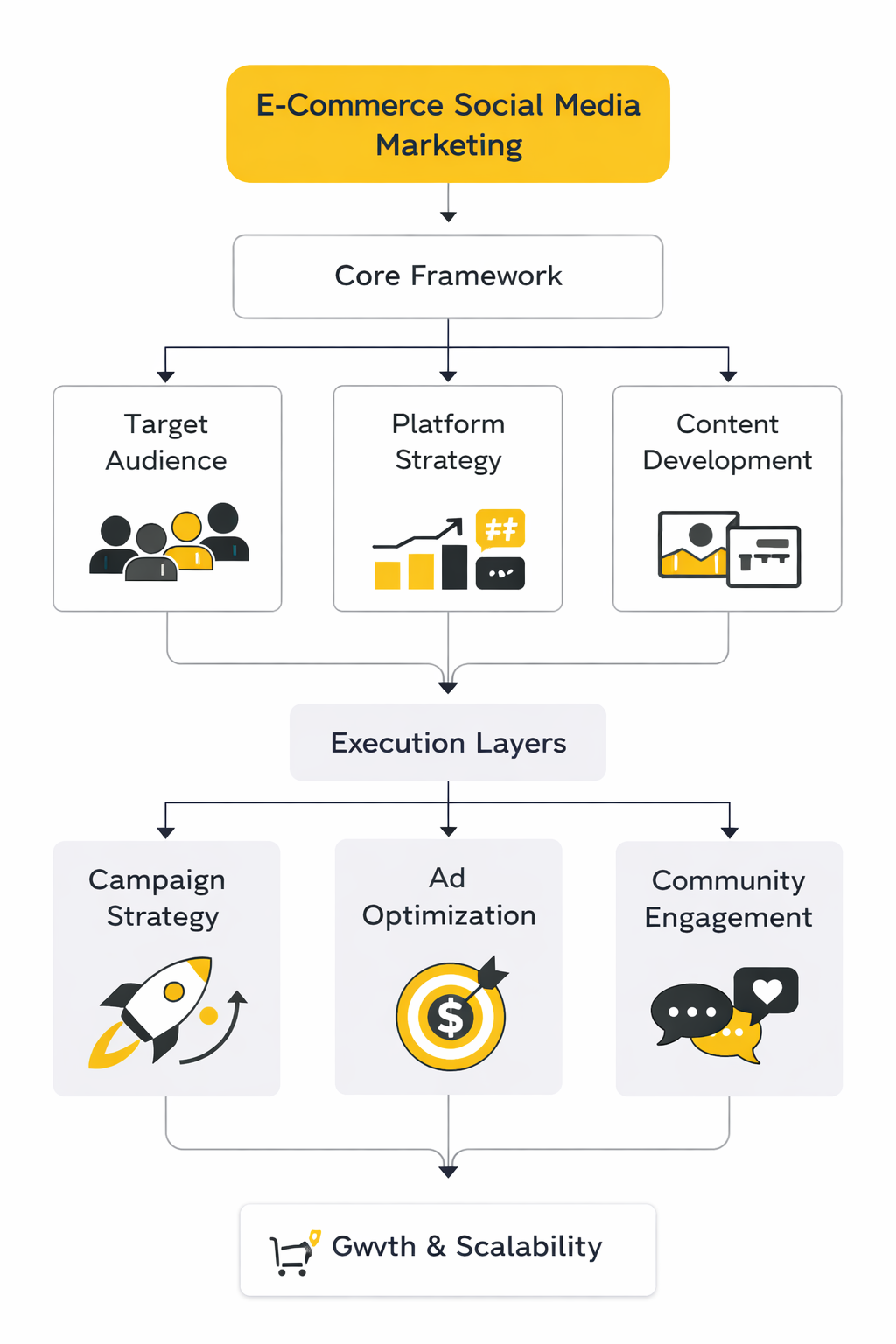
- Attention comes first, but it has to look native. HubSpot found that Instagram is the top-performing platform for site traffic, engagement, and audience growth, and the same report positions TikTok as a major driver of engagement and audience growth. The lesson is simple: the creative has to fit the platform before it can sell on the platform. blog.hubspot.com
- Belief is built through people, not polished claims. HubSpot found that 76% of marketers believe authentic and relatable content matters more than polished production, and Deloitte reports that 83% of consumers see the influencers or creators they follow as trusted sources of information. That is why serious agencies lean so hard into creators, UGC, customer reviews, comments, and real demonstrations instead of brand-only messaging. blog.hubspot.com+1
- Conversion happens when friction drops. Deloitte’s 2025 research shows that 34% of consumers would be more likely to buy on social with an even easier payment process, which means the jump from social post to checkout cannot feel clumsy. Sometimes that means in-app commerce, sometimes it means a better landing page, and sometimes it means moving the shopper into chat before they are ready to buy. Deloitte
- Retention protects margin. Social should hand buyers into owned systems quickly, because rented attention is always fragile. A practical execution stack often includes tools like ManyChat, Replo, Brevo, Buffer, and HighLevel so the brand can keep the relationship after the first click.
- Measurement decides whether growth is real. Deloitte found that 96% of social-first brands treat social commerce as a high or very high priority, but only 39% say it is delivering high ROI. That gap is exactly where agencies either prove their value or expose their weakness. Deloitte
This framework is why the right agency partner is never just “the team that makes posts.” The work is closer to revenue operations than most founders expect: platform-native creative on the front end, proof and persuasion in the middle, and cleaner conversion economics on the back end. When one of those layers breaks, brands usually compensate with more ad spend, and that is an expensive way to hide a systems problem. Deloitte+1
The rest of this guide will move from this framework into execution. First comes paid social that can scale without wrecking margin, then the creator and community systems that make social believable, then the conversion and retention infrastructure that turns social traffic into a durable business.
Paid Social Systems That Scale Profitably
Paid social is where a lot of ecommerce brands confuse motion with momentum. Recent research shows 30% of consumers discover new brands through social media ads, while 29.7% of adult internet users globally say the same, and Deloitte found that more mature social-commerce brands generate 14.4% of B2C revenue from social commerce versus 10.5% for low-maturity brands. That is why an ecommerce social media marketing agency should be judged on profitable demand creation, not on how many campaigns it launches in a month. gwi.com+2
Start With Platform Roles Instead of Spreading Budget Evenly
The best agencies do not split spend evenly across platforms just to look diversified. HubSpot’s 2025 survey found that Instagram is the top-performing platform for site traffic, engagement, and audience growth, while TikTok is especially strong for engagement and audience growth rather than traffic, and DataReportal’s 2025 brand-discovery analysis makes the bigger point clear: no single channel introduces brands to much more than a third of internet users. The practical move is to assign each platform a job, so Instagram can work harder on efficient conversion and community touchpoints, TikTok can generate new attention and creative angles, YouTube can extend proof and education, and Facebook can still do useful work for scale and retargeting. blog.hubspot.com+2
Build Creative Volume Before You Buy More Reach
Most paid social accounts do not stall because the audience is wrong. They stall because the creative system is too slow, too polished, and too fragile. HubSpot found that 76% of marketers think authentic and relatable content matters more than polished production, and 56% are already using AI to create short-form video, while TikTok’s own performance guidance says advertisers should refresh creative when results decline or daily new-user volume drops. A strong agency builds a supply chain of hooks, creator angles, demos, testimonials, comparison cuts, and offer variations so spend can scale without waiting for one “hero ad” to save the account. blog.hubspot.com+2
Let Automation Optimize Delivery, but Feed It Better Signals
Manual control is not the edge it used to be. Meta frames Advantage+ as an AI-led system that optimizes campaigns in real time and matches ads to people most likely to act, and its commerce guidance keeps stressing something less glamorous but more important: product data, prices, and promotions need to stay aligned across the shop and the site. The real takeaway is that automation performs best when the agency gives it clean conversion signals, a synced catalog, consistent offer structure, and enough creative variation to learn from. facebook.com+2
Make the Click Feel Like a Continuation, Not a Reset
A paid social ad should not hand the visitor to a random page and hope for the best. GWI shows that 26% of consumers still discover brands on official websites, and DataReportal puts that global figure at 25.8%, which is a useful reminder that the site experience still carries real weight even when discovery starts in-feed. If your ad is built around a specific problem, proof point, or offer, the landing page needs to continue that exact conversation, which is why fast page tools like Replo matter so much, and why conversational capture layers such as ManyChat or HighLevel can rescue intent before it disappears. gwi.com+1
Measure Paid Social Like an Operator, Not a Platform Rep
The reporting standard has gone up, and rightly so. Sprout Social says 65% of leaders want direct links between social campaigns and business goals, 52% want measurable cost savings across channels, and 45% want better visualizations of social data, while Deloitte shows the tension on the ground: 96% of social-first brands treat social commerce as a high priority, but only 39% say it delivers high ROI. That is why a serious ecommerce social media marketing agency tracks contribution margin, new-customer mix, payback period, landing-page conversion rate, and blended revenue impact instead of hiding behind platform-native ROAS screenshots. Sprout Social+1
The brands that scale paid social profitably are usually doing boring things better than everyone else. They know what each platform is supposed to do, they keep feeding the account fresh native creative, they let automation work with better inputs, and they protect the click with tighter post-click journeys. That sets up the next stage of growth, because once paid media is no longer leaking efficiency, organic social, creators, and community start becoming multipliers instead of side projects.
Organic Social, Creators, and Community That Build Demand
Once paid social is working, the next bottleneck is usually belief. People may click an ad, but they still look for signs that the brand is real, useful, and worth trusting before they buy. That is exactly why an ecommerce social media marketing agency cannot treat organic social, creator partnerships, and community management as side tasks, especially when 23% of consumers discover brands through recommendations and comments on social platforms, 83% of consumers say the creators they follow are trusted sources of information, and 57% of consumers who follow creators purchased or recommended a brand because of a brand and creator partnership. gwi.com+2
Organic Social Should Earn Attention Before It Asks for a Sale
Organic social works best when it feels like useful media first and brand communication second. Deloitte’s retail analysis found that 40% of consumers engage with sponsored social posts because the content is entertaining, 39% engage because it matches their interests or needs, and 50% expect brands to communicate authentically on social media either almost always or all the time. That is a strong signal that brand feeds should not read like product catalogs with captions attached. Deloitte
The practical implication is simple but easy to ignore. A strong agency builds recurring content around education, product use, comparisons, objections, lifestyle context, customer proof, and founder or team perspective instead of treating every post like a direct-response ad. That approach is more aligned with what people already reward on social, and it gives the paid team a much deeper pool of native creative to amplify later. Deloitte+1
Creators Turn Interest Into Belief
Creators matter because they compress the trust-building process. Deloitte’s broader social research found that 83% of consumers see the influencers or creators they follow as trusted sources of information, while its retail research found that 57% of creator followers have purchased or recommended a brand because of a brand and creator partnership. Those numbers make the case for creator strategy far better than any abstract talk about “authenticity.” Deloitte+1
The agencies that get this right do not chase the biggest follower counts and hope the math works out. They look for audience fit, credible product use, category fluency, clear communication, and repeatable content formats that can be repurposed across paid, organic, and landing pages. That is also why niche creators often outperform larger personalities for ecommerce brands, because the recommendation feels closer to a trusted signal than a rented endorsement. Deloitte+1
Community Management Is Part of the Revenue Engine
Community management is where a lot of brands quietly lose revenue. Deloitte’s 2025 State of Social research found that 73% of consumers expect brands to respond to them on social media, and Sprout Social’s 2025 Index reporting says 73% of social media users expect brands to respond on social within 24 hours, with 70% expecting personalized responses. If a brand is creating demand in public but failing to answer questions in public, it is weakening the same trust it is paying to build. Deloitte+1
Good community work does more than protect reputation. Comments, DMs, tagged posts, creator replies, and customer questions reveal objections, language patterns, product issues, shipping friction, and unexpected use cases that can sharpen content and improve conversion. That is why the best ecommerce social media marketing agency teams treat community management as a live research feed for creative strategy, retention, and merchandising decisions, not just as inbox cleanup. Sprout Social+1
How an Ecommerce Social Media Marketing Agency Runs This Process
This is the point where execution needs to become operational instead of aspirational. A brand does not need more random posting. It needs a weekly system that turns audience signals into content, content into proof, proof into conversation, and conversation into revenue.
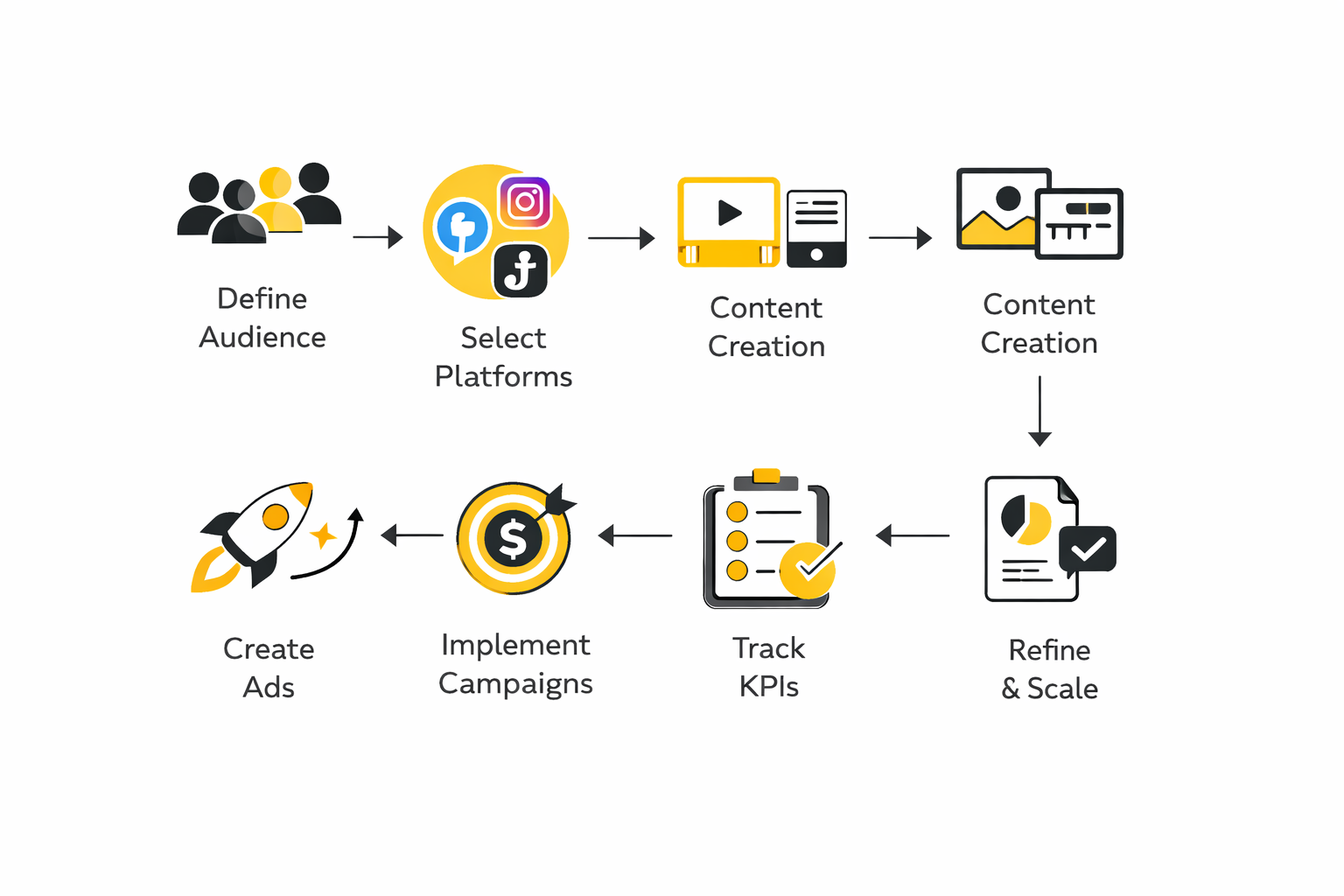
- Start with listening and demand mapping. A capable agency begins by reviewing comments, DMs, creator content, product reviews, support tickets, and on-platform search behavior to understand what people actually care about. That matters because Deloitte found 48% of consumers follow brands on social when those brands understand their interests, needs, and preferences. This is also where social listening tools and planning systems earn their keep, whether the workflow runs through something lightweight like Flick or a broader stack that combines listening, planning, and CRM. Deloitte
- Turn recurring audience questions into content pillars. The next step is to organize the feed around a handful of repeatable themes such as use cases, objections, comparisons, founder perspective, community stories, social proof, and product education. This sounds basic, but it stops the team from chasing every trend and helps keep the content tied to commercial goals. Sprout’s 2025 Index messaging around trend-chasing is a useful warning here, because social users are increasingly punishing brands that force themselves into irrelevant moments instead of saying something useful. investors.sproutsocial.com
- Build a creator system, not one-off influencer deals. The right process includes creator sourcing, outreach, brief templates, shipping, usage-rights tracking, publishing schedules, and performance reviews. Simple operational tools like Fillout for intake, Cal.com for coordination, and Copper or HighLevel for relationship tracking can keep this from turning into spreadsheet chaos. The goal is to create a dependable stream of believable content that can live on creator pages, brand channels, paid ads, and conversion pages at the same time. Deloitte+1
- Publish with a response layer already in place. This is where a lot of teams break the system by treating posting and replying as separate jobs. If consumers expect brands to respond quickly and personally on social, publishing without a response workflow is incomplete execution. Messaging tools such as ManyChat, Chatbase, and HighLevel AI can help with triage and capture, but the replies still need human judgment when stakes are high or nuance matters. Sprout Social+1
- Move the strongest signals into owned channels fast. Organic reach is valuable, but it is still rented attention. The process should push warm traffic into email, SMS, quizzes, consultations, or post-click journeys where the brand controls the follow-up, which is why systems like Brevo, Buffer, and HighLevel become part of the operating stack instead of optional extras. This is the handoff that turns social engagement into something measurable and repeatable. Deloitte+1
- Review weekly, then recycle what proves itself. The agency should be looking at saves, shares, comments, creator engagement quality, inbound message themes, assisted conversions, and the performance of repurposed assets in paid campaigns. Winning social programs compound because they keep reusing what the audience already validated, rather than reinventing the strategy every week. That feedback loop is one of the clearest differences between content operations that feel busy and content operations that actually grow revenue. blog.hubspot.com+1
This operating model is what makes social feel coordinated instead of chaotic. Organic content attracts the right attention, creators add proof, community management removes friction, and owned-channel capture prevents all that demand from evaporating after the scroll. The next part of the guide moves into the infrastructure underneath all of this, because even strong social demand will underperform if the conversion path, retention system, and measurement model are weak.
Conversion Infrastructure, Retention, and Measurement
The easiest way to make social look successful is to stare at the top of the funnel and stop there. Reach looks impressive, engagement feels encouraging, and platform dashboards are built to keep your eyes on what happened inside the app. The problem is that an ecommerce social media marketing agency does not get paid to create screenshots of momentum. It gets paid to help a brand turn attention into profitable customer behavior.
The Numbers That Actually Matter
The first benchmark is not a CPM, a hook rate, or a follower count. It is the gap between strategic importance and commercial proof. Deloitte found that 96% of social-first brands treat social commerce as a high or very high priority, but only 39% say it is delivering high ROI, while the same research shows more mature social-commerce brands generate 14.4% of B2C revenue from social commerce compared with 10.5% for low-maturity brands. That is the real benchmark to care about: whether social is becoming a material revenue contributor, not whether a few posts beat last month’s engagement rate. Deloitte
The second benchmark is contribution across the journey, not isolated last-click credit. DataReportal’s 2025 brand-discovery research shows the typical adult internet user discovers brands through 5.8 different sources, with social media ads at 29.7% and brand websites at 25.8%. In plain English, social rarely works alone, which means any agency using a single-touch view to judge social performance is probably undercounting what the channel actually started or accelerated. DataReportal – Global Digital Insights+1
The third benchmark is friction after intent appears. Deloitte found that 71% of consumers rated their most recent social purchase experience as good or excellent, but 34% said an even easier payment process would make them more likely to buy on social platforms, and 46% said customer reviews make them more likely to purchase on social. Those numbers matter because they point to action, not just observation: reduce checkout friction, move proof closer to the decision, and stop assuming that demand generation is the only thing holding performance back. Deloitte
Build an Analytics System That Matches the Journey
A good analytics setup mirrors how people actually buy. Someone sees a creator clip, taps through from an ad, reads comments, visits a product page, leaves, comes back from search, and buys three days later. Google’s guidance on attribution makes the same point directly: customers often interact with multiple marketing channels before converting, and data-driven attribution is the default and most recommended model for understanding that journey. Google Business
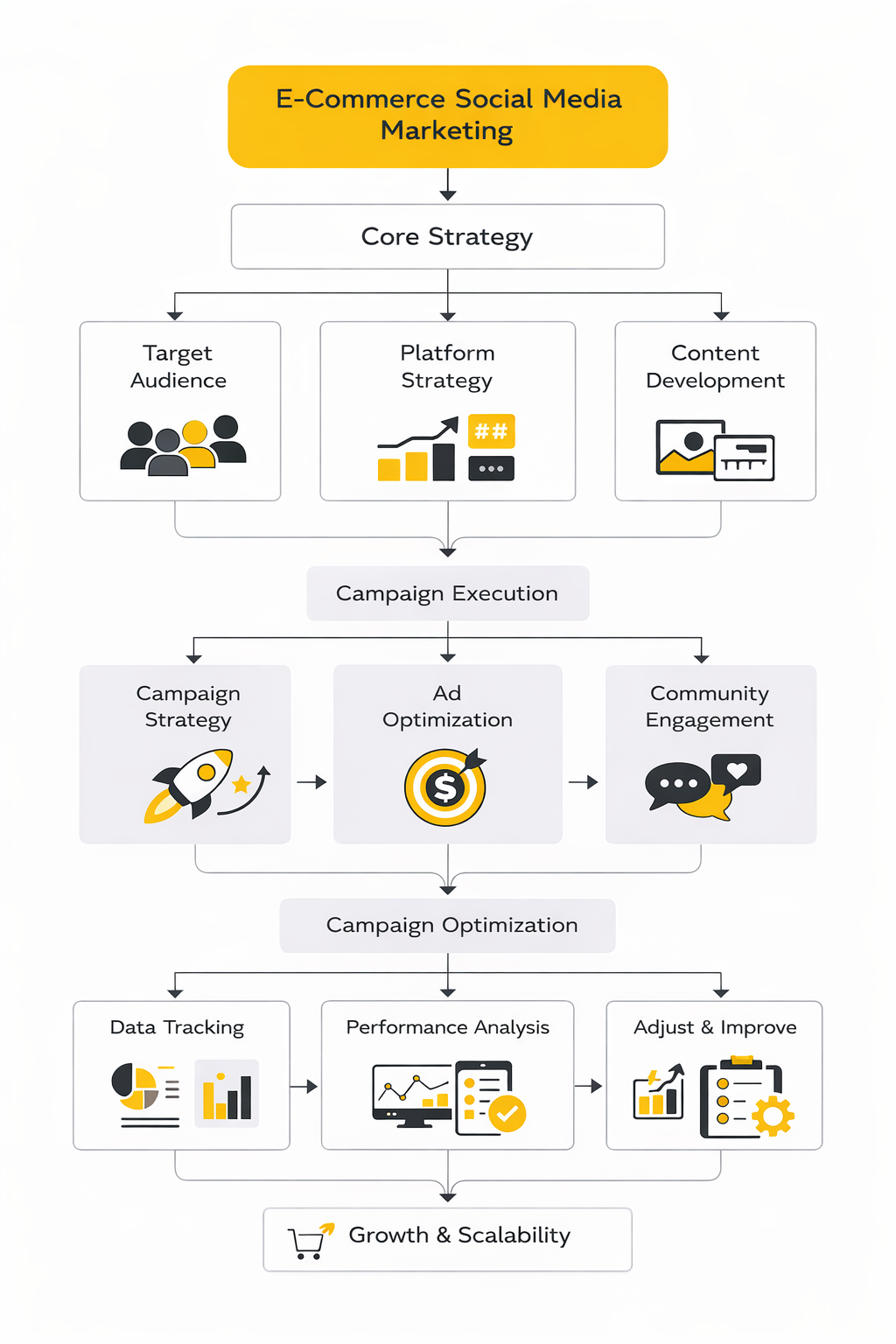
- Track platform delivery metrics for signal quality. Use reach, frequency, click-through rate, outbound clicks, view-through trends, saves, shares, and comment quality to understand whether the creative is earning attention or just buying impressions. These metrics are useful, but only as leading indicators. They tell you whether the message is landing, not whether the business model is improving.
- Track site behavior with full ecommerce events. Google Analytics recommends implementing ecommerce events because they let you understand specific parts of store behavior, and its ecommerce documentation explicitly calls out events like add_to_cart and purchase so you can see where shoppers move forward or drop off. If those events are missing or unreliable, the agency is guessing about what happened after the click. Google for Developers+1
- Use attribution to measure contribution, not just closure. Google’s attribution guidance explains why last-click views can distort decision-making when buyers touch several channels before purchase. For ecommerce brands, that means social should be evaluated for the demand it initiates, nurtures, and assists, not only for the final click that gets recorded in a cleaner channel. Google Business
- Connect social data to retention and service data. Sprout Social found that 65% of marketing leaders want direct connections between social campaigns and business goals, 52% want measurable cost savings across social channels, and 45% want better visualizations of social data. That only happens when social reporting connects to the systems that own follow-up, support, lifecycle messaging, and customer records, whether that stack runs through HighLevel, Brevo, ManyChat, or a similar setup. Sprout Social
How to Read the Core Signals Correctly
The smartest agencies do not treat every weak result as a media problem. If click-through rate is healthy but add-to-cart rate is soft, the issue is often message-to-page continuity, product clarity, or weak proof rather than audience targeting. If add-to-cart is strong but purchase completion is weak, the more likely suspects are checkout friction, shipping surprises, or poor payment flow, which fits Deloitte’s finding that easier payment would lift purchase intent for a meaningful share of shoppers. Deloitte+1
The same logic applies to organic and community data. A rise in comments, DMs, and tagged posts can be commercially valuable even before revenue catches up, because those are often signals of objection, curiosity, or buying intent that have not yet been captured cleanly in the dashboard. That is why a strong ecommerce social media marketing agency reviews interaction patterns alongside ecommerce events, rather than forcing every insight into one last-click report.
Customer care belongs in that same measurement loop. Sprout Social’s 2025 Index reporting says 73% of social media users expect brands to respond on social within 24 hours, 70% expect personalized responses, and later Sprout analysis says 73% say they will buy from a competitor if a brand does not respond on social. Once you see those numbers together, first-response time stops looking like a support metric and starts looking like a revenue-protection metric. Sprout Social+1
Benchmarks That Should Trigger Action
A useful benchmark should tell the team what to do next. If social is driving reach but not efficient site behavior, the creative or offer likely needs work. If the traffic behaves well but checkout completion lags, the conversion path needs simplification, stronger reviews, or a better page experience, which is exactly where faster storefront tools like Replo help agencies move quickly without waiting on long dev cycles.
The best internal benchmarks are usually trend-based rather than generic industry averages. Track whether creative fatigue is speeding up, whether landing-page conversion rate is improving after message alignment, whether response times are shrinking, whether first-order buyers from social are becoming repeat buyers, and whether assisted revenue from social is growing as a share of total ecommerce revenue. Those are the numbers that reveal whether the system is getting stronger or just louder.
That is the difference between reporting and measurement. Reporting tells you what happened on the surface. Measurement tells you which part of the system deserves more budget, which part needs repair, and whether your agency is actually building a more durable ecommerce growth engine.
How Professional Agency Execution Creates Compounding Growth
By this point, the question is not whether social can generate demand for an ecommerce brand. The real question is whether the system keeps getting stronger as spend rises, creator volume increases, and more revenue starts depending on faster execution. That is exactly where a professional ecommerce social media marketing agency earns its keep, especially now that IAB says U.S. creator ad spend is projected to reach $37 billion in 2025, up 26% year over year, and 48% of ad spenders rank creators as a “must buy”. IAB
Compounding Starts When One Asset Does More Than One Job
The biggest shift at the advanced level is simple: winning brands stop making one-off social assets and start building reusable commercial assets. IAB’s 2025 creator report shows brands are already using creator campaigns for multiple goals at once, with 43% focused on brand awareness, 41% on reaching new audiences, 35% on trust and reputation, and 32% on online sales or conversions. That matters because the agency that treats one creator brief as a source for paid ads, organic clips, landing-page proof, email content, and retargeting hooks will usually outrun the agency that keeps reinventing the wheel every week. IAB
In practice, compounding happens when the team builds around repeatable modules. A strong creator video can become a paid social asset, a product page proof block, a FAQ answer, a customer-service response template, and a retention email angle without losing the original message. That is how social starts behaving like an operating system rather than a content calendar.
The Smartest Agencies Reduce Platform Dependence
One of the easiest ways to get trapped during scale is to confuse platform momentum with business security. DataReportal found that the typical adult internet user discovers brands through 5.8 different sources, that social media ads account for 29.7% of discovery, and that no single source introduces brands to more than one-third of adult internet users. Its broader takeaway is even more useful for operators: a mix of digital advertising channels still reaches only about two-thirds of connected users, which means platform scale is powerful but never complete. DataReportal – Global Digital Insights
That is why mature agencies push hard to turn rented attention into owned demand. The job is not finished when a shopper clicks or comments; the job is finished when that interest gets pulled into a system the brand controls through email, SMS, chat capture, repeat-purchase flows, and customer records. Tools like ManyChat, Brevo, and HighLevel matter here because they help convert social activity into something the brand can follow up on without begging the algorithm for another chance.
Standardize Compliance Before You Scale Creator Volume
Scale creates more exposure, but it also creates more ways to get sloppy. The FTC’s guidance is blunt on two points that agencies cannot afford to ignore: creators need to clearly disclose their relationship to a brand when a material connection exists, and businesses that feature reviews need processes that help ensure those reviews reflect feedback from genuine customers rather than manipulated or fake input. IAB’s 2025 creator report points to the same operational reality from another angle, warning that as creator budgets grow, the industry still faces concerns around lack of standardization. Federal Trade Commission+1
This is where expert agency work looks a lot less glamorous and a lot more valuable. Rights management, usage windows, disclosure rules, creator approval flows, naming conventions, paid-usage permissions, and review-verification processes all become growth levers once volume increases. Even a lean stack built around Fillout for intake, Cal.com for coordination, Copper for relationship tracking, and a compliance workflow that the team actually follows can prevent expensive messes later.
Creative Discipline Beats Trend Chasing
Advanced execution is not about reacting faster to every meme on the internet. Sprout Social’s 2025 Index research found that 93% of consumers think it is important for brands to keep up with online culture, but a third think jumping on viral trends is embarrassing, and 27% think trend participation is only effective within 24 to 48 hours. TikTok’s own 2026 workflow update points in the same direction by centralizing creative planning in TikTok One, including insight tools built around real-time trends, audience behavior, and brand perception rather than random guesswork. investors.sproutsocial.com+1
The action this should drive is more discipline, not more speed for its own sake. Strong agencies keep a living bank of hooks, objections, creator formats, product angles, and offer types so they can respond to culture when it fits the brand without letting culture hijack the brand. Planning tools like Buffer and Flick help, but the real edge is editorial judgment: knowing which moments reinforce brand positioning and which ones just create noise.
Margin Resilience Is the Real Scaling Test
A lot of social programs look healthy until budget goes up. That is when weak systems get exposed, because more spend amplifies every flaw in creative quality, landing-page continuity, creator matching, and measurement discipline. Platform teams are responding by moving creator activity closer to ad infrastructure itself: YouTube says Creator Partnerships now plugs into YouTube Studio, Google Ads, and Display & Video 360, gives brands access to more than 3 million creators in the YouTube Partner Program, and supports lift-based measurement instead of simple post-level reporting. blog.youtube
That direction matters more than any single platform feature. It signals that agencies need to think in terms of contribution margin, conversion lift, creative reusability, and long-term value instead of judging success by a few short-lived wins inside one dashboard. If the system only works when spend is low, creator costs are cheap, and the founder is still manually approving everything, it is not really a scalable growth engine.
What Expert Buyers Ask Before They Scale With an Agency
The most sophisticated buyers do not ask an agency for more posts, more creators, or more dashboards. They ask whether the operating model will still hold together when the brand doubles content volume, enters a new market, or needs to defend margin during a softer quarter. That mindset changes the buying process completely.
- What part of the system do you actually own? The right answer should cover creative testing, creator operations, paid amplification, post-click alignment, reporting logic, and handoff into retention.
- How do you turn winning content into reusable assets? If the agency cannot explain how one strong piece of creative gets reused across paid, organic, onsite, and lifecycle channels, it is probably still working in one-offs.
- How do you manage usage rights, disclosures, and review integrity? This is not admin work on the side. It is part of protecting performance and avoiding trust damage.
- What metrics do you use to decide whether to scale, fix, or cut a campaign? The answer should go beyond vanity metrics and get into margin, conversion quality, assisted revenue, and repeat-purchase behavior.
- What becomes stronger after six months with you? Better agencies leave behind systems, libraries, playbooks, and institutional knowledge. Weak agencies leave behind dependency.
That is the real dividing line. A mediocre ecommerce social media marketing agency can help a brand get louder for a while. A strong one makes the whole commercial engine more durable, more measurable, and harder to disrupt when the market gets noisy.
The System That Holds Together at Scale
The brands that win with an ecommerce social media marketing agency usually stop thinking in channels and start thinking in connected systems. Discovery is fragmented across an average of 5.8 different sources, while Deloitte’s 2025 research shows the strongest social-first brands are organizing around community, content, and conversion instead of treating each one as a separate workflow. That means the real goal is not more posting or more ad sets. The goal is a loop where content earns attention, creators add proof, community removes friction, conversion paths capture demand, and retention systems keep the economics healthy. Deloitte+1
That system is getting more integrated, not less. Meta keeps pushing AI-led campaign optimization through Advantage+, TikTok is consolidating creator and creative workflows inside TikTok One, and YouTube’s new Creator Partnerships moves creator discovery and amplification closer to the ad stack itself. The practical takeaway is that agencies need stronger operating discipline now, because the platforms are making scale easier for teams that already know how to feed the system with better creative, cleaner signals, and sharper measurement. TikTok For Business+2
A lean team can still build that operating layer without turning the stack into a mess. Tools like Firecrawl, Guideless AI, Anything.link, ScaledMail, and Wispr Flow can help keep research, workflow, documentation, outreach, and internal coordination tighter as the program grows. The point is not to collect software for its own sake. The point is to make the social commerce machine easier to run, easier to measure, and harder to break.
FAQ for the Complete Guide
What does an ecommerce social media marketing agency actually own?
A serious ecommerce social media marketing agency should own much more than posting and ad buying. Deloitte’s 2025 work makes the right model pretty clear: the strongest social-first brands are investing across community, content, and conversion at the same time, because that is how social starts affecting real commerce instead of surface-level engagement. In practice, that means strategy, creative testing, creator operations, community response, paid amplification, post-click alignment, and reporting should all connect instead of living in separate silos. Deloitte
When is the right time to hire one?
The right time is usually when the brand has enough traction to prove there is demand, but not enough internal bandwidth to coordinate creative, paid media, creators, customer response, and measurement at a high level. Social commerce is already a meaningful market, with Shopify pointing to nearly $80 billion in U.S. social commerce retail earnings in 2025, so waiting until social is “more mature” is usually the wrong frame. The better question is whether your team can build a repeatable system on its own without slowing growth or wasting ad spend. Shopify
Which platforms deserve the most attention right now?
There is no universal answer, but there is a reliable starting point. HubSpot’s 2025 social media marketing report puts Instagram at the top for site traffic, engagement, and audience growth, while DataReportal’s 2025 brand-discovery data shows discovery is spread across many touchpoints rather than dominated by one platform. That means the smartest agency does not ask, “Which platform is best?” It asks, “Which platform should do which job for this specific brand?” blog.hubspot.com+1
Is paid social more important than organic social?
Treating paid and organic as competitors is one of the most expensive mistakes in this category. Social media ads account for 29.7% of brand discovery, but recommendations and comments on social platforms still influence discovery for another 23% of consumers, which means both paid distribution and public proof matter. Paid social buys speed, while organic social and community build belief. The system works best when paid amplifies messages the audience has already shown it trusts. DataReportal – Global Digital Insights+1
Do creators still matter for smaller ecommerce brands?
Yes, and arguably even more than many smaller brands realize. Deloitte found that 83% of consumers see the creators they follow as trusted sources of information, while IAB’s 2025 creator research says 48% of ad spenders now consider creators a “must buy”. The lesson is not that every brand needs celebrity talent. It is that believable product proof from the right voice often outperforms brand-made claims, especially when the budget is too small to brute-force attention with spend alone. Deloitte+1
What KPIs should I ask an agency to report every month?
Ask for a mix of leading indicators and commercial outcomes. Google’s ecommerce guidance makes it clear that events such as add_to_cart and purchase are essential if you want to understand where shoppers advance or stall, while Google Ads explains that data-driven attribution is designed to credit conversions based on how people interact with multiple ads and touchpoints. That means a good monthly report should include creative signal quality, site behavior, conversion flow, assisted revenue, new-customer mix, and retention impact instead of a single platform ROAS number pretending to explain the whole business. Google for Developers+2
How long should I give the strategy before I judge it?
You should expect early signal quickly and durable proof more slowly. Platform metrics and site-behavior changes can show up in the first testing cycles, but the full revenue picture is naturally slower because buyers discover brands through multiple touchpoints and do not always purchase on the first interaction. The fairest way to judge an agency is to look for progress in creative quality, message-to-page alignment, conversion behavior, and attribution clarity before demanding that every commercial effect be fully visible overnight. DataReportal – Global Digital Insights+1
Should the agency also manage comments and DMs?
In most ecommerce categories, yes. Sprout Social’s 2025 Index reporting says 73% of social media users expect brands to respond on social within 24 hours, and 70% expect personalized responses, which turns community management into a revenue and trust function, not just a support task. If an agency is creating demand in public but no one is handling objections, product questions, and pre-purchase friction in public, the system is incomplete. Sprout Social
Can AI replace the agency?
AI is becoming part of the operating stack, but it is not a substitute for commercial judgment. HubSpot found that 56% of marketers are already using AI to create short-form video, while Meta, TikTok, and YouTube are all pushing AI deeper into optimization, creator matching, and creative workflows through products like Advantage+, TikTok One, and Creator Partnerships. That changes the job, but it does not erase it. The advantage moves toward teams that can use AI to increase creative volume and workflow speed without losing strategic taste, brand control, or measurement discipline. blog.hubspot.com+3
What are the biggest red flags before I sign with an agency?
The first red flag is shallow reporting. If the agency talks almost entirely about reach, followers, and platform-native ROAS without discussing ecommerce events, attribution, contribution margin, or repeat-purchase behavior, it is probably not managing the business deeply enough. The second red flag is weak governance around creators, disclosures, and reviews, because the FTC’s guidance makes it clear that brands need honest disclosures of material connections and legitimate review practices rather than shortcuts that can damage trust later. Google for Developers+3
Should I choose a specialist ecommerce agency or a general social media agency?
If social is expected to influence revenue, merchandising, lifecycle capture, and customer experience, a specialist usually has the better operating model. Ecommerce work needs tighter coordination between paid media, creators, landing pages, offers, reviews, retention flows, and analytics than a general awareness-focused social program. That does not mean every generalist agency is weak. It means the more your brand depends on profitable conversion rather than simple reach, the more valuable ecommerce-specific experience becomes.
Work With Professionals
Explore 10K+ Remote Marketing Contracts on MarkeWork.com
Most marketers spend too much time chasing clients, competing on crowded platforms, and losing a percentage of every project to middlemen. MarkeWork gives you a better way. Browse thousands of remote marketing contracts and connect directly with companies desperate to hire skilled marketers like you, without platform commissions and without unnecessary gatekeepers. markework.com
If you're serious about finding better opportunities and keeping 100% of what you earn, explore available contracts and create a profile for free at MarkeWork.com.