

An ecommerce social media marketing agency used to be judged by posting consistency, follower growth, and whether the feed looked polished. That is not the job anymore. Today, the real job is to turn attention into revenue across creative, paid media, creators, landing pages, direct messages, retention, and reporting without letting the whole thing become a messy, expensive guessing game.
The opportunity is big enough that brands cannot treat social like a side channel. DataReportal and We Are Social both put global social media usage at 5.24 billion identities in early 2025, while McKinsey and Shopify both point to a U.S. social commerce market hovering around $80 billion in 2025. At the same time, the buyer journey is getting less linear, not more, with Google showing 64% of U.S. holiday shoppers blending scrolling, streaming, searching, and shopping and consumers moving through more than 130 mobile touchpoints a day.
This article breaks down what the best agencies are really doing, what a workable framework looks like, and where most ecommerce brands waste time and money.

Article Outline
A serious agency relationship only works when both sides are clear on the system, not just the services. That means knowing why the work matters, what framework holds it together, which moving parts actually drive results, and how execution should look when the team is good. The rest of this article follows that structure so each section builds on the last one instead of repeating the same generic advice.
- Why Ecommerce Brands Need Social Media Marketing Agencies Now
- The Social Commerce Framework That Connects Content, Paid Media, and Conversion
- What an Ecommerce Social Media Marketing Agency Actually Does
- The Core Components of High-Performing Agency Execution
- What Professional Implementation Looks Like in Practice
- How to Choose the Right Agency, Set KPIs, and Scale
Why Ecommerce Brands Need Social Media Marketing Agencies Now
The short answer is complexity, but that word hides the real issue. Social is now part storefront, part search engine, part ad network, part customer service desk, and part word-of-mouth machine. A brand can get reach and still lose money if the offer is wrong, the landing page is weak, the comments are unmanaged, the creators are misaligned, or the follow-up never happens.
That gap between effort and outcome shows up in the data. Deloitte Digital found that social budgets rose by an average of 9% from 2023 to 2024, yet brands were meeting only 69% of their social media business objectives. That tells you something important: more activity does not automatically produce better performance.
Consumer expectations make the challenge even sharper. In Emplifi’s 2025 social engagement study, 58% of consumers said it is important to see brands respond to customers on social, 65% said user-generated content influences them more than celebrity content, and 60% said a discount or promotion triggered the purchase. That is not a simple content calendar problem. That is an operating model problem.
The scale of the platforms makes specialization even more necessary. Facebook still reports 2 billion daily active users and says it has more than 40 million daily active young adults in the U.S. and Canada, YouTube Shorts now averages more than 200 billion daily views, and TikTok says shoppers on TikTok Shop in the U.S. have nearly tripled every month since launch while merchants generated $100 million in Black Friday sales. No single playbook works across all of that.
This is where a good ecommerce social media marketing agency earns its fee. It does not just make content look busy. It builds a system that connects community, content, and conversion in the same way Deloitte’s strongest social-first brands are already doing.
The Social Commerce Framework That Connects Content, Paid Media, and Conversion
The cleanest way to think about modern agency work is as a three-layer system. First, the brand earns attention. Then it captures intent. Then it turns that intent into repeatable revenue through follow-up, retention, and better customer experience. Miss one layer and the rest of the machine underperforms.
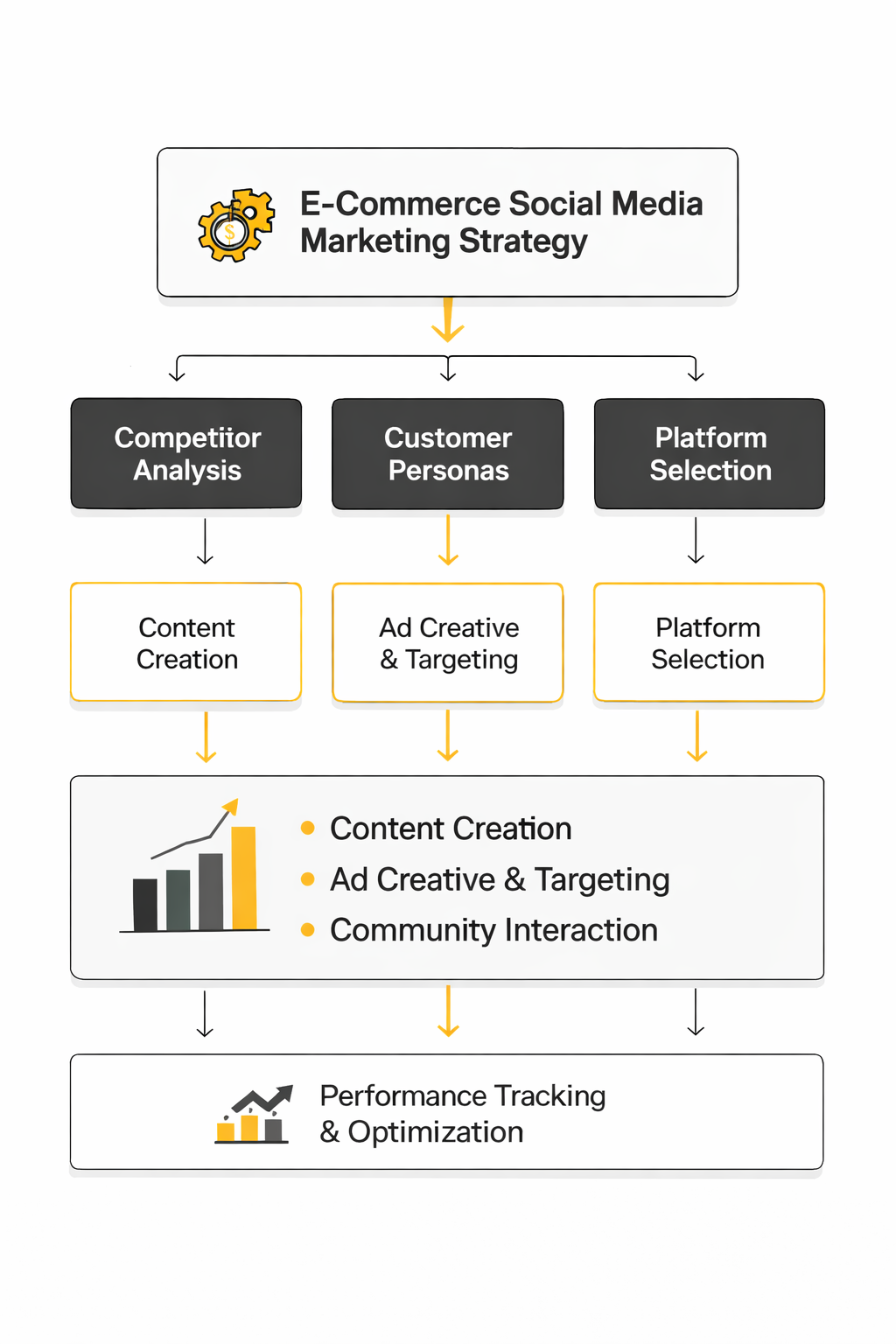
Attention Layer
This is where most brands spend too much time on aesthetics and not enough on signal. The point is not to publish more. The point is to create platform-native creative that earns a stop, gives a buyer a reason to care, and makes the next step obvious.
That matters because social is now a real discovery engine. Sprout Social’s 2025 research found that 76% of users said social content influenced a purchase in the last six months, and Shopify’s social commerce strategy research notes that almost one in four consumers now use platforms like TikTok and Instagram to search for new products. A capable agency builds creative for discovery, not just for brand consistency.
Conversion Layer
Attention alone is cheap. Conversion is where the real work begins, because buyers need confidence before they buy. Google’s current retail research frames that confidence around three things: price, product confidence, and purchase convenience, and that is a useful standard well beyond the holiday season.
A strong agency treats every campaign like a path, not a post. That usually means tighter offer design, clearer product proof, faster landing-page testing, comment-to-DM automation, and cleaner handoff into checkout or lead capture. In practice, tools like ManyChat help turn comments and direct messages into structured buying conversations, while Replo helps ecommerce teams launch and test landing pages fast enough to keep up with winning ad angles.
Retention Layer
This is the layer weak agencies ignore because it is less visible on the feed. That is a mistake. Social does not stop mattering after the first sale, because customers come back to social for reassurance, service, validation, and a reason to buy again.
The retention layer also protects margin. Emplifi’s 2025 findings show that roughly one-third of customers expect a DM reply within an hour, and 67% prefer a human response over AI when it matters. Agencies that take retention seriously connect paid media, customer conversations, and CRM workflows, often using platforms like HighLevel to centralize follow-up, nurture, and reporting instead of leaving revenue stranded between tools.
That is the framework in plain English. A good agency helps a brand get seen, get chosen, and get remembered. The next step is to unpack what that agency actually owns day to day, because this is where the difference between a real growth partner and a content vendor becomes impossible to miss.
What an Ecommerce Social Media Marketing Agency Actually Does
A real ecommerce social media marketing agency is not just a content team with ad account access. It is the group responsible for connecting channel strategy, creative production, media buying, creator partnerships, conversion paths, retention flows, and measurement into one commercial system. That matters because social performance falls apart fast when content, ads, product pages, and follow-up are all handled in separate silos with different goals and different definitions of success. Sprout Social+2
It Turns Strategy Into a Revenue Plan
The first job is deciding what social is supposed to do for the business. Some brands need efficient customer acquisition, some need stronger new-product launches, and some need better repeat purchase economics because their first-order margin is already too thin. When the agency is good, it builds social around business outcomes instead of hiding behind vanity metrics, which matters even more in a market where 65% of leaders want direct links between campaigns and business goals while only 30% of marketers say they can measure social ROI well. Sprout Social
It Builds the Creative Engine, Not Just the Creative Assets
Most brands think they need better ads when what they really need is a better creative operating system. The agency should be sourcing hooks, angles, customer language, founder points of view, creator content, product proof, and offer variations, then turning those into a steady stream of assets that can be tested and reused across organic and paid placements. That approach lines up with where platform performance is going, because Meta’s current guidance leans hard on creative optimization and Shopify’s current ecommerce playbooks keep emphasizing user-generated content and authentic creator-led content as conversion tools rather than just awareness tools. Facebook+2
It Manages Creators Like a Performance Channel
This is where weak agencies usually get exposed. They treat creators like a branding extra, send vague briefs, and hope something goes viral, while better teams treat creators as a structured acquisition and proof channel with clear usage rights, testing plans, and amplification strategy. That is the right direction because Shopify’s latest guidance says trust rises when creator content feels honest rather than scripted, with 79% of respondents in the 2025 Influencer Trust Index valuing authentic reviews and 71% valuing transparency about partnerships, and Instagram keeps pushing creator partnerships as a direct commerce lever inside its business tools. Shopify+2
It Owns the Path From Social Click to Purchase
A post or ad is only one step in the sale. After the click, the agency should be shaping the landing page, product-detail flow, offer framing, checkout friction, and post-click message sequence so the buyer does not lose confidence right when they are close to purchasing. That work matters because Google’s current retail research says buyers validate purchases through price, product confidence, and convenience, while Shopify continues to highlight checkout customization and post-purchase upsells as practical levers for improving revenue per visitor and average order value. Google Business+1
It Connects Community and Messaging to Conversion
Social is no longer just a broadcast channel, and agencies that still act that way are behind. Meta’s business tools now explicitly support ads that click into Instagram Direct, Messenger, and WhatsApp, and even allow third-party message flows to qualify and route conversations, which is exactly why conversational commerce is now part of serious ecommerce execution. In practice, that is where a tool like ManyChat becomes useful, because it helps turn comments and direct messages into structured journeys instead of leaving warm intent buried in a crowded inbox. Facebook+3
It Measures What Happened and What Happens Next
The final job is measurement, but not in the old shallow sense of reporting spend, clicks, and ROAS in a pretty deck. The agency should be improving event quality, attribution hygiene, creative learnings, cohort behavior, and repeat purchase visibility so the brand can decide what to scale with confidence. That means using tracking infrastructure like the Meta Pixel and Conversions API, and it often means centralizing follow-up and customer data in a CRM stack such as HighLevel so performance does not stop at the first sale. Facebook+3
The Core Components of High-Performing Agency Execution
Once you strip away the pitch deck language, strong agency performance usually comes down to a small number of components done extremely well and done consistently. These components are not glamorous, but they are the difference between a brand that keeps paying to learn the same lesson twice and a brand that compounds wins over time. This is also the point where an ecommerce social media marketing agency stops looking like a vendor and starts acting like an operating partner. Sprout Social+1
Creative Volume With Real Variation
High-performing teams do not just make more creatives. They make more useful variations across hooks, openings, creator faces, product demonstrations, testimonials, objections, offers, and calls to action so the platform has real options to learn from. That matters because the platforms themselves keep rewarding broader creative input, and the brands winning on social are rarely the ones running one polished hero ad for too long. Facebook+1
Social Proof That Feels Earned
A surprising amount of ecommerce creative still sounds like the brand talking about itself. The better approach is bringing in buyers, reviews, creator commentary, tutorials, before-and-after evidence, and community language that lowers skepticism without feeling forced. Shopify’s current UGC guidance highlights why this works, including evidence that shoppers who engage with user-generated reviews can convert 144% more often and generate 162% higher revenue per visitor, and its social selling guidance makes the same point more simply: people trust real customer experiences more than ads. Shopify+1
Fast Post-Click Testing
A lot of brands try to solve weak conversion by changing audiences first when the real problem sits on the page. Strong agencies test the bridge between the scroll and the sale, which means improving mobile layouts, product framing, bundles, review placement, checkout friction, and post-purchase offers as quickly as they test ad creatives. That is exactly why fast storefront tools such as Replo keep getting attention from ecommerce operators who need to launch and iterate pages without turning every small change into a development backlog. Google Business+2
Messaging and Retention Infrastructure
The best agencies do not stop at the purchase event because they know first-order economics can be deceptive. Shopify’s latest customer experience guidance stresses post-purchase communication, loyalty, and trust, and notes that 87% of shoppers are willing to pay more for a brand they trust. That makes retention infrastructure non-negotiable, whether the brand runs it through HighLevel, Brevo, or another stack that can handle segmentation, lifecycle flows, and repeat-purchase reporting cleanly. Shopify+1
Reporting That Produces Decisions
Bad reporting tells you what happened. Good reporting tells you what to do next. The agency should be able to say which messages are winning, which creators deserve more budget, which landing pages are leaking intent, where customer questions keep repeating, and which retention flows are lifting margin instead of just driving top-line revenue. Sprout Social+1
When those components are in place, the whole relationship changes. The brand stops asking whether social is working in general and starts asking where the next compounding gain is most likely to come from. That is the point where professional implementation becomes much easier to spot, because the work stops looking random and starts looking engineered. Sprout Social+1
What Professional Implementation Looks Like in Practice
Professional implementation is the point where an ecommerce social media marketing agency stops sounding impressive in a proposal and starts proving whether it can actually run growth. The best teams do not treat social as a batch of disconnected tasks like posting, boosting, replying, and reporting. They run it as one operating system that maps the customer journey, assigns each channel a role, removes friction between discovery and purchase, and reviews the work against business outcomes instead of activity for activity’s sake. Shopify+3
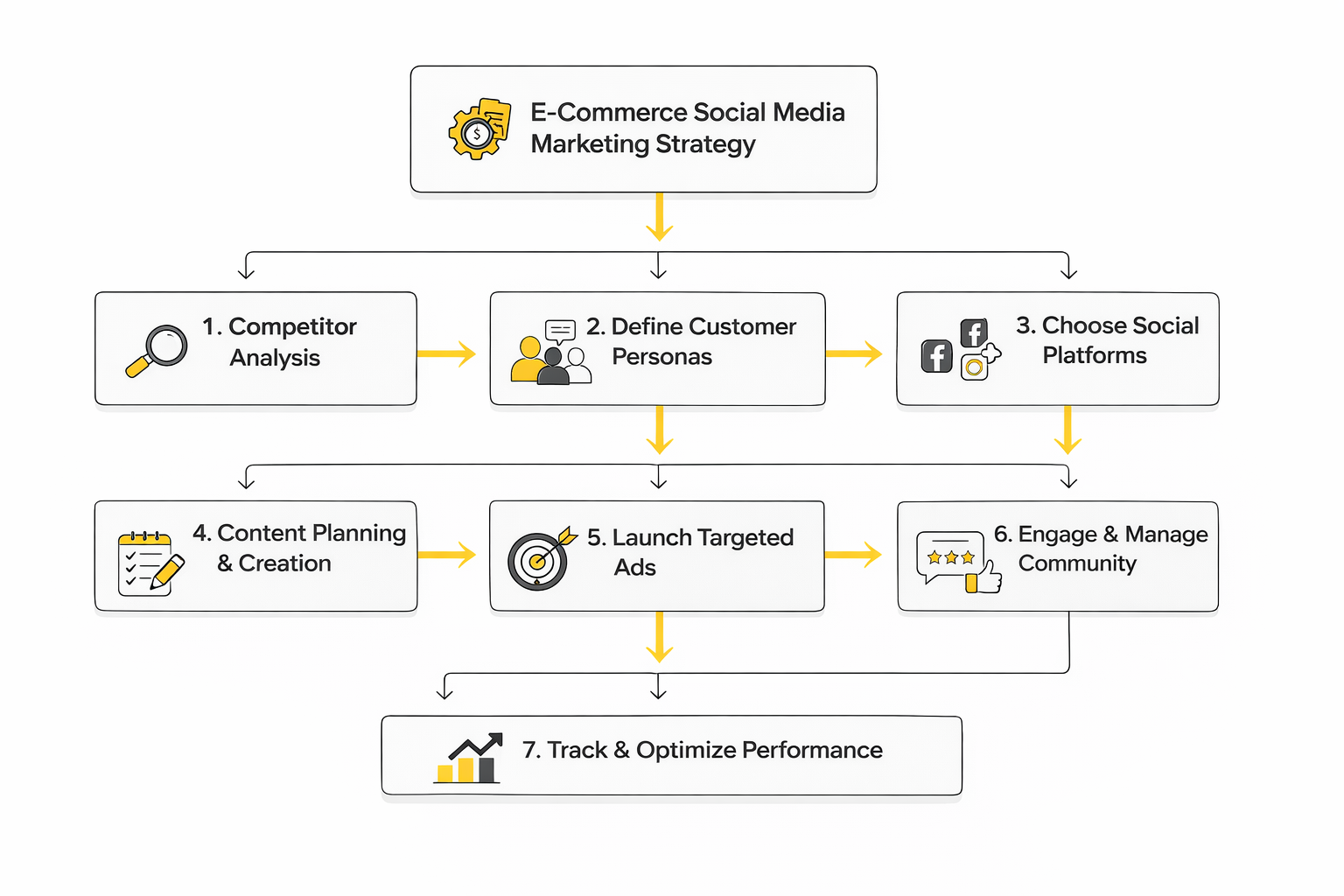
1. Start With a Commercial Diagnosis
The first step is not “make more content.” It is figuring out where revenue is leaking before the agency touches the content calendar or ad budget. That usually means auditing the hero products, offer strength, margin room, on-site conversion friction, checkout experience, and the moments where buyers lose confidence between seeing the product and actually paying for it. Google Business+2
That matters because the customer journey is no longer linear. Shopify’s current guidance on customer journey mapping stresses that buyers move through multiple microdecisions between first discovery and purchase, while Google’s current retail research keeps bringing the same three confidence drivers to the surface: price, product confidence, and purchase convenience. A good agency uses that reality to shape the diagnosis, because weak performance often comes from one broken transition rather than a weak channel overall. Shopify+1
This is also the right time to collect cleaner customer insight. A short post-purchase or abandoned-cart survey built with something simple like Fillout can reveal which platform introduced the buyer, what nearly stopped the purchase, and which objections still need better creative or better page copy. When agencies skip this step, they usually end up producing more content without getting much smarter. Shopify+1
The measurement setup belongs in this diagnosis phase too. Meta’s current documentation still treats the Pixel and Conversions API as foundational for cleaner signal flow, event sharing, and deduplication, which is exactly why serious agencies fix tracking before they scale spend. If the inputs are messy, the reporting will look more precise than it really is, and that is how brands keep funding the wrong conclusions. Facebook Developers+2
2. Give Each Channel a Clear Job
The next step is deciding what each platform is supposed to do. Shopify’s current social commerce strategy guidance is straightforward here: start with where your customers already spend time, where they already convert, and where the format matches the way your product needs to be understood. That sounds obvious, but plenty of brands still spread effort across too many channels and then wonder why nothing compounds. Shopify
In practice, that means assigning roles instead of chasing presence everywhere. One platform may be strongest for creator proof, another for scalable paid distribution, another for search-style discovery, and another for direct conversation. The exact mix changes by category, but the principle does not: channel choice should follow buyer behavior, not internal preference. Shopify+1
This is also where the agency decides how much friction the brand can remove inside the platform itself. Shopify’s current playbook emphasizes social checkout, shoppable content, creator collaborations, live shopping, and data refinement as practical social commerce levers, not abstract trends. When those pieces are aligned, the brand is not asking the buyer to restart the journey every time they move from content to commerce. Shopify+2
Creator strategy should be built into that channel plan from the start. Shopify’s influencer guidance focuses on selecting creators whose audience actually overlaps with the brand, and Instagram’s current business guidance frames creator marketplace and partnership ads as practical ways for brands to find collaborators and turn creator content into measurable paid distribution. That is a much better model than treating creator work like occasional brand seasoning. Shopify+1
3. Build a Weekly Creative Production System
Once the channel roles are clear, the agency needs a creative machine that produces useful variation every week. Shopify’s current social commerce guidance highlights formats like product demonstrations, unboxing videos, day-in-the-life content, and problem-solution hooks, which is a good reminder that strong creative is not about one polished brand film. It is about building a steady supply of angles that help buyers understand the product faster and trust it sooner. Shopify
That supply chain needs structure. A good ecommerce social media marketing agency is constantly pulling language from reviews, comments, support tickets, surveys, product questions, and creator feedback, then turning it into scripts, briefs, hooks, and retest ideas. For simpler scheduling and approvals, some teams use tools like Buffer, but the bigger advantage comes from the operating rhythm, not the scheduler. Shopify+1
Meta’s current performance marketing guidance keeps pushing the same direction: diversify creative, give the system real variation to work with, and use dynamic combinations where appropriate instead of relying on one tired control ad for too long. That fits what strong agencies do in the real world. They do not ask one asset to carry every audience, placement, and stage of awareness; they build a portfolio of assets that can be tested, iterated, and amplified. Facebook+3
4. Engineer the Path From Social Interest to Checkout
This is where execution becomes painfully tangible. If a post, creator asset, or ad gets attention but the next click leads to a weak page, a clunky checkout, or an offer that feels less convincing than the creative, the campaign is not underperforming by bad luck. It is underperforming because the path from interest to purchase was never engineered properly. Google Business+2
Shopify’s current social commerce guidance recommends enabling social checkout and shoppable content where it makes sense, precisely because redirecting shoppers into a more fragmented path creates friction. When the purchase still needs to happen on the website, the landing page has to carry forward the same promise the creative made: the price has to feel justified, the product proof has to be obvious, and the purchase experience has to feel easy enough to finish on a phone. That is exactly why page-speed and checkout improvements matter so much in agency execution. Shopify+2
This is also why fast page iteration matters. Tools like Replo are useful because they let growth teams test offers, bundles, social proof blocks, comparison sections, and mobile layouts without turning every landing-page idea into a development bottleneck. The agency should be able to move from “this ad angle is working” to “this page now matches that angle” in days, not in a future quarter. Shopify+1
For products that benefit from demonstration, the process can extend into live selling as well. Shopify’s current live-shopping guidance describes the format as real-time video with links, tags, or pinned comments that let viewers buy while they watch, and it emphasizes that the format works best when the experience feels interactive rather than overly polished. That is useful for agencies because it turns education, proof, urgency, and conversion into one event instead of four separate campaigns. Shopify
5. Connect Messaging, CRM, and Retention
A lot of buying intent now shows up in comments and direct messages before it shows up in checkout data. Shopify’s social commerce guidance explicitly recommends actively monitoring comments and DMs, and Meta’s current business tools support click-to-message campaigns plus third-party message flows that can send people into Instagram Direct, Messenger, or WhatsApp instead of a standard landing page. That makes messaging infrastructure part of implementation, not a nice extra. Shopify+2
This is the point where automation can help, as long as it stays useful. A tool like ManyChat can turn comments and DMs into structured flows for FAQs, product matching, offer reminders, and abandoned conversation follow-up, while a CRM layer such as HighLevel can hold those conversations, segment leads, and route post-purchase follow-up more cleanly. Meta’s current Conversions API documentation also now includes business messaging events, which matters because it allows messaging activity to become part of the measurement picture instead of sitting in a black box. Facebook Developers+2
Retention should be wired into this same system. Shopify’s current customer-experience guidance is clear that post-purchase touchpoints reinforce trust and drive repeat orders, and its retention guidance keeps framing repeat customers as the most profitable audience. That is why agencies that only optimize the first purchase usually hit a ceiling earlier than they expect. Shopify+1
For lifecycle work, the stack matters less than the handoff. Some brands will run email and SMS inside Brevo, some inside HighLevel, and some across a more custom setup, but the agency still needs to make sure welcome flows, post-purchase education, review requests, replenishment prompts, and win-back sequences reflect what actually happened on social. Otherwise the business keeps reacquiring customers it could have retained more profitably. Shopify+1
6. Run a Tight Weekly Learning Loop
The final piece is the operating rhythm. Shopify’s current social commerce guidance recommends using platform analytics and attribution data to refine content, storefront design, and conversion paths, while Sprout’s 2025 reporting research keeps stressing that leaders want social tied to concrete business goals. So the weekly review should answer a handful of hard questions: what message won, what creator or format scaled, where the click path broke, and what deserves the next round of budget and production. Shopify+2
That review should not look like a vanity dashboard. It should look like a decision document that compares creative themes, channel behavior, assisted conversions, customer questions, and post-click drop-off so the next sprint gets smarter. Shopify’s guidance on multichannel attribution is useful here because it acknowledges what operators already know: social often influences a sale before it gets direct credit for it. Shopify
This is the point where agency quality becomes obvious. The weak agency sends a report that explains what happened. The strong one explains what changed, why it changed, and what gets tested next so the brand can scale with less guesswork. Once you understand that implementation model, choosing the right partner and setting the right KPIs becomes much easier. Sprout Social+1
How to Read the Numbers That Matter
A smart ecommerce social media marketing agency does not win by producing more dashboards. It wins by making the numbers legible enough that the next decision is obvious. The job of measurement is to show whether social is attracting the right attention, turning that attention into orders, and doing it in a way that still leaves the brand with healthy economics after discounts, returns, and service costs. Shopify Help Center+2
Build One Measurement System Before You Chase Benchmarks
The first mistake brands make is comparing platform numbers that do not belong together. Shopify already separates the core commercial metrics that matter across channels, including sessions, conversion rate, average order value, attributed sales, orders, CAC, ROAS, device type, and new versus returning customers, which gives an agency a usable baseline for judging social as a revenue source instead of as a content stream. Shopify also treats fields and dimensions differently for a reason: metrics answer how much happened, while dimensions show where it happened, which is exactly how a reporting system stays useful instead of getting noisy. Shopify Help Center+2
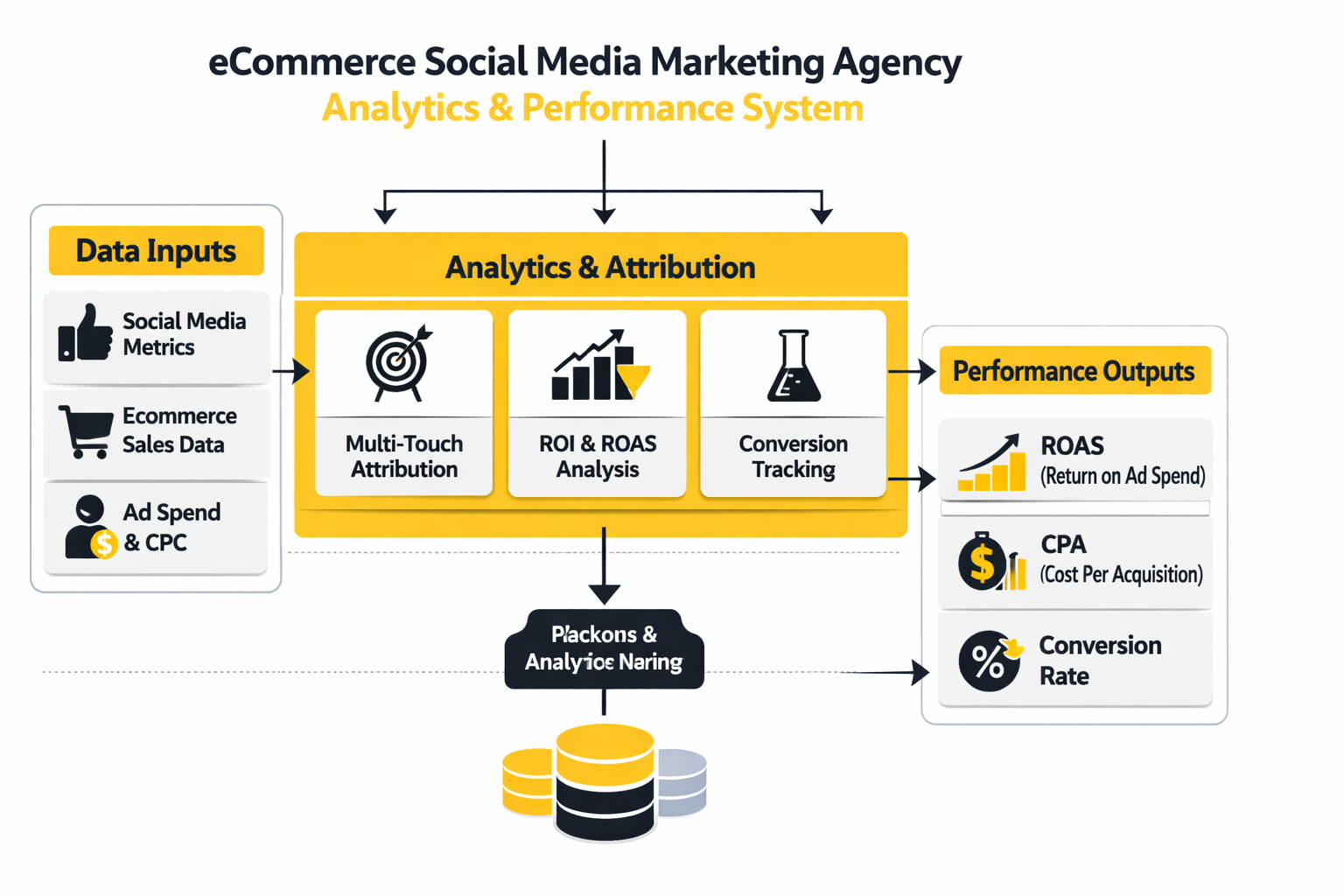
That baseline gets much stronger when event tracking is connected properly. Meta’s current Conversions API documentation describes it as a direct connection between marketing data and Meta’s optimization systems, and Meta’s developer docs note that the API now supports web, app, offline, and business messaging events, which matters because ecommerce journeys increasingly move between ads, site visits, and conversations instead of staying inside one click path. If a brand also needs a cleaner CRM view of those handoffs, a system like HighLevel can help keep lead, message, and order data from scattering across too many tools. Facebook+2
The action this should drive is simple: clean up definitions before judging performance. Decide what counts as a conversion, what time window matters, which traffic sources belong to social, and whether the team is optimizing for first purchase, net revenue, or customer lifetime value. Without that discipline, the agency ends up arguing over screenshots instead of improving the business. Shopify Help Center+2
Reach and Engagement Are Leading Indicators, Not the Final Verdict
Reach, impressions, and engagement still matter, but they are not the same thing as proof. Sprout’s 2025 ROI guidance is blunt on this point: the metrics social networks traditionally surface were not designed to prove business impact on their own, even though they still help show whether social is contributing to larger business goals. That is the right way to read them inside agency reporting, because a post that earns distribution and interaction is telling you something important about message fit long before it tells you anything definitive about revenue. Sprout Social
Benchmarks help most when they are used as context instead of as a scorecard. Sprout’s benchmark guidance recommends comparing performance against three types of benchmarks: industry, competitive, and personal, which is a much healthier model than obsessing over one generic average. It keeps the agency focused on whether the brand is improving against its own history, keeping pace with close competitors, and performing credibly inside its category. Sprout Social
This is also why benchmark reports can look contradictory without actually disagreeing. Rival IQ found engagement-rate declines across major platforms in its 2025 benchmark report, with Facebook down 36%, Instagram down 16%, and TikTok down 34%, while Sprout’s 2025 benchmark research found that average inbound engagements and average daily inbound engagements per post increased, and outbound engagement remained an underused growth lever at just two actions per day on average. Those findings can coexist because one report is focused on rate-based engagement and platform-level declines, while the other highlights how active brands are still creating more interaction when they produce better content and engage more deliberately. Rival IQ+1
The practical move here is not to panic when engagement rates fall in a crowded feed. Use reach and impressions to judge whether the content is getting distribution, use engagement per post to judge whether the message deserves another variation, and use outbound engagement to see whether the brand is actually behaving like a participant instead of a broadcaster. If those early signals are weak, scaling spend usually just buys more evidence of the same problem. Sprout Social+1
Conversion Metrics Tell You Whether Social Traffic Deserves More Budget
Once social traffic lands on the store, the measurement standard changes. Shopify defines online store conversion rate as the percentage of sessions that result in an order, and it breaks the funnel into concrete stages from landing on the site to adding to cart, reaching checkout, and completing payment. That is useful because it stops the agency from treating all underperformance like a targeting problem when the real issue may be product-page clarity, checkout friction, device experience, or price confidence. Shopify Help Center
A “good” ecommerce conversion rate still depends on context. Shopify’s current conversion guidance says global averages tend to sit around 2% to 3%, but it also stresses that traffic source, device mix, category, price point, subscription versus one-time purchase, checkout friction, and trust signals all shape the final number. So the action is not to demand one universal target across every campaign. It is to compare like with like: cold paid traffic against cold paid traffic, returning social visitors against returning social visitors, and mobile sessions against mobile sessions. Shopify+1
This is also where top-line sales can mislead the room. Shopify’s analytics field reference calls net sales the preferred approximation of actual revenue for most analyses, because it reflects discounts and sales reversals, and it defines gross margin as the percentage of sales that is profit after cost of goods sold. In plain English, that means an agency should not celebrate a campaign that inflates gross sales while crushing margin with discounts, low-value orders, or products that are expensive to fulfill. Shopify Help Center
If the post-click experience looks like the bottleneck, measurement should push action fast. Teams can use a rapid testing stack, and a page builder like Replo is useful when the goal is to match winning social hooks with landing pages, bundles, proof blocks, and mobile layouts without waiting on a long development queue. The data should make that handoff obvious: strong click-through with weak conversion usually points to a landing-page problem, while healthy conversion with weak average order value points to an offer or merchandising problem. Shopify Help Center+1
Retention, Customer Care, and Returns Are Profit Signals in Disguise
A lot of agency reports stop at purchase, which is exactly where they become least useful. Shopify’s retention guidance cites an average ecommerce repeat customer rate of 28.2%, and that is a helpful reminder that first-order performance tells only part of the story. A brand can buy a lot of new customers and still struggle if they do not come back often enough or if the margin on the first order is too thin to support the acquisition cost. Shopify
Social care belongs inside that measurement picture too. Emplifi’s 2025 consumer survey found that 58% of consumers think it is important to see brands respond to customers on social, roughly one-third expect DM replies within an hour, and 67% prefer a human response over AI when the issue matters. For an ecommerce agency, those are not soft brand metrics. They are conversion and retention signals, because unanswered comments, slow replies, and weak support create drop-off that never shows up clearly inside ad-level reporting. Emplifi+2
Returns make the same point even more brutally. Shopify’s 2025 returns guidance says the average ecommerce return rate reached 16.9% in 2024, meaning nearly 17 of every 100 products sold came back. So when a campaign appears to be scaling nicely, the next question should be whether the traffic is buying the right products for the right reasons, or whether the creative is overselling something the product experience cannot support. Shopify
One of the fastest ways to improve this part of reporting is to collect post-purchase and post-support feedback directly. A simple survey tool like Fillout can help brands learn what convinced the customer to buy, what nearly stopped the purchase, and what made them return or keep the product. That kind of feedback gives context to the metrics and helps the agency fix the message, not just the media plan. Shopify+1
What Good Reporting Should Actually Produce
Good reporting should create decisions, not admiration. Sprout’s 2025 research found that 65% of marketing leaders want direct connections between social campaigns and business goals, 52% want quantifiable cost savings, and 45% want better visualizations of social data, while Deloitte’s 2025 social research found budgets rose by an average of 9% from 2023 to 2024 even as brands were meeting only 69% of their social business objectives. That combination tells you exactly why agencies get scrutinized harder now: the appetite for investment is still there, but the tolerance for fuzzy reporting is not. Sprout Social+1
So the right weekly report is not a vanity document. It should answer which creative theme earned attention, which channel sent qualified traffic, where the funnel broke, whether new customers are becoming repeat customers, and whether net sales and margin justify more spend. Once the agency can answer those questions consistently, the next stage becomes much easier: choosing the right partner, setting sensible KPIs, and scaling without flying blind. Shopify Help Center+2
How to Choose the Right Agency, Set KPIs, and Scale Without Losing Profit
By this point, the difference between a serious ecommerce social media marketing agency and a noisy one should be clear. The serious one understands that social is not just content distribution. It is a growth system tied to customer acquisition cost, conversion rate, retention, creator economics, and the operational reality of the business behind the storefront. Shopify+2
Choose the Agency for Operating Fit, Not for the Broadest Pitch
A lot of brands still buy agencies the same way they buy software: by comparing feature lists. That is the wrong move. Shopify’s current agency-selection guidance is much more practical: determine what you actually need, consider your budget, ask who will work on the account, understand how communication works, clarify whether work is done in-house or outsourced, and review the proposal against your goals before you sign anything. Shopify+3
That matters because “full service” can hide a lot of weakness. One agency may be strong at paid social and weak at landing pages, another may be great with creators but poor at analytics, and a third may be organized enough to run the account well even if it is smaller. The better question is not whether the agency offers everything. The better question is whether its operating model matches what your business needs right now. Shopify+1
This is also where budget expectations need to get real. Shopify’s current guide says ecommerce agency fees can range from $1,000 to $20,000 or more per month depending on scope, size, and expertise, which is a wide enough range to make cheap-versus-expensive comparisons almost useless on their own. A low retainer can still be expensive if the scope is vague, the communication is poor, or the agency never gets far enough into the funnel to affect profit. Shopify
Set KPIs That Protect Margin, Not Just ROAS
A smart KPI stack should start with economics, not platform vanity. Shopify defines customer acquisition cost as the total direct and indirect sales and marketing costs divided by the number of new customers gained, and it treats customer lifetime value as one of the most important retail and ecommerce metrics because it shows what a customer relationship is actually worth over time. If an agency reports strong top-line sales while new-customer CAC rises, repeat purchase stays flat, and margin gets squeezed, the system is not scaling well even if the ad account looks busy. Shopify+2
That is why the best KPI stack usually blends acquisition and retention. New-customer CAC, net sales, checkout conversion rate, average order value, repeat purchase rate, and CLV belong in the same conversation because they tell you whether social is buying one-off revenue or creating customers worth keeping. Shopify’s retention guidance makes the same logic explicit by treating CLV as a way to measure whether retention strategy is actually working, not just whether people bought once. Shopify+1
Benchmarks can help, but only if you use them carefully. Shopify’s current CAC benchmark guide says average acquisition costs vary sharply by category, with examples such as health and beauty at $127, fashion and accessories at $129, and electronics at $377, while another Shopify benchmark reference puts retail average CAC at $87. Those numbers are useful as rough context, not as universal targets, because product price, repeat purchase behavior, margin profile, and funnel quality can make the same CAC look healthy in one business and reckless in another. Shopify+1
Do Not Confuse Attribution With Proof
This is where expert-level agency evaluation starts. Platform attribution can tell you what happened inside a measurement window, but it cannot fully answer what would have happened without the campaign. Google’s current measurement guidance makes that distinction directly and says incrementality is about identifying the true causal impact of advertising, with 2025 updates that lowered the minimum spend for some experiments from what once might have been above $100,000 to about $5,000. Google Podpora
That should change how a brand judges agency reporting. If the agency can only show last-click wins, screenshot-friendly ROAS, or selective platform dashboards, it may be describing correlation rather than actual lift. A stronger agency knows when to use platform reporting for speed, when to use store analytics for commercial truth, and when to run lift or incrementality tests because the budget is large enough that guessing has become expensive. Google Podpora+1
Omnichannel measurement matters here too. Think with Google’s current retail guidance argues that online and offline sales are intrinsically linked and that marketers should widen conversion objectives to reflect how consumers actually shop across touchpoints. Even if your brand is primarily ecommerce, that principle still matters, because social often influences branded search, direct traffic, creator-driven demand, and repeat purchases that never show up neatly inside one platform’s view of the world. Google Business
Scale by Adding Creative Range, Not by Constantly Resetting the System
A weak agency reacts to every small dip by changing too much at once. That usually feels active, but it is often destructive. Meta’s own guidance on the learning phase says advertisers should avoid unnecessary edits and high ad volumes, while Meta’s creative-fatigue and creative-diversification materials keep making the same point from another angle: repetitive visuals wear out, fresh variation matters, and better diversification can reduce costs. Facebook+2
The real tradeoff is control versus stability. Brands often want constant tweaks because they want reassurance, but campaigns usually scale better when the agency builds a disciplined testing rhythm instead of restarting the account every few days. Meta’s own recent positioning around Advantage+ and creative automation points in that direction as well, including a reported average 9% lower cost per action from a more streamlined Advantage+ sales campaign setup. Facebook+1
So the right question is not, “Why didn’t you change more things this week?” The right question is, “Did you add enough real creative variation, preserve enough stability for the system to learn, and isolate the next test clearly enough to trust the result?” That is what professional scaling sounds like when an agency actually knows what it is doing. Facebook+1
Put Creator Rights, Compliance, and Usage Terms in Writing Early
As social commerce matures, creator content is no longer a side asset. It is often core creative inventory, which means rights and compliance need to be handled like real commercial terms, not afterthoughts. Shopify’s current influencer strategy guidance tells brands to confirm expectations around contracts, deliverables, and usage rights early, and its 2026 influencer pricing guide is even more direct: paid advertising rights, reposting rights, exclusivity, and perpetual usage can all increase cost. Shopify+1
That has two direct implications when hiring an agency. First, you need to know whether the agency is negotiating creator content that you can only post organically or content you can legally repurpose into paid social, email, landing pages, and product pages. Second, you need to know whether those rights expire after a campaign, because content that performs well is usually worth reusing. Shopify+1
Compliance belongs in the same conversation. The FTC’s guidance says influencers must make material connections with brands obvious, and its Endorsement Guides define clear and conspicuous disclosure as something that is difficult to miss and easily understandable by ordinary consumers. If an agency runs creator or UGC programs without a clear disclosure process, it is not being edgy. It is creating avoidable risk. Federal Trade Commission+1
Know When to Keep Capabilities In House
Not everything should stay with the agency forever. As the brand matures, it often makes sense to keep product truth, brand voice, founder communication, and customer feedback loops closer to the internal team while the agency continues to handle specialized testing, channel optimization, creator sourcing, or performance analytics. Shopify’s own agency guidance hints at this by separating different agency types and service scopes instead of pretending every business needs the same model forever. Shopify+1
The most durable setup is usually hybrid. Internal teams tend to be better at product context and faster approvals, while agencies tend to be better at external perspective, execution speed, and keeping testing discipline when the brand is emotionally attached to its own messaging. For brands that want tighter visibility on publishing and content operations while still using agency support, lighter workflow tools like Buffer or Flick can help organize approvals and performance reviews without pretending the software replaces the strategic work. Shopify+1
The key is to make the handoff intentional. If the agency owns everything, the brand becomes dependent. If the brand takes back everything too early, momentum usually stalls. The better move is to decide which capabilities create long-term internal advantage and which ones are still worth renting from specialists. Shopify+1
Once those decisions are clear, most of the remaining questions become practical rather than strategic. Pricing, contracts, reporting cadence, timelines, and realistic expectations are usually what people want answered next, which is exactly where the final FAQ belongs.
The Ecommerce Social Growth Ecosystem
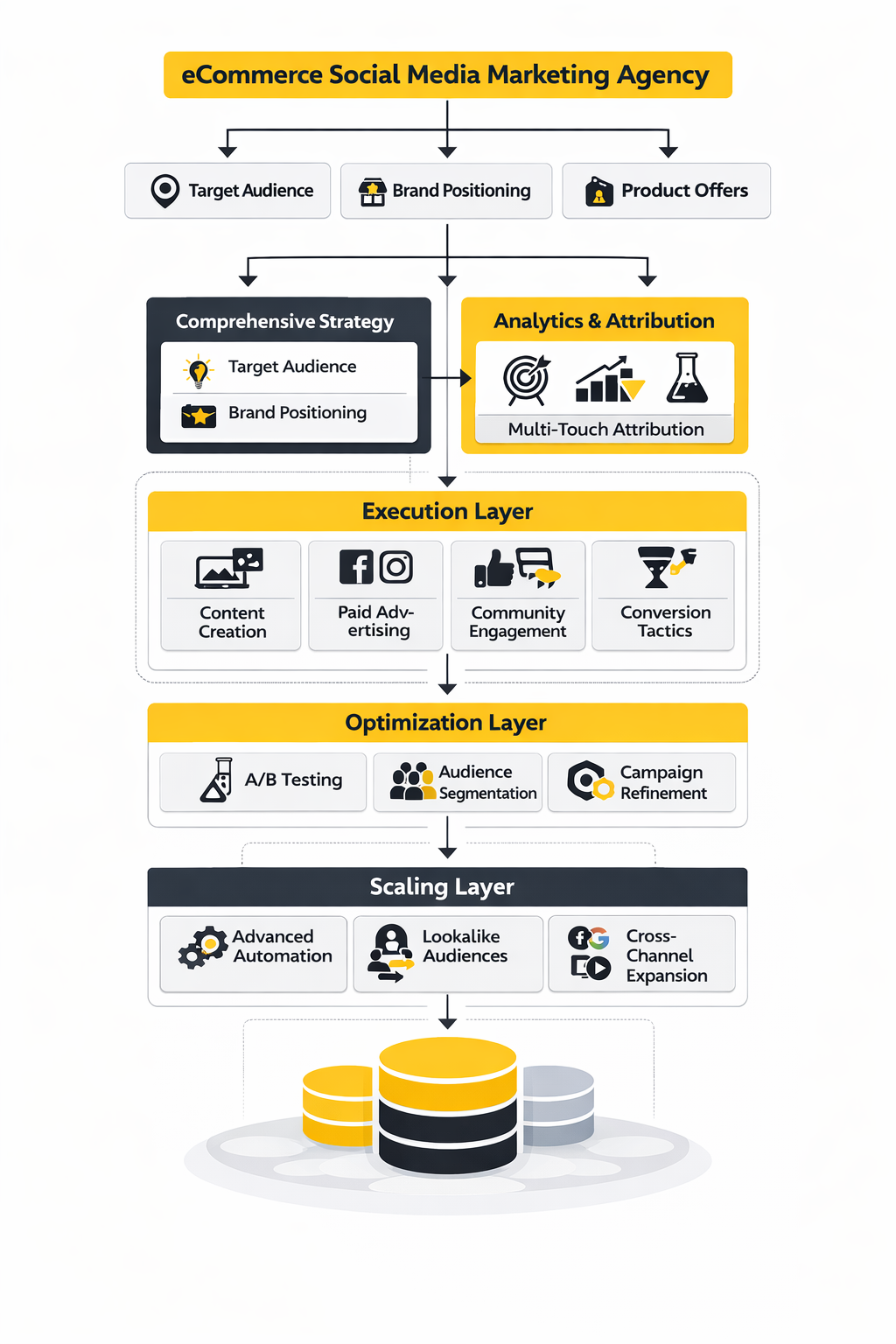
By the end of this article, the system should look a lot less mysterious. A strong ecommerce social media marketing agency is really coordinating one customer journey across discovery, proof, click, checkout, conversation, retention, and measurement rather than treating each step like a separate department. That is also why customer-journey mapping, social shopping, and cleaner event tracking matter so much: they show where the handoffs break and where the brand can remove friction fastest. Shopify+2
In practice, that ecosystem usually combines creative production, paid distribution, creator content, landing-page testing, DM automation, CRM follow-up, and retention flows. A lean stack might include ManyChat for comment and DM journeys, Replo for faster landing-page iteration, HighLevel or Brevo for follow-up, and Buffer or Flick for cleaner publishing and workflow. The exact tools matter less than the principle: every part of the stack should remove delay, confusion, or lost intent.
When that system is working, social stops being “content that may or may not help sales” and becomes a structured revenue engine. Social shopping shortens the buying path inside the platform, stronger journey design makes the off-platform path easier to finish, and cleaner measurement makes the next decision less political and more obvious. That is the outcome brands should want from an agency relationship, not just nicer posts and busier reporting decks. Shopify+2
FAQ for the Complete Guide
What does an ecommerce social media marketing agency actually own?
At minimum, it should own the path from attention to action. That means channel strategy, creative testing, creator coordination, paid distribution, landing-page alignment, message handling, and reporting that connects social activity to commercial outcomes. If the agency only handles posting or only buys ads without shaping the journey around them, it is acting more like a vendor than a growth partner. Shopify+2
When should a brand hire an agency instead of doing it in house?
The right moment is usually when the business already has enough signal to learn from but not enough internal bandwidth or specialist depth to improve the system quickly. If your team is stuck juggling content, paid media, creators, landing pages, and customer replies in separate silos, an agency can help unify the work and speed up testing. If the brand is still guessing about the offer, product fit, or customer journey, the agency should start with diagnosis rather than scale. Shopify+1
How long should you give an agency before judging performance?
You can usually judge the quality of thinking early and the quality of results a bit later. Within the first few weeks, a good agency should already be clarifying the customer journey, fixing tracking gaps, tightening the testing plan, and showing you where the biggest leaks are. A fair commercial read normally takes longer than a couple of weeks, because creative iteration, checkout friction, and channel learning need enough time to produce a signal worth trusting. Shopify+2
How much does an ecommerce agency usually cost?
Shopify’s current agency guidance puts typical ecommerce agency pricing anywhere from $1,000 to $20,000 or more per month, depending on scope, client size, and expertise. That range is wide enough that price alone tells you almost nothing. A cheaper agency can become expensive fast if it never gets beyond surface-level content work, while a more expensive one can be justified if it improves CAC, conversion, and retention at the same time. Shopify+1
Which platforms should matter most for ecommerce brands?
The right answer is not “all of them.” Shopify’s current social-commerce guidance keeps pushing a simpler rule: prioritize the platforms where your customers already spend time and where the format helps them understand and buy the product with less friction. That usually means matching channel choice to customer behavior, product complexity, and how easily the platform supports discovery, proof, and purchase. Shopify+1
Should one agency handle both organic and paid social?
Usually, yes, because the same creative insights should inform both sides. Organic tells you what language, proof, and formats resonate naturally, while paid helps you scale the strongest themes with more control and cleaner testing. Splitting those functions across disconnected teams can work, but it often slows feedback and creates two competing versions of the brand’s message.
What KPIs should be in the reporting stack?
The useful stack is commercial before it is cosmetic. At a minimum, most brands should watch new-customer CAC, net sales, conversion rate, average order value, repeat purchase behavior, and the funnel stages between landing, cart, checkout, and purchase. Conversion benchmarks can help with context, but even Shopify’s current conversion guidance says the widely cited 2% to 3% range varies a lot by price point, device mix, traffic source, and category, so the agency should compare like with like instead of chasing one generic average. Shopify+1
Can a smaller ecommerce brand still benefit from an agency?
Yes, but only if the scope stays focused. A smaller brand usually gets more value from one clear offer, one or two priority channels, a fast landing-page testing loop, and a simple retention setup than from a bloated “full-service” package. The mistake is hiring an agency to make the business look bigger before the fundamentals are strong enough to support scale.
How should creator and UGC agreements be structured?
Treat creator content like commercial inventory, not casual collaboration. Usage rights, paid amplification rights, reposting terms, exclusivity, deadlines, and disclosure rules should be settled before content goes live, because those terms directly affect both cost and how long the asset stays useful. FTC guidance still requires material relationships to be disclosed clearly and conspicuously, and Shopify’s current creator-pricing guidance makes it clear that usage rights and exclusivity can raise the cost, which is exactly why vague agreements become expensive later. Federal Trade Commission+3
What tools usually belong in the stack?
The best stack is the one that supports the actual bottleneck. Brands that need better comment and DM conversion may lean on ManyChat, brands that need faster page testing may use Replo, and brands that need cleaner follow-up may prefer HighLevel or Brevo. For feedback capture and qualification, Fillout, Cal.com, and even a support layer like Chatbase can make the system easier to run, but only when the strategy is already clear.
How do you know whether the agency is the problem or the offer is the problem?
Look at where the signal breaks. If the creative earns reach, clicks, or engagement but the page fails to convert, the offer, page structure, trust layer, or checkout experience may be the bigger issue than the media buying. If nothing is learning, nobody can explain why assets are winning or losing, and the reporting never leads to a sharper next test, the agency is probably the bottleneck. Shopify+2
Do you need incrementality testing, or is platform attribution enough?
Platform attribution is useful, but it is not the same as proof of causality. Google’s current measurement guidance now makes incrementality more accessible, with spend thresholds for some experiments reduced to around $5,000, which means more brands can test true lift instead of relying only on attributed conversions. You do not need to run those experiments on day one, but once spend is meaningful, incrementality becomes a much better answer than arguing over screenshot ROAS. Google Podpora+2
What should a strong first 90 days look like?
The first phase should clean up truth before it chases volume. That usually means auditing the customer journey, fixing event tracking, assigning channel roles, building a repeatable creative rhythm, tightening the post-click path, and creating a reporting format that leads to decisions instead of decoration. If those pieces are not getting clearer by the end of the first quarter, the relationship is probably producing motion without much real progress. Shopify+2
Work With Professionals
Explore 10K+ Remote Marketing Contracts on MarkeWork.com
Most marketers spend too much time chasing clients, competing on crowded platforms, and losing a percentage of every project to middlemen. MarkeWork gives you a better way. Browse thousands of remote marketing contracts and connect directly with companies desperate to hire skilled marketers like you, without platform commissions and without unnecessary gatekeepers. markework.com
If you're serious about finding better opportunities and keeping 100% of what you earn, explore available contracts and create a profile for free at MarkeWork.com. markework.com