

Email advertising looks simple from the outside. You write a message, hit send, and hope clicks show up. In practice, that mindset is exactly why so many campaigns underperform, land in spam, or produce numbers that look healthy on a dashboard but weak in revenue.
The channel is still powerful, but it has changed. Mailbox providers now enforce stricter sender standards, privacy features have made open data less trustworthy, and legal expectations around consent, disclosure, and opt-outs are no longer side details you can patch in later. Google’s sender rules for bulk mail, Apple Mail Privacy Protection, and FTC compliance requirements have collectively reshaped what good email advertising actually looks like.
That shift is good news for serious operators. When weaker senders cut corners, the brands that treat email advertising as a disciplined system get a clearer edge. The rest of this article breaks that system into a structure you can actually use.
- What Email Advertising Really Means
- Why Email Advertising Still Matters
- The Modern Email Advertising Framework
- Core Components of a High-Performing Program
- How Professionals Implement Email Advertising
- What to Measure, Optimize, and Scale
What Email Advertising Really Means
Email advertising is not just “sending promotions.” It is the deliberate use of email to create attention, drive action, and move a subscriber toward a commercial outcome, whether that outcome is a purchase, demo request, trial signup, renewal, or repeat order. That sounds obvious, but the distinction matters because it separates strategic email advertising from random newsletter blasts.
A lot of businesses confuse email advertising with email communication in general. Transactional updates, receipts, support replies, and product notifications all live in the inbox, but they do not play the same role. Advertising email is persuasive by design, and because of that, it sits closer to direct response, brand positioning, retention, and lifecycle marketing than most teams admit.
That is also why compliance and infrastructure belong inside the definition, not outside it. In the US, commercial email has to respect rules around accurate headers, non-deceptive subject lines, ad disclosure, physical address details, and opt-out handling under the CAN-SPAM compliance guide. In the UK and much of Europe, direct marketing by email is tied even more tightly to consent and electronic communications rules under ICO guidance and the European Commission’s explanation of direct marketing obligations.
Why Email Advertising Still Matters
Email advertising still matters because it gives brands direct access to an audience they already worked to acquire. That matters even more now that paid acquisition costs are volatile, platform algorithms change constantly, and third-party tracking has become less dependable. An owned list is not a magic asset, but it is one of the few channels a business can build without renting every interaction from a platform.
The performance case is still strong when the work is done well. The DMA’s 2025 benchmarking report found delivery rates at 98% in 2024, with B2C reaching 99.2%, while unique click rates rose to 2.3%. Mailchimp’s current benchmark page also shows that average engagement varies sharply by industry, with overall open rates at 35.63% and click rates at 2.62%, which is a useful reminder that email advertising should be judged against your category, not generic internet folklore.
What has changed is the standard for doing it well. Google defines bulk senders as domains sending roughly 5,000 messages or more to personal Gmail accounts in 24 hours, and it requires stronger authentication for bulk mail. Microsoft has also rolled out new requirements for high-volume senders targeting consumer inboxes. That means email advertising is no longer just about copy and offers. It is now a credibility game where infrastructure, list quality, and recipient trust shape whether the campaign gets a fair shot in the inbox at all.
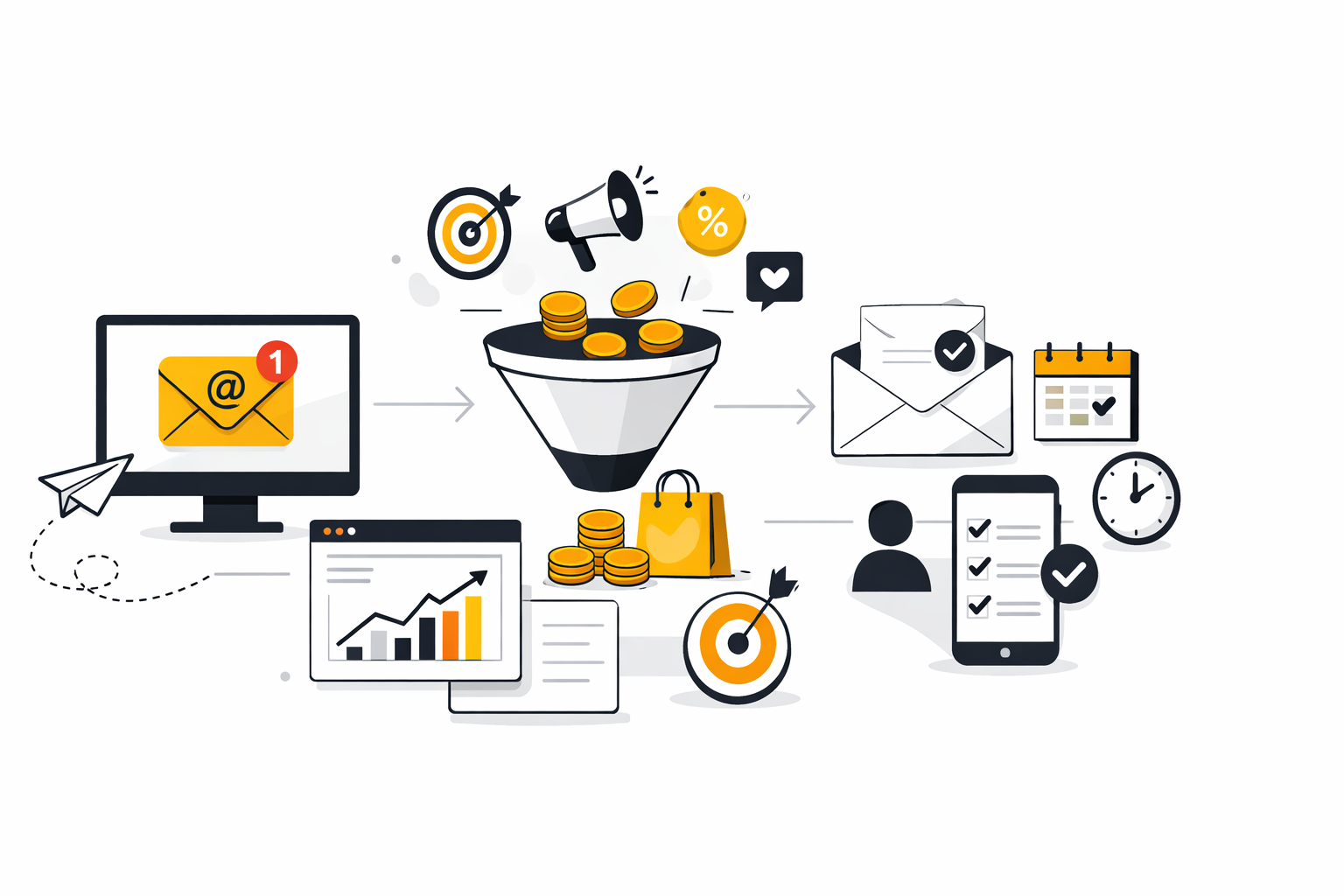
There is another reason this channel matters: it is one of the best environments for compound learning. Every send teaches you something about audience fit, timing, offer strength, creative angle, and funnel quality. Even when privacy changes make opens less reliable, clicks, downstream conversions, unsubscribe patterns, complaint rates, and segment-level behavior still reveal whether your email advertising is genuinely persuasive or just loud.
The Modern Email Advertising Framework
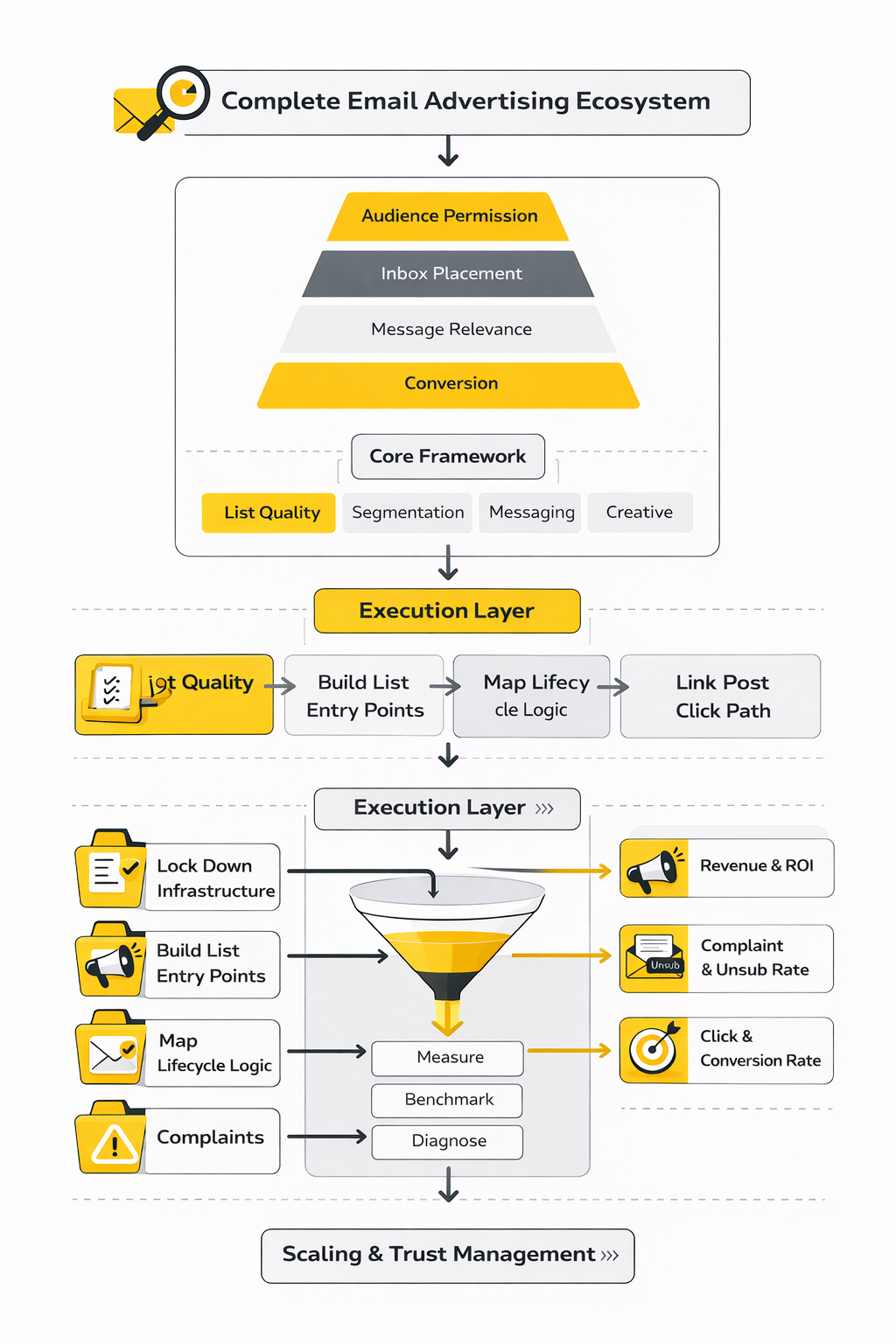
Modern email advertising works best when you stop treating it like a series of one-off campaigns and start treating it like a system with four linked layers: audience permission, inbox placement, message relevance, and commercial conversion. If one layer breaks, the whole program weakens. Great creative cannot rescue a damaged sender reputation, and perfect deliverability cannot rescue irrelevant offers.
The first layer is permission. You need a list built on legitimate consent or a legally valid alternative basis for the market you operate in, and you need that permission to be clear enough that recipients are not surprised when your promotions arrive. This is not just a legal checkbox. Surprise is one of the fastest ways to trigger complaints, unsubscribes, and filtering problems. ICO guidance on electronic mail marketing makes that point from the compliance side, while mailbox providers effectively enforce it from the deliverability side.
The second layer is inbox placement. That means domain authentication, technical alignment, complaint control, unsubscribe functionality, and sending practices that signal legitimacy. Google requires SPF or DKIM for all senders and SPF, DKIM, and DMARC for bulk senders. The one-click unsubscribe standard behind many inbox unsubscribe experiences is formalized in RFC 8058. These are not “nice to have” items anymore. They are baseline operating conditions.
The third layer is relevance. This is where segmentation, timing, creative, and offer design earn their keep. Broad average benchmarks can help you sanity-check performance, but relevance is what turns a delivered email into an opened message, a clicked CTA, and a conversion path that feels natural instead of forced. The fourth layer is conversion, which includes landing-page continuity, checkout or lead-flow friction, and the post-click experience that decides whether your email advertising creates revenue or just activity.
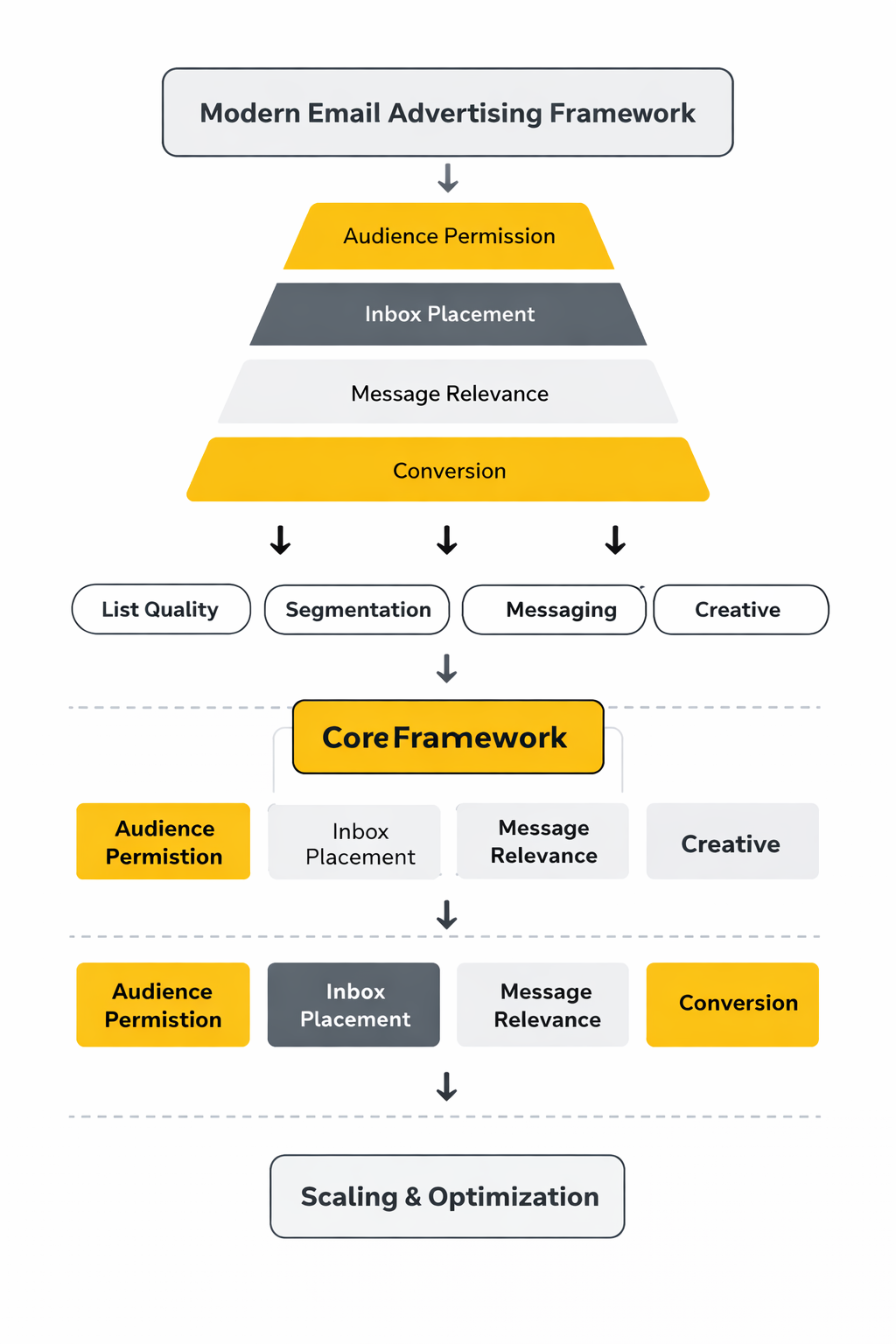
That framework matters because it keeps teams from solving the wrong problem. If results are weak, the issue might be targeting, not copy. It might be measurement distortion caused by Apple’s Mail Privacy Protection, not a sudden collapse in subject line quality. Or it might be that the ad promise in the email and the page experience after the click do not match closely enough. Once you see email advertising as a connected system, optimization becomes much more precise.
Core Components of a High-Performing Program
Once the framework is clear, the next step is understanding what actually makes email advertising perform in the real world. Not in theory, not in a slide deck, and not in a platform demo where every graph points up. A strong program usually comes down to a handful of components that work together so cleanly that the subscriber experiences the message as useful, timely, and relevant instead of intrusive.
This is where a lot of teams go off track. They obsess over subject lines while ignoring audience quality, or they redesign templates while keeping weak offers and muddy calls to action. High-performing email advertising is rarely built on one breakthrough tactic. It is usually the result of disciplined work across data, targeting, creative, infrastructure, and post-click experience.
List Quality and Permission
The quality of your list is not a background detail. It is the foundation that everything else depends on, because even great creative becomes useless when it is sent to people who never wanted it, barely remember subscribing, or no longer engage. When marketers complain that email advertising is getting harder, the real problem is often that they are trying to force performance out of a low-trust audience.
Permission matters for legal reasons, but it matters just as much for commercial ones. People who knowingly signed up are more likely to recognize your sender name, understand why they are hearing from you, and give your campaigns a fair shot. That lowers complaint risk, improves engagement quality, and helps protect sender reputation over time.
List quality also depends on how you manage decay. Subscribers change jobs, abandon old inboxes, lose interest, or simply stop noticing your messages. A serious email advertising program treats pruning as a performance lever, not a loss, because smaller engaged lists usually outperform bloated databases full of dead weight.
Segmentation That Reflects Real Buyer Behavior
Segmentation is where email advertising starts to feel intelligent. Instead of pushing the same message to everyone, you break the audience into groups that reflect actual behavior, intent, lifecycle stage, or commercial value. That shift is what turns a campaign from generic broadcasting into something much closer to targeted persuasion.
The mistake is thinking segmentation has to be overly complex to be effective. In practice, some of the best segments are straightforward: new subscribers, recent buyers, repeat buyers, inactive readers, high-value customers, abandoned-cart visitors, or leads who clicked but never converted. Those groups map to real commercial situations, which makes it easier to send offers and messages that actually fit the moment.
This is also where your tech stack starts to matter. Platforms such as Brevo, Moosend, and GoHighLevel make it easier to turn subscriber data into usable segments and automated flows. The tool is not the strategy, but weak tooling makes good strategy much harder to execute consistently.
Messaging That Matches Intent
Every email advertising message competes with distraction, skepticism, and inbox fatigue. That means your copy has to do more than sound clever. It has to match the reader’s level of awareness, the reason they joined your list, and the stage they are in right now.
A new subscriber usually needs orientation before pressure. A cart abandoner needs clarity and momentum. A repeat customer may respond better to exclusivity, timing, or product relevance than to a broad discount. When those contexts get blurred together, email advertising starts feeling random, and random messages rarely convert well.
The best messaging usually has one clear job. It might introduce an offer, create urgency, answer an objection, or move the reader to a landing page with stronger sales context. What it should not do is try to be a welcome email, a product launch, a brand manifesto, and a rescue campaign all at once.
Creative That Supports the Click
Creative matters, but not in the way many marketers think. In email advertising, design is there to support comprehension and action, not to show off what your designer can build. The strongest emails are usually visually clear, easy to scan, and structured around one primary conversion path.
That is especially important on mobile, where spacing, hierarchy, and clarity become brutally obvious. If the headline is vague, the CTA is buried, the product image loads poorly, or the body copy takes too long to reach the point, the campaign loses momentum fast. Clean structure often beats elaborate design because readers decide within seconds whether the message deserves more attention.
This is also why consistency matters. Your subject line, preview text, body copy, button language, and landing page should feel like one continuous argument. When the promise in the inbox matches the experience after the click, trust stays intact and conversion friction drops.
Offers That Deserve Attention
Weak offers kill a lot of email advertising before the audience ever has a chance to respond. You can optimize send times, tighten the copy, and personalize the first name, but if the offer itself is forgettable, performance will flatten. Readers do not click because the email was technically competent. They click because something valuable, timely, or compelling is being placed in front of them.
A strong offer is usually clear on three fronts: what the reader gets, why it matters now, and what makes it worth acting on. That could mean a product launch, a limited-time bundle, an exclusive bonus, a strong educational asset tied to a lead-gen flow, or a direct invitation into a demo or trial. The format changes, but the principle stays the same.
This is where many businesses mistake activity for persuasion. They send more emails instead of improving the commercial proposition inside the email. Frequency can help when the offer is strong and the audience is warm, but it rarely fixes a value proposition that feels ordinary.
Timing, Automation, and Sequence Logic
Good email advertising is not just about what you send. It is also about when the message appears and what the recipient has already seen. Timing shapes relevance, and relevance shapes both engagement and trust.
That is why automated flows often outperform random batch sends. A welcome sequence reaches people when awareness is fresh. A browse or cart sequence appears close to the moment of intent. A reactivation campaign works best when it is triggered by real inactivity rather than a calendar guess. In each case, the timing improves the odds that the message feels connected to the subscriber’s actual behavior.
Sequence logic matters just as much. If someone has already purchased, they should not keep receiving the same urgency-heavy pitch they got before buying. If they clicked but did not convert, the next message should move the conversation forward, not restart it from zero. Strong programs use automation to maintain narrative continuity, which is one of the most underrated advantages in email advertising.
Measurement That Goes Beyond Opens
A modern email advertising program cannot rely on open rate as its main truth signal. Privacy protections and mailbox behavior have made opens directionally useful in some cases, but too unstable to act as the center of decision-making. That does not mean measurement is broken. It means the focus has to move closer to business outcomes.
Clicks, click-to-open patterns, landing-page behavior, conversion rate, revenue per recipient, unsubscribe rate, complaint rate, and segment-level performance all tell a more useful story. They help you separate curiosity from intent and activity from actual commercial value. That is the difference between optimizing a dashboard and optimizing a business.
It also changes how you judge winners. An email with a flashy subject line might generate attention, but if the downstream traffic bounces or fails to convert, the campaign did not really win. The best email advertising teams measure success all the way through the funnel, because that is where real performance becomes visible.
How Professionals Implement Email Advertising
The difference between amateur and professional email advertising is not creativity alone. It is process. Strong teams build the channel in a sequence that protects deliverability first, makes targeting operational second, and only then scales creative and campaign volume.
That order matters more now than it did a few years ago. Google’s bulk sender rules, Yahoo’s sender standards, and Microsoft’s newer requirements for high-volume senders all point in the same direction: if your authentication, unsubscribe flow, and complaint profile are sloppy, your campaigns start losing before the copy is even read. Google’s sender guidelines, Yahoo’s sender best practices, and Microsoft’s April 2025 announcement for Outlook senders all make that clear.
Step 1: Lock Down the Sending Infrastructure
Professional implementation starts with domain setup, not design templates. At a minimum, that means configuring SPF and DKIM correctly, publishing a DMARC policy, and making sure the visible sender identity aligns with the domain that is actually authenticated. Google explicitly recommends SPF, DKIM, and DMARC for stronger delivery, and requires stricter authentication for bulk senders. Google’s authentication guidance and its SPF setup documentation both spell out why this is foundational.
This is also the stage where unsubscribe mechanics need to be real, not cosmetic. Google and Yahoo expect easy unsubscribing for promotional mail, while the technical basis for one-click unsubscribe is defined in RFC 8058. If a recipient wants out, the process should be immediate and friction-light. Anything else creates unnecessary complaints, and complaints are one of the fastest ways to damage future email advertising performance.
Good teams also separate domains and reputations intelligently. They know when to send promotional email from a dedicated subdomain, when to protect the primary brand domain, and when to warm up new traffic sources instead of dumping volume into an unprepared setup. That is not paranoia. It is operational discipline.
Step 2: Build the Audience Around Clear Entry Points
Once infrastructure is secure, professionals define how subscribers actually enter the system. That sounds basic, but it forces a useful question: why should this person be on this list in the first place? If the answer is vague, the future campaign calendar will be vague too.
The best list-building paths usually come from obvious moments of intent. That can mean a discount opt-in, a lead magnet, a waitlist, a post-purchase checkbox, a booking flow, or a content signup tied to a specific product category. What matters is that the source predicts what kind of email advertising the person should later receive.
This is also where tooling starts shaping execution speed. A stack built around Brevo, GoHighLevel, or Moosend can make segmentation and automation cleaner, but the real win comes from capturing context at signup. Source, interest, promised incentive, and consent status are not admin details. They are the raw materials of relevant email advertising later.
Step 3: Map the Lifecycle Before Writing Campaigns
This is where professionals save themselves from chaos. Before building campaigns, they map the subscriber journey and decide which moments deserve automated treatment, which need manual campaigns, and which should be suppressed entirely. That prevents the classic mess where subscribers receive overlapping promotions, duplicate nudges, or messages that no longer fit their status.
A practical lifecycle map usually includes the welcome stage, first-purchase stage, browse or cart recovery, post-purchase education, repeat purchase pushes, reactivation, and suppression rules for disengaged profiles. The point is not to create an elegant diagram for internal meetings. The point is to define who should get what, when, and why.
When that map is missing, email advertising turns reactive. Teams start sending because the calendar says Tuesday, not because the subscriber is in a meaningful commercial moment. That leads to more volume, but not more intelligence.
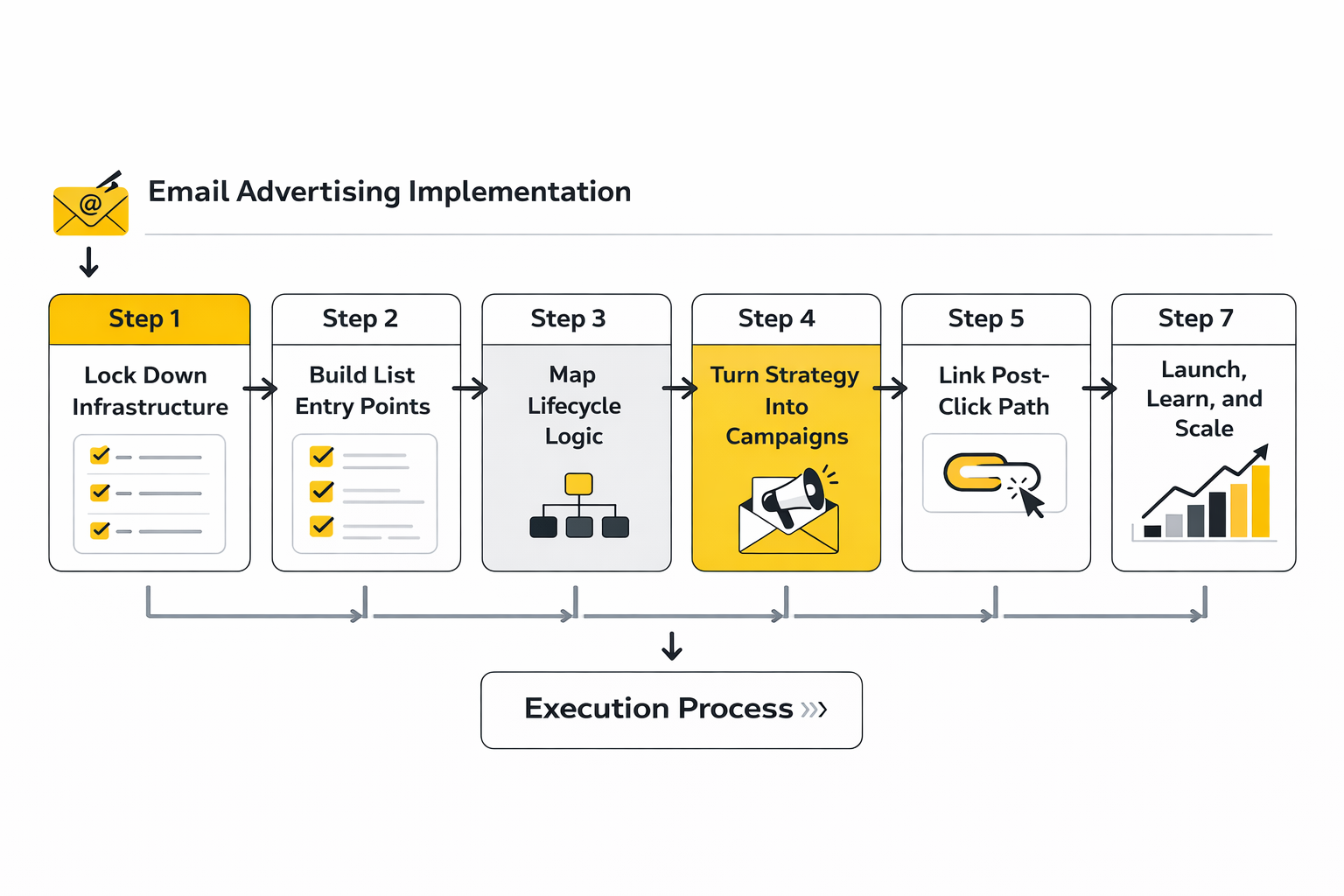
Step 4: Turn Strategy Into a Working Campaign System
Once the lifecycle is mapped, execution becomes tangible. Professionals usually break email advertising into two engines: automated flows that respond to behavior and scheduled campaigns that create planned demand. Both matter, but they do different jobs.
Automations handle moments where timing is the advantage. Welcome emails, abandoned cart reminders, post-purchase cross-sells, and win-back sequences work because they are connected to a specific action or lapse in activity. Scheduled campaigns handle launches, seasonal promotions, editorial sends, product drops, webinars, and broader announcements where the message needs coordinated reach.
A workable process often looks like this:
- Define the audience segment and commercial goal.
- Decide whether the message belongs in a flow or a campaign.
- Write the core angle, offer, and CTA before touching design.
- Build the email and connect it to the right landing page.
- Test rendering, links, suppression logic, and unsubscribe behavior.
- Send in controlled volume when risk is high or the segment is new.
- Review clicks, conversions, unsubscribes, and complaints before scaling.
That sequence is not glamorous, but it is how professional email advertising gets built without constant self-inflicted problems.
Step 5: Create the Landing Path With the Email, Not After It
One of the biggest implementation mistakes is treating the landing page as someone else’s problem. Professionals do the opposite. They build the post-click path as part of the same system because they know an email can win the click and still lose the sale if the page is slow, mismatched, or confusing.
This is where message continuity becomes operational, not just stylistic. If the email promises a bundle, the page should open on that bundle. If the email uses urgency, the page should reflect that same deadline. If the email is targeted to a specific segment, the page experience should not feel like a generic homepage detour.
For teams that move fast, builders such as Replo, ClickFunnels, or Systeme.io can help tighten the connection between message and page. The exact platform is less important than the principle. In strong email advertising, the promise made in the inbox is completed after the click, not diluted.
Step 6: QA the Things That Actually Break Campaigns
Professionals do not rely on a last-second visual skim. They use checklists because email advertising breaks in boring, expensive ways. Links go to the wrong page, discount codes fail, segmentation excludes recent buyers by mistake, mobile layouts stack badly, or unsubscribe behavior creates friction right when mailbox providers are watching closely.
The most important checks are usually plain and unsexy. Confirm authentication is passing. Confirm the segment is correct. Confirm suppression rules are active. Confirm links, tracking parameters, subject line, preview text, and sender details all match the intent of the send. Confirm the message still makes sense on mobile, where a huge share of recipients will read it.
This is also where privacy-era measurement has to be handled intelligently. Apple’s Mail Privacy Protection can preload remote content and obscure open behavior, which means teams that still judge campaign quality mainly by opens are often reacting to noise instead of signal. Apple’s explanation of Mail Privacy Protection is a reminder that the implementation process has to account for measurement distortion before the campaign is even evaluated.
Step 7: Launch, Learn, and Scale Carefully
A professional rollout is rarely reckless. Teams do not assume a bigger audience will automatically create a better result. They start with sensible cohorts, check inbox placement and complaint behavior, and expand when the early signals say the message deserves more reach.
Yahoo’s sender best practices explicitly warn senders to keep spam complaint rates low and stay below a 0.3% spam rate. That is not just a technical note. It is a practical scaling limit for email advertising because a campaign that looks profitable in isolation can still damage long-term reach if it trains recipients to complain. Yahoo’s guidance makes that tradeoff impossible to ignore.
The best teams also separate launch review from ego. They look at clicks, conversions, unsubscribes, complaint indicators, segment response, and landing-page behavior together. That wider view helps them scale what is truly working instead of just repeating whatever generated the prettiest top-line metric.
What Professional Execution Looks Like in Practice
At this point, the pattern should be clear. Professional email advertising is not a collection of hacks. It is a repeatable operating system built around trusted infrastructure, intentional list growth, mapped lifecycle logic, strong offers, clean post-click paths, and disciplined review.
That is exactly why implementation becomes a competitive advantage. Most brands are willing to send more emails. Far fewer are willing to build the kind of process that makes more email a smart move instead of a costly one. The teams that do it properly create something much stronger than a campaign calendar. They create a channel they can trust.
The next step is knowing how to judge that channel properly. That means looking beyond surface metrics and understanding what to measure, what to ignore, and what actually moves revenue in modern email advertising.
What the Numbers Are Really Telling You
The analytics side of email advertising gets messy fast because marketers often track too many numbers and understand too few of them. A dashboard can look busy without being useful. The real job is not collecting metrics. It is figuring out which signals reveal audience interest, which ones reveal inbox problems, and which ones show whether the channel is actually producing commercial results.
That matters even more now because some old shortcuts no longer work the way they used to. Apple’s Mail Privacy Protection can preload remote content and obscure whether a human being truly opened a message, which means open rate is still worth watching but no longer strong enough to carry the whole reporting system by itself. If you are still treating opens as the final truth, your email advertising decisions are probably being shaped by noise.
Start With the Metrics That Reflect Real Outcomes
The most useful measurement stack usually starts with four layers: deliverability, engagement, conversion, and commercial value. Deliverability tells you whether messages are reaching the inbox ecosystem cleanly. Engagement tells you whether recipients care enough to interact. Conversion tells you whether the click turned into the action you wanted. Commercial value tells you whether the whole system is worth scaling.
That sounds simple, but it fixes a common mistake. Many teams celebrate engagement metrics while ignoring whether those clicks led anywhere valuable. Others stare at revenue totals without noticing that complaint rates, unsubscribes, or weak list quality are quietly damaging the future performance of their email advertising.
A good reporting system should make those tradeoffs visible. It should tell you not just whether a campaign “worked,” but also whether it worked sustainably.
Deliverability Metrics Come First, Even When They Are Boring
Deliverability is not glamorous, but it decides whether the rest of the dashboard means anything. If your emails are filtered, junked, throttled, or blocked, downstream metrics become distorted because the audience never really got a fair chance to respond. That is why professional teams watch authentication status, bounce behavior, complaint levels, and sender reputation before they get too excited about creative tests.
Google’s Postmaster Tools exists for exactly this reason. It gives qualified high-volume senders visibility into delivery errors, spam reports, and reputation signals that ordinary campaign dashboards often hide. Yahoo’s sender best practices are even more direct, recommending spam complaint rates below 0.1% and flagging 0.3% as the red line where delivery problems become much more likely.
Those numbers matter because they change the action you should take. If complaint rates are elevated, the answer is usually not “write better subject lines.” It is more often tightening list hygiene, improving segmentation, reducing surprise, and making unsubscribe paths easier. In other words, bad deliverability metrics usually point back to audience quality and expectation management, not clever copy fixes.
Open Rates Still Have a Place, Just Not the Old One
Open rate is not useless. It is still a directional signal that can help compare subject line variants, sending cadence, and broad campaign resonance inside the same program. The problem starts when marketers pretend it is a clean measure of human attention.
That problem got much bigger after Apple changed the environment. Its privacy documentation explains that remote content may be downloaded in the background regardless of whether the recipient actually engaged with the email. That means open rate can be inflated, especially in audiences with heavy Apple Mail usage.
So what should open rate do now? It should act as a supporting indicator, not the main judge. If opens rise while clicks, conversions, and downstream behavior stay flat, the smart move is skepticism. In modern email advertising, a healthy open rate is encouraging, but it is no longer enough evidence on its own.
Click Metrics Tell You More About Message-Market Fit
Clicks are not perfect either, but they are usually much closer to real intent. A click means the recipient did something active. They moved from passive exposure to visible interest, which makes click rate one of the most useful signals for judging whether your message, offer, and audience actually lined up.
Broad benchmarks help here, as long as you use them carefully. Mailchimp’s current email benchmark page shows an all-user average open rate of 35.63%, click rate of 2.62%, and unsubscribe rate of 0.22%, while ecommerce averages sit lower at 29.81% opens and 1.74% clicks. The DMA’s 2025 benchmark report shows delivery at 98% in 2024 and unique click rates rising to 2.3%, which supports the same basic conclusion: clicks remain one of the clearest useful engagement signals in the channel.
The action these numbers should drive is context, not panic. A 2% click rate can be weak in one segment and excellent in another. A lower click rate on a broad awareness campaign may be fine, while the same number on a high-intent abandoned-cart flow may signal that something is broken. The benchmark gives you a reference point. The segment and campaign purpose tell you what it actually means.
Click-to-Open Rate Helps You Judge Creative Efficiency
Once you accept that opens are imperfect but still directionally useful, click-to-open rate becomes more interesting. It asks a sharper question: among the people counted as openers, how many actually clicked? That makes it a good way to judge whether the body of the email, the offer, and the CTA did their job after the subject line got attention.
The GDMA benchmark coverage reported a global click-to-open rate of 7.6% in 2024, while MailerLite’s 2025 benchmark summary puts the 2025 average at 6.81%. Those numbers are not interchangeable across every dataset, but together they show the same thing: click-to-open is useful because it evaluates how efficiently the message turns attention into action.
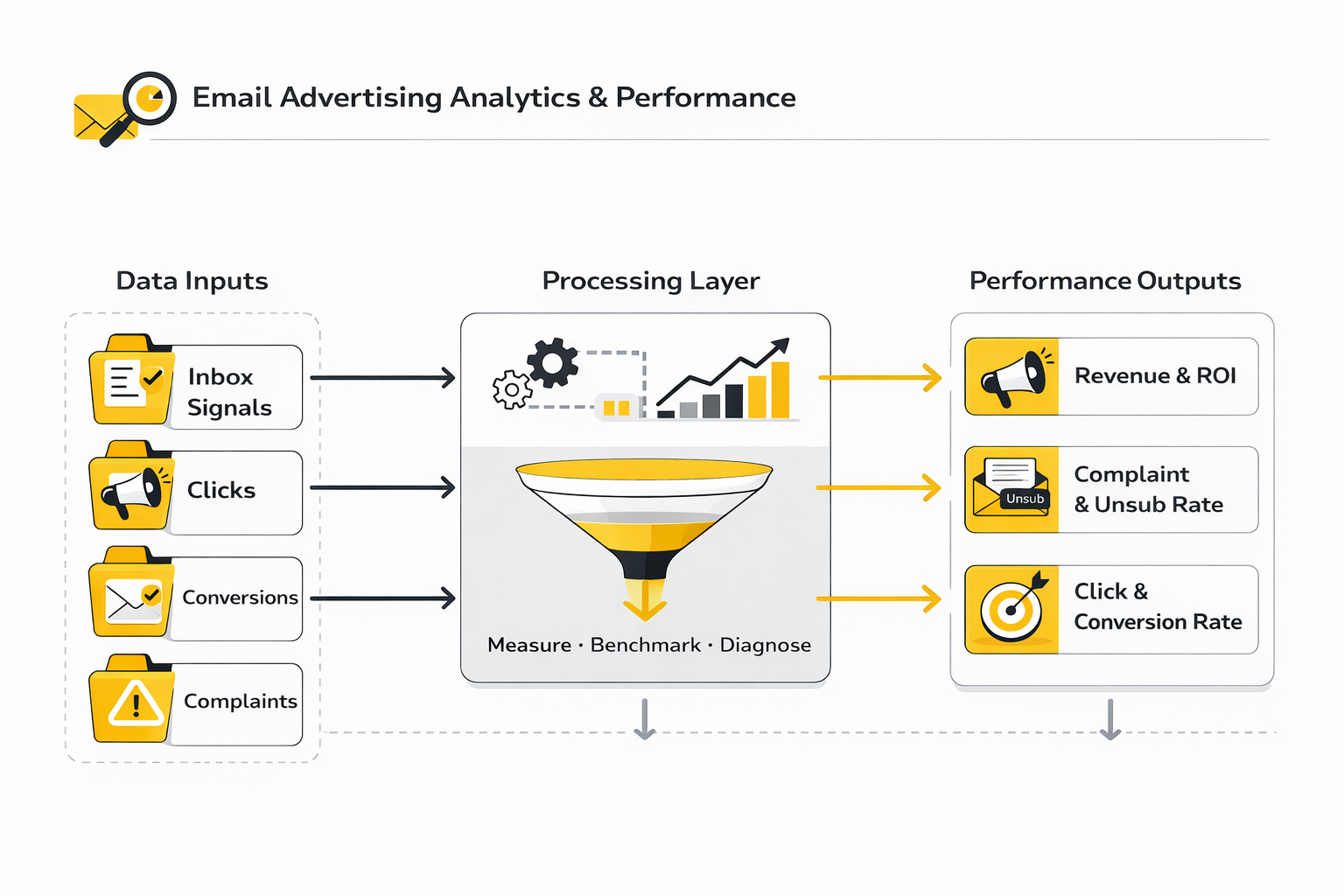
This metric becomes especially helpful when diagnosing specific failures. High opens with weak click-to-open usually point toward a mismatch inside the email itself. Maybe the subject line overpromised, the body copy dragged, the CTA lacked force, or the offer was not compelling enough. In that situation, the fix is creative and relevance, not necessarily deliverability.
Unsubscribes and Complaints Are Not Just “Negative Metrics”
A lot of teams look at unsubscribes and complaints as cleanup numbers you review after the fact. That is a mistake. In email advertising, these are some of the most honest forms of feedback you can get because they reveal when the message stopped feeling welcome.
Mailchimp’s current benchmark page places average unsubscribe rate at 0.22% across all users, with ecommerce at 0.19% and education at 0.18% on its published breakdown. That does not mean anything above those numbers is automatically bad. A hard-selling launch email to a broad segment may create more unsubscribes than a nurture email and still be commercially worthwhile. But when unsubscribes rise alongside weak clicks and poor conversion, the pattern usually means the audience did not see enough relevance to justify staying.
Complaints are even more serious. Yahoo’s best practices recommend staying below 0.1% spam complaints and treat 0.3% as a critical ceiling. That is not just a deliverability note. It is a business warning. If recipients are reporting your email as spam, your email advertising is no longer just underperforming. It is actively training mailbox providers to trust you less.
Conversion Metrics Are Where the Channel Gets Honest
This is the layer where excuses disappear. Clicks are useful, but conversion metrics tell you whether interest turned into action. For ecommerce, that may mean purchases, revenue per recipient, average order value, and repeat purchase behavior. For lead generation, it may mean demo bookings, qualified leads, application starts, or pipeline contribution. For subscriptions, it may mean trials, activations, upgrades, or retained customers.
This is also why email advertising should never be measured in isolation from the landing path. A campaign with average clicks but excellent on-page conversion can be far more valuable than one with flashy click numbers and weak downstream performance. The inbox gets the attention, but the page and offer finish the job.
So the action here is simple: tie every campaign to one primary business outcome. Not three. Not five. One. When that is clear, the data gets easier to interpret because you know what success is supposed to look like before the send goes out.
Revenue Per Recipient Beats Vanity Metrics
One of the most useful numbers in email advertising is revenue per recipient because it forces a real-world question: how much value did this send create for each person you reached? That makes it far harder to hide behind inflated opens or impressive-looking total revenue driven by brute-force list size.
Revenue per recipient is especially good at comparing unlike campaigns. A broad promotional blast may generate more total sales, but a segmented lifecycle email might generate more value per person reached. That matters because the second campaign is often the one worth scaling, cloning, or turning into a deeper automation.
This is the metric that helps bring discipline back into creative debates. Instead of arguing endlessly over which version “felt better,” teams can ask which version produced more value without creating unhealthy unsubscribe or complaint signals. That is a much better conversation.
Benchmarks Are Useful, but Only When You Use Them Correctly
Benchmarks are helpful because they stop you from evaluating performance in a vacuum. They remind you that industries behave differently and that channel-level averages are not personal judgments. A retail program, a nonprofit newsletter, and a B2B lead-gen sequence will not behave the same way, and trying to force them into one generic performance expectation usually creates bad decisions.
But benchmarks become dangerous when they replace thinking. If your program beats the average click rate but loses money after the click, you do not have a strong program. If your opens look outstanding but your audience is heavily Apple Mail-weighted, you may be celebrating a distorted number. If your unsubscribe rate looks low only because you are under-sending to disengaged people, you may be preserving optics while sacrificing growth.
Use benchmarks as guardrails, not commandments. Let them tell you where to investigate, not what to believe automatically.
The Right Analytics System Should Trigger Action
A good analytics setup for email advertising should lead directly to decisions. If click rate drops while deliverability stays healthy, review message relevance, offer strength, and CTA clarity. If conversion rate drops after a normal click response, audit the landing page, checkout flow, or lead form. If complaint rates rise, pull back on volume, tighten segmentation, and clean the list before scaling again.
That is why the best reporting systems are built around diagnosis, not decoration. They do not just summarize what happened. They help you understand what probably caused it and what you should change next.
Once measurement works that way, the channel gets easier to manage. You stop reacting emotionally to every campaign swing and start reading the data like an operating signal. That is when email advertising becomes much more predictable, which is exactly what serious operators want before they scale.
Scaling Email Advertising Without Breaking It
The hardest stage in email advertising is not getting early wins. It is scaling those wins without damaging trust, deliverability, or offer quality. A lot of brands can make a small segment respond. Far fewer can expand volume and frequency while keeping the channel efficient.
This is where the game changes from campaign execution to systems management. Once volume grows, little mistakes stop being little. A weak segment definition, a muddy suppression rule, or an aggressive calendar can start pushing complaint rates up fast, and mailbox providers have become much less patient with that kind of sloppiness. Google treats senders that hit roughly 5,000 messages or more to personal Gmail accounts in 24 hours as bulk senders, and that classification does not simply disappear later if you scale back.
More Volume Is Not the Same as More Growth
One of the easiest traps in email advertising is assuming that if one campaign worked at 20,000 sends, it should work even better at 200,000. Sometimes that is true. Often it is not, because performance does not scale linearly across audience quality.
Early wins usually come from the warmest, most recognizable, and most engaged parts of the list. As you widen the audience, relevance tends to drop, complaint risk rises, and conversion efficiency often falls before total revenue starts to plateau. That does not mean scaling is a bad idea. It means scaling needs guardrails.
The smart move is to expand in layers. Start with highly engaged segments, then widen carefully while monitoring complaints, unsubscribes, clicks, and revenue per recipient. This is slower than the “blast everyone” approach, but it preserves the long-term value of the channel.
Frequency Is a Strategic Choice, Not a Badge of Aggression
There is no universal perfect send frequency. Some brands can send daily and still perform well because audience expectations are clear, offers stay fresh, and the list is segmented tightly. Others damage results by sending twice a week because the content is repetitive and the timing feels self-serving.
This is why frequency should be treated as a relevance question first. If the subscriber is in a moment of active intent, more messages may make sense. If they are cold, broad promotional pressure can create fatigue faster than revenue. Mailbox providers do not care that your team had quarterly targets. They care whether recipients interact positively or start ignoring and complaining.
The practical test is simple. If added frequency increases total value while holding complaint and unsubscribe signals in a healthy range, it may be justified. If it creates more sends but worse efficiency, you are not scaling. You are diluting.
Deliverability Risk Compounds Faster Than Most Teams Expect
Advanced email advertising requires respect for compounding risk. A single bad campaign can create more than a temporary dip. It can train inbox providers to look at your future mail more skeptically, especially if the spike in negative signals is large enough.
That is why sender requirements matter strategically, not just technically. Google requires easy unsubscribing and one-click unsubscribe support for high-volume promotional mail, and Microsoft said that after May 5, 2025 Outlook would begin routing messages from non-compliant high-volume domains to Junk, with future rejection planned. Yahoo’s best practices also keep pressure on complaint control, with 0.3% still acting as a serious warning zone.
The action this should drive is caution around list expansion, lead-source quality, and calendar pressure. When a program scales, new acquisition sources should be tested, not blindly trusted. Old inactive segments should be reintroduced carefully, not dumped into major launches. Every growth decision should be filtered through one question: will this create more genuine interest, or just more exposure?
The Best Programs Separate Audience Value From Audience Size
A large list can make teams feel safe. It creates the illusion of leverage. But in email advertising, audience value matters more than audience size because every send carries both upside and risk.
That changes how serious operators think about segmentation. They stop treating all subscribers as equal units of reach and start treating the list as a portfolio with very different levels of intent, familiarity, and commercial potential. Some segments deserve more attention because they are active, responsive, and profitable. Others deserve less because sending to them too often creates little upside and real downside.
This is also why suppression is strategic. Removing or reducing mail to low-engagement audiences is not always a loss. In many cases it improves total program efficiency, protects sender reputation, and helps the stronger segments perform even better.
Creative Fatigue Is Real, Even When the Offer Is Good
Advanced teams know that a solid offer can still wear out if the angle never changes. The same discount logic, the same urgency language, and the same template rhythm eventually become predictable. Once that happens, the audience starts filtering you mentally before the mailbox provider ever does.
That is where creative rotation matters. Not random reinvention, but fresh framing. A product can be positioned through utility, speed, exclusivity, convenience, proof, comparison, seasonal timing, or problem-solving. The offer may stay the same while the reason to care changes.
This matters because creative fatigue often gets misdiagnosed as list fatigue. Teams think the audience is “burned out,” when the real problem is that the campaign is saying the same thing in the same way over and over. Good email advertising scales longer when it varies the argument, not just the send date.
Automation Can Increase Relevance or Multiply Mistakes
Automation is one of the strongest advantages in email advertising, but it cuts both ways. When the logic is right, automation creates relevance at scale. When the logic is wrong, it multiplies irrelevance faster than manual campaigns ever could.
That is why advanced programs review automation continuously. They check whether flows still match the current offer structure, whether delays still make sense, whether suppression rules prevent awkward overlaps, and whether recent buyers are being removed from pre-purchase pressure quickly enough. Automation should feel like smart timing, not robotic stubbornness.
This is also where platform capability starts to matter more at scale. Teams running more sophisticated lifecycle systems often lean on tools that connect CRM logic, segmentation, landing flows, and follow-up in one place, which is one reason stacks like GoHighLevel, Brevo, or Moosend tend to become more attractive as complexity rises. The platform will not save weak strategy, but weak systems absolutely make advanced strategy harder to sustain.
Attribution Gets Murkier as the Program Gets Better
There is a strange thing that happens when email advertising improves. The cleaner the lifecycle, the more the channel starts influencing conversions that may not look like direct last-click wins. A subscriber sees the email, returns later through branded search, purchases on another device, or converts after a retargeting touch that gets the formal credit.
That does not mean you should invent value that is not there. It means attribution should be handled with some maturity. If you judge the channel only by crude last-click reporting, you may underinvest in sequences and campaigns that are genuinely moving buying decisions. If you over-credit every assisted interaction, you go the other way and fool yourself.
The fix is to hold multiple views at once. Track direct conversion, but also watch lift in branded demand, repeat purchase behavior, assisted paths, and segment-level revenue trends over time. Advanced email advertising is rarely just a one-email-to-one-sale machine. It often works by shaping readiness and reducing friction across the buying journey.
Privacy Changes Force Better Strategy
Privacy changes have frustrated a lot of marketers, but they have also forced better discipline. Apple’s Mail Privacy Protection weakens open-rate certainty and makes passive tracking less reliable. That can feel like a loss if your old model depended on weak signals.
But strategically, it pushes email advertising in the right direction. It forces teams to care more about clicks, conversions, list quality, and actual buyer behavior. In other words, it pressures marketers to optimize for outcomes that were more valuable all along.
The brands that adapt best are not the ones fighting privacy changes. They are the ones building measurement systems and campaign logic that do not depend on fragile vanity metrics in the first place.
The Strongest Competitive Advantage Is Trust
At the advanced level, the channel becomes less about tactics and more about trust management. Not in the soft branding sense alone, but in the operational sense. Do recipients recognize you, expect you, value you, and feel in control of the relationship? If they do, email advertising becomes much easier to scale.
Trust affects almost everything. It improves open willingness, click confidence, conversion efficiency, and tolerance for frequency. It also reduces complaint risk, which matters more than ever in a sender environment shaped by platform enforcement and recipient control.
This is why the best operators do not treat trust and performance as separate conversations. They understand that a trusted sender can push harder without breaking the channel, while an untrusted sender struggles even with decent creative and strong offers. That is a brutal truth, but it is a useful one.
Before You Push Harder, Tighten the System
When a program wants more revenue, the instinct is usually to send more, launch faster, and widen the audience. Sometimes that works. More often, the better move is to tighten the system first.
Improve segmentation before increasing frequency. Improve landing-page continuity before chasing higher click volume. Improve reactivation logic before mailing colder cohorts. Improve suppression and consent handling before importing new leads. Tight systems scale better than loud systems.
That is the real expert-level shift in email advertising. Instead of asking, “How do we send more?” the better question becomes, “How do we make each send deserve more reach?” Once you think that way, scaling gets smarter, risk gets lower, and the channel becomes much more durable.
The final piece is practical: answering the most common questions people still have when they try to put all of this into action.
FAQ
Is email advertising still worth it in 2026?
Yes, but the easy version is gone. Email advertising still gives brands direct access to an owned audience, and the channel remains strong when list quality, authentication, relevance, and post-click conversion are handled properly. The rules are tighter now, with Google’s sender requirements, Yahoo’s sender expectations, and privacy changes like Apple Mail Privacy Protection pushing marketers toward cleaner operations.
What is the difference between email advertising and email marketing?
Email advertising is the commercial, persuasive side of the channel. It focuses on driving a defined action such as a purchase, booking, signup, or upgrade, while broader email marketing can also include education, retention, onboarding, and relationship-building. In practice, the lines overlap, but email advertising is where offer strength, conversion logic, and revenue accountability become much more central.
What metrics matter most in email advertising now?
The most useful metrics are the ones closest to business outcomes. That usually means inbox placement signals, click rate, click-to-open rate, conversion rate, revenue per recipient, unsubscribe rate, and complaint rate, rather than leaning too heavily on opens alone. Open rate still has some directional value, but Apple’s privacy protections make it a weaker source of truth than it used to be.
Are open rates still useful at all?
They are useful, just not in the old, simplistic way. Open rates can still help compare subject lines, send times, and broad campaign patterns inside the same program, but they should be treated as supporting evidence instead of the final verdict. Once Apple Mail Privacy Protection began downloading remote content in the background, the gap between a reported open and a real human read became much harder to trust.
What complaint rate is considered dangerous?
A complaint rate near 0.3% is where things start getting serious. Yahoo’s sender guidance recommends staying below 0.1% and treats 0.3% as the threshold bulk senders should remain under, which makes it a practical danger zone for modern email advertising. Once complaints climb, the right move is usually to tighten targeting, reduce surprise, and clean the list rather than pushing harder.
Do I need SPF, DKIM, and DMARC to run email advertising properly?
If you want to operate professionally, yes. Google’s official guidance requires all senders to use SPF or DKIM and requires bulk senders to use SPF, DKIM, and DMARC, which means authentication is no longer a “later” task. Without it, email advertising becomes harder to deliver, harder to trust, and more exposed to spoofing problems that can hurt the brand beyond a single campaign.
Does one-click unsubscribe really matter?
Absolutely, and not just for compliance optics. Easy unsubscribing lowers frustration, reduces complaints, and signals to mailbox providers that you are behaving like a legitimate sender instead of trapping people in your list. The technical standard is covered in RFC 8058, while Google’s sender rules reinforce how important accessible unsubscribing has become for promotional email.
How often should a business send advertising emails?
There is no universal answer because frequency only works when it matches audience expectation and message relevance. A highly engaged list with clear buying intent may tolerate much more volume than a colder or broader list, which is why frequency should be set by segment behavior, complaint risk, unsubscribe trends, and revenue efficiency rather than ego. The right question is not “How often can we send?” but “How often can we send while staying useful and wanted?”
Should small businesses use automation or just manual campaigns?
Most should use both, but start with automation where timing clearly matters. Welcome flows, abandoned-cart emails, post-purchase sequences, and reactivation logic usually create more leverage than sending every message manually because they align with live user behavior instead of calendar guesses. Once that base is working, manual campaigns can layer on launches, promotions, announcements, and broader demand creation.
What is a good click rate for email advertising?
A good click rate depends heavily on industry, segment, and campaign type, which is why raw averages should be treated as reference points rather than rigid targets. Mailchimp’s current benchmark data shows overall average click rates around 2.62%, while the DMA’s 2025 benchmark report reported unique click rates of 2.3% in 2024. Those figures are useful for orientation, but a high-intent lifecycle flow and a broad promotional campaign should not be judged by exactly the same standard.
Is buying an email list ever a good idea?
Commercially, it is usually a bad bet. Bought lists often come with low recognition, weak intent, higher complaint risk, and poor engagement quality, which can damage deliverability long before they create meaningful revenue. Even when the data looks large on paper, it rarely behaves like a real asset because the trust layer is missing from the start.
What tools are worth looking at for implementation?
The best tool is the one that supports your audience model, automation needs, segmentation depth, and landing-page workflow without creating operational drag. For many teams, platforms like Brevo, Moosend, and GoHighLevel are worth exploring for core email operations, while Replo, ClickFunnels, and Systeme.io can help tighten the path from click to conversion. The important part is not chasing the fanciest stack. It is choosing tools that make relevant execution easier and messy execution harder.
What is the biggest mistake most brands make with email advertising?
They try to extract more value from the channel before making the channel more trustworthy. That usually shows up as sending too often, widening segments too aggressively, overusing discounts, or leaning on inflated top-line metrics while deliverability and audience quality quietly worsen. The strongest programs grow because they earn more attention per send, not because they force more sends into the market.
Work With Professionals
Explore 10K+ Remote Marketing Contracts on MarkeWork.com
Most marketers spend too much time chasing clients, competing on crowded platforms, and losing a percentage of every project to middlemen.
MarkeWork gives you a better way. Browse thousands of remote marketing contracts and connect directly with companies desperate to hire skilled marketers like you, without platform commissions and without unnecessary gatekeepers.
If you're serious about finding better opportunities and keeping 100% of what you earn, explore available contracts and create a profile for free at MarkeWork.com.