

Email advertising gets underestimated because it feels familiar. Everyone has an inbox, every brand sends campaigns, and that makes the channel look ordinary from the outside. In reality, it is still one of the few marketing assets you can directly control, measure, and improve without renting all your reach from an algorithm.
That matters even more now because the inbox is more competitive and less forgiving than it used to be. Recent benchmark data shows performance can vary sharply by industry, geography, and list quality, which is exactly why a casual send-and-hope approach breaks down fast when you try to scale Brevo’s 2025 benchmark data.
The good news is that effective email advertising is not mysterious. It is a system. When the offer, audience, timing, deliverability setup, and campaign structure work together, email stops being a weekly task and starts becoming a dependable revenue channel.
Article Outline
- Why Email Advertising Still Matters
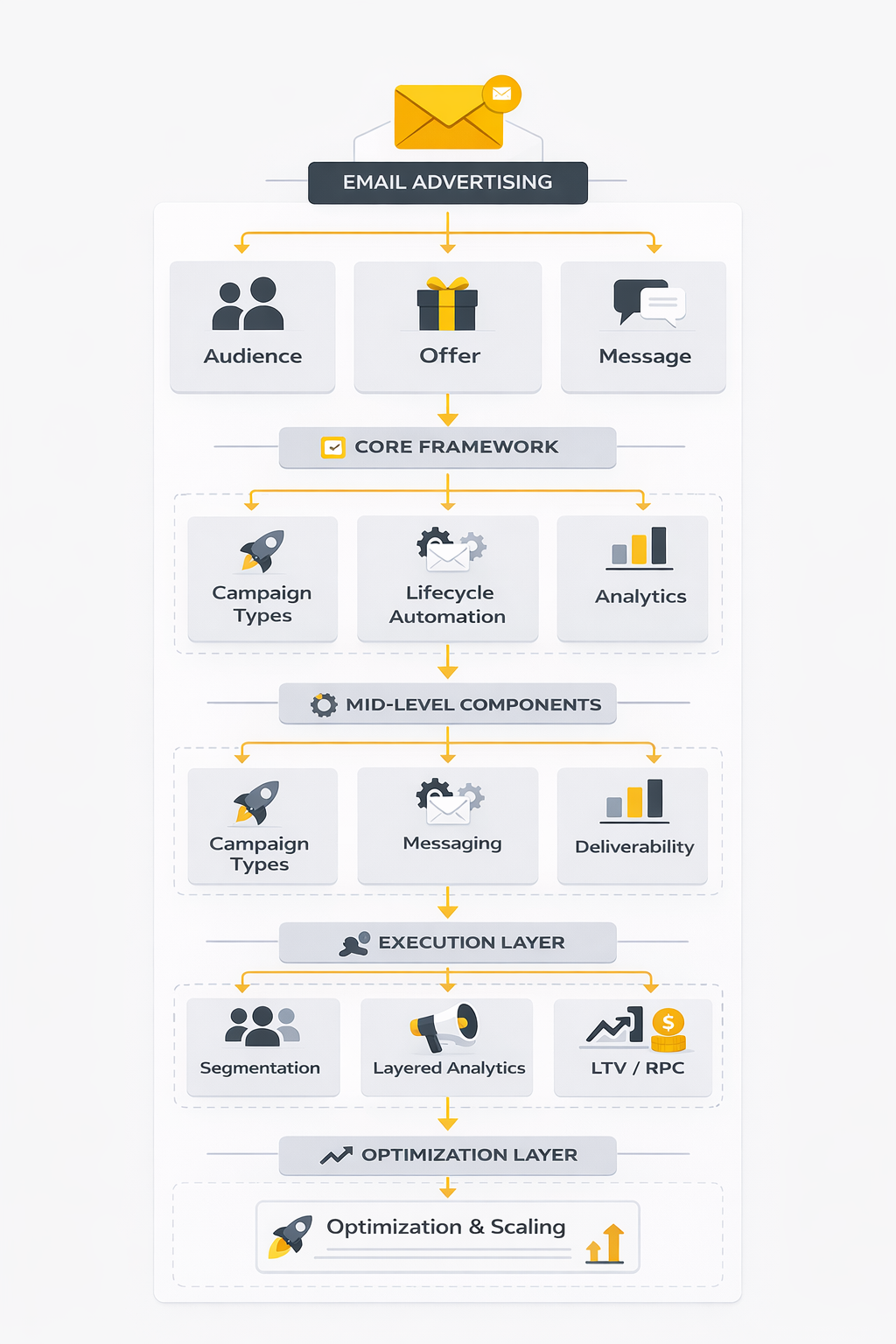
- The Email Advertising Framework
- Audience, Offer, and Message Fit
- Campaign Types That Drive Revenue
- How to Implement Email Advertising Professionally
- Measuring, Optimizing, and Scaling Results
Why Email Advertising Still Matters
Email advertising still matters because it sits closer to intent than most channels. A subscriber has already given you access to a private, high-attention environment, which makes every send a trust-based opportunity rather than a cold interruption. That does not guarantee results, but it does give you a direct line to people who already know your brand, your content, or your offer.
It also remains one of the clearest channels for tracking response. You can see how many people received the message, opened it, clicked it, and converted from it, then compare those outcomes across segments, send times, campaigns, and offers. Modern benchmarks make one thing obvious: performance is never just about writing better subject lines, because list hygiene, relevance, and sending practices shape the outcome just as much as copy does Brevo’s benchmark report.
Another reason email advertising keeps winning is durability. Paid social can spike and disappear. Organic reach can collapse when a platform changes the rules. A well-built email list behaves differently because it compounds over time, especially when you segment it properly and keep inactive contacts from dragging down performance. That is why list quality and permission standards are not technical side notes. They are part of the business model Brevo’s deliverability best practices.
There is also a strategic advantage here that smart operators understand quickly. Email works across the full customer journey. You can use it to capture leads, educate prospects, announce offers, recover abandoned carts, re-engage inactive buyers, and turn one-time customers into repeat customers. Very few channels can do all of that with the same level of control.
The mistake is treating email advertising like a batch-and-blast broadcast tool. Once that happens, teams start chasing vanity metrics, flooding the same list with the same message, and burning trust they spent months building. Good email advertising is not about sending more. It is about matching the right message to the right person at the right moment.
The Email Advertising Framework
The simplest way to think about email advertising is this: every successful campaign rests on five connected decisions. You need the right audience, the right offer, the right message, the right delivery conditions, and the right follow-up path. If one of those breaks, the campaign usually underperforms no matter how polished the design looks.
That is why a practical framework beats random tactics. Instead of asking whether you should send a discount, a newsletter, a welcome sequence, or a re-engagement email, you start by asking what job the campaign needs to do. Once the objective is clear, the structure becomes much easier to build.
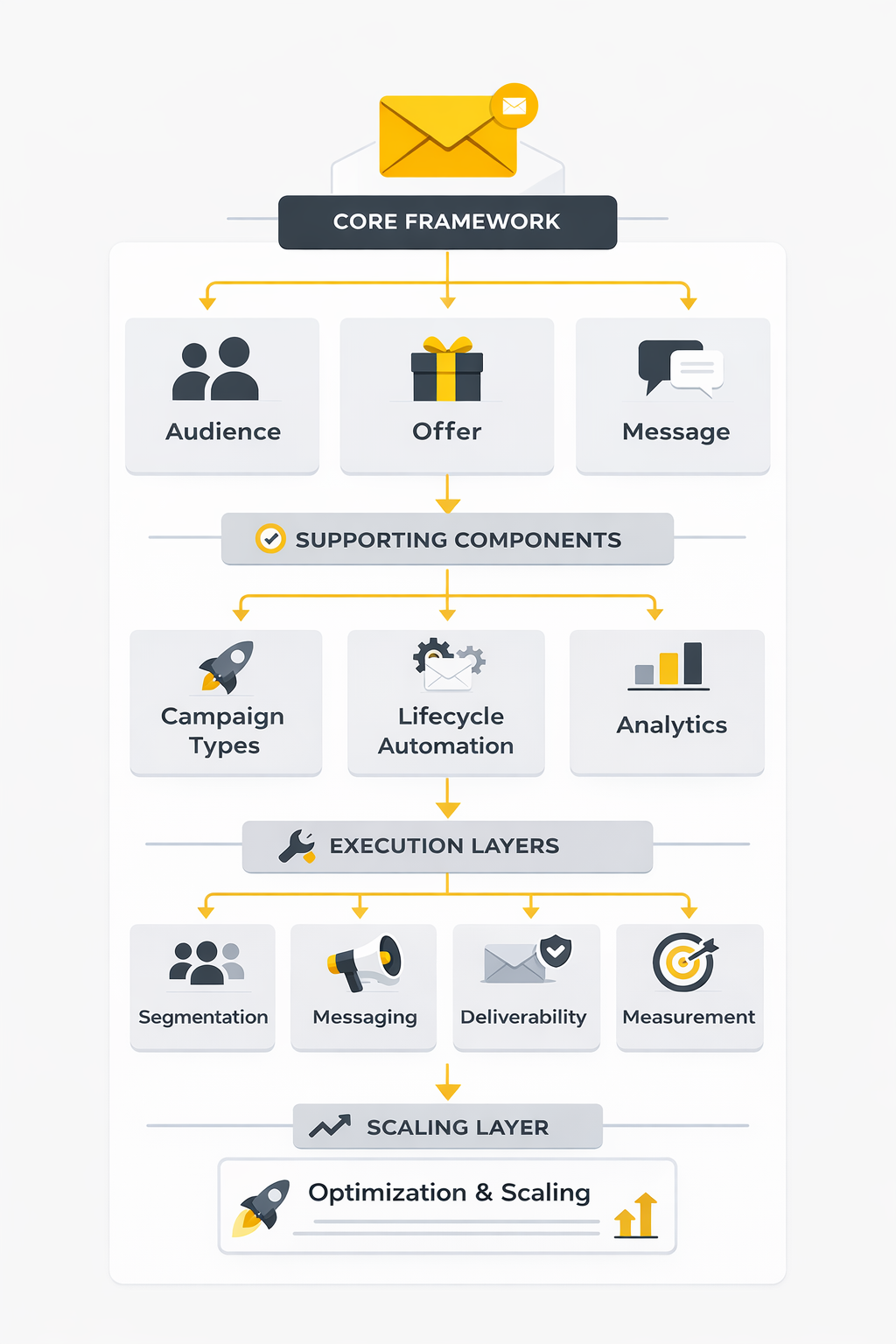
A strong email advertising framework usually looks like this:
- Define the campaign goal
- Match the audience segment to that goal
- Choose the offer or next action
- Build the message around one clear promise
- Protect deliverability before you scale
- Measure response and improve the next send
The first step sounds obvious, but it is where a lot of campaigns fail. If you do not know whether the email is supposed to generate a first purchase, restart a stalled lead, book a demo, or bring back churned attention, the copy gets vague and the call to action gets weaker. Email advertising works best when a campaign has one main job.
The second step is audience fit. A welcome email to a brand-new subscriber should not sound like a last-chance promotion for a repeat customer. A reactivation campaign should not read like a generic newsletter. Relevance improves response, but it also protects long-term performance because inbox providers pay attention to engagement signals over time Brevo’s getting started guide to deliverability.
The third step is the offer, and this is where many brands make email harder than it needs to be. Not every campaign needs a discount. Sometimes the right offer is a useful guide, a product recommendation, a product demo, a consultation, a deadline reminder, or a simple next step that reduces friction. The point is not to stuff the email with options. The point is to make the desired action feel obvious.
Then comes the message itself. Good email advertising copy does not try to say everything at once. It leads with one angle, one promise, one reason to care now, and one next step. That clarity matters far more than cleverness because subscribers decide very quickly whether your email deserves attention.
The fifth step is the part too many marketers notice only after performance drops: deliverability. Domain authentication, list hygiene, opt-in quality, gradual warming, and frequency discipline are not backend chores. They are part of campaign performance because unread emails in spam folders do not convert. Practical checklists from platforms focused on inbox placement keep reinforcing the same pattern: send to people who expect your emails, maintain clean lists, and avoid sudden spikes in volume Moosend’s deliverability checklist.
Finally, the framework only works if you close the loop. You do not just send and report. You review what happened by segment, by offer, by creative angle, and by intent level. That feedback is what turns email advertising from a repeating task into an improving system.
This is also the point where tooling starts to matter. Once campaigns get more segmented and more behavior-based, a platform with solid automation, CRM logic, and multi-step workflows makes execution much easier, especially if you are running email as part of a broader funnel rather than as a standalone newsletter. For teams building that kind of setup, tools like GoHighLevel, Brevo, or ScaledMail are worth evaluating based on how deeply you need segmentation, automation, and outbound control to go.
The rest of this article builds on that framework. Next, we will break down the real drivers behind email performance so you can align audience, offer, and messaging before you worry about templates, send frequency, or fancy automation.
Audience, Offer, and Message Fit
This is where email advertising either starts to click or quietly falls apart. You can have a clean template, a decent subject line, and solid deliverability, but if the wrong offer lands in front of the wrong people, performance stalls for a very simple reason: the email is asking for an action the reader does not care about yet.
A lot of teams misread this problem. They think the copy is weak, so they rewrite the headline. They think the design is outdated, so they rebuild the layout. Sometimes those things help, but the deeper issue is usually fit. The campaign is not aligned with the subscriber’s stage, intent, or motivation.
That is why serious email advertising starts with matching three things before you send anything: who the email is for, what you want them to do, and why they should care now. Once those three line up, the campaign becomes much easier to write, test, and improve.
Start With Audience Reality, Not List Size
A list is not an audience. It is a container full of people at different awareness levels, different buying stages, and different levels of trust. When brands ignore that and send one generic campaign to everyone, they usually create two problems at once: weaker engagement and worse long-term inbox performance.
Segmentation is the practical fix because it turns a broad database into smaller groups built around shared behavior or shared attributes. That can mean separating new subscribers from repeat buyers, active readers from inactive contacts, or product-category interest groups from general newsletter readers. Brevo’s segmentation guide makes the core point clearly: segmentation exists so you can send the right message to the right people instead of treating your whole list like one person Brevo’s segmentation breakdown.
This also matters because “normal” results vary more than people think. Email benchmarks differ by industry, region, and audience behavior, which means a campaign can look weak in one context and perfectly healthy in another. Moosend’s benchmark roundup puts average open rates in a broad range of roughly 18% to 28% and average click-through rates around 2% to 5%, which is exactly why smart operators compare results against relevant segments instead of chasing one universal magic number Moosend’s benchmark summary.
The practical takeaway is simple. Before writing the email, decide exactly which slice of the list should receive it and why that group is the best fit for the message. That one decision improves almost everything downstream.
Use Better Data So the Message Feels Earned
Good targeting depends on better inputs. In older marketing setups, brands leaned heavily on assumptions, broad demographics, or third-party data that felt “close enough.” That approach is getting weaker, and not just because privacy standards changed. It is weaker because it produces lazy messaging.
The more reliable approach is building campaigns around first-party and zero-party data. First-party data shows what people actually do, such as browsing, purchasing, clicking, or ignoring. Zero-party data shows what people intentionally tell you, such as preferences, goals, content interests, or communication frequency. Moosend’s recent guide on zero-party versus first-party data explains why this combination is stronger: one tells you what behavior suggests, and the other tells you what the customer explicitly wants Moosend on zero-party and first-party data.
That difference matters a lot in email advertising. If someone browsed a product page twice, that is useful. If they also told you they only want tips for beginners, that is even better. Now the email does not have to guess. It can meet them where they actually are.
This is one of the clearest shifts in modern email strategy. Better campaigns do not come from louder copy. They come from better audience understanding, especially when the subscriber has given you signals that make personalization feel relevant instead of creepy.
Build the Offer Around the Stage of Awareness
Once the audience is defined, the next question is the offer. This is where many campaigns become too aggressive too early. A cold subscriber gets pushed toward a purchase before trust is built. A warm prospect gets another educational email when they are already ready for a demo, consultation, or checkout. The mismatch is subtle, but it kills momentum.
The right offer depends on where the reader is in the decision process. New subscribers usually need orientation, clarity, and a reason to keep paying attention. Mid-funnel prospects often need proof, comparison help, or a lower-friction next step. Buyers close to conversion typically need urgency reduction, risk reduction, or a well-timed reminder rather than more general information.
This is why effective email advertising is not just “promotion.” It is sequencing. Brevo’s ecommerce marketing guide outlines the logic well by framing welcome emails, nurture emails, abandoned cart emails, and post-purchase emails as distinct jobs inside one lifecycle rather than interchangeable campaign types Brevo’s ecommerce email lifecycle view.
The important thing here is restraint. Not every email needs a discount. Sometimes the strongest offer is early access, a product recommendation, a useful guide, a saved-cart reminder, or a direct answer to the objection that is slowing the buyer down.
Message Fit Is What Turns Strategy Into Response
After audience and offer come together, the message has one job: make the next step feel obvious. That is where a lot of email advertising improves dramatically once the team stops trying to cram multiple promises into one send. One campaign should push one main idea. The more angles you add, the weaker the decision usually becomes.
Message fit means the email sounds like it belongs to that segment and that offer. A reactivation email should acknowledge distance or inactivity. A welcome email should reduce uncertainty and orient the subscriber fast. A cart recovery email should remove friction and make returning easy, not suddenly introduce a whole new brand story.
Design plays a role here, but not in the way many marketers assume. Clean structure, easy scanning, and a clear call to action help because inboxes are crowded and attention is short. Brevo’s email design research points out just how noisy the environment is, noting that roughly 376.5 billion emails were sent and received daily in 2025, which makes clarity more valuable than decoration Brevo’s 2026 design guide.
That is also why message fit usually beats creative flair. Readers do not reward effort. They reward relevance. If the email quickly shows that it understands what they need and what they should do next, response goes up without the campaign needing to feel flashy.
Behavior-Based Timing Beats Calendar-Based Guessing
There is another layer to fit that gets overlooked all the time: timing. Many brands schedule email advertising around their content calendar, internal deadlines, or the promo they want to push this week. That is convenient for the team, but it is not always aligned with user behavior.
Behavior-based timing is stronger because it reacts to what the subscriber actually did. A browse reminder after product interest, a cart recovery sequence after checkout abandonment, a reorder message after the expected refill window, or a re-engagement email after a clear drop in activity all feel more natural than an arbitrary batch send. Brevo’s newer segmentation updates reflect this shift by making it easier to trigger campaigns based on when an event happened, not just whether it happened Brevo’s dynamic segmentation update.
That approach gets even more valuable in ecommerce and lifecycle campaigns. HighLevel’s ecommerce email page makes the same operational point in plain language: one-size-fits-all email marketing fails because people need different messages based on behavior, purchase history, and preferences HighLevel on segmentation for ecommerce email.
When timing is based on behavior, the email feels less like an interruption and more like a useful follow-up. That is a big difference. It improves conversions, but it also protects trust, which matters just as much when you want email advertising to keep working month after month.
The next step is turning this fit into repeatable campaign structures. Once you understand who should get the message, what offer belongs in front of them, and when the email should arrive, you can start building the campaign types that generate revenue consistently instead of sporadically.
Campaign Types That Drive Revenue
Once audience, offer, and message fit are in place, email advertising becomes much more predictable. You are no longer wondering what to send next because the customer journey itself starts telling you. Different moments call for different campaign structures, and the highest-performing programs usually rely on a small set of core flows done very well.
The big shift here is moving from random sends to purposeful sequences. Broad campaigns still have value, especially for launches, promotions, and announcements, but automated lifecycle emails tend to punch far above their weight because they show up when intent is already present. That is why behavior-based flows keep outperforming generic broadcasts in most serious email programs Moosend’s automation guide.
Welcome and Onboarding Emails
A welcome sequence is the first proof that your email advertising is organized, intentional, and worth staying subscribed to. It sets expectations, introduces the brand voice, and gives the subscriber a reason to keep opening instead of forgetting who you are by next week. That first interaction matters more than people think because the subscriber is paying the most attention right after sign-up.
This is also where clarity beats creativity. A good welcome email does not try to tell the entire brand story, push every product category, and dump five links into the same message. It gives the subscriber orientation, one valuable next step, and a clear sense of what kind of emails they will receive from now on.
Brevo’s lifecycle guidance keeps reinforcing this because welcome emails are not just polite housekeeping. They are the bridge between interest and relationship, which makes them one of the highest-leverage assets in a healthy email system Brevo’s automation playbook.
Abandoned Cart and Browse Recovery Emails
If you want one campaign type that proves email advertising can drive direct revenue, this is it. Cart and browse recovery emails work because they reconnect with people who already showed intent but got interrupted, distracted, uncertain, or simply not ready in that exact moment. You are not inventing desire from scratch. You are recovering momentum that already existed.
That is exactly why these flows tend to outperform standard campaigns on a revenue basis. Recent benchmark reporting highlighted that automated messages such as cart recovery, welcome emails, and browse abandonment campaigns accounted for a disproportionate share of automated orders and sales compared with their email volume Moosend’s email automation best practices.
The important nuance is that these emails should reduce friction, not create more of it. Remind the person what they looked at, make returning easy, answer likely objections, and keep the call to action obvious. When brands overload these emails with too much design, too many offers, or unrelated upsells, they usually weaken the recovery instead of strengthening it.
Post-Purchase and Retention Emails
A lot of brands treat the sale like the finish line. In practice, that is where the next stage begins. Post-purchase email advertising is what turns a one-time transaction into a stronger customer relationship, and that is often where the most profitable long-term gains come from.
These emails can confirm the order, reduce buyer anxiety, improve product adoption, collect feedback, recommend related products, and create a path toward the second purchase. That second purchase matters because retention usually compounds faster than constant reacquisition. If your email program only focuses on conversion and ignores customer success after the sale, you are leaving money on the table.
Brevo’s retention-focused content leans into this lifecycle logic for good reason. The inbox is one of the easiest places to keep customers engaged after checkout without depending on another ad spend cycle to bring them back Brevo’s customer retention overview.
Re-Engagement and Win-Back Emails
Every list cools down over time. People change jobs, switch priorities, buy once and disappear, or simply stop noticing your messages. That does not always mean they are gone for good, but it does mean your email advertising needs a deliberate plan for inactive subscribers instead of sending them the same campaigns forever.
A win-back sequence works best when it acknowledges reality. The tone can be direct, the offer can be stronger, and the message should make it easy to either re-engage or opt out cleanly. That last part matters because protecting list quality is just as important as recovering old attention.
This is where email discipline pays off. A cleaner, more engaged list usually performs better than a bloated list that looks impressive in a dashboard but drags down opens, clicks, and inbox placement. Good operators know that re-engagement is not just about squeezing out extra conversions. It is about keeping the whole system healthy.
How to Implement Email Advertising Professionally
Knowing the right campaign types is useful, but execution is where results actually happen. Professional email advertising is not a collection of templates. It is a repeatable operating system that covers setup, segmentation, copy, creative, deliverability, launch checks, and reporting without cutting corners in the places that matter most.
This is also the point where many teams hit a wall. They understand the strategy, but their process is messy. Campaign briefs live in one place, assets in another, segmentation rules are vague, and nobody is fully sure whether the issue is the copy, the list, the offer, or the sending setup. Once that happens, every campaign feels harder than it should.
The fix is not adding more tools for the sake of it. The fix is building a clear implementation process that turns good strategy into consistent execution.
Build the System Before You Build the Campaign
The first professional move is setting up the infrastructure before you start writing emails. That means authenticating the domain, cleaning the list, defining naming conventions, documenting core segments, and making sure your data flows are reliable enough to trigger the right emails at the right time. If this layer is weak, everything built on top of it becomes less trustworthy.
That is especially true now because inbox providers are stricter about authentication, complaint rates, and sending behavior. Brevo’s deliverability and compliance guidance makes the point plainly: domain authentication with protocols like DKIM and DMARC improves inbox placement and helps meet modern sender requirements Brevo’s sender requirements guide.
The same goes for warming and sending consistency. HighLevel’s email sending guidance and Moosend’s warm-up resources both stress the same operational pattern: avoid sudden spikes, ramp volume sensibly, and protect reputation before you try to scale volume aggressively HighLevel’s email sending guide and Moosend’s warm-up strategy.
The Practical Execution Process
This is the part where email advertising becomes tangible. A professional process does not need to be bloated, but it does need to be consistent enough that campaigns are built the same way every time, reviewed the same way every time, and improved the same way every time.
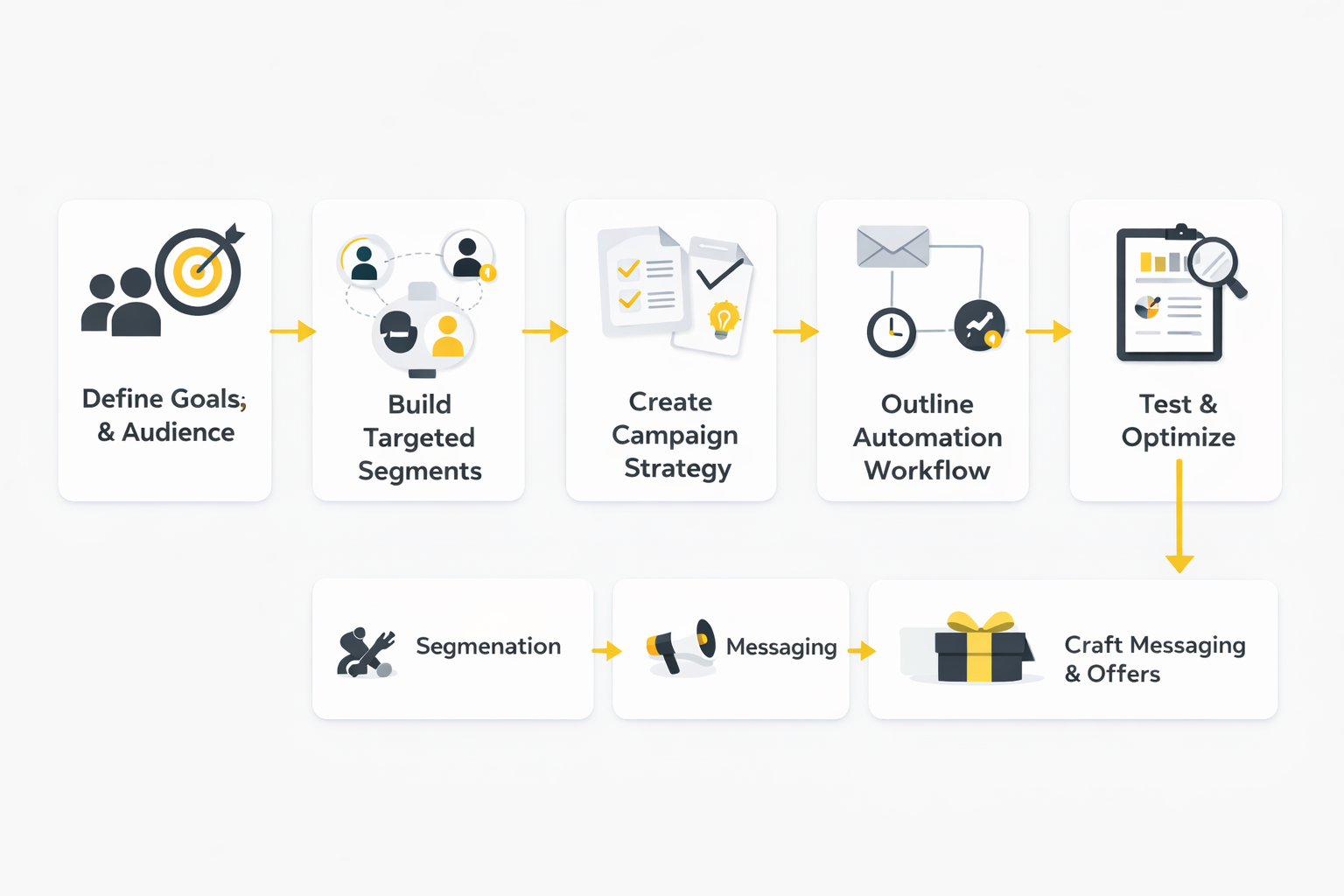
A clean workflow usually looks like this:
- Define the goal
Decide what the campaign must achieve. That could be first purchase, demo booking, cart recovery, repeat purchase, onboarding completion, or reactivation. One campaign should have one primary job, otherwise the message starts drifting.
- Choose the segment
Pick the exact audience based on behavior, stage, or intent. Do not default to “send to everyone” unless the campaign truly applies to everyone. This one decision often has a bigger impact than the copy itself.
- Match the offer to the moment
Decide what the reader should do next and what makes that step worth taking now. Sometimes that is a product purchase, but sometimes it is a guide, trial, demo, reply, or educational next step. The offer should fit the subscriber’s readiness, not the brand’s impatience.
- Write the email around one promise
Lead with a clear angle, support it with useful detail, and finish with an obvious call to action. The best-performing emails usually feel easy to understand at a glance. They do not make the reader work to figure out the point.
- Review deliverability and technical setup
Check authentication, sender identity, unsubscribe setup, tracking, and link integrity. Moosend’s deliverability checklist keeps emphasizing that technical setup, list quality, and reputation all affect inbox placement, which means these checks are not optional admin work Moosend’s deliverability checklist.
- Test before launch
Send previews, test on mobile, review personalization fields, check subject lines, and verify every CTA. Brevo’s email campaign workflow guidance keeps this grounded because even strong campaigns lose money fast when links break, formatting collapses, or logic errors send the wrong message to the wrong segment Brevo’s campaign checklist.
- Launch, observe, and document
Watch early signals, then document what happened clearly enough that the next campaign gets better. Professional teams do not just report opens and clicks. They capture what angle was used, what segment received it, what changed from the last version, and what should happen next.
That process sounds basic on paper, but that is the point. Winning execution is rarely complicated. It is disciplined.
Choose Tools That Match the Complexity of the Job
Tool choice matters once your email advertising moves beyond occasional newsletters. If you need lifecycle automation, CRM data, pipeline visibility, and multi-step workflows across email and follow-up channels, a more operational platform can save a lot of manual work. That is where systems like GoHighLevel tend to make sense, especially for agencies or businesses managing more complex lead journeys.
If your focus is strong campaign building, segmentation, and marketing automation without a heavy agency-style operating layer, platforms like Brevo or Moosend can be a better fit. The real question is not which brand is most popular. It is which platform makes your segmentation, automation, and reporting easier to run consistently.
That distinction matters more than feature lists. A slightly simpler system that your team actually uses well will usually outperform a more advanced platform that stays half-configured for months.
Professional Implementation Is Mostly About Consistency
This is the unglamorous truth a lot of people skip. Email advertising does not become professional because the design looks polished. It becomes professional when the same standards apply every time: clear goals, clear segments, strong offers, clean data, technical compliance, proper testing, and honest reporting.
That consistency is what keeps performance from bouncing wildly between campaigns. It also creates the conditions for useful testing because you can isolate what changed instead of guessing after the fact. Once you have that operating rhythm, optimization gets much easier.
That is where the article goes next. With the execution system in place, the final layer is measurement, optimization, and scaling without losing the relevance and deliverability that made the campaigns work in the first place.
What the Numbers in Email Advertising Actually Tell You
This is the point where a lot of marketers get lost. They collect dashboards full of email advertising metrics, stare at open rates, click rates, unsubscribes, bounce rates, and revenue columns, then still do not know what action to take next. The problem is usually not missing data. It is reading the data without enough context.
Good measurement is not about memorizing random benchmarks. It is about understanding what each number is signaling, what it can and cannot prove, and whether it points to a messaging issue, a targeting issue, a deliverability issue, or an offer issue. Once you get that right, analytics stop being a reporting exercise and start becoming a decision system.
Open Rates Still Matter, but They Cannot Carry the Whole Analysis
Open rate is still useful, just not in the lazy way many people use it. It can help you compare subject lines, sending times, and list segments at a high level, but it should not be treated like a pure measure of human attention anymore. Apple Mail Privacy Protection has made that much noisier by generating machine opens, which means recorded opens can be inflated and real reader interest can be lower than the dashboard suggests MailerLite’s 2026 benchmark notes.
That does not mean open rate is worthless. It means you use it directionally. If one segment consistently opens far less than another, that still tells you something. If a new subject line structure performs much worse than the previous one, that still matters. You just stop pretending that open rate alone can tell you whether the campaign worked.
This is also why benchmark ranges are more helpful than one magic target. Brevo’s 2025 dataset, built from more than 44 billion emails, shows just how much variation exists by region and industry, with open rates ranging widely depending on the business context Brevo’s 2025 benchmark data. That is the real lesson. Open rate is a comparison metric, not a trophy metric.
Clicks Usually Tell You More Than Opens
If you want a cleaner signal, clicks are usually more valuable. A click means the email created enough interest for someone to take the next step, which makes click-through rate one of the most practical ways to judge message clarity, offer strength, and CTA relevance. It is not perfect, but it is much closer to real intent than an open.
Brevo’s 2025 benchmarks put average click-through rates in the low single digits overall, with meaningful variation by sector and region Brevo’s benchmark breakdown. That might sound modest until you remember what a click represents: the email did not just get seen, it moved someone forward.
Click-to-open rate can also help when you want to isolate message quality a bit more. If opens are stable but click-to-open drops, the subject line may still be doing its job while the body copy, offer, or CTA is losing strength. If both opens and clicks drop together, the problem may start earlier with the sender reputation, segmentation, or subject line itself.
That is the kind of distinction that makes analytics useful. The goal is not admiring percentages. The goal is diagnosing where the leak begins.
Revenue Per Email Is Where the Business Case Gets Real
A campaign can have a respectable open rate and still underperform commercially. That is why email advertising should eventually be judged against revenue signals, not just engagement signals. Revenue per email, conversion rate, average order value, booked calls, qualified leads, or influenced pipeline matter because they connect inbox activity to business outcomes.
This is especially important when comparing campaign types. Broadcast promotions often generate visible spikes, but behavior-based flows like welcome emails, abandoned cart emails, and post-purchase sequences often produce stronger economics over time because they show up closer to intent Moosend’s automation best practices.
This is one reason experienced operators care so much about attribution structure. If the dashboard only shows opens and clicks, teams end up optimizing for the easiest numbers to improve rather than the numbers that matter most. A campaign that gets fewer opens but more revenue is not weaker. It is better.
That is also where tool selection starts to matter again. If your platform can track email performance alongside lead stage movement, conversion events, and lifecycle actions, optimization becomes much more grounded. For teams that want that broader view, platforms like GoHighLevel or Brevo can make the analytics layer much more useful than a basic send report.
Unsubscribes, Bounces, and Complaints Are Not Side Metrics
A lot of people treat negative metrics like cleanup data. That is a mistake. In email advertising, unsubscribes, bounce rates, and spam complaints tell you whether the system is staying healthy while you scale. They are not secondary. They are guardrails.
Brevo’s current benchmark data shows unsubscribe rates generally staying well below 0.5% in many healthy contexts, while bounce rates remain low when list quality is strong Brevo’s campaign benchmark help article. ActiveCampaign’s benchmark guidance frames unsubscribe rates under 0.5% as good and under 0.2% as excellent, which is a useful practical threshold even if the exact number varies by audience and campaign type ActiveCampaign’s email benchmark reference.
What matters more than the absolute number is the pattern. If unsubscribes jump after a certain type of promotion, the campaign may be misaligned with expectations. If bounce rates rise, the list may be aging, the collection source may be weak, or hygiene may be slipping. If complaints tick up, something more serious is happening because recipients are signaling that the message felt unwanted.
That is where deliverability stops being abstract. Google’s sender guidelines say bulk senders should keep spam complaint rates below 0.1% and avoid reaching 0.3% or higher Google’s sender guidelines FAQ. Yahoo’s bulk sender best practices also require functioning one-click unsubscribe for marketing and subscribed messages Yahoo sender best practices. These are not technical trivia points. They define how much room you have to grow without inbox placement getting worse.
Benchmarks Only Help When You Compare the Right Things
Benchmarks are useful, but only when you use them correctly. Comparing your B2B demo email against an ecommerce flash sale benchmark is not useful. Comparing a cold new-subscriber segment to a loyal repeat-buyer segment is not useful either. Context matters too much.
Brevo’s 2025 report is helpful precisely because it breaks performance out by industry, geography, and even mailbox provider, showing differences in inbox placement and engagement that would disappear inside a single average Brevo’s 2025 marketing benchmark report. That should change how you read your own numbers. A low-performing segment might not mean your whole email advertising program is weak. It might mean one part of the system needs a different offer or different cadence.
The smarter move is building your own internal benchmarks after a few months of disciplined sending. Compare welcome emails to past welcome emails. Compare win-back campaigns to past win-back campaigns. Compare promotion emails by segment, not just by total list size. That is how you create a measurement system that actually teaches you something.
The Analytics System That Makes Optimization Possible
Once you stop looking at metrics in isolation, email advertising gets much easier to improve. The point is not tracking everything. The point is tracking the few signals that tell you where performance is strengthening and where it is starting to crack.
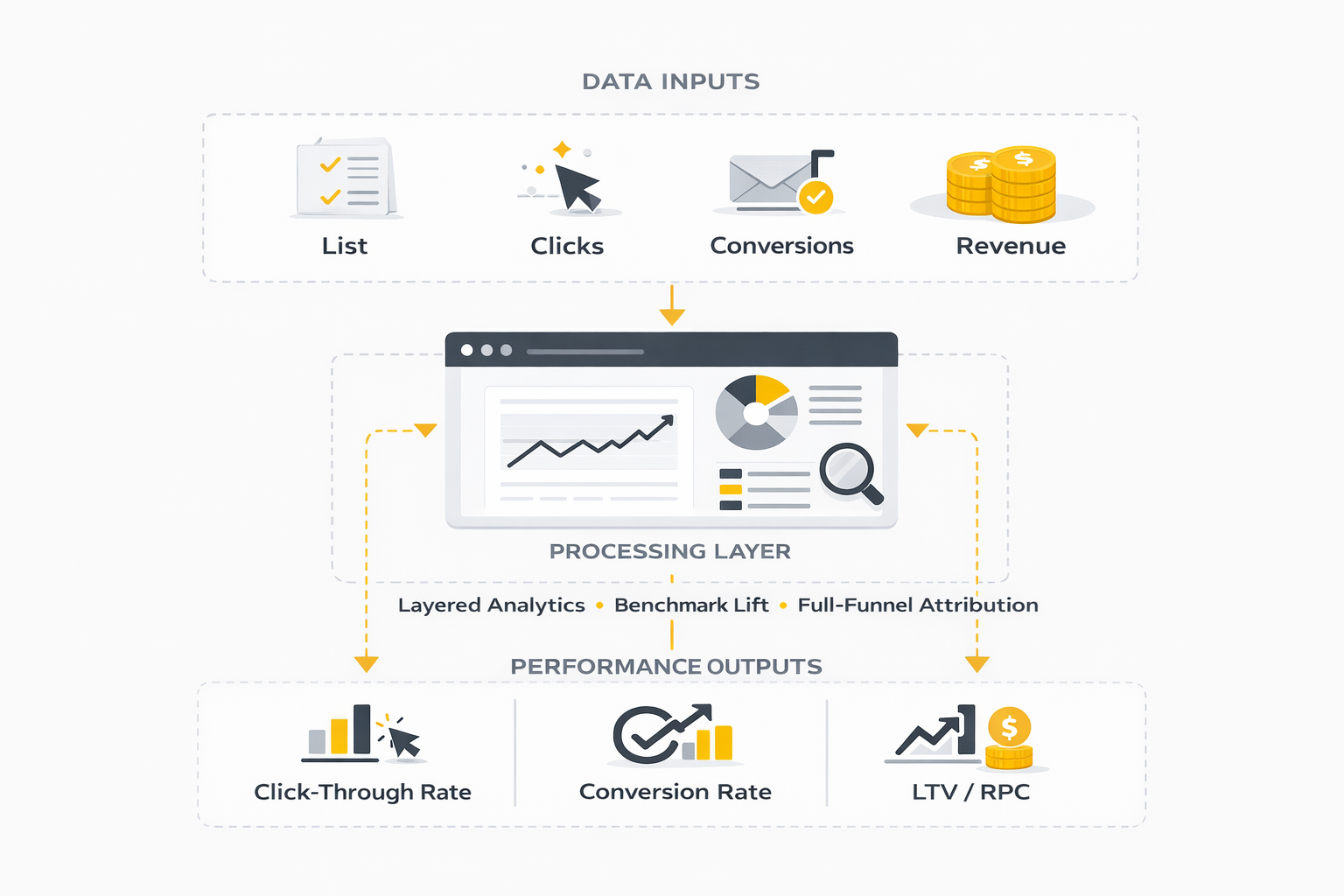
A practical analytics system usually works in layers:
- Attention metrics
Open rate and delivered rate tell you whether the message is getting seen at all. These are early indicators, not final proof of success.
- Engagement metrics
Click-through rate and click-to-open rate tell you whether the content and CTA created enough interest to move someone forward.
- Conversion metrics
Purchases, booked calls, lead submissions, demos, replies, and revenue per email tell you whether the campaign produced business value.
- Health metrics
Unsubscribes, bounces, and complaint rates tell you whether the campaign damaged trust or sender reputation while trying to drive performance.
- Trend metrics
Segment-level comparisons, month-over-month shifts, and flow-versus-broadcast performance tell you whether the whole system is improving over time.
This layered view matters because one strong metric can hide a weaker one. A campaign can get high opens but weak clicks. It can get good clicks but poor conversions. It can produce sales but also generate unsubscribe damage that makes future campaigns harder to deliver. When you read the whole stack together, the next action becomes clearer.
What Different Patterns Usually Mean
If opens are healthy but clicks are weak, the subject line probably worked better than the body. That usually points to a weak message, a muddled offer, or a CTA that asks for too much too soon. In that case, rewriting the subject line again is rarely the fix.
If clicks are strong but conversions are weak, the email may be doing its job while the landing page, checkout flow, booking page, or follow-up path is failing. This is where marketers often blame the campaign even though the leak appears after the click. That is also why aligned funnel tools and better landing page infrastructure matter, especially when the email is only one step inside a longer path. If that is your setup, something like Replo can matter more to performance than tweaking copy for the tenth time.
If unsubscribes and complaints rise while opens and clicks look acceptable, the campaign may still be damaging the list. That usually means frequency is too high, expectations were not set well, targeting is too broad, or the offer feels too repetitive. This is the kind of issue that looks tolerable in one report and expensive over the next two months.
The Data Should Always Trigger a Specific Action
This is the simplest rule in the whole measurement section: every metric review should end with a decision. If the number does not change what you do next, you are not really measuring. You are just watching.
For example, a drop in click-through rate should trigger a review of message angle, CTA clarity, and segment relevance. A rise in bounce rate should trigger list hygiene work and source review. A spike in complaints should trigger immediate sending restraint, audience tightening, and a closer look at acquisition quality. A strong conversion rate in one flow should trigger expansion or adaptation of that pattern elsewhere.
That is what separates professional email advertising from casual reporting. Metrics are not there to make the dashboard look busy. They are there to tell you where to push, where to pause, and where to fix the underlying system before scale turns a small problem into a painful one.
The next step is using those signals for structured optimization. Once the data is being interpreted correctly, you can test more intelligently, scale more safely, and improve performance without wrecking relevance or deliverability in the process.
Scaling Email Advertising Without Breaking It
This is where a lot of brands get overconfident. They find a few campaigns that work, add more sends, build more automations, widen more segments, and assume more volume will automatically create more revenue. Sometimes it does for a while. Then performance softens, unsubscribes rise, deliverability starts slipping, and nobody can tell exactly when the machine stopped getting better and started getting noisier.
The reason is simple: email advertising does not scale in a straight line. It scales through discipline. The more messages you send, the more important targeting, reputation, timing, and list quality become, because every mistake compounds faster when the volume is higher.
The First Scaling Risk Is Sending Too Much
Most email problems do not begin with terrible copy. They begin with too much frequency hitting too broad an audience. Once that happens, even decent campaigns start feeling repetitive because the subscriber is not judging each email on its own. They are judging the cumulative experience of getting too many messages that feel too similar.
That is why frequency is not just a scheduling choice. It is a trust decision. Moosend’s recent review of email marketing frequency makes the point clearly: there is no universal “best” send volume, because what works depends on audience expectations, industry, business model, and how much value each message actually delivers Moosend’s guide to email frequency.
Brevo’s 2026 design and campaign data adds another useful layer here by showing how crowded inboxes already are and how heavily some businesses send over a 30-day period Brevo’s 2026 email design guide. More volume can work, but only when the audience is segmented well enough that the subscriber experiences relevance rather than repetition.
The practical move is to scale frequency by segment, not by ego. Your most engaged buyers may tolerate and even welcome more communication. Your colder subscribers probably will not. Treating both groups the same is one of the fastest ways to flatten performance.
Automation Can Improve Relevance or Multiply Bad Decisions
Automation is one of the biggest advantages in modern email advertising, but it is also one of the easiest places to create silent damage. A weak manual campaign might underperform once. A weak automated campaign can underperform for months while continuing to send on schedule, quietly training recipients to ignore you.
That is why more automation does not automatically mean a more advanced program. Brevo’s automation guidance keeps emphasizing workflows, segmentation, and branching logic because those are what make automation useful rather than robotic Brevo’s automation software guide. If the trigger logic is sloppy or the timing is off, automation simply helps you scale irrelevance faster.
This is where expert-level email advertising gets more selective. Instead of building endless workflows, strong teams focus on the sequences that clearly match buyer intent, then review them regularly for drift. That review matters because audience behavior changes, offers change, products change, and an automation that made sense six months ago may now be confusing, too aggressive, or just stale.
Personalization Works Best When It Feels Useful, Not Performative
A lot of marketers still treat personalization like a visibility trick. Add a first name, mention a product category, maybe drop in a recommendation block, and call it advanced. That kind of surface personalization can help a little, but it is not what really improves email advertising performance.
Useful personalization is about context. It reflects what the subscriber has done, what they care about, what stage they are in, and what kind of next step would actually help them. Moosend’s work on first-party and zero-party data is useful here because it shows why stronger personalization comes from better inputs, not just more merge tags Moosend on better customer data.
The tradeoff is that better personalization requires better systems. You need cleaner data, more reliable event tracking, and a platform that can actually use those signals well. That is one reason businesses with more complex lifecycle journeys often outgrow simplistic tools and move toward systems with deeper segmentation and workflow control, including platforms like GoHighLevel when the email program is tied closely to CRM stages, lead management, and multi-step automation.
The important point is not to personalize everything. It is to personalize the parts that change the decision. If the personalization does not make the email more relevant or easier to act on, it is probably decoration.
Deliverability Gets Harder as Success Creates More Volume
This is the part many teams underestimate because it is less visible than creative work. When email advertising begins to work, volume usually rises. More campaigns go out, more automations are added, more segments get activated, and new acquisition sources feed new contacts into the system. That growth feels good, but it also puts more pressure on reputation, authentication, and list hygiene.
HighLevel’s current sending guidance and warm-up documentation are useful reminders that safe scale depends on verified domains, controlled warm-up, and reputation management rather than sudden jumps in output HighLevel’s email sending guide and HighLevel’s domain warmup guide. Brevo’s deliverability best practices say much the same thing from another angle: inbox placement improves when authentication, engagement, and list quality stay strong together Brevo’s deliverability best practices.
This creates a real strategic tradeoff. The temptation is to push harder when campaigns are converting well. The smarter move is usually controlled expansion. Scale the segments that stay engaged, tighten acquisition sources that send weaker leads, and watch reputation signals closely enough that you notice damage before it becomes expensive.
Better Testing Means Testing the Right Layer
A lot of teams say they test, but what they really do is tweak subject lines. That is fine at a basic level, but mature email advertising requires testing at multiple layers because not every performance problem starts in the inbox. Sometimes the subject line is the issue. Sometimes it is the segment. Sometimes it is the offer. Sometimes it is the page after the click.
Brevo’s drip and automation content is useful here because it highlights branching logic and sequence testing rather than only one-off send experiments Brevo’s drip email software guide. That is the more advanced mindset. You test where the customer journey is weak, not just where the email editor makes testing easy.
A good rule is this: test the highest-friction part of the path first. If opens are weak, test the subject line or sender identity. If clicks are weak, test the message angle or CTA. If clicks are solid but conversions are lagging, the landing page is probably where attention should go. In that situation, improving the post-click experience with a stronger page builder such as Replo can create more lift than another round of inbox-level tweaks.
Cross-Channel Support Often Makes Email Work Better
One advanced mistake is expecting email to do every job alone. Email advertising is powerful, but it gets even stronger when other channels support it instead of competing with it. A lead warmed by content, retargeting, SMS, or in-app messaging often responds better in the inbox because the brand does not feel unfamiliar when the email arrives.
HighLevel’s performance reporting has leaned into this cross-channel point by connecting authenticated sending and CRM-based automation with broader audience preparation across channels HighLevel’s August 2025 performance report. That does not mean every business needs a complicated omnichannel machine. It means the best email advertising usually exists inside a larger customer journey, not in isolation.
This matters most when the sale is not instant. If your buying cycle includes multiple touches, then email should be one coordinated step in a sequence, not the only place where persuasion happens. That perspective changes how you build campaigns because the email no longer has to carry the entire weight of education, proof, urgency, and conversion on its own.
The Strategic Standard for Expert-Level Email Advertising
At a certain point, the difference between average and excellent email advertising is no longer about templates or clever copy. It is about judgment. Knowing when to send more and when to hold back. Knowing when to automate and when to simplify. Knowing when a metric signals opportunity and when it signals stress inside the system.
The strongest programs stay reader-first even while they become more data-driven. They use segmentation, automation, testing, and analytics to increase relevance, not just to increase output. That sounds obvious, but it is the line many teams cross without noticing once scale becomes the goal instead of the result.
That is why the best operators stay obsessed with fit. Fit between audience and offer. Fit between behavior and timing. Fit between volume and reputation. Fit between email performance and the rest of the funnel. When that fit holds, scaling becomes much safer and much more profitable.
The final part brings everything together with a clear close and the practical questions that usually come up once someone is ready to put this system into action.
Bringing the Whole Email Advertising System Together
The strongest email advertising programs do not win because they found one magical subject line or one lucky promotion. They win because the whole system works together: list growth, segmentation, offer design, timing, automation, deliverability, creative execution, and measurement all support the same goal. Once that happens, email stops behaving like a channel you occasionally use and starts acting like an asset that compounds.
That is the real finish line here. You are not trying to send more email. You are trying to build a system that sends the right email, to the right person, at the right moment, with the right level of pressure. When that system is healthy, scaling gets easier, optimization gets smarter, and the revenue becomes much less random.
The ecosystem matters too. Email rarely works in isolation anymore, especially when buying journeys are longer or customer attention is split across channels. That is why the best setups often combine email with stronger landing pages, automation, CRM logic, and cleaner customer data so every step after the click is just as intentional as the message inside the inbox.
If you are building that kind of system, the tool stack should support the strategy rather than complicate it. Businesses that need deeper automation and CRM visibility often lean toward GoHighLevel, while teams focused on campaign building and segmentation may prefer Brevo or Moosend. If the post-click experience is the weak point, a stronger page builder like Replo can matter more than another round of inbox tweaks.
What matters most is not brand loyalty to one platform. It is whether the tools make your email advertising more relevant, more measurable, and easier to improve over time. That is the standard worth chasing.
FAQ
Is email advertising still worth it in 2026?
Yes, but only if you treat it like a system instead of a batch-send habit. Inbox providers are stricter, subscribers are less patient, and privacy changes have made lazy measurement less useful, which means weak programs get exposed faster than before. The upside is still real because email remains one of the few channels you directly control, and current benchmark data continues to show strong engagement and conversion potential when targeting and deliverability are handled well, as seen in Brevo’s 2025 benchmark report.
What is the difference between email advertising and email marketing?
Email marketing is the broader umbrella. It includes newsletters, lifecycle emails, onboarding, retention, content distribution, and relationship building. Email advertising usually refers more directly to campaigns built to generate a commercial action such as a purchase, booked demo, lead submission, or product click, even though in practice the two overlap all the time.
What metrics matter most in email advertising now?
Clicks, conversions, revenue, and list-health signals matter more than they used to because open-rate data is less reliable than it once was. Privacy protections, especially Apple Mail Privacy Protection, have made opens directionally useful but less dependable as a stand-alone KPI, which is why more teams are shifting toward click-through rate, click-to-open rate, and conversion metrics, a trend summarized in recent benchmark analysis. The best metric is the one that changes your next decision, not the one that simply looks impressive in a dashboard.
Are open rates still useful or should they be ignored?
They should not be ignored, but they also should not lead the whole analysis. Open rates still help compare subject lines, sender names, audience segments, and send timing, but they are now better treated as directional data rather than pure proof of human attention. That is exactly why modern email advertising needs layered analytics instead of one headline metric.
What is a good unsubscribe rate for email advertising?
There is no single perfect number, but lower is obviously better if the campaign is still producing results. Industry guidance and benchmark reporting typically place healthy unsubscribe rates well below 0.5%, with stronger programs often sitting much lower depending on the audience and campaign type, as reflected in Brevo’s benchmark definitions and ActiveCampaign’s benchmark glossary. What matters more than the exact figure is whether the rate jumps after a certain audience, offer, or frequency change.
How often should you send advertising emails?
As often as your audience can absorb them without feeling overwhelmed or annoyed. That sounds vague, but it is the honest answer because the right frequency depends on customer intent, industry norms, list quality, and how relevant the emails actually are. The more segmented and behavior-based your email advertising becomes, the more safely you can increase frequency without causing the fatigue issues described in Moosend’s frequency guide.
Do small businesses need automation, or is that overkill?
Small businesses do not need complicated automation just to look advanced. They do, however, benefit massively from a few well-built flows such as welcome emails, cart recovery, lead follow-up, and post-purchase sequences because those show up at moments of real intent. In most cases, a small number of clean automations will outperform a large number of messy ones.
What are the biggest deliverability mistakes in email advertising?
The biggest mistakes are poor list quality, weak authentication, sudden sending spikes, and ignoring complaint signals until performance drops hard. Google’s current sender guidance says bulk senders should keep spam complaint rates below 0.1% and avoid reaching 0.3% or higher, while Yahoo continues to require easy one-click unsubscribe for qualifying commercial mail through its sender best practices at Google’s sender guidelines FAQ and Yahoo sender best practices. In plain English, that means you cannot brute-force your way to scale anymore.
Should every email advertising campaign include a discount?
No, and overusing discounts can quietly train your audience to wait for the next offer instead of buying at normal value. Sometimes the right move is education, urgency, comparison help, onboarding clarity, a demo invitation, or a better-timed reminder. Discounts are tools, not a strategy.
What campaign types usually drive the most revenue?
Behavior-based flows usually carry a lot more revenue impact than brands expect. Welcome emails, browse recovery, abandoned cart emails, post-purchase sequences, and re-engagement campaigns tend to perform well because they respond to existing intent rather than interrupt people cold, a pattern consistently reinforced in lifecycle and automation reporting like Moosend’s automation best practices. Broadcast promotions still matter, but flows often produce the steadier economics.
How important is segmentation in email advertising?
It is one of the biggest drivers of performance because it improves relevance and protects list health at the same time. Sending the same message to everyone is easy operationally, but it usually creates weaker clicks, more unsubscribes, and more fatigue over time. Better segmentation makes frequency safer, offers more relevant, and analytics more useful.
What should you test first if performance drops?
Start where the biggest leak appears. If opens fall, look at subject lines, sender reputation, and segment quality. If opens hold but clicks fall, the message, offer, or CTA is probably the issue, and if clicks are strong but conversions are weak, the problem is often happening after the inbox on the page or funnel itself.
Do landing pages affect email advertising results that much?
Absolutely. Email advertising can generate the click, but it cannot rescue a confusing page, a weak offer presentation, or a clunky checkout path once the visitor lands. That is why teams serious about performance often improve their post-click experience with better page infrastructure, including tools like Replo, rather than blaming every conversion problem on the email alone.
Is it better to use one all-in-one platform or a more specialized stack?
That depends on how complex the customer journey is and how well your team actually uses the software. An all-in-one setup can be powerful if you need CRM stages, automation, reporting, and lead management connected in one place, which is why some teams move toward GoHighLevel. A more specialized stack can also work extremely well if each part is strong and the integration layer is clean, but only if the handoffs between tools do not create reporting confusion or execution drag.
What is the smartest way to improve email advertising over the next 90 days?
Start by tightening the fundamentals before chasing advanced tactics. Clean the list, verify authentication, review your core segments, strengthen one high-intent automation, and measure the full path from send to conversion instead of staring at opens alone. That kind of focused cleanup usually creates more lift than launching five new campaigns at once.
Work With Professionals
Explore 10K+ Remote Marketing Contracts on MarkeWork.com
Most marketers spend too much time chasing clients, competing on crowded platforms, and losing a percentage of every project to middlemen.
MarkeWork gives you a better way. Browse thousands of remote marketing contracts and connect directly with companies desperate to hire skilled marketers like you, without platform commissions and without unnecessary gatekeepers.
If you're serious about finding better opportunities and keeping 100% of what you earn, explore available contracts and create a profile for free at MarkeWork.com.