

Email copywriting is the skill of turning inbox attention into action. Not hype. Not clever wordplay for its own sake. The job is simple: help the right person understand why your message matters now, what they should do next, and why taking that step feels worth it.
That matters because email is still one of the few marketing channels where you are not fully renting attention from an algorithm. Strong email programs continue to drive measurable business value, with Litmus reporting that 35% of companies see $10 to $36 back for every $1 spent. But that return does not come from “sending more emails.” It comes from sharper positioning, cleaner offers, better timing, and copy that respects the reader.
Article Outline
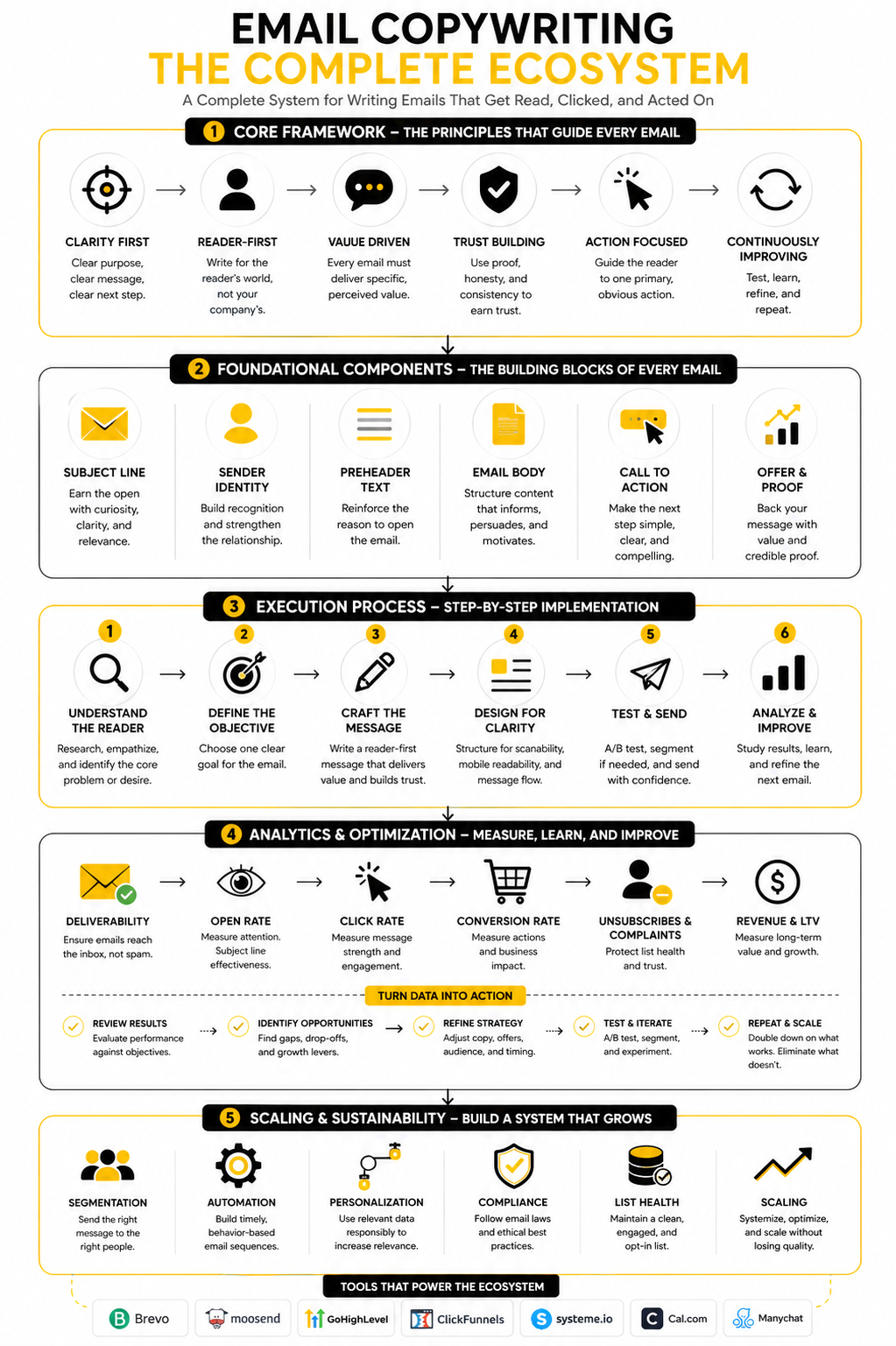
This guide is split into six parts so each section can build on the last without rushing the process. We will start with the strategic foundation, then move into the actual mechanics of writing emails that feel relevant instead of disposable. By the end, the goal is not just to write nicer emails, but to build a repeatable email copywriting system you can use across campaigns, launches, newsletters, automations, and follow-ups.
- Why Email Copywriting Still Matters
- The Email Copywriting Framework
- Audience, Intent, And Offer Clarity
- Subject Lines, Opens, And First Lines
- Body Copy, CTAs, And Conversion Flow
- Testing, Automation, Tools, And FAQs
Why Email Copywriting Still Matters
Email copywriting matters because the inbox is crowded, personal, and brutally honest. People do not owe your message attention just because they subscribed once, downloaded a lead magnet, or bought something last year. They open, skim, click, ignore, archive, or unsubscribe based on whether the message feels useful in that moment.
This is also why “good writing” is not enough. A polished email can still fail if the offer is vague, the timing is wrong, or the call to action asks for too much too soon. Recent benchmark coverage shows average email open rates can vary widely by industry, with HubSpot listing a 2025 cross-industry average open rate of 42.35%, but opens are only the first layer.
The deeper job is trust. Strong email copy makes the reader feel understood before it asks them to do anything. Weak copy jumps straight to the pitch, hides the value, or sounds like every other brand shouting “limited time” into the same inbox.
The Email Copywriting Framework
A practical email copywriting framework has four parts: reader, reason, message, and action. The reader is who the email is really for. The reason is why this email should exist today. The message is the one clear idea the reader needs to understand. The action is the next step you want them to take.
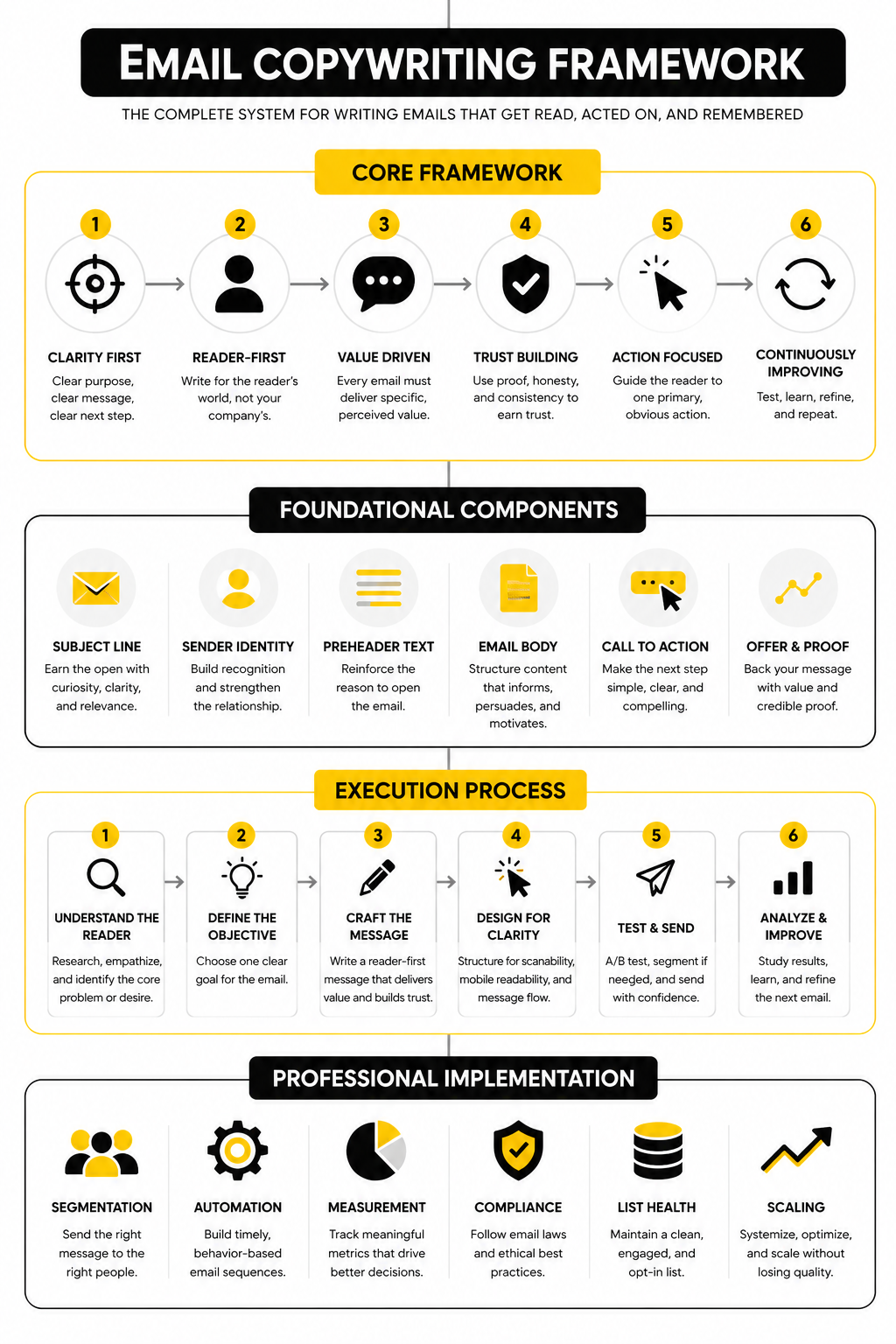
This framework keeps the writing grounded. Without it, emails drift into filler, over-explaining, or generic promotion. With it, every subject line, opening sentence, proof point, and CTA has a job.
It also makes tools more useful. Platforms like Brevo or Moosend can help you send, segment, and automate campaigns, but they cannot fix unclear thinking. The copy still has to carry the message.
Core Components Of Effective Email Copy
Every effective email needs a clear promise. The promise does not have to be dramatic, but it must give the reader a reason to continue. That reason might be a useful insight, a relevant offer, a reminder, a deadline, a product benefit, or a next step they already care about.
The second component is momentum. The subject line earns the open, the first line earns the next line, and the body copy earns the click. If any part feels disconnected, the reader drops off.
The third component is restraint. One email should usually do one main job. When you ask people to read three announcements, consider two offers, watch a video, book a call, and follow you on social media, you are not creating opportunity. You are creating friction.
Professional Implementation
Professional email copywriting is not about writing from scratch every time. It is about building reusable decision-making systems: audience notes, offer angles, subject line patterns, CTA rules, proof libraries, and testing habits. That is what turns email from a random content task into a reliable revenue channel.
For agencies, coaches, SaaS teams, and local businesses, this is where platforms such as GoHighLevel, ClickFunnels, or systeme.io can support the workflow. The tool handles the funnel, automation, CRM, or delivery layer. The copy decides whether the message feels worth acting on.
That is the standard for the rest of this guide. We are not chasing magic templates or recycled “swipe files.” We are building the thinking behind emails that people open, understand, trust, and click.
The Email Copywriting Framework
The strongest email copywriting starts before you write the first line. It starts with a decision: what job should this email do? If you skip that decision, you end up polishing sentences that should never have been written.
A useful email has one primary reader, one primary reason to exist, one core message, and one next action. That does not mean every email must be short. It means every part of the email should pull in the same direction.
This matters even more now because email performance is not just about opens. The 2025 GDMA International Email Benchmark reviewed 521 billion emails from 54,000 companies and found a broad pattern of open rates rising while click rates declined. Translation: people may open, but they still need a stronger reason to act.
Start With The Reader
Before writing, define the reader in practical terms. Not “small business owners.” Not “marketers.” Define what they know, what they want, what they are worried about, and what would make this message feel relevant today.
That changes the copy immediately. A founder who is comparing tools needs a different email than a warm lead who already watched a demo. A returning customer needs a different message than someone who has not opened your emails in months.
Good email copywriting is not about sounding impressive. It is about reducing the distance between what the reader already cares about and what you want them to do next.
Define The Reason For The Email
Every email needs a reason beyond “we had to send something.” The reason might be a launch, a useful lesson, a product update, a deadline, a seasonal shift, a behavior trigger, or a reminder tied to something the reader already did. Without that reason, the email feels random.
This is where many campaigns become weak. They start with the sender’s goal instead of the reader’s situation. “We need more sales this week” is not a reader-facing reason.
A better reason sounds like this: the reader has a problem, the timing matters, and this email helps them make a cleaner decision. That is the foundation of persuasive copy without manipulation.
Reduce The Message To One Clear Idea
The best emails are easy to repeat. After reading, the person should understand the main point without having to decode five competing arguments. If they cannot explain the email in one sentence, the copy is probably trying to do too much.
This does not mean the email can only contain one detail. It means the details should support one clear idea. For example, a launch email can mention features, proof, pricing, and urgency, but all of those pieces should support the same reason to click.
When the message is clear, the writing gets sharper. Subject lines become easier. CTAs become less forced. The body copy stops wandering.
Choose The Next Action Before Writing
The CTA is not something you add at the end. It is the direction of the entire email. If the action is to book a call, the copy should build enough trust and relevance for that commitment. If the action is to read a guide, the email should make the guide feel immediately useful.
This is also where the right tool matters. If your email leads into a funnel, a platform like ClickFunnels can support the next step. If your email leads into a CRM-driven follow-up process, GoHighLevel may fit better.
But do not hide behind software. The tool can route the click, track the contact, and automate the next message. The copy still has to make the click feel worth it.
Audience, Intent, And Offer Clarity
Audience clarity is where email copywriting becomes profitable. The same offer can feel valuable, irrelevant, or annoying depending on who receives it and when. That is why segmentation is not just a technical feature; it is a copywriting advantage.
Email platforms keep getting better at automation, behavior tracking, and personalization, but the strategy still has to come from you. The Klaviyo 2026 benchmarks report shows average campaign click rates across industries at 1.69%, while top performers reach 3.38%. The gap is not created by prettier buttons alone.
The gap comes from relevance. Better emails match the message to the moment. They understand what the reader is ready to believe, compare, question, or buy.
Match The Email To The Buyer’s Stage
A cold subscriber usually needs context. A warm lead needs clarity. A buyer may need onboarding, reassurance, or a reason to purchase again. Treating all three the same is lazy email marketing.
This is why welcome sequences, nurture campaigns, sales emails, and retention emails should not sound identical. Each one has a different job. The welcome email earns attention, the nurture email builds belief, the sales email asks for action, and the retention email protects the relationship.
When you match the copy to the stage, the email feels calmer and more useful. You stop over-selling people who are not ready. You also stop under-selling people who are waiting for a clear reason to move.
Make The Offer Easy To Understand
A weak offer makes email copy work too hard. If readers need several paragraphs to understand what they get, who it is for, and why it matters, the problem is not the sentence structure. The problem is the offer.
A clear offer answers three questions quickly. What is it? Who is it for? What changes after the person takes action? Those answers should be visible in the email, not buried behind vague benefits.
This is especially important when promoting tools, services, or funnels. A landing page builder, automation platform, CRM, or newsletter tool can all sound similar if the email stays generic. The copy has to show the specific use case, otherwise the offer becomes noise.
Use Personalization With Restraint
Personalization can help, but only when it improves relevance. Adding a first name to a subject line does not rescue a weak message. Mentioning the reader’s behavior, preference, purchase history, or stage in the journey can be much more useful.
For example, an abandoned cart email should not sound like a monthly newsletter. A post-demo follow-up should not sound like a cold pitch. A reactivation email should acknowledge distance without making the reader feel guilty.
This is where platforms such as Brevo, Moosend, and ManyChat can support better timing and segmentation. Use that power to make messages more helpful, not creepier. Relevance wins. Gimmicks wear out.
Subject Lines, Opens, And First Lines
Subject lines do not sell the whole offer. They sell the open. That is their job, and trying to make them do more usually makes them weaker.
A good subject line creates enough relevance, curiosity, or urgency for the right person to keep going. It should connect to the actual email, not trick people into opening something they did not ask for. Trust compounds slowly, but inbox disappointment compounds fast.
Open rates can also be misleading on their own because privacy changes and inbox behavior have made them less precise than they used to be. That is why benchmarks such as MailerLite’s 2026 email marketing benchmark data are useful for context, but they should not become the only thing you optimize. The real goal is not just more opens; it is more qualified attention.
Write The Subject Line After The Message Is Clear
The easiest way to write weak subject lines is to start there before the email has a point. You end up guessing at hooks instead of pulling from a clear message. That creates subject lines that sound clever but do not connect to the body copy.
Write the email angle first. Decide what the reader should understand, feel, or do after reading. Then write subject lines that point directly toward that idea.
This keeps your email copywriting honest. The subject line becomes a doorway into the message, not a bait-and-switch. That matters because the first click you earn is the open, but the relationship is built by what happens after it.
Use Curiosity Without Becoming Vague
Curiosity works when the reader believes the answer will matter to them. It fails when the subject line is so vague that it could belong to any brand, any offer, or any newsletter. “You need to see this” is not a strategy.
Better curiosity points toward a specific tension. It hints at a mistake, a missed opportunity, a surprising result, or a decision the reader already cares about. The goal is to create a small open loop without hiding the topic completely.
For example, a subject line about improving checkout emails should not pretend to be a personal emergency. It can be direct and still interesting. Clear beats mysterious when the reader is busy.
Make The First Line Carry The Momentum
The first line has one job: confirm that opening the email was a good decision. If the subject line creates interest and the first line starts with generic throat-clearing, the momentum dies. This is where many emails lose people immediately.
Do not begin with “Hope you’re well” unless the relationship genuinely supports it. Do not waste the first line restating your company name, your excitement, or the fact that you are sending an email. Start where the reader’s attention already is.
A strong first line can name the problem, sharpen the moment, or make a useful promise. It should feel like the email has already begun, not like the writer is warming up. That one shift makes the entire message feel more professional.
The Execution Process
Once the strategy is clear, the writing process becomes much simpler. You are not trying to “be creative” from a blank page. You are moving through a sequence that turns audience insight into a finished message.
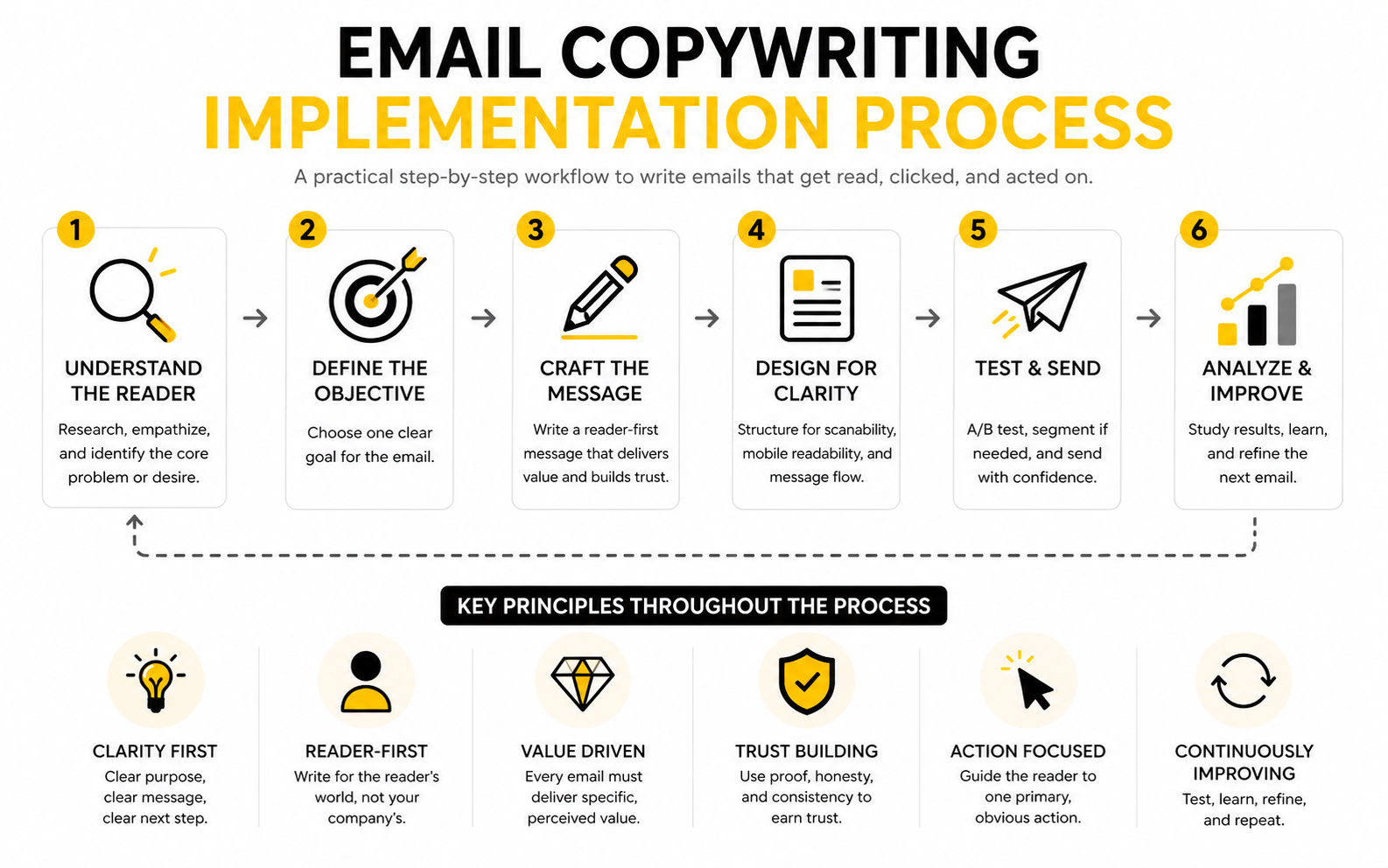
The process should be repeatable enough that you can use it for campaigns, automations, launches, newsletters, and follow-ups. It should also be flexible enough to fit different levels of buyer awareness. That balance is where email copywriting becomes a system instead of a guessing game.
Step 1: Define The Email’s Job
Start by writing one sentence that explains what this email must accomplish. Not the campaign. Not the whole funnel. This specific email.
For example, one email might need to get a subscriber to read a comparison page. Another might need to move a trial user toward activation. Another might need to recover a cart where the buyer hesitated because of shipping, trust, or price.
This step prevents bloated copy. When the job is clear, every sentence can be judged against it. If a line does not help the email do its job, cut it.
Step 2: Choose The Main Angle
The angle is the lens of the email. It decides whether you lead with pain, opportunity, proof, speed, simplicity, risk reduction, status, savings, timing, or a useful insight. Same offer, different angle, completely different email.
Do not pick the angle based on what sounds dramatic. Pick it based on what the reader is most ready to care about. A skeptical reader may need proof, while an overwhelmed reader may need simplicity.
This is also where segmentation makes the writing stronger. A returning customer can handle a more direct offer because they already know you. A new subscriber often needs more context before the same offer feels credible.
Step 3: Build The Email From The CTA Backward
Once you know the action, write backward from it. Ask what the reader must believe before clicking. Then build the email around those beliefs.
If the CTA is to book a call, the reader may need to believe the call is relevant, low-pressure, and worth the time. If the CTA is to start a trial, they may need to believe setup will be easy. If the CTA is to finish checkout, they may need reassurance around delivery, returns, or value.
This is where funnel tools can help if the next step needs structure. A simple email-to-page flow can work well with systeme.io, while more advanced funnel paths may fit ClickFunnels. But again, the page cannot rescue a lazy email. The click has to feel earned.
Step 4: Draft Fast, Then Edit Hard
The first draft is where you get the argument onto the page. Do not obsess over perfect wording too early. Get the flow down first: opener, problem or opportunity, useful context, offer, proof, CTA.
The second pass is where the real work happens. Remove filler, soften hype, sharpen transitions, and make the CTA more specific. If a sentence exists only because it sounds like marketing, delete it.
The final pass should be read like a subscriber would read it: quickly, skeptically, and on a small screen. Nielsen Norman Group’s long-running usability research has consistently emphasized that people scan digital content more than they read it line by line. Your email should survive that behavior.
Step 5: Check The Message Against The Reader
Before sending, ask whether the email feels like it was written for the reader or at the reader. That distinction matters. People can feel when copy is just a campaign calendar wearing a friendly tone.
Check the subject line against the body. Check the body against the CTA. Check the CTA against the reader’s stage.
This is the boring part that protects performance. Most email copy does not fail because the writer lacked talent. It fails because nobody checked whether the message, moment, and action actually matched.
Statistics And Data
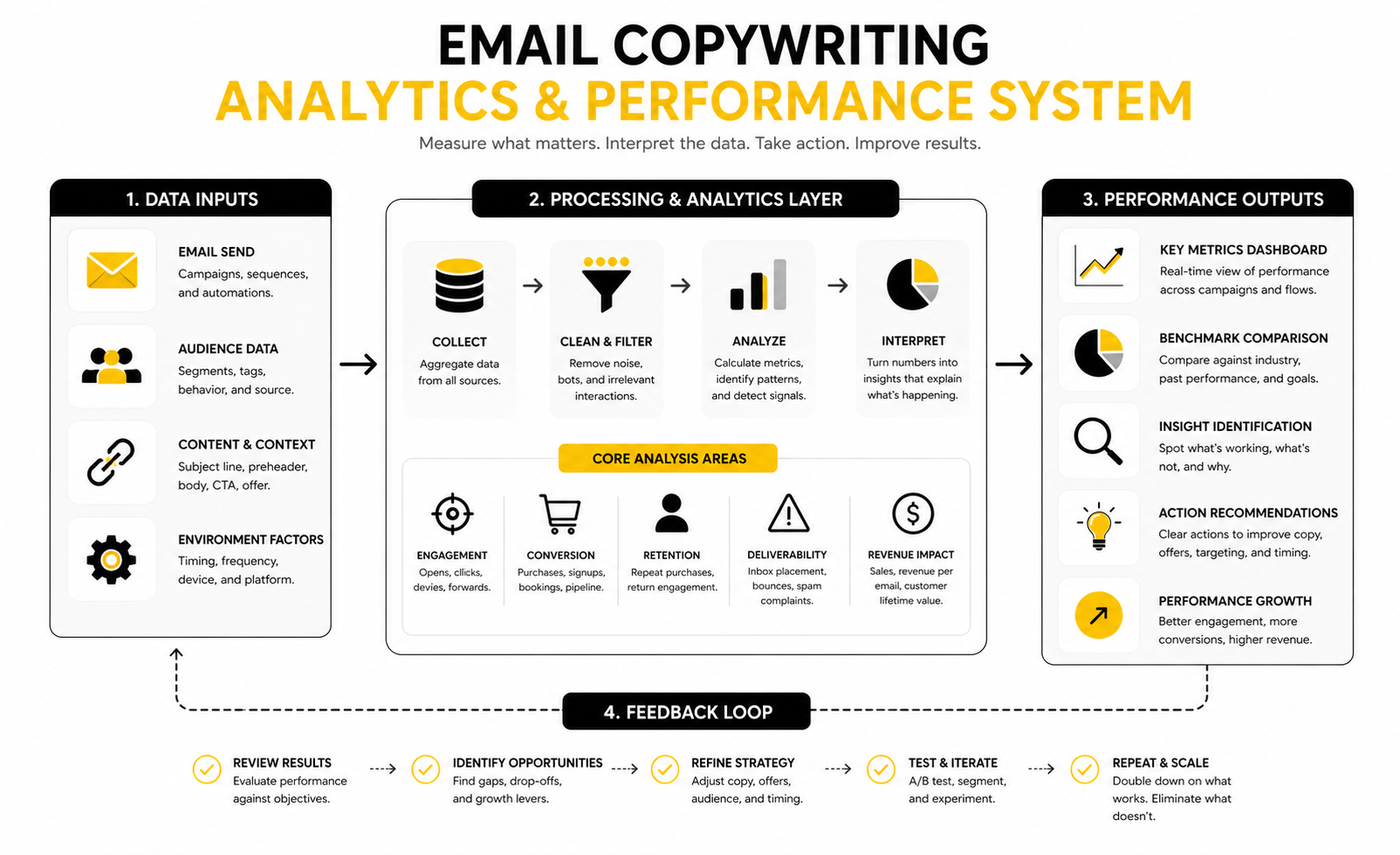
Data should make your email copywriting sharper, not noisier. The point is not to collect every possible metric and pretend the dashboard is the strategy. The point is to understand where attention is leaking, where trust is growing, and where the reader is getting stuck.
A healthy email measurement system looks at the full path: delivery, opens, clicks, conversions, unsubscribes, replies, revenue, and long-term list quality. Each metric answers a different question. When you treat them all as one generic “performance score,” you miss the real problem.
Start With Deliverability
Deliverability tells you whether your emails are actually reaching people in the first place. If messages are going to spam, landing in promotions, or bouncing because the list is weak, better copy will not fix the core issue. You cannot persuade someone who never sees the email.
The DMA Email Benchmarking Report 2025 reported delivery rates reaching 98% in 2024, with B2C delivery at 99.2%. That sounds strong, but it also sets a standard. If your deliverability is far below that, your first move is list hygiene, sender reputation, authentication, and sending discipline.
This is where platforms with solid email infrastructure and segmentation tools matter. Tools like Brevo and Moosend can help you manage campaigns, but the list still needs to be earned, cleaned, and respected.
Treat Open Rates As A Signal, Not A Verdict
Open rates are useful, but they are not as clean as many marketers want them to be. Apple Mail Privacy Protection changed the reliability of open tracking because images can be preloaded in ways that inflate opens or blur real reader behavior. Litmus notes that more than 50% of email opens happen on devices with Apple Mail Privacy Protection activated, so open data needs context.
This does not mean opens are useless. They can still show directional movement across subject lines, sender names, list segments, and topics. But they should not be the only metric used to judge whether an email worked.
Use opens to diagnose attention. If opens are weak, look at the sender name, subject line, audience match, list fatigue, and timing. If opens are strong but clicks are weak, the subject line probably created attention that the body copy did not convert.
Clicks Show Message Strength
Clicks are a stronger sign that the email created enough interest for someone to act. A click means the reader did more than glance. They found the message relevant enough to leave the inbox.
The DMA’s 2025 benchmark reported unique click rates rising for the third year in a row to 2.3%. MailerLite’s 2026 benchmark analysis reported an average 2025 click rate of 2.09%. Those numbers are useful because they keep expectations grounded.
A 2% click rate can be poor, normal, or excellent depending on the list, offer, industry, and email type. A newsletter to a broad audience will not behave like a cart recovery email. A launch email to a warm buyer segment should not be judged against a cold nurture email.
Conversion Rate Reveals The Real Business Impact
Clicks tell you the email created movement. Conversions tell you whether that movement was valuable. That is why the most serious email copywriting measurement connects the email to the landing page, checkout, booking page, trial signup, or sales conversation.
If clicks are high and conversions are low, the problem may not be the email. The landing page may be unclear, the offer may feel risky, the checkout may create friction, or the promise in the email may not match what appears after the click. This is where you need to audit the whole path, not just rewrite the subject line.
For funnel-driven campaigns, the email and page should feel like one continuous conversation. A tool like ClickFunnels can help structure the path after the click, while GoHighLevel can support follow-up, pipeline tracking, and CRM visibility. The key is simple: measure the journey, not just the email.
Unsubscribes And Spam Complaints Protect The List
Unsubscribes are not always bad. Some people should leave your list because they are no longer interested, no longer relevant, or never should have been there in the first place. A clean list is better than a large list full of people ignoring you.
But sudden increases in unsubscribes or spam complaints are a warning. They usually point to a mismatch between what people expected and what you sent. That could mean the frequency changed, the content became too promotional, the segmentation was lazy, or the opt-in promise was unclear.
This metric should influence copy and strategy. If people leave after sales emails, check whether the transition from value to offer feels abrupt. If they leave after newsletters, check whether the emails are useful enough to deserve their place in the inbox.
Benchmarks Are Context, Not Targets
Benchmarks help you see whether your numbers are wildly off, but they should not become your ceiling. Your best comparison is not always the industry average. It is your own past performance by segment, campaign type, offer, and audience maturity.
The GDMA Email Benchmark 2025 reviewed 521 billion emails from 54,000 companies and reported a confirmed open rate of 32.40%, a click-to-open rate of 7.62%, and a click rate of 1.99%. That scale makes the data useful, but it still does not tell you what your welcome sequence, launch list, or reactivation segment should achieve. Your context matters.
The practical move is to build your own baseline. Track performance by email type, not just by campaign. Once you know your normal range, every new send becomes easier to interpret.
What The Numbers Should Make You Do
Good analytics should lead to action. If deliverability drops, clean the list and check sender reputation. If opens drop, test positioning, subject lines, sender identity, and list fatigue. If clicks drop, improve the email’s promise, proof, structure, and CTA.
If conversions drop after clicks, inspect the offer and landing page before blaming the email. If unsubscribes rise, check expectation mismatch and frequency. If replies increase, study the language people use because that is often better copy research than another dashboard.
This is the professional way to use data in email copywriting. Do not chase vanity numbers. Use the numbers to find the bottleneck, fix the specific weakness, and make the next email more relevant than the last.
Advanced Email Copywriting Strategy
Once the basics are working, the next level of email copywriting is not “better words.” It is better judgment. You need to know when to sell harder, when to educate, when to segment, when to suppress, when to automate, and when to leave the reader alone.
That is where many brands get stuck. They learn subject lines, CTAs, and campaign structure, then assume scaling means sending more. In reality, scaling email usually means becoming more selective.
The inbox rewards relevance over volume. You can increase sending frequency when the message earns it, but you cannot bully people into caring. The more mature your email program becomes, the more your strategy should protect trust as carefully as it pursues revenue.
Segmentation Creates Leverage
Segmentation is one of the biggest upgrades you can make because it lets the same offer feel more specific to different groups of people. A new subscriber might need education. A returning buyer might need a complementary offer. A trial user might need help reaching the first useful result.
This is not just a technical exercise inside your email platform. It changes the copy itself. The headline, opening line, proof, objection handling, and CTA can all become sharper when the audience is narrower.
The mistake is over-segmenting before you have enough data or traffic. Start with meaningful differences: buyer versus non-buyer, engaged versus inactive, new lead versus warm lead, high intent versus low intent. Simple segmentation done well beats complex segmentation nobody maintains.
Automation Should Feel Timely, Not Robotic
Automation works best when it responds to real behavior. A welcome email after signup makes sense. A cart reminder after abandonment makes sense. A post-purchase onboarding sequence makes sense.
What does not work is automation that feels like a machine pretending to be a person. If the timing is strange, the message ignores the reader’s context, or the sequence keeps pushing after the reader already acted, the copy starts to feel careless. That is how automation damages trust.
Use automation to make emails more useful, not merely more frequent. Platforms like GoHighLevel can help connect forms, CRM stages, follow-ups, and pipeline activity, while systeme.io can support simpler automated funnel flows. The strategy still has to decide what the reader should receive, why they should receive it, and when the message should stop.
Personalization Has A Trust Ceiling
Personalization can improve relevance, but it also has a limit. When an email feels too invasive, the reader does not think, “Great targeting.” They think, “Why do they know that?” That reaction kills trust.
The smarter move is to personalize around useful context rather than sensitive details. Mention the product category someone viewed, the resource they downloaded, or the stage they are in. Do not overplay personal data just because the software gives you access to it.
This tradeoff matters more as marketers use more AI, behavioral tracking, and customer data. Gartner’s 2025 personalization research found that negative personalized experiences affected 53% of customers and made them 3.2 times more likely to regret a purchase. More personalization is not automatically better. Better personalization is better.
AI Can Accelerate Drafting, But It Cannot Own The Strategy
AI can help with ideation, rewrites, segmentation logic, variant generation, and repurposing. Used well, it speeds up production and helps you explore angles faster. Used badly, it fills the inbox with polished sameness.
The danger is that AI often produces copy that sounds acceptable before it is strategically correct. It can write smooth paragraphs around a weak offer. It can create subject lines that feel exciting but do not match the actual message. It can make bad strategy look presentable.
Use AI as a drafting assistant, not the decision maker. Feed it audience context, offer details, objections, proof, and brand voice. Then edit with human judgment because your reader does not care that the copy was easy to produce.
Compliance Is Part Of The Copy Strategy
Email compliance is not just a legal box to tick at the bottom of a template. It shapes how trustworthy your emails feel. Clear sender information, honest subject lines, visible unsubscribe options, and accurate commercial intent all protect the relationship.
The FTC’s CAN-SPAM guidance requires commercial emails to avoid deceptive subject lines, use accurate header information, identify the message as an ad when required, include a valid physical postal address, and provide a clear opt-out method. That is not optional polish. It is the baseline.
Good email copywriting should never depend on deception anyway. If the subject line needs to mislead people to get opens, the offer or angle is not strong enough. Fix that instead.
Scaling Requires Message Governance
As email volume grows, copy quality usually becomes harder to control. More campaigns, more segments, more automations, more stakeholders, and more tools can create a messy inbox experience. The reader does not care which department sent which message. They experience it all as one brand.
That is why scaling requires message governance. You need rules for frequency, tone, claims, offers, proof, discounting, suppression, and handoffs between campaigns. Without those rules, your best email copywriting will be undermined by overlapping sends and inconsistent promises.
A practical governance system can be simple:
- Define who owns the email calendar
- Set rules for promotional frequency
- Create approved language for major claims
- Maintain a proof library
- Review automations quarterly
- Suppress buyers from irrelevant lead campaigns
- Track complaints and unsubscribes by campaign type
This is not bureaucracy. It is how you protect the asset. Your email list is not just a traffic source; it is a relationship database.
The Biggest Strategic Risk Is Training People To Ignore You
Every email teaches your list what to expect from the next one. If you constantly send weak offers, fake urgency, vague newsletters, or recycled promotions, people learn to ignore you. They may not unsubscribe immediately, but mentally they are gone.
That is the hidden cost of lazy email copywriting. The damage does not always show up in one campaign. It shows up months later when open rates soften, click rates flatten, and previously warm subscribers stop reacting.
The fix is not to panic and shout louder. The fix is to rebuild usefulness. Send emails with a clear reason, a relevant message, and a next step that makes sense. Do that consistently, and your list starts paying attention again.
Testing, Automation, Tools, And Final Optimization
The final layer of email copywriting is the operating system around the copy. You need a way to test ideas, automate the right messages, review performance, and keep the whole customer journey consistent. Without that system, every email becomes a one-off guess.
Testing should be focused, not chaotic. Test one meaningful variable at a time: the angle, the subject line, the offer, the CTA, the segment, or the landing page promise. If you change everything at once, you may get a result, but you will not know what caused it.
Automation should be built around moments where the reader clearly needs help. A welcome sequence helps someone understand what comes next. A post-purchase sequence helps them get value from what they bought. A reactivation sequence gives inactive subscribers a reason to return or leave cleanly.
Build A Simple Email Copywriting System
A good system keeps the work practical. Start with a campaign brief, define the reader, choose the angle, write the email, connect the CTA to the next step, and review the data after sending. That rhythm is boring in the best way.
Your system should include:
- Audience segment
- Email objective
- Reader problem or desire
- Core promise
- Proof or support
- Primary CTA
- Suppression rules
- Success metric
- Follow-up action
This gives you consistency without making every email sound the same. It also makes collaboration easier when multiple people touch the email calendar, funnel, CRM, landing pages, and reporting.
Choose Tools That Match The Workflow
The right tool depends on the job. If you need campaigns, segmentation, and email automation, Brevo or Moosend can be useful options to explore. If you need CRM, pipelines, automations, and client follow-up in one place, GoHighLevel may fit better.
If the email drives people into a sales funnel, ClickFunnels or systeme.io can help structure the next step. If the email points to a scheduling action, Cal.com can support booking flows.
Do not buy software because the dashboard looks powerful. Buy it because it supports the journey you are actually building. A simple tool used consistently beats an advanced tool nobody understands.
Keep The Human Standard High
The inbox is filling with automation, AI-generated content, and low-effort campaigns. That makes strong human judgment more valuable, not less. The more generic the average email becomes, the more a clear, useful, specific message stands out.
Email copywriting is not about pretending every email is personal. It is about making every email relevant enough to deserve the reader’s attention. That means honest subject lines, clear offers, useful timing, and a CTA that respects where the reader is in the journey.
The final test is simple. Would this email still make sense if the reader was busy, skeptical, and reading on their phone? If yes, you are much closer to copy that works.
FAQ - Built for Complete Guide
What is email copywriting?
Email copywriting is the process of writing emails that guide readers toward a specific action. That action could be clicking a link, buying a product, booking a call, replying, finishing checkout, starting a trial, or reading a resource. The best email copywriting combines strategy, psychology, clarity, timing, and a strong understanding of the reader.
Why is email copywriting important?
Email copywriting matters because email is still one of the most direct ways to reach people who have already shown interest in your brand. You are not only competing for attention; you are competing for trust. Strong copy helps readers understand why the message matters and what they should do next.
What makes a good marketing email?
A good marketing email has one clear purpose, a relevant subject line, a strong opening, useful body copy, and a specific CTA. It should feel like it was written for the reader’s situation, not just the sender’s sales goal. It should also match the promise made before the person joined the list.
How long should a marketing email be?
A marketing email should be as long as it needs to be and no longer. Short emails work well for simple actions, familiar offers, and urgent reminders. Longer emails can work when the reader needs context, proof, education, or objection handling before taking action.
How do I write better subject lines?
Start with the email’s core message before writing the subject line. Then create a subject line that makes the right person want to open without misleading them. Strong subject lines are usually specific, relevant, and connected to the body of the email.
What is the biggest mistake in email copywriting?
The biggest mistake is writing from the sender’s perspective instead of the reader’s perspective. Many emails talk about what the company wants to announce, sell, or promote. Better emails connect the message to what the reader already cares about.
How often should I email my list?
There is no universal perfect frequency. The right cadence depends on your audience, offer, relationship, and content quality. If every email has a clear reason to exist, you can usually send more often than brands that only show up to promote something.
Should I use AI for email copywriting?
AI can help with brainstorming, drafting, rewriting, and creating variations. It should not replace strategy, customer insight, or final editing. Use AI to move faster, but keep a human in charge of relevance, truth, tone, and judgment.
How do I measure email copywriting performance?
Look beyond opens. Track delivery, clicks, conversions, replies, unsubscribes, spam complaints, revenue, and list engagement over time. Each metric tells you something different about where the email journey is working or breaking.
What is the difference between email copywriting and email marketing?
Email marketing is the broader strategy of using email to communicate, nurture, sell, retain, and grow customer relationships. Email copywriting is the writing inside that system. Marketing decides the campaign and audience; copywriting turns the message into words that move people.
How do I improve low click rates?
Low click rates usually mean the email did not create enough motivation to act. Check the promise, relevance, structure, CTA, offer clarity, and audience match. If opens are strong but clicks are weak, the subject line may be doing its job while the body copy is not.
How do I avoid sounding too salesy?
Be specific, useful, and honest. Explain who the offer is for, why it matters, and what the reader can expect after clicking. Salesy copy usually happens when the email pushes urgency before it has earned belief.
What tools help with email copywriting?
The best tools depend on the workflow. You may use Brevo, Moosend, GoHighLevel, ClickFunnels, or systeme.io depending on whether you need email sending, CRM, automation, funnels, or sales pages. The tool matters, but the strategy matters more.
Work With Professionals
Explore 10K+ Remote Marketing Contracts on MarkeWork.com
Most marketers spend too much time chasing clients, competing on crowded platforms, and losing a percentage of every project to middlemen.
MarkeWork gives you a better way. Browse thousands of remote marketing contracts and connect directly with companies desperate to hire skilled marketers like you, without platform commissions and without unnecessary gatekeepers.
If you're serious about finding better opportunities and keeping 100% of what you earn, explore available contracts and create a profile for free at MarkeWork.com.