

An email list for marketing still gets talked about like a basic tactic. It is not. It is one of the few channels you can build, improve, and keep using without depending entirely on a platform algorithm, and the opportunity is still huge when 75% of online adults use email at least once a month and Litmus reports that 35% of companies see returns between $10 and $36 for every $1 spent on email.
What changed is the margin for laziness. Google now requires all senders to use authentication like SPF or DKIM, with bulk senders also needing DMARC and one-click unsubscribe, while Apple’s Mail Privacy Protection blocks senders from reliably learning when someone opened an email. So the real game is no longer collecting as many addresses as possible. It is building a list that people want to join, mailbox providers trust, and your business can grow without burning reputation.
That also means the legal and ethical side is not optional. The FTC makes clear that CAN-SPAM applies to all commercial messages, not just bulk email, and includes no exception for B2B email, while the European Commission says third-party contact data can only be used for marketing when it was obtained lawfully for that purpose and the consent covered transfer to other recipients. That is why a strong email list for marketing starts with permission, not volume.
Article Outline
This guide is built as one connected system. The early sections explain why email still matters and what a healthy list actually looks like, and the later sections move into growth, measurement, and professional execution. The section names below are the exact structure the full six-part article will follow.
- Why an Email List for Marketing Still Matters
- The Email List Growth Framework
- The Core Components of a High-Performing List
- Acquisition Systems That Attract Qualified Subscribers
- Measuring Performance and What the Data Actually Means
- Professional Implementation, Compliance, and Scale
Why an Email List for Marketing Still Matters
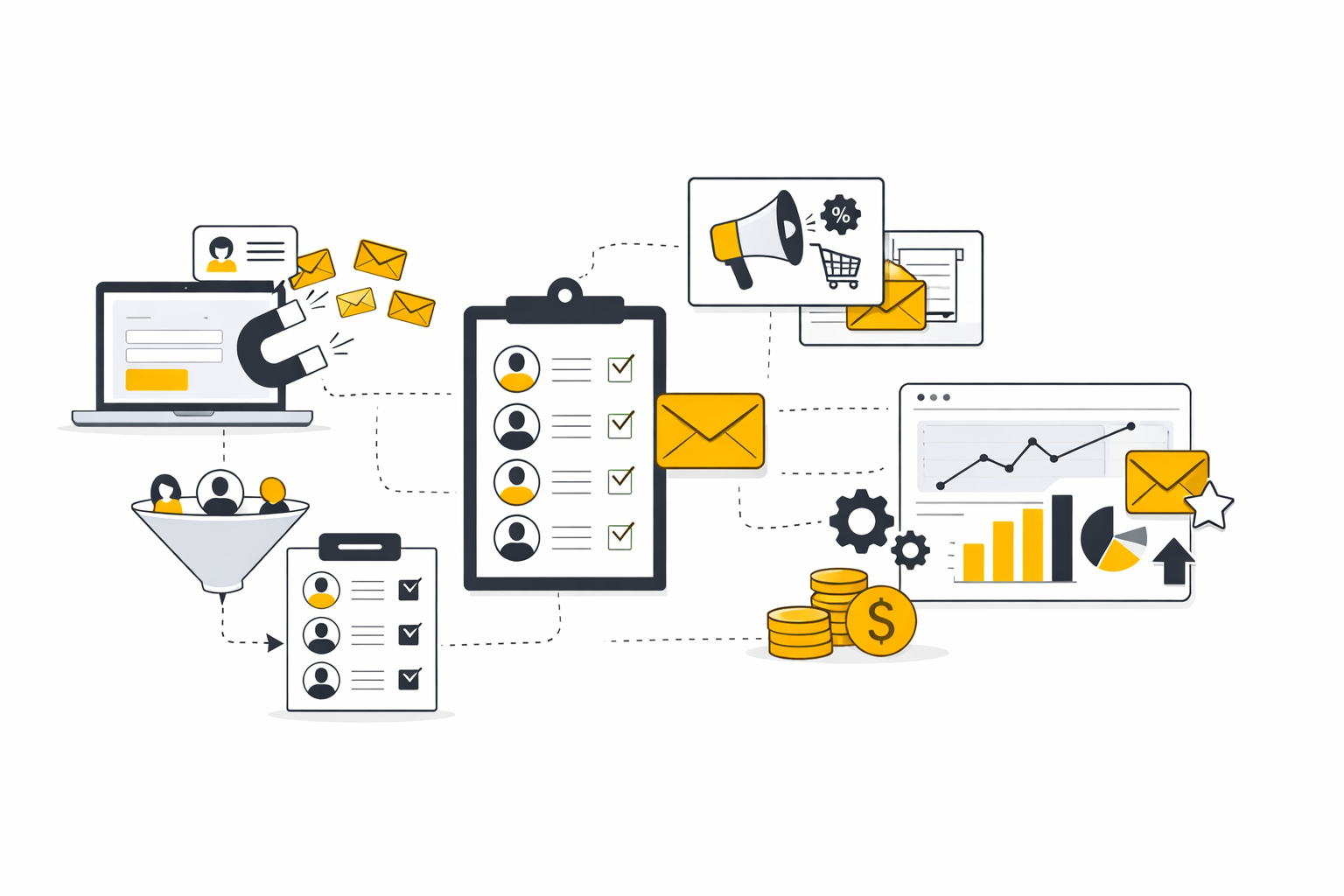
The biggest reason an email list for marketing matters is control. Social reach can disappear overnight, paid acquisition gets more expensive the moment competition rises, and search traffic is always partly rented, but an email list gives you a direct line to people who already said yes. That still matters in a world where inbox access remains normal behavior, not some niche habit, with email usage staying broad across age groups.
But control is not the same thing as entitlement. Google’s sender guidance now explicitly tells senders to make sure recipients opt in, confirm each recipient’s address before subscribing them, and make unsubscribing easy, because mailbox providers are watching behavior more closely than most marketers admit. In plain English, a list full of weak consent, stale contacts, or scraped addresses is not an asset. It is a deliverability problem waiting to get expensive.
That is exactly why buying or borrowing contacts is such a bad shortcut. Mailchimp is blunt that purchasing email lists is almost never worth it and that third-party contacts put senders at risk, while Brevo recommends double opt-in because it improves list quality and deliverability. A smaller list with clear intent will usually outperform a much bigger list built on vague interest or no real permission at all.
There is also a measurement reason this matters now. Apple’s privacy protections mean open behavior is no longer a clean proxy for interest, so the businesses that win with email are the ones building lists around real relevance from the start. If the right people join for the right reason, later metrics like clicks, replies, conversions, and revenue become far more useful.
The Email List Growth Framework
A strong email list for marketing grows through a sequence, not a trick. First you make a clear promise, then you give the right person a simple way to subscribe, then you confirm that permission is real, and only after that do you start segmenting, automating, and selling. Most weak email programs break because they try to jump to monetization before they have built trust at the point of entry.
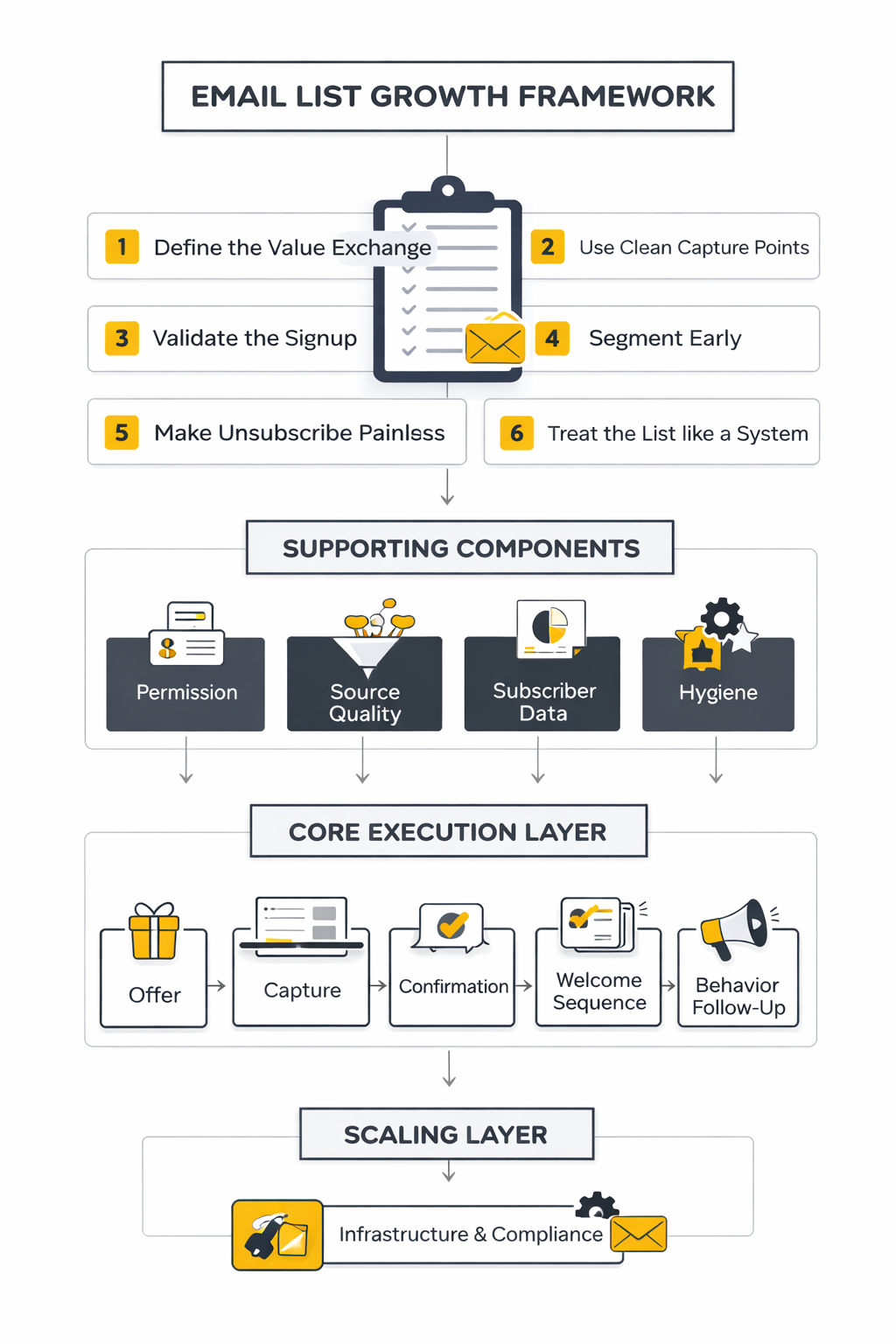
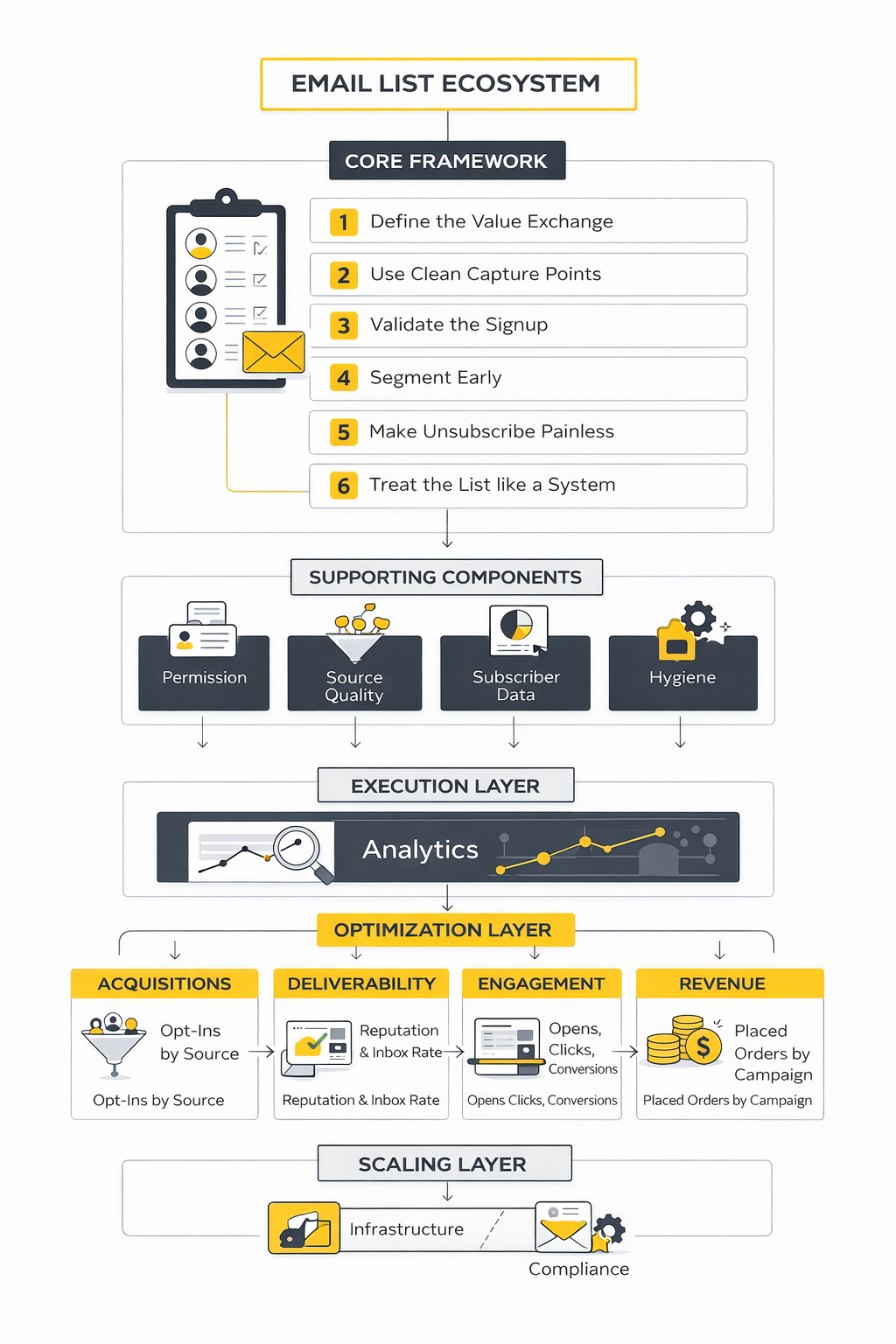
The framework in this article is straightforward because it needs to be usable, not clever.
- Define the value exchange clearly. People should know exactly what they are getting when they subscribe, whether that is insights, offers, tools, updates, or education.
- Use clean capture points. Your form, landing page, chatbot, quiz, or checkout flow should filter for intent instead of chasing empty volume.
- Validate the signup. Google recommends confirming each recipient’s email address before subscribing them, and Brevo explains why double opt-in improves both deliverability and list quality.
- Segment early. The source of the signup, the topic of interest, and the first click already tell you a lot about what that subscriber should receive next.
- Make unsubscribe painless. Google requires one-click unsubscribe for bulk promotional mail, and that is not just a compliance detail. Easy exits reduce complaints and protect your sender reputation.
- Treat the list like a system. Growth, hygiene, automation, and compliance should work together instead of living in separate tools and separate teams.
This is also where tooling starts to matter in a practical way. If you are building the capture layer, Fillout, ManyChat, and Replo can help you create cleaner entry points, while Brevo and HighLevel are worth looking at when you want the email, CRM, and automation side to feel more connected. The exact stack is less important than the operating principle. Every subscriber should enter a system that knows why they joined and what should happen next.
That is the foundation the rest of this guide will build on. Once the framework is in place, the next step is to look at the core components that turn a basic subscriber database into a high-performing list.
The Core Components of a High-Performing List
A high-performing email list for marketing is built from a few components that look simple on paper but make a massive difference in practice. Most underperforming programs do not fail because the copy is weak or the templates are ugly. They fail because the list itself was built on weak permission, poor source quality, thin subscriber data, and no serious process for protecting engagement.
That is the shift that matters. Once you stop treating the list like a container for addresses and start treating it like a system for trust, relevance, and deliverability, better results become a lot more predictable. Everything downstream gets easier because the list is doing part of the work for you.
Permission Is the First Asset
The first real component is permission. Google’s current email sender guidelines explicitly tell senders to make sure recipients opt in, confirm each recipient’s address before subscribing them, periodically confirm they still want the mail, and consider unsubscribing people who no longer engage. That is not just a compliance posture. It is a practical playbook for building a healthier list from the beginning.
This is why double opt-in still matters. Brevo’s guide to double opt-in explains that the process validates the address and improves deliverability and contact quality, and Mailchimp’s audience best practices say double opt-in helps ensure contacts are interested and keeps invalid addresses out of your audience. Yes, it can add a little friction. But the friction is usually worth it if what you want is a list that stays usable when volume grows.
In plain terms, an email list for marketing becomes more valuable when the moment of consent is clear and intentional. The subscriber should know what they are joining, what kind of messages to expect, and why they are receiving them. If you are building the form layer from scratch, tools like Fillout and Brevo are worth looking at because they make it easier to keep capture and confirmation clean.
Source Quality Beats Raw Volume
The second component is source quality. Mailchimp’s guidance on permission is direct: people who did not give permission are more likely to mark your messages as spam, engage less, and buy less. Brevo makes a similar point in its guide to legitimate contact databases, where it says contacts should know what they are signing up for, what channel they will hear from you on, and that consent must be specific and unambiguous.
This is why source quality matters more than headline list size. A subscriber who joined through a relevant form, product page, chatbot flow, or useful lead asset is fundamentally different from someone whose address was imported from an old spreadsheet or collected through a vague checkbox nobody remembers. One person is part of an audience. The other is just a record in a database.
That difference gets amplified over time. If the list is built from weak sources, the sender reputation degrades faster, complaints climb faster, and segmentation becomes less useful because the underlying intent was never strong to begin with. If you want a cleaner front end for intent-based signups, ManyChat can be useful when conversational capture fits the offer, and Replo is worth a look when the landing-page experience is doing a lot of the qualification work.
Your Subscriber Data Has to Be Useful Immediately
The third component is data structure. Mailchimp defines segments as groups of contacts who share data, and that is exactly the right lens. A list becomes more powerful when each new subscriber arrives with enough context to shape what happens next.
At a minimum, you should know where the person came from, what they signed up for, when they subscribed, and what they do after they join. That does not mean turning every form into a long questionnaire. It means collecting enough information to avoid dumping everyone into one giant bucket and pretending the same message makes sense for all of them.
This is also where a lot of businesses quietly sabotage themselves. They spend money driving traffic into forms, but they never capture the source, topic, offer, or intent behind the signup, so every future email has to work harder than it should. A better system is one where the record is useful on day one, which is one reason platforms like HighLevel and Copper can be attractive when you want subscriber context, pipeline visibility, and follow-up logic to stay connected.
Engagement Is Part of the List, Not Just a Reporting Metric
A lot of marketers treat engagement as something they check after the campaign goes out. That is too late. Klaviyo’s explanation of an engaged segment makes the point clearly: engaged subscribers are the people who recently interacted with your marketing and are most likely to keep interacting with future campaigns, which makes them crucial for both performance and deliverability.
That changes how you think about an email list for marketing. The list is not just the total number of subscribed contacts in the account. The real asset is the portion of the list that still recognizes you, still wants the content, and still behaves like an audience rather than dead weight.
It also changes frequency decisions. Klaviyo recommends sending most often to the most engaged people and less often to weaker segments, which is a much smarter way to scale than pushing the same cadence across the entire database. When you do that well, engagement stops being a vanity metric and starts acting like a filter that protects the rest of the program.
Hygiene Protects Revenue, Not Just Deliverability
The fifth component is hygiene. Mailchimp’s guide to cleaning email lists defines list cleaning as removing unengaged, unsubscribed, invalid, or duplicate contacts, and it ties that directly to better quality, stronger campaign effectiveness, and more accurate metrics. That matters because a messy list distorts performance long before it becomes obvious in reporting.
Mailchimp also warns in its guidance on inactive and stale addresses that stale audiences can drive higher bounce rates, spam complaints, and unsubscribes. Klaviyo’s guide to sunset flows pushes the same idea further by recommending a re-engagement sequence for people who stop interacting and then reducing or suppressing sends if they still do not respond. That is not just cleanup. It is sender protection.
This is one of the hardest tradeoffs for growing brands because cutting subscribers feels like shrinking. In reality, keeping inactive and invalid contacts around usually makes the list weaker, more expensive, and less trustworthy. A smaller list with strong permission and current engagement is usually a better operating asset than a bigger one bloated with addresses that no longer belong in active circulation.
The practical takeaway is simple. If your list does not have clean permission, strong source quality, useful subscriber data, engagement-aware sending, and regular hygiene, it is not ready to scale well. Once those components are in place, the next step is not guessing how to grow faster. It is building acquisition systems that attract qualified subscribers on purpose.
Acquisition Systems That Attract Qualified Subscribers
Once the foundation is in place, the next job is acquisition. This is where an email list for marketing either becomes a real growth engine or turns into a random collection of contacts with weak intent. The difference usually comes down to whether you built a system that attracts the right subscriber on purpose instead of chasing volume for its own sake. Google Podpora+2
That distinction matters because the best list-building systems do two things at the same time. They make it easy for the right person to say yes, and they make it hard for the wrong person to slip in by accident. If your acquisition process does not do both, your list may grow, but your deliverability, engagement, and conversion quality will drift in the wrong direction. Google Podpora+2
Start With the Offer, Not the Form
Most list growth problems are really offer problems. People do not subscribe because you added a popup. They subscribe because the promise is specific enough, relevant enough, and immediate enough to feel worth the exchange. HubSpot defines a lead magnet as a resource offered in exchange for contact information, but the important part is not the format. It is the fit between the offer and the person you want to attract. HubSpot Blog
That is why generic “join our newsletter” language usually underperforms. A better offer speaks directly to the next step the subscriber wants to take: a checklist, calculator, template, workshop, buyer’s guide, or product-specific incentive that naturally filters for intent. If the offer is vague, you will still collect addresses, but they will be weaker addresses, and the rest of your email list for marketing will have to work much harder to create real results. Mailchimp+1
The practical move here is to match the lead asset to the commercial path behind it. If you sell services, the best offer is often diagnostic or decision-support content. If you sell products, the best offer is often tied to discovery, first purchase, or product education. When the promise lines up with the eventual sale, list growth becomes cleaner because the offer is already doing part of the qualification for you. HubSpot Blog+1
Choose Capture Points That Match Visitor Intent
Not every visitor should see the same signup path. Someone reading a blog post, someone browsing a product page, and someone clicking from Instagram are showing different levels of intent, and your capture points should respect that. Mailchimp’s signup-form options and custom-form tools make this clear by supporting embedded forms, popup forms, and other placements for different contexts, while Klaviyo’s form analytics break performance down by step so you can see exactly where friction starts killing completion. Mailchimp+2
That is also why one capture method rarely carries the whole system. Embedded forms work well when the visitor is already consuming content and wants a low-friction way to stay connected. Popups can work extremely well when the timing and offer are strong, and Klaviyo notes that the best-performing brands on its platform see an average form submit rate above 3% for signup forms, while its popup-form guide cites outside benchmark data showing average popup conversion around 3.8%, with much stronger performance at the top end. Those numbers are useful because they tell you the bar is not “did anyone submit.” The bar is whether the form is doing real work relative to the traffic it sees. Klaviyo+1
If you want more controlled capture experiences, Fillout is useful when forms need more logic, ManyChat makes sense when conversational signup fits the funnel, and Replo is worth a look when your landing pages need to carry more of the conversion burden. The tool is not the strategy, but the wrong tool can absolutely create unnecessary friction.
Dedicated Landing Pages Usually Convert Better Than Generic Pages
A serious acquisition system does not dump every traffic source onto the same generic page. The closer the page matches the promise, source, and visitor intent, the more likely the signup is to be both higher converting and higher quality. That is why strong list builders create dedicated pages for specific offers instead of relying on one universal form hidden in the footer. HubSpot Blog+1
This is also where message continuity matters more than clever copy. The ad, social post, creator mention, blog CTA, or chatbot prompt should lead into a page that feels like the exact next step, not a completely new conversation. If the page makes the visitor re-interpret what they are signing up for, your conversion rate drops and the people who do subscribe are less anchored in the promise they expect you to fulfill. HubSpot Blog+1
For businesses that want more control over that path, ClickFunnels, Systeme.io, and Replo are all worth comparing. The point is not to chase funnel software for its own sake. The point is to remove distractions, make the value exchange obvious, and give the right visitor exactly one clear action to take.
Build the Execution Flow Like an Actual System
This is the part where the process becomes tangible. A strong email list for marketing is usually built through the same sequence over and over: source, offer, capture, confirmation, tagging, delivery, welcome sequence, and then behavior-based follow-up. When one of those steps is missing, growth gets noisier and the list becomes harder to trust. Google Podpora+2
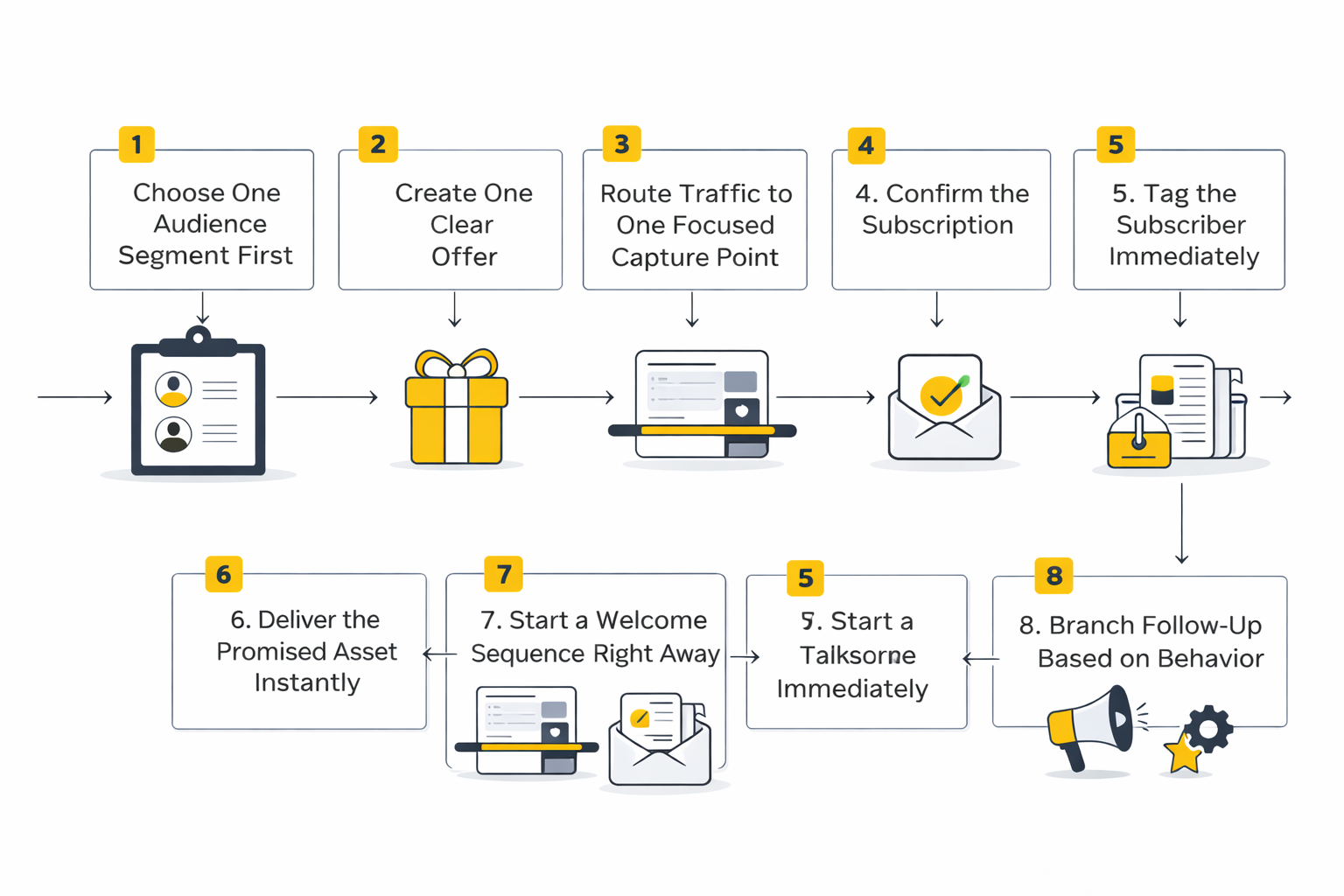
A clean implementation process looks like this:
- Choose one audience segment first. Do not try to build a list for everyone at once.
- Create one clear offer. Make the promise specific enough that the right person knows why it matters.
- Route traffic to one focused capture point. Use an embedded form, popup, chat flow, or landing page based on the visitor’s intent.
- Confirm the subscription. Google recommends confirming each address before subscription, and double opt-in helps keep weak contacts out. Google Podpora+1
- Tag the subscriber immediately. Source, interest, offer type, and signup date should be recorded on entry.
- Deliver the promised asset instantly. Do not make people wait or hunt for it.
- Start a welcome sequence right away. The first messages should explain what comes next and earn the next click.
- Branch follow-up based on behavior. Clicks, page views, replies, purchases, or inactivity should shape future messages.
That sequence is not complicated, but it is where most programs get sloppy. They spend heavily to drive traffic, then fail to tag properly, delay the asset, send a generic first email, or dump every subscriber into the same automation. A list built that way may still grow, but it will not age well because the acquisition layer is feeding weak context into the rest of the system.
The Welcome Sequence Is Part of Acquisition
A lot of businesses think of the signup as the end of acquisition. It is not. The welcome sequence is still part of the acquisition process because it determines whether a new subscriber becomes an engaged audience member or a name that quietly goes cold. Mailchimp describes automated welcome series as a strong way to greet new subscribers and introduce the brand, and Klaviyo’s welcome-email guidance notes that these emails consistently outperform normal sends, with average open rates around 51% in its benchmark set and much stronger click and order performance at the top end. Mailchimp+1
That is why the first few emails matter so much. The first message should confirm the promise and deliver the asset. The second should deepen context, show the reader what kind of value to expect, and move them one step closer to your commercial world. The third can start narrowing intent more directly through a click, preference signal, product angle, or a clear next-step call to action. Mailchimp+2
If you want to build more of that logic inside one stack, Brevo and HighLevel are both worth evaluating. The most important thing is that your list-building system does not end with “thanks for subscribing.” It should immediately begin training the subscriber to engage.
Distribution Matters as Much as the Form
A good signup system still needs traffic, and this is where many businesses underperform because they hide their best offers instead of distributing them like assets. Blog posts, social content, creator bios, chat flows, webinars, tools, and product pages should all point toward list growth in a way that fits the channel rather than feeling bolted on. HubSpot’s list-growth guidance is broad for a reason: strong programs grow through multiple surfaces, not one heroic popup. HubSpot Blog
That is also why content and distribution tools belong in the conversation. Buffer can help push lead assets through social consistently, while Anything.link is useful when you need a cleaner link hub for creators or solo brands sending traffic from social profiles into offers. The winning pattern is simple: more relevant entry points, each tied to a clear promise, feeding one structured email system.
When this acquisition layer is built properly, you stop asking vague questions like “how do I get more subscribers?” and start asking much better ones. Which source produces the strongest opt-ins. Which offer leads to the best first-click behavior. Which welcome path creates the best conversion quality. That is the point where list growth becomes measurable instead of hopeful, and it sets up the next part of the article naturally: how to measure performance and what the data actually means.
Measuring Performance and What the Data Actually Means
Once your acquisition system is running, the next question is not whether the email list for marketing is getting bigger. It is whether the list is getting stronger. That is a different standard, and the numbers only help if you know what they are actually measuring. Mailchimp’s current benchmark page puts the average open rate at 34.23% and average click-through rate at 2.62%, while Brevo’s 2025 benchmark reports 31.22% opens, 3.64% click-through, and a 0.4% unsubscribe rate overall. Klaviyo’s 2026 ecommerce benchmark takes the comparison further, showing average campaign click rate at 1.69% and average automated flow click rate at 5.58%, with campaign placed order rate at 0.16% and flow placed order rate at 2.11%. Mailchimp+3
Those differences are the first lesson. Benchmarks are useful, but they are not universal truth because they reflect different customer bases, different industries, and different metric definitions. You should use them as context, not identity. If your numbers are well below the range in sources that are close to your business model, that is a signal to investigate. If they are slightly above or below a generic average, that alone does not tell you much. brevo.com+2
Build the Analytics System in Layers
The cleanest way to measure an email list for marketing is to read it in layers. The first layer is acquisition quality, which asks where subscribers came from and whether those sources create real engagement later. The second is deliverability, which covers inbox placement, spam complaints, hard bounces, soft bounces, and domain reputation. The third is engagement, which looks at opens, clicks, click-to-open behavior, and unsubscribes. The fourth is commercial outcome, which is where you track conversions, placed orders, and revenue per recipient. Google Postmaster Tools is built around this logic by exposing spam rate, IP reputation, authentication, and delivery errors, while Mailchimp and Klaviyo both separate engagement metrics from revenue metrics in their reporting frameworks. Google Podpora+3
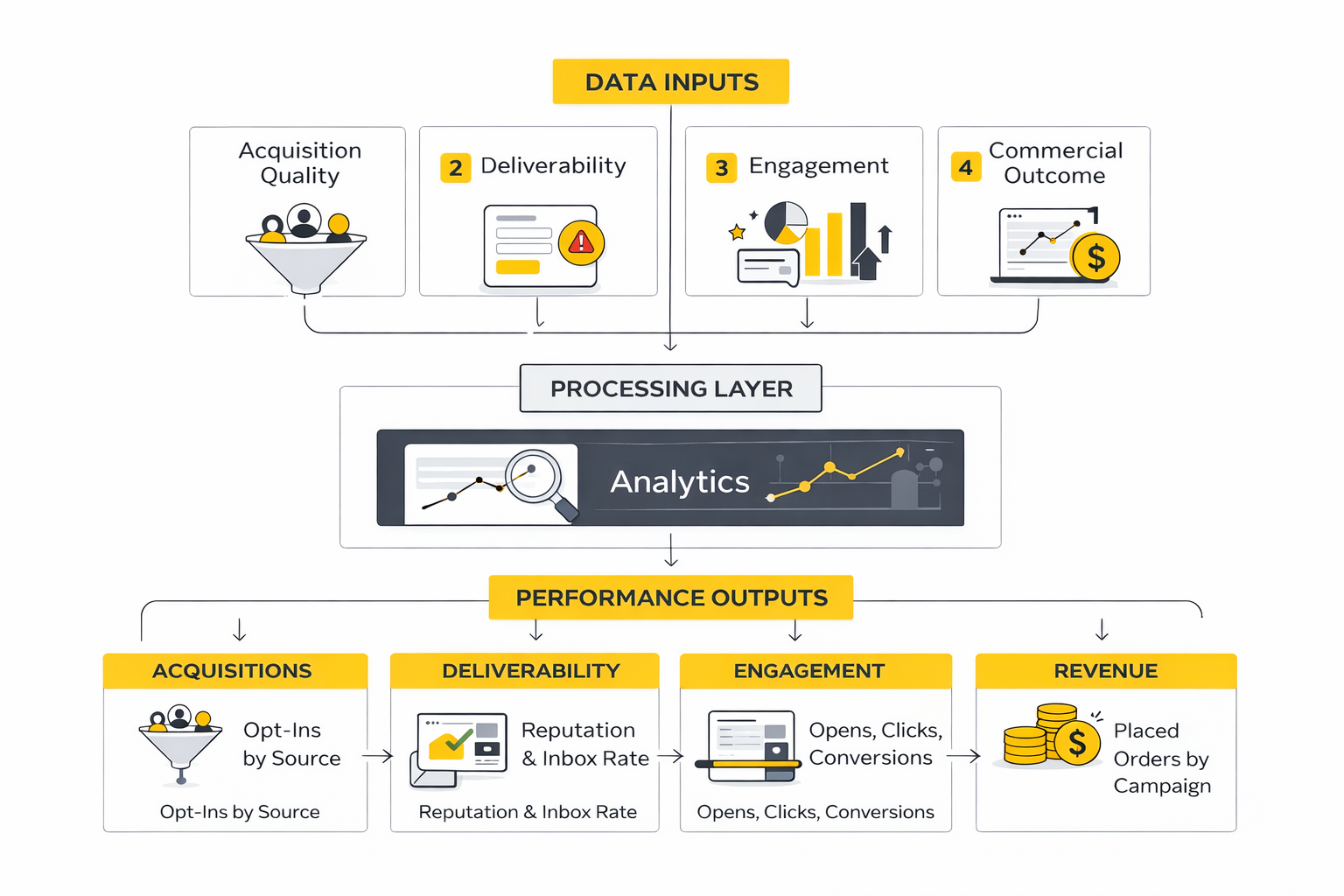
If your dashboard stops at opens and total clicks, you are flying half blind. A list can look healthy on top-line engagement while losing money, and it can look average on opens while becoming much more profitable because revenue per recipient is improving. Klaviyo is right to treat revenue per recipient as one of the most important performance measures because it shows how much revenue each message generates, not just whether somebody glanced at it. That is the metric that helps you decide what to scale, what to rewrite, and what to stop sending. Klaviyo+1
Open Rate Still Matters, but It Cannot Lead the Whole Conversation
Open rate is now a clue, not a verdict. Apple’s Mail Privacy Protection prevents senders from reliably seeing whether someone actually opened a message, and Mailchimp explains that Apple Mail preloads tracking pixels, which inflates opens and makes open-based reporting less reliable. That means open rate is still useful for rough pattern recognition, especially when you are comparing similar segments and similar campaigns, but it is no longer strong enough to carry the whole analysis by itself. Mailchimp+1
The practical way to read it is simple. If opens rise but clicks do not move, your subject line or preview text may be winning attention without the body doing enough work. If opens fall but click-to-open behavior stays healthy, the message may still be relevant and the real issue may be inbox positioning, timing, or audience fatigue. Mailchimp’s reporting definitions and Brevo’s benchmark glossary make this distinction useful because click-through rate measures clicks against delivered emails, while click-to-open rate measures how many openers were motivated enough to click. Those two numbers together tell you far more than open rate alone. Mailchimp+2
Deliverability Metrics Deserve More Respect Than Most Teams Give Them
Complaint rate, bounce rate, and unsubscribe behavior are not background metrics. They are operating constraints. Google says spam rate is calculated daily, recommends staying below 0.1%, and says senders should prevent spam rates from ever reaching 0.3% or higher. It also requires one-click unsubscribe for marketing and subscribed messages once you send more than 5,000 messages a day. In other words, if complaint rate creeps up, you do not just have a messaging problem. You may have a sender reputation problem in the making. Google Podpora+2
Bounce data needs the same seriousness. Mailchimp defines a hard bounce as a permanent delivery failure and a soft bounce as a temporary one, which means the action you take should differ too. Hard bounces usually point to bad data, typos, dead domains, or deeper list-quality issues. Soft bounces can signal temporary server issues, full inboxes, or filtering, so the right response is to watch patterns rather than panic over one send. If hard bounces start climbing, the fix is usually upstream in your acquisition process or your list hygiene, not inside the email copy. Mailchimp+1
Clicks, Conversions, and Revenue Tell You What to Do Next
This is where the data becomes useful enough to drive action. Mailchimp’s reporting framework defines click rate as the percentage of delivered emails that registered at least one click, and Klaviyo’s benchmark data shows just how different campaign behavior can be from flow behavior: campaigns average a 1.69% click rate and 0.16% placed order rate, while automated flows average 5.58% click rate and 2.11% placed order rate. That gap is not a small optimization story. It is a strategic one. Mailchimp+2
The action behind those numbers is clear. If campaigns keep generating attention but flows are doing the real conversion work, then your best next move is usually not “send more newsletters.” It is to improve the welcome sequence, abandonment emails, post-purchase follow-up, and other behavior-based automations that hit with better timing and stronger intent. Klaviyo’s 2026 benchmark summary says flows generate nearly 41% of total email revenue from just 5.3% of sends, with average revenue per recipient nearly 18 times higher than campaigns, which is exactly why mature email programs put so much effort into automation quality. Klaviyo+1
Read the Numbers as Signals, Not Scorecards
A lot of teams stare at benchmarks the wrong way. They treat them like grades instead of signals. A stronger way to read the data is to ask a sequence of questions. Is acquisition quality improving. Is deliverability stable. Is engagement holding after the click, not just before it. Is revenue per recipient rising. Are flows doing more of the monetization work over time. Those questions push you toward action instead of vanity. Google Podpora+2
That is also why the best analytics habit is comparison inside your own system. Compare subscribers from different lead magnets, compare campaigns against flows, compare recent subscribers against older cohorts, and compare engaged segments against stale ones. External benchmarks give you perspective, but internal comparisons tell you where your own email list for marketing is actually improving and where it is quietly getting weaker. If your reporting stack is messy, Brevo or HighLevel are worth comparing before the list gets bigger and the blind spots get more expensive.
Professional Implementation, Compliance, and Scale
Once an email list for marketing starts generating real revenue, the main challenge changes. You are no longer just trying to collect more subscribers. You are trying to keep the system reliable as sending volume rises, rules tighten, and a mistake in one part of the program can drag down the rest. Google’s sender requirements, Postmaster Tools dashboards, and the current guidance from major email platforms all point in the same direction: professional email now runs on infrastructure, not just copy and design. (support.google.com, support.google.com)
Set Up the Sending Domain Before Volume Forces You To
A professional email list for marketing should send from a domain you own and control, not from a free mailbox address. Google requires all senders to use SPF or DKIM, requires bulk senders to use SPF, DKIM, and DMARC, and also requires TLS for email sent to Gmail accounts. Mailchimp makes the same operational point from the platform side by noting that custom authentication can only be added to domains you control, and that public email services like Gmail and Yahoo cannot be authenticated for your brand. (support.google.com, mailchimp.com)
This matters more than people think because bulk-sender status is easier to trigger than most teams expect. Google says a bulk sender is any sender that gets close to or above 5,000 messages to personal Gmail accounts within 24 hours, and once that status is assigned, it does not expire. In other words, the right time to fix authentication, alignment, and sender-domain hygiene is before your launch or promo calendar pushes you over that line, not after. (support.google.com, support.google.com)
If you want fewer moving parts between forms, automation, and CRM, it is worth comparing systems like HighLevel and Brevo. The exact vendor is not the point. The point is that your domain, consent flow, and sending setup should feel like one system instead of a patchwork of tools that only talk to each other when something breaks.
Separate Promotional and Transactional Mail
One of the cleanest implementation upgrades is separating promotional traffic from transactional traffic. Google’s sender FAQ says one-click unsubscribe is required for marketing and promotional messages, but not for transactional messages like password resets, reservation confirmations, or form confirmations. Postmark’s Message Streams are built around exactly this distinction, with separate stream types for transactional and broadcast email. (support.google.com, postmarkapp.com)
That separation matters because not all email carries the same business risk. If a campaign sends to a weaker segment and complaint rates jump, you do not want that turbulence bleeding into receipts, login emails, invoices, or onboarding messages. When an email list for marketing grows up, you stop treating “email” as one bucket and start protecting the most important messages from the noisiest ones. (support.google.com, postmarkapp.com)
Control Frequency Like a Product Decision
Frequency is one of the easiest ways to damage a good list without realizing it. HubSpot’s email frequency safeguard lets teams set a maximum number of marketing emails a contact can receive within a chosen time period, and Klaviyo’s Smart Sending exists for the same reason: to prevent people from getting too many messages at once when campaigns and flows overlap. That is a strong signal that modern email operations are not just about what you want to send, but what the subscriber is realistically experiencing. (knowledge.hubspot.com, help.klaviyo.com)
This is also where a lot of teams confuse a preference center with compliance. Google’s guidance is clear that promotional mail at scale needs RFC 8058 one-click unsubscribe, and that a preferences page or body-link does not replace the required unsubscribe headers. So the mature setup is both: hard compliance in the message itself, and softer frequency or topic controls for subscribers who still want the relationship but not the full volume. (support.google.com, support.google.com)
Scale Sending Slowly and Decide When Dedicated IPs Are Actually Worth It
A bigger list does not automatically mean you need more complicated infrastructure, but it does mean you need more discipline. Google recommends checking compliance status in Postmaster Tools, which includes dashboards for spam rate, IP reputation, and delivery-related signals, and its FAQ notes that enforcement moves faster for new bulk-sending domains. That is why sudden sending spikes, rushed migrations, and aggressive volume jumps usually create more risk than reward. (support.google.com, support.google.com)
Dedicated IPs are a good example of where advanced-sounding infrastructure is not always the right answer. AWS documents both automatic and manual warm-up for standard dedicated IPs, which tells you immediately that dedicated sending requires ramp-up management, not just a checkbox. At the same time, the market itself is split: Postmark argues that for most senders a pristine shared IP pool will deliver better results, while SendGrid recommends dedicated IPs when you need tighter control over reputation for critical email. The real answer is that dedicated IPs make more sense when your volume is high and consistent enough to support them. If your sending is still uneven, better segmentation and steadier cadence usually matter more. (docs.aws.amazon.com, postmarkapp.com, support.sendgrid.com)
Treat Compliance as an Operating Rule, Not a Footer Checkbox
The legal side gets more complicated as soon as your list crosses markets, subscriber types, or acquisition channels. The FTC’s business guide says the CAN-SPAM Act sets the rules for commercial email, gives recipients the right to make you stop emailing them, and allows penalties of up to $53,088 per violating email. The ICO’s guidance is different in emphasis but just as clear: marketing emails to individuals generally require specific consent unless the soft opt-in applies, while companies can be marketed to under a different set of rules and should still be respected when they object. (ftc.gov, ico.org.uk)
The practical implication is bigger than a legal disclaimer in the footer. A serious email list for marketing should know how each subscriber entered the system, what kind of permission applies, what jurisdiction matters, and what kind of entity the contact represents. Once that information is built into the record itself, compliance stops being guesswork and starts becoming something the system can actually enforce. (ftc.gov, ico.org.uk)
The Real Tradeoff at Scale
The hardest scaling decision is usually not technical. It is strategic. As the list gets larger, every shortcut becomes more expensive, which means you have to decide whether you want a bigger database or a stronger one. Google’s rules, frequency safeguards, and deliverability tooling all push toward the same conclusion: the healthiest systems make it easy to unsubscribe, limit over-mailing, and keep a close eye on reputation before problems turn into filtering. (support.google.com, knowledge.hubspot.com, support.google.com)
That is what professional implementation really looks like. It is not flashy. It is a series of disciplined decisions that protect trust while the list grows: authenticated domains, separated traffic, sane frequency, monitored reputation, and compliance logic that survives real-world scale. Once that system is in place, the final part of the guide can do what it should do: answer the most common practical questions and tie the whole ecosystem together.
Bringing the System Together
A strong email list for marketing is really an operating system. The capture layer brings in the right people, the consent layer keeps the list clean, the automation layer turns early interest into ongoing engagement, and the measurement layer tells you where revenue is actually coming from. When those parts work together, email stops feeling like a channel you occasionally use and starts behaving like a durable asset you can improve quarter after quarter.
That is also why the best setups usually look boring in the best possible way. A clean form built in Fillout, a better signup path through ManyChat, sharper landing pages in Replo, and an automation layer in Brevo or HighLevel can do more for long-term list quality than another month of random campaign ideas. The stack matters less than the discipline behind it, but once the system is coherent, growth gets easier to predict and much easier to scale.
FAQ - Built for Complete Guide
What is the difference between an email list and an email list for marketing?
A general email list can be any collection of addresses. An email list for marketing is built for commercial communication and has to be based on permission, clear expectations, and clean unsubscribe handling. That is why the FTC’s CAN-SPAM guide and Google’s sender requirements matter so much in practice.
How long does it take before an email list starts producing meaningful results?
It depends on acquisition quality, offer strength, and what you are selling, but the real answer is that good lists usually produce early signals before they produce large revenue. You will often see useful movement first in confirmation rate, welcome-sequence clicks, replies, and first conversions rather than huge list size. If those signals are healthy, the system is usually on the right track even before the list feels big.
Should I use a lead magnet or just invite people to join the newsletter?
A plain newsletter signup can work if the brand already has trust, attention, or a clear editorial angle. Most businesses grow faster when the signup promise is more specific, because a targeted offer filters for stronger intent than vague “updates.” The better move is usually to make the value exchange concrete and then send the subscriber into a welcome sequence that reinforces that promise.
Is double opt-in worth the extra friction?
In many cases, yes. Brevo’s guide to double opt-in explains that it improves list quality and deliverability, and Google’s sender guidelines recommend confirming each recipient’s address before you subscribe them. That extra step is often worth it because it filters out bad addresses, weak intent, and fake submissions before they damage the rest of the system.
Can I buy a list if I promise to send good emails?
No, and that logic breaks down fast in the real world. Mailchimp’s guidance on permission and its warning on purchased lists make the risk clear: people who did not ask for your emails are more likely to complain, ignore you, or mark the messages as spam. Even strong copy cannot fix a broken consent model.
What is more important now: open rate or click rate?
Click rate is usually more useful because it reflects a stronger action. Apple’s Mail Privacy Protection documentation makes it clear that senders can no longer reliably tell when someone opened an email, which is why open rate has become a softer signal than it used to be. Opens still help with pattern recognition, but clicks, replies, conversions, and revenue tell you far more about whether the email list for marketing is actually getting stronger.
How often should I email my list?
The right cadence depends on what the subscriber expects, how much value you can deliver consistently, and how your campaigns overlap with automations. Frequency controls matter because even good content becomes harmful when the volume gets sloppy, which is exactly why tools like Klaviyo Smart Sending and HubSpot’s frequency safeguard exist. A sustainable weekly cadence usually beats random bursts followed by silence.
Do I need to authenticate my domain even if I am still small?
Yes. Google’s sender requirements require authentication for all senders, and stronger standards apply once volume rises. Setting up SPF, DKIM, and DMARC early is one of the simplest ways to avoid turning technical debt into a deliverability problem later.
Do I really need one-click unsubscribe?
If you are sending commercial or promotional email at bulk volume, yes. Google’s sender FAQ says one-click unsubscribe for promotional messages must use the proper list-unsubscribe headers, not just a landing page link in the footer. Even before you hit that threshold, easy unsubscribes are just smart business because they are far less damaging than spam complaints.
When should I remove inactive subscribers?
Usually after you have given them a fair chance to re-engage. Google’s sender guidelines recommend periodically confirming that recipients still want your messages and even considering unsubscribing people who no longer engage, which lines up with the broader best practice of running a reactivation sequence before suppression. The goal is not to shrink the list aggressively. The goal is to stop pretending dead weight is still an audience.
Should transactional email stay separate from marketing email?
Yes, especially once your volume grows. Google’s sender FAQ treats transactional messages differently from promotional ones in the context of unsubscribe rules, and operational tools like Postmark Message Streams are built around keeping those traffic types separate. That protects the emails customers truly need from the reputation swings of campaigns and promotions.
What is the best software stack for building an email list for marketing?
There is no universal best stack, but there is a best principle: use tools that make capture, consent, segmentation, automation, and reporting feel connected instead of fragmented. A stack that combines Fillout, ManyChat, Replo, Brevo, and HighLevel can cover most modern use cases depending on how much control and consolidation you want. The best choice is the one that helps you run the full system cleanly, not the one with the loudest feature list.
Work With Professionals
Explore 10K+ Remote Marketing Contracts on MarkeWork.com
Most marketers spend too much time chasing clients, competing on crowded platforms, and losing a percentage of every project to middlemen.
MarkeWork gives you a better way. Browse thousands of remote marketing contracts and connect directly with companies desperate to hire skilled marketers like you, without platform commissions and without unnecessary gatekeepers.
If you're serious about finding better opportunities and keeping 100% of what you earn, explore available contracts and create a profile for free at MarkeWork.com.