

An email list service used to be a fairly simple tool. You uploaded contacts, built a newsletter, hit send, and checked opens the next day. That version of the category is gone. Today, an effective email list service sits at the intersection of list growth, consent management, segmentation, automation, deliverability, analytics, and revenue attribution, because inbox providers and privacy rules have made sloppy sending much harder to get away with.
That shift matters because email is still one of the few audience channels a business can build and control directly. Global email volume keeps rising, people still use email at scale, and marketers continue to treat it as a core channel rather than a leftover from an earlier internet era. At the same time, performance now depends less on blasting bigger lists and more on using a service that can protect sender reputation, capture intent properly, and automate relevant messages instead of generic campaigns.
The phrase email list service can sound narrow, but the best platforms are really operating systems for owned audience growth. They help you collect subscribers the right way, store data cleanly, route people into the right sequences, and keep your domain out of trouble with Gmail and Yahoo. That is why choosing the wrong platform is no longer just an inconvenience. It can quietly suppress growth by damaging deliverability, weakening segmentation, and making your list less responsive over time.
Article Outline
- Why an Email List Service Still Matters
- The Framework Behind a Modern Email List Service
- Core Features That Separate Good Platforms From Weak Ones
- How to Choose the Right Email List Service for Your Business Model
- Professional Implementation Without Hurting Deliverability
- Common Mistakes, Smart Upgrades, and Final Recommendations
Why an Email List Service Still Matters
A lot of businesses still treat email software like a utility bill. They buy the cheapest plan, import a list, and assume the real work is in the copy. In practice, the platform itself shapes what kind of business you can build because it controls how you collect subscribers, how fast you can segment them, how reliably your campaigns land in the inbox, and how easily your team can automate follow-up. When Google began enforcing stricter sender requirements in 2024, and Yahoo reinforced similar standards, that became impossible to ignore.
There is also a simple audience reason email keeps mattering. DataReportal reports that 75 percent of online adults use email at least monthly, which is a strong reminder that email is not some fading channel marketers keep around for nostalgia. It is still a default layer of digital identity, account access, purchase communication, and brand relationship building.
The business case remains strong too, but the way you earn results has changed. Broad benchmarks from Mailchimp and Brevo show that average opens, clicks, and unsubscribe rates vary widely by industry, which means generic “best practices” are usually too blunt to be useful. A serious email list service earns its keep by helping you send better-timed, better-targeted messages, not just more messages.
Just as important, personalization is no longer a nice bonus sitting on top of the stack. In Litmus and Oracle’s 2024 research, more than 80 percent of respondents reported at least some performance improvement from subject line personalization, real-time content, and dynamic personalization. That pushes the category beyond newsletter software and into customer journey infrastructure.
The Framework Behind a Modern Email List Service
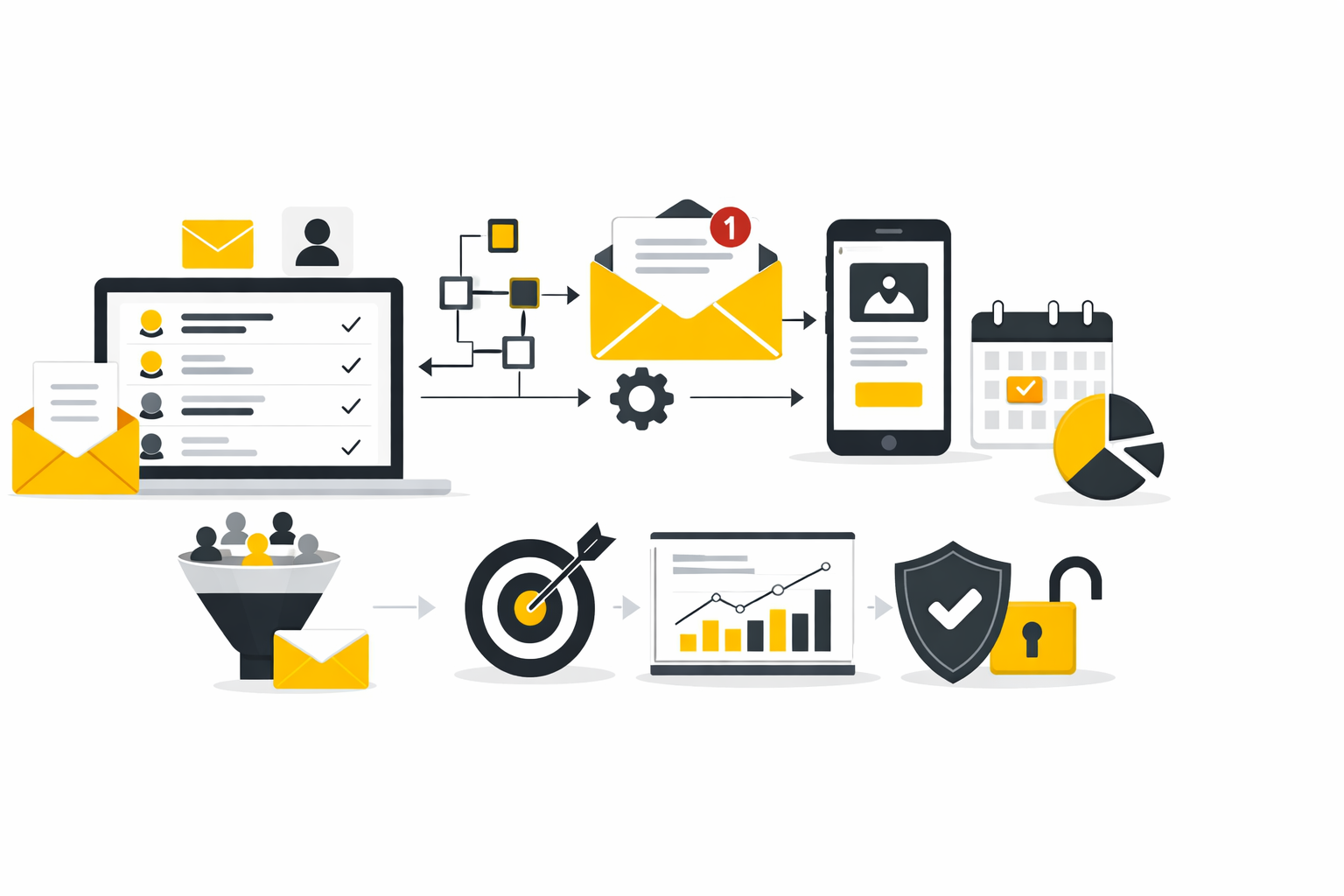
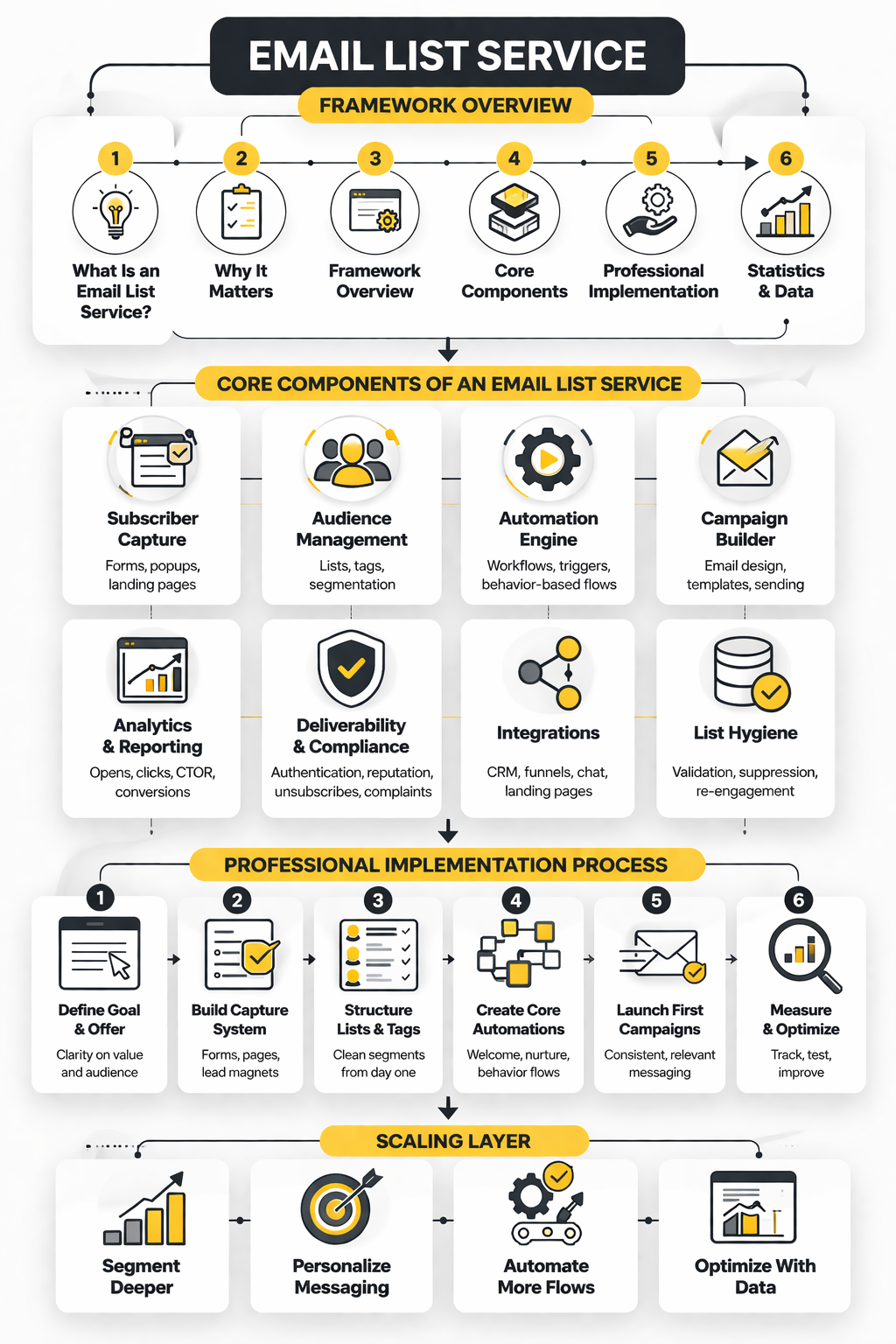
The easiest way to understand an email list service is to see it as a four-layer system. First, it captures permission through forms, landing pages, embedded opt-ins, and integrations. Second, it organizes subscriber data so contacts can be grouped by source, behavior, lifecycle stage, and purchase history. Third, it sends campaigns and automations with the authentication and compliance controls needed to reach the inbox. Fourth, it measures results well enough that the next send improves instead of repeating the same mistakes.
That framework sounds obvious, but most problems happen when one of those layers is weak. A company may be good at collecting leads but poor at validating consent. Another may have a beautiful editor but weak automation logic. A third may produce decent campaigns yet still underperform because authentication is incomplete, complaint rates are too high, or unsubscribes are not handled cleanly. Modern sender rules made those technical layers part of everyday marketing, not just an IT concern.
This is also why selection criteria should match the business model. A creator selling newsletters does not need the same stack as an ecommerce brand running abandoned-cart flows, and neither has the same needs as a local service business that wants email tied to CRM pipelines and follow-up automation. Platforms such as Brevo, Moosend, and GoHighLevel all play in the broader email list service space, but they are built with different operational assumptions.
The rest of this article will use that framework to separate surface-level features from the pieces that actually determine results. That means looking closely at segmentation, automation depth, deliverability controls, reporting, and implementation discipline rather than getting distracted by template galleries and marketing promises. The real question is not whether a tool can send email. It is whether it can help you build an owned audience that keeps compounding.
The Framework Behind a Modern Email List Service
Once you stop thinking about an email list service as a newsletter sender, the category becomes much easier to evaluate. The real job is to move a stranger from first permission to repeat engagement without losing context, consent, or deliverability along the way. That only happens when the platform handles audience capture, data organization, message delivery, and measurement as one connected system instead of four disconnected tasks.
A practical way to judge any email list service is to ask one question at each stage. Can it collect the right people cleanly, can it understand who those people are, can it send the right message at the right moment, and can it show you what is actually working. If one part breaks, the rest of the machine gets noisy fast, which is why weak platforms often feel fine at the start and frustrating once the list gets bigger.
The best setups also reduce manual work at the exact point where manual work becomes dangerous. When subscriber behavior starts changing daily, hand-built lists and one-off blasts become unreliable. That is where structured segmentation, automation logic, and reporting stop being “advanced features” and become the whole point of the platform.
Audience Capture Comes First
A strong email list service starts before the first campaign ever goes out. It needs ways to capture subscribers through embedded forms, pop-ups, landing pages, and lead magnets while keeping the opt-in process clear enough that the list stays permission-based. That sounds basic, but it is where a surprising amount of future damage begins, because bad collection practices create weak engagement long before deliverability metrics reveal the problem.
This is why audience capture should be treated as part of list quality, not just list growth. Tools like Moosend’s subscription forms and landing pages are useful because they connect acquisition and email follow-up inside the same workflow. The benefit is not convenience alone. It is cleaner data, faster routing, and fewer gaps between signup intent and first contact.
For businesses that collect leads across channels, this first layer often decides whether the platform will scale cleanly later. A creator may need a simple opt-in and welcome flow, while a local business may want forms tied directly to pipeline stages and appointment follow-up through GoHighLevel’s lead capture and email tools. Different use cases, same rule: bad capture usually leads to bad targeting.
Segmentation Is the Real Engine
Segmentation is where an email list service either becomes useful or stays shallow. A modern platform should let you group contacts by attributes, events, actions, source, and engagement patterns rather than forcing you into static lists that go stale the minute subscriber behavior changes. That matters because relevance compounds, while irrelevant sending erodes trust quietly and consistently.
You can see that logic clearly in Brevo’s segmentation documentation, which describes segments as groups generated from conditions based on attributes and events, then updated automatically as contact data changes. That is exactly what a serious email list service should do. The list should adapt as the audience changes instead of requiring constant manual exports and cleanup.
The more important point is strategic, not technical. Segmentation lets you stop asking “What should I send to everyone?” and start asking “What should this group receive next?” Brevo’s campaign guidance pushes that in the right direction by tying segments to business goals like repeat purchases, lead nurturing, and engagement improvement, which is exactly how segmentation should be used in the real world.
Automation Turns a List Into a System
Once segmentation is in place, automation becomes the layer that makes an email list service economically powerful. Without automation, you are still depending on manual campaign timing, manual follow-up, and manual memory. That works for a tiny list. It breaks the moment your audience is large enough that people enter your funnel every day from different sources and at different levels of intent.
A capable platform should let you trigger messages from behavior, not just from a calendar. Moosend’s automation framework highlights workflow builders, templates, tracking, and cart-abandonment logic because those are the pieces that keep messages timely instead of random. GoHighLevel’s email marketing stack frames the same idea around personalized journeys based on actions, which is the right mental model for service businesses and agencies managing lead progression.
This is where many buyers get distracted by visual builders and miss the deeper question. The important part is not whether a workflow canvas looks polished. The important part is whether the platform can react to subscriber behavior in a way that matches the business model, whether that means a welcome sequence, post-purchase education, abandoned-cart recovery, reactivation, booking reminders, or lead nurturing across multiple touchpoints.
Core Features That Separate Good Platforms From Weak Ones
The easiest mistake when comparing an email list service is to focus on surface features. Almost every product says it has templates, drag-and-drop editing, analytics, and automation. Those boxes are too generic to be useful, so the real evaluation has to go one level deeper into how those features behave under normal business pressure.
A good platform helps you create momentum. A weak one creates admin work. That difference shows up in a few core areas very quickly.
Dynamic Segments Beat Static Lists
Static lists feel simple because they are easy to understand at a glance. The problem is they age badly. As soon as subscribers click, buy, ignore, unsubscribe from a topic, or move from lead to customer, a static setup starts mislabeling people unless someone is constantly cleaning it by hand.
Dynamic segments solve that by updating based on rules instead of exports. Brevo’s segmentation tools are a good example of what to look for: conditions tied to attributes and events, with automatic updates as data changes. That is far more valuable than having dozens of frozen lists that look organized but send outdated messages.
Workflow Depth Matters More Than Workflow Count
A platform does not become powerful because it offers many automation templates. It becomes powerful when the workflows can branch, wait, trigger, exclude, and adapt without turning into a maintenance mess. In other words, depth matters more than volume.
This is one reason an email list service built for growth usually beats a cheaper tool that only handles basic autoresponders. Moosend’s automation layer emphasizes workflow builders, tracking, and analytics for a reason. Those pieces let you improve sequences over time instead of treating automation like a one-time setup you never revisit.
Built-In Growth Tools Save Friction Later
List growth tools are easy to underestimate when evaluating email platforms because they often look like secondary features. In reality, having forms, landing pages, and pop-ups inside the same environment reduces handoff errors and keeps subscriber context intact from the first click. That becomes more important as campaigns become more segmented and acquisition sources become more diverse.
For that reason, built-in capture tools are not just a convenience feature. They are part of the operating model. Moosend’s landing pages and forms and GoHighLevel’s all-in-one approach make more sense once you view them through that lens.
Reporting Should Help You Decide, Not Just Observe
A weak email list service gives you dashboards. A strong one helps you make decisions. That means reporting should connect campaign behavior to segment quality, automation performance, and business outcomes instead of stopping at opens and clicks.
You can already see the right direction in Brevo’s segmentation workflow, which pushes users to evaluate CTR, conversion rate, unsubscribe rate, and long-term optimization rather than treating a single send as the finish line. That is the right posture. Reporting should help you answer what to change next, not just show you what happened yesterday.
By this point, the pattern should be clear. The best email list service is not the one with the longest feature page. It is the one that can capture intent, organize audience data, automate relevant follow-up, and produce feedback you can actually use. In the next section, that framework becomes more practical, because choosing the right platform depends heavily on whether you are running ecommerce, a creator business, local services, or a more complex CRM-driven operation.
How to Choose the Right Email List Service for Your Business Model
At this point, the question is no longer whether you need an email list service. The real question is which kind of platform matches the way your business actually acquires leads, sells, and follows up. That choice matters because the wrong tool usually looks acceptable on day one and becomes expensive only after your list, automations, and deliverability responsibilities start growing.
The fastest way to make a smart decision is to choose based on workflow, not branding. If you run a content business, newsletter brand, or smaller ecommerce operation, you usually need strong forms, segmentation, straightforward automations, and reporting that is easy to act on. If you run a service business, agency, or sales-heavy operation, you usually need email tied to CRM stages, pipelines, appointment flows, and broader lifecycle automation, which is why platforms like Brevo, Moosend, and GoHighLevel are not really interchangeable even though they all sit in the same broad category.
There is also a practical budget point that people miss. A cheaper tool can become the more expensive option if it forces manual segmentation, weak reporting, or awkward integrations that your team has to patch together later. A slightly more capable email list service often pays for itself by reducing friction, preventing list decay, and making your follow-up process more consistent.
Match the Platform to the Revenue Model
An ecommerce brand usually cares about abandoned-cart recovery, product-triggered flows, promotional segmentation, and repeat-purchase campaigns. A consultant or local service business usually cares more about lead capture, nurturing, appointment reminders, and pipeline movement after the first inquiry. A creator or educator often needs clean subscriber capture, lead magnet delivery, launch sequences, and broadcast simplicity without a bloated CRM sitting in the middle.
That is why “best email list service” is usually the wrong search. The better question is which platform fits the job with the least operational drag. If your sales process depends on multi-step lead follow-up and team visibility, an all-in-one option like GoHighLevel makes more sense than a lightweight newsletter tool, while a simpler business may get faster results from a cleaner email-first platform like Brevo or Moosend.
Judge the Product by Setup Friction, Not Demo Screens
Most platforms look polished in a product tour. That is not the hard part. The hard part is how cleanly the platform handles forms, subscriber fields, imports, automations, authentication, unsubscribe handling, and reporting once real people start moving through the system.
This is where current sender rules make the decision less forgiving than it used to be. Google requires SPF or DKIM for all senders, and SPF, DKIM, and DMARC for bulk senders, while also enforcing one-click unsubscribe for commercial messages through the proper headers in its sender guidance and FAQ pages. Yahoo’s sender best practices also push one-click unsubscribe for marketing mail and recommend keeping spam complaint rates below 0.3 percent. Those are not edge-case details anymore. They shape which platforms are easier to run safely at scale. Google’s sender guidelines and Google’s unsubscribe FAQ make that clear, and Yahoo’s sender best practices reinforce the same operational standard.
Use a Shortlist That Reflects Reality
A smart shortlist is usually small. You do not need ten options. You need two or three that clearly fit your business model, your team size, and the complexity of your follow-up.
A simple way to narrow it down is this:
- Choose one email-first platform that is strong on campaigns and segmentation.
- Choose one automation-heavy platform if your follow-up process is more operational.
- Compare how each handles forms, workflows, authentication, reporting, and contact organization.
That framework keeps the evaluation grounded. It also prevents the classic mistake of buying a platform for hypothetical future complexity instead of the actual workflows you need to run over the next twelve months.
Professional Implementation Without Hurting Deliverability
Picking the platform is only half the job. The real leverage comes from implementation, and this is where a lot of businesses quietly sabotage themselves by importing old contacts, skipping domain setup, or turning on too many automations before the system is organized. A good email list service can help a lot, but it cannot rescue a sloppy rollout.
The safest implementation process is boring in the best possible way. You set the technical foundation first, organize the data second, build the essential journeys third, and expand only after engagement data starts coming in. That order matters because deliverability damage is much easier to create than to undo.
Start With the Technical Baseline
Before you send a single campaign, the sending domain needs proper authentication and the unsubscribe experience needs to be handled correctly. Google’s bulk sender rules explicitly call for SPF, DKIM, and DMARC, and commercial email needs one-click unsubscribe support through the right headers rather than a vague preference-page workaround. Yahoo’s guidance follows the same logic and ties sender reputation directly to list hygiene and complaint control. Google’s sender requirements, Google’s unsubscribe clarification, and Yahoo’s requirements are worth reading because they affect normal marketing operations now, not just enterprise setups.
This part is not glamorous, but it is non-negotiable. If the technical layer is weak, every campaign result becomes harder to interpret because poor performance might be caused by targeting, creative, or inbox placement. You want those variables separated as early as possible.
Clean the List Before You Build the Journeys
A clean implementation starts with a clean audience. That means removing stale imports you cannot confidently permission, mapping subscriber fields properly, and making sure tags, lists, and custom properties have a clear purpose before automations begin. An email list service works best when the data model is simple enough that the whole team can understand it and precise enough that the automations can trust it.
This is also where businesses should resist the urge to migrate everything. Not every old contact deserves a seat in the new system. If people have not engaged in a long time, or if the source of consent is unclear, importing them into a fresh setup often hurts more than it helps.
Build the Minimum Viable Automation Stack
Most businesses do not need a giant automation map on day one. They need a small set of flows that cover the obvious moments where intent is highest and follow-up matters most. In practice, that usually means a welcome sequence, a nurture or education sequence, a conversion-oriented sequence, and one re-engagement path for people who stop interacting.
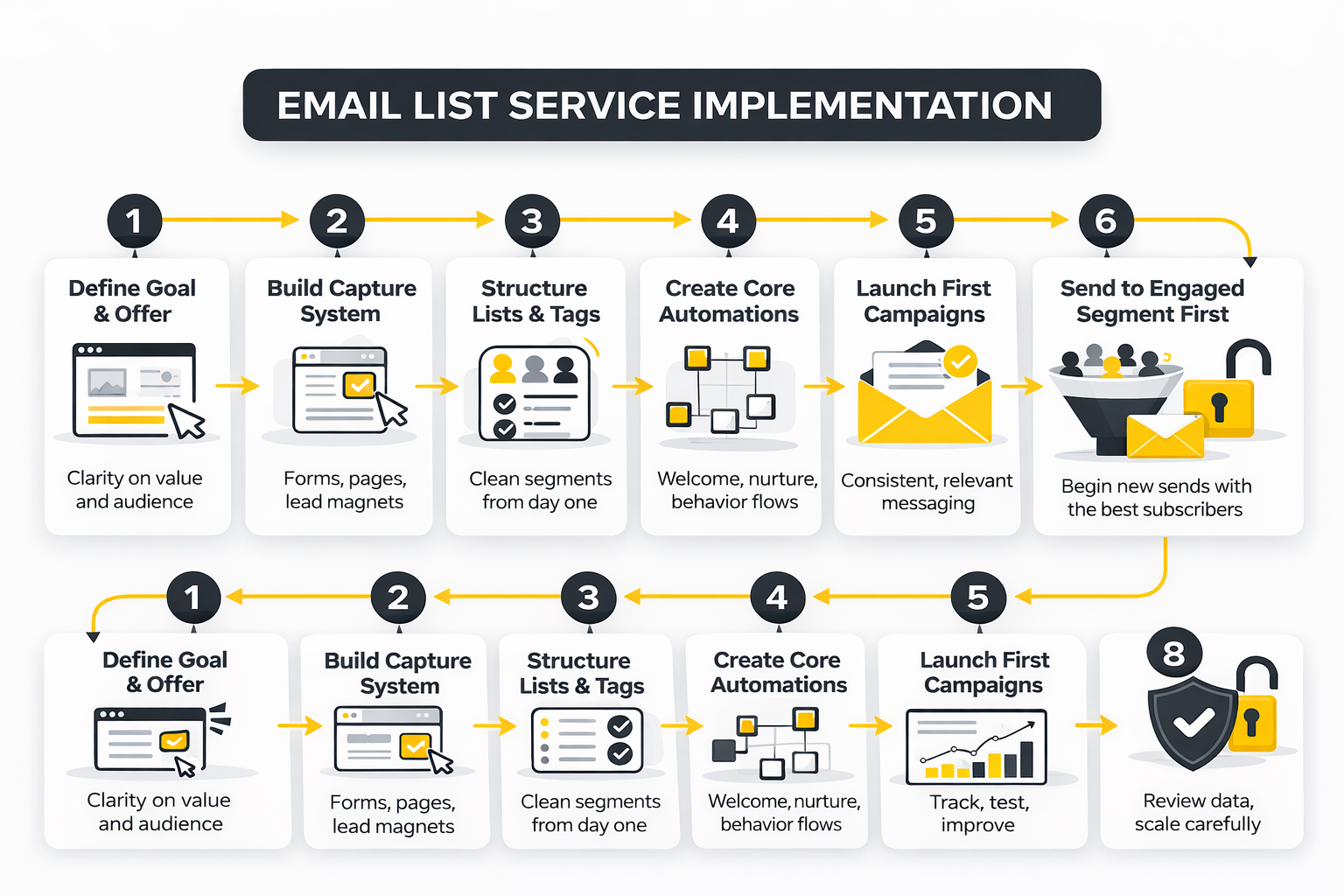
The rollout works best when it follows a clear order:
- Set up the sending domain, authentication records, and unsubscribe handling.
- Create the core contact fields, tags, and segments you will actually use.
- Connect forms, landing pages, or lead sources so subscriber origin is captured automatically.
- Import only verified contacts with clean field mapping.
- Build the welcome flow first, because every new signup will hit it immediately.
- Add one or two behavior-based sequences tied to your business model, not every idea on your wishlist.
- Send a controlled campaign to a smaller engaged segment before expanding volume.
- Review engagement, complaints, unsubscribes, and bounce patterns before scaling frequency.
That sequence keeps the system stable while the data starts teaching you what your audience actually responds to. It also protects you from the classic launch mistake where everything is technically “live” but nothing is easy to diagnose. Professional implementation is not about doing more. It is about making each layer legible enough that you can improve it without guessing.
Build Around Engaged Segments First
One of the smartest ways to launch a new email list service is to begin with the most engaged subscribers rather than the entire database. That approach aligns with current deliverability logic because inbox providers care about how recipients respond to your mail, not how ambitious your campaign calendar looks. If engagement starts strong, you earn the right to scale more confidently.
This is also supported by current benchmark thinking. Mailchimp’s industry benchmark data and Brevo’s 2025 benchmark report both show wide variation across sectors, which is a reminder that healthy performance is contextual and list quality matters a lot. An engaged smaller segment gives you a more honest baseline than a full-list blast that mixes active subscribers with quiet ones. Mailchimp’s benchmark overview and Brevo’s 2025 benchmark report both point in that direction.
Choose Tools That Keep Execution Simple
This is the part where tool sprawl starts to look expensive. If your forms live in one product, automations in another, CRM data in a third, and reporting in a fourth, you can make it work, but the operational burden goes up fast. A better email list service setup usually reduces those handoffs.
That does not mean every business needs an all-in-one stack. It means the implementation should stay as simple as the business model allows. A lean setup with Moosend or Brevo can be enough for many teams, while a more operationally complex business may benefit from the broader automation environment in GoHighLevel.
The next step is where the differences between platforms become even more obvious. Once the system is live, ongoing performance depends less on setup checklists and more on avoiding the mistakes that slowly kill list quality, relevance, and sender reputation.
What the Numbers Actually Tell You
By the time an email list service is fully set up, most teams start watching the wrong scoreboard. They stare at opens, celebrate a pretty dashboard, and assume the system is healthy. That is risky, because modern email measurement is messier than it looks, especially after Apple Mail Privacy Protection changed how open activity is recorded and after mailbox providers tightened sender standards.
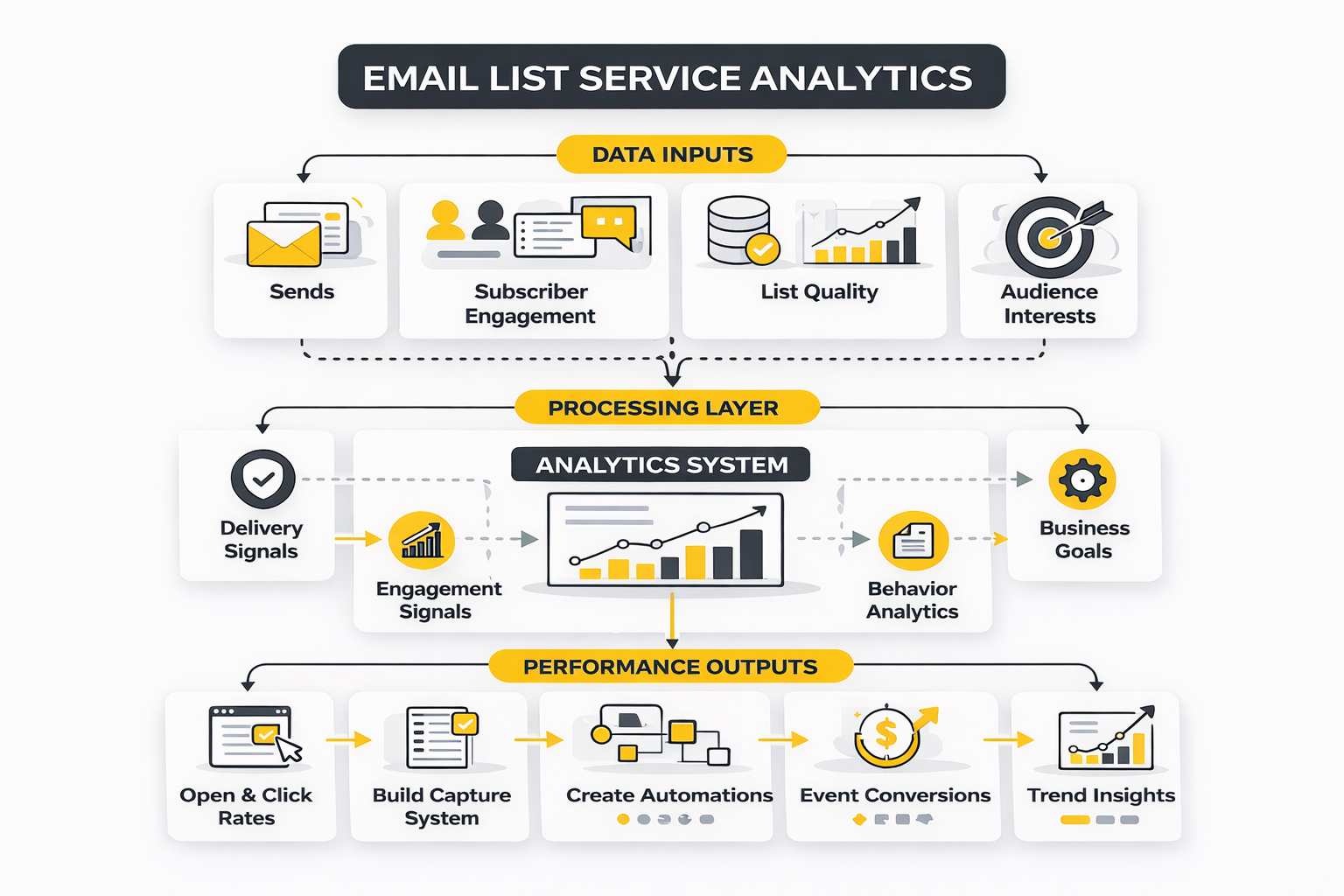
That does not mean the data is useless. It means the data needs context. A solid email list service should help you interpret performance in layers: attention signals, engagement signals, deliverability signals, and business signals. When those layers are read together, the numbers become operational guidance instead of vanity metrics.
Open Rate Is a Directional Signal, Not the Final Verdict
Open rate still matters, but it cannot carry the whole analysis anymore. Mailchimp’s current benchmark page puts the average open rate at 34.23% across industries, while Brevo’s 2025 benchmark based on more than 44 billion emails reports an overall open rate of 31.22% and strong variation by region and industry. Those are useful reference points, but they are not performance guarantees, and they become less meaningful when privacy protections inflate or distort the signal.
What an open rate is actually good for is triage. If opens suddenly fall after a domain change, a list import, or a jump in volume, that can point to inbox placement trouble, subject line weakness, or audience mismatch. If opens stay stable while clicks collapse, the message is getting attention but failing to create action. That is a very different problem, and a better email list service should help you separate those cases quickly.
Click Rate and CTOR Usually Tell You More
Click-through rate is one of the cleaner indicators of message relevance because it reflects a real action rather than a mailbox image load. Brevo’s 2025 benchmark reports an overall CTR of 3.64%, while GetResponse’s 2024 benchmark reporting highlights average CTR around 3.25% and notes that triggered emails outperform standard newsletters on this metric. That is a strong reminder that relevance and timing usually beat volume.
Click-to-open rate is even more useful when you want to evaluate the message itself. If people open but do not click, the problem is often inside the email: weak positioning, poor CTA structure, too many links, or a mismatch between subject line promise and body content. Brevo’s KPI guide is useful here because it breaks CTR and CTOR apart instead of blending them into a single engagement story.
Unsubscribes and Complaints Are Often More Important Than Marketers Admit
A low unsubscribe rate does not automatically mean subscribers are happy. Sometimes it means they are ignoring you instead of leaving. Still, unsubscribes are a critical pressure gauge because they reveal whether your cadence, targeting, and message intent stay aligned with what people expected when they joined.
Complaint rate matters even more. Yahoo explicitly tells bulk senders to stay below 0.3% complaint rate, and Google’s sender guidance makes it clear that easy unsubscribing and clean sending practices are now part of inbox eligibility, not optional polish. Once complaints rise, the problem is rarely fixed by better copy alone. It usually requires changes in acquisition quality, frequency, segmentation, or all three.
Bounce Rate Is a List Quality Signal
Bounce rate is one of the fastest ways to spot whether the audience itself is becoming unhealthy. Brevo’s 2025 benchmark reports a 0.19% hard bounce rate overall, with soft bounce rates varying more widely by region and category. That matters because a rising hard bounce rate usually points to decaying list quality, outdated imports, or poor collection sources rather than a campaign problem.
This is exactly why a serious email list service should not just send campaigns. It should help you control list hygiene. If bounced addresses, low-engagement contacts, and vague signup sources are allowed to accumulate, your analytics start lying to you. Results soften slowly, and teams often blame the creative long before they admit the audience data has deteriorated.
Delivery Rate Is Not the Same Thing as Deliverability
This distinction is one of the most misunderstood parts of email analytics. Delivery rate tells you whether the recipient server accepted the message. Deliverability tells you whether the message actually reached the inbox instead of spam, junk, or a missing folder state. Those are not the same thing, and treating them as if they are can hide serious problems for months.
Validity’s 2025 deliverability benchmark makes that gap tangible. It reports a global inbox placement average of 83.5%, and provider-level variation is meaningful, with Apple around 76.3% inbox placement in the report excerpt surfaced through search. Brevo’s 2025 benchmark also shows substantial mailbox-provider differences, including 88.1% inbox placement for Gmail, 87.4% for Yahoo, 82.5% for Microsoft, and 66.3% for Apple in its dataset. That is exactly why an email list service should be judged partly on how seriously it handles authentication, reputation, and list quality, not just campaign design.
The Metrics Stack That Actually Helps You Make Decisions
The cleanest way to read email performance is to stack the metrics in order of cause and effect. Opens tell you whether the message earned attention. Clicks tell you whether the content created interest. Conversions tell you whether the traffic did something meaningful. Bounces, unsubscribes, and complaints tell you whether the audience and sending strategy are eroding underneath the surface.
That stack helps you diagnose problems much faster:
- Low opens and low clicks usually point to deliverability trouble, weak subject lines, or poor audience targeting.
- Normal opens and weak clicks usually point to message-body issues, bad offer framing, or weak CTA structure.
- Healthy clicks and weak conversions usually point to a landing page or funnel problem, not an email problem.
- Good campaign metrics with rising complaints or unsubscribes usually mean short-term wins are damaging long-term list health.
This is where benchmarks become useful. Not as targets to worship, but as guardrails. Mailchimp, Brevo, and GetResponse all show that “normal” varies a lot by industry and email type, so the smarter move is to compare your performance against your own historical baseline first and use external benchmarks to sense-check whether you are drifting into unhealthy territory.
Why Personalization Data Matters More Than Raw Volume
A lot of teams still try to grow email results by sending more. That approach usually breaks before it scales. The stronger play is to send more relevant messages to more precise segments, and current research continues to support that direction.
Litmus’s 2024 State of Email Trends report found that subject line personalization, real-time content, and dynamic personalization improved performance for more than 80% of respondents who used them. That does not mean every campaign needs hyper-complex personalization. It means the data model inside your email list service should be good enough to support relevant messaging when it matters.
The action this should drive is straightforward. Instead of asking whether the whole list liked the campaign, ask which segments responded, which segments ignored it, and which behaviors predict the next conversion. That is how analytics becomes a growth tool rather than a reporting ritual.
Benchmarks Should Change Your Questions, Not Your Identity
There is a trap in benchmark culture. People see a published average and immediately assume their number is either good or bad in isolation. That is too simplistic. A lower open rate with higher clicks and stronger conversions can be far healthier than a beautiful open rate inflated by unengaged segments or privacy noise.
The better use of benchmark data is diagnostic. If your unsubscribe rate is well above common ranges, your expectations and content may be misaligned. If your hard bounce rate is climbing above normal levels, your acquisition or list maintenance process likely needs work. If your CTR is persistently weak while delivery looks fine, the offer and message architecture need attention. Mailchimp’s measurement guide and Brevo’s benchmark reporting are helpful reference points because they frame metrics as decision tools rather than trophies.
That is the real point of measurement in an email list service. The numbers should tell you what to change next. They should help you protect deliverability, improve relevance, and spot weak links in the system before they become expensive. In the next section, that turns practical again, because the biggest gains usually come not from adding more features but from avoiding the mistakes that quietly poison list quality over time.
Common Mistakes, Smart Upgrades, and Final Recommendations
Once an email list service is running, the challenge changes. Early on, the job is setup. Later, the job is restraint. The fastest way to damage results at scale is not usually one big mistake. It is a series of small decisions that look efficient in the moment and quietly weaken relevance, trust, and sender reputation over time.
That is why experienced operators treat email as a compounding asset, not a campaign machine. They protect list quality, limit unnecessary complexity, and keep the system understandable even as more segments, automations, and campaigns get added. The businesses that win with email long term are rarely the ones doing the most. They are the ones doing the most important things consistently.
The Biggest Scaling Risk Is Audience Decay
Every email list service gets weaker if the audience inside it stops being managed properly. People change jobs, abandon inboxes, lose interest, switch priorities, or simply stop caring about what they signed up for months ago. If your system keeps treating every contact like a live opportunity forever, performance gets distorted and deliverability risk starts rising behind the scenes.
This is one of the reasons scaling can feel confusing. A list can grow while results soften. On paper, the asset looks bigger. In reality, a larger percentage of the audience may be inactive, poorly tagged, or no longer aligned with the original offer. That is not a copy problem. It is a list management problem.
The fix is not aggressive pruning for its own sake. The fix is active segmentation, re-engagement logic, and clear rules for when a contact should be suppressed, downgraded, or removed from normal promotional sending. A strong email list service makes those decisions easier because the data stays structured and the automations can respond to behavior without constant manual cleanup.
More Automation Is Not Always Better
A lot of teams hit a strange wall after their first wins with automation. They see that welcome flows work, cart recovery works, nurture flows work, and lifecycle campaigns work, so they assume adding more flows will keep multiplying results. Sometimes it does. Often it just creates overlap, confusion, and message collisions.
This is where maturity matters. Good email operators know that automation depth should follow clarity, not excitement. If two workflows can trigger around the same contact at the same time and nobody on the team can explain which one should win, the system is already becoming fragile.
That is also why platform choice keeps mattering long after implementation. Some businesses need a lighter environment where campaigns and automations stay easy to audit. Others need a broader operational system where email sits next to lead management and follow-up logic. A simpler stack with Brevo or Moosend can be the better choice when clarity matters more than feature sprawl, while a business with deeper sales workflows may benefit from GoHighLevel.
Frequency Problems Usually Start as Strategy Problems
When email results decline, frequency is one of the first things people blame. Sometimes that is fair. Sometimes the real problem is that the messaging stopped earning repetition. If the audience keeps receiving broad updates instead of useful next steps, even a modest send schedule can start feeling excessive.
This is where an email list service should support strategic restraint. You want the ability to send often enough to stay present, but not so broadly that every message hits people who did not ask for it, do not need it, or are already in a different stage of the journey. Smart segmentation fixes a lot of what teams mistakenly try to fix with lower volume.
The more advanced question is not “How many emails should we send?” It is “Which people should receive this message now, and what evidence do we have that it fits their intent?” That shift in thinking is small, but it changes everything. It turns cadence from a blunt calendar decision into a relevance decision.
Tool Consolidation Can Be a Competitive Advantage
There is a point where extra tools stop being flexibility and start being friction. A popup tool, a landing page tool, a CRM, an email platform, a workflow builder, and a reporting layer can all coexist, but every extra handoff creates more room for broken attribution, missed triggers, duplicate contacts, and field mismatch. None of that looks dramatic on day one. It becomes expensive in month six.
That is why consolidation is not just about convenience. It is often about execution quality. When forms, contact records, automations, and reporting live closer together, teams move faster and make fewer silent errors. For some businesses, that means keeping things lean with one email-first platform. For others, it means using an operational stack that connects email with the broader customer journey.
This is also where adjacent tools become useful when they are chosen for a clear reason instead of added out of habit. A business that wants stronger landing page control may pair its email list service with Replo. A team that wants more structured lead capture may benefit from Fillout. The point is not to stack tools endlessly. The point is to add tools only when they remove a real bottleneck.
Deliverability Recovery Is Harder Than Preventive Discipline
One of the most expensive misconceptions in email is the idea that sender reputation problems can always be cleaned up later. Sometimes they can. It is usually slower and uglier than people expect. Once engagement weakens, complaint pressure rises, or domain trust slips, the recovery process tends to involve lower volume, tighter segmentation, better suppression rules, and stricter operational discipline than teams were willing to use before the problem appeared.
That is why prevention is worth so much. A healthy email list service setup protects the basics continuously. It makes permission visible, unsubscribe handling straightforward, audience sources trackable, and segment logic understandable. Those are not small admin details. They are the infrastructure that keeps growth from turning into decay.
This is also why “just import the old list” is one of the worst shortcuts in the category. It feels productive because it makes the database bigger instantly. In reality, it often imports uncertainty, stale addresses, old consent assumptions, and low engagement history into a system that was supposed to improve performance.
The Best Operators Build for Decision Speed
At an advanced level, the real value of an email list service is not just sending power. It is decision speed. Can the team see which segments are healthy, which workflows are slipping, which acquisition sources produce the best subscribers, and which campaigns are creating revenue without damaging list quality. If the answer is yes, the system is doing its job.
That is why clean naming conventions, clear segment architecture, and simple lifecycle logic matter more than many people expect. An overbuilt account often looks impressive during setup and frustrating during optimization. A slightly simpler account that everyone understands usually wins because it can be improved faster and with fewer mistakes.
This is the part many buyers miss when they compare platforms by feature count. The strongest email list service is not always the one with the most options. It is the one that helps your team make better decisions under normal operating pressure.
The Smart Upgrade Path Is Usually Narrower Than People Think
Most businesses do not need a dramatic rebuild to improve email performance. They need a short list of sharper moves. Clean the segments. Reduce audience overlap. Improve the welcome sequence. Tighten suppression rules. Rework campaigns that get opens without clicks. Remove dead weight from the automation map. Make forms and source tracking more reliable.
That is a much better upgrade path than chasing novelty. Too many teams assume growth will come from switching templates, adding more AI copy, or launching another automation branch when the real gains are sitting inside segmentation, list quality, and message relevance. The foundations are usually more fixable than people think, but only if the team is willing to work on the unglamorous parts.
By now, the picture should be clear. Choosing an email list service is not just software selection. It is a decision about how your business will collect attention, organize audience data, automate follow-up, interpret performance, and protect trust over time. The final part will wrap this up with direct answers to the most common questions and a practical bottom-line view of what actually matters when choosing and using an email list service.
Final Takeaway
A good email list service is not just a way to send newsletters. It is the system that helps you collect permission, organize subscriber data, automate relevant follow-up, measure what matters, and protect deliverability while the business grows. When that system is chosen well and managed with discipline, email becomes one of the most dependable owned channels a company can build.
That is also why the decision deserves more care than most buyers give it. The wrong platform can still send messages, but it usually creates friction in segmentation, reporting, automation, or list hygiene. The right platform makes the work clearer, the data cleaner, and the next decision easier.
At the expert level, this is the real standard. Your email list service should help you grow without forcing you into operational chaos. If it cannot do that, it is not really helping, even if the dashboard looks polished.
FAQ
What is an email list service?
An email list service is a platform that helps you collect subscribers, store contact data, segment audiences, send campaigns, and automate follow-up. The stronger platforms also help with unsubscribe handling, sender authentication, analytics, and lifecycle messaging. In practice, it is less like a simple sender and more like the control center for owned audience communication.
How is an email list service different from a regular email app?
A regular email app is built for one-to-one communication. An email list service is built for one-to-many or one-to-segment communication at scale. It handles subscriber permissions, campaign logic, automation workflows, performance reporting, and compliance requirements that normal inbox tools are not designed to manage.
Do small businesses really need an email list service?
Yes, if they want email to work consistently instead of casually. Even a small business benefits from structured signup forms, welcome emails, segmentation, and clear reporting. The smaller the team, the more valuable it is to have a system that removes manual work and keeps follow-up from slipping through the cracks.
When should a business upgrade from a basic tool to a more advanced one?
The right time is usually when the current setup starts creating blind spots. That might happen when you need better segmentation, stronger automations, cleaner reporting, or tighter coordination between email and your sales process. If the team is exporting lists manually, patching together workflows, or struggling to explain how contacts move through the system, the upgrade is overdue.
What features matter most in an email list service?
The most important features are usually subscriber capture, flexible segmentation, automation depth, clear reporting, and solid deliverability support. Everything else is secondary unless it solves a real operational problem. Fancy templates do not matter much if your segments are weak and your automations are unreliable.
Is the cheapest email list service usually a bad choice?
Not always, but it often becomes expensive in indirect ways. A cheap tool can cost more when it creates manual work, weak targeting, fragile workflows, or poor visibility into performance. The better way to judge value is not monthly price alone. It is whether the platform helps the business run email cleanly and improve it over time.
How many subscribers do I need before I start using an email list service?
You do not need a big list to justify one. In fact, the best time to start is early, before the data gets messy and before manual sending habits become normal. A clean system is easier to build from the beginning than to repair after the audience, tags, and workflows have become disorganized.
Can an email list service improve deliverability on its own?
It can help, but it cannot rescue bad practices automatically. The platform can support authentication, unsubscribe handling, suppression logic, and cleaner segmentation, which all matter a lot. Still, deliverability also depends on list quality, permission standards, complaint rates, sending behavior, and whether recipients actually engage with the messages you send.
Should I use one big all-in-one platform or a simpler specialist tool?
That depends on the business model and the team. A simpler specialist tool is often better when the goal is clean email execution without heavy operational complexity. A broader platform makes more sense when email needs to connect tightly with pipelines, appointments, CRM stages, or sales workflows. The best choice is the one that matches how the business actually runs, not the one with the longest feature list.
How often should I email my list?
There is no universal number that works for everyone. Frequency should follow audience expectations, offer relevance, and segment intent rather than a rigid calendar rule. If messages are timely and genuinely useful, a business can send more often. If the content is broad, repetitive, or weakly targeted, even a modest schedule can feel excessive fast.
What is the biggest mistake people make with an email list service?
One of the biggest mistakes is treating every subscriber the same for too long. That usually leads to overbroad sends, lower engagement, rising complaints, and weaker long-term performance. Another major mistake is importing old or poorly permissioned contacts into a new system and assuming bigger list size means stronger results.
How do I know if my email list service is working well?
A healthy system is not judged by one number. You want to see stable engagement, manageable unsubscribe pressure, low complaint and bounce issues, clear segment behavior, and evidence that email is contributing to real business outcomes. Just as important, the team should be able to explain how the system works without confusion. If nobody understands the logic, the setup is probably more fragile than it looks.
Is switching email platforms difficult?
It can be, but it is manageable when the move is planned well. The hard part is usually not exporting contacts. It is cleaning the data, mapping fields properly, rebuilding automations intelligently, and protecting deliverability during the transition. A messy migration often imports the same problems into a newer dashboard, which is why cleanup matters more than speed.
Which businesses benefit most from a strong email list service?
Almost any business that depends on audience attention, repeat engagement, or lead follow-up can benefit. Ecommerce brands use it for promotions and lifecycle messaging. Service businesses use it for lead nurturing and reminders. Creators use it to build an owned audience instead of relying fully on rented platforms. The business type changes the setup, but the underlying value stays the same.
Work With Professionals
Explore 10K+ Remote Marketing Contracts on MarkeWork.com
Most marketers spend too much time chasing clients, competing on crowded platforms, and losing a percentage of every project to middlemen. MarkeWork gives you a better way. Browse thousands of remote marketing contracts and connect directly with companies desperate to hire skilled marketers like you, without platform commissions and without unnecessary gatekeepers.
If you're serious about finding better opportunities and keeping 100% of what you earn, explore available contracts and create a profile for free at MarkeWork.com.