

An email marketing agency can look like a simple outsourced service from the outside. In reality, the best ones sit at the intersection of strategy, creative, data, lifecycle automation, deliverability, and revenue analysis. That matters more now because inbox placement has become stricter under Google’s sender guidelines and Yahoo’s sender best practices, while measurement has become messier under Apple’s Mail Privacy Protection rules.
That mix is exactly why companies go looking for specialist help. Email still produces strong returns when it is run well, with Litmus reporting that many marketing leaders see returns between 10:1 and 36:1, and consumers still lean toward the inbox for brand communication in Sinch Mailgun’s 2024 customer experience research. But high returns do not come from blasting campaigns. They come from segmentation, automation, relevance, and technical discipline.
The challenge is that not every email marketing agency is built for that level of work. Some agencies are really copy shops. Some are design shops with weak retention strategy. Some can build flows but cannot fix domain setup, list health, or reporting. This article is built to help you tell the difference before you hire one.
- Why an Email Marketing Agency Matters
- The Modern Email Marketing Agency Framework
- What Great Agencies Actually Do
- How to Evaluate Strategy, Deliverability, and Reporting
- Pricing Models, Red Flags, and Fit
- Choosing the Right Agency and Getting Results
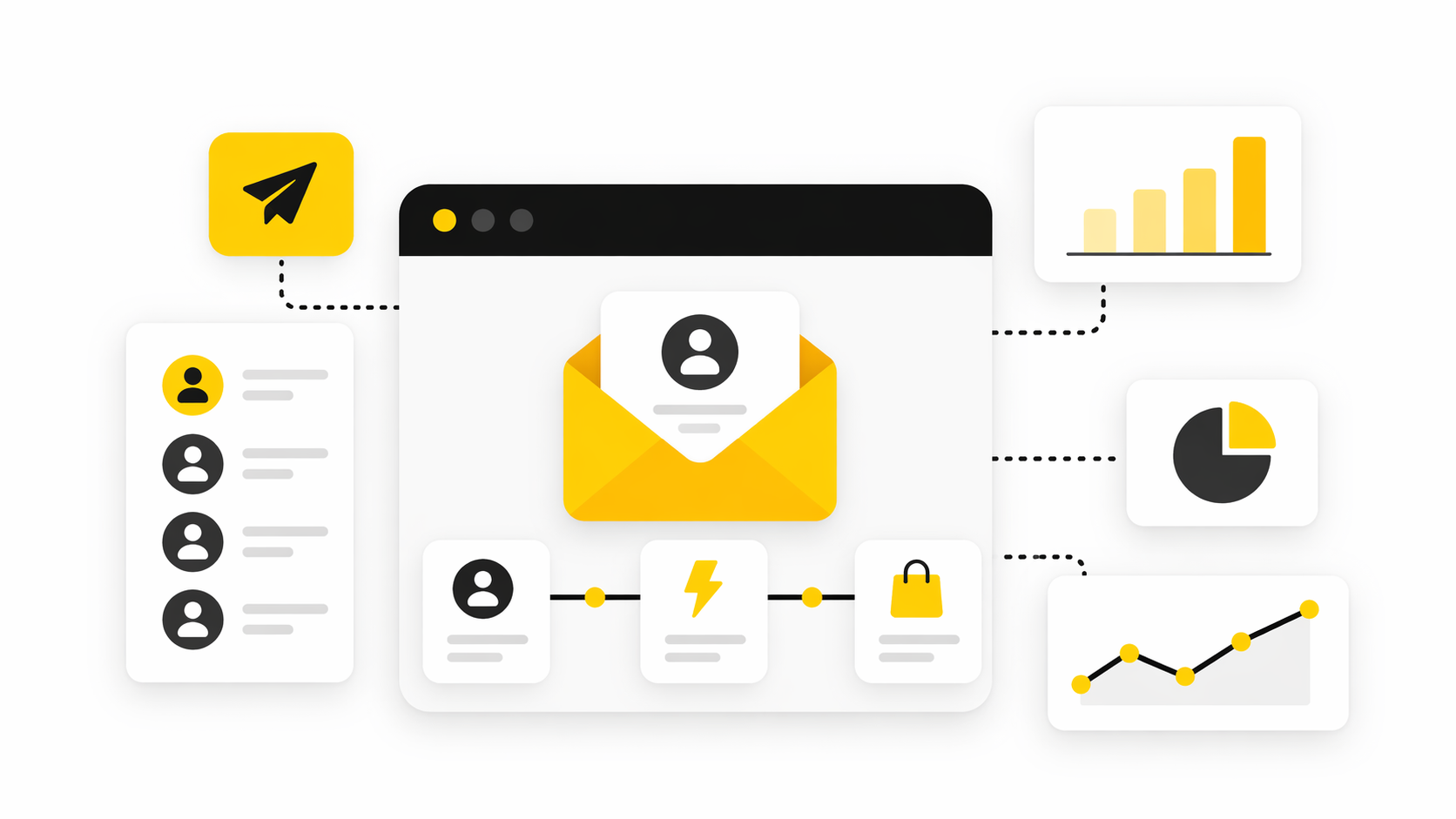
Why an Email Marketing Agency Matters
The short version is that email got harder and more valuable at the same time. It is more valuable because brands still own the channel, can personalize it deeply, and can use it across acquisition, conversion, retention, and win-back. It is harder because inbox providers now expect better authentication, cleaner consent practices, and easier unsubscribes, as spelled out in Google’s bulk sender FAQ and Yahoo’s requirements for senders.
That shift changed the job description. A real email marketing agency is no longer just there to send weekly campaigns. It has to connect copy, offer strategy, lifecycle thinking, segmentation logic, template QA, deliverability monitoring, and reporting that goes beyond vanity metrics. Open rate alone is not enough anymore because Apple’s privacy changes made many opens less reliable as a measure of human attention.
This is also why businesses often hit a wall with in-house execution. A lean team can usually get newsletters out. What usually breaks is the deeper system: welcome flows that are too generic, abandoned cart sequences that stop early, post-purchase journeys that do not expand lifetime value, and reporting that cannot explain what email actually contributed to revenue. In sectors where personalization drives growth, that gap gets expensive fast, which is why McKinsey continues to frame personalization as a major growth lever.
The other reason this matters is consumer expectation. People still want brands in their inboxes, but only when the messages are relevant, useful, and easy to control. Sinch Mailgun’s survey of more than 2,000 consumers found strong preference for email communications, while Brevo’s 2025 benchmark and Mailchimp’s benchmark library show just how much performance varies by industry and execution quality. That is where a strong agency can change the math.
The Modern Email Marketing Agency Framework
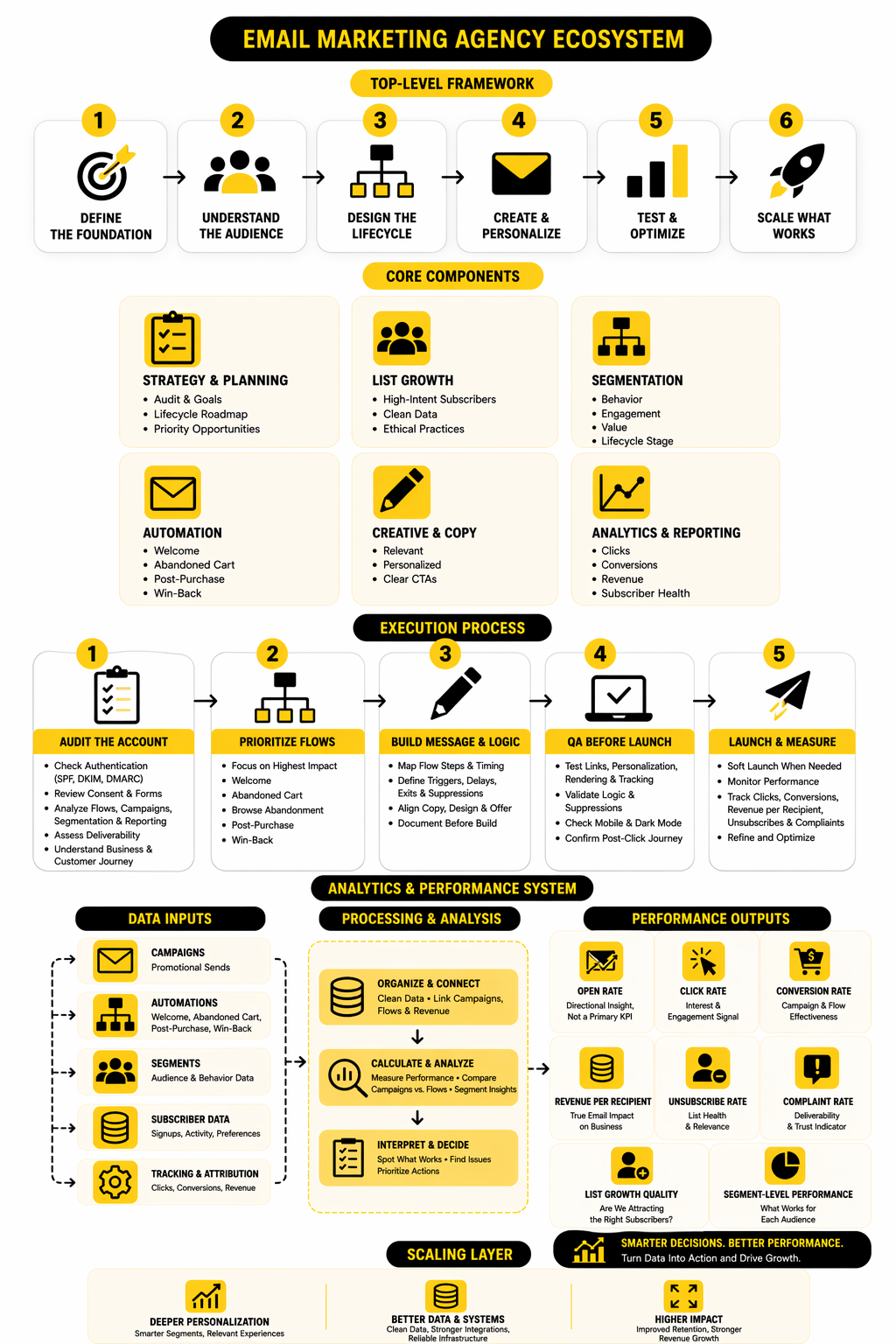
A modern email marketing agency works best when it follows a simple structure. First comes foundation: audience data, consent capture, domain authentication, platform setup, and baseline reporting. Then comes lifecycle architecture: mapping the journeys that matter most, such as welcome, browse abandonment, cart abandonment, post-purchase, replenishment, cross-sell, win-back, and VIP retention.
After that, the agency needs a campaign system that supports the lifecycle engine instead of competing with it. That means campaigns are not random blasts dropped on top of automations. They are coordinated around merchandising, content themes, seasonal moments, and customer segments, with performance judged by downstream actions like clicks, conversions, revenue per recipient, and unsubscribe pressure rather than inflated opens. That approach matches how leading benchmark providers now frame email performance, including Brevo’s regional and industry KPI breakdowns and Salesforce’s email benchmark guidance.
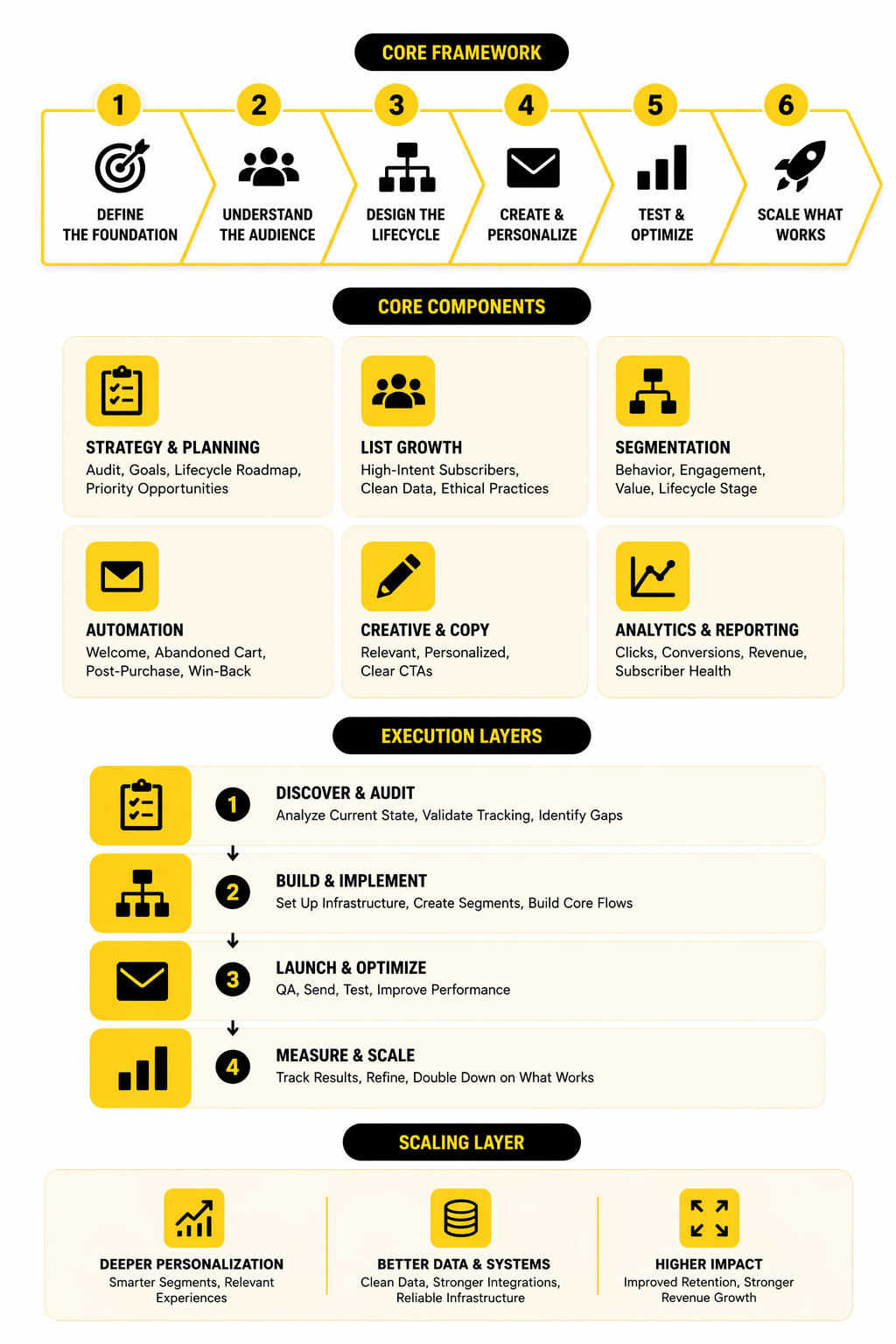
The last layer is optimization, and this is where average agencies usually fade. Good optimization is not just subject line testing. It includes list growth quality, send frequency control, segmentation depth, creative testing, deliverability checks, and attribution logic that can separate channel noise from actual business impact. When an agency understands this framework, email stops being a box to tick and starts acting like a revenue system.
That is the lens the rest of this article will use. Not whether an agency says it does email marketing, but whether it can build and run the full machine: compliant sending, relevant journeys, strong creative, trustworthy reporting, and a process that improves over time. In the next section, we will break down what great agencies actually do behind the scenes and where the biggest differences show up in practice.
What Great Agencies Actually Do
A strong email marketing agency does not start by asking how many campaigns you want each month. It starts by figuring out where revenue is leaking, which customer journeys matter most, and whether the account is even set up to deliver reliably. That first distinction is a big one, because the gap between a decent-looking email program and a profitable one usually sits in infrastructure, segmentation, and lifecycle design rather than in headline copy alone.
This is where many businesses misjudge the role. They think they are hiring extra hands for newsletters, but the real value comes from systems thinking. The agency should be able to connect list growth, customer intent, content timing, and deliverability into one operating model that improves over time.
The best teams also work with the reality of modern measurement. Open rates still tell part of the story, but they are no longer a clean proxy for attention because Apple’s Mail Privacy Protection masks reliable open behavior and Apple’s own support documentation explains that it prevents senders from seeing whether an email was opened. So a serious email marketing agency shifts focus toward clicks, conversion rate, revenue per recipient, list growth quality, spam complaints, and retention impact.
Strategy Comes Before Volume
Good agencies do not chase send count for its own sake. They look at what the business model needs, what the customer buying cycle looks like, and where email can influence the path from first signup to repeat purchase. That often means fewer random sends and more deliberate messaging built around welcome, nurture, promotion, post-purchase, replenishment, referral, and win-back moments.
This matters because lifecycle email keeps doing the heavy lifting long after the first conversion. Litmus lifecycle research continues to show how marketers are leaning on email across the customer journey, and McKinsey’s personalization research keeps pointing to the same truth: relevance drives performance. A real agency turns that idea into a concrete calendar, message hierarchy, and testing roadmap.
The practical outcome is clarity. Instead of wondering what to send next Tuesday, the brand knows which audience needs which message, why it matters, and what metric will define success. That alone removes a lot of wasted motion from the channel.
They Build the Core Revenue Flows First
Any competent email marketing agency should know that automated flows usually beat one-off campaigns for consistency. Welcome series, cart recovery, browse abandonment, post-purchase onboarding, review requests, replenishment reminders, and win-back sequences are not nice extras. They are the core architecture of an account that wants recurring revenue instead of occasional spikes.
This is not just theory. Benchmark data from Litmus, Brevo, and Salesforce all point in the same direction: the brands that treat email as an always-on system perform better than the ones that rely on occasional sends. Campaigns still matter, but flows create the baseline revenue and retention engine.
A great agency also prioritizes these flows in the right order. It does not waste month one on fancy seasonal concepts while cart abandonment is broken or the welcome sequence is generic. It fixes the high-intent, high-leverage journeys first, then expands from there.
They Segment Beyond Basic Demographics
Weak agencies segment by broad categories and stop there. Strong agencies go deeper into behavior, purchase history, engagement patterns, predicted intent, product affinity, and customer stage. That is where email starts to feel useful instead of repetitive.
This matters because inbox providers increasingly reward relevance and users punish irrelevance fast. Google’s sender guidelines and Google’s bulk sender FAQ make clear that authentication and complaint control are part of the new baseline, while Yahoo’s sender guidance pushes in the same direction. Better segmentation helps with both performance and deliverability because it reduces the amount of unwanted mail hitting the wrong people.
There is also a business angle here that gets missed. Segmentation is not just about better click rates. It lets a company match offers to timing, protect margin, reduce unsubscribes, and increase average customer value without relying on constant discounts.
They Treat Deliverability as an Operating Discipline
A serious email marketing agency does not talk about deliverability only when something breaks. It bakes it into setup, creative decisions, list management, send cadence, and monitoring. That means proper SPF, DKIM, and DMARC, a sane warm-up process when needed, active suppression of unengaged contacts when appropriate, and close attention to complaints and bounce patterns.
That discipline matters more now than it did a few years ago. Google requires SPF or DKIM for all senders and SPF, DKIM, and DMARC for bulk senders, and Google publicly tied its 2024 sender changes to authentication, easy unsubscribing, and low spam rates. Yahoo’s bulk sender rules reinforce the same message, which means technical sloppiness can now wreck performance before the email even gets a fair chance.
The best agencies also explain deliverability in business language. They do not hide behind jargon or make it sound mystical. They show how poor authentication, weak list hygiene, or aggressive sending can reduce reach, distort reporting, and cut directly into revenue.
They Combine Copy, Design, and Merchandising
Email is not just a technical channel and it is not just a creative one. The best email marketing agency understands that copy, design, offer strategy, and merchandising all affect whether a message earns the click. A clean template is useless with a weak hook, and strong copy can still underperform if the layout hides the call to action or the offer is badly timed.
That is why good agencies usually develop a repeatable production system. They define message hierarchy, visual standards, review processes, and testing priorities so each send is easier to build and easier to improve. On ecommerce accounts especially, the difference often comes down to whether the team understands product narrative, not just email assembly.
This is one reason some brands pair email execution with landing page optimization tools like Replo or broader CRM and automation stacks like GoHighLevel. The point is not the tool itself. The point is that the agency should know how email fits into the wider conversion path after the click.
They Report on Business Outcomes, Not Vanity Metrics
A weak report celebrates opens and total sends. A useful report explains what changed, why it changed, and what the team will do next. That means tying performance back to revenue contribution, conversion efficiency, subscriber quality, retention, and the health of each major flow.
This is especially important because privacy changes blurred some of the old signals. Once opens became less trustworthy, agencies had to become more disciplined about what they measure and how they interpret it. Apple’s privacy model forced that shift, and the better operators adapted by leaning harder into click behavior, purchase data, holdout thinking, and cohort analysis.
The best reporting also creates decisions. It should tell you whether to push harder on segmentation, change the cadence, rewrite the offer framing, rebuild a flow, or clean the list. If the report does not lead to action, it is decoration.
How Professional Implementation Actually Looks
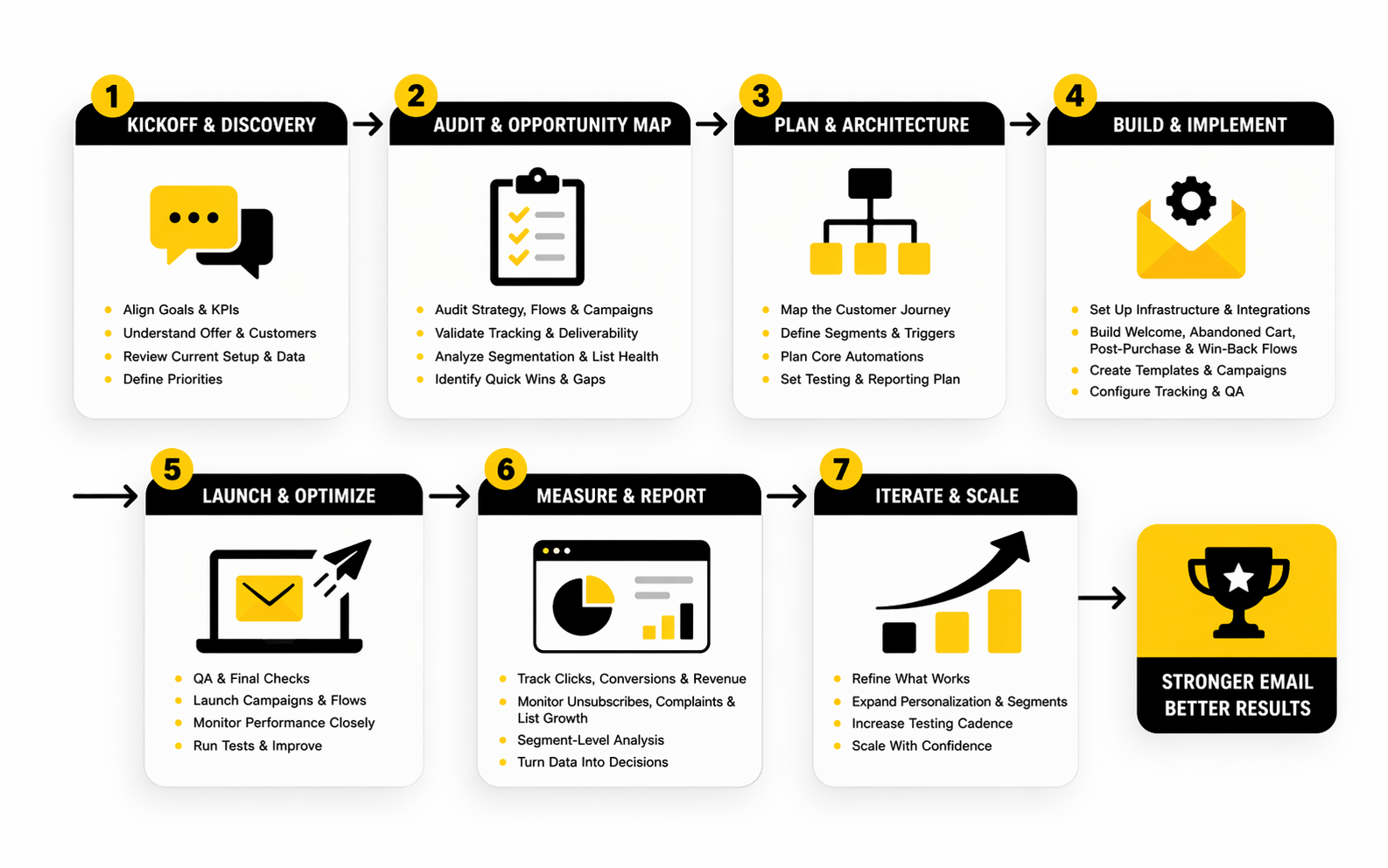
Professional implementation is where the gap between agencies becomes obvious. Anyone can promise better flows, stronger copy, and higher revenue. What matters is whether the team has a process to audit the account, prioritize the opportunities, ship the work, QA it properly, and learn from the results without causing technical damage along the way.
That process usually starts with an audit that goes deeper than the surface. The agency should review platform setup, consent capture, signup forms, domain authentication, suppression logic, current flows, segmentation rules, campaign history, reporting integrity, and deliverability health. It should also understand the commercial side of the business, because email strategy without margin awareness or lifecycle context is half-built from day one.
Execution then needs rhythm. Great agencies work from a sequence: diagnose, prioritize, build, test, launch, measure, and refine. That sounds simple, but it is exactly where underpowered teams fall apart, especially once accounts get larger and multiple automations, campaigns, and segments start interacting with each other.
A professional setup also respects the stack around the inbox. Forms, CRM data, landing pages, sales follow-up, and SMS often affect email performance more than people expect. That is why some agencies extend their work into connected tools like Brevo, Moosend, or ManyChat when the customer journey clearly spans more than one channel. The right email marketing agency does not force every client into the same stack, but it does understand the ecosystem well enough to build clean handoffs.
That is the real picture of competent implementation. It is strategic, technical, creative, and operational at the same time. In the next section, the focus shifts to how to evaluate those claims properly, because this is where buyers need to separate polished agency decks from teams that can actually execute.
The First 30 Days Set the Tone
The first month with an email marketing agency tells you almost everything you need to know. If the team jumps straight into blasting campaigns without cleaning the setup, validating tracking, and prioritizing the highest-value flows, that is usually a warning sign. The early phase should feel disciplined, because the biggest gains often come from fixing structural issues before scaling output.
A solid agency uses this window to establish the baseline. That means checking domain authentication, deliverability posture, consent capture, list quality, existing automations, template health, and reporting accuracy. It also means agreeing on what success actually looks like, especially now that Apple’s Mail Privacy Protection makes open-based reporting less reliable and Google’s sender requirements put more pressure on authentication and spam control.
This stage is not glamorous, but it is where competent execution begins. An agency that handles the first 30 days well usually works from a mature process rather than improvising every week.
Step 1: Audit the Account Like an Operator, Not a Designer
The audit should go far beyond the visual layer. A real email marketing agency checks whether SPF, DKIM, and DMARC are correctly configured, whether unsubscribe handling is clean, whether suppressed contacts are managed properly, and whether the current reporting setup can actually be trusted. That matters because Google’s bulk sender rules and Yahoo’s sender best practices made technical compliance part of the baseline, not a bonus.
The agency should also map the customer journey against the existing email program. Where do leads enter the list, what do they receive first, where do they stall, and which moments have the highest purchase intent? Without that map, even good creative work tends to land in the wrong place.
Then comes the commercial reality check. The team should understand average order value, repeat purchase behavior, buying frequency, margin sensitivity, sales cycle length, and the difference between a lead-generation sequence and a retention sequence. This is the point where strategy stops being abstract.
Step 2: Prioritize the Highest-Leverage Flows
Once the account is understood properly, the next move is prioritization. A capable email marketing agency does not try to rebuild everything at once. It focuses first on the flows most likely to influence revenue and customer experience quickly, which usually means welcome, abandoned cart, browse abandonment, post-purchase, and win-back.
There is a practical reason for this order. These moments are closest to intent, and intent is where email earns its keep. Benchmark material from Litmus, Salesforce, and Brevo’s recent email benchmarks keeps reinforcing the same point: email works best when messages line up with real behavior and timing.
Prioritization also protects the client from busywork. You do not need twelve average automations in month one. You need a handful of high-value sequences built properly, tracked properly, and improved deliberately.
Step 3: Build the Messaging and Logic Together
This is where the process becomes tangible. Every serious email marketing agency should be able to translate business goals into flow logic, decision points, timing rules, and message angles. That includes trigger conditions, delays, exits, suppressions, fallback logic, and segmentation rules, not just subject lines and hero banners.
The creative side has to be built with the logic, not after it. If the message sequence is wrong, great design will not save it. A welcome series needs a different pace than a replenishment flow, and a win-back sequence needs a different emotional angle than a cart reminder.
That is also why better agencies document before they build. They map each flow step, define the role of every message, and decide what the reader should do next. The process feels less chaotic because the structure is visible from the start.
Step 4: QA Before Volume Goes Out
This part gets underestimated all the time. Professional implementation means testing links, personalization tokens, fallback content, mobile rendering, dark mode behavior, tracking, trigger logic, and suppression rules before a single high-volume send goes out. One broken discount code or one bad merge field can damage trust fast.
It is not just about embarrassment either. Email providers care about recipient signals, and sloppy execution creates exactly the kind of behavior that hurts reputation. Low engagement, complaints, and confusion are not separate from deliverability. They feed it.
Good agencies also test across the stack. If the email points to a page that loads slowly, breaks on mobile, or loses continuity with the message, performance suffers after the click. That is why some teams pair strong email execution with landing page builders like Replo or broader funnel tools like ClickFunnels when the conversion path clearly depends on page continuity.
Step 5: Launch in a Controlled Way
A good launch is measured, not dramatic. The agency should know whether a flow needs a soft launch, whether segments should be introduced in phases, and whether old automations need to be retired carefully to avoid overlap or double sends. This is especially important in accounts with years of legacy logic sitting under the hood.
Controlled launch discipline matters more when volume is meaningful. Google’s sender documentation and Google’s setup guidance for SPF, DKIM, and DMARC both point to the need for consistent, authenticated sending, and that consistency is easier to protect when rollout is deliberate.
This is where an experienced email marketing agency earns trust. The client should feel that the team knows what can break, what needs to be monitored, and what must be sequenced carefully rather than rushed.
Step 6: Measure the Right Signals and Refine Fast
Once flows and campaigns are live, the process shifts from production to feedback loops. A strong email marketing agency looks at click patterns, conversion rate, revenue per send or per recipient, unsubscribe spikes, complaint trends, and segment-level performance. It uses those signals to decide what gets changed next.
This is where the weaker operators get exposed. They either overreact to noisy data or keep reporting broad numbers without a clear action plan. Better teams know that not every drop is a crisis and not every lift is a breakthrough. They look for patterns that justify a real decision.
The best refinement cycles are fast but not frantic. Maybe the timing between messages is too tight. Maybe the offer lands too early. Maybe a segment needs different product framing. Maybe the list source itself is attracting low-intent subscribers. Good agencies work through those questions systematically.
Professional Implementation Needs Clear Ownership
One of the clearest signs of a good process is ownership. You should know who owns strategy, who owns build, who owns QA, who owns reporting, and who signs off on send decisions. When that is blurry, mistakes multiply and timelines stretch for no good reason.
This is also why experienced agencies build workflows around approvals and feedback instead of relying on endless comment loops. Tools can help, but the real issue is operating discipline. Whether a team runs inside a platform like GoHighLevel, Brevo, or Moosend, the important thing is that the process stays visible and accountable.
Ownership also helps protect the client relationship. If reporting dips or an automation underperforms, the response should be diagnosis and adjustment, not finger-pointing. That is a major difference between mature agencies and presentation-heavy ones.
Process Quality Is What Makes Results Repeatable
This is the part many buyers miss. They look for a clever portfolio or a few nice-looking screenshots, but repeatable results come from repeatable process. The value of a strong email marketing agency is not that it had one good month for one client. It is that it can audit, prioritize, build, QA, launch, and optimize in a way that holds up across accounts.
That is what professional implementation really means. It is not slower for the sake of being slow. It is disciplined so the channel can scale without constant breakage. And once you see the process clearly, the next question becomes much easier: how do you judge whether an agency actually has the strategy, deliverability depth, and reporting maturity it claims to have?
What the Numbers Really Tell You
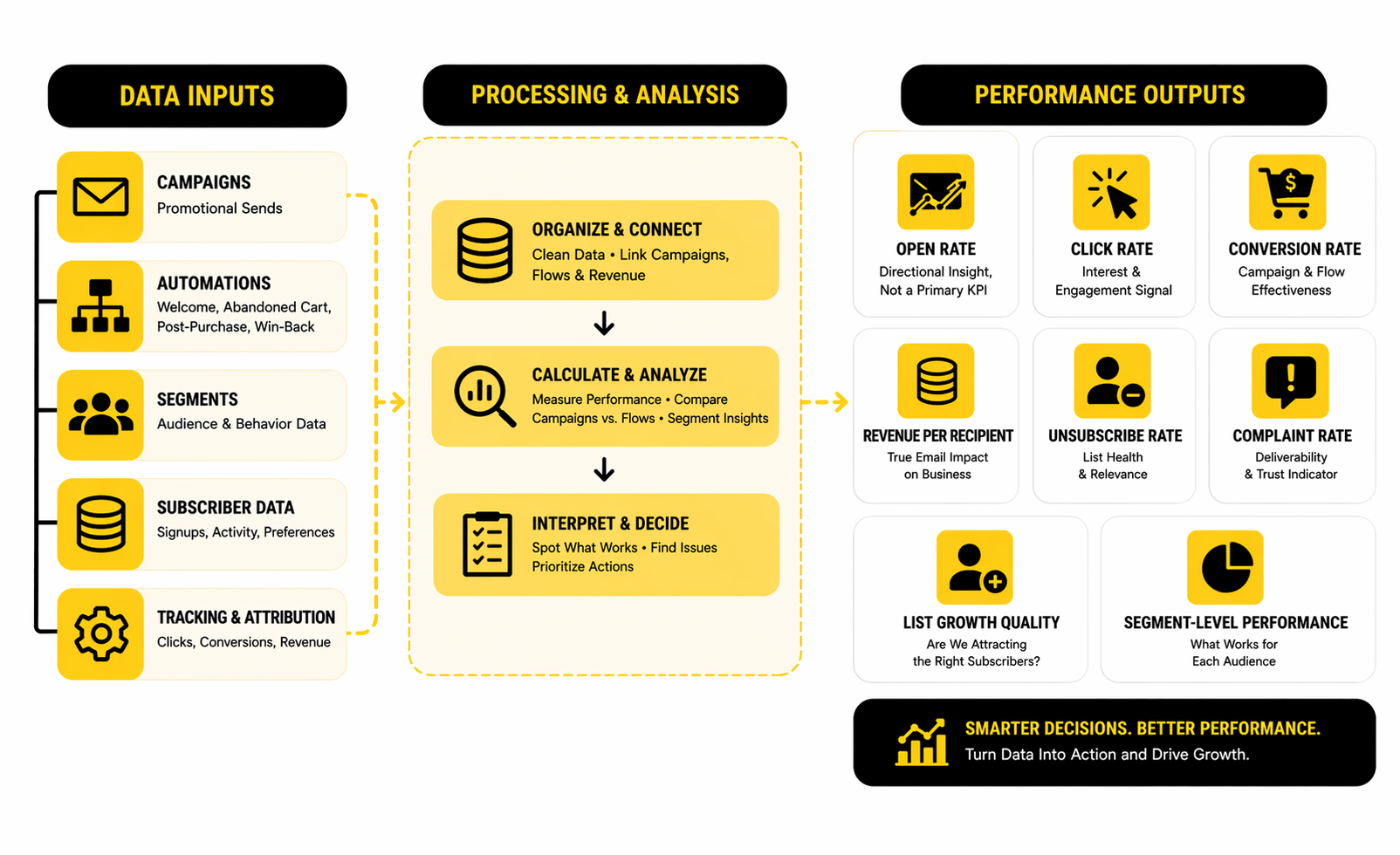
A good email marketing agency does not drown you in dashboards. It uses data to answer a smaller set of questions that actually matter. Is the list healthy, are messages getting into the inbox, are the right people clicking, and is the channel creating measurable business value over time.
That sounds obvious, but this is where a lot of reporting goes wrong. Teams pull random benchmark stats, compare unlike audiences, and celebrate surface-level improvements that do not change revenue or retention. The point of measurement is not to look busy. It is to decide what to fix next.
The first thing to understand is that benchmarks are directional, not absolute. Brevo’s 2025 benchmark study across more than 44 billion emails, Mailchimp’s industry benchmark library, and Salesforce’s email benchmark guidance all show the same pattern: performance varies heavily by industry, audience quality, send type, and business model. So the real job of an email marketing agency is not to chase someone else’s average. It is to understand your own baseline and improve the signals that matter most.
Open Rate Still Matters, Just Not the Way People Think
Open rate is not useless, but it is no longer a clean success metric. Privacy features changed that. Apple’s Mail Privacy Protection, Mailchimp’s Apple privacy FAQ, and Litmus’s Apple MPP resource center all point to the same issue: opens can be inflated, distorted, or detached from real human attention.
That means a strong email marketing agency uses open rate mainly as a directional health signal. If opens collapse suddenly, that can suggest inbox placement problems, subject line weakness, or audience fatigue. But if opens rise while clicks and conversions stay flat, the agency should not pretend that performance improved.
This shift matters because too many reports still treat open rate like the headline KPI. It is not. It is context. Useful context, sometimes, but still context.
Click Rate Tells You More About Real Engagement
Click rate is one of the clearest indicators of whether the message actually persuaded someone to act. It is closer to intent than opens, and it is much harder to inflate artificially. That is why many experienced operators now treat click rate and click-to-open rate as more useful engagement measures than opens alone.
The benchmark range here is important, but only when used carefully. Salesforce notes that a strong email CTR often falls somewhere in the 2% to 5% range, while Brevo’s 2025 benchmark puts the overall click-through rate at 3.64% and Mailchimp shows an overall average click rate of 2.62% with large industry variation. The point is not that every brand should hit the same number. The point is that meaningful clicks usually tell you more than inflated opens.
When click rate is weak, the action should be specific. Sometimes the offer is wrong. Sometimes the message hierarchy is messy. Sometimes the audience segment is too broad. Sometimes the email is fine and the landing page is the real problem. A competent email marketing agency knows the difference.
Conversion Rate Is Where the Channel Proves Its Value
Clicks matter, but conversion is where email stops being an engagement channel and proves itself as a revenue channel. This is one of the biggest mistakes in weak reporting. Teams celebrate decent click rates without checking what happened after the click. That disconnect can hide broken pages, weak offers, or traffic that looked interested but was never ready to buy.
This is also why analytics setup has to extend beyond the email platform. A good email marketing agency tracks the full path from send to click to purchase or lead outcome. If the post-click journey is weak, the agency should say so directly instead of protecting the email report.
For that reason, the best teams often work across the broader conversion stack, not just the inbox. If landing page continuity is part of the bottleneck, tools like Replo, ClickFunnels, or Systeme.io can become part of the fix. The tool is not the point. The continuity between message and destination is.
Unsubscribe Rate Is a Quality Signal, Not a Failure Signal
A lot of teams panic when they see unsubscribes. That is usually too simplistic. Some unsubscribes are healthy because they remove people who were never going to buy or who no longer want the content. The real issue is trend and context.
This is where the benchmarks help anchor the discussion. Brevo’s 2025 benchmark shows an overall unsubscribe rate of 0.4%, Mailchimp’s overall average is 0.22%, and ActiveCampaign’s benchmark guide frames anything under 0.5% as generally healthy, with under 0.2% considered excellent. Those numbers do not mean your account is broken at 0.35% or brilliant at 0.18%. They mean unsubscribe rate should be interpreted relative to frequency, segmentation, acquisition source, and campaign type.
If unsubscribes spike, the next question is not panic. It is diagnosis. Did the message go to the wrong segment, did the offer miss the moment, did acquisition quality drop, or has sending frequency drifted too high for that audience?
Bounce Rate and Inbox Placement Reveal Structural Health
Bounce rate is one of the clearest signals that something is wrong upstream. Poor list hygiene, bad acquisition, outdated records, or technical issues usually show up here first. Brevo’s 2025 benchmark reports an overall hard bounce rate of 0.19% and soft bounce rate of 3.6%, while Efficy’s 2025 benchmark report highlights bounce control and inactive list cleanup as core deliverability protection and Google’s sender guidance ties authentication and spam control directly to sender performance.
Bounce data also needs interpretation. A temporary spike can come from mailbox issues or a short-term technical problem. A persistent pattern usually points to deeper list quality trouble. An experienced email marketing agency will not just report the rate. It will trace the cause.
Inbox placement is even more important because delivered does not always mean seen. One of the most useful data points in Brevo’s benchmark study is that mailbox-provider performance varies materially, with Gmail, Microsoft, Yahoo, and Apple showing different inbox, spam, and missing rates. That should push agency decisions around authentication, sending cadence, and audience filtering, not just reporting language.
Revenue Per Recipient Usually Tells the Most Honest Story
If there is one metric that tends to cut through vanity fastest, it is revenue per recipient or revenue per delivered email. It is not perfect, but it is hard to hide behind. A campaign with flashy opens and weak revenue looks very different once you measure output against audience size. The same goes for automations that quietly outperform campaigns without creating noise in the weekly report.
This is where a strong email marketing agency earns its keep. It should be able to compare campaigns against flows, promotional sends against lifecycle sends, and broad segments against tighter ones. That is how you find out whether the team is creating real commercial lift or just making the dashboard look active.
This metric also changes behavior. Once revenue per recipient becomes visible, brands usually stop obsessing over total send volume and start asking better questions about audience quality, offer fit, and timing. That is a healthier place to operate from.
Benchmarks Are Useful Only When Paired With Segmentation
One average number for the whole account can hide a mess. A welcome series can outperform massively while campaigns stagnate. One signup source can deliver excellent repeat buyers while another floods the list with low-intent subscribers. One product category can carry clicks while another drags down everything around it.
That is why a serious email marketing agency breaks performance down by flow, segment, source, device, and where possible, lifecycle stage. Mailchimp’s benchmarking approach reflects this logic by comparing campaigns against peer characteristics rather than forcing one generic standard on everyone. That is the right idea.
Segmentation makes the data actionable. Without it, you get averages. With it, you get decisions.
The Best Analytics Systems Lead to Clear Next Steps
Good reporting does not end with a chart. It ends with a decision. If click rate is soft but conversion is strong, maybe the agency tests stronger calls to action and different layouts. If opens are stable but revenue per recipient is falling, maybe the offer is weaker or the audience has become less intent-rich. If unsubscribes rise after a list growth push, maybe the acquisition source is polluting the account.
This is why the analytics system should be simple enough to guide action and detailed enough to catch problems early. Many teams overbuild reporting and underuse it. The better move is a focused measurement stack built around deliverability, engagement, conversion, and revenue quality.
That is the real value of the numbers. They are not there to decorate the monthly update. They are there to tell you what the email marketing agency should do next, what the brand should stop doing, and where the next lift is most likely to come from.
Pricing Models, Red Flags, and Fit
By this point, the real question is no longer whether an email marketing agency can design emails or build flows. The real question is whether the relationship makes economic sense, scales cleanly, and gives the business an advantage it could not create just as efficiently in-house. That is where pricing, operating model, and fit start to matter more than portfolio screenshots.
This is also the point where buyers often get distracted by surface-level proposals. One agency looks cheaper, another promises more sends, another throws in SMS, landing pages, or CRM migration. None of that tells you much on its own. What matters is whether the fee structure matches the complexity of the work and whether the agency can move the metrics that actually matter.
The Cheapest Agency Is Rarely the Cheapest Outcome
An email marketing agency can look expensive until you compare its fee to the cost of weak execution. Bad segmentation, broken flows, deliverability issues, and poor QA do not just create mediocre performance. They waste traffic you already paid for, damage trust with subscribers, and make the whole retention system less efficient.
That tradeoff matters because email still remains one of the stronger-returning channels when it is run well. Litmus shows that many teams continue to report returns between 10:1 and 36:1, while Omnisend reported that merchants on paid plans averaged $79 in ROI for every $1 spent in 2025. Those numbers do not guarantee that every brand will see the same outcome, but they do explain why poor execution can quietly become an expensive mistake.
That is why fee comparisons without context usually lead buyers in the wrong direction. A lower retainer attached to weak systems can cost far more than a higher retainer attached to competent implementation.
Common Pricing Models Change Agency Behavior
Most email marketing agency engagements fall into a few broad models. Some charge a flat monthly retainer. Some combine a retainer with setup fees for major flow builds or migrations. Some use project pricing for audits, automations, template systems, or lifecycle rebuilds. A smaller group ties some portion of compensation to performance, although that gets complicated fast because attribution, seasonality, traffic quality, and offer strength all affect results outside the agency’s control.
The pricing model matters because it influences incentives. A pure volume-based model can push an agency toward producing more campaigns than the business actually needs. A rigid monthly retainer can drift into maintenance mode if the scope is vague. A project-based model can work well for foundational rebuilds, but it may leave no one truly responsible for long-term optimization once the project ends.
The best setup is usually the one that matches the stage of the account. Early on, a business may need an audit, flow architecture, and core implementation more than ongoing campaign production. Later, once the base system is stable, the value shifts toward testing cadence, segmentation depth, deliverability oversight, and cross-channel coordination. The right email marketing agency should be able to explain why its pricing model fits that stage instead of pretending one structure works for everyone.
Scaling Creates New Tradeoffs
A small account and a mature account do not need the same kind of agency. Early-stage brands often need speed, foundational automations, and a clear operating rhythm. Larger brands usually need more advanced segmentation, stronger QA, cleaner reporting, and tighter coordination between email, SMS, landing pages, paid media, and retention strategy.
This is where scaling starts to expose weak agency systems. More flows mean more overlap risk. More segments mean more room for logic errors. More send volume means a higher cost for mistakes. As Google’s sender requirements and Yahoo’s sender guidance make clear, authenticated sending, complaint control, and easy unsubscribing are now part of the operational baseline, so larger programs cannot afford casual execution.
Scaling also changes the balance between customization and simplicity. A great email marketing agency knows when deeper segmentation is worth the added operational load and when it is just creating complexity for the sake of looking sophisticated. More moving parts are not automatically better. They are only better when they produce better decisions and better performance.
The In-House Versus Agency Decision Is Usually About Leverage
A lot of businesses frame the decision as agency versus employee. That is too narrow. The real issue is leverage. Does the business need a strategic operator, a production team, a technical specialist, or a long-term retention partner that can own a meaningful part of lifecycle growth?
In-house teams have obvious advantages. They know the brand closely, move faster on internal context, and are usually better positioned to coordinate across departments. But specialist agencies often bring stronger pattern recognition, deeper platform experience, and more exposure to what is actually working across multiple accounts. That outside view can be especially valuable when privacy changes, deliverability requirements, and measurement standards keep evolving, which has been obvious since Apple’s Mail Privacy Protection rollout and the sender-standard tightening from Google.
In practice, the strongest setup is often hybrid. An internal owner keeps brand and business context tight, while the email marketing agency brings execution depth, technical structure, and fresh testing ideas. That tends to work better than pretending one side should do everything.
Red Flags Are Usually Operational, Not Aesthetic
Most red flags do not show up in the agency’s visual work. They show up in how the team thinks. If an agency talks endlessly about design but has little to say about list quality, reporting integrity, lifecycle prioritization, or deliverability, that is a problem. If it promises dramatic gains without asking about acquisition sources, conversion path, historical engagement, or domain setup, that is another one.
Overconfidence around metrics is another warning sign. Any email marketing agency that still treats open rate like the headline KPI is behind the curve, especially after Apple’s privacy model changed how opens behave. The better teams talk in terms of click behavior, conversion quality, subscriber health, and revenue contribution.
The last major red flag is process opacity. You should know how work gets prioritized, who approves sends, how QA works, and what happens when performance drops. If that remains fuzzy during the sales process, it usually stays fuzzy after the contract is signed.
Tool Bias Can Distort Agency Advice
Some agencies are genuinely platform-agnostic. Many are not. That is not always bad, because deep experience in one stack can create real efficiency. But buyers need to know whether the agency is recommending a platform because it fits the business or because it fits the agency’s delivery model.
This matters more as the stack broadens. A team might recommend GoHighLevel if the client needs CRM, automation, and broader funnel infrastructure in one system. Another might lean toward Brevo or Moosend for different cost and workflow reasons. That can all be legitimate. What you want is a clear explanation of the tradeoffs, not a vague claim that one platform is best for everyone.
The same applies to connected tools around lead capture, scheduling, AI support, and forms. If an agency recommends tools like Fillout, Cal.com, or Chatbase, the recommendation should tie back to a real journey problem. Otherwise it is stack sprawl disguised as strategy.
Fit Comes Down to Business Model, Not Just Skill
An email marketing agency can be excellent and still be wrong for a particular company. The right fit depends on offer complexity, sales cycle length, buying frequency, average order value, internal approval culture, data quality, and how much of the customer journey actually belongs in email.
That is why buyer fit is more specific than most people think. A high-frequency ecommerce brand, a B2B pipeline business, and a creator-led education brand can all hire agencies that call themselves email specialists, but the operating model should look different in each case. The best agencies know the difference and do not force every client into the same template.
This is also where expectations need to stay grounded. Email can be extraordinarily valuable, but it cannot compensate for a broken offer, poor acquisition quality, or a weak product experience. A trustworthy email marketing agency will tell you where the channel can create lift and where the business has a problem email cannot solve on its own.
The Best Agency Relationships Mature Into Strategic Partnerships
At the beginning, most engagements are tactical. The business needs flows, campaigns, reporting cleanup, better segmentation, and some quick wins. Over time, though, the strongest agency relationships become more strategic. The discussion shifts from what to send next week to how retention, personalization, acquisition quality, and lifecycle monetization connect across the whole business.
That shift is usually a good sign. It means the basics are under control and the agency has earned the right to influence bigger decisions. It also means the client is getting more than outsourced execution. It is getting operating leverage.
That is the ideal outcome, but only if the fundamentals were built well in the first place. The final step is knowing how to choose the right agency with clear eyes and what questions to ask before signing anything, which is exactly where the article heads next.
FAQ - Built for Complete Guide
What does an email marketing agency actually do?
A real email marketing agency does much more than send newsletters. It should handle strategy, lifecycle planning, segmentation, automation logic, creative production, QA, deliverability oversight, and reporting that connects email activity to business outcomes. If the agency only talks about campaigns and design, you are usually looking at a partial service, not a complete one.
The better question is not whether an agency can send email. It is whether it can build a repeatable retention system. That includes welcome flows, abandoned cart logic, post-purchase journeys, win-back campaigns, and analytics that explain what is working and what needs to change.
When should a business hire an email marketing agency instead of keeping everything in-house?
A business should usually hire an email marketing agency when internal execution is inconsistent, lifecycle automation is underbuilt, reporting is unclear, or the team lacks the technical and strategic depth to improve performance. This is especially true when email already matters to revenue but no one truly owns the channel at a high level.
In-house can absolutely work, but only if the team has enough time, platform knowledge, and process discipline. Many companies discover they can handle production but struggle with prioritization, testing, deliverability, and optimization. That is often where outside specialists create the most leverage.
How long does it take to see results from an email marketing agency?
Some gains can happen quickly, especially if the account has obvious issues like broken automations, weak segmentation, poor welcome flows, or missing cart recovery. In those cases, a competent email marketing agency can create visible improvements within the first month or two. Quick wins are real, but they usually come from fixing existing leaks rather than inventing something magical.
The bigger gains often take longer because they depend on testing cycles, cleaner data, better audience understanding, and more stable infrastructure. That is why smart buyers look for early signs of process quality first and larger performance lifts second. Fast action matters, but durable improvement matters more.
What should a good agency measure beyond open rates?
A strong email marketing agency should track clicks, conversion rate, revenue per recipient, unsubscribe trends, complaint rate, list growth quality, and segment-level performance. Open rates still provide some directional context, but they are no longer reliable enough to stand alone as the headline KPI. Privacy changes made that obvious.
The most useful agencies also separate campaigns from flows and measure them differently. That matters because automations often behave very differently from broad promotional sends. When reporting becomes more granular, decisions become more useful.
How much should an email marketing agency cost?
There is no universal price because cost depends on scope, account complexity, list size, platform setup, creative volume, and whether the agency is handling strategy, implementation, or both. A lean engagement focused on audits and flows will not cost the same as an ongoing program with campaigns, testing, reporting, and cross-channel coordination.
The more important issue is value, not sticker price. A cheaper agency that creates list fatigue, poor QA, weak reporting, or bad flow logic is rarely a bargain. A higher-priced team that improves revenue efficiency, retention, and operational clarity can be far less expensive in practice.
What are the biggest red flags when choosing an agency?
The clearest red flags are usually operational. Be cautious if the agency cannot explain its QA process, does not ask about deliverability and tracking, leans too heavily on open rates, or talks more about design than lifecycle performance. These issues show up before the work even begins.
Another major red flag is vague prioritization. A trustworthy email marketing agency should be able to say what it would fix first and why. If everything sounds equally important, the team probably does not have a mature strategy process.
Can a small business benefit from an email marketing agency?
Yes, but only if the engagement matches the stage of the business. A smaller company usually does not need a giant production machine. It needs the basics done well: list growth that attracts the right leads, clean setup, strong core automations, sensible campaign rhythm, and reporting that is simple enough to act on.
In fact, smaller brands often benefit a lot from structure because they cannot afford wasted send volume or messy execution. The right email marketing agency helps them avoid expensive mistakes early. The wrong one buries them in unnecessary complexity.
Do agencies usually handle SMS and other channels too?
Some do, and sometimes that makes sense. If the customer journey clearly spans email, SMS, forms, landing pages, CRM handoffs, and appointment flow, a broader lifecycle partner can be valuable. Platforms like GoHighLevel, ManyChat, and Brevo often come into the conversation for exactly that reason.
But broader is not automatically better. If the agency adds more channels without a clear strategic reason, the stack can get bloated fast. The right setup depends on the business model, the customer journey, and whether the extra channels will actually improve outcomes.
How do I know whether an agency understands deliverability?
Ask how it approaches authentication, list hygiene, send cadence, segmentation, complaint control, warm-up decisions, and inactive subscriber management. A strong email marketing agency should be able to explain these topics clearly without hiding behind technical jargon. It should also connect deliverability back to business results instead of treating it like an abstract specialty.
You can also look at how the agency talks about performance drops. Experienced teams know that inbox problems are not always caused by one thing. They think in patterns, not panic. That is usually a good sign.
Should an agency rebuild everything at once?
Usually not. A good email marketing agency knows that sequencing matters. The right move is often to fix tracking, core flows, segmentation logic, and high-intent journeys first, then expand into wider optimization and campaign sophistication once the fundamentals are stable.
Trying to rebuild the entire account at once often creates confusion, delays, and overlap issues. It also makes it harder to tell which changes actually improved performance. Strong agencies move with urgency, but they still prioritize.
What tools matter most when working with an agency?
The best tool depends on the problem being solved. Some businesses need an all-in-one operating layer, which is why they look at GoHighLevel. Others need stronger landing page continuity and testing flexibility, which makes tools like Replo, ClickFunnels, or Systeme.io more relevant.
What matters most is not the logo on the stack. It is whether the email marketing agency understands how the tool supports the customer journey. A platform should solve a real bottleneck, not just make the proposal look more impressive.
Can an agency help if list growth is the real problem?
Yes, but only if it is honest about where the problem starts. A strong email marketing agency can improve forms, welcome architecture, lead magnets, segmentation, and conversion pathways. It can also help assess whether acquisition sources are pulling in low-intent subscribers who never had real purchase intent to begin with.
That distinction matters a lot. If the list is growing with the wrong people, better campaigns will not fully solve the issue. The agency should be willing to trace the problem back to source quality, offer fit, or signup experience instead of pretending email alone can fix everything.
What should happen in the first month with a new agency?
The first month should feel structured. The email marketing agency should audit the account, validate tracking, assess deliverability, map the customer journey, identify the highest-leverage gaps, and build a clear execution plan. That process tells you whether the agency is acting like an operator or just reacting to requests.
You should also expect clarity around ownership, timeline, priorities, and decision-making. Even before performance improves dramatically, the relationship should already feel more organized. That is usually the earliest sign that the agency is worth keeping.
Work With Professionals
Explore 10K+ Remote Marketing Contracts on MarkeWork.com
Most marketers spend too much time chasing clients, competing on crowded platforms, and losing a percentage of every project to middlemen. MarkeWork gives you a better way. Browse thousands of remote marketing contracts and connect directly with companies desperate to hire skilled marketers like you, without platform commissions and without unnecessary gatekeepers.
If you're serious about finding better opportunities and keeping 100% of what you earn, explore available contracts and create a profile for free at MarkeWork.com.