

An email marketing campaign still does something most channels cannot: it lets you reach people directly on a platform your brand does not have to rent from an algorithm. That matters even more now that 75% of online adults use email at least monthly, global email use remains massive, and mailbox providers have become stricter about who earns inbox placement and who gets filtered out. In other words, email is still powerful, but it is less forgiving.
The modern challenge is not whether email works. The challenge is whether your campaign is relevant enough, trusted enough, and structured well enough to survive privacy changes, tighter sender rules, and rising subscriber expectations. Apple’s Mail Privacy Protection changed how open data should be interpreted, while Google now expects bulk senders to meet clear authentication, spam-rate, and unsubscribe standards in order to reliably reach Gmail users at scale (sender guidelines, spam-rate FAQ).
That is why a serious email marketing campaign cannot start with a template or a subject line. It has to start with a framework that connects audience intent, offer strength, creative execution, deliverability discipline, and measurement. The rest of this article follows that logic so each part builds on the one before it.
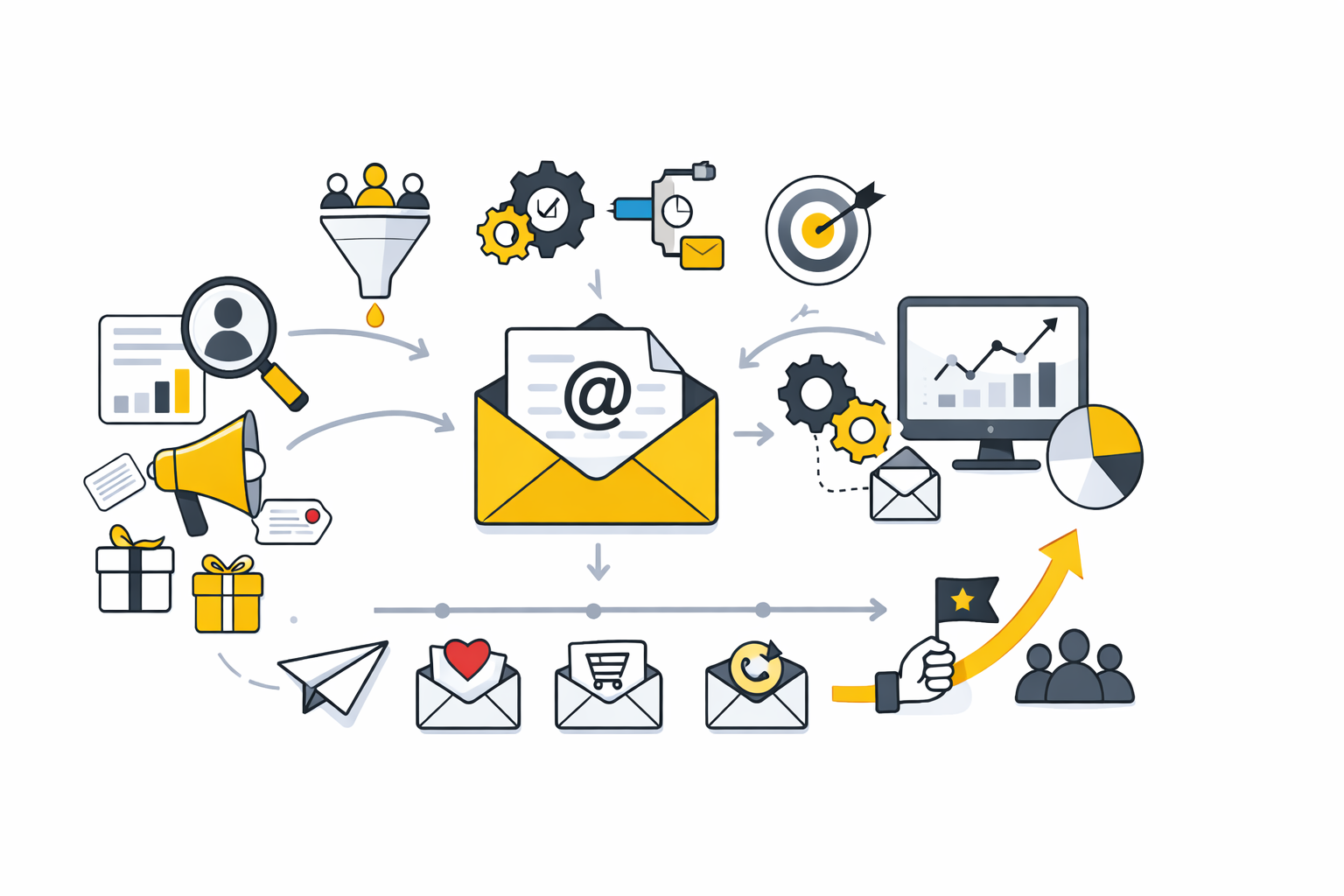
Article Outline
- Why Email Marketing Campaigns Still Matter
- The Modern Email Marketing Campaign Framework
- Audience Research, Offers, and Segmentation
- Copy, Design, and Automation That Move People to Act
- Deliverability, Compliance, and Performance Measurement
- Optimization, Scaling, and Long-Term Campaign Growth
Why Email Marketing Campaigns Still Matter
Email keeps outperforming newer channels because it sits at the intersection of reach, ownership, and intent. Recent industry research still shows strong returns, with Litmus reporting that many teams see email ROI in the 10:1 to 36:1 range, while long-running market benchmarks continue to position email among the highest-return digital channels (Campaign Monitor overview, Litmus 2025 recap). The exact number will vary by business model, list quality, and attribution model, but the directional signal is clear: email is still one of the most dependable revenue levers in digital marketing.
It also matters because it is one of the few channels where first-party data is built into the operating model. When someone subscribes, clicks, purchases, ignores, or unsubscribes, you are collecting behavior that can be used to improve targeting without depending entirely on third-party tracking. That advantage becomes more valuable as privacy protections expand and inbox providers reward relevance over volume.
There is another reason email marketing campaigns still deserve executive attention: the inbox is getting more professional. The DMA Email Benchmarking Report 2025 found delivery rates rose to 98% in 2024, open rates climbed to 35.9%, and unique click rates rose for the third straight year, which tells you disciplined programs are still earning attention. At the same time, global deliverability is not automatic, with Validity showing inbox placement pressure and regional differences that can materially affect campaign results if you ignore list hygiene and sender reputation (2025 deliverability benchmark, benchmark PDF).
The Modern Email Marketing Campaign Framework
A strong email marketing campaign follows a simple sequence: know the audience, match the offer to real intent, package the message clearly, send it from a trusted infrastructure, and measure what happened using metrics that still mean something. That sounds obvious, but teams often break the chain by overfocusing on design, underinvesting in segmentation, or chasing open rates that have been distorted by privacy changes. A better framework treats every campaign as both a persuasion system and a delivery system.
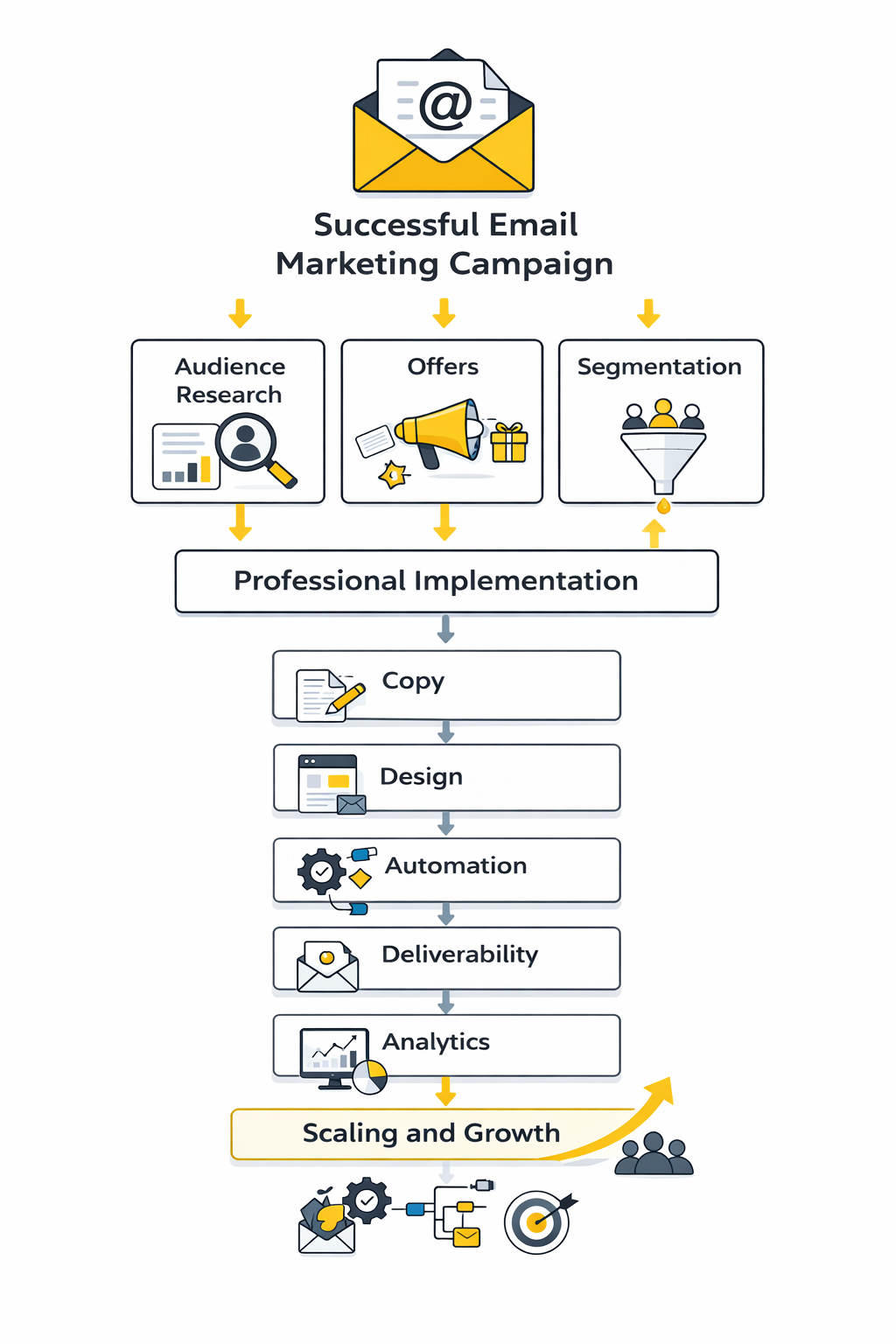
The first half of the framework is strategic. You need a defined audience, a concrete goal, a relevant promise, and a reason to send now instead of later. The second half is operational: authentication, list quality, unsubscribe handling, cadence, testing, and reporting all shape whether the campaign even gets a fair chance to perform. Google’s current requirements for bulk senders, including proper authentication and keeping spam rates under control, make that operational side impossible to treat as an afterthought (Google sender guidelines, Postmaster Tools, Yahoo sender best practices).
This is also why campaign performance should be judged with more nuance than a top-line open rate. Apple’s privacy protections can preload content and blur true open behavior, so clicks, click-to-open rate, conversions, revenue per recipient, unsubscribe trends, complaint rates, and downstream retention matter more than they used to (Apple Mail Privacy Protection, Brevo 2025 benchmarks, Mailchimp benchmarking guidance). In the next part, we will move from the high-level framework into the first real building blocks: audience research, offer selection, and segmentation logic.
Deliverability, Compliance, and Performance Measurement
By the time an email marketing campaign reaches measurement, most of the visible work is already done. The copy has been written, the flow has been built, and the send has happened. What comes next is where disciplined teams separate signal from noise, because email data can look clean while hiding real problems underneath.
This matters more now because inbox metrics are shaped by privacy tools and mailbox-provider rules as much as by creative quality. Google requires all senders to meet core authentication standards and expects bulk senders to keep user-reported spam rates under control, with the formal mitigation threshold sitting at 0.3%, while Yahoo points bulk senders to the same complaint-rate ceiling in its sender best practices (Google sender guidelines, Yahoo sender best practices).
Reading the Numbers That Actually Matter
A good email marketing campaign is not judged by one headline metric. It is judged by whether the numbers tell a coherent story from delivery to engagement to business outcome. That means you need to know which metrics are directional, which are diagnostic, and which ones should actually change your next decision.
Open rate is now a softer signal than many teams want it to be. Apple’s Mail Privacy Protection downloads remote email content in the background, which means opens can be triggered without a human consciously reading the message, so open rate is still useful for trend spotting but much weaker for precise decision-making than it used to be (Apple Mail Privacy Protection, Twilio’s MPP guide).
Click rate is more valuable because it reflects action, not just passive loading. Mailchimp’s benchmarking guidance frames click rate as the percentage of delivered emails that generated at least one click, which makes it a stronger measure of actual interest than open rate alone, and Brevo’s 2025 benchmarks place average click-through rates in the low single digits globally, with region and industry swings that can be significant (Mailchimp benchmarking, Brevo 2025 benchmarks). That does not mean a 3% click rate is always good or bad. It means context matters, and industry peers are more useful than random internet averages.
Click-to-open rate is useful for a different reason. It helps you judge whether the message delivered on the promise made in the subject line, because it asks how many of the people who opened also clicked. When that number is weak, the problem is often not reach but message mismatch, unclear calls to action, or an offer that looked better in the inbox than it did inside the email (Braze on click-to-open, Brevo benchmark help article).
Build an Analytics System, Not Just a Dashboard
Teams get into trouble when they watch metrics without assigning each one a job. Delivery tells you whether the message physically got through. Engagement tells you whether the email was interesting enough to earn attention. Conversion tells you whether the traffic was commercially useful. Revenue tells you whether the campaign created economic value instead of just activity.
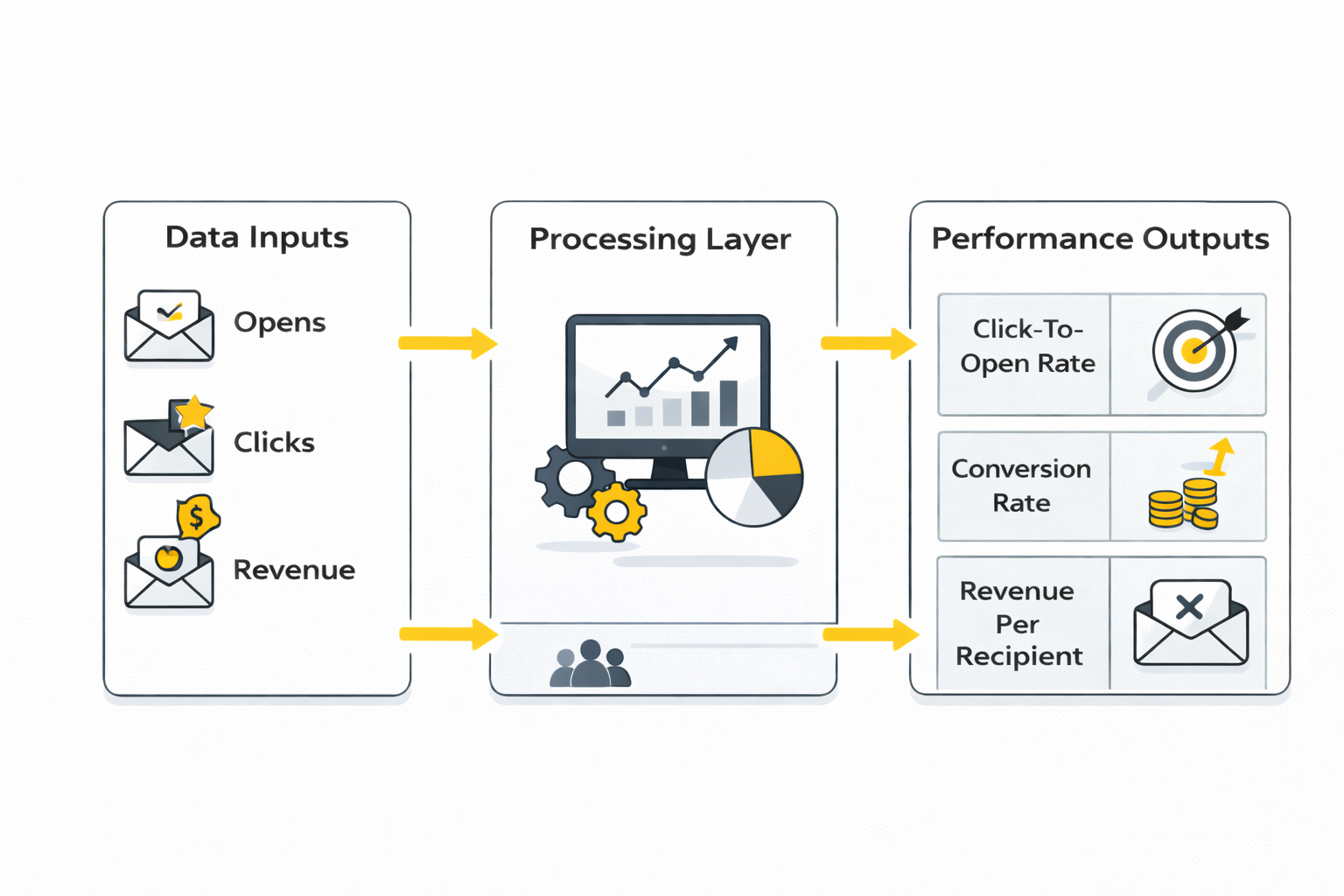
A practical analytics system for an email marketing campaign usually works in four layers:
- delivery metrics such as bounce rate, spam complaints, inbox placement, and authentication status
- engagement metrics such as click rate, click-to-open rate, replies, and downstream site behavior
- conversion metrics such as lead submissions, purchases, bookings, or demo requests
- efficiency metrics such as revenue per recipient, revenue per click, and overall ROI
This structure keeps the diagnosis honest. If open rates look strong but click rate is weak, the inbox promise may be better than the body copy. If clicks look healthy but conversions are poor, the offer or landing page is likely the problem. If conversions are fine but inbox placement is slipping, the campaign may be profitable now while quietly damaging future sends.
Use Benchmarks Carefully
Benchmarks are helpful when they keep you realistic, but they are dangerous when they replace thinking. Brevo’s 2025 report, built from more than 44 billion emails, shows meaningful differences by geography and industry, including stronger open and click performance in some sectors and much weaker commercial engagement in others. That should push you toward segmented expectations, not lazy comparisons.
The same rule applies to deliverability benchmarks. Validity’s 2025 benchmark shows Europe with an inbox placement rate of 89.1%, while Microsoft was materially tougher than Gmail and Yahoo in the same report. That kind of spread matters because a campaign can look “fine” in aggregate while underperforming badly with one mailbox provider that represents a large share of your list (Validity benchmark report). Action should follow the segment that is weak, not the average that makes the dashboard feel comfortable.
Pay Attention to Negative Signals Early
The most important metrics are often the ones teams try hardest to explain away. Unsubscribes, complaint rates, missing-inbox placement, and rising bounce patterns are not side notes. They are early warnings that the campaign is asking too much of the list, reaching the wrong people, or sending from infrastructure that is not being trusted enough.
Brevo’s 2025 benchmark data shows unsubscribes are usually low in percentage terms, but low does not mean irrelevant. A rising unsubscribe rate can tell you that targeting is drifting or that the message cadence is starting to outrun perceived value, while Google and Yahoo’s complaint-rate thresholds make spam complaints even more serious because they can directly affect inbox access for future sends (Brevo benchmarks, Google FAQ, Yahoo sender best practices). The right move is not to defend those signals. It is to investigate them while the damage is still reversible.
Measure Revenue, Not Just Response
A campaign can generate impressive-looking engagement and still be commercially mediocre. That is why revenue per recipient, revenue per click, and total campaign ROI matter so much. Litmus continues to report strong email ROI ranges, often between 10:1 and 36:1, but its research also notes that many marketers still struggle to prove that return clearly, which is exactly why better attribution discipline matters.
The practical lesson is straightforward. If a campaign gets fewer clicks but drives more revenue, it may be better than the one that looked more exciting in the engagement report. If a triggered flow produces modest volume but high revenue per recipient, it may deserve more resources than a large broadcast campaign that mainly creates motion. That is how an email marketing campaign should be evaluated in the real world: not by vanity, but by contribution.
Let the Data Tell You What to Change Next
Metrics are only useful when they trigger a decision. A weak open trend may push you to rethink subject lines, sender-name consistency, or list fatigue. A weak click-to-open rate should send you into body copy, CTA clarity, or offer-message alignment. A weak conversion rate usually points beyond the email itself and into the landing page, form friction, pricing logic, or mismatch between promise and destination.
This is where good tooling earns its keep. Platforms like Brevo make it easier to watch campaign and automation performance in one place, while systems like GoHighLevel become more valuable when your email marketing campaign needs to be read alongside pipeline, lead status, and follow-up outcomes. Measurement gets much better the moment the campaign is connected to business context instead of living in a reporting silo.