

Most articles about email marketing examples make the same mistake. They throw a gallery of nice-looking emails at you, point out a clever subject line, and leave you with inspiration instead of a system. That is useful for about five minutes, and then you are back in your ESP wondering what to send, why it should work, and how to build the sequence around it.
A better way to study email marketing examples is to treat them like evidence. The point is not to copy another brand’s design, discount, or tone. The point is to understand the job each email is doing inside a customer journey, because the best campaigns win through timing, relevance, segmentation, and follow-through more than they win through decoration.
That matters even more now because inbox competition is harder, deliverability standards are stricter, and performance depends on how well your emails match intent. Recent data from Brevo’s 2025 benchmark, which analyzed more than 44 billion emails, found average click-through rates at 3.96% and showed wide performance differences across industries. In plain English, random blasts are not the lesson anymore. Structure is.
This guide is built to help you see the patterns behind strong campaigns, not just the screenshots. We are going to look at what makes certain examples effective, how to classify them by business goal, which components show up again and again, and how to turn what you learn into a professional program that performs in the real world.
How This Guide Is Structured
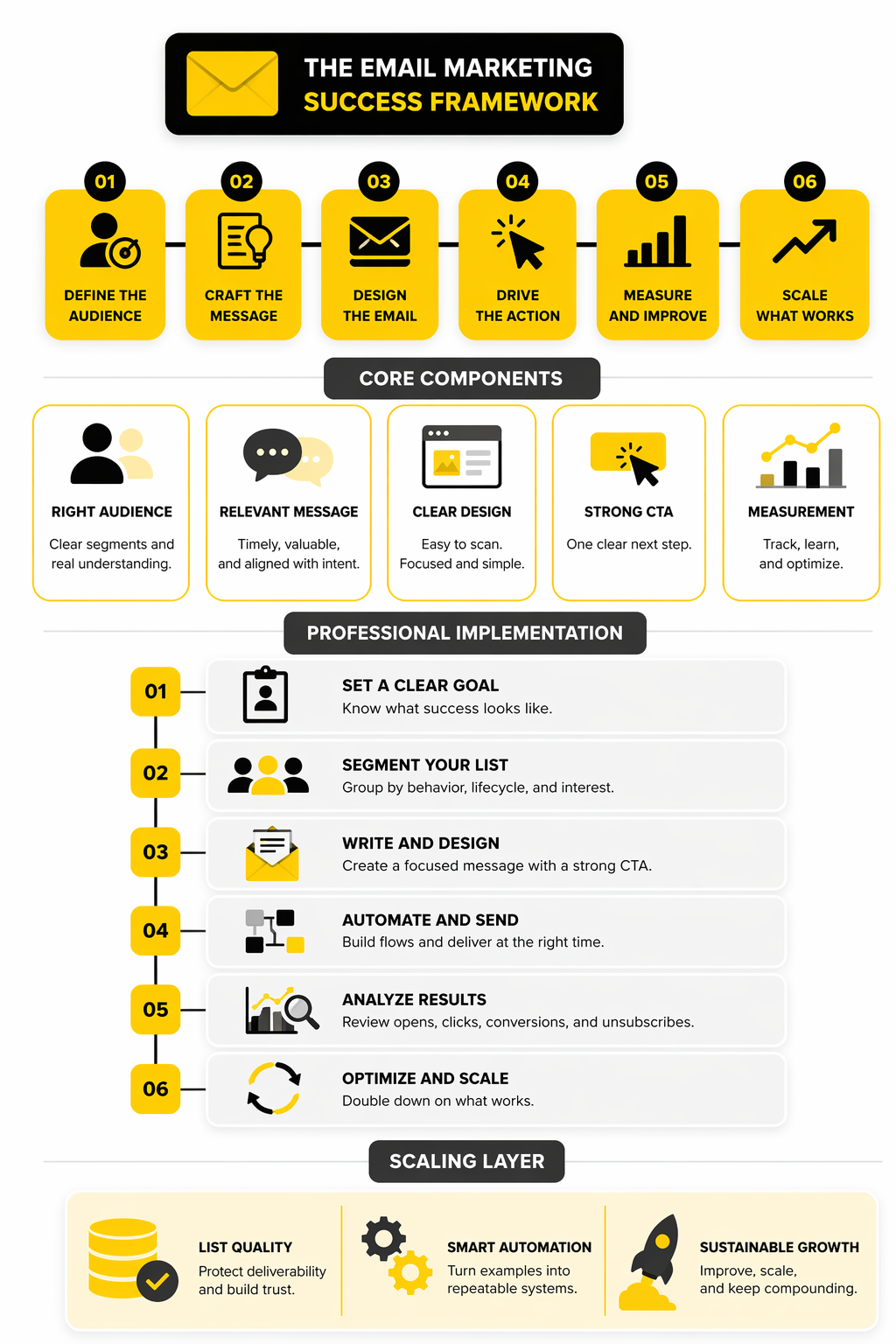
The easiest way to get value from email marketing examples is to stop thinking in terms of “good emails” and start thinking in terms of “good jobs.” Some emails exist to welcome. Some exist to recover abandoned demand. Some exist to educate, launch, retain, re-engage, or upsell. Once you understand that structure, examples stop being random inspiration and start becoming usable models.
That is also why this article is split into six connected parts. Each part builds on the one before it, so by the end you will not just have a swipe file in your head. You will have a framework for judging which examples are worth borrowing from, which ones are irrelevant to your business, and how to implement the right ideas without turning your brand into a knockoff of someone else.
- Part 1: What Makes Email Marketing Examples Worth Studying
- Part 2: Why Email Marketing Examples Still Matter
- Part 3: A Framework for Evaluating Email Marketing Examples
- Part 4: The Core Types of Email Marketing Examples to Learn From
- Part 5: The Core Components Behind High-Performing Email Campaigns
- Part 6: How To Implement These Lessons Professionally
The logic behind that structure is simple. First, you need context so you know what separates a useful example from a distracting one. Then you need a practical framework, because without one, even strong examples can push you toward copying surface-level tactics instead of understanding the strategic reason they worked.
From there, we will break down the major categories that come up again and again in real programs. Welcome emails, abandoned cart emails, product launch emails, newsletters, educational sequences, re-engagement campaigns, and post-purchase flows all look different on the surface, but the strongest ones usually follow the same underlying rules. That is where the real learning is.
We will also spend time on the parts most roundups skip: segmentation, offer structure, CTA clarity, timing, frequency, and the relationship between campaign emails and automated flows. Those details are what separate an email that looks polished from an email that actually moves revenue, retention, or trust. If you are serious about performance, this is the layer that matters.
Finally, the last section will bring everything together into professional implementation. That means turning examples into process, choosing the right tools, documenting your flows, and building a repeatable review system so your team can improve over time instead of reinventing the wheel every week. If you need a platform to build and automate those journeys, tools like Brevo, ManyChat, and GoHighLevel fit naturally into that stage because they help connect messaging, automation, and customer follow-up in one place.
The big takeaway for now is this: the best email marketing examples are not the flashiest ones. They are the ones that make you understand why the email existed, who it was for, what action it was trying to trigger, and what should happen next. Once you start reading examples that way, your own email strategy gets much sharper.
Why Email Marketing Examples Still Matter
Email marketing examples matter more now than they did a few years ago, because the game is less forgiving and a lot more operational. It is not enough to write a decent subject line, drop in a discount, and hit send. The brands getting results are usually the ones that understand how each email fits into a broader system of consent, targeting, timing, deliverability, and follow-up.
That shift is visible in the rules of the inbox itself. Google’s sender guidelines and Google’s bulk sender FAQ make it clear that bulk senders now need proper authentication, easy unsubscribing, and low spam complaint rates, while Yahoo’s sender best practices reinforce the same direction. When the technical floor gets higher, weak email marketing examples become dangerous because they tempt people to copy the visible part of a campaign while missing the invisible part that actually gets messages delivered.
There is also a performance reason to care. Brevo’s 2025 benchmark based on more than 44 billion emails shows that results vary sharply by industry and region, which is exactly why random inspiration is not enough. A good example helps you understand context, because what works for a newsletter publisher, a SaaS company, and an ecommerce brand is often solving three very different problems.
Examples Show You How Strategy Becomes Execution
This is the part most people miss. Strong email marketing examples are not useful because they are polished. They are useful because they show how strategy turns into a real message at a specific moment for a specific segment.
That distinction matters because email is no longer just a campaign channel. Omnisend’s 2025 ecommerce marketing report found that automated emails drove 37% of sales from only 2% of email volume, and Klaviyo’s current benchmark view shows flows generating a disproportionate share of revenue relative to send volume. The lesson is not merely “use automation.” The lesson is that the best examples usually reveal a trigger, a segment, an intent, and a next step, which is why they are worth studying in detail.
Once you start looking at examples this way, you stop asking shallow questions like whether the header looked modern or whether the brand used enough emojis. You start asking better questions. Why was this email sent now, why did this audience receive this version, and what behavior was the brand trying to create after the click?
The Best Examples Help You Avoid Expensive Guesswork
There is a very practical reason marketers keep searching for email marketing examples: sending the wrong thing is expensive. A weak message wastes attention, but a weak pattern is worse because it gets repeated across launches, nurture sequences, promotions, and lifecycle flows. Studying real examples shortens that learning curve.
It also helps you separate durable principles from temporary tactics. Subject line tricks come and go, design styles change, and every platform promises some new shortcut, but the fundamentals stay stubbornly consistent: relevance beats volume, clarity beats cleverness, and timing beats brute force. That is why the right examples are so valuable. They give you a chance to see those principles working in the wild before you spend time and budget building your own version.
There is another upside here. Examples make it easier to coach a team, brief a freelancer, or align stakeholders who all have different ideas about what “good email” means. Instead of arguing in abstractions, you can point to a real campaign and say, this is the kind of welcome sequence we mean, this is the level of CTA clarity we want, and this is how the handoff from email to landing page should feel.
Why This Matters Even More in an Omnichannel Setup
Email does not operate alone anymore, even when it remains the center of the relationship. Brevo’s 2025 benchmark report points to broader use of channels like SMS, WhatsApp, push, and mobile wallet messaging, and that changes what a good email example looks like. A strong email may no longer need to do every job on its own if another channel handles the reminder, the support touchpoint, or the urgency layer.
That is why modern examples are most useful when they are read as part of a sequence instead of as isolated creative. A welcome email may work because it sets up later SMS reminders. A post-purchase email may succeed because it reduces support friction before a customer ever opens a chat. A re-engagement email may land because the brand has been disciplined enough not to overmessage in the first place.
If you are building that kind of connected system, tools like Brevo, ManyChat, and GoHighLevel become more relevant because the real challenge is no longer just sending emails. It is coordinating journeys across channels without losing message quality, timing, or customer context.
What You Should Be Looking For When You Study Examples
The smartest way to study email marketing examples is to look for the underlying decision, not the surface polish. You want to notice the audience definition, the trigger, the promise, the proof, the CTA, and the role the email plays in the broader sequence. Once you can see those pieces clearly, examples stop being entertainment and start becoming operating knowledge.
That is exactly where this article goes next. Before we get into specific categories like welcome emails, abandoned cart emails, newsletters, and re-engagement campaigns, we need a clean framework for evaluating them. Without that framework, even good examples can still teach the wrong lesson.
A Framework for Evaluating Email Marketing Examples
Now that the case for studying email marketing examples is clear, the next step is learning how to judge them properly. This is where most marketers go off track, because they evaluate emails as creative pieces instead of business tools. A beautiful email can still be a weak example if it reaches the wrong segment, arrives at the wrong time, or pushes the wrong action.
A useful framework fixes that. It gives you a repeatable way to look at any campaign, any automation, and any lifecycle email and ask the same hard questions every time. That matters because email performance today is tied to far more than copy and design alone; it sits inside a system shaped by deliverability requirements, lifecycle thinking, and disciplined testing.
The goal of this section is simple: stop collecting random inspiration and start building a review process. Once you have that, email marketing examples become genuinely useful because you can tell whether an email deserves to be adapted, ignored, or rebuilt from scratch for your own audience.
Start With the Job the Email Is Supposed To Do
Every email has a job, and that job comes before the layout. Some emails exist to convert first-time interest. Others exist to recover an interrupted purchase, deepen product adoption, or pull inactive subscribers back into the funnel. If you cannot clearly define the job, you cannot evaluate whether the example is any good.
This sounds obvious, but it is where a lot of weak analysis starts. People see a sharp-looking launch email and call it effective without asking whether it was meant to create urgency, educate a warm segment, or move existing customers toward an upgrade. Those are different jobs, and they should be judged with different standards.
That is also why the strongest email marketing examples usually make more sense when you see the moment they belong to. Lifecycle teams do not think in isolated sends. They think in stages, triggers, and progression across the customer journey.
Judge Relevance Before You Judge Creativity
Relevance is the first filter, not a nice extra. An email can have strong copy, smart design, and a polished CTA, but if it lands with the wrong person, it becomes noise. That is a bigger issue now because inbox providers are paying close attention to sender behavior, complaint rates, and the overall quality of mail people receive.
This is why good examples usually reveal some kind of segmentation logic, even if it is not visible at first glance. Maybe the email is tailored to new subscribers, to people who viewed a product but did not buy, or to customers approaching a renewal date. The smarter the segmentation, the more likely the example is teaching you something durable rather than just showing you a lucky creative win.
It also explains why studying examples from the wrong kind of business can waste your time. An ecommerce abandoned cart email, a B2B demo nurture email, and a media newsletter may all be “good,” but they are solving different relevance problems. You want examples that match your customer journey closely enough to teach a transferable lesson.
Look for the Trigger, Not Just the Message
One of the best ways to evaluate email marketing examples is to ask what triggered the email. Was it a signup, a browse action, a cart event, a purchase, a usage milestone, a period of inactivity, or a manual campaign decision? The answer tells you whether the email belongs to a scalable system or whether it was just a one-off send.
That distinction matters because triggered workflows consistently outperform broad manual sending in many environments. Recent benchmark material keeps pointing in the same direction: when email is tied to behavior and lifecycle context, it carries much more weight than untargeted volume.
So when you study an example, do not just ask whether the message is persuasive. Ask what event caused it, whether that event signals buying intent or customer need, and whether the email is early enough to help but late enough to feel relevant. That is where examples become strategically useful.
The Review Process You Can Actually Use
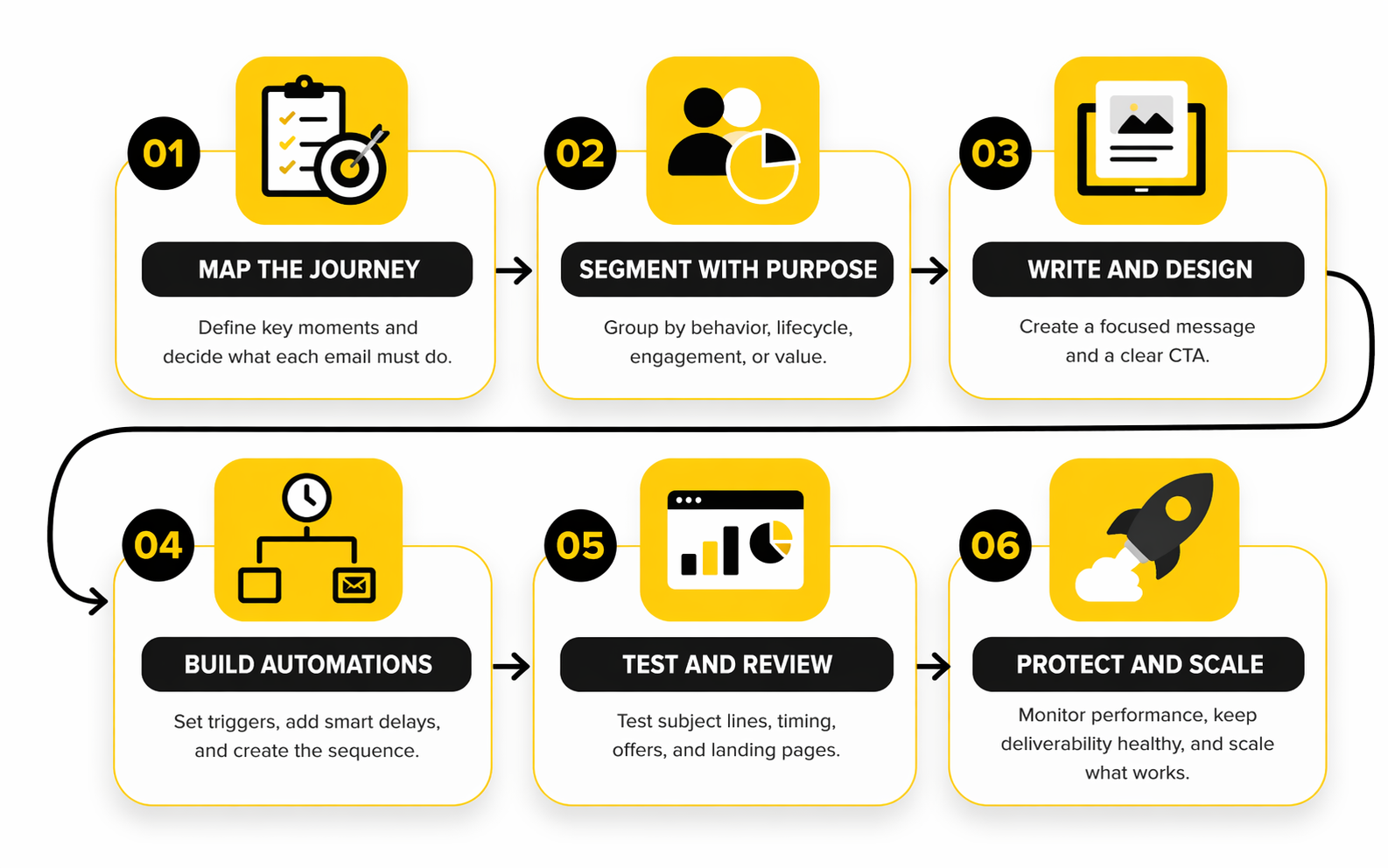
The easiest way to make this framework practical is to turn it into a process. You should be able to take any email marketing example and run it through the same sequence every time. That keeps you from getting distracted by surface polish and helps you build a team-wide standard for what counts as worth copying.
This process is especially useful if you are reviewing competitor emails, building a swipe file, auditing your own flows, or briefing a freelancer. It gives you a structured way to move from observation to implementation without making lazy assumptions.
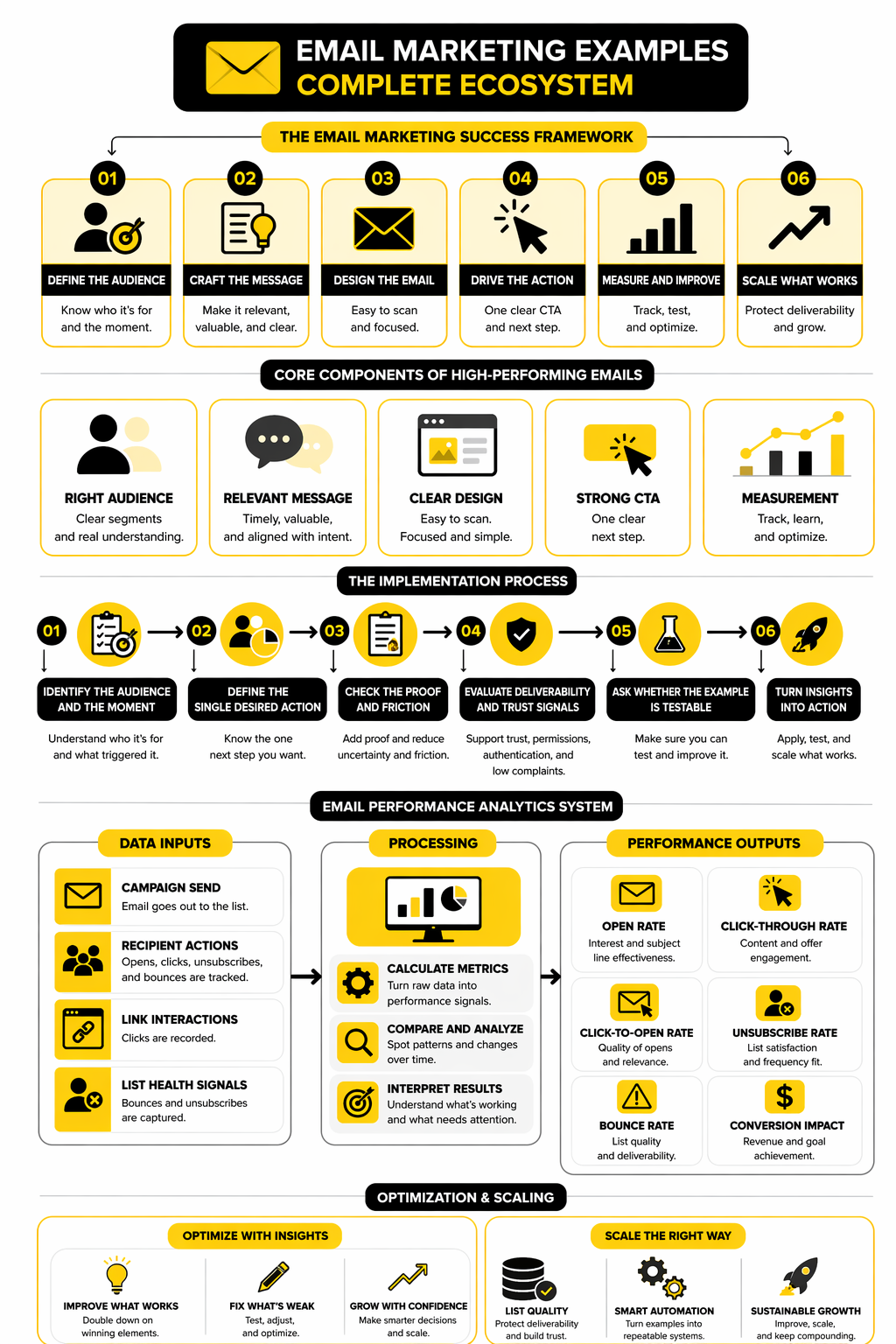
Step 1: Identify the Audience and the Moment
Start by asking who the email is for and what moment it belongs to. If the answer is vague, the example is already weaker than it looks. Strong emails tend to be tied to a clearly defined audience state, even when the copy feels broadly written.
This one step will immediately improve how you read email marketing examples. Instead of saying, this is a good promo email, you begin saying, this is a second-touch cart recovery email for warm shoppers with demonstrated purchase intent. That level of clarity changes everything because it tells you what to borrow and what to leave behind.
It also forces you to respect context. A message that works brilliantly for a subscriber three hours after a cart event may fail completely as a general broadcast. That is not a creative failure. It is a context mismatch.
Step 2: Define the Single Desired Action
The next question is what the sender wants the reader to do next. Not in theory. In reality. Click to product, book a demo, activate an account, read a guide, complete checkout, update preferences, or come back after inactivity.
Good examples are usually aggressive about clarity here. They may include secondary links, but the main action is obvious and the copy, structure, and CTA all support it. Weak examples often collapse because they try to do too much at once, which is one of the fastest ways to dilute performance.
This is where your evaluation gets more honest. If an email has three competing offers, six navigation exits, and a CTA that sounds polished but vague, it may still look premium while being strategically messy. A good example gives the reader one clear next move and makes that move feel natural.
Step 3: Check the Proof and Friction
Once the desired action is clear, look at what helps or blocks that action. Does the email include enough proof to make the click feel justified? Does it reduce uncertainty with social proof, product detail, education, urgency, reassurance, or support context?
This is one reason why the best email marketing examples often feel simpler than average ones. They are not trying to impress the reader with more elements. They are removing friction between interest and action. That could mean a sharper benefit statement, fewer visual distractions, or a CTA that matches the reader’s stage of awareness.
This step is also where landing-page alignment matters. If the promise inside the email and the destination after the click do not match, the example is weaker than it first appears. That handoff is part of the email’s job, not a separate issue.
Step 4: Evaluate Deliverability and Trust Signals
A lot of marketers still review emails as though inbox placement is guaranteed. It is not. Google’s sender requirements and FAQ make it clear that authentication, easy unsubscribing, and low complaint rates are not optional details for serious senders, and Gmail Postmaster Tools exists specifically so senders can monitor reputation and diagnose problems.
That means a professionally built example should be judged partly on whether it appears to support trust rather than strain it. Is the cadence likely to annoy people? Does the targeting feel relevant enough to avoid complaint spikes? Is the message consistent with what the subscriber signed up for?
This is not the glamorous part of email review, but it is one of the most important. The best example in the world is useless if your version of it hurts sender reputation or trains people to ignore you. Great email strategy is persuasive, but it is also respectful.
Step 5: Ask Whether the Example Is Testable
The final step is whether the idea can be tested cleanly. If you cannot isolate the variable that made the example interesting, you are not really learning from it. You are just admiring it.
Good email programs improve because they test one meaningful variable at a time, whether that is subject line, send time, CTA phrasing, content structure, or offer framing. Mailchimp’s A/B testing guidance reflects that same principle: cleaner tests create clearer conclusions, which is what allows a team to improve rather than just produce more activity.
This matters because the point of studying email marketing examples is not to reproduce someone else’s outcome. It is to generate a better next experiment inside your own business. If the example cannot lead to a disciplined test, it may still be interesting, but it is not especially useful.
Turning the Framework Into a Working Process
Once you have this framework, the implementation side becomes much more practical. You can build a simple review sheet for every email example you save and score it on audience fit, trigger strength, CTA clarity, friction reduction, trust factors, and testability. That one habit instantly makes your swipe file more valuable because it becomes a decision tool instead of a pile of screenshots.
This is also the point where tooling starts to matter. If you want to operationalize what you learn from email marketing examples, you need a platform that lets you build segments, automate triggers, and measure response without creating chaos. Tools like Brevo, ManyChat, and GoHighLevel make sense here because they help turn examples into workflows instead of leaving them as isolated ideas.
The real win is consistency. Once your team reviews every example through the same process, your standards improve fast. You stop chasing clever emails and start building reliable systems, which is exactly where this article needs to go next when we move from evaluation into the specific types of examples worth learning from.
What the Numbers Behind Email Marketing Examples Actually Tell You
Once you start studying email marketing examples seriously, measurement becomes impossible to ignore. At that point, the question is no longer whether an email looks good or sounds persuasive. The real question is whether it moved the metric that mattered for that specific moment in the journey, and whether that metric was interpreted correctly.
This is where a lot of teams get sloppy. They collect screenshots, compare subject lines, and talk about design trends, but they never connect those observations to performance signals that actually drive decisions. Good examples get much more useful when you can tie them to benchmarks, understand what those benchmarks hide, and know what action each number should trigger.
That also means you cannot treat all email metrics as equal. Some numbers are directional, some are diagnostic, and some are decisive. If you do not know the difference, email marketing examples can push you toward the wrong conclusions very quickly.
Benchmarks Are Useful, but Only if You Use Them Properly
Benchmarks are meant to give you context, not comfort. Brevo’s 2025 benchmark, based on more than 44 billion emails, shows overall rates around 31.22% for opens, 3.64% for click-through, 0.4% for unsubscribes, and 0.19% for hard bounces, but the same report shows major swings by industry and region. That is the important part. A benchmark is only helpful when it stops you from judging a B2B nurture email by ecommerce standards or a retention flow by newsletter logic.
This is why smart teams use benchmarks as a starting line, not a scorecard. If your click rate is below a general average, that does not automatically mean the email is weak. It may mean the segment was colder, the action was bigger, the send was broader, or the campaign had a different job than the benchmark you are comparing it against.
The practical move here is simple. Use benchmarks to spot unusual performance, then diagnose the reason before changing the campaign. That keeps you from making dumb optimizations based on shallow comparisons.
Open Rates Still Matter, but They Cannot Carry the Analysis
Open rates are still worth watching, but they should no longer dominate your thinking. Brevo explicitly notes that its figures account for Apple Mail Privacy Protection, which matters because opens became a noisier signal once mailbox providers started obscuring parts of user behavior. That does not make opens useless. It makes them incomplete.
In practical terms, open rate is best treated as an early signal about subject line strength, brand recognition, list quality, and sometimes send timing. It can tell you whether people noticed the email. It cannot reliably tell you whether the email created business value. That is a much higher bar.
So when you review email marketing examples, use opens to ask better questions, not to declare victory. A strong open rate with weak clicks often points to a promise mismatch. The subject line got attention, but the body did not cash the check.
Click Rate Tells You More About Real Intent
If you want a better read on whether an example is actually doing its job, click rate usually tells you more than open rate. It gets closer to active intent because the subscriber had to do something, not just register as opened. That is why click-through and click-to-open rates are often much more useful when you are comparing creative structure, CTA clarity, and offer strength.
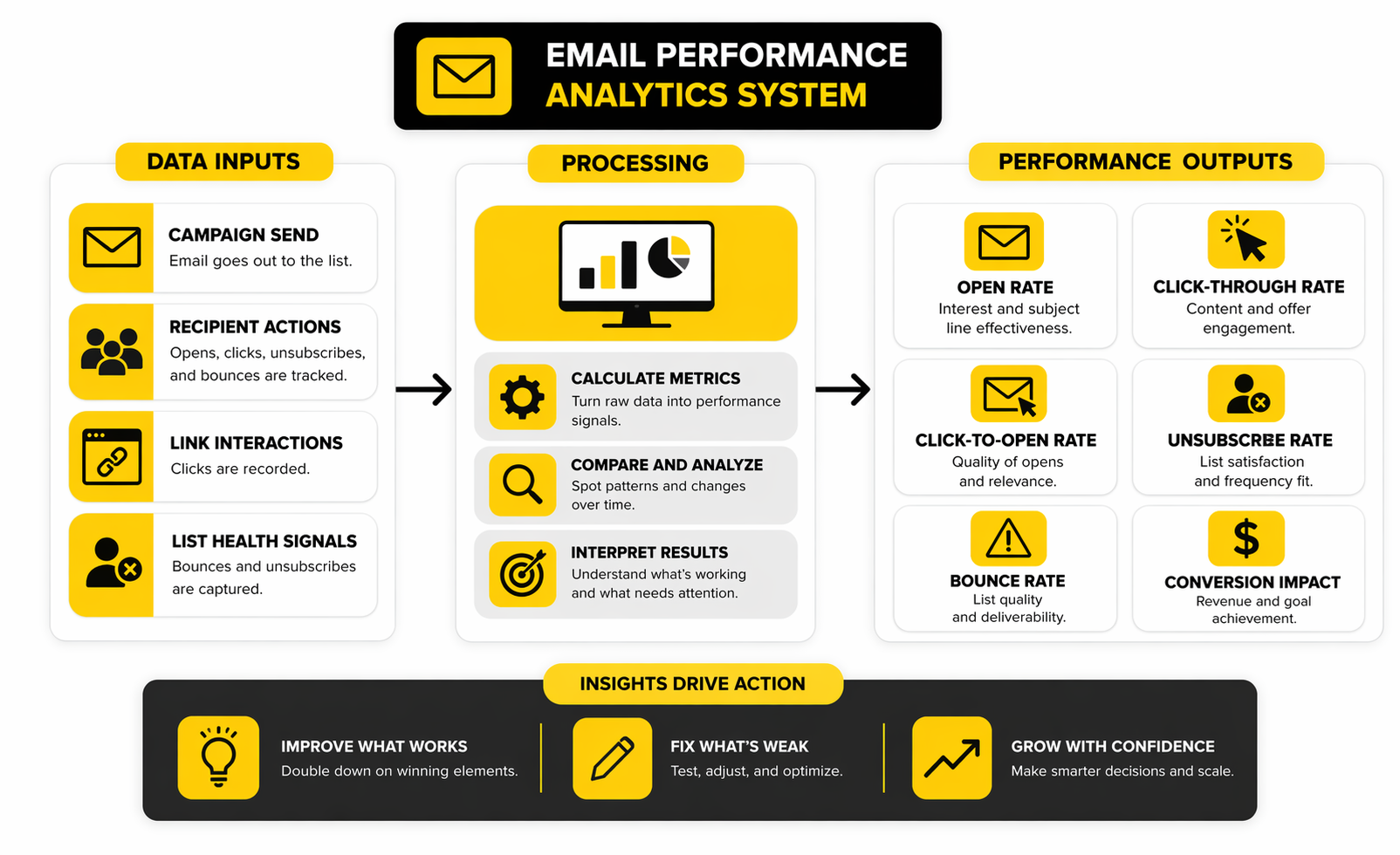
Brevo’s benchmark helps here because it separates click-through rate from click-to-open rate. That distinction matters. Click-through rate tells you how many delivered emails generated a click, while click-to-open rate helps you judge how well the body converted attention after the email was opened. These are different problems, and the fixes are different too.
That means the right action depends on which number is weak. If opens are healthy but clicks are poor, you should review message hierarchy, CTA placement, offer relevance, and landing-page alignment. If both opens and clicks are weak, the problem may start much earlier with targeting, timing, or list quality.
The Metrics That Actually Drive Better Decisions
At this point, measurement needs to become a system rather than a dashboard. You are not just watching numbers. You are using them to decide whether an email marketing example teaches you something worth repeating, something worth testing, or something worth rejecting.
That shift is what turns analytics from reporting into strategy. Once you know which metrics diagnose which problems, you stop reacting emotionally to every send and start making cleaner decisions.
Conversion Rate Changes the Entire Conversation
The moment you bring conversion into the discussion, a lot of vanity falls away. Clicks matter, but clicks without downstream action can flatter a weak campaign. Conversion tells you whether the email created meaningful movement after the click, which is why it should sit close to the center of your analysis whenever tracking allows it.
This is also where automated examples become much more interesting. Omnisend’s 2025 ecommerce report found that automated emails drove 37% of sales from just 2% of email volume, and that one in three people who clicked an automated message made a purchase, compared with roughly one in 18 for scheduled messages. Those numbers matter because they do not just celebrate automation. They show that context-rich emails tied to behavior often outperform broader campaigns by a wide margin.
The action this should drive is obvious. If you are studying email marketing examples and spending most of your time on generic promotional sends, you are probably looking in the wrong place. The examples with the highest practical value are often the ones attached to strong triggers like welcome, browse abandonment, cart recovery, and post-purchase sequences.
Unsubscribes and Spam Complaints Are Not Side Metrics
A lot of marketers still treat unsubscribes and complaints as background noise. That is a mistake. These are trust signals, and they tell you whether your email strategy is creating pressure faster than it is creating value.
Google’s sender guidance is extremely clear here: bulk senders should keep spam rates in Postmaster Tools below 0.10% and avoid reaching 0.30% or higher. That is not a technical footnote. It means relevance, frequency, consent quality, and list hygiene are directly connected to inbox performance. If people dislike what you send, the mailbox provider eventually starts agreeing with them.
This changes how you should interpret email marketing examples. A campaign that looks aggressive, flashy, or relentlessly urgent may seem impressive on the surface, but if that style causes complaint pressure in your audience, it is not a good example for your business. Strong performance is not just about extracting clicks. It is about doing it in a way the inbox will keep rewarding.
Bounce Rates and Deliverability Tell You Whether the Foundation Is Healthy
Bounce rate is one of those metrics that people only notice when something is already wrong. That is unfortunate, because it often gives you an early warning about list decay, acquisition quality, or operational sloppiness. Brevo’s benchmark includes both soft and hard bounce rates for a reason. They do not measure creative quality, but they absolutely affect campaign performance and sender health.
This matters when you evaluate examples because list quality changes everything. A mediocre email sent to a well-maintained, high-intent list can outperform a better email sent to a decaying one. If you miss that, you start copying creative tactics when the real issue lives in acquisition, hygiene, or permissions.
The right action here is less glamorous but more important. Clean your list, tighten signup quality, authenticate properly, and review engagement decay before you start blaming the copy. Sometimes the example is fine. The system around it is what is broken.
Measurement Only Helps if It Leads to the Right Next Move
This is the part that separates mature email teams from busy ones. Mature teams do not just report numbers after a send. They connect each number to a likely cause and an obvious next action.
A clean way to think about it looks like this:
- High opens, weak clicks usually point to a body-copy, offer, or CTA problem
- Weak opens, decent clicks often point to a subject line, sender-name, or timing problem
- Strong clicks, weak conversions usually point to landing-page friction or offer mismatch
- Rising unsubscribes or complaints usually point to poor targeting, too much frequency, or broken expectations
- High bounce rates usually point to list hygiene or acquisition quality issues
That interpretation layer is what makes email marketing examples genuinely useful. Without it, you just collect data. With it, every example becomes a lesson in diagnosis.
The Best Analytics Setup Is Simpler Than Most Teams Think
You do not need a bloated reporting stack to get smarter about email. What you need is a consistent way to connect campaign type, audience segment, trigger, CTA, and outcome. Once those five things are visible, most of the important patterns start surfacing quickly.
This is where platforms and process meet. If your tooling makes it hard to segment, attribute, and compare flow performance against campaign performance, you will struggle to learn from your own sends. That is one reason systems like Brevo, ManyChat, and GoHighLevel come up so often in serious implementation conversations. The point is not the logo. The point is having enough visibility to turn performance signals into decisions.
And that is really the heart of this section. Statistics by themselves do not improve anything. What improves performance is knowing which numbers matter for which kind of email, what those numbers are trying to tell you, and what you should do next because of them. That is exactly what we need before moving into the real building blocks behind high-performing email marketing examples.
The Core Components Behind High-Performing Email Campaigns
By this point, the pattern should be obvious. Great email marketing examples are rarely great because of one clever line or one well-designed template. They work because several core components line up at the same time: the audience is right, the message fits the moment, the CTA is clear, the measurement is honest, and the sending strategy does not damage trust. (turn186690search2, turn186690search14)
That is also why copying isolated tactics usually disappoints. You can borrow a structure, an angle, or a sequence idea from strong email marketing examples, but once you scale a program, the real challenge becomes managing tradeoffs. The more volume you send, the more segmentation matters. The more personalized you get, the more data quality matters. The more automation you build, the more system complexity starts pushing back. (turn186690search5, turn186690search15)
Segmentation Gets More Valuable as You Grow
Small email programs can survive with broad messaging for a while. Large ones cannot. Once your audience includes different intent levels, different product interests, different lifecycle stages, and different levels of trust, generic campaigns start underperforming because they are forced to speak too vaguely to too many people at once. (turn186690search7, turn186690search13)
This is one reason advanced teams study email marketing examples differently from beginners. They are not just looking for a good promotional email. They are looking for evidence that the email was built for a specific slice of the audience with a specific kind of intent. That is what makes the lesson transferable at scale.
The catch is that segmentation creates overhead. Every new segment can improve relevance, but it also adds complexity in copy, QA, reporting, and maintenance. So the smart move is not to segment endlessly. It is to segment where the business impact is real, such as lifecycle stage, purchase behavior, engagement level, geography, or product category.
Personalization Has Upside, but Most Teams Underestimate the Operational Cost
Personalization is one of those ideas that sounds easy until you have to run it consistently. Litmus reported that 95% of email marketers it surveyed were doing some kind of personalization, yet only 3% were adding dynamic elements into campaigns. That gap matters because it shows how often the industry talks about personalization at a high level while struggling to execute deeper personalization in practice. (turn186690search15)
That does not mean personalization is overrated. It means the bar is higher than a first-name token in the subject line. The best email marketing examples use personalization to change the relevance of the message, not just the cosmetics of it. They adjust what is shown, what is emphasized, and what next step makes sense for that person.
There is also a risk here that experienced operators take seriously. Bad personalization is often worse than no personalization, because it exposes broken data, mismatched timing, or assumptions the customer never agreed with. When that happens, you do not just lose the conversion. You weaken trust.
Frequency Is a Growth Lever Until It Becomes a Reputation Problem
One of the hardest tradeoffs in email is frequency. Send too little and you leave revenue, engagement, and retention on the table. Send too much and you invite unsubscribes, complaints, and inbox fatigue. The painful part is that both mistakes can look tempting in the short term, which is why weak teams often bounce between them. (turn186690search2, turn186690search14)
This is where good email marketing examples can be misleading if you read them without context. A brand that sends often may be doing so successfully because it has strong segmentation, high list intent, and disciplined preference management. Another brand copying that cadence without the same foundation can hurt performance fast.
Google’s sender guidance makes the downside very concrete by telling bulk senders to keep spam rates in Postmaster Tools below 0.10% and avoid reaching 0.30% or higher. That means frequency is not just a content decision. It is a deliverability decision. (turn186690search2)
Automation Scales Results, but It Also Scales Mistakes
Automation is where email programs start compounding. It is also where bad assumptions start compounding. Omnisend’s 2025 report showed automated emails driving 37% of sales from just 2% of email volume, which is one reason behavior-based flows get so much attention from serious operators. (omnisend.com)
But the hidden lesson is not simply “build more automations.” The real lesson is that a good automated flow is usually doing several things well at once: the trigger is meaningful, the delay is thoughtful, the segmentation is sensible, and the handoff between emails feels intentional. Once one of those pieces breaks, the flow can keep sending bad logic at scale.
That is why advanced teams audit automations constantly. They check whether flows are colliding with campaigns, whether subscribers are entering sequences they should have exited, and whether old assumptions are still valid after pricing, product, or customer behavior changes. Automation is powerful, but it does not stay smart on its own.
AI Can Speed Up Production, but It Cannot Replace Judgment
AI is becoming part of the email workflow whether teams like it or not. Litmus wrote in early 2026 that 70% of email marketers it surveyed for the 2025 State of Email Report expected up to half of their email marketing operations to be AI-driven by the end of 2026. That is a meaningful signal, especially for teams dealing with higher content volume and tighter production cycles. (turn186690search12)
The opportunity is real. AI can help with draft generation, testing ideas, content variation, subject line exploration, and workflow speed. For a growing team, that can remove a lot of friction. For a sloppy team, it can just help them produce mediocre email faster.
This is where expert judgment still matters a lot. The strongest email marketing examples usually reflect a sharp understanding of audience psychology, offer framing, and business context. AI can assist with those tasks, but it still cannot reliably own them without strong human supervision.
Design Matters Less Than Most People Think, Until It Suddenly Matters a Lot
One of the most useful mindset shifts here is understanding the role design really plays. Design does matter, but mostly as a support system for comprehension, trust, and action. A clean design can make a message easier to scan, a CTA easier to spot, and a brand feel more credible. That is valuable. It is just not the whole game. (turn186690search1, turn186690search9)
Where design becomes critical is when complexity rises. The more products you sell, the more offers you manage, and the more modular your campaigns become, the more important layout discipline gets. At that point, weak design stops being a branding issue and starts becoming a conversion issue because it creates cognitive friction.
That is why the best email marketing examples often look simpler than expected. They are not trying to show off every possible feature or visual trick. They are trying to guide attention cleanly. That is a different design philosophy, and it usually performs better.
Scaling Fails When the Landing Page and CRM Do Not Keep Up
A surprising number of email programs hit a wall not because the emails are weak, but because the rest of the system cannot carry the load. The landing page is disconnected from the email promise. The CRM data is stale. The attribution is unclear. The follow-up after a click or reply is delayed. When that happens, performance stalls even though the email itself may be decent. (turn186690search13, turn186690search14)
This is one reason advanced operators think about orchestration, not just campaigns. They care about how email, pages, CRM, forms, and sales or support workflows interact. If the pieces do not connect, the value of even very good email marketing examples starts leaking away after the click.
That is also where tool choice becomes more strategic. A platform like Brevo, ManyChat, or GoHighLevel can make a real difference when the goal is not just to send emails, but to manage the logic around them. The right stack will not fix weak strategy, but it can make strong strategy much easier to execute consistently.
The Real Expert Move Is Knowing What Not To Copy
This is probably the most important advanced lesson in the whole article. Mature marketers do not study email marketing examples to find things to imitate blindly. They study them to understand what should be adapted, what should be simplified, and what should be ignored.
That requires restraint. Some examples are built for bigger lists, stronger brands, higher intent audiences, or very specific business models. Copying them too literally can create more problems than value. The expert move is recognizing the principle beneath the example and translating it into something your own audience will actually respond to.
And that sets up the close nicely. Once you understand the tradeoffs, the risks, and the scaling issues behind high-performing email campaigns, implementation becomes much less mysterious. The final part is where we turn all of this into a practical operating model and answer the most common questions people still have when trying to apply what they have learned.
How To Implement These Lessons Professionally
The final step is turning what you learned from email marketing examples into an operating system. This is where most teams either level up or stay stuck. They keep collecting ideas, keep talking about strategy, and keep saving screenshots, but they never build the process that turns those ideas into repeatable performance.
A professional implementation model is much less glamorous than inspiration, but it is far more valuable. It gives you a way to decide what to build first, what to test next, what to ignore, and how to keep your program healthy as it grows. That matters because once volume rises, weak process starts showing up as missed revenue, poor deliverability, inconsistent messaging, and wasted time. Google’s bulk sender FAQ makes the stakes clear by defining bulk sending at around 5,000 messages to personal Gmail accounts in 24 hours and tying that level of sending to stricter operational expectations.
The easiest way to think about implementation is this: stop asking how to copy a great email and start asking how to build a system that can consistently produce the right email for the right person at the right time. That shift changes everything. It moves you from creative admiration into professional execution.
Build Around Journeys, Not Random Campaigns
The strongest email marketing examples almost always make more sense when seen inside a journey. A welcome email is stronger when you know what follows it. A post-purchase email becomes more useful when you understand whether it leads into review requests, usage education, referral asks, or replenishment reminders.
That is why professional teams map customer stages first and individual emails second. They define the key moments in the journey, assign the job each email should do, and then decide where campaigns, automations, and cross-channel support fit best. Omnisend’s 2025 ecommerce report reinforces why this matters by showing automated emails driving 37% of sales from just 2% of email volume, which is exactly what you would expect from behavior-based journeys that match intent.
This is also where channel coordination starts to matter. If your email program is meant to work alongside SMS, chat, or CRM follow-up, you need a system that can support those handoffs cleanly. Platforms like Brevo, ManyChat, and GoHighLevel become useful here because they help you turn strong examples into connected workflows rather than disconnected sends.
Create a Review and Testing Rhythm
Implementation gets much easier when every email passes through the same review questions. Who is this for, what triggered it, what action should it drive, what proof reduces friction, and how will success be measured? Once that becomes routine, your team starts making better decisions faster because the standard is shared.
Testing should sit inside that same rhythm. The point is not to test for the sake of looking sophisticated. The point is to test the variables most likely to change business outcomes, such as subject line framing, CTA clarity, delay timing, offer structure, or landing-page alignment. Brevo’s benchmark definitions are useful here because they separate metrics like open rate, click-through rate, click-to-open rate, unsubscribe rate, and bounce rate, which helps you connect the right test to the right problem.
A good operating rhythm also protects you from overreacting. One send does not define a strategy, and one weak result does not automatically mean the email was a mistake. A disciplined review cycle helps you see patterns over time instead of making emotional decisions after every campaign.
Protect the Foundation While You Scale
A lot of email programs break while growing because the team adds more volume before it strengthens the basics. Deliverability, list quality, permissions, segmentation logic, and data hygiene all matter more as the program expands. If those pieces are weak, scaling only magnifies the problem.
This is not optional anymore. Google’s sender guidelines require authentication, easy unsubscription, and attention to spam rates, while Yahoo’s sender best practices push in the same direction. When you look at email marketing examples through a professional lens, this becomes one of the most important lessons of all: good performance is never just creative. It is operational.
That is why mature teams treat deliverability as part of strategy, not just a technical cleanup task. They watch complaints, bounces, segment health, and engagement decay with the same seriousness they give to copy and design.
FAQ
What makes email marketing examples actually useful?
Useful email marketing examples show more than a nice layout or a catchy subject line. They reveal the job the email is doing, the audience it is meant for, and the action it is designed to create. If an example cannot teach you something about timing, relevance, structure, or sequence logic, it may be interesting, but it is not especially valuable.
Should I copy successful email marketing examples directly?
No, and this is where a lot of marketers get burned. Strong examples are best used as models for thinking, not templates for blind imitation, because the original may have worked for a different audience, a different offer, and a very different level of brand trust. The better move is to extract the principle, adapt it to your own customer journey, and then test it with your own list.
Which types of email marketing examples should I study first?
Start with examples tied to clear business moments. Welcome emails, abandoned cart emails, browse abandonment emails, post-purchase emails, and re-engagement flows usually teach more than random promotional blasts because their job is easier to define and measure. Omnisend’s 2025 report gives this idea real weight by showing automated emails producing a disproportionate share of email-driven sales.
Are open rates still worth paying attention to?
Yes, but they should no longer dominate your analysis. Open rates can still tell you something about sender recognition, subject line strength, and timing, but they became a less reliable proxy for true engagement after privacy changes affected measurement. Brevo’s 2025 benchmark page explicitly notes that its figures account for Apple Mail Privacy Protection, which is exactly why opens should be treated as a signal, not a final verdict.
What metrics matter most when evaluating an email example?
The answer depends on the job of the email. For some emails, click-through rate or click-to-open rate will tell you the most, while for others the more important question is whether the click converted into a purchase, a demo request, or a product activation. Brevo’s benchmark help article is useful because it separates the main KPIs clearly enough to remind you that each one diagnoses a different kind of problem.
How many email marketing examples should I keep in a swipe file?
You need fewer than most people think. A small, well-organized collection of strong examples with notes on audience, trigger, CTA, and performance lesson is more useful than a giant folder of screenshots you never analyze. The point is not volume. The point is building a library you can actually use when planning campaigns and flows.
When should I use automation instead of campaigns?
Use automation when the moment is predictable and tied to behavior. That includes things like welcome sequences, cart recovery, post-purchase onboarding, replenishment reminders, and re-engagement flows, because those emails are triggered by context rather than calendar pressure. Campaigns still matter, but Omnisend’s 2025 data makes it clear that behavior-based email often punches far above its share of send volume.
How important is deliverability when learning from email marketing examples?
It is extremely important, because a strong email that does not reach the inbox is not a strong email in practice. Google’s sender guidelines require proper authentication, simple unsubscribing, and attention to spam complaints, which means copying aggressive tactics without the right list quality or permissions can backfire hard. Great examples should be judged partly by whether they support trust, not just clicks.
Do plain-text style emails work better than designed emails?
Sometimes yes, sometimes no. The real issue is not whether the email looks plain or branded, but whether the format fits the message, the audience, and the expected level of friction before the click. A sales-led B2B email may benefit from a simpler, more personal feel, while an ecommerce launch or retention email may benefit from a stronger visual structure that helps scanning and product discovery.
How often should I send marketing emails?
There is no universal perfect number, which is why copying another brand’s cadence is risky. Frequency needs to match audience intent, list quality, content value, and your ability to stay relevant over time. The best way to manage it is to watch unsubscribes, complaints, engagement trends, and segment response closely rather than forcing a publishing schedule that your audience did not ask for.
What should I do if my email marketing examples look strong but results are weak?
Start by checking whether the problem is really in the email itself. Weak results can come from poor segmentation, low list quality, broken landing-page alignment, bad timing, or operational problems like deliverability and tracking gaps. This is why a professional review process matters so much, because it helps you diagnose the real cause instead of blaming the most visible part of the system.
Can AI help build better email marketing examples?
Yes, but only if you use it to speed up thoughtful work rather than replace thoughtful work. Litmus wrote in early 2026 that it saw a 340% increase in marketers using generative AI for tasks like copy, image generation, personalization, campaign analysis, and A/B testing during 2025, which shows how quickly AI is moving into the workflow. The catch is simple: AI can improve speed and variation, but it still needs human judgment around audience fit, offer quality, brand voice, and sequencing.
What is the fastest way to improve an email program without rebuilding everything?
Focus on the moments that already carry strong intent. Tighten your welcome flow, fix your cart recovery sequence, review your post-purchase logic, and clean up re-engagement before you start chasing advanced ideas. In most businesses, those improvements create more value faster than redesigning every newsletter template or obsessing over cosmetic details.
Work With Professionals
Explore 10K+ Remote Marketing Contracts on MarkeWork.com
Most marketers spend too much time chasing clients, competing on crowded platforms, and losing a percentage of every project to middlemen. MarkeWork gives you a better way. Browse thousands of remote marketing contracts and connect directly with companies desperate to hire skilled marketers like you, without platform commissions and without unnecessary gatekeepers.
If you're serious about finding better opportunities and keeping 100% of what you earn, explore available contracts and create a profile for free at MarkeWork.com.