

Remote email marketing jobs are not just “write a newsletter from home” roles anymore. The best opportunities now sit at the intersection of copywriting, lifecycle strategy, automation, deliverability, analytics, customer psychology, and AI-assisted production. That is why the keyword email marketing jobs remote matters: it describes a real career path, but also a competitive one where vague marketing experience is not enough.
Email still has serious commercial weight. Recent email ROI research shows many companies earn between $10 and $36 for every $1 spent, while the U.S. Bureau of Labor Statistics projects marketing manager employment to grow 6% from 2024 to 2034. At the same time, companies are getting pickier. They want people who can build campaigns, connect tools, read performance data, and improve revenue without needing constant hand-holding.
This article breaks the career path down into six practical parts:
- Why Remote Email Marketing Jobs Matter Now
- The Remote Email Marketing Career Framework
- Core Skills Companies Actually Pay For
- How To Build A Portfolio That Gets Interviews
- Where To Find Remote Email Marketing Jobs
- How To Apply, Interview, Negotiate, And Grow
Why Remote Email Marketing Jobs Matter Now
Remote email marketing jobs matter because email is one of the few marketing channels companies still own directly. Social reach can drop overnight, ad costs can spike, and search traffic can shift after an algorithm update. A healthy email list gives a business a direct line to customers, leads, users, donors, or subscribers.
That direct line creates demand for specialists who can do more than send campaigns. Companies need people who understand segmentation, automation, lifecycle timing, compliance, and performance measurement. Reports from Salesforce show modern marketing teams are focused heavily on AI, data, and personalization, which makes email a natural home for people who can combine creative judgment with technical execution through tools like Brevo, Moosend, and GoHighLevel.
The remote angle makes the opportunity bigger, but also tougher. Job boards show thousands of remote email marketing openings, yet many attract applicants from multiple countries and experience levels. The people who stand out are not the ones saying “I am passionate about marketing.” They are the ones who can show they know how email turns attention into measurable business outcomes.
The Remote Email Marketing Career Framework
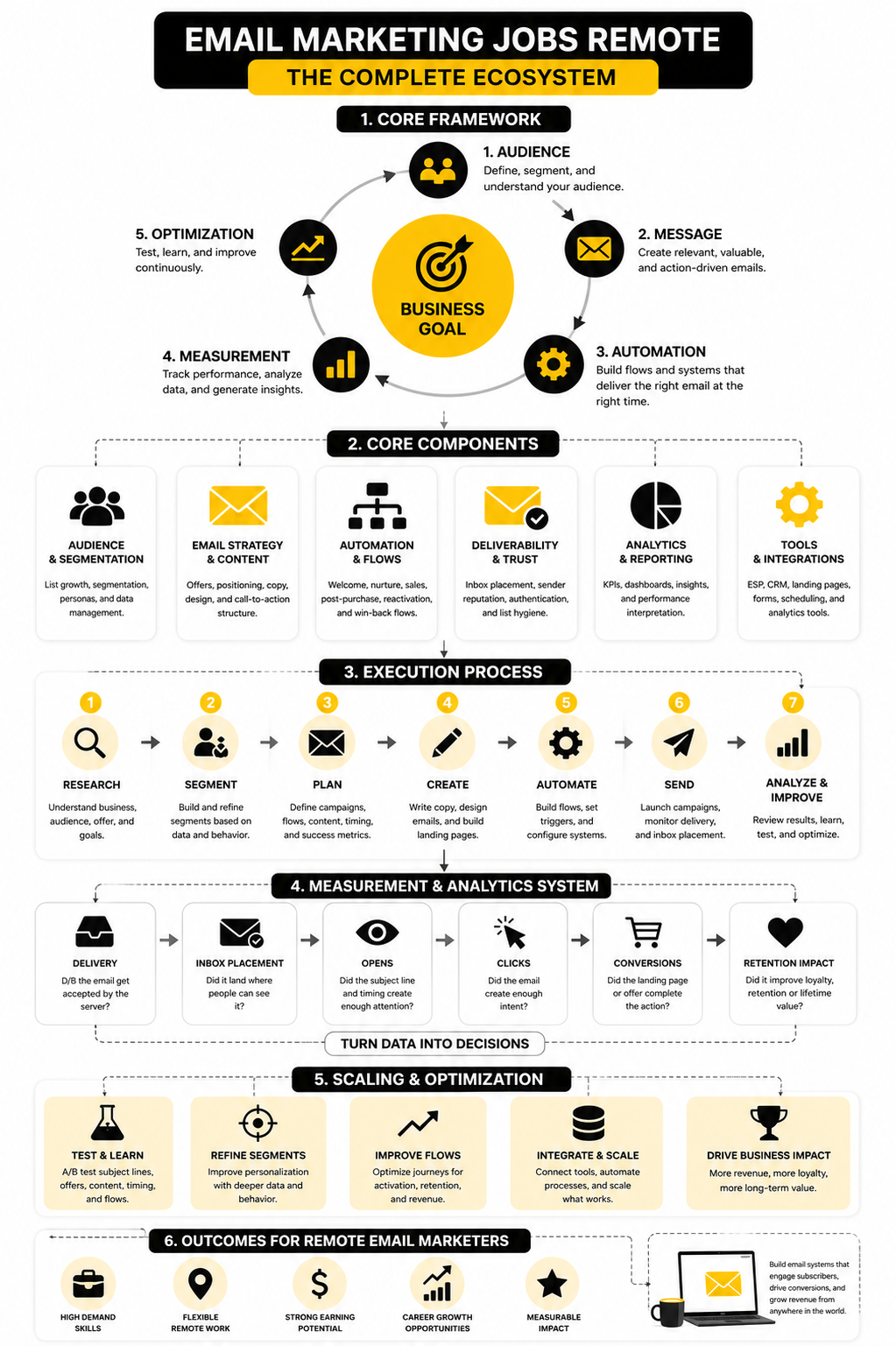
The simplest way to understand remote email marketing work is to see it as a system. You are not just writing subject lines. You are helping a business move the right person from one stage of the customer journey to the next with timely, useful, measurable communication.
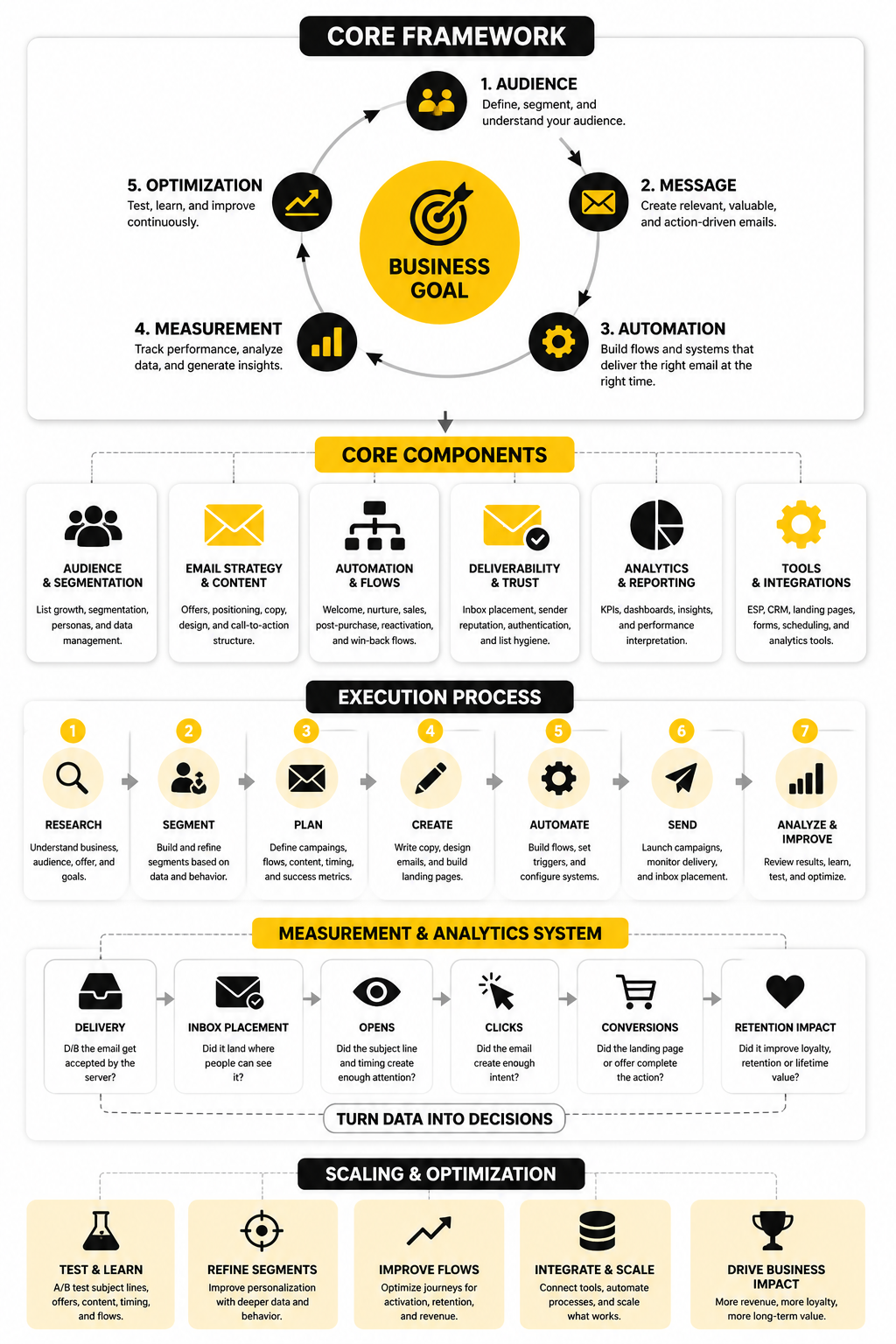
A strong remote email marketer usually works across four layers. First, there is strategy: who receives what, when, and why. Second, there is production: copy, design briefs, links, QA, scheduling, and coordination. Third, there is automation: welcome flows, abandoned cart sequences, reactivation campaigns, onboarding emails, and lead nurture systems. Fourth, there is optimization: testing, reporting, deliverability checks, segmentation, and revenue analysis.
This framework is useful because it keeps you from positioning yourself too narrowly. A beginner can start with campaign production and basic copywriting. A mid-level marketer can own automation and reporting. A senior lifecycle or CRM marketer can connect email to retention, customer lifetime value, paid acquisition, sales follow-up, and product usage.
Core Skills Companies Actually Pay For
The next logical step is skills. Not the fluffy version where every candidate says they are “creative, analytical, and detail-oriented.” Companies hiring for email marketing jobs remote want proof that you can manage a channel that touches revenue, customer relationships, brand trust, and technical systems at the same time.
A good remote email marketer is part writer, part operator, part analyst, and part systems thinker. That does not mean you need to master everything on day one. It means you need to understand which skills create value, which ones are expected for entry-level roles, and which ones help you move into better-paid lifecycle, CRM, automation, or retention positions.
The market is also shifting because AI is now part of the workflow. Research from Customer.io found that marketers are using AI heavily for copywriting and subject line optimization, with 68% using AI for copywriting and 65% using it for subject lines. That does not make human email marketers less important. It makes judgment, positioning, quality control, segmentation, and strategic thinking more important.
Copywriting That Moves People To Act
Copywriting is still the front door into many remote email marketing roles. You need to write subject lines, preview text, body copy, calls to action, promotional sequences, onboarding messages, product updates, and reactivation campaigns. The goal is not to sound clever. The goal is to make the next action feel obvious and worthwhile.
Strong email copy starts with the reader’s situation. What do they know already? What problem are they trying to solve? What would make them trust the message enough to click, reply, book, buy, upgrade, or come back? This is where many beginners go wrong because they write from the company’s point of view instead of the customer’s point of view.
The best candidates can show range. A SaaS onboarding email does not sound like a flash-sale email. A B2B nurture sequence does not sound like a creator newsletter. A retention email for an ecommerce brand needs a different rhythm from a webinar reminder built inside GoHighLevel, ClickFunnels, or Systeme.io.
Campaign Production And Quality Control
Remote teams love people who can ship clean work without creating chaos. Campaign production includes building the email, checking links, testing mobile layout, confirming audience segments, setting send times, coordinating approvals, and making sure the campaign actually matches the brief. This is unglamorous work, but it is where trust is built.
Mistakes in email are public and fast. A broken link, wrong discount code, bad personalization token, or incorrect segment can hit thousands of subscribers before anyone notices. That is why employers value candidates who use checklists, QA processes, naming conventions, and calm communication.
This skill is especially important in remote roles because your manager may not be sitting next to you. You need to document what you did, flag risks early, and make your work easy for designers, founders, sales teams, or ecommerce managers to review. Practical operators win here.
Segmentation And Customer Journey Thinking
Segmentation is where email marketing starts becoming more strategic. Instead of sending the same message to everyone, you group people based on behavior, lifecycle stage, purchase history, engagement, interest, geography, role, or intent. Better segmentation usually leads to more relevant messages and fewer wasted sends.
This matters because modern email performance depends less on blasting and more on matching. A new subscriber should not receive the same message as a loyal buyer. A trial user who activated three features should not receive the same email as someone who signed up and disappeared. A lead who came from a webinar needs a different follow-up than someone who downloaded a checklist.
Remote email marketers who understand journeys can talk about welcome flows, nurture paths, abandoned cart emails, lead scoring, win-back campaigns, post-purchase education, renewal reminders, and upgrade prompts. Tools like Brevo, Moosend, and ManyChat can help execute that work, but the thinking has to come from you.
Automation And Lifecycle Systems
Automation is one of the biggest separators between basic email assistants and higher-value email marketers. A one-off campaign can create a sales spike. A well-built automation system can work every day in the background, welcoming subscribers, educating leads, recovering carts, onboarding customers, and reactivating quiet users.
This does not mean automation should feel robotic. The best flows feel timely and useful because they respond to real behavior. Someone who just subscribed needs orientation. Someone who browsed but did not buy may need proof, urgency, or a clearer offer. Someone who bought needs confirmation, education, support, and a reason to come back later.
For remote roles, automation skill also signals independence. If you can map a journey, write the sequence, build the workflow, test the logic, and report on performance, you are much more valuable than someone who only waits for tasks. That is why lifecycle and CRM roles often ask for experience with customer journeys, marketing automation, data fields, triggers, and reporting.
Analytics Without Overcomplication
You do not need to be a data scientist to get hired in email marketing. You do need to understand the numbers that explain whether your work is helping the business. That usually means deliverability, open rate, click rate, click-to-open rate, conversion rate, unsubscribe rate, revenue per recipient, list growth, and engagement by segment.
Open rates are useful, but they are not the whole truth. Apple’s Mail Privacy Protection changed how opens are tracked, so serious marketers pay closer attention to clicks, conversions, replies, sales, and downstream behavior. Benchmark reports now often emphasize click and conversion data because those numbers are harder to inflate and closer to business impact.
The practical move is simple: learn to explain what happened and what to test next. A weak candidate says, “The campaign got a 2.4% click rate.” A strong candidate says, “The educational angle beat the discount angle with returning buyers, but new subscribers clicked the offer more, so I would split the next campaign by lifecycle stage.” That is the difference.
Deliverability And Compliance Basics
Deliverability is not optional anymore. If emails land in spam, the copy does not matter. If the list is dirty, the offer does not matter. If consent is unclear, the risk can become legal, reputational, and commercial.
Remote email marketers should understand sender reputation, authentication, bounce management, unsubscribe handling, spam complaints, list hygiene, and consent rules. You do not need to be a specialist immediately, but you should know enough to avoid reckless tactics. Buying random lists, over-mailing cold subscribers, and ignoring engagement signals are not “growth hacks.” They are usually shortcuts to poor performance.
Compliance also matters because remote jobs often involve audiences across regions. The details vary by market, but the mindset is consistent: respect consent, make unsubscribing easy, and avoid misleading subject lines or deceptive sending practices. Companies trust marketers who protect the list instead of squeezing it for one short-term spike.
Tool Fluency And Remote Collaboration
Most remote email marketing jobs expect you to learn tools quickly. That may include an ESP, CRM, ecommerce platform, landing page builder, analytics dashboard, project management app, AI writing tool, and documentation system. You do not need every tool on your resume, but you do need a pattern of learning systems and using them responsibly.
Tool fluency is not the same as clicking buttons. It means understanding how data moves, where mistakes happen, and how the email channel connects with the rest of the business. A form created in Fillout, a booking flow in Cal.com, a CRM record in Copper, and an email sequence all need to support the same customer journey.
Remote collaboration is the quiet skill underneath all of this. You need to write clear updates, ask precise questions, document decisions, and make async work easy. In a remote team, the person who communicates clearly often feels twice as reliable as the person who only does good work when someone chases them.
How To Build A Portfolio That Gets Interviews
Once you understand the core skills, the next job is proving them. A resume can say you understand email strategy, automation, segmentation, and reporting. A portfolio shows it in a way a hiring manager can actually judge.
This is where many people applying for email marketing jobs remote make the process harder than it needs to be. They wait for permission, client work, or a perfect past role before building proof. You do not need a famous brand in your portfolio to look credible. You need clean thinking, realistic execution, and a clear explanation of why each email exists.
Choose One Business Model First
Start with one business model instead of trying to build a generic portfolio for everyone. Ecommerce, SaaS, agencies, coaches, creators, local services, nonprofits, and B2B companies all use email differently. When your examples match the type of company you want to work for, your portfolio feels sharper immediately.
For ecommerce, build around welcome flows, abandoned cart emails, post-purchase education, review requests, and win-back campaigns. For SaaS, focus on activation, onboarding, feature adoption, trial conversion, renewal reminders, and expansion. For service businesses, show lead nurture, booking reminders, consultation follow-ups, and sales handoff sequences.
This choice matters because hiring managers scan fast. If a SaaS company sees a portfolio full of random retail promos, they may not connect the dots for you. Make the connection obvious.
Build A Small But Complete Email System
A strong beginner portfolio does not need twenty samples. Three complete pieces are better than fifteen disconnected emails. The goal is to show that you can think in journeys, not just write isolated messages.
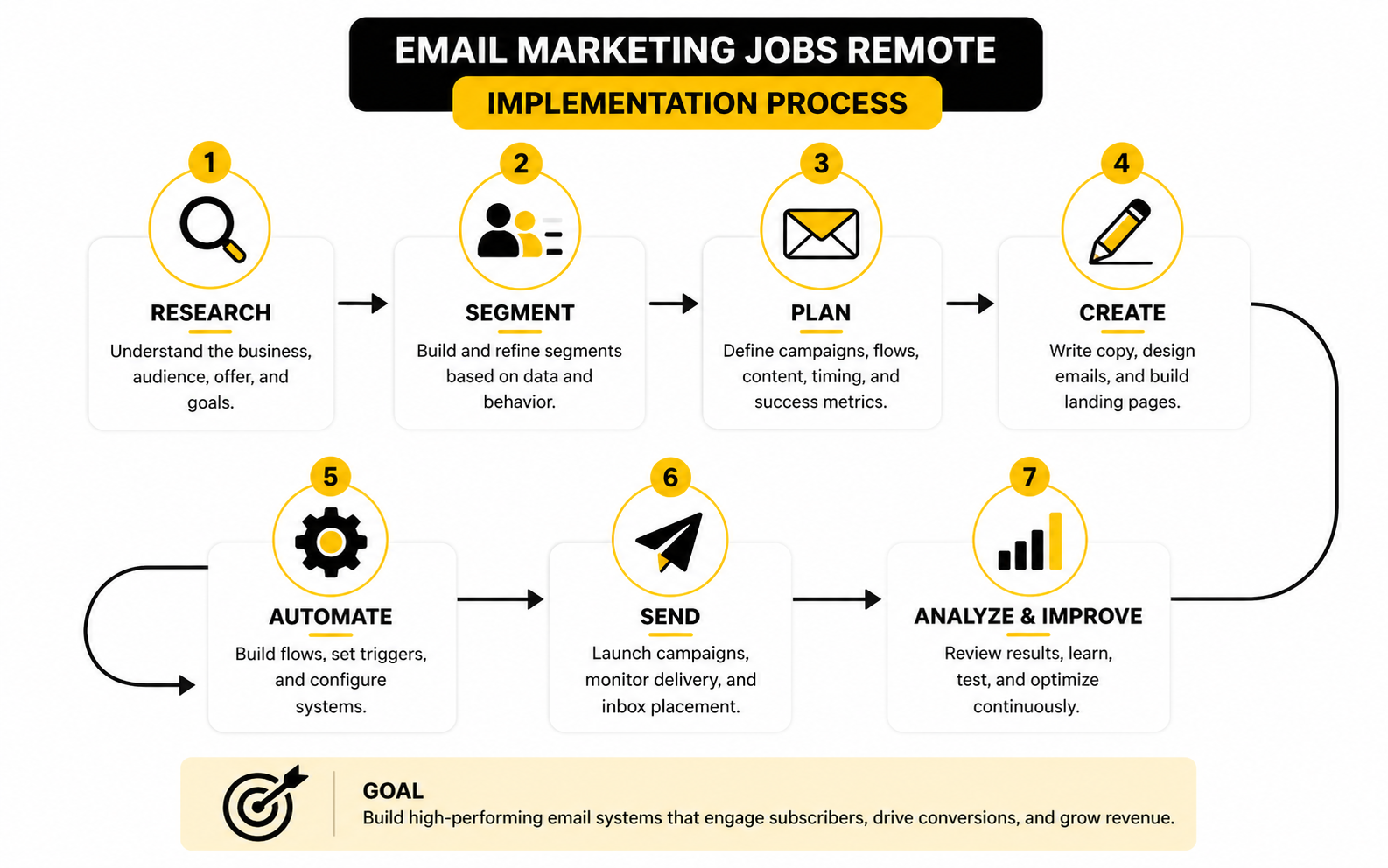
A practical portfolio project can follow this process:
- Pick a realistic business type and audience.
- Define the customer problem and the business goal.
- Map the journey stage the email supports.
- Write the email or sequence.
- Explain the segment, trigger, timing, and call to action.
- Add a simple performance hypothesis.
- Include what you would test next.
That structure makes your work feel professional because it mirrors how real email teams operate. It also gives interviewers something useful to discuss. Instead of asking vague questions about your “passion for marketing,” they can ask why you chose that trigger, why that CTA fits the stage, or how you would measure success.
Create Portfolio Pieces Around Real Tasks
Your samples should look like the work you would actually do in a remote email role. That means campaigns, flows, briefs, dashboards, QA checklists, and teardown notes are more useful than pretty mockups alone. Design helps, but strategy and execution matter more.
Good portfolio pieces include:
- A welcome sequence for a newsletter, SaaS trial, ecommerce store, or service business.
- An abandoned cart or abandoned checkout flow with timing and message logic.
- A reactivation campaign for subscribers who have stopped engaging.
- A product launch campaign with audience segments and send calendar.
- A lifecycle audit of a real brand’s publicly visible email experience.
- A campaign brief that a designer, founder, or marketing manager could actually use.
- A reporting summary that explains results, insights, and next steps.
Keep it grounded. Do not invent fake revenue numbers or pretend a mock campaign produced results. Label speculative work clearly, then show the thinking behind it. Honest work with strong reasoning beats inflated claims every time.
Show The Strategy Behind The Copy
Copy samples are useful, but strategy notes make them much stronger. A hiring manager wants to know whether you understand why the email exists. That means every sample should include a short explanation of the audience, trigger, offer, objection, timing, and expected action.
For example, a welcome email should explain what the subscriber just did and what they need next. A trial onboarding email should explain the activation behavior you are trying to encourage. A win-back email should explain why the person has gone quiet and what kind of message might bring them back without sounding desperate.
This is where you can stand out without having years of experience. Many applicants submit polished copy with no context. The candidate who explains the decision-making process feels safer to hire, especially for remote work where managers need people who can think independently.
Include Tool-Based Proof Without Overdoing It
Tool screenshots can help, but they should support the portfolio rather than dominate it. If you can show a flow map, segmentation logic, campaign calendar, or automation setup, that gives employers confidence that you understand implementation. Just keep private data out of it and avoid showing anything you do not have permission to share.
You can build practice systems in tools like Brevo, Moosend, Systeme.io, or GoHighLevel. For funnel-heavy roles, it can also make sense to show how email connects to a landing page or checkout flow using ClickFunnels or a similar platform. The point is not to collect logos. The point is to prove you can connect the moving parts.
If you are new, one clean automation screenshot with a clear explanation is enough. Do not overwhelm the reader with every trigger, tag, and condition. Show the logic, explain the business reason, and move on.
Write A Short Case Study For Each Project
Each portfolio project should have a short case study. It does not need to be long. It just needs to make your thinking easy to follow.
Use this structure:
- Context: What business, audience, or lifecycle stage is this for?
- Goal: What should the email system improve?
- Audience: Who receives the message and why?
- Execution: What did you create?
- Measurement: Which metrics would show whether it worked?
- Next test: What would you improve after the first send?
This format works because it feels like a real work sample, not a school assignment. It also prepares you for interviews because you will already know how to talk through your decisions. When someone asks why you wrote the email that way, you will have an answer.
Keep The Portfolio Simple And Easy To Review
Your portfolio should be easy to skim in five minutes. Remote hiring teams review a lot of candidates, and nobody wants to dig through a messy folder with unclear file names. Make the path obvious.
A simple structure works best:
- One short opening paragraph explaining what kind of email marketing work you do.
- Three to five portfolio projects grouped by business model or lifecycle stage.
- One page or PDF per project.
- Clear labels for speculative work, client work, and personal projects.
- A short contact section with your email, LinkedIn, and availability.
Do not hide the best work. Put the strongest project first. If your best sample is a lifecycle flow, lead with that instead of placing it after three generic newsletters.
Make Your Portfolio Match The Job You Want
The final step is tailoring. Before applying, compare your portfolio to the job description. If the role mentions lifecycle marketing, put your lifecycle project first. If the role focuses on ecommerce, lead with cart recovery, post-purchase, and retention samples. If the role is agency-based, show that you can work from a brief and explain your assumptions clearly.
This is not about pretending to be someone else. It is about reducing friction for the hiring manager. They should be able to look at your work and think, “This person understands the kind of email marketing we need.”
That is the real job of a portfolio. It does not need to be huge, flashy, or perfect. It needs to make you feel lower-risk, more practical, and more useful than the next applicant.
Statistics And Data That Actually Matter
Data is useful only when it changes what you do next. For remote email marketing jobs, that means you need to understand which numbers signal attention, which numbers signal intent, and which numbers signal business impact. Dumping benchmark stats into a report does not make you analytical. Turning numbers into better decisions does.
The strongest candidates can explain performance in plain English. They do not hide behind dashboards, and they do not panic when one metric moves. They look at the campaign goal, the audience, the segment, the offer, the timing, and the next step in the customer journey before deciding whether the email worked.
Start With The Business Goal
Every useful email report starts with one question: what was this email supposed to do? A newsletter might be judged by clicks, replies, content engagement, and list retention. A sales campaign might be judged by revenue, orders, qualified leads, bookings, or demo requests. An onboarding email might be judged by activation, feature usage, trial conversion, or reduced support tickets.
This matters because the same metric can mean different things in different contexts. A low click rate on a policy update may be fine if the goal was awareness. A high open rate on a revenue campaign may be worthless if nobody clicked, booked, bought, or replied. In real email work, the job is not to make every number look good. The job is to connect the right number to the right objective.
Email still earns serious attention because it remains measurable and commercially useful. The 2025 DMA benchmark reported a 98% delivery rate, a 35.9% open rate, and a 2.3% unique click rate across its dataset, but those numbers are starting points, not universal targets. A great remote email marketer knows that a B2B nurture email, ecommerce promotion, webinar reminder, and reactivation campaign should not be measured the same way.
Understand The Email Measurement Stack
A clean measurement system moves from technical delivery to commercial outcome. If you skip the early signals, you may misread the later ones. If you stop at early signals, you may celebrate activity that never turns into business value.
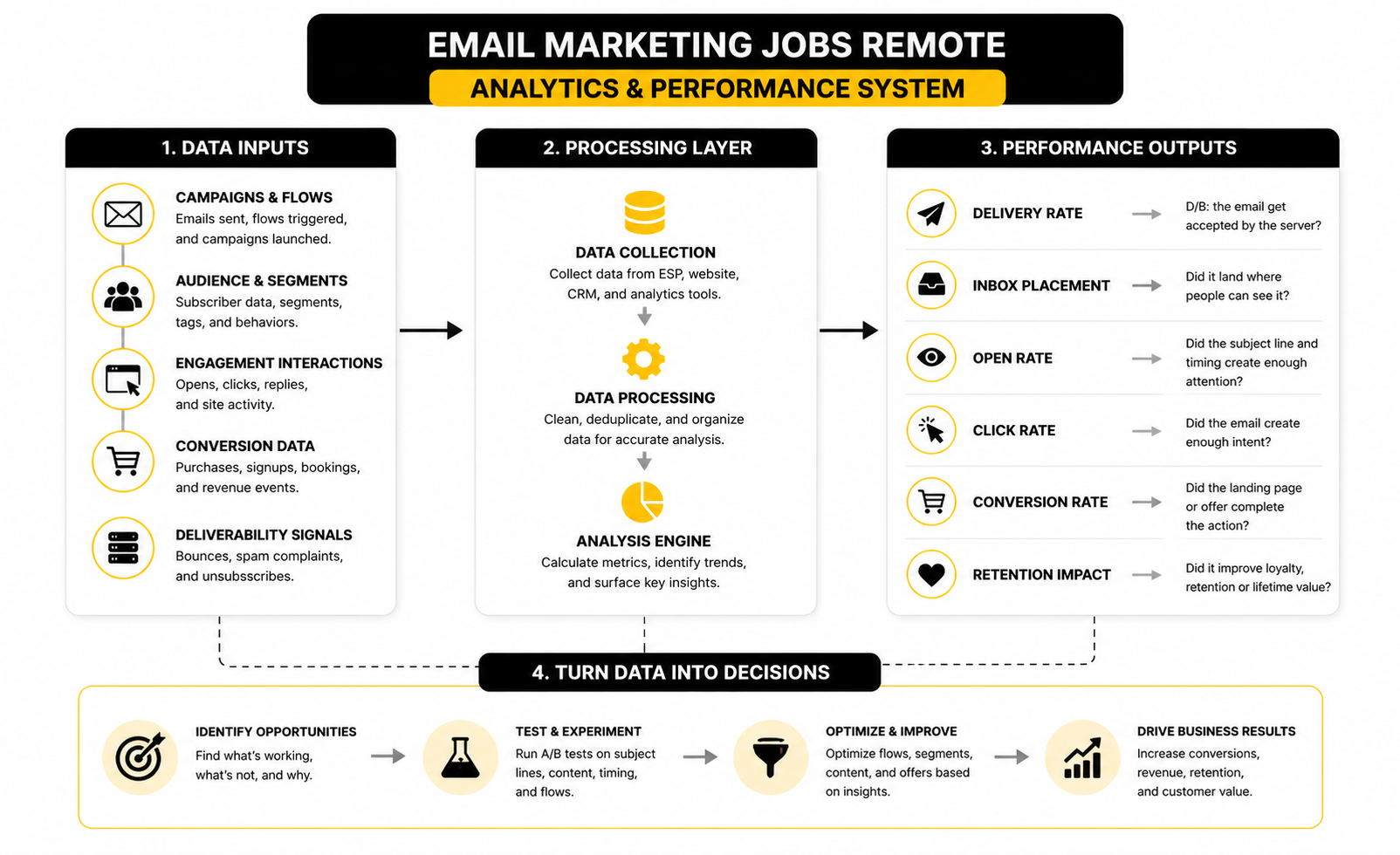
A practical email analytics stack looks like this:
- Delivery: Did the email get accepted by the receiving server?
- Inbox placement: Did it land where people could realistically see it?
- Open behavior: Did the subject line, sender name, timing, and brand relationship create enough attention?
- Click behavior: Did the message and offer create enough intent?
- Conversion: Did the landing page, checkout, booking flow, or sales process complete the action?
- Retention impact: Did the email improve loyalty, repeat purchase, renewal, usage, or customer lifetime value?
This is the lens that separates serious candidates from surface-level applicants. If clicks are strong but conversions are weak, the problem may not be the email. It could be the landing page, offer, price, checkout friction, page speed, form design, or sales handoff. If opens are weak but deliverability is healthy, the issue may be positioning, subject line relevance, send timing, or list fatigue.
Benchmarks Are Directional, Not Absolute
Benchmarks help you understand the range of normal performance, but they are not commandments. MailerLite’s 2025 benchmark data reported an average open rate of 43.46%, an average click rate of 2.09%, and an average unsubscribe rate of 0.22%. The DMA’s 2025 benchmark reported a 2.3% unique click rate, which is close enough to confirm the broader point: clicks are usually much smaller than opens, and that is normal.
This is important because beginners often compare one campaign to a random benchmark and draw the wrong conclusion. A 2% click rate may be weak for a highly engaged buyer segment but strong for a cold reactivation list. A 40% open rate may be ordinary for a loyal newsletter audience but excellent for a broad promotional send. The context decides the interpretation.
Use benchmarks as a map, not a verdict. They help you spot unusual performance, set expectations, and ask better questions. They do not replace segment-level reporting, historical performance, or business goals.
Open Rates Need Careful Interpretation
Open rates are still useful, but they are less reliable than they used to be. Privacy changes, image loading behavior, bot activity, and inbox technology can inflate or distort opens. That does not mean you should ignore open rates completely. It means you should treat them as an attention signal, not proof of success.
For remote email marketing roles, the practical interpretation is simple. Use open rates to compare subject lines, sender names, list quality, timing, and audience familiarity. Do not use open rates alone to prove revenue impact. If an email has a strong open rate and weak clicks, the subject line may have earned attention but the message did not create enough motivation.
This distinction matters in interviews. Saying “open rates are dead” sounds lazy. Saying “I use opens as a directional signal, but I rely more on clicks, conversions, revenue, replies, and downstream behavior for decisions” sounds like someone who has actually thought about the channel.
Clicks Show Intent, But Not The Whole Journey
Click rate is usually a stronger signal than open rate because it shows someone took action inside the email. That action may be reading a blog post, viewing a product, booking a call, starting checkout, downloading a guide, or visiting a pricing page. For many remote email roles, click behavior is where analysis starts getting useful.
Still, clicks need context. A campaign with one clear call to action should usually produce cleaner data than an email with five competing links. A content-heavy newsletter may generate many low-intent clicks, while a short sales email may generate fewer but higher-quality clicks. A product announcement may have modest clicks but strong expansion revenue if the right accounts engage.
When you analyze clicks, look at the link, audience, intent level, and next step. Do not just report the percentage. Explain what the click pattern says about interest and what you would do next.
Conversion Data Tells You Where Email Meets The Business
Conversions are where email marketing stops being a communication channel and starts becoming a revenue or growth channel. A conversion can be a purchase, booked call, demo request, trial activation, upgrade, renewal, donation, reply, app action, or completed form. The right conversion depends on the business model.
This is why email marketers who understand tools and tracking become more valuable. If a form in Fillout, a booking page in Cal.com, a CRM record in Copper, and an automation in GoHighLevel are disconnected, the report will never tell the full story. Clean tracking makes better marketing possible.
The action step is to define conversion before sending. Do not wait until the campaign is over and then search for a metric that looks good. Decide what success means, tag links properly, confirm the destination works, and make sure the team agrees on the primary outcome.
Deliverability Is A Performance Metric, Not A Technical Side Quest
Deliverability deserves more respect than it usually gets. If emails do not reach the inbox, the campaign cannot perform. Validity’s 2025 deliverability research highlights tougher inbox placement conditions after changing mailbox requirements, privacy rules, technology shifts, and sender behavior, which means marketers need to treat deliverability as an ongoing operating discipline.
For job seekers, this is a major opportunity. Many applicants talk about copy. Fewer talk confidently about bounces, spam complaints, authentication, list hygiene, inactive subscribers, sender reputation, and engagement-based segmentation. If you can discuss those basics without pretending to be a deliverability engineer, you will sound more credible.
The practical rule is simple: protect the list. Clean inactive segments, avoid misleading subject lines, monitor complaints, make unsubscribing easy, and do not send every campaign to everyone. The list is an asset, not a vending machine.
Reporting Should Lead To A Decision
A good report does not end with numbers. It ends with a decision. Keep doing this, stop doing that, test this next, split this audience, rewrite this offer, fix this landing page, clean this segment, or change the timing.
For remote work, this matters even more because reporting is part of communication. Your manager should not need to decode a spreadsheet to understand what happened. A simple performance summary can say what was sent, who received it, what the goal was, what happened, why it likely happened, and what you recommend next.
A practical campaign report can include:
- Campaign goal: The business outcome the email was meant to support.
- Audience: The segment that received it and why they were selected.
- Primary metric: The number that best reflects success.
- Supporting signals: Delivery, opens, clicks, unsubscribes, complaints, and conversions.
- Insight: What the data suggests about audience behavior.
- Next action: The change, test, or follow-up that should happen next.
That is the kind of reporting that gets trusted. It is not complicated for the sake of looking smart. It is practical, specific, and tied to action.
Where To Find Remote Email Marketing Jobs
By this point, the path should be clearer: build the skills, package the proof, understand the metrics, and then search where the right roles actually appear. The mistake is applying randomly to anything with “email” in the title. That creates noise, weak applications, and a lot of rejection that teaches you nothing.
Remote email marketing jobs usually sit under several titles, not just one. Search for email marketing specialist, CRM marketer, lifecycle marketer, retention marketer, marketing automation specialist, email campaign manager, customer marketing specialist, and demand generation marketer. Some roles are copy-heavy, some are technical, and some are strategy-heavy, so the title alone is never enough.
Use Job Titles As Clues, Not Guarantees
An “email marketing specialist” role may be mostly campaign production. A “lifecycle marketing manager” role may involve advanced segmentation, experimentation, activation, retention, and cross-channel orchestration. A “CRM marketing coordinator” role may require list management, reporting, campaign QA, and basic automation work.
This matters because different titles lead to different expectations. Entry-level and coordinator roles usually reward organization, writing, QA, and tool comfort. Mid-level roles expect you to own campaigns, recommend tests, understand analytics, and work across teams. Senior roles often require strategy, forecasting, stakeholder management, lifecycle planning, and revenue accountability.
Job boards confirm this range. Remote CRM and email marketing listings often ask for CRM systems, automation platforms, campaign management, and list-building experience, while lifecycle listings commonly emphasize customer journeys, retention, segmentation, and growth outcomes. Treat each description like a brief, then decide whether your portfolio matches the work.
Look Beyond The Biggest Job Boards
Large job boards are useful, but they are also crowded. You can use them to understand patterns, collect keywords, and see what employers repeatedly ask for. But if you only apply through the biggest platforms, you are competing in the noisiest part of the market.
Better sources often include niche remote boards, company career pages, agency websites, ecommerce brand hiring pages, SaaS career pages, marketing communities, founder newsletters, and LinkedIn posts from hiring managers. These sources can be slower to research, but the applications are often higher quality because you can tailor your pitch to the company and role.
Do not ignore agencies. Email, CRM, lifecycle, retention, and funnel agencies often need people who can execute across multiple clients. The pace can be intense, but agency experience can build your pattern recognition fast because you see different offers, audiences, tools, and problems in a short period.
Read The Job Description Like A Strategist
A job description tells you what the company is struggling with, even when it is written poorly. If the role mentions deliverability, they may have inbox or list-quality issues. If it mentions lifecycle programs, they likely need better customer journeys. If it mentions campaign calendars and cross-functional approvals, they may need someone organized who can coordinate production without slowing everyone down.
When you read a listing, separate the requirements into three groups:
- Must-have skills: The work you will do every week.
- Nice-to-have tools: Platforms you can learn if the underlying skill is strong.
- Business priorities: The outcomes the company actually cares about.
This makes your application sharper. Instead of saying you are interested in email marketing, you can say you noticed the role focuses on lifecycle automation and retention, then point to a portfolio project that maps a welcome sequence, reactivation flow, or post-purchase journey. That is a completely different level of signal.
Understand The Tradeoff Between Specialist And Generalist Roles
Some remote email marketing roles are pure channel roles. You own email campaigns, automations, segmentation, testing, reporting, and deliverability. These can be excellent if you want depth and a clear career path into lifecycle, CRM, retention, or customer marketing leadership.
Other roles are broader. You may handle email, landing pages, social scheduling, basic ads, webinars, lead magnets, sales follow-up, and reporting. These roles can be useful early in your career because you learn how email connects to the rest of the funnel, especially with tools like ClickFunnels, Systeme.io, GoHighLevel, or Replo. But they can also become messy if the company expects one person to replace an entire marketing team.
Neither path is automatically better. The right choice depends on your stage. If you need experience, a broader role can help you build proof fast. If you already know you want to become a lifecycle or CRM specialist, prioritize roles where email is a core revenue channel, not an afterthought.
Watch For Red Flags Before You Apply
Remote jobs can look attractive while hiding serious problems. Be careful with roles that expect you to manage strategy, copy, design, coding, automation, deliverability, analytics, SMS, ads, sales calls, and customer support for entry-level pay. That is not an email marketing job. That is a company trying to compress five roles into one.
Also watch for vague promises. If the posting talks about “unlimited earning potential” but does not explain the product, team, expectations, compensation, or success metrics, slow down. If the company wants cold email at high volume without discussing consent, targeting, compliance, or deliverability, that is a risk to your reputation as well as theirs.
Good roles are not always perfect, but they usually have clearer expectations. They explain the audience, tools, responsibilities, reporting structure, and business goals. They also make it possible to understand what success looks like after 30, 60, and 90 days.
Position Yourself For Higher-Quality Opportunities
Better opportunities usually go to people who look specific. “I do email marketing” is broad. “I build lifecycle emails for SaaS onboarding and retention” is clearer. “I help ecommerce brands improve welcome, cart recovery, and post-purchase email flows” is even easier for a hiring manager to understand.
This does not mean you can never take a different kind of role. It means your public positioning should make a strong first impression. Your resume, LinkedIn headline, portfolio intro, and outreach message should all point in the same direction.
For example, a strong positioning statement could say:
- “Remote email marketer focused on ecommerce retention, abandoned cart flows, and post-purchase campaigns.”
- “Lifecycle marketing specialist helping SaaS teams improve activation, onboarding, and trial conversion.”
- “Email campaign operator with experience in segmentation, QA, automation, and performance reporting.”
Simple beats clever. The goal is to make the reader understand where you fit in ten seconds.
Build A Search System Instead Of Applying In Bursts
Applying in random bursts is exhausting. A better approach is to build a weekly search system. That keeps your pipeline moving without turning the job hunt into a panic cycle.
A practical weekly system looks like this:
- Search five to seven relevant job titles.
- Save roles that match your target business model and skill level.
- Pull recurring keywords from the descriptions.
- Match each role to one portfolio project.
- Write a tailored opening paragraph for each application.
- Track the company, title, link, date applied, follow-up date, and response.
- Review patterns every week and adjust your positioning.
This process helps you learn from the market instead of just reacting to it. If every role you want asks for lifecycle reporting, build a better reporting sample. If the roles keep mentioning automation, improve your flow maps. If they keep asking for ecommerce experience, create sharper ecommerce-specific projects.
Use Outreach Without Sounding Desperate
Outbound messages can work when they are specific and useful. They fail when they sound like copied templates. The goal is not to beg for a job. The goal is to start a relevant professional conversation.
A good outreach message is short. Mention the company, the email-related problem you noticed, the type of work you do, and one relevant proof point. If you have a teardown or portfolio project that fits their business model, include it naturally. Do not send a long life story.
The best outreach often goes to founders, heads of growth, lifecycle leads, retention managers, ecommerce managers, agency owners, and marketing directors. These people understand the value of email when it is tied to revenue, activation, or retention. Make their job easier by being specific, prepared, and respectful of their time.
How To Apply, Interview, Negotiate, And Grow
The final stage is turning your skills into paid work. This is where many candidates get too passive. They build a portfolio, send the same resume everywhere, and hope someone recognizes their potential. That is not a strategy.
For email marketing jobs remote, your application needs to prove three things quickly: you understand the business goal, you can execute without chaos, and you can communicate clearly in an async environment. Remote teams are hiring for trust as much as skill. Make yourself easy to trust.
Tailor The First Screen
Your resume should not read like a generic marketing document. Lead with the parts of your experience that match the role: email campaigns, lifecycle flows, CRM work, automation, segmentation, reporting, copywriting, deliverability, or retention. If the company is hiring for ecommerce email, make ecommerce examples impossible to miss.
Use simple outcome language where you have real results. If you do not have verified performance numbers, do not invent them. Talk about the systems you built, the workflows you improved, the campaigns you supported, and the decisions your work made easier.
Your cover note should be short and specific. Mention the role, the business problem you think they are hiring for, and the one portfolio piece that proves you can help. That is enough.
Prepare For The Interview Like A Consultant
In interviews, do not just answer questions. Show how you think. A hiring manager wants to know whether you can look at a messy email program and find the next practical move.
Prepare to talk through:
- A campaign you would build for their audience.
- A flow you would audit first and why.
- A metric you would prioritize for the role.
- A deliverability risk you would watch.
- A test you would run in the first 30 days.
- A time you handled unclear feedback or competing priorities.
The strongest answers are specific without pretending you know their internal data. Say what you would inspect first, what you would ask, and how you would decide. That sounds professional because real email marketing is decision-making under imperfect information.
Handle Take-Home Assignments Carefully
Take-home assignments are common in marketing hiring. Some are fair. Some are unpaid consulting disguised as a test. You need to protect your time while still showing your ability.
A reasonable assignment might ask you to write one email, critique a campaign, map a simple flow, or explain how you would improve a sequence. A risky assignment asks for a full strategy, complete automation build, multi-week calendar, or detailed revenue plan with no compensation. Push for scope, timeline, and expectations before investing serious effort.
When you complete a test, explain your assumptions. A good submission does not just show the finished email. It shows who the email is for, what stage it supports, why the angle fits, what metric matters, and what you would test next.
Negotiate Around Value, Not Just Tasks
Email marketing can influence revenue, retention, activation, and customer experience. Do not negotiate like you are only being paid to schedule campaigns. Frame your value around the business outcomes the role supports.
For entry-level roles, negotiation may focus on learning scope, tool access, mentorship, remote flexibility, and a clear review timeline. For mid-level roles, it may include ownership of lifecycle flows, reporting responsibilities, testing budget, and compensation tied to experience. For senior roles, it should include strategic authority, cross-functional access, and clear success metrics.
Be practical. If the company cannot move on salary, ask about review dates, contractor rates, project scope, equipment budget, professional development, or a path from contract to full-time. The point is not to “win” the conversation. The point is to make the opportunity sustainable.
Keep Growing After You Get The Role
Getting hired is not the finish line. The fastest-growing email marketers keep improving their judgment. They study offers, customer objections, deliverability patterns, lifecycle gaps, conversion paths, and retention signals.
The real career growth comes from moving closer to business impact. Campaign production is valuable. Automation is more valuable. Lifecycle strategy is more valuable again. Owning a measurable retention, activation, or revenue problem is where your role becomes harder to replace.
Keep building proof even after you are employed. Save approved work samples, document before-and-after improvements, track decisions, and turn projects into case studies when confidentiality allows. Future opportunities become much easier when your work history is already packaged.
FAQ - Built For Complete Guide
What are remote email marketing jobs?
Remote email marketing jobs are roles where you plan, write, build, automate, test, and report on email campaigns from outside a traditional office. The work can include newsletters, lifecycle flows, promotional campaigns, onboarding emails, retention programs, CRM updates, and deliverability checks. Some roles are full-time, some are freelance, and some are contract-based.
Do I need a degree to get an email marketing job remotely?
A degree can help, but it is not the main thing most employers care about. They want proof that you can write clearly, understand customer journeys, use email tools, report on performance, and work independently. A strong portfolio can often carry more weight than a general marketing degree.
What skills should I learn first?
Start with copywriting, segmentation, campaign production, QA, and basic analytics. Then move into automation, lifecycle strategy, deliverability, and conversion tracking. That sequence gives you useful skills early while building toward higher-value roles.
What tools should I know for remote email marketing jobs?
Common tools include email service providers, CRMs, automation platforms, landing page builders, analytics tools, and project management systems. You might see platforms like Brevo, Moosend, GoHighLevel, Systeme.io, and ClickFunnels. The exact tool matters less than understanding the workflow behind it.
Can beginners get remote email marketing jobs?
Yes, but beginners need proof. A portfolio with realistic welcome flows, campaign briefs, reactivation emails, and reporting summaries can help you compete even without years of experience. Entry-level candidates should target coordinator, assistant, junior specialist, and agency support roles first.
Is email marketing still worth learning with AI?
Yes. AI can speed up drafts, subject line ideas, summaries, and testing concepts, but it does not replace strategy, customer understanding, deliverability judgment, or business decision-making. The better path is to use AI as an assistant while becoming stronger at positioning, segmentation, measurement, and execution.
What is the difference between email marketing and lifecycle marketing?
Email marketing often focuses on campaigns, newsletters, promotions, and automations. Lifecycle marketing is broader because it looks at the full customer journey from signup to activation, purchase, retention, renewal, and expansion. Many higher-paying roles use email as one major channel inside a lifecycle strategy.
How do I build a portfolio without clients?
Pick a realistic business model and create speculative projects clearly labeled as practice work. Build a welcome sequence, abandoned cart flow, onboarding series, campaign brief, or lifecycle audit. Explain the audience, goal, trigger, timing, metric, and next test so the work feels like a real business asset.
What metrics should I understand before applying?
You should understand delivery rate, open rate, click rate, click-to-open rate, conversion rate, unsubscribe rate, spam complaints, bounce rate, revenue per recipient, and list growth. More importantly, you should know what each metric can and cannot prove. Metrics are useful when they guide decisions.
Are remote email marketing jobs mostly freelance or full-time?
They can be either. Full-time roles are common in SaaS, ecommerce, agencies, media, education, nonprofits, and B2B companies. Freelance and contract roles are also common because many businesses need help with campaigns, audits, automations, launches, and retention systems without hiring a permanent employee immediately.
How do I stand out when applying?
Be specific. Match your resume and portfolio to the job description, lead with the most relevant project, and explain how your work supports the company’s goal. A tailored application with one strong portfolio example is usually better than a generic application sent to fifty companies.
What should I avoid in this career path?
Avoid fake case studies, invented results, spammy tactics, purchased lists, unclear consent, and overpromising. Also avoid roles that combine too many unrelated responsibilities for low pay. Good email marketers protect trust because trust is what makes the channel work.
Work With Professionals
Explore 10K+ Remote Marketing Contracts on MarkeWork.com
Most marketers spend too much time chasing clients, competing on crowded platforms, and losing a percentage of every project to middlemen.
MarkeWork gives you a better way. Browse thousands of remote marketing contracts and connect directly with companies desperate to hire skilled marketers like you, without platform commissions and without unnecessary gatekeepers.
If you're serious about finding better opportunities and keeping 100% of what you earn, explore available contracts and create a profile for free at MarkeWork.com.