

Email marketing with Klaviyo has quietly become one of the most powerful revenue engines in ecommerce and digital-first businesses. While many brands still treat email as a broadcast channel, the reality is very different—Klaviyo turns it into a behavior-driven, data-powered growth system.
Recent industry benchmarks show that automated email flows can drive over 30% of total email revenue, while segmented campaigns consistently outperform generic blasts in both open rates and conversions. That gap isn’t small—it’s the difference between struggling with retention and building a predictable revenue loop.
What makes this shift even more important is rising acquisition costs. Platforms like Meta and Google have become more expensive, less predictable, and more competitive. That forces brands to maximize owned channels, and email marketing through Klaviyo sits right at the center of that strategy.
The goal of this guide is not to explain basics. It’s to show how email marketing in Klaviyo actually works when it’s implemented at a professional level—where flows, segmentation, and lifecycle logic all connect into one system.
Article Outline
- Why Klaviyo Email Marketing Actually Matters Today
- Klaviyo Email Marketing Framework Overview
- Core Components of a High-Performance Klaviyo System
- How to Implement Klaviyo Like a Professional
- Advanced Optimization and Scaling Strategies
- Common Mistakes, FAQs, and Final Takeaways
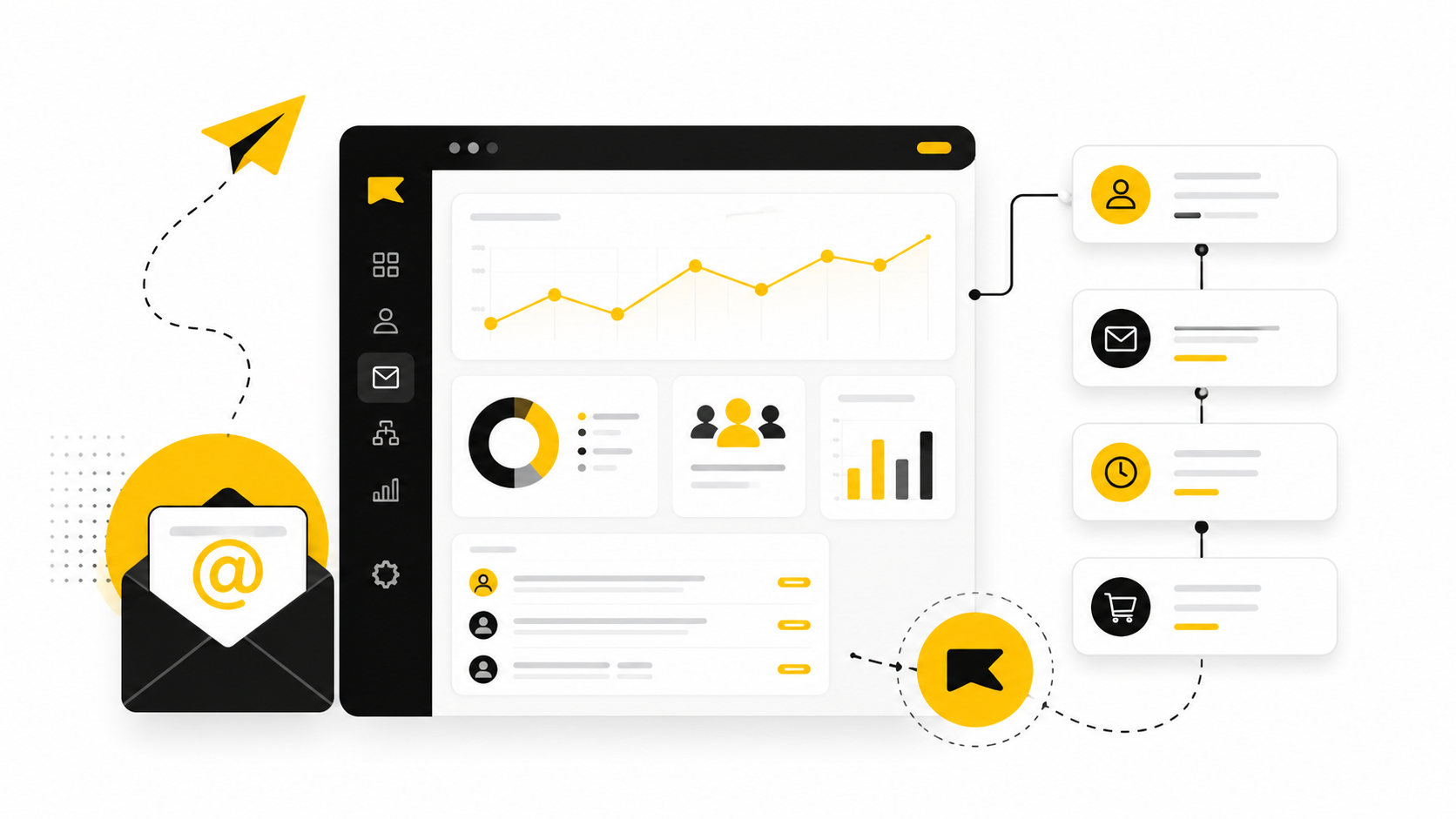
Why Klaviyo Email Marketing Actually Matters Today
Email marketing didn’t suddenly become powerful again. It never stopped working—most brands just used it incorrectly.
The key shift is ownership. When you rely entirely on paid acquisition, you are renting attention. When you build an email list inside Klaviyo, you own the relationship. That distinction becomes critical when ad costs rise or platforms change their algorithms overnight.
There’s also a structural advantage. Email allows for direct, personalized communication based on real behavior. Someone browses a product, abandons a cart, or purchases twice—Klaviyo captures that data and turns it into triggers. That’s fundamentally different from social media, where most messaging is broad and reactive.
Performance data reinforces this. Lifecycle emails like abandoned cart flows can generate conversion rates exceeding 5–10% in many ecommerce verticals, while standard campaigns often sit far lower. The difference isn’t just creative—it’s timing, relevance, and intent.
Another overlooked factor is compounding returns. Paid ads reset every day. Email systems improve over time as lists grow, segments refine, and flows optimize. This creates a long-term asset rather than a short-term tactic.
For brands building serious infrastructure, tools like Brevo or Moosend can complement broader strategies, but Klaviyo stands out specifically because of its deep ecommerce integrations and real-time data architecture.
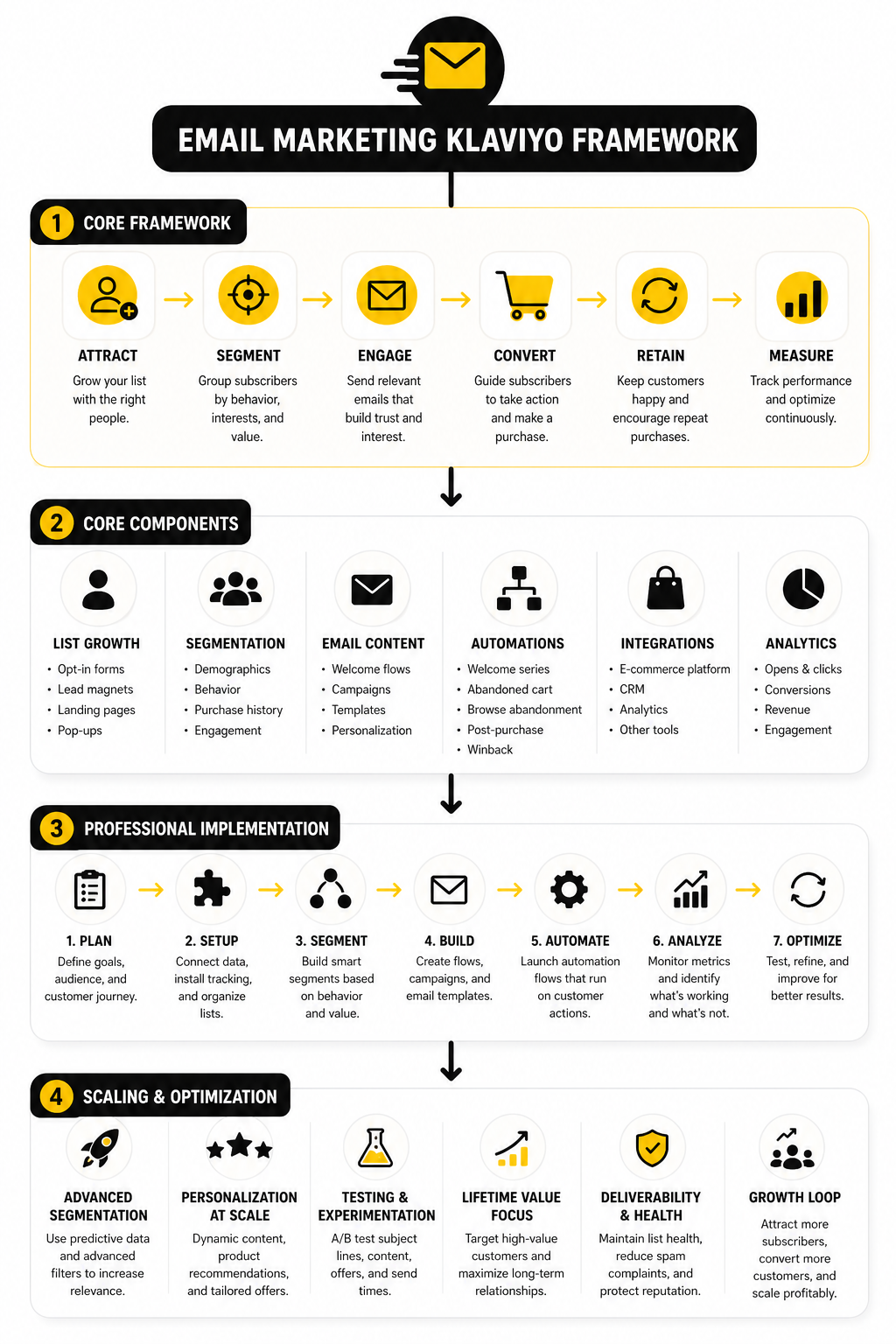
Klaviyo Email Marketing Framework Overview
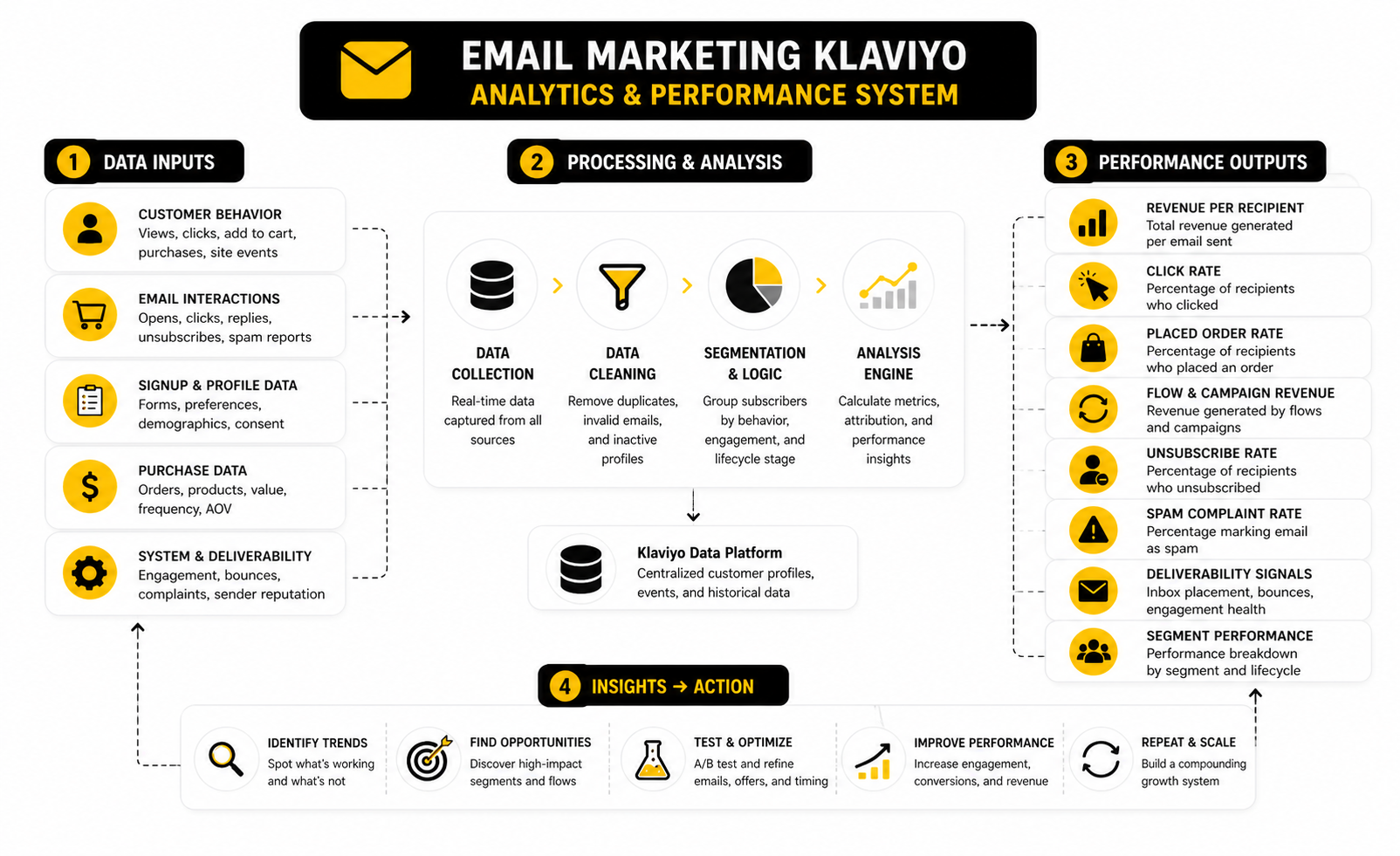
At a high level, Klaviyo isn’t just an email tool—it’s a customer data platform disguised as one. Everything revolves around capturing behavior and turning it into automated communication.
The framework breaks into three layers:
- Data collection
- Segmentation and logic
- Automated and campaign execution
Each layer builds on the previous one. Without clean data, segmentation fails. Without segmentation, automation becomes generic. Without automation, you lose scalability.
Data Collection as the Foundation
Every action a user takes—viewing a product, adding to cart, completing a purchase—feeds into Klaviyo’s system. This creates a real-time profile for each customer.
That data isn’t just stored. It becomes actionable. You can trigger emails based on specific behaviors, time delays, or combinations of events. This allows messaging to match intent instead of guessing it.
For example, someone who views a product three times without purchasing signals a different level of interest than someone who visited once. Klaviyo allows you to build logic around that distinction.
Segmentation That Actually Reflects Behavior
Most brands underuse segmentation. They create basic lists and send the same campaigns to everyone. That approach leaves revenue on the table.
Klaviyo enables dynamic segments based on:
- Purchase frequency
- Average order value
- Browsing behavior
- Engagement levels
This means your messaging evolves with the customer. A first-time visitor, a repeat buyer, and a VIP customer should never receive the same email sequence.
Advanced segmentation can dramatically improve performance. Targeted emails have been shown to drive significantly higher engagement rates than non-segmented campaigns, especially in ecommerce environments where intent varies widely.
Automation as the Growth Engine
Automation is where Klaviyo becomes powerful. Instead of manually sending emails, you build flows that run continuously.
Core flows include:
- Welcome series
- Abandoned cart reminders
- Post-purchase follow-ups
- Winback campaigns
Each flow operates independently but contributes to a unified customer journey. When implemented correctly, these flows create a system that generates revenue daily without manual intervention.
This is where many brands start connecting email with other tools. For example, pairing Klaviyo with conversational platforms like ManyChat can extend automation into SMS, Messenger, or Instagram, creating a multi-channel lifecycle system instead of isolated touchpoints.
Core Components of a High-Performance Klaviyo System
A functional setup is easy. A high-performing system requires precision.
The difference comes down to how well each component is designed and connected. In Klaviyo, four elements determine most of your results: flows, campaigns, segmentation, and deliverability.
Flows That Drive Consistent Revenue
Flows are not optional—they are the backbone of your system. The highest-performing Klaviyo accounts generate the majority of their email revenue from automated sequences rather than campaigns.
Key flows include:
- Welcome flow: converts new subscribers quickly
- Abandoned cart: captures high-intent lost sales
- Browse abandonment: re-engages product interest
- Post-purchase: increases lifetime value
- Winback: recovers inactive customers
Each flow should be optimized individually, but also aligned as part of a broader lifecycle.
Campaigns That Amplify Momentum
Campaigns still matter, but their role is different. Instead of being the primary revenue driver, they act as accelerators.
Strong campaign strategy focuses on:
- Product launches
- Seasonal promotions
- Inventory pushes
- Content-driven engagement
The key is targeting. Sending campaigns to the right segments dramatically improves results compared to blasting your entire list.
Segmentation That Evolves Over Time
Static segments become outdated quickly. High-performing Klaviyo setups use dynamic segments that update automatically.
Examples include:
- Engaged in last 30 days
- High spenders in last 90 days
- At-risk customers based on inactivity
This allows your messaging to stay relevant without constant manual updates.
Deliverability as a Silent Multiplier
Even the best strategy fails if emails don’t reach inboxes. Deliverability depends on:
- Sender reputation
- Engagement rates
- List hygiene
Cleaning inactive subscribers and maintaining consistent sending patterns can significantly impact performance. Small improvements here often lead to disproportionate gains in revenue.
For brands scaling beyond email into full funnel systems, platforms like GoHighLevel can unify CRM, automation, and lead management alongside Klaviyo, creating a more complete growth stack.
This is where most setups stop—but this is only the foundation. The real difference comes from how you implement and optimize these components in practice.
How to Implement Klaviyo Like a Professional
Professional email marketing in Klaviyo starts before the first campaign is written. The real work is in the architecture: what data comes in, how subscribers are grouped, which flows fire first, and how every message supports the customer journey. If that foundation is messy, better copy will not save the system.
A good Klaviyo setup should feel calm, not chaotic. Every flow has a clear job. Every segment has a reason to exist. Every campaign is sent to people who are likely to care.
Start With Clean Account Architecture
The first step is making sure Klaviyo is connected properly to your ecommerce platform, forms, checkout, and tracking events. This sounds basic, but it decides whether the entire system can be trusted. If product views, add-to-cart events, purchases, and consent data are not flowing correctly, your automations will be weak from day one.
You also need consistent naming. Flows, segments, templates, and campaigns should be labeled in a way that any marketer can understand later. A messy account becomes expensive fast because every future change takes longer.
Keep the structure simple at first. You do not need fifty segments and twenty flows on day one. You need clean data, essential automations, and a logical customer journey.
Build the Essential Flows First
The first flows should cover the biggest lifecycle moments. These are the points where customer intent is highest, so they usually produce the fastest impact. Start with the flows that protect revenue before chasing advanced personalization.
The core flow stack should include:
- Welcome series
- Abandoned cart flow
- Browse abandonment flow
- Post-purchase flow
- Customer winback flow
The welcome series introduces the brand and gives new subscribers a reason to buy. The abandoned cart flow recovers people who were close to checkout. The post-purchase flow builds trust after the sale and opens the door for repeat purchases.
Do not overcomplicate these flows. A clean three-email sequence with strong timing, clear offers, and relevant product context will usually beat a bloated ten-email sequence that tries to say everything at once.
Use Segments Before You Use Discounts
Discounts are easy. Strategy is harder.
Before offering a coupon, use Klaviyo segmentation to understand who you are talking to. A first-time visitor may need reassurance. A repeat buyer may need product education. A VIP customer may respond better to early access than a generic discount.
Strong segments often include:
- New subscribers who have not purchased
- Recent buyers
- Repeat customers
- High-value customers
- Engaged non-buyers
- Inactive subscribers
This is where email marketing with Klaviyo becomes more precise. Instead of asking, “What should we send this week?” you ask, “Who needs what message right now?” That shift changes everything.
Map Campaigns to Business Goals
Campaigns should not exist just because the calendar is empty. Every campaign needs a business reason. That reason might be launching a product, moving inventory, increasing repeat purchases, educating buyers, or reactivating a quiet segment.
A practical campaign calendar usually balances:
- Promotional campaigns
- Educational emails
- Product-focused emails
- Brand-building emails
- Seasonal campaigns
The mistake is relying only on promotions. If every email asks for the sale, subscribers eventually tune out. Mix conversion with value so the list stays engaged between offers.
Protect Deliverability From the Start
Deliverability is not something you fix after problems appear. It needs to be protected from the beginning. If your emails land in spam or promotions folders too often, every other metric becomes less reliable.
Good deliverability habits include:
- Sending first to engaged subscribers
- Removing or suppressing inactive contacts
- Avoiding sudden volume spikes
- Keeping spam complaints low
- Using clear sender names and honest subject lines
This part is not glamorous, but it matters. A smaller engaged list is usually more valuable than a large list that ignores you. Klaviyo gives you the tools to segment and clean your audience, but you still need the discipline to use them.
Connect Klaviyo With the Rest of the Funnel
Klaviyo should not live alone. It works best when it connects with the broader customer journey: landing pages, forms, quizzes, SMS, CRM, paid ads, and customer support. The stronger the connections, the more useful your email data becomes.
For ecommerce landing pages, tools like Replo can support dedicated product and campaign pages that feed better traffic into Klaviyo. For broader CRM and automation needs, GoHighLevel can support businesses that want email, pipelines, booking, and client communication in one place.
The point is not to stack tools randomly. The point is to make sure each tool has a role. Klaviyo should own lifecycle email logic, while the rest of the stack supports acquisition, conversion, and retention around it.
Measure What Actually Matters
Open rates are useful, but they are not the finish line. Privacy changes have made opens less reliable as a performance metric, so serious Klaviyo reporting needs to focus deeper in the funnel. Clicks, placed orders, revenue per recipient, repeat purchase rate, and unsubscribe rate tell a clearer story.
Track performance at three levels:
- Flow performance
- Campaign performance
- Segment performance
This lets you see where growth is actually coming from. Maybe abandoned cart is strong but post-purchase is weak. Maybe campaigns perform well with repeat buyers but not with new subscribers. Good reporting turns email from guesswork into a system you can improve.
Advanced Implementation and Scaling Strategies
Once the foundation is in place, email marketing in Klaviyo becomes a process of controlled improvement. You are not guessing what might work. You are watching behavior, adjusting the system, and building more profitable customer journeys over time.
This is where the difference between a basic setup and a serious revenue channel becomes obvious. Basic accounts send emails. Advanced accounts use customer behavior to decide who receives what, when they receive it, and what should happen next.
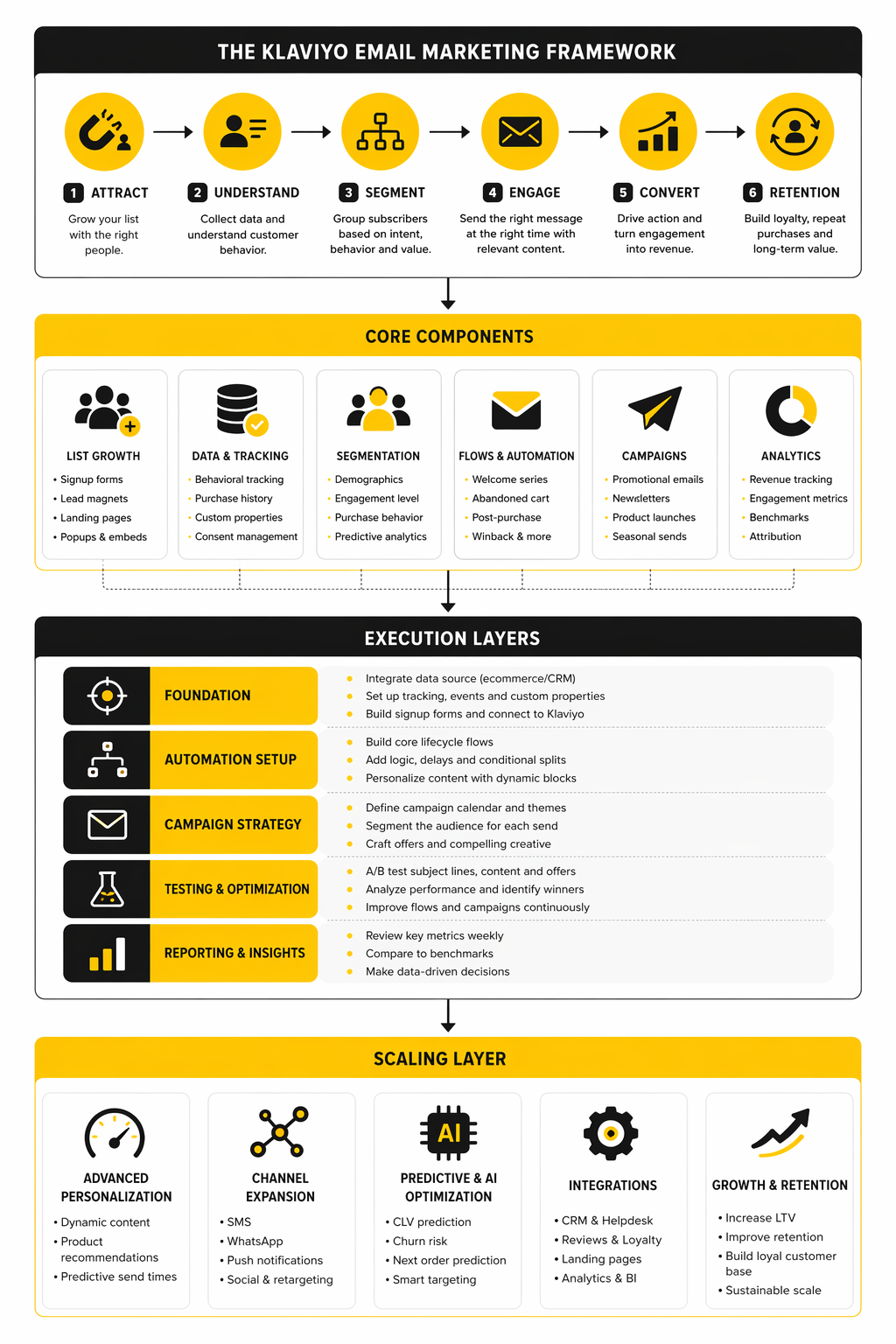
The Klaviyo Execution Process
The implementation process should be simple enough to follow but disciplined enough to scale. You do not need to rebuild everything every week. You need a repeatable operating system that turns data into better decisions.
A strong process looks like this:
- Audit the account and confirm tracking is clean
- Build or refine core lifecycle flows
- Create dynamic segments based on behavior
- Launch campaigns tied to clear business goals
- Review revenue, clicks, conversions, unsubscribes, and deliverability
- Improve one variable at a time
That last point matters. If you change the subject line, offer, design, timing, and audience all at once, you will not know what actually moved the result. Professional implementation is not about doing more. It is about learning faster.
Audit the Account Before You Optimize
The first serious step is an audit. Before creating new flows or campaigns, check whether the current account is technically sound. Many brands skip this and end up optimizing around broken data.
Start by reviewing ecommerce events, consent sources, active forms, suppression settings, segments, templates, and flow logic. Klaviyo’s own flow guidance emphasizes that automations work by triggering messages based on customer actions, so weak tracking creates weak automation. If the system cannot trust the behavior data, it cannot reliably personalize the customer journey.
The audit should also look for overlap. A customer should not receive three competing messages because multiple flows are fighting each other. Suppression rules, smart sending, and clear entry conditions keep the experience clean.
Build Flows Around Customer Intent
Every flow should be built around intent, not just timing. Someone joining a newsletter is not showing the same intent as someone abandoning checkout. Treating both people the same is lazy marketing.
A practical flow structure usually starts with the customer’s current mindset:
- New subscriber: curious but not committed
- Product browser: interested but undecided
- Cart abandoner: close to buying but interrupted or hesitant
- First-time buyer: needs reassurance and a good first experience
- Repeat buyer: ready for deeper product education or cross-sell logic
- Inactive customer: may need a reason to return
This makes the copy easier to write because each email has a job. You are not sending generic “brand updates.” You are answering the question the customer is likely asking at that exact moment.
Set Timing Based on Buying Behavior
Timing should reflect the purchase cycle. A low-cost impulse product can often move quickly. A higher-consideration product may need more education, reassurance, and spacing between messages.
For abandoned cart flows, the first email usually needs to arrive while the purchase is still fresh. Later messages can handle objections, reinforce benefits, or introduce urgency if it is honest. The point is not to pressure people randomly—it is to match the follow-up to the level of intent.
Post-purchase timing works differently. Immediately after purchase, the customer needs confirmation, clarity, and confidence. Later, they may need usage tips, replenishment reminders, review requests, or recommendations based on what they bought.
Personalize Without Making It Weird
Personalization works best when it feels helpful, not creepy. Use product behavior, purchase history, and lifecycle stage to make emails more relevant. Do not overdo it with awkward references that make the customer feel watched.
Useful personalization includes:
- Showing products related to browsing or purchase behavior
- Changing offers based on new versus returning customers
- Sending replenishment reminders when timing makes sense
- Excluding recent buyers from irrelevant promotions
- Giving VIP customers early access or stronger loyalty messaging
This is one of the strongest reasons to use Klaviyo for ecommerce email marketing. The platform can connect customer behavior to message logic without forcing you into a one-size-fits-all campaign calendar.
Improve Forms Before Chasing More Traffic
List growth is not just about getting more visitors. It is about converting the visitors you already have into subscribers with clear, honest value. A weak popup or vague signup form can waste thousands of qualified sessions.
Strong forms usually answer three questions quickly:
- What does the visitor get?
- Why should they care now?
- What happens after they subscribe?
The form should also match the page context. A homepage popup can be broader, while a product-page form can be more specific. If the offer, timing, and message are aligned, Klaviyo captures better subscribers instead of just more subscribers.
For brands building dedicated landing pages around lead capture or product launches, Replo can help create conversion-focused pages that feed stronger traffic into Klaviyo. The goal is simple: make the signup moment feel like a natural next step, not an interruption.
Use Testing to Build a Learning System
Testing should not be random. A/B tests need a reason, a hypothesis, and enough volume to mean something. Otherwise, you are just decorating reports.
Good Klaviyo tests usually focus on:
- Subject lines
- Preview text
- Send timing
- Offers
- Email structure
- Calls to action
- Audience segments
Start with high-impact areas first. Testing a button label on a tiny segment is usually less useful than testing the first email in a welcome flow or the timing of an abandoned cart message. The bigger the leverage point, the more valuable the learning.
Connect Email With SMS Carefully
SMS can be powerful, but it needs restraint. Email can carry education, storytelling, product detail, and longer offers. SMS works better for short, timely messages where the customer expects immediacy.
Do not copy the same campaign across both channels without thinking. A product launch email and a launch SMS can support each other, but they should not feel duplicated. Use SMS for moments where speed matters and email for depth.
If you use a conversational channel alongside Klaviyo, ManyChat can support automation through social messaging while Klaviyo handles the email lifecycle. That combination can work well when each channel has a clear role.
Create a Weekly Optimization Rhythm
The best Klaviyo accounts are not rebuilt constantly. They are reviewed consistently. A weekly rhythm keeps the system improving without turning email into chaos.
A useful weekly review includes:
- Flow revenue and conversion trends
- Campaign revenue per recipient
- Click performance by segment
- Unsubscribe and spam complaint patterns
- Deliverability signals
- New test results
This rhythm forces better decisions. Instead of reacting to one weak campaign, you look for patterns. That is how email marketing with Klaviyo becomes a durable growth channel rather than a series of disconnected sends.
Statistics and Data
Measurement is where email marketing with Klaviyo becomes honest. Strategy sounds good in planning docs, but the numbers show whether people are actually opening, clicking, buying, unsubscribing, or ignoring you. That is why analytics should not be treated as a reporting chore—it should guide what you improve next.
The problem is that most brands look at too many numbers without knowing what they mean. A high open rate can look impressive while revenue stays flat. A campaign can generate sales but damage engagement if it goes to the wrong audience. The point is not to collect metrics; the point is to connect each metric to a decision.
The Metrics That Actually Matter
Klaviyo gives you a lot of data, but a serious email program should focus on the numbers that explain movement through the customer journey. Opens, clicks, conversions, revenue per recipient, unsubscribe rate, spam complaint rate, and list growth all matter—but they do not matter equally in every situation.
Open rate is useful for spotting broad engagement issues, but it should not be your main success metric. Privacy changes and inbox behavior can make opens less reliable than they used to be. Clicks and placed orders usually tell a cleaner story because they show actual intent.
Revenue per recipient is one of the most practical metrics in Klaviyo. It tells you how much value each send creates relative to the size of the audience. Klaviyo’s benchmark tools specifically compare performance by industry, revenue band, and average order value, which makes the number more useful than a generic “good” or “bad” benchmark.
How to Read Benchmarks Without Fooling Yourself
Benchmarks are useful, but only when they are interpreted correctly. A beauty brand, a supplement brand, and a furniture brand should not judge performance by the same exact standard. Purchase cycle, margin, price point, and urgency all change what “good” looks like.
Klaviyo’s current benchmark data is designed to compare email performance by industry and peer group, including open rate, click rate, conversion rate, and revenue per recipient. That matters because a brand selling $25 consumables will naturally behave differently from a brand selling $900 products. The benchmark is a reference point, not a verdict.
Use benchmarks to answer better questions:
- Are flows outperforming campaigns like they should?
- Are engaged segments producing stronger revenue per recipient?
- Are click rates falling because the offer is weak or because the audience is wrong?
- Are unsubscribes rising after heavier promotion periods?
- Are high-intent flows converting below peer expectations?
This is how benchmarks become useful. They should point you toward investigation, not panic.
Campaign Metrics Versus Flow Metrics
Campaigns and flows need to be measured differently because they behave differently. Campaigns are scheduled sends. Flows are triggered by behavior. If you judge both with the same lens, you will make bad decisions.
Campaigns should be evaluated by audience quality, offer strength, timing, and revenue per recipient. A campaign sent to a smaller engaged segment can outperform a larger blast because the message is more relevant. Bigger audience size is not automatically better.
Flows should be evaluated by trigger quality, timing, message sequence, and conversion efficiency. Automated messages often outperform manual campaigns because they respond to real customer behavior. Omnisend’s ecommerce reporting found that automated messages outperformed campaigns across opens, clicks, and conversions, with cart, welcome, and browse abandonment emails driving most automated orders in its dataset.
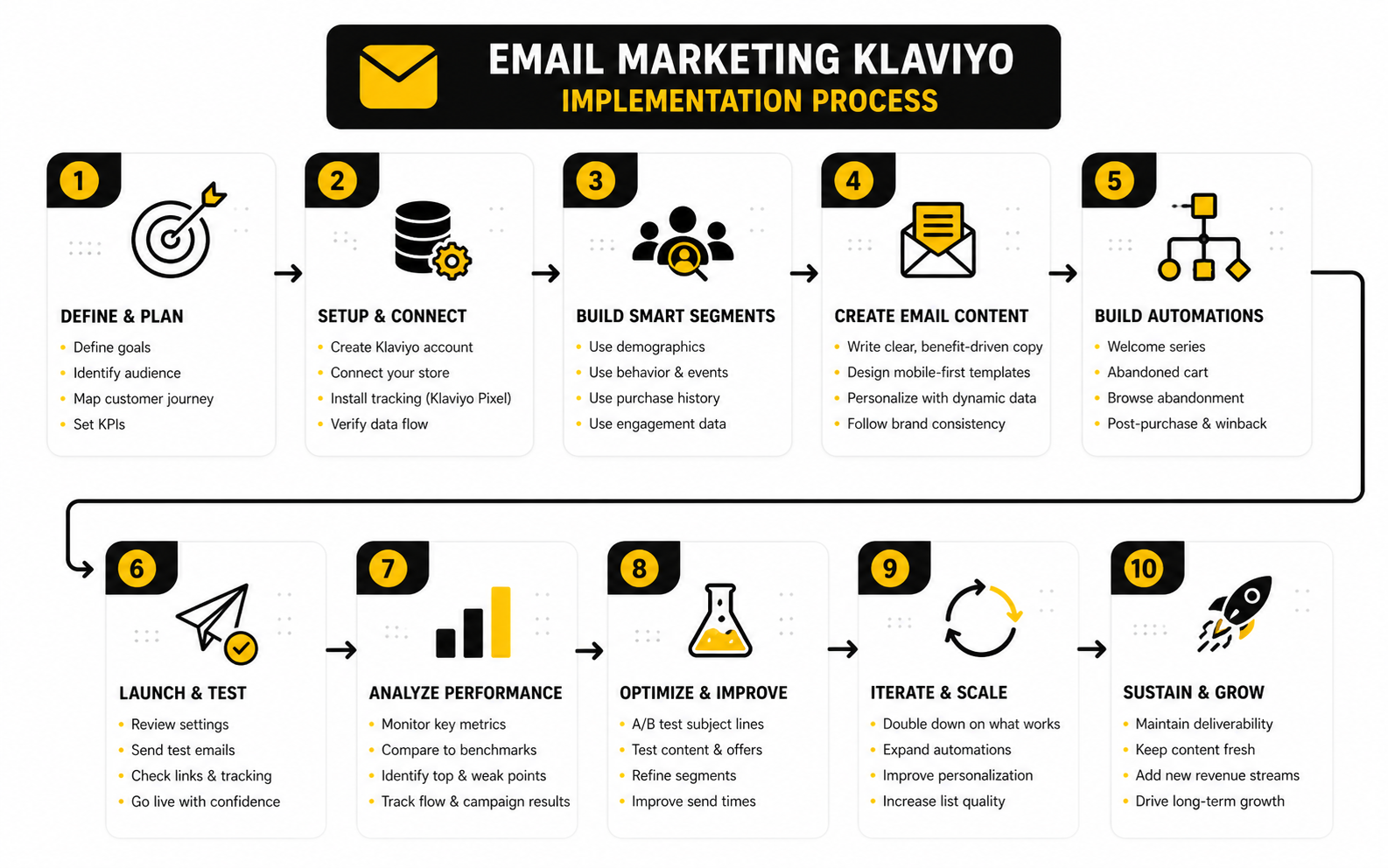
The Analytics System to Review Weekly
A good analytics system is simple. You do not need a giant dashboard that nobody uses. You need a weekly review that tells you what is working, what is weakening, and what deserves the next test.
Review these areas every week:
- Flow revenue by sequence
- Campaign revenue per recipient
- Click rate by audience segment
- Placed order rate by flow
- Unsubscribe rate by campaign type
- Spam complaint patterns
- Deliverability and list engagement
This review should lead directly to action. If abandoned cart revenue is strong but browse abandonment is weak, improve product education and timing. If campaigns perform well with recent buyers but poorly with non-buyers, split the strategy. If unsubscribes rise after discount-heavy sends, reduce pressure and rebuild value.
What Strong Performance Usually Looks Like
Strong Klaviyo performance usually has a few visible patterns. Automated flows generate consistent revenue without needing constant manual effort. Campaigns perform best when sent to intentional segments. The most engaged subscribers click more, buy more, and complain less.
You should also see revenue spread across multiple lifecycle points. If almost all email revenue comes from discount campaigns, the system is fragile. If welcome, abandoned cart, post-purchase, and winback flows all contribute, the account is healthier.
A strong account usually shows:
- Stable flow revenue over time
- Higher revenue per recipient from tighter segments
- Healthy click rates on educational and product emails
- Low complaint rates
- Predictable campaign performance by audience type
- Clear improvement from testing
That does not mean every email wins. It means the system produces enough signal to keep improving.
What Weak Performance Is Telling You
Weak numbers are not just failures. They are feedback. The key is knowing what kind of feedback you are seeing.
Low open rates can point to weak subject lines, poor sender reputation, or an unengaged list. Low click rates usually point to poor message-market fit, weak creative, unclear calls to action, or the wrong audience. Low conversion after strong clicks usually means the issue may be on the offer, product page, landing page, price, or checkout experience.
This is where email analytics connects to the rest of the funnel. If subscribers click but do not buy, the email did its first job. The next problem may be the landing page, offer clarity, product positioning, or buying friction. For brands that need better campaign landing pages, Replo can support product-specific pages that keep the message consistent after the click.
Revenue Attribution Needs Context
Klaviyo attribution is useful, but it should not be treated as absolute truth. Attribution windows can make email look stronger or weaker depending on how they are configured. A customer may see an ad, receive an email, click later, and purchase after another touchpoint.
That does not make Klaviyo reporting useless. It means you should use attribution directionally and compare trends consistently over time. The goal is to understand whether email is becoming more efficient, not to argue over a single perfect number.
A practical approach is to combine Klaviyo metrics with store revenue, customer lifetime value, repeat purchase rate, and paid media performance. When email revenue grows while paid acquisition becomes more efficient or repeat purchase improves, the system is doing real work. That is the level of measurement that actually helps the business.
The Action Behind the Numbers
Data only matters if it changes behavior. If a report does not lead to a decision, it is decoration.
Use Klaviyo analytics to decide what to do next:
- Improve weak flow steps before building new flows
- Send campaigns to narrower segments when engagement drops
- Test offers only after audience and message fit are clear
- Clean inactive subscribers before deliverability suffers
- Watch revenue per recipient instead of chasing list size
- Compare performance by lifecycle stage, not just campaign average
This is the real advantage of email marketing with Klaviyo. You are not forced to rely on broad assumptions. You can see how different customers behave, adjust the journey, and make the next send more relevant than the last one.
Advanced Considerations Before You Scale
Scaling email marketing with Klaviyo is not just about sending more emails. It is about increasing relevance while controlling risk. The bigger your list gets, the more every weakness becomes visible.
A small account can survive messy segments, weak consent tracking, and inconsistent reporting for a while. A larger account cannot. Once volume increases, deliverability issues, attribution confusion, and customer fatigue can start costing real money.
The Tradeoff Between Revenue and List Health
There is always pressure to send more. More campaigns usually means more short-term revenue, especially if the list is large and the offer is strong. But that does not mean more sending is always the right move.
If unsubscribes, spam complaints, and disengagement rise after heavier sending periods, the extra revenue may be hiding long-term damage. This is where you need discipline. A healthy email program protects future inbox placement, not just this week’s sales.
Klaviyo’s active profile guidance recommends managing inactive profiles so brands are not paying for contacts that do not generate revenue. That matters because list size alone is not an asset. An engaged list is an asset.
When to Use Discounts and When to Avoid Them
Discounts can work, but they are not a strategy by themselves. If every flow and campaign depends on a coupon, customers learn to wait. That weakens margin and makes your brand feel less valuable.
Use discounts where they support a clear conversion moment. A first-purchase incentive can make sense. A cart recovery offer can make sense if the customer has shown strong buying intent. A blanket discount to the entire list every week usually signals weak positioning.
Better alternatives often include:
- Early access
- Bundles
- Free shipping thresholds
- Loyalty perks
- Product education
- Limited-edition drops
- Personalized recommendations
The goal is not to avoid offers. The goal is to stop using discounts as a substitute for relevance.
Predictive Data Should Guide Priority, Not Replace Judgment
Klaviyo’s predictive analytics can estimate useful signals like customer lifetime value, churn risk, and expected next order timing. That makes it easier to prioritize customer groups instead of treating everyone the same. Used well, this helps brands send smarter retention, winback, and replenishment campaigns.
But predictive data is not magic. Predictions work best at the group level, not as perfect forecasts for one individual customer. You still need to review behavior, purchase history, margin, and product context before making aggressive decisions.
A practical use case is prioritizing retention. If a group has high predicted value and rising churn risk, they deserve a different message than low-value inactive subscribers. That is how advanced email marketing in Klaviyo becomes more strategic: you focus effort where the upside is highest.
Compliance Is Part of the Growth System
Compliance is not just legal housekeeping. It directly affects trust, deliverability, and brand reputation. If subscribers do not understand what they opted into, they are more likely to ignore emails, unsubscribe, or mark messages as spam.
Email programs need clear consent, honest signup language, visible unsubscribe options, and accurate sender details. Global rules like GDPR, CAN-SPAM, CASL, and CPRA all reinforce the same practical idea: people should know what they are signing up for and have control over how they hear from you.
This also affects your forms. Do not hide consent inside vague language. Do not make unsubscribe difficult. A smaller list built with clear permission will usually outperform a larger list built with friction, confusion, or pressure.
Channel Expansion Needs Clear Boundaries
Once Klaviyo performs well, it is tempting to add every possible channel. SMS, WhatsApp, Messenger, Instagram automation, CRM workflows, retargeting audiences, and AI chat can all be useful. But channel expansion without boundaries creates noise.
Each channel needs a job. Email can carry depth. SMS can deliver urgency. Social messaging can support conversations. CRM automation can move leads and customers through operational stages.
For brands that want conversational automation beyond email, ManyChat can support social and messaging flows. For service businesses or agencies that need CRM, pipeline, booking, and broader automation alongside email, GoHighLevel can make more sense as the operating layer around the customer relationship.
Scaling Requires Better Creative Operations
As the email program grows, creative becomes a bottleneck. More segments and more lifecycle stages require more messages, but that does not mean every email needs to be built from scratch. The solution is a modular creative system.
A strong creative system includes reusable blocks for:
- Product benefits
- Social proof
- Founder notes
- FAQs
- Offer explanations
- Reviews
- Comparison points
- Shipping and guarantee messaging
This keeps production fast without making every campaign feel identical. It also makes testing easier because you can isolate which message blocks improve clicks and conversions.
Your Email Calendar Should Reflect Customer Energy
Not every week deserves the same sending intensity. Some weeks are promotional. Some are educational. Some are better for retention, replenishment, or content.
A mature Klaviyo calendar should match customer energy, inventory needs, and business priorities. That means planning around product launches, seasonal demand, stock levels, customer buying cycles, and list engagement. Sending just because “we need an email this week” is how lists get tired.
The best calendar is not the busiest one. It is the one that keeps the relationship valuable while still driving revenue.
Know When Klaviyo Is Not the Whole Answer
Klaviyo can do a lot, but it cannot fix every business problem. If the product page is weak, email clicks may not convert. If the offer is unclear, segmentation will not solve it. If fulfillment is poor, post-purchase emails cannot fully repair trust.
This is why email should be connected to the full funnel. Landing pages, checkout flow, customer support, reviews, retention offers, and product positioning all shape the result. Tools like Replo can help when the issue is the page experience after the click, while Klaviyo handles the lifecycle logic before and after it.
The advanced move is knowing where the constraint actually is. Sometimes the email needs work. Sometimes the audience needs work. Sometimes the page, product, or offer is the real problem. Mature operators do not guess—they trace the drop-off and fix the weakest link.
Common Mistakes, FAQs, and Final Takeaways
The best Klaviyo systems are not the most complicated ones. They are the ones where data, timing, creative, segmentation, and customer intent all work together without creating noise. That is the final point: email marketing with Klaviyo should feel like a system, not a pile of disconnected sends.
When everything is connected, the customer experience becomes smoother. New subscribers are welcomed properly. Buyers get useful follow-up. Inactive customers receive relevant reactivation. Campaigns support the business without burning out the list.
FAQ - Built for Complete Guide
What is Klaviyo used for in email marketing?
Klaviyo is used to create email campaigns, automated flows, customer segments, signup forms, and lifecycle messaging. It is especially popular with ecommerce brands because it connects customer behavior directly to email automation. That means brands can send messages based on actions like browsing, cart abandonment, purchasing, or becoming inactive.
Is Klaviyo only for ecommerce brands?
Klaviyo is strongest for ecommerce, but it is not limited to ecommerce. Any business with customer data, repeat purchase potential, or lifecycle communication needs can use it. That said, brands using platforms like Shopify, WooCommerce, BigCommerce, or Magento usually get the most immediate value because Klaviyo integrates deeply with those systems.
Why is Klaviyo better than a basic email platform?
A basic email tool usually helps you send newsletters. Klaviyo goes deeper by connecting customer behavior, purchase history, predictive data, and segmentation into one email marketing system. That makes it better for brands that want automation, personalization, and revenue tracking instead of simple broadcasts.
What are the most important Klaviyo flows?
The most important flows are the welcome series, abandoned cart, browse abandonment, post-purchase, replenishment, winback, and sunset flows. These flows cover the main customer lifecycle stages from first signup to repeat purchase and reactivation. You do not need every advanced flow immediately, but the core lifecycle flows should be built early.
How many emails should be in a Klaviyo welcome flow?
Most welcome flows work well with three to five emails. The first email should deliver the signup promise and introduce the brand clearly. Later emails can handle product education, social proof, objections, and the first-purchase offer if one is being used.
How often should a brand send Klaviyo campaigns?
There is no universal sending frequency that works for every brand. A brand with a highly engaged list and frequent product drops can send more often than a brand with a long buying cycle. The right answer depends on engagement, unsubscribe rate, spam complaints, customer buying behavior, and whether each campaign has a real reason to exist.
What Klaviyo metrics matter most?
The most useful Klaviyo metrics are revenue per recipient, click rate, placed order rate, flow revenue, unsubscribe rate, spam complaint rate, and deliverability signals. Open rate can still provide context, but it should not be the main performance measure. The goal is to understand whether emails are creating real customer action, not just inbox activity.
Should Klaviyo emails include discounts?
Discounts can help, but they should be used carefully. If every campaign relies on a coupon, customers learn to wait for the next offer. A stronger strategy uses discounts only where they support a clear conversion moment and balances them with education, bundles, early access, loyalty perks, and product recommendations.
How does segmentation improve Klaviyo performance?
Segmentation improves performance by making emails more relevant. New subscribers, first-time buyers, repeat customers, VIPs, and inactive subscribers all need different messages. When campaigns and flows reflect those differences, engagement and revenue usually become more consistent.
What is the biggest mistake brands make with Klaviyo?
The biggest mistake is treating Klaviyo like a newsletter tool instead of a customer lifecycle system. Brands often build a few flows, send random campaigns, and never review the data properly. The better approach is to connect tracking, segmentation, automation, creative, and weekly optimization into one operating rhythm.
Can Klaviyo replace a CRM?
Klaviyo can manage a lot of customer communication, but it does not replace every CRM use case. Ecommerce brands may use it as the main lifecycle marketing platform, while service businesses or agencies may still need a broader CRM for pipelines, appointments, sales tasks, and client management. In that case, a tool like GoHighLevel can sit around the wider relationship while Klaviyo handles ecommerce email logic.
How long does it take to see results from Klaviyo?
Some results can appear quickly once core flows are live, especially welcome and abandoned cart sequences. Deeper gains take longer because they depend on testing, list growth, better segmentation, and stronger lifecycle planning. The real value compounds as the account collects more data and the system becomes more precise.
Is Klaviyo worth it for small brands?
Klaviyo can be worth it for small brands if they have enough traffic, subscribers, or purchase activity to benefit from automation. If a brand has almost no list and no acquisition system, the first priority may be traffic and lead capture. Once people are entering the funnel consistently, Klaviyo becomes much more valuable.
What should be optimized first in Klaviyo?
Start with tracking, consent, deliverability, and the core flows. After that, improve the highest-leverage emails inside the welcome, abandoned cart, and post-purchase sequences. Campaign testing should come after the foundation is clean, because better campaigns cannot fully compensate for weak account architecture.
Work With Professionals
Explore 10K+ Remote Marketing Contracts on MarkeWork.com
Most marketers spend too much time chasing clients, competing on crowded platforms, and losing a percentage of every project to middlemen.
MarkeWork gives you a better way. Browse thousands of remote marketing contracts and connect directly with companies desperate to hire skilled marketers like you, without platform commissions and without unnecessary gatekeepers.
If you're serious about finding better opportunities and keeping 100% of what you earn, explore available contracts and create a profile for free at MarkeWork.com.