

Here’s how this article will be structured:
- Why Email Lists Matter in Marketing
- Why “Email Marketing Lists for Sale” is a Misleading Idea
- Legal & Compliance Framework for Email Lists
- Core Risks When You Buy Email Lists
- Alternatives to Buying Email Lists
- Best Practices for Growing an Email List
Why Email Lists Matter in Marketing
Email remains one of the most effective digital marketing channels for nurturing relationships and driving sales because you communicate directly with people who have shown interest in your brand.
Many marketers chase scale early and look for shortcuts like purchasing contacts, thinking that a bigger list instantly equals more customers. The reality is quite different — the quality of your list usually matters far more than its size when it comes to engagement and conversions.
That belief in shortcuts leads people to search for “email marketing lists for sale,” but it’s important to understand what that phrase actually implies and why it’s controversial.
Why “Email Marketing Lists for Sale” is a Misleading Idea
The notion of buying an email list sounds appealing: pay once, get a database of thousands of addresses, and send your offer. But most email list vendors do not provide lists where every contact has explicitly opted in to receive your marketing messages. A purchased list might contain addresses gathered for some other purpose, then resold to many buyers — so recipients never consented to hear from your business specifically.
Because modern email standards require clear consent, lists for sale often fail to meet that requirement, and reputable email platforms will flag or block campaigns that try to use them.
Even if a seller claims the list is “opt‑in,” you cannot independently verify how the consent was collected. That means responding to a purchased list carries real risks that go beyond simple performance metrics.
Legal & Compliance Framework for Email Lists
Email marketing isn’t just a best‑practice playbook — it intersects with privacy and electronic communication laws globally.
In the European Union under GDPR, email contacts must consent specifically to receive communication from your business. A list you buy from someone else typically doesn’t meet that standard, and violating consent requirements can expose your company to fines up to €20 million or 4 % of annual revenue.
Canada’s CASL also demands express consent for commercial emails, and the CAN‑SPAM Act in the U.S. prohibits sending unsolicited marketing emails. None of these rules explicitly make it illegal to purchase a list, but they do make it unlawful to send marketing messages without proper consent — which is almost always what happens with purchased lists.
On top of that, most email service providers prohibit importing third‑party lists into their platforms because poor consent damages deliverability and their infrastructure reputation.
Core Risks When You Buy Email Lists
- Deliverability Damage
Purchased lists often include stale, invalid, or spam‑trap addresses. Sending to these can spike bounce rates and trigger spam filters, leading to poor deliverability even to your legitimate contacts later.
- Low Engagement & Conversion
People on a bought list didn’t ask for your emails, so they’re far less likely to open, click, or convert compared to a list that opted in organically. Some data suggests open rates on purchased lists can be dramatically lower than organically built lists.
- Legal Exposure
Because you often can’t prove how consent was collected — or if it even exists — sending marketing emails to a purchased list can leave your business exposed to enforcement from privacy regulators.
- Reputation Harm
Marketers and email service providers alike warn that purchased lists undermine trust. People mark unsolicited emails as spam, and repeated complaints can hurt your sender reputation for all future campaigns.
Alternatives to Buying Email Lists
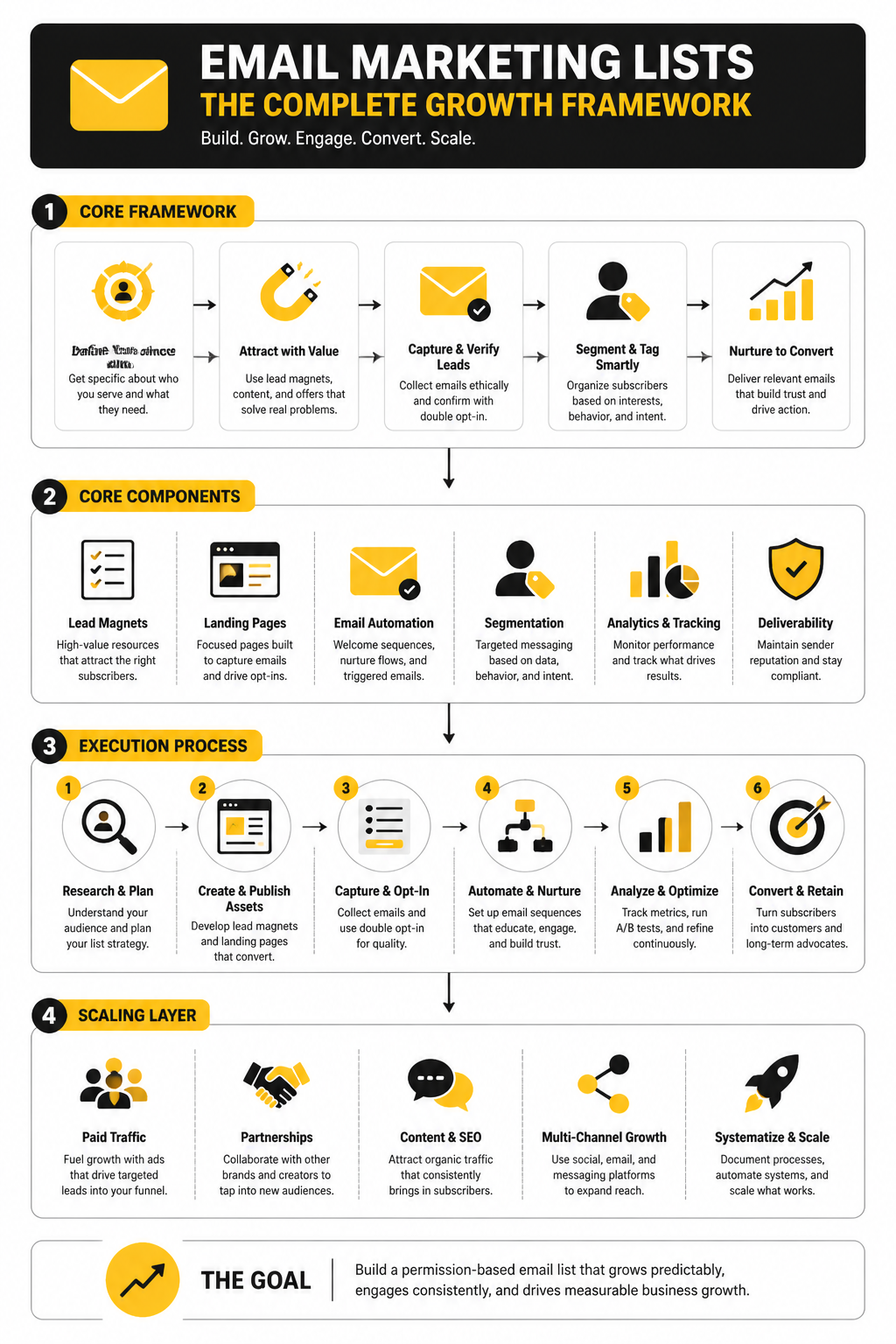
Instead of buying a list, most marketers find far better long‑term success with strategies that earn consent, such as:
- Offering high‑value lead magnets (guides, templates, tools)
- Running paid traffic campaigns that convert visitors into subscribers
- Partnering with complementary brands for co‑promotions
- Leveraging paid newsletter placements or sponsorships
These methods help you build a first‑party email list of people who explicitly want to hear from you, which boosts engagement and creates an asset you control.
Best Practices for Growing an Email List
- Use double opt‑in to confirm subscribers genuinely want your emails.
- Clearly communicate what subscribers will receive and how often.
- Segment your list based on interests so you send relevant content.
Building your list this way takes effort, but the results — higher open rates, higher conversion rates, and lower legal risk — make it worth it compared to chasing “email marketing lists for sale.”
Alternatives to Buying Email Lists
At this point, the pattern should be clear: chasing “email marketing lists for sale” is usually a shortcut that creates more problems than it solves. What actually works in modern marketing is building permission-based attention — people choosing to hear from you.
The difference is not subtle. Campaigns sent to opt-in audiences consistently outperform cold outreach, with email marketing ROI estimates reaching $36–$42 for every $1 spent. That kind of return doesn’t come from random contacts — it comes from relevance and trust.
Build Your Own Audience With Lead Magnets
A lead magnet is the simplest and most reliable starting point. You offer something genuinely useful in exchange for an email address — a guide, checklist, calculator, or tool.
The key is specificity. Generic “free ebooks” rarely convert anymore, but focused assets tied to a clear outcome still perform extremely well. For example, a SaaS company offering a “conversion audit checklist” or an ecommerce brand sharing a “product selection quiz” creates immediate relevance.
To capture and manage these leads effectively, tools like Brevo or Moosend help you automate opt-ins, confirmations, and follow-up sequences without compromising compliance.
Use Funnels Instead of Lists
Instead of buying a static list, build a dynamic system that continuously generates new subscribers.
A funnel typically includes:
- A landing page with a clear value proposition
- A lead magnet or offer
- A follow-up email sequence
- A conversion goal (purchase, call booking, etc.)
Platforms like ClickFunnels or Systeme.io make this process straightforward by combining pages, automation, and tracking in one place.
The shift here is important: you’re not buying access to attention — you’re building a machine that earns it repeatedly.
Partner With Existing Audiences
If speed is your concern, partnerships outperform purchased lists almost every time.
Instead of buying contacts, you collaborate with someone who already has a trusted audience. That could be:
- Newsletter sponsorships
- Joint webinars
- Co-branded lead magnets
- Affiliate collaborations
This works because the trust is transferred. When a respected brand introduces you, your conversion rates are significantly higher than cold outreach to a purchased list.
Leverage Paid Traffic the Right Way
Paid traffic is often misunderstood. Many marketers think ads are expensive because they try to send traffic directly to a sale.
A more effective approach is to use ads to grow your email list first. You acquire leads at a predictable cost, then monetize them through follow-up sequences.
When paired with a strong funnel, this approach scales cleanly. Tools like GoHighLevel combine CRM, automation, and funnel building so you can track every step — from first click to final conversion — without relying on questionable data sources.
Turn Conversations Into Subscribers
Modern list growth isn’t limited to forms anymore. Messaging platforms are becoming a powerful entry point for building audiences.
With tools like ManyChat, you can convert social media interactions into subscribers by guiding users from chat into email opt-ins.
This creates a more natural entry point. Instead of interrupting people with unsolicited emails, you engage them where they already are and then invite them into your ecosystem.
Best Practices for Growing an Email List
Once you commit to building your own list instead of buying one, the next step is doing it correctly. The difference between an average list and a high-performing one comes down to execution.
Prioritize Consent and Transparency
Every subscriber should clearly understand what they’re signing up for. That includes:
- What type of emails they’ll receive
- How often you’ll contact them
- What value they can expect
This isn’t just about compliance — it directly impacts engagement. Clear expectations reduce unsubscribes and spam complaints while increasing trust.
Use Double Opt-In Strategically
Double opt-in requires users to confirm their subscription via email before being added to your list.
While it may reduce initial sign-up volume slightly, it dramatically improves list quality. Confirmed subscribers are more likely to engage, which strengthens your sender reputation and long-term deliverability.
Segment Early and Often
Not all subscribers are the same, and treating them as one group limits your results.
Segmentation allows you to tailor content based on:
- Interests
- Behavior
- Purchase history
- Engagement level
Even simple segmentation can significantly increase performance. Targeted emails consistently outperform generic campaigns because they feel relevant rather than intrusive.
Focus on Long-Term Value
The biggest mistake marketers make is treating email like a short-term sales channel.
If every email is a pitch, subscribers lose interest quickly. Instead, balance promotional content with value-driven communication — insights, updates, and useful information that keeps people engaged.
Over time, this approach builds a relationship. And that relationship is what turns an email list into a real business asset.
The takeaway is straightforward: while “email marketing lists for sale” might look like a shortcut, the real leverage comes from building a system that attracts, earns, and retains attention.
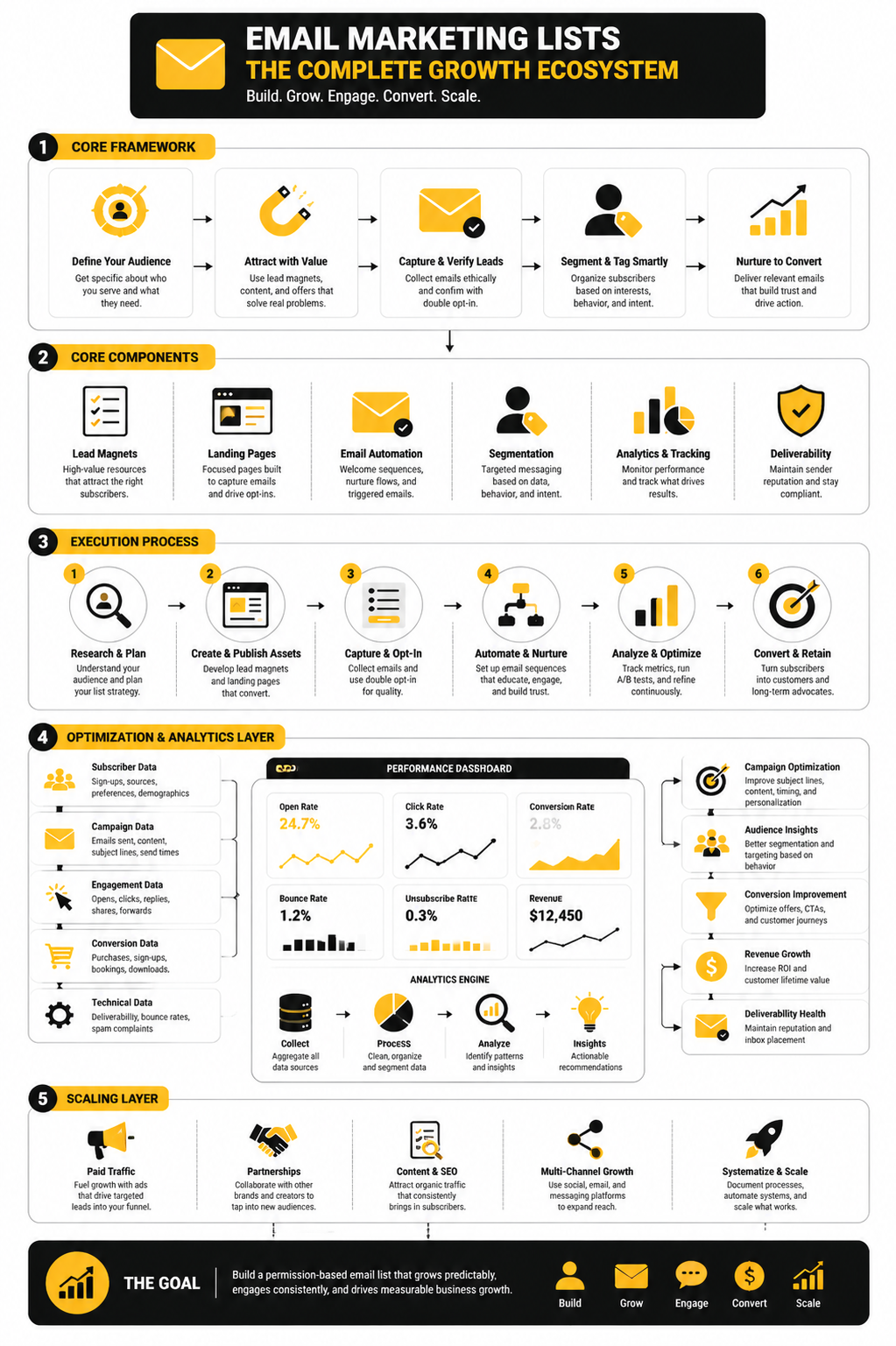
Professional Implementation of an Email List Growth System
Building your email list the right way requires a structured process. This isn’t just about having the right tools — it’s about executing a system that consistently attracts, qualifies, and engages subscribers. When implemented correctly, your list becomes a business asset that grows predictably over time.
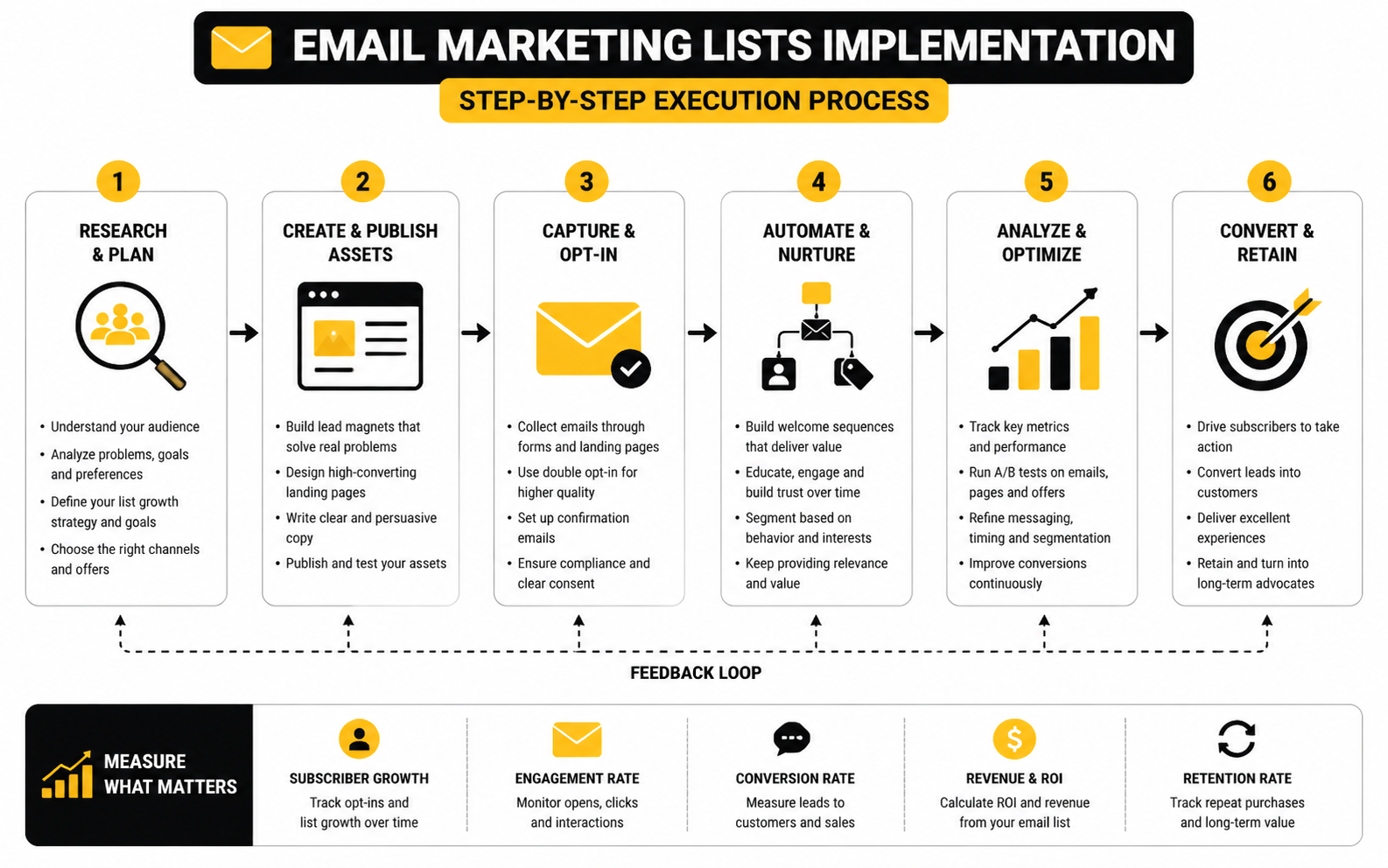
Step 1: Define Your Audience and Offer
Before collecting emails, clarify exactly who you want to reach and what problem you solve for them. A well-defined audience ensures your content and offers resonate.
- Identify demographics, interests, and behaviors.
- Craft a lead magnet that solves a specific pain point.
- Map out how your offer leads naturally to your main product or service.
This step prevents wasted sign-ups and ensures each subscriber has a higher chance of engagement and conversion.
Step 2: Set Up the Funnel Infrastructure
Once your audience and offer are clear, create a funnel that guides them from first interaction to subscription.
- Use platforms like ClickFunnels or GoHighLevel to handle landing pages, opt-ins, and automated follow-ups.
- Ensure your funnel includes a thank-you page and a double opt-in confirmation for compliance.
- Integrate analytics to track conversions at each stage.
A clean, automated funnel reduces friction and maximizes the effectiveness of each lead.
Step 3: Capture and Segment Leads
Not all subscribers are the same, so segmenting early allows for targeted messaging.
- Collect data through forms or quizzes during the opt-in process.
- Tag leads based on interests, behavior, or source.
- Store this data in a CRM or email platform to allow personalized campaigns later.
Segmented lists increase open and click-through rates because emails are relevant to each recipient.
Step 4: Create a Content Plan
Your list won’t stay engaged if you only send promotional messages. Develop a mix of valuable content, updates, and offers.
- Schedule regular newsletters and automated sequences.
- Use storytelling, insights, and tips to maintain trust.
- Highlight case studies, tutorials, or product benefits without over-selling.
A strong content strategy keeps your audience connected and ready to convert when you present an offer.
Step 5: Test, Optimize, and Scale
Even with a solid setup, continuous improvement is crucial.
- Test subject lines, content formats, and send times.
- Monitor engagement metrics like open rates, click-throughs, and conversions.
- Scale successful campaigns by increasing traffic to high-performing funnels.
Iterative optimization ensures your list grows in quality and size while maintaining high engagement rates.
Step 6: Maintain Compliance and Deliverability
Legal compliance and email deliverability are the backbone of sustainable email marketing.
- Regularly clean your list to remove inactive or invalid addresses.
- Ensure GDPR, CAN-SPAM, and CASL standards are followed.
- Monitor sender reputation to avoid being blacklisted.
Following these standards not only keeps you safe legally but also ensures your emails reach the inbox consistently.
Executing this process transforms email marketing from a risky shortcut into a reliable growth engine, outperforming any purchased list and building a sustainable business asset.
Measuring Email List Performance and Analytics
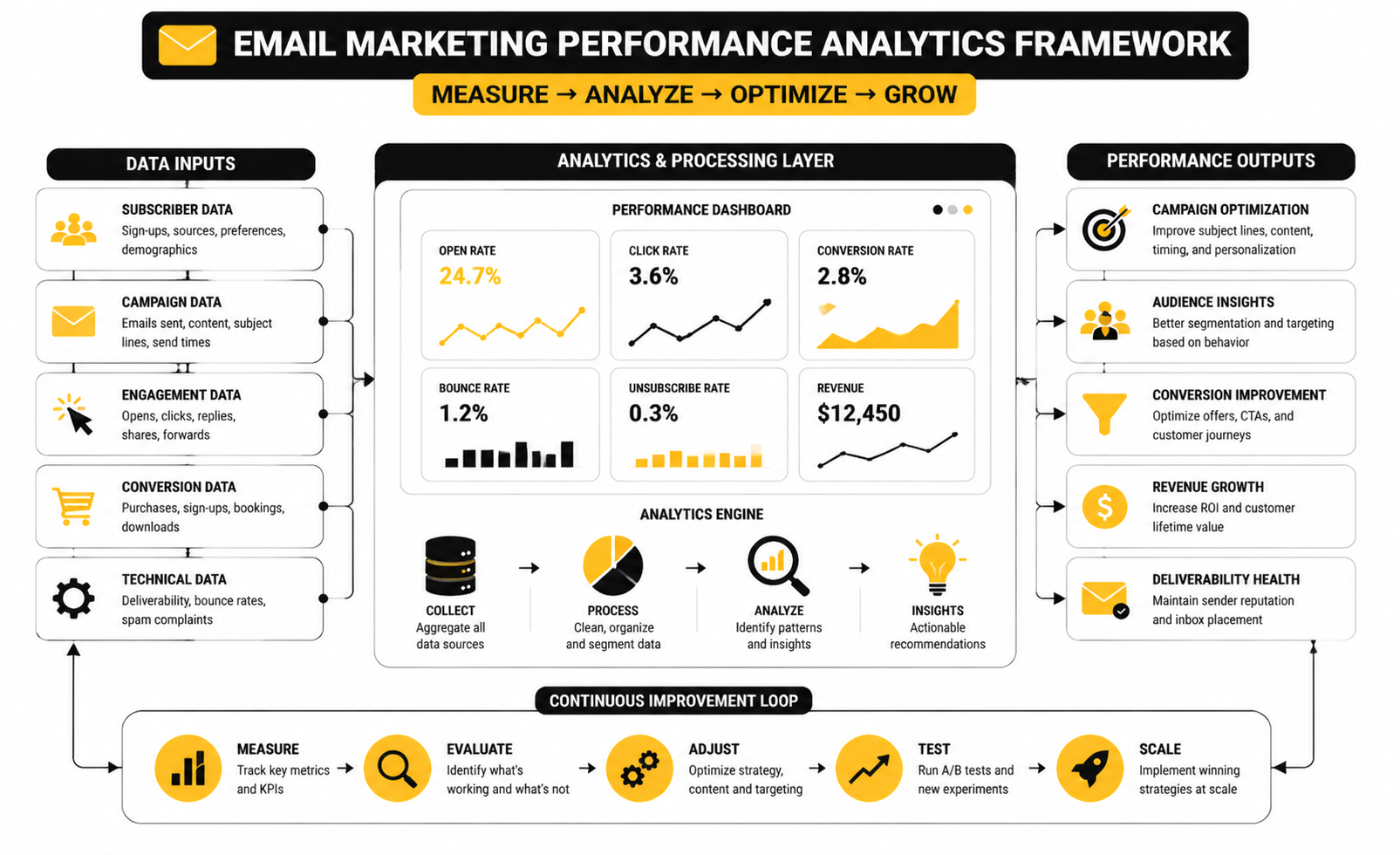
Understanding the numbers behind your email marketing efforts is critical. If you skip analytics, you’re flying blind — you won’t know which strategies are working, which segments engage most, or how to allocate resources for maximum growth.
Key Metrics to Track
- Open Rate
Open rate tells you whether your subject lines and timing are effective. If your rate is low, even a high-quality list won’t perform well without adjustments. Benchmarks vary by industry, but average B2B email open rates hover around 21–25%.
- Click-Through Rate (CTR)
CTR indicates whether your content resonates and prompts action. A high open rate with low CTR signals the need to refine messaging, offers, or call-to-actions.
- Conversion Rate
Conversion is the ultimate measure of success — it shows whether your list drives revenue or leads. This metric informs decisions on funnel adjustments, lead magnets, and follow-up sequences.
- Bounce and Complaint Rates
High bounce rates suggest outdated or invalid emails, while complaints point to misaligned expectations. Both can hurt deliverability and brand reputation, emphasizing the importance of maintaining a clean, engaged list.
How to Interpret the Data
Metrics aren’t just numbers — they tell a story:
- Compare segments: Are leads from a certain lead magnet performing better than others?
- Identify drop-off points: Where in the funnel do subscribers disengage?
- Test changes: Subject lines, send times, or email content can be tested against these metrics to refine performance.
Using Analytics to Drive Action
Data without action is wasted. Use insights to:
- Optimize funnel components for higher conversion.
- Re-engage dormant subscribers with targeted campaigns.
- Allocate budget to acquisition channels that produce the highest ROI, like GoHighLevel or ClickFunnels powered funnels.
When measured consistently, your metrics turn an email list from a simple contact repository into a predictive tool for revenue and growth. Effective analytics allows marketers to see what works, replicate success, and minimize wasted effort on purchased or poorly engaged contacts.
Advanced Considerations for Email List Strategy
Once you’ve built a compliant, opt-in email list, the next level is strategic management. At this stage, it’s not about collecting addresses — it’s about turning your list into a high-performing growth engine.
Balancing Growth and Quality
A common trap is chasing sheer numbers. Larger lists can feel impressive, but engagement is what drives revenue. Low-engagement subscribers increase the risk of spam complaints and reduce deliverability.
- Focus on quality leads from your most relevant sources.
- Prune inactive or unresponsive contacts periodically.
- Test acquisition channels to determine which produce long-term value.
Prioritizing quality over quantity may slow growth initially, but it creates a more sustainable asset.
Scaling Campaigns Without Losing Engagement
Scaling campaigns requires careful planning. Sending more emails without considering subscriber behavior can backfire.
- Use segmentation and behavior-based triggers to maintain relevance.
- Automate follow-ups and nurture sequences with tools like GoHighLevel or Brevo.
- Monitor metrics continuously to prevent list fatigue.
Scaling is about maintaining engagement, not just increasing volume.
Mitigating Risk From Third-Party Sources
Even when not buying lists, some marketers use third-party integrations or co-marketing arrangements. These can introduce risk if consent isn’t explicit.
- Verify that partners’ leads meet compliance standards.
- Track source-specific engagement to isolate underperforming segments.
- Avoid bundling purchased or rented lists into your campaigns.
This approach ensures your brand reputation and deliverability remain intact.
Strategic Tradeoffs
Every email marketing strategy involves tradeoffs:
- Immediate revenue vs. long-term engagement: Aggressive promotions can spike short-term revenue but harm retention.
- Acquisition speed vs. list quality: Rapid lead generation can produce large lists, but engagement may suffer.
- Automation vs. personalization: Full automation improves efficiency, but personalized touches often yield higher conversions.
Understanding these tradeoffs helps marketers make informed decisions instead of chasing quick fixes like “email marketing lists for sale.”
Expert-Level Optimization
For seasoned marketers, small refinements make a big difference:
- Implement A/B testing on subject lines, copy, and calls-to-action.
- Analyze engagement decay and re-engagement campaigns.
- Apply predictive segmentation to target high-value subscribers for offers.
Expert optimization ensures your email program scales efficiently while consistently driving measurable business outcomes.
FAQ - Built for Complete Guide
1. Are email marketing lists for sale legal to buy?
Buying lists is not inherently illegal, but sending emails without explicit consent violates laws like GDPR, CAN-SPAM, and CASL. Legal risk arises when recipients never opted in to receive your messages.
2. Will purchased email lists convert well?
Conversion is usually low because contacts haven’t expressed interest in your brand. Opt-in subscribers from targeted funnels typically outperform purchased leads in engagement and sales.
3. How do I know if a purchased list is “opt-in”?
Claims of opt-in are often unverifiable. Reputable email platforms block campaigns sent to lists that lack confirmed consent, so relying on a seller’s word is risky.
4. Can buying lists hurt my sender reputation?
Yes. High bounce rates, spam complaints, and unengaged recipients can negatively impact deliverability for all future campaigns, not just the purchased list.
5. What’s the cost difference between buying a list and building organically?
Buying a list may seem cheaper upfront, but engagement, conversions, and legal issues often make it far more expensive than growing a list through opt-in funnels.
6. How can I segment a growing email list effectively?
Use tags, behavior tracking, or lead magnet source information to create segments. Targeted messaging improves engagement and prevents list fatigue.
7. What metrics indicate a healthy email list?
Key indicators include open rate, click-through rate, conversion rate, and low bounce/complaint rates. Consistently monitoring these helps optimize campaigns.
8. Are there tools to automate opt-ins and follow-ups?
Yes. Platforms like GoHighLevel, ClickFunnels, and Brevo streamline subscriptions, confirmations, and automated nurturing sequences.
9. How do I ensure compliance when partnering with other brands?
Verify that partner-generated leads meet consent requirements and track source-specific engagement. Avoid blending purchased or rented lists with your opt-in audience.
10. What’s the long-term advantage of building my own list?
A first-party list grows trust, engagement, and deliverability over time. Subscribers genuinely interested in your brand respond better, providing higher ROI and sustainable growth.
11. Can messaging platforms supplement my email list?
Absolutely. Tools like ManyChat convert conversations on social media into email opt-ins, adding a natural entry point for new subscribers.
12. How often should I clean my email list?
Regularly remove inactive or invalid addresses every few months. Maintaining list hygiene ensures consistent deliverability and engagement.
Work With Professionals
Explore 10K+ Remote Marketing Contracts on MarkeWork.com
Most marketers spend too much time chasing clients, competing on crowded platforms, and losing a percentage of every project to middlemen. MarkeWork gives you a better way. Browse thousands of remote marketing contracts and connect directly with companies desperate to hire skilled marketers like you, without platform commissions and without unnecessary gatekeepers.
If you're serious about finding better opportunities and keeping 100% of what you earn, invite readers to explore available contracts and create a profile for free at MarkeWork.com.