

A strong email marketing plan still matters because email is one of the few channels you actually control. Recent Mailchimp benchmark data shows average performance across users at a 35.63% open rate, a 2.62% click rate, and a 0.22% unsubscribe rate, while Litmus ROI research says many teams report returns in the 10:1 to 36:1 range. Mailchimp+1
But an email marketing plan cannot just be a list of campaigns anymore. Google’s sender guidelines now require bulk senders to use SPF, DKIM, and DMARC, Yahoo’s sender requirements require one-click unsubscribe and complaint rates below 0.3%, and Gmail’s newer subscription management tools make it easier for people to leave weak programs fast. Google Podpora+2
Why an Email Marketing Plan Matters
A real email marketing plan connects strategy, data, creative, automation, and deliverability instead of treating email like a weekly blast. That is exactly where the industry has moved: HubSpot’s marketing automation guide centers trigger-based personalized journeys, Mailchimp’s segmentation documentation focuses on filtering audiences with behavioral and ecommerce data, and Braze’s customer engagement review highlights messaging, personalization, and AI as major priorities for modern teams. HubSpot+2
That matters because the gap between average and effective email is rarely about writing better subject lines alone. It is usually about whether the plan defines who gets what message, why they should care, when they should receive it, and how performance will improve over time. When those decisions are made upfront, email stops being reactive and starts compounding.
How This Article Is Structured
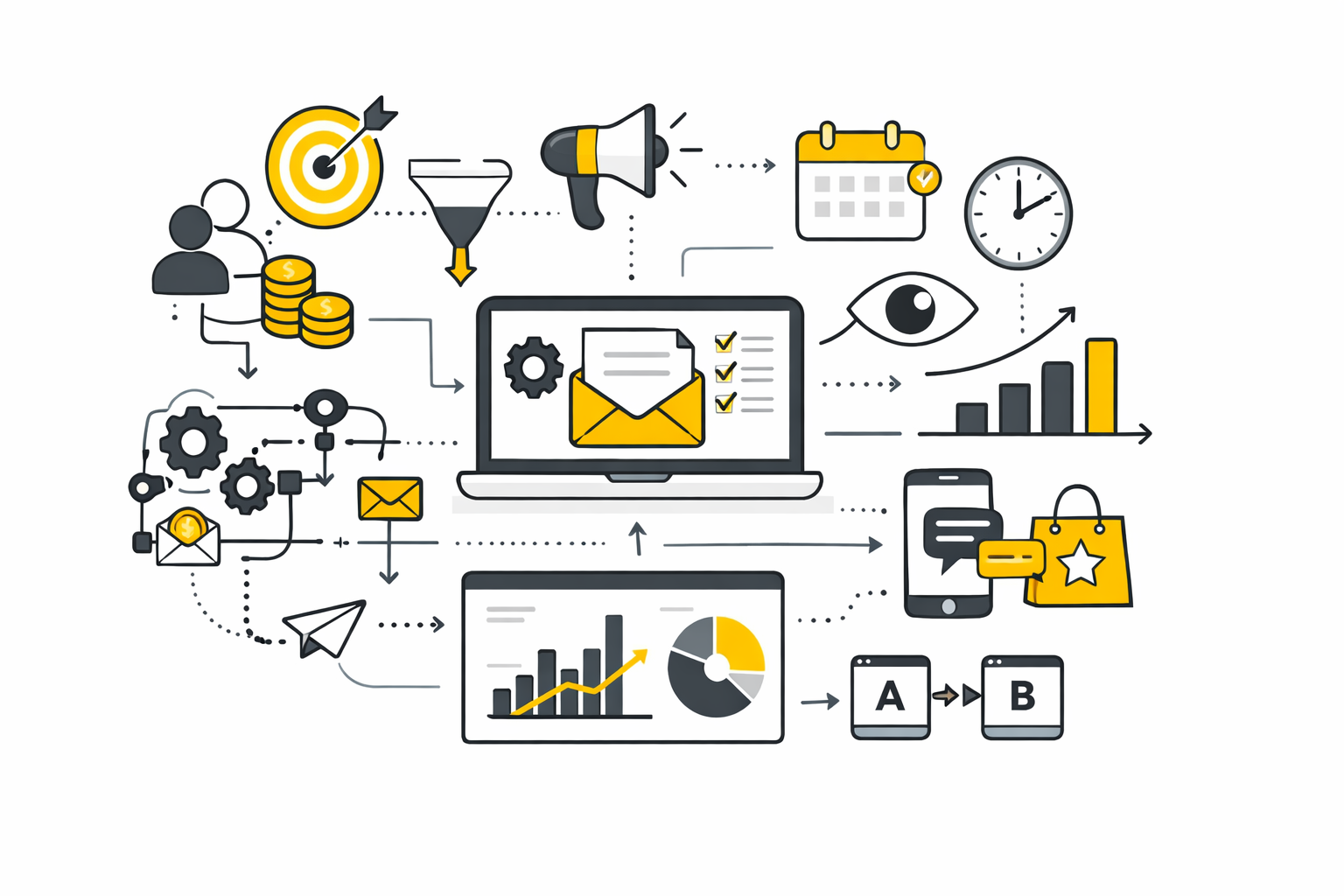
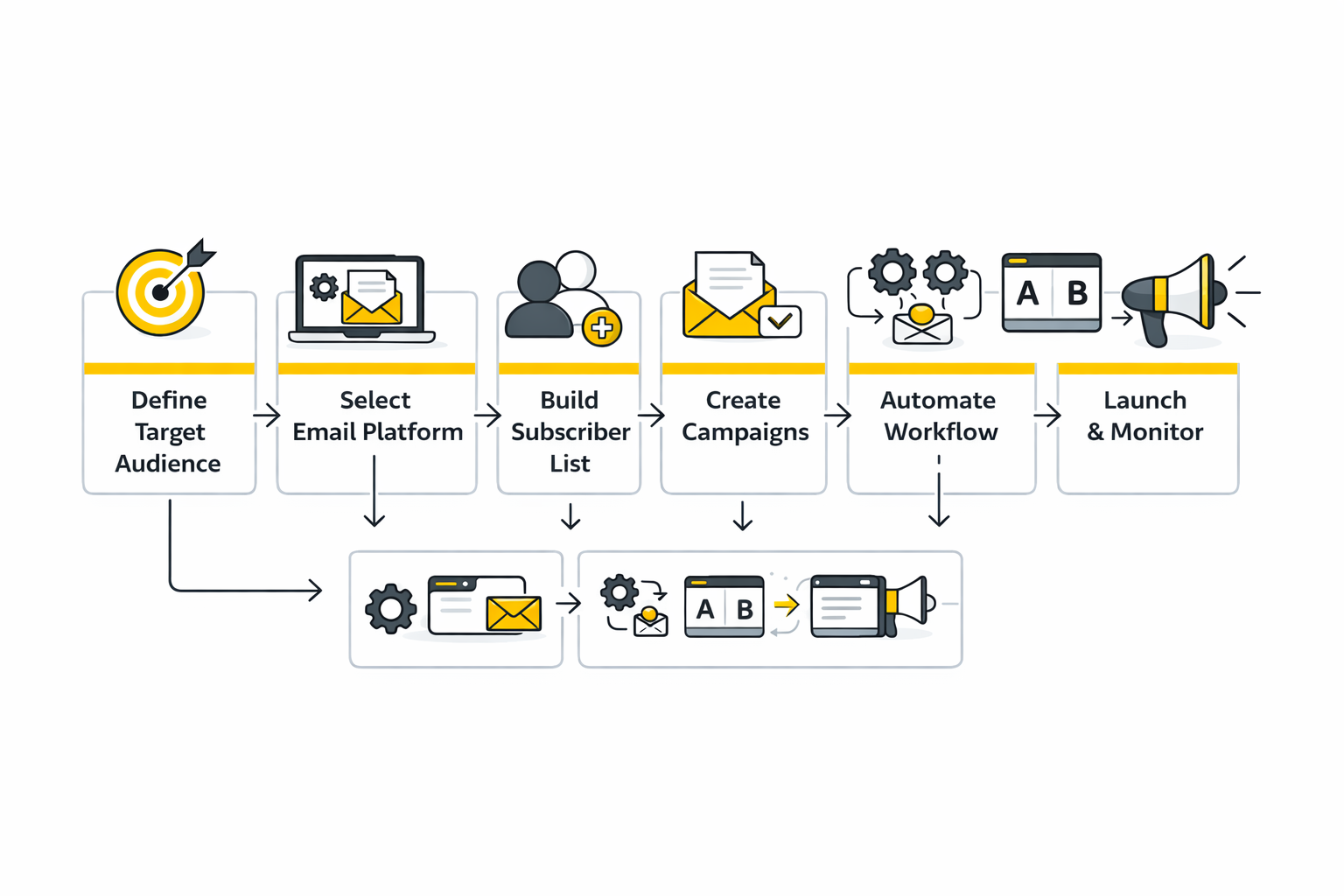
This article follows a six-part structure so you can build an email marketing plan in the same order high-performing teams usually build one in real life. The sequence matters because weak list strategy, unclear offers, sloppy automation, and poor sender setup can quietly ruin results before the copy ever has a chance. If you are choosing your stack while you build, platforms like Brevo, GoHighLevel, and Moosend are built around different versions of the same job: managing audience data, sending campaigns, and automating follow-up. brevo.com+2
- Why an Email Marketing Plan Matters
- The Email Marketing Planning Framework
- Audience, Offer, and List Strategy
- Campaign and Automation Architecture
- Professional Execution, Testing, and Deliverability
- Measurement, Optimization, and Email Marketing Plan FAQs
Each section builds on the previous one, so by the end you will have a practical system instead of a pile of disconnected tactics. That is the difference between sending more email and building a plan that actually drives revenue, retention, and trust. In the next section, we will break down the framework that holds the whole strategy together.
The Email Marketing Planning Framework
The easiest way to ruin an email marketing plan is to start with content before you decide what the channel is supposed to do. That is how teams end up sending random newsletters, scattered promotions, and automations that do not connect to revenue, retention, or customer experience. The better approach is simpler and more disciplined: define the business goal, decide who the message is for, match the offer to that audience, map the journey, and only then decide what gets sent and when.
That structure matters because broad benchmark numbers are useful for context, but they are not a strategy on their own. Mailchimp’s benchmark report, HubSpot’s 2025 benchmark summary, and Brevo’s 44-billion-email benchmark analysis all publish different average open and click ranges, which tells you something important right away: performance depends heavily on list quality, industry, send type, and audience expectations. A good email marketing plan uses benchmarks as guardrails, not as a copy-paste goal.
A practical framework usually comes down to five moving parts:
- Business objective so every send supports a real outcome like lead generation, first purchase, repeat purchase, retention, or reactivation.
- Audience segment so the same email is not forced onto people with completely different levels of intent.
- Offer and message angle so the reader understands why this email matters right now.
- Journey logic so campaigns and automations work together instead of competing with each other.
- Measurement loop so the plan improves based on engagement, conversion, and deliverability signals instead of guesswork.
When you build in that order, email becomes easier to manage because each message has a job. You stop debating every send from scratch and start operating from a system. That shift is what separates a channel that feels chaotic from one that compounds month after month.
Start With the Business Result
Most email teams talk about sends, templates, and calendars before they talk about the result they need. That sounds harmless, but it creates weak campaigns because the message gets built around activity instead of outcome. An email marketing plan should begin with a short list of commercial goals, because those goals determine everything downstream, from segmentation to automation priorities to what you measure.
For example, a business trying to turn new leads into booked calls needs a different plan from a store trying to increase repeat purchases. The first one may lean harder on education, objection handling, reminders, and a tighter handoff into sales. The second one may focus on welcome emails, product discovery, post-purchase follow-up, replenishment, and win-back logic.
This is also where tool choice starts to matter. If you want forms, CRM, automation, and pipeline management in one place, GoHighLevel is built for that kind of all-in-one execution. If your priority is capturing leads on higher-converting landing pages before they enter the email flow, Replo or Fillout can support the front end of the system without forcing a bloated setup.
Build Around the Customer Journey
A strong email marketing plan follows the customer journey instead of forcing everyone into the same broadcast schedule. That means thinking in stages: subscriber, lead, first-time buyer, repeat customer, high-value customer, inactive contact, and former customer. The message changes because the relationship changes, and the plan has to respect that.
This is why lifecycle structure matters so much. Recent guidance from Klaviyo’s flow audit checklist and its lifecycle marketing framework keeps coming back to the same always-on flows: welcome, abandoned cart, post-purchase, win-back, and related lifecycle sequences. Those are not just nice add-ons. They are the foundation because they align email with moments of actual customer intent.
Once you see email through the lens of journey stages, planning gets sharper fast. Instead of asking, “What should we send next week?” you ask, “What does this person need at this exact stage to move forward?” That is a much better question, and it leads to better sends.
Separate Campaigns From Flows
Campaigns and flows should not be treated like the same thing, because they solve different problems. Campaigns are scheduled sends tied to launches, promotions, announcements, editorial content, or seasonal pushes. Flows are triggered, behavior-based sequences that run in the background and handle the moments that happen whether your team is online or not.
That distinction matters because triggered automation often carries a lot of the real performance load. Klaviyo’s automation guidance highlights abandoned cart flows as one of the highest-revenue automation types, and that fits what most mature programs see in practice: behavior-based emails usually outperform broad sends because timing and intent are already built in. A newsletter can help, but it should not be doing the job of your welcome series, your cart recovery sequence, or your post-purchase education.
A solid email marketing plan usually treats campaigns as accelerators and flows as infrastructure. Campaigns create spikes around moments you choose. Flows create steady performance around moments your customers create themselves.
Audience, Offer, and List Strategy
Once the framework is clear, the next layer is audience, offer, and list quality. This is where many brands quietly lose the game, because they focus on writing better emails while sending them to the wrong people with the wrong promise at the wrong time. No copywriter can rescue that for long.
The fix is not complicated, but it does require discipline. Your audience strategy decides who belongs in the plan, your offer strategy decides why they should care, and your list strategy decides whether the whole system stays healthy enough to keep landing in the inbox. When those three pieces are aligned, every campaign and flow gets easier to build and easier to improve.
Segment by Behavior Before Demographics
Demographic data can help, but behavior usually tells you more about what someone is likely to do next. A subscriber who clicked three product emails in the last week is more useful to your email marketing plan than a broad age bracket with no engagement signal. The same goes for recent purchasers, repeat buyers, highly engaged readers, inactive subscribers, and people who signed up from different sources.
That is why modern email platforms keep pushing segmentation deeper. Mailchimp’s segmentation options include activity, purchase behavior, signup source, predicted demographics, and custom conditions, while Brevo’s 2025 trend report points to zero-party and first-party data as a major direction for smarter targeting. The practical takeaway is simple: segment based on what people have done, what they have asked for, and where they are in the journey.
This does not mean creating fifty tiny segments on day one. It means starting with the few groups that actually change the message in a meaningful way. New subscribers, engaged non-buyers, first-time customers, repeat customers, and disengaged contacts are usually enough to make your email marketing plan immediately more relevant.
Match the Offer to the Level of Intent
The offer in an email is not just a discount. It is the reason to pay attention now. Sometimes that is a promotion, but sometimes it is clarity, education, social proof, onboarding help, product recommendations, or a reminder to finish something the subscriber already started.
This is where a lot of email plans get lazy. They give low-intent subscribers a hard sales pitch too early, then wonder why open rates slide and unsubscribes creep up. A better plan matches the offer to the stage: welcome emails set expectations and introduce value, browse or cart flows reduce friction, post-purchase emails build confidence and increase usage, and win-back emails give people a clear reason to re-engage instead of pretending nothing happened.
If your funnel depends on a stronger lead-to-conversation path, tools like Manychat and Chatbase can support conversational capture and qualification before or alongside email. That can make the offer feel more personal because the subscriber is not entering the sequence as a blank record. They are entering with context.
Grow the List With Permission, Not Shortcuts
A healthy list is not just a bigger list. It is a permission-based asset made up of people who actually expect your emails and can recognize why they are receiving them. That sounds obvious, but it is still where plenty of programs break, especially when growth pressure pushes teams toward low-quality acquisition.
The long-term cost of shortcuts is high. Mailchimp’s permission-based marketing guidance, its advice on list management, and its explanation of suppression lists all point in the same direction: purchased lists, stale contacts, poor consent records, and weak suppression practices hurt performance and deliverability. That is now even more important because Google requires authentication for bulk senders, one-click unsubscribe in promotional mail, and Yahoo expects bulk senders to keep complaint rates below 0.3%.
So the right list strategy is not “collect as many emails as possible.” It is “earn the signup, set expectations clearly, keep proof of consent, remove people who should not be mailed, and make unsubscribing easy.” That is not admin work on the side. It is core strategy, because a broken list quietly undermines every other part of the email marketing plan.
What This Means in Practice
By this point, the structure should feel clear. Your email marketing plan needs a framework tied to business outcomes, a journey-based view of the customer, a clean separation between campaigns and flows, and a disciplined approach to audience, offer, and list quality. Without that, execution becomes noisy and expensive.
With it, the channel gets easier to scale because each send has a clear purpose and each segment has a reason to receive it. That is the point where email stops feeling like a content treadmill and starts acting like a real growth system.
The next part turns that strategy into actual send architecture, because a plan is only as good as the campaigns, flows, and automation logic that bring it to life.
Campaign and Automation Architecture
This is where an email marketing plan stops being a strategy document and starts becoming an operating system. You are no longer deciding whether email matters. You are deciding which messages run all the time, which ones are scheduled manually, and how those two layers stay out of each other’s way. Platforms like Mailchimp’s automation flows, Klaviyo’s flow library, and HubSpot workflows all point in the same direction: the best programs are built from triggers, branches, delays, and clear audience rules, not from one giant list and a hope that the copy carries the whole thing. Mailchimp+2
The practical shift is simple but important. Campaigns should handle planned moments like launches, promotions, editorial sends, and seasonal pushes. Flows should handle repeated moments created by customer behavior, such as subscribing, browsing, starting checkout, buying, going inactive, or reaching a lifecycle milestone. Mailchimp+2
Build the Core Flow Stack First
A lot of teams make the mistake of building more newsletters before they build the flows that should have existed from day one. That usually means the channel looks busy, but the high-intent moments are still leaking revenue or leads in the background. A better email marketing plan starts by getting the always-on infrastructure live first, because those flows do work whether your team is at the keyboard or not. Klaviyo Help Center+2
For ecommerce, the core stack is not mysterious anymore. Klaviyo’s getting-started guide recommends starting with a welcome series, abandoned cart, post-purchase, and winback flow, while Mailchimp’s automation templates center welcome contacts, abandoned cart reminders, and behavior-based sends. That matches the real logic of the channel: start the relationship well, recover high-intent drop-offs, improve the post-purchase experience, and create a structured path back for people who stop buying. Klaviyo Help Center+2
For lead generation, SaaS, and service businesses, the architecture changes shape but not principle. You still need a welcome or nurture sequence, lifecycle-based follow-up, and clear handoffs between marketing and sales, which is exactly why HubSpot uses lifecycle stages to categorize contacts based on where they sit in the process. In other words, the names of the flows can change, but the structure of the email marketing plan still follows stage, intent, and next action. knowledge.hubspot.com+2
One more thing matters here: do not stack duplicate automations on top of each other. If your ecommerce platform is already sending default checkout reminders, and your ESP is doing the same thing, you can end up doubling messages at the exact moment when trust matters most. Klaviyo explicitly recommends turning off default platform abandoned cart messages when you replace them with a better flow, and that is the kind of boring operational move that quietly protects results. Klaviyo Help Center
Create Campaign Lanes Before You Create More Emails
Once the core flows are mapped, your next job is to define campaign lanes. This is the part many brands skip, and then they wonder why a subscriber gets a welcome email, a promotion, a product drop, and a re-engagement nudge all in the same 24 hours. The email marketing plan needs priority rules before it needs more content. Klaviyo Help Center+2
In practice, most teams do better with a small number of clear lanes. One lane covers editorial or value-driven sends like newsletters and product education. Another handles commercial pushes like launches, promotions, or deadlines. A third can cover special-event sends if the business has a real calendar around webinars, product releases, or seasonal moments. That may sound basic, but it forces discipline, and discipline is what keeps the channel readable for the customer. Mailchimp+2
This is also where send suppression and frequency control stop being “nice to have” and become part of strategy. Klaviyo’s Smart Sending is built specifically to limit how many messages a person receives within a set period, and both Klaviyo campaign settings and Yahoo’s sender best practices make the same point from different angles: if you send too much, too broadly, or without easy exits, you create complaint risk fast. A serious email marketing plan does not just decide what to send. It decides what not to send, who should be excluded, and when a subscriber has already heard enough for the day. Klaviyo Help Center+2
Implement the System in the Right Order
The implementation process gets much easier when you stop treating it like a creative project and start treating it like production. You are building a machine with triggers, filters, delays, content, fallback logic, and quality control. That means the order matters, because messy data and unclear rules will break a flow long before weak copy does. Klaviyo Help Center+2
If you want this part to move quickly, keep the first rollout narrow. Choose the highest-value flow stack, define the entry rules, build the messages, test them hard, and only then add more branches. That approach is slower for about one week and much faster for the next six months. Klaviyo Help Center+2
- Start with the trigger, not the template. Decide what action should enroll someone into the flow: a signup, a checkout start, a purchase, a lifecycle-stage change, or a date-based event. Klaviyo’s trigger model and HubSpot’s workflow structure both assume the same thing: the trigger decides the logic, so get that right before you touch design. Klaviyo Help Center+1
- Add filters so the wrong people never enter. Trigger filters and profile filters exist for a reason. They keep customers from receiving messages that no longer match their situation, and Klaviyo specifically notes that profile filters continue checking whether someone still qualifies before each send. Klaviyo Help Center
- Use delays and branches to reflect real buying behavior. Not everyone should get the same message cadence. HubSpot’s delay actions are meant to space communication and time sends more naturally, while HubSpot branches let you split paths based on form fills, properties, activity, or random test groups. knowledge.hubspot.com+1
- Name flows clearly and build with future maintenance in mind. This sounds small until you have twenty active workflows and nobody remembers which “Welcome Flow Final” is actually live. Klaviyo recommends clear naming conventions because flow counts add up quickly, and that is exactly why a real email marketing plan needs naming standards, ownership, and version control from the start. Klaviyo Help Center
- Review sender setup and unsubscribe experience before launch. This is not just compliance housekeeping anymore. Google requires authentication alignment for senders, Yahoo requires one-click unsubscribe support and low complaint rates, and Microsoft’s 2025 high-volume sender update pushed the ecosystem further in the same direction. Google Podpora+2
- QA the flow before you call it done. Klaviyo’s readiness checklist walks through the exact areas teams usually miss: trigger selection, filters, time delays, splits, sender info, message content, and settings. That is a useful reminder that launching a flow is not one click. It is a review process. Klaviyo Help Center
This is also the stage where your stack either helps or slows you down. If you need landing pages and lead capture feeding directly into nurture flows, ClickFunnels, Systeme.io, and Fillout can simplify the front end. If you want a more unified CRM-and-automation setup for service businesses, GoHighLevel, Brevo, or Copper make more sense when the email marketing plan has to connect tightly to pipelines, appointments, and follow-up tasks. Mailchimp+2
The Process That Keeps Execution Professional
Once the architecture is live, the operational process has to stay tight. Every campaign or flow change should move through the same sequence: brief, audience check, offer check, build, QA, send or publish, review results, and document what changed. That might feel procedural, but it is exactly what prevents random last-minute sends from breaking the logic you worked hard to build. Klaviyo Help Center+2
Timing matters here, but not in the lazy “best day to send” way people usually mean it. Mailchimp’s send time optimization is built around individual engagement patterns within a chosen window, which is useful, but timing only helps after segmentation, messaging, and priority rules are already solid. A weak email sent at the perfect time is still a weak email. A strong email marketing plan earns better timing because the underlying logic is already right. Mailchimp
There is also a customer-experience angle that marketers underestimate. If roughly seven in ten online carts still get abandoned on average, as reflected by Baymard’s 2025 research, Klaviyo’s abandoned-cart guidance, and Contentsquare’s 2025 summary, then implementation is not a side issue. It is the difference between capturing existing intent and letting it disappear. That is why structure beats volume every time. Baymard Institute+2
The next part goes deeper into what separates a merely functional setup from a professional one: testing, deliverability, sender reputation, and the execution standards that keep your email marketing plan working after the first build is done.
The Numbers That Actually Matter
A smart email marketing plan does not treat reporting as a scoreboard after the send. It treats measurement as part of strategy, because the numbers tell you whether the list is healthy, whether the message resonated, and whether the channel is producing a business result. That is why the best teams read analytics in layers instead of obsessing over one vanity metric. knowledge.hubspot.com+2
The first useful reality check is this: benchmarks are all over the place, and that is normal. Recent reports put average performance anywhere from 35.63% opens and 2.62% clicks in Mailchimp’s dataset to 42.35% average opens in HubSpot’s 2025 benchmark roundup, while Brevo’s 2025 benchmark article shows 31.22% opens, 3.64% click-through, 0.4% unsubscribes, and 0.19% hard bounces overall. That does not mean one source is wrong. It means methodology, industry mix, geography, privacy settings, and how each platform calculates opens and clicks can change the picture a lot. Mailchimp+2
Read Benchmarks Like a Strategist, Not a Tourist
The mistake is using averages as targets without asking what kind of email you are comparing against. A welcome sequence, a product launch, a weekly newsletter, and a win-back campaign should not be judged by the same standard, even if they were all sent from the same platform. Mailchimp’s campaign benchmarking makes this point directly by comparing performance against similar businesses and audience characteristics rather than pretending one universal benchmark fits everyone. Mailchimp+2
This is where your email marketing plan needs context built in. Compare campaigns against the same audience type, the same intent level, and the same send category before you decide something is underperforming. Otherwise you end up “fixing” a healthy email just because it does not look like a completely different kind of send. Mailchimp+1
Use a Four-Layer Measurement System
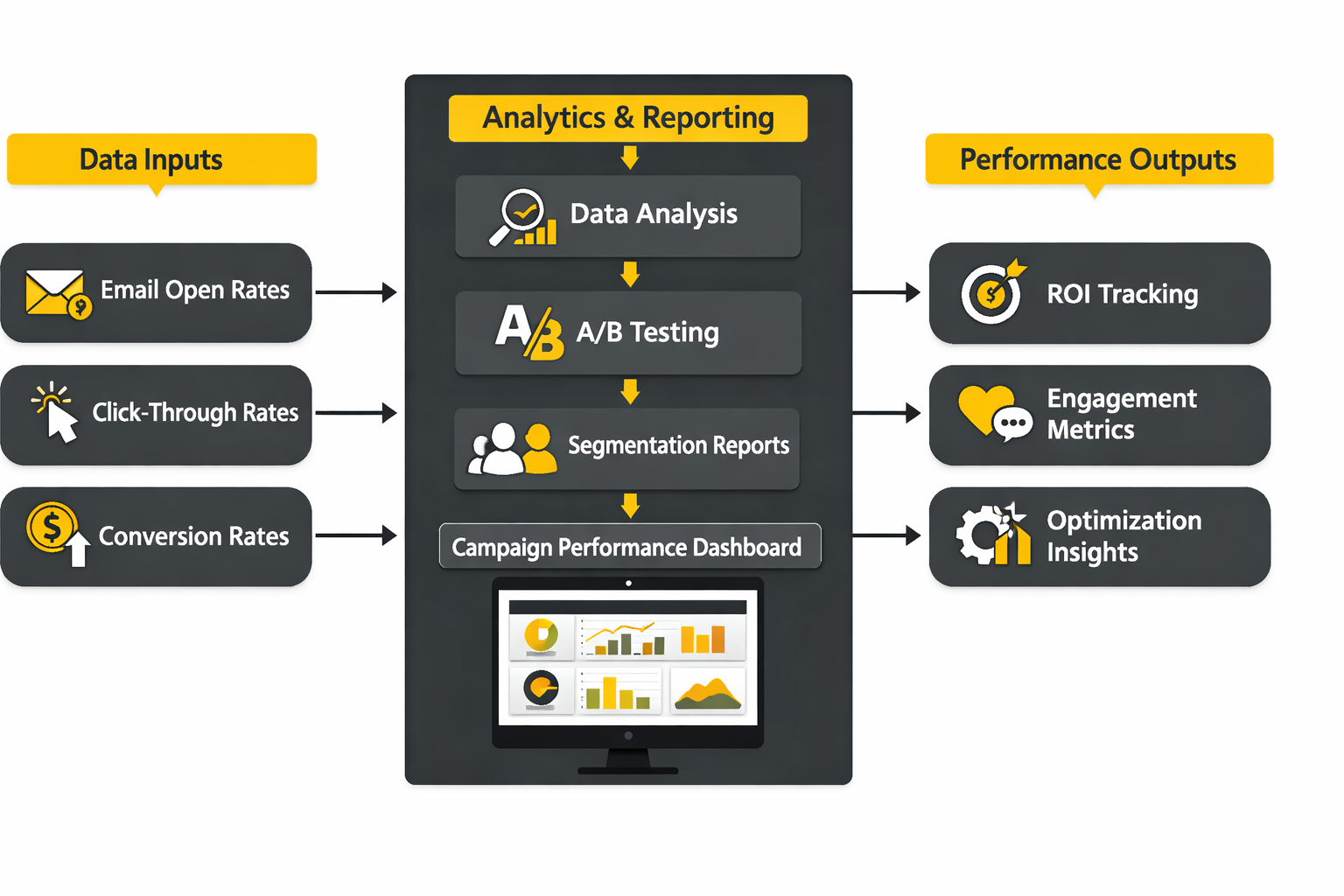
The cleanest way to measure an email marketing plan is to track four layers in order: delivery, engagement, conversion, and business value. That gives you a system for reading the numbers instead of reacting emotionally to whichever metric moved most. It also makes diagnosis faster, because each layer points to a different kind of problem. Klaviyo Help Center+2
- Delivery and inbox health tells you whether the email had a fair chance to perform at all.
- Engagement quality tells you whether the subject line, timing, and content got attention.
- Conversion behavior tells you whether the email changed what people did.
- Business impact tells you whether the program is producing revenue, retention, or pipeline efficiently.
That order matters more than people think. If delivery is weak, engagement numbers become noisy. If engagement is decent but conversion is poor, the issue is probably the offer, landing page, or audience fit. If conversion is fine but revenue per recipient is weak, the plan may be over-mailing too many low-intent contacts instead of focusing volume where it matters most. Klaviyo Help Center+2
Start With Delivery Before You Celebrate Engagement
Too many marketers jump straight to open rate and skip the question that should come first: did the message actually land well? Delivery rate, bounce rate, spam complaint rate, and sender reputation are the foundation of measurement because they tell you whether mailbox providers trust you. Klaviyo’s campaign analytics puts delivery rate, bounce rate, spam complaints, and unsubscribe rate right at the top for a reason, and HubSpot’s email health tool does the same when it scores sending reputation. Klaviyo Help Center+1
This is not theoretical anymore. Google’s sender guidelines say bulk senders should keep spam rates below 0.10% and avoid ever hitting 0.30%, while Yahoo’s sender best practices use the same 0.3% complaint threshold for bulk senders. So if complaint rate starts creeping up, that is not a small reporting blemish. It is an early warning that the audience, frequency, targeting, or expectations are off. Google Podpora+2
For a serious email marketing plan, that means one action rule should be non-negotiable: when complaints or bounces rise, pause the urge to “send more and test harder.” Clean the list, narrow the audience, review signup sources, check suppression logic, and inspect reputation signals first. Google Postmaster Tools exists specifically to help you monitor spam rate, reputation, authentication, and delivery errors, which makes it more useful than staring at campaign opens and hoping everything is fine. Google Podpora+2
Treat Opens as Directional, Not Definitive
Open rate still has value, but it is no longer clean enough to carry your reporting by itself. Apple says Mail Privacy Protection makes it harder for senders to know whether an email was opened, and Mailchimp’s MPP guidance says the feature inflates opens and other open-related metrics for Apple Mail users. That means opens are useful for rough trend reading, but a modern email marketing plan should never let open rate be the final word on success. Apple Podpora+2
The practical move is simple. Use opens to compare subject line direction, brand recognition, and broad audience interest, but rely more heavily on clicks, conversions, purchases, replies, and downstream actions when you make real decisions. Mailchimp explicitly recommends prioritizing clicks and purchases as stronger engagement signals in the MPP era, and that is the right call. Mailchimp+1
Focus on Click Quality, Not Just Click Volume
Click-through rate matters because it shows whether the message moved people from attention to action. But even here, raw CTR only tells part of the story. That is why many teams also watch click-to-open rate, because it isolates how persuasive the email was among people who actually engaged with it. HubSpot’s CTOR explanation and Mailchimp’s reporting definitions both separate click rate from clicks per unique opens for exactly this reason. HubSpot Blog+1
The action here is straightforward. If opens are healthy but click rate or CTOR is weak, the subject line probably did its job and the body did not. That usually points to a weak offer, too many competing links, unclear hierarchy, poor mobile layout, or a call to action that is asking for too much too soon. HubSpot Blog+2
Measure Conversions and Revenue Per Recipient
This is where a real email marketing plan becomes commercially useful. Clicks are interesting, but conversion tells you whether the email changed behavior, and revenue per recipient tells you whether the program is producing value efficiently across the audience you chose to mail. Klaviyo’s analytics glossary defines revenue per recipient as total attributed revenue divided by the number of people who received a message, which is one of the clearest ways to compare sends without being fooled by raw revenue alone. Klaviyo Help Center
This metric is especially helpful when two campaigns create similar total revenue with very different list sizes. If one send generated the same sales from a much smaller audience, that usually means the targeting was sharper and the email marketing plan is getting more efficient. That is the kind of insight that helps you decide whether to broaden a segment, tighten a segment, or protect a high-performing audience from unnecessary volume. Klaviyo Help Center+1
If you want a stack that makes this kind of tracking easier to connect across forms, CRM, and follow-up, GoHighLevel, Brevo, and Copper are all built around slightly different versions of the same goal: tying messaging activity to pipeline, customer activity, and attributable outcomes.
What the Data Should Actually Make You Do
A useful reporting habit is to assign every metric a decision. High open rate with low click rate should trigger a content and CTA review. Rising unsubscribe or complaint rates should trigger audience narrowing, frequency review, and signup-source inspection. Strong click rate with weak conversion should push you to audit the landing page, pricing friction, offer match, or sales handoff rather than blaming the email itself. Klaviyo Help Center+2
That is the real point of analytics in an email marketing plan. The numbers are not there to make you feel good or bad after a send. They are there to tell you where the system is breaking, where it is compounding, and what deserves the next round of work. The next part gets into that professional improvement loop in more detail, because once measurement is clear, testing, deliverability discipline, and execution standards become much easier to apply. knowledge.hubspot.com+2
Professional Execution, Testing, and Deliverability
This is the layer where an email marketing plan either becomes durable or starts breaking under its own volume. At small scale, you can sometimes get away with messy audience rules, inconsistent send cadence, and shaky technical setup. At real scale, the inbox stops forgiving that kind of sloppiness, especially now that Google, Yahoo, and Microsoft all expect stronger authentication and easier unsubscribe experiences from serious senders. Google Podpora+2
Scale Volume Carefully, Especially After a Platform or Domain Change
A growing program usually feels pressure to send more, faster, and to a wider share of the database. That is exactly when disciplined rollout matters most, because Gmail treats anyone sending close to 5,000 messages a day to personal Gmail accounts as a bulk sender, which pushes you into a stricter environment whether you feel “big” yet or not. The right move is not to blast the whole list after a migration, a new subdomain, or a new ESP. Google Podpora+1
Both Mailchimp’s domain warm-up guide and Klaviyo’s warming documentation lean in the same direction: start with the most engaged recipients, ramp volume gradually, and expand only when the underlying signals stay healthy. That matters because warming is not just a technical ritual. It is how mailbox providers learn whether your new infrastructure behaves like a trustworthy sender or like a sudden burst of questionable mail. Mailchimp+2
A mature email marketing plan treats warming as part of launch planning, not as cleanup after something goes wrong. If you are moving stacks or consolidating systems, platforms like GoHighLevel, Brevo, and Copper can simplify operations, but the migration only works if the sending reputation is protected during the transition. That is why expert teams widen audience access in steps, not in one dramatic send. Klaviyo Help Center+1
Make Deliverability a Planning Input, Not a Technical Cleanup
Too many companies still treat deliverability like an IT box that gets checked after the campaign calendar is already set. A better email marketing plan treats authentication, unsubscribe handling, and complaint prevention as planning constraints from the start, because those rules now directly affect whether the message gets inbox placement at all. Google’s sender rules, Yahoo’s sender best practices, and Microsoft’s newer high-volume requirements all point the same way: SPF, DKIM, DMARC, and working one-click unsubscribe are no longer optional for serious senders. Google Podpora+2
DMARC matters here because it is not just a line in DNS. DMARC.org explains it as an authentication, policy, and reporting protocol built on SPF and DKIM, and Microsoft’s own setup guidance frames it as protection against spoofing and phishing. In practical terms, that means a strong email marketing plan protects both deliverability and brand trust at the same time. dmarc.org+1
Once the basics are stable, advanced teams sometimes layer on BIMI so supported inboxes can display the brand logo more visibly. Google’s updates around Common Mark Certificates and Verified Mark Certificates make that path more accessible, but BIMI is a finishing move, not a rescue plan. If your authentication and reputation are weak, a logo beside the message will not save the program. Google Workspace Help+1
Use Frequency Caps and Preference Centers to Scale Without Fatigue
Scaling email volume without a frequency strategy is one of the fastest ways to burn a good list. HubSpot’s email frequency safeguard exists for a reason: once contacts start receiving too many marketing emails in a given period, unsubscribe risk rises and the quality of your engagement data starts to rot. The smartest email marketing plan does not ask only, “Can we send this?” It also asks, “Who should not receive this because they already heard from us enough this week?” knowledge.hubspot.com+1
Preference centers are the other half of that discipline. Mailchimp’s preferences center and HubSpot’s subscription types and subscription pages are built around the same idea: let people choose categories, interests, and communication types instead of forcing a full unsubscribe as the only escape hatch. That tradeoff matters because a subscriber who wants fewer emails is still far more valuable than a subscriber who leaves entirely. Mailchimp+2
This matters even more now that Gmail has made subscription management easier for users. Google’s Manage subscriptions view surfaces active senders, recent volume, and one-click unsubscribe in a much more obvious way, which means frequency abuse becomes visible faster and punished faster. A professional email marketing plan responds by giving subscribers more control before the inbox client does it for them. blog.google+2
Test Systems, Not Just Subject Lines
A lot of teams say they are testing when they are really just swapping subject lines and hoping for a lift. Real testing is more deliberate. Mailchimp’s A/B testing guidance, HubSpot’s A/B testing workflow for emails, and Klaviyo’s testing documentation for campaigns and flows all reinforce the same principle: decide the goal first, test one meaningful variable at a time, and read the result against the actual job of the message. Mailchimp+2
That changes how you prioritize tests. If the email is struggling to get opened, test subject line, from-name, or send-time variables. If opens are acceptable but action is weak, the better test is usually offer framing, CTA hierarchy, content order, or whether the email should be shorter and more direct. That is why the strongest email marketing plan tests the constraint that is most likely to be limiting performance, not the variable that is easiest to change. Mailchimp+1
Flow testing deserves even more discipline because automated messages repeat at scale. Klaviyo’s flow A/B testing guidance makes this especially useful for things like discounts, content style, and even plain-text versus image-heavy formats. A small win inside a welcome flow or cart sequence compounds much faster than a tiny improvement on a one-off newsletter. Klaviyo Help Center+1
Build a Sunset Policy Before the List Forces One on You
One of the least glamorous parts of an email marketing plan is also one of the most important: deciding when to stop mailing people who are no longer engaging. That feels painful because it can make the addressable list look smaller on paper. In reality, Klaviyo’s sunset flow guidance and Mailchimp’s suppression list resources both make the same point: continuing to send to inactive contacts drags down engagement quality and increases deliverability risk. Klaviyo Help Center+1
This is where strategic tradeoffs become real. A smaller but engaged file is usually more valuable than a huge stale list that creates complaints, soft engagement, and weak conversion per send. Expert teams accept that reality early, run win-back or sunset sequences on purpose, and suppress the people who clearly do not want the relationship anymore. Klaviyo Help Center+2
Standardize the Operating Model Before You Chase More Volume
As programs grow, complexity becomes the hidden cost. More segments, more automations, more handoffs, and more stakeholders can make an email marketing plan look sophisticated while quietly making it fragile. The fix is not more creativity. It is stronger operating standards around naming, QA, ownership, approval flow, rollback rules, and post-send review.
That is also why the best teams reduce unnecessary tool sprawl when they can. If your front end, forms, CRM, and automation are constantly passing data through brittle connections, the odds of broken triggers and dirty audience logic go up fast. Tools like Fillout, GoHighLevel, Brevo, or ClickFunnels can make sense when they reduce those operational seams rather than add new ones.
At this level, the best email marketing plan is not the most elaborate one. It is the one that can scale, stay compliant, protect reputation, and keep producing results without exhausting the audience in the process. The final part closes the article with the practical questions people usually ask once the strategy, execution, and measurement pieces are finally in place.
Keep the System Improving
The final version of an email marketing plan is never really final. The channel keeps changing because mailbox providers tighten standards, subscriber expectations move, and what worked six months ago can become noisy once the list grows or the business changes direction. That is why the best teams run email as a living system with regular reviews of list quality, automation performance, complaint trends, unsubscribe behavior, and conversion efficiency instead of treating setup as a one-time project. Google Podpora+2
One practical way to keep the system sharp is to review the plan in cycles. Monthly reviews are useful for campaign performance, automation bottlenecks, and segment drift. Quarterly reviews are better for bigger decisions like whether the current signup flow still qualifies the right people, whether double opt-in would improve list quality, whether a sunset flow should be tightened, and whether frequency rules still match what subscribers actually want. Mailchimp+2
That is also the point where your tooling should earn its place. If your current stack makes segmentation messy, attribution blurry, or automation maintenance harder than it should be, the right move is not to keep patching around the problem forever. In that situation, platforms such as Brevo, GoHighLevel, and Moosend can be worth a serious look because the operational side of the email marketing plan matters just as much as the strategy on paper. Google Podpora+1
When the system is healthy, you can feel it. The list is easier to manage, automations have a clear purpose, campaigns stop colliding with each other, and the metrics start telling a cleaner story. That is the real goal of an email marketing plan: not just sending more email, but building a channel that keeps compounding without exhausting the audience or damaging trust. Google Podpora+2
Email Marketing Plan FAQ
What should an email marketing plan include?
A strong email marketing plan should define business goals, audience segments, message categories, automation flows, campaign rules, measurement standards, and deliverability safeguards. If any one of those pieces is missing, the channel usually becomes reactive and harder to scale. The reason Google and Yahoo now put so much weight on authentication, unsubscribe handling, and complaint rates is simple: the plan has to work for both the business and the inbox providers that decide whether your mail gets seen. Google Podpora+2
How often should you send marketing emails?
There is no universal number that works for every brand, because the right frequency depends on audience intent, content quality, and how often you have something genuinely useful to say. A weekly schedule can work well for one business and damage another if the audience did not sign up for that level of contact. The smarter approach is to use frequency safeguards, preference management, and engagement signals so the email marketing plan adapts to audience behavior instead of forcing one blanket cadence on everyone. senders.yahooinc.com+1
Is double opt-in worth using?
For many businesses, yes, especially when list quality matters more than raw list growth. Mailchimp explains that double opt-in adds an extra confirmation step and helps maintain a higher-quality audience by reducing fake, mistyped, or low-intent signups. In a serious email marketing plan, that tradeoff is often worth it because a smaller list of confirmed subscribers usually performs better than a larger list full of weak addresses. Mailchimp+2
How long should a welcome sequence be?
There is no perfect number of emails that fits every business, but a welcome sequence should be long enough to set expectations, deliver the promised value, introduce the brand clearly, and move the subscriber toward a first meaningful action. If the sequence is too short, it wastes the highest-attention moment in the relationship. If it is too long or too aggressive, it can create fatigue early, which is exactly why the email marketing plan should tie welcome content to intent and not just fill space with generic brand talk. blog.google+1
What metrics matter most in an email marketing plan?
The most useful metrics are the ones that drive decisions, not the ones that merely look good in a report. Delivery health, spam complaints, unsubscribes, clicks, conversions, and revenue or pipeline impact usually matter more than open rate alone because mailbox privacy changes have made opens less reliable as a single source of truth. A strong email marketing plan reads performance in layers: first inbox health, then engagement, then conversion, then business outcome. Google Podpora+2
How do you keep email out of the spam folder?
You reduce the risk by sending to people who actually expect your emails, authenticating the domain correctly, making unsubscribing easy, and keeping complaint rates low. Google recommends SPF, DKIM, and DMARC for better delivery and warns that unauthenticated mail may be marked as spam or rejected, while Yahoo explicitly tells bulk senders to authenticate and keep spam complaints below 0.3%. In practice, that means deliverability is not a last-minute technical fix inside the email marketing plan. It is a planning discipline from day one. Google Podpora+1
Should every business send a newsletter?
Not necessarily. Some businesses benefit more from lifecycle automations, product education, reminders, and targeted offers than from a broad recurring newsletter. The right question is not whether a newsletter is fashionable, but whether it has a clear job inside the email marketing plan and whether the audience would actually miss it if it disappeared. blog.google+1
When should you remove inactive subscribers?
You should not rush to remove people after a quiet month, but you also should not keep mailing disengaged contacts forever. Klaviyo’s sunset flow guidance is built around exactly this problem: identify subscribers who are no longer engaging, try to re-engage them intentionally, and then suppress the ones who still do not respond. In a healthy email marketing plan, list pruning is not punishment. It is reputation protection. Klaviyo Help Center+1
Do small businesses need automation, or can they just send campaigns?
Even small businesses usually benefit from at least a few basic automations because some messages should not depend on someone remembering to send them manually. A welcome series, a post-purchase follow-up, or a simple re-engagement sequence can do steady work in the background while campaigns handle launches or promotions. That is one of the biggest advantages of building an email marketing plan early: automation lets a smaller team behave more consistently without needing a huge operation. Klaviyo Help Center+1
Can AI help build an email marketing plan?
AI can speed up research, draft variations, summarize results, and help teams create more options faster, but it should not replace judgment about audience fit, offer quality, compliance, or frequency. The parts of the email marketing plan that matter most still depend on sound segmentation, clear consent, and knowing what action the reader should take next. AI is most useful when it helps operators move faster inside a good strategy rather than generating more volume inside a weak one. Google Podpora+1
What is the biggest mistake people make with email?
The most common mistake is treating email like a content calendar instead of a system. That usually leads to random sends, weak segmentation, rising fatigue, and reporting that feels confusing because nobody defined what each message was supposed to accomplish in the first place. A solid email marketing plan fixes that by assigning a job to every flow, every campaign type, and every metric. blog.google+1
Do you need a preference center?
If you want a more durable program, yes. Preference options give subscribers a middle ground between staying fully subscribed and leaving altogether, which is valuable when frequency tolerance and topic interest vary across the list. The longer an email marketing plan runs, the more important that control becomes because subscriber choice is often the cleanest way to reduce complaints without killing reach. senders.yahooinc.com+1
Work With Professionals
Explore 10K+ Remote Marketing Contracts on MarkeWork.com
Most marketers spend too much time chasing clients, competing on crowded platforms, and losing a percentage of every project to middlemen. MarkeWork positions itself as a direct route to remote marketing work, with its homepage promoting 10K+ remote marketing contracts and free profile creation for freelancers. markework.com
That makes it relevant for marketers who are serious about turning the skills behind an email marketing plan into paid client work instead of spending all their energy prospecting. If you want better opportunities and want to keep 100% of what you earn, explore available contracts and create a profile for free at MarkeWork.com. markework.com+1