

Email marketing programs are not just newsletter tools anymore. The best ones help businesses collect permission, organize subscribers, automate follow-up, personalize messages, protect deliverability, and connect email activity to revenue. That is the difference between “sending emails” and running an email system.
The reason this still matters is simple: email remains one of the few marketing channels where you can build a direct relationship with your audience. Paid ads get more expensive. Social reach changes whenever platforms change their algorithms. Search traffic can rise or fall fast. Email gives you more control, but only when the program is built properly.
Recent reporting on Sinch Mailgun’s Email Impact Report found that among companies measuring email ROI, 60% see more than $10 back for every $1 spent, while Litmus found that 35% of companies see $10 to $36 for every $1 spent. Those numbers do not mean every email program wins automatically. They mean email can perform extremely well when strategy, segmentation, deliverability, automation, and measurement work together.
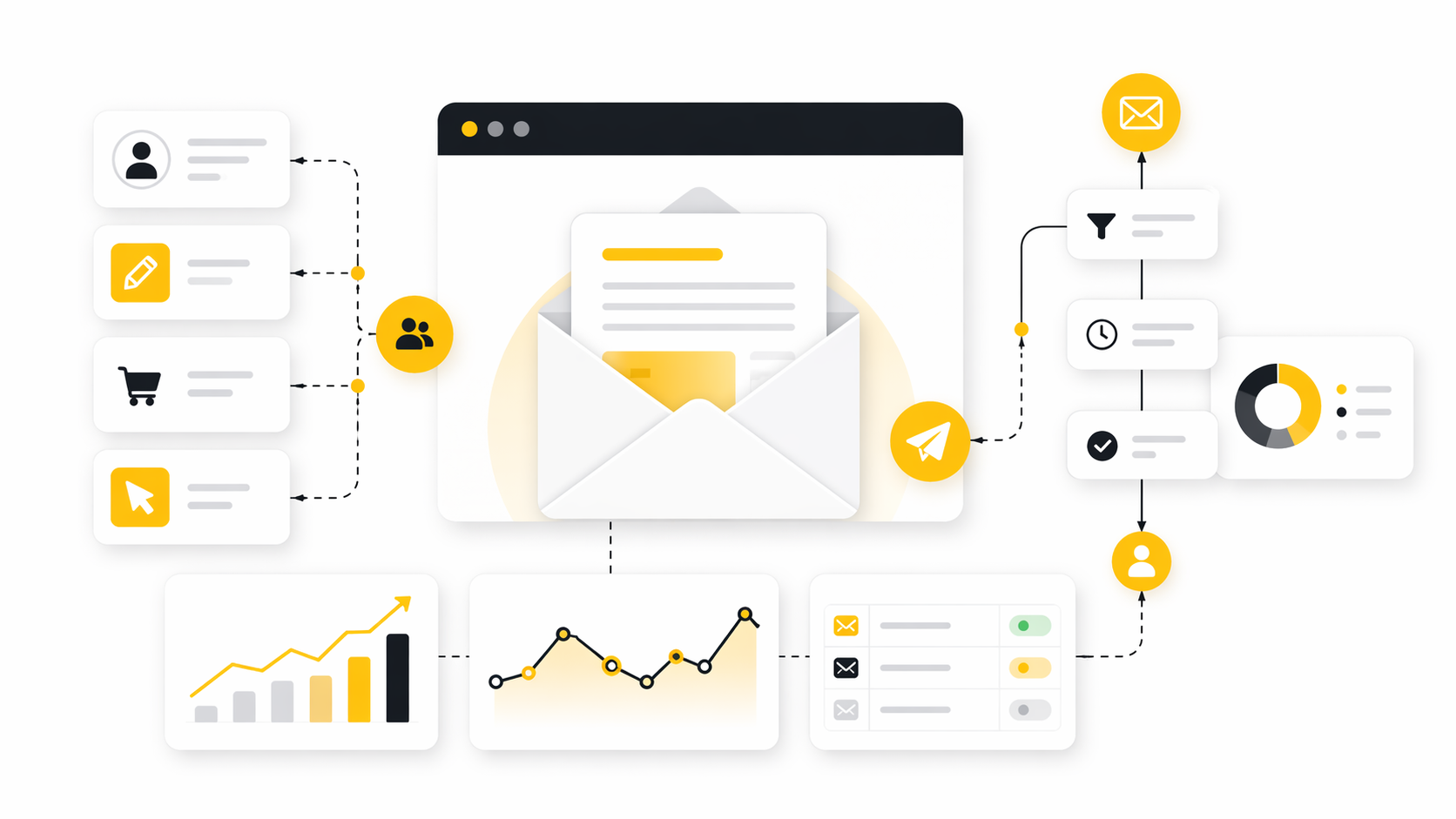
The full article will follow this structure:
- Why Email Marketing Programs Still Matter
- The Email Marketing Program Framework
- Core Components Of A Strong Email Program
- How To Implement Email Marketing Programs Professionally
- Statistics And Data
- Advanced Email Marketing Program Strategy
- FAQ - Built For Complete Guide
- Work With Professionals
Why Email Marketing Programs Still Matter
Email marketing programs matter because they turn attention into an owned relationship. A visitor might find you through an ad, social post, search result, webinar, referral, or lead magnet, but email is where you can keep the conversation going. That follow-up is where trust compounds.
The mistake is thinking email works because it is cheap. Cheap email is usually bad email. Good email works because it is timely, relevant, expected, and useful. The inbox is personal, so the standard is higher.
Email also supports almost every business model. Ecommerce brands use it to recover carts and increase repeat purchases. SaaS companies use it for onboarding and activation. Agencies use it to nurture leads. B2B teams use it to educate buying committees. Creators use it to own their audience instead of depending only on platforms.
The Email Marketing Program Framework
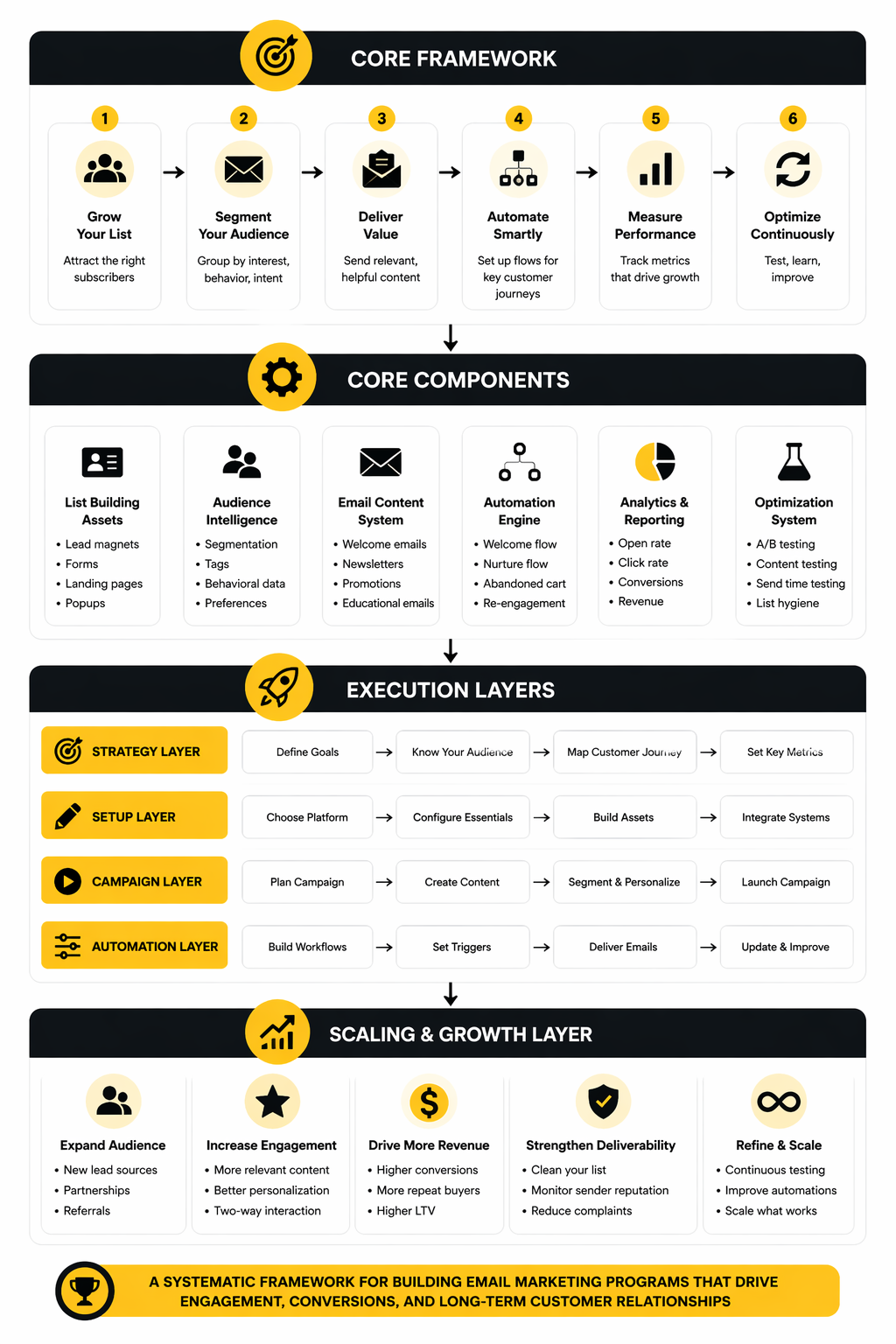
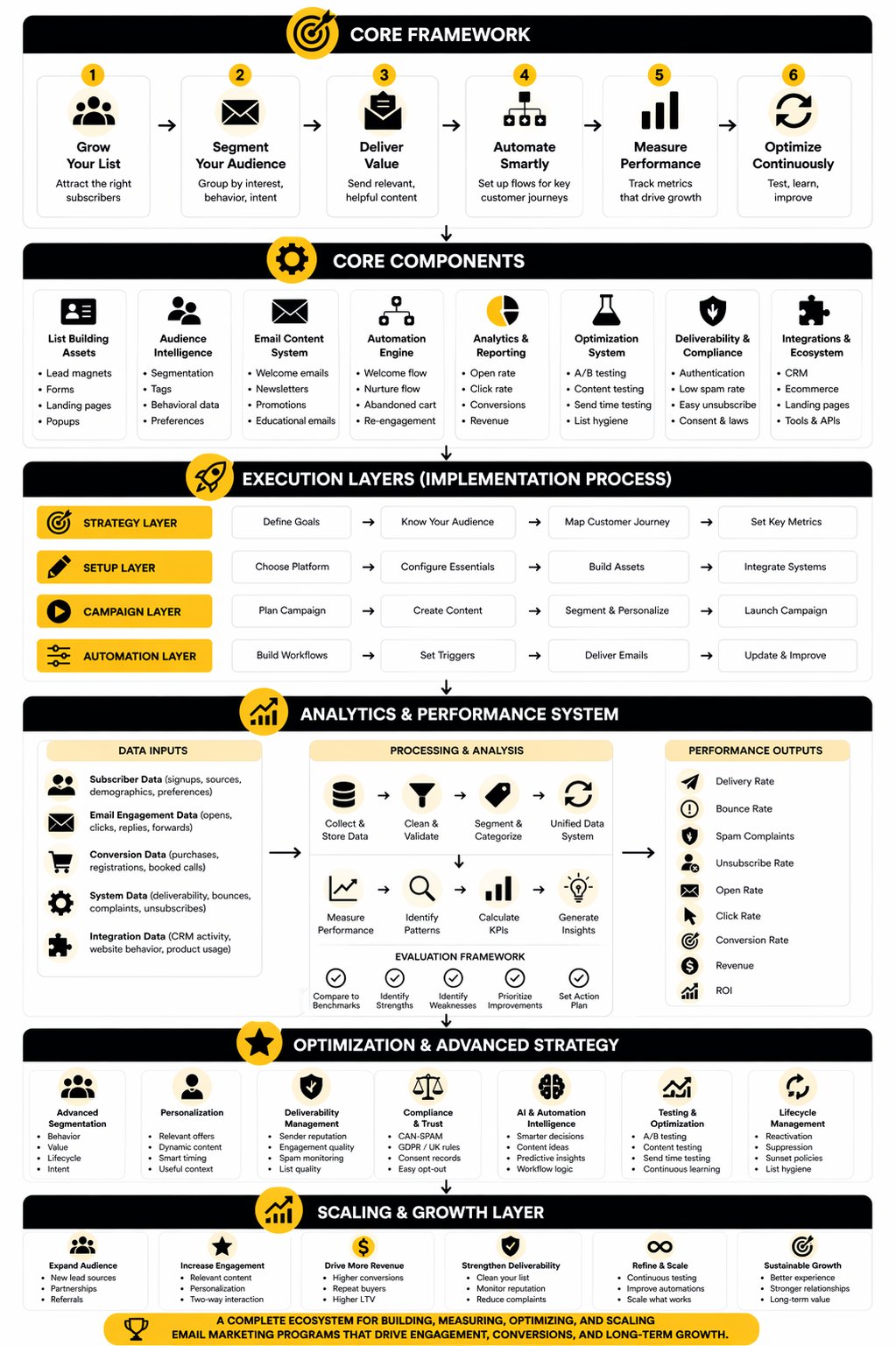
A strong email marketing program has five layers: audience, message, automation, deliverability, and measurement. These layers should work together. If the audience is weak, the message will feel generic. If the message is weak, automation only scales irrelevance. If deliverability is weak, even the best campaign may never reach the inbox.
The audience layer defines who is on your list, how they joined, what they care about, and what permission you have. The message layer defines what you say, how often you say it, and what action or belief each email should create. The automation layer turns important moments into reliable follow-up.
The deliverability layer protects sender reputation, authentication, list quality, and inbox placement. Google’s sender guidance makes this especially important because bulk senders need to meet requirements around authentication, user-reported spam rates, and easy unsubscribes to avoid delivery problems with Gmail users. The measurement layer then connects the whole program to outcomes like clicks, leads, sales, retention, pipeline, and revenue.
Audience Comes First
Your list is not one audience. It is a mix of new subscribers, warm leads, buyers, inactive contacts, loyal customers, trial users, event attendees, abandoned carts, and people who joined for completely different reasons. Treating them all the same is how email programs get ignored.
A useful email marketing program starts by understanding where people came from and what they expect. Someone who downloaded a guide needs a different path than someone who bought yesterday. Someone who clicked a pricing page needs different follow-up than someone who only opened a newsletter.
This is why consent and context matter. Permission is not just a legal checkbox. It is a performance signal. People who knowingly signed up for relevant emails are more likely to open, click, reply, buy, and stay subscribed.
Message Needs A Clear Job
Every email should have a job. It might welcome someone, educate them, sell a product, recover interest, invite them to an event, onboard a customer, explain a feature, or bring an inactive subscriber back. If the email has no job, it becomes noise.
Strong email programs separate campaign emails from lifecycle emails. Campaign emails are scheduled sends, such as launches, newsletters, promotions, or announcements. Lifecycle emails are triggered by behavior, customer stage, or timing. Both are useful, but they should not be planned the same way.
Subject lines matter, but they cannot fix weak relevance. A subject line can earn the open. The actual email has to earn the next step. That is where useful content, clear offers, strong segmentation, and good timing do the real work.
Automation Turns Strategy Into A System
Automation is where email marketing programs become scalable. Instead of manually following up with every subscriber, you build flows that respond to behavior and timing. That can include welcome sequences, abandoned cart recovery, lead nurture, post-purchase education, reactivation, renewal reminders, and sales handoff alerts.
The point is not to automate everything. The point is to automate the moments where speed and relevance matter. A welcome email is more useful right after signup than three weeks later. A cart recovery email works because it responds to active buying intent.
Platforms like Brevo, Moosend, Systeme.io, and GoHighLevel can support this kind of system when your strategy is clear. The tool helps execute the plan. It does not create the plan for you.
Core Components Of A Strong Email Program
A strong email program needs a list-growth engine, signup forms, segmentation rules, email templates, automation flows, campaign planning, deliverability checks, reporting, and a clear offer strategy. These pieces should not operate separately. They should support one customer journey.
The list-growth engine brings in subscribers through lead magnets, checkout opt-ins, content upgrades, webinars, quizzes, waitlists, forms, trials, or customer relationships. The signup experience should be honest about what people will receive. Expectations set at signup shape engagement later.
Segmentation turns the list into meaningful groups. A first-time subscriber should not always receive the same message as a repeat customer. A high-intent lead should not be treated like a casual reader. A customer who just purchased needs a different journey than someone who has gone cold.
Deliverability Is Part Of Strategy
Deliverability is not a technical side task. If your emails do not reach the inbox, your copy, design, offer, and automation do not matter. Good email marketing programs protect sender reputation with clean lists, proper authentication, low complaint rates, clear unsubscribe options, and sensible sending volume.
Google has made this even more explicit for senders reaching personal Gmail accounts. Bulk senders that fail sender requirements may have messages rejected or placed in spam, which means deliverability now belongs in the strategic conversation, not just the technical setup.
Deliverability also depends on relevance. If people stop opening, clicking, replying, or interacting, inbox providers may treat future sends with less trust. Better segmentation and better content are not just good for readers. They help protect the program.
Measurement Keeps The Program Honest
Email marketing programs should not be judged only by open rates. Opens can be distorted by privacy changes and tracking limitations. Clicks, conversions, replies, unsubscribes, spam complaints, revenue, pipeline, repeat purchases, and retention usually give a better picture.
The right metric depends on the job of the email. A newsletter may be judged by engagement and return visits. A sales sequence may be judged by demo bookings, replies, and revenue. An onboarding flow may be judged by activation, product usage, or customer retention.
This is where professional email strategy separates itself from casual sending. You are not asking, “Did people open it?” You are asking, “Did this email move the relationship forward?”
Choosing The Right Email Marketing Program
Choosing between email marketing programs should start with the business model, not the feature list. A SaaS company, ecommerce brand, agency, creator, and local service business all need different workflows. The right platform is the one that supports the real customer journey without adding unnecessary complexity.
Start with the main job email needs to do. If the goal is ecommerce revenue, prioritize product triggers, abandoned cart flows, customer segments, post-purchase journeys, and revenue attribution. If the goal is B2B lead nurturing, prioritize CRM integration, lead scoring, sales alerts, booking links, webinar follow-up, and pipeline visibility.
This is where many teams make the wrong call. They either buy an advanced platform before they have the strategy to use it, or they choose the cheapest tool and quickly hit limits. The smarter move is to map the workflows first, then choose the program that can run them cleanly.
How Email Marketing Programs Fit Different Business Models
Email marketing programs work best when they match how customers actually buy. Ecommerce brands usually need frequent campaigns, behavioral triggers, product recommendations, discount logic, and customer lifecycle flows. Their email program is usually built around first purchase, repeat purchase, retention, and win-back.
B2B companies usually need fewer emails, but each one has to carry more strategic weight. The buying cycle is longer, the decision involves more people, and the conversion path often includes sales conversations. That means lead nurture, proof assets, objection handling, product education, and sales handoff matter more than constant promotions.
Service businesses and agencies need a different setup again. Their email program often supports trust-building, consultation bookings, case study distribution, proposal follow-up, referral campaigns, and reactivation of old leads. For them, a clean CRM and booking flow can be more valuable than complex ecommerce automation.
Ecommerce Email Programs
Ecommerce email programs should be built around customer behavior. Someone who viewed a product, abandoned a cart, bought once, bought repeatedly, or stopped buying should not receive the same message. The value comes from matching timing, intent, and offer.
Core ecommerce flows usually include welcome emails, abandoned cart recovery, browse abandonment, post-purchase education, review requests, cross-sell, replenishment, loyalty, and win-back. These flows work because they respond to moments that already have commercial context. They are not random blasts.
Platforms like Brevo and Moosend can support this kind of lifecycle system when the list structure and customer data are clean. The platform helps, but the segmentation logic matters more.
B2B Email Programs
B2B email programs should help buyers move from awareness to confidence. The goal is usually not to force a purchase from one email. The goal is to educate, reduce uncertainty, answer objections, and create enough trust for the buyer to take the next serious step.
A strong B2B setup usually includes lead magnet delivery, welcome nurture, role-based education, webinar follow-up, case study sequences, sales alerts, CRM updates, and re-engagement campaigns. These workflows should respond to buyer intent. A pricing-page visitor deserves different follow-up than someone who downloaded a broad guide.
This is where CRM-connected platforms become useful. GoHighLevel can support email, pipeline, booking, automation, and follow-up in one system. Copper can help teams keep account context organized when the sales process is relationship-driven.
Creator And Newsletter Programs
Creator and newsletter email programs are built around trust. The list is not only a lead source. It is the main relationship asset. That means consistency, voice, relevance, and reader expectation matter more than heavy automation at the beginning.
The core setup should include a clear signup promise, a welcome sequence, regular editorial sends, simple segmentation by interest, and clean unsubscribe options. A creator should know which topics drive replies, clicks, shares, purchases, and long-term engagement. That feedback shapes the content strategy.
The mistake is treating newsletter subscribers like cold traffic. They are giving attention directly. Respect that, and the list becomes a compounding asset.
Features That Actually Matter
Most email marketing programs advertise long lists of features, but only a few truly change performance. You need reliable sending, list management, segmentation, automation, templates, analytics, integrations, deliverability controls, and compliance tools. Everything else depends on your use case.
Segmentation matters because it turns a broad list into groups with different needs. Automation matters because it lets you respond to behavior without doing everything manually. Reporting matters because it shows whether emails are creating clicks, conversions, revenue, pipeline, or retention.
Deliverability tools are not optional anymore. Google’s sender guidance requires many bulk senders to authenticate outgoing email, avoid unwanted messages, and make unsubscribing easy for recipients sending large volumes to Gmail accounts. That means technical setup, consent, complaint rates, and unsubscribe experience are now part of the program, not side tasks.
What To Look For Before You Choose
Before choosing a platform, map your actual workflows. Do you need ecommerce triggers? CRM sync? SMS? Landing pages? Forms? Sales pipelines? Product events? Advanced segmentation? Multi-user permissions? Native revenue reporting? The best choice depends on what you will actually use.
Look carefully at:
- List size and pricing model
- Automation builder quality
- Segmentation depth
- CRM or ecommerce integrations
- Deliverability features
- Template flexibility
- Reporting and attribution
- Consent and compliance tools
- Ease of migration
- Support quality
- Team permissions
- API and data flexibility
Do not buy based on a demo alone. Build your first few workflows on paper before choosing. The right platform should make those workflows easier, not force your strategy into awkward workarounds.
When Simple Is Better
A simple email marketing program is often the right starting point. If you have a small list, unclear offer, limited content, or no conversion path, advanced software will not fix the problem. It may just make the mess more expensive.
Start with the essentials: a clean list, a clear signup promise, a welcome sequence, a few useful segments, and a consistent sending rhythm. Then add automation when you know which behaviors actually matter. Complexity should be earned.
This is especially true for small teams. A lightweight setup that gets used every week beats an enterprise system nobody understands. The best email marketing programs are the ones your team can operate consistently.
When Advanced Automation Makes Sense
Advanced automation makes sense when the business has enough audience data, customer behavior, and revenue volume to justify it. If you know which actions predict purchase, churn, upgrade, or sales readiness, automation can help you respond faster and more personally. That is when email becomes a serious growth lever.
Advanced workflows may include lead scoring, lifecycle stages, predictive segments, dynamic content, abandoned behavior triggers, multi-step nurture, sales task creation, and customer health messaging. These workflows should be built around real customer behavior, not guesses.
The key is to avoid automation theater. A complex workflow that does not improve the customer journey is just a pretty diagram. Every automation should have a reason, a trigger, a message, and a measurable outcome.
How To Implement Email Marketing Programs Professionally
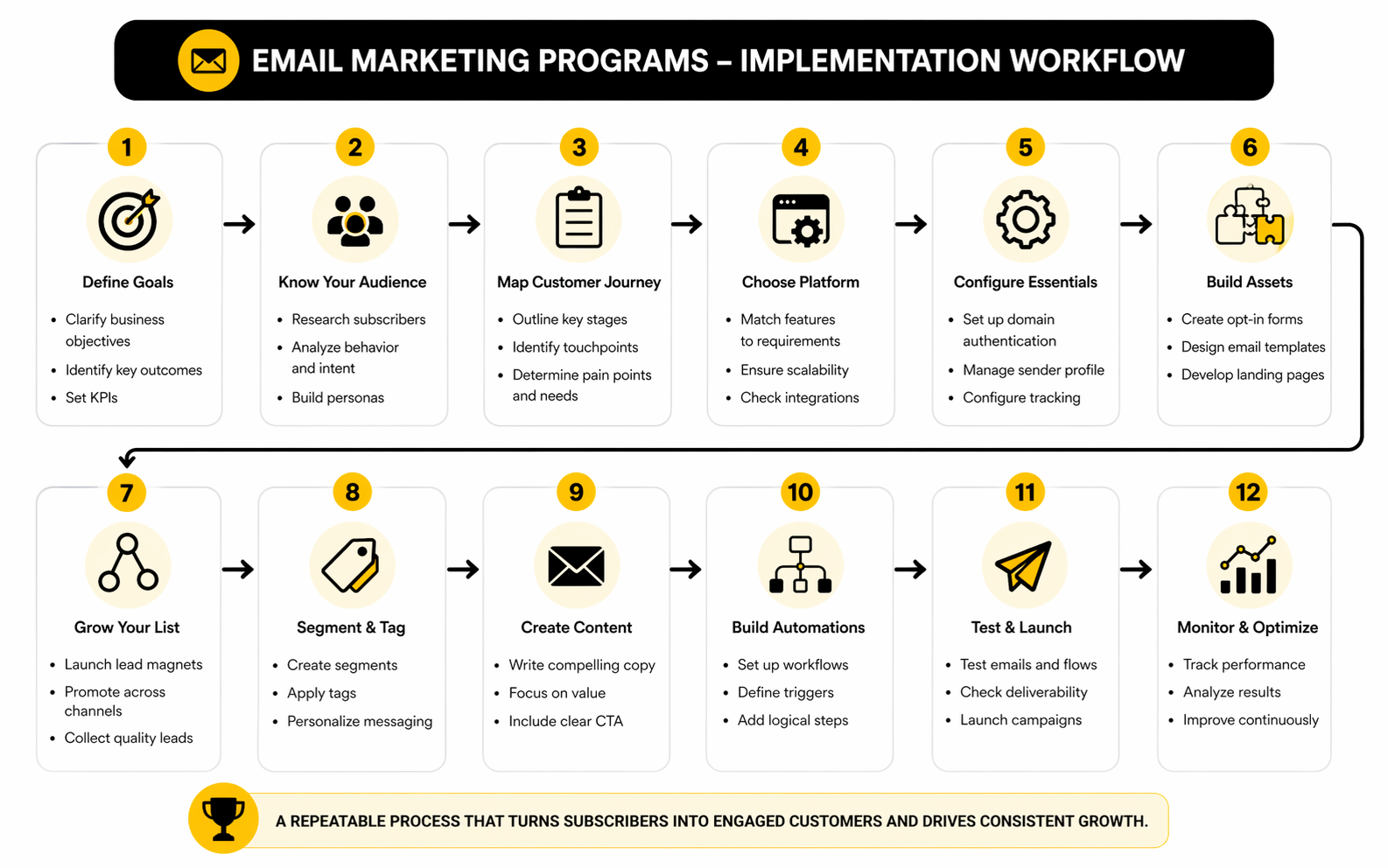
Professional implementation starts before the first campaign is sent. You need to know what the program is supposed to accomplish, which audiences it serves, what data it can use, and which customer moments deserve follow-up. Without that foundation, the platform becomes a place where messy ideas get automated.
Start by documenting the customer journey. Where do people first join the list? What do they expect after signup? What actions show buying intent? What happens after purchase, booking, trial signup, or inactivity? These questions turn email from a sending channel into a structured operating system.
Then decide which workflows matter first. You do not need twenty automations on day one. You need the few that protect the highest-value moments: welcome, nurture, purchase recovery, post-purchase, sales handoff, retention, and reactivation.
Step 1: Define The Program Goal
Every email marketing program needs one primary goal before it needs templates. That goal might be more first purchases, more booked calls, better trial activation, more repeat orders, stronger customer retention, or better lead-to-sales conversion. The goal decides what you build first.
A newsletter-led business may care most about engagement and audience trust. An ecommerce brand may care most about revenue per subscriber and repeat purchase rate. A B2B company may care most about sales-qualified leads and pipeline influenced by email.
Do not skip this step. If the goal is unclear, the whole program becomes reactive. You will keep sending emails because the calendar says so, not because the customer journey needs them.
Step 2: Audit The List And Data
Before building flows, clean up the list. Remove obvious junk, understand inactive segments, check consent sources, review bounce patterns, and identify where subscribers came from. Bad data makes even good automation unreliable.
Next, review the fields you can actually use. You may have email address, first name, source, customer status, purchase history, product interest, lifecycle stage, location, company role, or engagement data. Use what is reliable. Do not personalize with data you cannot trust.
This is also the right time to check authentication and sender setup. Google’s bulk sender rules require senders reaching large volumes of Gmail accounts to authenticate outgoing email, avoid unwanted messages, and make unsubscribing easy. That means deliverability needs to be handled before aggressive scaling, not after inbox placement drops.
Step 3: Build The Essential Segments
Segmentation should begin with practical groups, not complicated theory. Start with new subscribers, engaged contacts, inactive contacts, leads, customers, repeat customers, high-intent visitors, and people grouped by signup source or interest. These segments are enough to make the early program far more relevant.
The goal is to stop treating the full list like one audience. A recent buyer needs reassurance, onboarding, or a next-step recommendation. A cold subscriber needs either a strong reason to re-engage or a clean exit. A high-intent lead needs proof, clarity, and a clear conversion path.
Keep the first version simple. Segments should be easy to understand, easy to maintain, and useful for decisions. If a segment does not change what you send, when you send, or how you measure, it probably is not needed yet.
Step 4: Create The Core Automation Flows
Once the data and segments are clear, build the core flows. The welcome flow introduces the brand, sets expectations, and guides the subscriber toward the next useful action. The nurture flow educates and builds trust before asking for a bigger commitment.
For ecommerce, abandoned cart, browse abandonment, post-purchase, review request, replenishment, and win-back flows often matter early. For B2B, lead magnet delivery, webinar follow-up, case study nurture, sales alert, and reactivation flows usually matter more. For service businesses, consultation booking follow-up and proposal follow-up can be extremely valuable.
Each automation should have a clear trigger, purpose, message sequence, exit condition, and success metric. If you cannot explain why the flow exists, it should not be live. Automation should reduce friction, not create inbox clutter.
Step 5: Design Campaigns Around Real Moments
Campaigns are not separate from the automation system. They should support launches, promotions, education, seasonal moments, product updates, events, content releases, and customer needs that do not fit a permanent flow. Good campaigns feel timely and intentional.
Plan campaigns around audience readiness. Do not send the same sales email to someone who joined yesterday, bought last week, and ignored you for six months. Use segmentation to control pressure and relevance.
This is where tools like Buffer can support broader campaign coordination when email is tied to social content, launch windows, and editorial calendars. Email performs better when it is part of a coordinated marketing motion instead of an isolated send.
Step 6: Connect Forms, Pages, And Offers
An email program is only as strong as the entry points feeding it. Forms, landing pages, checkout opt-ins, lead magnets, quizzes, webinar registrations, and booking pages all shape subscriber quality. Weak entry points create weak lists.
Make each form specific about what the person will receive. A vague “join our newsletter” form usually performs worse than a clear promise tied to a useful outcome. The better the promise, the easier it is to write relevant follow-up.
Tools like Fillout, Replo, and ClickFunnels can help build the capture layer when they are connected to a clear email strategy. The form is not the strategy. It is the doorway into the strategy.
Step 7: Test Before Scaling
Before increasing send volume, test the program carefully. Check every form, tag, segment, automation trigger, unsubscribe link, redirect, booking link, coupon, product link, and CRM handoff. Small mistakes can become expensive when automation runs at scale.
Test the experience like a subscriber, not only like a marketer. Join from different forms. Click through the emails. Wait through the delays. Confirm that the next message makes sense based on the previous action.
Also watch early engagement signals. If unsubscribes, complaints, bounces, or low clicks show up quickly, do not push harder. Fix the relevance, list quality, offer, timing, or deliverability setup first.
Step 8: Create A Weekly Operating Rhythm
Email marketing programs improve through rhythm. Review performance weekly, clean up issues, check upcoming campaigns, inspect automation results, and make one or two focused improvements. Do not try to rebuild the whole system every week.
A weekly review should look at campaign performance, automation health, list growth, unsubscribe patterns, complaints, conversion points, and revenue or pipeline impact. The goal is to spot useful signals early. If one segment performs well and another drops off, that tells you where the next optimization belongs.
This operating rhythm matters more than chasing tactics. The best email programs are not perfect on launch day. They become strong because someone keeps improving the system.
Statistics And Data
Email marketing programs should be measured like business systems, not like content calendars. The numbers only matter when they explain what is happening and what to do next. A high open rate can still produce weak revenue. A lower open rate can still be profitable if the audience is qualified, the offer is strong, and the conversion path works.
The first layer is visibility. Sinch Mailgun’s 2026 Email Impact Report found that fewer than half of organizations can reliably track email ROI, even though companies that do measure it often see strong returns. That gap matters because an email program without ROI tracking can look busy while quietly wasting list quality, creative effort, and commercial opportunity.
The second layer is deliverability. The same reporting on the Sinch Mailgun findings noted that nearly 18% of marketing emails fail to reach the inbox at all. That should change how you interpret every campaign. If performance looks weak, the problem may not be the subject line. It may be list quality, sender reputation, authentication, spam complaints, or low engagement.
The Metrics That Actually Matter
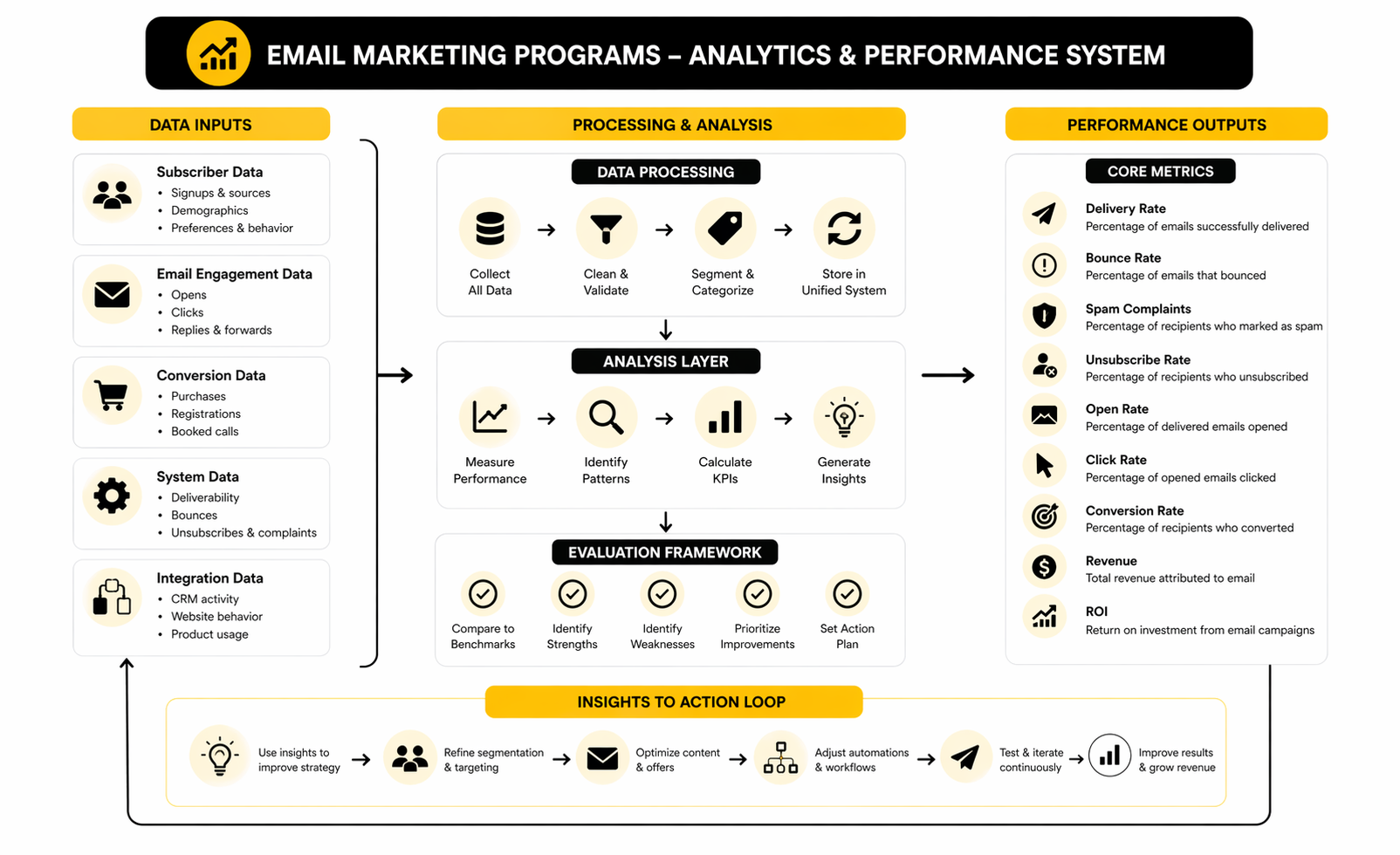
Email marketing programs need a practical measurement stack. Start with delivery rate, bounce rate, spam complaint rate, unsubscribe rate, open rate, click-through rate, conversion rate, revenue, and ROI. Then add program-specific metrics such as booked calls, demo requests, trial activations, repeat purchases, customer retention, pipeline influenced, or reactivation rate.
Open rate is useful, but it should not be treated as the final truth. Privacy features, image loading, inbox behavior, and tracking limitations can affect it. Use open rate as a directional engagement signal, not as the main business metric.
Click-through rate is often more actionable because it shows whether the email created enough interest for someone to move. Conversion rate goes one step further and shows whether the click led to the intended action. Revenue and pipeline metrics are where the program finally connects to business value.
Benchmarks Are Context, Not Targets
Benchmarks help you understand whether performance is broadly healthy, but they should not become the strategy. MailerLite’s recent benchmark data shows wide differences by industry, with ecommerce open rates listed at 32.67%, software and web app at 39.31%, consulting at 45.96%, and marketing and advertising at 37.23%. Those differences are a reminder that “good” depends on audience, category, sender relationship, and message type.
A welcome email should usually outperform a cold reactivation campaign. A post-purchase flow should usually behave differently from a newsletter. A small, highly engaged B2B list may beat a large ecommerce list on opens while producing less total revenue. That is why comparing every email against one universal benchmark is lazy analysis.
Use benchmarks to spot obvious problems. If deliverability is weak, clicks collapse, unsubscribes spike, or complaints rise, investigate quickly. But once the program is stable, compare performance against your own historical baseline. Your best benchmark is usually your own list, offer, audience, and sending rhythm.
How To Read Open Rates
Open rates tell you whether the sender name, subject line, timing, inbox placement, and audience relationship are working well enough to earn attention. If opens are low across every segment, look at deliverability, sender reputation, list age, signup quality, and sending consistency. If opens are low only in one segment, the issue is probably relevance.
Do not overreact to one campaign. A single email can underperform because of timing, topic, offer, seasonality, or audience fatigue. Look for patterns across multiple sends before making big changes.
When open rates are strong but clicks are weak, the email earned curiosity but failed to create action. That usually points to a mismatch between subject line and content, weak offer clarity, poor layout, unclear call to action, or content that gives people no reason to continue. Fix the message before blaming the audience.
How To Read Clicks And Conversions
Clicks show intent. They tell you whether the email created enough motivation for someone to leave the inbox and take the next step. If clicks are low, the message may be too broad, the offer may be weak, or the call to action may be unclear.
Conversions show whether the destination fulfilled the promise of the email. If clicks are healthy but conversions are weak, the problem is often the landing page, checkout flow, booking page, form, pricing page, or offer framing. Email may be doing its job while the next step is leaking demand.
This is why email marketing programs should not be measured in isolation. The email creates movement. The page, funnel, product, sales process, or checkout has to complete the movement. Tools like ClickFunnels, Systeme.io, or Replo can help when the conversion path needs cleaner pages, stronger offer flow, or faster campaign deployment.
How To Read Unsubscribes And Complaints
Unsubscribes are not always bad. Sometimes they clean the list and protect engagement. A small number of people leaving after a specific campaign may simply mean the message was not relevant to them. That is normal.
Spam complaints are different. They are a stronger negative signal because they tell inbox providers that recipients did not want the message. Google’s sender guidance says bulk senders need to keep user-reported spam rates low and meet requirements around authentication and easy unsubscribe options. That means complaints are not just a vanity metric. They can affect whether future emails reach the inbox.
If complaints rise, stop and diagnose. Check list source, consent, frequency, subject line accuracy, content expectations, unsubscribe visibility, and whether old inactive contacts were included. Do not keep pushing volume into a list that is telling inbox providers it does not want your emails.
The Analytics System
A clean analytics system has three layers: inputs, processing, and outputs. Inputs include subscriber source, consent status, segment, behavior, campaign, automation trigger, email engagement, and downstream conversion data. Processing means organizing that data into segments, reports, attribution views, and weekly decisions.
Outputs are the business signals: revenue, booked calls, demos, repeat purchases, trial activation, customer retention, reactivation, pipeline, unsubscribe risk, and list health. This is where the program becomes useful. You are not just collecting numbers. You are using them to decide what to send, who should receive it, when to stop, and where to improve.
The best email marketing programs make analytics part of the weekly operating rhythm. Review deliverability first, engagement second, conversion third, and revenue or pipeline fourth. That order matters because revenue problems often start earlier in the chain. If emails are not delivered, opened, clicked, or trusted, revenue will eventually suffer.
What The Data Should Make You Do
Data should drive action. If a welcome flow has strong opens but weak clicks, rewrite the value proposition and call to action. If a cart flow gets clicks but weak purchases, improve the offer, product page, or checkout path. If a newsletter drives replies but not revenue, decide whether its job is relationship-building or commercial conversion.
If inactive subscribers are dragging down engagement, build a reactivation sequence and remove people who do not respond. If one segment consistently outperforms the rest, study why. It may reveal your best acquisition source, strongest customer profile, or most valuable content angle.
Do not chase every metric at once. Pick the bottleneck. Fix the bottleneck. Then move to the next one. That is how email marketing programs become stronger without turning analytics into noise.
Advanced Email Marketing Program Strategy
Advanced email marketing programs are not advanced because they have more automations. They are advanced because they make better decisions with cleaner data. The goal is not to send more email. The goal is to send the right email to the right person at the right moment, then know whether it worked.
This is where strategy becomes sharper. You have to decide which subscribers deserve more attention, which ones should be suppressed, which offers should be personalized, and which workflows should be simplified. More complexity only helps when it improves relevance, timing, deliverability, or revenue.
The best programs also know when not to send. That sounds simple, but it is a serious advantage. Protecting the list is often more valuable than squeezing one more campaign into the calendar.
Segmentation Gets More Valuable As The List Grows
Basic segmentation separates subscribers by status, source, engagement, and customer stage. Advanced segmentation looks at intent, value, lifecycle movement, product interest, sales readiness, and risk. That is where email marketing programs start feeling personal without manually writing every message.
For ecommerce, advanced segments might include high-value customers, discount-sensitive buyers, one-time purchasers, replenishment windows, category interest, and churn risk. For B2B, they might include role, company type, funnel stage, content topic, product interest, webinar attendance, and sales activity. For creators, they might include topic interest, buyer status, engagement depth, and referral behavior.
The tradeoff is maintenance. Segments need clean data, clear rules, and regular review. If nobody knows why a segment exists, it will eventually create confusion.
Personalization Should Be Useful, Not Creepy
Personalization works when it helps the reader. A product recommendation based on browsing behavior can be useful. A reminder tied to a trial action can be useful. A follow-up based on a downloaded resource can be useful. Random first-name tags and forced “personal” lines usually do very little.
The practical test is simple: does the personalization make the email more relevant? If it only proves that you collected data, leave it out. People do not want to feel tracked. They want messages that make sense.
Dynamic content can be powerful, but it should be used carefully. If the data is wrong, the email feels broken. If the logic is too complicated, the team struggles to maintain it. Useful personalization beats impressive-looking personalization every time.
Deliverability Becomes A Scaling Constraint
As send volume grows, deliverability becomes one of the biggest constraints. Google’s sender guidance says senders reaching personal Gmail accounts need to meet requirements around authentication, spam rates, and one-click unsubscribe. That means scale now depends on trust, not just list size.
This changes how you should think about growth. Buying lists, scraping contacts, blasting inactive subscribers, hiding unsubscribe links, or sending irrelevant campaigns can damage the whole program. You may get a short-term traffic bump and a long-term inbox problem.
A scaling email program needs suppression rules, reactivation logic, sunset policies, authentication checks, bounce monitoring, complaint monitoring, and list-source discipline. Boring? Maybe. But this is the part that keeps revenue-producing emails reaching the inbox.
Compliance Is Not Optional
Email compliance depends on where your subscribers are, how you collected consent, and what type of message you send. The FTC’s CAN-SPAM business guidance explains requirements for commercial email in the United States, including truthful header information, non-deceptive subject lines, clear identification, a valid physical postal address, and honoring opt-out requests. In the UK, the ICO explains that electronic marketing generally requires consent or a valid soft opt-in for previous customers.
This is not legal decoration. Compliance affects trust, deliverability, brand reputation, and risk. A program that cuts corners with consent may grow quickly, but it usually creates weaker engagement and higher complaint risk.
The safest operating principle is clear: collect permission honestly, explain what people will receive, make unsubscribing easy, and keep a clean record of consent. That approach is better for readers and better for long-term performance.
AI Should Improve The System, Not Just Write Copy
AI can help email marketing programs, but not if it is only used to produce more generic campaigns faster. The real value is in research, segmentation ideas, testing plans, subject line variation, lifecycle mapping, customer review analysis, and performance diagnosis. Copy generation is only one small piece.
The danger is volume without judgment. If AI lets the team send twice as many mediocre emails, the program gets worse. If it helps the team understand the audience better and improve the next decision, the program gets stronger.
Tools like GoHighLevel AI, Chatbase, and Firecrawl can fit into research, automation, support, or content workflows when the use case is clear. Do not add AI because it sounds modern. Add it when it removes friction or improves decisions.
The Biggest Scaling Mistake
The biggest scaling mistake is confusing list growth with program health. A larger list is not automatically better. If the new subscribers are low quality, poorly sourced, or poorly nurtured, they can reduce engagement and hurt deliverability.
Healthy growth comes from better acquisition sources, clearer signup promises, stronger onboarding, cleaner segmentation, and useful follow-up. Unhealthy growth comes from vague giveaways, rented lists, forced opt-ins, and campaigns that attract people who will never buy. The list may grow, but the business value does not.
This is why list quality should be reviewed by source. If one source produces strong clicks, purchases, replies, or booked calls, invest more there. If another source produces unsubscribes, bounces, and silence, fix it or stop using it.
Lifecycle Strategy Beats Campaign Chaos
Campaigns are useful, but lifecycle strategy is what makes email marketing programs durable. A subscriber should have a thoughtful journey from signup to first conversion, from first conversion to repeat action, and from active relationship to retention or reactivation. That journey should not depend on someone remembering to send the right email manually.
Lifecycle strategy also reduces pressure on launches. If the core flows are working every day, the business is not dependent on occasional big campaigns. That creates more stable performance.
The most useful lifecycle stages are usually simple:
- New subscriber
- Engaged lead
- High-intent lead
- First-time customer
- Repeat customer
- Inactive subscriber
- At-risk customer
- Reactivated contact
Each stage needs different messaging. Keep the system understandable. A lifecycle map that the team can actually use will outperform a complicated diagram nobody touches.
When To Upgrade Your Email Marketing Program
You should upgrade your email marketing program when the current system blocks growth, not just because another tool looks better. Common signs include weak segmentation, poor automation flexibility, unreliable reporting, missing integrations, slow campaign production, limited deliverability controls, or messy CRM handoff.
Do not migrate platforms casually. Migration can break forms, automations, tags, historical reporting, templates, unsubscribe logic, and integrations. Before moving, document the current system, decide what should be rebuilt, and remove workflows that no longer serve a clear purpose.
Sometimes the right upgrade is not a new platform. It might be better list hygiene, stronger offers, clearer flows, improved landing pages, or a better operating rhythm. Software matters, but it is rarely the only bottleneck.
FAQ - Built For Complete Guide
What are email marketing programs?
Email marketing programs are systems for collecting subscribers, sending campaigns, running automated flows, measuring performance, and improving customer relationships through email. A real program includes strategy, segmentation, deliverability, content, automation, reporting, and optimization. The software matters, but the system behind it matters more.
What is the best email marketing program for beginners?
The best beginner option is usually the one that is simple enough to use consistently. New teams should prioritize easy list management, simple automation, clean templates, signup forms, and basic reporting. A beginner does not need the most advanced platform first; they need a program they can actually operate every week.
What is the best email marketing program for ecommerce?
Ecommerce teams should look for product-based segmentation, abandoned cart flows, post-purchase automations, revenue tracking, customer lifecycle segments, and strong integrations with the store platform. The program should support first purchase, repeat purchase, retention, and win-back. If the tool cannot connect email activity to customer behavior, ecommerce performance will be harder to improve.
What is the best email marketing program for B2B?
B2B teams should prioritize CRM integration, lead scoring, lifecycle stages, sales alerts, nurture sequences, booking links, and pipeline reporting. The goal is not just to send newsletters. The goal is to help buyers move from interest to trust to a real sales conversation.
How often should businesses send marketing emails?
There is no universal sending frequency that works for every business. A content-heavy newsletter might send weekly, while an ecommerce brand may send more often during promotions and less often between campaigns. The right frequency depends on subscriber expectations, engagement, offer strength, and unsubscribe or complaint patterns.
What metrics should email marketing programs track?
Track delivery rate, bounce rate, spam complaints, unsubscribes, opens, clicks, conversions, revenue, pipeline, retention, and ROI. Open rates can be useful, but they should not be the only decision point. The most important metric is the one tied to the email’s job.
Why do email marketing programs fail?
Most programs fail because they treat the whole list the same, send without a clear purpose, ignore deliverability, or measure the wrong things. Another common failure is buying software before defining the customer journey. The tool cannot rescue weak positioning, poor consent, bad data, or irrelevant messaging.
Are email marketing programs still worth it?
Yes, but only when they are built properly. Recent Sinch Mailgun reporting found that many companies measuring email ROI see strong returns, while poor deliverability and weak tracking leave money on the table. That means email is still powerful, but casual sending is not enough.
How important is deliverability?
Deliverability is critical because emails that never reach the inbox cannot generate clicks, sales, replies, or trust. Authentication, list quality, complaint rates, unsubscribe experience, and engagement all affect deliverability. A serious email program treats inbox placement as a core business issue.
Should small businesses use automation?
Yes, but they should start with essential automations. A welcome sequence, lead nurture flow, post-purchase flow, abandoned cart flow, booking follow-up, or reactivation flow can create meaningful results without becoming complicated. Small businesses should automate high-value moments first.
When should a business upgrade its email marketing platform?
Upgrade when the current platform blocks growth. That might mean weak segmentation, limited automation, poor reporting, missing integrations, deliverability limitations, or messy CRM handoff. Do not upgrade just because another tool looks more advanced.
Can AI improve email marketing programs?
AI can help with research, segmentation ideas, subject line testing, performance analysis, workflow planning, and content drafting. It should not be used to flood subscribers with generic emails. The best use of AI is better decision-making, not more noise.
Work With Professionals
Explore 10K+ Remote Marketing Contracts on MarkeWork.com
Most marketers spend too much time chasing clients, competing on crowded platforms, and losing a percentage of every project to middlemen.
MarkeWork gives you a better way. Browse thousands of remote marketing contracts and connect directly with companies desperate to hire skilled marketers like you, without platform commissions and without unnecessary gatekeepers.
If you're serious about finding better opportunities and keeping 100% of what you earn, explore available contracts and create a profile for free at MarkeWork.com.