

An email marketing specialist is no longer just the person who writes newsletters and presses send. The role now sits at the intersection of copywriting, segmentation, automation, deliverability, analytics, customer research, and revenue strategy. That matters because email is still one of the few marketing channels where a business can build a direct audience instead of renting attention from an algorithm.
The numbers back that up, but they also expose the gap. Email can generate an average return of $36 for every $1 spent, yet many teams still treat it like a basic campaign channel instead of a full lifecycle system. That is exactly where a strong email marketing specialist earns their keep: they turn scattered sends into a repeatable, measurable engine.
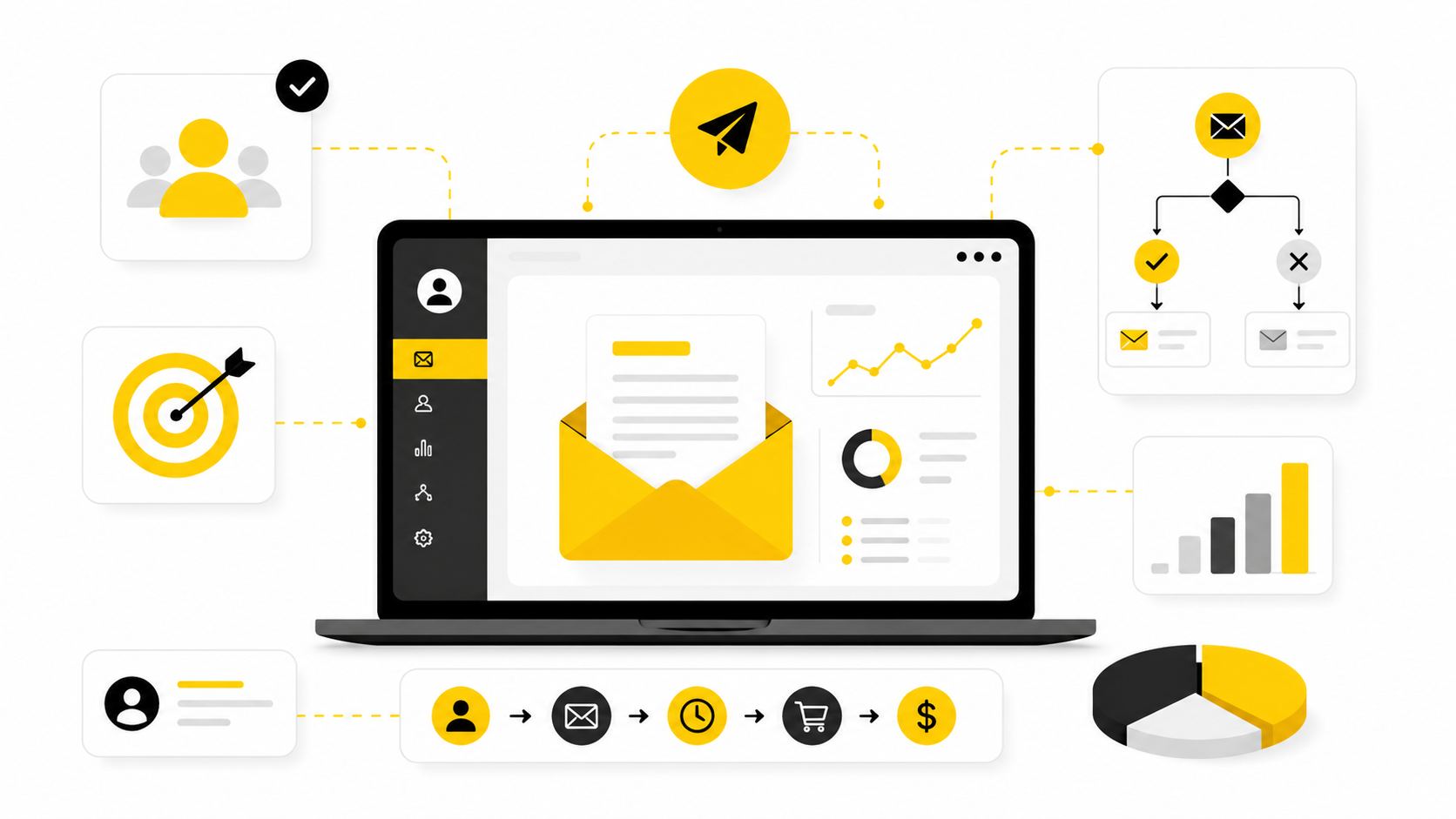
This guide breaks the role down in a practical way. You will see what an email marketing specialist actually does, why the role matters, which skills separate average operators from strategic specialists, and how businesses can build an email function that performs without burning out the audience.
Article Outline
- Why An Email Marketing Specialist Matters
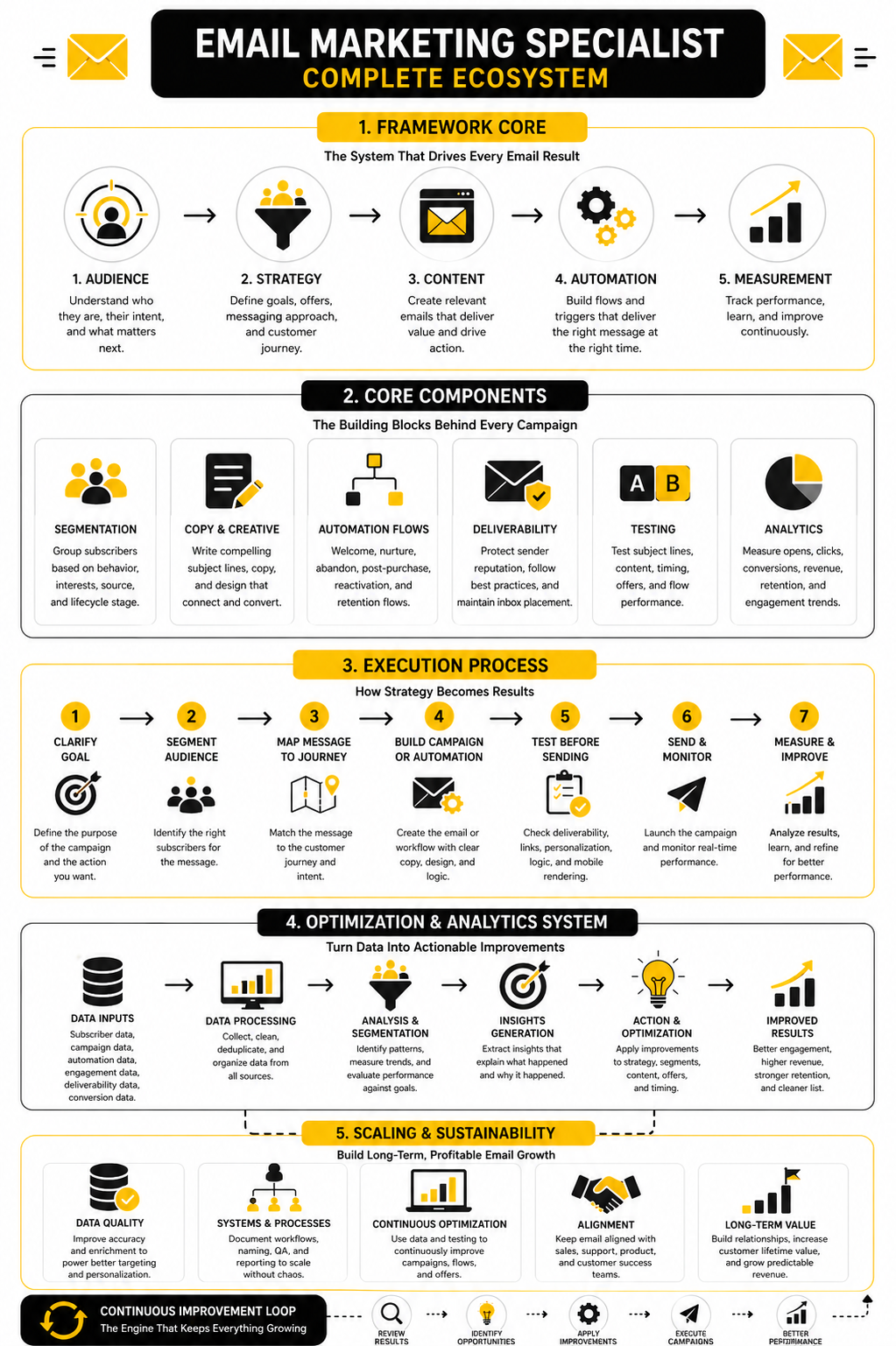
- The Email Marketing Specialist Framework
- Core Responsibilities Of An Email Marketing Specialist
- Skills That Separate Good Specialists From Great Ones
- Professional Implementation: Tools, Workflows, And Measurement
- Hiring, Career Growth, And Common Questions
Why An Email Marketing Specialist Matters
Email looks simple from the outside because the finished product is usually just a message in an inbox. Behind that message, though, is a chain of decisions about audience intent, timing, offer structure, personalization, compliance, testing, and follow-up. When those decisions are handled casually, email becomes noise.
The specialist’s job is to protect the value of the list. That means sending useful messages often enough to stay relevant, but not so often that subscribers stop paying attention. Recent benchmark research shows how much execution matters: one 2025 email benchmark report recorded overall averages around 35.64% open rate, 5.31% click rate, and 2.06% bounce rate, while different campaign types performed very differently depending on context and setup.
A good email marketing specialist also helps a business move away from “one campaign at a time” thinking. They build flows for welcome sequences, abandoned carts, lead nurturing, post-purchase education, reactivation, onboarding, and customer retention. In plain English, they make sure the right people hear the right message at the right moment.
The Email Marketing Specialist Framework
The easiest way to understand the role is to think in systems, not tasks. A specialist does write emails, build campaigns, and report on performance, but those are outputs. The real work is connecting audience data, message strategy, automation, and revenue goals into one operating rhythm.
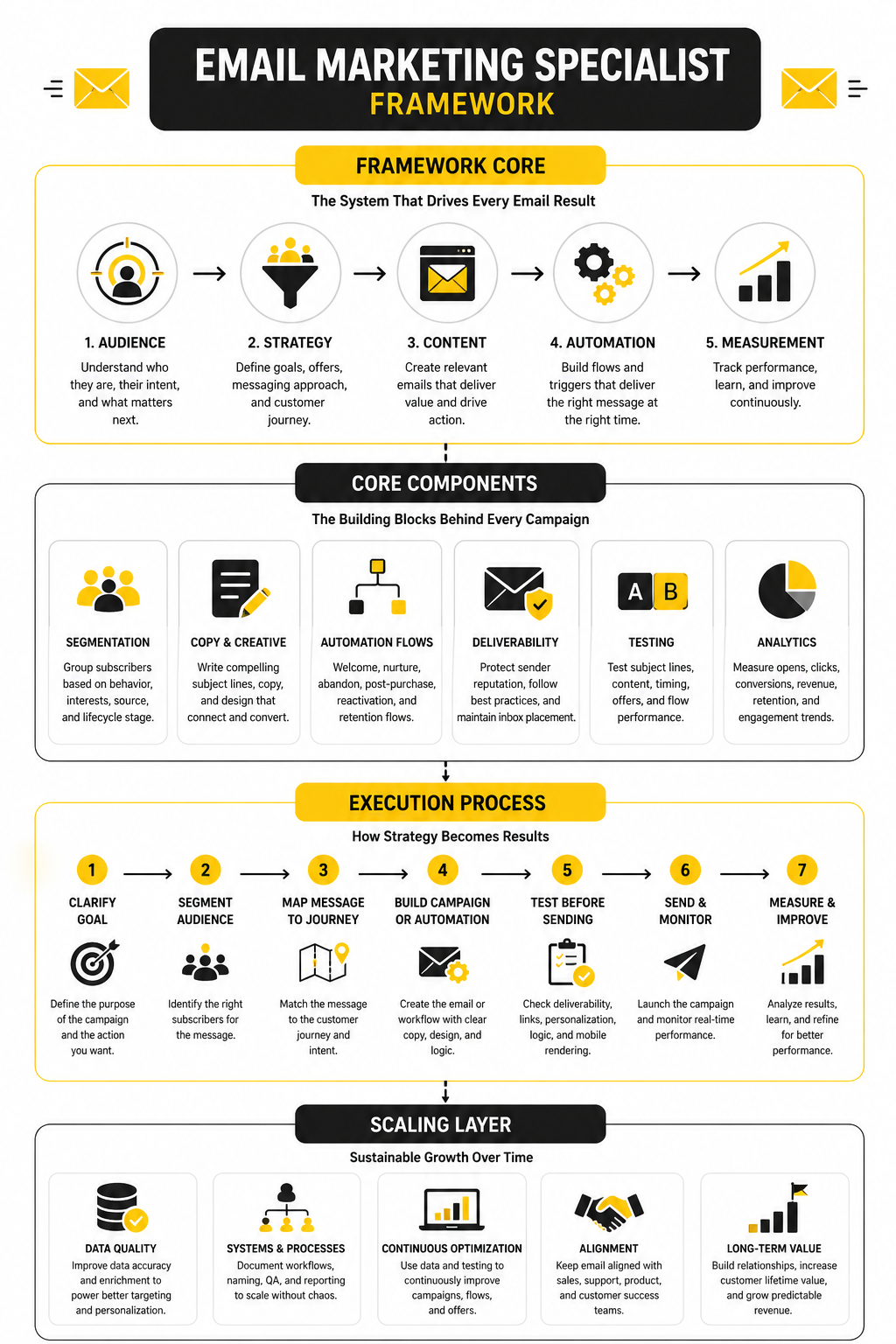
The framework starts with the audience. Who is receiving the email, what do they already know, what action makes sense next, and what would make the message genuinely useful? Without that clarity, even the best subject line is just decoration.
From there, the specialist builds the campaign logic. That includes segmentation, triggers, timing, creative direction, testing plans, and measurement. Tools like Brevo, Moosend, and GoHighLevel can support that system, but the tool is never the strategy. The specialist is the person who turns the tool into a business asset.
Core Responsibilities Of An Email Marketing Specialist
The core responsibility of an email marketing specialist is not “send more emails.” It is to build a reliable process that turns customer intent into useful communication. That process starts before the first subject line is written and continues after the campaign results come in.
A strong specialist works across strategy, content, automation, testing, deliverability, and reporting. They do not treat these as separate jobs. They connect them, because a great email with poor segmentation still fails, and a smart automation with weak copy still underperforms.
The best way to understand the role is to follow the actual execution flow. This is where the work becomes real, practical, and measurable.
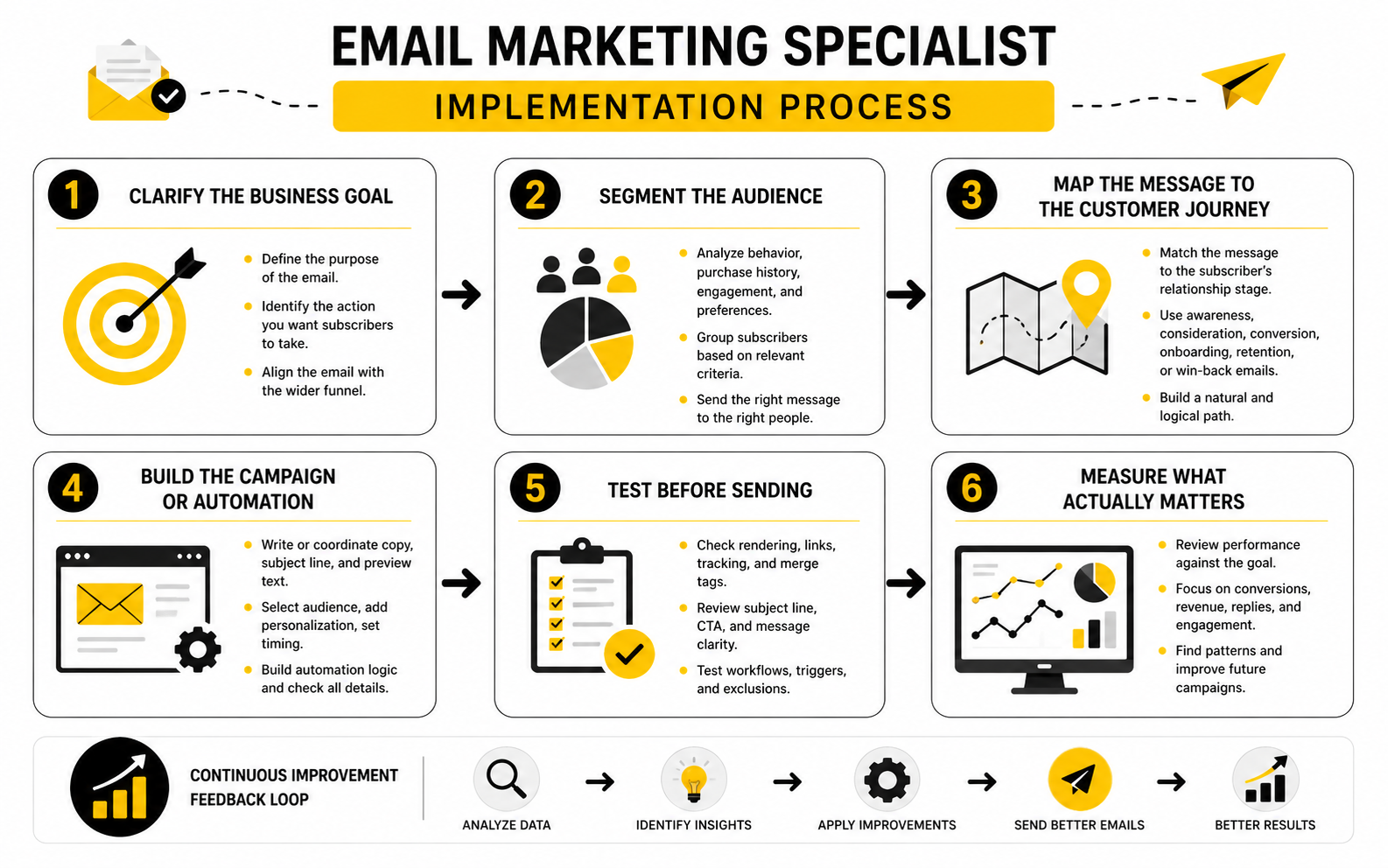
1. Clarify The Business Goal
Every campaign needs a job. Sometimes the goal is revenue, but not always. An email might need to educate new leads, recover abandoned carts, activate trial users, announce a product update, collect survey responses, or reduce churn.
An email marketing specialist starts by asking what action the subscriber should take next. That sounds basic, but it prevents a lot of weak campaigns. If the goal is unclear, the message becomes vague, the call to action becomes soft, and the report becomes hard to interpret.
This is also where the specialist aligns email with the wider funnel. For example, a campaign promoting a landing page built in ClickFunnels should not be judged only by opens or clicks. It should be judged by whether the email moved the right people into the next step of the sales process.
2. Segment The Audience
Segmentation is where email starts becoming relevant. A specialist looks at subscriber behavior, purchase history, lead source, engagement level, lifecycle stage, and stated preferences. Then they decide who should receive the message and who should not.
This matters because the same offer can feel helpful to one person and annoying to another. A new lead may need education, while an active customer may need a product recommendation or upgrade path. Sending both people the same email usually means one of them is getting a weaker experience.
A practical segmentation process does not need to be complicated at first. The specialist can begin with simple groups like new subscribers, engaged leads, recent buyers, inactive subscribers, and high-value customers. Over time, those segments can become more precise as the business collects better data.
3. Map The Message To The Customer Journey
Once the audience is clear, the message needs context. A welcome email should not sound like a flash sale. A reactivation email should not sound like a product launch. Each message has to match the subscriber’s relationship with the brand.
An email marketing specialist maps emails to the customer journey so the communication feels natural. That includes awareness emails, consideration emails, conversion emails, onboarding emails, retention emails, and win-back emails. The point is not to overwhelm people with automation, but to make sure they are not left guessing what to do next.
This is where lifecycle thinking becomes powerful. Instead of treating email as a series of random broadcasts, the specialist builds a path. The subscriber moves through that path based on behavior, not just a fixed calendar.
4. Build The Campaign Or Automation
Execution starts when the strategy becomes an actual workflow. The specialist writes or coordinates the copy, defines the subject line, prepares preview text, selects the audience, adds personalization, checks links, sets timing, and builds the automation logic. This is detail-heavy work, and small mistakes can be expensive.
For service businesses, agencies, and local businesses, GoHighLevel can fit naturally here because it combines CRM, automation, funnels, and follow-up in one place. For ecommerce or newsletter-led businesses, tools like Brevo or Moosend may be a cleaner starting point. The right tool depends on the business model, not on which platform has the loudest marketing page.
The specialist also has to think about failure points. Are the right people entering the workflow? Are excluded contacts properly removed? Are unsubscribe links working? Are internal test emails displaying correctly on mobile? This is not glamorous, but it is where professional email marketing is won.
5. Test Before Sending
Testing is not optional. A professional email marketing specialist checks rendering, links, tracking, personalization fields, subject lines, sender details, suppression lists, and automation triggers. One broken merge tag can make a brand look careless in front of thousands of people.
Testing also includes strategic checks. The specialist should ask whether the email has one clear purpose, whether the call to action matches that purpose, and whether the message gives the reader a real reason to act. Good QA catches technical errors, but great QA catches weak thinking.
This is especially important for automated sequences. A broadcast error is painful, but an automation error can run quietly for weeks. That is why every serious workflow needs a review process before it goes live.
6. Measure What Actually Matters
After the email sends, the work is not finished. The specialist reviews performance and separates useful signals from vanity metrics. Opens can help with directional feedback, but clicks, conversions, revenue, replies, unsubscribes, spam complaints, and downstream behavior usually tell a better story.
The key is to measure the campaign against its original goal. If the goal was to generate booked calls, the report should not celebrate a high open rate while ignoring poor calendar conversions. If the goal was onboarding, the specialist should look at activation behavior, not just email engagement.
This is also how future campaigns improve. The specialist looks for patterns, not isolated wins. Over time, the data should sharpen segmentation, messaging, offers, timing, and automation logic. That feedback loop is what turns email from a task into a growth system.
Statistics And Data
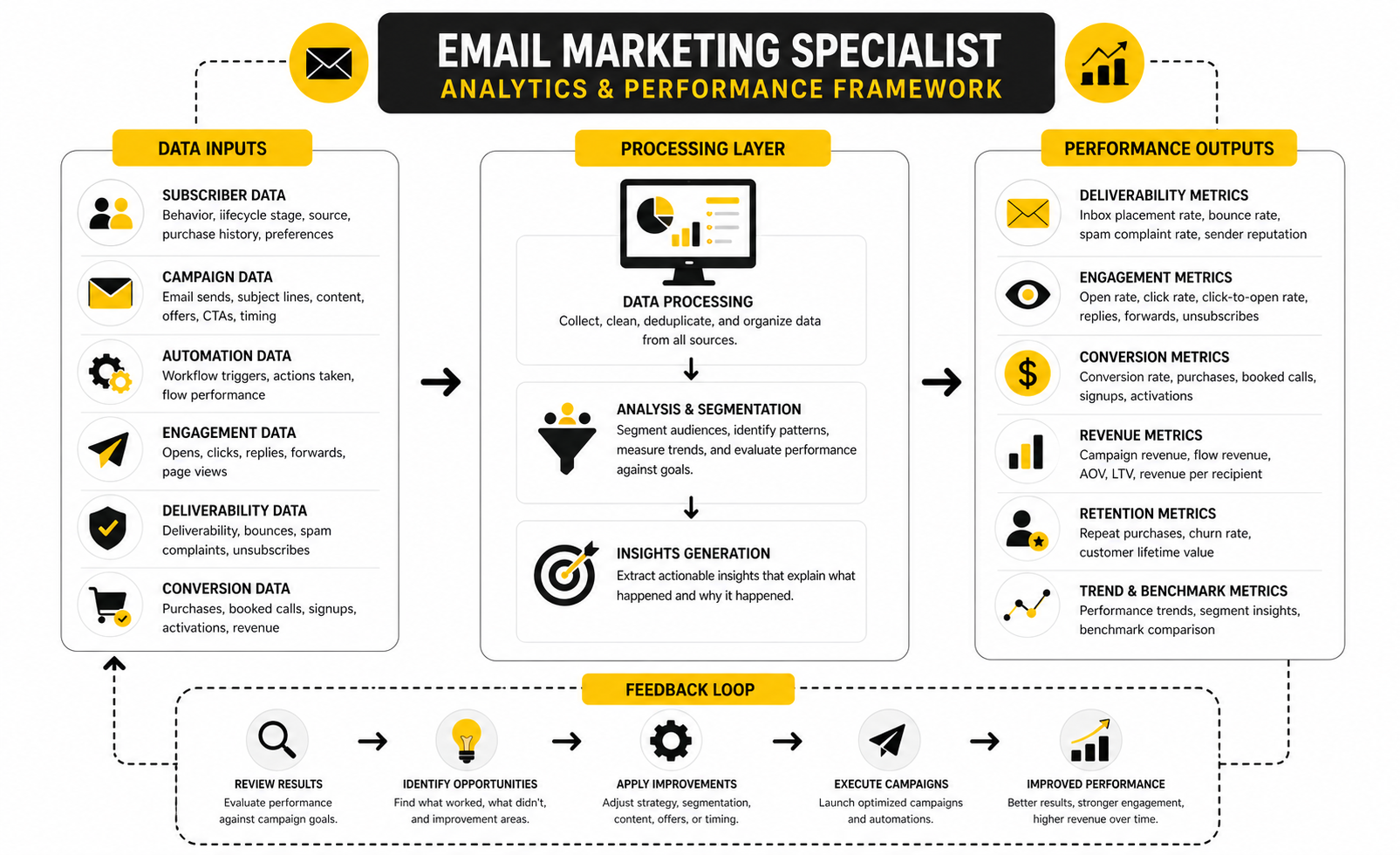
Data is where an email marketing specialist proves whether the system is working. Not by dumping open rates into a report and calling it insight. The job is to read the numbers, understand what they mean, and decide what should change next.
Email performance has to be measured in layers. One number rarely tells the full story. A strong open rate with weak clicks can mean the subject line created interest but the message failed to move people. A low click rate with high revenue can mean the email reached a smaller but more qualified segment. Context matters.
The Metrics That Actually Matter
The first layer is deliverability. If the email does not reach the inbox, nothing else matters. Google’s sender guidelines require proper authentication for senders and warn that Gmail may limit, block, or mark messages as spam when requirements are not met, while Yahoo’s sender guidance tells senders to keep spam complaints below 0.3%.
The second layer is engagement. Opens, clicks, click-to-open rate, replies, forwards, unsubscribes, and spam complaints show whether people are paying attention and whether the message feels welcome. Recent benchmark data from MailerLite showed a 43.46% average open rate, 2.09% average click rate, and 0.22% unsubscribe rate across 2025 campaigns.
The third layer is business impact. This is where an email marketing specialist looks at purchases, booked calls, trial activations, demo requests, repeat orders, retention, and lifetime value. Email can produce strong returns, with Litmus reporting that many programs see meaningful ROI, but that only matters when the business can connect email activity to actual outcomes.
Benchmarks Are Useful, But They Are Not The Goal
Benchmarks help you spot obvious problems. If your bounce rate is much higher than the market norm, your list quality may be weak. If your unsubscribe rate spikes after a campaign, the message, targeting, or frequency probably needs attention.
But benchmarks should never become the strategy. A business with a small, highly qualified list can outperform a larger list on revenue while looking average on engagement. A brand sending educational content may naturally see different click behavior than a brand sending discount-heavy ecommerce campaigns.
The smarter move is to compare against three things at once: industry benchmarks, your own historical performance, and the goal of the campaign. That gives the email marketing specialist a much clearer view. You are not asking, “Was this number good?” You are asking, “Did this email do the job it was supposed to do?”
What Open Rates Can And Cannot Tell You
Open rates are still useful, but they are less reliable than many teams think. Privacy changes, image loading behavior, inbox filtering, and bot activity can all affect how opens are recorded. That means an open rate should be treated as a directional signal, not a final verdict.
A rising open rate can suggest stronger subject lines, better sender trust, cleaner segmentation, or improved timing. A falling open rate can point to fatigue, weak relevance, poor deliverability, or a list that has gone cold. The specialist’s job is to investigate the cause instead of reacting emotionally to the number.
This is why opens should be paired with deeper signals. If opens rise but clicks, replies, and conversions stay flat, the campaign may have created curiosity without enough substance. If opens fall slightly but revenue increases, the email may still be doing its job with a better-qualified segment.
Clicks Show Intent
Clicks are usually a stronger signal than opens because they show action. Someone saw the message and chose to move forward. That does not automatically mean the campaign worked, but it does show that the email created enough interest to earn the next step.
A low click rate can mean the offer was weak, the call to action was unclear, the segment was wrong, or the email asked for too much too soon. It can also mean the email did its job without needing a click, especially for announcement, support, or relationship-building messages. Again, the metric has to be interpreted through the purpose of the email.
This is where tools matter, but only when they make the data easier to use. Platforms like Brevo, Moosend, and GoHighLevel can help track engagement and automation performance, but the specialist still has to decide what the numbers mean.
Revenue Is The Cleanest Signal, But Not The Only One
Revenue is often the cleanest performance signal because it shows whether email helped create money. For ecommerce, that might mean campaign revenue, flow revenue, average order value, repeat purchases, or revenue per recipient. For service businesses, it may mean booked calls, qualified leads, pipeline value, or closed deals.
The trap is judging every email only by immediate revenue. Some emails build trust, reduce objections, improve onboarding, or prevent churn. Those messages may not create instant sales, but they can still protect long-term revenue.
A good email marketing specialist separates direct-response campaigns from lifecycle communication. A launch email should be judged differently from a customer education email. A win-back sequence should be judged differently from a newsletter. One dashboard cannot explain everything unless the metrics are tied to the purpose of each message.
Negative Signals Deserve Fast Attention
Unsubscribes are not always bad. Some people leaving the list is normal, and a cleaner list often performs better over time. But sudden unsubscribe spikes are warning signs that the audience did not like the message, timing, frequency, or targeting.
Spam complaints are more serious. Mailgun’s 2025 deliverability guidance warns that complaint rates above 0.1% enter a danger zone, while 0.3% can create major deliverability risk. That means one complaint in every 1,000 emails is already worth watching carefully.
Bounce rates also need attention because they affect sender reputation. High bounces can point to old lists, weak opt-in practices, scraped contacts, poor validation, or bad imports. A specialist should not keep sending to a list that is clearly hurting deliverability.
The Reporting Rhythm
A useful email report should lead to action. It should show what was sent, who received it, what happened, what changed, and what the team should do next. Anything else is decoration.
For weekly reporting, the focus should be campaign performance, deliverability issues, list growth, unsubscribes, complaints, and key conversion events. For monthly reporting, the specialist should look at trends across segments, automations, revenue contribution, top-performing messages, weak points, and testing results. For quarterly reporting, the focus should shift toward strategy: list quality, lifecycle gaps, offer performance, and major opportunities.
This rhythm keeps email grounded in business decisions. The numbers are not there to impress anyone. They are there to help the team send better messages, protect the list, and make the channel more profitable.
Skills That Separate Good Specialists From Great Ones
At a basic level, an email marketing specialist can build campaigns, write decent copy, and read a dashboard. That is useful, but it is not enough when the list grows, the funnel gets more complex, and the business starts relying on email for predictable revenue. The next level is strategic judgment.
Great specialists know when to send and when not to send. They understand that every campaign spends a little bit of subscriber trust. The goal is not to maximize volume; the goal is to maximize useful communication without damaging long-term attention.
That is where advanced email marketing becomes more like portfolio management than content production. You are balancing revenue, relationship quality, deliverability, data accuracy, and customer experience at the same time. Push too hard in one area and another area starts to crack.
The Tradeoff Between Frequency And Fatigue
More email can create more revenue in the short term. That is why many teams keep increasing send volume after a strong campaign. The problem is that attention does not scale infinitely.
A smart email marketing specialist watches fatigue before it becomes obvious. Early warning signs include falling click rates, weaker repeat engagement, more unsubscribes, more spam complaints, and lower performance from the same audience segments over time. These signals often appear before revenue drops, which is why they matter.
Frequency should be based on audience behavior, not internal pressure. A buyer waiting for a renewal reminder needs a different cadence from a cold lead who downloaded one checklist three months ago. Treating both people the same is how lists get burned.
The Risk Of Over-Automation
Automation is powerful, but it can also make bad strategy happen faster. A broken campaign sent once is a mistake. A poorly designed automation running every day is a system-level problem.
The danger is not automation itself. The danger is building flows that ignore context. If someone buys, complains, cancels, books a call, or becomes inactive, the system should react intelligently instead of continuing to push the next generic message.
This is why an email marketing specialist needs periodic automation audits. Welcome flows, nurture sequences, sales follow-ups, onboarding flows, and reactivation campaigns should be reviewed for timing, logic, copy accuracy, exclusions, and performance. Tools like GoHighLevel can make automation easier to manage, but the specialist still has to keep the machine clean.
Personalization Needs Better Data, Not Just More Tokens
Personalization is not just adding a first name to the subject line. Real personalization uses behavior, preferences, lifecycle stage, purchase history, and intent. It makes the email feel more relevant because the message fits the reader’s situation.
The catch is that personalization is only as good as the data behind it. Bad data creates awkward emails, wrong recommendations, and confusing follow-ups. Worse, it can make the brand feel careless because the message proves the company does not really understand the customer.
That is why the specialist has to care about data hygiene. Forms, tags, custom fields, CRM stages, consent records, and event tracking all shape the quality of the email program. If those inputs are messy, the output will be messy too.
AI Can Speed Up Production, But It Cannot Own The Strategy
AI can help an email marketing specialist brainstorm angles, draft variations, summarize customer research, generate subject line options, and speed up repetitive production work. Used well, it gives the specialist more time for thinking. Used badly, it floods the list with generic content.
The issue is not whether AI can write an email. The issue is whether the email is accurate, relevant, differentiated, compliant, and aligned with the brand’s actual offer. That still requires human judgment.
AI should support the process, not replace responsibility. A specialist still needs to verify claims, check tone, protect deliverability, understand the audience, and make the final call. Faster output is only valuable when the quality bar stays high.
Compliance Is Part Of The Strategy
Compliance is not exciting, but ignoring it is reckless. Email marketing touches consent, unsubscribe handling, sender identity, data use, and regional privacy rules. A serious specialist treats these as operating requirements, not annoying legal details.
The practical side is straightforward. Use permission-based lists, make unsubscribing easy, avoid misleading subject lines, keep sender information accurate, and respect consent preferences. These basics protect both the audience and the business.
Deliverability rules also keep getting stricter. Yahoo’s sender guidance tells senders to keep spam complaint rates below 0.3%, which means reputation management is no longer something only technical teams can care about. An email marketing specialist has to understand the line between persuasive and pushy.
Scaling Requires Better Operations
As email grows, the work gets more operational. More campaigns, more segments, more offers, more automations, and more stakeholders create more chances for mistakes. Without a process, the specialist becomes the bottleneck.
Scaling needs clear campaign briefs, approval workflows, naming conventions, testing checklists, reporting templates, and documentation. This may sound boring, but it prevents chaos. It also makes performance easier to compare because campaigns are built and measured consistently.
For lean teams, platforms like Brevo or Moosend can keep the email setup manageable. For funnel-heavy businesses, pairing email with CRM and sales pipeline visibility matters more. The main point is simple: do not scale a messy system.
Expert-Level Email Marketing Is Restraint
The best specialists are not the ones who send the most. They are the ones who know which message should exist, who should receive it, and what should happen next. That restraint is what keeps email profitable without turning the list against the brand.
This is also what separates a technician from a strategist. A technician builds the campaign they are asked to build. A strategist challenges the brief when the audience, offer, timing, or goal does not make sense.
That is the standard worth aiming for. An email marketing specialist should make the business more confident about what it sends, more disciplined about what it measures, and more respectful of the people on the other side of the inbox.
Hiring, Career Growth, And Common Questions
A good email marketing specialist can support a business. A great one can change how the business communicates, sells, and retains customers. That is why the role belongs close to revenue, customer experience, and product positioning instead of being buried as a simple production task.
The strongest specialists understand the full ecosystem. They know how traffic becomes subscribers, how subscribers become buyers, how buyers become repeat customers, and how email supports each step without becoming annoying. That bigger view is what makes the role valuable long term.
Hiring or becoming an email marketing specialist comes down to proof. Can the person build clear campaigns, manage automation, understand data, protect deliverability, and improve business outcomes? If yes, they are not just “doing email.” They are building one of the most important owned channels a company has.
FAQ - Built For Complete Guide
What does an email marketing specialist do?
An email marketing specialist plans, builds, sends, tests, and improves email campaigns and automations. The role usually includes segmentation, copywriting, workflow setup, reporting, deliverability monitoring, and campaign optimization. In a stronger business setup, the specialist also connects email to revenue, retention, and customer experience.
Is an email marketing specialist the same as a copywriter?
No, although copywriting is part of the job. A copywriter focuses mainly on the words and persuasion angle, while an email marketing specialist owns the broader system around the message. That includes audience targeting, automation logic, testing, analytics, and performance improvement.
What skills does an email marketing specialist need?
The core skills are email strategy, copywriting, segmentation, automation, analytics, deliverability, and basic CRM understanding. The specialist also needs clear thinking because most email problems are not just writing problems. They are usually strategy, audience, offer, or timing problems.
How important is deliverability?
Deliverability is critical because the best campaign means nothing if it does not reach the inbox. A specialist needs to understand authentication, list quality, spam complaints, bounces, engagement signals, and sender reputation. This is one of the areas where professional execution matters most.
What tools should an email marketing specialist know?
A specialist should understand at least one serious email or marketing automation platform. Tools like GoHighLevel, Brevo, and Moosend can all support email workflows, but the right choice depends on the business model and funnel complexity.
How do you measure email marketing success?
Email success should be measured against the goal of the campaign. Opens and clicks are useful signals, but conversions, revenue, booked calls, replies, retention, unsubscribes, complaints, and deliverability trends usually matter more. A good specialist knows which metrics deserve attention and which ones are just noise.
How often should a business send emails?
There is no universal sending frequency that works for every business. The right cadence depends on the audience, offer, lifecycle stage, and quality of the content. A specialist should watch engagement, unsubscribes, complaints, and revenue trends to find the balance between consistency and fatigue.
Can AI replace an email marketing specialist?
AI can help with drafts, ideas, variations, research summaries, and production speed. It cannot fully replace strategy, judgment, audience understanding, offer positioning, compliance awareness, or final quality control. The best specialists will use AI as leverage, not as a substitute for thinking.
What makes an email marketing specialist worth hiring?
A specialist is worth hiring when email has become important enough that casual execution is costing money. That might mean weak automation, poor reporting, low conversions, deliverability issues, inconsistent campaigns, or a growing list that is not being used well. The right person brings structure, clarity, and measurable improvement.
How can someone become an email marketing specialist?
Start by learning the fundamentals of email strategy, copywriting, segmentation, automation, analytics, and deliverability. Then build real projects, even small ones, because this skill becomes valuable through execution. A portfolio with clear campaign goals, workflows, and results will always be stronger than vague claims.
What is the biggest mistake businesses make with email marketing?
The biggest mistake is treating email like a broadcast tool instead of a customer journey system. Random newsletters and last-minute promotions rarely build a strong channel. A better approach is to create structured flows, useful campaigns, clear segmentation, and a reporting rhythm that keeps improving performance.
Should small businesses hire an email marketing specialist?
Small businesses should consider hiring a specialist when they have leads, customers, or past buyers but no consistent follow-up system. Email can help turn existing attention into more sales without constantly buying more traffic. Even a simple welcome sequence, nurture flow, and reactivation campaign can create meaningful upside.
Work With Professionals
Explore 10K+ Remote Marketing Contracts on MarkeWork.com
Most marketers spend too much time chasing clients, competing on crowded platforms, and losing a percentage of every project to middlemen.
MarkeWork gives you a better way. Browse thousands of remote marketing contracts and connect directly with companies desperate to hire skilled marketers like you, without platform commissions and without unnecessary gatekeepers.
If you're serious about finding better opportunities and keeping 100% of what you earn, explore available contracts and create a profile for free at MarkeWork.com.