

Email marketing websites are no longer just tools for sending newsletters. They are full revenue systems that drive acquisition, retention, and lifetime value at scale.
The reason this matters is simple. Email consistently outperforms most channels in ROI, with returns reaching $36–$42 for every $1 spent when executed properly email marketing ROI data . But here’s the problem: most businesses are using only a fraction of what modern email marketing websites can actually do.
This guide breaks down the real system behind high-performing email marketing websites, not just tools, but the full infrastructure that drives results.
The Structure of This Guide
- Why Email Marketing Websites Matter More Than Ever
- The Core Framework Behind High-Performing Platforms
- How Email Marketing Websites Actually Work in Practice
- Analytics, Benchmarks, and What the Data Really Means
- Advanced Strategy, Tradeoffs, and Scaling Considerations
- FAQ – Built for Complete Guide
Why Email Marketing Websites Still Dominate
Despite the rise of social media, paid ads, and AI-driven channels, email remains one of the most reliable growth engines in digital marketing.
The global email user base has surpassed 4.4 billion users, and daily email volume continues to grow rapidly email usage growth . That means your audience is already there, checking their inbox multiple times per day.
What separates average results from exceptional ones is not whether you use email, but how your email marketing website is structured. Businesses that treat email as a system—rather than a broadcast tool—consistently outperform competitors.
There’s another layer most people miss. Email is one of the few channels you actually own. Platforms can change algorithms overnight, but your list remains your asset. That’s why serious marketers build infrastructure around email, not just campaigns.
The Core Framework Behind Email Marketing Websites
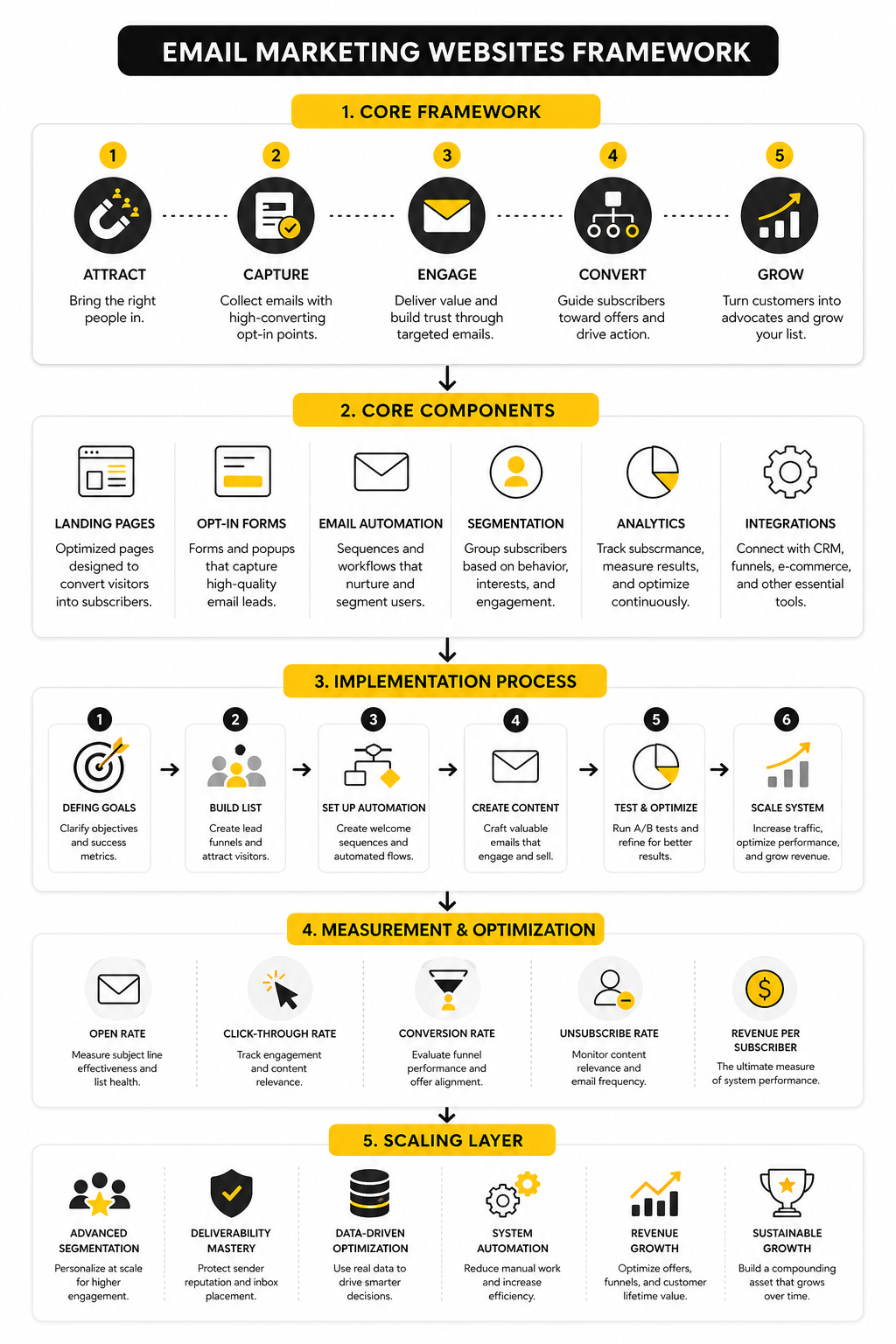
At the highest level, every successful email marketing website operates on a simple but powerful framework:
- Audience capture
- Data organization
- Automated communication
- Conversion optimization
- Retention and lifecycle expansion
Each layer builds on the previous one. If one breaks, the entire system underperforms.
Audience Capture Layer
Everything starts with capturing attention and turning visitors into subscribers. This usually happens through landing pages, lead magnets, or embedded forms.
Modern builders like Replo are designed specifically to optimize this step. The difference between a generic form and a high-converting capture page can be massive in terms of long-term revenue.
What matters here is not just volume, but intent quality. A smaller, more relevant list will outperform a large, unqualified one every time.
Data and Segmentation Layer
Once contacts enter your system, the real work begins. This is where most businesses fail.
Segmentation is one of the highest-leverage activities in email marketing. Campaigns that segment audiences see over 100% higher click-through rates compared to generic blasts segmentation impact .
Email marketing websites that win are not just storing emails—they are building dynamic profiles:
- behavior-based segments
- purchase history
- engagement signals
- lifecycle stage
Without this layer, automation becomes guesswork.
Automation and Delivery Layer
Automation is where email shifts from manual work to scalable growth.
Automated campaigns generate over 300% more revenue than standard campaigns automation performance . This includes:
- welcome sequences
- abandoned cart flows
- onboarding emails
- re-engagement campaigns
Platforms like Brevo or Moosend allow you to build these systems visually, but the tool is not the advantage. The logic behind the automation is what drives results.
Conversion Layer
This is where email marketing websites turn attention into revenue.
It includes:
- offer positioning
- timing of emails
- CTA placement
- funnel alignment
A single well-optimized sequence can outperform dozens of generic campaigns. For example, multi-email sequences generate significantly higher revenue than single-send campaigns, proving that persistence matters more than volume.
This layer is often connected to funnel builders like ClickFunnels, where email and landing pages work together as one system.
What Makes a Professional Email Marketing Website
There’s a clear difference between basic setups and professional-grade systems.
A basic setup sends emails.
A professional system:
- tracks behavior across channels
- personalizes content dynamically
- automates decision-making
- integrates with sales and CRM systems
Platforms like GoHighLevel combine CRM, automation, and funnel building into one ecosystem. This is where email marketing websites evolve from tools into full growth infrastructure.
Another critical factor is integration. Email doesn’t operate in isolation anymore. It connects with:
- SMS
- chatbots
- landing pages
- analytics platforms
Tools like ManyChat extend email into conversational marketing, while platforms like Chatbase integrate AI-driven interactions.
The result is not just better campaigns, but a unified communication system.
The Real Shift Happening Right Now
Most marketers still think in campaigns.
The shift happening now is toward systems thinking.
Email marketing websites are becoming:
- data platforms
- automation engines
- conversion systems
The companies that understand this are not just sending emails. They are building infrastructure that compounds over time.
And that’s exactly where the rest of this guide goes next.
How Email Marketing Websites Actually Work in Practice
Once you understand the framework, the next step is execution. This is where most businesses struggle, not because the tools are complicated, but because the system requires coordination across multiple layers.
A high-performing email marketing website is not built in isolation. It connects landing pages, automation flows, segmentation logic, and conversion funnels into one continuous experience. Every action a user takes feeds into the next step.
The difference between average and high-performing setups comes down to one thing: intentional sequencing.
Step 1: Build a Conversion-Focused Entry Point
Everything starts with a single entry point. This could be a landing page, a popup, or a lead magnet offer.
What matters is alignment between:
- the traffic source
- the message
- the offer
If someone clicks on an ad promising a discount, your email capture must deliver exactly that expectation. Any disconnect here reduces conversions immediately.
Tools like Replo allow you to design high-converting pages quickly, but the real advantage comes from testing different offers and layouts. Even small improvements in conversion rate compound over time.
Step 2: Capture and Enrich User Data
Once a user subscribes, the system should not just store their email. It should start building a profile.
This includes:
- source of acquisition
- behavior on site
- initial engagement signals
- declared preferences
Modern email marketing websites automatically enrich this data. The goal is to move from a static list to a dynamic database.
This step is critical because it determines how effective your segmentation and automation will be later. Without proper data, everything downstream becomes generic.
Step 3: Trigger the First Automated Sequence
The first automated sequence is where the relationship actually begins.
Welcome emails have some of the highest engagement rates in email marketing. Many datasets show open rates exceeding 50% for welcome flows, making them one of the most valuable opportunities in your system welcome email performance.
This sequence should:
- reinforce the value proposition
- deliver the promised asset
- introduce your brand
- guide the next action
Platforms like Brevo make it easy to build these flows, but again, the structure matters more than the tool.
Step 4: Segment Based on Behavior
As users interact with your emails and website, your system should continuously update their profile.
This is where segmentation becomes powerful. Instead of sending the same message to everyone, you create targeted paths:
- engaged vs inactive users
- buyers vs non-buyers
- high-intent vs low-intent segments
Behavioral segmentation consistently drives better performance because it matches messaging to intent. This is one of the key reasons segmented campaigns outperform generic ones by such a large margin.
Step 5: Connect Email to Conversion Funnels
Email marketing websites are most effective when tightly integrated with funnels.
This means:
- emails driving traffic to specific landing pages
- landing pages triggering new automation flows
- purchases updating user segments
Builders like ClickFunnels or all-in-one systems like GoHighLevel allow you to connect these pieces seamlessly.
Without this integration, email becomes disconnected from revenue. With it, every campaign becomes measurable and scalable.
Step 6: Introduce Multi-Channel Automation
Email alone is powerful, but modern systems extend beyond it.
High-performing setups combine:
- SMS
- chat automation
- retargeting
For example, tools like ManyChat allow you to create conversational flows that complement your email campaigns.
The key idea is consistency. The same user should experience a unified journey across channels, not disconnected messages.
Step 7: Build Retention and Lifecycle Campaigns
Most businesses focus heavily on acquisition but ignore retention. This is a costly mistake.
Returning customers are significantly more valuable than new ones, and email is one of the best channels to nurture long-term relationships.
Lifecycle campaigns include:
- onboarding sequences
- upsell and cross-sell flows
- re-engagement campaigns
- loyalty messaging
Email marketing websites that implement these properly turn one-time buyers into repeat customers. Over time, this dramatically increases lifetime value.
Where Most Implementations Fail
Even with the right tools, many businesses fail to get results. The reasons are predictable.
The most common mistakes include:
- treating email as a broadcast channel
- ignoring segmentation
- building disconnected funnels
- failing to track user behavior
- overcomplicating automation too early
Another major issue is tool overload. Many marketers stack multiple platforms without a clear system, creating complexity instead of leverage.
A better approach is to start simple, then scale. Platforms like Systeme.io are often used to build streamlined systems before expanding into more advanced setups.
The Shift From Campaigns to Systems
The biggest mindset shift is moving from campaigns to systems.
Campaign thinking focuses on short-term results:
- send email
- track opens
- move on
System thinking focuses on long-term growth:
- build sequences
- optimize flows
- improve conversion paths
- compound results over time
Email marketing websites are no longer about sending messages. They are about building infrastructure that generates predictable outcomes.
And once that system is in place, everything becomes easier to scale.
Professional Implementation: Building a Scalable Email System
At this point, the framework is clear and the mechanics are understood. Now the focus shifts to turning that knowledge into a real, working system that generates consistent results.
This is where email marketing websites either become a serious growth asset or remain underutilized tools. The difference is execution discipline and system design.
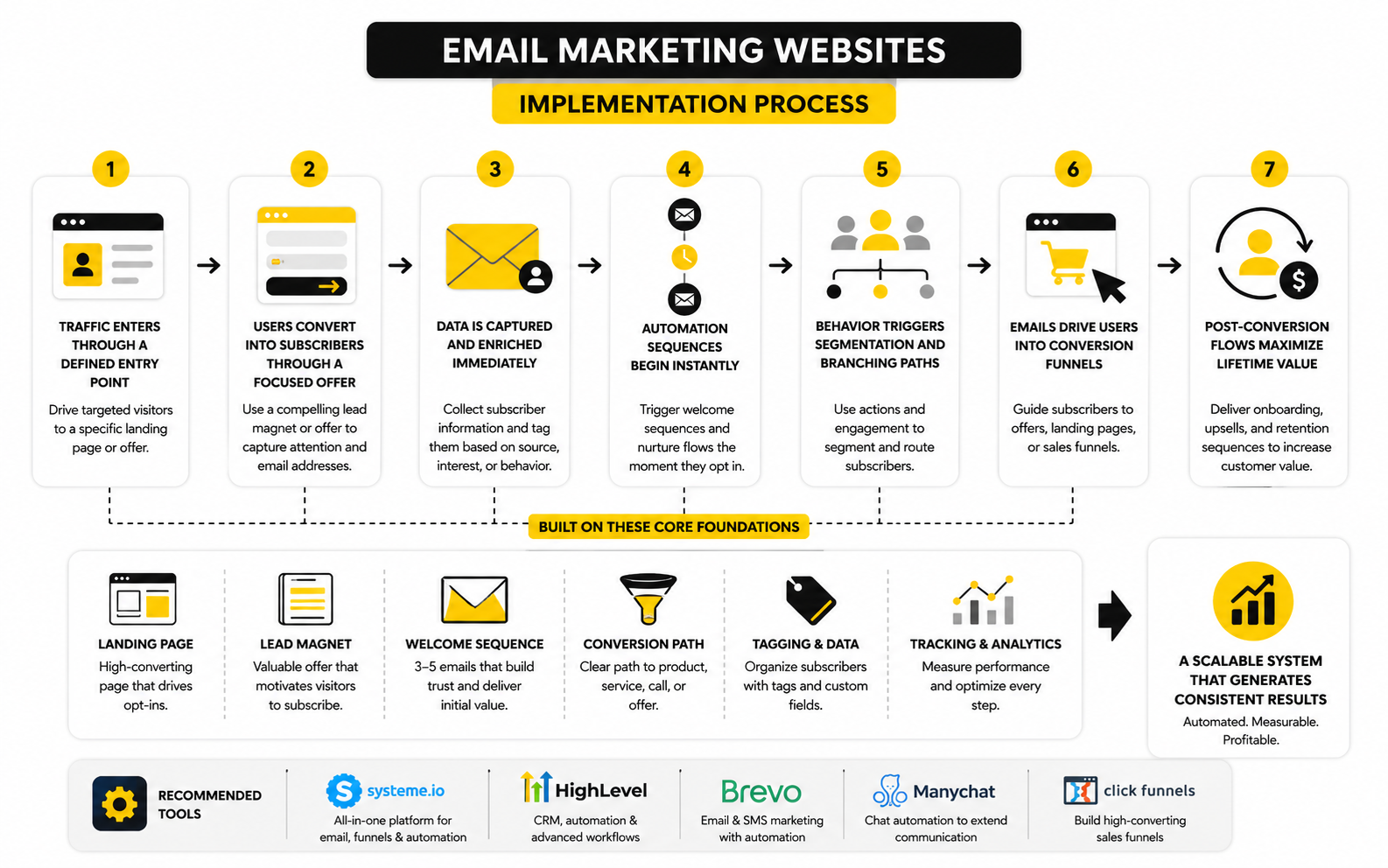
The Full Implementation Flow
When you strip everything down, every high-performing email marketing website follows a structured execution path. There are no shortcuts here, just clean sequencing and consistent optimization.
- Traffic enters through a defined entry point
- Users convert into subscribers through a focused offer
- Data is captured and enriched immediately
- Automation sequences begin instantly
- Behavior triggers segmentation and branching paths
- Emails drive users into conversion funnels
- Post-conversion flows maximize lifetime value
This flow is not theoretical. It’s how the highest-performing systems operate across e-commerce, SaaS, and service businesses.
Building Your First Complete System
The smartest way to implement is not to build everything at once. It’s to create a minimum viable system and expand from there.
Start with these core components:
- one high-converting landing page
- one lead magnet or offer
- one welcome sequence (3–5 emails)
- one conversion path (product, call, or funnel)
That’s enough to validate your system. Once this works, you layer in complexity.
Platforms like Systeme.io are often used at this stage because they allow you to build everything in one place without fragmentation.
Expanding Into Advanced Automation
Once your base system is working, the next step is expansion.
This includes:
- behavioral triggers (clicks, opens, page visits)
- conditional sequences (if/else logic)
- dynamic content personalization
- multi-step conversion flows
At this stage, tools like GoHighLevel become powerful because they combine CRM data, automation, and funnel tracking into one system.
The goal is not complexity for its own sake. The goal is relevance at scale.
Connecting Email to the Entire Marketing Stack
A professional email marketing website does not operate alone. It becomes the central nervous system of your marketing.
It connects with:
- landing page builders
- CRM systems
- analytics tools
- chat and messaging platforms
For example:
- Brevo handles email and SMS together
- ManyChat extends communication into chat automation
- ClickFunnels handles high-converting funnel flows
When these systems are aligned, your email marketing website becomes the backbone of your entire revenue engine.
The Role of Timing and Cadence
One of the most underestimated parts of implementation is timing.
It’s not just what you send, but when you send it.
Effective systems:
- trigger emails immediately after key actions
- space follow-ups strategically
- increase intensity during high-intent moments
- reduce frequency during low engagement periods
This is where automation becomes more than convenience. It becomes precision.
Avoiding Overengineering Early
A common mistake is trying to build a perfect system from day one.
This leads to:
- overly complex flows
- unused segments
- broken automation logic
- analysis paralysis
The better approach is:
- build simple
- validate performance
- optimize based on data
- expand gradually
Even the most advanced email marketing websites started with basic systems that were refined over time.
The Compounding Effect of a Well-Built System
Once your system is live and optimized, something important happens.
Every improvement compounds:
- higher conversion rates increase list value
- better segmentation improves engagement
- stronger automation increases revenue per user
Over time, this creates a flywheel effect. Your email marketing website stops being a channel and becomes a predictable growth system.
And that’s the point where email stops feeling like effort and starts functioning like leverage.
Understanding Performance Data in Email Marketing Systems
Once your system is live, the real leverage comes from understanding what the data is telling you. Most people look at numbers. Professionals interpret signals.
Email marketing websites generate a constant stream of measurable feedback. The problem is not lack of data. It’s knowing which metrics actually matter and what decisions they should trigger.
The Core Metrics That Actually Matter
Not all metrics are equal. Some are vanity. Others directly tie to revenue.
Here are the core signals you should focus on:
- Open rate → indicates subject line effectiveness and list health
- Click-through rate (CTR) → shows how compelling your message and offer are
- Conversion rate → reveals whether your funnel is aligned with user intent
- Unsubscribe rate → signals content mismatch or over-frequency
- Revenue per subscriber → the ultimate measure of system performance
Industry-wide benchmarks show that average open rates hover around 20–30% while click-through rates often sit between 2–5% depending on industry and list quality, as highlighted in recent email marketing benchmark reports.
These numbers are not targets. They are context. What matters is how your system compares to itself over time.
How to Read the Signals Correctly
Looking at a metric in isolation is where most mistakes happen.
For example:
- High open rate + low CTR → your subject line works, but your content doesn’t deliver
- Low open rate + high CTR → your message resonates, but your positioning is weak
- High CTR + low conversions → your funnel or offer is broken
Each combination tells a different story. The job is to diagnose the system, not celebrate individual numbers.
Building a Simple Analytics System
To make this actionable, you need a clear measurement structure.
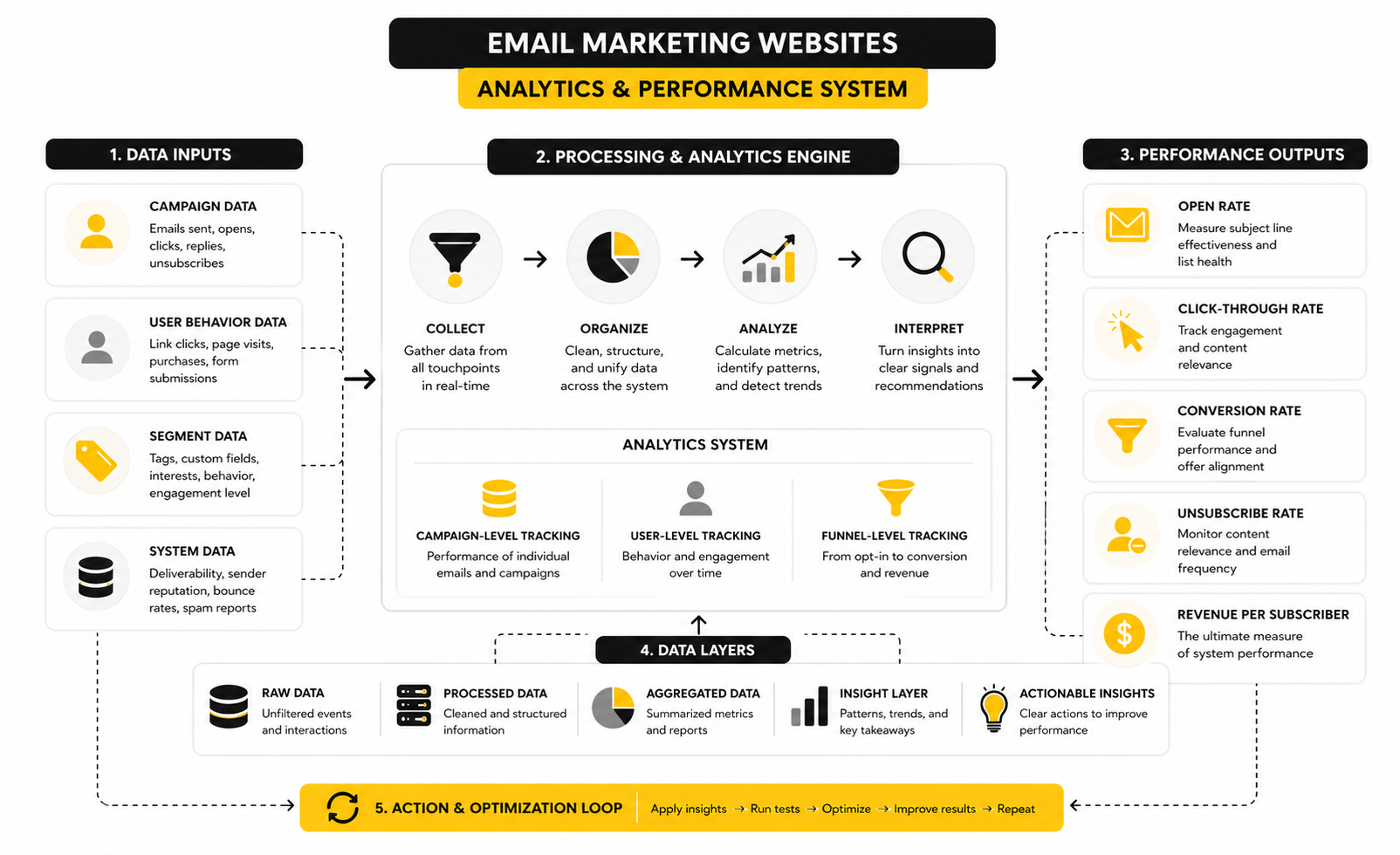
A basic but effective analytics system includes:
- campaign-level tracking (opens, clicks, conversions)
- user-level tracking (behavior over time)
- funnel-level tracking (from opt-in to purchase)
Platforms like GoHighLevel and Brevo make this easier by centralizing data across campaigns, automation, and CRM.
Without this structure, you’re guessing. With it, you’re optimizing.
Benchmarks vs. Reality
Benchmarks are useful, but they can also be misleading if used incorrectly.
A high-performing system:
- improves consistently over time
- adapts to audience behavior
- optimizes based on real user data
Instead of chasing industry averages, focus on:
- improving your baseline metrics
- identifying bottlenecks
- testing changes systematically
For example, improving CTR from 2% to 4% doesn’t just double engagement. It often doubles downstream conversions as well.
The Power of Testing and Iteration
Every metric becomes valuable when paired with testing.
This includes:
- subject line A/B tests
- send time experiments
- content format variations
- offer positioning tests
Even small improvements compound. A 10% increase in open rate combined with a 10% increase in CTR can significantly impact overall revenue.
Tools integrated into platforms like Systeme.io allow you to run these tests without adding complexity.
Recognizing Leading vs. Lagging Indicators
One of the most important distinctions is between leading and lagging metrics.
- Leading indicators: opens, clicks, engagement
- Lagging indicators: conversions, revenue
Leading indicators tell you what’s about to happen. Lagging indicators confirm what already happened.
If your opens and clicks are declining, revenue drops will follow. The earlier you catch this, the faster you can fix it.
Turning Data Into Action
Data without action is just noise.
Each metric should trigger a specific response:
- low open rates → test new subject lines or improve deliverability
- low CTR → rewrite emails or improve clarity
- low conversions → fix your landing page or offer
- high unsubscribe rate → adjust frequency or messaging
This is how email marketing websites evolve from static tools into dynamic growth systems.
And once you start acting on data consistently, performance stops being unpredictable. It becomes something you can actively control.
Advanced Strategy: Scaling Email Marketing Systems Without Breaking Them
Once the fundamentals are working, the next challenge is scale. This is where most email marketing systems either compound growth or quietly collapse under their own weight.
Scaling email marketing websites is not about sending more emails. It’s about maintaining performance while complexity increases.
The Hidden Tradeoff Between Volume and Relevance
As your list grows, maintaining relevance becomes harder. What worked at 1,000 subscribers often breaks at 100,000.
Here’s the core tension:
- more volume = more potential revenue
- more volume = less personalization if unmanaged
If you don’t actively solve this, performance drops. Open rates decline. Engagement weakens. Deliverability suffers.
The solution is not sending less. It’s segmenting more intelligently.
Platforms like GoHighLevel and Brevo allow dynamic segmentation based on behavior, not just demographics, which becomes essential at scale.
Deliverability Becomes a Strategic Priority
At small scale, deliverability is rarely a problem. At larger scale, it becomes one of the biggest risks.
Email providers track:
- engagement rates
- spam complaints
- sender reputation
- sending consistency
If these signals degrade, your emails stop reaching inboxes. Not gradually. Suddenly.
To protect deliverability:
- warm up domains properly
- avoid sudden spikes in volume
- remove inactive subscribers regularly
- maintain consistent sending patterns
Ignoring this is one of the fastest ways to kill a profitable system.
Automation Complexity and System Fragility
As you add more automations, your system becomes more powerful but also more fragile.
Common scaling issues include:
- overlapping automation sequences
- conflicting triggers
- duplicated messaging
- broken logic paths
What starts as a simple flow can turn into a tangled system that’s hard to manage.
This is where structure matters. Advanced users rely on platforms like Systeme.io to centralize funnels, automation, and messaging in one environment, reducing fragmentation.
The Risk of Over-Automation
Automation is powerful, but it can also backfire.
When every message is automated:
- emails can feel robotic
- timing can feel unnatural
- audience trust can decline
The best-performing systems blend:
- automated sequences (for scale)
- manual campaigns (for relevance and freshness)
This hybrid approach keeps communication feeling human while still leveraging automation efficiency.
Scaling Requires Better Offers, Not Just Better Emails
At a certain point, improving email performance alone is not enough.
If your offer doesn’t convert:
- no subject line will fix it
- no automation will save it
- no segmentation will compensate
Scaling forces you to upgrade:
- product-market fit
- pricing strategy
- funnel alignment
Many high-performing marketers pair their email systems with conversion-focused funnels built through platforms like ClickFunnels to ensure that increased traffic actually turns into revenue.
Data Overload and Decision Paralysis
As your system grows, so does the amount of data. More campaigns. More segments. More metrics.
Without discipline, this leads to:
- over-analysis
- conflicting insights
- slow decision-making
The solution is clarity:
- define your primary KPI (usually revenue per subscriber)
- track supporting metrics
- ignore everything else unless needed
This keeps your focus sharp and prevents unnecessary complexity.
Infrastructure Matters More Than You Think
At scale, your tech stack becomes a competitive advantage or a bottleneck.
You need:
- reliable sending infrastructure
- fast automation execution
- accurate tracking
- seamless integrations
Trying to patch together multiple tools often creates friction. That’s why many teams consolidate into all-in-one systems like GoHighLevel, which combine CRM, email, automation, and funnel building.
Long-Term Value vs. Short-Term Gains
One of the biggest strategic decisions is how aggressively to monetize your list.
Short-term focus:
- frequent promotions
- higher immediate revenue
- increased unsubscribe rates
Long-term focus:
- balanced content and offers
- stronger brand trust
- higher lifetime value
The best email marketing websites support both approaches, but the strategy you choose determines the sustainability of your growth.
The Real Goal of Scaling
At the highest level, scaling is not about sending more emails.
It’s about building a system that:
- grows without breaking
- adapts based on data
- maintains trust with the audience
- increases revenue predictably
When your system reaches that point, email marketing stops being a channel. It becomes an asset that compounds over time.
Building a Sustainable Email Marketing Ecosystem
At this point, the focus shifts from campaigns and tactics to something bigger: the ecosystem.
Email marketing websites are no longer just tools you use occasionally. They become the backbone of how your business communicates, converts, and retains customers over time.
A mature system connects:
- lead generation
- segmentation
- automation
- analytics
- monetization
All working together without friction.
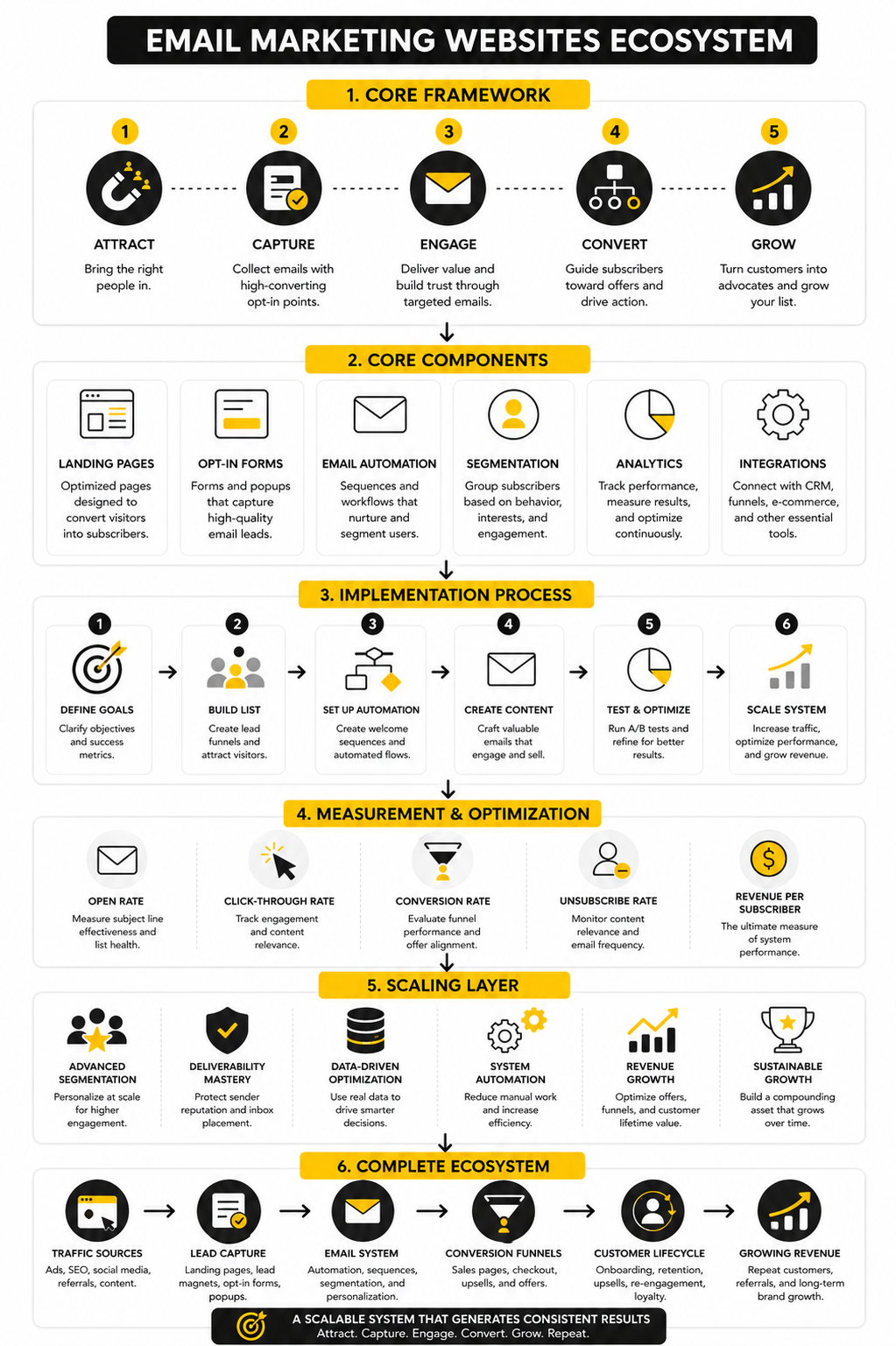
When everything is aligned, you don’t think in campaigns anymore. You think in flows, systems, and lifetime value.
This is the level where small optimizations create outsized results, because they impact the entire ecosystem rather than a single email.
FAQ - Built for Complete Guide
What are email marketing websites used for?
Email marketing websites are platforms that allow you to collect leads, send campaigns, automate sequences, and track performance. They serve as the central system for managing communication with your audience at scale.
What is the best email marketing platform for beginners?
For beginners, simplicity matters most. Platforms like Systeme.io are popular because they combine email marketing, funnels, and automation in one place without overwhelming complexity.
How do email marketing websites make money?
They generate revenue by turning subscribers into customers. This happens through automated sequences, promotional campaigns, and nurturing emails that guide users toward purchasing decisions.
How often should you send emails?
There is no universal rule, but consistency matters more than frequency. Whether you send weekly or multiple times per week, your audience should know what to expect and receive value in every message.
What is a good open rate for email campaigns?
Open rates typically fall between 20% and 30% in many industries, but the real benchmark is your own performance over time. Improving your baseline is more important than chasing averages.
How do you grow an email list quickly?
Effective list growth comes from combining lead magnets, landing pages, and traffic sources. Tools like ClickFunnels help build optimized funnels that convert visitors into subscribers efficiently.
What is the difference between automation and campaigns?
Campaigns are one-time email sends, while automation involves sequences triggered by user behavior. Automation allows email marketing websites to scale communication without manual effort.
How do you avoid emails going to spam?
Maintaining good deliverability requires:
- consistent sending patterns
- clean email lists
- high engagement rates
- proper domain setup
Ignoring these factors increases the risk of emails being filtered out.
Is email marketing still effective in 2026?
Yes, email remains one of the highest ROI channels in digital marketing. Its effectiveness comes from direct access to your audience without relying on third-party platforms or algorithms.
What is the most important metric to track?
Revenue per subscriber is often the most meaningful metric because it reflects the overall effectiveness of your entire system, not just individual campaigns.
Can small businesses compete using email marketing?
Absolutely. Email marketing levels the playing field by allowing smaller businesses to build direct relationships with their audience and compete without large advertising budgets.
Do you need multiple tools for email marketing?
Not necessarily. Many businesses prefer all-in-one platforms like GoHighLevel to manage email, CRM, automation, and funnels in a single system.
Work With Professionals
Explore 10K+ Remote Marketing Contracts on MarkeWork.com
Most marketers spend too much time chasing clients, competing on crowded platforms, and losing a percentage of every project to middlemen.
MarkeWork gives you a better way. Browse thousands of remote marketing contracts and connect directly with companies desperate to hire skilled marketers like you, without platform commissions and without unnecessary gatekeepers.
If you're serious about finding better opportunities and keeping 100% of what you earn, explore available contracts and create a profile for free at MarkeWork.com.