

Emma email marketing sits in an interesting spot in the market. It is not trying to win by being the cheapest tool on the page, and it is not pretending every business has the same needs. The platform is built around a more specific problem: helping organizations send better email when multiple teams, locations, departments, or stakeholders need to work from one brand system without creating chaos.
That matters more now than it did a few years ago. Email volume keeps climbing, with the DMA’s 2024 benchmarking report pointing to 381 billion emails sent in 2023, while Google’s sender guidelines and Yahoo’s bulk sender requirements have made inbox placement, authentication, and unsubscribe hygiene operational requirements instead of nice-to-have cleanup work.
In that environment, the real question is not whether a business should use email. The question is whether its platform can support segmentation, approvals, analytics, brand control, and deliverability discipline at the same time. That is exactly where Emma tries to compete, with brand controls, permissions, and integrations, newer features like Smart Send and Smart Segment, and a structure designed for distributed teams.
- Why Emma Email Marketing Matters
- Emma Email Marketing Framework Overview
- Core Components That Shape Performance
- How Teams Implement Emma Professionally
- Metrics, Compliance, and Optimization
- Frequently Asked Questions About Emma Email Marketing
Why Emma Email Marketing Matters
Emma makes the most sense when email is no longer a one-person newsletter task. Its own product positioning emphasizes centralized brand control, flexible permissions, and integration with an existing tech stack, which is a strong fit for universities, franchises, hospitality groups, agencies, nonprofits, and multi-location brands. That positioning carries through the feature set too, especially in the tiered account structure, shared assets, approval workflows, and multi-account reporting.
That kind of structure is increasingly valuable because performance today depends on more than attractive templates. Validity’s 2024 State of Email report shows that global inbox placement still leaves meaningful room for failure, and Google’s February 2024 bulk-sender rules made authentication, low complaint rates, and easy unsubscribes non-negotiable for higher-volume senders. In plain English, a platform now has to help teams stay organized enough to send relevant email and disciplined enough to keep reaching the inbox.
Emma’s appeal also comes from how it bridges strategy and operations. The platform highlights automation, segmentation, dynamic content, subscription management, and audience sharing across subaccounts, while also offering professional services for strategy, design, and technical help. For organizations that do not just need software but need a more governable email program, that combination is a real differentiator.
There is also a market reality behind the demand for tools like this. Litmus’ latest ROI snapshot still shows email delivering strong returns for many companies, and Campaign Monitor’s benchmark roundup continues to highlight how automated emails outperform one-off manual sends. Emma is clearly built for teams that want those gains without handing every office or franchise location unrestricted control over the brand.
Emma Email Marketing Framework Overview
The easiest way to evaluate Emma email marketing is to stop thinking about it as “email software” and start thinking about it as a four-part operating framework. First, you need a controlled brand environment so teams can move quickly without breaking templates, tone, or compliance standards. Second, you need audience intelligence through segmentation, data syncing, and subscription controls so messages stay relevant instead of turning into list fatigue.
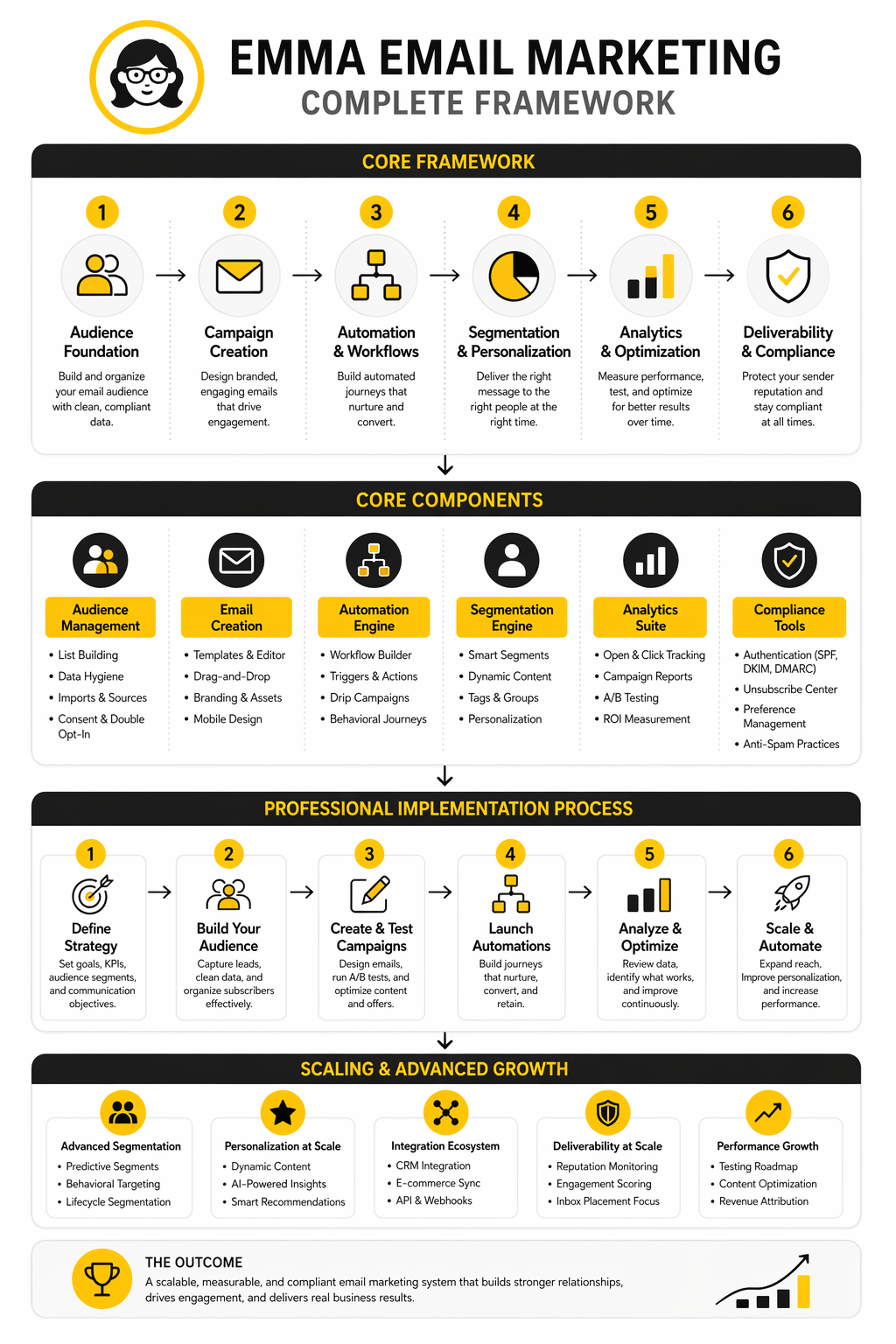
Third, you need campaign execution tools that make sending easier and smarter. Emma leans into that with features such as Smart Send for send-time optimization, Smart Segment for natural-language audience building, and automation options outlined on its pricing and feature pages. Those are not cosmetic add-ons. They are part of a broader effort to reduce manual work while making email more targeted.
Fourth, you need oversight. Emma repeatedly emphasizes analytics, centralized visibility, and account governance for distributed teams, and that matters because open rates alone have become less reliable after privacy changes, a point reinforced by the DMA benchmarking report and Validity’s reporting on Apple Mail Privacy Protection’s impact. Serious email programs need to connect sends to engagement quality, list health, and business outcomes, not just vanity metrics.
This framework is why Emma tends to resonate with organizations that have operational complexity. The company says 50,000 organizations worldwide use the platform, and its customer material consistently points toward environments where multiple stakeholders need to collaborate under one system. When personalization is becoming more expected, with McKinsey noting that consumers increasingly want tailored interactions and companies are using AI to scale them, a platform that combines personalization tools with governance becomes easier to justify.
The rest of this article will build on that structure. Next, we will break down the core components that actually shape Emma performance in practice, from segmentation and automation to templates, integrations, and reporting.
Core Components That Shape Performance
Once you get past the positioning, the real value of Emma email marketing comes down to a handful of components that directly affect results. Not every feature matters equally, and that is where a lot of software evaluations go wrong. A platform can look polished in a demo and still fall apart when you need better targeting, repeatable workflows, or cleaner reporting across multiple teams.
Emma’s current product stack is strongest when you use those components together instead of treating them like isolated tools. Its feature pages consistently group segmentation, dynamic content, automation, analytics, and governance into one system rather than a random checklist of extras on a pricing page. That is the right way to think about it, because inbox performance is usually the result of compound decisions, not one magic campaign.
Segmentation Is the Engine, Not a Bonus Feature
Segmentation is where Emma starts to separate itself from simpler newsletter tools. The platform highlights dynamic, real-time audience building based on subscriber data and behavior, and that matters because relevance is still the fastest way to improve email performance without sending more volume. When teams keep blasting the full list, they usually create their own deliverability problem.
Emma has also pushed this further with Smart Segment, which lets users describe an audience in natural language and then generate segment filters from that prompt. That is practical, not gimmicky, because audience logic is one of the first places busy marketing teams cut corners. If the segmentation setup becomes too slow or too technical, people default to broader sends and weaker targeting.
The strategic point is simple. Better segmentation improves message fit, and better message fit tends to improve clicks, reduce unsubscribes, and protect list quality over time. That broader relationship shows up across modern benchmark coverage from Salesforce’s overview of core email metrics and recent industry reporting on personalization and engagement, even if exact benchmark numbers vary by industry, send type, and list quality.
Automation Is Where Emma Becomes Operationally Useful
A lot of teams buy email platforms for campaigns and then quietly get most of their value from automation. Emma leans hard into that use case with workflow-based automation tied to subscriber actions and other triggers. That is important because lifecycle email usually does a better job matching timing and intent than manually scheduled batch sends.
The practical benefit is not just efficiency. It is consistency. A welcome flow, nurture sequence, event reminder series, renewal prompt, or re-engagement path keeps running even when the team is stretched, and Emma’s own help documentation on building automation workflows shows the platform is designed around triggered journeys rather than one-off autoresponders.
This matters even more in the current inbox environment. Google now expects higher-volume senders to maintain authentication, list quality, and easy unsubscribes through disciplined sending practices laid out in its bulk sender FAQ and broader sender requirements. Automation does not solve compliance by itself, but it helps teams send more intentional email instead of defaulting to indiscriminate blasts that raise complaints and weaken engagement.
Personalization and Dynamic Content Do the Heavy Lifting
Emma’s dynamic content capabilities are one of the more serious reasons to consider the platform. The company describes dynamic content as a way to serve unique blocks, sections, or full content variations to different subscribers within a single email. That is far more useful than basic first-name personalization, which often looks personalized without actually changing relevance.
This is where Emma email marketing becomes more than a sending tool. If you can combine segment logic, stored subscriber data, and dynamic content in one mailing, you reduce production overhead while still making the campaign feel more targeted. That is a big operational win for brands managing multiple offers, locations, departments, or audience types at the same time.
Emma has also connected personalization with lighter AI-assisted workflows. Its current materials reference privacy-first AI along with Smart Send and Smart Segment, while newer content around AI review processes shows the company is positioning AI as a speed layer rather than a replacement for human judgment. That is the right framing, because faster drafting is useful, but better targeting and stronger QA are what actually protect performance.
Testing and Reporting Turn Good Ideas Into Repeatable Wins
Without testing, most email teams are just decorating opinions. Emma includes A/B content testing for subject lines, CTAs, images, and other campaign variables, and it also supports workflows where the winning version can be sent to the remaining audience. That is the kind of feature that sounds basic until you realize how often teams skip it because the process is annoying.
Testing matters because today’s measurement environment is messier than it used to be. Privacy changes have made open-rate interpretation less clean, and Emma’s own analytics tools now sit in a broader market where marketers have to read clicks, conversions, device behavior, and downstream actions more carefully. That shift is reflected in recent benchmark discussions from the DMA’s 2024 report and Validity’s 2024 email insights, both of which reinforce the idea that engagement analysis needs more nuance than “opens went up.”
For Emma users, that means the best use of reporting is diagnostic, not decorative. You want to know which audience segments respond, which content themes pull real clicks, which devices dominate, and where underperformance starts. That is how testing stops being a checkbox and becomes a feedback loop.
Integrations and Multi-Team Control Are the Less Glamorous Advantage
This is the piece many buyers underrate until things get messy. Emma puts a lot of emphasis on integrations with CRM and customer data systems and on team structures built for distributed organizations. That is not as flashy as AI copy generation, but it is usually more valuable in the long run.
A disconnected email platform creates slow, manual work everywhere. Audiences go stale, personalization gets shallow, reporting becomes harder to trust, and local teams start building side processes that break brand consistency. Emma’s model is clearly built to prevent that by giving central teams more governance while still allowing local execution.
That governance angle is a genuine differentiator. The company’s feature pages repeatedly stress brand controls, permissions, shared assets, and compliant execution across teams. For organizations with multiple locations or internal stakeholders, that kind of control is not bureaucracy. It is what keeps email marketing usable at scale.
The result is that Emma works best when you evaluate it as an operating system for organized email teams, not just a campaign sender. In the next part, that becomes even clearer, because implementation is where the platform either proves its value or exposes gaps in planning, process, and ownership.
Metrics, Compliance, and Optimization
The measurement side of Emma email marketing is where a lot of teams either get sharper or get misled. The platform gives users access to campaign analytics, comparisons, click-based heat maps, subject line split testing, and A/B content testing, but having data is not the same as knowing what to do with it. The real job is to separate signal from noise and connect each metric to an action.
That matters more now because email metrics do not behave the way they did a few years ago. Privacy protections, inbox-provider requirements, and heavier automation have changed what counts as a trustworthy signal. So when you look at Emma reports, you should not ask only whether a number is good. You should ask what that number is actually measuring, what might be distorting it, and what decision it should trigger next.
Start With the Metrics That Still Move the Business
The easiest mistake is obsessing over opens because they are visible, familiar, and emotionally satisfying. Emma still surfaces opens inside its analytics dashboard, and that makes sense because they still tell you something. But they no longer tell you everything.
That shift is not theoretical. Validity’s 2024 email insights notes that 70% of opens are now generated by Apple’s privacy proxy, which means open-rate inflation is a real measurement problem for marketers who treat opens as literal engagement. At the same time, Salesforce argues in its 2025 discussion of why email open rates are still relevant that opens can still be useful when viewed in aggregate over time, especially for spotting broader shifts in fatigue, bulking, or creative performance.
That is the balanced way to read Emma data. Opens are still useful as a directional trend line, especially when a campaign suddenly underperforms versus its own history. But if you want to know whether a message actually worked, clicks, conversions, unsubscribes, complaint behavior, and downstream actions deserve more weight.
Use Benchmarks as Context, Not as a Scoreboard
Benchmarks are helpful when they keep you honest. They become harmful when they make you chase averages that have nothing to do with your audience, industry, send type, or list quality. Emma users should absolutely compare their own performance against broader market data, but only to ask better questions.
The latest DMA Email Benchmarking Report 2025 says delivery rates rose to 98% in 2024, open rates reached 35.9%, and unique click rates climbed to 2.3%. Those numbers are useful because they show the broad direction of the market, especially the continued rise in reported opens after Apple Mail Privacy Protection and the modest but important lift in unique clicks. They are not useful if you treat them like universal pass-fail thresholds.
A smarter interpretation is more grounded. If your Emma email marketing program shows healthy delivery but weak clicks, the problem is probably not authentication. It is more likely a relevance issue, an offer issue, or a creative issue. If opens rise while clicks flatten, that can signal better subject lines without better content alignment. If unsubscribes stay stable while click quality improves, that is usually a stronger sign of progress than a flashy open-rate spike.
Build an Analytics Stack Around Four Questions
Emma’s analytics become much more useful when you organize them around a simple framework. Instead of staring at a dashboard and hoping insight appears, ask four questions after every meaningful send. Did the message reach the inbox. Did the audience notice it. Did the audience engage. Did the engagement lead to the intended action.
That structure sounds basic, but it is exactly what turns data into decisions. Inbox reach is a deliverability and compliance question. Attention is mostly a subject line, timing, and brand-recognition question. Engagement is about message match, offer quality, and content architecture. Action is where the campaign proves whether it created real business value.
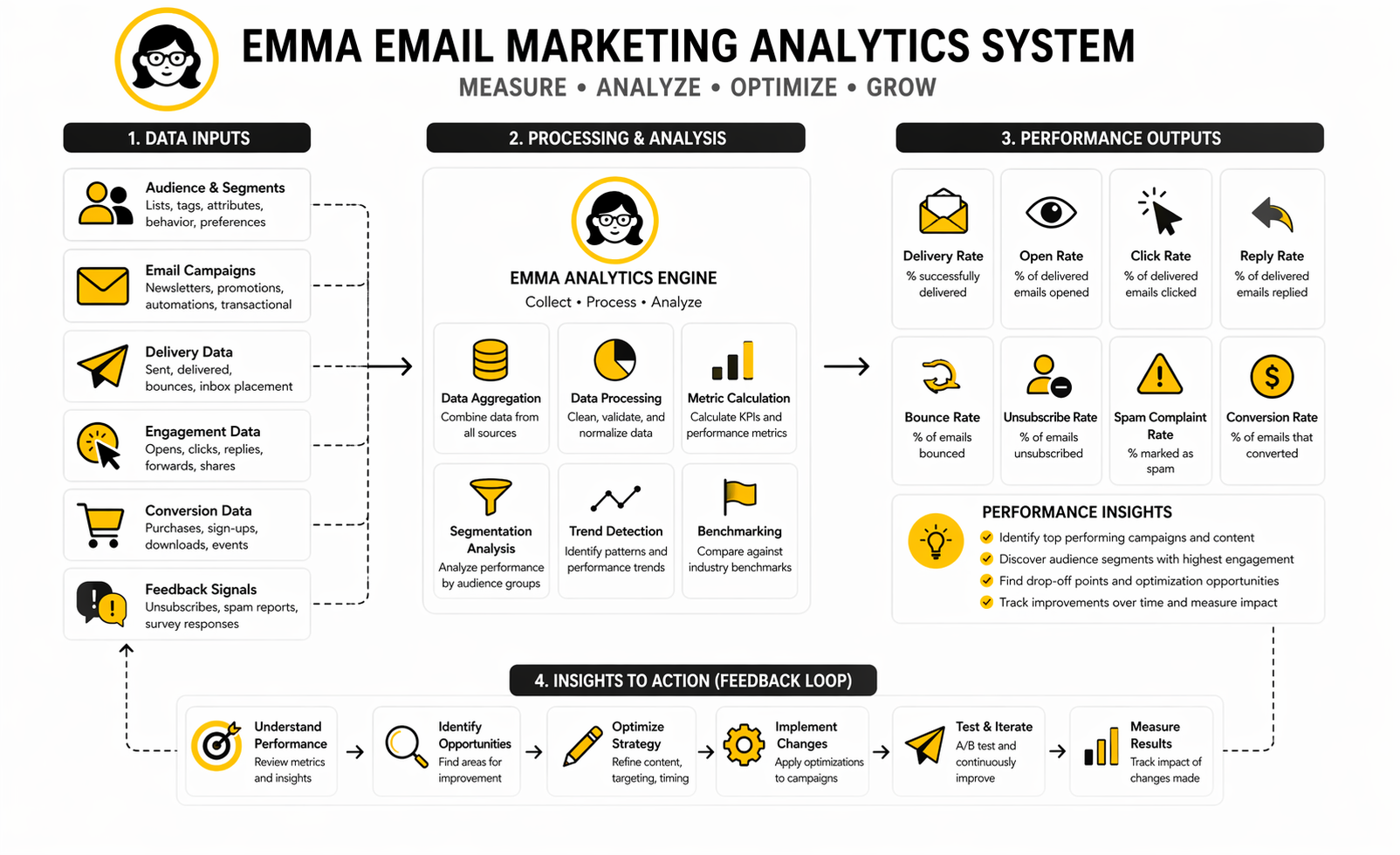
Emma’s own analytics pages emphasize opens, clicks, email comparisons, and shareable reports, which fits neatly into that structure. You can use Emma data to compare campaigns over time, isolate which sends created stronger click behavior, and identify where a segment or message starts losing traction. Once you read the data this way, the dashboard becomes much less cosmetic and much more operational.
The Most Important Performance Signals Are Usually Combined Signals
Single metrics are tempting because they are simple. Combined signals are harder to read, but they are usually what tell the truth. For example, a campaign with average opens, stronger click-through, and lower unsubscribes is often healthier than a campaign with excellent opens and weak clicks. One is generating action. The other might just be generating curiosity.
That is why Emma’s A/B testing tools matter. Testing helps separate surface-level wins from meaningful wins. A subject line test might raise opens, but if the winning version attracts the wrong kind of attention and clicks stay flat, the campaign did not really improve. The same logic applies to send-time testing, CTA testing, dynamic content variations, and content-length tests.
Emma also adds another layer here through Smart Send and more recent product material explaining that the feature analyzes past campaign engagement to recommend send timing. That is useful, but only when teams interpret the results correctly. Better timing can help a good message perform better. It cannot rescue an irrelevant campaign or a tired segment.
Clicks Need Context, Not Celebration
Click-through rate is still one of the most useful signals in email because it reflects active behavior. Someone had to make a choice. That makes it more trustworthy than opens in many cases and more useful for creative decisions. But clicks need context too.
A higher click-through rate can mean the content was more compelling. It can also mean the email was sent to a smaller, warmer, or more motivated segment. That is why Emma users should compare click patterns by segment, campaign type, and intent level rather than treating every click rate like apples-to-apples evidence.
This is also where dynamic content becomes measurable in a real way. If one email can deliver more relevant content to different subscribers from the same send, then the success test is not just whether total clicks increased. It is whether the right groups clicked on the right content with fewer signs of list fatigue. That is a much better standard for judging personalization.
Complaints and Unsubscribes Are Not Just Negative Metrics
Many teams still treat unsubscribes like a branding embarrassment and complaints like an edge case. That is outdated thinking. In the current inbox environment, both are strategic metrics because they tell you whether your email is staying aligned with audience expectations.
The compliance side is now explicit. Google’s sender guidelines and bulk sender FAQ require higher-volume senders to authenticate mail, make unsubscribing easy, and avoid sending unwanted email. Yahoo’s sender best practices also tell bulk senders to keep spam rates below 0.3%. These are not abstract technical details. They directly affect whether Emma campaigns keep landing where they should.
That changes how you should read list churn. An unsubscribe is often healthier than a spam complaint because it lets an uninterested subscriber leave cleanly. Validity’s 2024 insights makes this point clearly by framing unsubscribes as a reputation-protective outcome compared with recipients marking messages as spam. So if Emma email marketing reports show unsubscribes rising slightly while complaints remain controlled and click quality improves, that is not automatically bad news. It may mean the list is getting cleaner.
Optimization Should Follow a Sequence
The best optimization programs do not chase everything at once. They move in order. First fix deliverability and compliance. Then fix segmentation. Then fix the message. Then fix timing and presentation. That sequence matters because teams often waste time testing subject lines when the real problem is that the wrong audience is being emailed in the first place.
Emma’s own ecosystem supports that order fairly well. Analytics shows what happened. A/B testing helps isolate variables. Dynamic content improves message relevance. Smart Send helps refine timing after the message and audience are already in better shape.
A practical optimization cycle inside Emma usually looks like this:
- Review deliverability, unsubscribe behavior, and complaint trends first.
- Compare campaign performance by audience segment rather than list-wide averages.
- Identify whether the bottleneck is attention, engagement, or conversion.
- Test one meaningful variable at a time.
- Roll winning patterns into templates, workflows, or segment rules.
- Recheck performance over several sends instead of trusting one lucky result.
That last point is important. One strong campaign is not a strategy. Patterns are what matter. Emma email marketing becomes most valuable when the team uses reporting to build repeatable rules, not one-off wins.
What the Data Should Drive Next
At this stage, the point is not to admire the dashboard. It is to use the dashboard to make smarter calls. If opens trend down over time, review deliverability, subject-line strength, and send cadence. If opens look fine but clicks weaken, review content relevance, CTA clarity, and segment fit. If clicks are healthy but conversions lag, the problem may sit on the landing page or offer rather than inside the email itself.
That is also where comparison matters more than isolated snapshots. Emma’s reporting tools are useful because they allow teams to compare campaigns, share results internally, and identify what actually changed between one send and the next. That kind of disciplined review is how optimization gets real.
The final takeaway is simple. The numbers inside Emma are only helpful when they lead to action. Measurement is not a separate reporting task tacked onto the end of email marketing. It is the mechanism that tells you what to stop, what to scale, and what to fix next.
Frequently Asked Questions About Emma Email Marketing
Is Emma email marketing a good fit for small businesses?
Emma email marketing can work for small businesses, but it is usually a stronger fit when the business has more operational complexity than a simple newsletter program. The public pricing page currently lists Emma Lite at $105 per month and Emma Essentials at $165 per month for 10,000 contacts on annual contracts, which puts it in a more deliberate buying category than ultra-lightweight entry tools on the market today on Emma’s pricing page. If your business needs approvals, stronger brand control, shared assets, or multi-team coordination, that cost can make sense much faster.
What makes Emma different from a basic email platform?
The difference is not just template polish or automation checkboxes. Emma is built more like a governed email system, with an emphasis on centralized oversight, team permissions, segmentation, and distributed execution rather than pure speed for a solo sender on Emma’s homepage and in its overview of team-friendly email marketing features. That matters when multiple departments, campuses, locations, or franchise operators all need to work inside one brand structure without breaking the process.
Does Emma support automation well enough for serious lifecycle marketing?
Yes, and that is one of the more practical reasons to consider it. Emma’s automation materials describe workflow-based campaigns tied to subscriber actions and triggers, which is the kind of structure you need for onboarding, nurture, reminder, renewal, and re-engagement sequences in Emma’s automation overview and its help content for the automation workflow builder. For most teams, lifecycle automation is where the platform becomes operationally useful instead of just visually attractive.
How important is segmentation inside Emma email marketing?
It is one of the biggest performance levers in the whole platform. Emma’s segmentation feature set focuses on dynamic audience filtering and more recent tools like Smart Segment, which are meant to make audience building easier and more precise in its list segmentation feature page and pricing overview. In practice, that matters because better targeting usually improves clicks and reduces fatigue more reliably than simply sending more campaigns.
Can Emma help with deliverability, or is that still mostly on the sender?
It helps, but the sender still owns the outcome. Emma gives teams structure, subscription controls, automation, and reporting, but Gmail and Yahoo now expect bulk senders to meet technical and behavioral standards around authentication, complaint rates, and unsubscribe handling in Google’s bulk sender FAQ and Yahoo’s sender best practices. In other words, a well-structured platform helps, but it cannot rescue weak data hygiene or irrelevant sending habits.
What metrics should teams care about most inside Emma?
Teams should still watch opens, but not worship them. The more useful stack is delivery, clicks, unsubscribes, complaints, and downstream conversion behavior, especially now that privacy protections have changed how open rates should be interpreted in the DMA’s 2025 benchmark report and Validity’s recent email insights. Emma’s analytics become much more valuable when you use them to answer what happened, why it happened, and what should change next.
Are industry benchmarks still useful for Emma users?
Yes, but only as context. The DMA’s 2025 report shows delivery rates at 98%, open rates at 35.9%, and unique click rates at 2.3%, which gives teams a useful market reference point in the full benchmark report. The catch is that those numbers should guide diagnosis, not ego, because your audience quality, send type, and segmentation strategy matter more than matching a blended industry average.
Does Emma make sense for franchises, multi-location brands, or universities?
Yes, that is one of the clearest use cases. Emma repeatedly positions the platform around multi-team control, subaccounts, shared branding, and audience management across distributed organizations in its Teams overview and support articles on subaccount creation. If your email challenge is less about sending one newsletter and more about coordinating many senders without losing control, Emma becomes much more compelling.
How should teams think about unsubscribes and complaint rates now?
They should treat both as strategic signals, not just compliance clean-up. Yahoo explicitly tells bulk senders to keep spam complaint rates below 0.3% in its sender guidance, and Google’s bulk-sender framework makes it clear that easy unsubscribes and low complaint rates are now part of modern inbox eligibility in Google’s FAQ. A healthy Emma email marketing program is not just one that gets clicks. It is one that lets the wrong subscribers leave cleanly before they start hurting reputation.
Does AI inside Emma remove the need for strong editorial review?
Not even close. Emma is now promoting AI-assisted content creation inside a governance-focused platform on its homepage, which can absolutely speed up drafting and experimentation. But faster production does not protect a brand from weak segmentation, vague offers, bad timing, or compliance mistakes, so editorial review still matters a lot.
What is the biggest implementation mistake teams make with Emma?
They treat it like a campaign tool instead of an operating system. The account structure, permissions, segmentation rules, and source-of-truth decisions should be locked down before the team starts rushing through sends, because that is what determines whether the platform scales cleanly in Emma’s audience-sharing guidance and support content on managing users in Teams and Corporate accounts. When those foundations are fuzzy, Emma can still function, but it will not deliver its full value.
Is Emma worth the price compared with cheaper tools?
That depends on what you are really buying. If all you need is a basic send engine, a cheaper platform may be enough. If you need centralized control, better team coordination, governed templates, stronger segmentation, and a platform that can support scale without turning into internal chaos, Emma’s pricing can be justified much more easily on the current pricing page.
What should a business clarify before choosing Emma email marketing?
It should clarify who owns the program, how customer data flows into the platform, which teams need access, and what success actually means. Those are not procurement details. They are the questions that decide whether Emma becomes a long-term system for growth or just another software expense layered onto a messy process.
Work With Professionals
Explore 10K+ Remote Marketing Contracts on MarkeWork.com
Most marketers spend too much time chasing clients, competing on crowded platforms, and losing a percentage of every project to middlemen.
MarkeWork gives you a better way. Browse thousands of remote marketing contracts and connect directly with companies desperate to hire skilled marketers like you, without platform commissions and without unnecessary gatekeepers.
If you're serious about finding better opportunities and keeping 100% of what you earn, explore available contracts and create a profile for free at MarkeWork.com.