

Facebook advertising is still one of the few channels where a small company and a large brand can compete inside the same auction with the same tools. That matters because the platform is not just big, it is still commercially relevant. Meta reported 3.58 billion daily active people across its Family of Apps in December 2025, while DataReportal’s analysis of Meta’s own planning tools showed Facebook ads could reach 2.28 billion users in January 2025.
The bigger reason businesses keep spending here is not nostalgia. It is the combination of reach, intent signals, creative variety, and machine learning. Facebook remains the most widely used social platform among adult internet users in GWI’s Q2 2025 data, and Meta’s ad business keeps expanding, with ad impressions up 18% year over year in Q4 2025. In plain English, the audience is still there, the inventory is still moving, and advertisers are still finding enough return to keep feeding the machine.
This article breaks Facebook advertising into a practical system instead of a pile of tactics. That is the only useful way to approach it now, because winning campaigns usually come from strong inputs, clean tracking, disciplined offers, and smart creative testing rather than from one magical targeting hack.
Article Outline
- Why Facebook Advertising Still Matters
- How the Facebook Advertising System Works
- The Core Components of High-Performing Campaigns
- Creative, Targeting, and Measurement That Actually Scale
- Professional Implementation Inside Ads Manager
- Optimization, Reporting, and Long-Term Growth
Why Facebook Advertising Still Matters
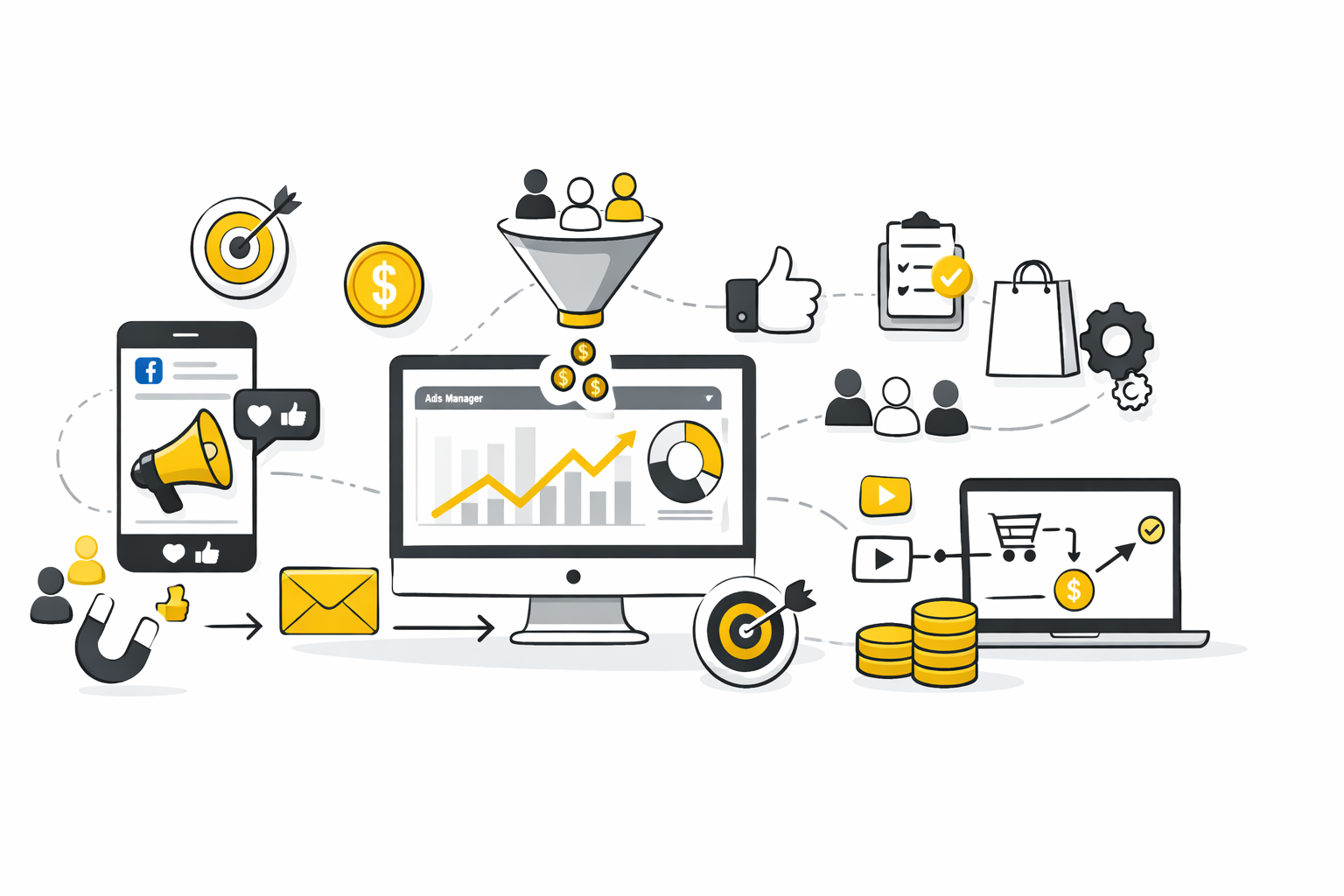
Facebook advertising still matters because it sits at the intersection of scale and intent. Plenty of channels can give you awareness, and plenty of channels can capture demand, but Facebook can do both when the account is set up properly. People discover brands, compare options, watch product demos, click through to landing pages, and come back later after retargeting or follow-up sequences do their job.
The platform also keeps giving advertisers more automation, which is helpful when used with judgment. Meta’s own guidance around Advantage+ makes it clear that the company is pushing more campaign decisions toward automation, and that lines up with the broader business trend in its latest results, where Meta reported both higher impressions and higher average price per ad in 2025. That combination tells you something important: competition is real, but the system is still producing enough value that more advertisers are willing to pay.
Another reason Facebook advertising remains so strong is that the ecosystem is wider than the blue app itself. You are really buying access to Meta’s broader delivery system across placements, behaviors, and intent patterns. That is why advertisers who think only in terms of “Facebook posts with boost buttons” usually underperform; they are using a massive response engine like a basic publishing tool.
There is also a practical advantage that many businesses underestimate. For brands that need a full funnel, Facebook advertising plugs naturally into landing pages, lead forms, email workflows, scheduling tools, and CRM pipelines. If you need a simple stack to capture and nurture paid traffic, tools like ClickFunnels or Systeme.io can make that handoff much easier than stitching together five separate apps.
What has changed is this: Facebook advertising is less forgiving than it used to be. Weak offers, messy tracking, generic creative, and impatient optimization get punished faster. The upside is that businesses willing to treat the channel professionally still have room to win, especially when competitors are relying on outdated account structures or chasing vanity metrics.
How the Facebook Advertising System Works
At the highest level, Facebook advertising runs on an auction. Meta explains that its ad auction is designed to choose the ad that creates the most value for both people and businesses, not simply the advertiser with the biggest bid. That means your results are influenced by more than budget. Your objective, expected action rate, creative relevance, audience response, and conversion signals all shape how efficiently the system can deliver.
That is why the old mindset of “set a target audience and force delivery” is weaker now than it used to be. Meta increasingly wants advertisers to give the system a clear goal, enough conversion data, and enough creative variety to learn. The platform’s learning phase documentation is blunt about this: new ad sets or significant edits can push delivery back into a period where performance is less stable because the system is still figuring out who is most likely to respond.
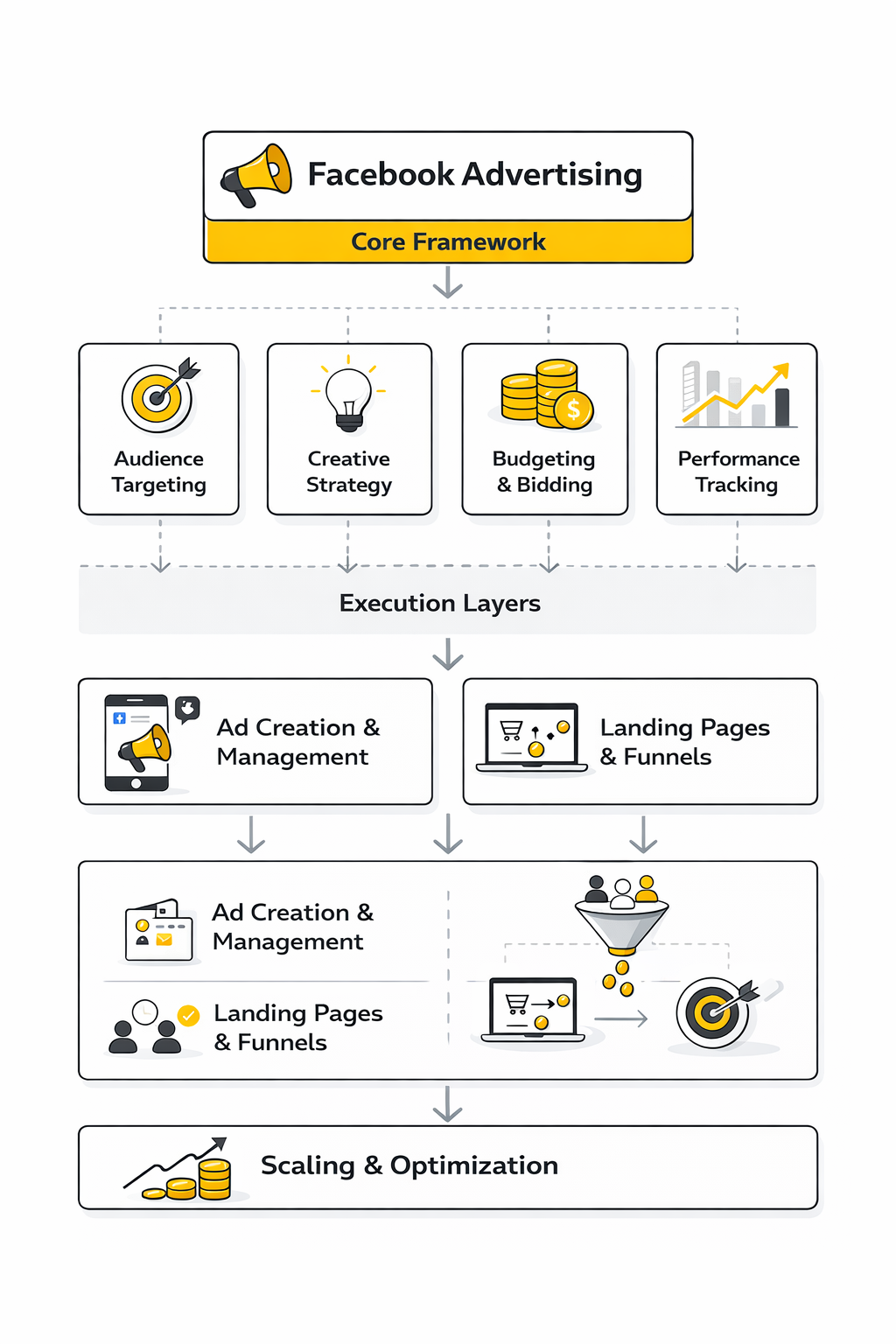
The framework is easier to understand when you stop seeing Facebook advertising as media buying only. It is really four systems working together: the auction, the data layer, the offer, and the creative. If one of those pieces is weak, the rest of the campaign has to compensate, and eventually it stops scaling.
The Basic Framework Behind Strong Campaigns
The first layer is objective clarity. Meta can optimize for many outcomes, but vague business goals create muddy campaign setups. If you want purchases, optimize for purchases. If you want qualified leads, build the campaign and the funnel around qualified leads, not cheap form fills that look good in a dashboard and collapse in sales calls later.
The second layer is clean measurement. Meta’s Conversions API and developer documentation both stress the same core idea: direct server-side event sharing helps connect marketing data to Meta’s optimization systems more reliably. In a privacy-constrained environment, that is no longer a technical luxury. It is part of the foundation.
The third layer is budget and delivery structure. Meta’s guidance on Advantage+ campaign budget and campaign budgets more broadly shows how the system redistributes spend toward better opportunities in real time. That can be powerful, but only if your campaign architecture is clean enough that the algorithm is not deciding between a good ad and five weak ones that should never have made it into the account.
The fourth layer is creative relevance. Meta’s ad relevance diagnostics exist for a reason: delivery and cost are tied to how well the ad resonates with the audience. In modern Facebook advertising, creative is not the decoration added after strategy. It is a performance variable.
This is the framework the rest of the article will build on. In the next section, we will break down the core components that separate random campaigns from campaigns that can actually survive testing, scale spend, and produce measurable business results.
The Core Components of High-Performing Campaigns
Once the framework is clear, the next question is simple: what actually makes Facebook advertising perform? Not in theory, but in the real accounts that keep spending because the numbers justify it. The answer is not one setting inside Ads Manager. It is the combination of a sharp offer, reliable conversion data, creative that earns attention quickly, and a post-click experience that does not waste the traffic you paid for.
That combination matters more now because Meta is leaning harder into automation. When the system has better inputs, it usually makes better decisions. When the inputs are weak, automation just helps you burn budget faster and at scale.
A Strong Offer Comes Before Better Targeting
A lot of advertisers still try to fix a weak campaign by changing audiences, placements, or bid controls. That is usually the wrong move. If the offer is ordinary, badly framed, overpriced, or unclear, Facebook advertising becomes much harder because the auction cannot manufacture demand that is not there.
A strong offer gives the user a reason to stop scrolling and care right now. That might be a clear outcome, a compelling price-to-value ratio, a simpler buying path, a faster transformation, stronger proof, or lower perceived risk. The common thread is relevance. People do not click because your ad exists. They click because something in the message makes the next step feel worth their time.
This is also where many lead generation campaigns go off the rails. Cheap leads are not the same thing as good leads. If the promise inside the ad attracts curiosity but not buying intent, the platform can deliver volume while the sales team gets junk. That is why businesses using Facebook advertising need to define the offer in business terms first and ad terms second.
Clean Conversion Signals Give Meta Something to Optimize
Meta’s system is only as smart as the feedback it receives. That sounds obvious, but in practice it is where many campaigns fail quietly. If the account is optimized around the wrong event, missing event data, or broken attribution, the algorithm starts learning from noise instead of signal.
This is exactly why Meta keeps pushing advertisers toward Conversions API and stronger event matching through its developer documentation. The platform is telling advertisers, very clearly, that server-side event sharing and better data resilience are now part of performance marketing, not some optional technical upgrade for larger teams. In a post-cookie, privacy-restricted environment, bad measurement is not just inconvenient. It distorts optimization.
The practical takeaway is simple. If purchases matter, optimize for purchases. If qualified calls matter, send that data back when possible. If downstream CRM outcomes matter, connect them. Facebook advertising performs better when the business sends back the clearest available signal instead of settling for shallow proxy metrics.
Creative Is the Real Lever in Modern Facebook Advertising
Creative is now one of the strongest levers in the entire system. That is not a trendy opinion. It is the direction Meta itself has been pushing for years through its creative guidance, automation tools, and recommendation engines. The platform can expand audience discovery, test placements, and redistribute budget, but the ad still has to win the first battle, which is attention.
Meta’s own best-practice materials consistently push mobile-first, sound-off-aware, and fast-loading formats, especially across short-form video environments like Reels. That lines up with the broader usage shift visible across Meta properties and with the company’s push toward AI-assisted delivery and creative variation through Meta Advantage+. If you are still building ads like tiny desktop billboards, you are fighting the platform instead of using it.
Good creative in Facebook advertising does a few things well. It makes the promise obvious fast. It connects with a real problem or desired result. It reduces friction by showing what the product is, who it is for, and why this brand is worth trusting. The best ads do not feel clever for the sake of it. They feel immediately useful.
The Landing Page Still Decides Whether Traffic Becomes Revenue
A Facebook ad can only earn the click. It cannot finish the sale on its own unless you are using an in-platform experience designed for that purpose. Once people leave the app, the landing page takes over, and this is where many campaigns lose money they should have kept.
There is no shortage of advertisers who obsess over CPM, CTR, and thumb-stop rate while sending paid traffic to pages that are slow, vague, cluttered, or disconnected from the ad promise. That breaks momentum. If the ad says one thing and the page feels like a different conversation, conversion rates drop and the campaign gets blamed for a funnel problem.
This is one reason funnel builders remain relevant in Facebook advertising workflows. If you need faster deployment, cleaner offers, upsells, and tighter page-to-email continuity, ClickFunnels and Systeme.io are legitimate options because they reduce the gap between ad click and follow-up system. The tool is not the strategy, but a smoother handoff does matter when you are paying for every visit.
Follow-Up Systems Matter More Than Most Advertisers Admit
Not every profitable Facebook advertising campaign converts on the first click. In fact, many do not. People compare, hesitate, get distracted, open five tabs, and come back later. That is normal behavior, especially in higher-consideration categories or offers with a longer sales cycle.
This is where email, CRM automation, and remarketing stop being “nice extras” and start becoming part of the acquisition engine. If your lead capture and nurturing stack is weak, you force Facebook to do too much of the heavy lifting alone. If your follow-up is strong, the same traffic can produce much more revenue because you are extending the window in which the click can become a customer.
That is why tools for email and lifecycle messaging naturally fit this channel. Platforms like Brevo and Moosend make sense when the goal is to turn ad-driven leads into a real sequence rather than a one-shot form submission that dies in a spreadsheet. Facebook advertising gets more efficient when the rest of the system keeps working after the impression is over.
What These Components Look Like in a Real Campaign Structure
At this point, the pattern should be clear. High-performing Facebook advertising is not built from one trick. It is built from aligned components that reinforce each other. The ad promise matches the offer, the tracking reflects the real goal, the landing page continues the same conversation, and the follow-up system captures value that would otherwise leak out.
When one of these parts is weak, the account becomes unstable. Results look random, scaling gets painful, and performance drops after every small market shift. When the parts are aligned, campaigns become easier to interpret because you can see what is actually happening instead of guessing.
That alignment is what separates hobby-level media buying from professional execution. In the next section, we will move from the components themselves into the part most advertisers struggle with most: how to handle creative, targeting, and measurement in a way that supports scale instead of sabotaging it.
Creative, Targeting, and Measurement That Actually Scale
This is the part where Facebook advertising usually gets misread. Many advertisers still think scale comes from finding the perfect audience and then forcing more budget through it. In reality, scale now comes more often from stronger creative inputs, broader but smarter audience setup, and cleaner measurement that tells Meta what a valuable user actually looks like.
That shift is not subtle anymore. Meta has spent the last two years pushing advertisers toward automation, broader delivery, and stronger signal quality through tools like Advantage+, Advantage+ placements, and Conversions API. If your account structure still depends on endless audience slicing and fragile browser-only tracking, you are building on the wrong foundation.
Creative Is Doing More of the Targeting Work
Facebook advertising has moved into a phase where the ad itself does a surprising amount of the audience selection. Meta’s engineering team described how Andromeda supports more personalized ad retrieval and larger creative diversity, which matters because it confirms what many performance teams are already seeing inside live accounts. The machine is leaning more heavily on creative signals, response patterns, and conversion feedback than on the old habit of manually stacking interests.
That changes how ads should be developed. Instead of trying to build one “perfect” ad that talks to everyone, the better move is to create several sharp angles around the same offer. One ad may lead with pain, another with proof, another with speed, another with simplicity, and another with a specific objection the buyer needs resolved before clicking.
Meta’s own guidance around Advantage+ creative points in the same direction. The platform wants more creative variation because variation gives the system more ways to match the right message to the right person. In practical terms, better Facebook advertising now looks less like a single polished campaign and more like a controlled library of useful messages.
Broad Audiences Usually Beat Overbuilt Targeting
This is where a lot of advertisers resist reality. They still want control because control feels safer. But Facebook advertising is no longer strongest when you lock delivery into a maze of narrow interests, exclusions, and overlapping audience theories.
Meta has openly shifted toward audience expansion and looser targeting logic through Advantage+ audience and even removed some older controls, including detailed targeting exclusions from active campaigns starting March 31, 2025. That matters because it tells you where the platform is heading. The system wants room to find converters, not a long list of manual constraints based on guesses from 2018.
That does not mean targeting is dead. It means targeting has changed. Your job is still to set sensible geographic boundaries, language choices when relevant, customer lists, retargeting windows, and category restrictions when needed. But for many businesses, Facebook advertising performs better when the account gives Meta a clear objective and high-quality inputs instead of micromanaging every possible audience variable.
Measurement Is What Keeps Scaling Honest
Scaling without measurement is how advertisers convince themselves that spend equals growth. It does not. Facebook advertising becomes dangerous when performance looks good inside platform metrics while the business itself feels no real improvement in revenue quality, lead quality, or margin.
That is why signal quality matters so much. Meta’s Meta Pixel documentation, Conversions API documentation, and guidance on event match quality all point to the same operational truth: the system works better when advertisers send durable, well-matched event data. Better signal quality improves optimization, measurement, and the platform’s ability to connect actions back to users in a privacy-restricted environment.
For serious Facebook advertising, this means measurement has to be treated like infrastructure. You need the right standard events, deduplication when using both browser and server events, high-quality customer parameters where appropriate, and a clean handoff from ad click to conversion point. Otherwise, the account starts optimizing around partial truth, and partial truth gets expensive.
Professional Implementation Inside Ads Manager
Once creative, targeting, and measurement are understood properly, execution gets much simpler. Not easy, but simpler. The goal is not to build the most complicated account in your market. The goal is to build an account structure that gives Meta enough clarity to learn, enough signal to optimize, and enough creative variation to keep finding efficient conversions.
The biggest mistake here is launching too many variables at once. Facebook advertising performs best when the campaign is structured to answer clean questions. Is the offer strong enough? Is the signal clean enough? Is one creative angle clearly outperforming the others? Is the landing page preserving the momentum created by the ad? Good implementation makes those answers visible.
A Practical Setup Process That Holds Up Under Pressure
The cleanest way to launch Facebook advertising today is to treat setup like a disciplined operating process rather than a technical checklist. Start with the business goal, map the funnel around that goal, confirm tracking before launch, and only then build the campaign. Too many advertisers reverse that order and wonder why the numbers feel unstable.
A practical process usually looks like this:
- Define the real conversion goal, not the vanity metric.
- Confirm the offer, headline angle, and landing page before opening Ads Manager.
- Install and verify the Meta Pixel and, where possible, connect Conversions API.
- Choose the campaign objective that matches the business outcome.
- Use a clean audience structure instead of stacking endless interests.
- Upload multiple creatives built around distinct buying angles.
- Keep Advantage+ placements on unless there is a proven reason not to.
- Launch with enough budget and patience to let the system learn.
- Review conversion quality, not just cheap top-line results.
- Make controlled optimizations instead of constant edits.
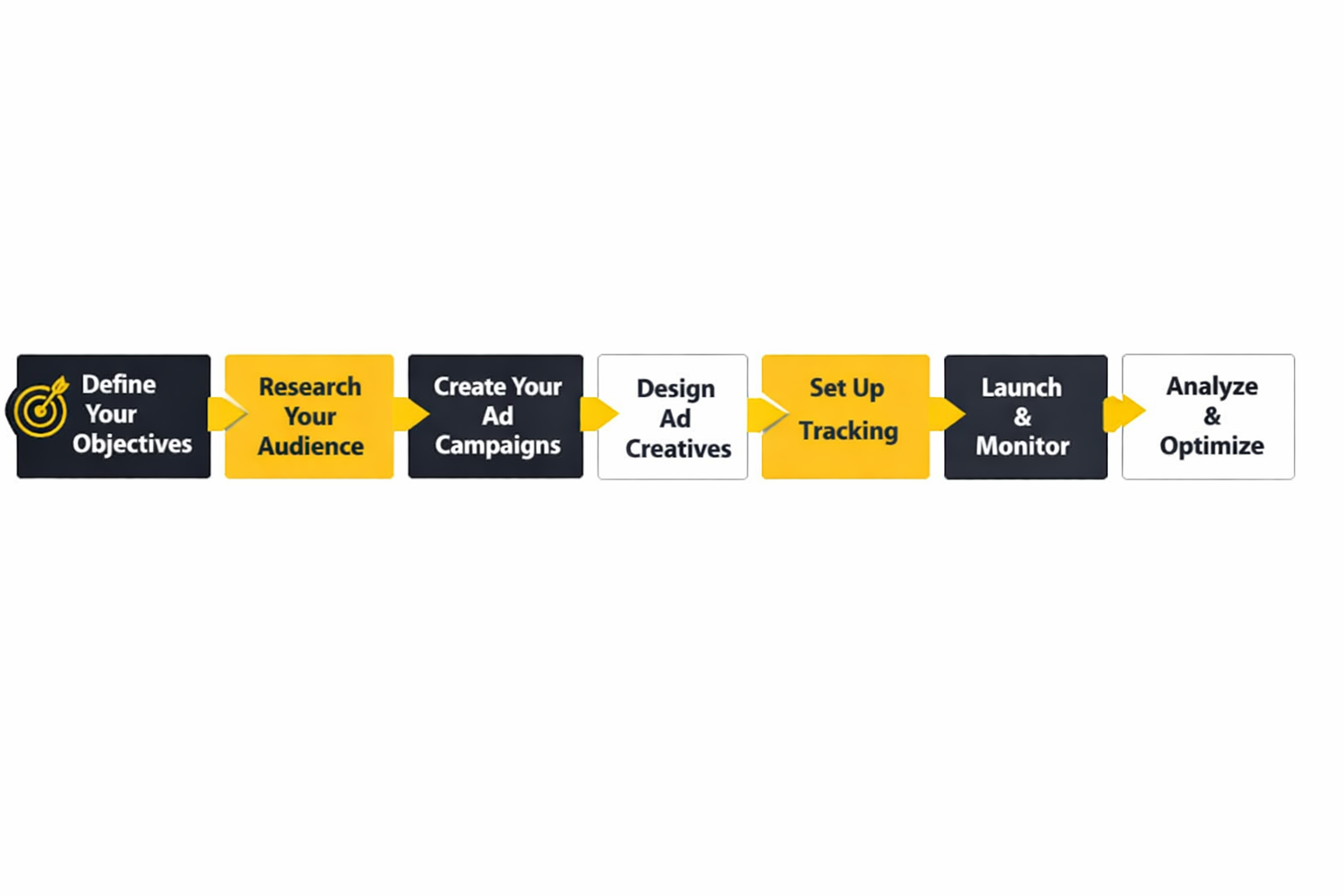
This process sounds basic, but that is exactly why it works. Strong Facebook advertising is usually built on disciplined repetition of fundamentals, not on secret hacks. The professionals do not win because they found a hidden button. They win because they set up fewer contradictions inside the campaign.
How to Structure Campaigns Without Suffocating Delivery
Inside Ads Manager, simpler structures usually outperform cluttered ones. If you create too many ad sets with tiny budgets, overlapping audiences, and nearly identical creatives, you make learning harder and reporting messier. The system spreads data too thin, and then advertisers react by editing too often, which makes the problem worse.
Meta’s own explanation of the learning phase is the warning label here. Delivery becomes less stable when new ad sets or significant edits reset the system’s learning process. That means constant tinkering is not a sign of sophistication. Very often, it is just self-sabotage disguised as account management.
For many brands, a stronger structure is one campaign per objective, a manageable number of ad sets, broader targeting where appropriate, and enough ad variation inside each set to let the system identify patterns. Facebook advertising scales better when the architecture supports learning instead of interrupting it every two days.
Compliance and Category Choices Cannot Be an Afterthought
This part is less glamorous, but it matters. Facebook advertising can fail before launch if the campaign is built with the wrong policy assumptions, non-compliant claims, or the wrong category classification. That is especially important in housing, employment, credit, and social issue campaigns, where Special Ad Category rules restrict some targeting options by design.
Meta’s Advertising Standards also shape what language, imagery, and claims are acceptable. If your campaign relies on aggressive personal attributes, unrealistic outcomes, or restricted content, performance discussions become irrelevant because the ads may never get stable approval in the first place. Professional implementation means building for approval and longevity, not just for click-through rate.
This matters even more when a brand wants to scale fast. Account health becomes part of the growth strategy. A campaign that works for three days and then gets restricted is not a winning campaign. Strong Facebook advertising is not just about what can launch. It is about what can keep running.
The Tools Around Ads Manager Matter Too
Ads Manager is the core interface, but it is not the whole operating system. Real execution also includes landing page builders, lead forms, email platforms, scheduling tools, CRM follow-up, and reporting logic that helps the team move quickly without losing clarity. That stack does not need to be huge, but it does need to be intentional.
For example, if the offer requires a full funnel instead of a single product page, a platform like ClickFunnels can help connect the ad, landing page, upsell flow, and conversion path more tightly. If the campaign depends on lead capture and qualification, Fillout can make form routing cleaner. If the handoff to follow-up sequences matters, Brevo or Moosend can turn a paid click into a real nurturing system instead of a dead-end submission.
That is the difference between running ads and running Facebook advertising as a revenue system. In the next section, we will get into what happens after launch: how to optimize, read the numbers correctly, and grow without breaking the campaigns that are already working.
Facebook Advertising Data, Metrics, and What Actually Matters
This is where Facebook advertising either becomes a real growth channel or turns into a confusing dashboard that looks impressive but drives weak decisions. The platform gives you a lot of numbers, but most of them are only useful if you understand what they signal and what action they should trigger.
The goal is not to track everything. The goal is to track what connects spend to business outcomes. When advertisers lose that connection, they start optimizing for cheap clicks, inflated engagement, or vanity conversions that never turn into revenue.
The Metrics That Actually Drive Decisions
At a practical level, Facebook advertising performance comes down to a handful of core signals. Everything else is secondary or supportive.
The most important metrics are:
- Cost per result (aligned with your real goal)
- Conversion rate from click to outcome
- Cost per click (CPC)
- Click-through rate (CTR)
- Frequency and reach
- Return on ad spend (ROAS) or revenue per lead
Each one answers a different question. CTR tells you if the ad is earning attention. CPC tells you how expensive that attention is. Conversion rate tells you if the funnel is doing its job. Cost per result tells you if the campaign is viable. ROAS tells you if the business model works.
Meta’s internal logic reflects this structure. Its ad auction system explicitly combines bid, estimated action rate, and ad quality. In simple terms, Facebook advertising rewards ads that people are likely to act on, not just ads with higher budgets.
Benchmarks Only Matter When You Understand Context
A lot of articles throw out average CTR or CPC benchmarks, but those numbers are easy to misuse. A “good” CTR in one industry can be terrible in another. A high CPC might be completely acceptable if the customer value is high enough.
That said, directional benchmarks can still help if you treat them as signals, not targets. Data from sources like WordStream’s Facebook ads benchmarks and Hootsuite’s paid social reports consistently show that:
- CTR varies widely but often sits around 0.9%–1.6% depending on industry
- CPC can range from under $1 to several dollars based on competition
- Conversion rates depend heavily on funnel quality, not just traffic
The key insight is this: Facebook advertising performance is relative. If your CTR is low, it usually points to creative or offer issues. If CTR is strong but conversions are weak, the problem is usually post-click. If both are strong but cost per result is still too high, the economics of the offer need work.
Reading the Signals Without Overreacting
One of the biggest mistakes in Facebook advertising is reacting too quickly to small data samples. Meta’s own explanation of the learning phase exists for a reason. The system needs enough events to stabilize performance, and premature edits reset that process.
This is where discipline matters. You do not evaluate a campaign after a handful of clicks or one day of data. You evaluate it after enough conversions to see a pattern. For many campaigns, that means at least 30–50 meaningful events before making structural decisions.
The right way to read the data is to look for patterns, not spikes. A single good day does not mean you should scale aggressively. A single bad day does not mean you should shut everything off. Facebook advertising becomes more predictable when decisions are based on trends instead of emotional reactions to daily fluctuations.
How Metrics Connect to Action
Data only matters if it leads to better decisions. Each metric should point to a clear next move.
- Low CTR -> Fix the creative or the hook If people are not clicking, the ad is not resonating. Change the angle, not just the colors.
- High CTR but low conversion rate -> Fix the landing page or offer alignment The ad is doing its job, but the page is breaking momentum.
- High CPC -> Improve relevance or broaden delivery Expensive clicks often mean the system is struggling to find responsive users.
- Rising frequency with declining performance -> Refresh creative Audience fatigue is real, especially in smaller markets or narrow targeting.
- Good cost per lead but poor sales -> Fix lead quality or qualification This is a classic trap in Facebook advertising. Cheap leads are not the goal.
When you map metrics to actions like this, the account becomes easier to manage. You are no longer guessing. You are diagnosing.
The Role of Attribution and Data Gaps
Attribution is one of the most misunderstood parts of Facebook advertising. The platform reports on what it can measure, but no system sees everything. Privacy changes, cross-device behavior, and delayed conversions all create gaps.
Meta’s guidance around attribution settings explains how different attribution windows change reporting. A shorter window may undercount conversions that happen later. A longer window may include conversions that were influenced by multiple channels.
This is why serious advertisers do not rely on one dashboard. They compare Meta’s reporting with backend data, CRM outcomes, and actual revenue. If Facebook shows strong performance but the business does not feel it, something is off. If the business is growing but Facebook looks weak, attribution may be undercounting.
Building a Simple but Reliable Measurement System
The best Facebook advertising setups are not the ones with the most dashboards. They are the ones where the numbers line up clearly enough to make confident decisions.
A reliable measurement system usually includes:
- Meta Ads Manager for campaign-level performance
- Verified events through Pixel and Conversions API
- A backend system (CRM, checkout, or analytics tool) that confirms real outcomes
- Clear definitions of what counts as a qualified lead or a successful conversion
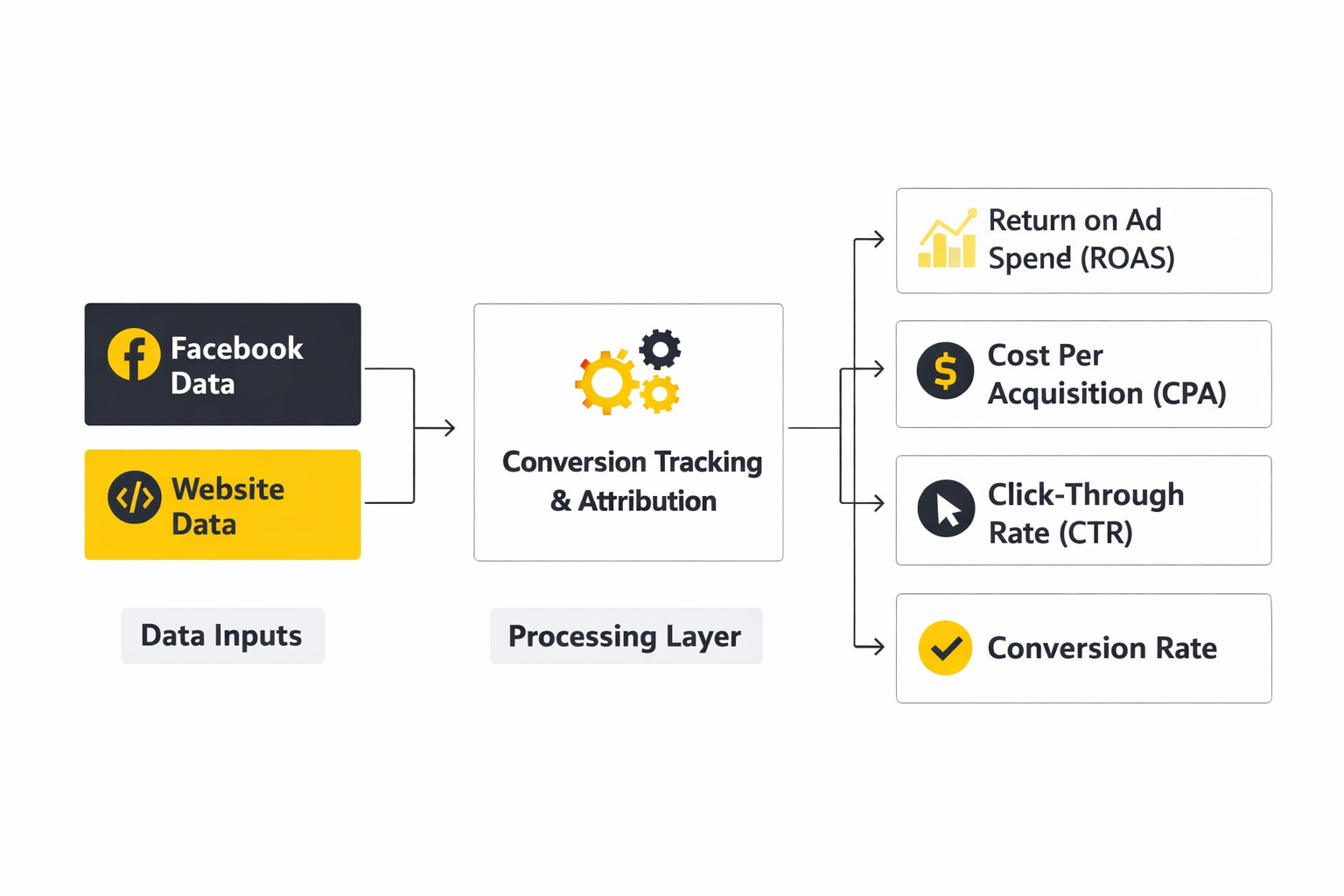
If those pieces are aligned, you can trust your data enough to scale. If they are not, every optimization becomes a guess.
Why Data Discipline Is the Real Advantage
At this point, the pattern should be obvious. Facebook advertising is not won by chasing random metrics. It is won by understanding what each number represents and how it connects to real business outcomes.
The advertisers who scale consistently are not the ones with the flashiest creatives or the biggest budgets. They are the ones who read the data correctly, act on it without overreacting, and keep the entire system aligned from impression to revenue.
In the next section, we will take this further and look at optimization and long-term growth. Because launching a campaign is one thing, but keeping it profitable as you increase spend is where most advertisers lose control.
Optimization, Reporting, and Long-Term Growth
Once a campaign is live and the early data is clean, the job changes. Facebook advertising is no longer about getting something off the ground. It becomes a game of protecting what works, expanding it carefully, and knowing which problems are real problems versus normal platform volatility.
This is where a lot of advertisers lose money. They either scale too fast because one week looked great, or they get scared by short-term swings and start changing everything at once. Neither approach is professional. Long-term performance comes from controlled changes, clear reporting, and a solid understanding of the tradeoffs inside the auction.
Scaling Is Usually a Creative Problem Before It Is a Budget Problem
Most accounts do not stall because Meta suddenly forgot how to deliver ads. They stall because the same message has reached too much of the available audience, the offer has lost urgency, or the campaign is trying to stretch one winning ad far beyond its natural lifespan. Facebook advertising can absolutely scale, but it usually scales through fresh creative inputs and stronger economics, not brute-force budget increases alone.
Meta’s own delivery guidance around Advantage+ campaign budget and best practices to reduce cost per result points toward the same principle: give the system room to allocate spend efficiently, but do not confuse automation with infinite demand. More spend only works when the account still has enough audience headroom and enough creative range to support it.
That is why strong operators ask a different question when performance flattens. They do not ask, “How do I force this campaign to spend more?” They ask, “What new angle, new proof, new format, or new offer version gives the system a fresh way to win?” That question usually leads somewhere useful.
Budget Changes Need Restraint
Scaling sounds exciting, but the mechanics matter. Aggressive budget jumps can destabilize delivery, especially when the campaign is still settling or when the ad set is barely producing enough conversion volume to learn properly. Facebook advertising rewards consistency more than drama.
Meta explains in its guidance on significant edits and the learning phase that meaningful changes can affect delivery and may push the system back into learning. That is a practical warning, not a technical footnote. If you change budgets, targeting, creatives, placements, and optimization settings all at once, you lose the ability to tell what actually caused the next result.
The smarter move is staged scaling. Increase spend in measured steps, watch cost per result and conversion quality, and let the campaign prove it can absorb more budget before pushing again. That sounds less exciting than “scale to the moon,” but it is how durable Facebook advertising is actually managed.
Creative Fatigue Is Real, and It Hits Quietly
Creative fatigue rarely announces itself in a dramatic way. More often, the ad slowly gets more expensive, CTR softens, frequency climbs, and the team keeps hoping the next day will fix it. It usually does not.
Meta’s advertising engine is getting better at matching messages to people, as shown by the company’s own engineering work on Andromeda and sequence-based ad recommendations. That is good news, but it also means the system moves faster toward creative saturation when the same assets have already done their job. Facebook advertising today is less forgiving of lazy refresh cycles because the machine quickly discovers what works and just as quickly exhausts it.
The fix is not random design churn. It is a planned creative pipeline. Keep the core offer stable when it is working, but rotate hooks, proof elements, opening frames, customer objections, and format types before fatigue becomes expensive. Advanced advertisers do not wait until a campaign is in trouble. They prepare replacement assets while the winner is still healthy.
Attribution Tradeoffs Never Fully Go Away
Even with better tracking, attribution remains messy. Someone sees an ad on Facebook, searches your brand later, opens an email, comes back through direct traffic, and buys two days after that. Which channel gets the credit depends on the reporting system you are looking at, and none of those systems tells the full story perfectly.
That is why advanced Facebook advertising teams stop treating platform attribution as the final truth. They use it as one view of performance, then compare it against revenue data, CRM status changes, lead qualification rates, and cohort behavior. Meta’s own resources on attribution settings and Conversion Lift make the same point in a more formal way: directional reporting is useful, but incrementality is what tells you whether ads caused additional business.
This matters even more when budgets grow. At small spend levels, sloppy attribution can be irritating. At larger spend levels, it becomes dangerous because it can justify waste. If you want Facebook advertising to remain profitable over time, you need a reporting culture that values causation more than flattering dashboards.
Incrementality Is the Standard Serious Advertisers Grow Into
There is a point where simple in-platform reporting is no longer enough. Once the budgets are meaningful, the business needs to know not just what the ads were associated with, but what they genuinely added. That is where incrementality becomes the mature way to think about Facebook advertising.
Meta offers Conversion Lift testing and explains that these studies are designed to measure the incremental impact of ads using test and control groups. This is a much better lens for long-term decision-making because it helps separate conversions that would have happened anyway from conversions that were actually driven by spend. It is not something every small advertiser needs on day one, but it is absolutely where more advanced programs should head.
The big strategic tradeoff is time versus certainty. Incrementality testing takes more structure, more patience, and sometimes more budget. But it also gives you the kind of answer that helps you defend spend, reallocate budgets intelligently, and stop over-crediting channels that are simply harvesting existing demand.
Reporting Should Help You Decide, Not Just Observe
Too many reports are built for watching, not deciding. They are packed with metrics, screenshots, and breakdowns, but they do not tell the team what changed, why it changed, and what should happen next. That is wasted effort.
A useful Facebook advertising report usually does four things. It shows business outcomes, explains the main drivers behind performance changes, identifies risks early, and recommends the next controlled actions. Everything else is secondary.
A practical reporting structure often looks like this:
- Spend, revenue, qualified leads, or other real outcomes
- Efficiency trends such as cost per result, conversion rate, and blended return
- Delivery context such as frequency, audience saturation, and creative fatigue
- Funnel context such as landing page conversion rate and lead-to-sale quality
- Clear actions for the next reporting period
This is where connected tools can help. If leads need to be routed, scored, and handed off cleanly, a CRM like Copper can tighten visibility after the click. If the campaign depends on booking calls quickly, Cal.com can reduce friction between ad response and sales conversation. Those are not magic growth hacks, but they do make reporting more honest because they connect ad performance to downstream business behavior.
The Biggest Risks Are Usually Strategic, Not Technical
Technical issues matter, but they are rarely the deepest problem in a mature account. More often, the real risks come from strategic drift. The business keeps spending on an offer that no longer feels special, the creative team keeps recycling versions of the same ad, or the sales process fails to convert the leads that marketing is generating.
There is also platform risk. Meta’s Advertising Standards and review systems can affect approval, delivery stability, and account health. If your growth plan depends on edgy claims, vague compliance assumptions, or copy that pushes into prohibited territory, the problem is not optimization. The problem is that the strategy itself is fragile.
That is why experienced advertisers build redundancy into the system. They maintain creative backups, diversify post-click paths, keep clean documentation of what works, and avoid building the entire growth engine around one campaign that nobody can replace. Facebook advertising becomes much safer when the business is resilient enough to survive normal platform changes.
What Expert-Level Facebook Advertising Really Looks Like
At the expert level, Facebook advertising stops feeling like a series of campaigns and starts feeling like an operating system. Offers are tested deliberately. Creative is refreshed on schedule. Tracking is audited before it breaks. Reporting is tied to real outcomes. Scaling decisions are made with evidence instead of adrenaline.
The strongest teams also understand the tradeoff between simplicity and control. They know when to let Meta automate, and they know when the business needs tighter guardrails because the wrong lead, wrong product margin, or wrong audience quality would be too expensive. That balance is where the craft sits now.
This is the real closing insight before the FAQ: Facebook advertising still works, but it rewards adults. Not marketers chasing old tricks, not founders demanding miracles from bad funnels, and not teams hiding behind pretty dashboards. The channel is still powerful. You just have to run it like it matters.
FAQ - Built for Complete Guide
Is Facebook advertising still worth it in 2026?
Yes, Facebook advertising is still worth it for many businesses because the platform still offers enormous commercial reach and deep delivery data. Meta reported 3.58 billion daily active people across its Family of Apps in December 2025, and DataReportal’s review of Meta planning tools showed Facebook ads could reach 2.28 billion users in January 2025. The opportunity is still there, but the easy wins are not, so results now depend much more on strategy, creative quality, clean tracking, and a real offer.
How much should a beginner spend on Facebook advertising?
A beginner should spend enough to generate useful data, not just enough to feel active. In practice, that means using a budget that can produce a meaningful number of optimization events, because Meta’s learning phase guidance makes clear that unstable delivery is common when the system lacks enough signals. Tiny budgets can work for testing messages, but serious Facebook advertising needs enough spend to reveal patterns rather than random noise.
What is the biggest mistake businesses make with Facebook advertising?
The biggest mistake is trying to rescue a weak offer with targeting tricks. Businesses often blame audience settings when the real problem is that the product, promise, pricing, proof, or landing page is not compelling enough to deserve the click. Facebook advertising can amplify a strong offer beautifully, but it is brutally honest when the market does not care.
Should I use broad targeting or interests?
For many advertisers, broad targeting now works better than overbuilt interest stacks because Meta keeps pushing the system toward more automated audience discovery. That trend is visible in tools like Advantage+ audience and in Meta’s removal of detailed targeting exclusions from active existing campaigns starting March 31, 2025. Interests still have use cases, especially in early testing or niche offers, but modern Facebook advertising usually performs best when the account gives the algorithm stronger creative and cleaner signals instead of excessive restrictions.
How many creatives should I launch with?
You should launch with enough creatives to test different buying angles, not just different designs of the same message. One ad might lead with the problem, another with proof, another with speed, and another with ease of use, because those are different reasons people buy. Facebook advertising performs better when Meta has multiple meaningful creative options to match against different response patterns rather than a single ad repeated in five minor variations.
What matters more, the ad or the landing page?
They matter together, but the landing page decides whether the paid click actually becomes revenue. A strong ad can create attention and intent, but a weak page can destroy both in seconds through confusion, mismatch, or friction. That is why Facebook advertising should be treated as a system, and why funnel tools like ClickFunnels or Systeme.io can make sense when the post-click experience needs to be tighter.
Do I need the Meta Pixel and Conversions API?
Yes, in most serious cases you need both. Meta’s own documentation around the Meta Pixel and Conversions API shows that stronger event sharing improves optimization and measurement resilience, especially in a privacy-restricted environment. Facebook advertising becomes much less reliable when the platform receives incomplete or low-quality conversion data.
How long should I wait before optimizing a campaign?
You should usually wait until you have enough data to see a pattern instead of reacting to every daily swing. Meta explicitly warns through its learning phase documentation that major edits can destabilize delivery, which is why constant tinkering often hurts more than it helps. Good Facebook advertising management is patient enough to gather evidence and disciplined enough to change one meaningful variable at a time.
What metrics should I watch first?
Start with cost per result tied to the real business goal, then look at click-through rate, cost per click, conversion rate, and downstream quality. Those numbers tell you whether the problem is attention, cost, post-click friction, or weak customer economics. Facebook advertising gets easier to manage when every metric answers a specific diagnostic question instead of being treated like a scoreboard decoration.
Why do I get cheap leads but poor sales?
Because low lead cost is not the same as high lead quality. If the ad promise attracts curiosity instead of genuine intent, Meta can often find plenty of people willing to submit a form while your sales team gets contacts that never had serious buying intent in the first place. This is one of the most common Facebook advertising traps, and it usually points back to offer framing, qualification steps, and how success is defined inside the account.
Can Facebook advertising work for B2B companies?
Yes, but the path is usually less direct than in impulse-driven ecommerce. B2B buyers often need more context, more proof, more follow-up, and more time, which means the ad, landing page, CRM, and nurture sequence all matter more. Facebook advertising can work well in B2B when it is used to start qualified conversations and move prospects into a proper system instead of expecting immediate low-friction conversions.
How often should I refresh creative?
You should refresh creative before fatigue becomes expensive, not after performance has already collapsed. Frequency trends, softening CTR, rising CPC, and weaker conversion rates are often the early warning signs that the market has seen enough of the same message. Facebook advertising rewards teams that maintain a creative pipeline, because fresh hooks and proof points often unlock more scale than budget changes do.
Is automation replacing media buyers?
Not really, but it is changing what good media buyers do. Meta is automating more of the mechanical delivery process through tools like Advantage+, which means the real value now comes from offer design, creative strategy, measurement quality, and business interpretation. Facebook advertising still needs skilled operators, but the skill has moved away from button pushing and toward smarter inputs and sharper decisions.
What tools fit best around Facebook advertising?
The right stack depends on the business model, but most advertisers need landing pages, forms, email automation, scheduling, and CRM visibility around Ads Manager. That is why platforms like Fillout, Brevo, Moosend, and Cal.com can fit naturally around Facebook advertising when the goal is to turn clicks into qualified conversations and actual revenue. The platform itself is powerful, but the surrounding system often determines whether the traffic becomes profit.
What is the smartest way to think about Facebook advertising going forward?
Think of it as a managed growth system, not a collection of ad tricks. Meta’s business results still show a platform with rising ad demand, including 18% year-over-year growth in ad impressions in Q4 2025, but stronger competition means weaker operators get exposed faster. Facebook advertising still works extremely well when the business has something real to sell and is willing to run the channel with discipline.
Work With Professionals
Explore 10K+ Remote Marketing Contracts on MarkeWork.com
Most marketers spend too much time chasing clients, competing on crowded platforms, and losing a percentage of every project to middlemen. MarkeWork gives you a better way. Browse thousands of remote marketing contracts and connect directly with companies desperate to hire skilled marketers like you, without platform commissions and without unnecessary gatekeepers.
If you're serious about finding better opportunities and keeping 100% of what you earn, explore available contracts and create a profile for free at MarkeWork.com.