
Facebook is still one of the most powerful paid acquisition channels in the world, but the gap between brands that win and brands that burn budget has never been wider. That gap is often defined by the quality of execution, not the platform itself.
This is where Facebook marketing companies come in. The right agency doesn’t just run ads—they build systems that convert attention into revenue. The wrong one drains your budget while hiding behind vanity metrics.
The challenge isn’t whether to hire help. It’s knowing how to choose the right kind of help, what frameworks actually work today, and how to scale without losing control.
Article Outline
- Why Facebook Marketing Companies Matter More Than Ever
- What Facebook Marketing Companies Actually Do
- The Core Framework Behind High-Performing Campaigns
- How Professional Implementation Changes Results
- How to Choose the Right Facebook Marketing Company
- Scaling, Optimization, and Long-Term Growth
Why Facebook Marketing Companies Matter More Than Ever
Facebook’s advertising ecosystem has changed dramatically over the past few years. Privacy updates, attribution limitations, and rising competition have made it harder for inexperienced advertisers to get consistent results.
The platform still reaches over 3 billion monthly active users, but reaching the right audience profitably requires more than boosting posts or running basic campaigns. It requires structured testing, strong creative strategy, and advanced tracking.
Most brands underestimate how complex this has become. What used to work with simple targeting and basic creatives now requires:
- Full-funnel campaign design
- Conversion-focused landing pages
- Creative iteration cycles
- First-party data integration
- Automation and follow-up systems
This is exactly where specialized Facebook marketing companies create leverage. They bring not just execution, but systems, processes, and experience across multiple industries.
What Facebook Marketing Companies Actually Do
At a surface level, most people think these companies “run ads.” That’s technically true, but it misses the bigger picture.
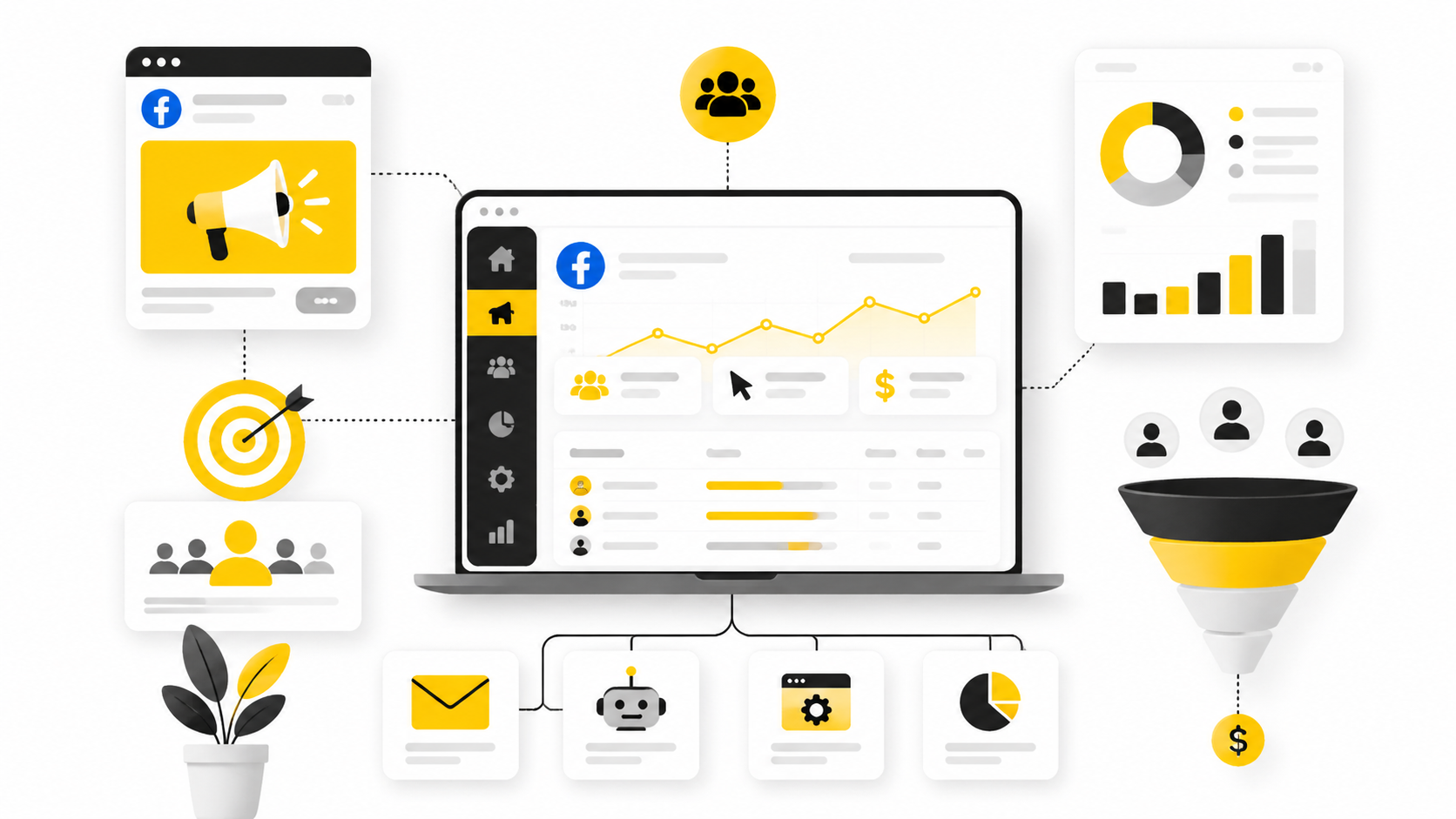
The best Facebook marketing companies operate as growth partners. Their work spans multiple layers of your business:
Strategy Development
They define who you should target, what message resonates, and how your funnel should be structured. This includes audience segmentation, offer positioning, and budget allocation.
Without this layer, even great ads fail because they’re pointed at the wrong people or selling the wrong thing.
Creative Production
Ad performance today is driven heavily by creative. Agencies test multiple variations of:
- Video ads
- Static images
- Hooks and headlines
- User-generated content formats
Brands that win are often producing dozens of creatives per month, not just one or two polished campaigns.
Funnel and Conversion Optimization
Traffic alone doesn’t generate revenue. The journey after the click matters just as much.
This is where tools like ClickFunnels or Systeme.io often come into play, helping agencies build high-converting landing pages and sales funnels that turn clicks into customers.
Tracking and Data Infrastructure
With limited visibility from platforms, agencies now rely on:
- Conversion APIs
- First-party data tracking
- CRM integrations
Platforms like GoHighLevel allow agencies to unify leads, automate follow-ups, and track customer journeys more accurately than native Facebook tools alone.
Automation and Retention
Acquiring a lead is only part of the equation. Monetization often happens after the first interaction.
Smart agencies implement:
- Messenger automation using tools like ManyChat
- Email sequences via platforms like Brevo
- Retargeting campaigns across multiple touchpoints
This transforms one-time clicks into long-term customers.
The Core Framework Behind High-Performing Campaigns
Every effective Facebook marketing company follows a structured system, even if they describe it differently.
At its core, high performance comes from aligning four key layers:
- Audience
- Creative
- Offer
- Funnel
If one breaks, the entire system underperforms.
Audience Targeting
Modern targeting relies less on micro-interests and more on:
- Broad audiences with strong creatives
- Lookalike audiences built from real customer data
- Retargeting warm traffic
The shift is clear: Facebook’s algorithm works best when fed quality data and strong signals, not overly restrictive targeting.
Creative Testing Engine
Creative is now the primary lever for scaling.
Winning agencies don’t guess—they test aggressively. They build pipelines that constantly produce and validate new concepts, often guided by tools like Flick Social for trend insights and content performance.
Offer Positioning
Even perfect targeting and creative won’t fix a weak offer.
Top-performing campaigns often rely on:
- Clear value propositions
- Strong incentives
- Risk reversal (guarantees, trials, bonuses)
Funnel Structure
This is where everything connects. A strong funnel ensures:
- Fast load times
- Clear messaging alignment with ads
- Minimal friction to conversion
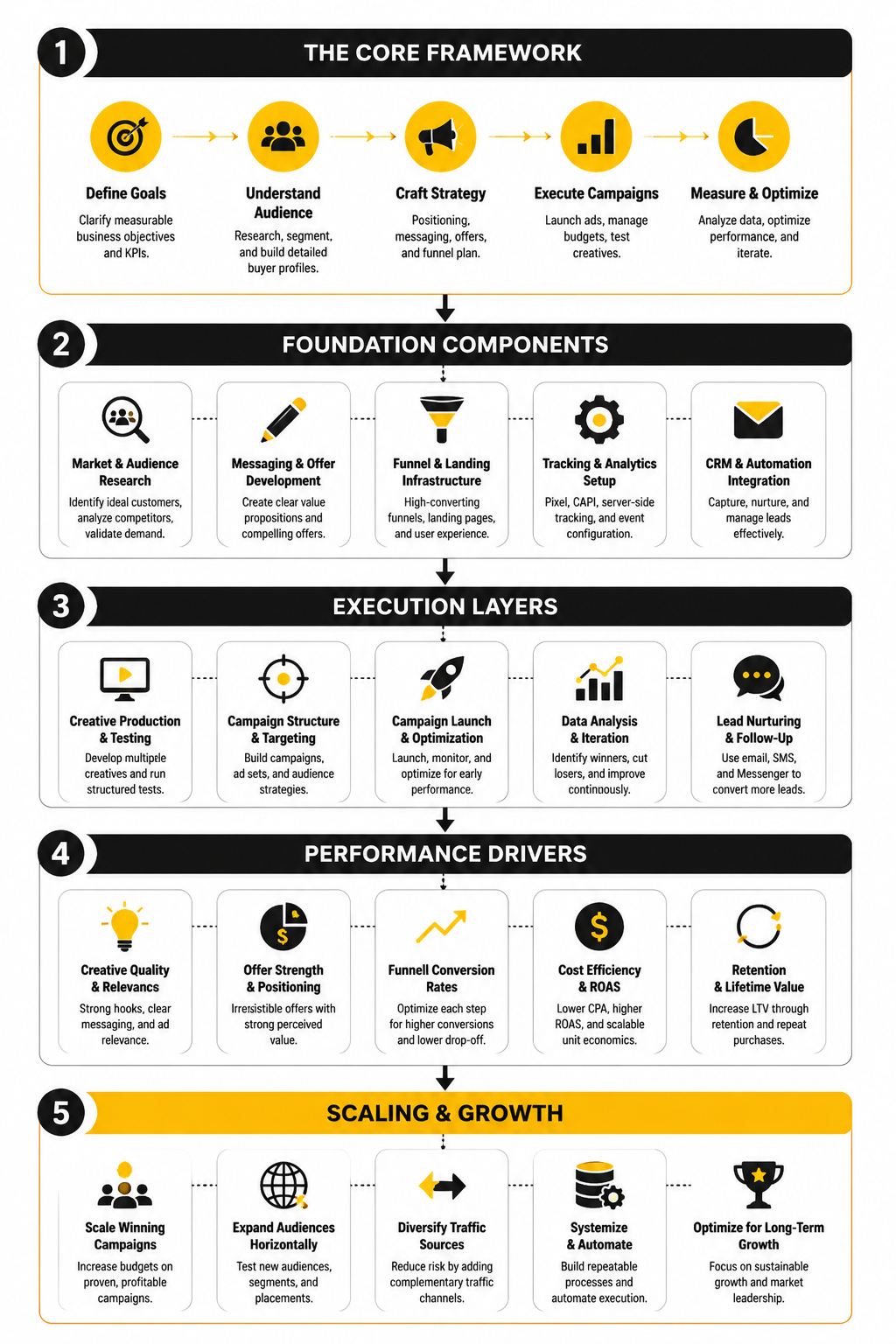
The difference between average and elite Facebook marketing companies is how well they integrate these layers into a repeatable system.
How Professional Implementation Changes Results
Execution is where theory becomes revenue. Two businesses can use the same platform, same budget, and even similar products—and still see completely different outcomes.
Professional Facebook marketing companies bring:
- Speed in testing and iteration
- Access to proven creative patterns
- Data-driven decision making
- Cross-industry insights
They also reduce costly mistakes. Poor campaign structure, weak creatives, and broken tracking can waste thousands before a brand even realizes what’s wrong.
When implemented correctly, Facebook advertising becomes predictable. Not easy—but predictable enough to scale with confidence.
The rest of this article breaks down how to evaluate agencies, what separates average from elite, and how to build a system that keeps working long-term.
How to Choose the Right Facebook Marketing Company
Most businesses don’t fail with Facebook ads because the platform doesn’t work. They fail because they pick the wrong partner.
There’s a big difference between a company that knows how to run ads and one that understands how to build a scalable acquisition system. If you don’t know what to look for, they can sound exactly the same in a sales call.
Look Beyond Case Studies
Case studies are everywhere, and most of them are useless without context. A company showing a 5x ROAS doesn’t tell you:
- How long it took to get there
- How much was spent before results stabilized
- Whether the results were repeatable
Strong Facebook marketing companies will walk you through the process, not just the outcome. They’ll explain testing cycles, creative strategy, and how they handled underperformance—not just highlight wins.
If they can’t explain the system behind the result, that result probably isn’t reliable.
Evaluate Their Creative Process
Creative is the biggest lever in modern Facebook advertising. This is where most agencies quietly fail.
Ask specific questions:
- How many creatives do you test per month?
- Who produces the content?
- How do you generate new angles?
Top-tier agencies often run structured creative pipelines, using data to guide iteration instead of relying on random ideas. Some even use tools like Replo to rapidly build and test landing page variations that match ad creatives.
If an agency talks more about targeting than creative, they’re behind.
Understand Their Tracking Setup
Tracking is where things get technical—and where a lot of agencies cut corners.
With attribution becoming less reliable, serious Facebook marketing companies invest heavily in:
- Server-side tracking
- Conversion APIs
- CRM integrations
Platforms like GoHighLevel are often used to centralize lead data, automate follow-ups, and maintain visibility beyond what Facebook reports.
If an agency relies only on Facebook Ads Manager data, you’re not getting the full picture.
Check Their Funnel Thinking
Great ads won’t save a weak funnel. This is one of the most expensive mistakes businesses make.
A strong agency will actively improve:
- Landing page conversion rates
- Offer clarity
- Checkout experience
- Post-click engagement
You’ll often see them working inside tools like ClickFunnels or Systeme.io to align messaging from ad to conversion.
If they say “we only handle ads,” that’s a red flag. Performance doesn’t stop at the click.
Transparency and Communication
You should never feel like your agency is hiding behind dashboards.
The best Facebook marketing companies are brutally transparent about:
- What’s working
- What’s failing
- What they’re testing next
They don’t just send reports. They explain decisions.
Clear communication becomes even more important when performance dips, because that’s when strategy matters most.
Scaling, Optimization, and Long-Term Growth
Once campaigns start working, the real challenge begins. Scaling is where most systems break, and where average agencies get exposed.
Growth isn’t just about increasing budget. It’s about maintaining efficiency while expanding reach.
The Reality of Scaling Facebook Ads
Scaling introduces new variables:
- Audience saturation
- Creative fatigue
- Rising CPMs
Data from multiple industry reports shows that ad costs have increased significantly in recent years, with some verticals seeing double-digit CPM growth annually. This means scaling without a system quickly erodes margins.
Facebook marketing companies that understand this don’t just “turn up spend.” They expand horizontally and vertically at the same time.
Horizontal vs Vertical Scaling
Strong agencies use two primary approaches:
Horizontal scaling:
- Testing new audiences
- Launching new creatives
- Expanding placements
Vertical scaling:
- Increasing budget on winning ad sets
- Optimizing bid strategies
- Refining conversion events
The balance between these two determines whether scaling is stable or chaotic.
Creative Fatigue Management
Creative fatigue is one of the fastest ways performance collapses.
High-performing Facebook marketing companies treat creatives as a renewable resource. They continuously:
- Analyze top-performing hooks
- Replicate winning patterns
- Introduce new variations before performance drops
Tools like Flick Social help identify trends and content formats that resonate with audiences, allowing agencies to stay ahead instead of reacting too late.
Building a Retention Engine
Acquisition is expensive. Retention is where profitability happens.
Smart agencies extend beyond ads by building:
- Email sequences using Brevo
- Messenger flows with ManyChat
- CRM-driven follow-ups inside GoHighLevel
This turns a single acquisition into multiple revenue opportunities, stabilizing the entire system.
The Shift Toward Full-Funnel Thinking
The biggest difference between average and elite Facebook marketing companies is mindset.
Average agencies optimize campaigns. Elite agencies build ecosystems.
They connect:
- Ads
- Funnels
- CRM
- Automation
- Retention
When everything works together, scaling stops being guesswork and starts becoming predictable.
In the next part, we’ll break down what separates top-tier agencies from everyone else—and how to spot the difference before you sign a contract.
Professional Implementation: How Facebook Marketing Companies Execute
Understanding strategy is one thing. Turning it into a working acquisition system is where most businesses hit a wall.
This is exactly where experienced Facebook marketing companies stand out. They don’t just plan—they execute in a structured, repeatable way that reduces guesswork and accelerates results.
The difference becomes obvious when you look at how campaigns are actually built from the ground up.
Step 1: Deep Discovery and Offer Alignment
Every serious implementation starts before a single ad is launched.
Top Facebook marketing companies begin by dissecting your business:
- What are you actually selling?
- Who is the ideal customer?
- Why should they care right now?
This phase often uncovers misalignment between the product and how it’s presented. In many cases, improving the offer itself creates more impact than any targeting tweak.
Agencies that skip this step usually end up optimizing weak foundations.
Step 2: Funnel and Infrastructure Setup
Once the strategy is clear, the next step is building the environment where conversions will happen.
This includes:
- Landing pages
- Lead capture systems
- CRM connections
- Tracking infrastructure
Platforms like ClickFunnels or Systeme.io are often used to deploy funnels quickly, while tools like GoHighLevel handle lead management and automation.
At the same time, proper tracking is configured. Without this, scaling becomes blind.
Step 3: Creative Production and Testing Pipeline
This is where campaigns start to take shape.
Instead of launching a single “perfect” ad, high-performing Facebook marketing companies build testing pipelines. They produce multiple variations across:
- Hooks
- Visual formats
- Messaging angles
The goal is simple: identify what resonates as quickly as possible.
Agencies that consistently win treat creative like a system, not a one-time task. They often integrate trend research tools like Flick Social to guide what formats and styles are working right now.
Step 4: Campaign Launch Structure
When campaigns go live, they’re not random collections of ads. They follow a clear structure designed for data clarity and scalability.
A typical launch setup includes:
- Broad targeting campaigns to feed the algorithm
- Retargeting campaigns for warm audiences
- Conversion-optimized objectives aligned with business goals
Budgets are distributed strategically to gather meaningful data fast, not slowly trickle results.
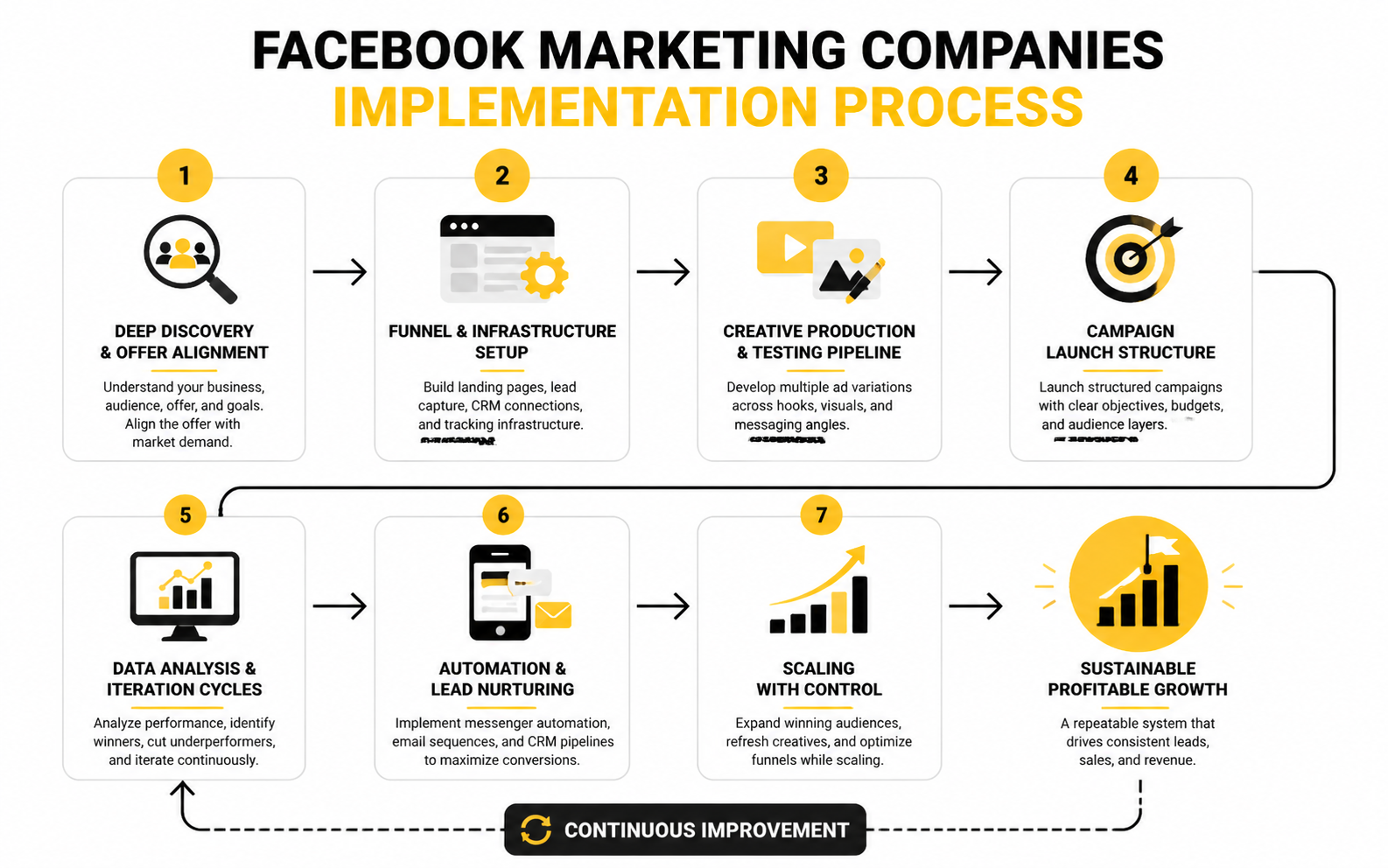
Step 5: Data Analysis and Iteration Cycles
Once campaigns are live, the real work begins.
Facebook marketing companies operate in cycles:
- Analyze performance data
- Identify winning patterns
- Kill underperforming elements
- Double down on what works
This happens continuously, not once a month.
The most effective teams shorten feedback loops. Instead of waiting weeks, they iterate weekly or even daily, depending on spend levels.
Step 6: Automation and Lead Nurturing
At this stage, campaigns are generating leads or sales—but that’s only part of the system.
To maximize ROI, agencies implement follow-up mechanisms:
- Messenger automation via ManyChat
- Email sequences through Brevo
- CRM-driven pipelines inside GoHighLevel
This ensures that leads who don’t convert immediately are still monetized over time.
Step 7: Scaling With Control
Once performance stabilizes, scaling begins—but carefully.
Instead of aggressively increasing budgets and risking performance drops, strong Facebook marketing companies:
- Expand winning audiences gradually
- Introduce new creatives before fatigue hits
- Optimize funnel conversion rates alongside ad performance
This controlled scaling approach is what separates sustainable growth from short-term spikes.
Why Process Consistency Matters More Than Tactics
Many businesses obsess over tactics—new ad formats, targeting hacks, or algorithm tricks.
The reality is simpler. Results come from consistent execution of proven processes.
Facebook marketing companies that succeed long-term don’t rely on secrets. They rely on discipline:
- Testing continuously
- Measuring accurately
- Iterating quickly
When this process is in place, performance becomes far more predictable. And that’s what allows businesses to move from “trying ads” to building a reliable growth engine.
In the next section, we’ll break down what separates average agencies from elite operators—and how to spot the difference before you commit.
Performance Data That Actually Matters
At some point, every conversation about Facebook marketing companies comes down to numbers. But most businesses track the wrong numbers, or worse, misinterpret the ones they have.
The goal isn’t to collect more data. It’s to understand which signals actually drive decisions and which ones are just noise.
The best agencies don’t overwhelm you with dashboards. They focus your attention on a small set of metrics that directly connect to revenue.
The Difference Between Vanity Metrics and Revenue Metrics
It’s easy to get distracted by metrics that look impressive but don’t move your business forward.
Common vanity metrics include:
- High click-through rates
- Large reach numbers
- Cheap cost per click
These can feel like progress, but they don’t guarantee profitability.
Revenue-focused Facebook marketing companies prioritize metrics like:
- Cost per acquisition (CPA)
- Return on ad spend (ROAS)
- Customer lifetime value (LTV)
- Conversion rate across the funnel
For example, global benchmarks show Facebook ad click-through rates often average around 0.9% to 1.6% depending on industry, but that number alone tells you nothing about whether your campaigns are actually profitable.
The shift is simple but critical: stop optimizing for attention, start optimizing for outcomes.
Understanding Benchmarks in Context
Benchmarks are useful—but only when interpreted correctly.
You’ll often see ranges like:
- Cost per click varying from under $1 to several dollars depending on industry
- Conversion rates between 2% and 10% for most funnels
- CPM increases across industries due to rising competition
What matters is not whether your numbers match a generic benchmark. What matters is whether your economics work.
If your CPA is $50 and your average customer value is $200, you’re in a strong position—even if your CPC looks high.
Facebook marketing companies that understand this don’t chase cheap metrics. They optimize for profitable ones.
Building a Reliable Measurement System
This is where things become technical—and where most businesses lose clarity.
A proper measurement system combines multiple layers:
- Platform data (Facebook Ads Manager)
- Funnel data (landing pages and conversions)
- CRM data (actual customers and revenue)
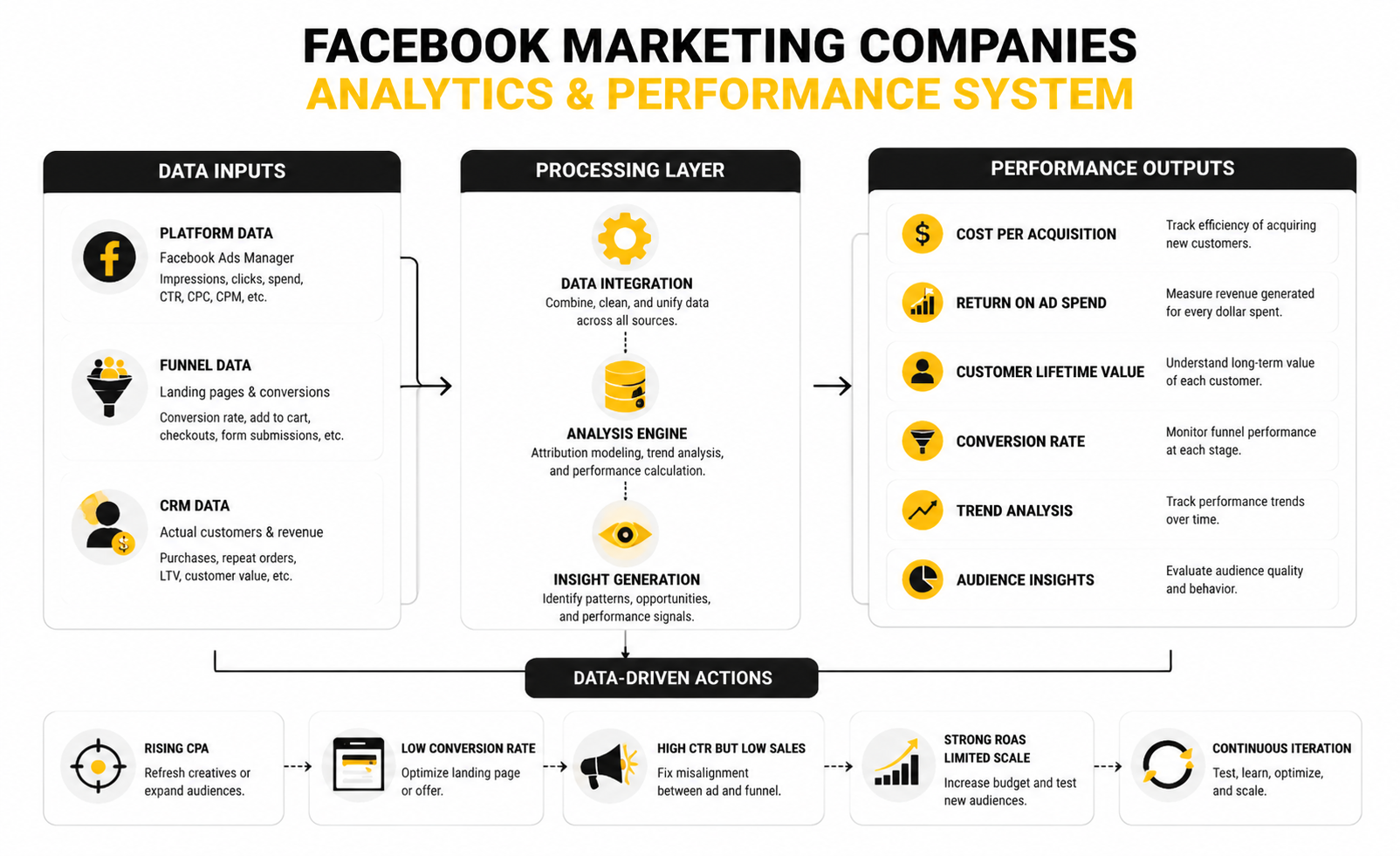
Tools like GoHighLevel are often used to connect these layers, giving a clearer picture of what happens after the click.
Without this integration, you’re relying on partial data. And partial data leads to bad decisions.
Attribution Is Not Perfect—And That’s the Point
Modern attribution has limitations. Privacy changes have reduced visibility, and no platform shows the full customer journey anymore.
Strong Facebook marketing companies adapt to this reality instead of fighting it.
They look at:
- Blended ROAS across channels
- Trends over time instead of single-day performance
- Correlation between spend and total revenue
This approach accepts that no single dashboard is 100% accurate—but patterns still tell the truth.
Key Performance Signals to Watch
Instead of drowning in metrics, focus on signals that indicate whether your system is healthy.
These include:
- Stable or improving CPA over time
- Increasing conversion rates after funnel improvements
- Consistent scaling without sharp performance drops
- Strong retention and repeat purchase behavior
If these signals are positive, the system is working—even if individual metrics fluctuate.
What the Data Should Actually Drive
Data is only valuable if it leads to action.
Here’s how top Facebook marketing companies translate metrics into decisions:
- Rising CPA → refresh creatives or expand audiences
- Low conversion rate → optimize landing page or offer
- High CTR but low sales → misalignment between ad and funnel
- Strong ROAS but limited scale → increase budget and test new audiences
Every number should answer one question: what do we do next?
If your agency can’t clearly connect data to action, they’re reporting—not optimizing.
Why Interpretation Beats Raw Data
Most businesses don’t need more analytics tools. They need better interpretation.
A dashboard doesn’t grow your business. Decisions do.
This is why experienced Facebook marketing companies are valuable. They don’t just show you numbers—they tell you what those numbers mean, what to ignore, and where to focus next.
In the next section, we’ll break down how to compare agencies directly and identify which ones are actually capable of delivering consistent results.
Advanced Considerations Most Businesses Miss
By this point, the mechanics of Facebook marketing companies should be clear. But the real leverage sits in the decisions that happen after the basics are working.
This is where experienced operators separate themselves. They understand that scaling isn’t just about doing more—it’s about making smarter tradeoffs.
The Tradeoff Between Control and Automation
Facebook’s algorithm has become more powerful, but also more opaque.
Many Facebook marketing companies lean heavily into automation:
- Broad targeting
- Advantage+ campaigns
- Algorithm-driven optimization
This can work extremely well, especially at scale. But it comes with a tradeoff: you lose some control over how your budget is allocated and how audiences are prioritized.
More advanced teams balance this by combining:
- Automated campaigns for scale
- Controlled campaigns for testing and precision
If everything is automated, you’re relying entirely on the platform. If everything is manual, you’re slowing down performance. The balance matters more than the tactic.
When Scaling Breaks Your Economics
One of the most common mistakes is assuming that what works at $1,000/month will work at $50,000/month.
It usually doesn’t.
As budgets increase:
- CPMs often rise
- Audience quality can drop
- Creative fatigue accelerates
This creates a situation where your cost per acquisition slowly creeps up. Without a system to counteract this, margins disappear.
Smart Facebook marketing companies plan for this early. They improve:
- Average order value
- Backend monetization
- Retention systems
So even if acquisition costs rise, the business remains profitable.
The Hidden Risk of Platform Dependency
Relying too heavily on one platform is risky—no matter how well it performs today.
Ad accounts get restricted. Costs fluctuate. Algorithm changes happen without warning.
This is why experienced Facebook marketing companies don’t treat Facebook as the entire business. They treat it as one acquisition channel inside a broader system.
They typically integrate:
- Email marketing through tools like Brevo
- CRM and pipeline management using GoHighLevel
- On-site conversion optimization with tools like ClickFunnels
This reduces risk and increases overall stability.
Creative Strategy Becomes a Competitive Advantage
At scale, targeting becomes less of a differentiator. Creative becomes everything.
What most businesses don’t realize is that creative isn’t just design—it’s strategy.
High-performing Facebook marketing companies build creative systems based on:
- Customer psychology
- Buying triggers
- Real objections
- Market awareness levels
They’re not just testing visuals. They’re testing ideas.
Over time, this creates a compounding advantage. The more you test, the more you understand your audience. The more you understand your audience, the more efficient your campaigns become.
Speed Is the Real Multiplier
One of the least discussed advantages of top agencies is speed.
It’s not just about having good ideas. It’s about how quickly those ideas are tested, validated, and scaled.
Faster teams:
- Launch more creatives
- Identify winners sooner
- Cut losses earlier
This creates a feedback loop where performance improves continuously.
Slower teams, even if they’re competent, fall behind because they can’t iterate fast enough.
The Real Cost of Hiring the Wrong Agency
Most businesses focus on agency fees. That’s the wrong metric.
The real cost comes from:
- Wasted ad spend
- Missed growth opportunities
- Delayed learning cycles
A bad Facebook marketing company doesn’t just cost you money—it costs you time. And time is the one thing you can’t recover.
This is why evaluation matters so much. The right partner accelerates everything. The wrong one slows your entire business down.
Building Internal Leverage Alongside Your Agency
The smartest companies don’t outsource everything blindly.
Even when working with Facebook marketing companies, they build internal understanding of:
- Core metrics
- Customer behavior
- Funnel performance
This doesn’t mean micromanaging your agency. It means being able to ask better questions and make better strategic decisions.
Some teams even layer in tools like GoHighLevel internally to maintain visibility and ownership of their data, regardless of who runs the campaigns.
Long-Term Advantage Comes From Systems, Not Hacks
At this level, shortcuts stop working.
The businesses that win long-term aren’t chasing the latest tactic. They’re building systems that consistently generate:
- New creative
- Reliable data
- Continuous optimization
Facebook marketing companies that understand this don’t sell tricks. They build infrastructure.
And that’s what turns advertising from an experiment into a predictable growth channel.
In the final part, we’ll bring everything together with practical answers to the most common questions businesses have before choosing a Facebook marketing company.
Bringing It All Together Into a Scalable System
At this stage, everything connects.
The difference between struggling campaigns and predictable growth isn’t one tactic—it’s how all pieces work together. Facebook marketing companies that consistently deliver results don’t operate in silos. They build ecosystems.
That ecosystem typically includes:
- Acquisition through Facebook ads
- Conversion through optimized funnels
- Data through CRM and tracking systems
- Monetization through follow-ups and retention
When these layers are aligned, performance compounds. Each improvement feeds into the next, creating a system that becomes more efficient over time instead of less.
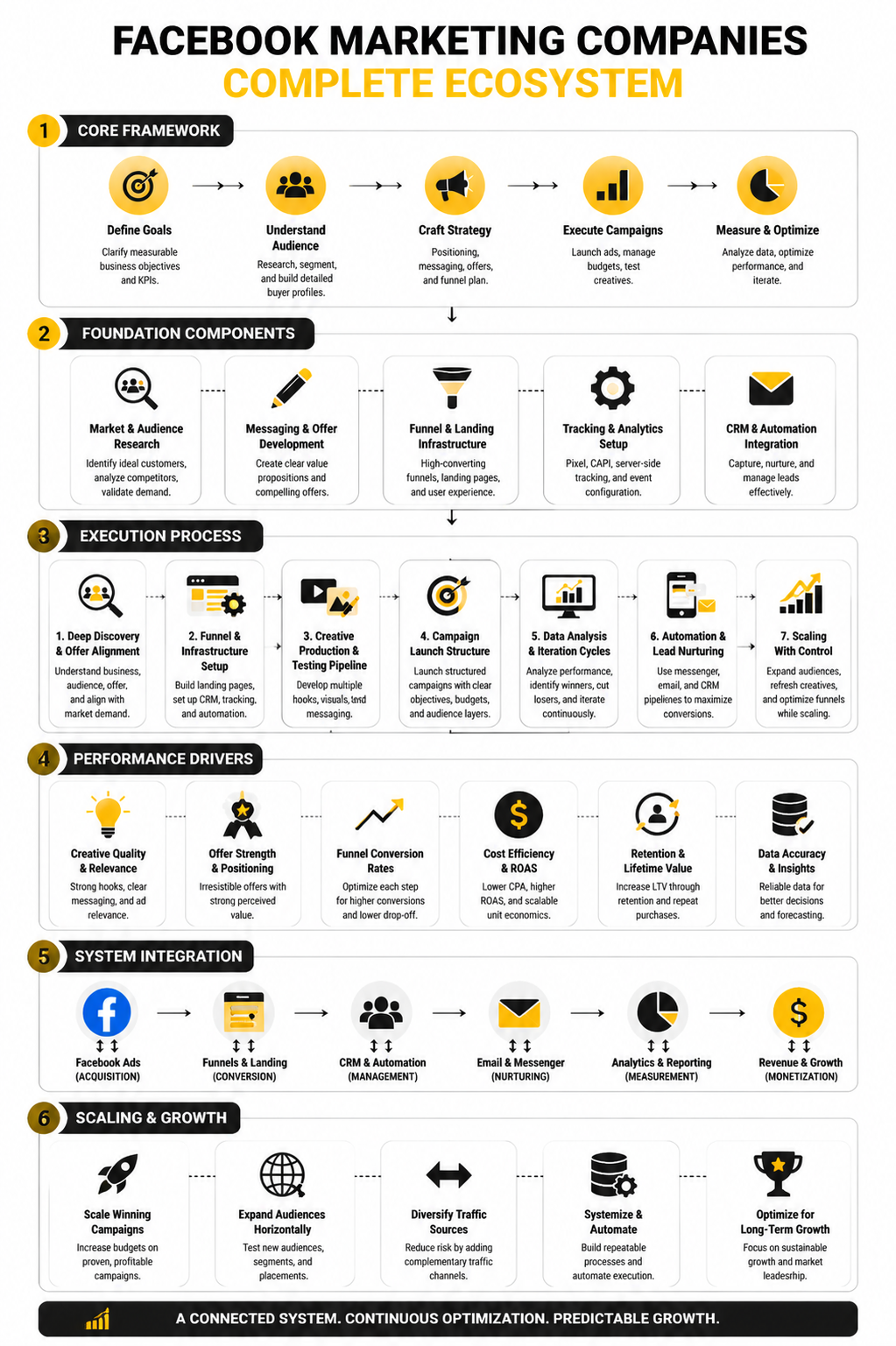
The moment this ecosystem is in place, Facebook stops being a gamble. It becomes a controllable growth engine.
FAQ - Built for Complete Guide
What do Facebook marketing companies actually charge?
Pricing varies widely depending on experience and scope. Most agencies charge either a flat monthly fee, a percentage of ad spend, or a hybrid model. Entry-level services might start around a few hundred dollars monthly, while high-performance agencies can charge thousands plus performance-based incentives.
How long does it take to see results?
Initial data often comes within days, but meaningful optimization typically takes 4–8 weeks. Facebook marketing companies need time to test creatives, refine audiences, and stabilize performance before scaling confidently.
Is Facebook advertising still effective in 2026?
Yes, but it’s more complex. The platform still commands massive reach, and businesses continue investing heavily in it because it works when executed properly. The difference is that success now depends more on creative, data, and systems than simple targeting.
Should I hire an agency or build an in-house team?
It depends on your stage. Early-stage businesses often benefit from experienced Facebook marketing companies because they bring speed and proven systems. Larger companies may combine agencies with internal teams to maintain control and scale faster.
What’s the biggest mistake businesses make with Facebook ads?
Most businesses focus on ads instead of the entire funnel. Weak offers, poor landing pages, and lack of follow-up systems kill performance even when ads are good. The problem is rarely just “the ads.”
How do I know if my campaigns are working?
Look beyond surface metrics. Focus on cost per acquisition, return on ad spend, and total revenue impact. If your campaigns generate customers profitably and consistently, they’re working—even if some metrics fluctuate.
Can Facebook marketing companies guarantee results?
No legitimate agency can guarantee results. What they can guarantee is a structured process, consistent testing, and data-driven decisions. Performance always depends on market conditions, offer strength, and execution quality.
How important is creative compared to targeting?
Creative is now the dominant factor. Strong messaging and engaging formats often outperform even perfectly targeted campaigns. This is why top Facebook marketing companies invest heavily in creative testing pipelines.
What tools do agencies typically use?
Most agencies combine multiple tools, including:
- Funnel builders like ClickFunnels
- CRM and automation platforms like GoHighLevel
- Email systems like Brevo
- Funnel alternatives like Systeme.io
These tools create the infrastructure needed for scaling.
How do I avoid hiring the wrong agency?
Focus on process, not promises. Ask how they test creatives, how they handle tracking, and how they respond when campaigns underperform. Transparency and clarity matter more than bold claims.
Can small businesses compete with larger advertisers?
Yes, but differently. Smaller businesses often win by being more agile, testing faster, and using more authentic creatives. Facebook marketing companies that understand this can help smaller brands outperform bigger competitors in specific niches.
What happens if performance drops suddenly?
Performance fluctuations are normal. Strong agencies respond by analyzing data, refreshing creatives, adjusting audiences, and improving funnel conversion rates. The key is having a system that reacts quickly instead of guessing.
Work With Professionals
Explore 10K+ Remote Marketing Contracts on MarkeWork.com
Most marketers spend too much time chasing clients, competing on crowded platforms, and losing a percentage of every project to middlemen.
MarkeWork gives you a better way. Browse thousands of remote marketing contracts and connect directly with companies desperate to hire skilled marketers like you, without platform commissions and without unnecessary gatekeepers.
If you're serious about finding better opportunities and keeping 100% of what you earn, explore available contracts and create a profile for free at MarkeWork.com.