

A facebook marketing expert is no longer someone who only knows how to boost posts or pick interests inside Ads Manager. The role now sits between strategy, creative testing, data quality, offer positioning, automation, and revenue accountability.
That matters because Meta is still one of the largest advertising ecosystems on the internet. Meta reported 3.58 billion daily active people across its family of apps in December 2025, while ad impressions rose 12% for the full year 2025 and average price per ad rose 9% in the same period, which tells you two things at once: the opportunity is huge, and competition is not getting cheaper (Meta Q4 and Full Year 2025 Results).
This guide breaks down what a real Facebook marketing expert does, how the work should be structured, and what separates professional execution from random campaign tweaking. We will cover the strategic layer first, then move into campaign architecture, creative, tracking, funnels, automation, and measurement.
Article Outline
- Why A Facebook Marketing Expert Still Matters
- The Facebook Marketing Expert Framework
- Core Components Of Facebook Marketing
- Professional Implementation And Campaign Setup
- Creative Strategy, Testing, And Optimization
- Measurement, Automation, Tools, And FAQs
Why A Facebook Marketing Expert Still Matters
Facebook marketing is harder than it looks because the visible work is only a small part of the job. Anyone can launch a campaign, but not everyone can connect the offer, audience, creative, landing page, follow-up system, and measurement plan into one working growth machine. That is where expertise shows up.
The platform has shifted heavily toward automation, but automation does not remove the need for strategy. Meta’s own Performance 5 training focuses on simplified account structure, automation, creative diversity, high-quality data, and result validation, which means the expert’s job is less about micromanaging every lever and more about feeding the system better inputs (Meta Blueprint Performance 5).
This is also why a facebook marketing expert needs to understand the business model behind the ad account. A local service business, ecommerce brand, course seller, SaaS company, and agency lead-generation funnel all need different conversion paths. The platform may be the same, but the strategy is not.
The Facebook Marketing Expert Framework
A strong Facebook marketing system has four layers: strategy, traffic, conversion, and retention. Strategy defines the offer and economics, traffic brings the right people into the system, conversion turns attention into leads or sales, and retention increases the value of every customer after the first click. Miss one layer and the account usually becomes fragile.
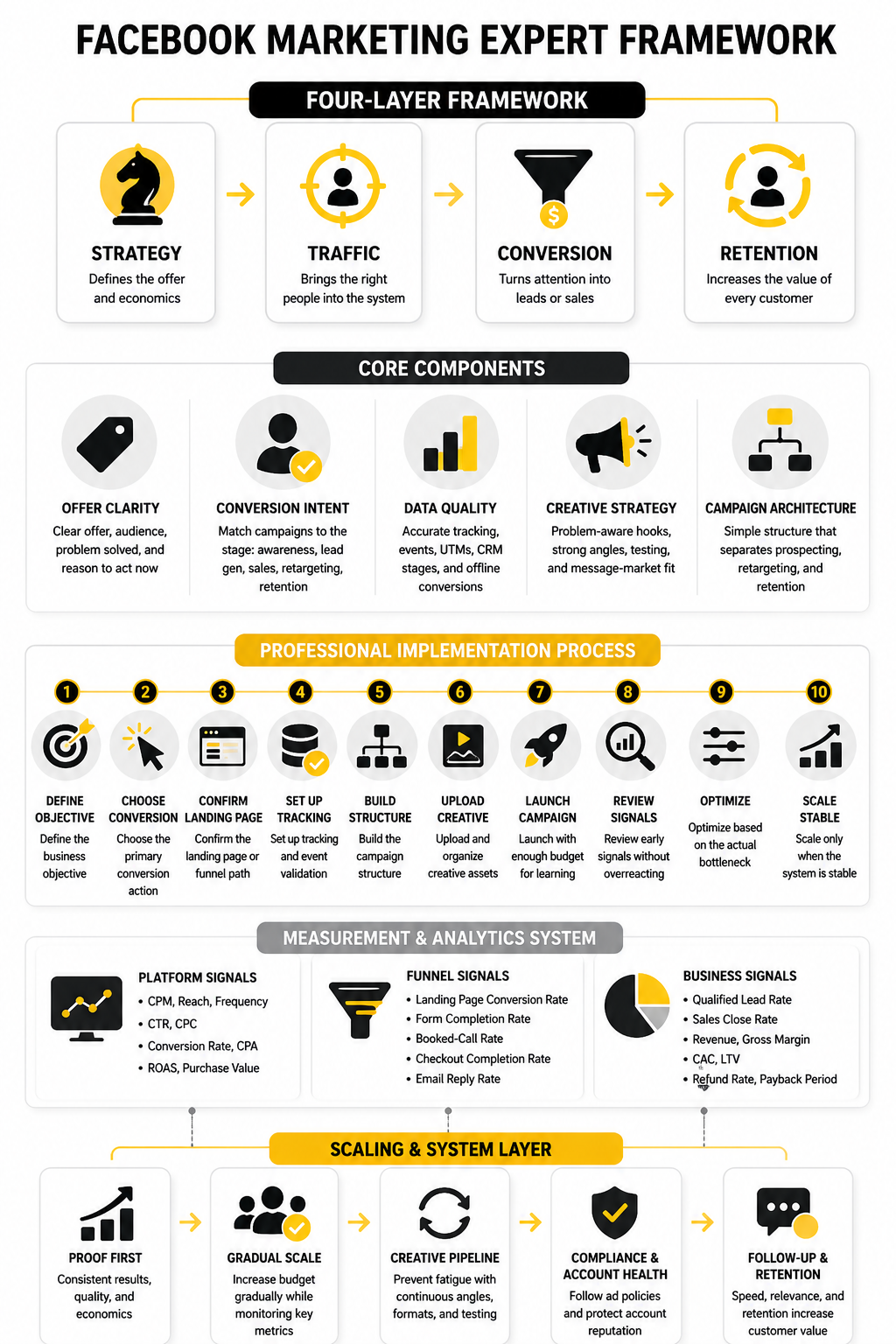
The framework also needs a clear operating rhythm. A professional does not randomly change budgets, pause ads emotionally, or rebuild campaigns every few days because one metric moved. They review the account through a repeatable process: diagnose the bottleneck, make one controlled improvement, give the system enough data, then decide what to scale or cut.
Tools can support this system when they fit the workflow. For example, ManyChat can be useful when Facebook campaigns rely on Messenger or Instagram DM follow-up, while GoHighLevel can make sense for agencies and local businesses that need landing pages, CRM, pipeline tracking, and automated follow-up in one place. The tool is not the strategy, but the right tool can make the strategy much easier to execute.
Core Components Of Facebook Marketing
A facebook marketing expert does not start with campaign settings. They start with the market, the offer, and the reason someone should care now. If that part is weak, even a technically perfect campaign will struggle because the ad is pushing something people do not clearly want.
The first core component is offer clarity. The audience needs to understand what is being sold, who it is for, what problem it solves, and why taking action today is worth their attention. This matters even more now because Meta’s ad system can find people, but it cannot fix a confusing promise.
The second component is conversion intent. A campaign built for cold leads should not be judged the same way as a campaign built for direct purchases. A facebook marketing expert separates awareness, lead generation, sales, retargeting, and retention because each stage has a different job.
The third component is data quality. Meta’s Performance 5 guidance puts high-quality data and result validation beside creative diversity and automation, which is a clear signal that tracking is not optional anymore (Meta Performance 5). If the pixel, Conversions API, events, UTMs, CRM stages, or offline conversions are messy, the account will make worse decisions.
Audience And Positioning
Audience targeting used to be the part everyone obsessed over. Interests, lookalikes, exclusions, stacks, and tiny audience segments felt like the magic. Today, the better question is not “which hidden targeting trick should we use?” but “what message will make the right person recognize themselves?”
That shift is important because Meta’s automation works better when the campaign has enough room to learn. Over-segmenting audiences can limit delivery, split data, and make results harder to interpret. A good facebook marketing expert still understands targeting, but they do not treat it as the whole strategy.
Positioning carries more weight than most people think. The same product can be framed as a time-saver, revenue driver, risk reducer, status upgrade, or simpler alternative. The expert’s job is to choose the angle that matches the buyer’s current motivation, not just the brand’s preferred talking points.
Campaign Architecture
Campaign architecture is where strategy becomes structure. The goal is to make the account simple enough for Meta to optimize, but organized enough for the marketer to understand what is happening. That balance matters because messy accounts create messy decisions.
A practical setup usually separates prospecting, retargeting, and retention when the budget and funnel justify it. Smaller accounts may need fewer campaigns so each campaign gets enough conversion volume. Larger accounts can afford more separation, but only when the structure makes reporting and optimization clearer.
The biggest mistake is building an account around personal preference instead of decision-making. If a campaign structure does not help you answer what to scale, what to fix, and what to stop, it is probably too complicated. Clean structure beats clever structure almost every time.
Creative Strategy
Creative is now one of the strongest levers in Facebook marketing. Meta can automate bidding, placements, and delivery, but the system still needs ads that earn attention and create intent. This is why a facebook marketing expert should think like a strategist, copywriter, editor, and analyst at the same time.
Strong creative usually starts with the buyer’s problem, not the product’s feature list. The ad needs to make someone feel understood before it asks them to click. That can happen through direct-response copy, short-form video, founder-led content, customer proof, product demonstrations, comparison angles, or problem-aware hooks.
Creative testing should be structured, not chaotic. Testing ten random ads tells you less than testing three clear angles with a defined hypothesis. The point is not to make more ads for the sake of it; the point is to discover which message actually moves the market.
Professional Implementation And Campaign Setup
Professional implementation is where the strategy either becomes a working system or falls apart. This is the point where a facebook marketing expert has to turn positioning, creative ideas, funnel logic, and tracking requirements into an account structure that can actually produce reliable data. The work is not glamorous, but it is where a lot of performance is won.
The process should start before Ads Manager opens. You need to know the offer, conversion goal, customer journey, required assets, landing page path, follow-up process, and measurement plan. If those pieces are not clear, campaign setup becomes guesswork dressed up as execution.
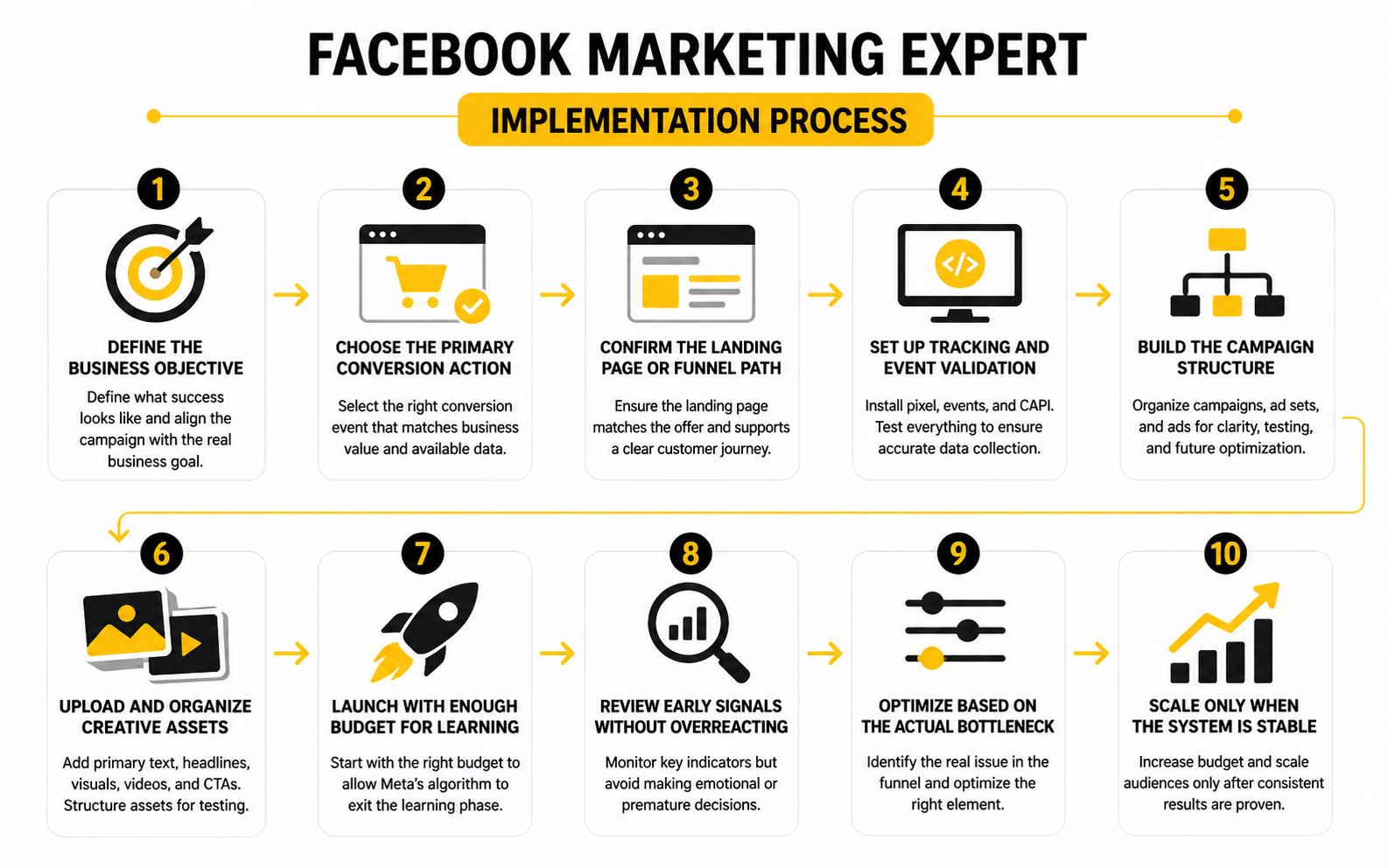
A clean implementation process usually looks like this:
- Define the business objective.
- Choose the primary conversion action.
- Confirm the landing page or funnel path.
- Set up tracking and event validation.
- Build the campaign structure.
- Upload and organize creative assets.
- Launch with enough budget for meaningful learning.
- Review early signals without overreacting.
- Optimize based on the actual bottleneck.
- Scale only when the system is stable.
Step 1: Define The Business Objective
The campaign objective should come from the business goal, not from habit. If the business needs booked calls, the campaign should be built around qualified lead flow and appointment quality. If the business needs ecommerce sales, the campaign should optimize toward purchase behavior and revenue efficiency.
A facebook marketing expert should ask what success looks like after the ad click. A low-cost lead is not useful if the sales team cannot close it, and a high click-through rate means very little if the landing page does not convert. The real goal is not activity; it is profitable movement through the customer journey.
This is where many accounts go wrong. They optimize for the easiest metric instead of the most meaningful one. The expert’s job is to keep the campaign tied to business outcomes, even when vanity metrics look tempting.
Step 2: Choose The Right Conversion Event
The conversion event tells Meta what kind of result to look for. That makes it one of the most important setup decisions in the entire account. Choose an event that is too shallow and you may get volume without quality; choose one that is too deep without enough data and the campaign may struggle to learn.
For lead generation, the event might be a completed form, booked appointment, qualified lead, or CRM-stage movement. For ecommerce, it might be add to cart, initiate checkout, or purchase depending on account maturity and conversion volume. For a service business, the best event may be connected to booked calls or pipeline stages if the tracking setup supports it.
The key is to match the event to both business value and available data. A facebook marketing expert does not blindly choose the deepest event every time. They choose the event that gives the algorithm a useful signal while still keeping the campaign close to revenue.
Step 3: Set Up Tracking Before Launch
Tracking should never be treated as a cleanup task after launch. Meta’s own guidance around the Conversions API focuses on connecting server-side marketing data so campaigns can measure results and optimize more effectively (Meta Conversions API documentation). If the tracking foundation is weak, every optimization decision becomes less reliable.
At minimum, the implementation should confirm the pixel, domain verification, standard events, custom conversions, UTM structure, and CRM or checkout attribution path. For businesses with longer sales cycles, the setup should also consider offline conversions or CRM-stage feedback. That is how the campaign learns from better signals than just clicks and form fills.
This part is not optional anymore. Privacy changes, browser restrictions, and multi-device journeys all make clean data harder to capture. A facebook marketing expert has to protect decision quality by making tracking part of the launch process, not an afterthought.
Step 4: Build Campaigns Around Decisions
The campaign structure should make future decisions easier. If everything is mixed together, you cannot tell which audience, offer, creative angle, or funnel path is responsible for the result. If everything is split too aggressively, the budget gets fragmented and the account may not collect enough data.
A practical structure starts with the main business goal and then separates only what needs to be measured separately. Prospecting and retargeting often deserve different treatment because they speak to people at different levels of awareness. Different offers may also need separate campaigns if their economics, funnel paths, or success metrics are meaningfully different.
This is where discipline matters. A facebook marketing expert builds for clarity, not complexity. The best structure is the one that helps you know what to scale, what to fix, and what to stop.
Statistics And Data
Numbers only help when they change what you do next. A facebook marketing expert does not stare at dashboards to feel productive; they use data to diagnose where the system is leaking. The goal is to understand whether the problem is attention, traffic quality, conversion, follow-up, economics, or scale.
This matters because the platform itself is still expanding while becoming more competitive. Meta reported 3.58 billion daily active people across its family of apps in December 2025, with full-year ad impressions up 12% and average price per ad up 9% year over year (Meta 2025 results). That combination means there is still massive reach available, but weak campaigns can get expensive fast.
Benchmarks can be useful, but they are not the scoreboard. WordStream’s 2025 Facebook ads benchmark report covers CTR, CPC, conversion rate, and cost per lead across more than 1,000 campaigns, which makes it helpful for directional context rather than a universal target (WordStream Facebook ads benchmarks). Your own offer economics, lead quality, close rate, average order value, repeat purchase rate, and payback window matter more than an industry average.
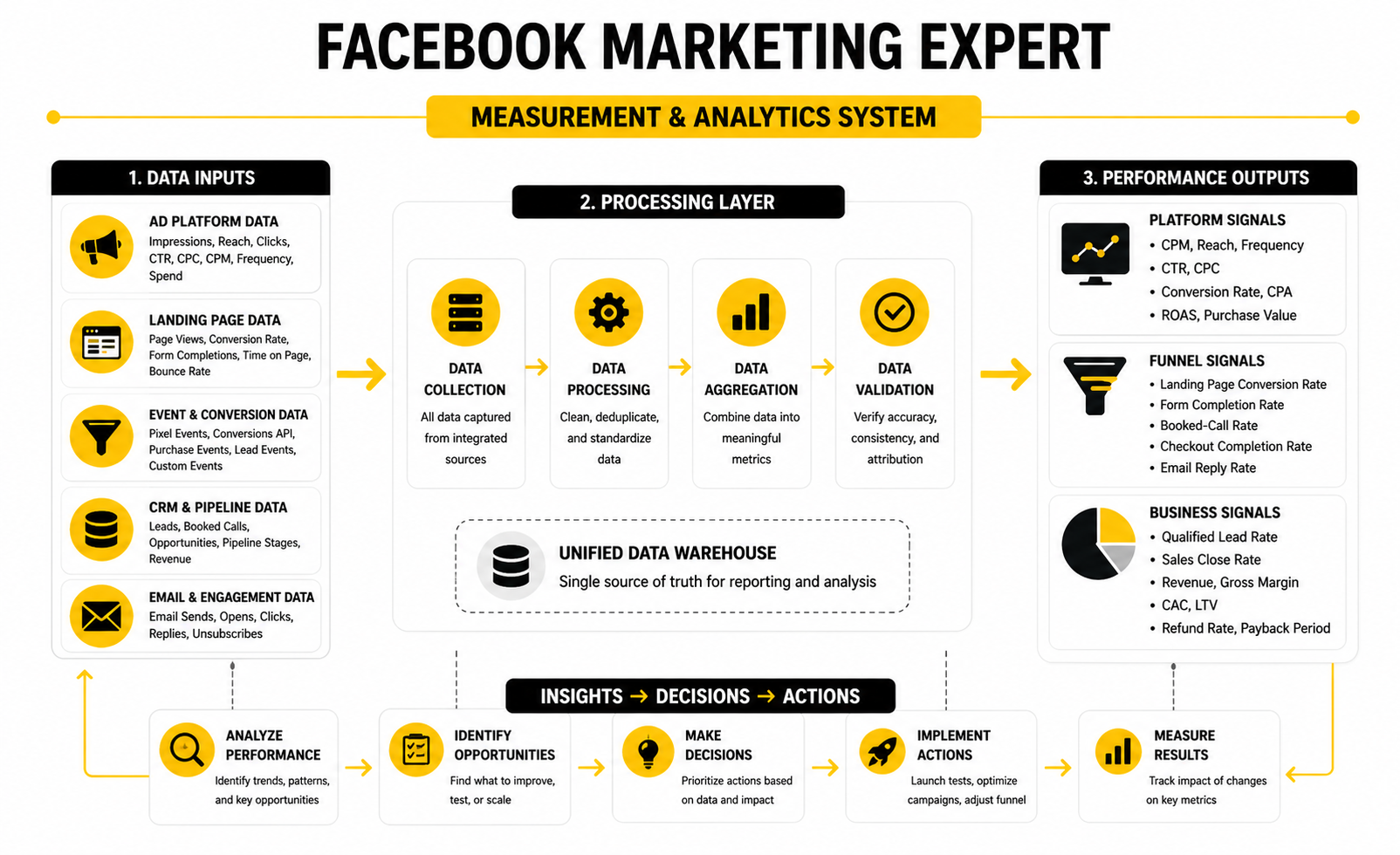
A practical measurement system should separate metrics into three layers:
- Platform signals: CPM, reach, frequency, CTR, CPC, landing page views, conversion rate, CPA, ROAS, and purchase value.
- Funnel signals: landing page conversion rate, form completion rate, booked-call rate, checkout completion rate, email reply rate, and abandoned-cart recovery.
- Business signals: qualified lead rate, sales close rate, revenue, gross margin, customer acquisition cost, lifetime value, refund rate, and payback period.
What The Metrics Actually Mean
CTR tells you whether the ad is earning enough attention from the audience seeing it. A low CTR can mean the hook is weak, the creative is stale, the offer is unclear, or the audience is not responding to the angle. It does not automatically mean the campaign is bad, but it does mean the first moment of persuasion needs attention.
CPC shows how expensive each click is, but cheaper is not always better. A cheap click from the wrong person can waste more money than an expensive click from a buyer with strong intent. A facebook marketing expert looks at CPC together with conversion rate, lead quality, and revenue, not in isolation.
CPA is closer to the truth, but even CPA can mislead you. A low cost per lead is useless if the leads do not answer calls, cannot afford the offer, or never become customers. A higher CPA can be acceptable when the lead is qualified, the close rate is strong, and the customer value supports the acquisition cost.
Benchmarks Should Guide Questions, Not Decisions
Benchmarks are best used to spot where to investigate. If your CTR is far below the range you normally see in the account, creative and positioning should be reviewed first. If CTR is healthy but conversion rate is weak, the landing page, offer, form, checkout, or message match probably needs work.
This is the difference between reading data and reacting to data. Reacting sounds like “CPC is too high, pause the ad.” Reading the data sounds like “CPC is high, but conversion rate and order value are also high, so this may still be profitable.”
A facebook marketing expert uses benchmarks as a map, not a verdict. The action should come from the full pattern. One metric rarely tells the whole story.
The Metrics That Matter Most By Campaign Type
Lead-generation campaigns should be judged beyond form submissions. The important questions are whether leads are qualified, whether they book, whether they show up, and whether sales conversations turn into revenue. For this type of funnel, a CRM like GoHighLevel can help connect ad leads to pipeline stages, follow-up, and booked appointments.
Ecommerce campaigns need a tighter connection between ad spend and purchase economics. ROAS matters, but so do gross margin, contribution margin, average order value, refund rate, repeat purchase rate, and payback period. A campaign that looks average on day one can be excellent if customers buy again quickly.
Messenger, Instagram DM, and comment-to-message campaigns need a different lens. The first conversion might be a conversation, not a purchase. In that case, ManyChat can help manage automated replies, qualification flows, and handoff points so the campaign does not lose people after the first interaction.
How To Turn Data Into Action
The simplest way to act on data is to identify the bottleneck before changing anything. If people do not stop and click, improve the creative angle. If they click but do not convert, improve the landing page or offer presentation. If they convert but do not buy, improve qualification, nurture, sales process, or pricing.
Do not change five things at once unless the campaign is clearly broken. When you change the audience, budget, creative, landing page, and offer in the same week, you lose the ability to learn what actually worked. Controlled changes are slower emotionally, but they are faster strategically.
This is where expertise becomes obvious. A facebook marketing expert does not optimize for prettier dashboards. They use data to make sharper decisions, protect budget, and build a system that can scale without guessing.
Advanced Tradeoffs A Facebook Marketing Expert Has To Manage
At a certain point, Facebook marketing stops being about finding one good campaign and starts being about managing tradeoffs. More automation can improve delivery, but it can also reduce visibility into why something is working. More creative testing can reveal better angles, but it can also create noise if the testing plan is not disciplined.
This is where a facebook marketing expert earns trust. They do not chase every new feature, panic every time performance dips, or treat Meta’s recommendations as automatic truth. They weigh the upside, the risk, and the business context before changing the system.
Meta’s Advantage+ automation is clearly where the platform is moving, with automated audience creation, budget allocation, placements, and creative generation becoming a larger part of campaign delivery (Meta Advantage+ automation). That does not mean strategy disappears. It means the inputs matter more: offer, creative, tracking, landing page, and conversion quality.
Scaling Without Breaking The Account
Scaling is not just increasing the budget. Real scaling means increasing spend while keeping the economics stable enough for the business to handle. That requires patience, because aggressive budget jumps can disturb learning, distort reporting, and expose weaknesses in the funnel.
A practical scaling process starts with proof. The campaign should show consistent conversion quality, stable cost ranges, and a clear relationship between spend and revenue. Once that is true, budget can be increased gradually while the expert watches for changes in CPA, ROAS, frequency, conversion rate, and lead quality.
The biggest mistake is scaling before the backend is ready. If the sales team cannot respond quickly, the CRM is messy, the email follow-up is weak, or the landing page struggles under higher traffic, more ad spend simply makes the leaks bigger. Scale amplifies the system you already have.
Creative Fatigue And Message Decay
Creative fatigue is not always obvious at first. Performance can fade slowly while the account still looks “fine” on the surface. Frequency rises, CTR softens, CPM increases, conversion rate drops, and suddenly the campaign that used to work feels expensive.
A facebook marketing expert should watch for message decay, not just ad fatigue. Sometimes the exact creative is tired. Other times the market has already heard the same promise too many times, and the angle needs to evolve.
The fix is not always a full rebrand or a dramatic new funnel. Often, the better move is to refresh the hook, change the proof, test a new objection, show the product in a different context, or build ads for a different awareness stage. The creative system needs a pipeline, not last-minute panic.
Compliance, Risk, And Account Health
Facebook marketing has real platform risk. Ads can be rejected, accounts can be restricted, pages can lose trust, and certain categories have stricter requirements. A serious facebook marketing expert treats compliance as part of performance, not as boring admin work.
This matters even more in sensitive areas like finance, health, employment, housing, politics, social issues, and personal attributes. Meta’s advertising standards restrict misleading claims, discriminatory targeting, prohibited products, and ads that imply sensitive personal characteristics (Meta Advertising Standards). Ignoring those rules can create short-term clicks and long-term damage.
Good compliance is practical. Avoid exaggerated claims, before-and-after promises that cannot be supported, manipulative urgency, personal-attribute callouts, and landing pages that say something different from the ad. Strong marketing does not need to trick people.
Funnel Depth And Follow-Up
Most businesses do not lose money only because the ad is weak. They lose money because the follow-up is slow, generic, or disconnected from the reason the person clicked. That is especially painful for lead-generation campaigns, where speed and relevance can make a huge difference.
A stronger funnel gives the prospect a clear next step. That might be a booked call, a checkout page, a quiz, a lead magnet, a product demo, a consultation form, or a Messenger conversation. The best path depends on the offer, price point, urgency, and buyer awareness.
For service businesses and agencies, GoHighLevel can help connect landing pages, pipelines, reminders, and follow-up automations in one place. For conversation-led campaigns, ManyChat can support Messenger and Instagram DM flows that qualify people before a human takes over. The point is simple: the click is not the finish line.
Expert-Level Decision Making
The difference between an operator and an expert is judgment. An operator can launch campaigns, read reports, and follow best practices. A facebook marketing expert can decide what matters when the numbers conflict.
For example, a campaign with a higher CPA might still be better if the leads close at a higher rate. A lower ROAS campaign might be worth keeping if it brings in new customers with strong repeat purchase behavior. A creative with lower CTR might still win because it attracts fewer curiosity clicks and more serious buyers.
That level of judgment comes from connecting platform data to business reality. The expert is not trying to “beat the algorithm” with tricks. They are building a system where the algorithm, the offer, the creative, the funnel, and the business model all point in the same direction.
Measurement, Automation, Tools, And FAQs
The strongest Facebook marketing systems are not built around one campaign. They are built around an ecosystem where ads, creative, landing pages, tracking, CRM, follow-up, sales, and retention all support each other. That is the final layer a facebook marketing expert has to think through.
This is also where the work becomes more operational. The expert needs a repeatable cadence for reviewing results, refreshing creative, checking tracking, improving the funnel, and reporting outcomes in plain business language. No drama, no dashboard theater, just a clear system that tells the team what to do next.
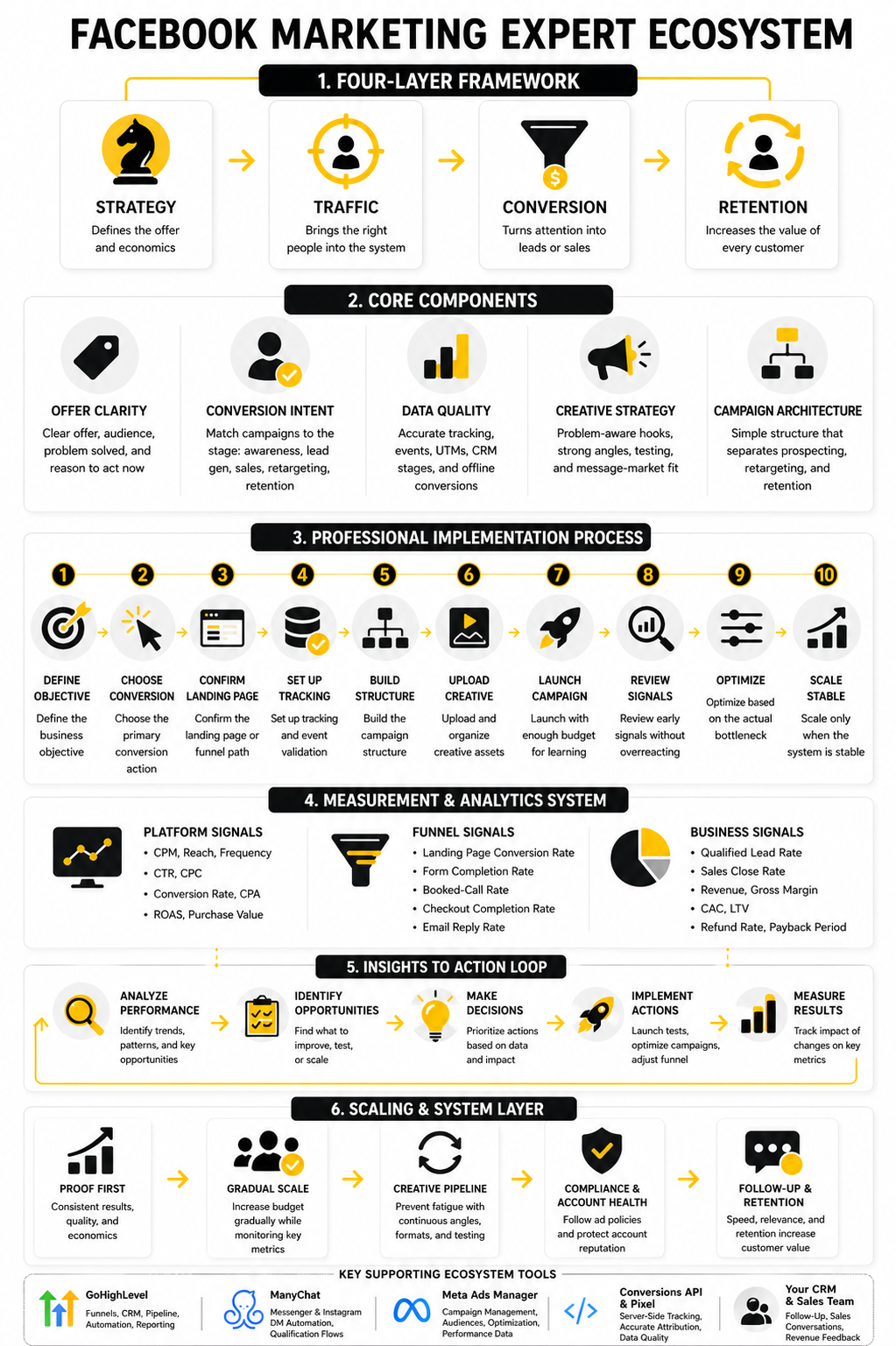
The best setup is usually simple enough to manage every week and strong enough to scale over time. Ads create demand, the funnel captures intent, automation handles the first response, and analytics show where money is being made or lost. When those pieces work together, Facebook stops being a random traffic source and becomes a controlled acquisition channel.
FAQ - Built for Complete Guide
What does a facebook marketing expert actually do?
A facebook marketing expert plans, launches, manages, and improves Facebook and Instagram campaigns with a focus on business outcomes. The role includes offer strategy, campaign setup, creative testing, tracking, analytics, funnel improvement, and reporting. The best experts do not just lower ad costs; they help turn paid attention into qualified leads, sales, and long-term growth.
Is Facebook marketing still worth it?
Yes, but only when the strategy is strong. Meta still has massive reach across Facebook, Instagram, Messenger, and WhatsApp, and its ad business continues to grow through more impressions, higher ad pricing, and stronger AI-driven delivery. The opportunity is real, but weak offers, poor tracking, and lazy creative get punished faster than they used to.
How is a facebook marketing expert different from a media buyer?
A media buyer usually focuses on campaign setup, budget management, and optimization inside the ad platform. A facebook marketing expert should think more broadly across positioning, funnel performance, creative direction, data quality, sales handoff, and customer economics. In smaller businesses, one person may do both, but the expert mindset is more strategic.
What skills should a Facebook marketing expert have?
They should understand paid social strategy, copywriting, creative testing, Meta Ads Manager, tracking, Conversions API, landing pages, CRM workflows, attribution, and reporting. They also need judgment, because not every metric deserves the same level of attention. The technical skills matter, but the ability to connect marketing activity to revenue matters more.
How much should I spend on Facebook ads?
There is no universal number because the right budget depends on your offer, conversion goal, sales cycle, margins, and data volume. A small local business may start with a controlled testing budget, while an ecommerce brand with proven economics may spend much more aggressively. The key is to spend enough to learn, but not so much that bad assumptions become expensive.
What is the biggest mistake beginners make with Facebook ads?
The biggest mistake is launching ads before the offer, funnel, and tracking are ready. Many beginners blame the algorithm when the real problem is a weak landing page, unclear message, poor follow-up, or bad conversion event. A facebook marketing expert fixes the system before trying to scale the spend.
Should I use broad targeting or detailed targeting?
Broad targeting often works well when the campaign has strong creative, clear conversion signals, and enough budget for Meta to learn. Detailed targeting can still help in specific situations, especially when the audience is niche or the account lacks reliable conversion data. The decision should come from testing and business context, not from ideology.
How often should Facebook ad creative be refreshed?
Creative should be refreshed when performance signals show fatigue or when the testing pipeline needs new angles. Rising frequency, falling CTR, higher CPA, and weaker conversion quality can all suggest that the message is losing power. A smart expert does not wait until everything breaks; they keep new hooks, formats, and proof points moving into the account.
What tools are useful for Facebook marketing?
The most useful tools depend on the funnel. GoHighLevel can help agencies and service businesses manage landing pages, pipelines, appointments, and automated follow-up. ManyChat can help with Messenger and Instagram DM automation, especially when the campaign is built around conversations.
Do I need a landing page for Facebook ads?
Not always, but many campaigns perform better with a focused landing page because it keeps the message tight. Sending paid traffic to a generic homepage can work for established brands, but it often creates too many distractions for direct-response campaigns. A strong landing page should match the ad promise, answer objections, and make the next step obvious.
How do I know if my Facebook ads are profitable?
You need to connect ad spend to revenue, margin, and customer value. ROAS can help for ecommerce, but it does not tell the full story if refunds, repeat purchases, or profit margins are ignored. For lead generation, you need to track lead quality, booked calls, show rates, close rates, and revenue from the pipeline.
When should I hire a facebook marketing expert?
Hire an expert when the opportunity cost of guessing becomes too high. That might be when you have a proven offer but cannot scale, when your campaigns are inconsistent, when tracking is unreliable, or when your team needs a clearer acquisition system. Good help should make your decisions sharper, not just add more reports.
Work With Professionals
Explore 10K+ Remote Marketing Contracts on MarkeWork.com
Most marketers spend too much time chasing clients, competing on crowded platforms, and losing a percentage of every project to middlemen.
MarkeWork gives you a better way. Browse thousands of remote marketing contracts and connect directly with companies desperate to hire skilled marketers like you, without platform commissions and without unnecessary gatekeepers.
If you're serious about finding better opportunities and keeping 100% of what you earn, explore available contracts and create a profile for free at MarkeWork.com.