

Facebook marketing keeps getting written off, and then it keeps doing something inconvenient for the critics: it keeps driving reach, demand, and sales for businesses that actually know how to use it. Meta’s own latest results show its family of apps reached 3.58 billion daily active people in December 2025, while Facebook’s ad tools still pointed to more than 2.2 billion adults reachable through ads in early 2025. That is not a dead platform. That is a giant distribution system with a lot of noise and a lot of opportunity.
The real problem is not whether Facebook still works. The problem is that most businesses approach Facebook marketing with a messy mix of random posting, weak creative, outdated audience targeting, and no serious conversion path. At the same time, the platform has become more automated, more video-driven, and more dependent on strong inputs than on manual hacks, which is exactly why old tactics are underperforming while disciplined operators keep winning.
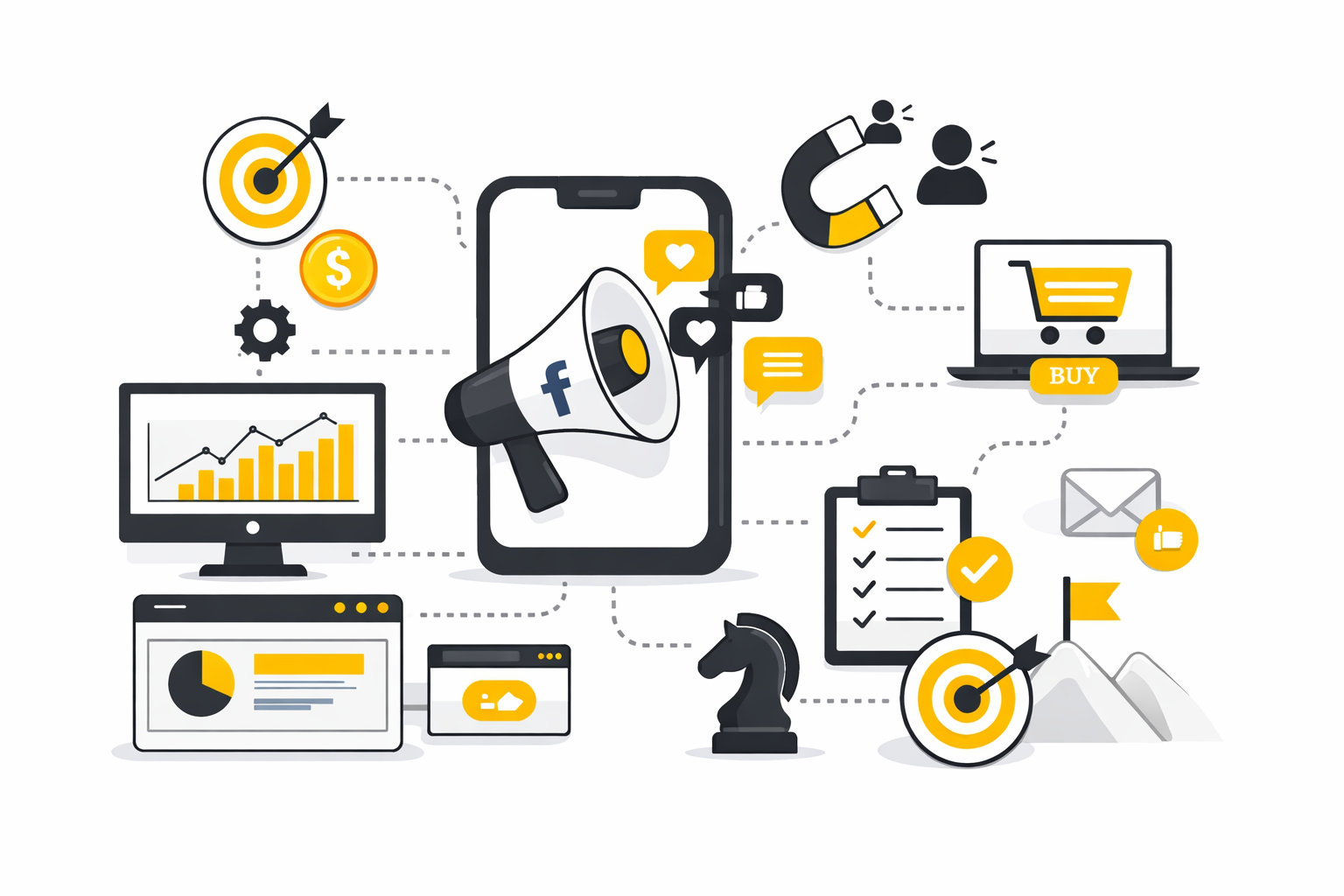
Article Outline
- Why Facebook Marketing Still Matters
- The Facebook Marketing Framework
- Core Components of a High-Performing Facebook Presence
- Paid Facebook Marketing That Converts
- Professional Implementation and Optimization
- Measuring Results and Scaling What Works
Why Facebook Marketing Still Matters
Facebook still matters because scale, attention, and buying intent have not disappeared at the same time. In the United States alone, 71% of adults reported using Facebook in Pew’s 2025 survey, which helps explain why it remains one of the few platforms that can support both broad awareness and practical retargeting. For a lot of companies, especially local businesses, service brands, ecommerce stores, education offers, and community-led brands, Facebook is still where demand gets captured after interest starts elsewhere.
It also matters because Facebook marketing is no longer just about posting on a Page. It now sits inside a broader Meta environment that includes Facebook feeds, Reels, Marketplace surfaces, Messenger touchpoints, and cross-placement delivery powered by automation such as Advantage+ placements and broader AI-assisted targeting like Advantage+ detailed targeting. In plain English, the platform has become less about manually controlling every lever and more about feeding the system strong creative, clear offers, solid data, and enough signal to optimize.
There is also a brutal but useful reality here: organic Facebook is harder than it used to be. Large-scale benchmark studies from Rival IQ and Emplifi both show that Facebook engagement is relatively modest compared with more entertainment-heavy platforms, which means weak content gets ignored fast. That sounds like bad news, but it is actually useful, because it forces businesses to stop confusing activity with strategy.
The Facebook Marketing Framework
The simplest way to think about Facebook marketing now is this: audience, offer, creative, destination, data, and optimization all have to work together. If one of those pieces breaks, the rest of the system gets expensive very quickly. A beautiful ad cannot rescue a weak offer, and a strong offer cannot scale for long if the post-click experience is confusing or slow.
That is why this article uses a six-part structure instead of treating Facebook as a single channel trick. You need a practical framework that starts with market relevance, moves through content and paid distribution, and ends with measurement strong enough to tell you what deserves more budget. Meta’s own guidance on ad delivery best practices and Page post best practices points in the same direction: clear messaging, strong creative, audience understanding, and efficient delivery matter more than random tactical tweaks.
For businesses that need a cleaner path from click to lead or sale, the framework also has to include the destination. That can mean a lead form, a booking page, a product page, or a funnel built in tools like ClickFunnels or Systeme.io, depending on the business model. The important point is not the software. The important point is that Facebook marketing only becomes profitable when the whole path is designed, not just the ad.
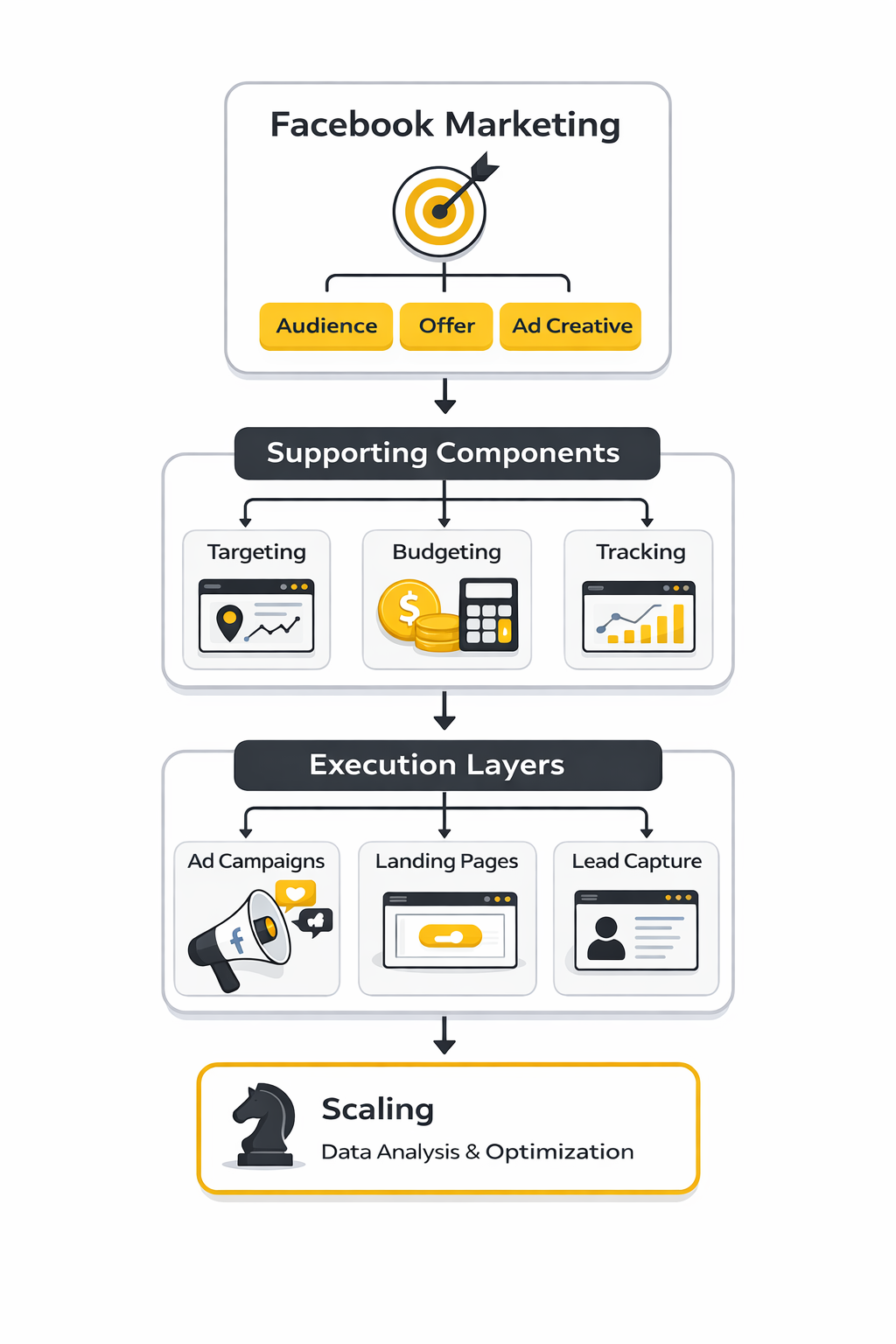
What the Rest of This Article Will Build Toward
The next parts will move from strategy into execution in a logical order. First, we will break down the core components that make a Facebook presence credible and conversion-ready, because that foundation affects both organic performance and paid efficiency. After that, we will get into ad structure, campaign design, creative testing, implementation discipline, and the measurement systems that separate real growth from vanity metrics.
This matters because Facebook marketing punishes fragmented thinking. If your content team is posting one message, your ads are pushing another, and your landing pages are promising something else entirely, the algorithm does not fix that for you. It just helps you spend money faster.
By the end of the full article, the goal is straightforward: you should be able to look at your Facebook marketing and know where the bottleneck is, what to fix first, and how to build a system that performs like a professional one rather than a collection of disconnected tactics.
Core Components of a High-Performing Facebook Presence
A high-performing Facebook marketing system starts long before you launch an ad or publish a Reel. It starts with the assets people actually see and judge in seconds: your Page, your messaging, your content style, your response speed, and the path you give them after they click. Meta’s own guidance for Pages and posts keeps coming back to the same basics: clear business information, strong creative, audience relevance, and actionable messaging are not optional details anymore because they shape both trust and performance. facebook.com+2
The mistake most brands make is treating these components as separate jobs handled by different people with no shared strategy. One person posts “engaging” content, another runs promotions, someone else answers messages late, and the landing page says something half-different from the ad. Facebook marketing gets expensive fast when the user experience feels stitched together instead of deliberate. facebook.com+2
Start With a Page That Looks Trustworthy
Your Facebook Page is still part storefront, part credibility check, and part conversion asset. When someone clicks through from a post, ad, recommendation, or search result, they are not only evaluating your offer. They are also looking for signs that the business is real, active, transparent, and worth a second click. Meta’s Page management guidance specifically emphasizes keeping business details accurate, using Page transparency features well, and maintaining a professional presence people can verify. facebook.com+1
That means your Page basics need to be clean. Your category should make sense, your profile and cover visuals should match your brand, your description should explain what you do in plain language, and your call-to-action should point somewhere useful rather than somewhere generic. In Facebook marketing, confusion is friction, and friction kills momentum long before “bad targeting” ever gets a chance to. facebook.com+2
It also means your recent content matters more than many businesses think. A dormant Page full of outdated promos, thin graphics, and random reposts signals neglect. A Page with current posts, clear positioning, and visible interaction shows that there is an actual business on the other side of the screen, which is a huge trust advantage even before someone becomes a lead or customer. facebook.com+1
Build Message-to-Market Match Before You Chase Reach
A lot of Facebook marketing underperforms for one simple reason: the message is not tight enough for the audience seeing it. Brands often jump straight into creative production without deciding what they want to be known for, who the message is for, and what specific problem the post or ad is helping solve. That leads to generic content that sounds polished but forgettable.
The market has become less forgiving here. Research from Sprout Social’s 2025 Index and related 2025–2026 analysis from Sprout shows that consumers respond strongly to authenticity, originality, relevance, and human interaction, while trend-chasing without substance can backfire. That is a useful filter for Facebook marketing because it pushes brands away from empty visibility plays and toward clearer positioning. Sprout Social+2
Before you worry about volume, get these questions right:
- What exactly do you want this audience to associate with your brand?
- What problem are they actively trying to solve?
- What proof makes your solution credible?
- What action should they take next?
If those answers are fuzzy, more reach usually just means more wasted impressions. Facebook marketing rewards clarity far more than cleverness. facebook.com+1
Create Content for Attention, Trust, and Action
Content on Facebook now has to do more than fill a calendar. It needs to earn attention, build trust, and move people toward some kind of next step, even when that next step is just remembering your name. Meta’s post guidance stresses high-quality creative, clear messaging, and actionable content, while its Reels guidance pushes creators and brands toward native-looking, visually clear, non-recycled short-form video. facebook.com+3
That changes how good Facebook marketing content should be judged. The right question is not “Did we post today?” The right question is “Did this content make the audience feel, learn, trust, or do something useful?” If the answer is no, frequency does not save it.
In practical terms, most strong Facebook content falls into a few clear jobs:
- Credibility content that proves you know what you are doing
- Problem-aware content that names pains, mistakes, and missed opportunities
- Decision content that compares options, explains process, or handles objections
- Action content that asks for the click, booking, message, or purchase
This is where tools can help, but only if they support the strategy instead of replacing it. A scheduling platform like Buffer can make publishing and coordination easier, but it will not fix weak creative or vague positioning. Facebook marketing still wins or loses on the substance of the message first. facebook.com+1
Treat Reels and Short-Form Video as Core, Not Optional
Short-form video is no longer the side dish in Facebook marketing. It is one of the main distribution formats the platform keeps prioritizing across discovery surfaces, and Meta’s own guidance for Reels repeatedly points marketers toward experimentation, strong visual hooks, good production clarity, and content that feels native rather than repurposed from somewhere else. facebook.com+2
That does not mean every business needs polished studio production. In many cases, it means the opposite. You need subject clarity, a fast start, readable framing, useful information, and a point of view that sounds human. The brands that struggle with Facebook marketing video are often not underproducing. They are overcomplicating.
This is also where many businesses quietly sabotage themselves by reposting low-quality vertical clips with visible watermarks or weak edits. Meta explicitly warns against low-quality and visibly recycled video in Reels best-practice guidance, which tells you something important about how the platform evaluates creative fitness. If you want distribution, make content that looks like it belongs on Facebook, not like an afterthought exported from another app. facebook.com+1
Make Responsiveness Part of the Strategy
Facebook marketing is not just publishing and advertising. It is also what happens when people comment, message, ask for details, or hesitate right before taking action. That matters because social users increasingly expect fast, personal brand responses, with Sprout’s 2025 Index coverage highlighting that 73% of users expect a response within 24 hours and 70% expect personalization in customer care. Sprout Social
That expectation changes how you should think about comments and DMs. They are not administrative leftovers. They are part of the conversion environment. A slow, generic, or absent response can waste the demand your content or ads worked hard to generate.
For many businesses, the smarter move is to build a lightweight follow-up stack instead of relying on manual memory. If Facebook marketing is generating leads, you need somewhere for those contacts to go, whether that is an email system like Brevo, a nurture flow in Moosend, or a simpler CRM process that prevents warm prospects from going cold. The platform can create attention, but your systems determine whether attention becomes revenue. facebook.com+1
Use a Destination That Matches the Intent of the Click
One of the least glamorous parts of Facebook marketing is also one of the most important: where the click goes next. Too many campaigns send traffic to a homepage, a cluttered category page, or a generic contact screen and then wonder why conversion rates stay soft. That is not a Facebook problem. That is a journey design problem.
Meta’s lead generation guidance keeps pushing relevance between ad, call to action, and offer, because people convert better when the destination feels like a continuation of the promise they already clicked on. A lead magnet should go to a focused opt-in page. A consultation offer should go to a booking or qualification flow. A product ad should land on a product page that matches the message and reduces decision friction. facebook.com+1
This is where funnel tools can genuinely fit the user intent. If the business needs a structured path from Facebook click to lead capture, webinar registration, application, or checkout, platforms like ClickFunnels or Systeme.io can make the handoff cleaner. The point is not that every business needs a funnel builder. The point is that Facebook marketing works better when every click lands in the right environment.
Paid Facebook Marketing That Converts
Once the foundation is solid, paid Facebook marketing becomes much easier to scale because the ad account is no longer trying to compensate for weak positioning, messy content, and a broken destination. This is where many brands finally get leverage. Not because paid media is magic, but because it amplifies a system that already makes sense.
That amplification is more powerful than ever inside Meta’s ad ecosystem. In its latest annual results, Meta reported 18% year-over-year growth in ad impressions in Q4 2025, which is one more reminder that the platform is still moving enormous volumes of attention. The opportunity is real, but so is the competition, which is why the structure of your campaigns and the quality of your inputs matter so much. investor.atmeta.com+1
The next section will break down how to structure paid Facebook marketing for conversions without falling into the usual traps: over-segmentation, creative fatigue, weak offers, and too much obsession with tiny settings that matter less than the actual ad and landing experience.
Paid Facebook Marketing That Converts
Once the organic foundation is working, paid Facebook marketing becomes the engine that scales reach and revenue. This is where many brands either grow fast or burn budget quickly, depending on whether their campaigns are structured with discipline. Meta’s advertising platform now runs heavily on machine learning optimization, which means the inputs you give the system—creative quality, conversion data, and audience signals—matter far more than endless manual tweaking. Guidance inside Meta’s advertising resources repeatedly emphasizes strong creative, event tracking, and clear campaign objectives as the core drivers of delivery performance. (facebook.com)
That shift toward automation has also simplified some campaign mechanics while raising the bar for strategy. Over-segmentation, constant editing, and hyper-micromanaging audiences can interrupt the learning phase and make campaigns unstable. Facebook marketing today works best when you provide the algorithm with enough data and creative variation to learn what converts rather than trying to outguess it.
Structure Campaigns Around Business Goals
Before touching the Ads Manager interface, the most important step is deciding the real business outcome you want the campaign to produce. Facebook marketing gives you multiple objective categories—awareness, traffic, engagement, leads, app promotion, and sales—but the wrong objective can distort the entire campaign.
Meta’s documentation stresses that campaign objectives should align with the result you want the algorithm to optimize toward. If your goal is lead generation but you optimize for traffic, the system will find people who click easily, not necessarily people who convert. (facebook.com)
Most successful Facebook marketing campaigns fall into one of three business outcomes:
- Lead generation for services, consulting, education, and local businesses
- Direct sales for ecommerce and product-driven brands
- Demand creation where content drives awareness before retargeting converts it later
Choosing the right objective tells Meta’s system what success looks like, which is why the setup stage matters more than most marketers realize.
Set Up Conversion Tracking Before Spending Money
A surprising number of advertisers launch campaigns before their data infrastructure is ready. That mistake makes it almost impossible to understand whether Facebook marketing is actually producing revenue or just generating activity.
Meta provides multiple tracking tools, including the Meta Pixel and Conversions API, which help capture events such as purchases, leads, and page views. Proper event tracking gives the platform the feedback it needs to improve delivery over time. Without those signals, the system is effectively guessing. (facebook.com)
For businesses running lead campaigns or multi-step funnels, tracking becomes even more important. Every action—form completion, consultation booking, product purchase—should be recorded so the algorithm can optimize toward the most valuable outcomes rather than shallow engagement.
If the campaign sends users through a funnel instead of a direct purchase page, the landing experience must support tracking and conversion measurement. Platforms like ClickFunnels or Systeme.io make it easier to connect lead capture pages, email follow-ups, and sales steps into one measurable flow.
Creative Testing Is the Real Optimization Lever
A common misconception in Facebook marketing is that targeting tweaks or budget adjustments drive most performance improvements. In reality, creative variation tends to have a much larger impact on campaign results. Meta’s own advertiser guidance consistently highlights creative freshness and testing as major contributors to performance.
This happens because the algorithm distributes ads partly based on predicted engagement and conversion probability. When you test different formats, messages, and visual styles, the system can quickly identify which versions resonate with the audience.
Effective creative testing often involves experimenting with variations such as:
- Different opening hooks in video or copy
- Alternative value propositions for the same offer
- Visual formats such as static graphics, carousels, or short video
- Customer-focused messaging versus product-focused messaging
The point is not to overwhelm the system with dozens of tiny changes. The goal is to test meaningful creative differences that reveal what actually drives response.
Build a Simple Execution Workflow
At this stage, Facebook marketing moves from theory into operational routine. A clear process helps keep campaigns organized and prevents constant reactive changes that reset learning cycles.
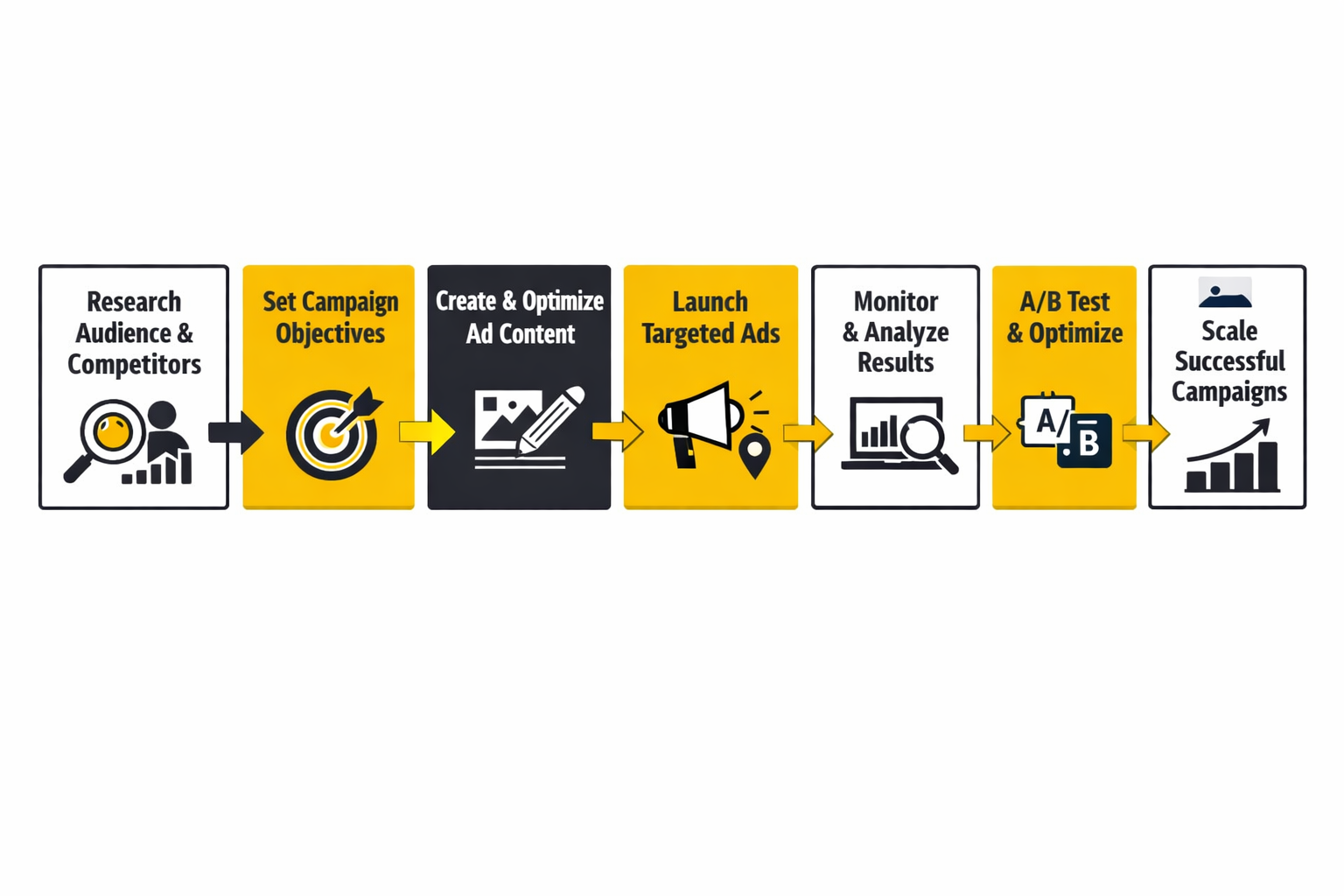
A typical execution workflow often looks like this:
- Define the campaign objective and conversion event Identify whether the campaign should optimize for leads, purchases, or another measurable outcome.
- Create two to four core ad concepts Each concept should communicate the offer in a different way rather than simply changing small details.
- Launch campaigns with stable budgets Avoid constant adjustments during the learning phase so the algorithm can gather reliable performance signals.
- Review early performance indicators Metrics like click-through rate, cost per click, and engagement often show which creative direction has potential.
- Scale the strongest creative variations Increase budget gradually on ads that produce conversions rather than simply impressions.
This process sounds simple, but it reflects how Facebook marketing actually works in practice. Systems that rely on structured experimentation usually outperform those driven by guesswork or constant edits.
Retargeting Turns Attention Into Revenue
Not every user converts during their first interaction with a brand. Retargeting exists precisely because social media behavior tends to be exploratory. People browse, evaluate options, and return later once they feel confident about a decision.
Facebook marketing allows advertisers to retarget users who interacted with their Page, watched videos, visited their website, or engaged with previous ads. These audiences often convert at significantly higher rates because they already recognize the brand and understand the offer.
The retargeting stage is also where messaging can shift. Early campaigns focus on discovery and interest, while retargeting messages address objections, reinforce credibility, or introduce limited offers. When done well, this step closes the gap between attention and action.
Avoid the Common Scaling Mistakes
Many advertisers assume scaling simply means increasing budget. In reality, scaling Facebook marketing successfully requires protecting the elements that made the campaign work in the first place.
Common mistakes during scaling include:
- Increasing budgets too quickly, which disrupts delivery stability
- Launching too many new audiences simultaneously
- Ignoring creative fatigue as performance declines
- Editing campaigns frequently during learning phases
Meta’s advertising system performs best when changes are incremental and supported by data. Gradual scaling allows the algorithm to adapt without losing the performance patterns it already identified.
The next section will move deeper into professional implementation and optimization, focusing on how experienced marketers manage campaigns long-term, maintain creative momentum, and build Facebook marketing systems that keep improving instead of plateauing.
Understanding Facebook Marketing Performance Data
A Facebook marketing strategy only becomes reliable when you can interpret its data correctly. Campaign dashboards, ad metrics, and audience reports can look overwhelming at first, but most of the important signals come from a relatively small set of indicators. When you understand what those numbers actually represent, they stop being vanity metrics and start acting as decision tools.
The scale of Meta’s advertising ecosystem explains why careful measurement matters. In the company’s most recent annual results, Meta reported more than 3.98 billion monthly active users across its family of apps, with advertising still representing the overwhelming majority of revenue. That volume of activity means even small improvements in campaign efficiency can translate into significant revenue differences for advertisers. Meta’s 2025 annual report illustrates how massive the ad marketplace has become.
But raw scale does not automatically produce results. Facebook marketing success depends on understanding which signals indicate healthy campaigns and which metrics simply create noise.
The Metrics That Actually Matter
Many advertisers track dozens of numbers but fail to interpret the ones that determine real outcomes. A practical Facebook marketing measurement system usually focuses on a few categories that reveal how audiences move from attention to action.
The first category is attention metrics, which tell you whether people are stopping to engage with the creative. Click-through rate, video watch time, and engagement provide early signals about message resonance. When these indicators are weak, the problem is usually creative relevance rather than targeting or budget.
The second category is traffic quality metrics. These show whether the people clicking actually behave like potential customers once they reach the destination. Metrics such as cost per click, landing page view rate, and time spent on page help determine whether the audience and offer are aligned.
The third category is conversion performance, which ultimately defines whether Facebook marketing is profitable. Cost per lead, cost per acquisition, and return on ad spend indicate whether the system is producing real business outcomes rather than superficial engagement.
Industry benchmark analysis from the Rival IQ Social Media Industry Benchmark Report and related research across marketing platforms shows that engagement rates on Facebook vary widely by industry, which reinforces an important lesson: numbers only make sense when interpreted within context.
Why Benchmarks Should Guide Decisions, Not Dictate Them
Benchmark reports are useful because they provide reference points, but they should not become rigid performance targets. Facebook marketing performance varies dramatically based on factors such as industry, pricing, brand reputation, and offer complexity.
For example, ecommerce campaigns with impulse products may see lower cost-per-click numbers but higher overall traffic volume. Service businesses that sell high-ticket consultations often see fewer clicks but stronger lead quality. Both scenarios can represent healthy campaigns depending on the business model.
Reports like the Hootsuite Social Media Benchmark Report consistently show that engagement and click patterns differ significantly between industries. That variability is exactly why marketers should focus on trend improvement rather than chasing universal averages.
The key question is not whether your campaign beats a global benchmark. The key question is whether the campaign improves over its own previous performance.
Building a Practical Analytics System
Professional Facebook marketing relies on a structured measurement workflow rather than occasional performance checks. When campaigns generate leads or sales consistently, it is usually because the advertiser tracks the entire customer journey rather than isolated ad metrics.
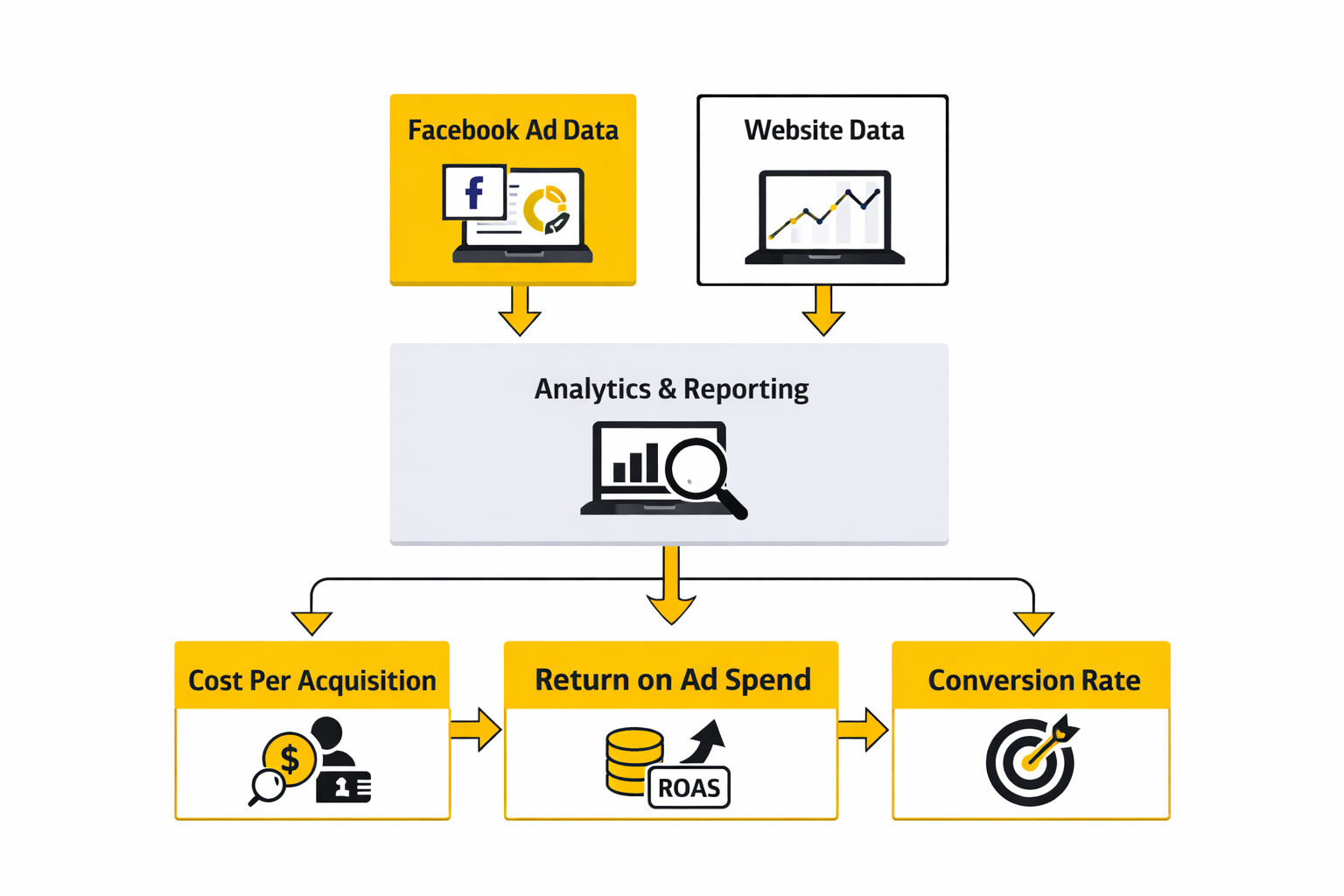
A simple but effective analytics system often includes these stages:
- Ad engagement tracking Measure whether audiences interact with the creative. Strong engagement suggests the message resonates.
- Traffic behavior monitoring Analyze how visitors behave after clicking an ad. High bounce rates usually indicate a mismatch between the ad promise and landing experience.
- Conversion tracking Identify the number of leads, purchases, or sign-ups generated from each campaign.
- Revenue attribution Connect campaign data to actual revenue rather than relying only on platform-reported metrics.
- Optimization feedback loops Use performance insights to refine creative, adjust audience segments, and improve landing experiences.
Many businesses combine Facebook’s native reporting with email and CRM analytics to track this journey. Platforms like Brevo or Moosend help capture post-click engagement and nurture leads after the initial interaction, allowing marketers to see how Facebook marketing contributes to long-term revenue rather than only immediate conversions.
Identifying Early Warning Signals
One of the most valuable skills in Facebook marketing is recognizing performance issues before they become expensive. Data rarely collapses overnight. Instead, small warning signs appear that indicate the campaign needs attention.
Common early indicators include declining click-through rates, increasing cost per result, or sudden drops in engagement. These signals usually point to creative fatigue or audience saturation rather than platform malfunction.
Research across advertising performance reports consistently shows that creative refresh cycles play a major role in maintaining campaign efficiency. When audiences repeatedly see the same ads, engagement declines and costs increase. Monitoring these patterns allows marketers to introduce new creative before performance deteriorates significantly.
Turning Data Into Actionable Strategy
Numbers alone do not improve campaigns. The value of analytics comes from the decisions they support. A disciplined Facebook marketing system treats every data point as feedback that shapes future experiments.
For example:
- If engagement is high but conversions are low, the issue likely sits on the landing page or offer.
- If clicks are low but impressions are high, creative messaging probably needs adjustment.
- If conversions exist but costs keep rising, audience expansion or creative variation may be necessary.
This approach transforms analytics from a reporting exercise into a strategic tool. Facebook marketing becomes far more predictable when performance signals are interpreted correctly and acted upon consistently.
The next section will explore professional implementation and long-term optimization, focusing on how experienced marketers maintain performance momentum, scale successful campaigns, and build Facebook marketing systems that continue improving over time.
Professional Implementation and Optimization
This is the stage where Facebook marketing stops being a campaign and starts becoming an operating system. Plenty of brands can get a few good weeks from a strong ad or a timely offer. Far fewer can keep performance stable when budgets rise, audiences saturate, creative gets tired, and attribution becomes messy.
That is the real divide between amateur execution and professional implementation. Professionals do not assume a winning campaign will keep winning on its own. They build processes for creative renewal, cleaner data, simpler account structure, and disciplined decision-making because Meta’s system now rewards signal quality and operational consistency more than manual complexity. Meta’s ad delivery guidance makes that pretty clear, including the recommendation that ad sets generally need around 50 optimized conversion events before they can exit the learning phase.
Simpler Accounts Usually Scale Better
One of the biggest mindset shifts in modern Facebook marketing is letting go of the old obsession with account complexity. Many advertisers still build sprawling structures with endless audience splits, duplicated ad sets, and tiny budget pockets because that used to feel more “advanced.” In practice, that often starves the algorithm of data and keeps campaigns unstable.
Meta has been openly pushing advertisers toward consolidation, broader inputs, and more machine-learning-friendly setups through tools like Meta Advantage+. That does not mean every account should become one campaign with zero control. It means complexity should have a reason. If a split does not serve a real business purpose, it is usually just noise.
A useful rule here is simple: only add structure when it improves either control or insight. If it does neither, it is probably making Facebook marketing harder than it needs to be.
Better Data Beats Better Guessing
A lot of advertisers try to solve performance problems with audience ideas when the real problem is poor signal quality. If Meta does not receive reliable conversion data, it has a weaker understanding of who is actually valuable to your business. That makes optimization slower, scaling riskier, and reporting less trustworthy.
This is exactly why Meta keeps emphasizing the combination of browser and server-side tracking. Its own implementation materials for the Conversions API and developer best practices focus on sending more complete event data, improving event match quality, and using deduplication correctly when Pixel and server events are both active. For serious Facebook marketing, this is not a technical side quest. It is a performance issue.
The practical takeaway is straightforward. If you are spending meaningful money, your measurement stack needs to be resilient enough to survive browser limitations, partial attribution, and messy user journeys. That is one reason more mature operators connect Facebook marketing with forms, CRM workflows, and follow-up systems instead of judging everything from Ads Manager alone. If you need cleaner handoffs after the click, tools like Fillout, Brevo, or Copper can support that system-level visibility.
Scaling Creates New Problems, Not Just Bigger Results
Scaling sounds exciting because people picture more reach, more leads, and more sales. What they often do not picture is the stress it puts on the system. Once spend rises, Facebook marketing usually exposes every weakness you managed to ignore at lower volume: thin margins, fragile creative, sloppy lead handling, weak qualification, and unclear attribution.
This is why scaling should never be treated as a budget decision alone. It is an operational decision. Can your team respond to more inbound demand quickly enough. Can your funnel handle colder traffic without collapsing conversion rates. Can your creative pipeline produce fresh assets before fatigue kicks in.
There is also a strategic tradeoff here. Broadening spend often means moving beyond the easiest-to-convert audience segments first. That can raise acquisition costs even when total revenue increases. Smart Facebook marketing teams understand this and judge scale based on contribution margin, sales quality, and blended performance, not just the emotional high of seeing bigger top-line numbers.
Creative Fatigue Is a Business Risk, Not a Minor Metric
By the time most advertisers notice creative fatigue, they are already paying for it. Click-through rates soften, cost per result drifts upward, frequency climbs, and suddenly the campaign that looked brilliant two weeks ago starts behaving like it forgot how to sell. This is not unusual. It is one of the most predictable patterns in Facebook marketing.
What matters is how you prepare for it. Meta’s own optimization resources emphasize ongoing creative testing and iteration rather than set-it-and-forget-it campaigns. The reason is simple: audiences adapt fast. What feels fresh on day one can feel invisible after repeated exposure.
The stronger approach is to build a repeatable creative pipeline instead of waiting for collapse. That means refreshing hooks, angles, formats, offers, and proof elements on a schedule. If content planning is becoming the bottleneck, a workflow tool like Buffer can help teams stay consistent, but the deeper win comes from knowing what to refresh and why, not just publishing more often.
Automation Helps, but Blind Automation Hurts
A lot of Facebook marketing advice now swings too far in one direction. Some people still cling to old manual controls as if nothing changed. Others hand everything to automation and act like strategy no longer matters. Both approaches miss the point.
Meta’s automation tools can absolutely improve performance when the business already has strong inputs. That includes cleaner data, more creative volume, stronger conversion signals, and a landing experience that matches intent. Used in that environment, automation can save time and improve delivery efficiency. Used in a weak system, it can accelerate waste.
That is why the real job is not choosing between manual and automated Facebook marketing. The real job is deciding where human judgment still matters most. Usually that means market positioning, offer design, messaging, creative direction, post-click journey design, and performance interpretation. Let the platform optimize delivery, but do not outsource thinking.
Brand Safety, Compliance, and Account Stability Matter More as You Grow
At small scale, many businesses treat account stability as an afterthought. Then something gets flagged, permissions are messy, billing access is unclear, or an admin change creates chaos right when campaigns matter most. Once Facebook marketing becomes a real revenue channel, those issues stop being annoying and start being dangerous.
This is especially important for advertisers in regulated or sensitive categories, but the principle applies more broadly. Claims need to be supportable. Landing pages need to match ads. User data handling needs to be clean. Team access needs to be controlled. A professional setup protects continuity, not just performance.
There is a strategic point here that gets missed all the time. Risk management is part of optimization. A Facebook marketing system that produces results but can be disrupted by sloppy permissions, unclear ownership, or compliance mistakes is not truly scalable. It is just temporarily lucky.
The Best Operators Build Feedback Loops Across the Whole Funnel
The most advanced Facebook marketing teams do not isolate media buying from the rest of the business. They look at what sales teams hear on calls, what support teams see in objections, what landing pages convert best, what emails get opened, and which lead sources actually close. That cross-functional view usually creates a huge advantage because it improves message quality at the source.
This is where a lot of hidden growth lives. When the objections from sales are fed back into ad copy, conversion rates often improve. When the best-performing lead magnets shape new campaigns, acquisition gets cheaper. When marketers know which booked calls become customers, they stop optimizing for shallow lead volume.
That broader system can also be strengthened with tools that support scheduling, qualification, and automation around the campaign itself. For example, Cal.com can make appointment handoffs smoother for service offers, while Chatbase may help qualify or answer questions for inbound traffic before prospects disappear. None of these tools replace strategy, but the right infrastructure can make good Facebook marketing far easier to execute consistently.
Measuring Results and Scaling What Works
At this point, the goal is no longer to “do Facebook marketing.” The goal is to know which parts of the system deserve more budget, more attention, and more operational support. That means stepping back from single-campaign thinking and evaluating the business impact of the whole machine.
The final part will close with that bigger view: how to decide what is actually working, how to scale without fooling yourself, and which questions matter most when Facebook marketing becomes a serious growth channel rather than a side experiment.
Measuring Results and Scaling What Works
The final test of Facebook marketing is not whether a campaign can produce a few good screenshots. It is whether the system can keep producing qualified attention, leads, and sales without turning into chaos the moment you raise budget or add more moving parts. This is where a lot of businesses finally realize that performance is not created by one ad. It is created by the whole ecosystem: positioning, creative, tracking, landing pages, follow-up, and decision-making.
That broader view matters because Meta’s platform is still massive enough to reward disciplined operators in a serious way. The company’s latest annual results show 3.58 billion daily active people across its family of apps in December 2025, while ad impressions across the family of apps rose 18% year over year in Q4 2025. Pair that with DataReportal’s estimate that Facebook ads reached 2.28 billion users in January 2025, and the takeaway is straightforward: Facebook marketing still offers enormous scale, but scale only helps when the machine behind it is built properly. Meta investor results and DataReportal’s 2025 Facebook stats make that point pretty hard to ignore.
The smart move at this stage is to stop thinking in isolated tactics and start asking better questions. Which creative angles bring in the highest-quality buyers. Which offers convert fast but churn later. Which campaigns look efficient inside Ads Manager but fall apart once sales quality is reviewed. Facebook marketing gets much better when you judge it like an operator instead of a dashboard tourist.
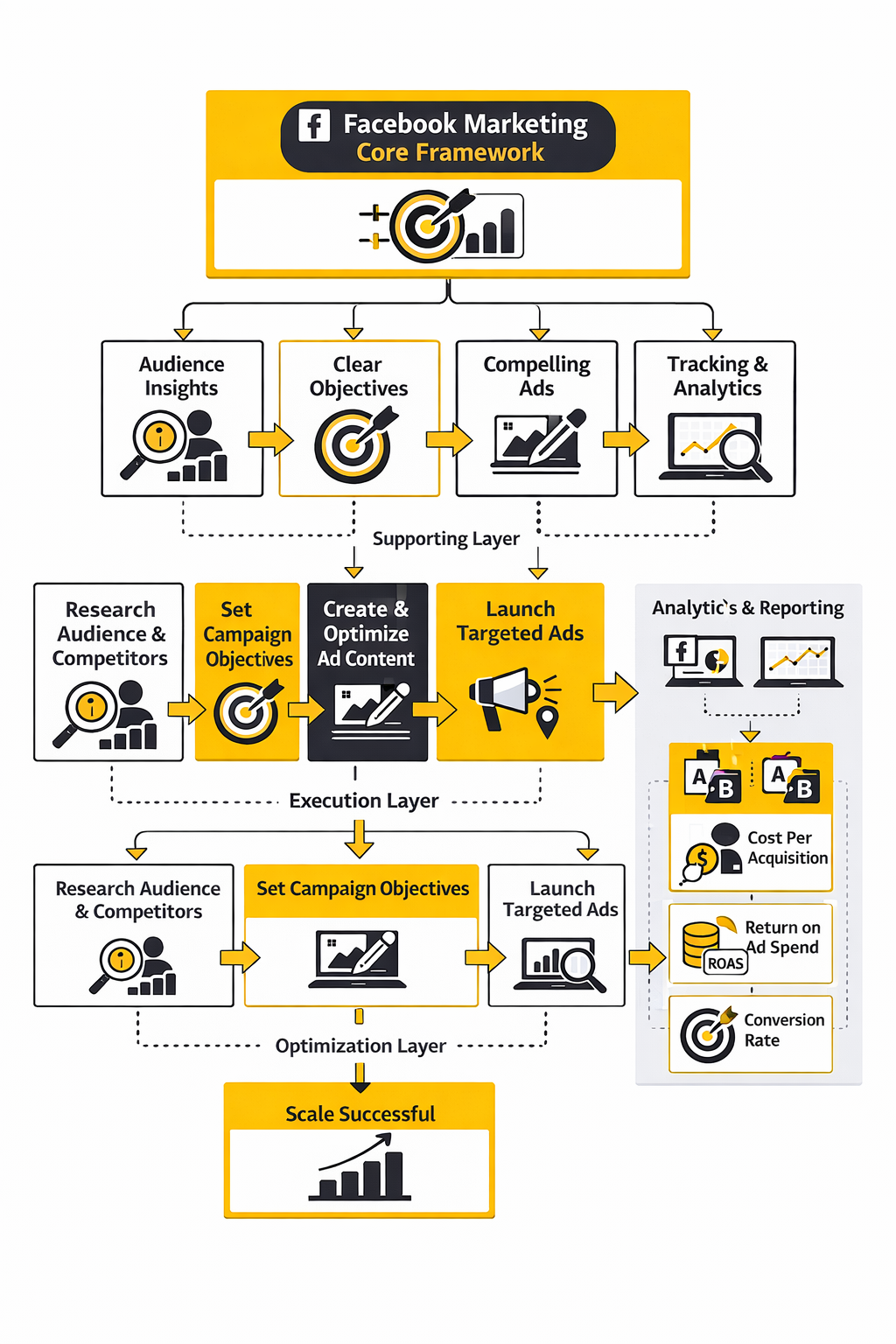
Scale the System, Not Just the Spend
The biggest scaling mistake is assuming more budget automatically means more profit. In reality, scaling Facebook marketing usually means your easy wins get used up first, and the next layer of growth comes with higher costs, weaker intent, or more operational pressure. That does not mean scaling is bad. It means scaling needs to be managed with clear expectations.
This is also where account discipline pays off. Meta’s own guidance on the learning phase and learning-limited delivery still points advertisers toward stable setups and enough optimization volume, including the familiar threshold of about 50 optimization events after significant edits for the system to learn effectively. Meta’s learning phase help page and its learning-limited guidance explain why constant edits and thin data can quietly sabotage performance. If you scale spend while the system is still unstable, you often amplify inefficiency instead of results.
The stronger approach is to scale the full environment. That means budget increases are matched by stronger creative throughput, cleaner tracking, faster lead handling, and better post-click experiences. If the funnel is the bottleneck, more reach just gets you more waste.
Use Blended Performance, Not Platform Ego
One of the easiest traps in Facebook marketing is falling in love with platform-reported metrics while ignoring what happens after the click. Ads Manager is useful, but it is not the whole truth. Attribution windows, reporting gaps, delayed conversions, offline sales, and cross-channel influence can all distort the picture.
That is why more advanced teams look at blended performance alongside native platform data. They compare Meta-reported conversions with CRM outcomes, email engagement, booked calls, sales quality, and contribution margin. A campaign that looks slightly weaker inside the ad account can still be more valuable if it brings in better customers downstream.
This is especially important for lead generation. A cheap lead that never replies is not a win. A more expensive lead that books, shows up, and buys can be the far better outcome. Facebook marketing gets smarter fast when you stop optimizing for surface-level efficiency and start optimizing for actual business value.
Protect the Feedback Loop as You Grow
Growth usually breaks the exact habits that created it. Teams get busier, reporting gets messy, creative reviews slow down, and customer feedback stops flowing back into the campaigns. When that happens, Facebook marketing often plateaus not because the platform stopped working, but because the learning loop inside the business got weaker.
The fix is less glamorous than people want, but it works. Keep the feedback loop tight between ads, landing pages, forms, sales calls, customer objections, and retention signals. If the sales team hears the same hesitation five times in one week, that probably belongs in the ad copy or landing page. If a specific lead magnet attracts volume but not quality, it should not keep getting protected just because the top-of-funnel numbers look pretty.
This is also where software can help when it supports the process instead of distracting from it. A stronger funnel builder like ClickFunnels or Systeme.io, an email platform like Brevo or Moosend, and a cleaner publishing workflow with Buffer can all support Facebook marketing when the core strategy is already sound.
FAQ
Is Facebook marketing still worth it in 2026?
Yes, for a lot of businesses it absolutely is. The platform still offers enormous reach, mature ad infrastructure, strong retargeting capability, and enough user familiarity to support both local and global campaigns. With 71% of U.S. adults reporting Facebook use in Pew’s 2025 research, it remains one of the biggest mainstream platforms for practical marketing, not just trend-driven visibility.
What types of businesses tend to do best with Facebook marketing?
Service businesses, local companies, ecommerce brands, coaches, educators, event-driven businesses, and community-led brands often perform well because Facebook supports both trust-building and conversion. It is especially useful when the buying process benefits from repetition, social proof, retargeting, or follow-up. Businesses with weak offers or poor lead handling usually blame Facebook marketing for problems that actually start elsewhere.
Is organic Facebook marketing enough on its own?
Usually not, at least not if growth is the goal. Organic Facebook marketing still matters for credibility, audience warming, and content testing, but paid distribution is often what creates consistency and scale. The better question is not organic or paid. The better question is how those two work together.
How much should a beginner spend on Facebook ads?
There is no universal perfect number because cost depends on market, objective, creative quality, and offer strength. What matters more is whether the budget is large enough to generate useful learning data. If the campaign cannot produce enough signal, especially around Meta’s well-known learning thresholds, Facebook marketing becomes harder to evaluate with confidence.
What is the most important part of a Facebook ad campaign?
The combination of offer and creative usually matters most. Targeting still matters, but not nearly as much as many advertisers think. If the message is weak, the promise is vague, or the landing page breaks trust, Facebook marketing gets inefficient fast no matter how carefully the audience was selected.
Should I use broad targeting or narrow targeting?
In many cases, broader targeting now works better than advertisers expect, especially when the conversion signal is strong and the creative is clear. Meta has spent years pushing toward more automation and broader machine-learning inputs. Facebook marketing today often performs best when the business gives the system quality signals instead of overcontrolling every detail.
How long should I wait before changing a campaign?
You usually want to avoid panic edits, especially during the learning phase. Meta’s own documentation warns that significant edits can reset learning and delay optimization. That does not mean you should ignore obvious problems, but Facebook marketing tends to reward measured changes more than emotional ones.
What metrics should I care about most?
That depends on the stage of the journey, but the most useful categories are attention, traffic quality, conversion quality, and revenue. Click-through rate can tell you whether the message is getting attention. Cost per lead or cost per acquisition tells you whether action is happening. Revenue, margin, and customer quality tell you whether Facebook marketing is actually helping the business grow.
Why do some campaigns get lots of clicks but very few sales?
That usually points to a mismatch after the click. The ad may be strong, but the landing page, offer, form, checkout flow, or follow-up process may be weak. In Facebook marketing, high click volume with poor conversion often means the front end is doing its job and the rest of the system is not.
How often should I refresh creative?
More often than most teams want to. Creative fatigue is one of the most predictable failure points in Facebook marketing, especially when budgets rise or audiences are relatively small. The right cadence depends on spend and audience size, but the core rule is simple: refresh before fatigue becomes expensive, not after.
Is retargeting still important?
Yes, because most people do not buy on the first interaction. Retargeting lets you reconnect with visitors, video viewers, engaged users, and previous site traffic who already know something about the brand. Facebook marketing becomes much more efficient when cold traffic campaigns and retargeting campaigns work together instead of acting like separate universes.
Do I need a funnel builder for Facebook marketing?
Not always, but you do need a destination that matches the click intent. For some businesses that is a clean product page or booking page. For others, a structured funnel built with ClickFunnels or Systeme.io can make Facebook marketing easier to measure and easier to scale.
What is the biggest mistake businesses make with Facebook marketing?
The biggest mistake is thinking the platform will compensate for a weak business system. It will not. Facebook marketing can amplify attention and demand, but it cannot rescue bad positioning, thin proof, poor follow-up, or a confusing customer journey.
Work With Professionals
Explore 10K+ Remote Marketing Contracts on MarkeWork.com
Most marketers spend too much time chasing clients, competing on crowded platforms, and losing a percentage of every project to middlemen.
MarkeWork gives you a better way. Browse thousands of remote marketing contracts and connect directly with companies desperate to hire skilled marketers like you, without platform commissions and without unnecessary gatekeepers.
If you're serious about finding better opportunities and keeping 100% of what you earn, explore available contracts and create a profile for free at MarkeWork.com.