

A real facebook marketing pro is not someone who knows where to click inside Ads Manager. It is someone who understands how Facebook still fits into attention, trust, demand capture, and conversion in 2026, then turns that understanding into a repeatable system. That still matters because Meta reported 3.58 billion daily active people across its family of apps in December 2025, DataReportal estimated Facebook ads reached 2.28 billion users in January 2025, and Pew found that 71% of U.S. adults use Facebook, with about half visiting daily.
That staying power is easy to underestimate if you only look at hype cycles. Facebook is still a place where people check local businesses, join communities, compare products, respond to offers, and keep up with what is happening around them. It is also still a major discovery layer, with Pew reporting that 38% of U.S. adults regularly get news on Facebook and DataReportal showing Facebook remains deeply tied to news and current-affairs intent globally.
The problem is that most advice about Facebook marketing is either too basic or badly outdated. The old tricks do not deserve the oxygen anymore. Professional Facebook growth today is about creative range, first-party data, conversion design, messaging flows, and disciplined feedback loops.
Article Outline
- Why Facebook Marketing Pro Still Matters
- The Facebook Marketing Pro Framework
- Audience Strategy After the Micro-Targeting Era
- Creative Systems That Beat Creative Fatigue
- Data, Messaging, and Conversion Infrastructure
- Professional Implementation, Optimization, and FAQs
Why Facebook Marketing Pro Still Matters
The opportunity is still there, but the easy wins are gone. Meta’s latest results showed ad impressions across its apps rising 18% year over year in Q4 2025 while average price per ad rose 6%, which is a strong reminder that the auction keeps moving and the platform still rewards advertisers who can turn attention into action. That is the difference between someone dabbling in Facebook and someone operating at a professional level.
Organic performance is not automatic either. Recent benchmark work from Hootsuite and Sprout Social shows Facebook engagement swings hard by industry, region, and content mix, which means generic publishing advice breaks down fast in the real world. The brands that keep winning are not guessing their way through content and ads. They are measuring what angle, format, offer, and audience combination actually moves people.
The platform itself is also pushing marketers toward a new center of gravity. Meta describes Advantage+ audience as AI-driven audience finding, frames Conversions API as a direct connection between advertiser data and Meta’s optimization systems, and documented the removal of detailed targeting exclusions from active campaigns starting March 31, 2025. In plain English, the edge is shifting away from tiny targeting hacks and toward stronger creative, cleaner data, and better operating discipline.
The Facebook Marketing Pro Framework
A practical Facebook marketing pro framework has five layers: market, message, media, measurement, and momentum. The order matters more than most people think. When you start with ad settings instead of buyer reality, offer strength, and conversion friction, the account gets noisy fast and scaling becomes guesswork.
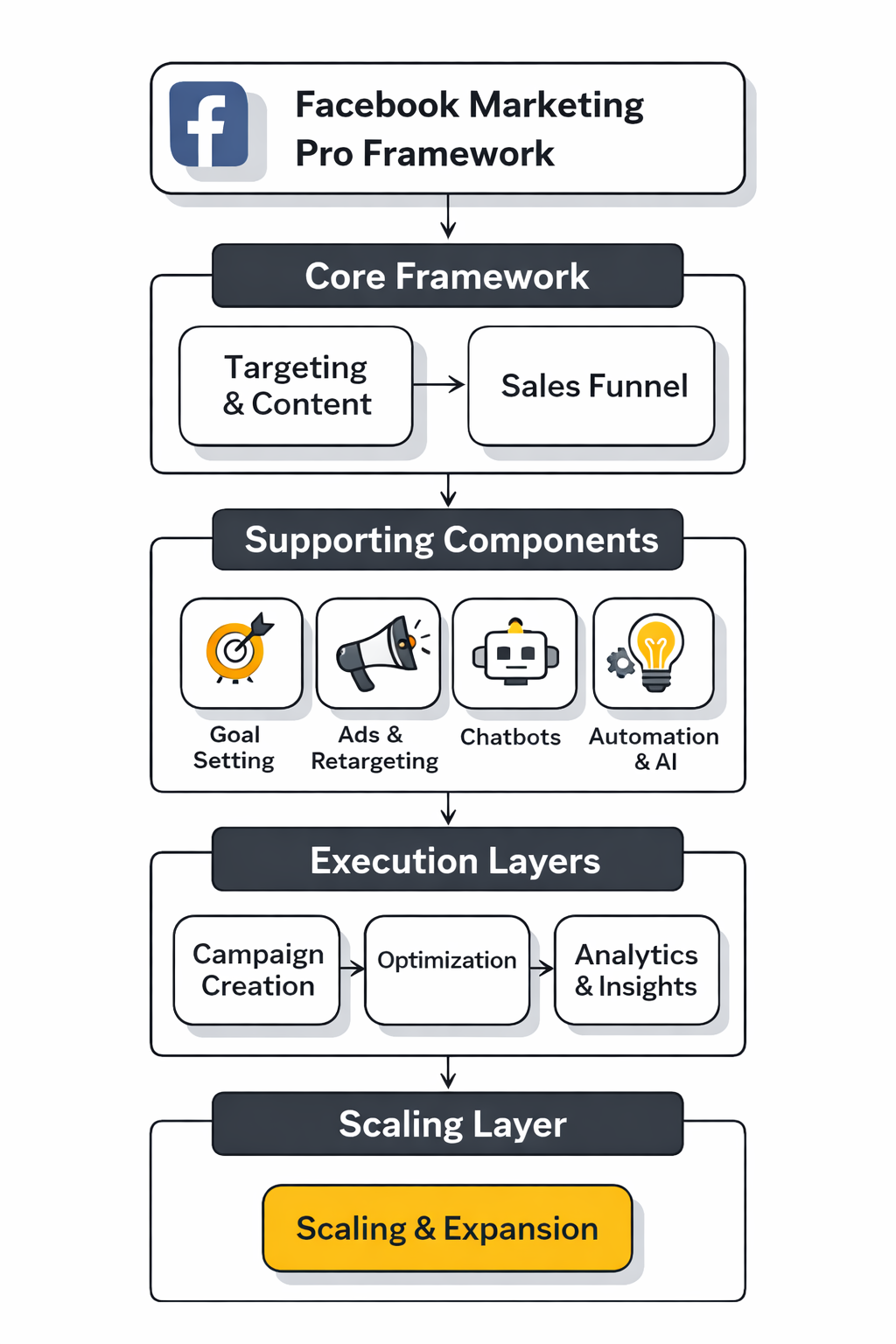
- Market and first-party signals. Start with real customer inputs, not fantasy personas. Custom audiences, website audiences, and grounded seed data give Meta a better place to start before automation expands delivery.
- Message and creative variation. Broad delivery only works when the ad itself gives the system enough angles to match with different people. That is why current benchmark research from Hootsuite and Sprout Social matters so much, and why Meta’s own performance marketing materials lean so heavily into AI-assisted performance tools.
- Media and conversation paths. Not every click should go to the same destination. Messaging ads and click-to-Messenger flows make sense when the sale needs questions, qualification, or fast human follow-up, while other offers work better with a page, a form, or a direct checkout.
- Measurement and attribution. Serious operators do not rely on browser-only tracking and hope for the best. A stronger setup combines Meta Pixel, Conversions API, and downstream CRM outcomes so campaign decisions are based on revenue quality instead of cheap top-line numbers.
- Momentum through systems. Professional Facebook growth comes from review rhythms, not heroic bursts of activity. The accounts that compound are the ones checking creative fatigue, lead quality, response time, frequency, landing-page drop-off, and follow-up performance every week.
For the stack behind that framework, ManyChat is a practical fit for Messenger-led journeys, HighLevel is useful when Facebook leads need CRM pipelines and follow-up automation, and Buffer helps keep the organic side consistent enough that paid and organic activity stop pulling in different directions. Tools do not create strategy on their own, but the right setup removes a lot of unnecessary friction.
That is the standard I mean by facebook marketing pro. The rest of this article will build from this framework and get more tactical: how to handle broader audiences without sloppiness, how to build creative systems that do not burn out, and how to set up the data and messaging infrastructure that gives Facebook enough signal to perform.
Audience Strategy After the Micro-Targeting Era
One of the biggest mindset changes in 2026 is this: a facebook marketing pro no longer treats targeting as the main lever. Meta has removed detailed targeting exclusions from active campaigns created in Ads Manager, while pushing advertisers toward an AI-powered Advantage+ audience model that uses suggestions and controls instead of the old style of hand-built, overfiltered audience stacks. Facebook+2
That does not mean audience strategy is dead. It means audience strategy has moved upstream. The real job now is to feed Meta better signals, cleaner customer definitions, and stronger creative so the system has something useful to optimize around. Facebook Developers+2
Start With Customer Truth Instead of Interest Guessing
The old habit was to begin with interest layers, stack behaviors, then keep narrowing until the audience looked “qualified.” The better move now is to start with people who have already shown intent: customer lists, website visitors, lead-form openers, video viewers, page engagers, and Messenger engagers. Meta’s own audience documentation still centers Custom Audiences around people you already know, and it supports customer-file, website, and engagement-based audience creation for exactly that reason. Facebook+3
That shift matters because broad delivery works best when your seed data reflects real buying behavior. If your source audience is sloppy, your expansion gets sloppy too. If your source audience is built from qualified leads, recent buyers, repeat customers, or meaningful engagement, the machine has a much better starting point. Facebook+2
For most businesses, the cleanest setup is not complicated. You want one reliable source of truth for leads and customers, one reliable flow of website and form events, and one clear way to move those people into follow-up. That is where tools like HighLevel, Fillout, and Brevo can help because they make your audience inputs cleaner before you ever touch campaign targeting.
Build Around Three Audience Layers
A professional audience strategy is usually easier to manage when you separate it into three layers instead of building ten micro-segments that all compete with each other. Meta’s current setup still supports Custom Audiences, Lookalikes, engagement audiences, website audiences, and audience controls, but the strongest accounts use those pieces to simplify rather than multiply complexity. Facebook+3
- Broad prospecting: This is where you let the system find new demand with minimal unnecessary restrictions. You still control geography, language, offer, creative angle, and conversion event, but you stop pretending that thirty interest toggles equal real strategy.
- Warm retargeting: This is where you reconnect with people who already touched the brand. Website visitors, video viewers, lead-form engagers, page engagers, and people who opened conversations are all more useful here than generic interest clusters. Facebook Developers+2
- Customer suppression and expansion: This is where you exclude people who should not see a specific offer and build lookalikes or adjacent prospecting from the people you most want more of. Meta still supports custom audience exclusions as an alternative to the old detailed targeting exclusions it removed. Facebook+2
This structure keeps the account readable. More important, it forces you to define audience purpose clearly: who you are trying to acquire, who you are trying to convert, and who you should stop paying to reach with the wrong message.
Use Broad Prospecting Without Becoming Lazy
Broad targeting does not mean careless targeting. It means you stop over-optimizing the audience and move your precision into the offer, creative, landing experience, and event optimization. That approach lines up with Meta’s push toward Advantage+ audience and its broader Performance Marketing framework, both of which are built around AI-led delivery rather than manual audience micromanagement. Facebook+2
The practical filter now is the ad itself. Your headline, hook, creative format, proof, CTA, and destination page do more to qualify the right person than most interest combinations ever did. That is also why current benchmark work from Hootsuite’s 2025 engagement research and Sprout Social’s 2025 benchmark analysis matters so much: content performance is uneven by industry and format, so weak creative gets exposed fast when targeting becomes broader. blog.hootsuite.com+2
You should still use restrictions when they are genuinely necessary. Meta’s audience setup continues to support controls and suggestions around things like age, gender, location, and custom audiences, with minimum age treated as a control rather than just a suggestion in many setups. If the business model, legal environment, or offer clearly requires limits, use them. If not, do not strangle delivery just to feel more in control. Facebook+2
Retarget Behavior That Signals Intent
Warm audiences are still where some of the easiest efficiency lives, but only if you stop bundling everybody together. Someone who watched a large chunk of a product video is different from someone who glanced at a blog post. Someone who opened a lead form is different from someone who bought last month. Meta’s engagement-audience tools support these behavior-based groups across Page engagement, Instagram engagement, video engagement, lead forms, Instant Experiences, and other interactions, which gives you much better raw material for retargeting than generic “visited site” logic alone. Facebook+3
The smart move is to match retargeting windows to buying intent. High-intent actions should usually get the fastest and strongest follow-up, while lower-intent engagement should get more education, proof, and friction reduction first. When those follow-ups happen inside Messenger, ManyChat is useful because the conversation itself becomes another source of audience signal, not just a support channel.
This is also where most accounts quietly waste money. They run one generic retargeting ad to everyone who interacted in the last month, then wonder why relevance fades. Better segmentation does not mean going back to 2019-style audience obsession. It means acknowledging that different intent signals deserve different messages.
Use Exclusions Carefully and for Real Business Reasons
A lot of advertisers heard “detailed targeting exclusions are gone” and concluded that exclusions do not matter anymore. That is the wrong takeaway. Meta removed detailed targeting exclusions, but it still allows alternative exclusion products such as custom audience exclusions and certain audience controls, so suppression still matters when it protects margin, customer experience, or compliance. Facebook+2
The key is to exclude for business logic, not for anxiety. Exclude existing customers from a new-customer acquisition offer. Exclude booked leads from another booking push. Exclude recent purchasers from the exact same entry offer when that offer would create frustration or waste. Beyond that, heavy exclusion habits often become a way of hiding weak creative or weak conversion design.
Even then, do not assume your exclusions are perfect. In practice, customer suppression depends on how complete your source data is, how well Meta can match that data, and whether your audience definition actually captures the people you think it does. That is one reason experienced operators keep exclusions focused on the situations where they matter most instead of treating them like a universal cure. Jon Loomer Digital+1
Treat Compliance as Part of Audience Strategy
This part gets ignored until an account gets restricted or performance suddenly drops in a regulated niche. Meta continues to apply special rules for housing, employment, and financial products and services, and its Special Ad Category documentation makes clear that audience and product restrictions still apply there. On top of that, Meta began rolling out more proactive restrictions in September 2025 on custom audiences and custom conversions that may suggest prohibited information, including certain health conditions and financial status. Facebook Developers+3
That is why a facebook marketing pro does not separate targeting from governance. Audience planning now includes consent, data labeling, list hygiene, category compliance, and naming discipline. It is less glamorous than ad hooks and split tests, but it is part of what makes performance durable instead of fragile.
The next layer is where this gets even more visible: creative. Once targeting gets broader, creative stops being decoration and starts doing much more of the qualification work.
Creative Systems That Beat Creative Fatigue
This is where a facebook marketing pro starts to separate from everyone still obsessed with audience tweaks. Meta, AppsFlyer, and dentsu’s 2025 creative optimization report built from 1.1 million creative variations and $2.4 billion in ad spend found that campaigns using a diverse mix of creative formats and messaging types saw up to a 32% improvement in CPA and a 9% lift in incremental reach. That is the clearest signal possible that creative is no longer a support function inside Facebook marketing. It is the engine. AppsFlyer+2
Meta’s own platform changes point in the same direction. In January 2026, Meta said its latest ad ranking improvements drove a 3.5% lift in ad clicks on Facebook and helped increase ads quality by 12% in Q4 2025, while the company’s feed and video ranking improvements lifted views of organic feed and video posts by 7%. When the platform gets better at matching specific creative to specific people, lazy ad duplication gets weaker and true message variety gets stronger. Facebook
Build Creative Around Angles, Not Tiny Variations
Most teams still mistake volume for variety. Swapping one headline, changing one color, or moving one CTA button is not a creative system. Real diversification means changing the promise, the emotional frame, the proof, the objection you answer, the format, and sometimes even the destination experience.
That is also why Facebook creative strategy has to start with angles, not assets. One angle might lead with speed, another with trust, another with a specific pain point, another with a before-and-after outcome, and another with social proof. Meta’s creative tools are designed for variation at that level, with Advantage+ creative automatically generating multiple ad versions and dynamic creative combining different images, headlines, and text elements. The system works best when you give it genuinely different ideas to test instead of five nearly identical ads. Facebook+2
A good rule here is simple: every new ad should answer a different buyer question. If one ad says “this is easier,” the next should say “this is safer,” and the next should say “this performs better,” not just repeat the same claim with a different thumbnail. That is how you reduce fatigue before it starts, because people are not seeing one message recycled to death. Facebook+1
Use Organic Posts as a Creative Testing Layer
Organic Facebook is still useful here, not because it magically replaces paid distribution, but because it gives you cheap signal on what language and formats people actually respond to. Socialinsider’s 2026 Facebook benchmark study based on 25 million posts from more than 130,000 business pages found that Facebook’s average engagement rate sat at 0.15%, with status posts leading at 0.20%, while brands posted 22% less often year over year. That is a strong reminder that more content is not the goal. Better content is. socialinsider.io
That same study found albums often perform well for smaller pages, while status posts dominate engagement for mid-sized and larger pages. For a working marketer, the lesson is practical: do not force every idea into a polished promo asset. Use simple opinion-led posts, short prompts, conversational text updates, albums, and lightweight video cuts to find hooks that earn reactions, comments, and shares before you spend real money behind them. socialinsider.io
This is one of the cleanest ways to work faster without getting sloppier. You publish organic tests, watch which phrases pull comments or shares, then turn the best-performing angles into paid assets. If you want a cleaner workflow for that publishing calendar, Buffer and Flick are both useful because they help keep your testing cadence consistent instead of ad hoc.
The Weekly Facebook Marketing Pro Execution Loop
Creative systems break down when production is random. The strongest operators run Facebook like a weekly lab: they collect market signals, turn them into distinct angles, ship those angles in multiple formats, then review winners and failures with enough discipline to learn something real. That is the point where execution stops feeling vague and becomes operational.
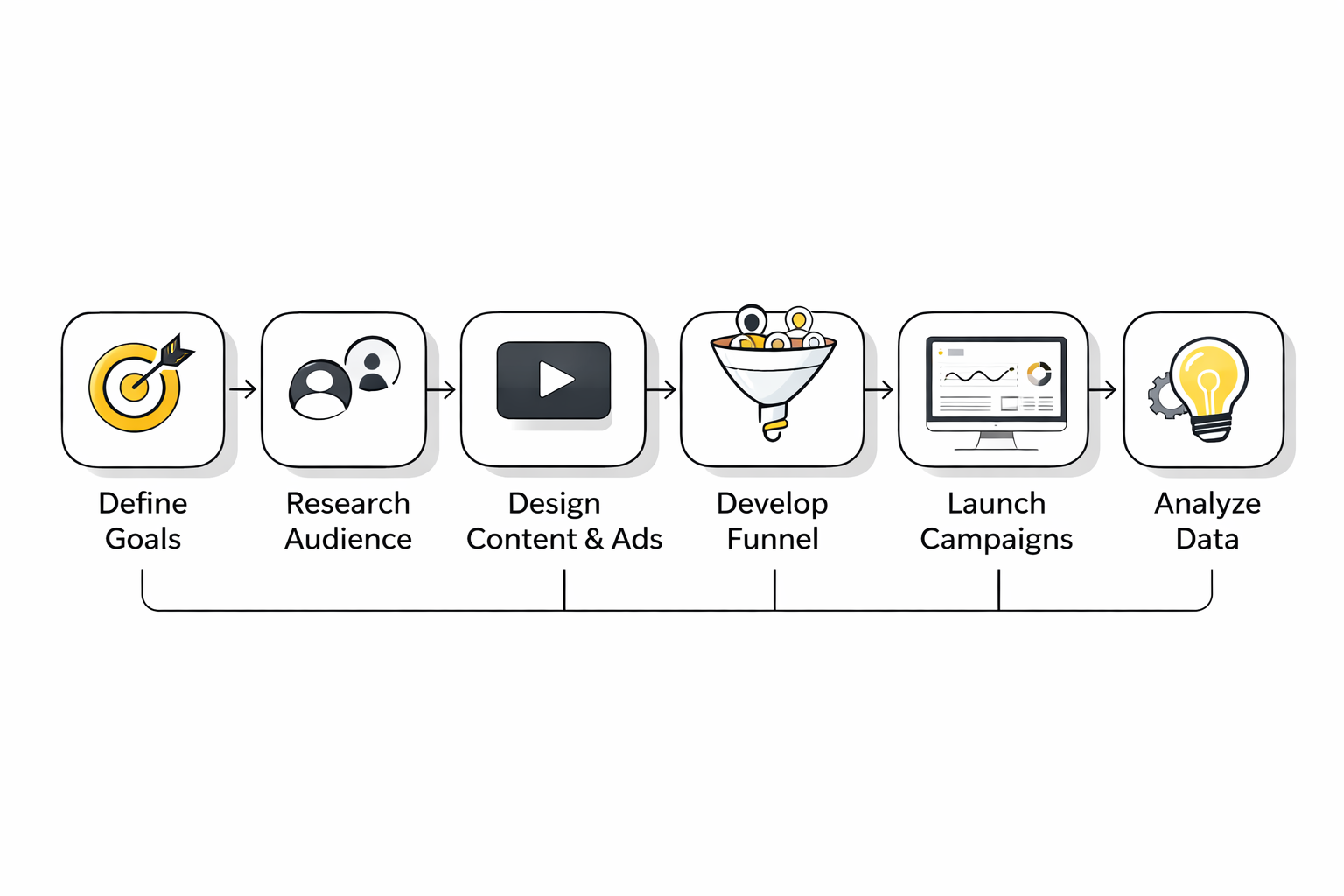
- Pull signals from the last seven days. Review ad comments, sales calls, CRM notes, Messenger conversations, site search terms, and top-performing posts. You are looking for repeated phrases, recurring objections, and specific words customers use when they describe the problem or outcome.
- Turn those signals into 3 to 5 fresh angles. Each angle should have a different job. One might create urgency, one might remove risk, one might show proof, and one might frame the cost of inaction.
- Produce each angle in more than one format. Meta’s own guidance keeps reinforcing that different placements need different creative treatments and aspect ratios, so build square or feed-friendly assets and vertical versions for Stories or Reels instead of forcing one asset everywhere. Keep the copy tight too, because Meta’s ad guidance consistently pushes short, clear text and visible calls to action.
- Match the destination to the friction level. If the offer is simple, send traffic to a direct page. If the offer needs explanation or qualification, send the click into a conversation or a higher-context page instead.
- Review performance by angle, not just by ad ID. If three different “proof” ads are winning, that is not three winners. It is one message family outperforming the rest. Treat it that way.
- Refresh before collapse, not after. When the same hook has been carrying the account for too long, do not wait for performance to crater before building replacements. The best accounts always have the next batch ready.
That loop sounds basic, but it is exactly where most campaigns fail. They do not lack budget. They lack creative throughput, message diversity, and a consistent review rhythm. A facebook marketing pro fixes that by treating creative operations as a standing process, not an occasional burst of inspiration. Facebook+4
Match the Destination to the Creative Promise
A lot of Facebook creative underperforms because the ad and the next step feel like two different conversations. The hook might be direct, specific, and emotionally sharp, then the landing page becomes generic and slow. Or the ad invites a question, but the click goes to a page that forces too much commitment too early.
That is why implementation is not finished when the ad is live. Meta’s current momentum around messaging makes this even more obvious: the company said click-to-message ad revenue in the U.S. grew more than 50% year over year in Q4 2025, driven by Website to Message ads. That tells you a lot about where user behavior is going. In many categories, people do not want a harder funnel. They want a smoother one. Facebook+2
So the destination should match intent. Simple offer, low friction, clear price point: send to a focused page. Higher-ticket service, more objections, or anything that benefits from qualification: route into Messenger or a tighter nurture flow. That is where ManyChat, HighLevel, and page builders like Replo or ClickFunnels become practical, because they help you keep the promise made in the ad intact after the click.
Keep a Winner Library, Not Just a Campaign Archive
Most marketers archive ads and lose the actual lesson. A better system keeps a living library of winners organized by angle, format, audience temperature, offer type, and destination. That way, when performance drops, you are not starting from zero. You are recombining proven ingredients with new context.
This matters even more now because Meta’s creative systems increasingly reward breadth and freshness. Socialinsider’s latest Facebook data shows brands are publishing less often while still navigating a platform where participation-heavy formats keep outperforming expectation, and Meta’s own updates show fresher, more relevant content is getting stronger distribution. The practical takeaway is not “post more” or “make more ads.” It is “keep a sharper bench of ideas ready to deploy.” socialinsider.io+1
That creative bench is what prepares you for the next layer of Facebook execution: getting the data, messaging, and conversion infrastructure tight enough that the platform can actually learn from the demand your creative generates.
What the Numbers Actually Mean
A facebook marketing pro does not treat Ads Manager like a scoreboard and call it a day. The dashboard is useful, but it is still a model of reality, not reality itself, which is exactly why Meta lets advertisers choose attribution models, compare attribution settings, and run lift-style tests instead of relying on one default view forever. Meta’s attribution settings documentation and its incremental attribution documentation both point in the same direction: measurement is something you design, not something you passively accept.
That matters because the wrong interpretation leads to the wrong fix. A rising CPM does not automatically mean your campaign is failing, just like a strong CTR does not prove the traffic is valuable. The job is to read the full chain from impression to click to conversion to qualified revenue, then decide where the bottleneck actually lives.
Benchmarks help, but only when you use them as context instead of identity. Recent cross-industry views from WordStream’s 2025 Facebook benchmark update, AdBacklog’s 2025 benchmark ranges, and Triple Whale’s 2026 report based on nearly 35,000 brands all show the same basic truth: Facebook performance varies wildly by objective, vertical, and account quality, so the useful question is never “Is my CTR good?” It is “What is this number telling me about the next constraint in the system?”
Build the Measurement Stack Before You Scale
The cleanest Facebook analytics setup still starts with the basics. Meta’s Pixel documentation defines the Pixel as the JavaScript snippet that tracks visitor activity on your website, while the Conversions API documentation describes the server-side layer that connects your marketing data directly to Meta’s optimization systems. Those two pieces are not rivals. They are complements.
When both are active, the next priority is quality control. Meta’s documentation on event deduplication and its help pages on event match quality and Conversions API monitoring make the reason plain: if browser and server events are not deduplicated correctly, your numbers get distorted, and if match quality is weak, Meta may see fewer conversions and higher costs than your business actually generated.
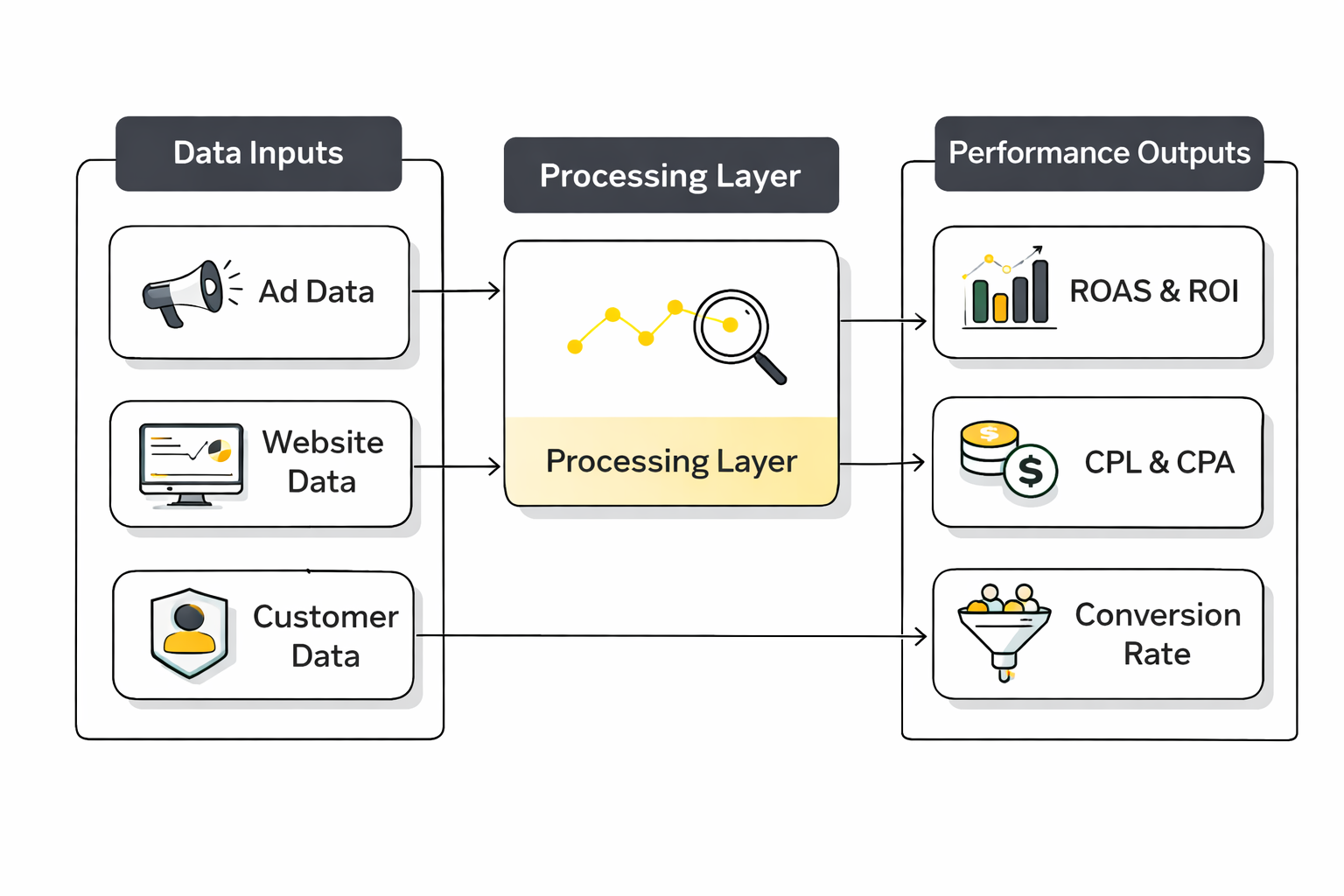
- Pixel for browser-side behavior. This captures on-site activity like pageviews, content views, add-to-carts, leads, and purchases in the browser using Meta’s standard web event structure. It is still essential because it shows how people move through the site in real time and helps build remarketing audiences. Meta’s Pixel overview and conversion tracking guide are still the core references here.
- Conversions API for server-side reliability. This sends events directly from your server or platform, which gives Meta a cleaner line to the data than browser-only tracking can provide. Meta’s own documentation frames CAPI as a direct connection between advertiser data and the systems that optimize targeting and measure results, which is why serious setups rarely stop at the Pixel anymore. Meta’s Conversions API docs and server-side GTM guide spell that out clearly.
- Deduplication so the same conversion is not counted twice. If the Pixel and Conversions API both fire for the same event, they need shared identifiers so Meta can treat them as one conversion instead of two. That is exactly what Meta’s deduplication documentation and Business Help guidance are addressing.
- CRM and offline outcome data so Facebook is not grading itself. Meta supports CRM lead-event integrations and says the Conversions API is its recommended integration method for offline and physical store events. That is the missing layer for businesses that care more about qualified appointments, closed deals, and revenue collected than cheap front-end leads.
- Faster event flow and ongoing diagnostics. Meta notes that sending events faster helps you see results closer to real time, which matters when you are making daily budget decisions. Slow, incomplete, or mismatched event delivery turns optimization into guesswork.
This is the point where tools become practical instead of flashy. If you need one place to connect forms, conversations, pipeline stages, and booked meetings, HighLevel, Copper, and Cal.com make it much easier to see whether Facebook is producing real business movement or just pretty top-line numbers. That is a huge difference, and it is one of the clearest marks of a real facebook marketing pro.
Read CPM, CTR, CPC, CVR, and CPA as a Chain
Individual metrics only become useful when you read them together. In Triple Whale’s 2026 benchmark report covering nearly 35,000 brands, 2025 median Meta performance landed around a $14.19 CPM, 2.19% CTR, 1.6% CVR, and $38.19 CPA. That combination tells a much richer story than any one number alone because it shows where the auction is expensive, where creative is still earning clicks, and where the post-click system is either converting or leaking.
A broader cross-industry view tells the same story from a different angle. WordStream’s 2025 benchmark update put average traffic-campaign CTR at 1.71%, while its 2025 Facebook cost analysis put traffic-campaign CPC at $0.70 and lead-campaign CPC at $1.92. Meanwhile, WordStream’s 2026 stats roundup listed lead-gen averages around 2.50% CTR, $1.92 CPC, 8.25% conversion rate, and $23.10 cost per lead, which already shows why objective-level comparisons matter more than lazy all-purpose averages.
Here is the practical read:
- High CPM and strong CTR usually means the auction is expensive, but the message is landing. The action is rarely “panic and shut it off.” It is usually “improve conversion rate, expand creative variety, and protect margin.”
- Normal CPM and weak CTR usually points to a creative or offer problem. If the auction is not especially expensive but people still are not clicking, the message is not doing enough work.
- Strong CTR and weak CVR usually means the ad is making a promise the destination is not keeping. That is a landing-page, qualification, pricing, trust, or funnel-friction problem much more often than a targeting problem.
- Cheap CPC and poor lead quality is where a lot of advertisers fool themselves. If the leads do not book, show, buy, or renew, low acquisition cost is just low-quality waste.
That last point is why backend tracking matters so much. If your pipeline lives in HighLevel, your nurture runs through Brevo, or your sales team is working from Copper, you can stop optimizing for “lead” and start optimizing for what happens after the lead. That is where the numbers become useful enough to drive serious budget decisions.
Organic Benchmarks Still Matter to Paid Performance
Organic Facebook data is not a side quest. It is one of the cheapest ways to understand which hooks, prompts, and content types are getting real participation before you spend ad budget behind them. Socialinsider’s 2026 Facebook benchmark study found average Facebook engagement at 0.15%, with status posts reaching 0.20%, albums holding at 0.18%, Reels improving to 0.18%, and brands posting 39 times per month on average after a 22% drop in posting volume.
The important part is not the average itself. The important part is what the distribution suggests: Facebook is not rewarding volume for its own sake. It is rewarding content that creates lightweight participation, especially comments, reactions, and shares, which is exactly why simple status-led hooks can still outperform more produced assets in the right context.
That should affect paid execution directly. If an organic post starts a real conversation, that topic deserves paid testing. If albums are earning shares on a smaller page or a short opinion post keeps pulling comments, that is not just social activity. It is message validation you got before paying CPMs for it. Tools like Buffer can help keep that testing rhythm steady, but the real value is the feedback loop, not the calendar itself.
Attribution Changes the Story More Than Most Marketers Realize
Attribution is where overconfidence usually begins. Meta’s attribution settings documentation explains that advertisers can customize attribution at the ad set level, and its reporting guidance makes clear that comparing attribution settings can reveal how much your reported conversion totals shift under different views. That alone should make you more careful about declaring a campaign “profitable” too early.
The bigger shift is incremental measurement. Meta’s incremental attribution help page says the model is designed to optimize for conversions caused by ads, and Meta’s own January 2026 product update said its latest Q4 model rollout drove a 24% increase in incremental conversions compared with the standard attribution model. That does not mean the standard model is useless. It means you now have a better way to ask the harder question: which conversions actually happened because the ads ran?
For bigger decisions, reporting alone still is not enough. Meta’s documentation on Conversion Lift and Experiments makes the logic clear: if you want to measure incremental effect instead of attributed effect, you need test and holdout structures, not just dashboard totals. That is a more demanding way to work, but it is also a more professional one.
Use Benchmarks to Trigger Action, Not to Defend Your Ego
The useful way to read Facebook numbers is diagnostic, not emotional. If your CTR is below the range shown by sources like WordStream, AdBacklog, or Triple Whale, that is a prompt to revisit hook, angle, proof, and format. If CTR is healthy but CVR is weak, the next move is usually landing-page clarity, qualification, speed, or follow-up quality, not another audience rebuild.
The same goes for rising costs. Triple Whale’s benchmark report showed Meta CPMs up 20.03% year over year in its dataset, but that is not an automatic reason to abandon the channel. It is a reason to improve creative throughput, strengthen first-party data, and build more owned follow-up infrastructure so your economics are not crushed every time the auction tightens.
That is really the core lesson of this section. The numbers matter, but only when they are connected to the right action. A facebook marketing pro does not chase cleaner dashboards for their own sake. They build a measurement system that tells them what to fix next, then they actually fix it.
Scaling Without Breaking the Account
Scaling Facebook is not just a budget decision. It is a systems decision, because the moment you add spend, you also change delivery patterns, auction pressure, creative fatigue, follow-up load, and the amount of signal Meta needs to stay efficient. Meta’s own guidance on the learning phase, learning limited, and significant edits all points to the same reality: when you make too many meaningful changes too fast, the system has to relead, and performance often gets noisier before it gets better. Facebook+2
That is why a facebook marketing pro scales in layers. First, they prove that the conversion path is stable. Then they widen distribution through cleaner budgets, broader delivery, and stronger creative coverage instead of spawning endless duplicate ad sets and hoping one of them sticks. Meta’s help on reducing audience fragmentation and auction overlap makes the platform’s preference obvious: fewer overlapping structures usually give the delivery system a better chance to learn efficiently. Facebook+1
Consolidate Before You Multiply
One of the easiest ways to wreck a scaling account is to turn one working campaign into five near-identical campaigns with tiny differences. That feels like control, but in practice it often spreads budget too thin, slows learning, and creates internal competition. Meta explicitly recommends combining ad sets and campaigns to reduce audience fragmentation and notes that overlap can limit delivery when ads from the same account are competing for the same people. Facebook+1
The better move is to consolidate around clear jobs. Keep prospecting clean, keep retargeting purposeful, and only split structure when there is a real business reason such as geography, language, offer economics, or a very different conversion path. A facebook marketing pro knows that reporting convenience is not the same thing as delivery efficiency, and the account usually gets stronger when structure is simplified rather than multiplied. Facebook+1
Raise Spend Where Signal Quality Can Support It
Budget increases only work well when the account has enough event volume and enough creative breadth to absorb the extra spend. Meta’s budget documentation explains that campaign budgets now use Advantage+ campaign budget, which shifts spend dynamically across ad sets to find the best overall results. That can be powerful, but it also means weak ad sets do not magically deserve budget just because they exist. Facebook
This is where many advertisers make the wrong tradeoff. They try to force even spend distribution or preserve old structures instead of letting the stronger message families attract more budget. When that happens, the account looks “organized” but becomes less efficient. Tools like HighLevel help here because once leads, appointments, and pipeline stages are visible outside Ads Manager, it becomes much easier to justify consolidating spend behind what is actually producing business outcomes.
Know When to Use Cost Controls and When to Stay Loose
Bid strategy is one of the clearest places where advanced operators think differently. Meta’s documentation on bid strategies, bid cap, cost per result goal, and ROAS goal control shows that these tools are available for different reasons, but they are not interchangeable. They are also not neutral. Each one trades flexibility for control in a different way. Facebook+3
The usual mistake is introducing hard efficiency controls too early. If the account is still exploring, creative is still rotating, or the market is still shifting, aggressive bid constraints can choke delivery before the system has enough room to find good opportunities. A facebook marketing pro usually starts looser, lets the account learn, and only adds tighter cost controls when the economics are already clear enough to defend.
Creative Scale Still Beats Mechanical Scale
A lot of people say they want to scale Facebook when what they really mean is that they want the same ad to keep working on a larger budget forever. That is not a scaling strategy. That is dependence. The healthier model is expanding creative breadth alongside budget so delivery has fresh ways to win as frequency rises.
That approach is getting more support from the platform itself. Meta said in its September 2024 AI product update that campaigns using its generative AI ad features saw an average 11% higher click-through rate and 7.6% higher conversion rate than campaigns that did not, and said more than one million advertisers were already using those tools. That does not mean AI replaces judgment. It means faster creative variation is becoming a real advantage for teams that already understand positioning, offers, and objections. Facebook
Used properly, AI is a throughput tool. It helps you generate more versions, more formats, and more combinations faster. Used badly, it becomes a machine for producing polished sameness. That is why pairing faster ad production with sharper human review still matters, and why builders like Replo and ClickFunnels only pay off when the message behind the page is already strong.
Strategic Tradeoffs That Matter at the Professional Level
The longer you run Facebook, the less the game looks like “find the winning ad” and the more it looks like managing tradeoffs. Speed versus stability. Automation versus control. Volume versus quality. Cheap front-end conversions versus profitable downstream outcomes. The real edge is not avoiding tradeoffs. It is seeing them early enough to choose the right one.
This is also where benchmark data needs to be interpreted carefully. Triple Whale’s 2026 Meta benchmark report showed 2025 median CPM at $14.19, CPA at $38.19, CTR at 2.19%, and Meta taking 68.31% of total ad budget across the brands in its dataset. Those numbers matter because they show both scale and pressure: Facebook is still a dominant acquisition channel, but it is also a crowded one, so sloppy operations get punished faster than they did when the auction was cheaper. triplewhale.com
Volume Is Not the Same as Quality
This becomes painfully obvious in lead generation, local services, and high-ticket funnels. It is entirely possible to reduce cost per lead while making the sales team less effective, because cheaper leads are often less qualified, slower to respond, or less serious. A facebook marketing pro watches booked rate, show rate, close rate, refund rate, and retained revenue, not just the first green number visible in Ads Manager.
That is why the backend stack matters more as you scale. If Messenger is part of the path, ManyChat can help qualify faster. If appointments and pipelines are the choke point, HighLevel or Cal.com can make follow-up speed visible enough to fix. The platform can optimize toward the event you send it, but your business still has to decide whether that event actually deserves more budget.
Automation Is Powerful, but Blind Automation Is Expensive
Meta keeps adding more automation layers, and some of them are genuinely useful. The company’s Opportunity Score expansion in the Marketing API was presented as a deeper set of value-proven recommendations, and Meta’s automated rules tools continue to make it easier to trigger notifications or automatic changes based on performance conditions. That is helpful, especially when account complexity grows. Facebook Developers+1
But professional operators do not outsource judgment to defaults. Recommendations are prompts, not commandments. Automated rules are guardrails, not strategy. The right use case is protecting the account from obvious waste, flagging anomalies, and speeding up operational hygiene, not replacing the thinking required to judge offer quality, creative strength, and business fit.
Stability Sometimes Beats Aggression
There are moments when the highest-growth move is not the smartest move. If the sales team is underwater, fulfillment is strained, response times are slipping, or the offer is about to change, more budget can hurt more than it helps. Meta’s own documentation around significant edits and learning re-entry is a reminder that instability inside the account has a cost, and instability outside the account usually shows up there too. Facebook+1
This is where mature operators differ from restless ones. They would rather preserve a healthy system than force growth into a funnel that cannot absorb it. That mindset sounds less exciting, but it is one of the main reasons some accounts compound while others spike and collapse.
Risks That Can Quietly Undermine Performance
By the time most teams notice risk, it has already turned into lost delivery, lower signal quality, or account friction. Facebook performance does not only break because of creative fatigue or weak offers. It also breaks because of policy mistakes, regional restrictions, weak governance, and overdependence on one interpretation of attribution.
Policy is the obvious one. Meta’s Advertising Standards still sit underneath everything, Special Ad Category rules continue to restrict how certain advertisers can target, and Meta’s 2025 expansion of financial products and services as a Special Ad Category changed requirements for affected advertisers. These are not side notes. They shape what a professional setup is allowed to do. Facebook+2
Regional conditions matter too. Meta’s October 2025 change in the EU stopped political, electoral, and social issue ads from being delivered there, and Meta’s changes to the EU ad experience introduced a less personalized ads option for some users in response to regulatory pressure. Even if your business is not directly affected by those exact policies, the lesson is bigger: platform conditions are not static, and a facebook marketing pro watches regulatory shifts because they can change targeting, delivery, and measurement assumptions faster than most campaign managers expect. Facebook+1
Do Not Let Facebook Grade Facebook Alone
One of the quietest risks in scaling is believing reported platform success without external validation. Meta’s Conversion Lift, Experiments, and holdout testing guidance all exist for a reason: attributed performance and incremental performance are not the same thing. If a campaign looks efficient inside Ads Manager but produces no meaningful lift in the business, the dashboard was never the truth you needed. Facebook+2
That is why expert-level Facebook work ends up looking broader than Facebook itself. You validate with holdouts, compare against backend revenue, watch retention, and track what happens after the first conversion. Once you operate like that, the channel becomes much easier to trust because you stop asking it to be judge, jury, and witness at the same time.
The Real Professional Standard
At the advanced level, the goal is not to become more clever inside Ads Manager. The goal is to become more durable. That means cleaner structures, better signal quality, faster creative iteration, smarter tradeoffs, and enough measurement discipline to know whether scale is actually helping the business or just inflating top-line activity.
That is the difference between someone who runs Facebook ads and someone who deserves the label facebook marketing pro. The professional does not win because they found one trick. They win because the whole operating system is harder to break.
The Facebook Marketing Pro Operating System
By the time you reach this point, the pattern should be clear. A real facebook marketing pro does not rely on one campaign trick, one audience hack, or one “winning ad” that carries the whole account forever. The durable advantage comes from connecting creative, data, messaging, follow-up, and attribution into one operating system that can keep learning even as costs, policies, and buyer behavior shift.
That system is also more connected than most marketers admit. Meta’s own documentation keeps reinforcing that Meta Pixel event coverage, Conversions API reliability, Advantage+ audience delivery, Advantage+ placements, and attribution comparisons all work better when the account has clean inputs and a clear business goal. Once those pieces are aligned, Facebook stops feeling like a volatile ad channel and starts acting more like a repeatable growth engine.
At the practical level, that usually means one place to capture leads, one place to continue the conversation, one place to score or qualify demand, and one place to measure revenue after the click. For a lot of teams, that stack might include ManyChat for Messenger and automated qualification, HighLevel for pipeline and automation, Brevo or Moosend for email nurture, Fillout for cleaner lead capture, and Chatbase when you want faster AI-assisted qualification or support. The exact tools can change, but the system logic does not.
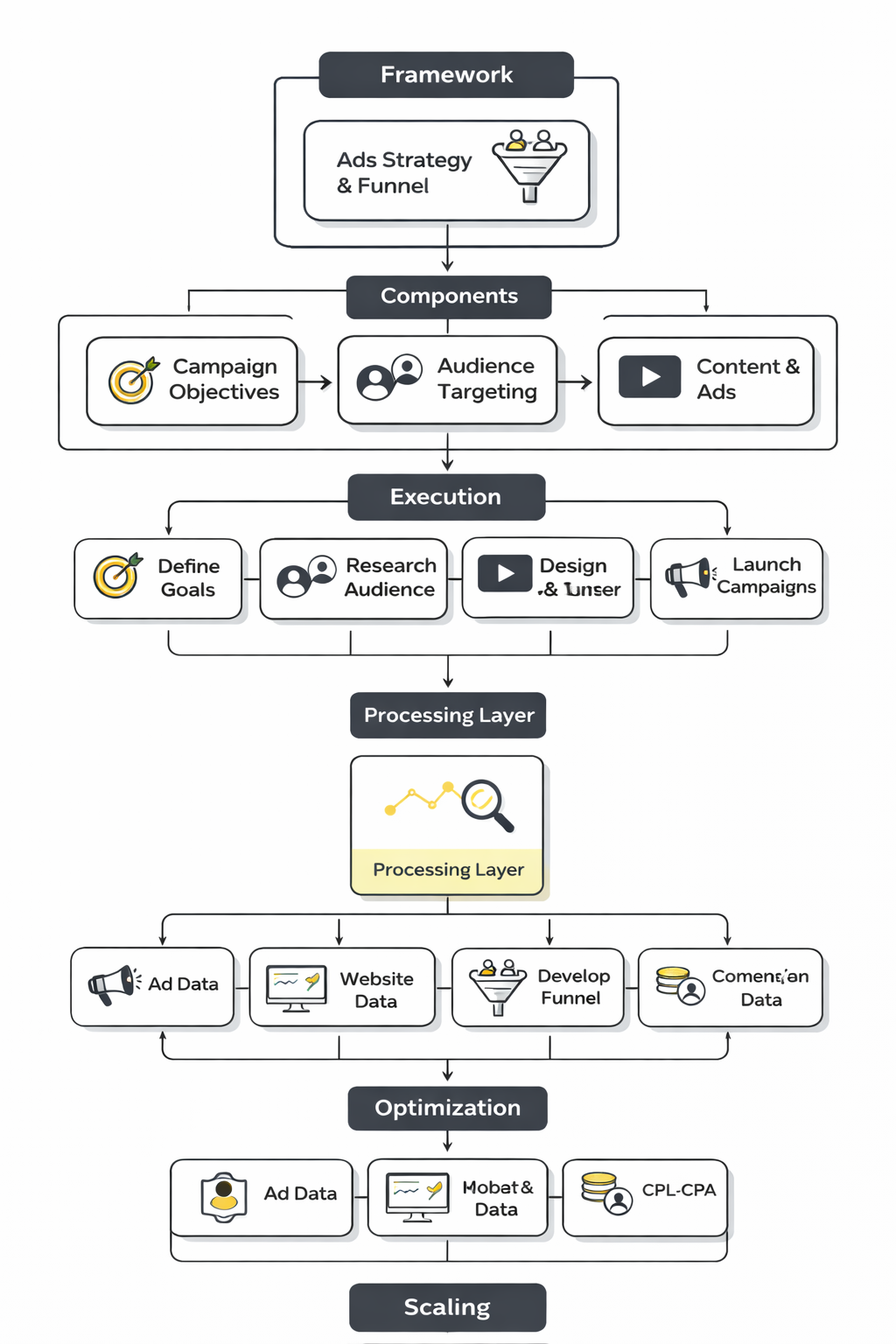
When that ecosystem is working, every layer makes the others smarter. Creative gives Meta better response signals, better signals improve delivery, better delivery feeds better leads into your CRM, better follow-up improves actual revenue, and better revenue data gives you a more honest basis for optimization. That is the point where being a facebook marketing pro stops sounding like a title and starts looking like a real operating standard.
FAQ - Built for Complete Guide
Is Facebook still worth it for marketers in 2026?
Yes, but not for the old reasons. Facebook still has enormous commercial reach, with Meta reporting 3.58 billion daily active people across its family of apps in Q4 2025, while DataReportal’s January 2025 estimates put Facebook ad reach at 2.28 billion users and Pew found that 71% of U.S. adults use Facebook. The reason it still works is not that it is easy. It works because the platform still combines reach, community behavior, local intent, remarketing depth, and conversion infrastructure in a way very few channels can match.
What does a facebook marketing pro actually do differently?
The professional difference is less about secret tactics and more about systems. Meta’s current product direction around Advantage+, Conversions API, and attribution controls shows that winning operators now focus more on signal quality, creative variation, and downstream measurement than on endless manual tweaks. In practice, that means they manage the whole path from hook to message to sale instead of only watching ad-level metrics.
Should I still use detailed targeting, or is broad targeting better now?
Broad targeting usually deserves the first shot now, especially when your creative and event tracking are strong. Meta says Advantage+ audience uses AI to find your campaign audience, and its current setup treats many audience inputs as suggestions rather than hard walls, which is a major change from older Facebook playbooks. That does not mean targeting is irrelevant, but it does mean weak positioning can no longer hide behind overly narrow audience stacks.
Do I need both Meta Pixel and Conversions API?
For most serious advertisers, yes. Meta’s own documentation describes the Meta Pixel as the browser-side tracker for on-site behavior and the Conversions API as the server-side connection to Meta’s optimization systems, while its deduplication guidance explains how the two should work together without double counting. If you care about cleaner signal coverage, better matching, and more reliable optimization, the combination is far stronger than browser-only tracking.
How much budget do I need to start Facebook marketing professionally?
There is no single magic number, because budget only becomes useful when it matches your funnel economics, offer quality, and conversion volume. What matters more is whether the account can generate enough events to move through Meta’s learning phase without constant resets from major edits or fragmented structure. A smaller budget with clear messaging, fast follow-up, and disciplined testing will outperform a larger budget attached to a sloppy system almost every time.
How long should I wait before judging a campaign?
Long enough to gather signal, but not so long that you ignore obvious failure. Meta’s help on the learning phase and learning limited status makes it clear that the system needs enough optimization events to stabilize delivery, which means early results are often noisier than marketers want to admit. The right move is to judge creative response and funnel behavior quickly, then judge profitability only after the account has enough signal to be read honestly.
Which metrics matter most for a facebook marketing pro?
The most important metrics are the ones that reveal the next bottleneck, not the ones that look best in a screenshot. Meta gives advertisers tools to compare different attribution settings and even incremental attribution views, which is a reminder that CTR, CPC, CPA, and ROAS are not standalone truths. The best metric stack usually runs from CPM and CTR to landing-page conversion, qualified lead rate, booked rate, close rate, and retained revenue.
Are click-to-Messenger ads still a smart move?
They are often a great move when the sale needs context, questions, or speed. Meta’s developer documentation for click-to-Messenger ads and messaging ads for lead generation shows how strongly the platform still supports conversation-led acquisition. If your offer benefits from qualification, guided buying, or fast handoff, Messenger can outperform a cold landing page because it reduces friction instead of adding it.
How often should I refresh creative?
Refresh cadence should follow fatigue and signal quality, not an arbitrary calendar. The stronger lesson from Meta’s product direction and current benchmark research like Triple Whale’s 2026 Meta ad benchmarks and Socialinsider’s 2026 Facebook engagement study is that breadth and freshness matter more than squeezing one asset for too long. The practical answer is to keep a weekly production loop running so replacements are ready before the existing winners burn out.
Can small businesses still compete on Facebook?
Yes, especially when they use speed and relevance better than larger teams use budget. Facebook’s reach is huge, but local intent, community trust, and direct-response formats still give smaller brands room to win when their offer is specific and their follow-up is fast. A small business with sharper messaging, better Messenger handling, and cleaner CRM discipline can beat a bigger advertiser that treats Facebook like a blind spending machine.
Is organic Facebook still worth doing if I already run ads?
Yes, because organic content is one of the cheapest testing environments you have. Socialinsider’s 2026 Facebook benchmark study found average engagement at 0.15%, with status posts, albums, and Reels all showing distinct performance patterns, which is exactly why organic posting is useful for validating hooks before you pay distribution costs. If you use tools like Buffer or Flick to keep that testing consistent, organic and paid can start feeding each other instead of operating like separate departments.
What is the biggest mistake most marketers make on Facebook now?
They keep trying to solve strategic problems with interface-level fixes. Meta has been steadily shifting the platform toward AI-assisted delivery through Advantage+, automation and recommendation layers like Opportunity Score, and stronger event-led optimization, so weak offers, weak creative, and weak follow-up get exposed faster than they used to. The biggest mistake is still pretending the account is broken when the operating system behind the account is the real problem.
Work With Professionals
Explore 10K+ Remote Marketing Contracts on MarkeWork.com
Most marketers spend too much time chasing clients, competing on crowded platforms, and losing a percentage of every project to middlemen. MarkeWork gives you a better way. Browse thousands of remote marketing contracts and connect directly with companies desperate to hire skilled marketers like you, without platform commissions and without unnecessary gatekeepers.
If you're serious about finding better opportunities and keeping 100% of what you earn, explore available contracts and create a profile for free at MarkeWork.com.