

Facebook marketing is still one of the few channels where you can combine massive audience scale, detailed campaign control, strong retargeting, and built-in social proof in one system. That matters more now than it did a few years ago, because attention is fragmented, attribution is messier, and cheap traffic without a real conversion plan is basically useless.
The reason smart brands still take Facebook seriously is not nostalgia. It is the combination of Meta’s ad infrastructure, first-party data tools, creative testing options, and the simple fact that Facebook remains one of the most widely used platforms in the world, with 2.28 billion people reachable through Facebook ads in January 2025 and 71% of U.S. adults saying they use Facebook in Pew Research’s 2025 study. Add in Meta’s broader ecosystem, where the company reported 3.58 billion daily active people across its family of apps in December 2025, and you can see why serious marketers still build around it.
This article is structured as one complete system, not a bag of random tactics. We will start with why Facebook marketing still matters, then move into the operating framework, campaign execution, measurement, and the advanced decisions that separate casual advertisers from disciplined operators.
- Why Facebook Marketing Still Matters
- The Facebook Marketing Framework
- Audience Targeting and Offer Positioning
- Creative, Messaging, and Campaign Setup
- Measurement, Optimization, and Scaling
- Advanced Plays, Common Mistakes, and FAQ
A lot of marketers talk about Facebook as if it disappeared when younger audiences shifted attention elsewhere. That is the wrong lens. Facebook marketing is not just about posting on a brand page and hoping for organic reach. It is about using a mature ad platform, an enormous user base, deep behavioral signals, retargeting, lead capture, messaging, and a conversion-focused ecosystem that still plays a central role in how people discover, compare, and buy.
For many businesses, Facebook is strongest in the middle and bottom of the funnel. People may first hear about a product somewhere else, but Facebook often becomes the place where they see reviews, get retargeted, click an offer, join a lead form, or finally convert on a follow-up visit. Meta’s own documentation makes that intent structure clear through its campaign objectives inside Ads Manager, which are built around awareness, traffic, engagement, leads, app promotion, and sales rather than vanity metrics.
The other reason Facebook marketing still matters is that the platform gives advertisers unusually practical feedback loops. You can inspect competitors in the Meta Ad Library, improve website tracking with the Meta Pixel, and strengthen event reporting through the Conversions API. That does not magically fix bad strategy, but it gives disciplined marketers better inputs than most channels offer.
The cleanest way to think about Facebook marketing is this: audience, offer, creative, destination, tracking, and optimization all have to work together. Most losing campaigns fail because one of those parts is weak, and marketers blame the platform instead of the broken link in the chain. Great results usually come from a solid system, not a clever headline alone.
Here is the framework the rest of this article will use. First, define the business goal and match it to the right campaign objective. Second, clarify the offer and the audience before building ads. Third, create messaging and visuals that fit the stage of awareness. Fourth, send clicks to a destination that is built to convert, whether that is a product page, a lead form, a booking flow, or a landing page built in tools like ClickFunnels or Systeme.io. Fifth, make sure measurement is clean enough to support optimization. Then scale only what proves it can produce profitable outcomes.
This is also where many teams make a costly mistake. They treat Facebook marketing as an ad-buying exercise when it is really a conversion system. The ad creates attention, but the landing experience, lead handling, email follow-up, CRM hygiene, and content cadence determine whether that attention turns into revenue. If you are also supporting paid campaigns with organic distribution, scheduling and consistency tools like Buffer can help keep the broader content engine aligned with the ad strategy instead of working against it.
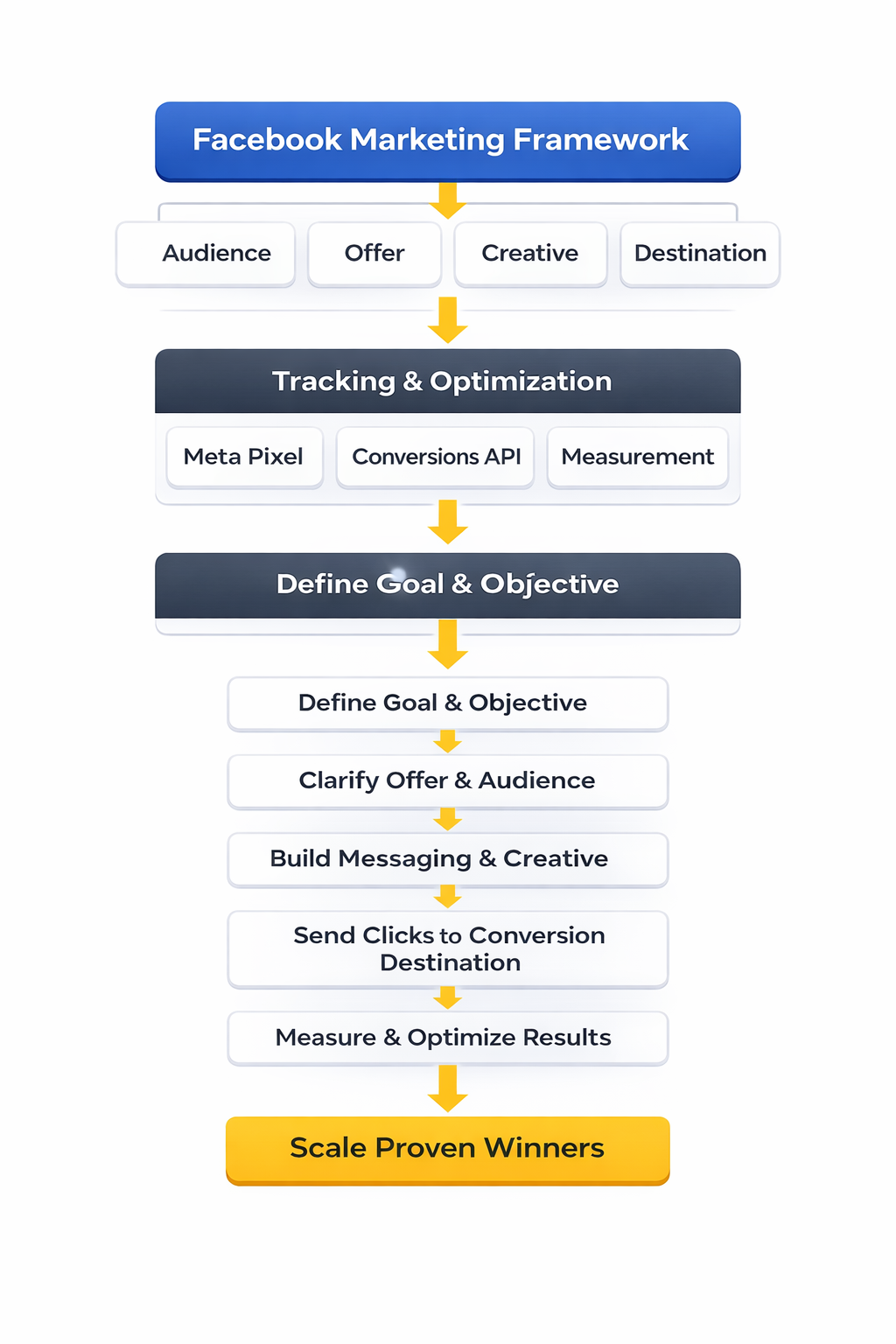
Professional execution starts with alignment, not ad spend. The team knows the core KPI, the acceptable customer acquisition cost, the conversion event being optimized, and the message-market fit of the offer before a campaign ever launches. That alone puts them ahead of a huge percentage of advertisers.
Professional implementation also respects measurement reality. Meta itself recommends using tools such as the Pixel and Conversions API because browser-only tracking is incomplete and modern privacy conditions create gaps if you do not send cleaner event data. That means the real job is not “run some ads,” but build a structure where Facebook can learn from accurate signals and your business can act on the results.
Finally, professionals do not rely on guesswork when reviewing the market. They study live creative in the Ad Library, compare angles, identify repeated hooks, and look for patterns in offers, proof, and calls to action. That gives you a sharper starting point, and it keeps you from building campaigns in a vacuum.
Now that the foundation is clear, the next part moves into audience targeting and offer positioning. That is where Facebook marketing stops being broad theory and starts becoming specific, because the difference between average performance and strong performance usually comes down to whether the right message is reaching the right person with the right promise at the right moment.
From there, we will build outward into creative strategy, campaign setup, optimization, and the advanced decisions that help you scale without wrecking efficiency. That is the real goal of this playbook: not more activity, but better decisions.
If Facebook marketing feels unpredictable, this is usually where things went off track. Most campaigns do not fail because Meta suddenly stopped working. They fail because the advertiser is showing an average offer to the wrong audience, or a strong offer to an audience that has no reason to care yet.
That is why targeting and positioning have to be built together. Meta can help you find people, but it cannot rescue a weak promise, a fuzzy buyer, or a lazy message. The platform is powerful, but it still needs strategic direction.
A lot of advertisers begin with interests because that feels concrete. You can type in a few categories, pick some behaviors, and launch something that looks precise. In practice, that often creates fake confidence, especially now that Meta keeps pushing advertisers toward broader AI-assisted delivery through tools like Advantage+ audience and Advantage+ detailed targeting.
The smarter approach is to start with buyer intent. Ask what problem the customer is trying to solve, how urgently they want it solved, what objections are slowing them down, and what would make them trust a solution fast. Once that is clear, your Facebook marketing gets sharper because the audience definition comes from actual commercial reality, not from random boxes inside Ads Manager.
This matters even more because Meta’s own targeting options have changed. The platform has consolidated and adjusted parts of detailed targeting over time, including updates to detailed targeting groupings in 2025, so the old obsession with micro-targeting keeps getting weaker. Broad targeting is not lazy when the offer is clear and the conversion signal is strong. It is often the more scalable play.
For practical Facebook marketing, most businesses can think in four audience buckets. This keeps the account simple and stops you from building a bloated mess full of overlapping ad sets that compete with each other.
- Warm audiences made up of people who already know you
- Customer-based audiences built from your own first-party data
- Lookalike audiences modeled from high-quality source data
- Broad prospecting audiences where Meta has room to learn and expand
Warm audiences are usually the easiest place to find efficient wins. Meta lets advertisers build custom audiences from website visitors, customer lists, app activity, and engagement across Meta technologies, which makes retargeting one of the most practical parts of the platform. If someone visited a product page, watched your video, opened a form, or engaged with your content, they have already moved beyond cold awareness. Treating them like total strangers is a mistake.
Customer-based audiences matter because they connect your own data to the platform. Meta supports customer list custom audiences, which means your email list, lead database, or customer file can become one of the strongest assets in your Facebook marketing system. This is one reason first-party data has become so important. The brands with cleaner customer data usually make better retargeting decisions, better exclusions, and better seed audiences.
Lookalike audiences are still useful, especially when the source data is strong. Meta defines lookalike audiences as a way to reach new people who share similar characteristics with an existing audience. That sounds simple, but the real lever is the source. A lookalike built from all leads is not the same as one built from qualified leads, repeat buyers, or high-value customers.
Broad prospecting is the audience bucket many advertisers resist until they finally test it properly. But Meta has spent years investing in AI-driven delivery, and the company openly frames Advantage+ campaign setup and AI-based ad ranking improvements as core drivers of better audience matching. That does not mean “go broad and pray.” It means broad often works best when you feed the system a clear objective, strong creative, and a meaningful conversion event.
This is the part too many people skip. They think Facebook marketing is mainly about getting the click, when the real game is getting the right person to care enough to act. Your offer has to match how aware the audience already is.
Cold audiences usually respond better to a lower-friction entry point. That could be a useful lead magnet, a diagnostic, a free tool, a short demo, a practical checklist, or a compelling piece of educational content. If the sale requires trust, pushing a hard conversion too early can wreck performance before the algorithm has enough good signals to learn from.
Warm audiences can handle a stronger ask because the trust gap is smaller. Someone who already visited your site, joined your email list, or engaged with your brand has more context. This is where direct product offers, booking calls, limited-time promotions, and stronger sales messaging usually make more sense.
That is why the campaign objective must support the offer, not fight it. Meta’s current framework is built around six campaign objectives and its guidance on choosing the right ad objective is straightforward: match the objective to the result you actually want. If your real goal is qualified leads, using a traffic campaign because clicks look cheaper is usually self-sabotage.
When marketers say an ad “converted because of the copy,” they are often giving the copy too much credit. Strong copy matters, but positioning does the heavier lifting. Positioning answers the question: why should this specific audience believe this offer is for them, now, instead of later, and from you instead of everyone else?
Good positioning usually comes from specificity. That can mean calling out the use case, the pain point, the speed of the result, the risk reduction, the type of buyer, or the business context. Weak positioning sounds broad and polished. Strong positioning sounds like it understands the reader’s situation before the click.
This is where landing pages matter too. If your Facebook marketing message promises one thing and your destination page drifts into generic brand language, performance will suffer. Tools built for fast campaign-to-page alignment, like ClickFunnels, Systeme.io, or lead-form workflows supported by Fillout, can help tighten that handoff when speed and testing matter.
Some advertisers learn this too late. Not every category gets the same targeting freedom, and pretending otherwise can get campaigns restricted or force bad planning decisions. Meta requires advertisers in sensitive areas to choose the correct Special Ad Category, and those categories come with audience limitations designed to reduce discriminatory targeting.
That means Facebook marketing in areas like housing, employment, or certain financial services needs a different playbook. You cannot build strategy on assumptions that no longer apply. The more regulated the offer, the more disciplined you need to be with compliance, first-party data, creative clarity, and campaign structure.
The big takeaway is simple: better targeting starts before Ads Manager. When you know who the buyer is, what stage they are in, what promise matters to them, and what kind of ask fits that moment, Facebook marketing becomes much more predictable. In the next part, we will turn that foundation into creative, messaging, and campaign setup that gives Meta something worth optimizing.
Once the audience and offer are clear, Facebook marketing becomes an execution discipline. This is where campaigns either turn into a structured testing engine or collapse into random ads that never gather useful data. The difference is almost always process.
Creative and messaging do the heavy lifting inside Meta’s system. The platform’s ranking and delivery models prioritize ads that drive meaningful interactions and conversions. Meta openly explains that its ad auction considers expected action rates, ad quality signals, and advertiser bids when determining delivery in the Meta ads auction overview. That means the creative itself is one of the most powerful levers you control.
Design trends change constantly. What actually moves performance is whether the ad makes the offer instantly understandable to the right person. Facebook marketing rewards clarity far more than cleverness.
A strong ad typically answers four questions in the first few seconds:
- Who is this for
- What problem does it solve
- Why should someone trust the solution
- What happens if they click
That can appear in multiple formats. Video continues to dominate attention across Meta’s ecosystem, particularly short-form vertical formats that align with mobile behavior. Meta has repeatedly highlighted video engagement across its platforms, including Reels growth and video discovery trends in its Meta earnings updates.
But static images, carousels, and simple graphic ads still work extremely well when the message is strong. In fact, many high-performing Facebook marketing campaigns use surprisingly simple visuals paired with very direct messaging.
Instead of guessing endlessly, it helps to organize creative into a few repeatable formats. These formats consistently show up in winning Facebook marketing campaigns because they match how people evaluate products and services.
- Problem-solution ads These highlight a specific pain point and present the offer as the clear answer. They work particularly well in prospecting campaigns where the audience may not know your brand yet.
- Demonstration ads Showing the product in action reduces friction. If a viewer can immediately see how something works, the trust barrier drops.
- Social proof ads Testimonials, reviews, or customer success examples can dramatically increase credibility. This is especially powerful when the buyer needs reassurance before committing.
- Educational ads Teaching something useful before asking for the sale works well with colder audiences. It positions the brand as a trusted authority and often drives higher-quality traffic.
The best advertisers rarely rely on one ad alone. Instead, they launch multiple creative angles simultaneously and allow the algorithm to find early signals.
Execution becomes far easier when you treat Facebook marketing like a structured experiment rather than a single bet. The goal is not to guess the perfect ad. The goal is to quickly discover which combination of message, creative, and audience generates meaningful signals.
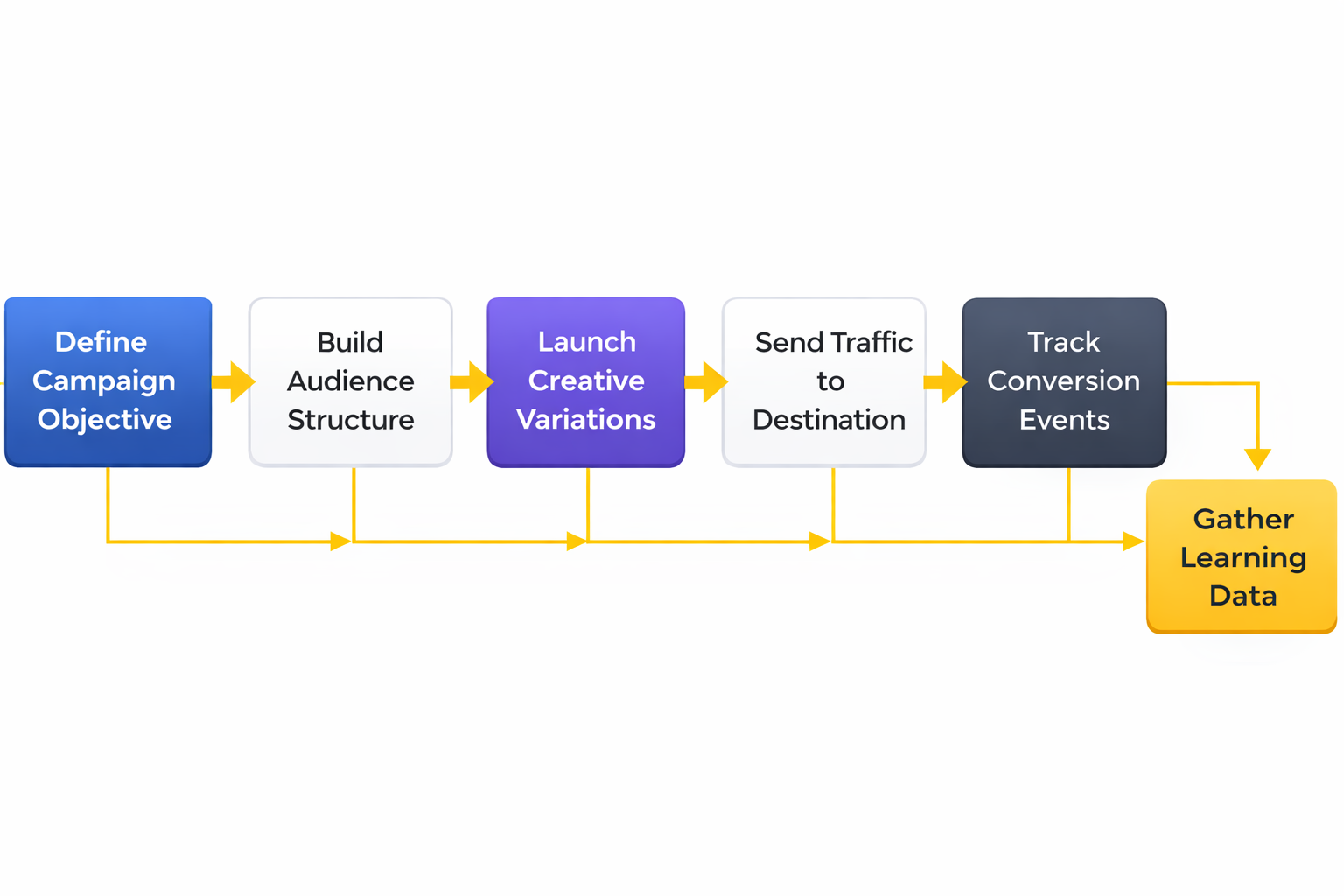
A simple but effective execution process looks like this:
- Define the campaign objective Choose the objective that matches the real business outcome. Meta’s campaign system is built around objectives like leads, engagement, traffic, or sales, and the platform optimizes delivery differently depending on the selection.
- Build the audience structure Create separate ad sets for warm audiences, lookalike audiences, and broad prospecting when relevant. This keeps signals clean and makes performance easier to interpret.
- Launch multiple creative variations Instead of launching one ad, deploy several creative angles. Different hooks, visuals, and headlines give the algorithm room to learn.
- Send traffic to a conversion-focused destination Ads are only the front door. If the landing page fails, the campaign will fail with it. Tools designed for rapid funnel building like ClickFunnels or integrated marketing platforms like Systeme.io make it easier to align ads with high-converting pages.
- Track meaningful conversion events Meta’s optimization relies heavily on conversion signals. Properly configured tracking tools such as the Meta Pixel and Conversions API help the system identify which users are most likely to convert.
- Let campaigns gather learning data Constantly editing campaigns during the learning phase often resets optimization. Meta documents how campaigns enter a learning phase where the algorithm gathers data to improve delivery.
The execution phase is where patience becomes a strategic advantage. Many advertisers sabotage campaigns by interfering too early or by shutting down experiments before enough data appears.
One of the biggest misconceptions in Facebook marketing is that the ad alone determines success. In reality, the ad, landing page, email follow-up, and CRM workflow all shape the outcome.
If the campaign collects leads, those leads need immediate follow-up. Platforms designed for email automation and contact management such as Brevo or Moosend allow businesses to nurture leads captured from Facebook campaigns with automated sequences and targeted messaging.
This matters because lead quality often depends on what happens after the form is submitted. Strong follow-up sequences can dramatically increase conversion rates without increasing ad spend. In other words, Facebook marketing becomes far more profitable when the rest of the marketing system supports it.
Some businesses only run Facebook ads when they launch a promotion. That approach wastes one of the platform’s biggest advantages: accumulated learning and audience familiarity.
Consistent campaigns allow advertisers to refine targeting, improve creative libraries, and gather meaningful performance data over time. Brands that treat Facebook marketing as an ongoing acquisition engine usually develop stronger insights about their buyers and their messaging.
This is also where content rhythm helps. When organic and paid campaigns reinforce each other, audience trust grows faster. Scheduling tools like Buffer help maintain that rhythm, ensuring the brand remains visible between paid pushes.
The implementation phase turns strategy into action. But action alone does not guarantee results. The next stage is where disciplined advertisers gain their real advantage: measuring what actually works and scaling only what proves it deserves more budget.
Measurement is where Facebook marketing gets real. Up to this point, you can still hide behind creative opinions, audience theories, and launch excitement. Once the data starts coming in, the only thing that matters is whether the campaign is creating profitable movement through the funnel.
This is also where a lot of marketers get lost. They stare at dashboards full of numbers, react to whatever looks dramatic, and make changes before they understand what the numbers actually mean. Good measurement is not about collecting more metrics. It is about knowing which signals deserve action and which ones are just noise.
At the platform level, Facebook is still operating at a scale that makes serious advertiser attention completely rational. Meta’s own tools, summarized by DataReportal’s 2025 Facebook statistics, showed Facebook ads reaching 2.28 billion users in January 2025, while Meta’s Q4 and full-year 2025 results reported 3.58 billion daily active people across the company’s family of apps in December 2025. Those are not vanity numbers. They explain why Facebook marketing remains relevant even when organic distribution gets harder.
But platform scale should not trick you into believing your campaign is working. Big reachable audiences only tell you the market is there. They do not tell you whether your offer, your creative, or your funnel can convert inside that market.
That distinction matters because many advertisers confuse exposure with progress. Reach and impressions can confirm delivery, but they do not confirm business value. You still need deeper performance signals before you can call a campaign healthy.
The first layer of data tells you whether the market is reacting to the ad. That usually starts with impressions, reach, frequency, click-through rate, thumb-stop behavior on video, and outbound clicks. These metrics do not close the loop, but they tell you whether your message is strong enough to earn attention.
A useful benchmark source still cited widely in the industry, WordStream’s updated Facebook ad benchmarks, puts the average Facebook ads click-through rate across industries at 0.89% and average cost per click at $1.68. Those numbers should be used carefully. They are directional, not universal, because industry mix, geography, optimization goal, creative quality, and placement choices can swing performance hard.
That is why experienced operators do not obsess over beating a global average. They ask a better question: is this response level strong enough for our business model and our funnel stage? A cold-audience education ad can tolerate different click economics than a bottom-funnel product offer. The benchmark helps you orient yourself, but it should never make the decision for you.
This is where Facebook marketing separates curiosity from commercial intent. A cheap click is worthless if the landing page leaks trust, the lead form attracts the wrong people, or the conversion event is too soft to reflect real buying behavior. Once traffic arrives, the next layer of measurement has to focus on landing page view quality, lead rate, purchase rate, cost per acquisition, return on ad spend, and where possible, downstream revenue quality.
Meta’s own ad system is designed around this logic. The company explains in its guidance on ad delivery and choosing campaign objectives that delivery is optimized around the result you tell it to pursue. That means if you optimize for low-friction actions that do not correlate with revenue, the platform may get better at finding cheap low-friction actions, not better customers.
This is the trap behind a lot of misleading Facebook marketing reports. A campaign can look efficient on surface metrics and still damage the business because the leads are weak, the purchases are low value, or the retention is poor. Real measurement connects ad spend to outcomes that matter after the click.
The analytics stack for Facebook marketing should not be improvised after launch. You want your tracking system in place before you spend serious money, because optimization quality depends on the signals you send back into Meta. That is exactly why Meta keeps pushing advertisers toward the Meta Pixel and the Conversions API.
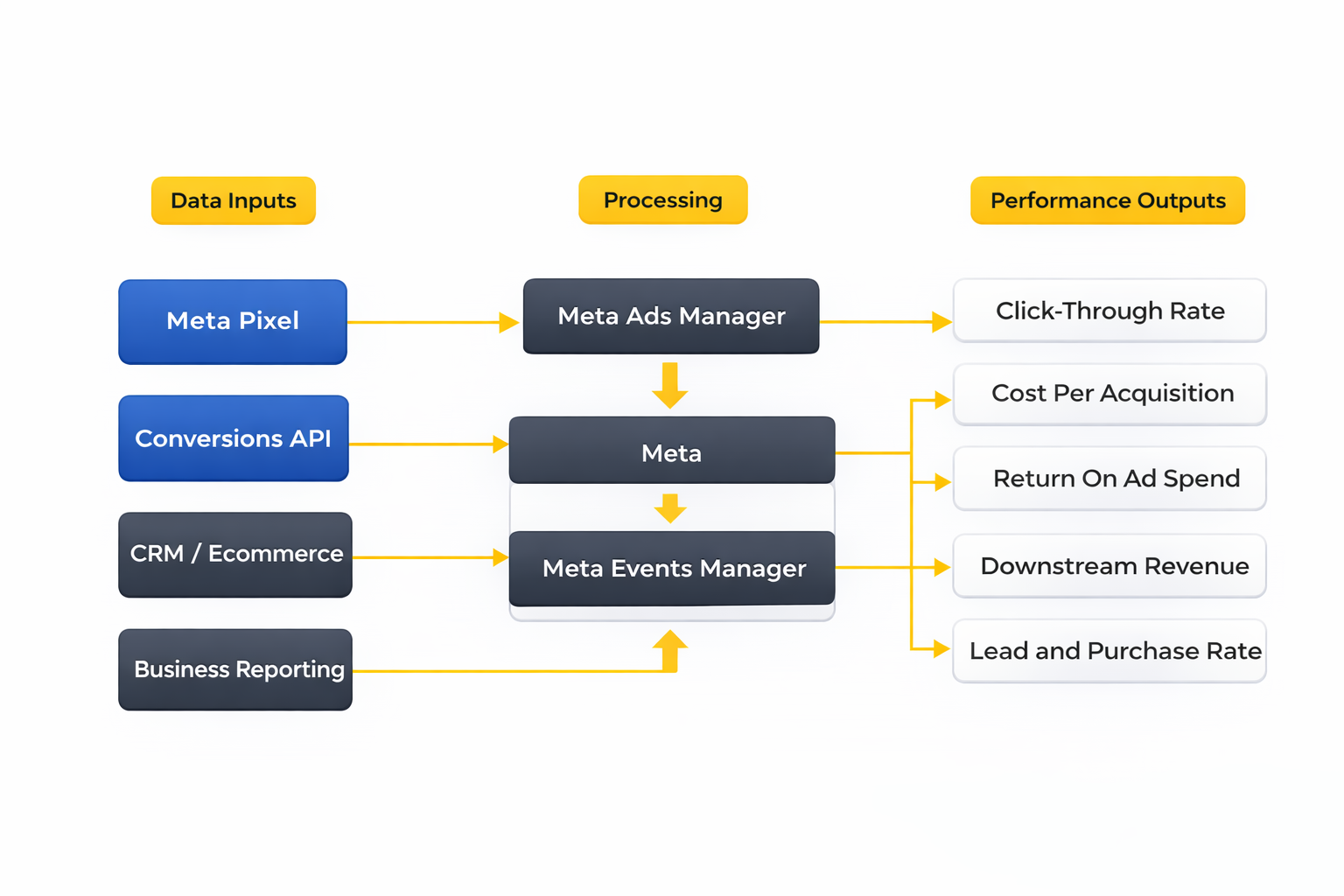
The reason is practical, not technical theater. Browser-only tracking is incomplete, and Meta’s own documentation around the Conversions API makes clear that server-side event sharing helps improve reliability and supports better measurement and optimization. If your event data is broken, delayed, duplicated, or too shallow, the platform learns from bad information.
A useful measurement stack usually includes four pieces working together. Ads Manager shows delivery and campaign performance. Events Manager validates whether tracking is firing properly. Your CRM or ecommerce backend shows lead quality and sales reality. Then your reporting layer pulls those together so you can judge performance without being fooled by one platform’s partial view.
Frequency is one of the simplest metrics in Facebook marketing, but it gets ignored constantly. When the same audience sees the same message too often, performance can flatten or deteriorate even when the offer itself is still strong. That usually shows up as rising costs, weaker click-through rates, lower conversion efficiency, or a general sense that the campaign has gone stale.
There is no perfect universal frequency number because audience size, buying cycle, and creative variety all change the threshold. Still, a rising frequency combined with worsening response is one of the clearest signs that action is needed. The action might be refreshing creative, widening the audience, changing the angle, or reducing pressure on an overworked retargeting pool.
The key point is that frequency only becomes meaningful when paired with other signals. A higher frequency is not automatically bad. It becomes a warning when it lines up with declining performance and no longer produces incremental value.
Attribution is where people become far too certain. They see a return number in Ads Manager and treat it like courtroom evidence, even though modern marketing attribution is full of blind spots, overlap, and timing issues. Facebook marketing absolutely needs attribution, but it also needs humility about what attribution can and cannot prove.
Meta itself has adjusted measurement and attribution tools repeatedly, and its documentation on incremental attribution shows that the company is trying to move beyond simplistic last-touch thinking. That is a smart direction, because many conversions would have happened anyway, while others are influenced by several channels long before the final click appears. So the right question is not just “what got credit?” but “what likely created incremental lift?”
This changes how you interpret performance. If branded search rises, direct traffic improves, and sales increase while Facebook campaigns are active, the platform may be doing more work than last-click reporting shows. On the other hand, if Facebook claims strong return but your actual contribution margin is weakening, the campaign may be taking too much credit. Good operators compare platform reporting with business reporting and never let one dashboard tell the whole story.
Breakdowns are one of the best ways to understand performance inside a live account. Meta’s reporting tools and breakdown options let you inspect results by age, gender, placement, region, time, and other dimensions. Done properly, this helps you spot wasted spend, unusually strong pockets of performance, and creative mismatches.
But Meta also warns advertisers about the breakdown effect, where people misread segmented performance and assume the system is wasting spend in the wrong places. That warning is important. The system often distributes impressions dynamically based on expected total performance, not on making every segment look equally pretty in a report.
So the action here is not to ban breakdowns. It is to use them with discipline. If a segment is underperforming consistently and materially, investigate it. But do not destroy a profitable campaign just because one placement or one demographic slice looks less attractive in isolation.
The whole purpose of measurement is action. Every reporting cycle should tell you whether to keep spending, reduce waste, test a new angle, repair tracking, improve the landing page, or scale what is working. If the data does not lead to a decision, it is just decoration.
A practical review process usually looks like this:
- Check delivery stability and learning status
- Review first-response metrics like CTR, CPC, video hold rate, and outbound clicks
- Review funnel metrics like lead rate, add-to-cart rate, purchase rate, or booked call rate
- Compare platform-reported outcomes with CRM or revenue data
- Decide whether the bottleneck is audience, offer, creative, page, follow-up, or tracking
That process matters more than any random statistic pulled from the internet. Benchmarks can help you calibrate, but your own account history is the real standard once you have enough clean data. Over time, the best Facebook marketing teams build internal benchmarks that are far more useful than public averages because they reflect their market, offer, economics, and funnel design.
The next step is scaling and advanced decision-making. That is where the numbers stop being descriptive and start becoming strategic, because once you know how to read the data properly, you can grow without guessing.
This is the point where Facebook marketing gets expensive for undisciplined teams and very profitable for disciplined ones. Early wins are not that rare. Holding performance while spend rises, competition shifts, creative fatigue builds, and tracking stays imperfect is the real test.
A lot of advertisers think scaling means increasing budget on whatever worked last week. That is usually how they break a campaign that was just starting to stabilize. Meta’s own guidance on the learning phase and significant edits makes the tradeoff clear: aggressive changes can interrupt delivery learning, which means growth has to be managed, not forced. Facebook+1
The strongest Facebook marketing accounts do not rely on brute-force budget increases alone. They scale by improving the quality of conversion signals, expanding creative volume, and giving Meta enough room to find more of the right buyers. That is a very different mindset from “this ad works, so double the budget and hope.”
This is one reason Meta keeps steering advertisers toward AI-assisted systems such as Meta Advantage+. The platform is built to use automation and broader delivery when it has enough signal to work with, but that only helps if your event quality is strong and your offer actually converts. If the signal is weak, broader automation can simply help you waste money faster. Facebook+2
In practice, scaling usually becomes safer when you add more winning creative before you add much more budget. New hooks, new proof angles, new formats, and fresh offers reduce the pressure on a single ad to carry the whole account. That is the part many teams resist because building creative is harder than touching the budget slider, but it is usually the more durable move.
Creative fatigue is one of the biggest hidden taxes in Facebook marketing. The ad may still be technically live, but once the audience has absorbed the message too many times, the response curve changes. Click-through rate softens, conversion cost rises, and the account starts looking like it has an audience problem when it really has a message freshness problem.
This is why advanced teams build creative production into the operating model. They are not waiting until performance collapses to start producing replacements. They are constantly collecting customer language, objections, reviews, sales call themes, and new proof so the next wave of ads is already in motion before the current wave burns out.
There is also a strategic advantage here. The more creative variations you can test, the less dependent you are on fragile targeting tricks. Strong Facebook marketing today is often less about clever audience hacking and more about matching a strong creative angle to a strong signal path.
A campaign can look stuck when the real problem is measurement quality. If event matching is poor, if the wrong priority events are configured, or if data is inconsistent between browser and server sources, Meta has less reliable feedback to optimize against. That is exactly why the company documents Aggregated Event Measurement, Conversions API best practices, and broader Conversions API implementation guidance so heavily. Facebook+2
The practical takeaway is simple. Before assuming your Facebook marketing has hit a ceiling, make sure the measurement foundation is not the actual bottleneck. A campaign cannot scale intelligently on bad feedback loops.
This is also where your own systems matter more than people admit. If leads from Facebook are being qualified poorly, scored inconsistently, or lost inside a weak sales process, the platform may be blamed for a backend failure. Using a proper CRM and follow-up stack can fix more than most ad account tweaks ever will, which is why tools such as Copper, Brevo, or Moosend fit naturally into a serious growth system.
A lot of advertisers treat policy review like annoying paperwork. That is a mistake. In Facebook marketing, compliance is part of campaign design because rejected ads, restricted accounts, and disabled assets can kill momentum faster than weak CTR ever will.
Meta’s Advertising Standards, the broader Transparency Center standards, and its guidance on advertising restrictions make one thing very clear: the platform expects advertisers to follow category, content, and claims rules closely. If your offer sits near health claims, personal attributes, income promises, or sensitive categories, the cost of sloppy copy is not theoretical. It can shut campaigns down at exactly the wrong moment. Facebook+2
That means advanced operators write ads with performance and survivability in mind. They know how to make a strong promise without triggering avoidable policy problems. They also monitor account quality and approval patterns instead of assuming every rejection is random.
Facebook marketing can be an outstanding growth engine, but it is still rented distribution. Algorithms shift, approval systems misfire, competition changes, and attribution never becomes perfectly clean. If the whole business depends on one acquisition channel behaving nicely forever, the business is more fragile than it looks.
The smartest move is to use Facebook to build owned assets. That means email lists, customer databases, remarketing pools, booked relationships, community touchpoints, and direct response infrastructure you control. A lead capture flow built on ClickFunnels, Systeme.io, or qualified forms built with Fillout matters not just for conversion, but for resilience.
This is the deeper strategic tradeoff. If you use Facebook marketing only to chase today’s purchase, you stay vulnerable. If you use it to grow first-party data, improve follow-up, and compound audience insight over time, the channel becomes much more valuable.
The same advanced mistakes appear again and again because they are disguised as action. Teams over-segment accounts until data gets thin. They optimize for cheap proxy events instead of meaningful business outcomes. They kill ads too early, edit campaigns too often, ignore backend conversion quality, and then call the platform unreliable.
Another common mistake is confusing motion with learning. A busy account is not always a smart account. In many cases, better Facebook marketing comes from fewer campaigns, cleaner structures, stronger creative rotation, and more patience with valid tests.
The last big mistake is underestimating operations. Real scaling requires creative throughput, clean reporting, policy awareness, good landing pages, strong lead handling, and decent sales follow-up. Once spend rises, operational weakness shows up everywhere.
At the expert level, Facebook marketing is less about tricks and more about system quality. The offer is clear. The account structure is simple enough to learn. Creative production is continuous. Tracking is strong enough to trust directional decisions. The team knows which metrics matter and which ones are just dashboard wallpaper.
That is also why the best advertisers tend to sound boring when they explain their edge. They are not describing a secret button. They are describing disciplined execution across creative, measurement, compliance, conversion flow, and post-click follow-up.
And that is the right place to end this part of the playbook. By now, the big picture should be clear: Facebook marketing still works, but it rewards structure far more than improvisation. The final part will wrap this up with the closing takeaways and the FAQ that answers the questions readers usually ask when they are trying to turn strategy into action.
By this point, the pattern should be obvious. Facebook marketing works best when it is treated as a connected system rather than a set of isolated tasks. Audience quality, offer clarity, creative strength, landing-page alignment, tracking reliability, and follow-up speed all shape performance together, which is why weak execution in one area can make the whole account look worse than it really is.
That systems view matters even more now because Meta keeps leaning harder into automation, broader delivery, and signal-based optimization through tools like the Meta Pixel, Conversions API, custom audiences, and lookalike audiences. The platform can do a lot, but only when the business gives it enough clear data and enough strong creative to work with. Facebook+3
The real strategic shift is this: stop thinking about Facebook marketing as “buying ads” and start thinking about it as building a repeatable acquisition engine. That engine should create demand, capture demand, qualify demand, and keep improving as more first-party data flows back into the system. When you build it that way, the channel becomes far more durable and a lot less fragile.
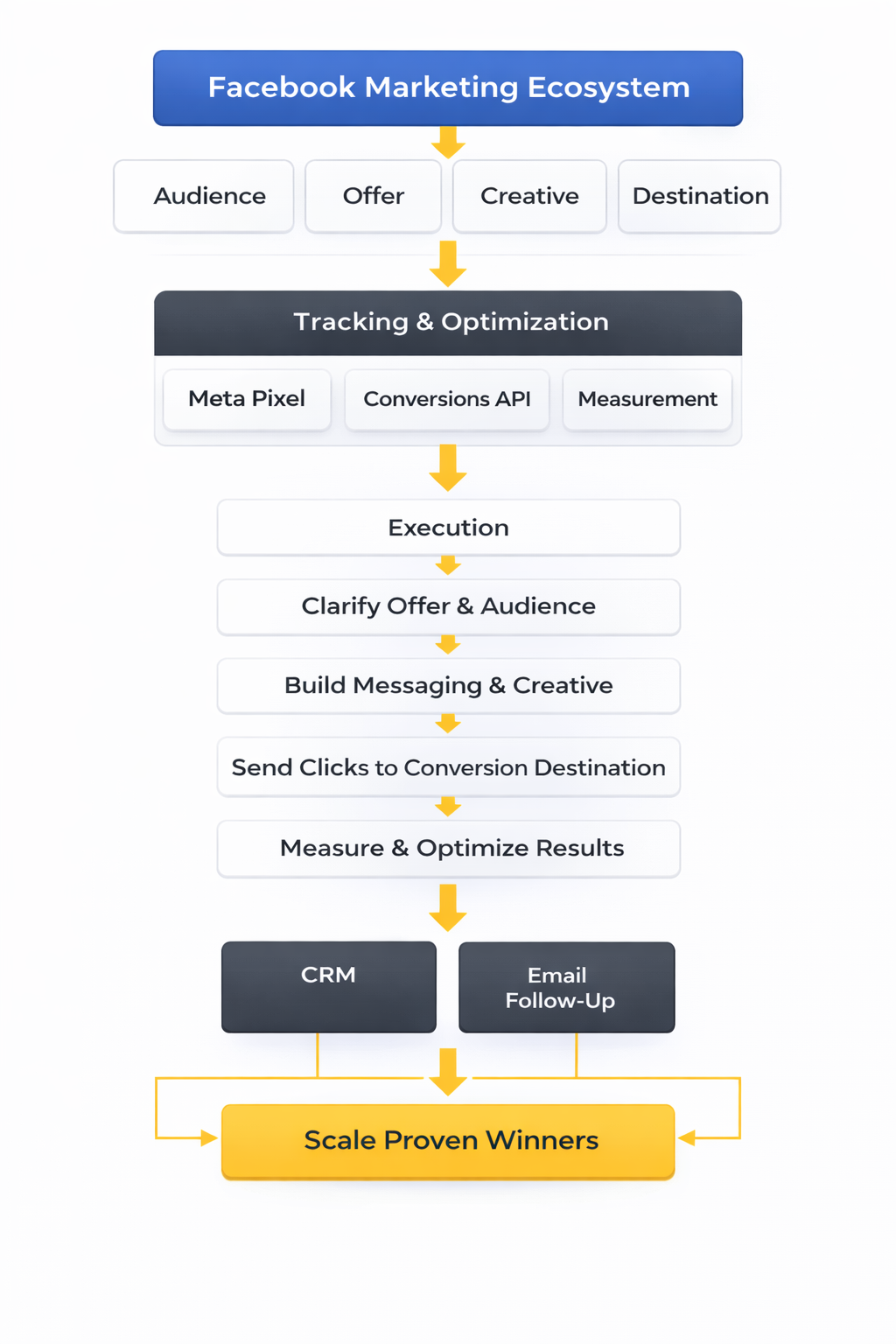
A strong final system usually has a simple shape. Cold traffic sees clear problem-aware or solution-aware creative. Warm audiences get stronger proof, sharper offers, and lower-friction conversion paths. Leads and buyers then move into email, CRM, remarketing, and sales workflows that keep creating value after the first click.
That is also why Facebook marketing still deserves serious attention. Facebook remains one of the most widely used platforms, with 71% of U.S. adults reporting Facebook use in Pew Research’s 2025 study, while Meta reported 3.58 billion daily active people across its family of apps in December 2025. The scale is still there, but the winners are the advertisers who bring discipline to the scale instead of assuming reach alone will save weak strategy. Pew Research Center+1
Yes, but not for lazy execution. Facebook marketing is still worth it because the audience scale and ad infrastructure remain enormous, and Meta’s ecosystem still reaches billions of people every day. The catch is that weak offers, poor tracking, and sloppy creative get exposed faster now, so the channel rewards disciplined operators much more than casual ones. investor.atmeta.com+1
You do not need a massive starting budget, but you do need enough money to gather useful learning data. Meta’s own delivery guidance explains that ad sets generally need around 50 optimized events to exit the learning phase, which means the real answer depends on your conversion rate and your cost per result, not on a magical fixed number. A small budget can work if the offer is simple, the audience is clear, and the conversion event is realistic for the amount you can spend. Facebook+1
The most common mistake is optimizing for cheap activity instead of meaningful outcomes. Beginners often celebrate low-cost clicks or engagement while ignoring whether those clicks produce qualified leads, purchases, or revenue. Facebook marketing gets much more predictable once you optimize for the event that actually matters to the business instead of the event that makes the dashboard look exciting.
Broad targeting is often stronger than people expect, especially when your creative and conversion signals are strong. Meta has spent years improving signal-based delivery and automated audience expansion, so the old obsession with endless targeting layers is usually less useful than it used to be. Detailed targeting still has a place, but broad testing often gives the system more room to find converters efficiently. Facebook+1
Absolutely, because custom audiences are one of the cleanest ways to connect your own business data to Meta’s delivery system. Website visitors, customer lists, video viewers, and engaged users are usually some of the highest-value pools inside a Facebook marketing strategy because they already know you or have shown intent. That makes them critical for retargeting, exclusions, and seed audiences for broader expansion. Facebook+2
Yes, but the quality of the source audience matters more than the label itself. A lookalike built from weak leads will usually be weaker than a lookalike built from high-quality customers, repeat buyers, or highly qualified opportunities. In practical Facebook marketing, lookalikes still make sense when you have clean source data and want to extend what is already working. Facebook+2
Because browser-only tracking is incomplete, and Meta wants advertisers sending stronger event data back into the system. The Meta Pixel tracks website actions, while the Conversions API creates a more direct connection between your marketing data and Meta’s optimization systems. In plain English, better signal quality usually gives Facebook marketing a better chance of finding the people most likely to convert. Facebook+2
Long enough to see whether the campaign is producing stable signals, but not so long that obvious waste drags on for weeks. Meta explains that the learning phase is the period when the system is still exploring how best to deliver an ad set, and significant edits can reset or disrupt that process. That means Facebook marketing usually performs better when you make fewer impulsive changes and judge campaigns with enough data to support the decision. Facebook+1
Refresh creative when the audience is showing signs of fatigue, not on an arbitrary calendar alone. If frequency rises while click-through rate, conversion rate, or efficiency trends in the wrong direction, the account is often telling you the message is getting stale. Strong Facebook marketing teams avoid waiting for a full collapse by continuously producing new hooks, angles, visuals, and proof points.
The answer depends on funnel stage, but the principle is simple: the closer a metric is to revenue, the more it deserves your attention. Reach, impressions, and CTR help diagnose attention and message fit, but lead quality, purchase rate, customer acquisition cost, and contribution to real revenue matter far more for decision-making. Good Facebook marketing reporting moves from delivery metrics to conversion metrics to business outcomes instead of stopping at surface-level numbers.
For most businesses, organic alone is not enough if the goal is predictable acquisition. Organic content can build familiarity, proof, and community, but paid distribution gives you speed, targeting, retargeting, and controllable reach that organic posting rarely delivers on its own. The best Facebook marketing setups usually let organic and paid reinforce each other instead of pretending one should replace the other.
Businesses with clear offers, real margins, strong creative potential, and a follow-up process usually have the best shot. That includes ecommerce brands, lead generation businesses, local services, education offers, info products, software with a clear use case, and many B2B offers with a practical conversion path. Facebook marketing becomes much harder when the offer is vague, the economics are weak, or the sales process after the click is broken.
It is extremely important because account quality and ad approvals directly affect momentum. Meta’s Advertising Standards and business help guidance make clear that advertisers need to follow rules on prohibited content, restricted categories, and ad claims. In practice, strong Facebook marketing is not just persuasive, it is also durable enough to survive review and keep running. Transparency+1
The smartest long-term goal is not just more purchases today. It is building owned demand assets like email lists, customer databases, warm audiences, remarketing pools, and CRM intelligence that make every future campaign stronger. That is when Facebook marketing stops being a short-term traffic source and starts becoming a compounding business asset.
The big lesson is not complicated. Facebook marketing still works, but it no longer rewards random effort nearly as much as it rewards system quality. The businesses that win are the ones that connect strategy, creative, measurement, compliance, conversion flow, and follow-up into one operating model.
If you want the shortest version possible, here it is. Know the buyer. Tighten the offer. Match the message to awareness. Track what matters. Respect the learning process. Refresh creative before fatigue gets expensive. And build owned assets so every campaign makes the next one stronger.
Most marketers spend too much time chasing clients, competing on crowded platforms, and losing a percentage of every project to middlemen. MarkeWork gives you a better way. Browse thousands of remote marketing contracts and connect directly with companies desperate to hire skilled marketers like you, without platform commissions and without unnecessary gatekeepers.
If you're serious about finding better opportunities and keeping 100% of what you earn, explore available contracts and create a profile for free at MarkeWork.com.