

Flodesk pricing used to be simple: one flat rate, unlimited subscribers, and a very clear pitch for creators who wanted beautiful emails without enterprise-style complexity. That changed. Flodesk now uses subscriber-based pricing for new customers, which means the right plan depends less on “Is Flodesk affordable?” and more on how your list, automations, sales pages, and checkout needs fit together.
That is why this guide will not just list prices. We will break down what each plan actually gives you, where the costs can grow, when Flodesk makes sense, and when another tool may be a cleaner fit. The goal is simple: help you pick the plan that protects your margin instead of quietly eating it.
Article Outline
- Why Flodesk Pricing Matters
- Flodesk Pricing Framework
- Flodesk Plan Breakdown
- Core Features That Affect Value
- Professional Implementation Checklist
- Flodesk Pricing FAQ
Why Flodesk Pricing Matters
Pricing matters because email software is not just another monthly subscription. It sits directly between your audience and your revenue. If the tool is too limited, you lose growth opportunities; if it is too expensive for your stage, you lose margin before the channel has time to mature.
Flodesk is especially interesting because it is built for people who care about design, simplicity, and selling without duct-taping five tools together. That makes it attractive for creators, coaches, service providers, digital product sellers, and small ecommerce brands. But those same users also need to know when the prettier interface is worth the premium.
The real question is not whether Flodesk pricing is “cheap” or “expensive.” The better question is whether the plan you choose matches the way your business actually makes money. A newsletter-only creator, a course seller, and a service business with automated lead nurturing should not evaluate Flodesk the same way.
Flodesk Pricing Framework
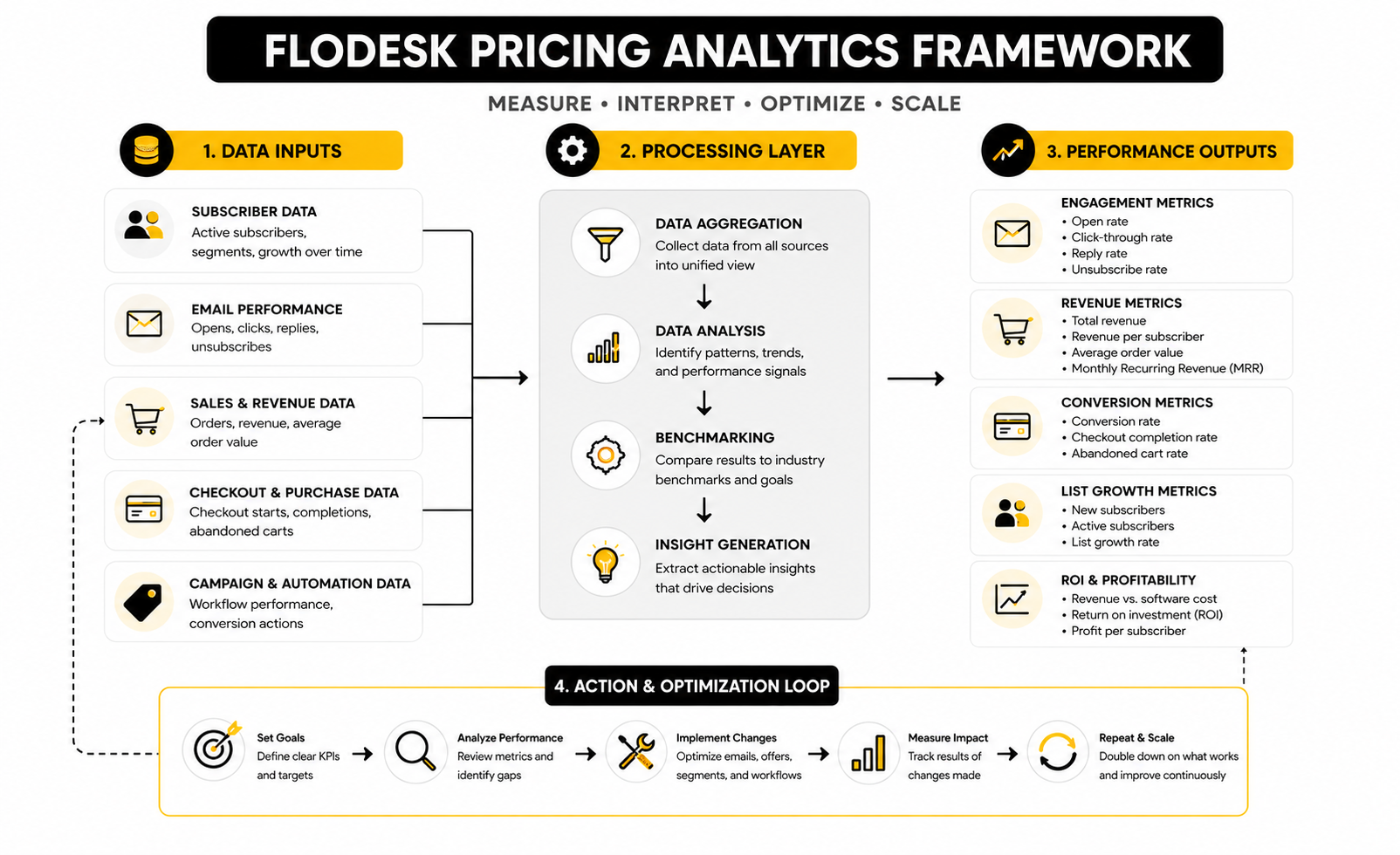
Use Flodesk pricing as a decision framework, not a price list. Start with your current list size, then look at how fast that list is growing, how much revenue email already drives, and whether you need automations or checkout features. That gives you a much clearer answer than simply choosing the lowest monthly plan.
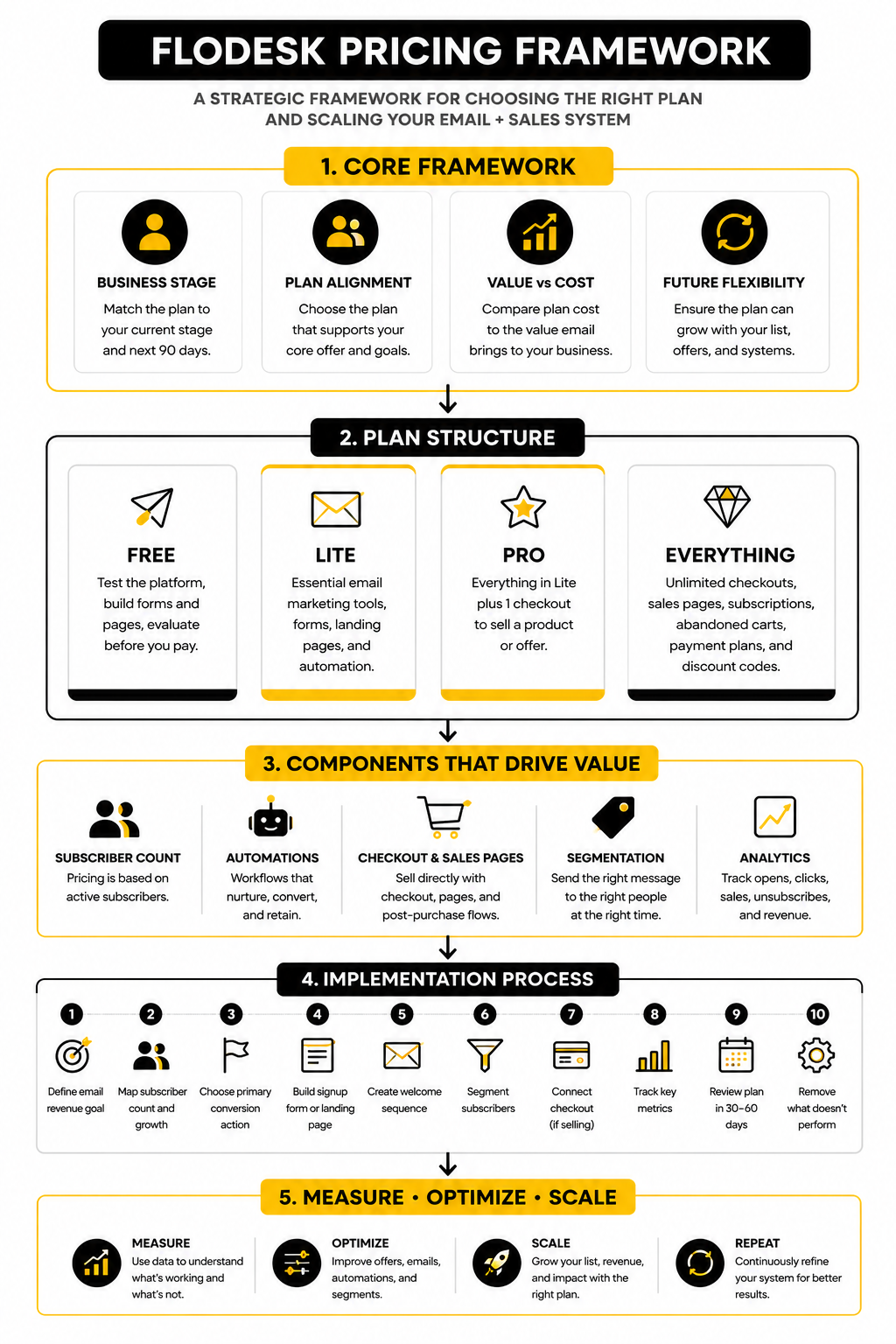
The framework for this article is simple: match your plan to your revenue system. If you only need forms and landing pages, you should think differently than someone running automated launches, paid products, abandoned cart flows, or post-purchase sequences. The more your email system supports revenue, the easier it becomes to justify a higher tier.
This is also where alternatives belong in the conversation. If you need broader CRM, funnels, pipeline automation, or agency-style client management, a platform like GoHighLevel may be more useful than a design-first email platform. If you mainly need lean email marketing at a lower cost, Moosend or Brevo may be better comparisons.
Flodesk Plan Breakdown
The next step is understanding what the current Flodesk pricing structure is actually charging for. For new customers, Flodesk now ties pricing to active subscriber count, and its own help center says this subscriber-based model started on December 2, 2025. That matters because older reviews may still describe the legacy flat-rate plan, which can make the tool look cheaper or simpler than it is for someone signing up today.
Flodesk now separates value across four plan types: Free, Lite, Pro, and Everything. The Free plan is useful for testing the interface, building forms, and getting comfortable with the editor before committing. But once email becomes part of your sales system, you will usually be comparing Lite, Pro, and Everything rather than treating Free as a long-term operating plan.
The clean way to read the plans is this: Lite is for basic email marketing, Pro is for more serious email growth plus limited checkout capability, and Everything is for people who want email, sales pages, checkout, subscriptions, abandoned cart automations, payment plans, and discount codes in one place. Flodesk’s own pricing page says Checkout is included on Pro with one checkout and on Everything with unlimited checkouts, while Stripe still handles payment processing separately.
Free
Free is best for evaluating whether Flodesk feels right. You can test the design workflow, see how forms and pages are built, and decide whether the platform matches your style before you pay. That is useful because Flodesk’s strongest appeal is not just functionality; it is how quickly non-designers can create polished assets.
The limitation is that Free should not be treated like a real business infrastructure plan. If email is meant to drive revenue, you need sending, automation, segmentation, and enough flexibility to run campaigns without hitting a wall. Free is a trial environment, not the place to build your full customer journey.
Use Free when you are comparing tools, building your first list asset, or validating whether the editor saves you time. Do not stay there just because it costs nothing. Free software can still become expensive if it delays launches, creates manual work, or keeps your audience sitting idle.
Lite
Lite is the first real paid step in the Flodesk pricing ladder. It is the natural fit if you want simple newsletters, branded campaigns, signup forms, and landing pages without needing built-in selling features yet. For creators and solo operators, this can be enough if the main job is to grow and communicate with an audience.
The main question is whether your email strategy stops at communication or continues into conversion. If you only need to send weekly updates, nurture a lead magnet audience, or announce services manually, Lite can make sense. But once you want checkout, abandoned cart recovery, subscriptions, or a more complete sales flow, Lite can start to feel like a halfway step.
This is where you should be honest about your next 90 days. If you are only publishing and nurturing, Lite is practical. If you already know you will sell digital products, coaching, templates, memberships, or workshops through your email list, skipping straight to a higher plan may be cleaner.
Pro
Pro is where Flodesk becomes more interesting for small businesses that want email and selling under one roof. The inclusion of one checkout gives you a simple path to sell a product or offer without immediately adding a separate checkout platform. That can be a big deal if your business has one core offer and you want less tech friction.
The tradeoff is obvious: one checkout is useful, but it is not unlimited flexibility. A creator with one flagship digital product might be fine. A business with multiple offers, order bumps, payment plans, subscriptions, and seasonal promotions may outgrow that setup quickly.
Pro works best when your offer structure is simple and your list is valuable enough to justify moving beyond basic email. It is not the plan for people who want to run a full catalog of products inside Flodesk. It is the plan for someone who wants a focused email-and-sales setup without overbuilding.
Everything
Everything is the plan that should be evaluated as a revenue system, not just an email tool. It includes unlimited checkouts, sales pages, payment plans, subscriptions, abandoned cart automations, and discount codes. That changes the math because the plan is no longer only about sending campaigns; it is about whether Flodesk can replace several smaller tools in your stack.
This is the plan that makes the most sense when you sell directly to your audience. Digital products, paid workshops, coaching packages, memberships, templates, and simple service offers all fit the model. If your sales process is straightforward, Everything can remove a lot of the tool-hopping that slows small teams down.
But it is not automatically the best plan for everyone. If you need complex funnels, deep CRM pipelines, appointment workflows, client subaccounts, or agency automation, GoHighLevel may be a stronger strategic fit. If you want a more budget-conscious email platform with automation, Moosend and Brevo are worth comparing before you commit.
Core Features That Affect Value
The plan you choose should be driven by the features that actually change your workflow. Flodesk pricing looks different when you only need newsletters compared with when you need automations, sales pages, checkout, subscriptions, and abandoned cart recovery. The mistake is paying for a plan because it sounds more complete, then using only 20% of it.
Start by separating “nice to have” from “this makes money.” A beautiful email editor is useful because it helps you publish faster and stay consistent, but the real value comes from the system around it. Forms, segments, workflows, checkout pages, and post-purchase emails are the pieces that turn Flodesk from a design tool into a revenue tool.
Email is still worth taking seriously because it remains one of the most durable marketing channels. Recent benchmark roundups continue to place email marketing ROI around the 36 to 42 dollars returned for every dollar spent, but that number only means something when your setup is intentional. A messy list, weak offer, or half-built automation will not magically perform because the software looks good.
Subscriber Count
Subscriber count is now the first pricing variable to watch. If your list is small and growing slowly, the lower tiers can stay affordable for a while. If your list grows quickly through lead magnets, partnerships, ads, or viral social content, your monthly cost can rise with it.
That does not make subscriber-based pricing bad. It just means you need list hygiene. Remove inactive subscribers, segment people based on behavior, and stop treating every email address as equally valuable.
A smaller engaged list is usually better than a bloated one. This is especially true when your email platform charges based on active subscribers. You want your Flodesk account to reflect real business assets, not vanity metrics.
Automations
Automations are where Flodesk pricing becomes easier to justify. A manual newsletter is useful, but automated welcome sequences, lead magnet delivery, product education, and post-purchase follow-up are what give email leverage. Once these workflows are set up, they keep working while you focus on acquisition, offers, and delivery.
The key is to avoid building automations just because the feature exists. Every workflow should have a clear job. It should welcome, qualify, educate, sell, onboard, recover, or retain.
For most businesses, the first automation should be a simple welcome sequence. After that, build around behavior. Someone who downloads a guide, clicks a product link, or buys an offer should not receive the same experience as a cold subscriber who has never engaged.
Checkout And Sales Pages
Checkout features matter if you sell directly from your list. This is where Flodesk can reduce friction for creators and small businesses that do not want a separate sales page builder, checkout tool, and email platform. If one platform can handle the page, the payment flow, and the follow-up emails, implementation gets much cleaner.
That said, simple checkout is not the same as a full funnel platform. If you need multi-step funnels, advanced upsells, client pipelines, or broader CRM automation, ClickFunnels or GoHighLevel may fit better. Flodesk is strongest when your sales path is clean, visual, and direct.
The practical test is simple. If your offer can be explained on one focused page and sold with a clean checkout, Flodesk can be enough. If your sales process needs complex branching, sales calls, pipeline stages, or agency-style workflows, you should compare it against a heavier system before choosing.
Professional Implementation Checklist
Once the plan is clear, implementation should be boring in the best possible way. You are not trying to build the most complex email machine in your market. You are trying to build a reliable system that captures leads, sends the right messages, sells the right offer, and gives you data you can actually use.
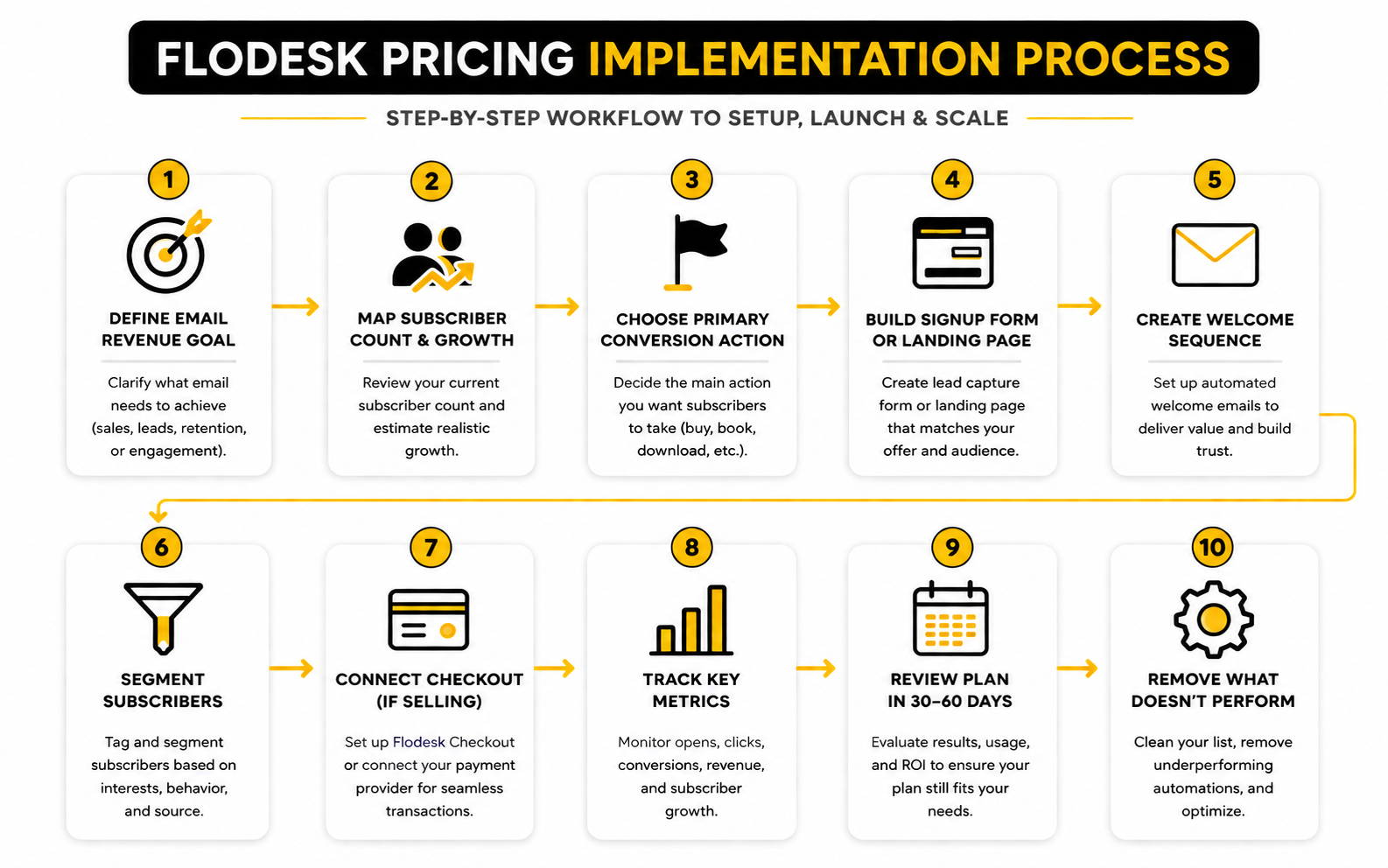
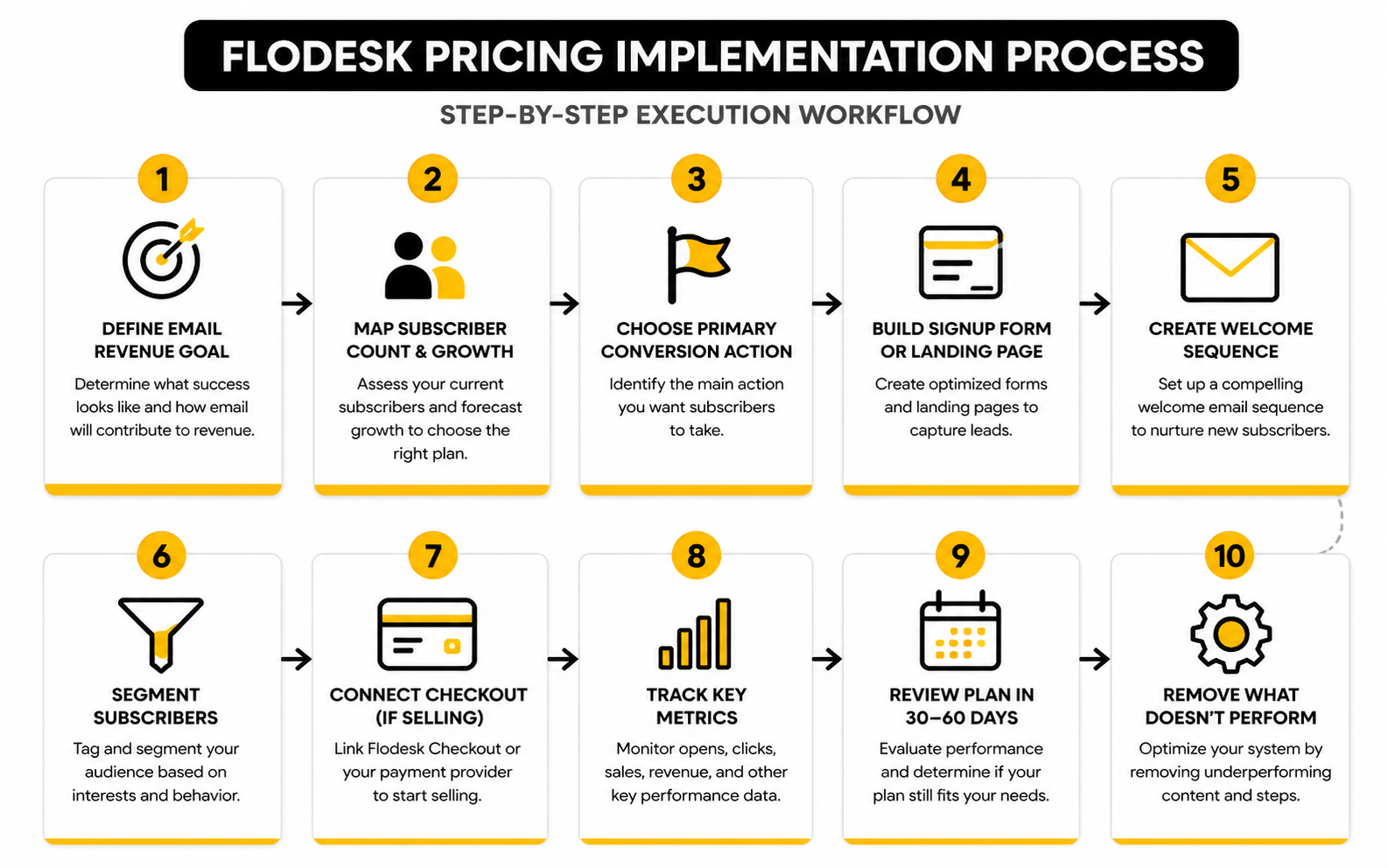
Use this process before committing to any Flodesk plan:
- Define the business goal for email.
- Map your current subscriber count and expected list growth.
- Choose one primary conversion action.
- Build the signup form or landing page.
- Create the welcome sequence.
- Segment subscribers based on behavior or source.
- Connect checkout only if you are actively selling.
- Track opens, clicks, sales, unsubscribes, and inactive contacts.
- Review the plan again after 30 to 60 days.
- Remove complexity that is not producing revenue or insight.
This is where many people overcomplicate things. They try to build ten workflows, five lead magnets, and three offers before the first email has even been tested. Start with one clean path, then expand once the numbers tell you where the leverage is.
Step 1: Start With The Revenue Path
Before touching templates, define what email is supposed to do for the business. Is it nurturing leads for a service? Selling a digital product? Filling workshops? Driving repeat purchases? That answer controls everything else.
A newsletter without a revenue path can still build trust, but it is harder to evaluate. A revenue path gives your Flodesk pricing decision a business context. You can compare the monthly cost against actual outcomes instead of judging it as another software expense.
This does not mean every email needs to sell. It means the overall system should know where it is going. Helpful content, personal updates, education, and soft promotion all work better when they support a clear business model.
Step 2: Build The First Workflow
The first workflow should be simple enough to launch quickly and useful enough to keep. A good starting point is a welcome sequence that delivers the promised resource, introduces the brand, explains the problem you solve, and points readers toward the next best step. That sequence can do more for your business than another redesigned newsletter template.
Keep the structure lean. Three to five emails are usually enough for a first version. The goal is not perfection; the goal is getting a real sequence in front of real subscribers.
Once the workflow is live, improve it based on behavior. If people click the offer link but do not buy, the sales page or offer may need work. If they do not click at all, the emails may need clearer positioning, stronger relevance, or better timing.
Step 3: Connect Selling Only When It Is Needed
Checkout features are valuable when they support a real offer. They are not valuable if they sit unused because the business is still figuring out what to sell. This is why you should not upgrade just because a plan includes more commerce features.
If you already have a product, workshop, subscription, or paid service package, connecting checkout can make sense quickly. If you are still validating the offer, keep the setup lighter until demand is clearer. Flodesk pricing is easiest to justify when the added features directly support revenue.
For lean creators, this is the main decision point. Use Flodesk for simple, polished selling when speed and design matter. Use a broader platform like Systeme.io or GoHighLevel when funnels, courses, CRM, or automation depth matter more than the email editor itself.
Statistics And Data
Measurement is where Flodesk pricing becomes a business decision instead of a software preference. A plan is not “worth it” because it has more features; it is worth it when those features improve the numbers that matter. For most businesses, those numbers are list growth, engagement, click intent, conversions, revenue per subscriber, and the cost of keeping the system running.
Benchmarks are useful, but only when you treat them as context instead of targets. MailerLite’s 2025 benchmark data covers more than 3.6 million campaigns from 181,000 approved accounts, which makes it helpful for understanding broad email performance patterns. But your list quality, offer, sending frequency, niche, and traffic source will matter more than any average.
The right way to interpret data is simple: compare your Flodesk cost against the value created by your email system. If a higher plan helps you capture more leads, automate sales, recover abandoned checkouts, or sell directly from email, the monthly price can make sense quickly. If the plan gives you features you do not use, the same price becomes drag.
The Metrics That Actually Matter
Open rate is useful, but it should not be your main decision metric. Apple’s Mail Privacy Protection changed how opens are reported, which means open rates can be inflated or less reliable than they used to be. Treat opens as a directional signal, not a final verdict.
Click rate is more useful because it shows whether subscribers are taking action. If people open but do not click, the subject line may be doing its job while the email content, offer, or call to action is weak. That tells you where to improve before blaming the platform.
Conversion rate is the metric that connects Flodesk pricing to revenue. If subscribers click through and buy, book, apply, or register, your email system is doing real work. If clicks happen but conversions do not, the next bottleneck is probably the landing page, checkout, offer, or sales message.
Revenue Per Subscriber
Revenue per subscriber is one of the cleanest ways to judge whether Flodesk is financially sensible. If your list produces meaningful monthly revenue, subscriber-based pricing becomes easier to accept. If your list is large but barely monetized, every higher pricing tier will feel more painful.
Calculate it simply. Take the revenue attributed to email over a period, then divide it by the number of active subscribers. This gives you a practical number you can compare against your monthly Flodesk cost.
For example, a list with fewer subscribers but higher buyer intent can easily outperform a much larger list built from low-quality giveaways. This is why list hygiene matters. You are not paying for status; you are paying to maintain access to people who may actually engage and buy.
Cost Per Active Subscriber
Cost per active subscriber gives you a sharper view than total monthly price. A tool can look expensive at first glance but become reasonable if your subscribers are engaged and profitable. The opposite is also true: a cheap plan becomes wasteful when most contacts never open, click, or convert.
To calculate it, divide your monthly Flodesk cost by active subscribers, not total contacts. Active subscribers are the people who still show signs of interest. That might mean recent opens, clicks, purchases, replies, or form activity, depending on how you define engagement.
This number should push action. If cost per active subscriber rises, clean the list, improve segmentation, and review acquisition sources. Do not keep paying for contacts that only make your dashboard look bigger.
Engagement Benchmarks
Email benchmarks help you spot whether your results are normal, weak, or unusually strong. Brevo’s email benchmark research shows that performance varies widely by industry, which is why comparing a coaching business to ecommerce, SaaS, or nonprofits can be misleading. The benchmark is a compass, not a scoreboard.
Open rates can tell you whether your subject lines and sender reputation are healthy. Click rates show whether your message and offer are relevant. Unsubscribe and complaint rates show whether your targeting, frequency, or expectations are off.
The action is the important part. Low opens should push you to test subject lines, sender names, and list quality. Low clicks should push you to improve the offer, email structure, and call to action. High unsubscribes should push you to tighten positioning and send to better-matched segments.
Checkout Performance
If you use Flodesk Checkout, measurement needs to go beyond email metrics. You should track page views, checkout starts, completed purchases, abandoned checkouts, average order value, and revenue by campaign. This is where the Everything plan can justify itself if the commerce features directly improve sales.
Abandoned checkout recovery is especially important because it targets people who already showed buying intent. That is very different from sending another broad promotional email to the whole list. A recovery flow should be measured by recovered revenue, not just open rate.
This is also where you compare Flodesk against broader funnel tools. If your checkout process is simple, Flodesk can keep everything clean. If you need upsells, downsells, detailed funnel analytics, or more advanced sales paths, ClickFunnels or GoHighLevel may give you more room to build.
What The Data Should Make You Do
Good analytics should lead to decisions. If your list is growing but revenue is flat, you need better segmentation, stronger offers, or clearer sales paths. If revenue is strong but manual work is high, automation becomes more valuable.
If your email channel is not producing revenue yet, stay lean and avoid paying for features you are not ready to use. Build the first workflow, prove the offer, and upgrade when the system needs more capability. That keeps Flodesk pricing tied to progress instead of hope.
The practical rule is this: review your plan every 30 to 60 days while the system is young. Look at subscriber growth, engagement, conversions, revenue, and unused features. Then either simplify, optimize, or upgrade based on what the data actually shows.
Advanced Tradeoffs Before You Choose
The deeper question behind Flodesk pricing is not “Which plan has the best feature list?” It is “Which plan gives you enough capability without locking your business into the wrong operating model?” That distinction matters because email software becomes harder to change once your forms, automations, sales pages, checkout flows, and customer history are all connected.
Flodesk is strongest when you want a clean, design-led system that helps you publish quickly and sell simple offers without a messy stack. It is less ideal when your business depends on complex funnels, deep CRM records, sales pipelines, client accounts, or advanced reporting. That does not make it weak; it just means you need to match the tool to the job.
The smartest buying decision is to look one stage ahead, not five stages ahead. Do not overpay today for an imaginary business you might build someday. But do not choose the cheapest plan if you already know you will need commerce, automations, or segmentation within the next few months.
Legacy Pricing Versus New Pricing
The biggest strategic wrinkle is the difference between legacy customers and new customers. Flodesk’s original unlimited flat-rate plan is no longer available to new members, and the current model scales with active subscribers. That changes the calculation for anyone comparing old reviews with the pricing page today.
If you are on a legacy plan, your decision is mostly about whether to keep it. If your list is large, engaged, and profitable, legacy pricing may be a strong advantage. Be careful before canceling or switching because you may not be able to return to the same economics later.
If you are a new customer, the decision is more straightforward. You should assume your Flodesk cost will rise as your active list grows. That makes list quality, segmentation, and monetization more important from day one.
Scaling With A Growing List
Subscriber-based pricing rewards clean growth and punishes sloppy growth. A list built from high-intent lead magnets, buyers, webinar registrants, and warm referrals can justify higher software costs. A list built from broad giveaways or low-fit traffic can look impressive while quietly becoming expensive.
This is where many creators get caught. They focus on growing the list, then realize the list is not generating enough revenue to support the tools around it. Bigger is not better if the audience is not aligned with the offer.
Treat list growth like inventory. Every subscriber should have a reason to be there, a segment that explains their context, and a path toward a relevant next step. If not, you are paying to store attention you may never convert.
Deliverability Risk
Deliverability is not a technical afterthought anymore. Google’s bulk sender guidance pushes senders to authenticate email, support easy unsubscribes, and keep user-reported spam rates low, with spam rates ideally below 0.1% and never reaching 0.3% or higher. That means your pricing decision is also a list quality decision.
If you import a cold, old, or poorly sourced list into Flodesk, the problem is not the platform. The problem is trust. Inbox providers care about how recipients react, and bad engagement can hurt the reach of future campaigns.
This is why subscriber cleanup is not just a cost-saving tactic. It protects your sender reputation, improves performance data, and makes your paid plan reflect real demand. Cutting inactive contacts can feel painful, but it is often the most profitable move.
Tool Stack Overlap
One hidden risk in Flodesk pricing is paying twice for the same job. If you already use a funnel builder, checkout platform, CRM, form tool, and automation platform, adding Flodesk without removing anything can create stack bloat. The monthly subscription may look fine, but the operational cost gets messy.
Before upgrading, write down what Flodesk will replace. If it replaces your landing page builder, email tool, simple checkout, and basic automations, the value is easier to defend. If it only adds prettier emails while everything else stays the same, be more careful.
This is also where a broader platform can be smarter. If your business needs CRM, pipelines, calendars, automation, forms, and email in one environment, GoHighLevel may reduce overlap. If you need simple funnel pages and offer flows, Systeme.io may be worth comparing before building everything around Flodesk.
Migration Costs
Switching email platforms is rarely just exporting contacts and importing them somewhere else. You have forms, landing pages, tags, segments, automations, unsubscribe records, design assets, checkout pages, payment flows, and tracking habits. The more deeply you build inside one platform, the more expensive migration becomes later.
That does not mean you should avoid Flodesk. It means you should document your setup from the beginning. Keep a simple record of your forms, workflows, segments, offers, checkout links, and key metrics so you are not trapped by your own mess.
A good tool should make you faster, not fragile. If your business would break because one platform changed pricing, limited a feature, or stopped fitting your needs, your system needs better structure. Build with convenience, but keep enough portability to stay in control.
When Flodesk Is The Right Call
Flodesk is a strong choice when design quality, speed, and simplicity matter more than enterprise depth. It works especially well for creators, coaches, consultants, educators, and small businesses selling focused offers to a warm audience. If you value a clean interface and do not want to wrestle with ugly templates or bloated workflows, that is a real advantage.
It is also a good fit when your sales process is not overly complicated. A lead magnet, welcome sequence, nurture emails, simple sales page, checkout, and post-purchase follow-up can cover a lot of real businesses. You do not need a giant funnel machine for every offer.
The important thing is to choose Flodesk because it matches your operating style, not because it feels trendy. If it helps you publish, sell, and stay consistent, the pricing can make sense. If you need advanced CRM depth, detailed funnel analytics, or multi-step sales infrastructure, choose the tool that fits that reality instead.
FAQ - Built For Complete Guide
Is Flodesk pricing still flat-rate?
Flodesk pricing is no longer flat-rate for new customers. The old unlimited subscriber model was replaced with subscriber-based plans for new signups, which means your cost can increase as your active list grows. This is why older Flodesk reviews can be misleading if they were written before the pricing change.
Does Flodesk have a free plan?
Yes, Flodesk has a Free plan. It is useful for testing the editor, building basic assets, and seeing whether the platform feels right before paying. It should be treated as a testing plan, not as the long-term foundation for a serious email revenue system.
Which Flodesk plan is best for beginners?
Most beginners should start with the lowest plan that supports the actual job they need done. If you only need basic email marketing, Lite can be enough. If you already plan to sell through Flodesk, Pro or Everything may make more sense than upgrading later under pressure.
Is Flodesk worth it for creators?
Flodesk can be worth it for creators who care about design, speed, and simple selling. It works well when you want polished emails, forms, sales pages, and checkout without building a complicated tech stack. It is less compelling if you mainly need advanced CRM features, complex funnels, or deep reporting.
Is Flodesk good for ecommerce?
Flodesk can work for simple ecommerce-style selling, especially for digital products, workshops, services, and creator-led offers. The Everything plan is more relevant if you need unlimited checkouts, abandoned cart automations, payment plans, subscriptions, and discount codes. For larger ecommerce operations with complex catalogs and advanced customer behavior tracking, a more specialized ecommerce email platform may be a better fit.
What is the biggest hidden cost in Flodesk pricing?
The biggest hidden cost is poor list quality. If your plan scales with subscribers, inactive or low-fit contacts make the platform more expensive without adding real value. Clean segmentation and regular list hygiene can protect both your budget and your deliverability.
Should I choose Flodesk or GoHighLevel?
Choose Flodesk if you want beautiful email marketing, simple automation, and clean selling tools without a heavy setup. Choose GoHighLevel if you need CRM pipelines, appointment workflows, client management, broader automation, or agency-style systems. The better choice depends on whether email design or operational depth matters more.
Should I choose Flodesk or ClickFunnels?
Choose Flodesk if email and simple checkout are the center of your system. Choose ClickFunnels if your main priority is building funnel flows, upsells, sales pages, and offer paths with more funnel-specific control. Flodesk is cleaner for email-first businesses; ClickFunnels is stronger for funnel-first selling.
Should I choose Flodesk or Systeme.io?
Flodesk is usually better for design-focused email and simple creator selling. Systeme.io is worth comparing if you want funnels, courses, automations, and a broader all-in-one setup at a leaner price point. If visual polish matters most, Flodesk has the edge; if bundled functionality matters most, Systeme.io may be more practical.
How often should I review my Flodesk plan?
Review your plan every 30 to 60 days while your email system is still developing. Look at subscriber growth, engagement, checkout performance, revenue per subscriber, and unused features. If you are paying for capability you do not use, simplify; if your current plan is limiting revenue, upgrade with a clear reason.
Does Flodesk replace a CRM?
Flodesk should not be treated as a full CRM replacement for every business. It can manage subscribers, segments, forms, workflows, and simple customer journeys, which is enough for many creators and small businesses. If you need pipelines, sales reps, deal stages, call tracking, or multi-client operations, you will likely need a dedicated CRM or broader platform.
What is the best way to keep Flodesk costs under control?
Keep your list clean, segment subscribers properly, and only upgrade when a feature supports a real business outcome. Do not pay for checkout features before you have something to sell. Do not keep inactive subscribers just because a bigger list feels good.
Is Flodesk better for digital products or services?
Flodesk can work well for both, but the setup is different. Digital product sellers may get more value from checkout, subscriptions, discounts, and abandoned cart recovery. Service providers may get more value from forms, nurture sequences, lead qualification, and booking-focused calls to action.
What should I do before paying for Flodesk?
Map your subscriber count, offer, email workflow, and sales path before choosing a plan. Decide whether email is mainly for communication, lead nurturing, or direct selling. Then choose the plan that supports that system without adding unnecessary complexity.
Work With Professionals
Explore 10K+ Remote Marketing Contracts on MarkeWork.com
Most marketers spend too much time chasing clients, competing on crowded platforms, and losing a percentage of every project to middlemen.
MarkeWork gives you a better way. Browse thousands of remote marketing contracts and connect directly with companies desperate to hire skilled marketers like you, without platform commissions and without unnecessary gatekeepers.
If you're serious about finding better opportunities and keeping 100% of what you earn, explore available contracts and create a profile for free at MarkeWork.com.