

A lot of people search for a free email blast service when what they really want is simple: send campaigns without getting trapped in expensive software too early. That instinct makes sense, especially when you are building a list from scratch, testing an offer, or trying to prove that email can drive revenue before you commit to a bigger platform.
The catch is that “free” in email marketing almost never means unlimited, and it definitely does not mean consequence-free. Free plans usually come with contact caps, monthly or daily send limits, platform branding, thinner automation, or approval requirements, while mailbox providers now expect stronger authentication and cleaner list practices than they did a few years ago.
That is why this guide is not going to treat every free email blast service as interchangeable. Some are better for newsletters, some are better for ecommerce, some are better for simple broadcasts, and some only look free until your list or sending frequency starts to grow.
Article Outline
- Why Free Email Blast Services Still Matter
- How the Free Email Blast Service Landscape Works Now
- The Core Features That Separate Good Free Tools From Bad Ones
- Which Free Email Blast Service Fits Different Business Models
- How to Implement a Free Email Blast Service Like a Pro
- When to Upgrade, Switch, or Leave Free Behind
Why Free Email Blast Services Still Matter
Email is still one of the few channels you actually control. Social reach can disappear with an algorithm change, paid ads can get expensive fast, and search traffic can swing for reasons outside your control, but an email list gives you a direct line to people who already raised their hand and said they want to hear from you.
That does not mean every business should jump straight into an expensive stack. A free email blast service can be the right starting point when you need to validate messaging, build your first welcome flow, or send regular campaigns to a small but growing audience. Platforms like Brevo and Moosend are part of that conversation because the market still rewards tools that lower the barrier to entry.
What matters more in 2026 is not whether a platform lets you send for free on day one. What matters is whether that free tier gives you enough room to learn the channel properly while staying compliant with the authentication and unsubscribe standards that Gmail, Yahoo, and regulators expect.
How the Free Email Blast Service Landscape Works Now
The old way of evaluating free email tools was mostly about contact count and send volume. That still matters, but the smarter way to evaluate a free email blast service now is to look at four things together: how many contacts you can store, how many emails you can send, what kind of automation you get, and how seriously the platform handles deliverability setup.
This is where the category starts to split. Some tools are generous on sends but stricter on branding or segmentation, some keep the free tier small but polished, and some give you a broad feature set with limits that make sense only for a small list. Current official plan details show that free plans vary wildly, from daily send limits to monthly send caps to lower contact ceilings than many marketers assume.
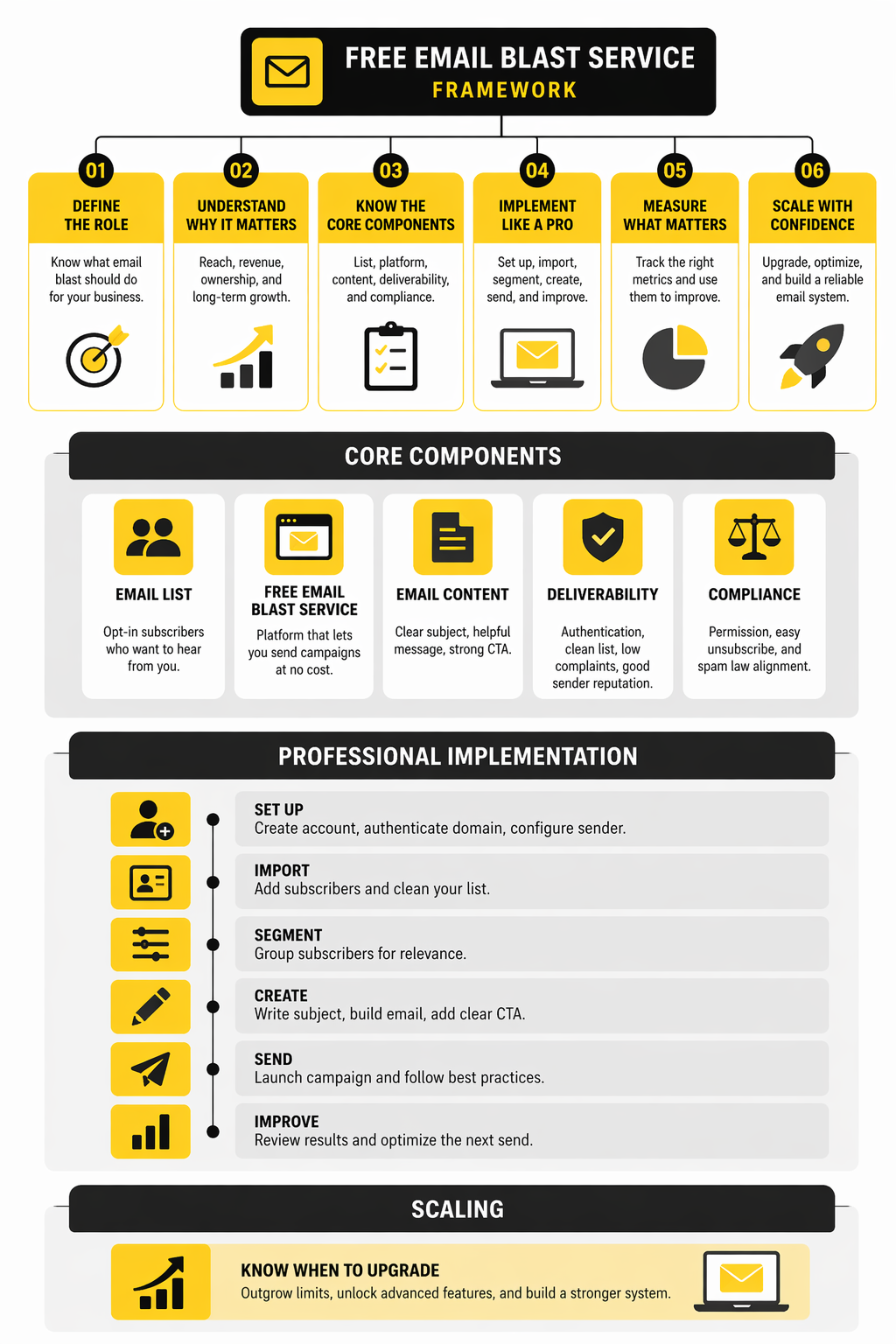
That shift changes the buying logic. Instead of asking, “Which free email blast service lets me send the most email?” the better question is, “Which free email blast service gives me the cleanest path from first campaign to reliable growth without forcing a messy migration later?” That is the framework the rest of this article will use.
The Core Features That Separate Good Free Tools From Bad Ones
The fastest way to waste time with a free email blast service is to compare only the headline price. Free is not the feature that matters most. The real question is whether the tool helps you build campaigns that are easy to send, easy to measure, and realistic to scale without rebuilding everything later.
That is where the gap opens up between tools that are merely cheap and tools that are actually useful. Some give you a decent editor but weak automation. Some give you automation but make the sending limits so tight that your list outgrows the plan before you learn anything meaningful. Others bundle email with funnels, forms, CRM, or landing pages, which can be a big advantage when you want one system instead of a patchwork stack.
A Free Plan Needs Enough Sending Room to Be Useful
This sounds obvious, but it is where many people get trapped. A free email blast service is only helpful if you can send often enough to learn what subject lines, offers, timing, and list segments actually perform. If you are constantly rationing sends, you are not running email marketing properly. You are just trying not to hit the ceiling.
That is why official send limits matter more than flashy homepage language. Brevo’s free plan details and its free-plan FAQ make it clear that the free tier is real, but also tightly governed by a daily sending cap. By contrast, Systeme.io positions its free account around limited usage with more room on contacts than many entry-level tools, while Moosend frames its free access as a trial rather than a forever-free plan.
That distinction matters more than most beginners realize. If you need a true long-term free email blast service, a forever-free model and a free trial are not the same thing. One is a training ground you can stay on for a while, and the other is a countdown clock.
The Editor Should Let You Move Fast Without Fighting the Tool
A clunky email editor quietly kills momentum. You start delaying campaigns because every send feels harder than it should, and that turns consistency into a chore. For a small business or solo operator, the best tool is often the one that gets you from idea to sent campaign with the least friction.
This is one area where feature pages tell you a lot. Brevo highlights its drag-and-drop campaign editor, templates, automation, and segmentation, while Systeme.io emphasizes a visual editor, automated campaigns, and built-in performance tracking. GoHighLevel’s email marketing page leans into the same promise from a different angle, focusing on a drag-and-drop builder plus deeper workflow automation inside a larger operating system.
What you want here is not more buttons. You want fewer bottlenecks. A good free email blast service should make it easy to build plain text emails, branded newsletters, and simple promotional sends without forcing you to touch code or fix formatting every time you change a block.
Basic Automation Is Not Optional Anymore
A platform that only lets you send one-off broadcasts is already showing its limits. Even if you start with blast campaigns, the first real wins in email usually come from simple automation: a welcome sequence, a lead magnet delivery email, a cart reminder, or a follow-up after someone fills out a form. If your chosen tool cannot handle that well, you will hit the wall earlier than you expect.
That is why automation belongs in the core evaluation framework, not the “nice to have” pile. Brevo’s platform overview explicitly includes no-code automation, Moosend’s pricing page puts automation in the core offer, and Systeme.io’s feature set ties email directly to broader business workflows.
This is where all-in-one platforms can punch above their weight. When forms, funnels, and email live in the same system, the automation path is often cleaner because you are not stitching together multiple tools just to trigger a basic sequence. That does not automatically make them better for everyone, but it does make them attractive if you want your free email blast service to do more than weekly newsletters.
Reporting Has to Be Clear Enough to Guide the Next Send
Plenty of tools say they offer analytics. That alone is not enough. The reporting has to help you make the next decision, not just decorate a dashboard with numbers.
The best entry-level platforms give you enough visibility to answer simple but important questions. Did people open? Did they click? Which page or form converted better? Which automation actually moved people forward? Systeme.io promotes real-time email stats, while Moosend’s automation reporting and landing page analytics tools are built around that feedback loop.
This is not about becoming obsessed with every metric. It is about being able to learn fast. A free email blast service that hides useful performance signals behind higher tiers can slow your growth even if the monthly price looks generous.
Forms, Landing Pages, and Funnels Can Save You a Lot of Headaches
A surprising number of email problems are not email problems at all. They are lead capture problems. If your signup forms are weak, your landing pages convert badly, or your traffic has nowhere focused to go, then even the best campaign builder will not save the result.
That is why the surrounding tools matter. Moosend includes landing pages and subscription forms in its core offer, and Systeme.io’s free plan is built around the idea that funnels, contacts, automation, and email should work together. If you already know you need opt-in pages, checkout flows, or nurture sequences, a platform with those pieces under one roof can be more valuable than a tool that is stronger on email alone.
This is also where people underestimate migration pain. Starting with a free email blast service that cannot support the rest of your lead flow often means rebuilding forms, automations, and pages later. That rebuild is annoying on a side project and expensive inside a real business.
The Best Free Tool Usually Matches Your Business Model, Not Some Master Ranking
There is no universal winner because the category itself is fragmented. A creator with one newsletter, a local service business following up with leads, an ecommerce brand running promos, and an agency managing multiple client pipelines are not solving the same problem, even if they all search for a free email blast service.
That is why the strongest platforms tend to win for different reasons. Brevo is easier to justify when you want a recognizable email-first platform with CRM and segmentation built in. Systeme.io becomes more compelling when your business revolves around funnels, offers, and automation on a tight budget. GoHighLevel makes more sense when email is just one piece of a broader lead management and automation stack.
That framing is the right bridge into the next part. Once you know which features matter most, the decision stops being abstract. Then it becomes much more practical: which free email blast service actually fits the way your business gets leads, follows up, and makes sales.
Which Free Email Blast Service Fits Different Business Models
Once you stop looking for the single best platform and start looking for the best fit, the decision gets much easier. A free email blast service should match the way you collect leads, follow up, and sell. That sounds simple, but it changes everything because the right choice for a newsletter operator is rarely the right choice for an agency or a local service brand.
Best Fit for Simple Newsletters and Basic Broadcasts
If your main goal is to send regular updates, announcements, or promotional emails to a modest list, a cleaner email-first platform usually makes more sense than an all-in-one system. You want a reliable editor, straightforward reporting, basic segmentation, and enough sending room to stay active without hitting a wall every week. In that situation, Brevo is a strong fit because its forever-free model is designed for smaller senders who want to get moving without paying upfront.
The tradeoff is that the daily cap forces discipline. That is not always bad, especially early on, because it pushes you to keep your list clean and your campaigns intentional. But if you plan to send to a growing list multiple times per week, a free email blast service with a daily limit becomes less flexible than it looks on the sales page.
Best Fit for Funnels, Lead Magnets, and Low-Cost Offers
If your business depends on landing pages, opt-ins, email sequences, and simple product flows, the platform should do more than email. This is where an all-in-one tool can beat a pure email platform, because the friction between capture, follow-up, and conversion is lower from day one. Instead of connecting five tools, you build the whole lead path in one place.
That is why Systeme.io is so attractive for small operators. Its free plan is built around the idea that funnels, contact storage, newsletters, automation, and offer delivery should work together, which makes it easier to launch quickly and harder to get stuck in setup mode. For creators, consultants, coaches, and digital product sellers, that kind of simplicity often matters more than having the most advanced email designer in the market.
Best Fit for Agencies and Service Businesses With More Moving Parts
An agency or service-based business usually has a bigger operational problem than “how do I send a newsletter for free.” It needs lead capture, pipeline tracking, reminders, nurture workflows, and often client-facing automation. In that context, email is just one layer inside a broader system.
That is why GoHighLevel is worth considering even though it is not a forever-free email blast service in the strict sense. It is closer to a business operating system with a free trial than a permanent free sender, which means it is a fit when you care more about automation depth and CRM logic than about staying on a zero-dollar plan forever. If you are an agency, that distinction matters because “free” can be more expensive than paid software when the stack itself creates operational drag.
How to Implement a Free Email Blast Service Like a Pro
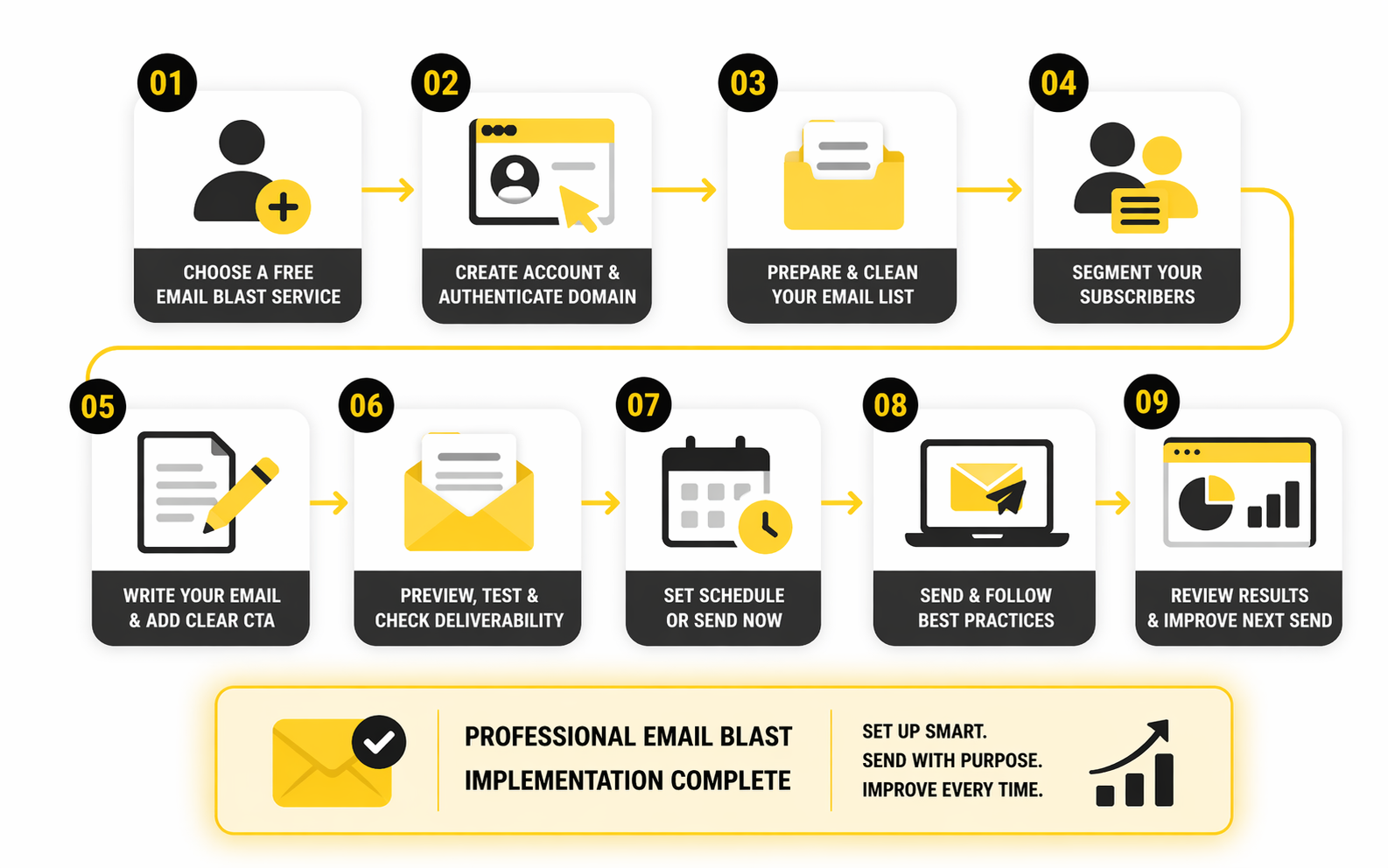
Picking the platform is only half the job. The part that actually drives results is implementation, and this is where a lot of people sabotage themselves without realizing it. They sign up for a free email blast service, import a rough list, build one campaign, and then wonder why open rates, clicks, and conversions never really come together.
A better approach is to treat setup like infrastructure, not decoration. You do not need a complicated stack, but you do need a clean process. When the foundation is right, even a free plan can perform surprisingly well.
Step 1: Start With the Simplest Viable Use Case
Do not try to build an enterprise email machine on a free plan. Start with one clear objective, such as sending a weekly newsletter, delivering a lead magnet, following up with new inquiries, or promoting one offer. That focus keeps your setup clean and helps you learn faster.
This is where most free plans work best. A narrow use case lets you evaluate the platform on real outcomes instead of imaginary future needs. If your first workflow works, then you expand. If it does not, you fix the system before complexity multiplies the problem.
Step 2: Set Up Authentication Before You Worry About Design
This part is not glamorous, but it matters more than almost anything else. If your domain authentication is weak or incomplete, your emails are more likely to land in spam, promotions, or nowhere useful at all. That is a huge reason why one business thinks its free email blast service is “bad” while another gets solid results from the same tool.
Most reputable platforms walk you through domain setup, sender verification, and related email records inside the onboarding flow. Brevo, Systeme.io, and GoHighLevel all position setup as part of getting campaigns live, but you still have to do the work. Skip this step and you are basically asking the inbox to distrust you.
Step 3: Import Only the Contacts You Can Defend
A free email blast service is not a license to dump in every email address you have ever collected. Poor list quality hurts deliverability, inflates unsubscribes, and makes your reporting less useful. Worse, it can make a free plan feel small because you are wasting sends on people who were never likely to engage.
Be strict here. Import only contacts who signed up, opted in, purchased, or otherwise gave you a reasonable basis to email them. A smaller clean list beats a larger dead list every single time, especially when your send allowance is limited.
Step 4: Build One Core Sequence Before You Build More Campaigns
Most people rush to broadcast emails because they feel productive. In reality, the first workflow you should build is usually a simple automation that runs without you. That could be a welcome email, a lead delivery sequence, a short nurture campaign, or a follow-up tied to a form submission.
This is where platforms with broader automation tools start to pull ahead. Systeme.io makes this especially practical when your forms, pages, and email live together, while GoHighLevel becomes more compelling when your business needs deeper follow-up logic. The goal is not to automate everything. The goal is to automate the first thing that saves you time and creates consistency.
Step 5: Keep the First Campaign Boring on Purpose
This is one of those counterintuitive moves that works. Your first real send should be simple, plain, and easy to measure. Do not over-design it, do not stuff it with too many links, and do not try to impress people with clever structure before you understand what your audience responds to.
A clean subject line, a clear message, one primary action, and a recognizable sender name will teach you more than an overly polished campaign full of distractions. That is also why a tool with a fast editor can outperform a more “powerful” one in the early stage. If the platform gets out of your way, you send more consistently and learn faster.
Step 6: Connect Email to the Rest of the Growth System
Email performs better when it is not isolated. Your form builder, landing pages, calendar links, lead capture paths, and follow-up logic should all point in the same direction. A free email blast service becomes much more valuable when it is part of a simple, coherent funnel instead of a disconnected sending tool.
For that reason, it can make sense to pair email with adjacent tools that reduce friction elsewhere in the customer journey. A business running lead-gen flows might connect landing pages through Replo, use forms via Fillout, or streamline appointment booking with Cal.com. The exact combination matters less than the principle: every extra tool should remove friction, not create more of it.
Step 7: Measure What Helps You Improve the Next Send
You do not need a giant analytics stack to run email well. You need enough signal to improve subject lines, offers, timing, and follow-up. That means watching the basics closely and resisting the temptation to obsess over vanity metrics that do not change your next action.
This is another reason implementation matters more than free pricing alone. A good free email blast service gives you enough reporting to identify whether your list quality is weak, your message is unclear, or your offer is simply not compelling enough. Once you can answer those questions, you stop guessing and start improving.
Reading the Numbers Behind Email Performance
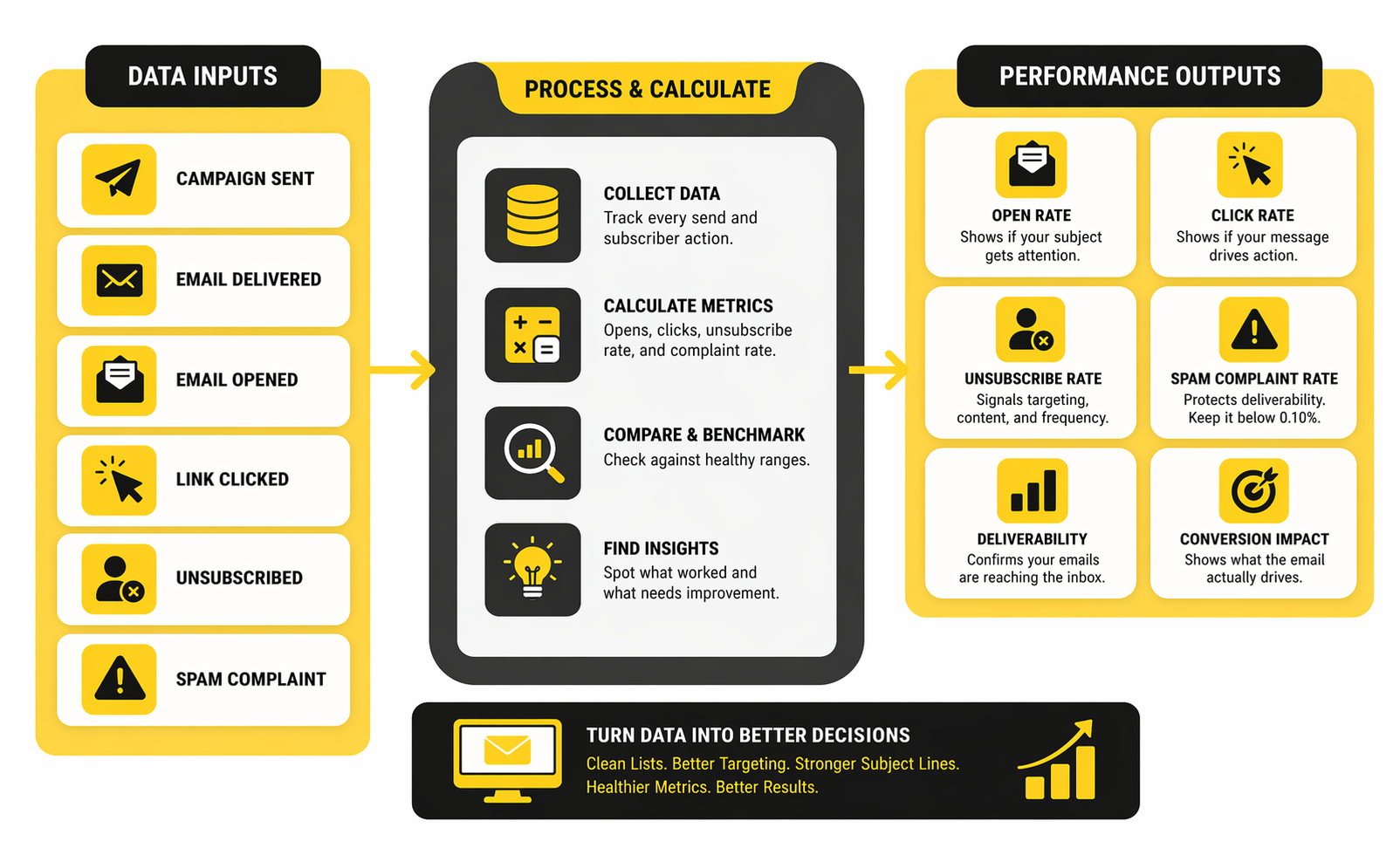
Once your free email blast service is live, the next mistake is obvious and common: staring at dashboards without knowing what the numbers are trying to tell you. Metrics only matter when they change your next decision. If a number looks good but does not help you improve targeting, creative, timing, or deliverability, it is mostly decoration.
That is why benchmarks need context. Recent reporting shows broad averages, but those averages are pulled from different datasets, industries, inbox environments, and tracking methods. DMA’s 2025 benchmarking report put 2024 average delivery at 98%, average open rate at 35.9%, and unique click rate at 2.3%, while Mailchimp’s benchmark page shows all-user averages around 35.63% opens, 2.62% clicks, and 0.22% unsubscribes, and Brevo’s 2025 benchmark data shows overall averages of 31.22% opens, 3.64% click-through, 0.4% unsubscribes, and 0.19% hard bounces. The takeaway is not that one report is right and the others are wrong. The takeaway is that email performance is highly dependent on list quality, industry, and measurement methodology.
Open Rate Still Matters, But Not the Way It Used To
Open rate is still useful, just not as a clean proxy for engagement. Privacy protections changed that. Apple Mail Privacy Protection can inflate opens by preloading images and tracking pixels, which is why platforms and infrastructure providers now tell marketers to rely less on opens when judging content quality or audience intent. Twilio’s guidance on Apple MPP explicitly recommends shifting more reporting, testing, and sunsetting decisions toward click-based measures.
That means you should treat open rate as a directional signal, not a victory lap. If your open rate collapses, something may be wrong with your subject line, sender reputation, or inbox placement. But if your open rate looks great while clicks and conversions stay flat, your free email blast service is not necessarily performing well. It may just be reporting inflated opens in a privacy-distorted environment.
Click Rate Tells You More About Real Interest
If you want a cleaner read on whether your message landed, click rate usually matters more than open rate. It is a harder action, which makes it more meaningful. It tells you that someone not only received the email but found something compelling enough to act on.
That is why the gap between opens and clicks is often more revealing than either metric alone. MailerLite’s 2025 benchmark roundup reported a 43.46% average open rate and a 2.09% average click rate for 2025, while DMA’s 2025 report put unique clicks at 2.3%, and Mailchimp’s current benchmark page puts all-user click averages at 2.62%. When your open rate is healthy but clicks are weak, the usual problem is not deliverability. It is message-to-offer fit, weak calls to action, or sending to people who were never that interested in the first place.
Click-to-Open Rate Is Where the Signal Gets Sharper
This is one of the most useful metrics for anyone using a free email blast service. Click-to-open rate tells you how many people who opened the email also clicked. In practical terms, it helps isolate how persuasive the content was after the message got attention.
That makes CTOR especially useful when open rates are distorted. Brevo’s benchmark data shows overall CTOR at 11.66% based on its displayed open and click figures, while MailerLite’s 2025 benchmark roundup reports a 6.81% average click-to-open rate for 2025. The exact number you should expect depends on audience and industry, but the principle is stable: if opens are fine and CTOR is weak, the problem is usually your email body, your offer, or the relevance of the call to action.
Unsubscribes Are Not Always Bad News
A lot of people panic when they see unsubscribes, but some churn is healthy. The goal is not to keep every subscriber forever. The goal is to keep the right subscribers engaged while giving the wrong ones an easy way out before they mark you as spam.
This is why unsubscribe rate should be interpreted with nuance. Mailchimp shows an all-user unsubscribe average of 0.22%, Campaign Monitor says its average unsubscribe rate is 0.17% and notes that unsubscribes under 2% are within industry norms, and ActiveCampaign’s benchmark guidance frames anything under 0.5% as good and under 0.2% as excellent. In practice, a modest unsubscribe rate is usually less dangerous than rising spam complaints, because an unsubscribe is a clean exit while a complaint damages sender reputation.
Bounce Rate Is a List Quality Alarm
Bounce rate is one of the clearest operational signals in your system. When it starts climbing, your list hygiene, acquisition practices, or authentication setup may be slipping. That matters even more on a free plan, because wasted sends burn through limited capacity and can hurt future deliverability.
The key distinction is between soft and hard bounces. Constant Contact’s sender statistics guide explains delivery calculations and separates temporary delivery issues from permanent failures, while Campaign Monitor’s measurement guide lays out the bounce formula and the difference between hard and soft bounces. If hard bounces are showing up repeatedly, the action is obvious: stop importing low-quality contacts, remove invalid addresses quickly, and look hard at where your signups are coming from.
Spam Complaints Matter More Than Most Beginners Think
This one is not negotiable. You can survive average clicks for a while. You can recover from an ugly campaign. But sustained complaint problems can quietly wreck inbox placement and make a free email blast service feel broken even when the platform itself is fine.
Google is very explicit here. Google’s sender guidelines FAQ says bulk senders should keep spam rates below 0.1% and prevent them from reaching 0.3% or higher. Yahoo says essentially the same thing in its sender best practices. That means poor targeting, unclear opt-ins, or aggressive send frequency are not just conversion problems. They are deliverability problems.
Benchmarks Are Useful, but Trendlines Are More Useful
Industry averages are helpful for orientation, not self-worth. If your business sits slightly below a published benchmark but improves month after month, that is progress. If your numbers look average but your complaint rate is climbing and your conversions are stalling, that is a problem no benchmark chart can hide.
This is the smarter way to use analytics inside a free email blast service. Track your own trendlines first, then compare them to broad benchmarks second. If opens fall, check inbox placement and subject lines. If clicks lag, fix the message and offer. If unsubscribes rise, tighten segmentation or reduce frequency. If complaints increase, treat it like a red alert and clean up the list before anything else.
What the Data Should Actually Change in Your Workflow
Numbers only help when they trigger action. That is the whole point. A clean analytics rhythm turns your free email blast service from a sending tool into a learning system.
The simplest framework is this:
- If open rate drops sharply, review authentication, sender name, subject line quality, and whether you are landing in inboxes consistently.
- If opens hold but clicks stay weak, improve the email body, tighten the offer, and reduce competing links.
- If clicks are decent but conversions are poor, the problem is often on the landing page or checkout step, not in the email itself.
- If unsubscribe or complaint rates rise, reduce frequency, segment harder, and stop mailing weak-fit subscribers.
- If bounce rates climb, fix list hygiene immediately before you damage deliverability further.
That is the practical difference between reading stats and using them. The data is not there to impress you. It is there to tell you what to do next.
When to Upgrade, Switch, or Leave Free Behind
A free email blast service is a smart starting point, but it is not automatically a smart long-term operating model. At some point, the constraints that kept your costs low start creating hidden costs somewhere else. That is usually the moment when email becomes either a growth asset or a growth bottleneck.
The tricky part is that this shift rarely announces itself clearly. Most businesses do not wake up one morning and decide their free email blast service has failed. What usually happens is slower and more expensive: campaigns get delayed, automation gets patched together, reporting becomes incomplete, and sending limits force compromises that weaken the whole system.
Free Stops Being Free When It Slows Down Revenue
This is the first real strategic tradeoff. If your free plan saves you money but prevents you from sending at the right frequency, segmenting properly, or building the automations that turn leads into sales, then the software is no longer cheap. It is just underpriced friction.
That matters even more once your email list starts producing real business value. When email is helping book calls, recover carts, promote launches, or move prospects through a pipeline, the cost of limited functionality can easily outweigh the subscription fee you were trying to avoid. In that situation, staying on a free email blast service for too long is not disciplined. It is expensive in disguise.
The Upgrade Trigger Is Usually Operational, Not Emotional
A lot of people think they should upgrade when they “feel ready.” That is not a strong standard. The better move is to upgrade when your operations start showing signs that the free plan is distorting your decisions.
There are a few common triggers. You are suppressing sends because of daily caps, building workarounds instead of proper automations, splitting lists across tools, or avoiding segmentation because the platform makes it annoying. Once that starts happening, the free email blast service is shaping your strategy instead of supporting it, and that is the wrong power balance.
Deliverability Risk Gets More Serious as Volume Grows
Low-volume mistakes can hide for a while. Higher-volume mistakes usually get exposed fast. That is why scaling is not just about sending more emails. It is about protecting your sender reputation while you do it.
This is where sloppy habits become dangerous. Weak list hygiene, vague opt-ins, inconsistent sending patterns, and poor complaint management may look survivable when your list is small, but they become much more costly once you are mailing at scale. A free email blast service can help you start, but it will not protect you from bad sending discipline. That part is still on you.
Migration Pain Is Real, So Plan for It Before You Need It
One of the most overlooked costs in email marketing is migration. People focus on monthly pricing and forget to think about what happens when they need to move contacts, tags, forms, automations, templates, and reporting logic to a new platform. That move can be simple if you planned for it early, or deeply annoying if you did not.
The smartest way to use a free email blast service is to assume you may outgrow it and build accordingly. Keep your tags logical, your forms documented, your automations clean, and your core assets portable. If the time comes to switch, you want a controlled transition, not a messy rebuild done under pressure.
The Best Operators Build Around Portability
This is a more advanced point, but it matters. Do not let your entire growth system become dependent on one tiny feature that only one platform handles in one weird proprietary way. That kind of lock-in feels harmless when you are starting and painful when you are scaling.
Portability means designing a system you can understand and explain. Your lead sources should be clear, your segmentation rules should make sense, and your automations should exist for obvious business reasons, not because the platform happened to make a certain trick possible. The cleaner your logic is, the easier it is to upgrade, switch, or simplify later.
Not Every Business Should Stay With an Email-Only Tool
This is where business model comes back into the conversation. If email is just one channel inside a broader funnel, CRM, or follow-up engine, then graduating from a basic free email blast service often means moving into a more connected operating system. That is especially true for agencies, service businesses, and operators who need pipeline visibility as much as they need campaigns.
In those cases, tools like GoHighLevel become more relevant because the decision is no longer about cheaper email. It is about tighter execution across forms, pipelines, messaging, automation, and follow-up. That does not make an all-in-one stack automatically better, but it does make it easier to justify once email stops being an isolated task.
Sometimes the Right Move Is to Stay Put and Get Better
Not every ceiling means you need to migrate. Sometimes the platform is fine and the real problem is weak strategy. Poor list quality, vague offers, and inconsistent sending will not magically improve on a more expensive plan.
That is why experienced operators separate software problems from execution problems. If your free email blast service still supports your list size, your send frequency, and your basic automation needs, then upgrading too early can become another form of procrastination. Better software helps, but it does not rescue weak fundamentals.
The Real Goal Is Not Free Email but Reliable Email
This is the mindset shift that matters most near the end of the decision process. You are not trying to win a contest for the cheapest platform. You are trying to build a dependable channel that keeps producing attention, clicks, leads, and sales without constant drama.
That is the standard a free email blast service has to meet. If it helps you build that system, great. If it starts getting in the way, then the right move is to upgrade, switch, or simplify before the constraints harden into real business problems.
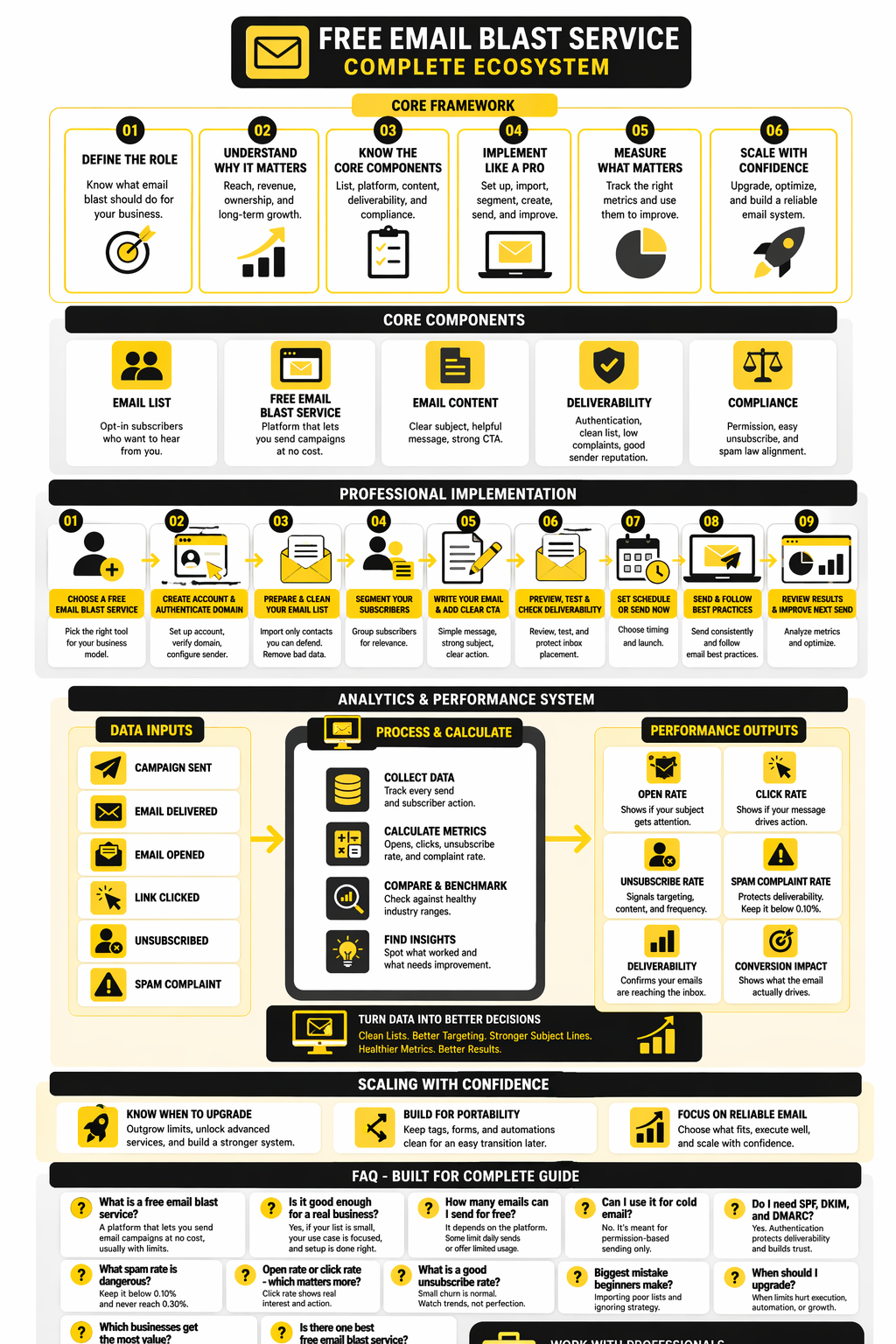
FAQ
What is a free email blast service, really?
A free email blast service is an email marketing platform that lets you send campaigns without paying upfront, usually with limits on sends, contacts, branding, automation, or reporting. The important part is not the word free. The important part is whether the platform gives you enough room to run email properly before those limits start interfering with growth.
In practice, a free email blast service works best as a starting point. It is ideal for small lists, early testing, and simple workflows, but you still need to treat setup, consent, and deliverability seriously if you want the results to be reliable.
Is a free email blast service good enough for a real business?
Yes, sometimes. If you have a small list, a narrow use case, and a clean signup process, a free email blast service can absolutely support a real business in the early stage. That is especially true when you are sending a newsletter, delivering a lead magnet, or following up with new inquiries.
The key is knowing what “good enough” means. If the platform supports your current list size, your send frequency, and one or two core automations, it may be enough for quite a while. If it starts forcing bad decisions, it is time to move on.
How many emails can I usually send for free?
That depends completely on the platform. Some tools offer a forever-free plan with strict daily caps, while others offer limited free trials or usage-based free access that is really meant to get you into a paid tier. For example, Brevo’s free plan limits show a 300-email daily cap, while Systeme.io’s pricing page frames its free offer around limited usage with up to 2,000 contacts.
This is why you should always read the plan details, not just the headline. A free email blast service that looks generous at first glance can become restrictive fast if you send often.
Can I use a free email blast service for cold email?
That is usually a bad idea. Most email marketing platforms are designed for permission-based sending, not cold outbound outreach. If you upload scraped lists or start blasting people who never opted in, you can damage deliverability, trigger complaints, and get your account restricted.
A free email blast service works best with opted-in subscribers. If people asked to hear from you, email can perform extremely well. If they did not, you are building on shaky ground from the start.
Do I need SPF, DKIM, and DMARC on a free plan?
Yes, or at least you should treat that as the standard. Email providers increasingly expect authenticated sending, and bulk sender rules from major inbox providers make that even more important. Google’s official email sender guidelines and bulk sender FAQ are very clear that authentication, easy unsubscribe, and low spam rates matter.
This is one of the biggest differences between casual sending and professional sending. Even with a free email blast service, proper authentication is part of the job now.
What spam complaint rate is considered dangerous?
The line you should care about is not just “low.” It is specific enough to act on. Google says senders should keep spam rates below 0.10% and avoid reaching 0.30% or higher in Postmaster Tools, while Yahoo’s sender best practices also emphasize staying under 0.3%.
That matters because complaint problems can make a platform seem weak when the real issue is list quality or targeting. If your complaint rate is climbing, the answer is usually not to send more. It is to clean the list, tighten the message, and stop emailing weak-fit subscribers.
Should I care more about open rates or click rates?
You should care about both, but not equally. Open rates are still useful as a directional signal, yet privacy protections have made them less trustworthy as a pure measure of engagement. Click rates are usually closer to real intent because they show someone actually did something.
That is why a healthy free email blast service workflow looks at opens, clicks, and downstream conversion together. Opens tell you whether the email got attention. Clicks tell you whether the message was compelling. Conversions tell you whether the offer and destination actually worked.
What is a good unsubscribe rate?
A small unsubscribe rate is normal and often healthy. It means uninterested people are leaving cleanly instead of reporting you as spam or staying on the list without engaging. Broad benchmark references from platforms and industry publishers often place average unsubscribes well below 1%, but context matters more than chasing a universal magic number.
The smarter question is whether your unsubscribe rate is changing. If it jumps after a campaign, that signal matters. It usually points to weak targeting, too much frequency, or a mismatch between what people expected and what you sent.
Can I build automations on a free email blast service?
Sometimes yes, but not always at the level you want. Some platforms include basic automations on free plans, while others limit the number of workflows, triggers, or contacts those automations can touch. That is why a free email blast service should be evaluated on workflow depth, not just send volume.
If you can build a welcome series, a form-triggered follow-up, and one or two simple nurture paths, that may be enough to start. If you need branching logic, deep CRM behavior, or more complex customer journeys, you will probably outgrow the free tier sooner.
What is the biggest mistake people make with free email tools?
The biggest mistake is acting like the platform is the strategy. People spend too much time comparing free plans and not enough time improving list quality, offer relevance, subject lines, or onboarding flow. A weak strategy on a paid platform still performs badly, and a clean strategy on a free plan can perform surprisingly well.
The second biggest mistake is importing contacts they cannot really defend. That hurts deliverability, wastes send capacity, and turns the whole channel into a harder problem than it needs to be.
When should I upgrade from a free email blast service?
You should upgrade when the limits start changing your behavior in bad ways. That usually means daily send caps are forcing awkward scheduling, automation limits are creating manual work, or segmentation is too limited to keep your list clean and relevant. At that point, the platform is no longer helping you grow.
A good rule is simple: stay free while free helps you execute well. Leave free when it starts weakening execution.
Which type of business gets the most value from a free email blast service?
Small businesses with clear offers and clean lead capture usually get the most value early on. Creators, consultants, local service businesses, and simple ecommerce operations can all benefit if they focus on one core workflow first. The simpler the funnel, the more usable a free plan tends to be.
The harder your business depends on CRM logic, multi-step automations, or complex client management, the faster you will feel the ceiling. That does not mean a free email blast service is useless. It just means it is better as a launchpad than a permanent operating system.
Is there a best free email blast service for everyone?
No, and that is exactly why so many generic rankings are weak. The best option depends on whether you care most about newsletters, funnels, lead-gen workflows, CRM depth, or all-in-one simplicity. A free email blast service is only “best” when it fits the business model it is supporting.
That is the real conclusion of this guide. You are not looking for a universal winner. You are looking for the tool that lets you send well, learn fast, and upgrade cleanly when the time comes.
Work With Professionals
Explore 10K+ Remote Marketing Contracts on MarkeWork.com
Most marketers spend too much time chasing clients, competing on crowded platforms, and losing a percentage of every project to middlemen. MarkeWork gives you a better way. Browse thousands of remote marketing contracts and connect directly with companies desperate to hire skilled marketers like you, without platform commissions and without unnecessary gatekeepers.
If you're serious about finding better opportunities and keeping 100% of what you earn, explore available contracts and create a profile for free at MarkeWork.com.