

Free email campaign services are still one of the easiest ways to start building an owned audience, especially when paid ads are expensive, social reach is unreliable, and early-stage budgets are tight. The catch is that the phrase free hides the real tradeoffs: contact caps, send limits, branding, automation restrictions, and sometimes no true free tier at all. Right now, that matters even more because email performance is being shaped by platform limits, mailbox-provider rules, and privacy changes rather than by design alone.
The practical opportunity is still huge. DMA’s 2025 benchmarking data reported 98% delivery rates in 2024, with B2C delivery reaching 99.2%, while unique click rates rose for the third straight year to 2.3%. That is exactly why choosing the right free platform matters: if inbox placement and click quality are strong, the wrong free plan can become the bottleneck long before your content does.
What has changed is the environment around the tools. Google says bulk senders reaching 5,000 or more messages a day to personal Gmail accounts must meet stricter requirements, Yahoo says senders should authenticate mail and keep spam complaints below 0.3%, and Apple Mail Privacy Protection makes open tracking less reliable by hiding IP addresses and preventing senders from knowing whether an email was opened. So the real question is no longer just which platform is free, but which free email campaign service gives you enough room to grow without setting you up for deliverability or measurement problems later.
Why This Matters
Most beginners compare free email campaign services by headline pricing, and that is usually the wrong first filter. A free plan that looks generous can still slow you down if it caps automations, limits templates, forces branding, or makes it hard to move your list once you start gaining traction. The smarter way to look at the category is to ask which tool helps you send consistently, stay compliant, and graduate smoothly into a more serious setup when your audience starts responding.
How This Guide Is Structured
This article is built to answer the question in the order that actually helps you make a decision. We will start by defining what counts as a free email campaign service, then move into the platforms that are genuinely worth testing, then break down the framework you should use to compare them without getting distracted by feature lists. After that, we will cover implementation, common mistakes, and the practical questions that usually come up once you are ready to send.
Article Outline
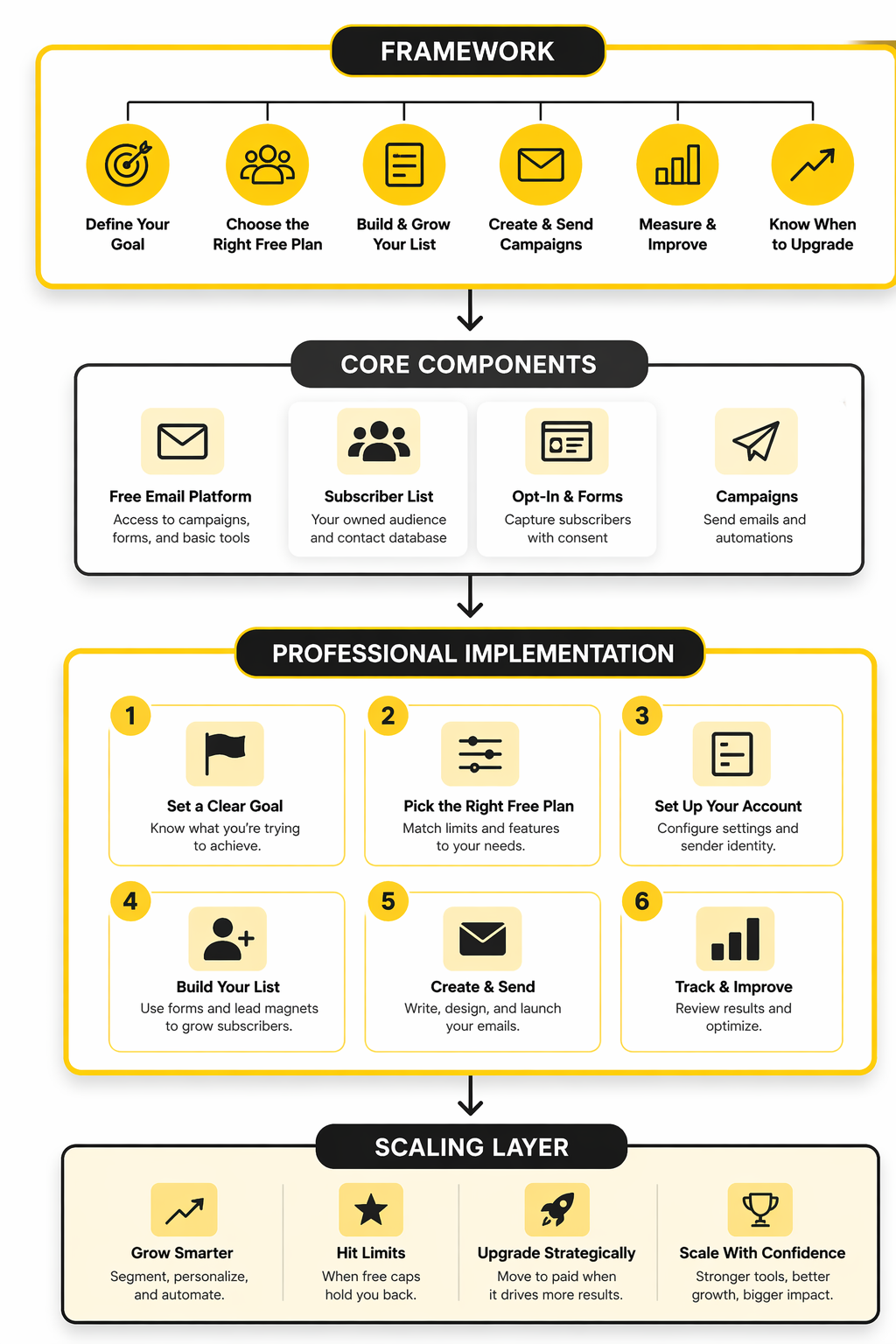
The six parts of this article will use these sections:
- Why Free Email Campaign Services Still Matter
- What Counts as a Free Email Campaign Service
- The Best Free Email Campaign Services Worth Testing
- How to Compare Limits, Deliverability, and Automation
- How to Implement a Professional Free-Plan Setup
- Common Mistakes, Upgrade Triggers, and FAQ
This structure keeps the article focused on real buying and setup decisions instead of turning it into a random tool roundup. It also makes room for the two things that usually get skipped in surface-level content: the framework behind the choice and the operational details that decide whether your campaigns actually work. By the end, you should be able to tell the difference between a free plan that is useful for growth and one that is only useful for signing up.
Why Free Email Campaign Services Still Matter
Free email campaign services still matter because email remains one of the few channels you actually control. Social platforms can cut your reach, paid acquisition can get expensive fast, and algorithm changes can wipe out momentum you thought was stable. A small email list, even on a free plan, gives you a direct line to people who already raised their hand and said they want to hear from you.
That matters even more now because email performance is holding up better than a lot of marketers expected. DMA’s latest benchmarking reported 98% delivery rates in 2024, with B2C hitting 99.2%, while unique click rates climbed to 2.3%. Those numbers do not mean every campaign works automatically, but they do show that inbox access is still valuable enough to justify building a list before you spend heavily elsewhere.
The other reason this category matters is speed. A good free plan lets a solo creator, small business, or early-stage ecommerce brand start capturing leads, sending broadcasts, and learning what people respond to without taking on software costs from day one. That is a big deal, because the first phase of email marketing is usually not about scale. It is about proving that people care enough to subscribe, click, and buy.
Free Tools Are Now a Testing Ground, Not a Long-Term Strategy
This is where people get tripped up. They treat free email campaign services as if the goal is to stay free forever, when the real value is using a free tier to validate your audience, message, and sending rhythm. Once those are working, you upgrade because you want better automations, deeper segmentation, cleaner branding, or more sending volume, not because the platform somehow failed you.
You can see that shift in how platforms design their free plans. Mailchimp’s free tier is now capped at 250 contacts and 500 sends per month, while MailerLite’s free plan is built around 500 subscribers and core email features, and Omnisend’s free plan allows 500 emails per month to up to 250 unique contacts. The pattern is obvious: vendors are still willing to let you start for free, but they are much more deliberate about when growth starts costing money.
That is not a bad thing if you understand the game. A free plan should help you learn fast, build smart habits, and avoid committing too early to a stack that does not fit your business. If you want a platform that gives you room to get started without paying upfront, Brevo’s free entry point is one of the cleaner examples because it is built around sending rather than just stored contacts, which changes the economics for some businesses.
The Stakes Are Higher Because Deliverability Rules Got Stricter
This part is easy to underestimate. Free email campaign services used to be mostly a budget conversation, but now they are also a compliance and infrastructure conversation. Google defines bulk senders as those sending close to 5,000 messages or more to personal Gmail accounts in 24 hours, and those senders must meet stricter authentication and sender requirements. Yahoo also expects authentication and says spam complaint rates should stay below 0.3%.
That changes how you should think about free tools. The platform matters, but list quality, authentication, unsubscribe hygiene, and sending behavior matter just as much. In practice, the best free email campaign services are the ones that make it easier to follow modern sending standards instead of giving you a cheap-looking dashboard with weak fundamentals underneath.
There is also the measurement problem. Apple’s Mail Privacy Protection changed what open-rate data can really tell you, which means smart marketers need tools that help them focus more on clicks, conversions, and downstream behavior. So when you compare free options, you should care less about flashy dashboards and more about whether the plan gives you enough meaningful reporting to improve the next send.
What Counts as a Free Email Campaign Service
Not every tool that says free belongs in the same bucket. A real free email campaign service gives you an ongoing no-cost plan you can keep using without entering a billing cycle the moment a short trial ends. That sounds basic, but it is one of the most important distinctions in this whole category because plenty of platforms offer generous trials while offering no real free tier at all.
For this article, a tool counts if it lets you build a list, create campaigns, send emails, and keep using the product at zero monthly cost within a defined limit. Those limits can be based on contacts, sends, features, branding, automation depth, or some mix of all five. What matters is that the plan is genuinely usable, not just technically available.
A Free Plan Is Not the Same Thing as a Free Trial
This distinction matters more than most comparison posts admit. ActiveCampaign clearly pushes a free trial, and Moosend’s public positioning also centers on paid access plus a trial period, which means neither should be treated as a true free-plan option in the same category as Brevo, Mailchimp, MailerLite, Omnisend, or beehiiv. If a tool expires unless you upgrade, it is a trial, not a free email campaign service in the practical sense most readers mean.
That difference affects your workflow immediately. With a real free plan, you can take your time setting up forms, writing a welcome email, cleaning your list, and learning the dashboard without a countdown clock hanging over every decision. With a trial, you are often rushing to evaluate advanced features before the billing switch flips, which is a completely different buying context.
The Core Components of a Real Free Email Tool
At minimum, a real free email campaign service should let you do four things well enough to get traction. First, you need subscriber collection through forms, landing pages, or integrations. Second, you need campaign sending that is not so restricted it becomes pointless. Third, you need basic reporting so you can tell whether the audience is responding. Fourth, you need enough account stability that you can keep using the platform while your list is still small.
That is why free plans vary so much in real usefulness. Mailchimp has the basics, but its free limits are now tight enough that a lot of businesses will outgrow it quickly. MailerLite gives smaller audiences a broader runway with campaign creation and automations on the free tier, while beehiiv is more generous on subscriber count for newsletter-first businesses, and Omnisend is better understood as an ecommerce-flavored starter option with stricter email caps.
A platform also has to match your business model. If you are a creator or newsletter operator, a free plan built around audience growth may be enough for a while. If you are a local business or service company that needs email tied to CRM, forms, automation, and lead follow-up, then a broader system such as GoHighLevel becomes more relevant once you move past the basic free-tier stage, even though it is not a free-plan-first tool.
What Does Not Count
A platform does not really count in this discussion if the free version is too restricted to send meaningful campaigns. It also does not count if the so-called free plan is just a feature teaser with no sustainable workflow, or if branding, volume, or contact restrictions make the plan unusable the moment you get a little traction. That is the difference between a product that helps you start and one that exists mainly to push you into checkout.
The same goes for tools that are adjacent to email marketing but not actually email campaign services. A chatbot platform, landing page builder, or social scheduling tool can absolutely support your acquisition funnel, but it should not be confused with the system that stores subscribers and sends campaigns. Those tools become useful around email, not instead of email.
That clarity makes the rest of this guide much more practical. Once you define the category properly, you stop comparing everything with an email field and start comparing the platforms that genuinely let you launch, learn, and grow. That is the right setup for the next section, where the focus shifts from definitions to the free email campaign services that are actually worth testing.
How to Implement a Professional Free-Plan Setup
Once you have picked a platform, the next job is not designing the perfect newsletter. It is building a setup that can collect subscribers cleanly, welcome them properly, and keep your sending habits healthy from the start. That is the difference between using free email campaign services as a toy and using them as a real growth channel.
A professional setup on a free plan should feel simple on the surface and disciplined underneath. You do not need a giant stack, but you do need the basics working together: a signup point, a clear promise, a confirmation flow, a welcome email, a sending schedule, and a clean unsubscribe path. If any of those pieces are missing, your list may grow, but it will not grow well.
The good news is that you can build this without overcomplicating it. Tools like Brevo already support the core building blocks, including forms, campaigns, and automations, which is exactly what a serious free-plan setup needs. If your business later needs a deeper CRM and multi-channel follow-up layer, GoHighLevel becomes more relevant after the free-stage proof of concept is working.
Step 1: Start With One Clear Offer
Most weak email setups fail before the first email is ever sent. The form is vague, the promise is generic, and the visitor has no strong reason to subscribe right now. If you want free email campaign services to perform, start with one tight offer that tells people what they get, how often they will hear from you, and why it is worth joining.
That offer can be a newsletter, a discount, a short resource, a waitlist, or a practical update stream. What matters is clarity. People subscribe faster when they know exactly what is coming, and they stay subscribed longer when the first message matches what the form promised.
This is also where a cleaner form flow helps. If the default embedded form inside your email tool feels limiting, you can pair it with a dedicated form builder like Fillout and pass leads into your email system without making the signup experience feel clunky.
Step 2: Keep the Signup Path Friction-Free
A free-plan setup should not ask for too much too early. Name and email are usually enough unless you have a very specific reason to collect more. Every extra field adds drag, and early-stage list building is usually about reducing resistance, not building a giant data profile on day one.
This is where people often sabotage themselves. They build a long form because segmentation sounds smart, but they have not yet earned enough trust for that to work. A shorter path usually gets you more signups, and you can collect more detail later through clicks, replies, or preference updates.
If you want to drive signups from multiple surfaces, connect the form to the places where attention already exists. That might be your site, a landing page, a social bio hub like Anything.com, or even a chat-led capture flow if conversational acquisition fits your audience better.
Step 3: Set Up a Thank-You Page and Confirmation Logic
A subscriber should never hit submit and then fall into a void. After someone joins your list, they need to see a clear next step, whether that is checking their inbox, confirming their address, downloading a resource, or visiting a core page on your site. That small transition matters more than most people realize because it trains the subscriber to expect an immediate relationship, not a passive one.
This is also the right moment to decide how strict you want your list hygiene to be. In some cases, double opt-in is worth the extra friction because it protects list quality and reduces bad addresses. In other cases, especially when your audience is warmer and your offer is straightforward, a simpler flow may be enough as long as expectations are clear and unsubscribing is easy.
A good free email campaign service should make this part manageable without extra engineering. If the setup feels confusing here, that is already useful information because it usually means the tool will feel even worse once you start segmenting and automating.
Step 4: Write the First Welcome Email Before You Build Anything Fancy
Your first welcome email is doing much more work than most people think. It confirms the subscription, frames the relationship, explains what comes next, and gives the subscriber one easy action to take. That action might be reading a guide, replying with a problem, visiting a product page, or checking a curated resource hub.
Too many beginners skip this and jump straight into newsletters. That is backwards. A welcome email is your easiest win because it is triggered at the moment of highest intent, when someone has just said yes to hearing from you.
The best version is simple and useful. Thank them, remind them why they signed up, set frequency expectations, and point them toward one next step that feels natural. If you want to support that step with a stronger landing experience, a page builder such as Replo can help shape the post-signup journey without forcing you into a bloated website rebuild.
Professional Implementation
A professional implementation is not about stacking more tools. It is about sequencing the right moves so your list starts clean and stays manageable as it grows. With free email campaign services, the goal is to build a system that is light enough to launch quickly but structured enough that you do not have to rebuild everything after your first few hundred subscribers.
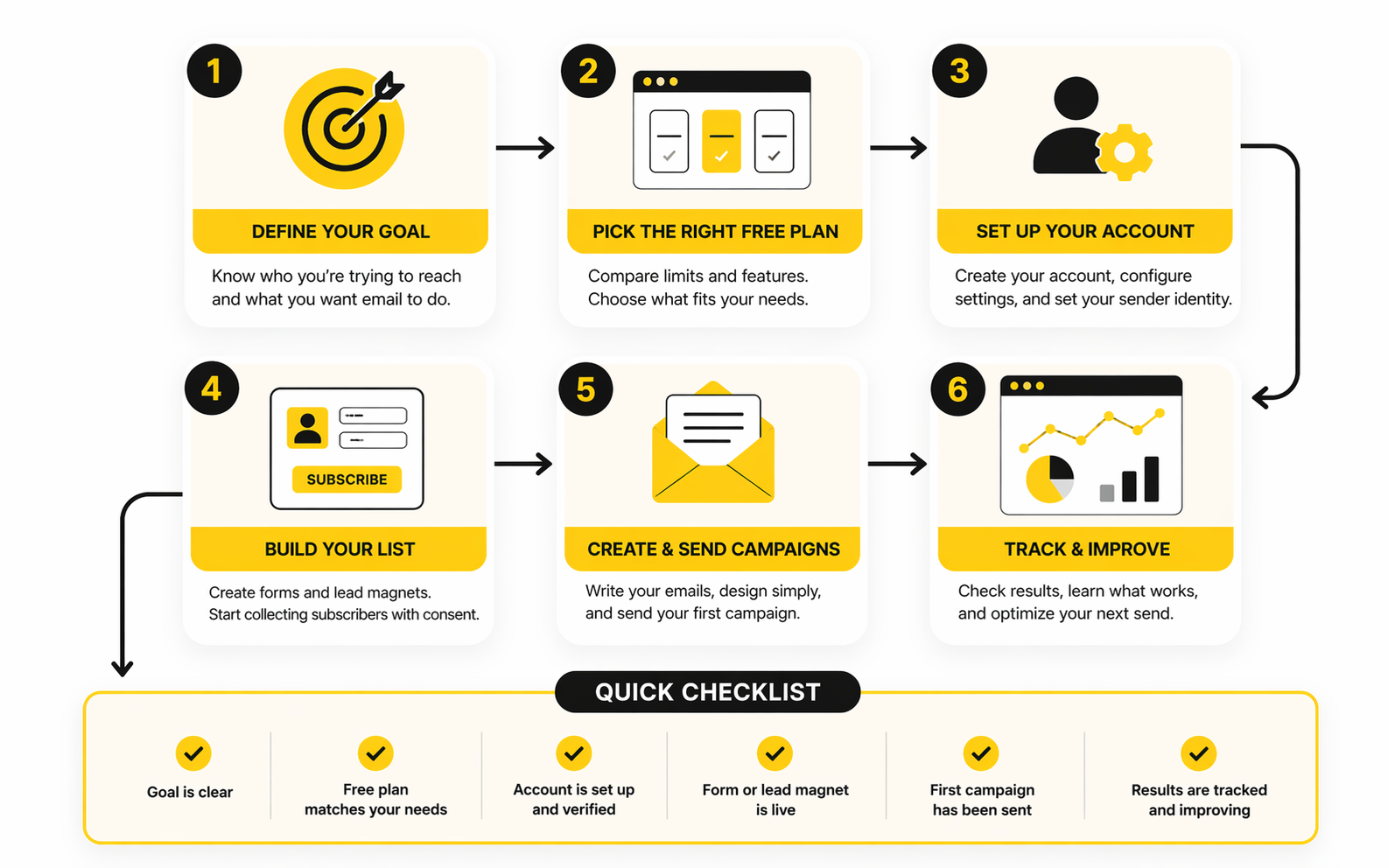
The sequence below is where the setup becomes tangible. If you follow it in order, you will avoid most of the messy problems that make free plans feel more limiting than they really are.
The Practical Setup Sequence
- Choose one email platform and commit to it for your first 30 to 60 days.
- Create one core signup offer with one clear audience promise.
- Publish one form or landing page and place it where existing traffic already lives.
- Connect the form to one list or segment only.
- Write and activate one welcome email.
- Create one weekly or biweekly campaign rhythm you can actually maintain.
- Add unsubscribe and sender details that are clear, visible, and honest.
- Review performance based on clicks, replies, unsubscribes, and list growth rather than obsessing over opens alone.
This process works because it keeps the setup tight. You do not need six automations, twelve segments, and a complicated nurture tree to prove that email can work for your audience. You need a reliable path from signup to first send to next action.
Step 5: Authenticate Your Sending Setup Early
This is one of the most important steps in the whole process, and it is the step beginners delay the most. If your platform allows domain authentication, do it early. Waiting until you hit problems is the wrong move because deliverability is easier to protect than to repair.
The reason is simple. Major mailbox providers now expect senders to follow stronger authentication, complaint control, and unsubscribe standards, so a sloppy setup becomes visible faster than it used to. Even if your volume is still small, building the right habits early makes every later upgrade cleaner and every campaign more trustworthy.
This is where some people outgrow pure free-plan simplicity. If your business depends on sales follow-up, appointment flows, or multi-step lead handling, a broader environment like GoHighLevel can make sense once the basics are proven because it connects email to the rest of the revenue workflow instead of treating campaigns as an isolated activity.
Step 6: Build One Repeatable Sending Rhythm
A small list does not need constant emailing. What it needs is consistency. Free email campaign services work best when you pick a rhythm you can sustain without disappearing for six weeks and then blasting people with three emails in two days.
For most early-stage setups, weekly or every-other-week is enough. That gives you enough room to learn what people click, what they ignore, and what kind of message actually earns attention. The goal is not to impress anyone with frequency. The goal is to become recognizable in the inbox.
This is why your content plan should stay narrow at first. Pick two or three content angles you can return to naturally, then keep refining from there. Consistency beats variety when your audience is still learning who you are.
Step 7: Make Unsubscribing Easy and Respect the Signal
A healthy list is not a list where nobody unsubscribes. It is a list where the right people stay and the wrong people leave without frustration. Trying to trap disengaged subscribers is a bad strategy because it damages trust and eventually damages performance too.
That is why unsubscribe design matters more than people think. It should be obvious, easy, and drama-free. If someone wants out, let them out cleanly and move on.
This is not just about being polite. It is about protecting the long-term performance of your setup. Free email campaign services can only help you if your list quality stays strong, and list quality drops fast when subscribers feel misled or stuck.
Step 8: Add Simple Supporting Tools Only When They Solve a Real Bottleneck
There is nothing wrong with expanding the stack, but timing matters. If your core email setup is not working yet, adding more software usually creates noise, not leverage. The better move is to wait until you can point to a real bottleneck and name exactly what the extra tool is supposed to fix.
That might mean adding ManyChat when chat-based lead capture becomes more efficient than static forms. It might mean using Buffer to distribute signup content more consistently, or Cal.com when your email list starts feeding calls or demos. Those tools can absolutely help, but only after your base email workflow is already doing its job.
That is the real implementation mindset. Keep the core system lean, make each addition earn its place, and do not confuse stack complexity with marketing maturity. The next step is comparing free email campaign services more critically, because once the setup is real, the differences in limits, automation depth, and long-term usability become much easier to judge.
Statistics and Data That Actually Matter
This is the point where a lot of content about free email campaign services goes off the rails. It starts dumping average open rates, generic CTR charts, and random platform screenshots without explaining what any of it should change. Data only becomes useful when it tells you whether your list is healthy, whether your message is resonating, and whether your setup is improving over time.
The numbers also need context. A strong metric on a tiny list can still be misleading, while a weaker metric on a growing, well-qualified list can still be commercially useful. That is why measurement should be built around decision-making, not vanity.
Recent benchmarking makes that pretty clear. DMA’s 2025 report found 98% delivery rates in 2024, 99.2% delivery in B2C, 35.9% open rates, and 2.3% unique click rates. Those numbers matter, but not because you should obsess over matching them exactly. They matter because they show that deliverability is still strong, clicks still matter, and the inbox is still a high-value channel when your setup is clean and your list is relevant. DMA’s 2025 benchmark
Delivery Rate Tells You Whether You Even Get to Compete
Delivery rate is your first gate. If the message does not get accepted by receiving servers, nothing else in the campaign matters. This is why free email campaign services should be judged partly on whether they make authentication, sender setup, and compliance easy enough for normal users to get right.
That benchmark delivery number from DMA is encouraging, but it should not make you complacent. Good industry averages do not rescue weak list practices. If your list is poorly collected, your sending domain is sloppy, or your complaint rate drifts up, your own results can collapse even while the broader market looks healthy. DMA’s 2025 benchmark
This is also where mailbox-provider rules become very practical. Google requires all senders to meet baseline standards and says bulk senders sending more than 5,000 messages per day to Gmail accounts need stronger compliance, including authentication and low complaint rates. That means delivery is no longer just a backend concern for large senders. It is part of the operating environment, even if you are still small. Google’s sender guidelines
Complaint Rate Is a Bigger Signal Than Most Beginners Think
A lot of beginners watch opens and clicks while barely noticing spam complaints. That is backwards. Complaint rate is one of the clearest signals that your targeting, expectations, or frequency are off, and it can hurt future delivery much faster than a disappointing click rate ever will.
Google says senders should keep spam rates below 0.1% and prevent them from reaching 0.3% or higher, while Yahoo also says senders should keep complaint rates below 0.3%. That is not a theoretical compliance detail. It is a practical benchmark that should shape how you build forms, write subject lines, set frequency expectations, and handle unsubscribes. Google’s sender FAQ Yahoo sender best practices
This is exactly why clean acquisition matters more than inflated list size. A smaller, clearer list usually performs better and creates fewer complaints than a larger list built on vague promises or weak consent. When a free plan caps your audience size, that can actually force a healthier discipline if you use the limit well.
Open Rates Are Still Useful, But Only in a Narrow Way
Open rates are not dead, but they are not clean anymore either. Apple says Mail Privacy Protection prevents senders from seeing whether a recipient opened an email and hides the user’s IP address, which is a direct hit to the old model of open-based reporting. That means open rate is now better used as a rough directional signal than as a precise source of truth. Apple on Mail Privacy Protection
That does not mean you should ignore opens completely. They can still help you spot sharp changes over time, especially when you compare campaigns sent to similar audiences under similar conditions. What they should not do is drive major decisions on their own.
This is where people misread data inside free email campaign services. They see a high open rate and assume the campaign worked, when the real outcomes might be weak clicks, weak replies, weak revenue, or a rising complaint rate hiding underneath. Opens can still be a clue. They just are not the verdict.
How to Compare Limits, Deliverability, and Automation
The smartest way to compare free email campaign services is to stop treating them like a features spreadsheet and start treating them like operating systems with tradeoffs. A plan is only as good as the outcomes it helps you create. That means the right comparison lens is not just what features exist, but which constraints matter first for your business model.
Some users hit contact caps first. Others hit send limits, automation walls, branding limits, or missing integrations. If you do not know which bottleneck is most likely to hit you, you can choose the wrong free plan even if the headline offer looks generous.
The Five Metrics That Should Drive Your Comparison
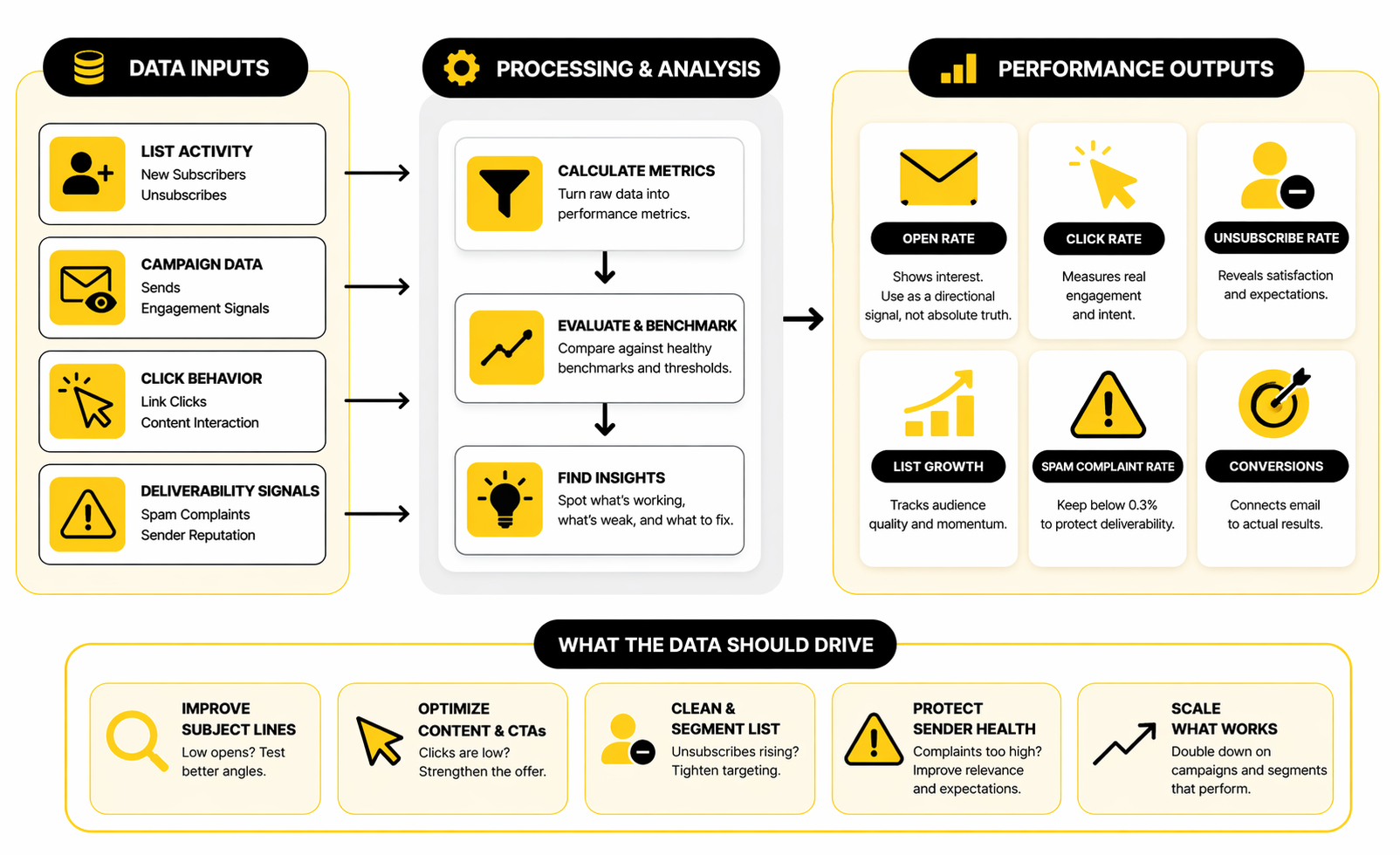
There are five measurement buckets that matter most when evaluating free email campaign services in practice.
- List growth quality
- Delivery and inbox health
- Meaningful engagement
- Automation usefulness
- Upgrade pressure
Each one tells you something different. Together, they help you judge whether the free plan is helping you build momentum or merely delaying the moment when the platform becomes a problem.
1. Measure List Growth Quality, Not Just Subscriber Count
A growing list is only good if the right people are joining. Watch where subscribers come from, which forms convert, and whether newer subscribers click, reply, or unsubscribe at different rates than older ones. That tells you whether growth is healthy or just noisy.
This matters because free plans often make you pay for stored contacts sooner than you expect. If your list is filling up with low-intent subscribers, you are not just diluting performance. You are also moving faster toward your first pricing wall.
That is one reason some businesses prefer send-based pricing models over pure contact-based ones. A tool like Brevo can make more sense when contact storage is less of a problem than total send volume, especially if your list includes many low-frequency subscribers.
2. Watch Delivery and Complaints Before You Chase Creative Wins
This is the health check layer. Delivery, bounce behavior, authentication status, and complaint rates tell you whether the foundation is solid. If these metrics are unstable, there is no point spending hours debating copy angles or button placement.
The action this should drive is straightforward. Tighten signup promises, remove deadweight subscribers, authenticate your domain early, and keep unsubscribe language obvious and respectful. Those moves are not glamorous, but they protect the part of the system that every other result depends on.
Free tools differ a lot here. Some make sender setup relatively clean, while others bury important configuration steps or make you outgrow the plan before you can build a proper workflow. That friction matters more than people think because operational sloppiness usually shows up first in delivery.
3. Treat Clicks as a More Trustworthy Engagement Signal
Clicks are not perfect, but they are more useful than opens in a privacy-distorted environment. DMA’s 2.3% unique click rate benchmark is helpful because it centers on a stronger engagement signal than open data alone. A click means the subscriber did something deliberate, and that gives you a better read on relevance. DMA’s 2025 benchmark
What action should that drive? Look for patterns between topic, format, and destination. Which subject lines get curiosity without triggering disappointment? Which content angles lead to real traffic? Which calls to action turn passive readers into active visitors?
This is also where landing-page quality starts to matter. If your clicks are decent but downstream action is weak, the email may not be the problem. A stronger post-click experience, built with something like Replo or a simple focused page, can change performance more than rewriting the email again and again.
4. Judge Automation by Outcome, Not by Workflow Complexity
Automation is easy to oversell. A free plan does not become better just because it lets you build a maze of branching workflows. What matters is whether the available automation helps you execute the key moments that matter: welcome, follow-up, re-engagement, and basic segmentation.
So the performance question is simple. Does the automation help new subscribers move into their next useful action with less manual work and fewer missed opportunities? If yes, it is doing its job. If no, extra workflow nodes are just decoration.
This is where broader tools become more attractive once the basics are validated. If email starts feeding appointments, sales conversations, or pipeline follow-up, a system like GoHighLevel becomes easier to justify because the automation is tied to commercial outcomes, not just newsletter behavior.
5. Track Upgrade Pressure Before It Forces a Bad Decision
The final metric is not inside the dashboard, but it matters. Upgrade pressure is the point where your growth starts colliding with the free plan’s structure. That can happen because of send caps, subscriber caps, missing automation, branding restrictions, or limited reporting.
The mistake is waiting until you hit the wall to think about it. A better move is to watch your trend line early. If list growth is healthy, campaign cadence is increasing, and segmentation needs are getting more specific, you should already be asking whether the next stage belongs inside the same platform or elsewhere.
That does not mean upgrading too soon. It means understanding the cost of staying put. Sometimes the free plan is still the right choice. Sometimes the real cost is the opportunity you lose by delaying a move into a better-fit system.
What Good Data Should Make You Do Next
Good analytics should lead to concrete actions, not just nicer reports. If delivery is weak, fix authentication and list hygiene. If complaints are rising, tighten expectations and simplify the unsubscribe path. If opens look fine but clicks are weak, improve message relevance or post-click experience. If engagement is strong but automation is shallow, that is usually the moment to consider a platform upgrade.
That is the real value of this measurement layer. It keeps you from making emotional decisions based on one dashboard number. Free email campaign services can absolutely work, but they work best when you read the numbers in the right order and let those signals shape the next move.
The next part will focus on the mistakes and upgrade triggers that usually decide whether a free setup stays useful or starts holding the business back.
Common Mistakes and Hidden Risks
The biggest mistake with free email campaign services is not choosing the wrong tool. It is choosing the right tool for the wrong phase and then expecting it to behave like a mature platform forever. Free plans are excellent for validation, but they become dangerous when they start shaping your strategy around platform limits instead of customer behavior.
That usually happens quietly. You start sending less often because the cap is tight, you avoid segmenting because the feature set is thin, or you keep inactive contacts because migration feels annoying. None of those decisions look dramatic in the moment, but together they can turn a useful starter setup into a system that slows growth.
The risk is not just operational. It is strategic. When your email setup starts training you to protect the free tier instead of improving the business, the plan is no longer saving you money. It is costing you momentum.
Mistake 1: Optimizing Around the Cap Instead of the Customer
This is one of the easiest traps to fall into. A free plan with strict contact or send limits can push you into weird behavior, like under-emailing engaged subscribers, suppressing healthy growth, or avoiding campaigns that would actually help revenue because you are trying to stretch the allowance. That is not efficiency. That is distortion.
You can see how different platforms create different kinds of pressure. Mailchimp’s free tier is capped at 250 contacts and 500 sends per month, while Brevo’s free plan allows 300 emails per day and stores up to 100,000 contacts, and MailerLite’s free plan supports up to 500 subscribers and 12,000 monthly emails. Those structures create very different bottlenecks, which means the cheapest-looking plan is not always the least restrictive one in practice. Mailchimp’s free plan limits Brevo’s free plan limits MailerLite’s free plan details
The action here is simple. Choose the limitation you can live with, not the logo you recognize most. If your list grows faster than your send volume, one model may be fine. If you send frequently to a smaller audience, another model may make far more sense.
Mistake 2: Treating Consent and Compliance Like Bigger-Business Problems
A lot of small senders assume privacy and consent rules become important later. They do not. They matter the moment you start collecting email addresses, especially if you are marketing to people in the UK or EU, where marketing email rules are much less forgiving than many beginners assume.
The UK ICO states that you must not send marketing emails or texts to individuals without specific consent, except for the narrow soft opt-in exception for your own previous customers. The broader GDPR framework also applies whenever you process personal data in the EEA or target people there. That means free email campaign services do not exempt you from the legal basics just because the account costs nothing. ICO guidance on electronic mail marketing EDPB GDPR FAQ
This matters strategically because poor consent practices create two problems at once. They increase legal risk, and they also damage deliverability by creating the kind of subscriber mismatch that drives complaints. So compliance is not a separate box to tick later. It is part of performance from day one.
Mistake 3: Trusting Open Rates Too Much
Open rates still get too much emotional weight. They feel easy to read, so people use them as a proxy for success even when the signal has been weakened by privacy features and background content loading. That is one reason marketers can think a campaign worked while the real business outcome says otherwise.
Apple says Mail Privacy Protection hides the recipient’s IP address and prevents senders from seeing whether an email was opened. That means opens are now better treated as rough directional data than as a hard benchmark for campaign quality. If you use them as your main KPI, you will misread what is actually happening. Apple Mail Privacy Protection
The smarter move is to anchor your decisions in clicks, replies, conversions, unsubscribes, and complaint trends. Those signals are closer to intent, and they drive better decisions when you are deciding whether a free email campaign service is still doing its job.
Mistake 4: Ignoring How Easy It Will Be to Leave
Vendor lock-in is not always dramatic. Sometimes it just looks like messy exports, inconsistent fields, broken automations after migration, or list cleanup work you kept postponing. The problem is not that platforms let you export. Most of them do. The problem is that bad structure inside your account makes the export less useful than it should be.
Mailchimp lets users export audiences, segments, tags, and groups as CSV files. Brevo allows contact and attribute exports, MailerLite supports subscriber exports, and beehiiv supports both quick and full subscriber exports. So the issue is usually not whether you can get your data out. The issue is whether you maintained a clean enough system for that data to remain valuable after it leaves. Mailchimp export contacts Brevo contact export MailerLite export subscribers beehiiv subscriber export
That is why structure matters even on free plans. Clear fields, consistent tags, honest source tracking, and simple segments make future upgrades easier. Messy accounts make future upgrades expensive, even when the next platform is technically better.
Upgrade Triggers That Actually Matter
Upgrading should not be a status move. It should happen when the free plan starts limiting useful behavior, not when you simply get bored with it. That sounds obvious, but a lot of businesses upgrade too early for features they do not use or too late after the free tier has already started distorting decisions.
The real trigger is not just growth. It is friction. When the workarounds become more costly than the subscription, the free plan has done its job and it is time to move.
Trigger 1: Your Send Limits Are Changing Campaign Strategy
This is the cleanest signal of all. If your send cap forces you to skip good campaigns, delay launches, split sends awkwardly, or avoid nurturing segments that are ready to hear from you, you are no longer using the plan strategically. You are negotiating with the ceiling.
Brevo’s 300-per-day model can be fine for testing and small audiences, but it becomes restrictive when you need larger campaign bursts. Mailchimp’s 500 monthly send ceiling can create a different kind of pressure, especially if you want to email even a modest list more than once a week. Meanwhile, beehiiv’s free plan is more generous on sends, with up to 2,500 subscribers and unlimited sends, but its fit depends much more on a newsletter-style business model. Brevo free limits Mailchimp pricing comparison beehiiv pricing
The takeaway is straightforward. When the limit changes what you would ideally send to real people, it is time to stop calling it a free benefit and start seeing it as a growth tax.
Trigger 2: Basic Automation Is No Longer Enough
Early on, one welcome email and a simple follow-up sequence may be enough. Later, you may need behavior-based routing, cleaner suppression logic, better lead handling, or lifecycle messaging that reflects what people actually do. That is the point where automation stops being a nice extra and starts affecting revenue directly.
This is where many free email campaign services begin to separate sharply. A platform may still let you broadcast campaigns, but if it cannot support the next layer of relevant follow-up, then your audience experience becomes flatter than your business needs. The problem is not just efficiency. It is missed timing.
That is especially true for businesses where email is tied to appointments, pipelines, or sales conversations instead of just content distribution. Once that happens, the better question is no longer which free plan has the nicest editor. It is which system fits the commercial workflow you are actually running.
Trigger 3: Branding and Trust Start to Matter More Than Free Access
The earlier you are, the more people forgive a basic-looking setup. As you grow, that tolerance drops. Weak branding, generic footers, awkward landing experiences, or limited control over the subscriber journey start to hurt trust more than they save money.
This is not vanity. It is conversion math. Stronger trust usually means better clicks, better replies, and better downstream action. If your audience is becoming more valuable, then a rough free-plan experience can become more expensive than the upgrade you are trying to avoid.
That does not mean everyone needs a premium stack immediately. It means presentation, continuity, and brand control start becoming performance variables once your list is no longer purely experimental.
Trigger 4: You Need Better Reporting Than the Free Dashboard Can Give You
At the beginning, basic campaign stats are enough. You mainly need to know whether the list is growing, whether people are clicking, and whether complaints or unsubscribes are trending the wrong way. Later, that stops being sufficient.
The moment you need cleaner attribution, better segmentation analysis, more meaningful cohort views, or clearer journey reporting, weak analytics become a real constraint. That is especially true now that open data is less reliable and mailbox-provider standards put more weight on complaint discipline and sender quality. Google says bulk senders should keep spam rates below 0.3%, and Yahoo sets the same ceiling, which makes quality monitoring part of the real operating model. Google sender guidelines FAQ Yahoo sender best practices
This is where a smarter paid setup can pay for itself. Better reporting does not matter because dashboards are fun. It matters because clearer signals let you improve faster and protect deliverability before the damage becomes visible in revenue.
The Strategic Tradeoff Most People Miss
The real tradeoff with free email campaign services is not free versus paid. It is flexibility versus focus. A constrained free plan can actually help you stay disciplined, keep your setup lean, and prove that the channel works before you complicate it. That is the upside.
The downside is that constraints do not stay helpful forever. At some point they begin steering your behavior in ways that no longer match the business. When that shift happens, staying free stops being a smart test and starts becoming a refusal to adapt.
That is the lens experts use. They do not ask whether a platform is free. They ask whether it still supports the next useful move. The final part will bring that together with the most common questions, the cleanest upgrade decisions, and the practical takeaways that help you choose without overthinking it.
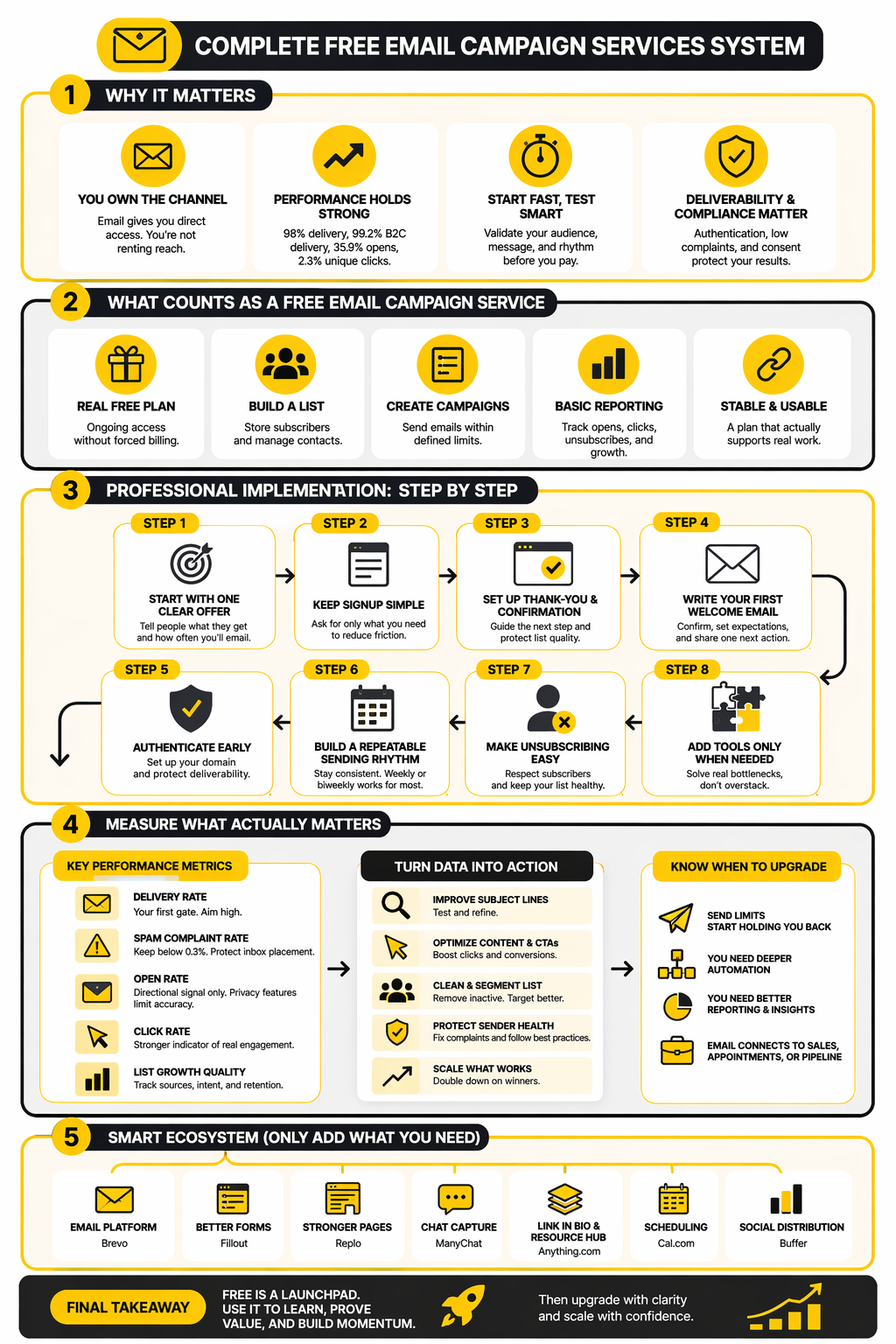
FAQ
1. Are free email campaign services actually enough for a serious business?
Yes, they can be enough at the beginning, but only for the beginning. A good free plan can help you prove demand, collect subscribers, send consistently, and learn what your audience responds to without taking on software costs too early. The mistake is expecting a validation tool to carry the full weight of a scaling business forever.
2. What is the best use case for free email campaign services?
The best use case is early traction. That usually means creators testing a newsletter angle, small businesses building a first list, agencies launching a lead magnet, or founders trying to create an owned audience before paying for a larger stack. Free email campaign services are strongest when the goal is learning and momentum, not deep infrastructure.
3. How do I know whether a free plan is truly free or just a trial?
A true free plan keeps working without forcing you into a short countdown toward payment. If the platform gives you ongoing access to forms, campaigns, contacts, and basic reporting within fixed limits, that is a real free tier. If access expires unless you upgrade, it is a trial, even if the entry point looked generous.
4. What metric should I care about most at the start?
At the start, the best metric is not open rate. It is a combination of list growth quality, click behavior, unsubscribe trends, and whether subscribers take the next action you wanted. If people are joining, engaging, and not immediately regretting the signup, your setup is doing something right.
5. Are open rates still useful?
They are useful, but only with caution. Apple says Mail Privacy Protection prevents senders from reliably knowing whether an email was opened and hides information about Mail activity, which means open-rate data is no longer a clean truth source. You can still use opens as a rough directional signal, but clicks, replies, and conversions deserve more trust.
6. When should I worry about spam complaints?
You should worry about them immediately, not later. Google says bulk senders become ineligible for mitigation when user-reported spam rates are greater than 0.3%, which tells you very clearly that complaints are not a minor reporting detail. If complaints rise, the right move is to tighten expectations, improve list quality, and make unsubscribing easier instead of trying to push harder.
7. Is Brevo still one of the more practical free options?
For many businesses, yes. Brevo’s free plan includes 300 daily email sends and storage for 100,000 contacts, which makes it especially interesting for users who care more about send pacing than tiny contact caps. That does not make it the perfect fit for every business, but it does make it one of the more practical places to start if you want room to build a real list.
If you want to test that type of setup, Brevo is one of the cleaner entry points in this category.
8. Should I build my entire system around a free plan?
No, and this is where people get themselves in trouble. You should build your first working system on a free plan, but you should not let the free plan dictate every strategic decision once the business starts growing. The moment the cap changes your sending behavior more than your audience does, the plan is starting to run you.
9. What is the biggest mistake people make with free email campaign services?
The biggest mistake is protecting the free tier instead of protecting performance. That can show up as emailing too little, avoiding segmentation, skipping cleanup, or delaying necessary upgrades because the idea of paying feels psychologically heavier than the revenue being lost. Free is useful when it keeps you focused, but harmful when it keeps you small.
10. What tools pair well with free email campaign services without making the stack messy?
The best companion tools are the ones that remove a clear bottleneck. If your forms are weak, Fillout can make capture cleaner. If your landing experience needs work, Replo can help tighten the post-click journey. If your growth engine depends on conversation-based acquisition, ManyChat can fit naturally.
11. When should I move from a free email tool to something broader?
You should move when email is no longer operating as a simple newsletter or broadcast channel. If your system now needs lead routing, multi-step follow-up, appointment handling, pipeline visibility, or stronger cross-channel automation, the email tool may no longer be the center of the problem. At that point, a broader operating system such as GoHighLevel starts making more strategic sense.
12. Can free email campaign services work for agencies or client businesses?
Yes, but only if the scope is honest. They can work well for early testing, small local businesses, lightweight lead nurturing, and audience-building projects where simplicity is an advantage. They become much less comfortable when the client expects advanced reporting, sales workflow integration, or larger operational complexity.
13. How often should I email on a free plan?
As often as you can do it consistently without damaging quality. For most early-stage setups, weekly or every other week is enough to build recognition and gather useful feedback without burning through your allowance or exhausting your audience. Frequency should be shaped by relevance and sustainability, not by guilt or arbitrary rules.
14. What is the cleanest way to make a final decision?
Pick the plan whose limitation hurts you least right now. If you need more contact room, choose for that. If you need more sending flexibility, choose for that. If you already know you will need CRM depth and broader automation soon, do not pretend a basic free plan will solve a next-stage problem just because it feels cheaper today.
Final Takeaway
Free email campaign services are still worth using, but only when you use them with the right expectations. They are excellent for building the first version of a real email system, learning what your market responds to, and creating an owned channel before paid software becomes necessary. They are not magic, and they are not meant to remove the need for good messaging, list quality, consent discipline, or eventual infrastructure upgrades.
The best choice is usually not the platform with the loudest brand or the most crowded feature page. It is the one that lets you start cleanly, measure the right things, and grow until the next stage becomes obvious. If you keep that lens, free stops being a gimmick and becomes what it should be: a low-risk way to build something valuable.
Work With Professionals
Explore 10K+ Remote Marketing Contracts on MarkeWork.com
Most marketers spend too much time chasing clients, competing on crowded platforms, and losing a percentage of every project to middlemen. MarkeWork gives you a better way. The platform says you can explore 10K+ remote marketing contracts and connect directly with companies looking to hire marketers without platform commissions and without unnecessary gatekeepers.
If you're serious about finding better opportunities and keeping 100% of what you earn, explore available contracts and create a profile for free at MarkeWork.com.