

The phrase free email lists for marketing sounds simple, but it usually points to two very different ideas. One is the lazy shortcut people hope exists somewhere online: a giant list of contacts they can grab and blast. The other is the asset that actually compounds over time: a permission-based list you build without paying for every subscriber, using content, offers, forms, referrals, and smart conversion paths.
That distinction matters more now than it did a few years ago. Gmail’s bulk sender rules and Yahoo’s sender best practices pushed authentication, unsubscribe clarity, and complaint control from “good hygiene” into the category of non-negotiable basics. At the same time, email is still one of the strongest owned channels available, with Litmus reporting that many teams still see returns in the 10:1 to 36:1 range, while Sinch Mailgun found that nearly 18% of marketing emails miss the inbox when execution slips.
So this article is not about scraping, buying, or “downloading” contacts. It is about how to build free email lists for marketing in a way that is legal, durable, and commercially useful. If the people joining your list do not recognize you, want what you offer, or trust what happens next, the list is not an asset. It is just future deliverability damage wearing a growth label.
- Why Free Email Lists for Marketing Still Matter
- What “Free” Really Means in Email List Building
- A Practical Framework for Growing a List Without Buying Leads
- The Core Assets That Turn Traffic Into Subscribers
- How to Implement the System Professionally
- What to Measure, Fix, and Scale Over Time
Why Free Email Lists for Marketing Still Matter
A real email list gives you something most rented channels never will: a direct line to people who already raised their hand. That matters when paid acquisition gets expensive, social reach changes overnight, or platform algorithms decide your visibility is optional this week. With email, you still have to earn attention, but you are operating on an owned relationship rather than borrowed distribution.
The economics are still hard to ignore. Litmus continues to show strong email ROI benchmarks, and broader 2025 reporting from the market shows that teams who treat email like infrastructure instead of an afterthought usually perform better over time. The catch is that performance now depends much more on permission, relevance, and technical setup than on raw send volume.
That is exactly why the “free list” idea gets misunderstood. A list is not valuable because it is large. It is valuable because the right people joined voluntarily, your domain is trusted, your first email lands, and the next email still gets opened instead of ignored, unsubscribed from, or marked as spam.
What “Free” Really Means in Email List Building
In practice, free email lists for marketing means you are not paying a broker, data vendor, or ad network for the contacts themselves. You are earning subscribers through organic traffic, existing audiences, community, referrals, partnerships, lead magnets, webinars, newsletters, product touchpoints, and conversion elements on channels you already control. The list may still cost time, software, content, and testing effort, but the subscriber relationship begins with consent rather than a transaction.
That difference is not just philosophical. It changes legal exposure, response rates, and deliverability. The FTC’s CAN-SPAM compliance guide lays out the basics for commercial email in the US, while European rules around consent remain stricter, with the EDPB’s guidance on consent still shaping what valid permission looks like in practice. If you build the list properly, compliance supports growth. If you start with shady acquisition, compliance becomes cleanup.
It also changes how platforms treat you. Mailchimp is blunt about why purchased lists are a bad idea, and Brevo warns that bought contacts can damage sender reputation and delivery rates. That is not platform moralizing. It is operational reality. Purchased or scraped contacts generate the exact bounce, complaint, and disengagement signals inbox providers use to decide whether your mail belongs in the inbox at all.
A Practical Framework for Growing a List Without Buying Leads
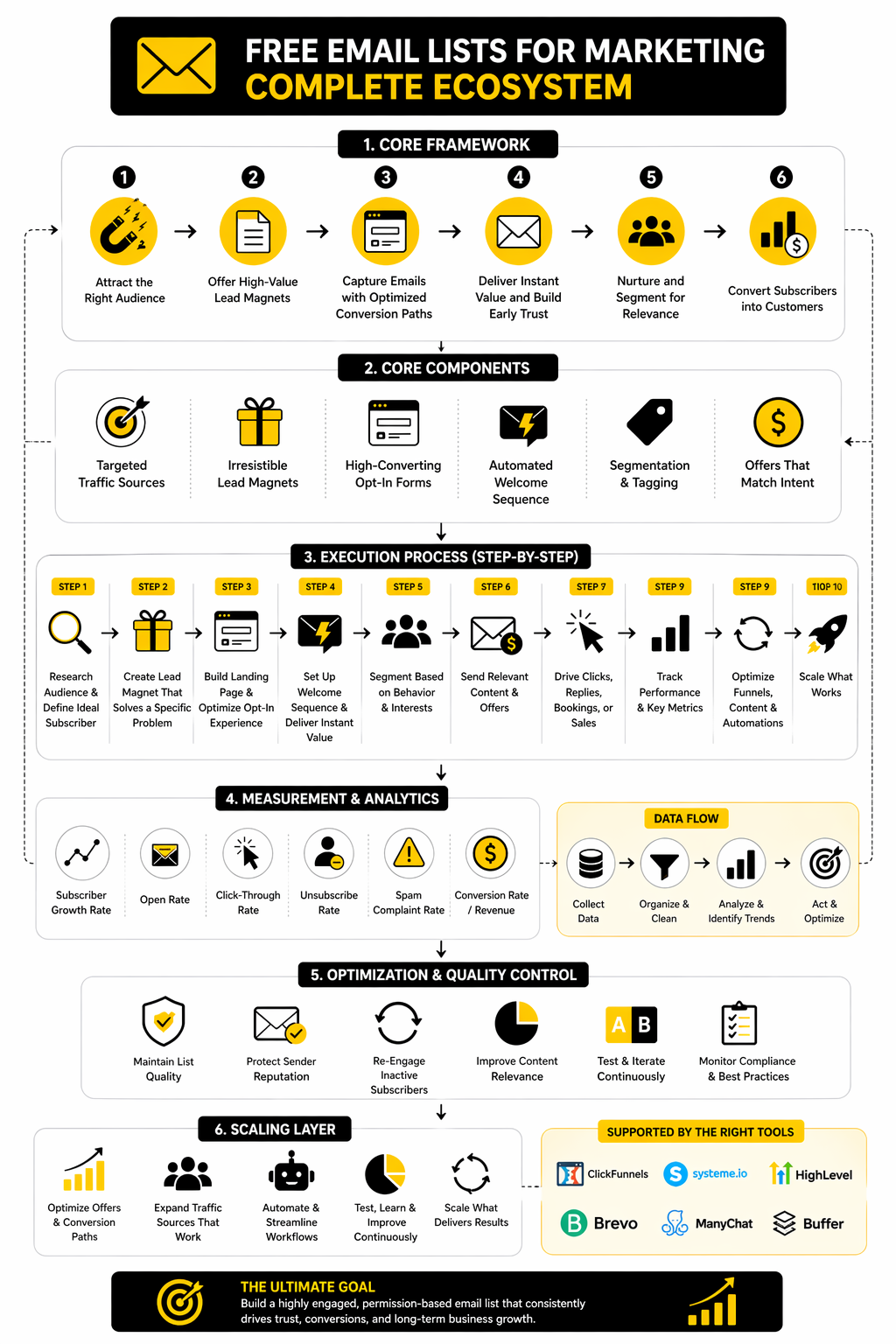
The cleanest way to think about this is as a four-part system: traffic, offer, capture, and follow-up. Traffic brings the right people in. The offer gives them a reason to subscribe now instead of “later.” Capture turns interest into an opt-in with as little friction as possible. Follow-up proves the signup was worth it, which is what protects long-term engagement and list health.
This is where most list-building advice gets weak. It overemphasizes the form and underestimates the sequence behind the form. A popup can work, but only if the visitor already understands the value on the other side. Recent data from Omnisend’s analysis of 1.24 billion popup displays put the average email popup conversion rate at 2.1% in 2025, which is useful because it resets expectations. You do not need magic. You need an offer-message-trigger combination that consistently beats the baseline.
The framework also needs to respect deliverability from day one. Google’s sender FAQ makes clear that bulk senders need proper authentication and easy unsubscribe paths, while Yahoo expects the same fundamentals through its bulk sender requirements. In other words, growth and deliverability are not separate projects anymore. The same system that acquires subscribers has to protect your reputation while it does it.
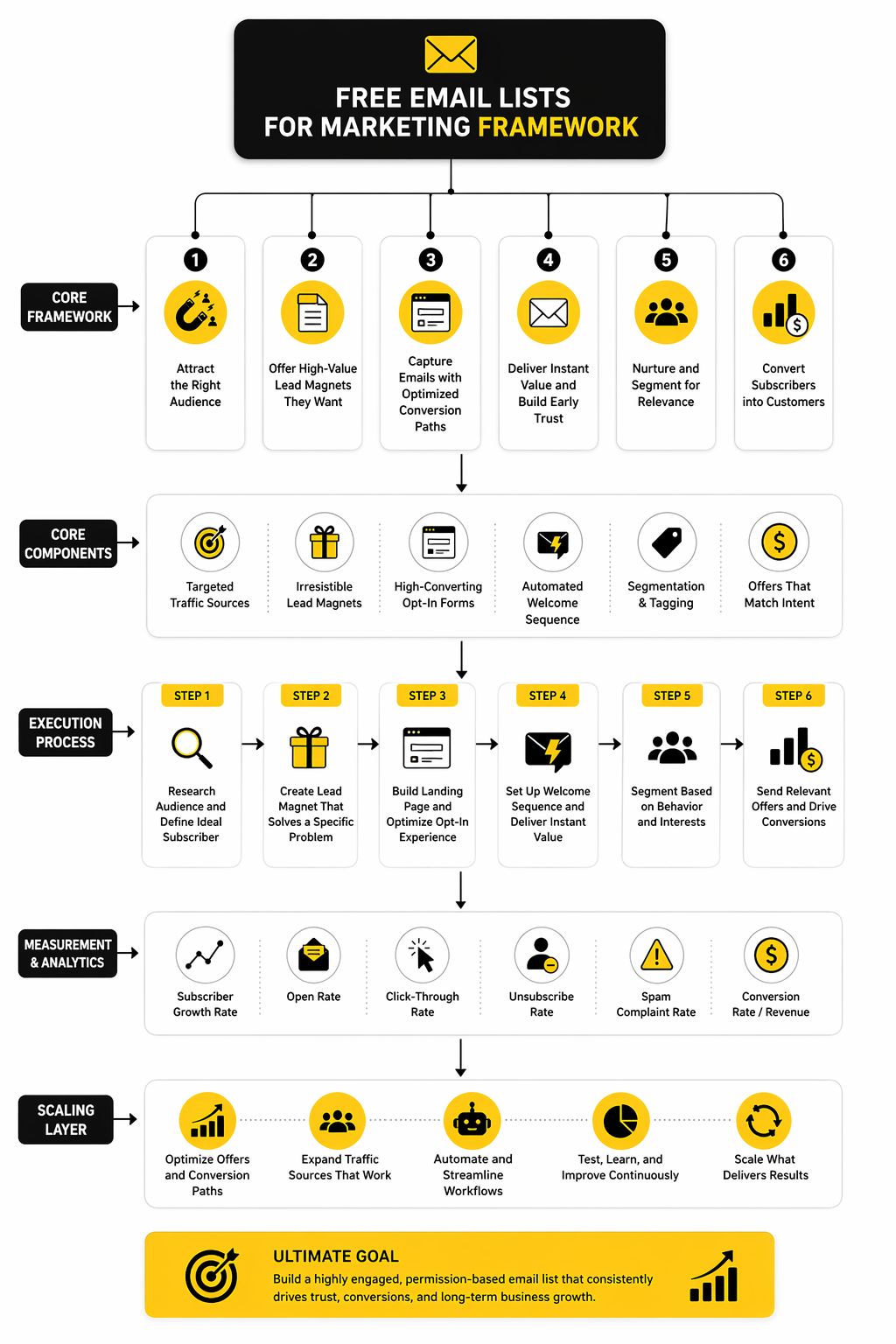
In the next part, we will break down that framework in detail and look at the specific list-building engines that create the best free email lists for marketing: content upgrades, newsletters, popups, landing pages, referral loops, and lead magnets that attract people who are actually likely to buy.
A Practical Framework for Growing a List Without Buying Leads
If you want free email lists for marketing that turn into revenue instead of headaches, the cleanest model is simple: attract attention, make a relevant offer, capture the opt-in, and follow with something worth opening. Most brands do one or two of these steps reasonably well and then wonder why the list grows slowly or stays cold. The leak is usually in the handoff between steps, not in the idea of email itself.
The first step is qualified attention. That can come from SEO, short-form content, YouTube, partnerships, referrals, communities, organic social, or customer traffic you already have. The source matters because subscriber quality usually mirrors acquisition intent; someone who reads a comparison article or uses a calculator is much closer to a commercial decision than someone who casually liked a post.
Then comes the offer, and this is where people either build a real asset or waste months. A weak offer asks for an email because you want one. A strong offer gives the reader a reason to subscribe now because the next step is clearly useful, faster, or more profitable for them.
Capture is the technical moment where that interest becomes a contact record. This is where forms, landing pages, popups, embedded signup blocks, quiz flows, and chat-based lead collection do the work. Recent popup benchmark data from Omnisend shows that the average email popup converted 2.1% of visitors in 2025, which is useful because it proves two things at once: popups still work, and average performance is not high enough to save a bad offer.
The last step is follow-up, and it matters more than most marketers admit. Google’s sender requirements and sender FAQ make it clear that inbox placement now depends on authentication, unsubscribe clarity, and unwanted mail signals, while Yahoo’s bulk sender expectations reinforce the same point. So the first emails someone receives after opting in are not just a welcome sequence. They are part of your reputation system.
Start With One Audience, Not Every Possible Subscriber
The fastest way to stall list growth is to build for everyone. When the message is vague, the magnet gets generic, the form gets ignored, and the emails that follow feel irrelevant before the relationship even starts. Narrow beats broad here almost every time.
A focused audience lets you create a sharper promise. Instead of “join my newsletter for tips,” you can offer a teardown, a template, a short checklist, a buyer’s guide, a benchmark, or a case-based lesson that matches one immediate problem. That kind of specificity is what turns random traffic into the kind of free email lists for marketing that are actually worth emailing.
It also makes segmentation easier later. The page someone joined from, the lead magnet they chose, and the question they answered on the form all give you a cleaner starting point for relevance. That means better engagement, fewer complaints, and a much healthier base to grow from.
Match the Offer to the Moment of Intent
Not every visitor is ready for the same thing. Someone reading a beginner guide probably wants a checklist or short explainer. Someone comparing tools may be ready for a template, pricing framework, or demo invitation. Someone already on a product page may only need a confidence boost, a reminder, or a concrete use case.
This is why the best list builders do not rely on one universal opt-in across the whole site. They align the offer to the page intent. It is the difference between asking for attention and continuing the momentum the visitor already created.
That also explains why welcome flows outperform regular campaigns so often. Klaviyo’s recent benchmark reporting shows welcome emails can reach an average open rate of 51%, which makes sense because they arrive when attention is freshest and intent is highest. A new subscriber is telling you, very clearly, that timing matters just as much as copy.
The Core Assets That Turn Traffic Into Subscribers
Once the framework is clear, the next question is practical: what assets actually build the list? Not the fantasy version. The real version. The answer is that most strong email programs lean on a small set of repeatable assets and then improve them over time instead of chasing endless hacks.
Landing Pages That Sell One Next Step
A good landing page does not try to explain your entire business. It sells one decision. The headline, proof, CTA, and form should all pull in the same direction, with as little friction as possible.
That is why simple page builders and funnels still matter for email growth. If you want to spin up a focused opt-in page around a lead magnet, webinar, or workshop quickly, tools like ClickFunnels, Systeme.io, or GoHighLevel fit naturally because they reduce the time between idea and launch. Speed matters here because list growth improves when you can create offers around specific traffic sources instead of forcing everything through one generic homepage form.
The key is not the software itself. It is whether the page makes the next step obvious and valuable. If the page feels like a detour, conversion drops. If it feels like progress, people opt in.
Embedded Forms That Feel Native to the Content
Embedded forms do not interrupt, which is both their weakness and their advantage. They usually convert lower than aggressive popups, but they can feel more trustworthy because they appear as part of the content experience instead of hijacking it. That matters on educational pages where the visitor is already engaged and does not need a loud prompt.
This works especially well on high-intent articles. If someone is reading a detailed guide, an embedded form offering a worksheet, benchmark summary, or next-step framework can feel like a natural continuation rather than a sales move. In that context, the form becomes part of the reading journey, not a separate demand.
The same principle applies to newsletter blocks. When the promise is clear and the positioning is strong, a plain signup form can outperform a flashy design. The visitor does not need entertainment. They need a reason to believe the next email will be useful.
Popups That Trigger on Behavior, Not Ego
Popups work, but lazy popups train people to ignore you. The benchmark data is clear enough to be helpful: popups still collect a huge volume of subscribers, and average performance is meaningful, but the days of throwing a discount box on every visit and calling it strategy are gone. Relevance, timing, and trigger logic now decide whether the interruption feels helpful or annoying.
Behavior-based triggers are usually the better route. Exit intent, scroll depth, time on page, cart behavior, product interest, and content category all give you stronger context than showing the same box to everyone after four seconds. That is how you turn the same traffic into better free email lists for marketing without needing more ad spend.
If you want to push beyond basic forms, conversational capture can help too. A chat-led signup or message opt-in can work when the interaction feels useful, especially for lead qualification or multi-step discovery. Tools like ManyChat fit best when the brand already has active social or messaging touchpoints, not as a random add-on.
Lead Magnets That Solve a Small Expensive Problem
Most lead magnets fail because they are broad, bloated, or forgettable. A 47-page PDF with generic advice is not automatically more persuasive than a one-page checklist. In many cases it is worse, because the visitor senses the effort required before they even subscribe.
The stronger move is to solve a smaller problem with more immediacy. Checklists, calculators, scripts, teardown examples, swipe files, mini-courses, onboarding packs, planning sheets, and benchmark summaries work because they compress time. The subscriber is not buying information in the abstract. They are buying a faster path to a result.
That is the test worth using going forward: does this asset help the subscriber make a decision, avoid a mistake, or get a result faster? If the answer is weak, the opt-in rate will usually be weak too. In the next part, we’ll move from assets into execution and show how to implement this system professionally so the list you build stays deliverable, segmented, and commercially useful.
How to Implement the System Professionally
This is the point where most people either build a list that compounds or create a mess they spend the next year cleaning up. The difference is rarely creativity. It is process. If you want free email lists for marketing that keep growing without wrecking deliverability, the system needs to be simple enough to launch fast and structured enough to scale cleanly.
Professional implementation starts with one audience, one core offer, one capture path, and one welcome sequence. Not five funnels. Not twelve lead magnets. Not a chaotic stack of forms scattered across different tools with no naming rules, no tags, and no idea which subscriber came from where.
The good news is that modern tools make the mechanics easier than they used to be. Platforms like Brevo, GoHighLevel, and Systeme.io all position forms, automations, and email sending as part of one connected workflow. That matters because the more handoffs you create between tools, the easier it is to lose attribution, delay follow-up, or break the subscriber experience.
Build the System in This Order
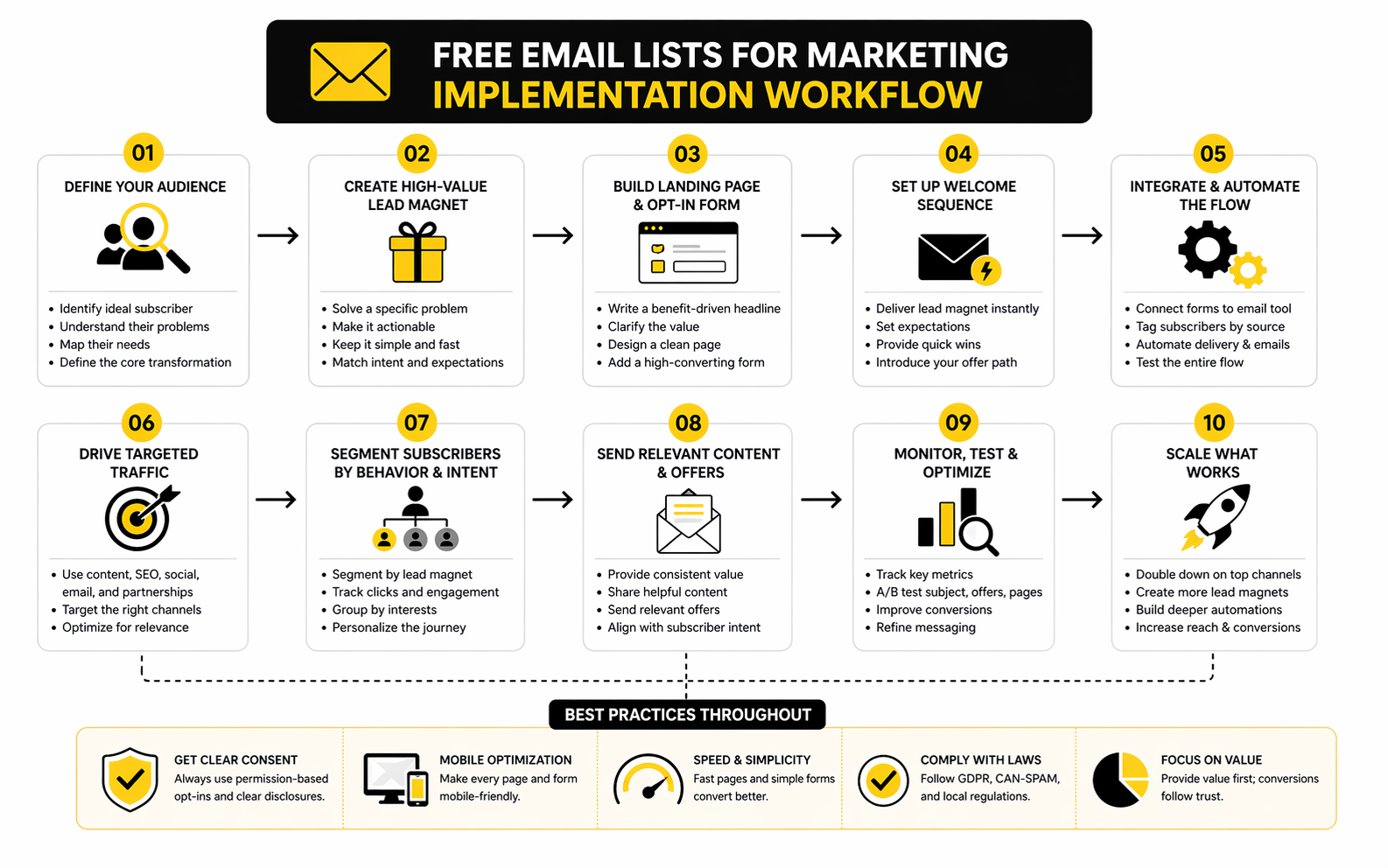
The cleanest implementation sequence is not complicated, but it does need discipline. Build the offer first, then the page, then the form, then the automation, then the welcome emails, and only then start driving traffic. When people reverse that order, they end up sending traffic into half-finished pages or collecting leads with no meaningful follow-up behind them.
A practical rollout usually looks like this:
- Define one audience segment and one high-intent problem
- Create one offer that solves that problem quickly
- Build one landing page or embedded content block around that offer
- Connect the form to one list, one tag, or one pipeline stage
- Trigger one welcome sequence immediately after signup
- Add one secondary action inside the sequence, such as a reply, click, booking, or product view
- Measure conversion, open behavior, clicks, and unsubscribes before expanding
That order sounds basic, but basic is exactly what works. A stable system beats an impressive-looking one that nobody can maintain. The goal is not to impress yourself with complexity. The goal is to make every new subscriber enter a reliable path.
Set Up Your Capture Layer Before You Worry About Scale
Your capture layer is the infrastructure that turns attention into a usable subscriber record. That includes the form fields, confirmation message, thank-you page, tags, source tracking, and any routing rules that decide what happens next. If this layer is sloppy, the rest of the funnel becomes guesswork.
Keep the form friction low at the start. In most cases, email address and perhaps first name are enough for an initial opt-in unless you have a strong reason to ask for more. Every extra field is a negotiation, and unless the value exchange is obvious, that negotiation usually lowers conversion.
This is where builders with native forms can save a lot of friction. Brevo’s form tools, HighLevel form workflows, and Systeme.io’s integrated email pages all fit this stage because they reduce the chance that someone opts in and then disappears into a broken handoff between tools.
Connect Every Opt-In to a Clear Next Action
An email signup should always trigger something concrete. That might be delivery of a lead magnet, a short welcome series, a nurture sequence, a booking invitation, or a segmentation step based on intent. What it should never do is dump the contact into a giant list and wait for your next newsletter blast.
This is where automation stops being a “nice to have” and becomes part of the product. HighLevel’s own workflow documentation frames automation around triggers and actions, which is exactly the right mental model: one event happens, then a defined sequence follows. That is how you make list growth operational instead of manual.
The simplest professional version looks like this. Someone joins through a page or form, gets tagged by source, receives the promised asset immediately, gets one short orientation email next, and then moves into a segment-specific path based on what they click or ignore. That is not enterprise complexity. That is the minimum viable system for building free email lists for marketing that stay useful.
Use Welcome Sequences to Train the Relationship Early
The welcome sequence is where you set expectations and protect future performance. If the first email is late, confusing, overly promotional, or disconnected from the signup promise, the relationship starts with friction. That friction compounds fast.
A stronger sequence does three jobs. First, it delivers the promised asset or outcome immediately. Second, it tells the subscriber what kinds of emails they should expect next. Third, it creates a low-friction action that helps you qualify interest, such as a link click, a reply, or a choice between two topics.
This is also where voice matters. The people building the best email programs do not write welcome emails like legal notices or brochure copy. They write them like a competent human showing the subscriber where to go next and why it is worth paying attention.
Add Segmentation Earlier Than Most People Do
Segmentation is often treated like an advanced tactic for larger teams, but it becomes valuable much earlier than that. Even a small list performs better when you know whether someone joined from a beginner guide, a pricing page, a product quiz, a webinar registration, or a short-form social campaign. Those signals tell you what they care about right now.
You do not need a massive CRM project to start doing this well. A few clean tags, source fields, and behavior-based branches are enough. The real skill is not collecting endless data. It is collecting the minimum amount of data that changes what email the subscriber should receive next.
That is one reason chat-led flows can work well when used intentionally. If someone comes from social and the conversation format suits the channel, tools like ManyChat can help collect email addresses while also capturing intent through conversational prompts. Done well, that gives you both the contact and the context.
Keep the Tool Stack Tight
One of the easiest mistakes in implementation is stacking too many tools too early. A popup tool, a page builder, a CRM, an email sender, an automation layer, a scheduler, a chatbot, and a form platform can all be useful, but they can also create seven points of failure where one integrated setup would have done the job. Complexity often feels like maturity when it is really just fragility.
That does not mean one tool is always better than a specialized stack. It means your current stage should decide the stack, not your fear of missing out. If you are early, there is real value in using an all-in-one route like GoHighLevel or Systeme.io so pages, forms, email, and automations live in one place.
If your site already runs on a more customized setup, you may prefer modular tools. In that case, the standard is simple: every integration must preserve source data, trigger the right sequence immediately, and make reporting readable without heroic effort. If it cannot do that, it is not helping.
Create a Weekly Operating Rhythm
Once the system is live, the next risk is neglect. List-building does not usually fail because the first launch was terrible. It fails because nobody reviews the funnel after it goes live. Small fixes get ignored, forms become stale, welcome sequences stay untouched, and pages keep collecting subscribers long after the promise stopped matching the market.
A weekly review rhythm solves a lot of this. Check which sources are driving signups, which pages convert best, where subscribers are dropping off, and which welcome emails are getting clicked. Then make one improvement at a time instead of redesigning everything at once.
That kind of rhythm is where implementation becomes a real growth system. You are no longer just collecting names. You are tuning a machine that turns attention into permission, permission into engagement, and engagement into the next commercial step. In the next part, we’ll get into what to measure, what to fix first, and how to scale the list without diluting quality.
What to Measure, Fix, and Scale Over Time
Once your acquisition system is live, the next job is reading the data without lying to yourself. This is where a lot of marketers go wrong. They either obsess over vanity metrics that feel good but change nothing, or they look at a weak result once and start rebuilding the whole funnel when the real issue is just one broken step.
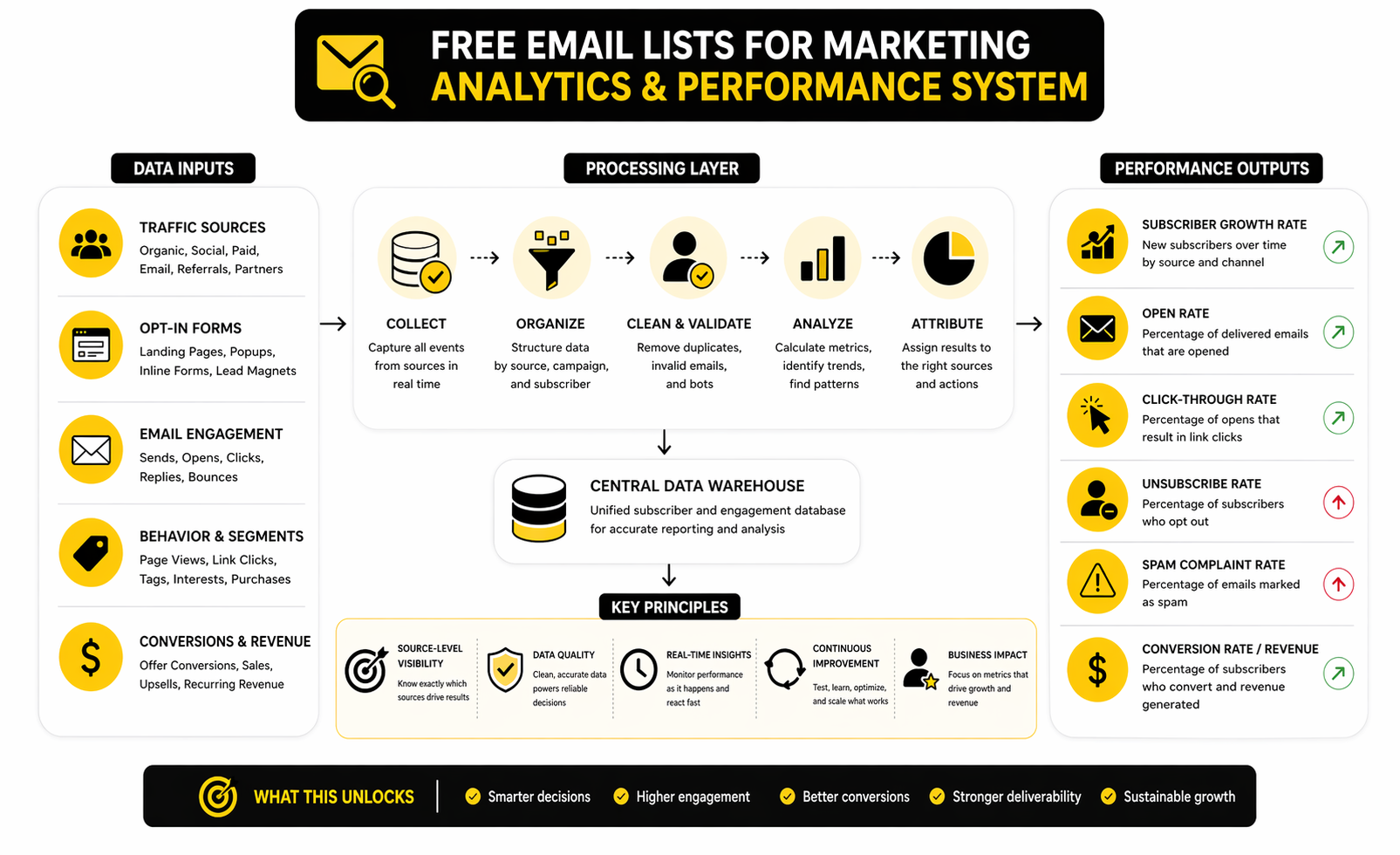
The smarter move is to read your list-building system as a chain. Traffic quality affects opt-in rate. Opt-in quality affects welcome engagement. Welcome engagement affects inbox placement and future conversions. So when you measure free email lists for marketing, you are not measuring one thing. You are measuring whether each stage is making the next stage stronger or weaker.
The Metrics That Actually Matter First
Start with four core numbers: visitor-to-subscriber conversion rate, welcome sequence click rate, unsubscribe rate, and spam complaint rate. Those four tell you whether your offer is attractive, whether your follow-up is relevant, whether your emails are annoying people, and whether inbox providers are getting negative signals from your list. Everything else matters later, but these are the numbers that expose structural problems fastest.
That is also why raw list size is such a weak headline metric. A larger list with weak engagement, rising complaints, and low click activity is often less valuable than a smaller list built from better intent. Growth without quality is not growth. It is future churn with better branding.
Benchmarks help here, but only if you use them as context instead of identity. Mailchimp’s current benchmark page shows an average open rate of 35.63%, click rate of 2.62%, and unsubscribe rate of 0.22% across all users, while MailerLite’s 2025 benchmark report places the average click rate at 2.09% and unsubscribe rate at 0.22%. Those numbers are useful because they tell you what “normal” looks like, not because they tell you what your business should settle for.
Why Opt-In Rate Is the First Diagnostic Number
If a page or form is not converting, the problem usually starts before email ever enters the picture. The traffic may be weak. The offer may be too generic. The page may ask for trust before it has earned it. Or the CTA may be vague enough that the visitor does not understand why subscribing is worth it right now.
This is why popup and form benchmarks matter only when tied to page context. Omnisend’s 2025 popup dataset, based on 1.24 billion popup displays, put the average email popup conversion rate at 2.1%. That number is useful because it gives you a reality check. If your core opt-in asset is converting at 0.4%, you probably do not have a “traffic problem” alone. You likely have an offer, message, trigger, or page-friction problem.
The action this should drive is specific. If the conversion rate is low, test the promise before the design. Tighten the headline. Make the benefit more immediate. Remove a field. Match the lead magnet to the page intent more closely. Too many people redesign the box when the real issue is that nobody wants what is inside it.
Open Rate Still Matters, but Not the Way It Used To
Open rate is still useful as a directional signal, but treating it as hard truth is a mistake. Apple’s Mail Privacy Protection changed the game years ago, and Litmus notes that more than half of email opens happen on a device with Apple Mail Privacy Protection activated. That means many reported opens are no longer clean proxies for human attention.
Litmus has also been explicit that open rate has become challenging to evaluate on its own, because Apple’s privacy layer blocks reliable visibility into whether someone actually opened an email in the old sense. So if your opens rise while clicks, replies, and conversions stay flat, that is not necessarily progress. It may just be measurement distortion.
The action this should drive is restraint. Use open rate to compare broad patterns, spot obvious inbox problems, and see whether subject lines are trending in the right direction. But do not build your whole performance story on opens anymore. If you want a cleaner read on engagement, weight clicks, replies, downstream sessions, and conversions more heavily.
Clicks Tell You More About Intent
Clicks are not perfect either, but they are much closer to an actual expression of interest. Someone who clicks has crossed a threshold from passive inbox exposure to active behavior. That is why click rate and click-to-open rate are usually more useful for diagnosing message relevance than open rate alone.
This is also where weak list quality gets exposed fast. A big list acquired through vague giveaways or soft intent usually produces decent-looking top-line growth and disappointing click behavior. A tighter list built from focused offers often looks less impressive on paper at first, but it tends to generate much healthier click and conversion patterns.
So when you review a welcome sequence or lead magnet follow-up, ask a blunt question: are subscribers doing anything meaningful after the email lands? If not, the issue is not just the message. It may be the promise that got them onto the list in the first place.
Complaint Rate Is the Metric That Can Hurt You Fastest
If there is one number you should not treat casually, it is spam complaints. Google’s sender guidance is direct: keep spam rates in Postmaster Tools below 0.3%, and its FAQ makes clear that bulk senders over that threshold become ineligible for mitigation until they stay below it for seven consecutive days. That is not an abstract best practice. That is the line between stable sending and preventable inbox damage.
Yahoo is equally clear that bulk senders need to authenticate mail with SPF, DKIM, and DMARC, and that requirement sits alongside unsubscribe and reputation expectations. Put differently, if your list-building process creates confusion, low intent, or surprise emails, the damage shows up not only in campaign performance but in sender reputation.
The action here is simple and important. Watch complaint rate at the source level, not just at the account level. If one lead magnet, one traffic source, or one campaign path produces subscribers who complain more often, isolate it fast. That source is not feeding your business. It is taxing it.
Unsubscribes Are Not Always Bad News
A rising unsubscribe rate is not automatically a crisis. Sometimes it means your targeting has drifted. Sometimes it means your email frequency jumped too fast. Sometimes it means the promise at signup was broader than the content that followed. But in some cases, unsubscribes are just a healthy filter that removes weak-fit subscribers before they do more damage through complaints or dead engagement.
That is why unsubscribe data should be read with context. ActiveCampaign’s benchmark guidance treats under 0.5% as good and under 0.2% as excellent, while Mailchimp and MailerLite both place broader unsubscribe averages around 0.22% and 0.22%. If you are above those ranges consistently, something is probably off. If you are near them while clicks and conversions stay healthy, you may just be maintaining list quality.
The right action is not to panic and go silent. It is to inspect where unsubscribes happen. If they spike after the first promotional push, your welcome sequence may not have set expectations. If they spike after a source-specific signup, the acquisition promise may be too broad. The unsubscribe event is not the diagnosis. It is the signal telling you where to look.
The Best Benchmark Is Your Own Trendline
External benchmarks are useful for orientation, but your own trendline is more valuable. If your visitor-to-subscriber rate improves from 1.4% to 2.3%, your welcome clicks rise, and complaint rate stays controlled, that is real progress even if another brand somewhere reports a higher open rate. You are building a healthier system, not winning a screenshot contest.
This matters because free email lists for marketing are highly context-sensitive. A B2B service business, a newsletter-led media brand, a creator funnel, and an ecommerce store will not produce the same benchmark profile. The source mix, buying cycle, and offer type all change what “good” looks like. What matters is whether your numbers are improving in a way that predicts stronger commercial outcomes.
So track your own baselines obsessively. Compare pages against pages, sources against sources, and sequences against sequences. When one path produces better subscribers, do more of that. When one path drags down complaints, clicks, or deliverability, fix it or cut it.
Build a Measurement Stack That Leads to Decisions
A practical analytics setup does not need to be fancy, but it does need to connect acquisition with outcomes. At minimum, you should know where the subscriber came from, what asset they signed up for, what welcome emails they received, whether they clicked, and whether they moved toward a business goal. If your dashboard cannot answer those questions, it is reporting activity, not performance.
This is where many teams make life harder than it needs to be. They track everything except the journey. Then they end up with pages full of metrics and no idea which offer created the subscribers who actually bought, booked, or stayed engaged. Measurement should reduce uncertainty, not decorate it.
The action this should drive is operational discipline. Name your campaigns clearly. Tag sources consistently. Keep forms tied to specific offers. Define the next action for every new subscriber path. In the next part, we’ll turn that into optimization and scaling decisions so you know what to double down on, what to prune, and how to keep the list growing without sacrificing quality.
Scaling Without Wrecking the Asset
This is the stage where list building gets more dangerous, not less. Early on, almost any improvement feels like progress because the baseline is low and the system is still fresh. But once your subscriber flow starts working, the pressure shifts from “how do we get more signups?” to “how do we scale without lowering intent, hurting reputation, or training the list to ignore us?”
That is the real tradeoff behind free email lists for marketing. The cheaper your subscriber acquisition becomes, the easier it is to justify more volume. More popups. More lead magnets. More content offers. More send frequency. More traffic sources. But scaling the top of the funnel only helps if the subscribers entering the system still match the promise, still want the follow-up, and still behave like people who might buy instead of people who wanted one free thing and disappeared.
Bigger Lists Create Hidden Quality Problems
One of the most common scaling mistakes is treating every new subscriber as equally valuable. They are not. A subscriber who joins from a product-adjacent guide, reads the welcome sequence, and clicks into a commercial page is dramatically different from someone who joined through a generic giveaway and never opens again. On paper, both count as “list growth.” In reality, one strengthens the business and the other clouds the data.
This is why advanced list building requires a quality filter, not just a volume engine. As the list grows, you need to know which sources produce engaged subscribers, which offers create future buyers, and which channels just pad the database. If you do not make that distinction early, scaling hides the problem instead of solving it.
That is also where many operators get trapped by vanity. A screenshot of rapid subscriber growth feels good. A smaller chart with higher engagement and stronger downstream revenue is usually worth more, even if it is less exciting to post about.
Frequency Is a Growth Lever and a Reputation Risk
Once you have more subscribers, the temptation is obvious: send more. Sometimes that is the right move. Sometimes it is exactly how a healthy list starts to decay. Frequency is not inherently good or bad. It becomes good or bad depending on whether the content still matches intent and whether the audience is being trained to expect useful communication instead of repetitive noise.
The mistake is assuming that if someone opted in once, they want every message forever. They do not. Attention has to be re-earned continuously. That is especially true when your list includes people from different entry points, different awareness levels, and different buying timelines.
So the advanced move is not just “test frequency.” It is to tie frequency to recency, engagement, and source intent. The newest and most active subscribers can usually tolerate more touchpoints. Older or colder segments often need a lighter cadence or a different type of message entirely. If you ignore that distinction, list fatigue starts looking like a creative problem when it is really a targeting problem.
More Offers Usually Means More Operational Complexity
A single lead magnet is easy to manage. Ten lead magnets are not. Every new offer creates copy, page, form, tagging, automation, segmentation, delivery, reporting, and maintenance work. If you are not disciplined, what began as a smart list-building machine turns into a pile of overlapping campaigns that nobody fully understands.
That does not mean you should stay small forever. It means you need a rule for when a new asset earns the right to exist. The strongest operators do not create endless offers just because they can. They create a new opt-in asset when there is a distinct audience, a distinct intent pattern, and a clear follow-up path attached to it.
This is where all-in-one systems can become more valuable as you scale. If you are expanding into more funnels, more audience segments, or more service layers, a platform like GoHighLevel can make sense because it keeps pages, CRM logic, automations, and communications closer together. If your model is more creator-led or newsletter-led, a simpler route through Systeme.io may stay cleaner for longer. The answer is not about brand loyalty. It is about how much operational complexity your current growth model can absorb.
Segmentation Becomes More Valuable Than New Traffic
At some point, the best growth move is not acquiring more subscribers. It is getting smarter with the subscribers you already have. This is the moment when advanced teams start outperforming beginners even without a dramatic increase in traffic. They understand that relevance often produces better gains than reach.
A list with decent size but weak segmentation ends up being treated like one audience. That usually means bland campaigns, broad messaging, and uneven performance. A segmented list lets you send different content to people based on what they signed up for, what they clicked, what they ignored, and where they sit in the buying journey. That is how you improve outcomes without relying on constant top-of-funnel expansion.
This also affects monetization quality. The more precisely you can match message to intent, the less you need to “push” offers. Commercial emails start feeling timely instead of intrusive. That is a big shift. It protects both conversion and trust.
Re-Engagement Is Not Optional Once You Grow
The larger your list becomes, the more inactive records it will accumulate. That is normal. People change jobs, shift interests, stop reading, switch inbox habits, or simply cool off. The mistake is pretending those subscribers are still active because deleting or suppressing them feels like losing something.
In reality, keeping disengaged subscribers forever can hurt more than it helps. They weaken engagement signals, clutter reporting, and make it harder to see what your active audience actually wants. More importantly, they can become the hidden drag on deliverability that turns a healthy program into a frustrating one.
That is why advanced list building always includes a re-engagement policy. Not just a vague idea. A real policy. Decide when someone becomes inactive, what sequence they should receive before suppression, and what behavior counts as genuine renewed interest. This is one of the least glamorous parts of email operations, but it is one of the most important.
Content Depth Beats Content Volume at the Expert Level
When teams hit a scaling wall, they often assume they need more content. More posts, more lead magnets, more newsletters, more clips, more campaigns. Sometimes the real need is stronger content, not more content. A shallow content engine can grow a list for a while, but it usually attracts weaker intent and produces weaker follow-up engagement.
Deeper content changes that. Better comparisons, clearer frameworks, sharper point of view, stronger examples, and more useful tools tend to attract subscribers who understand the problem more clearly and are closer to action. Those are the people who make free email lists for marketing commercially meaningful.
That is also why distribution quality matters. If you want to extend the reach of your list-building content across channels without making the brand feel scattered, tools like Buffer or Flick can fit naturally. But distribution only amplifies what is already there. It cannot rescue weak substance.
AI and Automation Help, but Only If the Strategy Is Clear
There is a lot of hype around AI-assisted growth systems, and some of it is justified. AI can help speed up segmentation logic, draft sequences, summarize data, route leads, personalize journeys, and make a lean team feel bigger. But AI does not fix a weak offer, a confused audience, or a signup path that never deserved to convert in the first place.
That is why the highest-leverage use of AI in list building is not magical copy generation. It is operational acceleration. It helps you move faster once the fundamentals are already sound. If the core system is messy, AI just helps you scale the mess more efficiently.
Used well, though, it can be powerful. If you are building more advanced qualification or support layers around your list, tools like Chatbase or Guideless can become part of a broader conversion path. The important thing is that they support the subscriber journey rather than distracting from it.
The Strategic Tradeoff Nobody Likes to Admit
Here is the uncomfortable truth: the fastest way to grow a list is often not the best way to build a durable one. Broad offers grow faster than narrow ones. Frictionless giveaways grow faster than targeted resources. Aggressive capture tactics can produce more raw leads than restrained ones. But those shortcuts often bring weaker intent, lower engagement, and more cleanup later.
That does not mean you should avoid aggressive growth entirely. It means you should know the price of the tradeoff before you take it. If a tactic grows the list faster but lowers click quality, raises churn, or makes future monetization harder, it may not be a win at all. It may just be growth borrowed from the future.
The best operators understand this and act accordingly. They do not ask only, “Will this get more subscribers?” They ask, “Will this produce the kind of subscribers we still want six months from now?” That is the question that separates a real email asset from a swollen contact database. In the final part, we’ll close this out with a practical FAQ and a set of direct answers to the questions that come up most often when people try to build free email lists for marketing the right way.
FAQ for the Complete Guide
Is buying an email list ever a good idea for marketing?
In almost every real-world case, no. Buying a list usually creates weak engagement, higher complaints, worse deliverability, and a much lower chance that the people receiving your email actually wanted to hear from you in the first place. Google’s current sender rules still make it clear that bulk senders need to keep spam rates below 0.3%, and bought lists are one of the fastest ways to move in the wrong direction.
There is also a strategic problem beyond compliance. A purchased list may look like a shortcut, but it skips the trust-building step that makes email work. You are not starting with permission. You are starting with interruption, and that is a bad foundation for almost any serious brand.
What does “free email lists for marketing” actually mean?
It means building a permission-based subscriber list without paying a broker or database vendor for the contacts themselves. You still invest time, content, infrastructure, and sometimes software, but the subscriber joins because your offer, content, or conversion path earned that action. That is very different from renting access to strangers and hoping the math works out.
This distinction matters because the source of the email address affects everything that follows. It shapes open behavior, click quality, complaint rates, and the likelihood that the subscriber ever becomes commercially useful. A list built through consent behaves like an asset. A list acquired through shortcuts behaves like a liability.
How fast can I realistically grow a list without paying for leads?
That depends on your traffic quality, your offer, and how clearly the capture path matches the visitor’s intent. There is no universal growth number worth trusting across every niche, but there are useful baselines for the capture layer. Omnisend’s 2025 popup data from 1.24 billion displays put the average email popup conversion rate at 2.1%, with under 1.5% usually underperforming and 3% to 5% looking much healthier.
The practical takeaway is straightforward. If you already have traffic, small improvements in offer quality and opt-in relevance can move list growth faster than chasing entirely new channels. Most of the time, the fastest gains come from tightening the value proposition, not adding more tools.
What is the best lead magnet for building a strong email list?
The best lead magnet is the one that solves a small, expensive, immediate problem for the exact audience you want. That might be a checklist, template, calculator, teardown, mini-course, pricing framework, or benchmark summary. It does not need to be long. It needs to be useful quickly.
This is where many marketers overcomplicate the process. They assume bigger assets are more persuasive. In practice, shorter assets often win because the subscriber can see the value immediately and believes they will actually use it. A one-page tool that saves a decision can outperform a long PDF full of generic advice.
Are popups still worth using in 2026?
Yes, but only when they are relevant, timed well, and matched to the page context. Popups are still effective because they create a clear moment of decision, and current benchmark data shows they continue to convert meaningfully when the offer is strong. The mistake is not using popups. The mistake is showing the same weak popup to every visitor regardless of intent.
The better approach is to use triggers like exit intent, scroll depth, content category, or product interest. That turns the popup into a context-sensitive capture asset instead of a blunt interruption. If the timing feels earned, people tolerate the interruption much more easily.
What metrics should I watch first if I am building a list from scratch?
Start with visitor-to-subscriber conversion rate, welcome email click rate, unsubscribe rate, and spam complaint rate. Those metrics tell you whether the offer is attractive, whether the welcome sequence is doing anything useful, whether the list is being annoyed, and whether your sender reputation is at risk. They are much more useful than staring at raw list size.
Benchmark data can help you interpret performance. Mailchimp’s current benchmark page shows average email results around 34.23% opens, while its broader benchmark reporting and similar market datasets show unsubscribe averages that often sit in the low fractions of a percent. Use those numbers as orientation, not as your identity. Your trendline matters more than someone else’s average.
Should I use double opt-in or single opt-in?
It depends on your list quality goals, compliance posture, and how much friction your audience will tolerate. Double opt-in can improve list cleanliness and reduce the chance of fake or mistyped addresses entering the system. Single opt-in can maximize raw growth, especially for lower-friction content offers.
The tradeoff is simple. Single opt-in often grows faster. Double opt-in usually grows cleaner. If your audience is highly intentional and your welcome sequence is strong, single opt-in may be fine. If deliverability is fragile, compliance risk is higher, or list quality is more important than absolute volume, double opt-in is often the safer call.
How many emails should I send after someone joins?
Enough to maintain momentum, but not so many that the relationship feels hijacked. The first email should arrive immediately and deliver whatever was promised. After that, the right cadence depends on what the subscriber signed up for and how much intent they showed.
This is why welcome sequences matter so much. They let you use timing while attention is still high. Recent ecommerce email data from Omnisend shows automated welcome messages in 2025 reached 37.49% open rates and 2.91% conversion rates, which is a useful reminder that the first messages often carry the strongest leverage.
How do I know if my list quality is getting worse as it grows?
Look for divergence between growth and engagement. If subscriber volume rises while click rates weaken, complaint rates creep up, or unsubscribes jump after early emails, quality may be slipping. Another warning sign is when one traffic source or one lead magnet brings in a lot of names but very little downstream action.
This is why source-level tracking matters. You need to know not only how many people joined, but where they came from and how they behaved after joining. If one asset produces subscribers who open, click, and convert while another produces silence, those are not equal growth channels, even if the signup totals look similar.
What tools are good for building and managing the system?
The best tool is the one that matches your current complexity without creating extra operational drag. If you need funnels, forms, automations, and CRM-style routing in one place, GoHighLevel is a natural fit. If you want a simpler all-in-one route for pages, email, and lead magnets, Systeme.io is often a cleaner starting point.
If you need email sending and automation with a more traditional campaign flow, Brevo makes sense. If your growth engine is more funnel-centric, ClickFunnels can be the better fit. The important thing is not the logo. It is whether the stack preserves source data, triggers follow-up instantly, and keeps reporting readable.
Can social media help build free email lists for marketing without paid ads?
Absolutely. Organic social can work well when the content leads naturally into a stronger owned-channel offer. Short-form clips, carousels, threads, and tutorials can all function as top-of-funnel attention if the next step is clear and relevant. The common mistake is treating social content and email growth as separate projects.
This is where distribution discipline matters. If you want to keep your publishing cadence consistent across channels while pushing people toward your list-building assets, tools like Buffer or Flick can support the workflow. But the bridge still has to make sense. Social gets attention. The offer earns the email.
Is open rate still a reliable metric?
It is useful, but not reliable enough to treat as the final word. Apple Mail Privacy Protection changed how open data behaves, and Litmus notes that more than half of email opens happen on devices with Apple Mail Privacy Protection enabled. That means open rate is now better used as a directional indicator than a hard measure of human attention.
Clicks, replies, conversions, and downstream on-site behavior are usually more trustworthy indicators of real interest. So if your open rate looks strong but nobody clicks or moves forward, do not congratulate yourself too quickly. The system may be getting seen without actually getting traction.
What is the biggest mistake people make with list building?
Confusing contact volume with subscriber quality. It is extremely common to chase the easiest possible signup, celebrate the growth chart, and then wonder why the list feels dead three months later. Weak-fit subscribers create more noise than value because they distort your reporting while contributing little to revenue.
The better mindset is to ask a harder question earlier. Not “How do I get more emails?” but “How do I get more of the right people onto the list, then move them into the next useful action?” That shift changes everything. It affects your content, your lead magnets, your forms, your welcome sequence, and your long-term deliverability.
Do I need AI to make this work well now?
No. You need a clear audience, a strong offer, a clean capture path, and relevant follow-up. AI can help accelerate parts of the system, but it cannot rescue a broken strategy. If the list-building logic is weak, AI usually just helps you produce mediocre assets faster.
Where AI can help is in routing, support, qualification, summarization, and follow-up efficiency once the fundamentals are already sound. If that fits your model, tools like Chatbase or Guideless can support a broader funnel. They are not the strategy. They are force multipliers for a strategy that already works.
What is the simplest version of this whole system if I want to start this week?
Pick one audience, one offer, one page, one form, and one short welcome sequence. That is enough to start. You do not need a complicated ecosystem to prove the model. You need a clear promise and a working subscriber journey.
If you can launch one focused capture asset, send one immediate welcome email, and track the source and clicks properly, you already have the foundation of a serious list-building machine. From there, the job is optimization, not reinvention. That is how real free email lists for marketing are built: one clean system, then steady improvement.
Explore 10K+ Remote Marketing Contracts on MarkeWork.com
Most marketers spend too much time chasing clients, competing on crowded platforms, and losing a percentage of every project to middlemen. MarkeWork gives you a better way. Browse thousands of remote marketing contracts and connect directly with companies desperate to hire skilled marketers like you, without platform commissions and without unnecessary gatekeepers.
If you're serious about finding better opportunities and keeping 100% of what you earn, explore available contracts and create a profile for free at MarkeWork.com.