

Free email marketing sounds almost too good to be true, but the channel itself is still one of the hardest-working assets a business can own. Marketers continue to rank email among the best ROI channels, and small businesses increasingly say it is their most effective marketing tool, which matters a lot when you are trying to grow without burning cash on every new app or campaign. HubSpot’s marketing data, Litmus research, and Constant Contact’s small business report all point in the same direction.
That does not mean every free plan is equal, and this is where people get stuck. One platform gives you automation but limits subscribers, another gives you more contacts but caps monthly sends, and another looks free until you need a landing page, segmentation, or deliverability tools that actually make the system useful. The smart move is not chasing “free” in the abstract. It is building a setup that lets you capture subscribers, send consistently, stay compliant, and upgrade only when revenue justifies it.
This guide is built to do exactly that. You are going to see how free email marketing really works, where the limits are, which building blocks matter first, and how to implement the channel in a way that still looks professional.
Article Outline
- Why Free Email Marketing Still Matters
- A Simple Framework for Choosing the Right Free Setup
- The Core Tools You Actually Need
- How To Build and Send Better Campaigns on a Free Plan
- When To Upgrade and What To Pay for First
- Common Mistakes, Smart Fixes, and Final FAQs
Why Free Email Marketing Still Matters
Free email marketing matters because it gives you a direct line to people who already said yes to hearing from you. That is fundamentally different from renting attention on social platforms where reach can vanish with one algorithm change. When you own the list, you control when you publish, how you segment, and how often you show up.
The economics are still hard to ignore. Litmus reports that many marketing teams see email returns in the range of 10:1 to 36:1, while HubSpot says email remains one of the top ROI channels for B2C brands. Even better, this is not a niche channel fading away. Constant Contact notes that global daily email volume was estimated at 361.1 billion in 2024, with further growth projected.
For smaller businesses, this becomes even more practical. Constant Contact’s 2025 SMB data found that 44% of small businesses now say email is their most effective marketing channel. That is a big clue: when budgets are tight and time is limited, email keeps surviving because it keeps producing.
There is also a tactical advantage that beginners underestimate. You do not need a giant audience to get traction with email. A small, relevant list with a clear offer will usually outperform broad, weak traffic that never gets captured in the first place.
A Simple Framework for Choosing the Right Free Setup
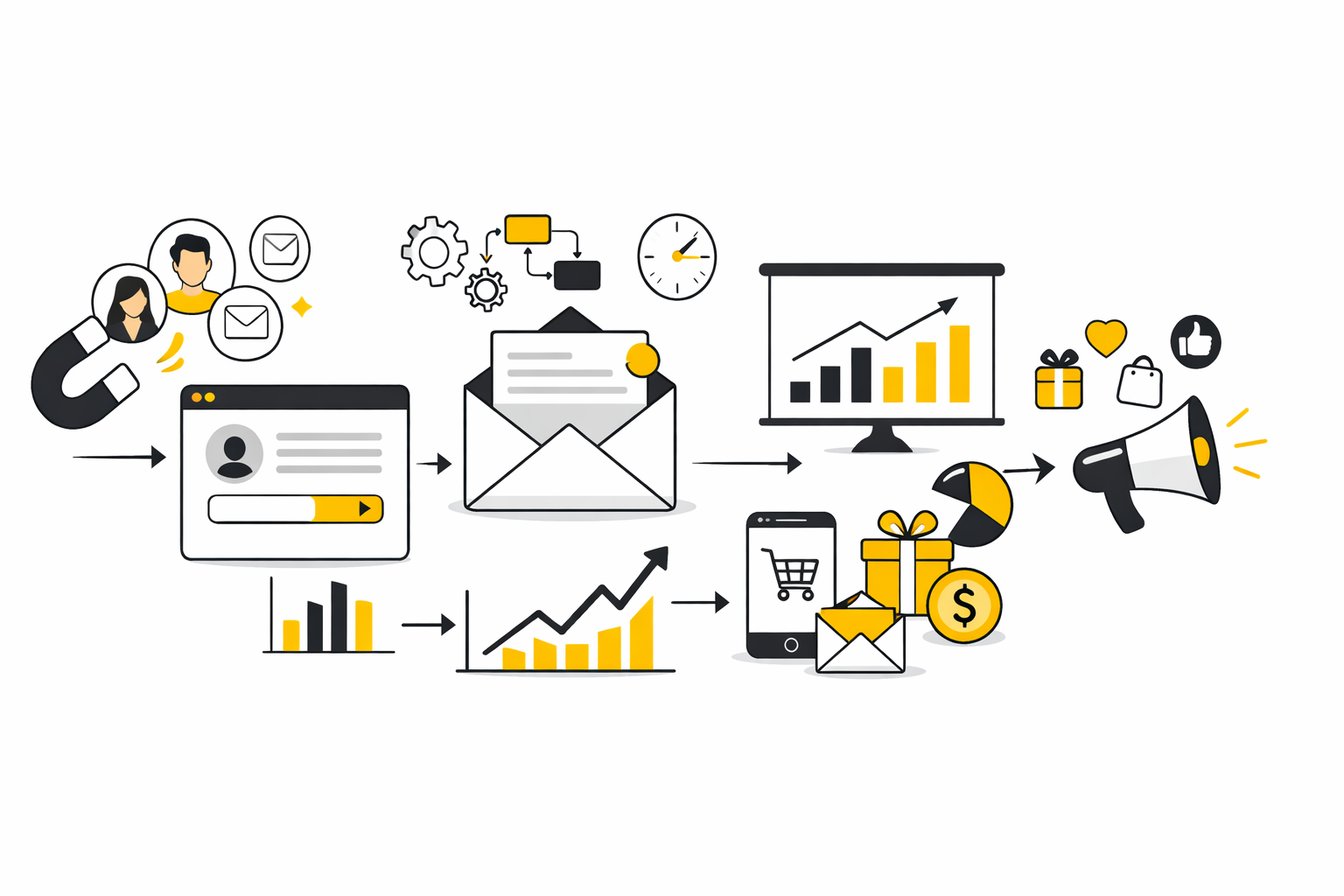
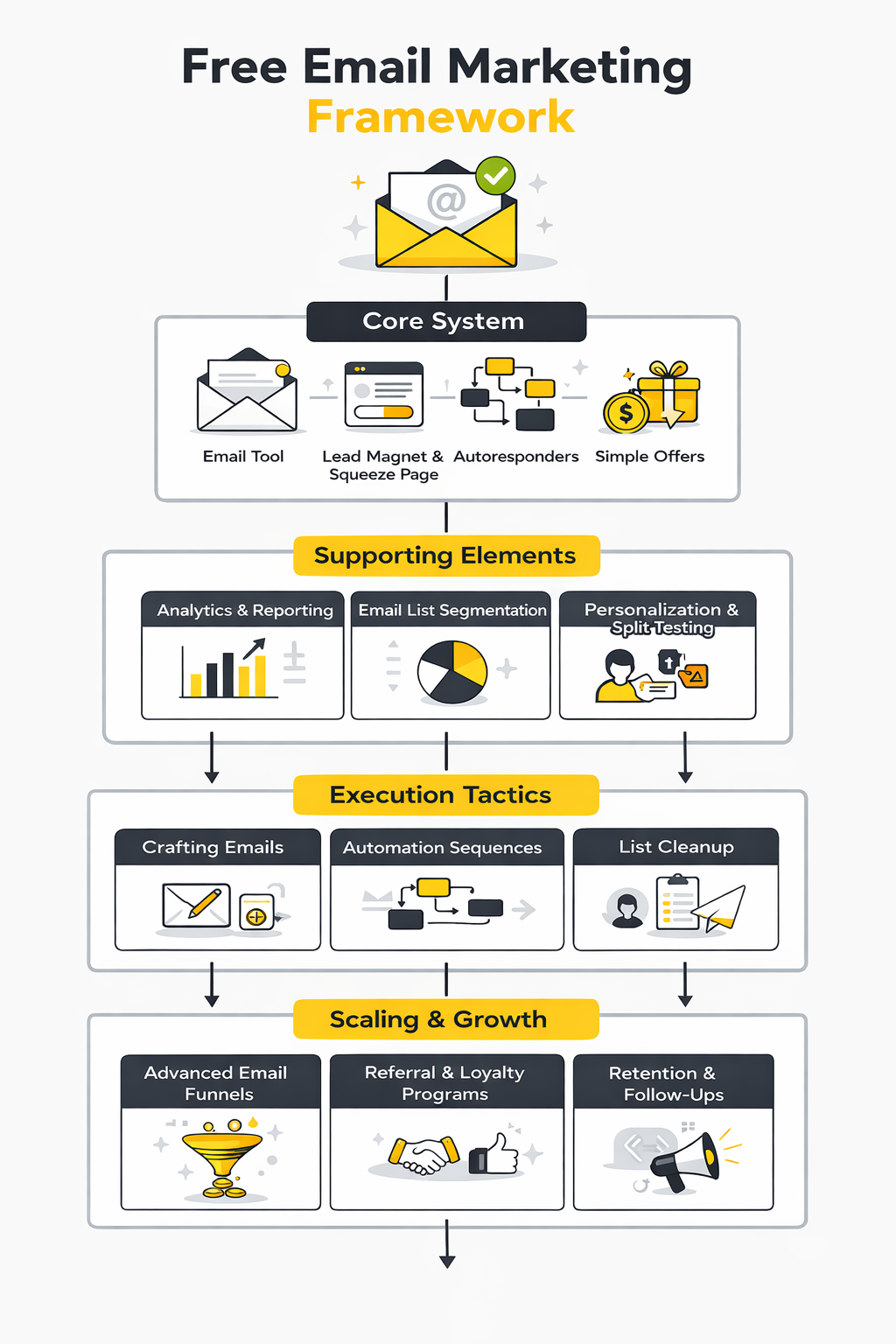
The easiest way to think about free email marketing is as a four-part system: capture, store, send, and improve. First, you need a way to collect subscribers through forms or landing pages. Then you need a platform that stores those subscribers cleanly, sends campaigns reliably, and gives you enough reporting to improve your next send instead of guessing.
This is also where feature limits matter more than flashy branding. MailerLite’s free plan includes up to 500 subscribers and up to 12,000 monthly emails, while its pricing page highlights automations, landing pages, and website tools on the free tier. Mailchimp’s comparison page shows a smaller free allowance with 250 contacts and 500 monthly sends, which can be enough for testing but not much room to grow. Brevo’s pricing page keeps its positioning simple around scalable sending, and if you want an all-in-one beginner setup with funnels included, Systeme.io is worth a look because it reduces the number of separate tools you need.
The framework gets stronger when you match the platform to the business model. A creator or local business may need easy newsletters and signup forms first. A service business may care more about simple automations and lead capture. A digital product seller may be better off with a funnel-led tool such as ClickFunnels or a leaner all-in-one option like Systeme.io, because email works best when it sits inside a full conversion path rather than as an isolated newsletter.
One more thing really matters here: compliance is not optional just because the software is free. The FTC’s CAN-SPAM guide requires accurate header information, non-deceptive subject lines, a physical address, and a clear way for people to opt out. Free email marketing works best when it is built on trust, not shortcuts, and that starts with collecting permission properly from day one.
The Core Tools You Actually Need
Most people overcomplicate free email marketing right at the start. They think they need a giant stack with pop-up software, a separate CRM, a landing page builder, analytics tools, and a full automation engine before they send a single useful email. In reality, you can get moving with a much smaller setup as long as the essentials are covered properly.
The real test is simple. Can your setup collect subscribers, store them cleanly, send emails reliably, and help you improve based on performance? If the answer is yes, you have enough to start. If the answer is no, adding more tools usually just creates more mess.
An Email Platform That Matches Your Growth Stage
Your first tool is the email platform itself, and this is where free email marketing either becomes practical or frustrating. The best beginner option is not the platform with the most hype. It is the one whose free limits still let you run your actual publishing rhythm without hitting a wall every week.
That difference becomes obvious when you compare official plan limits. MailerLite’s free plan supports up to 500 subscribers and 12,000 monthly emails, which is solid for a newsletter, creator list, or small service business. Brevo’s free plan is built around sending volume rather than subscriber caps, and Brevo’s help center makes clear that the free tier includes 300 emails per day, which works for testing and light campaigns but can slow you down fast if your list grows. Mailchimp’s plan comparison remains useful for simple campaigns, but its free allowance is much tighter than it used to be, so you need to know that before you build around it.
This is why free email marketing should be chosen based on your business model, not based on brand familiarity. If you need more of an all-in-one system with email, pages, and simple funnels under one roof, Systeme.io makes sense because it reduces tool sprawl. If you already know you want a funnel-first setup tied closely to sales pages and upsells, ClickFunnels fits better than trying to force a basic newsletter tool into a sales engine.
Signup Forms and Landing Pages Come Next
A free email marketing setup is useless if it cannot collect subscribers smoothly. You need at least one embedded form on your site or storefront, and in many cases you also need one focused landing page built around a single offer. That might be a lead magnet, a waitlist, a newsletter signup, a free consultation, or a product launch notification.
This is where integrated tools matter more than people think. MailerLite’s pricing details include websites, landing pages, and signup forms in the free tier, which can save you from paying for extra page software too early. Brevo’s plan details also include forms, which helps if your main need is collecting leads and sending broadcasts from one place rather than stitching together multiple tools.
The important part is not having ten forms. It is having one form tied to one clear promise. Free email marketing works best when the reader immediately understands what they will get, how often they will hear from you, and why subscribing is worth their time.
Basic Automation Is More Important Than Fancy Campaigns
A lot of beginners obsess over newsletters and ignore the emails that do the real heavy lifting. The first automation you should care about is the welcome sequence. Even one or two well-written onboarding emails can do more for trust and conversions than a month of random broadcasts.
This is another reason to check the free tier carefully before committing. MailerLite’s plan pages highlight automation access on the free plan, which is a big advantage for small operators who want a proper welcome flow without upgrading immediately. By contrast, some platforms reserve more advanced automation for paid tiers, which means your “free” setup may look fine on paper but still force manual work everywhere that counts.
That matters because subscriber intent is usually highest right after opt-in. Someone who just joined your list is paying attention now, not three weeks from now when you finally remember to email them. Free email marketing gets much stronger the moment you stop treating every email like a standalone campaign and start building a simple sequence that guides the subscriber toward the next step.
Reporting Has To Be Good Enough To Make Decisions
You do not need enterprise analytics to run free email marketing well, but you do need enough visibility to stop guessing. That means open trends, click data, unsubscribe behavior, and list growth at a minimum. Anything less and you are flying blind.
The benchmark is not perfection. It is context. Mailchimp’s current benchmark resource shows average open rates around 34.23% across industries, while HubSpot’s 2025 benchmark roundup puts the overall average higher, showing why you should treat benchmarks as directional rather than absolute targets. The smarter move is to compare your own results against your niche, your list quality, and your recent trend line instead of obsessing over one generic number.
This matters because not every weak result means the same thing. A low open rate can point to poor subject lines, weak sender recognition, or deliverability issues. A low click rate with decent opens usually points to content or offer mismatch. Free email marketing becomes a real asset only when you can read those signals and respond with better decisions.
How To Build and Send Better Campaigns on a Free Plan
Once the foundation is in place, the job changes. Now you are not just collecting names. You are training your audience to expect useful, relevant emails from you on a consistent rhythm.
This is where people either build momentum or quietly burn out. They send one decent email, disappear for three weeks, then wonder why nobody clicks the next one. Consistency beats intensity here, especially when your tools are limited and your time is tight.
Keep the Offer Simple and the Email Focused
The fastest way to weaken a campaign is to cram too much into it. One email should usually have one main goal, one main angle, and one main action. That sounds obvious, but a lot of free email marketing fails because the sender tries to announce a blog post, push a product, share company news, and ask for a reply all in the same message.
You do not need long copy to be persuasive. You need clarity. A good email tells the reader what this is, why it matters, and what to do next without making them work for the answer.
That is also why the landing page and the email should feel connected. If the email promises a checklist, the page should lead with the checklist. If the email pushes a consultation, the page should make booking frictionless, and a tool like Cal.com can help keep that next step clean and fast.
Write for Relevance, Not for Everyone
Free email marketing gets better the moment you stop blasting the entire list with the same message every time. Even basic segmentation can improve results because people respond better when the email feels like it was meant for them. You do not need advanced behavioral data to do this well. Simple splits like customer versus lead, buyer interest, signup source, or topic preference already make a difference.
This approach also aligns with broader industry performance patterns. DMA’s 2025 benchmarking report continues to frame relevance and engagement as central to email performance, while Mailchimp’s benchmarks show wide variation by industry, which is another clue that audience context matters more than generic averages. In plain English, better matching usually beats louder sending.
So start small. Segment by what you actually know. Free email marketing does not need to be technically fancy to feel personal and timely.
Protect Deliverability Before It Becomes a Problem
This part is easy to ignore when the list is small, but that is a mistake. Deliverability is not something you fix after things break. It is something you protect while your volume is still manageable.
The big mailbox providers have made this even more important. Google’s sender guidelines require all senders to meet baseline standards for Gmail delivery, and bulk senders face additional requirements tied to authentication and spam thresholds. Google’s sender FAQ also notes stronger enforcement on non-compliant traffic, which means sloppy setup can hit visibility before you realize what is happening.
In practice, that means using a real sender domain when possible, setting up authentication correctly, cleaning inactive contacts, and avoiding shady acquisition tactics. Free email marketing is still real email marketing. The inbox does not care that your software plan costs zero.
Use Free Tools That Remove Friction Around the Campaign
You do not need a bloated stack, but a few adjacent tools can make the system much more usable. A cleaner form builder can improve signup quality. A scheduler can turn interest into booked calls. A social scheduling tool can help you promote the lead magnet consistently instead of relying on memory.
That is where lightweight add-ons can fit naturally. Fillout is useful when native forms feel too limiting, especially if you want cleaner qualification flows before someone joins your list. Buffer can help you keep organic promotion moving so your email list grows even when you are not actively launching something.
The key is discipline. Add tools only when they remove a real bottleneck. Free email marketing stops feeling free the moment you start paying with chaos instead of money.
When To Upgrade and What To Pay for First
At some point, free email marketing stops being a growth tool and starts becoming a constraint. The tricky part is recognizing that moment early enough so you upgrade for leverage, not out of frustration. Most people wait too long, then switch platforms under pressure, which creates unnecessary disruption.
The right time to upgrade is not when you “feel serious.” It is when your current setup starts limiting revenue-generating actions. That usually shows up in three clear ways: you are hitting subscriber or send limits regularly, you need better automation to convert leads, or you are losing time doing manual work that should be automated.
The First Paid Features That Actually Matter
When you move beyond free email marketing, not all upgrades are equal. Some features look impressive but do not move the needle, while others quietly multiply your results.
The first upgrades worth paying for are:
- Advanced automation: multi-step sequences, conditional logic, and behavior-based triggers
- Higher sending limits: so your growth is not capped artificially
- Better segmentation: tagging, grouping, and dynamic targeting
- Custom domains and branding: which improves trust and deliverability
- Priority support or deliverability tools: especially once your list grows
This aligns with how email performance scales in real-world usage. Campaign Monitor’s performance insights highlight that triggered emails consistently outperform standard campaigns in engagement, which makes automation one of the highest-leverage upgrades you can buy.
If your goal is sales rather than just communication, this is where funnel-based tools start making more sense. A platform like ClickFunnels connects landing pages, email flows, and checkout steps in one system, which reduces friction between interest and purchase. If you want something leaner but still integrated, Systeme.io remains a practical upgrade path because it keeps email, funnels, and automation under one roof.
A Simple Rule for Timing Your Upgrade
There is a clean rule that removes guesswork: upgrade when the next feature will clearly pay for itself within a reasonable timeframe. That might be through increased conversions, saved time, or better retention.
For example, if better automation helps convert even a small percentage of your list into paying customers, the upgrade is justified. If higher send limits allow you to email consistently instead of skipping campaigns, the upgrade is justified. If segmentation lets you send more relevant offers and reduce unsubscribes, the upgrade is justified.
Free email marketing is not about staying free forever. It is about delaying cost until the system is already working.
Common Mistakes, Smart Fixes, and Final FAQs
Before moving into FAQs later, it is worth addressing the patterns that repeatedly slow people down. These are not technical issues. They are decision mistakes that compound over time.
Mistake 1: Treating Email Like a Side Task
A lot of people treat email as something they “should probably do” instead of building it into their core workflow. They post on social media daily but send emails randomly, which weakens the channel from the start.
The fix is simple but requires discipline. Pick a schedule you can maintain and stick to it. Even one email per week builds more long-term momentum than sporadic bursts of activity.
Mistake 2: Overcomplicating the Stack Too Early
Free email marketing attracts tool collectors. People sign up for multiple platforms, try to connect everything, and end up with a system that is harder to manage than it is to use.
The fix is to simplify aggressively. Start with one platform that handles email and basic capture. Add tools only when they solve a clear bottleneck, not when they look interesting.
Mistake 3: Ignoring List Quality
It is easy to focus on growth and ignore quality. But adding disengaged subscribers, using weak incentives, or importing contacts without proper consent creates long-term problems that are hard to fix.
This ties directly into deliverability and engagement. Google’s sender requirements emphasize authentication and spam control, while broader industry benchmarks like Mailchimp’s data show how engagement varies widely depending on audience quality. In practice, a smaller, active list will outperform a large, disengaged one almost every time.
Mistake 4: Sending Without a Clear Next Step
Emails that “just share something” without a clear action tend to underperform. The reader may enjoy the content, but nothing happens after that.
The fix is to design every email around a next step. That could be clicking a link, booking a call, downloading a resource, or replying with feedback. Tools like Cal.com or structured funnel builders make this easier because they reduce friction between interest and action.
Step-by-Step Implementation You Can Actually Follow
This is where everything comes together. Free email marketing works when you turn theory into a repeatable process you can execute without thinking too much every time.
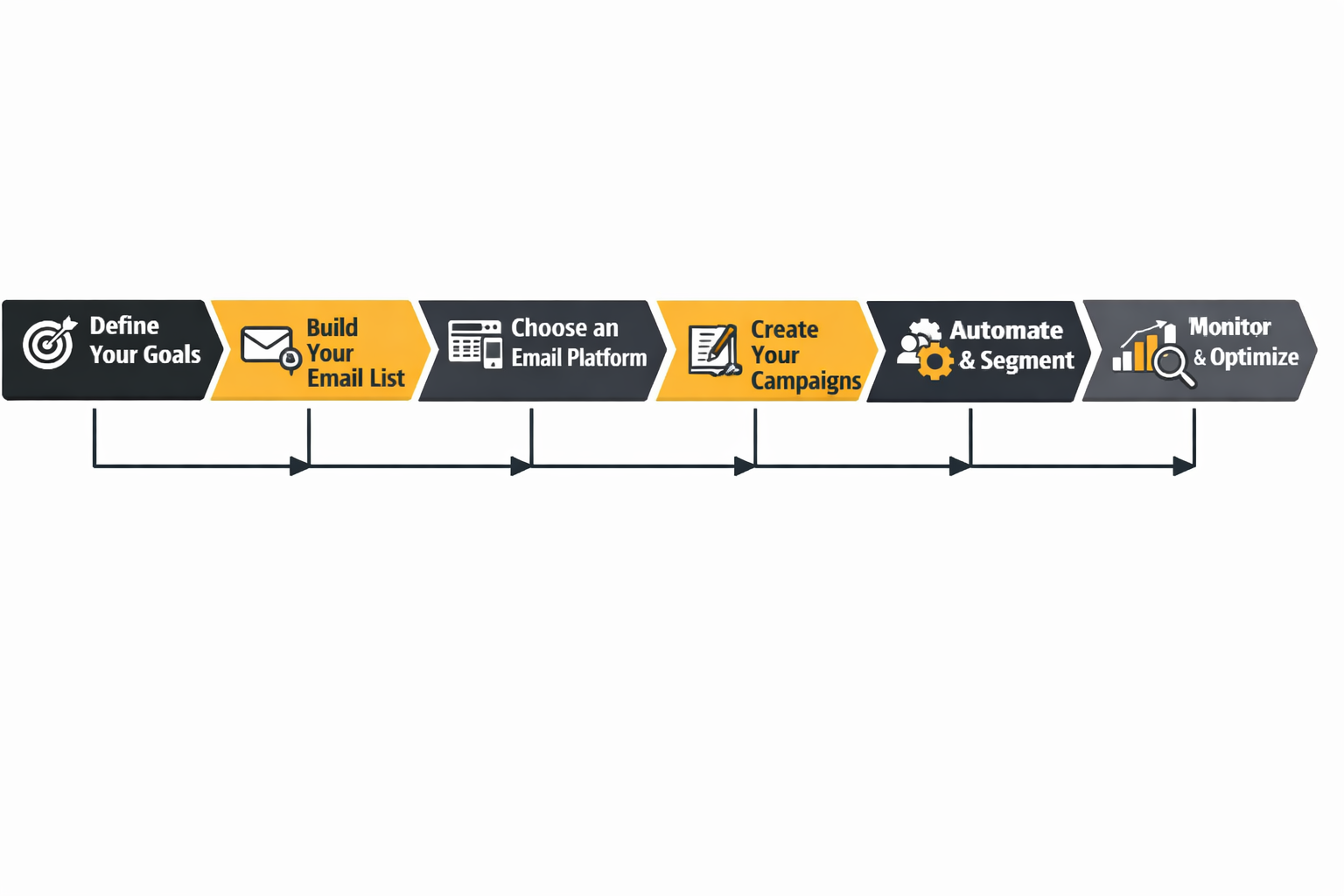
Step 1: Choose One Platform and Set It Up Properly
Pick a platform that fits your current needs, not your imagined future scale. Set up your sender profile, verify your domain if possible, and configure basic authentication. This step is not exciting, but it protects everything you build afterward.
If you want simplicity, Systeme.io is a strong starting point because it combines email, pages, and automation. If you prefer a more traditional email-first tool, Brevo or MailerLite can work just as well.
Step 2: Create One Clear Signup Path
Build one form and one landing page tied to a single offer. Do not create multiple competing entry points at the start. Focus on clarity: what the subscriber gets, why it matters, and what happens next.
If your platform’s form builder feels limiting, a tool like Fillout can help you create cleaner flows while still feeding contacts into your email system.
Step 3: Write a Short Welcome Sequence
Create at least two to three emails that trigger automatically after someone subscribes. The first should set expectations and deliver the promised value. The second should build trust and introduce your core idea or offer. The third can guide the subscriber toward a clear next step.
This is where free email marketing starts behaving like a system instead of a list. You are not just collecting contacts. You are guiding them.
Step 4: Send One Consistent Weekly Email
Pick a day and stick to it. Your emails do not need to be long or complex. They need to be useful, clear, and aligned with your overall message.
Consistency builds familiarity. Familiarity builds trust. Trust drives action.
Step 5: Track, Adjust, and Simplify
After a few weeks, look at your data. Which emails get opened? Which links get clicked? Where do people drop off? Use that information to refine your next emails instead of guessing.
Free email marketing becomes powerful when you treat it like a feedback loop. You send, you observe, you improve, and you repeat.
Step 6: Connect Email to a Simple Funnel
Once the basics are working, connect your emails to a simple funnel. That might be a booking page, a product offer, or a lead-to-sale flow.
If you want a more structured funnel environment, ClickFunnels gives you a full path from opt-in to conversion. If you prefer a leaner system, Systeme.io can handle the same journey with fewer moving parts.
The key is not complexity. It is connection. Your email should always lead somewhere meaningful.
Understanding Email Marketing Data That Actually Drives Results
Most people look at email metrics and either panic or ignore them. Neither helps. Free email marketing becomes powerful when you understand what the numbers are actually telling you and what action they should trigger next.
The goal is not to chase perfect stats. The goal is to build a feedback loop where every campaign teaches you something specific about your audience. Once you see it that way, metrics stop being abstract and start becoming practical.
The Core Metrics That Matter (And What They Really Mean)
You do not need dozens of dashboards. You need a few key signals that tell you whether your system is healthy or drifting.
The most important ones are:
- Open rate: shows how compelling your subject line and sender identity are
- Click rate: shows how relevant your content and offer are
- Unsubscribe rate: shows whether expectations are misaligned
- Conversion rate: shows whether your funnel actually works
- List growth rate: shows whether your system is expanding or stagnating
Industry benchmarks give useful context, but they should not control your decisions. Mailchimp’s benchmark data shows average open rates around the mid-30% range, while HubSpot’s updated benchmarks often report higher averages depending on segmentation and list quality. That gap alone tells you something important: averages vary widely based on audience and targeting.
So instead of asking “Is 30% good?”, ask “Is this better than my last five campaigns?” That shift changes everything.
How to Read Metrics Like a System, Not in Isolation
Most mistakes come from reading metrics individually instead of in combination. One number rarely tells the full story.
Here is how to interpret them properly:
- High opens, low clicks -> your subject line works, but your content or offer is weak
- Low opens, decent clicks -> your email content is solid, but nobody is seeing it
- High unsubscribes after a campaign -> your message did not match expectations
- Good engagement, low conversions -> your funnel or landing page needs work
This is where free email marketing becomes strategic. You stop guessing and start diagnosing. Every campaign becomes a test, and every result points to a specific improvement.
The Metrics That Matter More Than You Think
There are a few signals that beginners often ignore but that quietly shape long-term performance.
List quality over list size is the biggest one. A smaller, engaged list will outperform a larger, disengaged one almost every time. That is not theory. Engagement-based filtering is now part of how inbox providers decide what gets delivered and what gets buried.
Another one is consistency over spikes. One high-performing campaign does not mean your system works. A steady pattern of solid performance does. That is what builds predictable results.
Finally, click intent matters more than raw clicks. Ten clicks from highly interested subscribers can be more valuable than one hundred casual clicks that never convert. Free email marketing works best when you optimize for meaningful action, not just activity.
Building a Simple Analytics Loop You Can Actually Use
This is where the process becomes tangible. You do not need advanced dashboards. You need a repeatable loop you can follow every week.
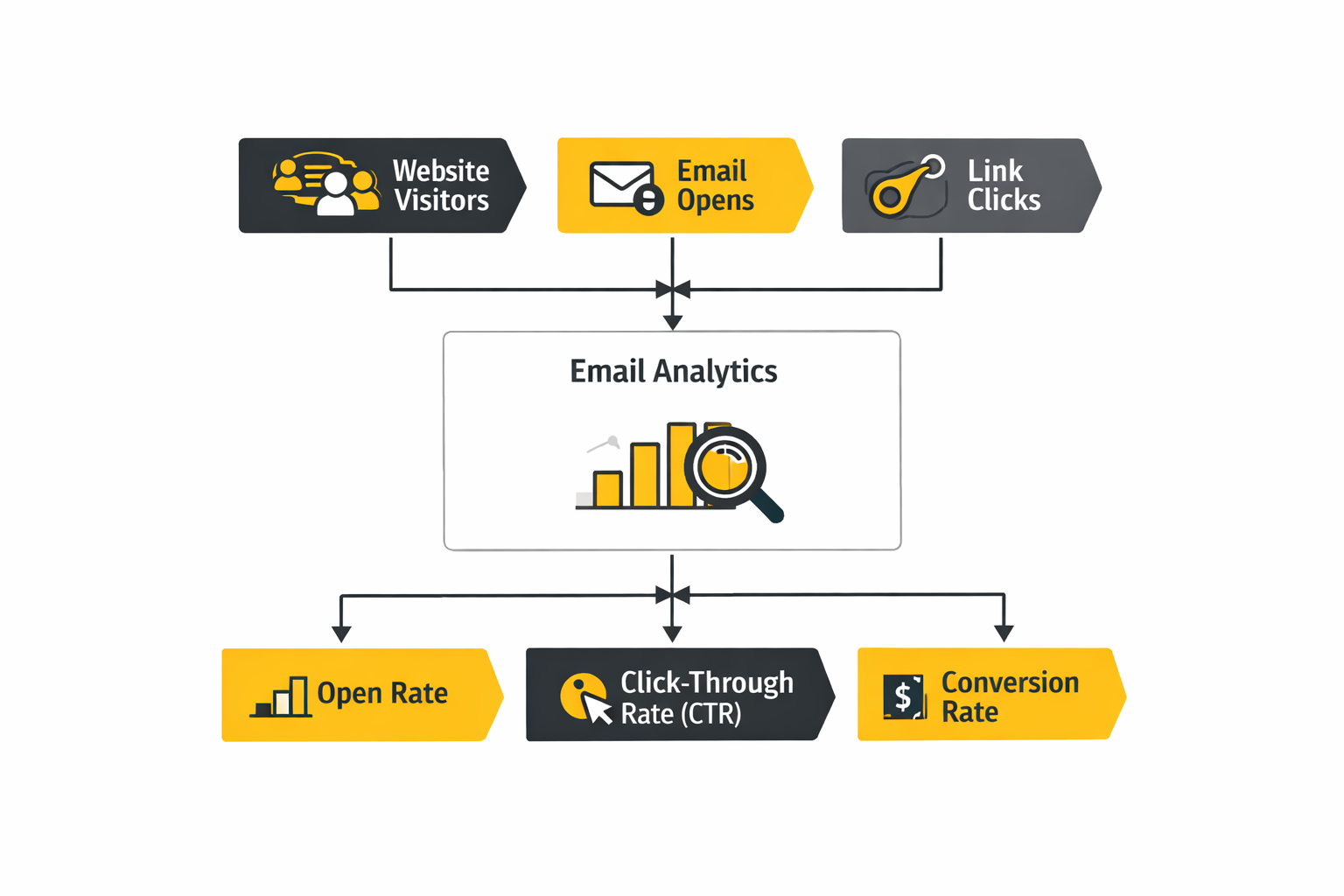
A simple system looks like this:
- Send one campaign with a clear goal
- Track opens, clicks, and conversions after 24–72 hours
- Identify the strongest and weakest element (subject line, content, offer, or timing)
- Adjust one variable in the next campaign
- Repeat and compare trends over time
That is it. No complexity required. The power comes from repetition and consistency, not from adding more data.
If you are using an all-in-one platform like Systeme.io or a campaign-focused tool like Brevo, this loop becomes easier because your email performance and funnel behavior live closer together. That means you can connect clicks to actual outcomes instead of treating them as isolated events.
Benchmarks Are Directional, Not Absolute
Benchmarks are useful, but only if you use them correctly. They are not targets you must hit. They are reference points that help you understand where you stand.
For example, Campaign Monitor’s research consistently shows that segmented and triggered emails outperform generic campaigns. That does not mean your broadcast emails are failing. It means you have a clear path to improve results by making them more relevant.
Similarly, open rates can vary massively depending on industry, audience familiarity, and sending frequency. A niche B2B list may behave very differently from a broad ecommerce list. Free email marketing requires you to respect that context instead of chasing generic numbers.
Turning Data Into Better Decisions
Data only matters if it changes what you do next. That is the part most people skip.
If your open rates are low, you test new subject lines and sender positioning. If your click rates are weak, you simplify the message and strengthen the call to action. If conversions are low, you fix the landing page or offer instead of rewriting the email endlessly.
This is where a connected system helps. When your email tool connects cleanly to your funnel or booking flow, you can trace the full path from inbox to action. Whether you are sending traffic to a simple page or a structured funnel inside ClickFunnels, the principle stays the same: measure what matters, then improve the weakest link.
Free email marketing is not limited by the price of your tools. It is limited by how well you interpret and act on the signals you already have.
Strategic Tradeoffs That Change as You Scale
Free email marketing is simple when your list is tiny and your goals are modest. It gets more complicated when the list grows, your offers diversify, and email starts influencing real revenue. That is the point where the tradeoffs become more important than the tool itself.
The first tradeoff is convenience versus control. An all-in-one platform can help you move faster because forms, pages, automations, and reporting sit in one place. But a more specialized stack can give you better flexibility once your funnel, segmentation, and analytics needs become more demanding. Neither path is automatically better. The right one depends on whether speed or control is the bigger bottleneck in your business.
The second tradeoff is volume versus relevance. Sending more often can increase total clicks, but it can also damage engagement if the content quality drops or the message stops feeling timely. That matters because inbox providers increasingly care about sender behavior and user response signals, and Gmail’s official sender rules now set baseline requirements for authentication and spam control for everyone sending to Gmail accounts. Google’s sender guidelines and Google’s bulk sender FAQ make it clear that scale without discipline is a real risk.
Why Deliverability Becomes a Business Issue, Not a Technical Detail
At the beginning, deliverability sounds like a backend problem for IT teams and email nerds. Once revenue depends on campaigns landing in the inbox, it becomes a business issue fast. Free email marketing can get you started, but it does not protect you from weak sending practices.
This matters more now because the major mailbox providers have tightened expectations. Gmail requires authentication for all senders and adds extra rules for bulk senders, including easier unsubscribing and staying below spam complaint thresholds. Google’s product update on new Gmail protections and the official admin guidance point in the same direction: sloppy list management and low-trust sending behavior are getting less room to survive.
The practical takeaway is straightforward. If people do not recognize you, do not want your emails, or cannot leave the list easily, your performance will suffer eventually. That is why smart scaling usually means emailing fewer, better-qualified people more intentionally rather than blasting everyone just because your plan allows it.
The Hidden Cost of Free Plans
Free email marketing is valuable, but it is not cost-free in the broader sense. The cost often shows up as limits on automation depth, branding control, support speed, reporting detail, or sending volume. Those limits are manageable early on, but later they can quietly reduce growth.
You see this most clearly when you start optimizing seriously. If your platform makes it hard to segment by behavior, compare campaigns properly, or trigger emails based on actual subscriber actions, you are not just missing features. You are losing learning speed. HubSpot’s reporting overview emphasizes comparative reporting and performance snapshots for exactly this reason, while recent Litmus guidance on campaign strategy highlights metrics like CTR, CTOR, unsubscribe rate, bounce rate, and spam complaints as core campaign diagnostics.
That is why upgrading is sometimes less about sending more emails and more about making better decisions. A tool that helps you see what is working faster can justify its cost long before sheer list size forces the move.
Segmentation Gets More Valuable Than Raw Growth
Beginners usually chase list growth. More advanced operators start chasing fit. That shift matters because a large list with weak intent becomes expensive to maintain and harder to monetize well.
This is also where benchmark data can mislead people. Average open and click rates vary heavily by industry and use case, which is exactly why broad benchmarks are only useful as context. Mailchimp’s benchmark resource and HubSpot’s benchmark roundup both show meaningful differences across categories. The lesson is not that one industry is “better” at email. The lesson is that audience composition changes performance dramatically.
For free email marketing, that means segmentation is one of the most powerful upgrades in thinking, even before it becomes a paid feature upgrade in software. If you know who joined for which reason, your emails get sharper. If you keep treating everyone as one blob, your messaging gets diluted and your numbers start lying to you.
Compliance and Trust Are Part of Performance
A lot of marketers treat compliance as a box-checking exercise. That is too narrow. Compliance is part of trust, and trust affects performance.
The legal side is clear enough. The FTC’s CAN-SPAM compliance guide requires accurate routing information, non-deceptive subject lines, a valid postal address, and a clear way to opt out. But the deeper point is strategic, not just legal. Respectful sending practices improve subscriber confidence, reduce complaints, and create a stronger foundation for long-term inbox placement.
That matters even more when you grow beyond a hobby list. Free email marketing works best when the subscriber relationship is permission-based and expectation-based. If people feel tricked into joining or trapped after joining, the damage shows up in unsubscribes, complaints, and eventually reduced reach.
When an All-in-One System Starts Winning
There is a stage where separate tools begin creating more drag than value. If your lead capture, email, booking, and conversion flow all live in different places, simple decisions start taking too long. Reporting gets fragmented, troubleshooting gets annoying, and small errors multiply.
That is why many businesses eventually move toward systems that connect the whole journey more tightly. Systeme.io can make sense when you want email, pages, and automations in one operational layer. If the business is heavily sales-funnel driven, ClickFunnels becomes more relevant because it is designed around movement from opt-in to offer to purchase rather than around newsletters alone.
This is not about buying more software because it looks professional. It is about reducing friction in the path from subscriber interest to measurable action. When that path gets smoother, email usually performs better because the system around it is finally doing its job.
What Experts Usually Do Differently
The biggest difference is not that experienced operators know more tricks. It is that they treat email as infrastructure, not content. They think about acquisition quality, message match, deliverability, conversion flow, and reporting together instead of optimizing one piece in isolation.
They also respect leading indicators. A drop in opens, a rise in unsubscribes, or a weak click-to-open pattern is not “just a bad send.” It is a signal. Litmus campaign guidance frames campaign metrics in exactly that operational way, where the right primary metric depends on the goal of the email and supporting metrics reveal where friction is happening.
Most importantly, experienced marketers do not confuse free email marketing with low-value marketing. They know the free part is just a starting condition. The real edge comes from audience trust, message relevance, consistent execution, and smart interpretation of data. Get those right, and even a simple setup can perform far above what most people expect.
Bringing It All Together Into a Scalable System
By this point, free email marketing should no longer feel like a collection of tactics. It should feel like a system that captures attention, builds trust, and moves people toward action in a predictable way.
At a high level, the system is simple. You attract attention, convert that attention into subscribers, guide those subscribers through a sequence, and connect them to a meaningful next step. The complexity only appears when these parts are disconnected or inconsistent.
The strongest setups share a few traits. They use one clear entry point instead of scattered forms. They rely on simple automation instead of manual follow-ups. They measure performance and adjust instead of guessing. And most importantly, they treat email as part of a larger flow, not as a standalone channel.
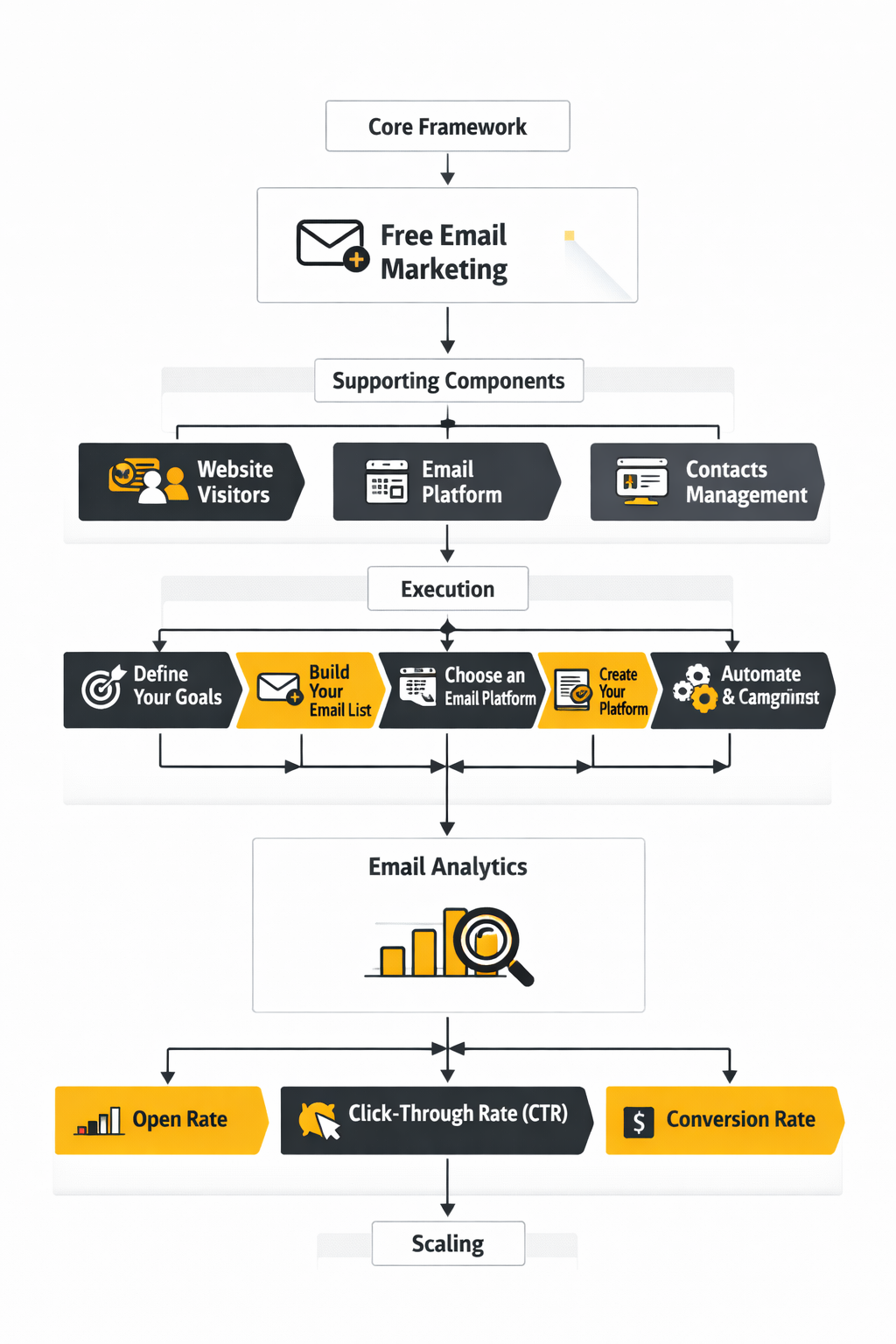
When everything is connected, even a basic free setup can outperform a complicated paid stack. The difference is not the tool. It is how cleanly the system moves from subscriber to outcome.
FAQ - Built for Complete Guide
Is free email marketing really enough to grow a business?
Yes, but only to a certain stage. Free email marketing is more than enough to validate an idea, build an audience, and generate early revenue. The limitation appears when your growth starts hitting platform caps or when you need deeper automation to scale conversions.
What is the best free email marketing platform right now?
There is no universal “best.” It depends on your use case. If you want simplicity and funnels, Systeme.io is a strong option. If you want a traditional email platform with solid sending infrastructure, Brevo or MailerLite are reliable starting points.
How many emails should I send per week?
One consistent email per week is enough to build momentum. More frequent sending can work if your content stays relevant, but inconsistency is a bigger problem than frequency. A steady rhythm trains your audience to expect and engage with your emails.
What matters more: open rates or click rates?
Click rates matter more because they reflect actual engagement with your content and offer. Open rates are still useful, but they are influenced by subject lines and tracking limitations. Focus on actions, not just visibility.
Can I make sales with a very small email list?
Yes, if the list is relevant and engaged. A small list with strong intent can outperform a large, passive audience. Free email marketing works best when quality comes before scale.
Do I need a website to start email marketing?
No, but you do need a landing page or form. Most modern platforms include this functionality. You can build a simple page inside your email tool or use a funnel builder to handle the full flow.
What is the biggest mistake beginners make?
Overcomplicating everything. Too many tools, too many ideas, and no consistent execution. The fastest path is a simple system: one offer, one list, one weekly email, and one clear next step.
How do I avoid spam folders?
Focus on permission, relevance, and consistency. Use proper authentication, avoid buying lists, and send emails people actually want. Google’s sender requirements reinforce that authentication and user engagement are now critical for inbox placement.
When should I switch from free to paid?
Upgrade when your current setup limits growth or revenue. That usually happens when you need better automation, higher sending limits, or more advanced segmentation. The decision should be based on return, not emotion.
Is email still worth it compared to social media?
Yes, because you own the audience. Social platforms can change reach overnight, but your email list remains a direct communication channel. That control becomes more valuable as your business grows.
Should I use funnels with email marketing?
If your goal includes sales, then yes. Funnels connect your emails to clear outcomes. Tools like ClickFunnels or Systeme.io make this easier by keeping everything in one place.
How long does it take to see results?
You can see early traction within weeks if you are consistent. Meaningful results usually build over a few months as your list grows and your messaging improves. Email rewards persistence more than quick bursts of effort.
Work With Professionals
Explore 10K+ Remote Marketing Contracts on MarkeWork.com
Most marketers spend too much time chasing clients, competing on crowded platforms, and losing a percentage of every project to middlemen.
MarkeWork gives you a better way. Browse thousands of remote marketing contracts and connect directly with companies desperate to hire skilled marketers like you, without platform commissions and without unnecessary gatekeepers.
If you're serious about finding better opportunities and keeping 100% of what you earn, explore available contracts and create a profile for free at MarkeWork.com.