

A free email marketing platform sounds simple until you actually need it to support real growth. One tool gives you more contacts but limits daily sending. Another gives you automation but caps subscribers. Another looks generous until branding, templates, segmentation, or support become the real bottleneck.
The right choice is not “which free plan is biggest.” The right choice is which platform lets you build a clean list, send consistently, learn from performance, and upgrade without rebuilding everything later. That matters whether you are launching a newsletter, validating an offer, building a creator audience, or setting up email for a small business.
This guide will cover the full decision from strategy to implementation, split into six parts:
- Why a Free Email Marketing Platform Still Matters
- The Free Plan Evaluation Framework
- Core Components That Actually Matter
- Best Free Email Marketing Platforms To Compare
- Professional Implementation And Migration Planning
- Final Recommendations And FAQ
Why a Free Email Marketing Platform Still Matters
Email is still one of the few marketing channels where you can build an owned audience instead of renting attention from an algorithm. Social reach can change overnight, ad costs can spike, and search traffic can shift after one update. A list you built with permission gives you a more stable way to reach people who already asked to hear from you.
Free plans matter because they remove the friction at the exact moment most businesses are still figuring out their offer. You can test signup forms, welcome emails, weekly campaigns, and basic segmentation before committing to a paid stack. That is why platforms like Brevo, Moosend, and Systeme.io are worth comparing carefully instead of choosing the first familiar name.
The trap is assuming “free” means “low risk.” A bad platform choice can create hidden work later through poor deliverability habits, weak automation, limited exports, clunky forms, or pricing that jumps at the wrong moment. The goal is to start lean without starting messy.
The Free Plan Evaluation Framework
A good free email marketing platform should be judged through four lenses: sending limits, list growth limits, automation depth, and upgrade path. Sending limits tell you how often you can communicate. Contact limits tell you how long the free plan can support your growth before you need to pay.
Automation depth is where many free tools quietly separate themselves. A basic newsletter sender may be enough for simple updates, but a welcome sequence, lead magnet delivery, abandoned signup reminder, or post-purchase follow-up can change how useful the platform feels. This is where you should look beyond the homepage promise and ask what you can actually build on day one.
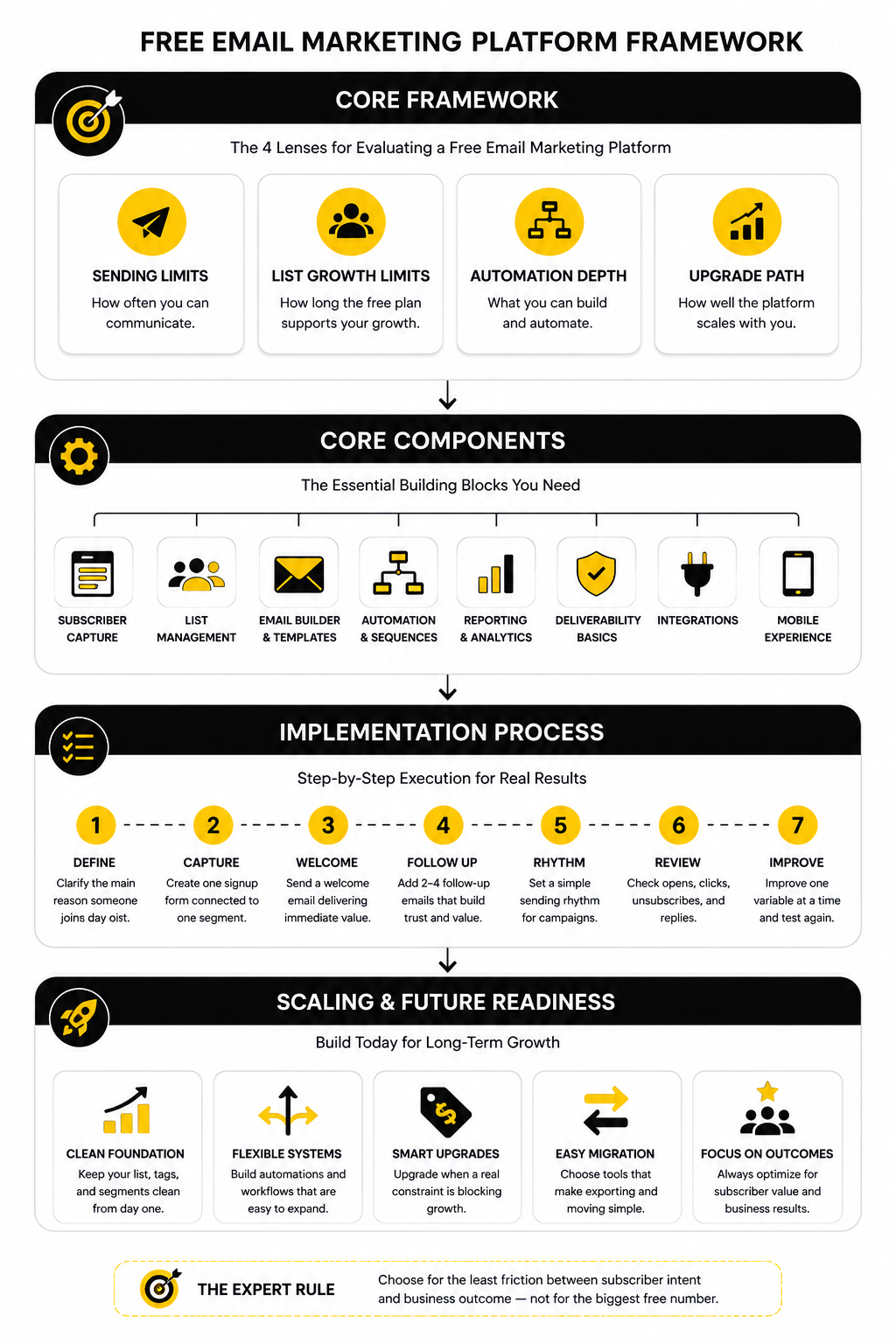
The upgrade path matters because switching email platforms is annoying once forms, automations, tags, and templates are already live. You want a tool that is free today and still sensible when your list reaches 500, 1,000, 5,000, or 10,000 subscribers. That does not always mean choosing the cheapest option; it means choosing the platform with the fewest painful surprises.
Core Components That Actually Matter
A free email marketing platform should help you do four jobs well: capture subscribers, organize them, send useful emails, and measure what happened. Everything else is secondary at the beginning. Fancy AI tools, template galleries, and multichannel add-ons are nice, but they do not fix a weak list, unclear message, or poor sending rhythm.
The basic setup should include signup forms, landing pages, list fields, tags or segments, email templates, automation, unsubscribe handling, and reporting. If one of those pieces is missing or heavily restricted, the platform may still work for a tiny newsletter, but it will feel limiting once your marketing becomes more intentional. This is why you should test the workflow before importing your whole list.
Email is not dead, and the numbers still justify taking setup seriously. The DMA’s 2025 benchmarking work reported that email delivery rates reached 98% in 2024, while unique click rates rose for the third year in a row. That does not mean every campaign will perform well, but it does mean the channel still rewards clean execution.
Subscriber Capture
Subscriber capture is where most people judge a tool too casually. They look for “forms included” and move on. The better question is whether the form builder lets you create the right fields, embed forms cleanly, trigger automations, and route subscribers into useful segments.
A basic form is enough if you only need a newsletter signup. But if you offer a lead magnet, run webinars, collect interest categories, or separate customers from prospects, you need more control. Tools like Brevo and MailerLite are often compared here because their free plans include practical list-building features instead of only newsletter sending.
Do not overcomplicate the first form. Ask for the email address, maybe the first name, and only add extra fields if they will change what you send next. Every unnecessary field adds friction, and friction is expensive when you are still trying to prove the offer.
List Management
List management is the quiet feature that determines whether your account stays clean or becomes a mess. You need to know where subscribers came from, what they asked for, whether they engaged, and which emails they should not receive. Without that structure, every campaign becomes a risky blast.
Tags, segments, custom fields, and suppression lists matter because they let you send with context. A new subscriber should not receive the same message as someone who already bought. A cold subscriber should not be treated the same as someone clicking every week.
This is also where a free plan can hide real limitations. Some platforms give you a contact allowance but restrict audiences, tags, or automation rules. Others allow more flexible organization but limit email volume, like Brevo’s free plan with 300 email sends per day, so the right choice depends on whether your bottleneck is list size or sending frequency.
Email Builder And Templates
The email builder should make sending easier, not turn every newsletter into a design project. You want clean templates, mobile-friendly layouts, simple editing, reusable sections, and enough control to keep the message on brand. If the editor feels slow or fragile during testing, it will feel worse when you are rushing to send a campaign.
Design flexibility matters less than clarity. A simple email with a strong subject line, clear promise, and one obvious next step will usually beat a beautiful email with five competing calls to action. The platform’s job is to help you ship that message consistently.
Still, templates can save a lot of time when they are practical. Look for layouts for announcements, newsletters, product updates, promotions, and welcome emails. Avoid choosing a free email marketing platform only because the templates look good in the demo; the real test is whether you can edit them fast without breaking the layout.
Automation And Sequences
Automation is where a free email marketing platform starts becoming more than a place to send newsletters. A welcome email can confirm the subscriber made the right choice, deliver the promised resource, and set expectations for what comes next. A short sequence can do that even better because it gives you several chances to educate, build trust, and move the reader toward one clear next step.
Start with one useful automation before building anything complex. The first sequence should usually be a welcome flow with three to five emails: delivery, context, value, proof, and invitation. That is enough to create momentum without turning your account into a maze of branches you cannot maintain.
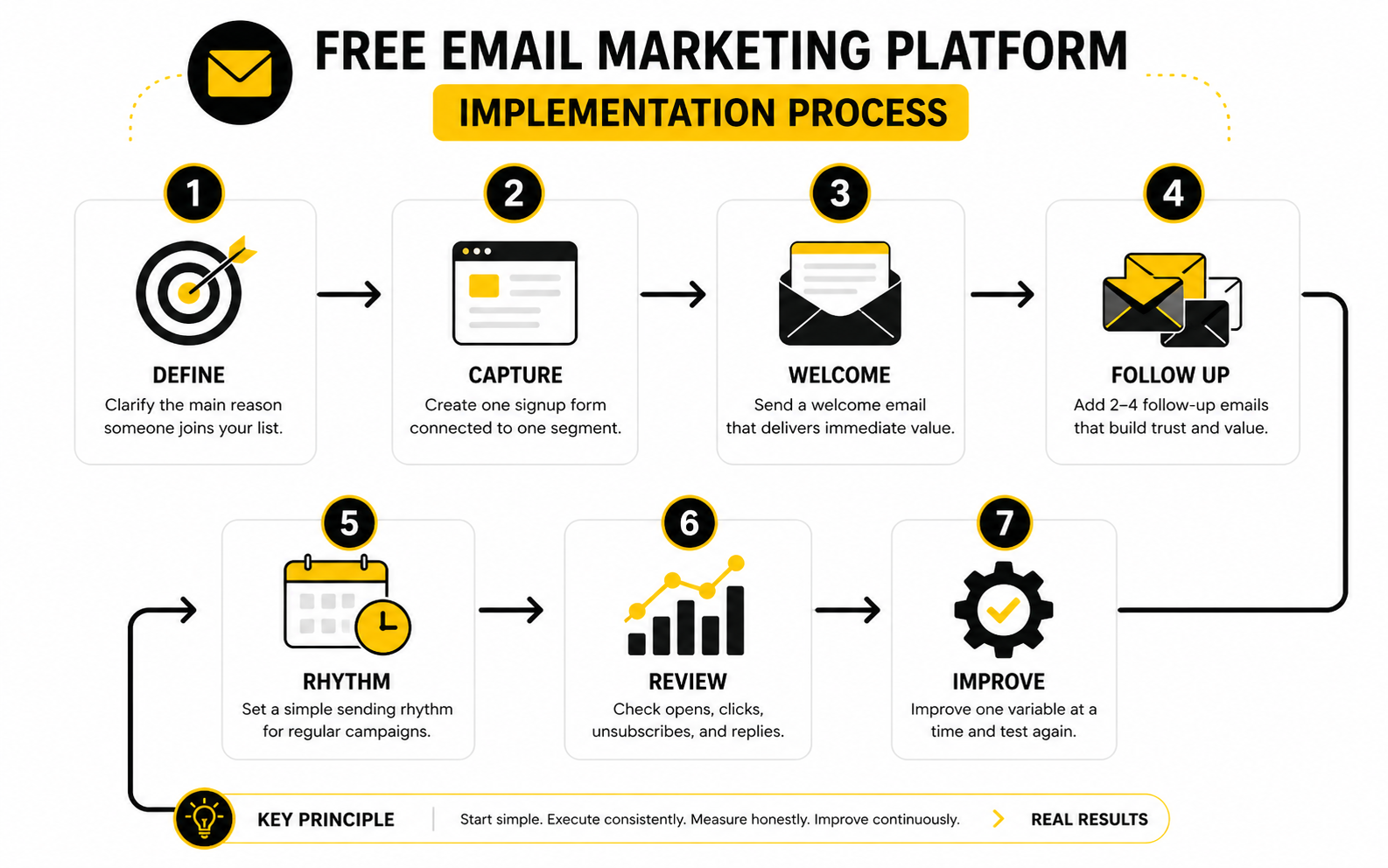
A practical implementation process looks like this:
- Define the main reason someone joins your list.
- Create one signup form connected to one audience or segment.
- Write a welcome email that delivers the promised value immediately.
- Add two to four follow-up emails that answer common objections or teach one useful idea.
- Set a simple sending rhythm for regular campaigns.
- Review opens, clicks, unsubscribes, and replies after every send.
- Improve one variable at a time instead of rebuilding the whole system.
This is also where platform choice becomes real. If your tool makes it hard to connect a form to an automation, tag people based on behavior, or edit a sequence without confusion, you will avoid improving it. A platform like Systeme.io can make sense when email needs to sit beside funnels and digital products, while Moosend is useful to compare when you want to test automations, forms, landing pages, and segmentation during a free trial.
Reporting And Feedback Loops
Reporting should help you make better decisions, not just make you feel good after a send. Open rates can show whether the subject line and sender relationship are working, but privacy changes mean they are not perfect. Clicks, replies, conversions, unsubscribes, spam complaints, and list growth tell a more complete story.
A simple weekly review is enough at the beginning. Look at which emails earned clicks, which links people ignored, where subscribers dropped off, and whether your list is growing from the right sources. Then make one adjustment before the next campaign.
Do not chase benchmarks too aggressively. Benchmarks are useful for context, but your own audience is the data that matters most. If your click rate improves because your offer became clearer, that is more valuable than matching someone else’s industry average.
Deliverability Basics
Deliverability is not a technical detail you can ignore until later. If mailbox providers do not trust your sending behavior, your emails may land in spam or promotions even when subscribers asked to hear from you. The best free email marketing platform cannot fully compensate for poor list quality, weak permission practices, or reckless sending.
Set up authentication properly when the platform supports it. That usually means adding DNS records for SPF, DKIM, and sometimes DMARC, depending on the tool and domain setup. It is not glamorous work, but it protects your sender identity and makes your marketing more reliable.
List hygiene matters just as much. Do not import scraped contacts, do not buy lists, and do not keep emailing people who never engage. A smaller list of people who actually want your emails is better than a bloated list that damages your sender reputation.
Statistics And Data
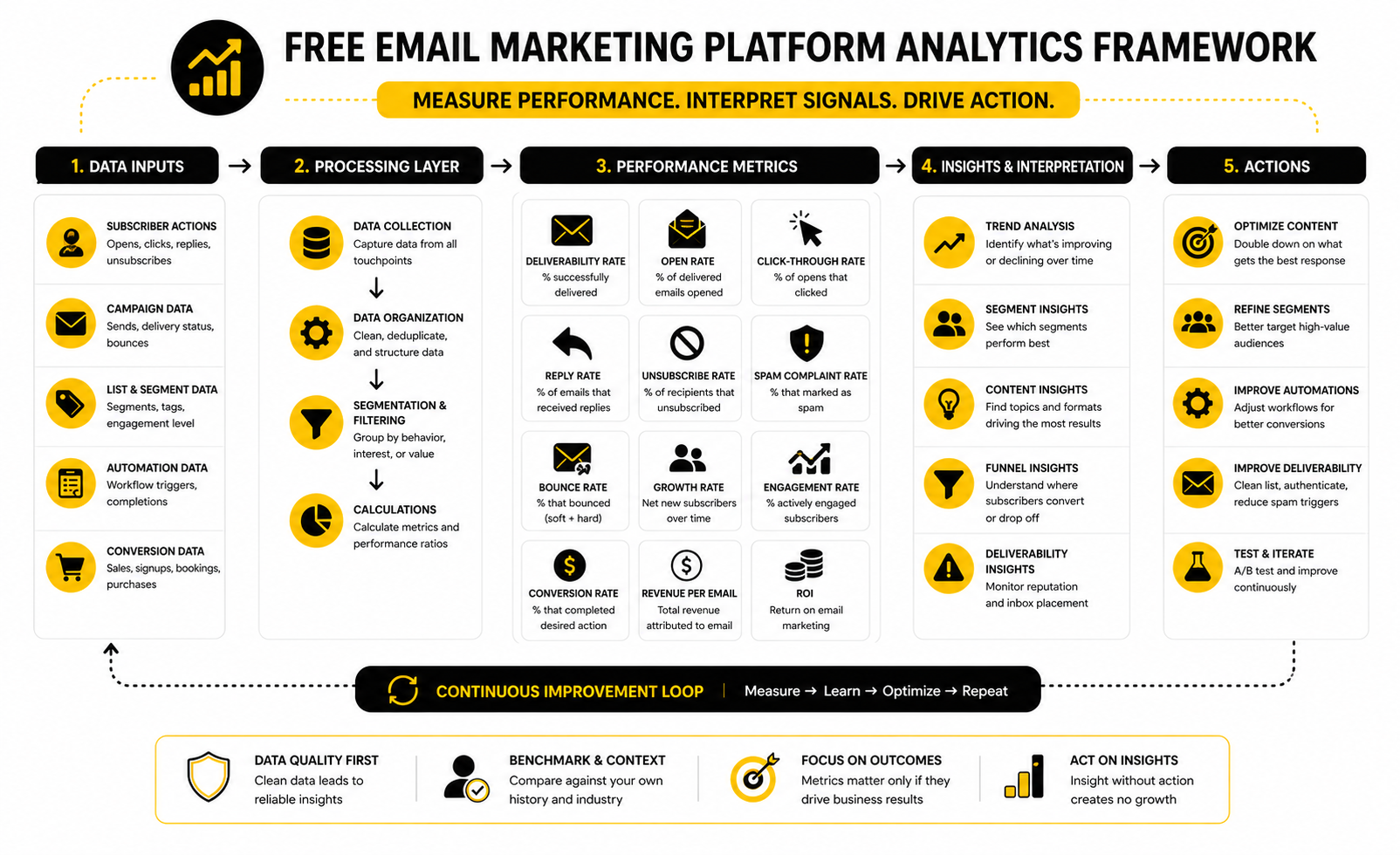
Email analytics are useful only when they help you decide what to do next. A benchmark can tell you whether your numbers are in a normal range, but it cannot tell you whether your offer is clear, your audience is qualified, or your timing makes sense. That is why the smartest way to evaluate a free email marketing platform is to look at the full performance system, not one isolated metric.
The most important numbers usually fall into five groups: deliverability, engagement, action, retention, and revenue. Deliverability tells you whether emails are reaching inboxes. Engagement tells you whether people notice and read them. Action tells you whether the email made someone click, reply, book, buy, or continue the journey.
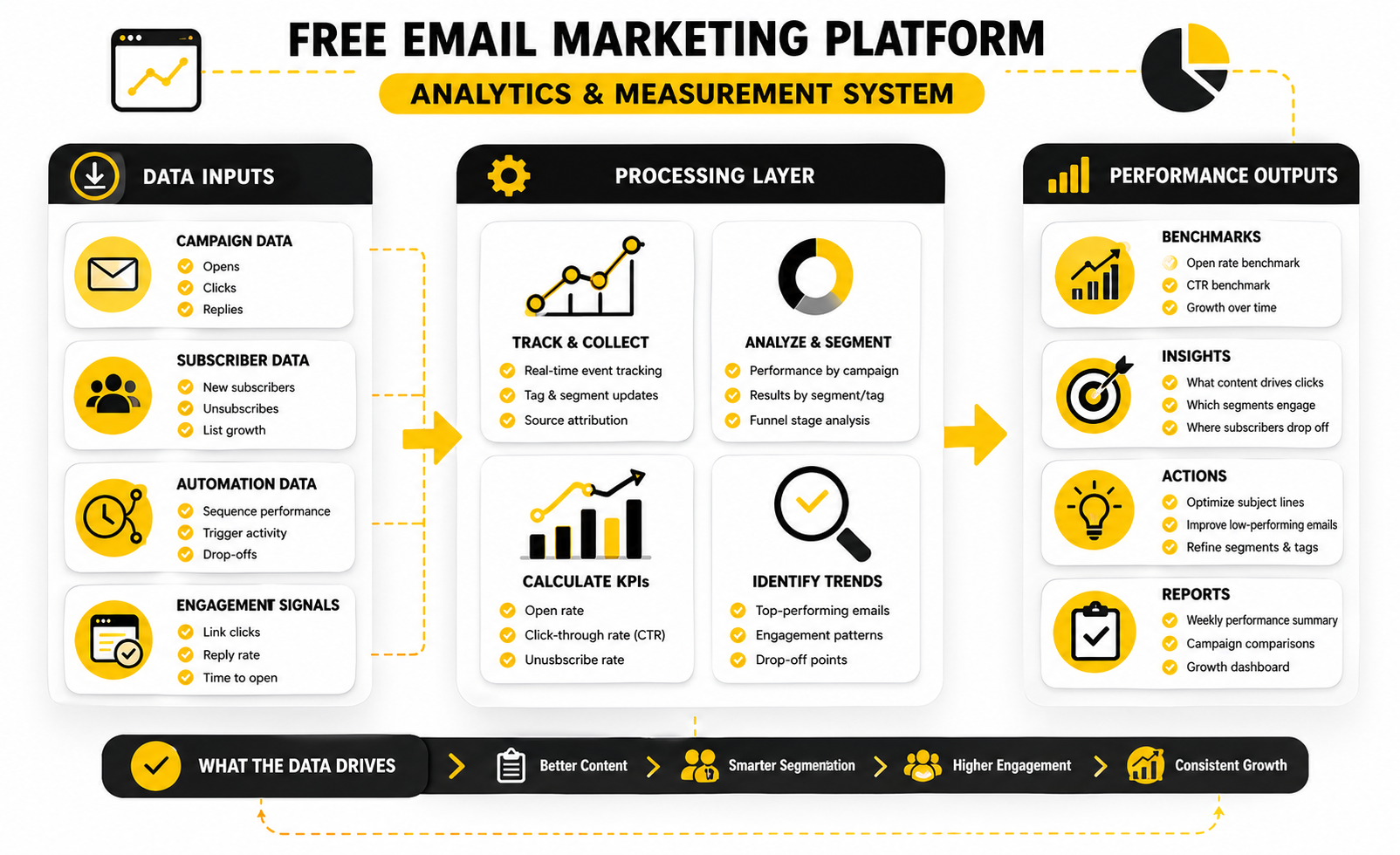
The DMA’s 2025 email benchmarking work reported that email delivery rates reached 98% in 2024, which is a strong reminder that email can still be a reliable owned channel when the list is permission-based and the sender reputation is healthy. MailerLite’s 2025 benchmark study reviewed 3.6 million campaigns from 181,000 approved accounts, which makes it useful for directional comparison across industries, regions, opens, clicks, click-to-open rates, and unsubscribes. Those numbers are helpful, but they should never replace your own trend line.
Open Rates
Open rates are still worth watching, but they are no longer clean proof that someone read your email. Privacy features can preload tracking pixels, and different inbox environments can distort the number. Treat opens as a soft signal for subject line relevance, sender recognition, and list warmth.
A rising open rate can mean your positioning is improving. A falling open rate can mean your subject lines are weak, your send frequency is off, or your audience is drifting away from the topic. But do not panic after one campaign, because one send can be affected by timing, seasonality, list mix, or a weak topic.
The better move is to compare similar emails against each other. Newsletter against newsletter. Promotion against promotion. Welcome email against welcome email. That gives you a cleaner read than comparing one product announcement to a weekly educational email.
Click Rates
Click rate is usually more useful than open rate because it shows active interest. Someone clicked because the promise inside the email was relevant enough to take the next step. That makes click performance a better signal for offer strength, content clarity, and call-to-action quality.
If opens are healthy but clicks are weak, the problem is usually inside the email. The subject line created curiosity, but the message did not create enough desire or confidence. Tighten the copy, reduce competing links, and make the next step obvious.
If both opens and clicks are weak, the issue is broader. You may be sending to the wrong segment, using a weak angle, or training subscribers to ignore you with inconsistent value. A free email marketing platform can show you the symptoms, but you still need to diagnose the marketing problem behind them.
Unsubscribes And Complaints
Unsubscribes are not automatically bad. Some people leave because they are no longer a fit, and that can actually improve list quality. The warning sign is not one unsubscribe; the warning sign is a pattern after specific topics, send frequencies, or promotional angles.
Spam complaints are more serious. They tell mailbox providers that recipients do not trust or recognize your emails. If complaints rise, stop chasing volume and fix consent, expectations, and list source quality first.
This is why purchased lists are a bad shortcut. They may look like growth in a spreadsheet, but they damage the very signals that make email work. A smaller, cleaner list will usually outperform a bigger list that never asked to hear from you.
Conversion And Revenue Signals
Clicks are not the finish line. If your goal is sales, bookings, applications, webinar attendance, or product usage, you need to connect email activity to the business result. Even a simple UTM setup can show which campaigns drive traffic and which ones only create vanity engagement.
A free plan may not include advanced attribution, but you can still measure the basics. Use clear links, separate campaign URLs when possible, and track what happens after the click in your website analytics or checkout system. The goal is not perfect attribution; the goal is enough clarity to make better decisions.
The practical question is simple: which emails create movement? If a campaign earns fewer opens but more replies, sales, or booked calls, it may be more valuable than a high-open email with no action. That is the mindset that separates reporting from real measurement.
Professional Implementation And Migration Planning
A free email marketing platform should not be treated like a disposable starter tool. Even if you begin with fifty subscribers, the structure you create now becomes the foundation you either scale with or clean up later. The smartest move is to set up the account as if it will matter six months from now, because if the channel works, it will.
Start by deciding what must stay simple and what must stay flexible. Simple means one clear audience, one main signup path, one welcome sequence, and one regular campaign rhythm. Flexible means your tags, fields, forms, and automations are named clearly enough that you can expand without guessing what anything means later.
This is where many people make the wrong tradeoff. They pick the platform with the biggest free allowance, then discover that the workflow is awkward, the upgrade path is expensive, or the tool does not fit the business model. A better question is: “Will this still make sense when the list is active, segmented, and generating revenue?”
When Free Is Enough
Free is enough when your email system is still proving the basics. You need to know whether people subscribe, whether they open, whether they click, and whether email helps move them toward a meaningful action. You do not need enterprise automation before you have a message that people care about.
A free plan is usually a good fit for early newsletters, solo creators, simple service businesses, small lead magnet funnels, and pre-launch audiences. In that stage, constraints can actually help because they force you to focus. If you only have a limited number of emails or contacts, every message needs a job.
The warning sign is when the limitation starts changing your strategy. If you avoid sending useful emails because of a daily cap, delay campaigns because of contact limits, or skip segmentation because the plan does not support it well, the “free” tool is now costing you momentum. That is the point where upgrading or moving becomes a business decision, not a software preference.
When To Upgrade
Upgrade when email becomes tied to revenue, retention, or operational reliability. If you are using email for product launches, client acquisition, appointment booking, onboarding, customer education, or ecommerce follow-up, the cost of weak tooling can be higher than the subscription fee. At that point, paid features are not luxuries; they are part of the system.
The first upgrade trigger is usually volume. Brevo’s free plan gives you 300 email sends per day, which can be perfect for steady, smaller sends but awkward for a launch list that needs everyone to receive the same campaign at the same time. Systeme.io’s free plan supports up to 2,000 contacts, which is generous for an all-in-one funnel setup, but the broader limits around funnels, courses, and custom domains may matter sooner depending on your business.
The second upgrade trigger is control. You may need A/B testing, advanced automation, deeper segmentation, custom reporting, landing pages, more users, faster support, or cleaner branding. Do not upgrade because a pricing page makes the higher tier look exciting; upgrade because a specific constraint is blocking a specific outcome.
Migration Risks
Migration sounds easy until you realize how many small pieces are connected. Contacts, tags, custom fields, forms, templates, automations, unsubscribe records, suppression lists, integrations, and analytics history all need attention. If you move too quickly, you can lose context or accidentally email people who should not be contacted.
The biggest risk is consent. You need to preserve unsubscribe status, list source, and permission context when moving platforms. Google’s sender rules make authentication, low spam complaint rates, and easy unsubscribe handling essential for anyone who wants reliable inbox placement with Gmail users.
The second risk is sending reputation. Moving platforms does not magically reset poor list quality, and blasting a newly imported list can create problems fast. Warm up carefully, send first to engaged subscribers, and avoid turning migration week into a major promotional push.
Choosing For The Business Model
The best free email marketing platform depends on how your business actually grows. A newsletter-first creator needs easy writing, list growth, and simple segmentation. A service business may care more about forms, appointments, CRM notes, and follow-up workflows. An ecommerce brand needs product behavior, purchase history, abandoned cart logic, and revenue reporting.
If email is only one piece of a broader funnel, an all-in-one option can reduce tool sprawl. Systeme.io is worth considering when you want email, funnels, a course, and simple selling features in one place. If you are building an agency-style client acquisition or follow-up machine, GoHighLevel may fit better once you are past the free-tool stage and need CRM, pipelines, automations, and client communication under one roof.
If your main need is dedicated email marketing, compare free and entry-level plans based on the specific constraint you will hit first. Brevo makes sense to evaluate when daily sending volume works for you and contact storage matters. Moosend is worth testing when you want to see how automation, segmentation, and landing pages feel before committing.
The Expert-Level Rule
Do not choose for the biggest free number. Choose for the least friction between subscriber intent and business outcome. That is the expert-level rule, and it will save you from most bad platform decisions.
A platform with fewer contacts can still be better if it helps you send the right message faster. A platform with generous limits can still be wrong if it makes your process clunky or your upgrade path painful. The decision should always come back to what you are trying to build, how soon you will outgrow the free plan, and how painful it would be to move.
The practical play is simple: start lean, set up clean, measure honestly, and upgrade only when the constraint is real. Free is a starting advantage, not the whole strategy.
Final Recommendations
The best free email marketing platform is the one that matches your next constraint, not the one with the loudest free-plan headline. If your list is small and you need a clean newsletter workflow, prioritize ease of writing, forms, and reporting. If you are building a funnel, prioritize automations, landing pages, and the upgrade path.
If contact storage matters more than send volume, Brevo is worth testing because its free plan structure is built around a daily sending limit rather than a tiny contact cap. If you want email inside a broader funnel and product-selling setup, Systeme.io is a practical option to compare. If your business is already moving toward CRM, pipelines, client follow-up, and multi-step automations, GoHighLevel is not really a free starter tool, but it can make sense once the email system becomes part of a larger revenue operation.
The final system should be simple: one clear signup offer, one clean list structure, one useful welcome sequence, one regular campaign rhythm, and one measurement routine. That is enough to learn fast without creating a complicated mess. Once that system starts producing consistent clicks, replies, bookings, or sales, upgrading becomes easier to justify.
FAQ - Built For Complete Guide
What is a free email marketing platform?
A free email marketing platform is software that lets you collect subscribers, send email campaigns, and usually manage basic reporting without paying upfront. Most free plans include limits on contacts, monthly sends, daily sends, automations, branding, or support. The goal is not to stay free forever, but to validate your email strategy before committing to a paid plan.
What is the best free email marketing platform for beginners?
The best option for beginners is usually the one that feels easiest to use while still giving you forms, templates, automation, and clear analytics. A tool with a generous free plan is helpful, but only if you can actually launch campaigns without friction. For many beginners, the best choice is the platform they can set up correctly in one afternoon and keep using consistently.
Is a free email marketing platform enough for a small business?
Yes, a free plan can be enough for a small business that is still building its first list, testing offers, or sending simple newsletters. It becomes limiting when email starts driving real revenue, bookings, customer onboarding, or product launches. At that point, paid features like advanced automation, better reporting, and more reliable scaling often become worth the cost.
What features should I look for first?
Start with signup forms, contact management, templates, automation, deliverability support, and reporting. Those are the features that determine whether your email system actually works. Extra features are useful only after the core workflow is clear.
Are free email marketing tools safe for deliverability?
They can be safe if you use them correctly. The platform matters, but your behavior matters more: send only to people who opted in, authenticate your domain, keep spam complaints low, and make unsubscribing easy. Gmail’s bulk sender rules require authentication, low unwanted-mail behavior, and easy unsubscribe handling for high-volume senders, which makes clean setup more important than ever.
Should I choose based on contact limits or email send limits?
Choose based on the constraint you will hit first. If you have a larger audience but send less often, contact-friendly pricing may matter more. If you have a smaller list but send frequently, monthly or daily email limits may become the problem sooner.
When should I upgrade from a free plan?
Upgrade when the free plan starts limiting a business outcome. That could mean you cannot send to your whole list, cannot build the automation you need, cannot remove branding, cannot segment properly, or cannot measure performance clearly. Do not upgrade because of fear; upgrade because a real constraint is slowing growth.
Can I run automations on a free plan?
Some free plans include basic automations, while others restrict automation heavily or reserve it for paid tiers. Before choosing a tool, test the exact automation you need, not just the feature checkbox. A welcome sequence, lead magnet delivery, and basic tagging are usually the first automation features worth checking.
Do I need a website before using an email marketing platform?
No, but it helps. Many platforms include signup forms or landing pages, so you can start collecting subscribers even before your full website is ready. Still, a website or dedicated landing page gives you more control over positioning, conversion tracking, and trust.
Is it bad to use a platform’s branding on free emails?
It is not automatically bad, especially when you are testing. But branding can make the experience feel less professional if you are selling premium services, launching a product, or nurturing higher-value leads. Removing platform branding is often one of the first reasonable upgrade triggers.
Can I switch platforms later?
Yes, but migration takes planning. You need to export contacts, preserve unsubscribe records, move tags and fields, rebuild forms, recreate automations, and test sending before fully switching. The cleaner your original setup is, the easier migration becomes.
What is the biggest mistake people make with free email marketing tools?
The biggest mistake is treating the tool like the strategy. A free email marketing platform can help you send, automate, and measure, but it cannot fix a weak offer, unclear audience, or inconsistent communication. Start with the message, build the simplest system around it, and let the data show you what to improve.
Work With Professionals
Explore 10K+ Remote Marketing Contracts on MarkeWork.com
Most marketers spend too much time chasing clients, competing on crowded platforms, and losing a percentage of every project to middlemen.
MarkeWork gives you a better way. Browse thousands of remote marketing contracts and connect directly with companies desperate to hire skilled marketers like you, without platform commissions and without unnecessary gatekeepers.
If you're serious about finding better opportunities and keeping 100% of what you earn, explore available contracts and create a profile for free at MarkeWork.com.