

Free email marketing services still make sense in 2026, but only if you pick them for the right reason. The goal is not to collect the biggest list of “free forever” tools. The goal is to find a platform that lets you start sending, learning, and improving before hard limits, branding rules, or deliverability problems slow you down.
That matters more now because the gap between free plans is wider than most comparison posts admit. Some tools still give small businesses real room to operate, like Brevo’s free plan with 300 daily sends and contact storage up to 100,000, while others are much tighter, like Mailchimp’s free tier capped at 250 contacts and 500 monthly sends or Omnisend’s free plan capped at 500 emails per month to 250 reachable contacts. That difference changes what kind of business each tool is actually good for.
Email is still worth taking seriously because the channel keeps producing measurable returns when it is run well. Recent research from Litmus shows many marketers reporting returns in the 10:1 to 36:1 range, and benchmark data from MailerLite and DMA shows that email continues to deliver meaningful opens and clicks even in a crowded inbox environment.
Article outline
- Why Free Email Marketing Services Still Matter in 2026
- How to Judge a Free Plan Before You Commit
- Best Free Email Marketing Services for Different Business Types
- Core Features That Separate a Useful Free Tool From a Trap
- How to Implement Your Free Email Stack Like a Pro
- When to Upgrade Without Wasting Money
Why Free Email Marketing Services Still Matter in 2026
For a new business, creator brand, newsletter, local service company, or early-stage ecommerce shop, free email marketing services lower the cost of getting started without removing the discipline the channel requires. You can build signup forms, send a welcome sequence, test subject lines, and learn what your audience responds to before software costs become a real budget line. That makes free tools especially valuable when you are still proving demand rather than optimizing scale.
They also matter because email remains an owned channel. Social reach can drop overnight, paid ads can get expensive fast, and search traffic can swing with every algorithm update, but an email list is still a direct relationship with people who chose to hear from you. That is part of why so many teams keep investing in email despite constant noise around newer channels, and why platforms keep competing so hard on free entry plans.
At the same time, the bar is higher than it used to be. Deliverability and sender trust are no longer optional technical details, especially with Google’s sender requirements, the newer Gmail enforcement guidance, and Yahoo’s sender best practices. So the real value of a free platform is not just that it costs nothing. It is whether it helps you start correctly.
How to Judge a Free Plan Before You Commit
The first thing to check is the real operating limit, not the headline. A free plan that sounds generous on paper can still be restrictive once you look at daily sending caps, branding rules, automation access, user limits, and how many contacts you can actively email. For example, MailerLite’s free plan supports up to 500 subscribers and 12,000 monthly emails, Sender’s free tier supports up to 2,500 subscribers and 15,000 monthly emails, and Mailjet’s free plan allows 6,000 monthly emails but only 200 per day. Those are very different ceilings, even though all three are technically free.
The second thing to check is whether the plan fits your business model. A local service business may care more about forms, simple automations, and contact management than raw send volume. An ecommerce brand may need segmentation and behavioral flows early, which makes a tool like Omnisend more relevant even with a smaller free limit, while a general small business may get more mileage from a broader platform like Brevo.
The third thing to check is whether the platform gives you enough signal to improve. Email becomes powerful when you can track opens, clicks, unsubscribes, list growth, and the performance of individual campaigns over time. Benchmark data from Brevo’s 2025 benchmark coverage of more than 44 billion emails, DMA’s 2025 report, and MailerLite’s 2025 benchmark roundup makes one thing obvious: small improvements in engagement compound fast when you keep sending consistently.
Framework Overview
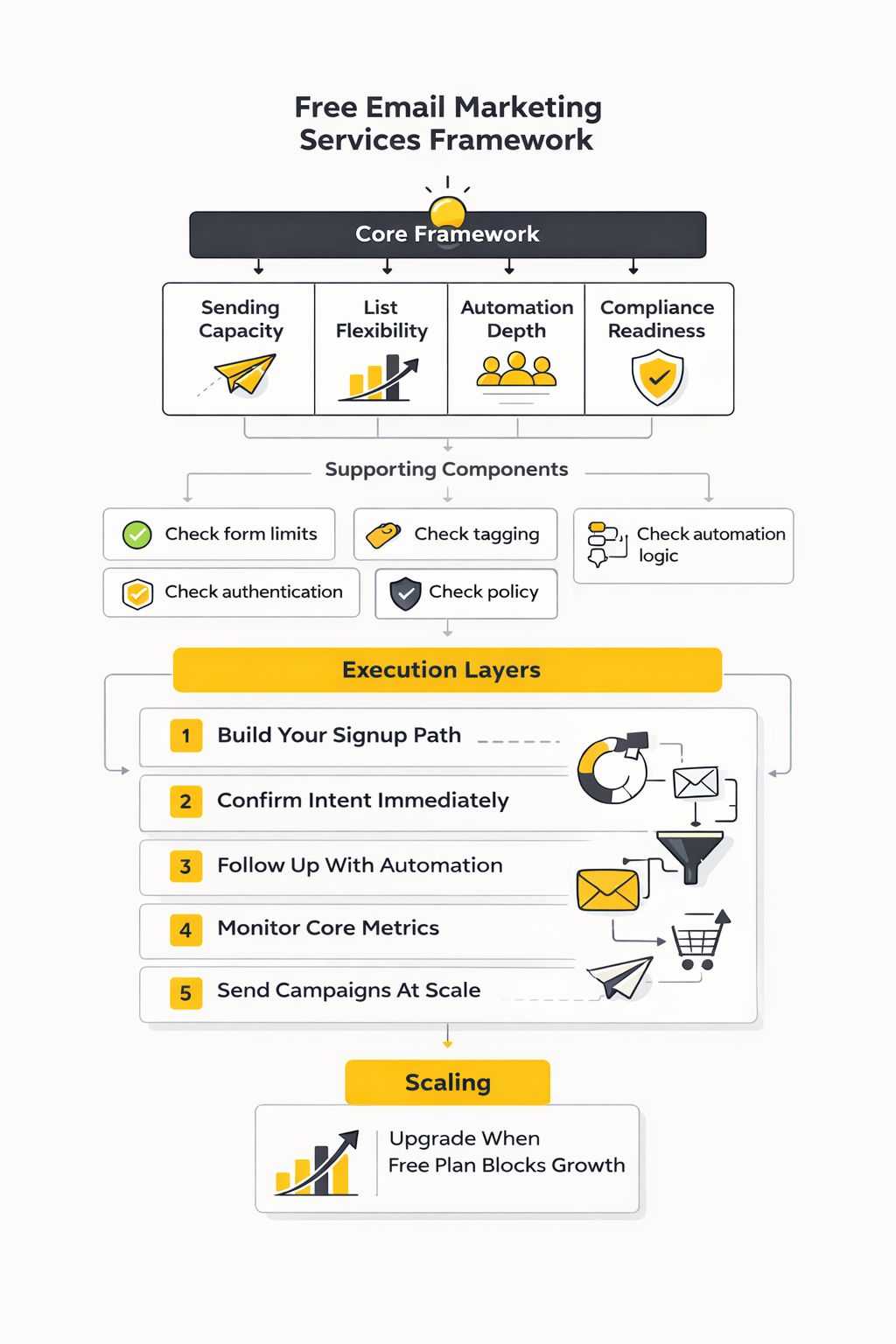
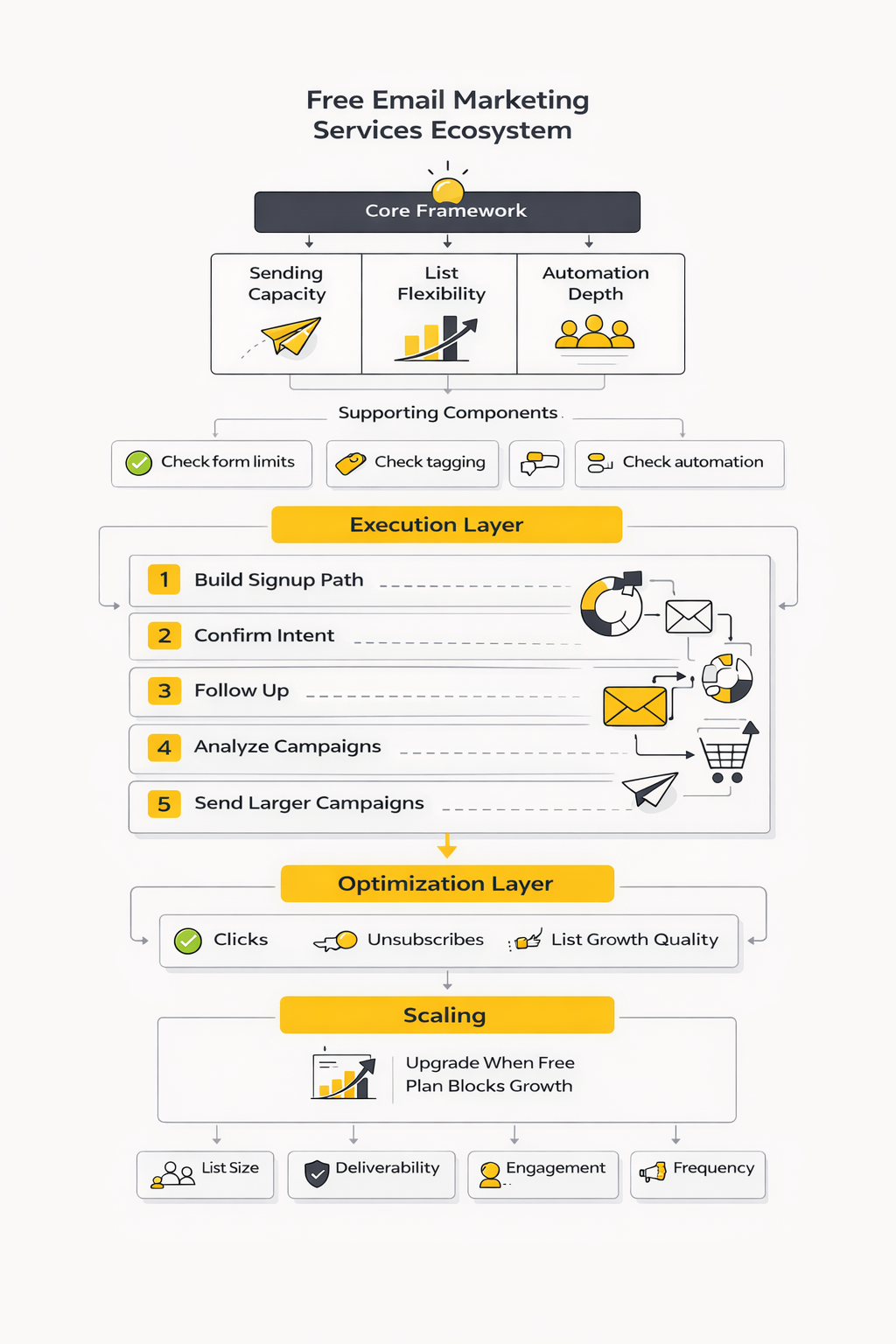
A practical way to evaluate free email marketing services is to score every platform across four areas: sending capacity, list flexibility, automation depth, and compliance readiness. Sending capacity tells you how much momentum you can build. List flexibility tells you whether you can grow without hitting a wall too early. Automation depth tells you whether you can do more than blast newsletters. Compliance readiness tells you whether the platform helps you send in a way inbox providers will keep accepting.
This framework matters because most bad software choices happen when people focus on only one metric. They choose the biggest free subscriber cap, then realize the email limit is too low. Or they choose the most polished editor, then discover automation is missing, branding is locked in, or deliverability setup is weak. A better choice comes from matching the free plan to the stage and shape of your business.
In the next part, the article will use this framework to compare the strongest free email marketing services by use case, not just by headline feature count. That is the only comparison method that actually helps you decide.
Best Free Email Marketing Services for Different Business Types
The biggest mistake people make with free email marketing services is assuming there is one universal winner. There is not. The better question is which platform gives your business enough room to send, segment, and automate without forcing an upgrade before email has even started paying for itself.
That is why use case matters more than feature count. A local service brand does not need the same setup as a creator selling a mini-course, and neither one should choose software the way an agency or SaaS team would. Once you look at the real fit, the shortlist gets much easier.
Best for most small businesses: Brevo
If you want the safest all-around pick, Brevo’s free plan is hard to ignore. It gives you a genuinely usable starting point with 300 daily email sends and contact storage up to 100,000, which immediately makes it more flexible than most free plans that choke list growth early. For businesses that need newsletters, forms, basic automations, and room to organize contacts properly, that balance is strong.
What makes Brevo especially practical is that it is not just an email sender. The platform also leans into CRM-style contact management, transactional messaging, and broader customer communication, which means you do not outgrow it the second your marketing gets a little more serious. That matters because switching platforms later is always more painful than people expect.
The catch is the daily send cap. If you have a fast-growing audience or you need to hit a larger list in one campaign, that limit becomes the wall you feel first. But for service businesses, consultants, local brands, and early-stage online stores, it is still one of the most usable free email marketing services on the market.
Best for creators and simple digital businesses: Systeme.io
If your business is built around lead magnets, simple funnels, email sequences, and selling digital products, Systeme.io’s free plan deserves a serious look. It includes up to 2,000 contacts on the free tier, and its core appeal is that email lives inside a broader funnel and product ecosystem rather than sitting off to the side. That can simplify your whole stack when speed matters more than sophistication.
This is where a lot of free email marketing services fall apart for creators. You end up stitching together a form tool, a landing page builder, an email tool, a checkout page, and maybe a course platform on top of that. Systeme.io works because it removes a lot of that tool sprawl from day one.
It is not the best choice for every business. If your main priority is a pure email platform with deeper list management or stronger sending flexibility, Brevo will often feel cleaner. But if your real goal is to turn subscribers into buyers through lightweight funnels and automated follow-up, Systeme.io makes a lot of sense.
Best when you want a real trial before paying: Moosend
Some businesses do not need a forever-free plan as much as they need a serious evaluation period. In that situation, Moosend’s 30-day free trial is more useful than a weak forever-free tier because it gives you access to core features like automation, landing pages, forms, A/B testing, and reporting during the trial window. That makes it a better fit for teams that want to test workflow depth before making a decision.
There is an important difference here, though. Moosend is not a true free-forever platform in the same way Brevo or Systeme.io can be. It is better to think of it as a clean, low-risk way to test whether a more advanced email setup is worth paying for once your list and campaign habits are established.
That distinction matters because many “free email marketing services” roundups blur free plans and free trials together. They are not the same thing. A free trial is useful when you are close to buying and want a real hands-on test, while a free plan is better when you are still trying to get traction without adding another monthly bill.
Best for agencies and service operators who need more than email: GoHighLevel
For agencies, consultants, and client-service businesses, email rarely lives alone. You also need funnels, forms, pipelines, automations, appointment flows, and client communication in one place. That is why GoHighLevel’s 14-day free trial can be a smarter evaluation path than choosing one of the simpler free email marketing services and then duct-taping the rest of your stack together.
This is not the tool I would recommend to someone who just wants to send a newsletter. It is heavier than that, and it is built around a broader operating system for lead generation and follow-up. But if email is only one piece of your revenue workflow, GoHighLevel’s platform can be more aligned with how your business actually runs.
The honest framing is simple: GoHighLevel is not a free-forever email service. It is an all-in-one system with a free trial that can replace several paid tools if your business model is complex enough. For the right operator, that tradeoff can be worth far more than a basic free email sender.
Which option makes the most sense right now
If you want the broadest free starting point with the fewest immediate compromises, Brevo is the easiest recommendation. If you are building funnels and selling simple digital offers, Systeme.io has a stronger argument than many pure email platforms because the workflow is more connected. If you want to test deeper automation before paying, Moosend is a solid trial-driven option, and if you run an agency or service business with more moving parts, GoHighLevel is really a systems decision rather than just an email decision.
That is the filter to use. Do not ask which platform has the longest feature list. Ask which one matches the way your business captures leads, follows up, and converts attention into revenue.
The next step is to look past plan pages and focus on the features that actually separate a useful free platform from a frustrating one. That is where the real differences show up, and it is also where most buyers make the wrong call.
Core Features That Separate a Useful Free Tool From a Trap
The fastest way to waste time with free email marketing services is to choose based on templates alone. Nice-looking emails are easy to show in a demo, but they do not matter much if the plan makes it hard to collect clean subscribers, segment people properly, or stay inside deliverability rules once you start sending consistently. The platforms worth using are the ones that make the basics easy and the important things possible.
The first feature that matters is how contacts enter your list. A usable platform should let you connect forms, apply tags, and confirm intent without building a messy manual workflow around spreadsheets and copy-pasting. That is one reason tools like Brevo and Systeme.io stand out for smaller operators: the path from form submission to contact organization is simple enough to set up quickly, but structured enough to scale.
The second feature is basic automation, because free email marketing services stop being valuable the moment every follow-up depends on you remembering to send it. Even one welcome email, one tag-based branch, and one cleanup rule can make a free plan far more productive than a prettier platform with no real workflow logic. Systeme.io’s automation rules and Brevo’s sign-up and confirmation flows are good examples of what “enough automation” looks like for an early-stage business.
The third feature is deliverability support, and this is where a lot of cheap-looking comparisons miss the point. Gmail’s requirements made authentication, spam control, and easy unsubscribing much less optional than they used to be, especially for higher-volume senders, and Google says senders should keep spam rates below 0.1% and avoid reaching 0.3% or higher. That means free email marketing services are only useful if they help you collect permission cleanly, remove people who no longer want your emails, and keep your sending habits disciplined before volume rises.
The fourth feature is reporting you can actually act on. Open rates are no longer a perfect truth signal, but they still help when you read them alongside clicks, unsubscribes, and list growth. Recent benchmark coverage from Brevo’s 2025 benchmark report and MailerLite’s 2025 benchmark roundup showed average open rates above 40% and click rates around 2%, which is useful not because it gives you a magic target, but because it tells you whether your own numbers are merely average, clearly weak, or improving in the right direction.
How to Implement Your Free Email Stack Like a Pro
Choosing the platform is the easy part. The real win comes from setting it up in the right order so you do not burn through your free limits, damage deliverability, or create a list full of contacts who never really wanted to hear from you. A simple setup done properly will outperform a “clever” setup that starts with too many tools and too little structure.
The practical order is straightforward. First you create one clear signup path, then you confirm intent, then you tag people by source or interest, then you send a short welcome sequence, and only after that do you start regular campaigns. That sequence sounds basic, but it is exactly what keeps free email marketing services useful long enough to generate real data instead of noise.
Step 1: Build one clear signup path
Start with a single offer and a single form. That could be a newsletter signup, a quote request follow-up list, a waitlist, or a lead magnet, but it needs to be specific so subscribers know what they are opting into. The more vague the promise, the worse your engagement gets later, and weak engagement is expensive even on a free plan because it eats your limited sends without producing much return.
This is also where stack simplicity matters. If your business is funnel-driven, Systeme.io gives you a cleaner all-in-one route for pages, forms, and follow-up. If you want broader email flexibility and CRM-style contact handling, Brevo is usually the stronger base.
Step 2: Confirm intent before you scale
This is the step people skip when they are in a hurry, and it is usually the step that causes problems later. Brevo’s help documentation shows that when you build a form directly in the platform, you can enable double confirmation automatically, and when the form is external, you can still build a double opt-in flow with automation. That matters because the cleanest subscriber is the one who has clearly asked to be there twice, not the one who vaguely remembers downloading something three months ago.
For businesses operating in markets where consent quality matters a lot, this step is not just neat housekeeping. It reduces junk signups, lowers the odds of spam complaints, and gives you a much stronger base for future campaigns. Free email marketing services become dramatically more useful when the list is smaller but cleaner.
Step 3: Tag contacts the moment they join
Most beginners wait too long to organize contacts. They collect names in one bucket, send the same message to everyone, and only start thinking about segmentation when engagement slips. That is backward.
The smarter move is to tag at the point of entry. If someone joins from a service page, tag that source. If they opted in for a lead magnet, tag that topic. Systeme.io’s automation rules and tag system make this simple enough to do from the start, and that one habit gives you a cleaner way to personalize future campaigns without rebuilding your list later.
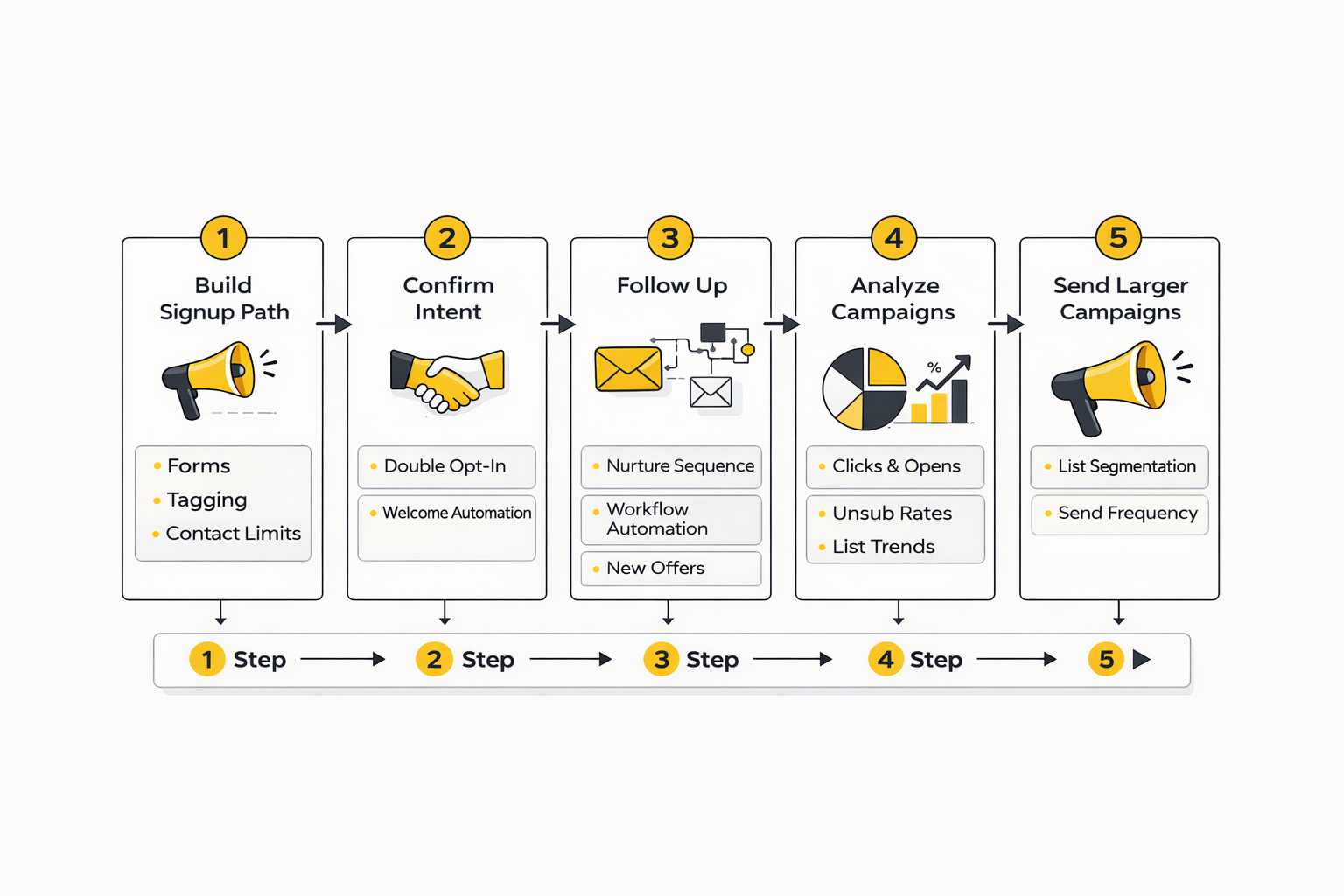
Step 4: Create a short welcome sequence
Your first automated sequence does not need to be long. In fact, with free email marketing services, shorter is usually better because you want every message to earn its place. A strong beginner sequence is often just three emails: a welcome email that delivers the promised value, a second email that sets expectations, and a third email that points the reader toward the next action you actually want.
This is where free plans can still produce serious leverage. One well-built sequence keeps working while you focus on getting more subscribers, and it creates a stable baseline for measuring clicks, replies, and unsubscribes. Even on limited plans, automation beats one-off blasting because it ties each send to clear intent rather than hope.
Step 5: Send campaigns only after the system works
A lot of people start with newsletters because newsletters feel like “real marketing.” The problem is that campaigns sent into a weak system tend to expose every flaw at once. Bad targeting, poor list quality, vague expectations, and low engagement all show up fast when you push a broad send.
That is why the better move is to test your system first. Make sure subscribers are entering correctly, confirmation is working, tags are applying, and the welcome sequence lands cleanly. Once that foundation is stable, your campaigns become much easier to improve because you are measuring content performance, not debugging your setup.
Step 6: Watch the metrics that actually protect the account
When people talk about email metrics, they usually obsess over opens first. Opens still matter a bit, but on free email marketing services, the more protective numbers are clicks, unsubscribes, list growth quality, and complaint risk. Google’s current guidance is clear enough here: keep spam rates low, authenticate properly, and make unsubscribing easy.
That changes how you should think about early optimization. A smaller list with better clicks and fewer complaints is healthier than a bigger list that ignores you. The point of a free plan is not to inflate vanity numbers. It is to prove that your audience wants what you are sending before you increase volume or software spend.
A lean setup that works
If you want the shortest version of the process, it looks like this:
- Pick one platform that matches your business model.
- Create one focused signup form or landing page.
- Turn on confirmation or build a double opt-in flow.
- Tag subscribers by source or intent immediately.
- Build a three-email welcome sequence.
- Send regular campaigns only after the path is working.
- Monitor clicks, unsubscribes, and complaint risk more closely than vanity metrics.
That is the professional version of starting small. It is not flashy, but it is exactly how free email marketing services go from “cheap software” to a real acquisition channel.
The next part is where the money decision gets clearer. Once you know how to run the free setup properly, it becomes much easier to spot the moment a free plan stops helping and starts holding the business back.
What the Numbers Are Really Telling You
Once your setup is live, free email marketing services stop being a software choice and start becoming a measurement problem. The numbers matter, but only if you read them in context and let them drive decisions instead of ego. That is where a lot of beginners go wrong: they chase a higher open rate, ignore weak clicks, and miss the fact that the list is not moving people toward any real action.
A better approach is to treat your email metrics like a simple operating system. One group of numbers tells you whether people are seeing your emails, another tells you whether they care enough to act, and a third tells you whether your sending habits are damaging trust. The job is not to collect more metrics. The job is to find the few that tell the truth fastest.
Open rates are useful, but they are not the main event
Open rates still help, especially when you are comparing your own campaigns over time. They can tell you whether your subject lines are improving, whether your sender name feels familiar enough, and whether your timing is getting better. But they are no longer clean enough to treat as the final score.
That matters because benchmark reports now show very different “normal” ranges depending on how the data is calculated. Brevo’s 2025 benchmark report, built from more than 44 billion emails, shows an overall open rate of 31.22% and a click-through rate of 3.64%, while MailerLite’s 2026 benchmark roundup reports a 2025 average open rate of 43.46% and an average click rate of 2.09%. Those numbers are both useful, but they are not interchangeable, which is exactly why you should use benchmarks as reference points rather than rigid targets.
The action this should drive is simple. If your opens are healthy but clicks are weak, the problem is probably not visibility. It is usually the offer, the body copy, the call to action, or the audience fit. That is a very different fix from “write a better subject line,” and it is why opens should start the diagnosis, not end it.
Clicks tell you whether attention is turning into intent
If you only watch one engagement metric closely, make it clicks. Clicks are not perfect either, but they are much closer to genuine interest because they require effort. A subscriber can accidentally register as an open or trigger one through privacy protections, but a click usually means they were interested enough to move.
This is where free email marketing services become easier to judge honestly. If your click rate is consistently weak, the platform may not be the problem at all. MailerLite’s 2025 benchmark data puts the average click rate at 2.09% and click-to-open rate at 6.81%, while Brevo’s 2025 report shows a 3.64% overall click-through rate. The exact number you should aim for depends on industry, audience warmth, and campaign type, but the principle stays the same: clicks tell you whether the email created enough curiosity or urgency to move the reader.
That should shape your next move. If clicks are below your baseline, do not immediately redesign the whole system. Start by tightening the promise in the email, reducing the number of competing links, and making the next step more obvious. Most underperforming emails do not fail because the software is weak. They fail because the message asks for too much attention in too many directions.
Unsubscribes and spam complaints are not just “negative metrics”
A rising unsubscribe rate can feel discouraging, but it is often one of the healthiest signals in the account if you read it properly. It tells you when expectations are drifting, when your targeting is too broad, or when frequency is out of step with what people signed up for. In other words, it gives you a chance to fix the relationship before deliverability gets worse.
The benchmarks are useful here because they show how sensitive this number can be. Brevo’s 2025 report shows an overall unsubscribe rate of 0.4%, while MailerLite’s 2026 benchmark roundup shows a 2025 average unsubscribe rate of 0.22%. Those ranges are not identical, but both are low enough to make the point: when unsubscribes start climbing materially above your usual pattern, something needs attention.
The more serious warning sign is complaint risk. Google’s sender guidelines say senders should keep spam rates below 0.1% and prevent them from ever reaching 0.3% or higher. That is not just a technical footnote. It means a list that is too cold, too broad, or too poorly permissioned can quietly become the reason your future emails struggle, even if the content itself is fine.
The simplest analytics system is usually the best one
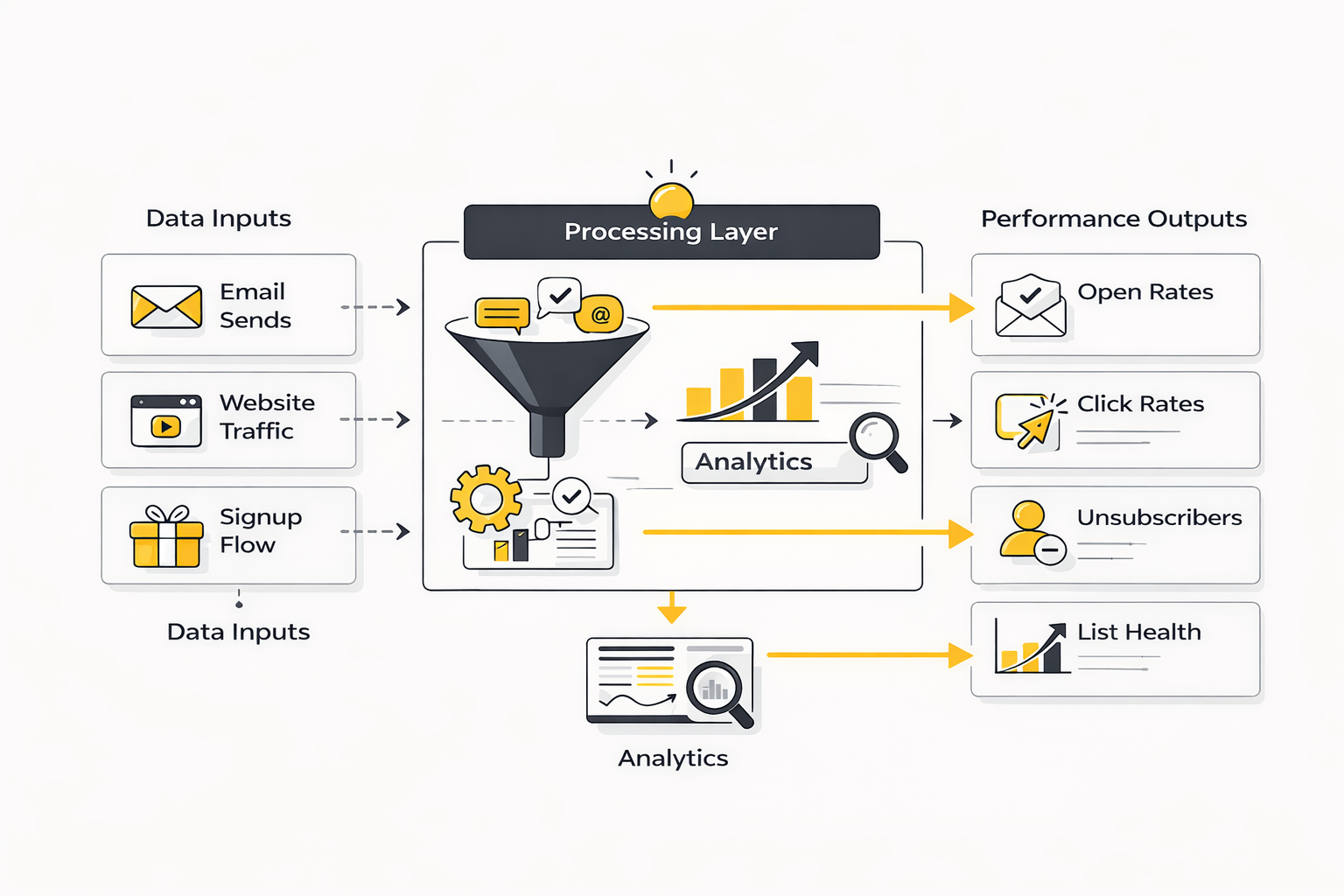
You do not need a complex dashboard to manage free email marketing services well. In fact, the leanest reporting system is often the most effective because it forces you to focus on a handful of decisions instead of drowning in vanity data. A practical weekly review can fit on one page.
Here is the version that actually works:
- Check deliverability health first by watching bounce patterns, unsubscribe shifts, and complaint risk.
- Check engagement quality second by comparing clicks and click-to-open trends across campaigns.
- Check list movement third by measuring how many new subscribers turned into active readers or buyers.
- Check content winners and losers last by comparing topics, offers, and calls to action.
That order matters. If deliverability is weak, engagement data becomes less trustworthy because fewer people are seeing the email in the first place. If deliverability is fine but clicks are soft, the issue is more likely the message or audience fit. If clicks are solid but business results are weak, the problem may sit on the landing page, checkout flow, or follow-up sequence rather than inside the email itself.
Benchmarks are helpful, but trend lines are more powerful
Industry benchmarks are useful because they stop you from overreacting to one campaign. A 2% click rate might be poor for one list and perfectly reasonable for another. Context matters, and that is why public studies from Litmus, MailerLite, and Brevo are useful reference material rather than strict scorecards.
But your own trend line is what really matters. If your click rate rises from 1.2% to 1.8% over six campaigns, that improvement means more than arguing about whether your niche “should” be at 2.1%. If unsubscribes fall after you tighten your signup promise, that is a meaningful win even if another brand in another category publishes different averages.
That is also why email remains so attractive as a channel. Litmus’s recent ROI coverage shows many companies still reporting returns in the 10:1 to 36:1 range, but the bigger point is not the headline number. It is that email rewards teams that measure carefully, improve steadily, and keep their list clean enough for each campaign to build on the last one.
What each signal should make you do next
Metrics become valuable when they trigger action. Without that link, they are just decoration inside the dashboard. This is the simplest way to interpret them:
- High opens, low clicks usually means the email got attention but the content or offer was not strong enough.
- Low opens, decent clicks often points to a subject line, timing, or sender-recognition issue.
- Good clicks, poor downstream results usually means the landing page or next step is doing the damage.
- Rising unsubscribes or complaint risk means expectations, targeting, or frequency need to be corrected fast.
This is the part many software comparisons skip. The goal is not to find free email marketing services with the prettiest report screen. The goal is to use the reports to make better decisions while the list is still small enough to fix easily.
That leads naturally to the next question: when do you stop optimizing inside a free plan and admit the plan itself is now the bottleneck? That is where the upgrade decision becomes much clearer, and it is the next part of the article.
When to Upgrade Without Wasting Money
A free plan is valuable when it helps you learn faster than you spend. It becomes expensive the moment it starts distorting how you market. That is the real upgrade trigger with free email marketing services, and it has very little to do with pride or “looking more professional.”
Most businesses wait too long for the wrong reason. They keep squeezing a free plan because zero dollars feels efficient, even while daily send caps, branding limits, weak automation, or missing integrations quietly slow list growth and reduce revenue. Saving money is smart, but only until the free plan starts making good execution harder than it should be.
Upgrade when the limit changes your behavior
This is the cleanest rule of all. If the platform limit is forcing you to send in a worse way, it is time to move. A daily cap that makes you stagger campaigns manually, a contact limit that stops list growth, or a workflow restriction that keeps leads from getting the right follow-up is no longer a harmless constraint. It is now a tax on performance.
You can see that tradeoff clearly in current plan structures. Brevo’s free plan still includes 300 emails per day, which is fine when you are early and disciplined, but Brevo’s own free-plan help page explains that larger campaigns require manual requeueing over multiple days. That is manageable at the beginning. It is a bottleneck once your list and campaign rhythm are actually working.
The same logic applies elsewhere. Systeme.io’s free plan supports up to 2,000 contacts with unlimited email sending, so the pressure point there is usually not send volume first. It is whether you need more capacity, more workflow flexibility, or fewer tradeoffs across the rest of the funnel stack. In other words, the right upgrade moment depends on which limit is shaping your behavior in the worst way.
Upgrade when your list quality is proven, not when your ego is ready
A lot of people upgrade too early because they want the feeling of “real software” before the fundamentals are there. That is backward. If your list is not opening, clicking, or converting at a healthy baseline yet, paying more rarely fixes the core problem. Usually it just gives you more room to repeat the same weak strategy at a larger scale.
The better trigger is proof. Once your signup path is clean, your welcome sequence is working, and your campaigns are generating reliable engagement, then paying to remove friction makes sense. That is when the upgrade amplifies a functioning system instead of compensating for a broken one.
This matters because modern paid plans are not trivial add-ons anymore. GoHighLevel’s entry pricing starts at $97 per month, which can be perfectly reasonable for an agency or service operator replacing several tools, but absurdly premature for a solo creator who has not yet validated their offer. Moosend’s pricing starts much lower and follows subscriber-based scaling after the 30-day trial, which is easier to justify when your email engine is already producing results.
The real scaling risks most people miss
The obvious risk with free email marketing services is running out of room. The less obvious risk is building your entire workflow around platform quirks you never meant to keep. That can show up as messy manual segmentation, weak naming conventions, improvised tagging, or hacks to work around send limits. The longer that goes on, the more painful the eventual upgrade becomes.
There is also a strategic risk around under-investing in infrastructure once your list starts to matter. Authentication, segmentation, landing page consistency, and reliable automation matter more as volume grows, not less. Google’s sender rules are a reminder that scaling email is not just about sending more. It is about sending in a way mailbox providers continue to trust. (support.google.com)
That is why the smartest businesses do not ask only whether the next plan is affordable. They ask whether the new plan reduces operational risk. If paying removes fragile manual work, protects deliverability, and lets you segment more precisely, the upgrade is not really a cost. It is risk reduction.
The smartest upgrade path depends on your business model
Not every upgrade should be deeper into a pure email tool. Sometimes the right move is to pay for more sending volume inside the same platform. Sometimes it is to move into a broader system because email is only one piece of the sales process.
For example, if you are already happy with your setup and simply need more sending room, moving up inside Brevo’s pricing ladder is often cleaner than migrating elsewhere. If your business is built around funnels, simple offers, and digital products, upgrading inside Systeme.io can be the smarter move because it keeps pages, contacts, automation, and sales flow under one roof. If your operation is client-heavy and email sits inside a larger acquisition machine, GoHighLevel becomes a stronger strategic bet than paying for a slightly better standalone email tool.
That is the expert-level distinction many comparison articles miss. You are not just upgrading price. You are upgrading operating model. Once you see that clearly, the “best” option usually becomes much more obvious.
Signs you should stay on the free plan a little longer
There are also moments when not upgrading is the smart call. If your list is still small, your offer is still changing, and your engagement is inconsistent, adding software cost can distract you from the real work. In that phase, the discipline of a free plan can actually help because it forces you to simplify.
You should probably stay put if most of these are still true:
- Your list is small enough that current send limits are not interfering with timing.
- Your click performance is still too unstable to judge content quality properly.
- Your signup promise or offer is still being tested.
- Your welcome sequence is unfinished or weak.
- You are not yet using the basic reporting already available inside the free plan.
That is not being cheap. It is being honest. Free email marketing services are most powerful when they are used as a proving ground, not a permanent crutch and not an excuse to start paying before the business is ready.
Make the upgrade decision with one simple filter
The best question to ask is this: If I upgraded today, what specific friction would disappear tomorrow? If you cannot answer that clearly, wait. If you can answer it in one sentence and the removed friction would likely improve revenue, speed, or deliverability, the upgrade is probably justified.
That keeps the decision grounded. It stops you from upgrading because of shiny features, and it also stops you from clinging to a free plan just because free feels safe. The right move is the one that improves execution without creating unnecessary complexity.
That sets up the final part well, because once you know how to choose, implement, measure, and scale free email marketing services, the remaining questions become much more practical. The last section will close the article with the key takeaways and the FAQ people usually ask right before they make a decision.
The final takeaway is simple: free email marketing services are valuable when they help you build a clean list, send with discipline, and learn what your audience actually wants before software costs start stacking up. They stop being valuable when the limits force bad behavior, sloppy segmentation, delayed campaigns, or manual workarounds that eat more time than the savings are worth. That is the line to watch, and once you see it clearly, the decision gets much easier.
The smartest operators do not obsess over whether a tool is free forever. They care whether it gives them a stable system they can trust, measure, and improve. That is the real difference between casually sending emails and building an email channel that contributes to growth.
FAQ - Built for Complete Guide
Which platform is the best overall choice among free email marketing services?
For most small businesses, Brevo is still one of the strongest all-around options because it balances sending, contact storage, and broader business use better than many free plans. Its current free plan includes 300 emails per day and storage for up to 100,000 contacts, which makes it more usable than many tools that cap both list size and sending much earlier. The best choice still depends on your model, but if you want the safest broad recommendation, Brevo is a strong place to start.
Are free email marketing services actually worth using in 2026?
Yes, but only when you use them to validate a real system instead of treating them like a permanent shortcut. Free tools still make sense when you are building a welcome sequence, testing list growth, and learning what content creates clicks before you commit to a paid stack. They are worth less when the plan is so limited that you cannot run email in a realistic way.
What is the biggest mistake people make with free email marketing services?
The biggest mistake is choosing based on surface features like templates or brand popularity instead of operating limits. A polished editor means very little if the free plan blocks segmentation, restricts sending too aggressively, or creates messy manual work every time you want to run a campaign. Good email performance comes from system fit, not from the prettiest interface.
Is Brevo really free, or is the free plan too limited?
Brevo is genuinely free to start with, and its help documentation makes the limits clear rather than hiding them. The biggest constraint is the daily sending cap, because Brevo’s help center explains that campaigns larger than 300 recipients must be requeued manually over multiple days on the free plan. That is workable for small operations, but once timing and campaign scale start to matter, that limit can become the upgrade trigger.
Is Systeme.io better than Brevo for some businesses?
Yes, especially for creators, solo operators, and simple digital businesses that care about funnels as much as email. Systeme.io’s pricing page shows the free plan includes up to 2,000 contacts, and its appeal is that pages, forms, automation, and selling live together instead of being spread across several tools. If your workflow is offer-driven rather than newsletter-first, Systeme.io can be the smarter fit.
Do I need double opt-in when using free email marketing services?
Not in every market or use case, but it is often one of the smartest moves you can make early. Double opt-in helps clean up your list, reduces junk signups, and gives you more confidence that subscribers actually want your emails. That becomes even more valuable as inbox providers get stricter and complaint risk matters more.
What metrics should I watch first if I am just getting started?
Start with clicks, unsubscribes, and overall list quality before you obsess over opens. Opens can still tell you something, but clicks are closer to real intent, and unsubscribes can warn you when expectations or targeting are drifting. A smaller list with stronger clicks is usually worth much more than a larger list with weak engagement.
What open rate or click rate should I consider “good”?
There is no single answer because benchmarks vary by industry, audience warmth, and how each platform calculates the data. Recent benchmark reports show wide but useful reference ranges, with Brevo’s 2025 benchmark report showing a 31.22% average open rate and 3.64% click-through rate and MailerLite’s 2025 benchmark summary showing a 43.46% average open rate and 2.09% average click rate. The more useful question is whether your own trend line is improving and whether the clicks are leading to the action you want.
Can I run a serious business on free email marketing services alone?
For a while, yes. Many early-stage businesses can run a clean signup path, welcome sequence, simple segmentation, and regular campaigns on a free tool if the audience is still relatively small. The problem is not seriousness. The problem is when the plan starts shaping behavior in a worse way, which is when the free setup stops being an asset and starts being friction.
When should I upgrade from a free email plan?
Upgrade when the limit changes how you market, not when you simply feel ready to pay. If the plan forces delayed sends, weak automation, or poor segmentation, the “free” setup is now costing you performance. That is the point where paying usually becomes rational.
Are Gmail and Yahoo requirements a real issue for small senders too?
Yes, because sender trust is no longer something only big brands need to think about. Google’s current sender guidance says senders should keep spam rates below 0.1% and avoid reaching 0.3% or higher, which is a reminder that list quality and clear consent matter early, not just later. Even if your list is small, bad habits can train your account in the wrong direction.
Is Moosend a free email marketing service or just a trial?
It is better described as a free trial than a true free-forever platform. Moosend’s pricing page currently positions the offer as a 30-day free trial with core features included, which makes it useful for testing, but different from tools meant to stay free longer-term. That distinction matters because a free plan and a free trial solve different problems.
Should I use an all-in-one platform instead of a pure email tool?
Sometimes yes, and the right answer depends on where email sits inside your business. If your operation depends on funnels, CRM workflows, appointment flows, or client management, an all-in-one platform can remove a lot of friction that a standalone email tool will not solve. That is why some agencies and service businesses find GoHighLevel more useful strategically than a simpler email-only platform.
Can free email marketing services work for ecommerce brands?
They can work at the beginning, but ecommerce businesses often hit the limits faster because segmentation and automation matter earlier. Browse abandonment, post-purchase follow-up, and customer lifecycle messaging usually become too important to handle with weak free-plan workflows. That does not make free tools useless, but it does mean ecommerce brands should judge them more harshly than a local service business would.
What is the best final filter for choosing a platform?
Pick the platform that matches the way your business captures leads, follows up, and converts attention into revenue. That sounds obvious, but it instantly eliminates most bad choices because it forces you to think operationally instead of emotionally. The right tool is the one that supports your current model cleanly and gives you a believable upgrade path when traction arrives.
Work With Professionals
Explore 10K+ Remote Marketing Contracts on MarkeWork.com
Most marketers spend too much time chasing clients, competing on crowded platforms, and losing a percentage of every project to middlemen. MarkeWork gives you a better way. Browse thousands of remote marketing contracts and connect directly with companies desperate to hire skilled marketers like you, without platform commissions and without unnecessary gatekeepers.
If you're serious about finding better opportunities and keeping 100% of what you earn, explore available contracts and create a profile for free at MarkeWork.com.