

Choosing a free email newsletter service sounds simple until you realize the “free” part can mean wildly different things. Some tools give you generous subscriber limits but weak automation. Others give you polished templates but cap your sends, remove key features, or add branding you may not want.
That matters because email is still one of the few channels you actually control. Social reach can drop overnight, ad costs can move fast, and search traffic can swing with algorithm updates. Email gives you a direct line to people who asked to hear from you, which is why recent email research still shows strong returns when teams track performance properly, with some measured programs reporting more than $10 returned for every $1 spent.
But free does not mean careless. A newsletter platform affects deliverability, list growth, segmentation, signup forms, automation, analytics, and eventually revenue. The right choice is not “the tool with the biggest free plan.” The right choice is the free email newsletter service that fits how you plan to grow.
Article Outline
- Why A Free Email Newsletter Service Still Matters
- The Newsletter Platform Framework
- Core Components Of A Good Free Email Newsletter Service
- How To Compare Free Plans Without Getting Trapped
- Professional Implementation For Your First Newsletter
- Common Mistakes, Tool Shortlist, And FAQ
Why A Free Email Newsletter Service Still Matters
A free email newsletter service matters because it lowers the cost of starting, but it does not lower the importance of doing things properly. Your first subscribers are often your most valuable readers because they join before your brand feels big, polished, or obvious. Treating that early list seriously helps you build trust before you try to scale.
The real advantage is speed. You can test a positioning angle, publish a weekly update, validate an offer, or build a small audience without buying a full marketing stack first. That is especially useful for creators, consultants, local businesses, SaaS founders, ecommerce brands, and service providers who need signal before they need complexity.
There is also a strategic reason to start early. Email performance gets stronger when you have clean subscriber data, consistent sending habits, and clear reader expectations. Benchmarks from the DMA Email Benchmarking Report keep pointing marketers back to the same reality: email is not just a broadcast channel, it is a relationship channel.
The Newsletter Platform Framework
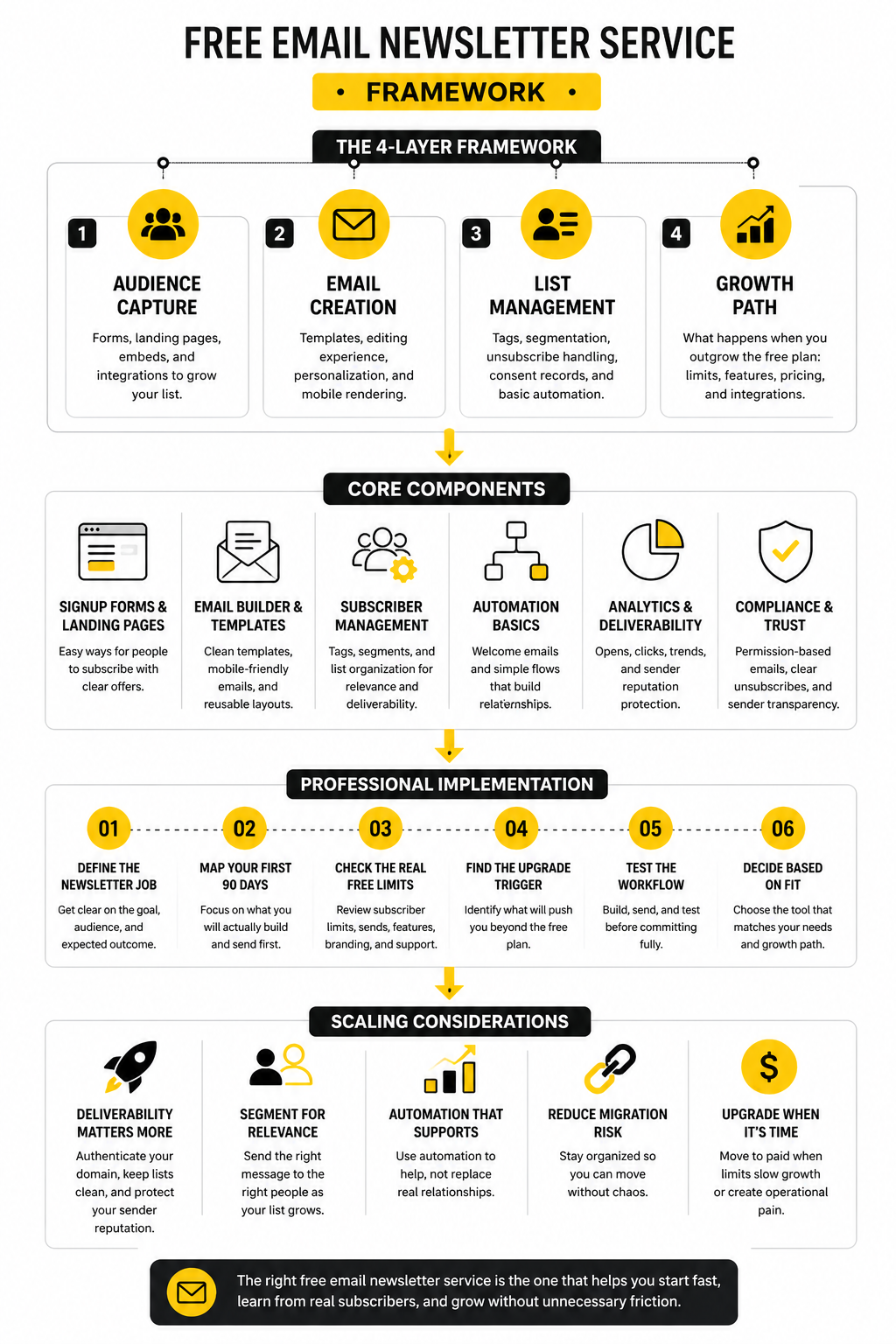
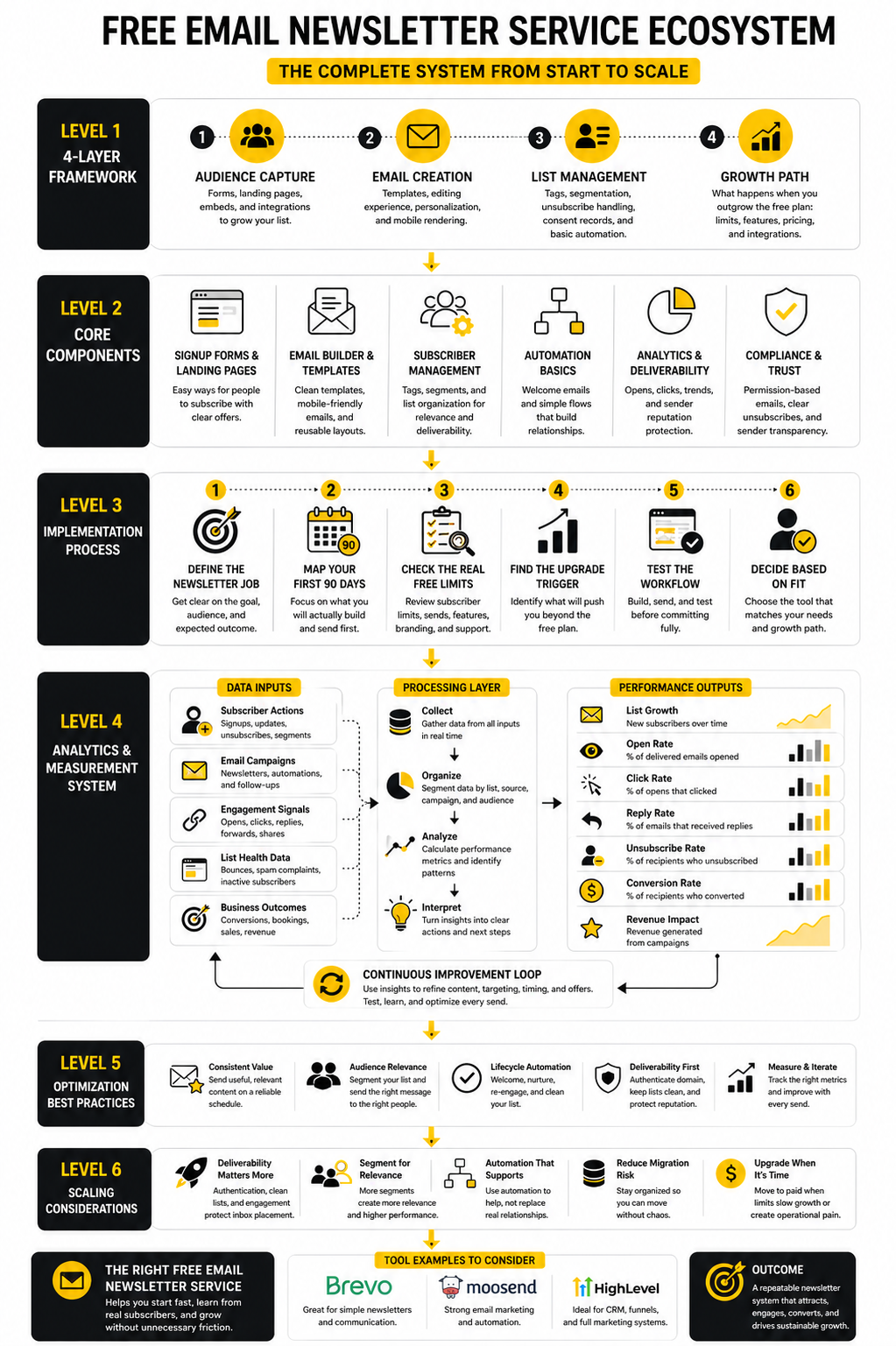
The best way to choose a free email newsletter service is to separate the decision into four layers: audience capture, email creation, list management, and growth path. Audience capture is about forms, landing pages, embeds, and integrations. Email creation is about templates, editing experience, personalization, and mobile rendering.
List management is where many free tools start to feel different. You want tagging, segmentation, unsubscribe handling, consent records, and basic automation that will not collapse the moment your list becomes useful. A free plan that looks generous but gives you no practical way to organize subscribers can become expensive later.
The growth path is the part people skip. Ask what happens when you hit the free limit, need automations, remove branding, add a custom domain, or connect ecommerce and CRM data. Tools like Brevo, Moosend, and GoHighLevel can fit very different businesses, so the framework matters more than a generic “best tool” list.
Core Components Of A Good Free Email Newsletter Service
A good free email newsletter service should help you do four things without friction: collect subscribers, send clean emails, organize the list, and understand what happened after each send. If one of those pieces is weak, the free plan may still work for testing, but it will not support serious growth for long. The goal is not to find the most complicated platform; it is to find the simplest platform that does the important things well.
Signup Forms And Landing Pages
Your signup flow is the front door of the newsletter. A basic embedded form is enough when you already have a website, but a landing page is useful when you want to promote the newsletter from social posts, ads, podcasts, or partner mentions. The best free tools make this easy without forcing you to build a full website first.
Keep the offer clear. Tell people what they will receive, how often they will receive it, and why it is worth joining. If you need more flexible opt-in forms, quizzes, or lead capture workflows, a form builder like Fillout can sit in front of your email platform and give you more control over the subscriber experience.
Email Builder And Templates
The email builder should help you publish faster, not tempt you into over-designing every send. For most newsletters, a clean text-first layout beats a heavy template because it feels personal, loads quickly, and keeps the focus on the message. Templates are still useful, but they should support clarity instead of turning every newsletter into a flyer.
Look closely at mobile preview, spacing, button styling, and how easy it is to reuse a structure. If you need to rebuild the same layout from scratch every week, the tool is slowing you down. A strong free email newsletter service should let you create a repeatable format that readers recognize instantly.
Subscriber Management
Subscriber management is where beginners often underestimate the work. At first, one list feels fine. Then you add lead magnets, product updates, webinar registrations, customer segments, and people who only want one topic.
Tags and segments help you avoid sending everything to everyone. This matters because relevance protects engagement, and engagement protects deliverability. If your tool does not give you a simple way to separate new leads, active readers, buyers, and cold subscribers, you will eventually need messy workarounds.
Automation Basics
You do not need advanced automation on day one, but you do need the basics. A welcome email is the minimum because it confirms the subscription, sets expectations, and gives the reader a reason to remember you. A short welcome sequence is even better when your newsletter supports a product, service, course, or community.
This is where free plans can differ a lot. Some tools allow basic automation for free, while others reserve useful workflows for paid plans. If automation will matter soon, compare tools like Brevo, Moosend, and GoHighLevel based on what happens after the first subscriber joins, not just what the pricing table says.
Analytics And Deliverability Signals
Analytics should answer practical questions. Did people open? Did they click? Did they unsubscribe? Did one topic clearly perform better than another?
Do not obsess over one metric in isolation. Opens can be distorted by privacy features, clicks depend on whether the email had something worth clicking, and unsubscribes can be healthy when they remove people who were never going to engage. What you want is a trend: better topics, cleaner lists, stronger calls to action, and fewer deliverability problems over time.
Compliance And Trust
A newsletter is permission-based. That means people should know what they are signing up for, have a clear way to unsubscribe, and receive emails from a sender identity they recognize. This is not just legal hygiene; it is basic trust.
Add your business details where required, avoid misleading subject lines, and never buy random lists. A free email newsletter service can give you the software, but it cannot save you from bad sending habits. Trust is part of the system, and once you damage it, it is hard to rebuild.
How To Compare Free Plans Without Getting Trapped
Free plans are useful, but they are also designed with limits. That is not a problem by itself. The problem is choosing a free email newsletter service because the headline number looks generous, then discovering the real limit only after your list has started growing.
Start with the constraint that will affect you first. For some newsletters, that is subscriber count. For others, it is monthly send volume, automation access, landing pages, branding removal, or support. A tool that gives you 10,000 contacts but only limited sending may feel worse than a tool with fewer contacts and a better publishing workflow.
Step 1: Define The Newsletter Job
Before comparing platforms, define what your newsletter is supposed to do. A creator sending weekly essays has different needs than a local clinic sending appointment reminders, and both are different from an ecommerce brand sending product launches. When the job is clear, the tool decision gets much easier.
Write the goal in one plain sentence. For example, “This newsletter will turn website visitors into booked calls,” or “This newsletter will keep customers engaged between purchases.” That sentence tells you whether you need landing pages, CRM features, ecommerce integrations, automation, or just a clean publishing tool.
Step 2: Map Your First 90 Days
Do not compare tools based on the business you hope to have two years from now. Compare them based on what you will actually do in the first 90 days. Most people need one signup page, one embedded form, one welcome email, and one repeatable newsletter format.
This keeps the decision practical. You are not trying to buy a giant marketing machine before you have proof that people want the emails. You are choosing a free email newsletter service that lets you publish consistently, learn from real subscribers, and avoid rebuilding everything next month.
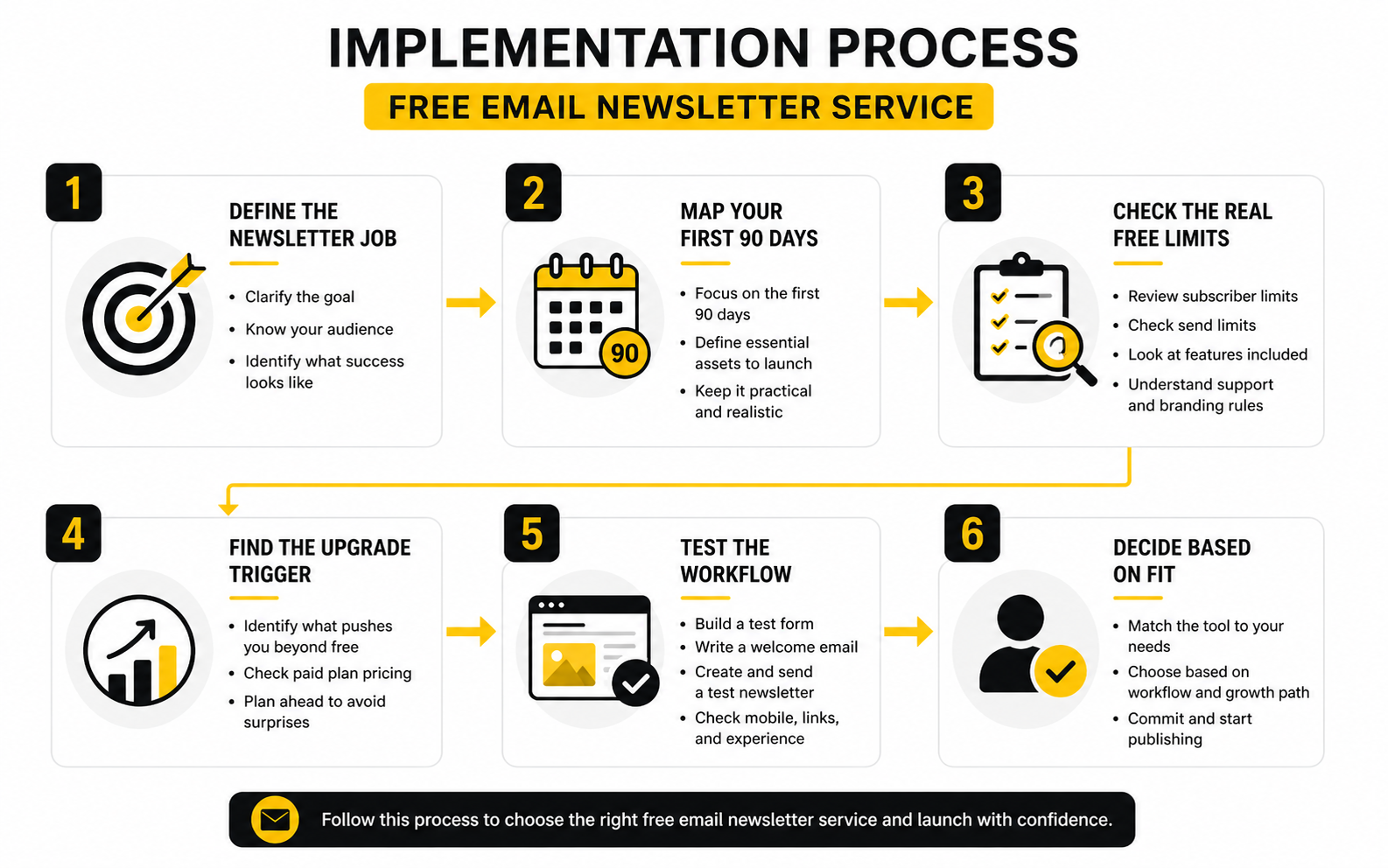
Step 3: Check The Real Free Limits
The real limits usually sit below the headline offer. Check how many emails you can send per day or month, how many subscribers you can store, whether automation is included, whether platform branding appears on your emails, and what happens when you need support. These details matter more than a broad “free forever” claim.
For example, Brevo’s free newsletter software is built around a daily sending limit, which can work well for smaller lists and steady publishing. A platform like Moosend may make more sense when you want to test a full-featured email marketing workflow before committing to a paid plan. The point is not that one model is always better; the point is to match the limit to your actual publishing rhythm.
Step 4: Look For The Upgrade Trigger
Every free plan has a moment where it stops being free. That moment might be your list size, send volume, automation needs, reporting needs, or desire to remove branding. You want to know that trigger before you invest time into setup.
This is where many beginners make the expensive mistake. They compare free plans, ignore paid pricing, and then feel locked in when migration becomes annoying. Always check the next paid tier, because a free tool with a painful upgrade path is not really free once your newsletter starts working.
Step 5: Test The Workflow Before You Commit
Do not choose a platform from screenshots alone. Create a test form, write a welcome email, build one newsletter, send it to yourself, and check it on mobile. You will learn more from that one test than from reading ten comparison posts.
Pay attention to friction. Was the editor fast? Did the form look trustworthy? Was the unsubscribe link handled properly? Could you find the reporting without digging through menus? A good free email newsletter service should make the basic workflow feel boring in the best possible way.
Step 6: Decide Based On Fit, Not Hype
The best platform is the one you will actually use every week. If the tool is powerful but annoying, you will avoid sending. If the tool is simple but too limited, you will outgrow it before you build momentum.
Choose based on your current newsletter job, your next upgrade trigger, and your comfort with the workflow. That gives you a decision you can defend. More importantly, it gives you a system you can keep using after the excitement of starting wears off.
Statistics And Data That Actually Matter
Newsletter data is useful only when it changes what you do next. A free email newsletter service will usually show opens, clicks, unsubscribes, bounces, and list growth, but those numbers are not equally reliable. The mistake is treating the dashboard like a scoreboard instead of a diagnostic tool.
Open rate can still show directional interest, but it should not be your main truth. Apple Mail Privacy Protection can preload email images and distort open tracking, which means a high open rate may not always mean more humans actually read the email. That is why serious measurement has to look beyond opens and focus on behavior that is harder to fake.
The Core Newsletter Metrics
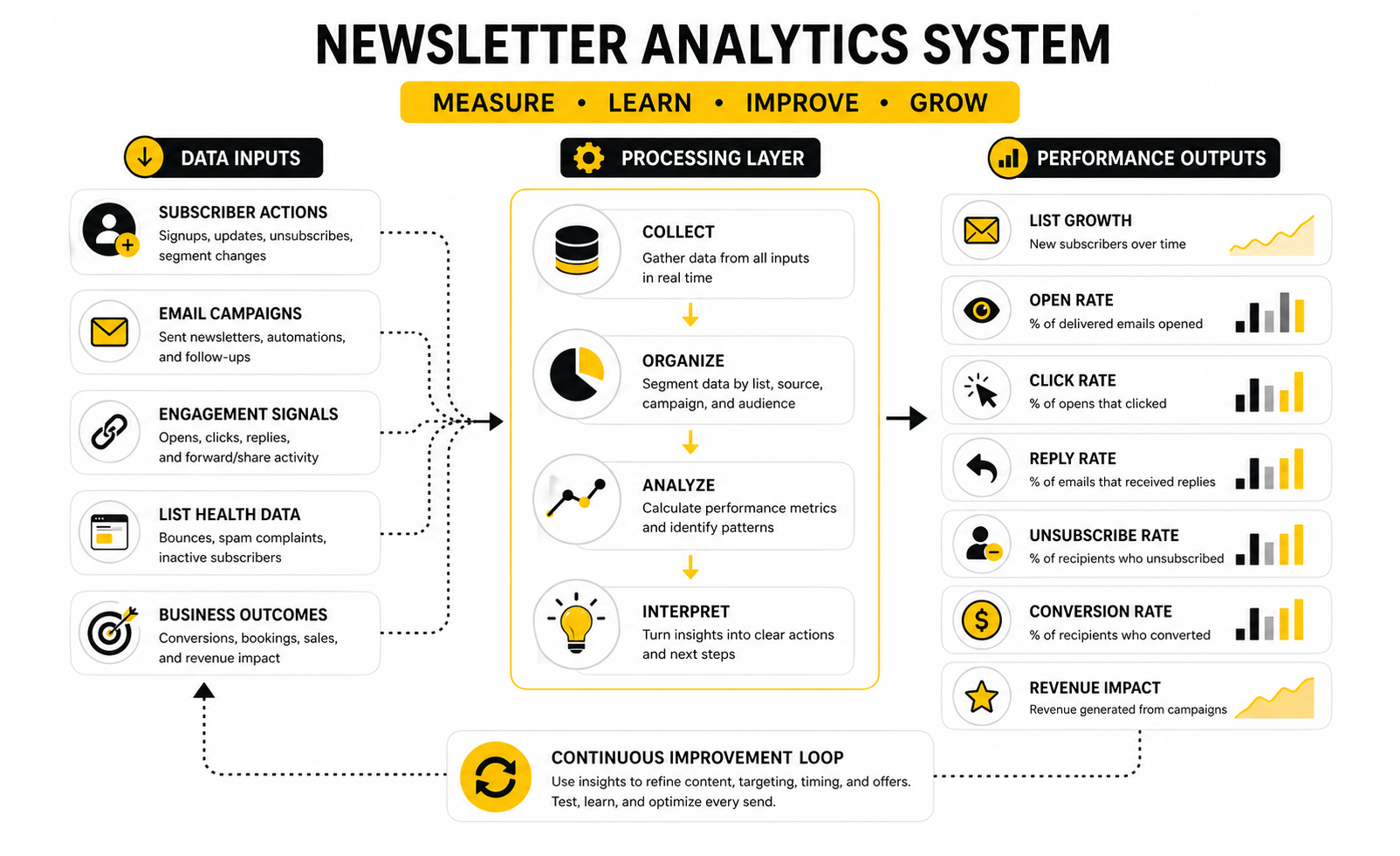
Track five numbers first: list growth, open rate, click rate, unsubscribe rate, and conversion rate. List growth tells you whether your offer is attracting people. Click rate tells you whether the email created enough intent for someone to act.
Unsubscribe rate is not automatically bad. If people leave after a clear, honest email, your positioning may simply be filtering the wrong audience out. The number becomes a problem when unsubscribes spike after misleading subject lines, irrelevant promotions, or a sudden change in sending frequency.
Conversion rate is the business metric. It might mean booked calls, product purchases, replies, demo requests, survey completions, or content downloads. If your newsletter never connects to a meaningful action, you are just publishing into a dashboard.
Benchmarks Are Context, Not Targets
Benchmarks help you spot obvious problems, but they should not control your strategy. MailerLite’s 2025 benchmark data covers more than 3.6 million campaigns from 181,000 approved accounts, which makes it useful for directional comparison. Still, your niche, list source, relationship strength, offer, and sending frequency can shift performance dramatically.
A small expert newsletter can beat a large generic brand newsletter because the audience has stronger intent. A new list from a high-quality lead magnet may outperform an old list that has not been cleaned in years. Use benchmarks to ask better questions, not to panic because your numbers do not match someone else’s chart.
What Good Performance Looks Like
Good performance starts with consistency. If your click rate is flat but your list is growing with the right people, you may need better calls to action rather than a new platform. If opens are high but clicks are weak, the subject line may be doing its job while the email body fails to create momentum.
Deliverability is the quiet metric behind everything. Recent deliverability research keeps pointing to a hard truth: not every marketing email reaches the inbox, and one current report found that 18% of marketing emails never make it there. That means weak performance is not always a copywriting problem; sometimes your sender reputation, authentication, list quality, or engagement history is holding you back.
How To Turn Data Into Action
Use a simple review rhythm after every send. Look at the subject line, topic, send time, click pattern, unsubscribes, and replies. Then write down one thing you will test next time.
The action should match the signal. Low clicks mean improve the offer, link placement, or email structure. High unsubscribes mean check expectation mismatch. Weak list growth means improve the signup promise or put the form in more visible places. A free email newsletter service is enough for this stage as long as it gives you the basic signals clearly.
The Reporting Setup To Use From Day One
Create one small tracking sheet outside your email platform. Record the date, topic, subject line, audience segment, send volume, open rate, click rate, unsubscribes, replies, and the main business result. This keeps you from relying only on whatever your tool chooses to emphasize.
After ten sends, patterns become visible. You will see which topics create clicks, which formats get replies, and which calls to action move people closer to revenue. That is when email stops feeling like random publishing and starts becoming a repeatable growth channel.
Advanced Considerations Before You Scale
Once the basics are working, the question changes. You are no longer asking whether a free email newsletter service can send a newsletter. You are asking whether your setup can support growth without hurting deliverability, trust, workflow, or revenue.
This is where the cheap decision can become expensive. A free plan is great when it helps you validate the channel. It becomes a liability when it blocks segmentation, limits automation, weakens reporting, or forces a messy migration at the exact moment your list starts becoming valuable.
Deliverability Gets More Important As You Grow
Small lists can hide bad habits for a while. Bigger lists expose them fast. If your emails start getting ignored, deleted, bounced, or marked as spam, inbox providers receive signals that your messages may not deserve priority placement.
That is why authentication matters. Since 2024, major inbox providers have pushed bulk senders toward stronger requirements around SPF, DKIM, DMARC, low spam complaint rates, and easier unsubscribe flows. Even if you start with a free email newsletter service, your domain reputation belongs to you, so protect it from day one.
Free Branding Can Affect Perception
Many free tools add their own branding to emails, landing pages, or signup forms. That may be fine when you are testing a small idea. It can feel less professional when you are selling consulting, promoting a serious brand, or sending traffic from paid campaigns.
The question is not whether branding is annoying. The question is whether it changes trust at the moment someone is deciding to subscribe, click, book, or buy. If your newsletter supports a commercial goal, removing platform branding may be one of the first upgrades worth paying for.
Segmentation Becomes The Difference Between Helpful And Noisy
At the beginning, sending the same email to everyone is normal. Later, it gets lazy. Readers join for different reasons, and the more your audience grows, the more those differences matter.
Segment by intent before you segment by tiny details. Separate people who downloaded a lead magnet from people who bought, booked a call, joined a webinar, or subscribed from a general content page. If your platform cannot handle that cleanly, connect your newsletter to a broader CRM workflow with something like GoHighLevel or keep your capture system organized with Fillout.
Automation Should Support The Relationship, Not Replace It
Automation is powerful when it helps people get the right message at the right time. It becomes damaging when every subscriber is pushed through generic sequences that ignore context. More automation is not automatically more strategy.
Start with lifecycle moments that genuinely help the reader. Welcome new subscribers, deliver what they requested, follow up after a form submission, and re-engage quiet subscribers before removing them. If you want AI-assisted workflows, tools like GoHighLevel AI can help, but the strategy still needs a human brain behind it.
Migration Risk Is Real
Most people do not think about migration until they are forced into it. Then they realize they have forms embedded across their site, automations running in the background, tags with inconsistent names, landing pages indexed in search, and subscribers spread across multiple sources. Moving platforms becomes more than exporting a CSV.
Reduce that risk early. Use clean tag names, keep a backup of subscribers, document active forms, and avoid building complex logic inside a platform you already know you may leave. A free email newsletter service should help you move forward, not quietly trap your system inside messy dependencies.
When A Free Plan Is No Longer The Right Plan
Upgrade when the limitation is costing you more than the subscription. That may happen when you need more sends, better automation, cleaner branding, stronger analytics, faster support, or deeper integrations. Do not upgrade because the pricing page makes paid features look exciting.
The cleanest signal is operational pain. If you are spending extra hours working around the free plan, delaying campaigns because of limits, or losing clarity because the tool cannot show the data you need, the free plan has done its job. It got you started. Now the newsletter needs infrastructure that matches the value it creates.
Common Mistakes, Tool Shortlist, And FAQ
A free email newsletter service works best when it sits inside a simple system. You need one clear signup promise, one clean capture flow, one reliable sending rhythm, one basic measurement loop, and one upgrade path that will not punish you later. That is the final system: not a random tool, but a workflow you can keep improving.
The biggest mistake is treating the newsletter like a side task instead of a business asset. Even a small list can become valuable when it is built around trust, relevance, and consistent delivery. Start lean, but build like the list will matter.
Practical Tool Shortlist
For a simple newsletter with basic email marketing needs, Brevo is a practical place to start because it gives small teams a straightforward way to send campaigns and manage contacts. It makes sense when you care about email as part of a broader communication workflow rather than a creator-only publishing setup.
For marketers who want to test a more classic email marketing platform, Moosend is worth comparing because the workflow is built around campaigns, automation, and list management. It is a better fit when you want the newsletter to become part of a larger marketing engine.
For agencies, local businesses, consultants, and service providers, GoHighLevel can make more sense when email needs to connect with CRM records, pipelines, booking, funnels, and follow-up automation. It is not the lightest option, but it becomes useful when the newsletter is part of a sales system instead of a standalone publication.
Common Mistakes To Avoid
Do not choose a platform only because the free plan looks generous. A free plan that blocks automation, hides useful reporting, or makes migration painful can cost more in wasted time than a paid plan would have cost in money. The better question is whether the tool helps you publish, learn, and grow with fewer bottlenecks.
Do not send without a clear promise. If people joined for weekly tactical advice, do not suddenly send random product blasts. Expectation mismatch is one of the fastest ways to damage engagement.
Do not wait until your list is large to clean up your process. Use clear tags, document your forms, test your links, and track each send from the beginning. Good habits are easy when the list is small and painful when the list is already messy.
FAQ - Built For Complete Guide
What is the best free email newsletter service?
The best free email newsletter service depends on your goal. A creator may need a fast editor and simple publishing workflow, while a service business may need CRM, forms, automation, and booking integrations. Choose the tool that fits your first 90 days and has an upgrade path you can live with.
Can I start a newsletter for free?
Yes, you can start a newsletter for free with many email platforms. The free plan usually includes limits around subscribers, monthly sends, automation, branding, or support. Those limits are fine for testing as long as you understand them before building your workflow.
What should I look for in a free newsletter platform?
Look for signup forms, landing pages, an easy email editor, subscriber management, basic analytics, and a clear upgrade path. The platform should also handle unsubscribe links and permission-based list management properly. If it makes the basics hard, skip it.
Is a free email newsletter service good enough for a business?
A free plan can be good enough for early testing, small lists, and simple campaigns. Once the newsletter starts supporting sales, client acquisition, customer retention, or paid traffic, you may need stronger automation, branding control, deliverability tools, and reporting. Free is a starting point, not always a long-term operating model.
How often should I send my newsletter?
Send as often as you can be useful without becoming noise. Weekly is a strong starting rhythm for many newsletters because it creates consistency without overwhelming the reader. If you only have something valuable twice a month, send twice a month and be reliable.
What metrics should I track first?
Track list growth, open rate, click rate, unsubscribe rate, replies, and conversions. Opens are useful as a directional signal, but clicks, replies, and business outcomes usually tell you more. The goal is to understand what your audience does, not just what the dashboard displays.
Do I need automation when starting out?
You need at least a welcome email. It confirms the subscription, sets expectations, and gives the reader a strong first impression. More complex automation can wait until you know your audience, offer, and follow-up logic.
Should I use a custom domain for my newsletter?
A custom domain is a smart move when the newsletter represents a business, personal brand, or commercial offer. It looks more professional and helps you build a recognizable sender identity. As you grow, domain authentication and sender reputation become more important.
Can I use a newsletter to sell products or services?
Yes, but the newsletter should not feel like a constant pitch. Teach, guide, share useful ideas, and connect offers naturally to the reader’s problem. Selling works better when the newsletter has already earned attention.
When should I upgrade from a free plan?
Upgrade when the free plan blocks growth or creates operational pain. That could mean you need more sends, stronger automation, better segmentation, cleaner branding, deeper integrations, or faster support. The right time to upgrade is when the newsletter is valuable enough that the limits cost more than the plan.
How do I avoid spam problems?
Use permission-based signup forms, send relevant content, authenticate your domain, avoid misleading subject lines, and make unsubscribing easy. Remove inactive contacts when they stop engaging. Deliverability is not one trick; it is the result of consistent trust signals.
What is the simplest way to start today?
Pick one free email newsletter service, create one signup page, write one welcome email, and send one useful newsletter this week. Do not spend weeks comparing tools before you have subscribers. Build the smallest working system, then improve it with real data.
Work With Professionals
Explore 10K+ Remote Marketing Contracts on MarkeWork.com
Most marketers spend too much time chasing clients, competing on crowded platforms, and losing a percentage of every project to middlemen.
MarkeWork gives you a better way. Browse thousands of remote marketing contracts and connect directly with companies desperate to hire skilled marketers like you, without platform commissions and without unnecessary gatekeepers.
If you're serious about finding better opportunities and keeping 100% of what you earn, explore available contracts and create a profile for free at MarkeWork.com.