

Email didn’t just survive the algorithm era—it quietly became one of the most reliable growth channels online. While social platforms fluctuate and ad costs keep rising, newsletters continue to deliver consistent reach and engagement. In fact, email marketing still generates around $42 for every $1 spent based on recent industry data (latest email ROI benchmarks) .
At the same time, newsletters are no longer just a side channel. Over 81% of marketers actively use newsletters, and the format has evolved into a full-blown creator and business ecosystem (current newsletter usage data) . What changed is simple: tools got easier, automation got smarter, and launching a newsletter no longer requires a budget.
That’s where a free newsletter tool becomes powerful. It removes the biggest barrier—cost—and lets you focus on building audience, authority, and eventually revenue.
Article Outline
- Why free newsletter tools matter today
- Framework for choosing the right free newsletter tool
- Core components of a high-performing newsletter system
- Professional implementation strategies
- Growth and monetization tactics
- Advanced scaling and optimization
Why Free Newsletter Tools Matter Today
The biggest shift in digital marketing is ownership. Platforms like Instagram, TikTok, and even Google can limit your reach overnight. Email is different because you own the relationship directly.
A free newsletter tool gives you access to that ownership without upfront investment. You can build a list, send content, and create consistent touchpoints with your audience from day one. This is especially critical when you consider that average newsletter open rates now hover around 37–40% across billions of emails (engagement benchmarks) .
There’s also a behavioral shift happening. People are overwhelmed by feeds but still check their inbox daily. With global email volume projected to exceed 390 billion emails per day (email usage data) , the inbox has become a competitive space—but also a high-value one.
Free tools lower the risk. You can test ideas, refine messaging, and build traction before investing in advanced systems. That flexibility is why many successful newsletters today started with zero budget and scaled later.
The Framework for Choosing the Right Free Newsletter Tool
Not all free tools are equal. Some limit subscribers, others restrict automation, and many hide critical features behind paywalls. Choosing the right one early can save you months of migration later.
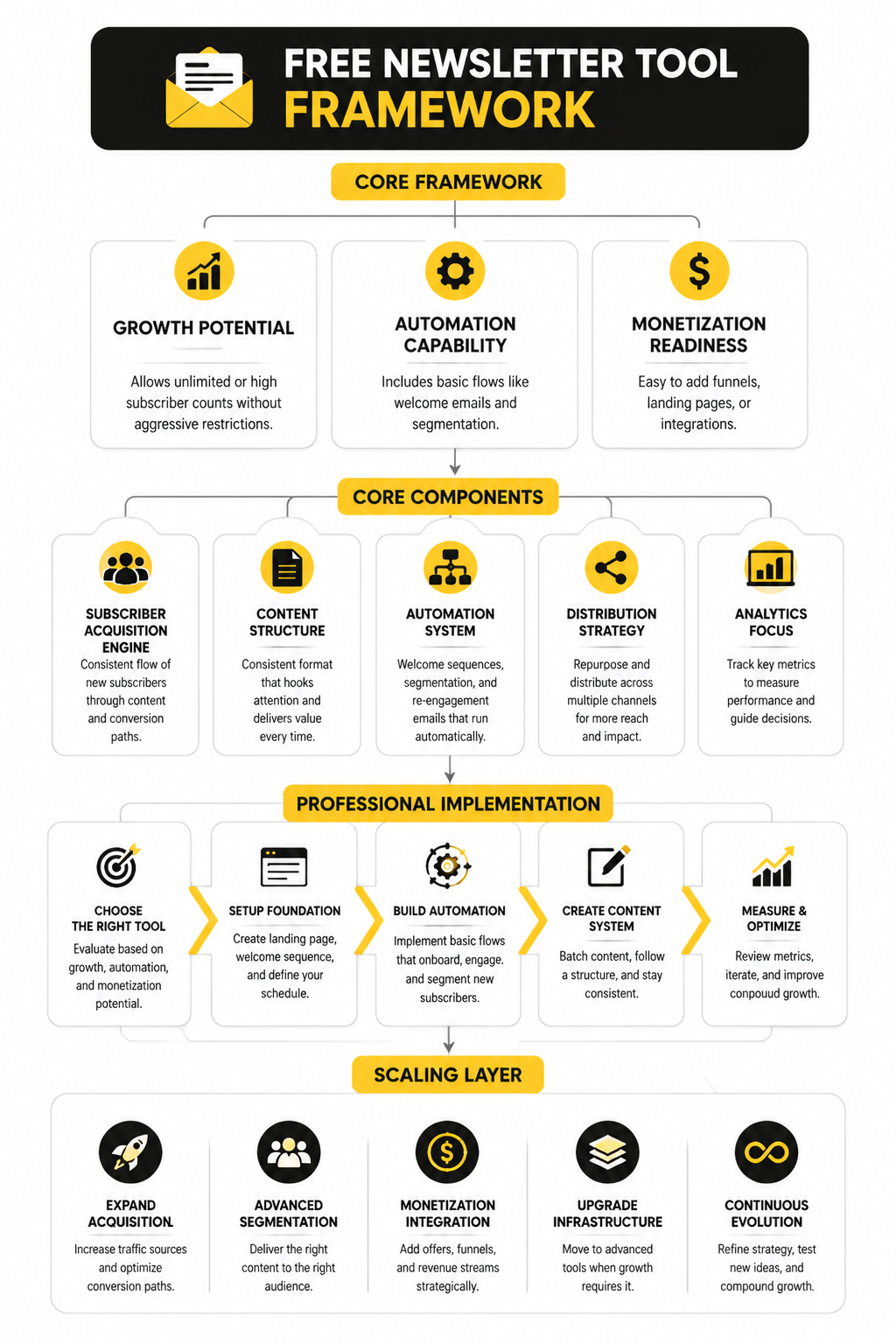
The framework is simple: evaluate tools based on growth potential, automation capability, and monetization readiness.
First, growth potential matters more than features. A tool that allows unlimited or high subscriber counts without aggressive restrictions will give you room to scale. Platforms like Brevo are often used because they balance free access with scalability.
Second, automation is where real leverage comes from. Even on a free plan, you want basic flows like welcome emails and segmentation. Without automation, you’re stuck sending manual broadcasts, which doesn’t scale.
Third, monetization readiness is often overlooked. Some tools make it easy to add funnels, landing pages, or integrations. For example, platforms like Systeme.io combine newsletters with funnels, allowing you to turn subscribers into customers without switching platforms.
This framework ensures you don’t just pick a free newsletter tool—you pick one that won’t limit your growth.
What Most People Get Wrong Early
Most beginners choose tools based on convenience instead of long-term fit. They pick the easiest interface, not realizing they’re locking themselves into limitations.
The real mistake isn’t the tool—it’s ignoring strategy. A free newsletter tool is just infrastructure. Without a clear system for content, audience targeting, and engagement, even the best platform won’t produce results.
Another common issue is underestimating consistency. Data shows that engagement spikes happen early, with over 21% of opens occurring within the first hour of sending (timing insights) . That means timing, frequency, and expectations matter more than flashy design.
Getting this right early changes everything. Instead of constantly switching tools, you build a system that compounds over time.
Core Components of a High-Performing Newsletter System
Once the tool is chosen, the real leverage comes from how you structure your newsletter system. A free newsletter tool on its own does nothing unless it’s built around the right components. This is where most people either create momentum—or stall completely.
A high-performing setup isn’t complicated, but it is intentional. Every part has a job: capture attention, build trust, and drive action. If one piece is missing, the entire system weakens over time.
Subscriber Acquisition Engine
Everything starts with how you get people onto your list. Without a steady flow of new subscribers, even the best newsletter will plateau quickly.
The strongest approach is to combine content-driven discovery with clear conversion paths. That means you’re not just posting content—you’re directing attention toward your newsletter consistently. Social platforms, SEO, and short-form content all work here, but only if there’s a clear next step.
Landing pages are critical. Tools like Systeme.io or funnel builders like ClickFunnels make this easier by letting you create simple, focused pages designed for one outcome: subscription.
A few principles make a measurable difference:
- One clear value proposition per page
- Minimal distractions or links
- Fast loading and mobile optimization
- Strong call-to-action placement
When these are aligned, conversion rates improve significantly without increasing traffic.
Content Structure That Keeps People Opening
Getting subscribers is one thing. Keeping them engaged is where most newsletters fail.
The key is consistency—not just in frequency, but in format. Readers should know what to expect every time they open your email. That expectation builds habit, and habit drives long-term engagement.
A simple structure works best:
- A strong opening that hooks attention
- One core idea or insight
- Supporting points or breakdown
- A clear takeaway or action
This avoids overwhelming readers. Instead of trying to say everything, each email delivers something specific and valuable.
Engagement data reinforces this approach. Emails with focused content and clear structure tend to outperform longer, unfocused ones in both clicks and retention. It’s not about writing more—it’s about writing better.
Automation That Builds Momentum
This is where a free newsletter tool starts to feel powerful. Automation turns your newsletter from a manual task into a system that runs continuously in the background.
At minimum, you need:
- A welcome sequence
- Basic segmentation
- Re-engagement emails
The welcome sequence is the most important. It sets expectations, introduces your voice, and builds early trust. Without it, new subscribers feel disconnected, which increases unsubscribe rates.
Platforms like Brevo or Moosend offer entry-level automation even on free plans, which is enough to build a solid foundation.
Once automation is in place, every new subscriber enters a system that educates, engages, and warms them up—without extra effort from you.
Distribution Beyond the Inbox
Relying only on email delivery is a mistake. The best newsletter systems extend beyond the inbox and create multiple touchpoints.
Repurposing is the easiest way to do this. One newsletter can become:
- Multiple social posts
- A short-form video script
- A blog article
- A thread or carousel
Tools like Buffer help distribute this content consistently across platforms, keeping your newsletter visible even outside email.
This approach does two things. It increases reach without creating more work, and it reinforces your message across different formats. Over time, that repetition builds authority.
Simple Analytics That Actually Matter
Most people either ignore analytics or overcomplicate them. The truth sits in the middle.
You don’t need dozens of metrics. You need a few that clearly show whether your system is working:
- Open rate trends over time
- Click-through rate on key links
- Subscriber growth rate
- Unsubscribe patterns
These numbers tell a story. If open rates drop, your subject lines or timing might be off. If clicks are low, the content or CTA likely needs improvement.
The goal isn’t perfection—it’s feedback. A free newsletter tool gives you just enough data to iterate and improve without getting overwhelmed.
At this point, you don’t just have a tool—you have a system. The next step is turning that system into something more refined, more strategic, and ultimately more profitable.
Professional Implementation Strategies
At this stage, the difference between a casual newsletter and a real growth channel comes down to execution. A free newsletter tool gives you access, but implementation determines whether it actually performs.
Most people overcomplicate this phase. They chase advanced tactics before building a stable foundation. In reality, the best-performing newsletters follow a simple, repeatable process that compounds over time.
Step-by-Step Newsletter Setup That Actually Works
The goal is to go from zero to a working system as quickly as possible. Not perfect—just functional and consistent.
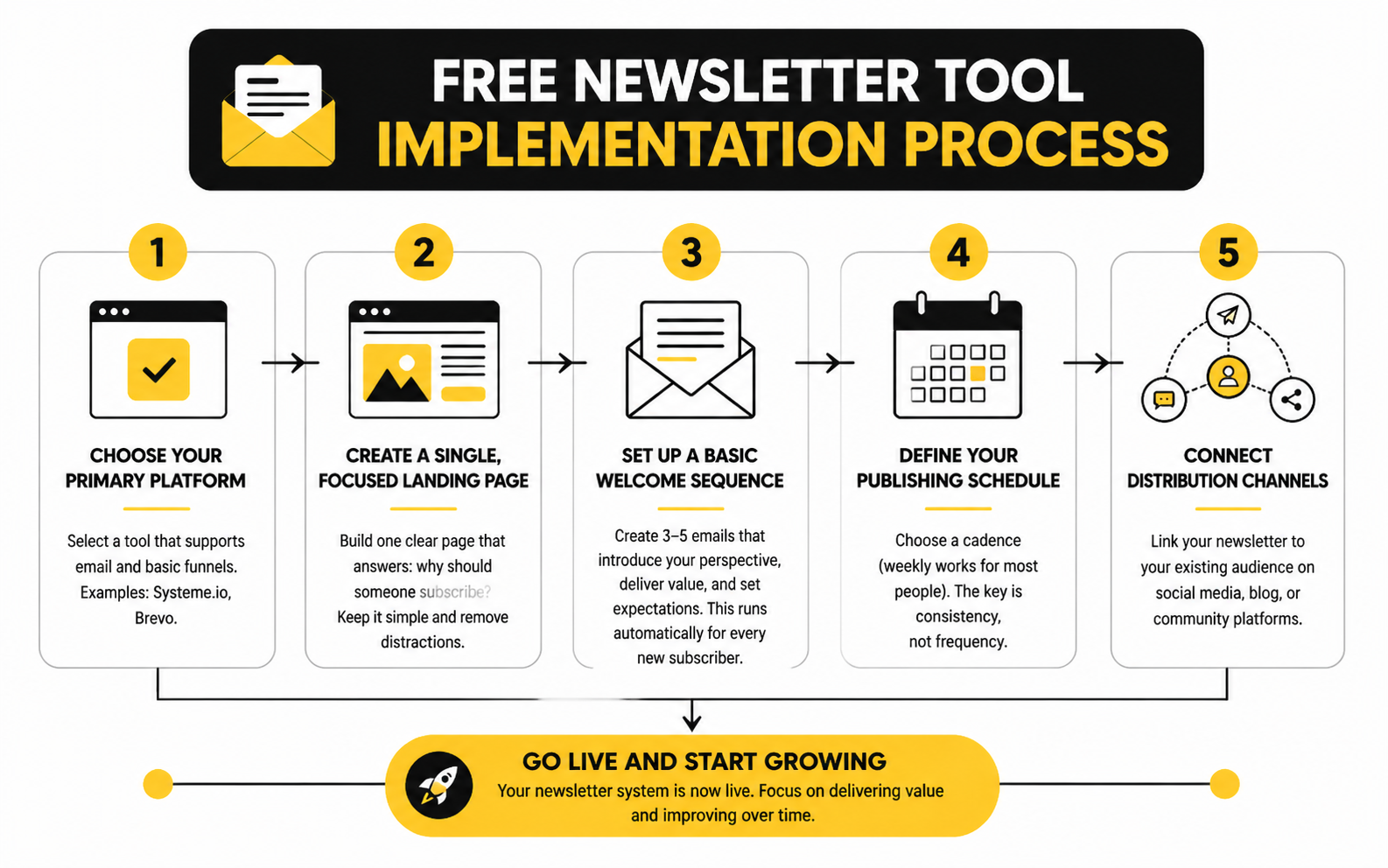
Start with the core setup:
- Choose your primary platform
Use a tool that supports both email and basic funnels. Platforms like Systeme.io or Brevo are strong starting points because they combine multiple functions in one place.
- Create a single, focused landing page
Don’t build five pages. Build one that clearly answers: why should someone subscribe? Keep it simple and remove distractions.
- Set up a basic welcome sequence
This should be 3–5 emails that introduce your perspective, deliver value, and set expectations. This sequence runs automatically for every new subscriber.
- Define your publishing schedule
Weekly works for most people. The key is consistency, not frequency.
- Connect distribution channels
Link your newsletter to wherever you already have attention—social media, blog, or community platforms.
This process is enough to get your system live. And once it’s live, you can start improving it.
Turning a Free Newsletter Tool Into a Real Asset
The biggest shift happens when you stop treating your newsletter as content—and start treating it as infrastructure.
Instead of asking “what should I write,” you start asking “what does my audience need next?” That subtle change moves your focus from output to impact.
A practical way to think about it:
- Every email builds trust
- Every link drives action
- Every subscriber is a long-term asset
This is why tools with built-in funnels matter. For example, using something like ClickFunnels alongside your newsletter lets you connect content directly to offers without friction.
Even if you’re not selling anything yet, building this structure early saves time later. You won’t need to rebuild everything when you decide to monetize.
Content Production Without Burnout
Consistency breaks when the process is too heavy. That’s why professional implementation always includes a content system—not just ideas.
The easiest approach is batching.
Instead of writing one email every week, write 2–4 at once. This creates buffer and reduces pressure. It also improves quality because you’re thinking in themes rather than isolated pieces.
Another effective approach is content recycling. One strong idea can be turned into:
- A newsletter
- A short video
- Multiple social posts
- A discussion thread
Tools like Buffer make it easier to schedule and distribute this content without manual effort every day.
The goal isn’t to create more—it’s to extract more value from what you already create.
Avoiding the Plateau Most Newsletters Hit
There’s a predictable pattern. Early growth feels fast, engagement is high, and everything seems to work. Then things slow down.
This plateau usually happens because the system stops evolving.
Common causes include:
- Repeating the same content angles
- Ignoring subscriber feedback signals
- Not refining the onboarding experience
- Failing to introduce new acquisition channels
Fixing it requires small but consistent upgrades. Improve subject lines. Test new formats. Adjust your landing page. Optimize your welcome emails.
These incremental changes compound. Over time, they separate stagnant newsletters from ones that keep growing.
Building for Scale From the Beginning
Scaling doesn’t start when you hit 10,000 subscribers. It starts when you design your system.
That means:
- Using automation instead of manual processes
- Structuring content so it can be repurposed
- Choosing tools that won’t limit growth
This is where platforms like GoHighLevel become relevant. They combine CRM, automation, and marketing tools into one system, making it easier to scale without stacking multiple platforms.
Even if you stay on a free newsletter tool for now, thinking this way changes how you build. You’re not just sending emails—you’re creating a system designed to grow, adapt, and eventually generate revenue.
Newsletter Performance Data That Actually Matters
Once your system is running, the next step is understanding whether it’s working—or just existing. A free newsletter tool gives you access to analytics, but most people either ignore the data or misread it completely.
The goal isn’t to track everything. It’s to focus on a few key signals that directly reflect growth, engagement, and long-term value. When you interpret these correctly, your newsletter stops being guesswork and becomes a system you can improve intentionally.
The Core Metrics You Should Watch
There are four metrics that matter more than anything else. Everything else is secondary.
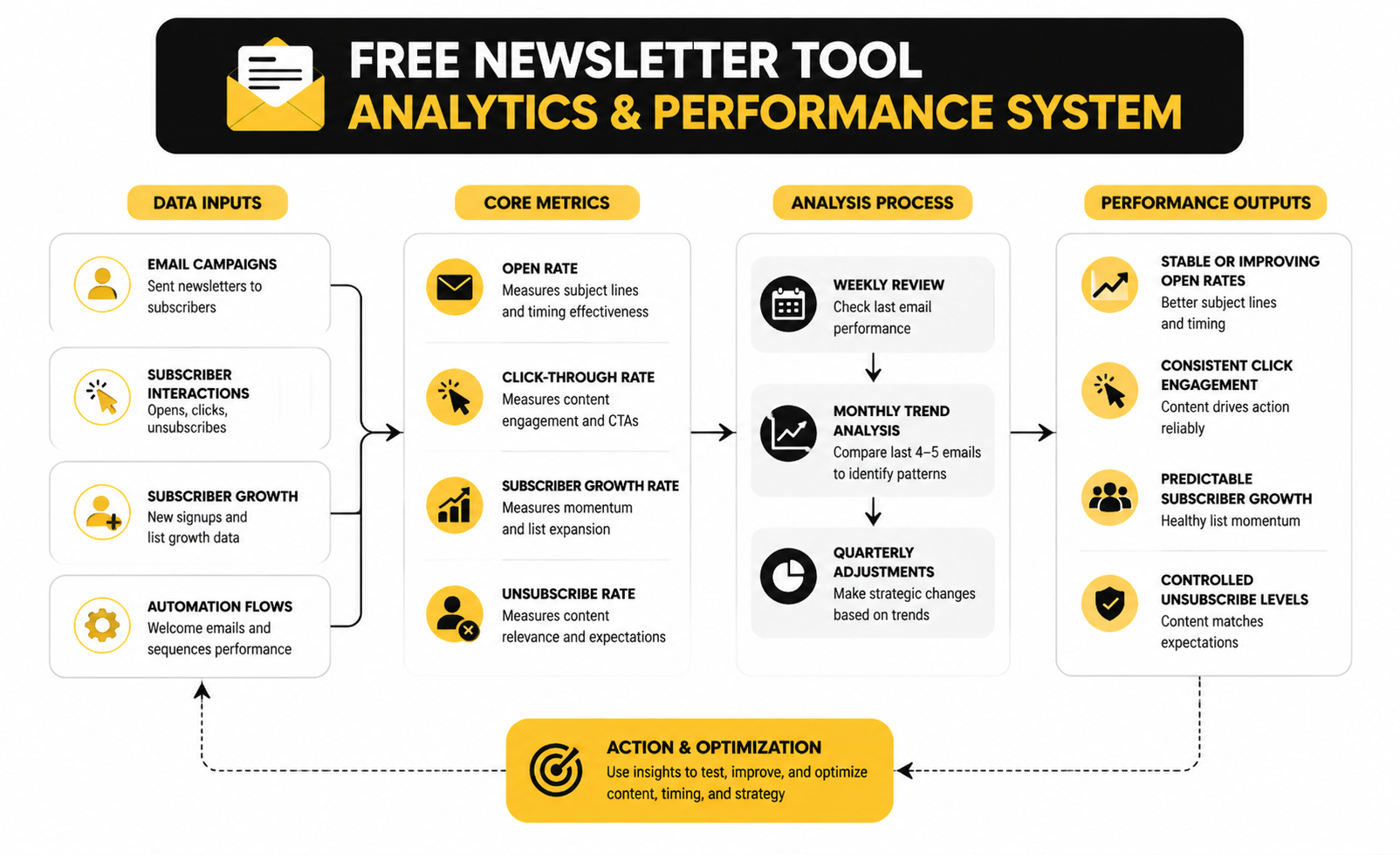
- Open rate
- Click-through rate
- Subscriber growth rate
- Unsubscribe rate
Open rate tells you if your subject lines and timing are working. Right now, many industries are seeing 35%+ average open rates across large datasets (recent benchmark breakdown).
Click-through rate shows whether your content actually drives action. Typical ranges sit between 2–5%, but what matters more is consistency. If clicks drop, it usually means your content isn’t aligned with audience expectations.
Subscriber growth rate is your momentum indicator. A healthy newsletter grows steadily, even if slowly. If growth stalls, it’s rarely a content issue—it’s almost always an acquisition problem.
Unsubscribe rate tells you when something is off. A small percentage is normal, but spikes usually signal a mismatch between what people expected and what they received.
How to Read the Numbers Correctly
This is where most people go wrong. They look at metrics in isolation instead of patterns.
A single low open rate doesn’t matter. A downward trend does.
A high unsubscribe rate on one email might be normal. A consistent increase means your positioning is off.
You want to look at data over time:
- Are open rates stable or declining?
- Are clicks improving as your content evolves?
- Is your list growing faster than it’s shrinking?
This pattern-based thinking gives you clarity. Instead of reacting emotionally to one bad email, you start making decisions based on trends.
Building a Simple Analytics System
You don’t need complex dashboards. A basic system inside your free newsletter tool is enough if you use it properly.
Here’s a practical way to structure it:
- Weekly review
Check your last email’s performance. Look at opens, clicks, and unsubscribes together.
- Monthly trend analysis
Compare the last 4–5 emails. Look for patterns, not outliers.
- Quarterly adjustments
Make bigger changes only after enough data accumulates. This avoids overreacting.
Platforms like Brevo and Moosend already provide these insights. The difference comes from how you use them.
What High Performance Actually Looks Like
It’s easy to chase numbers without understanding what “good” really means.
A strong newsletter typically shows:
- Stable or improving open rates over time
- Consistent click engagement, even if modest
- Predictable subscriber growth
- Controlled unsubscribe levels
The key word here is consistent. One viral email doesn’t matter. A system that performs reliably does.
There’s also an important nuance. Smaller newsletters often have higher engagement because the audience is tighter. As you scale, percentages may drop slightly—but total impact increases.
Understanding this prevents unnecessary panic as your list grows.
Turning Data Into Action
Metrics are only useful if they lead to decisions.
Here’s how to translate signals into action:
- Low open rates → test new subject lines or send times
- Low clicks → simplify your content and strengthen your CTA
- Slow growth → improve your landing page or acquisition channels
- High unsubscribes → realign your content with expectations
This is where your free newsletter tool becomes more than a platform. It becomes a feedback loop.
Over time, these small adjustments compound. Instead of guessing what works, you’re building a system that learns and improves with every email you send.
Advanced Strategy: Scaling Beyond the Free Newsletter Tool
At some point, your free newsletter tool stops being the main advantage—and starts becoming a constraint. That transition is where most creators either level up or get stuck.
The goal here isn’t to abandon free tools too early. It’s to recognize when your system has outgrown them and evolve intentionally. Scaling isn’t about adding complexity. It’s about removing friction while increasing output and results.
The Hidden Tradeoffs of Staying Free Too Long
Free plans are powerful in the beginning, but they come with limits that become more visible as you grow.
The most common constraints include:
- Subscriber caps or sending limits
- Limited automation workflows
- Basic segmentation only
- Restricted integrations
At a small scale, these don’t matter. But once your list grows, they start affecting performance. For example, if you can’t segment your audience properly, engagement drops because content becomes less relevant.
There’s also a deliverability factor. Larger lists require better infrastructure, and premium tools often handle this more reliably. As email volume increases globally, inbox placement becomes more competitive, not less.
The key insight is this: free tools are for building momentum, not sustaining scale.
When to Upgrade Your Newsletter Stack
Timing matters. Upgrade too early, and you waste money. Upgrade too late, and you slow down growth.
A few signals make the decision clear:
- You’re consistently hitting platform limits
- Your automation needs go beyond basic flows
- You’re actively monetizing your newsletter
- You need deeper analytics or segmentation
At this stage, platforms like GoHighLevel become relevant because they unify CRM, automation, and communication into one system. Instead of stacking tools, you simplify your workflow.
The upgrade isn’t about features—it’s about efficiency. You’re buying back time and improving performance.
Monetization Without Breaking Trust
One of the biggest mistakes at this level is rushing monetization. Just because you can make money doesn’t mean you should do it immediately.
A newsletter becomes valuable because of trust. If monetization feels forced, that trust disappears quickly.
The better approach is alignment:
- Promote tools or products you actually use
- Integrate recommendations naturally into content
- Prioritize value before conversion
For example, if you’re already using a platform like Systeme.io to build funnels, mentioning it in context makes sense. It doesn’t feel like an ad—it feels like part of the system.
This approach compounds over time. Instead of chasing short-term revenue, you build a newsletter that people trust enough to act on.
Audience Segmentation at Scale
As your list grows, treating everyone the same becomes a problem. What worked at 500 subscribers won’t work at 10,000.
Segmentation solves this.
Instead of sending one generic email, you tailor content based on behavior:
- New subscribers vs long-term readers
- High engagement vs low engagement
- Different interests or content preferences
Even basic segmentation improves results significantly. It increases open rates, boosts clicks, and reduces unsubscribes.
Most free newsletter tools offer limited segmentation, which is fine early on. But as complexity grows, upgrading becomes necessary to maintain performance.
The Real Risk: Stagnation
The biggest risk isn’t choosing the wrong tool. It’s stopping evolution.
A newsletter that doesn’t adapt will eventually decline. Audience expectations change, content trends shift, and competition increases.
Avoiding stagnation requires continuous iteration:
- Test new content formats
- Refine your positioning
- Improve onboarding flows
- Expand acquisition channels
This doesn’t mean constant reinvention. It means steady, intentional upgrades.
Building a Long-Term Asset, Not Just a Channel
At the highest level, your newsletter isn’t just a marketing tool. It’s an asset.
It’s a direct line to your audience. It’s a platform you control. And it’s something that can generate consistent revenue over time.
This is why the foundation matters so much. Starting with a free newsletter tool is smart—but thinking long-term is what turns it into something valuable.
By the time you reach this stage, the question isn’t “which tool should I use?” It’s “how do I make this system stronger, more scalable, and more profitable?”
Building a Complete Newsletter Ecosystem
By now, the free newsletter tool is no longer just a starting point—it’s part of a larger system. The highest-performing newsletters don’t operate in isolation. They connect content, automation, distribution, and monetization into one cohesive ecosystem.
This is where everything compounds. Instead of thinking in individual emails, you start thinking in flows, assets, and long-term audience value. Every subscriber enters a system that educates, engages, and eventually converts.
A mature ecosystem typically includes:
- A primary newsletter platform
- A landing page or funnel system
- Content distribution channels
- Automation sequences
- Monetization pathways
When these elements work together, growth becomes predictable. You’re no longer guessing what will happen next—you’re guiding it.
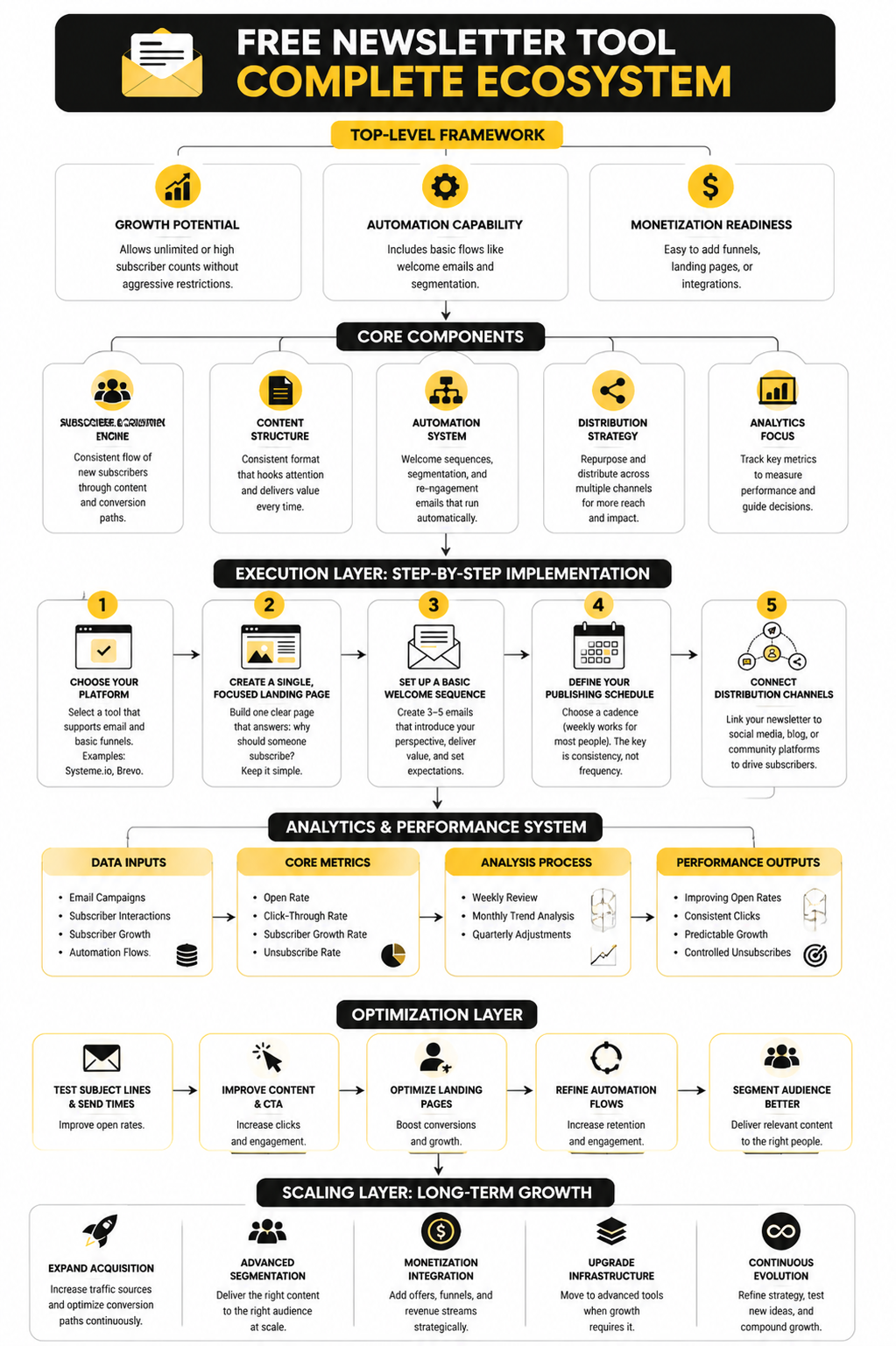
The real advantage here is leverage. One idea can move through the entire system: captured on a landing page, delivered via email, distributed across platforms, and connected to an offer. That’s how a simple free newsletter tool evolves into a scalable asset.
FAQ - Built for Complete Guide
What is the best free newsletter tool to start with?
The best tool depends on your goals, but platforms like Brevo and Systeme.io are strong starting points because they combine email sending with automation and landing pages. This reduces the need for multiple tools early on.
Can you really grow a newsletter using only free tools?
Yes, especially in the early stages. Many newsletters reach thousands of subscribers before upgrading. The key is focusing on content, distribution, and consistency rather than features.
How many subscribers can I have on a free plan?
This varies by platform. Some tools limit total subscribers, while others limit monthly email sends. Always check these limits before committing, because switching platforms later can be time-consuming.
How often should I send a newsletter?
Weekly is a strong baseline. It balances consistency with sustainability. More frequent sending can work, but only if you can maintain quality over time.
What is a good open rate for a newsletter?
Open rates vary by niche, but many newsletters perform well in the 30–40% range. The more important factor is whether your open rate stays consistent or improves over time.
How do I get my first subscribers?
Start with your existing audience, even if it’s small. Then expand through content, social media, and simple landing pages. Tools like ClickFunnels can help create focused pages that convert visitors into subscribers.
Do I need automation from the beginning?
You don’t need complex automation, but a basic welcome sequence is essential. It helps onboard new subscribers and sets expectations immediately.
When should I switch from a free newsletter tool to a paid plan?
Upgrade when your growth or monetization is limited by your current tool. This usually happens when you need better automation, segmentation, or higher sending limits.
How do I make money from a newsletter?
Monetization can come from promoting tools, selling products, or offering services. The most effective approach is integrating offers naturally into your content rather than forcing them.
What’s the biggest mistake beginners make?
Focusing too much on tools and not enough on strategy. A free newsletter tool is just a platform—the real results come from consistent execution and audience understanding.
Can a newsletter replace social media?
Not entirely, but it can become your most reliable channel. Social media drives discovery, while your newsletter builds long-term relationships and trust.
Work With Professionals
Explore 10K+ Remote Marketing Contracts on MarkeWork.com
Most marketers spend too much time chasing clients, competing on crowded platforms, and losing a percentage of every project to middlemen.
MarkeWork gives you a better way. Browse thousands of remote marketing contracts and connect directly with companies desperate to hire skilled marketers like you, without platform commissions and without unnecessary gatekeepers.
If you're serious about finding better opportunities and keeping 100% of what you earn, explore available contracts and create a profile for free at MarkeWork.com.