

Free online advertising sounds almost too good to be true, especially when paid media keeps getting more expensive and more crowded. But the phrase is usually misunderstood. In practice, it does not mean unlimited reach with zero effort. It means building visibility through platforms that already have audience demand built in, such as Google Search, Google Maps, review sites, social platforms, and community networks, then using those surfaces consistently enough that people can actually find and trust you. Google’s own Business Profile documentation makes that point indirectly by tying visibility to profile completeness and relevance, while major platforms like LinkedIn, Instagram, Facebook, YouTube, Yelp, and Nextdoor all offer free business presences designed to help people discover brands before a company spends a dollar on ads.
That matters more now because the broader advertising market keeps expanding, which pushes more businesses into the same digital spaces. Global ad spend reached nearly $1.1 trillion in 2024, and digital continues to account for most of the growth, while U.S. digital video ad spend alone hit $64 billion in 2024 and is projected to rise again in 2025. When the market gets this competitive, free online advertising stops being a side tactic and becomes the foundation that makes every other marketing channel work better.
- What Free Online Advertising Really Means
- Why Free Online Advertising Matters
- The Free Visibility Framework
- The Core Channels That Drive Free Reach
- How to Turn Free Attention Into Leads and Sales
- Common Mistakes, Smart Tools, and FAQ
What Free Online Advertising Really Means
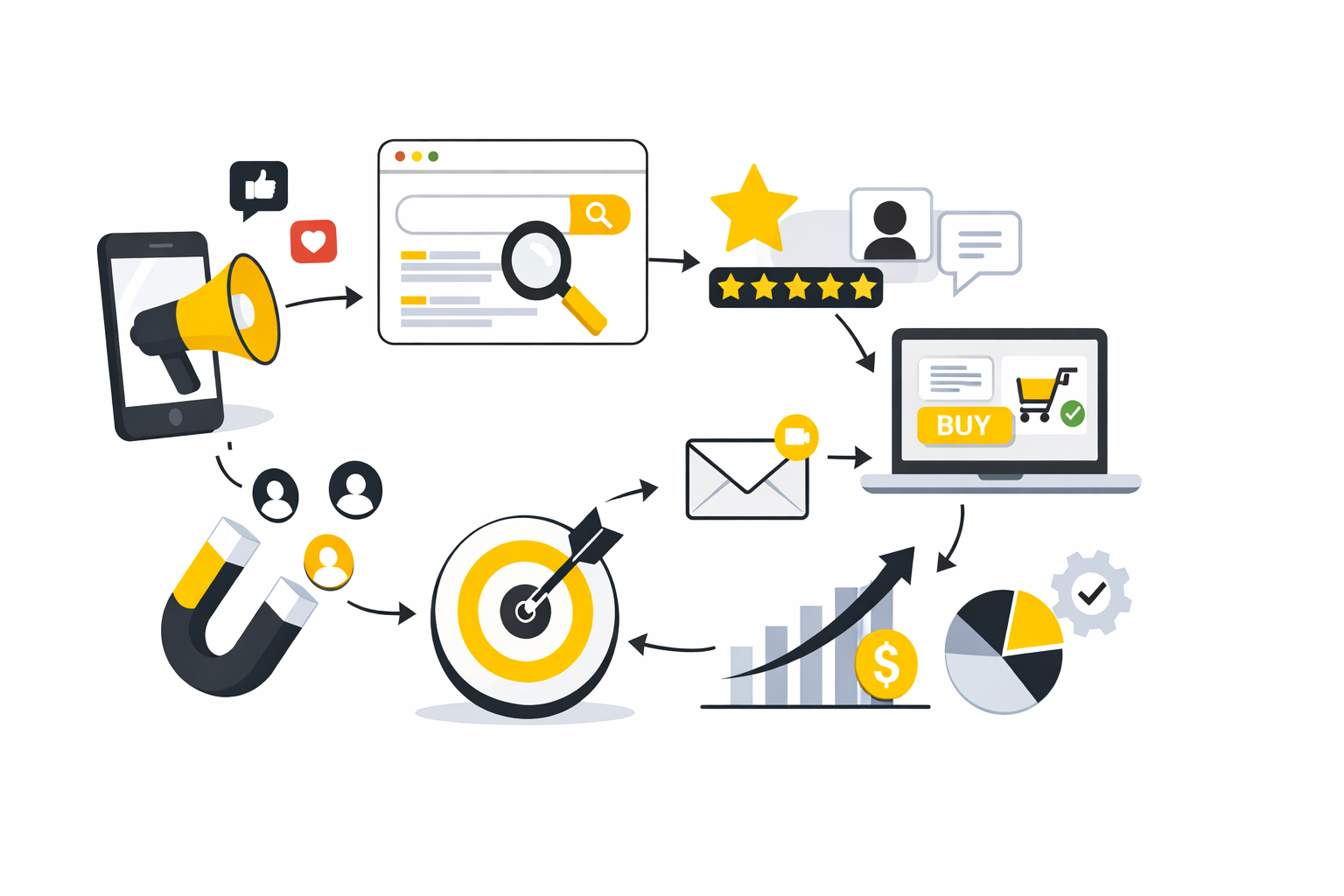
Free online advertising is best understood as borrowed distribution plus owned conversion. Borrowed distribution comes from platforms that already have traffic, like Google Maps, LinkedIn, Instagram, YouTube, Yelp, and Nextdoor. Owned conversion is what happens after someone finds you, such as clicking to your site, messaging your business, calling directly, or joining your email list. That is why a free listing or profile is not just a profile. It is an entry point into your whole funnel.
A lot of businesses fail here because they treat free visibility like a one-time setup task. They claim a profile, fill in half the fields, post inconsistently, and then decide the channel does not work. The platforms themselves signal the opposite. Google explicitly says complete and accurate Business Profile information helps a business show up in local results, and it provides performance reporting for views, clicks, calls, bookings, and direction requests so owners can measure whether the profile is actually generating demand.
The real opportunity is simple. Instead of asking, “Where can I advertise for free?” the better question is, “Where are people already searching, scrolling, comparing, and validating businesses like mine?” Once you frame it that way, free online advertising becomes a system for meeting intent, not a hack for beating the market. Pew’s recent social platform data and HubSpot’s consumer trend reporting both reinforce that discovery increasingly happens across search and social, not in just one place.
Why Free Online Advertising Matters
The first reason is cost pressure. As more brands compete for attention, paid advertising becomes harder to scale profitably, especially for smaller companies that cannot absorb high customer acquisition costs. That is exactly why owned visibility on free surfaces matters so much. A strong profile, channel, or page lowers the risk that every new customer has to be purchased through paid media. Broader market data from WPP Media, DataReportal, and IAB all point in the same direction: more money is flowing into digital promotion, not less.
The second reason is buyer behavior. People do not move from ignorance to purchase in one neat line anymore. They search Google, compare reviews, check your Instagram, glance at your LinkedIn page, maybe watch a YouTube video, and then decide whether you feel legitimate. BrightLocal’s latest review research shows reviews still shape decisions strongly, even if consumers are now more skeptical and read them more critically, while Google’s own documentation shows businesses can track the interactions that happen directly from Search and Maps.
The third reason is trust. A business that appears consistently across search, maps, social, reviews, and local community platforms looks more established than one with a thin or outdated footprint. That is one reason platforms keep investing in free business surfaces: LinkedIn Pages are positioned as a way for members to find a business, Instagram professional accounts unlock business tools and insights, and Nextdoor promotes free Business Pages as a local discovery and recommendation engine. Free online advertising works when it compounds credibility, not when it chases vanity reach.
The Free Visibility Framework
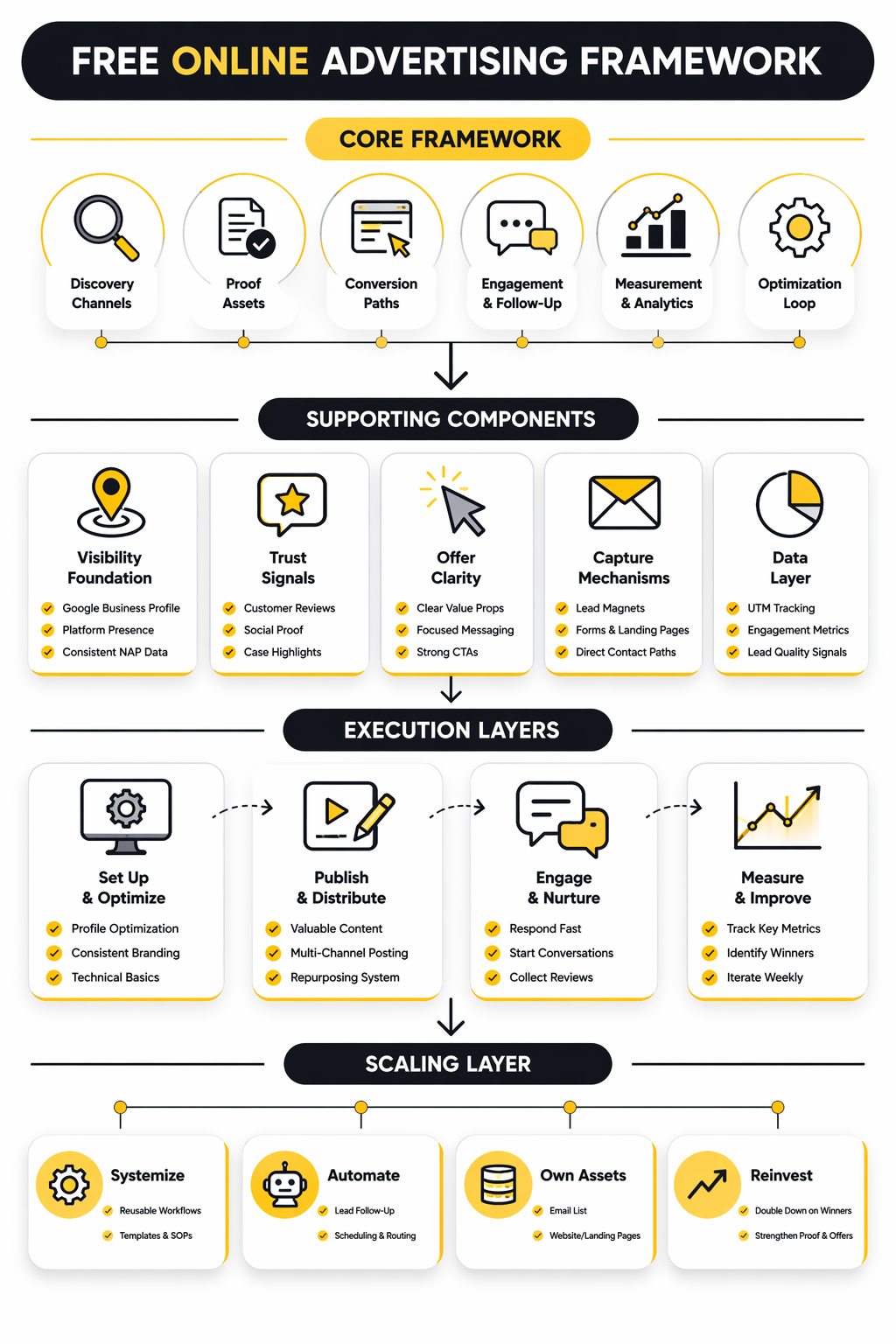
The framework for free online advertising is straightforward: be discoverable, be credible, be active, and be convertible. Discoverable means your business can be found in the places where buyers already look. Credible means your information is complete, current, and backed by real reviews, examples, or expertise. Active means the profile does not look abandoned. Convertible means a visitor knows exactly what to do next, whether that is call, message, book, subscribe, or buy. Google Business Profile, LinkedIn Pages, and Instagram professional accounts all support these layers in different ways.
This is the key shift most people miss. Free online advertising is not one channel. It is a stack. Search captures intent, review platforms reduce doubt, social platforms create familiarity, and direct-response assets such as landing pages or email capture convert that attention into something you own. The strongest businesses do not pick one. They connect the stack so each channel strengthens the next.
Part of the reason this framework works is that consumer discovery is fragmented now. Social media remains a major habit across age groups, and HubSpot’s 2025 consumer trend reporting says social media is the top product discovery channel for Gen Z, Millennials, and Gen X. So if your brand is only trying to rank in search, you are missing discovery. If it is only posting on social, you are missing high-intent search behavior. Free online advertising works best when both are connected on purpose.
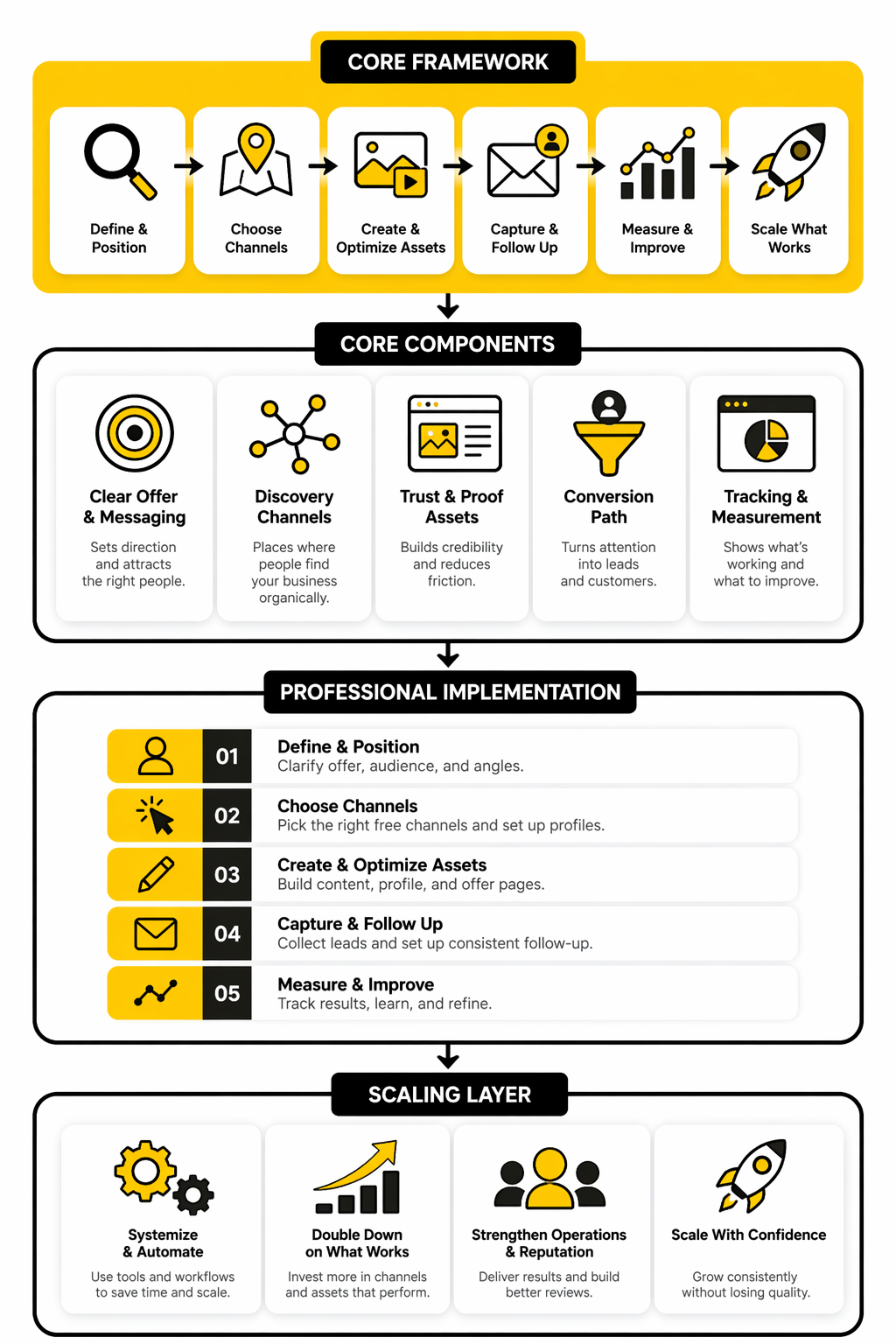
In the next part, the article moves into the channels that actually drive free reach, starting with the platforms that create the fastest visibility for most businesses: Google Business Profile, review sites, social profiles, community platforms, and content channels that keep working after you publish them.
The Core Channels That Drive Free Reach
The best free online advertising channels are the ones that already sit in front of intent. That is the main filter. You do not want random exposure if the people seeing you have no reason to care. You want to show up where buyers are already searching, comparing, validating, and deciding.
That changes how you evaluate platforms. A channel is not valuable because it is popular in the abstract. It is valuable because it helps the right person find you at the right moment, then gives them enough information to take the next step. That is why the strongest mix usually includes local search, review platforms, social proof surfaces, and content platforms that keep bringing people back long after you publish.
Google Business Profile and Local Search Surfaces
For most local businesses, this is the first place to start. A Google Business Profile is not just a directory entry. It is a live business asset that can drive calls, clicks, direction requests, bookings, and direct discovery from Search and Maps when it is complete and current. Google states plainly that businesses with complete and accurate information are more likely to show up in local results, which is about as close as you will get to free online advertising with built-in purchase intent. Google’s own guidance is very clear on that.
This channel matters because local intent is brutally practical. Someone searching for a plumber, dentist, roofer, salon, accountant, or coffee shop is not browsing for entertainment. They are trying to solve a problem now or very soon. If your profile is strong, you get visibility before a user even reaches your website, which makes this one of the rare places where free online advertising can directly compress the path from search to action.
The businesses that win here usually do a few simple things well. They choose the right primary category, keep hours accurate, upload fresh photos, collect real reviews, answer questions, and make the profile feel alive rather than abandoned. That sounds basic, but it is exactly the kind of execution gap that creates opportunity.
Review Platforms That Reduce Buyer Friction
Review platforms work because they answer the question buyers ask right after discovery: “Can I trust this business?” That is why sites like Yelp still matter, especially in categories where people compare options quickly and use third-party reviews as a reality check. Yelp’s own business materials emphasize that a business page is free to create and manage, which makes it one of the simplest forms of free online advertising available to small businesses that depend on local trust. Yelp’s business page documentation makes that point directly, and Yelp for Business repeats that it is free to be on the platform.
What matters here is not just getting reviews. It is having a review profile that looks believable, recent, and specific. Recent consumer research from BrightLocal’s 2025 review survey shows people still rely heavily on reviews, but they are more skeptical than they used to be. That means generic praise does less for you now, while detailed, credible feedback does more.
This is where a lot of businesses get lazy. They ask for reviews only when they remember, ignore negative feedback, and leave old complaints hanging in public. A better approach is to make review generation part of the operating system. If you already use a CRM and automation stack, tools like GoHighLevel can help you build simple follow-up flows that request reviews after real customer interactions, which turns review growth into a repeatable process instead of a random event.
Social Profiles That Build Familiarity Before the Sale
Social platforms are not just for entertainment brands anymore. They are credibility layers. People may discover you in Google, but then they often check Instagram, LinkedIn, Facebook, or YouTube to see whether you look legitimate, active, and worth trusting with their money. That is why free online advertising often works best when search and social support each other instead of competing for attention.
LinkedIn is especially strong for B2B, professional services, recruiting-heavy businesses, and companies that sell based on expertise. LinkedIn says a Page is how members find your business on the platform, and it is free to create, which makes it one of the most underused credibility assets in business marketing. LinkedIn’s Pages documentation positions the Page as a discovery and trust surface, not just a company bio.
Instagram works differently, but the principle is the same. A professional account gives businesses access to features for growth, insights, and promotion, and Meta’s own help documentation frames it as a way to help businesses grow and understand performance. Instagram’s professional account help page and its business resources both reinforce that businesses use the platform not just to post, but to get found and build a relationship with potential customers before a direct sale.
The mistake here is treating every platform the same. LinkedIn wants proof of expertise and consistency. Instagram wants visual relevance, clarity, and momentum. If you post the same thing everywhere with no respect for context, the result usually feels flat. If you match the platform to the buyer’s expectations, free online advertising starts to feel less like hustling for attention and more like showing up where you belong.
Community Platforms and Neighborhood Discovery
Some of the best free online advertising opportunities are still hiding in plain sight. Community platforms work because they sit closer to word-of-mouth than broad social media does. People are not just consuming content there. They are looking for recommendations, local updates, and businesses that feel nearby and trustworthy.
That is why Nextdoor deserves more attention than it usually gets. The platform’s business materials highlight that businesses can claim a free page, publish unlimited free posts, and collect recommendations from local neighbors. Nextdoor’s business page overview makes the use case obvious: visibility, recommendations, and local reach without needing to buy attention first.
This matters most for service businesses, home services, health providers, local retail, family-focused brands, and anyone whose reputation spreads through neighborhood trust. On these platforms, polished branding matters less than responsiveness, clarity, and being visibly part of the local area. That is good news, because it means smaller operators can compete without a giant budget.
Content Platforms That Compound Over Time
Some channels give you a short burst of visibility. Others keep working. That is the difference between social posting that fades in a day and content platforms that continue getting discovered through search, recommendation systems, and repeated sharing. YouTube is the clearest example. The platform explains that its search and discovery systems are built to match videos with viewers based on watch behavior, satisfaction signals, and audience interest, which means one useful video can keep generating awareness long after it goes live. YouTube’s creator resources spell that out in unusually direct language.
This is why content is such an important part of free online advertising. A strong video, tutorial, comparison, walkthrough, or customer education piece does more than “create content.” It answers real questions buyers already have. That makes it discoverable. Then it keeps reinforcing your credibility every time someone lands on it weeks or months later.
The same logic applies to written content, though not every business needs a giant blog. You need useful assets that map to real demand. A contractor might publish project walkthroughs. A software company might post short demos and integrations. A consultant might break down common mistakes buyers make before hiring. Free online advertising gets much stronger when content is designed for recurring discovery instead of one-day engagement.
Direct Audience Channels You Control
There is one uncomfortable truth in all of this. Borrowed reach is great, but it is still borrowed. Algorithms change, platform features disappear, and visibility can drop without warning. That is why smart businesses use free online advertising to build direct audience access they control, especially email lists, text lists, and messaging subscribers.
This is where light infrastructure starts to matter. A simple opt-in, a useful lead magnet, or a strong follow-up sequence can turn casual visibility into a long-term audience asset. Email platforms like Brevo, Moosend, and Systeme.io make that easier to set up without forcing you into an expensive stack from day one.
Messaging can be even more direct when it fits the business model. For brands that get strong engagement through DMs or social-first customer journeys, ManyChat is the kind of tool that can help turn incoming attention into automated conversations, lead capture, and follow-up. The important point is not the tool itself. It is the strategy behind it. Free online advertising becomes dramatically more valuable once the people you attract are not lost after the first interaction.
Why the Best Channel Mix Depends on Buyer Intent
There is no universal channel stack that works for every business. A local med spa and a B2B software firm should not use the same playbook. A solo consultant and a multi-location home services company should not either. The right free online advertising mix depends on how people buy, how urgently they buy, and what kind of proof they need before making a move.
If the purchase is urgent and local, local search and review profiles usually matter most. If the purchase is considered and reputation-driven, LinkedIn, YouTube, and case-study content often matter more. If the business depends on repeat attention, then email capture and owned audiences become more important than chasing endless platform reach.
That is the real takeaway from this section. You do not need to be everywhere. You need to be visible in the places that match buyer intent, then consistent enough that people keep seeing proof you are the right choice. In the next section, that visibility gets translated into something more valuable: leads, conversations, and actual revenue instead of just impressions.
How to Turn Free Attention Into Leads and Sales
Getting visibility is only half the job. The hard part is turning that visibility into something you actually own, whether that is a lead, a booked call, a form submission, a direct message, or a sale. Free online advertising starts paying off when every discovery surface points somewhere intentional instead of dumping people into a messy website or a dead-end profile.
This is where a lot of businesses sabotage themselves. They work hard to get discovered on Google, Instagram, LinkedIn, YouTube, or review platforms, then give people no clear next step. Google’s Business Profile performance tools are useful here because they track actions like website clicks and other customer interactions, which forces you to think beyond views and into outcomes. Google’s performance guidance is helpful precisely because it pushes attention back to what people do after they find you.
The practical move is simple. Every profile, post, video, and listing should answer one question fast: what should this person do next? Once that is clear, free online advertising stops being a vanity exercise and starts becoming a real acquisition system.
Start With One Conversion Goal Per Channel
Not every platform should ask for the same action. A local service business might want calls from Google Business Profile, while a consultant might want booked meetings from LinkedIn, and a creator-led brand might want email signups from YouTube or Instagram. The mistake is trying to force every channel to do everything.
A cleaner approach is to assign one primary conversion goal to each major surface. On Google Business Profile, that might be calls, direction requests, or website visits. On Instagram, it might be DMs or bookings, especially since professional accounts can display contact options and action buttons for business actions. Instagram’s professional account help and its action button documentation both show how the platform supports those next steps.
This matters because clarity reduces friction. When people do not have to guess what to do next, they act more often. Free online advertising works best when the user journey feels obvious, not clever.
Build a Simple Path From Discovery to Capture
Most businesses do not need a giant funnel to make this work. They need a clean path. That usually looks like this: a person discovers you, checks a proof point, lands on a focused page, and takes a single action. If you skip the middle steps, the journey feels weak. If you overload the final step, people stall.
That focused page matters more than people think. Sending traffic to a homepage usually wastes intent because homepages are written for everyone and no one at the same time. A dedicated page tied to one offer, one audience, and one CTA gives free online advertising somewhere useful to go. If you want to build those pages quickly, platforms like Replo, ClickFunnels, and Systeme.io exist for exactly this reason.
The goal is not to make the page flashy. The goal is to make it obvious. People should understand the offer, the benefit, and the next step in a few seconds. That sounds basic, but it is one of the biggest differences between attention that disappears and attention that turns into pipeline.
Use Proof Before You Ask for Action
People rarely convert the first time they see you unless the need is urgent. Most of the time, they need a reason to trust you first. That proof can come from reviews, photos, examples of work, short testimonials, platform activity, or clear expertise. The important part is sequence. Proof should appear before the ask, not after it.
This is one reason YouTube and other content channels can be so effective for free online advertising. YouTube’s creator resources and analytics documentation make it clear that creators can study reach, traffic sources, and audience behavior over time, which helps them keep refining what draws people in and what keeps them watching. YouTube Studio analytics documentation and its reach reporting help are useful because they show the platform is built for iterative improvement, not one-off posting.
In plain English, that means you can use content to do the trust-building before asking for the conversion. A short demo, walkthrough, comparison, or educational post can handle the credibility work that a landing page alone often cannot. Then your CTA feels earned instead of premature.
The Practical Execution Process
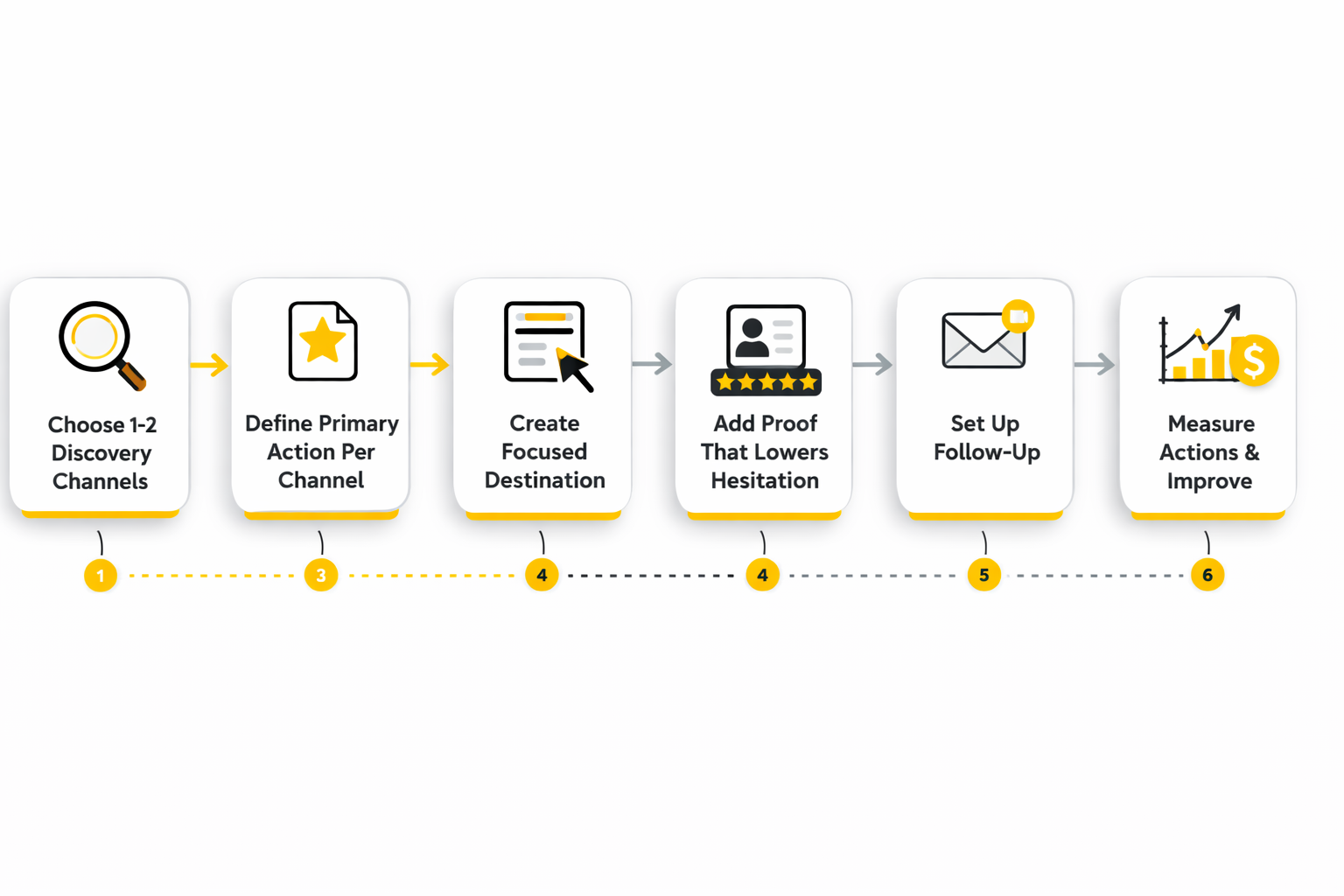
If you want free online advertising to become a repeatable system, the process should stay brutally simple. Complexity kills consistency, and consistency is what makes free channels compound.
- Choose the one or two discovery channels that match buyer intent best.
- Define one primary action you want from each channel.
- Create a focused destination for that action.
- Add visible proof that lowers hesitation.
- Set up follow-up so new attention is not wasted.
- Measure actions, not just views, and improve the weakest step.
That is the entire machine. The first step is selection. If you are a local service brand, local search, reviews, and neighborhood platforms probably matter most. If you are B2B, LinkedIn, a clear site, and authority content may matter more. If you try to scale every free channel at once, the system breaks before it starts.
The second step is conversion design. Your Google listing should push toward calls, visits, or site clicks. Your Instagram profile should make messaging, booking, or store visits obvious through contact details and action buttons. Your content should direct people toward one focused next move, not five different options competing with each other.
The third step is follow-up. This is where free online advertising often leaks value. Someone clicks, messages, or signs up, and then nothing happens quickly enough. If you want to tighten that up, tools like ManyChat, Brevo, and GoHighLevel help because they let you automate replies, lead capture, reminders, and basic nurture without needing an enterprise setup.
Make Contact Options Frictionless
A surprising amount of marketing still fails at the contact step. Businesses bury phone numbers, hide booking links, ignore DMs, or send people through forms that ask for too much too early. That is a great way to waste free online advertising, because the person already showed intent and then got punished for it.
The better move is to make contact easy in the format the platform already supports. Instagram professional accounts can display business contact information and professional inbox features, which is valuable because some users would rather message than call or fill out a form. Instagram’s contact button documentation and its professional inbox help both point in that direction.
The same principle applies to scheduling. If the natural next step is a call or demo, let people book it without email ping-pong. A scheduling tool like Cal.com can clean that up fast. Friction is not just annoying. It is expensive.
Capture Data Early, Then Nurture Intelligently
Not everyone will buy on the first visit, and that is fine. The point of free online advertising is not always immediate conversion. Often it is first contact. Once you accept that, the job becomes capturing enough information to continue the conversation in a way that still feels useful.
This is where lightweight forms and simple qualification logic help. If you need better intake without adding technical overhead, tools like Fillout make it easier to collect cleaner lead data, and CRMs like Copper can help organize what happens after that. The key is not to overbuild the system on day one. It is to make sure leads do not vanish into a spreadsheet graveyard.
Nurture matters because attention is uneven. Some people are ready today, some next month, and some only after they have seen you in a few different places. Email, messaging, and retargetable audience data give you more chances to win later without having to start the discovery process from zero every time.
Measure the Step That Breaks First
Most people measure free online advertising badly. They obsess over follower counts, impressions, and profile views because those are easy to see. But those numbers are only useful if they help you diagnose movement toward action. Otherwise, they are just a nicer form of distraction.
A better way to think about it is this. If you are getting visibility but no clicks, the offer or profile positioning may be weak. If you are getting clicks but no leads, the landing page or CTA is weak. If you are getting leads but no customers, the follow-up or sales process is weak. This is exactly why platform-level reporting matters. Google tracks customer interactions on Business Profiles, and YouTube Analytics helps creators understand how people find and engage with content. Google Business Profile performance docs and YouTube Analytics help are useful because they keep you focused on behavior, not ego.
That is the practical mindset shift. Do not ask whether free online advertising is “working” in the abstract. Ask which step is leaking the most value right now. Then fix that step first.
Why Process Beats Hustle
A lot of people try to brute-force free online advertising with constant posting and random experiments. That approach feels productive, but it usually burns out fast because it has no system behind it. You end up busy, visible in flashes, and still disappointed by results.
Process beats hustle because it compounds. When your profiles are optimized, your proof is visible, your CTA is clear, your landing path is focused, and your follow-up is automated, every new piece of attention has a better chance of becoming something real. Then free online advertising stops depending on daily motivation and starts functioning like a repeatable growth engine.
The next part is where the article shifts from execution into the traps that quietly destroy results, plus the tools and operating habits that make the whole system easier to run without turning it into a full-time job.
What the Data Actually Tells You
Measurement is where free online advertising either becomes a business asset or stays a hobby. Plenty of channels can give you visibility, but visibility alone is not a win. What matters is whether that attention turns into actions that move someone closer to revenue, such as clicks, calls, messages, bookings, replies, and purchases.
That is why random stats are not enough. Useful numbers only matter when they help you decide what to fix next. A big follower count with weak clicks is not momentum. A modest audience with strong inquiries usually is. The whole point of analytics is to separate flattering signals from profitable ones.
The First Layer: Discovery Metrics
The first layer tells you whether people are finding you at all. On Google Business Profile, that means watching performance data tied to how people interact with your business on Search and Maps, including views and customer actions like website clicks, calls, bookings, and direction requests. Google’s Business Profile performance documentation matters here because it shows exactly which behaviors Google considers meaningful, and they are much closer to buying intent than a simple impression count.
On social platforms, discovery metrics are useful, but only if you interpret them correctly. Meta’s business help content explains that reach is a better indicator of how many people actually saw content than relying on vanity signals like page likes or follower totals. Meta’s guidance on reach metrics makes that point clearly, and its Page insights documentation reinforces that discovery and interaction data should be read together.
The action this should drive is simple. If discovery is weak, you do not have a conversion problem yet. You have a visibility problem. That usually means your profile is incomplete, your channel choice is wrong, your content is not aligned with search or audience demand, or your posting consistency is too weak to create momentum.
The Second Layer: Engagement Quality
Once people find you, the next question is whether they care enough to interact. This is where the numbers get more interesting. YouTube’s own analytics help explains that impressions and click-through rate should not be viewed in isolation, because the quality of a result depends on traffic source, audience fit, and what happens after the click. YouTube’s CTR and impressions guidance is valuable because it pushes you away from lazy interpretation and toward context.
That point matters beyond YouTube. A post with a high impression count but weak saves, comments, profile visits, or clicks often means it reached people who were mildly interested but not motivated. A lower-reach post that drives direct messages, page visits, or website traffic is usually more valuable. Free online advertising works when attention is qualified, not just large.
This is also why review behavior deserves to be treated as an engagement signal, not just reputation management. BrightLocal’s 2025 Local Consumer Review Survey shows consumers still rely heavily on reviews, but they are more skeptical than they were a few years ago. That means review volume by itself is not enough. The freshness, detail, and credibility of reviews matter more because buyers are reading them more critically before acting.
The Third Layer: Conversion Signals
This is the layer most businesses should care about most. Conversion signals are the actions that show your free online advertising is turning into pipeline. Website clicks, calls, form fills, appointment bookings, DM conversations, and email signups all belong here. They are not all equal, but they are all more important than passive engagement.
This is also where a lot of misreading happens. If a channel gets plenty of profile views but few clicks, the problem is often positioning. If it gets clicks but no inquiries, the problem is usually the landing experience, the offer, or the CTA. If it gets leads but no closed business, the issue sits in follow-up, qualification, or sales execution. The metric only matters if it points to the next operational decision.
For owned channels, the same principle applies. MailerLite’s 2025 benchmarks put the average email open rate in 2025 at 43.46 percent and the average click rate at 2.09 percent, while MailerLite’s email metrics breakdown makes the more important point: click rate is now a more reliable engagement metric than open rate because privacy protections can distort opens. That should change how you interpret your own list. A strong open rate with weak clicks is often a message mismatch, not a success.
The Analytics System That Actually Helps
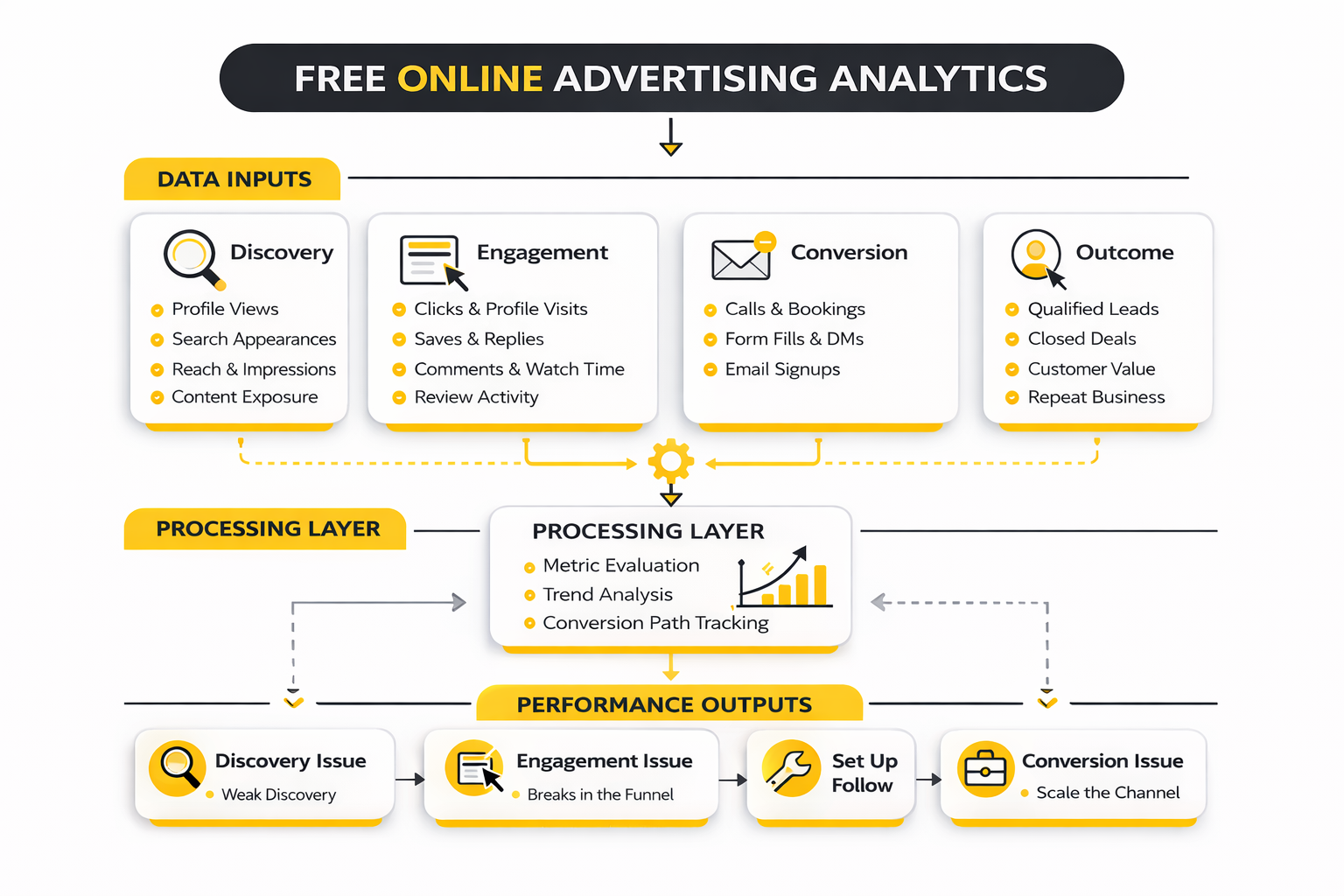
A useful analytics system for free online advertising does not need to be complicated. It needs to tell you where the leak is. The cleanest version has four levels: discovery, engagement, conversion, and follow-up outcome. If you track those four consistently, you can usually see exactly where performance breaks.
- Discovery
Track profile views, search appearances, reach, impressions, and content exposure. This tells you whether the market is seeing you.
- Engagement
Track clicks, profile visits, saves, replies, comments, watch time, and review activity. This tells you whether your visibility is attracting the right kind of attention.
- Conversion
Track calls, form fills, bookings, DMs, email signups, and direct inquiries. This tells you whether attention is turning into intent.
- Outcome
Track qualified leads, closed deals, customer value, and repeat business. This tells you whether the channel is producing real business, not just top-of-funnel activity.
This framework matters because it stops you from overreacting to the wrong numbers. If discovery is strong but engagement is weak, you need better creative, sharper positioning, or better proof. If engagement is strong but conversions are weak, your next-step path is broken. If conversions happen but customers do not close, the issue is downstream and not the fault of free online advertising itself.
Benchmarks Are Directional, Not a Scorecard
Benchmarks can be useful, but only if you treat them like orientation tools instead of a public ranking system. The average email click rate from MailerLite’s 2025 data and its metric guide can help you understand whether your list is fundamentally healthy. But a benchmark does not tell you whether your specific offer, niche, or audience maturity is strong enough. It just tells you where you sit in broad context.
The same goes for review trends. BrightLocal’s 2025 research is useful because it shows a shift in trust behavior, not because it gives you a magic number to chase. If consumers are relying less on blind trust and more on careful reading, the action is obvious: get better reviews, not just more reviews. Specificity beats volume when skepticism rises.
The same principle applies on social and video. A channel can outperform benchmark averages and still underperform for your business if the resulting audience never converts. That is why benchmarks should shape questions, not conclusions. They help you ask whether you are in a healthy range. They do not replace judgment.
What Good Performance Usually Looks Like
Good performance in free online advertising usually has a few patterns. First, discovery grows steadily instead of spiking once and disappearing. Second, engagement is tied to intent, which means people click, save, reply, visit profiles, or ask questions rather than just passively view. Third, conversion actions show up often enough that the channel earns more attention from your team.
There is also a consistency signal that matters a lot. When several channels reinforce each other, the numbers become more trustworthy. If someone finds you through search, checks your reviews, visits your Instagram, and then books a call, that is not messy attribution. That is normal modern buying behavior. HubSpot’s 2025 consumer trends reporting is helpful here because it shows social media is still a top product discovery channel for multiple generations, which means your analytics should account for multi-touch behavior rather than pretending one platform gets all the credit.
This should push you toward a more mature view of measurement. Free online advertising rarely works as a single-channel story. It works as a network of proof points that move people closer to action over time.
The Wrong Numbers to Obsess Over
There are a few numbers that get too much attention because they are easy to screenshot. Follower count is the obvious one. Unless follower growth also improves reach quality, site traffic, leads, or sales, it is mostly cosmetic. The same goes for raw view counts on short-form video, especially when platforms continue adjusting how those views are counted and displayed. Reporting changes can make numbers look better or worse without changing the underlying business impact.
Another weak signal is open rate when used by itself. MailerLite’s metrics guidance is right to emphasize click rate more heavily because privacy changes have made opens less dependable as a performance indicator. The action here is not to ignore open rate entirely. It is to stop treating it like proof that your email channel is healthy.
The same caution applies to impressions. High impressions can mean the algorithm tested your content widely. They do not automatically mean the message landed. If impressions rise while clicks, inquiries, and downstream actions stay flat, the number is interesting but not impressive.
What the Data Should Make You Do Next
Data should create decisions. If Google Business Profile views are rising but calls are flat, improve your category choices, photos, reviews, and CTA path. If social reach is growing but profile clicks are weak, tighten your positioning and content-to-offer connection. If email opens look strong but clicks remain weak, the message is attracting curiosity without creating action.
That is the practical lens that makes free online advertising useful. You are not measuring to admire performance. You are measuring to identify the bottleneck. Every channel produces signals, but only a few of them tell you what to fix next.
The next section moves into the mistakes and operating habits that determine whether all of this stays manageable. Because that is the other half of the problem. Even a good measurement system is useless if the execution model behind it is messy, inconsistent, or impossible to maintain.
Common Mistakes and Smarter Ways to Scale
By this point, the real shape of free online advertising should be obvious. It is not one tactic. It is an operating system made of discovery channels, proof assets, conversion paths, follow-up, and measurement. That is the good news. The harder news is that the same system becomes fragile fast if you scale it carelessly.
Most businesses do not fail because free online advertising stops working. They fail because the process gets noisy, the channels get diluted, and the team starts optimizing whatever is easiest to publish instead of whatever is most likely to produce customers. Once that happens, even good metrics become harder to trust.
The Biggest Strategic Mistake: Confusing Activity With Progress
A lot of teams fall into the same trap. They post more, open more profiles, chase more trends, and assume that more activity means more traction. It usually does not. It usually means more surface area to maintain, more inconsistency, and more weak signals to misread.
This matters even more now because discovery keeps fragmenting. HubSpot’s 2025 consumer trends report shows social media remains the top product discovery channel for Gen Z, Millennials, and Gen X, while Google continues expanding AI-led search experiences through products like AI Mode. In practice, that means buyers can encounter your business through more pathways than ever, which sounds exciting until you realize each pathway needs enough quality and consistency to hold up under scrutiny.
The action this should drive is restraint. Pick fewer channels, but make them harder to ignore. Free online advertising gets stronger when each visible asset is credible, current, and connected to a real conversion path.
The Platform Dependency Problem
There is another risk that gets underestimated all the time. When all your visibility lives on rented platforms, your growth becomes dependent on decisions you do not control. A platform changes ranking logic, modifies analytics, shifts interface priorities, or introduces new AI-driven discovery layers, and suddenly your results move without your permission.
You can already see this happening. Google is pushing further into AI-assisted search behavior with AI Mode and broader search changes, while YouTube keeps emphasizing viewer satisfaction, watch behavior, and recommendation relevance in its search and discovery systems. None of that is inherently bad, but it means free online advertising is not stable in the old sense. The rules are always moving.
The fix is not to abandon platforms. That would be foolish. The fix is to treat platforms as feeders, not foundations. Your actual foundation should be your site, your email list, your CRM, your customer data, and your repeatable follow-up process. If the platform sends you traffic today and less tomorrow, you should still own what happened after the visit.
Why Reputation Risk Scales Faster Than Reach
The more visible you become, the more fragile your reputation becomes too. That is the tradeoff people rarely talk about when they celebrate free reach. More exposure means more reviews, more public feedback, more comment surfaces, more message volume, and more opportunities for prospects to compare your promises against your delivery.
That matters because consumers are reading reviews with more skepticism now. BrightLocal’s 2025 historical review analysis and its newer 2026 Local Consumer Review Survey both point toward a more critical review environment, where people weigh patterns and credibility rather than blindly trusting star ratings. In other words, scaling visibility without tightening operations is dangerous. If the customer experience slips, the public evidence of that slip compounds quickly.
The practical move is to connect marketing and operations much more closely. If you want stronger reviews, you need stronger delivery. If you want more referrals, you need a better handoff after purchase. Free online advertising does not cover operational cracks. It exposes them.
The Content Trap: Publishing Too Broadly
Another common scaling problem is content sprawl. A business starts creating content because it helps visibility, then gradually turns that into a volume game. Soon the channel is full of vague tips, trend reactions, generic thought leadership, and posts designed more to fill a calendar than to drive demand.
That usually backfires because recommendation and search systems are getting better at detecting what audiences actually value. YouTube is explicit that recommendations depend on factors like what viewers watch, how long they watch, what they skip, and satisfaction signals gathered over time through its creator guidance. That should push you toward utility, clarity, and relevance instead of content for content’s sake.
A better advanced strategy is to build content around commercial intent layers. Some pieces should attract discovery. Some should build trust. Some should answer objections. Some should convert people who are already close to deciding. Once you understand those jobs, free online advertising becomes more focused and far less exhausting to maintain.
The Smarter Way to Scale: Build Systems, Not Heroics
Most small teams try to scale by asking people to work harder. That is not scaling. That is borrowing performance from energy you will not have forever. Real scaling happens when the system starts doing more of the work.
That means templates, standard operating procedures, automated follow-up, structured publishing workflows, and a central place to manage conversations and leads. This is where software becomes useful, not because tools create strategy, but because good tools reduce chaos. If you are trying to centralize lead capture, nurture, and basic sales follow-up, GoHighLevel is one of the more direct options for building that kind of operating layer. If the main problem is landing pages and offer-focused destinations, ClickFunnels, Replo, or Systeme.io can make the execution side much cleaner.
The important point is not which tool you choose first. It is that you choose tools around bottlenecks, not curiosity. If lead follow-up is leaking, solve that. If scheduling is messy, solve that. If your pages are weak, solve that. Expert-level growth usually looks boring from the outside because it is built around removing friction one system at a time.
Smart Tools Only Matter When They Protect Focus
There is a danger here too. The modern marketing stack makes it very easy to overbuild. You can connect forms, CRMs, calendars, AI assistants, inbox automation, chatbots, content planners, social schedulers, and reporting tools until the business looks sophisticated but moves slowly.
That is why the best smart tools are the ones that protect focus instead of multiplying complexity. For social scheduling and consistency, Buffer is useful precisely because it simplifies publishing rather than turning it into a dashboard obsession. For conversational capture, ManyChat helps when DMs and messaging are already part of how customers buy. For simple scheduling, Cal.com removes one of the most annoying forms of conversion friction.
The same logic applies to email and form capture. Brevo, Moosend, and Fillout are useful when they shorten the path from attention to capture. They are not useful when they become excuses to postpone publishing, testing, or following up.
Advanced Tradeoff: Efficiency Versus Brand Depth
As you grow, you will feel a real tension between efficiency and brand depth. Efficiency says standardize, automate, templatize, and repurpose everything. Brand depth says slow down, sound human, and create trust through specificity and nuance. Both sides are right, and the tension never fully disappears.
The mistake is pushing too far in either direction. If you over-automate, your free online advertising starts sounding interchangeable. If you insist everything must be handcrafted every time, the system becomes too slow to maintain. The mature answer is to automate the structure and humanize the substance. Use systems for routing, scheduling, tagging, reminders, and reporting. Keep judgment, positioning, and customer empathy close to a real human.
This is becoming more important as AI-generated content gets easier to produce. When more businesses can flood the internet with passable material, clarity and specificity become stronger differentiators. Free online advertising will still work, but the bar for trust signals keeps rising.
When Free Online Advertising Stops Being “Free”
This is worth saying plainly. Free online advertising is never actually free. It costs time, operational discipline, creative energy, customer service quality, and system maintenance. The difference is that you are paying with leverage-building work instead of just media spend.
That trade can be excellent, especially early on. But once your channels start producing reliable demand, the next question is not whether you should protect the “free” label forever. The next question is whether you should reinvest into the parts of the system already proving themselves. Sometimes that means better tooling. Sometimes it means better creative. Sometimes it means adding paid amplification to content or offers that already convert organically.
The smart move is not to become ideological about free traffic. The smart move is to use free online advertising to find what resonates, then strengthen what is already working. Organic traction should guide investment, not replace it forever.
What Experienced Operators Do Differently
Experienced operators usually look calmer because they understand a few things beginners do not. They know every channel has a carrying cost. They know not every metric deserves a reaction. They know platform reach is borrowed, reputation is fragile, and consistency beats intensity over time.
They also know that free online advertising is strongest when it feeds assets the business actually owns. That is the deeper strategy behind everything in this article. You are not just trying to get seen. You are trying to turn visibility into a durable growth engine that gets more resilient as it grows.
The final part brings everything together with the closing takeaways and the FAQ, because by that point the real job is not learning more tactics. It is knowing where to start, what to prioritize, and what questions matter most when you put this into practice.
Bringing the Whole System Together
By now, the bigger point should be clear. Free online advertising is not a list of websites where you drop your business name and hope something happens. It is an ecosystem made of discovery, proof, conversion, follow-up, and measurement, all working together closely enough that each part makes the next one stronger.
That is why the businesses that win with free online advertising rarely look flashy from the outside. They are just easier to find, easier to trust, easier to contact, and easier to remember. When those basics are in place, free reach stops feeling random and starts acting like a real growth engine.
FAQ
Is free online advertising actually free?
Not in the strict sense. You usually are not paying for impressions or clicks, but you are still paying with time, consistency, operational discipline, and content effort. That trade can be excellent early on because strong organic assets like a Google Business Profile, reviews, and useful content can keep generating discovery without requiring continuous ad spend, especially when Google shows interactions like views, clicks, and other customer actions directly inside Business Profile performance insights.
What is the best free online advertising channel for a local business?
For most local businesses, Google Business Profile is still the first place to start. It sits close to intent, and Google explicitly ties performance visibility to actions happening on Search and Maps through its Business Profile guidance and performance documentation. After that, reviews and local community platforms matter because buyers usually want a second layer of trust before they contact you.
What is the best free online advertising channel for a B2B company?
B2B usually needs a different mix. LinkedIn, educational content, email capture, and a clean conversion path tend to matter more than neighborhood-style discovery because buyers are often evaluating expertise, credibility, and fit over a longer cycle. That is one reason LinkedIn keeps positioning Pages as a way for members to discover businesses and learn what they do through its LinkedIn Pages resources.
How long does free online advertising take to work?
It depends on the channel and the buying intent. A fully optimized local profile can start producing useful actions relatively quickly if there is already demand, while content-driven channels like YouTube, SEO, or email list growth usually take longer because compounding is part of the model. The reason patience matters is that recommendation and discovery systems reward useful, consistent assets over time, which is built into how YouTube describes search and discovery.
Do I need a website, or can profiles and social pages be enough?
You can get some results without a full website, especially if you are local and the main action is a call or message. But over time, relying only on third-party platforms becomes risky because you do not own the distribution, the interface, or the data. A website or at least a focused landing page gives your free online advertising somewhere stable to send people when they are ready to act, which is why tools like Systeme.io, ClickFunnels, and Replo are often useful.
How many channels should I focus on at once?
Usually fewer than you think. Most businesses get better results by choosing one primary discovery channel, one proof layer, and one owned capture path instead of trying to maintain six weak channels badly. Free online advertising scales much better when each platform has a clear job, rather than every platform being treated like a generic content dump.
Are reviews still that important?
Yes, and arguably more than before because buyers are reading them more critically. BrightLocal’s 2026 Local Consumer Review Survey shows reviews still shape decisions strongly, but freshness, detail, and credibility matter more as consumers become more skeptical. That means the goal is not just accumulating stars. The goal is building a review profile that looks recent, specific, and real.
Should I use social media if my audience mostly comes from search?
Usually yes, but with the right expectations. Social media often acts as a validation layer rather than the first-touch discovery source, which means people may find you in search and then check Instagram, LinkedIn, or YouTube to see whether you look active and trustworthy. That behavior lines up with broader discovery trends in HubSpot’s 2025 consumer trends reporting, which shows social remains a major product discovery channel across several age groups.
What metrics matter most for free online advertising?
The most useful metrics are the ones that sit closest to action. Calls, website clicks, bookings, replies, DMs, form submissions, and qualified leads matter much more than vanity metrics like follower count by itself. Google’s Business Profile insights, YouTube’s analytics resources, and email benchmark studies like MailerLite’s 2025 data are useful because they help connect visibility to behavior.
Is email still worth using if social and search are doing the discovery work?
Absolutely. Social and search are great for discovery, but email is one of the clearest ways to keep access to the audience you already earned. That matters because open platforms change constantly, while an email list gives you a more direct line to people who already showed interest, and platforms like Brevo and Moosend make that easier to manage without a giant stack.
Can free online advertising work without posting content constantly?
Yes, but only if your core assets are strong. A complete Google Business Profile, current reviews, a clear offer page, and a smooth contact path can do a lot of work even if you are not publishing every day. Content helps because it compounds trust and discovery over time, but free online advertising does not require nonstop posting nearly as much as it requires clear positioning and consistent maintenance.
When should I add automation to the process?
Add automation when manual follow-up becomes the bottleneck, not before. If you are getting inquiries but responses are slow, if review requests happen inconsistently, or if leads disappear after the first touch, then automation starts making sense. Tools like ManyChat, GoHighLevel, and Cal.com are most useful when they remove friction that already exists.
Does AI change how free online advertising works?
Yes, mainly by changing how discovery and evaluation happen. Google is expanding AI-assisted search behavior through products like AI Mode, and BrightLocal’s newer research on AI and local recommendations suggests more consumers are using AI tools in the recommendation journey. The practical takeaway is not to chase every new feature. It is to make your business data, reviews, positioning, and proof strong enough that you remain easy to surface and easy to trust across changing interfaces.
Final Takeaway
The simplest way to think about free online advertising is this: show up where intent already exists, build trust faster than competitors, make the next step obvious, and own as much of the relationship as possible once someone engages. That is the system. Everything else is detail.
If you do that well, free online advertising stops being a desperate hunt for “free traffic” and becomes something much more valuable. It becomes a repeatable way to turn visibility into leads, leads into customers, and customers into proof that makes the next customer easier to win.
Work With Professionals
Explore 10K+ Remote Marketing Contracts on MarkeWork.com
Most marketers spend too much time chasing clients, competing on crowded platforms, and losing a percentage of every project to middlemen. MarkeWork gives you a better way. Browse thousands of remote marketing contracts and connect directly with companies desperate to hire skilled marketers like you, without platform commissions and without unnecessary gatekeepers.
If you're serious about finding better opportunities and keeping 100% of what you earn, explore available contracts and create a profile for free at MarkeWork.com.