

A freelance copywriter is not just a person who writes words for hire. The role sits much closer to revenue than most creative jobs because good copy affects clicks, leads, bookings, replies, demos, and sales. That matters even more now, when brands can generate endless average content with AI but still struggle to sound credible, specific, and persuasive.
That shift is exactly why this topic deserves a serious breakdown instead of recycled advice about “finding your niche” and “posting on LinkedIn.” Businesses still invest in email, content, landing pages, and lifecycle marketing because those channels continue to produce measurable returns, but they increasingly need writers who can connect messaging to outcomes rather than just fill space on a page. A strong freelance copywriter is now part strategist, part researcher, part operator, and only then a writer.

Article Outline
- Why Freelance Copywriting Still Matters
- What a Freelance Copywriter Actually Does
- The Client Acquisition Framework
- Core Skills That Separate Amateurs From Pros
- How Professional Copywriters Deliver Work Clients Rehire
- How to Build a Freelance Copywriting Business That Lasts
Why Freelance Copywriting Still Matters
Freelance copywriting matters because companies do not buy words. They buy clearer positioning, stronger conversion paths, more qualified leads, and more consistent customer communication. When marketers keep putting email, website content, and blog content near the top of their ROI mix, the writer who can improve those assets becomes commercially useful fast.
The market is also moving toward specialists. Content Marketing Institute found that about three-quarters of marketers say they need more specialized or niche skills to stay relevant, which is a strong signal for any freelance copywriter trying to compete on something more meaningful than low prices. In practical terms, the generalist who “can write anything” often loses to the writer who understands one buyer, one funnel, and one business model deeply.
There is another reason this work matters now: independent talent is becoming normal, not exceptional. Upwork’s 2025 research reported that 28% of U.S. knowledge workers were freelancing or working independently, which tells you that businesses are increasingly comfortable hiring external specialists for high-value work. For a freelance copywriter, that creates opportunity, but only for people who position themselves like a business partner instead of a spare pair of hands.
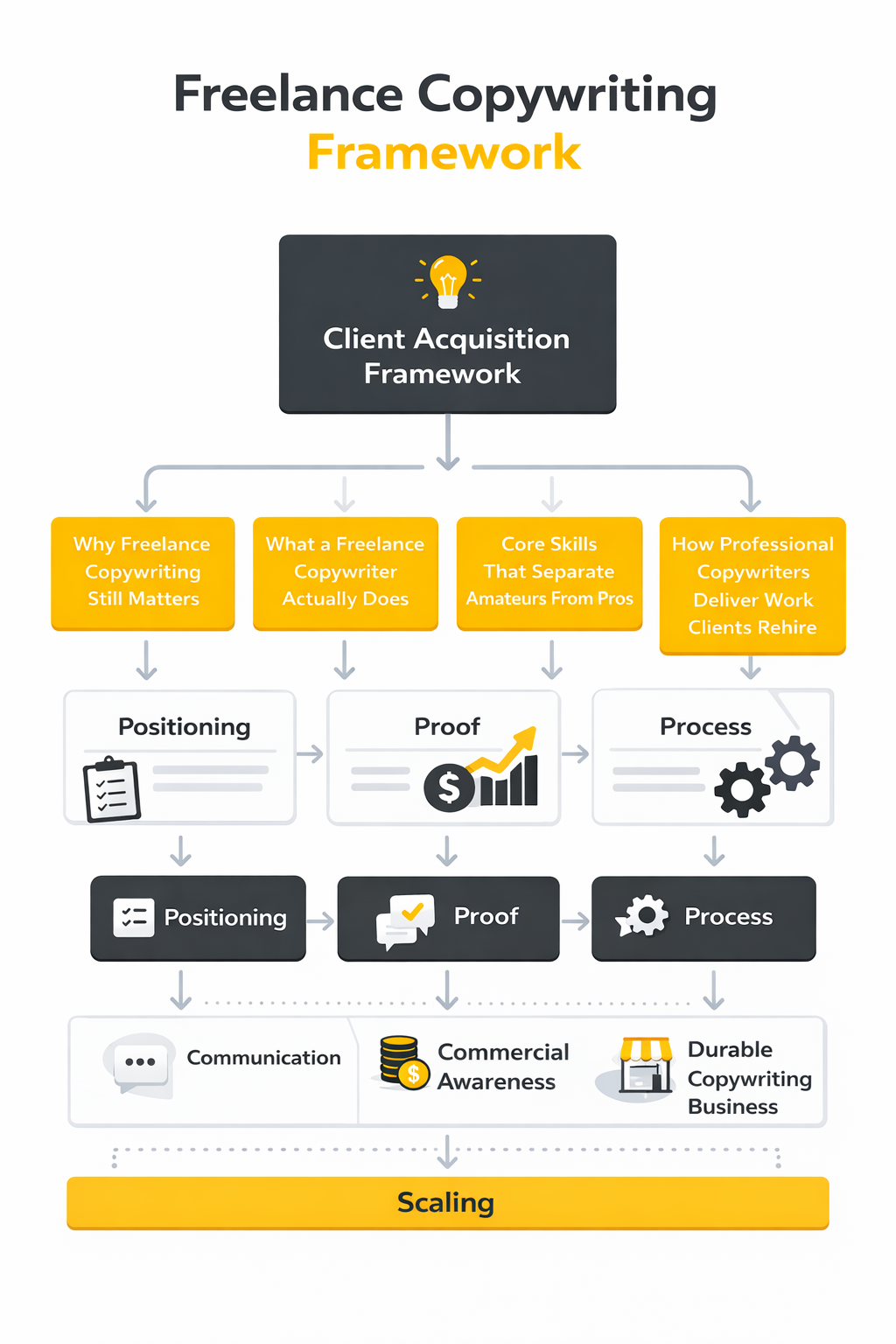
The Six-Part Framework
This article follows a practical sequence because that is how freelance copywriting actually works in the real world. First you need to understand why the role matters, then what the job really includes, then how to win work, then how to sharpen the skills that justify better fees, then how to deliver professionally, and finally how to turn scattered projects into a durable business. That order is not arbitrary; it mirrors the path from “I can write” to “clients trust me with revenue-critical work.”
The biggest mistake new writers make is treating copywriting as a portfolio problem when it is really a systems problem. You need positioning, proof, process, communication, and commercial awareness working together. Once those pieces line up, a freelance copywriter becomes much easier to hire, easier to refer, and much harder to replace.
What Comes Next
The next part moves from the big-picture case into the real job description. That means looking at what a freelance copywriter actually does across offers, pages, emails, research, messaging, and optimization, because the work is broader than most people assume. Once that is clear, the rest of the framework starts to make sense.
What a Freelance Copywriter Actually Does
A freelance copywriter does far more than draft clever headlines or polish a sales page. The real job is to help a business say the right thing to the right person at the right moment in the buying journey, then make that message useful across channels. That scope has grown because buyers now do more independent research before they ever talk to sales, a pattern highlighted in both the 2024 Edelman-LinkedIn B2B Thought Leadership Impact Report and Gartner’s 2025 finding that 61% of B2B buyers prefer a rep-free buying experience.
That changes the standard of the work. A client is not hiring a freelance copywriter to “make it sound better” in some vague creative sense. They are hiring someone to reduce friction, sharpen relevance, and help prospects move with more confidence from curiosity to action.
Research Comes Before Writing
The first real deliverable is usually not copy. It is clarity. A serious freelance copywriter starts by understanding the offer, the market, the customer language, the objections, the alternatives, and the business model behind the page or campaign.
That research step matters because too much branded content still misses the mark. The 2024 Content Preferences Benchmark Survey found that 51% of buyers said content was too generic and irrelevant to their needs, which is exactly the kind of failure strong copy is supposed to prevent. A freelance copywriter who skips research usually produces surface-level work that sounds polished but does not connect.
This is why better writers ask harder questions than clients expect. They want the sales calls, the customer interviews, the objections in demo notes, the conversion data, the onboarding emails, and the lost-deal reasons. Without that material, the writing may still be clean, but it will not feel true.
Messaging Is Part of the Job, Not an Extra
Many clients think they need copy when what they actually need is messaging. That difference is huge. Copy is the execution on the page, while messaging is the underlying logic that tells the market who the offer is for, why it matters, what makes it different, and why anyone should believe it.
A freelance copywriter often has to build that layer before the visible assets can improve. If the positioning is muddy, the homepage gets muddy. If the offer is vague, the emails get vague. If the proof is weak, the sales page starts leaning on hype because it has nothing stronger to stand on.
That is one reason writers who understand strategy keep becoming more valuable. Content Marketing Institute’s 2024 skills coverage pointed to growing demand for capabilities that go beyond writing alone, including audience development, analytics, technology, SEO, and editing in a more strategic role. (contentmarketinginstitute.com)
The Work Usually Spans More Than One Asset
A freelance copywriter may be hired for a landing page, but the page rarely lives alone. It connects to ads, emails, lead magnets, demos, nurture flows, retargeting, onboarding, and customer education. In other words, the writer is often shaping how the offer sounds across a system, not just inside one file.
That makes channel awareness non-negotiable. HubSpot’s 2026 marketing statistics page, drawing from its recent State of Marketing reporting, shows that website, blog, and SEO remain the top ROI-generating channel for marketers, while blog posts also ranked among the top five highest-ROI content formats in 2025. (hubspot.com) If those channels continue to matter commercially, the freelance copywriter working on them has to understand intent, structure, and conversion rather than treating each piece as isolated content.
This is also where weak briefs cause expensive problems. A client may ask for “some emails” when they actually need a welcome sequence, abandoned-cart logic, reactivation messaging, and a cleaner transition into sales conversations. A good freelance copywriter hears the request, then diagnoses the system behind it.
Copywriters Translate Business Goals Into Reader Decisions
The most useful copywriting work sits between strategy and action. The client says they want more demos, more qualified leads, lower churn, or better close rates. The writer translates that into clearer promises, stronger proof, simpler page flow, tighter calls to action, and more relevant follow-up.
That translation layer is what separates a commodity writer from a commercial one. Buyers are overwhelmed, self-directed, and quick to ignore outreach that feels irrelevant, which is exactly why message precision matters more than ever. Gartner’s 2025 sales survey also found that 73% of B2B buyers actively avoid suppliers who send irrelevant outreach, so a freelance copywriter is often protecting the brand from sounding lazy, generic, or disconnected from real buyer needs.
This is why the best writers talk about decisions, not just deliverables. They care about whether a visitor understands the offer, whether a lead sees the next step clearly, and whether a prospect feels enough trust to keep moving. That is a much more valuable lens than obsessing over whether a sentence sounds “punchy.”
Professional Copywriters Also Shape Workflow
Clients do not just remember the writing. They remember how the project felt. A freelance copywriter who can run a clean process usually gets rehired faster than one who disappears for a week and comes back with a Google Doc full of clever lines and no thinking behind them.
Professional implementation usually includes a project intake form, research collection, offer review, call notes, first-draft logic, revision boundaries, and handoff guidance. Simple tools can make that smoother, whether that means using Fillout for intake, Cal.com for discovery calls, Copper for relationship tracking, or Brevo or GoHighLevel when copy needs to connect directly to campaigns and automations.
That operational side matters more now because clients increasingly expect external specialists to function like real partners. Upwork’s 2025 Future Workforce Index found that more than one in four U.S. skilled knowledge workers operate in freelance or non-traditional models, and that work generated over $1.5 trillion in earnings in 2024. (upwork.com) In plain English, the market is mature enough now that “just send me the draft” is no longer a strong professional standard.
The Client Acquisition Framework
Once you understand what the job actually includes, the next question becomes obvious: how does a freelance copywriter get hired for work that is worth doing? Not by blasting cold messages with vague promises. Not by calling yourself a storyteller and hoping somebody feels inspired. And definitely not by competing on price with people who are selling words by the kilogram.
The stronger path is simpler. You make it easy for the right client to see what problem you solve, what type of work you do best, and what business outcome your process is built to support. That is the acquisition framework the rest of this article will unpack, because getting clients consistently starts with positioning before outreach ever begins.
Step One Is Choosing a Problem, Not Just a Niche
A lot of advice tells writers to pick a niche, which is fine as far as it goes. But in practice, clients buy problem-solvers faster than category labels. Saying you are a freelance copywriter for SaaS is broad. Saying you help SaaS teams improve homepage messaging, email onboarding, and conversion copy is much easier to understand and refer.
This matters because buyers are screening quickly. The 2024 Edelman-LinkedIn report makes it clear that self-directed discovery is now central to B2B buying behavior, which means your positioning has to do more work before a conversation ever starts. A freelance copywriter with a specific problem-market fit is simply easier to trust than one presenting as a generic creative for hire.
Step Two Is Proof the Market Can Understand Fast
Clients do not need twenty random samples. They need evidence that you can think in the context they care about. Sometimes that means a portfolio. Sometimes it means a teardown, a messaging example, a before-and-after rewrite, or a clear explanation of how you approach a page, funnel, or sequence.
This is where many talented writers lose momentum. They show writing quality, but not business relevance. The market has already shown that content becomes easier to ignore when it feels generic, which is why your proof has to demonstrate judgment, not just style. (2024 Content Preferences Benchmark Survey)
Step Three Is a Repeatable Way for Leads to Enter Your World
The best client acquisition systems are rarely complicated. They usually combine visible expertise, a clear offer, a straightforward contact path, and follow-up that does not feel chaotic. That can live on a simple site, a focused LinkedIn presence, a referral engine, or a lightweight outbound process, but it needs structure.
For some freelance copywriters, that means pairing a clean landing page with a scheduler and a qualification form. For others, it means publishing breakdowns, email insights, or conversion critiques consistently, then routing interest into a simple workflow through tools like Buffer, ManyChat, or Chatbase when lead capture and response speed matter. The exact stack is flexible, but the principle is not: make it easy for qualified buyers to understand the offer and take the next step.
The next section goes deeper into the skills that make this framework work in practice. Because once positioning and acquisition start bringing opportunities in, the real separator is not hustle. It is whether the freelance copywriter has the core skills to justify premium trust.
Core Skills That Separate Amateurs From Pros
Once a freelance copywriter understands how to attract the right clients, the next separator is skill depth. Not “talent” in the romantic sense. Real skills that help a writer diagnose a commercial problem, build a sharper message, and turn scattered information into copy that moves someone toward a decision.
That bar is rising because the easy layer of content is getting automated. HubSpot’s 2026 marketing statistics page notes that 94% of marketers plan to use AI in content creation processes in 2026, which means clients do not need another person who can merely produce acceptable first drafts. They need someone who can think better than the prompt, spot weak positioning, and create copy that feels grounded in the market instead of inflated by generic language.
Commercial Empathy Beats Clever Writing
A strong freelance copywriter knows how to enter the buyer’s head without turning the page into a parody of customer pain points. That takes commercial empathy, which is really the ability to understand what the buyer wants, what they fear, what they compare, what they mistrust, and what would make them feel safe enough to move forward. It is less about writing flashy lines and more about identifying the exact moment where hesitation appears.
This matters because irrelevance kills momentum fast. Gartner reported in 2025 that 73% of B2B buyers actively avoid suppliers who send irrelevant outreach, which is a useful reality check for any freelance copywriter still relying on broad claims and interchangeable messaging. If the copy sounds like it could belong to ten other companies, the buyer reads it as noise.
Commercial empathy also changes the research process. The writer stops asking, “How do I make this sound better?” and starts asking, “What would this reader need to believe before taking the next step?” That question leads to stronger pages, better emails, and messaging that feels specific enough to trust.
Offer Clarity Is a Core Writing Skill
Many freelance copywriters think their main job starts after the offer is already clear. In reality, offer clarity is often part of the assignment. The writer has to identify what the product or service actually helps someone do, what outcome deserves the headline, and what proof supports the promise without leaning on hype.
This is where amateurs often fall apart. They inherit messy positioning, then decorate it. A better freelance copywriter slows down long enough to isolate the strongest value angle, remove soft claims, and organize the page around the real conversion logic. That work is strategic, but it shows up directly in the writing.
The need for that clarity is getting stronger, not weaker. HubSpot’s 2026 State of Marketing page frames the next wave of growth around sharper brand point of view, trust, and relevance in markets flooded with AI-generated sameness. (hubspot.com) A freelance copywriter who can sharpen an offer without overcomplicating it becomes much more valuable than someone who only knows how to fill sections on a template.
Channel Fluency Changes the Quality of the Copy
A homepage is not an email. An onboarding sequence is not a sales page. A LinkedIn post is not a lead magnet. That sounds obvious, but a surprising amount of weak copy happens because writers apply the same rhythm, proof style, and CTA logic everywhere.
A professional freelance copywriter understands how the channel shapes the message. Email still deserves special attention because the channel continues to produce strong returns and remains central to retention, nurture, and lifecycle marketing. Litmus reported in 2025 that 35% of marketing leaders get $10 to $36 back for every $1 spent on email, 30% get $36 to $50 back, and 5% report more than $50, which explains why businesses keep investing in email copy that is timely, relevant, and well-structured.
Channel fluency also affects execution speed. If a freelance copywriter understands how a landing page flows differently from a nurture sequence, they ask better questions up front and waste less time rewriting the wrong draft. That is one of the invisible skills clients notice even when they do not have language for it.
Editing Is Where the Money Is
Drafting gets attention, but editing is where professional quality actually shows. A serious freelance copywriter cuts weak transitions, removes duplicated points, tightens proof, simplifies structure, and checks whether the page earns each next step. That is the stage where the work shifts from “pretty good” to commercially usable.
This matters even more in an environment where generic content is everywhere. The 2024 Content Preferences Benchmark Survey found that 51% of buyers said the content they received was too generic and not tailored to their needs. A freelance copywriter who edits ruthlessly for specificity protects the client from publishing something technically fine but strategically forgettable.
Good editing also means resisting the urge to overwrite. Clients usually do not need more adjectives, more metaphors, or more big promises. They need fewer weak words, cleaner logic, and stronger alignment between claim, proof, and call to action.
Research Discipline Makes Everything Else Better
Research is not a warm-up task. It is part of the product. The freelance copywriter who collects better source material writes stronger first drafts, makes better structural decisions, and avoids the vague filler that appears when evidence is thin.
That discipline can include customer interviews, call recordings, CRM notes, internal docs, support tickets, reviews, competitor pages, search intent analysis, and performance data. It can also include practical systems that make research easier to organize, whether that means using Wispr Flow to capture voice notes and ideas, or Firecrawl to pull structured website material into a research workflow. The tools are optional, but the discipline is not.
This is also where a freelance copywriter starts looking less like a vendor and more like a partner. Content Marketing Institute’s 2025 enterprise research found that 75% of enterprise marketers are using AI, up from 58% the year before, which means the human edge increasingly comes from judgment, source quality, and message accuracy. Better research is one of the clearest places that edge still shows up.
How Professional Copywriters Deliver Work Clients Rehire
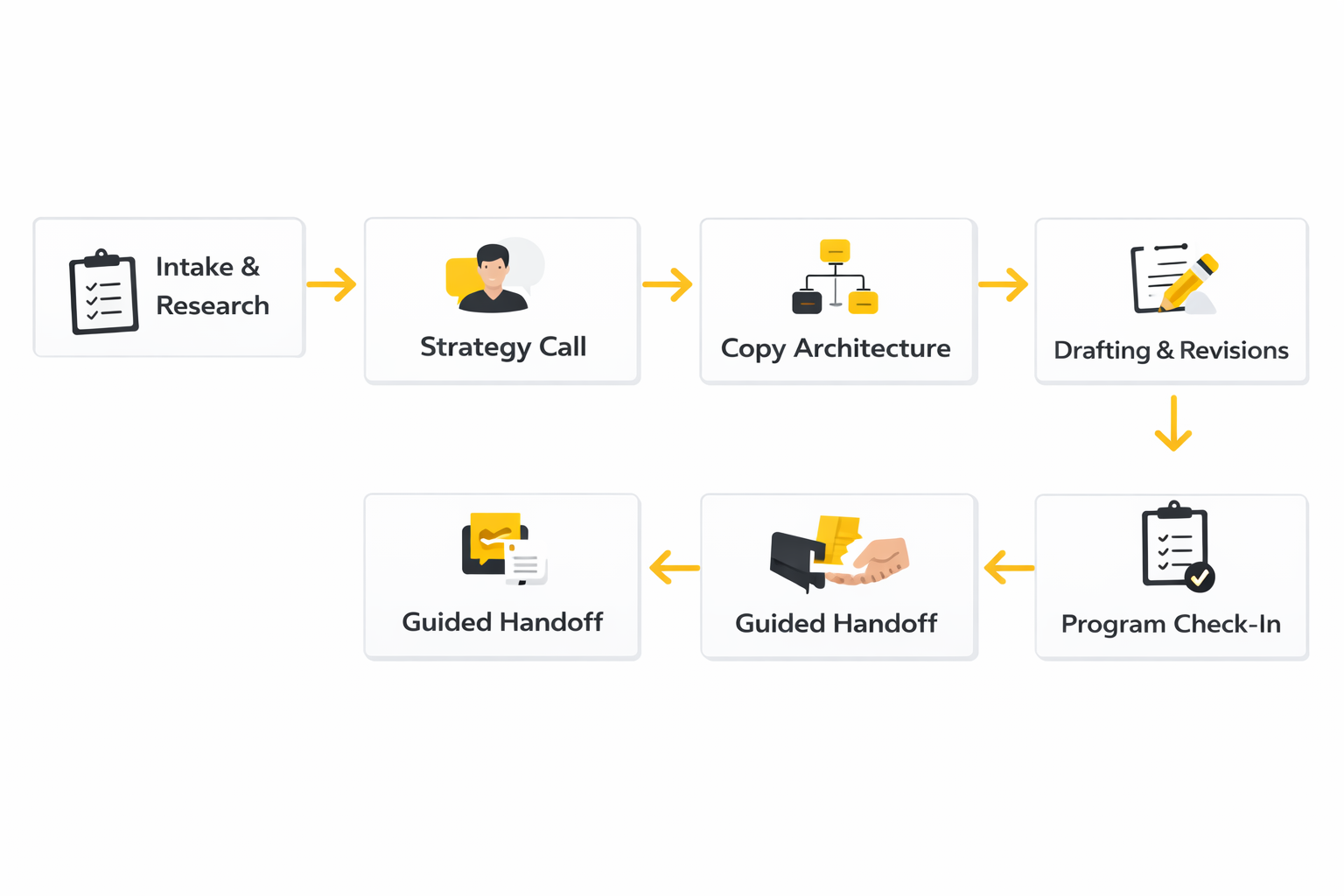
At some point, skill alone stops being the main issue. A freelance copywriter can be talented and still create a frustrating client experience. The writers who get rehired consistently tend to have a process that makes the engagement feel calm, structured, and commercially focused from the first conversation to the final handoff.
That process matters because clients are rarely buying a page in isolation. They are buying momentum, clarity, and lower execution risk. When the workflow is clear, the copy feels more trustworthy before anyone reads the first headline.
The Process Starts With Better Intake
Most bad projects are damaged before the writing begins. The brief is vague, the goals are fuzzy, nobody has defined the audience properly, and the client sends random reference links instead of useful business context. A professional freelance copywriter slows that down and replaces chaos with a cleaner intake.
That usually means gathering the offer details, audience, funnel stage, goals, proof assets, previous performance, customer objections, and revision boundaries in one place. A structured intake form built in something like Fillout can do a lot of the heavy lifting before the kickoff call even happens. The point is not bureaucracy. The point is making sure the writer starts with the right problem.
Good intake also signals professionalism fast. It tells the client this is not going to be a loose exchange of half-formed thoughts in Slack followed by last-minute panic. That alone makes a freelance copywriter easier to trust.
Then Comes Message Architecture
Before drafting, strong writers organize the message. They decide what promise leads, what proof supports it, what objections need handling, what sequence makes sense, and what action the reader should take next. This is the part many clients never see directly, but they feel its absence immediately when it is missing.
A freelance copywriter who skips architecture often writes sections that sound decent on their own but do not build toward a decision. A better process treats the page or campaign like a structured argument. Each block has a job, and each job supports the next one.
This is where tools can help without replacing the thinking. A writer building ecommerce landing pages might use Replo to map page sections in a way that keeps structure visible, while a broader funnel project may run through GoHighLevel when pages, forms, automations, and follow-up all need to connect. The software is secondary. The architecture is the real asset.
Drafting Should Be Fast Because Thinking Happened Earlier
The cleanest copy projects do not usually come from long dramatic drafting sessions. They come from solid research, clear message architecture, and a writer who already knows what each section is supposed to accomplish. In that environment, the first draft becomes an execution step, not a search party.
That has practical consequences for the client. Drafts arrive closer to the brief, revisions stay tighter, and feedback conversations become more useful because everyone is reacting to a real structure instead of trying to rescue a vague direction. A freelance copywriter who drafts this way saves more than time. They save attention.
This matters in email especially, where teams move quickly and output volume stays high. Litmus noted in its 2025 agency email playbook that 76% of marketing teams produce emails in one week or less, which is another reminder that speed only helps when the process underneath it is sound. Fast chaos is still chaos.
Revision Control Protects the Relationship
Revisions are normal. Endless revisions are a process failure. A professional freelance copywriter knows how to invite useful feedback without turning the project into a moving target shaped by whoever had the latest opinion in the group chat.
That usually means setting revision rounds, defining what kind of feedback is useful, and anchoring comments back to audience, goal, and conversion logic. When that frame is missing, revisions drift toward taste battles. When it is present, the conversation stays tied to the purpose of the asset.
This is one of the biggest reasons clients rehire. They do not just want good copy. They want a freelance copywriter who can hold the line when a project starts wobbling and still keep the relationship constructive.
Handoff Is Part of the Deliverable
The job is not over when the doc is done. Good handoff explains how to use the copy, where performance should be watched, what testing angles make sense, and what assumptions informed the draft. That extra context makes the work easier to implement and easier to learn from.
A freelance copywriter who hands over a final draft with zero explanation creates friction for the client’s team. A better handoff gives them confidence. It also increases the odds that future iterations improve instead of restarting from scratch every time.
This is where the process becomes visible as a business asset. The writer is no longer just “someone who writes.” They are someone who helps the client move from research to message to execution to next-step learning. That is exactly the kind of professional implementation clients remember when the next project appears.
The final stretch of the article moves from delivery into durability. Because doing good work is not enough by itself. A freelance copywriter still needs a business model, positioning discipline, and long-term operating habits that make the work sustainable instead of exhausting.
Measuring What Good Copy Actually Does
A freelance copywriter who never looks at performance data is guessing with better grammar. The point of measurement is not to impress a client with dashboards. It is to learn whether the message made the next step easier, whether the right people engaged, and whether the copy should be scaled, revised, or replaced.
This is where a lot of writers get lazy. They celebrate a nicer page, a cleaner email, or a sharper hook, then stop before the commercial question gets answered. But the real standard is simpler: did the copy improve movement through the funnel, and did it do that with the right audience rather than random traffic?
The Numbers That Matter for a Freelance Copywriter
Not every metric deserves equal attention. A freelance copywriter needs to care most about the numbers that reflect message fit, buyer intent, and movement toward revenue. That usually means reading performance in layers instead of staring at one surface-level percentage.
The first layer is attention. On a page, that may show up in bounce rate, scroll depth, time on page, and CTA clicks. In email, it starts with opens, but opens alone have become less reliable because privacy features can inflate them, which is why click rate, click-to-open rate, replies, and conversions tell a more useful story. MailerLite’s 2025 benchmark update put the average email open rate at 43.46%, the click-to-open rate at 6.81%, the click rate at 2.09%, and the unsubscribe rate at 0.22%, but those numbers only mean something when you compare them against list quality, offer strength, and audience intent.
The second layer is action. If the copy is supposed to drive demos, signups, booked calls, free trials, or purchases, then the conversion step matters more than raw traffic. Unbounce’s benchmark report is useful here not because it gives a magic target, but because it draws from more than 57 million conversions across more than 41,000 landing pages, which gives context for whether a result is weak, average, or exceptional.
The third layer is quality. A freelance copywriter should always ask whether the conversions were good conversions. More leads do not help if sales says they are unqualified. More trial signups do not matter if activation drops. More booked calls are not a win if no-shows spike because the copy overpromised.
Why Benchmarks Help and Where They Mislead
Benchmarks are useful when they prevent overreaction. If a client sees a 2% click rate and panics, industry context may show that the result is normal and that the bigger issue sits further down the funnel. If a landing page converts poorly relative to a credible benchmark, that can justify deeper testing on the offer, proof, form friction, or CTA structure rather than endless subjective edits.
But benchmarks become dangerous when people treat them like universal rules. A warm email list should not be judged like a cold newsletter list. A branded search landing page should not be judged like a paid social page. A high-ticket B2B offer should not be judged like a low-friction ecommerce checkout. The same number can mean healthy traction in one context and obvious underperformance in another.
That is why a freelance copywriter needs to interpret numbers through the lens of source, intent, and stage. If the traffic is cold, engagement metrics often deserve more patience. If the audience is warm and the offer is proven, weak conversion data is more likely to point to message or page-structure problems. The number is just the start. The diagnosis is the actual work.
What Data Usually Signals a Copy Problem
Some performance patterns point strongly toward copy issues. If a page gets traffic but almost nobody clicks the primary CTA, the problem may be weak offer clarity, soft proof, muddy structure, or a call to action that does not feel specific enough. If people open emails but do not click, the subject line may be doing its job while the body copy fails to carry intent forward.
If users click through but do not convert, the issue may sit in page-message mismatch. That often happens when ads promise one thing and the landing page starts talking about something broader, safer, and less relevant. A freelance copywriter should be very alert to that disconnect because it quietly kills performance without always looking dramatic in the headline itself.
There is also a trust pattern worth watching. Gartner found in 2025 that 61% of B2B buyers prefer a rep-free buying experience and 73% actively avoid suppliers that send irrelevant outreach. That has direct implications for copy performance. If the message feels generic, over-eager, or disconnected from buyer reality, the damage shows up in engagement, reply quality, and downstream conversion behavior.
Statistics and Data That Actually Change Decisions
The best measurement section in any copy project is not a pile of random percentages. It is a short set of numbers that changes what happens next. For a freelance copywriter, the useful question is always: what action should this result drive?
If open rates are healthy but click rates lag, the action is rarely “rewrite the subject line again.” It is usually to tighten the body, sharpen the transition into the offer, or make the CTA feel lower-friction and more specific. If a landing page gets solid CTA clicks but poor form completion, the copy may be fine and the actual issue may be the form itself, the signup process, or the commitment level being asked too early.
HubSpot’s current marketing statistics are helpful here because they show that website, blog, and SEO remain the top ROI-generating channel for marketers, while blog posts were still among the top five highest-ROI content formats in 2025. That does not mean every article or landing page performs automatically. It means a freelance copywriter working in those channels should care about measurement because these assets still sit close to commercial return.
A Simple Analytics System for Copy Projects
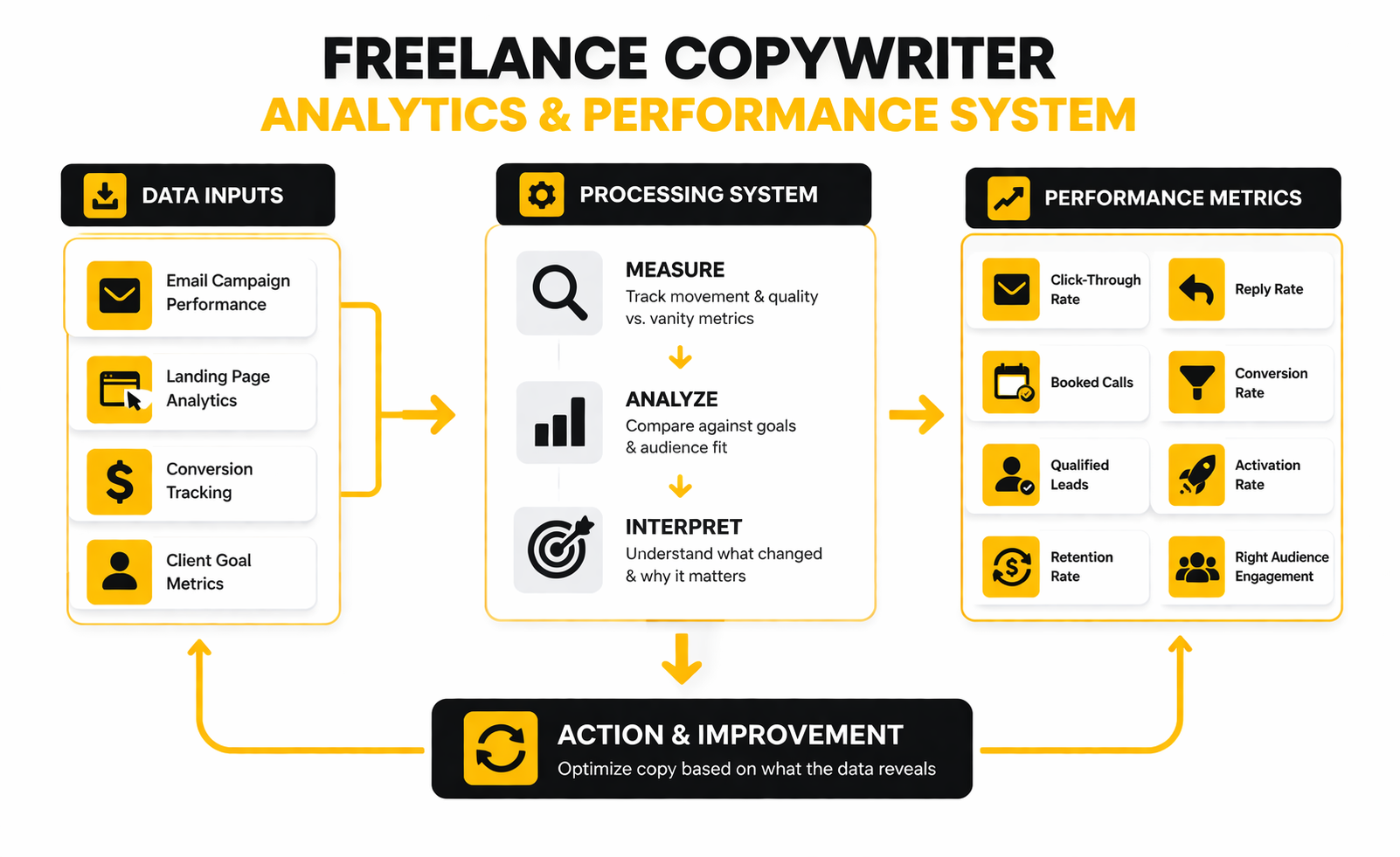
A freelance copywriter does not need an enterprise analytics stack to make smarter decisions. What helps most is a consistent review system that connects the copy to one primary goal, a few supporting metrics, and a short interpretation window. That keeps the work practical.
A simple structure looks like this:
- Define the primary conversion goal before writing.
- Choose two to four supporting metrics that indicate whether the message is working.
- Compare results against the previous version, not just an abstract benchmark.
- Segment by traffic source or audience when possible.
- Review actual behavior before rewriting the page or sequence.
That sounds basic because it is basic. But it prevents one of the most expensive habits in client work: rewriting copy before anyone has identified whether the failure is message, traffic, offer, audience, or implementation. A freelance copywriter who can hold that discipline becomes much more useful in performance conversations.
This is also where simple tools can support the process. A writer managing lead capture and follow-up inside GoHighLevel, forms through Fillout, calendar bookings through Cal.com, or social distribution through Buffer can often see the funnel more clearly than someone passing drafts around in documents and hoping the client fills in the rest.
How to Read Performance Without Fooling Yourself
The biggest measurement mistake is reacting too early. One campaign, one week, or one traffic burst can create misleading results. A freelance copywriter should always ask whether there is enough volume to trust the pattern and whether any external variables changed at the same time, such as audience targeting, offer pricing, seasonality, or page speed.
The second mistake is optimizing for the wrong stage. High open rates with weak conversions may look fine to someone focused on attention, but they are still bad business if they do not create movement. The reverse can happen too. A modest open rate with strong clicks and strong downstream conversion may signal that the copy is attracting fewer but better-fit readers.
The third mistake is treating copy as the only lever. Unbounce’s conversion benchmark data is valuable partly because it reminds marketers that page performance is shaped by the whole experience, not just the wording. A freelance copywriter should absolutely own the message, structure, proof, and CTA, but not pretend that weak offer-market fit or a clumsy handoff can be fixed with better verbs.
What the Data Should Drive Next
Once the numbers are in, the next step should be obvious enough to execute. If engagement is weak at the top, revisit relevance and headline-message match. If intent is there but conversion stalls, strengthen proof, reduce friction, and clarify the next step. If lead quality is poor, tighten qualification and make the offer more honest about who it is for.
That is the core difference between reporting and thinking. Reporting says the page converted at 3.1% and the email click rate was 2.2%. Thinking says the copy likely earned attention but lost momentum at the transition into commitment, so the next iteration should test proof placement, CTA specificity, and form length. That is how a freelance copywriter moves from being measured by deliverables to being trusted for judgment.
The next part shifts from analytics into sustainability. Because once you can attract clients, do the work, and measure what happened, the final challenge is turning those capabilities into a freelance copywriting business that lasts instead of a sequence of short bursts and client scramble.
How to Build a Freelance Copywriting Business That Lasts
A freelance copywriter usually hits the first ceiling long before the market runs out of opportunity. The ceiling is not demand. It is capacity, positioning drift, client concentration, and the quiet habit of saying yes to work that keeps cash moving but makes the business weaker.
This is where the job stops looking like freelancing in the casual sense and starts looking like business design. Upwork’s 2025 workforce research showed that more than one in four U.S. knowledge workers now operate independently, generating $1.5 trillion in earnings in 2024, which is a strong reminder that independence is no longer a side path. It is a real operating model, but only for people who build it deliberately. Upwork’s 2025 Future Workforce Index and the matching Upwork investor release both point in that direction.
Specialization Gets More Valuable as AI Gets Cheaper
The more generic writing becomes, the more valuable judgment becomes. That is the tradeoff most freelance copywriters need to understand right now. If basic drafting is easier to automate, then the advantage shifts toward people who can sharpen positioning, extract insight from messy research, and shape copy that sounds commercially true instead of algorithmically smooth.
That trend is already visible across content teams. Content Marketing Institute’s 2025 enterprise research found that 57% of enterprise marketers say AI-powered automation will be a high or medium priority, which means clients are not looking for a human version of a template engine. They are looking for someone who can make better decisions inside the system. (contentmarketinginstitute.com)
For a freelance copywriter, this should drive a clear action: move closer to business-critical work. Homepage messaging, offer positioning, email lifecycle strategy, conversion pages, sales enablement, onboarding, retention copy, and product-led flows are harder to replace than generic blog content. The closer you get to message risk and revenue risk, the stronger your market position becomes.
Pricing Changes When You Stop Selling Drafts
A lot of writers stay stuck because they price the visible output instead of the commercial value behind it. They quote a landing page, an email sequence, or a homepage rewrite as if the client is buying word count plus effort. In reality, the client is buying reduced ambiguity, faster execution, and a stronger chance that a key business asset performs.
That does not mean every freelance copywriter should make heroic claims about ROI. It means pricing should reflect the level of thinking, research, and implementation involved. If the work includes interviews, message architecture, strategy calls, revision control, and handoff guidance, it is already bigger than “writing.”
This is also where packaging helps. A focused offer is easier to price than a vague service menu. A freelance copywriter who sells homepage messaging systems, launch email packages, onboarding sequence optimization, or offer clarification workshops usually has an easier time commanding better fees than someone who says yes to anything involving text.
Client Concentration Is a Hidden Business Risk
One large retainer can feel like stability right up until it disappears. That is one of the most common structural risks in freelance businesses because revenue concentration feels efficient while it is working. Then a budget freeze, leadership change, or strategy pivot lands, and suddenly the writer is not just replacing income. They are rebuilding pipeline under pressure.
A durable freelance copywriter treats concentration risk like a business metric, not a surprise. If one client accounts for too much revenue, the solution is not panic. It is gradual diversification through better lead flow, stronger referral systems, and packaging that makes smaller but cleaner projects worth taking.
This is one reason visible expertise matters so much. A writer who publishes breakdowns, critiques, or smart commentary creates future demand before needing it. Even lightweight distribution through something like Buffer can help keep that signal alive, but the bigger point is strategic: never let one client become your business model.
Scaling Does Not Always Mean Hiring
Many freelance copywriters assume growth means building an agency. Sometimes it does. Often it does not. In plenty of cases, the smarter move is to become more selective, raise rates, tighten the offer, improve workflow, and reduce delivery complexity before adding people.
Hiring too early can create a fragile business with more coordination, thinner margins, and lower quality control. A freelance copywriter who has not yet standardized intake, process, revisions, and handoff will usually scale confusion faster than revenue. That is not leverage. That is administrative inflation.
Better scaling often starts with operating leverage instead. Templates for kickoff, clearer scopes, better research capture, cleaner scheduling, stronger CRM hygiene, and fewer custom project types make a solo business much easier to run. Tools can help here, whether that means Cal.com for simpler scheduling, Copper for contact tracking, or Fillout for cleaner intake, but the leverage comes from the system, not the app.
The Best Freelance Copywriters Protect Their Attention
There is a level where the main constraint is no longer skill. It is cognitive fragmentation. Too many calls, too many Slack threads, too many half-scoped projects, too many “quick revisions,” and suddenly the writer is working all day without producing their highest-value thinking.
That problem gets worse as demand increases because busyness can look like success for a while. But a freelance copywriter who cannot protect research time, drafting time, and decision-making time will slowly drift toward reactive work. The business may still look busy from the outside while the quality quietly drops.
This is where boundaries become part of the product. Defined communication windows, tighter scopes, fewer channels, and more structured review cycles all protect the quality of the work. Clients usually respect that more than writers think, especially when the process is clearly tied to better outcomes.
Strategic Tooling Should Remove Friction, Not Add Noise
Software can absolutely help a freelance copywriter work faster and more cleanly, but only when the tools support an already clear process. Otherwise, the stack becomes another form of procrastination with monthly billing attached. The right question is not “What tools are popular?” It is “Where is friction slowing down delivery, follow-up, or insight?”
For lead intake and funnel execution, some writers may prefer all-in-one systems such as GoHighLevel or page-building options like Replo when landing page structure matters. Others may need distribution support through Buffer, email execution with Brevo or Moosend, or research support through Firecrawl. The point is not to collect tools. It is to reduce friction where friction is expensive.
That matters because email, lifecycle, and self-serve buying environments still carry serious business weight. Litmus’ 2025 email ROI reporting showed that many companies continue seeing returns in the 10:1 to 36:1 range, with a meaningful share reporting even higher returns, which is a strong argument for making execution systems cleaner around channels that still drive measurable value. (litmus.com)
Reputation Compounds Faster Than Marketing Tricks
The strongest long-term growth channel for a freelance copywriter is usually trust, not novelty. Clients remember whether you understood the assignment, whether your process reduced confusion, whether your copy respected the buyer, and whether the project felt commercially grounded. Those signals travel further than personal branding tricks.
That is especially true in a market where buyers increasingly prefer self-directed evaluation and are quick to reject irrelevant outreach. Gartner reported in 2026 that 67% of B2B buyers prefer a rep-free experience, which makes clarity, credibility, and consistency even more important in how a freelance copywriter presents and delivers their work. (gartner.com)
So the advanced play is not mysterious. Do fewer things better. Get known for a sharper category of problem. Build a process that lowers client stress. Protect your attention. Use tools carefully. Keep proof visible. A freelance copywriter who does those things well is not just surviving market shifts. They are building something sturdier than the average service business.
The final part brings everything together with the practical close: the key takeaways, the most common questions, and the decisions that matter most if you want to build a freelance copywriting business that actually lasts.
Bringing the Whole System Together
By this point, the role of a freelance copywriter should look very different from the shallow version most people imagine. This is not just about writing attractive sentences or sounding persuasive on command. It is about understanding buyers, shaping positioning, building assets that support revenue, measuring what happened, and improving the system over time.
That is the real ecosystem. Client acquisition feeds better projects, better projects create better proof, better proof attracts stronger clients, and stronger clients give a freelance copywriter more leverage to specialize, charge properly, and protect their time. Once that loop is working, the business becomes much more stable.
The important part is that none of these pieces can stay isolated for long. A writer who only focuses on craft but ignores positioning gets stuck. A writer who learns sales but ignores delivery loses trust. A writer who gets clients but never measures performance keeps repeating the same mistakes with more confidence than they deserve.
FAQ - Built for Complete Guide
What does a freelance copywriter actually do?
A freelance copywriter helps businesses communicate in a way that moves readers toward action. That can include websites, landing pages, emails, sales pages, onboarding flows, product messaging, lead magnets, ads, and nurture sequences. The strongest freelance copywriter is not just filling space on a page but helping the client create clearer commercial decisions.
Is freelance copywriting still worth it with AI everywhere?
Yes, but the easy middle is disappearing fast. Generic drafting is getting cheaper, which means the value is shifting toward research, positioning, judgment, editing, and message clarity. A freelance copywriter who only produces average first drafts is under pressure, while one who improves business communication in meaningful ways is still extremely useful.
How does a beginner freelance copywriter get first clients?
The best starting point is usually not a giant portfolio or a broad service list. It is a focused problem, a small body of proof, and a clear way for the right client to understand what you help with. A beginner freelance copywriter gets further by showing how they think than by trying to look bigger than they are.
Do I need to choose a niche right away?
You do not need a perfect niche on day one, but you do need some useful focus. It is easier to win work when clients can quickly understand the type of problem you solve, the kind of company you work with, or the channel you know well. A freelance copywriter who stays too broad for too long often sounds forgettable even when the writing is strong.
What skills matter more than raw writing talent?
Research, positioning, interviewing, editing, offer clarity, and strategic thinking matter more than most people expect. A freelance copywriter who can understand buyer language and organize a persuasive structure will outperform someone who only knows how to make sentences sound polished. Writing still matters, but commercial judgment matters more.
What should a freelance copywriter include in a portfolio?
A useful portfolio should show relevance, not just variety. That can mean homepage rewrites, email sequences, landing pages, messaging breakdowns, teardown-style samples, or before-and-after examples that show clearer thinking. Clients want proof that a freelance copywriter can solve their kind of problem, not just assemble attractive words.
How should freelance copywriters charge?
There is no single pricing model that works for everyone. Some projects fit flat fees, some fit retainers, and some work better as consulting-plus-execution packages. The key is that a freelance copywriter should price the level of thinking, research, process, and business impact involved instead of reducing everything to word count or hours.
What is the biggest mistake freelance copywriters make?
One of the biggest mistakes is saying yes to too many kinds of work for too many kinds of clients. That creates messy positioning, inconsistent results, and a business that feels busy but weak. A freelance copywriter usually grows faster by becoming clearer, not by becoming available for everything.
How can a freelance copywriter use AI without becoming replaceable?
Use AI to remove friction, not to remove thought. It can help with organization, brainstorming, transcription, pattern spotting, and rough-first-pass support, but it should not replace the hard parts of the job. A freelance copywriter stays valuable by bringing sharper judgment, stronger research, and more trustworthy message decisions than automation alone can provide.
What metrics should a freelance copywriter care about most?
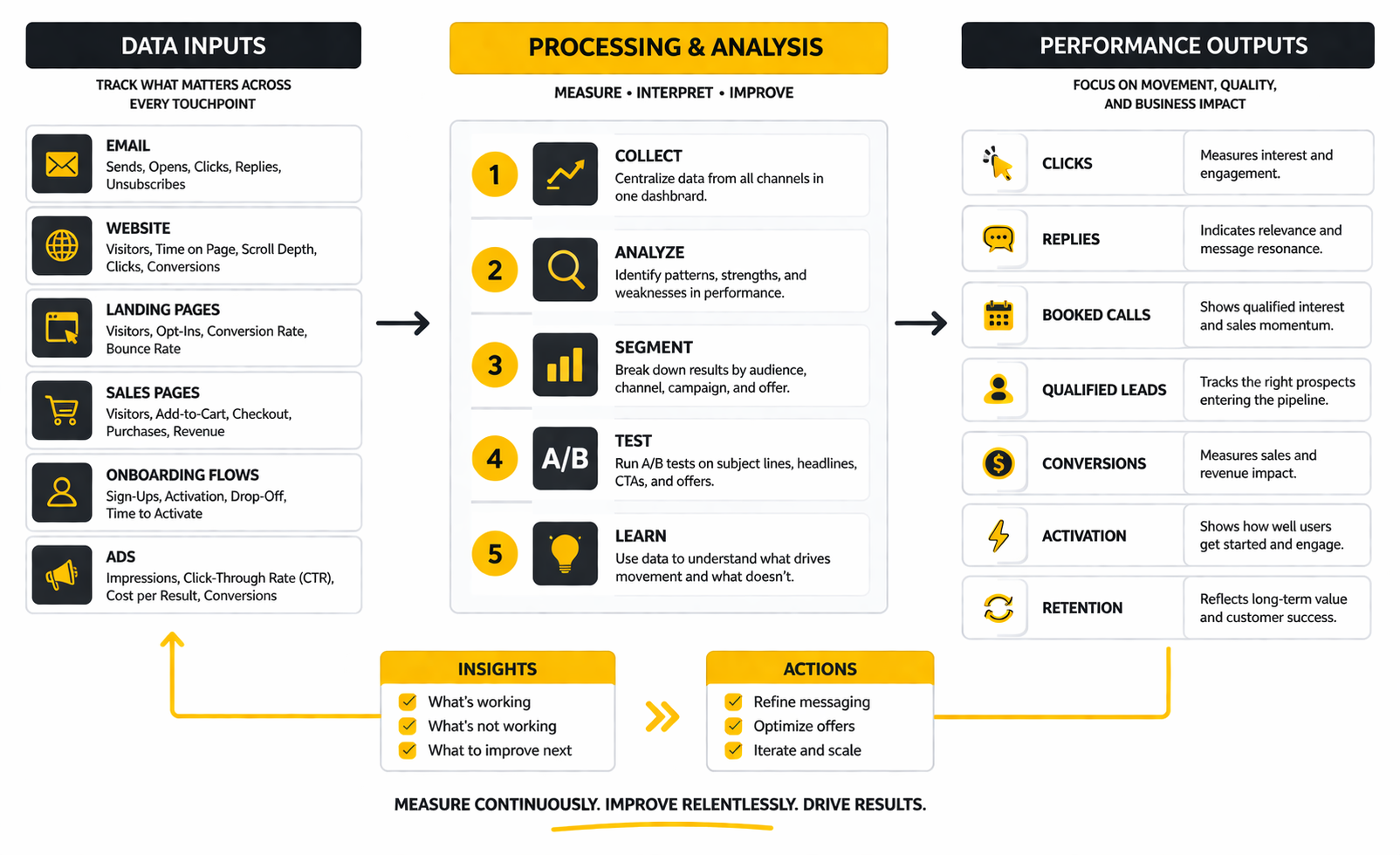
The useful metrics depend on the goal, but they should connect to movement and quality rather than vanity. Clicks, replies, booked calls, qualified leads, conversions, activation, and retention usually matter more than surface-level engagement by itself. A freelance copywriter should always ask what the copy was meant to change and whether it changed that thing for the right audience.
Is it better to stay solo or build an agency?
That depends on the business you want, not the one that looks impressive online. Some freelance copywriters earn more, work better, and keep higher quality by staying solo with tighter positioning and better systems. Others eventually build teams, but that only works well when the underlying process is already strong.
How long does it take to build a stable freelance copywriting business?
Usually longer than social media makes it sound. A freelance copywriter has to build trust, proof, positioning, process, and client quality at the same time, and that takes repetition. The encouraging part is that stability often arrives gradually, through better decisions and cleaner systems, not through one dramatic breakthrough.
Final Takeaway
A freelance copywriter wins long term by becoming more useful, not louder. The market does not need more vague personal brands promising “high-converting copy” with no real thinking behind it. It needs professionals who can understand a business, clarify an offer, shape a message, run a clean process, and improve performance without turning every project into chaos.
That is the real standard. If you can attract the right clients, do the work properly, measure what happened, and keep tightening the system, you are no longer just freelancing in the casual sense. You are building a business around a skill that still matters.
Work With Professionals
Explore 10K+ Remote Marketing Contracts on MarkeWork.com
Most marketers spend too much time chasing clients, competing on crowded platforms, and losing a percentage of every project to middlemen.
MarkeWork gives you a better way. Browse thousands of remote marketing contracts and connect directly with companies desperate to hire skilled marketers like you, without platform commissions and without unnecessary gatekeepers.
If you're serious about finding better opportunities and keeping 100% of what you earn, explore available contracts and create a profile for free at MarkeWork.com.