

Freelance digital marketing is no longer a side lane in the industry. It has become a practical hiring model for startups, local businesses, ecommerce brands, creators, and even larger companies that need specialist help without building a full in-house team. That shift makes sense when you look at the market around it: the U.S. Bureau of Labor Statistics still expects marketing leadership roles to grow over the next decade, while platforms like Upwork report rising demand for skills such as campaign management, display advertising, and email marketing. Bureau of Labor Statistics+1
For the freelancer, this creates real opportunity, but it also creates noise. A lot of people use the phrase freelance digital marketing as if it means “do everything online,” and that is exactly where many careers get messy. The marketers who build durable businesses usually do the opposite: they define a sharp offer, connect it to business outcomes, and build systems that make them look reliable from day one.
This article is built to help you think about freelance digital marketing the right way. Not as a vague collection of tactics, but as a business model, a service framework, and a professional operating system. The goal is to give you a clear path from understanding the landscape to offering services, running delivery, winning clients, and avoiding the mistakes that make good marketers look amateur.
Article Outline
- What Freelance Digital Marketing Really Means
- Why Businesses Hire Freelance Digital Marketers
- The Freelance Digital Marketing Framework
- Core Services That Clients Actually Buy
- How to Run the Work Like a Professional
- Common Mistakes, Smart Trends, and FAQ
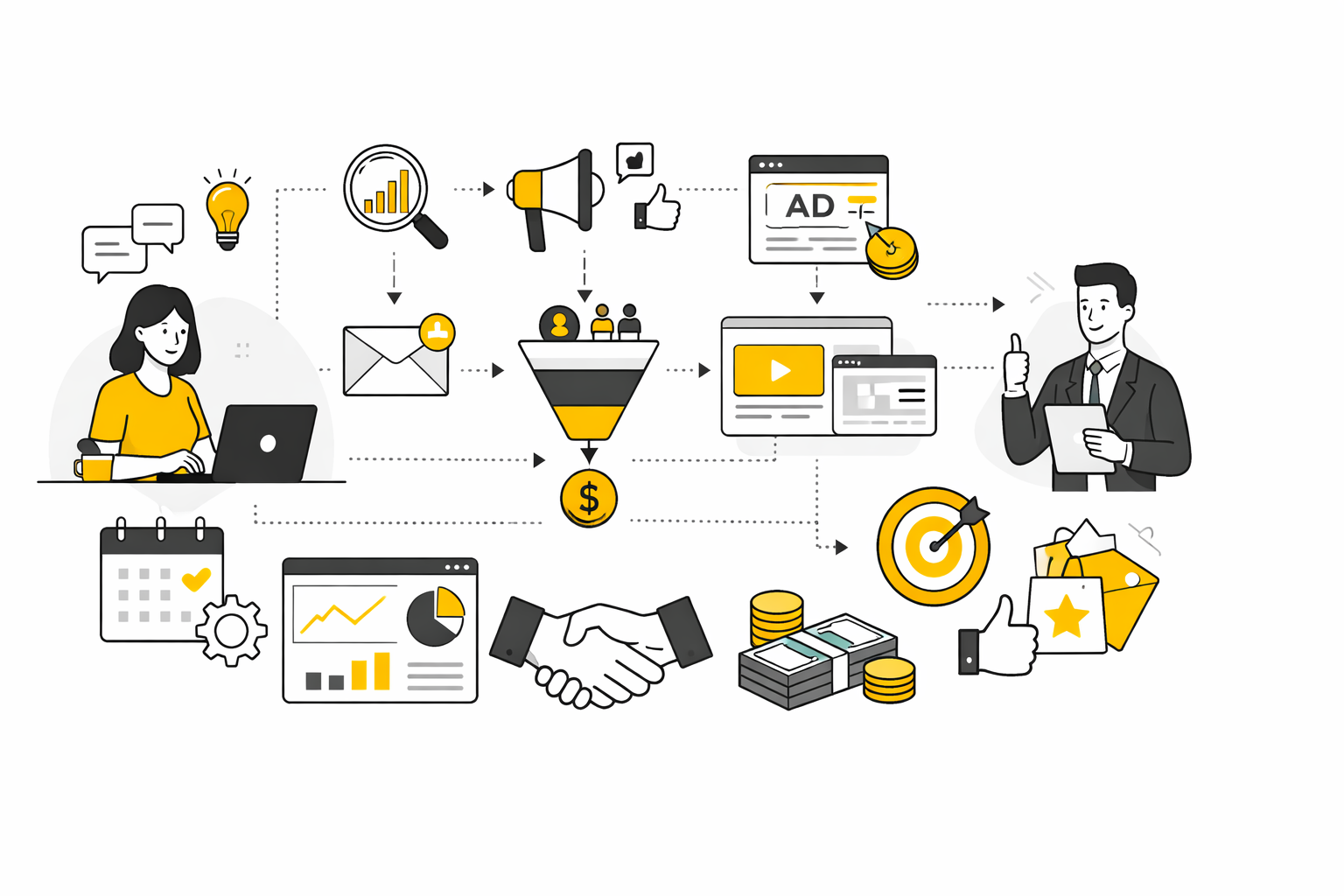
Why Freelance Digital Marketing Matters Right Now
The timing matters more than most people realize. Global advertising spend reached almost US$1.1 trillion in 2024, and digital channels are responsible for most of the growth since 2019. At the same time, businesses are under pressure to move faster, test more channels, and prove results more clearly, which makes flexible outside talent attractive when a full-time hire feels too slow, too expensive, or too narrow. DataReportal – Global Digital Insights+1
That is why freelance digital marketing is valuable on both sides of the deal. Companies get access to specialist execution without carrying the fixed overhead of a larger internal team. Freelancers get the ability to build around a strength, choose a niche, and create income from performance, speed, and expertise rather than from job titles alone.
There is another reason this topic matters: digital marketing itself has become more fragmented. Search, paid social, email, analytics, short-form video, CRM automation, landing pages, local discovery, and AI-assisted production all connect, but they do not all belong in one person’s offer. A freelancer who understands where their work fits in that larger machine is much easier to hire, much easier to trust, and much more likely to keep clients.
For smaller businesses especially, freelance digital marketing often fills the exact gap between “we know we need to market online” and “we are not ready for a full department.” Google still positions its Business Profile as a free way to turn Search and Maps visibility into customers, which tells you something important: even the biggest platforms know that practical digital growth often starts with lean execution, not giant campaigns. Google Business+1
What Freelance Digital Marketing Really Means
At its core, freelance digital marketing is the business of helping a client attract attention, generate demand, convert leads, or retain customers through digital channels on an independent contract basis. That definition sounds simple, but the important word is business. Clients are not paying for random content, scattered ads, or activity for its own sake. They are paying for movement in a funnel, a channel, or a revenue process.
That is why the best way to think about the field is not by platform first, but by commercial role. Some freelancers help clients get found through SEO or local search. Some help them buy attention through paid media. Some help them convert existing traffic through landing pages, email sequences, and funnel design. Others focus on retention, reporting, or automation. Those are different jobs, different promises, and often different buyers.
This also explains why broad “full-service” positioning is usually weaker than people think. Businesses do want range, but they trust clarity more. A freelancer who can clearly say, “I help B2B companies turn paid traffic into booked demos,” or “I help local service brands generate qualified leads from Google Search and Maps,” sounds far more credible than someone who claims to do every kind of marketing for every kind of client.
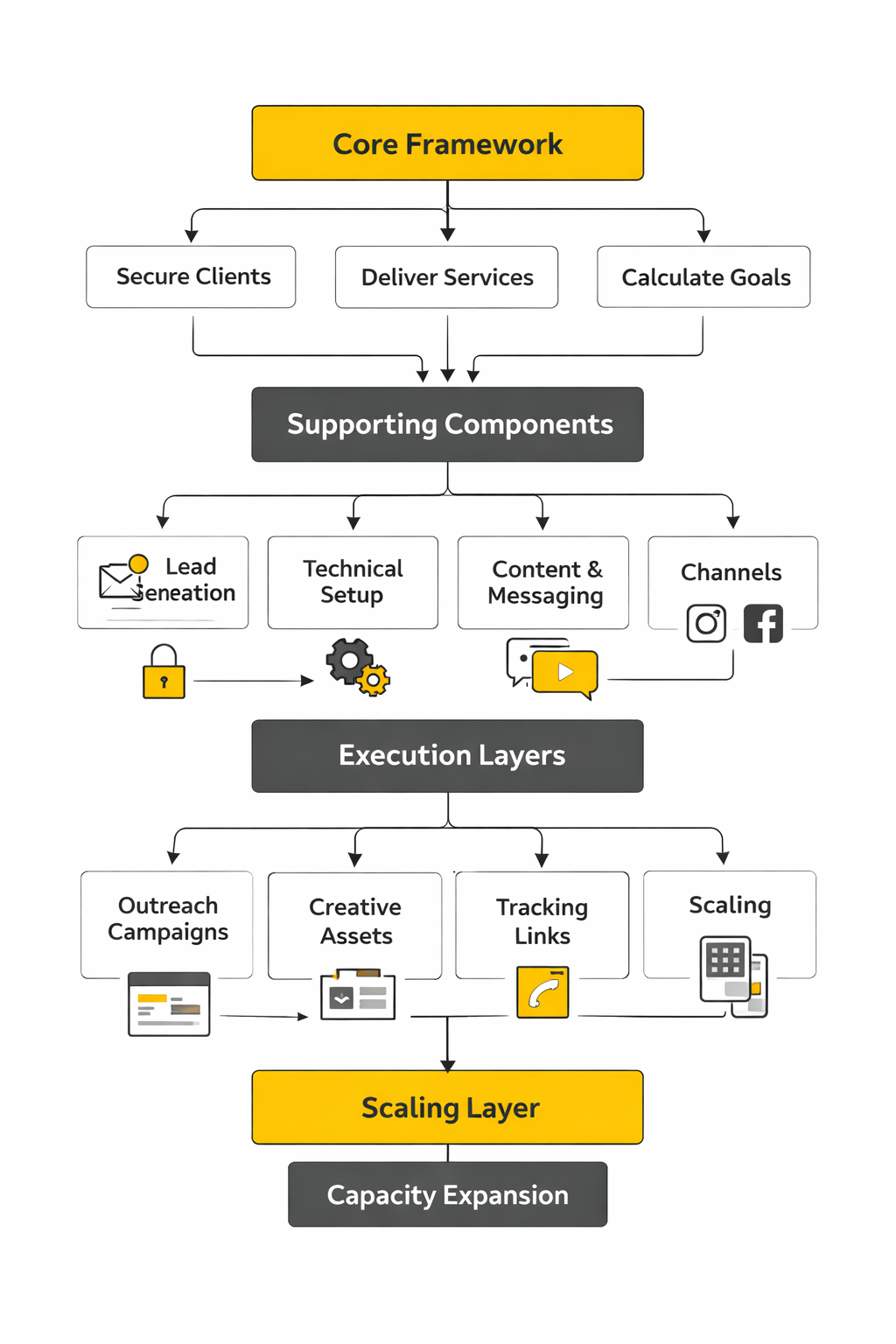
The Six-Part Framework This Article Will Follow
This guide is organized to match the way a real freelance digital marketing business is built. First, you need a clear understanding of the role itself and the market forces behind it. Then you need to see why businesses buy these services, because client demand shapes positioning more than freelancer preference ever will.
After that, the article moves into the actual framework: how freelance digital marketing works as a system rather than as a pile of disconnected tactics. From there, we break down the core services clients actually pay for, because knowing the market categories helps you define an offer that is easier to sell. The later sections shift into implementation, where process, tools, communication, measurement, and reliability become the difference between getting hired once and getting retained.
This structure is deliberate. A lot of articles rush straight into tactics, but tactics make much more sense once the commercial logic is clear. By the time you reach the final part, you should not just understand freelance digital marketing as a topic. You should be able to see how to shape it into a focused, professional, and sustainable service business.
What Comes Next
The next part moves into the buyer’s perspective. That matters because freelance digital marketing becomes much easier to sell once you understand why companies bring in independent specialists in the first place, what pressures they are under, and what kind of outcomes they actually value.
From there, the article will build toward a practical framework you can use to evaluate channels, define services, and package your work in a way that feels commercially serious. That is the real aim here: not just to explain the term freelance digital marketing, but to show how it works when it is done well.
Why Businesses Hire Freelance Digital Marketers
Most clients do not wake up looking for a “freelancer” in the abstract. They are usually trying to solve a more specific business problem: leads are inconsistent, ad performance is slipping, content is going out without a strategy, or nobody on the team has time to own the channel properly. That is why freelance digital marketing becomes attractive when a company needs progress faster than a traditional hire can deliver and with less long-term commitment than a full agency retainer. Upwork’s 2025 skills research, Salesforce’s State of Marketing report, and the Constant Contact Small Business Now findings all point in the same direction: businesses want flexible access to specialized marketing capability while staying tightly focused on ROI.
There is also a simple economic reason this model keeps growing. Many businesses are operating in environments where demand changes quickly, channels keep multiplying, and internal teams are expected to do more with tighter scrutiny on performance. In that kind of market, freelance digital marketing is appealing because it lets a company buy exactly the expertise it needs for the stage it is in, instead of hiring a broad generalist and hoping the fit works out later. The pressure on marketers to prove impact while navigating budget constraints is now explicit in Salesforce’s latest research, and small-business confidence in marketing outcomes remains far lower than the amount of effort owners are putting in. Salesforce Constant Contact
Flexibility Beats Fixed Overhead
This is the first big reason businesses hire independent specialists. A full-time marketing hire comes with salary, onboarding time, management overhead, and the risk that the person is either too junior to lead strategy or too senior to stay in the weeds. A freelancer gives the business a way to plug a gap without turning that decision into a permanent organizational commitment.
That matters even more for smaller companies. Constant Contact’s recent small-business reporting shows that many SMBs are increasing marketing effort and, in some cases, budget, but confidence in the effectiveness of that work is still weak. When business owners feel that tension, they usually do not want a bloated setup. They want focused help, fast execution, and a clearer line between spend and outcome, which is exactly where freelance digital marketing fits. Constant Contact Constant Contact news release
For local and service businesses, the math can be even simpler. If visibility on Google Search and Maps can bring in calls, bookings, or walk-in demand, hiring a specialist to improve that pipeline is easier to justify than staffing a wider in-house function. Google’s own Business Profile materials make that practical value obvious by centering discovery, local visibility, and conversion from search intent into customer action. Google Business Profile Google support
Specialist Skills Are More Valuable Than Broad Promises
The second reason businesses hire freelancers is skill concentration. Digital marketing has splintered into enough channels and tools that very few companies can rely on one person to be equally strong at paid acquisition, organic search, lifecycle email, analytics, content systems, CRM automation, creative testing, and reporting. The companies hiring well know this, which is why demand often clusters around narrow capabilities instead of broad “marketing help.” Upwork’s 2025 in-demand skills report World Economic Forum
That trend is not just a freelancer talking point. The World Economic Forum’s 2025 skills research shows that technology literacy, AI and big data, analytical thinking, and creative thinking are all rising in importance, while LinkedIn’s 2025 skills data suggests a major reshaping of workplace skill requirements through 2030. In plain English, businesses are dealing with faster change and they do not always have the internal depth to keep up. Bringing in a freelance digital marketing specialist is often the quickest way to access current platform knowledge without rebuilding the team from scratch. World Economic Forum digest World Economic Forum skills outlook LinkedIn Skills on the Rise 2025
This is also why vague positioning underperforms. Clients usually do not want “someone who does marketing.” They want someone who can fix conversion tracking, launch a search campaign, improve email revenue, build a lead funnel, or tighten organic visibility around a clear commercial goal. The freelancer who speaks that language sounds easier to trust because the buyer can imagine the result before the project even starts.
Speed Matters More Than Most Businesses Admit
Another reason companies choose freelance digital marketing is speed. When a campaign is underperforming, a launch is approaching, or leads have slowed down, the internal problem is rarely theoretical. Revenue teams feel it immediately, and waiting months to define a role, recruit, interview, hire, and ramp someone up is often too slow.
Freelancers reduce that delay because they usually arrive with a method, a tool stack, and a bias toward execution. That is increasingly useful in a market where digital channels keep moving and where platform behavior changes faster than many teams can document internally. DataReportal’s latest global snapshots continue to show the scale of digital behavior worldwide, while Salesforce and HubSpot both highlight how marketers are being pushed to adapt quickly across AI, content, social, email, and performance channels. DataReportal Salesforce marketing trends HubSpot State of Marketing
This is where a good freelancer often beats a slower structure. Not because freelance automatically means better, but because clients value someone who can step in, diagnose fast, and move from “what is happening?” to “here is the next decision” without turning every action into a committee project. In practice, that speed is often the difference between being seen as an expense and being seen as a useful growth operator.
Businesses Want Accountability, Not Just Activity
A lot of companies have already been burned by marketing that looked busy but changed nothing important. They have seen calendars filled with posts, dashboards packed with vanity metrics, and ad spend explained in language that never quite reaches profit, pipeline, or booked revenue. That is one of the biggest hidden drivers behind freelance digital marketing demand: buyers want accountability that feels closer to the work.
Independent marketers are often hired because the reporting line is simpler. One person owns the task, the timeline, the setup, and the explanation. When that person can connect channel work to lead quality, conversion rate, cost efficiency, retention, or customer acquisition, the relationship becomes much easier to justify than a sprawling arrangement with unclear ownership.
This buyer mindset is also why lean implementation tools matter. A freelancer who can set up practical systems for email, automation, scheduling, forms, CRM, and reporting makes the engagement feel operational instead of theoretical. In the real world, that might mean using a platform like Brevo for email and CRM workflows, Buffer for social publishing, Cal.com for frictionless booking, or Fillout for better lead capture when the client needs cleaner handoffs between marketing and sales.
What Smart Clients Are Really Buying
When you strip the language down, businesses hiring freelance digital marketing are usually buying one of four things. They are buying focus when the in-house team is stretched too thin. They are buying specialization when a channel or system needs real expertise. They are buying speed when the business cannot wait for a full hiring cycle. And they are buying clarity when they want someone closer to the numbers and the execution.
That is the important shift. Clients are not really shopping for marketing tasks in isolation. They are shopping for controlled progress. Once you understand that, the next part of the framework becomes much clearer, because freelance digital marketing stops looking like a random set of services and starts looking like a structured way to move a business from attention to action to revenue.
The Freelance Digital Marketing Framework
By this point, the pattern should be clear. Businesses are not buying random marketing actions. They are buying movement, and that movement follows a structure whether people acknowledge it or not. If you ignore that structure, your work feels scattered. If you understand it, your work starts to look like a system that can be trusted.
Freelance digital marketing works best when you think in terms of flow rather than tasks. Attention turns into interest. Interest turns into action. Action turns into revenue. Revenue turns into retention. Every service you offer should clearly sit somewhere inside that chain, and more importantly, it should connect to the step before and after it.
This is where most freelancers either level up or stall. The ones who succeed stop thinking “what service can I sell?” and start thinking “where in the business pipeline do I create measurable impact?”
From Channels to Outcomes
A lot of confusion in freelance digital marketing comes from starting with channels instead of outcomes. Saying you “run Facebook ads” or “do SEO” is technically true, but it does not tell a client what changes after you are hired. It keeps the conversation stuck at activity level instead of business level.
A stronger approach is to tie each channel directly to a result. Paid ads become a way to generate qualified leads or sales at a target cost. SEO becomes a way to capture high-intent demand already searching for a solution. Email becomes a way to convert and retain existing traffic. Social becomes a distribution layer that supports awareness or engagement depending on the strategy.
Industry data reinforces this shift toward measurable outcomes. HubSpot’s latest State of Marketing highlights how marketers are prioritizing ROI, conversion tracking, and revenue attribution over pure reach metrics, while Salesforce continues to emphasize performance accountability across channels. When businesses think this way, they naturally gravitate toward freelancers who can connect execution to results.
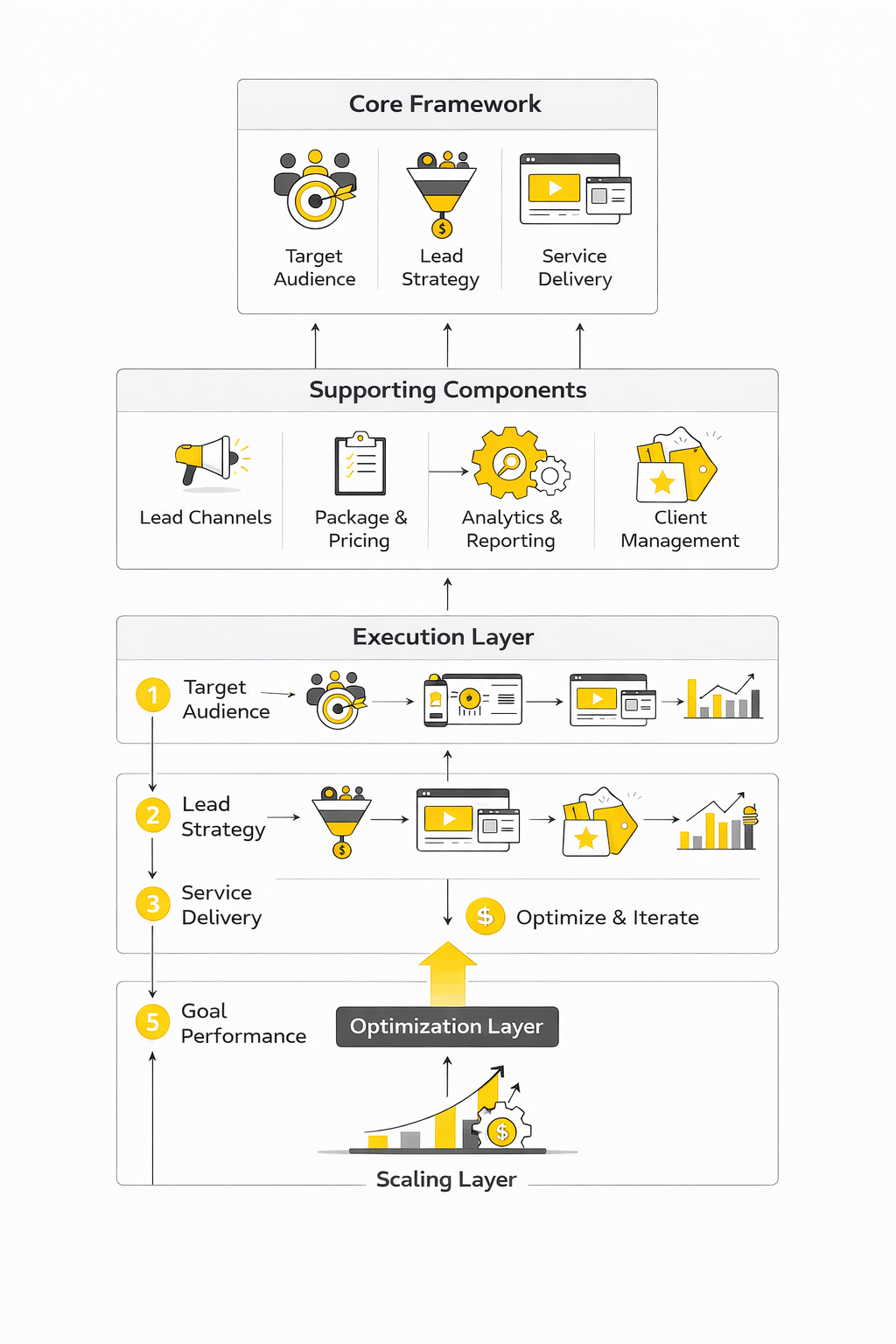
The Core Flow Every Freelancer Should Understand
At a practical level, almost every freelance digital marketing engagement can be mapped into a simple four-stage flow. This is not theory. It is how real campaigns are structured when they are working.
- Traffic / Attention
- Paid ads (Google, Meta, TikTok)
- Organic search and content
- Social distribution
- Partnerships and referrals
- Capture / Conversion
- Landing pages
- Lead forms
- Booking systems
- Ecommerce product pages
- Nurture / Follow-Up
- Email sequences
- Retargeting campaigns
- CRM workflows
- SMS or messaging
- Revenue / Retention
- Sales processes
- Upsells and cross-sells
- Customer experience
- Repeat purchase systems
When you look at freelance digital marketing through this lens, something important happens. You stop trying to do everything and start choosing where you can be strongest. That clarity makes positioning easier, pricing easier, and delivery much more consistent.
Where Most Freelancers Get Stuck
The biggest mistake is trying to operate across all four stages without a system. It usually starts with good intentions. You want to offer more value, so you take on ads, landing pages, email, analytics, and reporting all at once. The problem is that without a clear process, this turns into fragmented work that is hard to manage and even harder to explain.
Clients feel that confusion quickly. They may not say it directly, but they sense when work lacks structure. Campaigns feel disconnected. Results take longer to interpret. Communication becomes reactive instead of planned. This is exactly where freelance digital marketing starts to look unreliable, even if the individual pieces are technically correct.
The fix is not to do less work. The fix is to organize your work into a repeatable framework that clients can follow and trust.
Turning the Framework Into a Working Process
This is where execution becomes real. A strong freelance digital marketing setup does not just define stages. It defines how work moves through those stages in a predictable way.
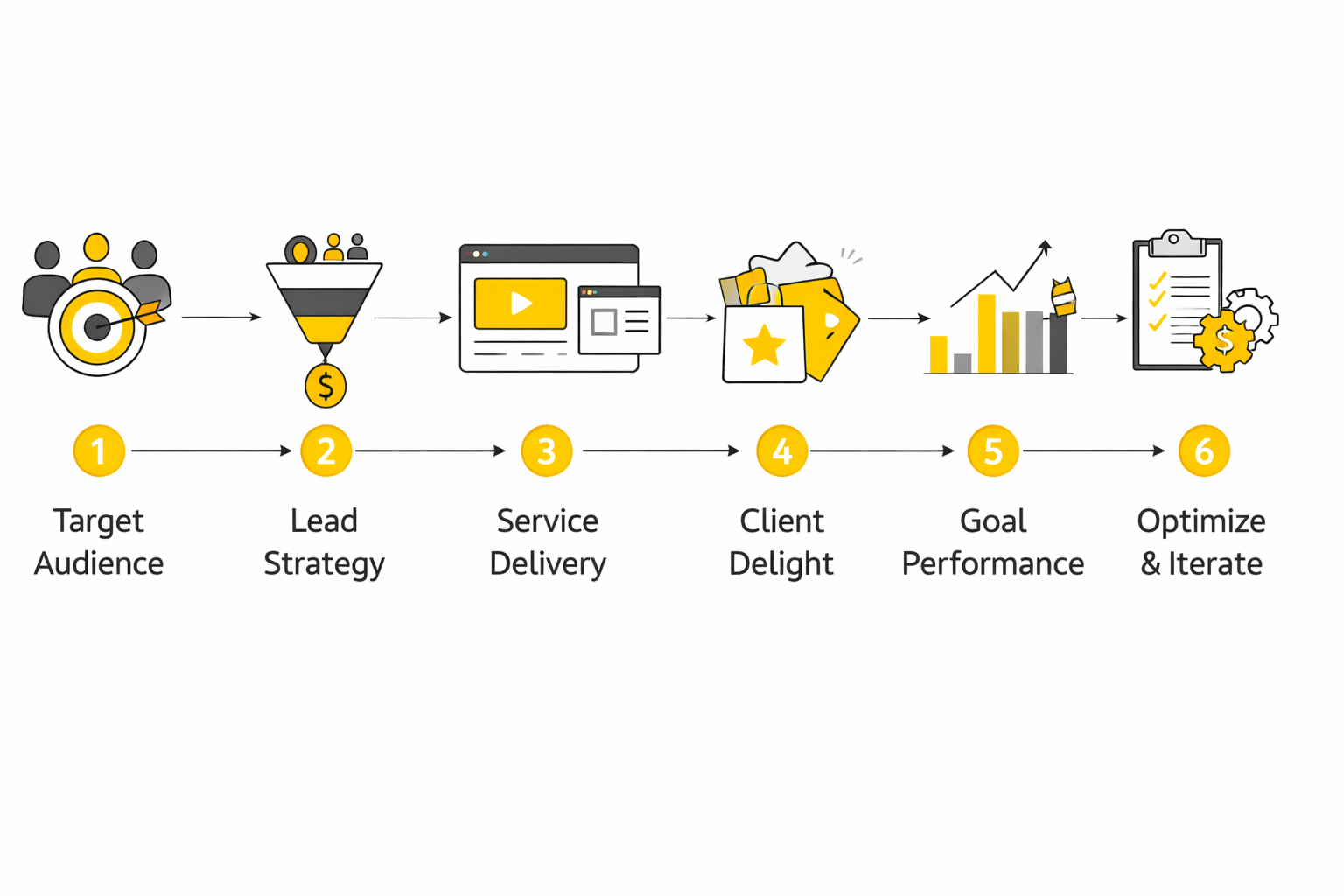
A simple but effective implementation process looks like this:
Step 1: Diagnose the Bottleneck
Before touching any channel, you identify where the business is losing momentum. Is traffic too low? Are visitors not converting? Are leads not turning into customers? This step matters because solving the wrong problem wastes both time and budget.
Step 2: Define the Primary Objective
You narrow the focus to one clear outcome. That could be lowering cost per lead, increasing conversion rate, improving booking volume, or boosting repeat purchases. Without this step, freelance digital marketing drifts into “doing things” instead of driving results.
Step 3: Build the Minimum System
Instead of overbuilding, you create the simplest version of the system that can work. That might mean a focused landing page, a basic email sequence, and a clean tracking setup. Tools like Systeme.io or ClickFunnels are often used here because they allow fast deployment without heavy technical overhead.
Step 4: Launch and Collect Data
You push the system live quickly and start collecting real performance data. This is where many freelancers hesitate, but speed matters. Data from actual users is always more valuable than assumptions made during planning.
Step 5: Optimize Based on Signals
Once data comes in, you refine the system. That might mean adjusting targeting, improving messaging, simplifying forms, or restructuring the offer. The key is to make decisions based on patterns, not guesses.
Step 6: Stabilize and Scale
After the system starts producing consistent results, you stabilize it and then scale what works. This could involve increasing ad spend, expanding keyword coverage, or adding new acquisition channels while keeping the core system intact.
Why This Process Changes Everything
When you operate like this, freelance digital marketing stops feeling chaotic. You are no longer juggling disconnected tasks. You are running a controlled process that moves a business toward a defined outcome.
Clients notice the difference immediately. Communication becomes clearer because every action ties back to a stage in the process. Reporting becomes simpler because you are tracking movement through a system, not isolated metrics. Most importantly, your work becomes easier to value because it is tied to progress, not effort.
This is also where your positioning strengthens naturally. Instead of saying you “offer marketing services,” you can show that you run a structured process that identifies bottlenecks, builds systems, and improves performance over time. That is a very different conversation, and it is exactly the kind of conversation businesses are already looking for when they hire freelance digital marketing professionals.
Understanding the Numbers That Actually Matter
At this stage, freelance digital marketing stops being about setup and starts being about interpretation. Data is everywhere, but most of it is noise unless you know what to look for and what decisions it should drive. The goal is not to collect more metrics. The goal is to understand which signals tell you whether the system is moving forward or breaking down.
This is where many freelancers lose credibility. They present dashboards filled with impressions, clicks, and engagement without tying those numbers back to outcomes. Businesses do not care about activity in isolation. They care about whether traffic turns into leads, whether leads turn into customers, and whether those customers generate revenue over time.
The difference between average and high-level freelance digital marketing is simple: you measure what moves the business, not what looks impressive in a report.
The Core Metrics That Drive Decisions
Every stage of the framework introduced earlier has its own set of metrics, but not all metrics carry equal weight. The key is to prioritize numbers that indicate progress between stages, not just performance within a single channel.
Here is how that breaks down in practice:
Traffic Quality, Not Just Volume
Raw traffic numbers mean very little on their own. A spike in visitors can look positive while hiding the fact that those users have no intent to buy or engage. What matters more is how that traffic behaves once it arrives.
Key signals to watch:
- Bounce rate and time on page
- Pages per session
- Traffic source quality (organic vs paid vs referral)
Google’s own analytics guidance emphasizes behavior and engagement over raw session counts because those signals are better indicators of whether content matches user intent. Google Analytics help
For freelance digital marketing, this translates into a simple rule: if traffic is increasing but conversions are flat, the problem is not volume. It is alignment.
Conversion Rate Is the Real Lever
Conversion rate is one of the most important metrics across all digital marketing work because it connects attention to action. Whether the goal is leads, bookings, or purchases, this number tells you how efficiently the system is working.
Industry benchmarks vary, but multiple studies from platforms like WordStream and Unbounce consistently show that average landing page conversion rates often sit in the low single digits, while top-performing pages can reach double digits depending on the niche. WordStream benchmarks Unbounce conversion benchmark report
The takeaway is not the exact percentage. It is the gap between average and high performance. That gap is where most freelance digital marketing value is created. Improving conversion rate even slightly can outperform large increases in traffic because it affects every visitor, not just new ones.
Cost Per Result Defines Sustainability
Once paid channels are involved, cost efficiency becomes unavoidable. Cost per lead, cost per acquisition, or cost per click are not just performance metrics. They determine whether a campaign can scale or whether it will collapse under its own spend.
Platforms like Google Ads and Meta Ads both structure their reporting around these cost-based metrics because they directly reflect the relationship between spend and outcome. If acquisition cost exceeds customer value, the system breaks no matter how good the creative or targeting looks.
For freelancers, this is where positioning becomes stronger. When you can control or improve cost per result, you are no longer seen as someone running ads. You are seen as someone protecting and improving the economics of the business.
Customer Value Changes Everything
One of the most overlooked areas in freelance digital marketing is what happens after the first conversion. Many freelancers stop at lead generation or initial sales, but real performance often depends on lifetime value, retention, and repeat purchases.
Research from HubSpot’s marketing data and multiple ecommerce reports consistently show that returning customers tend to convert at higher rates and generate more revenue over time. This shifts the entire strategy. A campaign that looks expensive on the first purchase can become highly profitable if retention is strong.
That is why freelancers who understand customer value can make better decisions about acquisition. They can justify higher upfront costs, build stronger email systems, and create follow-up processes that increase total revenue instead of chasing cheap leads that never convert properly.
Building a Simple Analytics System
At this point, the challenge is not knowing which metrics exist. It is building a system that makes those metrics usable. Freelance digital marketing becomes much more effective when data flows through a clear structure instead of being scattered across tools.
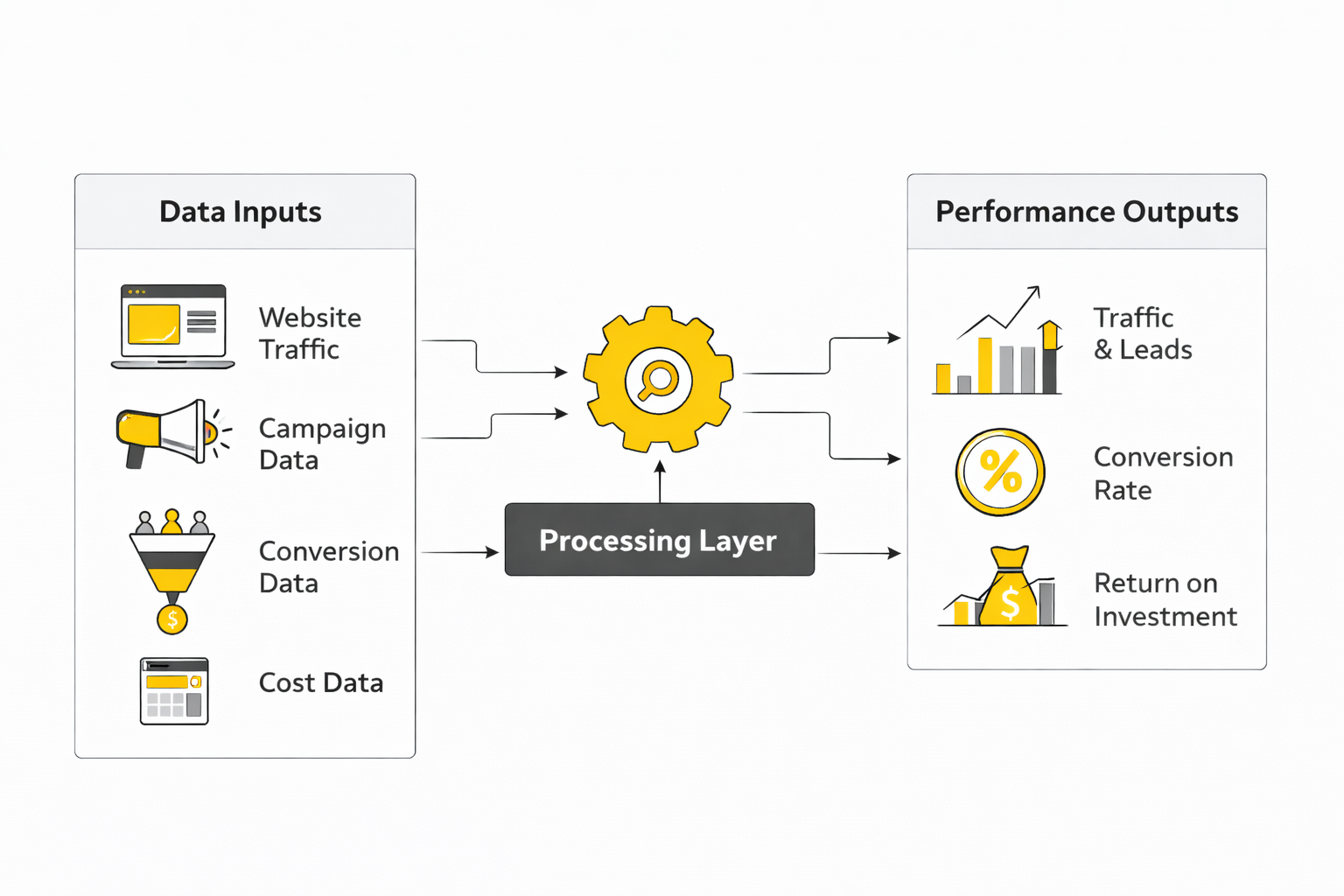
A practical analytics setup usually includes:
1. Clean Tracking Foundation
Everything starts with accurate tracking. That means properly configured analytics, conversion events, and attribution. Without this, every decision is built on incomplete or misleading data.
Tools like Google Analytics, ad platform dashboards, and CRM systems all need to align so that conversions are recorded consistently. If a lead is generated but not tracked, optimization becomes guesswork.
2. Centralized Reporting View
Instead of jumping between platforms, you create a simple reporting layer that pulls key metrics into one place. This does not need to be complex. The goal is clarity, not complexity.
For freelancers working with smaller clients, combining email and CRM data through platforms like Brevo or integrating scheduling data from Cal.com can already provide a clearer picture of how leads move through the system.
3. Stage-Based Metrics
You map metrics directly to the four-stage framework:
- Traffic stage -> engagement metrics
- Conversion stage -> conversion rate
- Nurture stage -> open rates, click rates, response rates
- Revenue stage -> sales, revenue, retention
This removes confusion because each metric has a defined role. You are no longer analyzing numbers in isolation. You are tracking movement through a system.
4. Regular Review and Adjustment
Data only becomes useful when it drives action. That means reviewing performance regularly and making decisions based on patterns, not isolated spikes.
A good rule is simple:
- If a metric improves consistently, scale it
- If a metric declines, investigate the cause
- If a metric stays flat, test something new
This creates a rhythm where freelance digital marketing becomes iterative instead of reactive.
What the Data Should Actually Tell You
The most important shift is learning how to read data as a story instead of as a collection of numbers. Every campaign is telling you something about user behavior, market demand, and system performance.
If traffic is high but conversions are low, the message or offer is likely misaligned. If conversions are strong but volume is low, the system needs more exposure. If leads are coming in but sales are weak, the issue is likely in follow-up or qualification. Each pattern points to a specific stage in the process.
This is where freelance digital marketing becomes strategic. You are no longer reporting what happened. You are explaining why it happened and what should happen next.
That ability is what turns analytics from a reporting task into a decision engine. And once you reach that level, your value is no longer tied to execution alone. It is tied to direction, which is exactly what most businesses are actually looking for when they invest in freelance digital marketing.
How to Run the Work Like a Professional
Once the framework and analytics are in place, the next challenge is operational maturity. This is the part many people underestimate. Freelance digital marketing does not usually fail because of a lack of tactics. It fails because delivery becomes messy, scope expands quietly, reporting gets inconsistent, and the client starts feeling uncertainty where they wanted confidence.
Professional implementation is really about reducing friction. The client should know what is happening, why it is happening, what success looks like, and what decisions are next. That sounds obvious, but it is rare enough that it becomes a competitive advantage on its own.
This is also where the business side of freelance digital marketing becomes visible. You are not just optimizing campaigns. You are managing expectations, timelines, access, approvals, risks, and communication in a way that makes the whole engagement feel stable.
The Tradeoff Between Specialization and Capacity
Specialization makes you easier to hire, but it also creates a practical ceiling. If your offer is tightly focused, that usually improves positioning, conversion, and client trust. At the same time, it can limit how much revenue you can extract from a single account unless you expand into adjacent services or raise pricing based on business impact.
That is the real tradeoff. A narrow offer is easier to sell, but a broader delivery model can increase account value if it stays coherent. The danger is trying to expand too early and turning a sharp freelance digital marketing offer into a vague mini-agency promise that is harder to execute well.
This is where judgment matters. If you are known for lead generation, it makes sense to move one step downstream into landing pages, CRM routing, or follow-up automation. It makes far less sense to suddenly offer brand strategy, video editing, SEO, lifecycle email, and design just because a client asked. Growth should follow the system, not random demand.
Scope Creep Is Usually a Process Problem
Most scope creep does not arrive dramatically. It arrives politely. A client asks for one more landing page, a quick extra report, another ad variation, a social calendar review, or help with a tool integration that was never part of the original engagement. Each request seems small, but the combined effect can quietly destroy margins and create delivery stress.
This is why strong boundaries are not a personality issue. They are a systems issue. The clearer your onboarding, deliverables, revision limits, communication rhythm, and reporting structure, the less room there is for confusion. In freelance digital marketing, professionalism often shows up as structure long before it shows up as brilliance.
It also helps to anchor every request to the agreed objective. If the extra work clearly improves the main business goal, you can price it or fold it into a revised scope. If it does not, it should be treated as separate. That keeps the relationship focused and stops the project from turning into unpaid operational support.
Scaling Without Breaking the System
A lot of freelancers say they want to scale, but what they actually mean is that they want more revenue without more chaos. Those are not automatically the same thing. In freelance digital marketing, scale can come from higher-value positioning, productized services, better retainers, tighter systems, selective subcontracting, or tool-assisted efficiency. It does not always mean building an agency.
That distinction matters. The World Economic Forum continues to rank analytical thinking, AI literacy, and creative problem-solving among the most important skills in the near-term economy, while LinkedIn’s skills research points to ongoing changes in how work is structured and what employers value. The implication for freelancers is clear: scale comes less from doing more manual work and more from building leverage through systems, decision quality, and efficient execution. World Economic Forum LinkedIn Skills on the Rise 2025
The safest way to scale is to standardize before you expand. That means repeatable onboarding, templated reporting, clear success metrics, documented workflows, and a limited tool stack. If those pieces are weak, adding more clients only magnifies the disorder. If those pieces are strong, growth becomes much more controlled.
AI Changes the Workflow, Not the Need for Judgment
This part matters more than the hype usually admits. AI can absolutely compress research, drafting, ideation, reporting support, transcription, and admin-heavy work. That makes freelance digital marketing faster in some areas and more competitive in others. It also raises the bar because clients increasingly expect speed without accepting lower quality.
But faster production is not the same as better marketing. The strategic value still comes from judgment: choosing the right bottleneck, reading the data properly, understanding offer-market fit, and making decisions that improve the economics of the campaign. That is why AI is more useful as an amplifier than a replacement for serious freelance work.
Used well, it becomes operational leverage. A freelancer can tighten workflows with tools for automation, scheduling, form capture, CRM support, and research assistance instead of spending hours moving information manually. In practice, that might mean pairing Buffer for social scheduling, Brevo for CRM and email automation, Firecrawl for structured web extraction, Chatbase for client-facing AI support experiences, or Wispr Flow to reduce friction in day-to-day communication and drafting. The tools help, but they only create an advantage when they sit inside a disciplined process.
The Risk of Over-Reporting and Under-Explaining
Some freelancers report too little. Others report too much. Both are problems. When reporting is too thin, the client feels blind. When it is too dense, the client gets buried in numbers without understanding what changed or what should happen next.
The real skill is interpretation. A professional freelance digital marketing report should answer a few core questions clearly: what happened, why it happened, what it means for the business, and what decision follows. That is the level clients actually value because it turns data into direction.
This is also one of the fastest ways to separate yourself from low-trust operators. Businesses are under more pressure than ever to connect spend to performance and defend budget decisions with real evidence, which is exactly why ROI language now sits so close to budget planning in enterprise marketing guidance. Salesforce on 2025 budget planning Salesforce marketing statistics If your reporting makes the next move clearer, you become harder to replace.
Client Fit Matters More Than Freelancer Talent
Not every client is a good client, and this is where experience becomes protective. Some businesses have weak offers, broken sales processes, unrealistic timelines, or internal politics that no freelancer can fix from the marketing layer alone. In those situations, even solid freelance digital marketing work can look ineffective because the surrounding system cannot convert the opportunity.
That is why advanced freelancers qualify hard before they commit. They assess whether the product is strong enough, whether the sales handoff exists, whether tracking can be trusted, whether decision-makers are accessible, and whether the business is actually prepared to act on the findings. This saves a huge amount of pain later.
It also keeps your results cleaner. A freelancer who says yes to every account usually ends up carrying problems that were never marketing problems to begin with. A freelancer who screens for fit can focus on work where strategy, execution, and business reality actually line up.
The Best Freelance Digital Marketing Businesses Feel Boring in the Right Way
This might sound strange, but it is true. At a high level, good freelance digital marketing is often less dramatic than people expect. It is structured onboarding, clean tracking, consistent communication, calm optimization, good documentation, and steady improvement over time. It feels boring because the panic has been removed from the process.
That is exactly what clients pay for. They do not want endless reinvention. They want controlled progress. They want fewer surprises, better decisions, and more confidence that the system is moving in the right direction.
That is where the article now turns for the final stretch. The last part will bring the whole picture together by looking at common mistakes, practical trends shaping the field, and the questions people usually ask when they are deciding whether freelance digital marketing is the right path or the right hire.
FAQ - Built for Complete Guide
What is freelance digital marketing in simple terms?
Freelance digital marketing means helping businesses grow through online channels while working independently instead of as an employee. That can include lead generation, SEO, paid ads, email marketing, content strategy, analytics, funnel building, or conversion optimization. The important part is not the contract model alone. It is the fact that the marketer is hired for targeted business outcomes, not just general activity.
Is freelance digital marketing a real long-term career or just a side hustle?
It is absolutely a real career, but only when treated like a business. The market is moving toward skills-based hiring and specialist talent, which is one reason Upwork’s 2025 research and the interactive In-Demand Skills 2025 data both emphasize deep expertise over broad generalist positioning. That creates room for serious freelancers, but it also means casual positioning gets exposed quickly.
What services are easiest to sell in freelance digital marketing?
The easiest services to sell are usually the ones tied closest to revenue or lead flow. That often means paid search, paid social, landing page optimization, email automation, local SEO, or conversion-focused content. Businesses are much more likely to buy work that solves a visible bottleneck than work that sounds vaguely useful.
Do businesses actually prefer freelancers over agencies?
Sometimes yes, especially when they need speed, focus, and a more direct working relationship. Many companies do not want to pay for layers of account management when what they really need is a specialist who can diagnose a problem and execute cleanly. The appeal of freelance digital marketing is that it often feels more accountable because the person doing the work is also the person explaining the results.
How much specialization is too much?
Specialization becomes a problem only when it is so narrow that the market is tiny or the service cannot connect to a meaningful business outcome. In most cases, freelancers benefit from being specific enough to be understood quickly but flexible enough to move one step upstream or downstream in the same system. A strong niche usually sounds like a clear commercial promise, not just a platform preference.
What should a freelancer measure first for a new client?
Start with the metric closest to the client’s main goal, then work backward. If the goal is more booked calls, measure qualified leads and booking conversion before obsessing over clicks. If the goal is ecommerce growth, focus on purchase conversion, average order value, and retention before celebrating reach. Good freelance digital marketing always starts with business math, not vanity metrics.
Is AI making freelance digital marketing easier or harder?
Both, and that is why judgment matters more now. AI is making production faster, research lighter, and execution more scalable, which raises client expectations around speed and output. At the same time, marketers still need interpretation, prioritization, and decision-making, and that is exactly where human value stays high. HubSpot’s AI trends for marketers shows growing investment in automation, while Salesforce’s latest State of Marketing report keeps pushing the same message from another angle: teams want AI, but they want measurable returns from it.
What tools matter most when building a freelance digital marketing setup?
The right stack depends on the offer, but most freelancers need a few basics: analytics, communication, scheduling, CRM or email automation, and some kind of workflow support. For many client setups, that can mean combining Brevo for CRM and email, Moosend for campaigns and automation, Buffer for publishing, and Cal.com for booking. The point is not to collect tools. The point is to create a reliable operating system that reduces friction for both you and the client.
How do freelancers avoid competing only on price?
By making the offer easier to value. When your positioning is vague, the buyer compares you to everyone else doing “marketing help.” When your offer is tied to a clear result, a channel-specific bottleneck, or a measurable system improvement, price becomes only one part of the decision. Freelance digital marketing gets more profitable when the client understands exactly what problem you solve and what progress should look like.
Should freelance digital marketers build funnels and landing pages too?
Often yes, especially when those assets are directly connected to the result you are responsible for. Traffic without conversion infrastructure is fragile, and many campaigns underperform because the click destination is weak rather than because the acquisition channel is broken. That is why many freelancers expand naturally into simple funnel builds with tools like ClickFunnels or Systeme.io when the project clearly needs a tighter conversion path.
Is content still worth offering, or has AI commoditized it?
Content still matters, but generic content is absolutely easier to replace now. The real value is in strategy, distribution, intent alignment, and conversion relevance. HubSpot’s current marketing statistics still show strong ROI from several content formats, including blog content and video, but the winning work is becoming more distinct, more useful, and better connected to the funnel. In other words, content is not dead. Lazy content is.
What skills matter most for the future of freelance digital marketing?
Analytical thinking, communication, adaptability, and AI literacy are becoming core. The Future of Jobs Report 2025 highlights analytical thinking as the most sought-after core skill among employers, and it also points to broad skill disruption over the coming years. That fits freelance digital marketing perfectly because the field rewards people who can interpret messy situations, adapt to changing platforms, and keep tying execution back to business outcomes.
How do freelancers know when to scale?
Scale when the work is repeatable, margins are healthy, and delivery quality is stable. Do not scale just because you are busy. Many freelancers confuse overload with traction and then add complexity before they have documented processes, clean reporting, and consistent onboarding. The safest growth happens when the system is already working and scale simply gives it more volume.
What is the biggest mistake new freelance digital marketers make?
Trying to sell everything to everyone. It feels safer at first, but it usually creates weak positioning, messy delivery, and unclear results. New freelancers often think more services means more opportunity, when in reality it often means less trust. The sharper move is to build around one strong capability, prove results, and expand only where it reinforces the same system.
Is freelance digital marketing better for beginners or experienced marketers?
Both can succeed, but they succeed differently. Beginners usually need to narrow down faster, build proof carefully, and focus on one problem they can solve well. Experienced marketers have the advantage of pattern recognition and business judgment, which makes client trust easier to earn. Either way, freelance digital marketing rewards clarity and reliability far more than flashy self-promotion.
Final Takeaway
Freelance digital marketing works when it is treated as a structured business discipline rather than a vague collection of online tactics. The strongest freelancers understand the commercial role of their work, diagnose the right bottleneck, build a system that matches the client’s reality, and use data to drive decisions instead of decoration. That is what makes the model sustainable.
It also explains why the field keeps growing. Businesses need specialist execution, flexible capacity, better accountability, and faster adaptation across channels that keep changing. Freelancers who can offer that with a clear process and a calm, professional delivery model are in a strong position. Not because the market is easy, but because clarity is valuable and confusion is expensive.
Work With Professionals
Explore 10K+ Remote Marketing Contracts on MarkeWork.com
Most marketers spend too much time chasing clients, competing on crowded platforms, and losing a percentage of every project to middlemen. MarkeWork gives you a better way. Browse thousands of remote marketing contracts and connect directly with companies desperate to hire skilled marketers like you, without platform commissions and without unnecessary gatekeepers.
If you're serious about finding better opportunities and keeping 100% of what you earn, explore available contracts and create a profile for free at MarkeWork.com.