

Freelance marketing used to mean being a generalist, chasing random projects, and hoping referrals kept the pipeline alive. That model is getting weaker, not stronger, because clients now expect sharper specialization, faster execution, and clearer proof that the work moves revenue, leads, or pipeline. The opportunity is still huge, but it belongs to freelancers who treat marketing like a business system instead of a collection of gigs.
That shift is backed by what is happening in the market. Upwork’s 2025 workforce research says skilled knowledge freelance work generated more than $1.5 trillion in earnings in 2024 in the United States, while the U.S. Bureau of Labor Statistics projects 36,400 openings per year on average for advertising, promotions, and marketing managers from 2024 to 2034. Put those two signals together and the message is clear: demand for marketing skill is real, but the winners will be the people who can package that skill in a way companies can buy quickly and trust immediately.
There is another change underneath all this. LinkedIn’s recruiting research shows skills-based hiring can expand talent pools by 10x, and Content Marketing Institute’s 2025 benchmarks show many teams still lack a scalable model for content creation. That combination creates room for a freelance marketer who can step in with a clear offer, a repeatable workflow, and measurable outcomes instead of vague “full-service” promises.

Article Outline
This article is structured as one practical playbook, not a theory piece. Each part builds on the one before it, so by the end you will have a complete model for starting, tightening, or upgrading a freelance marketing business that actually makes sense in today’s market. The section names below are the same ones the rest of the article will use.
- Why Freelance Marketing Matters Right Now
- The Freelance Marketing Framework
- Core Services, Positioning, and Niches
- How To Find Clients and Build Demand
- How To Deliver Work Like a Professional
- Pricing, Systems, and Long-Term Growth
The Freelance Marketing Framework
The core idea of freelance marketing is simple: you are not selling “marketing help.” You are selling a specific business outcome through a service the client can understand, trust, and compare against the cost of doing nothing. That sounds obvious, but most freelancers still muddy the message by listing too many services, targeting too many types of buyers, and relying on custom work before they have a repeatable way to win.
This article uses a six-part framework because that is how the business actually works in real life. First, the market has to justify the opportunity. Then your offer has to make sense. Then you need demand, delivery, pricing, and systems that do not collapse the moment work gets busy.
The most important thing to understand early is that freelance marketing is not just about being good at channels. It is about connecting market demand, positioning, client acquisition, execution, and retention into one operating model. When even experienced B2B marketers report that only 35% have a scalable content creation model, the freelancer who can bring structure becomes much easier to hire.
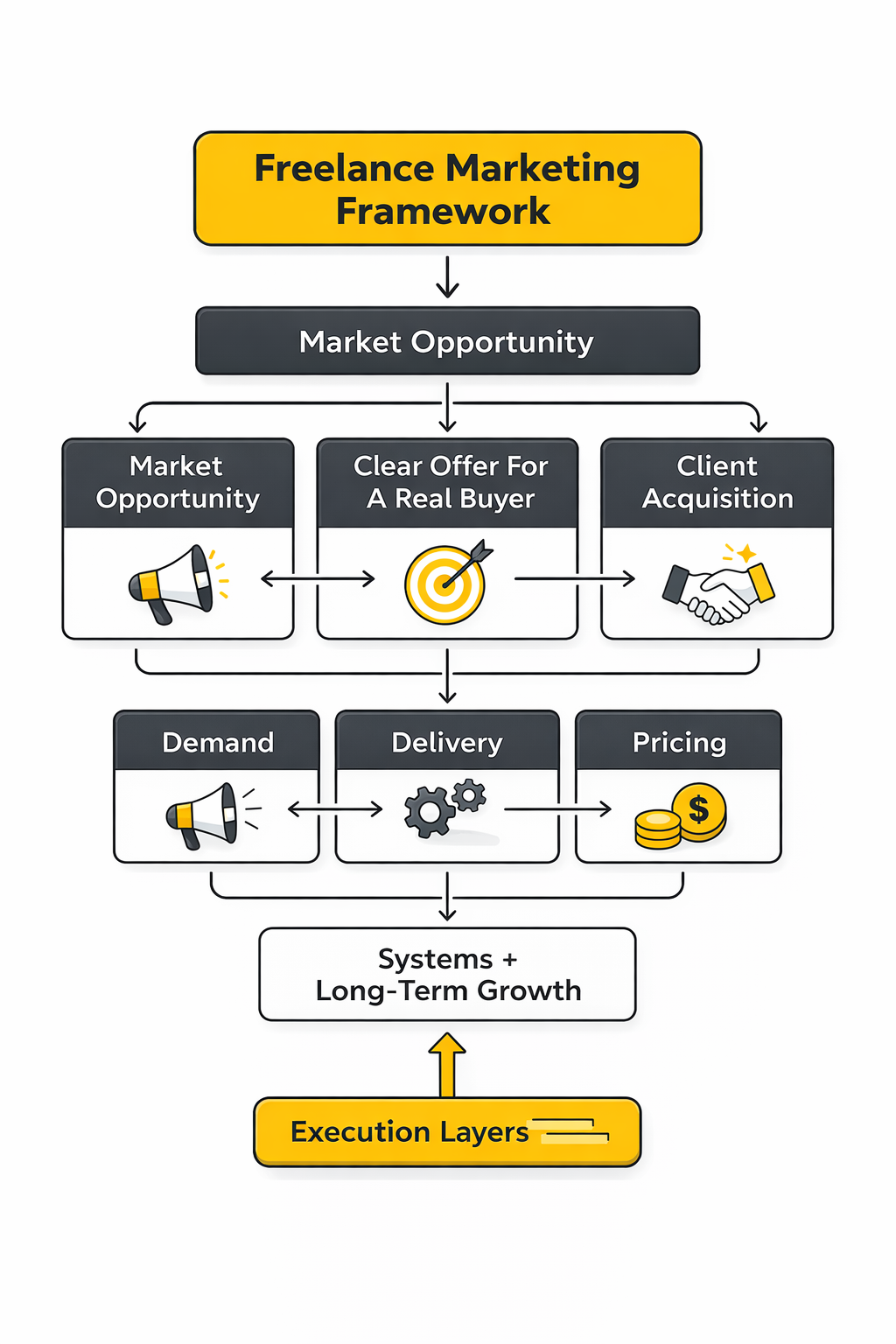
By the end of Part 6, the goal is not just to help you “do freelance marketing.” The goal is to help you build a practice that is easier to sell, easier to run, and harder for clients to replace. That is where the real leverage starts.
Why Freelance Marketing Matters Right Now
Freelance marketing matters more now because companies still need growth, but many of them do not want to solve every marketing problem with full-time hires. That gap creates space for specialists who can come in fast, own a clear result, and work without the overhead of building a permanent team. The market signal is not subtle here: Upwork’s 2025 workforce research says skilled knowledge freelancers generated more than $1.5 trillion in earnings in the United States in 2024, and Upwork’s April 2025 release says 28% of U.S. knowledge workers are now freelancing or working independently.
The demand is not just coming from startups trying to stay lean. Larger organizations are also using outside specialists when they need speed or niche capability, especially in areas where execution quality matters more than headcount optics. That is why Upwork’s September 2025 hiring report is worth paying attention to: high-value work among large businesses grew 31%, and demand rose for human-centered skills that do not disappear just because AI tools got better.
There is also a buyer-side pressure that helps good freelancers. Marketing leaders are expected to do more with flat budgets, tighter scrutiny, and higher expectations around measurable outcomes. Gartner’s 2025 CMO spend survey says 59% of CMOs feel they do not have enough budget to execute their strategy, which makes flexible expert support much easier to justify than broad, expensive retainers that feel hard to control.
That pressure becomes even more important when you look at how marketing itself is changing. Teams are investing more in video, thought leadership, paid distribution, and AI-assisted execution, but they are still struggling to create reliable systems around those efforts. Content Marketing Institute’s 2025 B2B benchmarks show 61% expect increased investment in video, 52% in thought leadership, and 40% in paid advertising, while the same research shows many teams still lack a scalable content engine. For a freelance marketer, that means the opportunity is not just “help us post more.” It is “help us build something that works without wasting six months.”
Small businesses are feeling the same tension from a different angle. They know they need marketing, but they are often not confident about what is working, which channels deserve more effort, or how to turn activity into actual revenue. Constant Contact’s 2025 small business report found fewer than one in five small businesses felt very confident in the impact of their marketing, even while effort increased. That lack of clarity is exactly where focused freelance marketing becomes valuable, because many clients do not need a huge strategy deck. They need someone who can simplify the mess and move the numbers.
The Freelance Marketing Framework
The right framework starts with a simple correction: freelance marketing is not a job title, it is a business model. When you think about it like a job title, you start describing yourself with vague labels like content marketer, growth marketer, or social media freelancer and hope the client figures out the rest. When you treat it like a business model, you build an offer around a specific buyer, a specific problem, and a specific result.
That is why the best freelance marketers rarely sell “everything.” Buyers already have enough confusion, and confusion slows deals down. The firms and operators winning attention right now are the ones making the value obvious, especially in trust-driven categories where buyers want expertise before they want another vendor pitch. LinkedIn’s 2025 B2B benchmark research frames trust as a central performance issue, and LinkedIn’s 2025 creator marketing research shows 82% of decision-makers say creator content influences decisions. That matters because a strong freelance positioning strategy is really a trust strategy in disguise.
A practical framework for freelance marketing has four layers. First comes positioning, where you define who you help and what kind of problem you solve better than a generic marketer. Second comes offer design, where you turn that expertise into something the client can buy without reading your mind. Third comes client acquisition, where your authority, outreach, referrals, and content create demand. Fourth comes delivery, because even a strong pipeline falls apart fast if the work is inconsistent, late, or impossible to scale.
Most freelancers get stuck because they try to skip the first two layers. They chase leads before they can explain their value clearly, and they say yes to custom work before they know what should be standardized. That creates the worst version of freelance marketing: unpredictable sales, messy execution, weak referrals, and pricing that always feels too low. The fix is not more hustle. The fix is building the machine in the right order.
This is also where technology becomes useful, but only after the business logic is clear. Tools for automation, CRM, scheduling, email, chat, and workflow can absolutely sharpen delivery and make a solo practice feel much bigger than it is. But no software can rescue fuzzy positioning or a weak offer. The framework has to come first, because once that is in place, every tool and every channel starts compounding instead of adding more noise.
In the next section, the focus shifts from the market and the model to the actual building blocks: which services make sense, how to choose a niche without boxing yourself in, and how to package freelance marketing in a way clients can understand fast and buy with confidence.
Core Services, Positioning, and Niches
The easiest way to make freelance marketing harder than it needs to be is to start with channels instead of business problems. Clients do not wake up wanting “three LinkedIn posts a week” or “better email flows” in the abstract. They want more qualified leads, stronger conversion, lower acquisition costs, better retention, or clearer proof that marketing is doing something useful, which is exactly why service design has to begin with the outcome and only then move to the tactic. LinkedIn and Edelman’s 2025 thought leadership research also shows trust-building content still shapes buying behavior in a serious way, which is another reminder that freelance marketing works best when it connects execution to commercial impact instead of content volume alone.
That is why strong freelance marketers usually cluster around a few service families instead of trying to do everything at once. One group focuses on demand creation, like content strategy, SEO, paid acquisition, email marketing, or social distribution. Another group focuses on conversion and revenue capture, like landing pages, funnel optimization, CRM follow-up, lifecycle email, and lead qualification. A third group focuses on authority and brand trust, which matters more than ever when 61% of B2B marketers expect increased investment in video and 52% expect increased investment in thought leadership content.
Start With a Problem You Can Solve Repeatedly
A useful niche is not just an industry label. It is the overlap between a buyer type, a painful problem, and a process you can repeat without reinventing your business every month. That is the real filter, because freelance marketing becomes much easier to sell when a prospect can look at your offer and instantly feel that you understand their situation, their bottlenecks, and the kind of result they are under pressure to produce.
This is why “I help B2B SaaS companies” is still too broad for most people. “I help founder-led SaaS teams turn product expertise into thought leadership that generates demo demand” is much stronger because it points to a buyer, a mechanism, and a commercial outcome. The same logic works in ecommerce, local services, agencies, creators, info businesses, or professional services. The sharper the problem definition, the easier it becomes to write your positioning, your sales copy, your outbound message, and your proposal without sounding generic.
There is also a practical reason to niche earlier than feels comfortable. Once you repeat the same kind of work, you build pattern recognition faster, you make fewer delivery mistakes, and you can price with more confidence because you are not estimating from scratch every time. That compounding effect is one of the biggest advantages in freelance marketing, and it is exactly what separates a stressful custom-service business from one that starts to feel like a real operating model.
Pick Services That Match Buyer Urgency
Not every marketing service sells with the same ease. Some services solve obvious pain fast, while others are valuable but harder for buyers to prioritize because the payoff feels slower or fuzzier. When you are building a freelance marketing practice, it usually makes sense to anchor your offer around work that buyers already believe matters, then layer in the longer-term strategic pieces once trust is established.
That is one reason email, conversion, and pipeline-oriented services stay attractive. HubSpot’s 2025 marketing statistics roundup points to email marketing, paid social, and content marketing as leading ROI channels for B2C brands, which aligns with what many freelance operators already feel in the market: clients keep funding work that can be tied more directly to leads, sales, and retention. For B2B, thought leadership and content-backed trust are also rising in importance, especially when buying groups are crowded and attention is fragmented.
A good rule is simple. If the client can connect your service to revenue, pipeline, booked calls, qualified leads, or conversion lift, the sale gets easier. If the service sounds important but the business case is vague, you will spend more time defending scope, educating the buyer, and getting squeezed on price. That does not mean you should avoid brand or content work. It means you should frame those services in language the buyer already cares about.
Package the Work So Clients Can Buy It Fast
Most freelance marketing offers are too open-ended. They read like a menu, which forces the client to do the strategy work themselves before they can even understand what they are buying. A better offer has a clear starting point, a clear deliverable, a clear timeline, and a clear reason it exists.
In practice, that usually means building one of three offer types. The first is an audit or diagnostic, where you identify gaps and hand the client a prioritized action plan. The second is an implementation sprint, where you build or fix something concrete over a short timeline. The third is an ongoing retainer, where you manage a repeatable system once the direction is already clear.
The smart move for many freelancers is to sequence these instead of selling a retainer immediately. A diagnostic lowers the buying risk. A sprint creates momentum and proof. Then the retainer becomes a logical extension instead of a leap of faith. This structure works because it respects how buyers actually make decisions, especially in markets where trust has to be earned before budget expands.
A Practical Process for Building Your Offer
This is where freelance marketing becomes tangible. You do not need a giant brand deck, a perfect website, or ten different services to get traction. You need a simple process that turns your skills into an offer a specific buyer can understand within a few seconds.
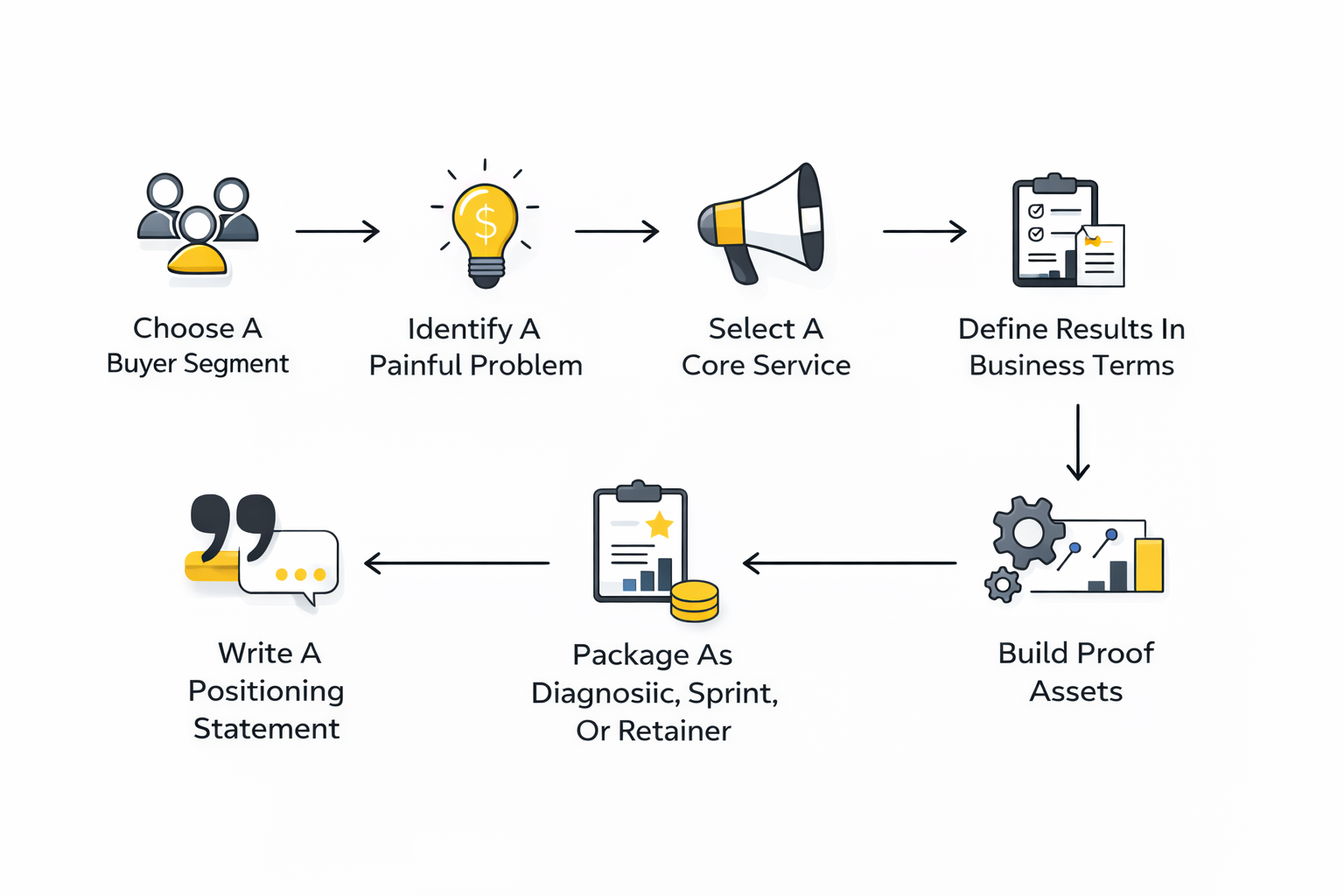
Use this sequence:
- Choose one buyer segment you understand well enough to speak their language.
- Identify one painful business problem that shows up repeatedly in that segment.
- Select one core service that directly addresses that problem.
- Define the result in business terms, not activity terms.
- Turn the work into a diagnostic, sprint, or retainer with a clear scope.
- Write a short positioning statement that makes the buyer feel recognized.
- Build two or three proof assets that show how you think, even if you are still early.
The reason this process works is that it forces clarity. Instead of saying “I do freelance marketing for anyone who needs help,” you start saying things like: I help local service businesses fix lead follow-up leaks, or I help ecommerce brands improve post-click conversion, or I help B2B founders turn expertise into pipeline-driving content. That kind of clarity sharpens every part of the business, from prospecting to pricing to delivery.
Proof matters here, but proof is broader than case studies. It can be a teardown, an audit sample, a clear before-and-after framework, or a strong point of view published consistently where your buyers pay attention. That matters because modern buyers often research quietly before they ever respond, and Edelman and LinkedIn’s 2025 report highlights just how influential hidden buyers can be during evaluation.
Build a Lightweight Stack That Supports Delivery
Once the offer is clear, your systems should stay lean. Most freelance marketing businesses do not need a bloated tech stack in the beginning. They need a scheduling layer, a form or intake layer, a CRM or pipeline view, a content or communication workflow, and a clean way to manage follow-up without dropping leads.
That is where a few simple tools can help without becoming the business itself. For example, Cal.com can handle scheduling cleanly, Fillout works well for client intake, Buffer can simplify publishing workflows, and GoHighLevel is useful when your offer depends on CRM, automations, and lead management in one place. The key is not the logo on the tool. The key is whether the system makes your freelance marketing practice easier to run, easier to explain, and easier to scale without adding chaos.
A lot of freelancers overbuild this stage because tools feel productive. Usually, the opposite is smarter. Keep the stack boring, keep the process visible, and only add complexity when the business actually earns it. That discipline pays off later, because the same structure that helps you deliver better also makes your work look more professional from the client’s side.
The next step is demand. Once your positioning is sharp and your offer makes sense, the question stops being “what should I sell?” and becomes “how do I consistently get in front of the right buyers without living in feast-or-famine mode?”
Pricing, Systems, and Long-Term Growth
A freelance marketing business gets more interesting once the early survival problems are handled. At that point, the challenge is no longer just winning work. The real challenge is building a model that keeps margins healthy, protects your time, and grows without turning into a chaotic mini-agency you never meant to create.
That is where a lot of solid freelancers stall. They get better clients, but they keep the same pricing logic, the same custom delivery style, and the same reactive workflow they used when they were still trying to land their first few projects. The business looks bigger from the outside, but inside it is still fragile.
Price for Outcomes, Not Activity
One of the biggest strategic mistakes in freelance marketing is pricing around visible effort instead of business value. Clients will almost always try to compare hours, deliverables, and line items, because that feels easier than evaluating impact. But if your work improves conversion, sharpens lead quality, fixes follow-up, or creates a repeatable demand engine, the value is not the number of tasks completed. The value is the commercial change those tasks create.
This matters even more now because budgets are under pressure. Gartner’s 2025 CMO spend survey says marketing budgets stayed flat at 7.7% of company revenue, which means buyers are scrutinizing spend harder, not softer. In that environment, freelance marketing gets stronger when the offer is tied to a meaningful business problem instead of a vague list of activities.
The practical move is to build pricing around one of three structures. The first is a fixed-fee diagnostic or sprint, where the value comes from speed and clarity. The second is a retainer tied to an ongoing system, where the client is paying for continuity, judgment, and momentum. The third is a hybrid model, where a base fee covers execution and a performance component rewards results when the tracking is clean enough to make that fair.
Hourly pricing still has a place, especially for advisory work or narrow support. But it becomes a ceiling fast when your systems improve. The better you get at freelance marketing, the faster you solve problems, and hourly billing can perversely punish that efficiency. That is why experienced operators usually move toward scope-based pricing, value-based framing, or retainers anchored to business priorities.
Protect Your Margins as AI Changes Delivery
AI is changing the mechanics of marketing work, but not in the lazy way people often describe it. It is making execution faster, research easier, production cheaper, and commoditized outputs easier to imitate. That does not kill freelance marketing. It just changes where the premium sits.
The premium is shifting toward judgment, positioning, synthesis, channel selection, editorial taste, offer design, conversion thinking, and the ability to connect tools into a working client system. That shift is visible across the market. HubSpot’s 2026 marketing statistics page says 94% of marketers plan to use AI in their content creation processes in 2026, which means “I can generate content faster” is not a durable advantage anymore.
The smart response is not to resist AI. It is to use it where it increases margin without lowering trust. In freelance marketing, that usually means using automation for ideation, repurposing, reporting support, CRM cleanup, first-draft workflows, internal documentation, and routine follow-up. It does not mean handing over strategic judgment or publishing weak outputs that make your client look interchangeable.
This is also why service design matters so much. If your offer is basically selling labor hours, AI puts pressure on pricing. If your offer is selling a cleaner system, sharper decisions, and better outcomes, AI can actually improve your economics because it reduces production drag while preserving the value of your expertise. That is a much stronger place to operate from.
Scale Carefully or You Will Build the Wrong Business
A lot of people say they want to scale, but what they usually mean is that they want better income with less chaos. Those are not the same thing. Scaling freelance marketing the wrong way often means adding contractors too early, selling too many custom services, and creating delivery complexity faster than revenue quality improves.
A better way to grow is to increase leverage before you increase headcount. That means tightening your niche, standardizing onboarding, productizing repeatable parts of delivery, improving templates, and building a small stack that reduces admin overhead. For example, GoHighLevel can make sense when your client work depends on CRM pipelines, automations, and reporting in one place, while Copper can be useful if your growth depends more on relationship management and a clean sales workflow.
The key tradeoff is this: every new service, client type, or delivery model can create revenue, but it can also dilute focus. The most durable freelance marketing businesses usually grow by deepening a proven model, not by stacking random revenue streams. That might mean raising prices within one niche, adding a diagnostic before the retainer, licensing templates, or building a light advisory layer on top of implementation.
There is also a hidden operational benefit here. The more standardized your process becomes, the easier it is to delegate safely later if you choose to. That keeps growth optional instead of forcing you into a hiring decision just to keep up with the work.
Watch for Concentration Risk Before It Bites You
One of the least glamorous risks in freelance marketing is concentration. It shows up when too much revenue comes from one client, one acquisition channel, one platform, or one deliverable type. Things can look stable for months, then a budget freeze, algorithm change, or internal hire wipes out a large chunk of income in a week.
This matters because freelance businesses often confuse familiarity with safety. A client who has paid you reliably for a year can still cut scope when priorities change. A channel that has fed your pipeline for six months can dry up once competition increases. Upwork’s 2025 hiring data makes clear that demand is moving, and when markets move, overexposure becomes dangerous fast.
The fix is not paranoia. It is basic business design. Keep more than one acquisition path active, avoid letting one client dominate the book unless the pricing justifies the risk, and build assets that make your demand generation less dependent on rented platforms alone. In practice, that often means pairing referrals with authority content, outbound with inbound proof, and a client delivery system with a visible point of view in the market.
Build Assets, Not Just Revenue
This is where long-term growth gets real. The strongest freelance marketing businesses eventually stop depending only on live selling and live delivery. They build assets that keep working even when the founder is not in a sales call or deep inside execution.
Those assets can be simple. They might be a sharp newsletter, teardown content, a small library of frameworks, a niche-specific audit, a CRM template, an onboarding workflow, or a conversion playbook that prospects can experience before they ever buy. In B2B markets especially, this matters because trust is often built before the first conversation. Edelman and LinkedIn’s 2025 thought leadership report shows hidden buyers actively consume and evaluate thought leadership, which means your content can shape deals before you know you are in them.
This is also where the right tools can create leverage without bloating the business. Brevo or Moosend can support lightweight email infrastructure, while Dub can help when your content and offers rely on cleaner attribution. The point is not to stack tools for the sake of feeling sophisticated. The point is to turn repeated effort into repeatable assets.
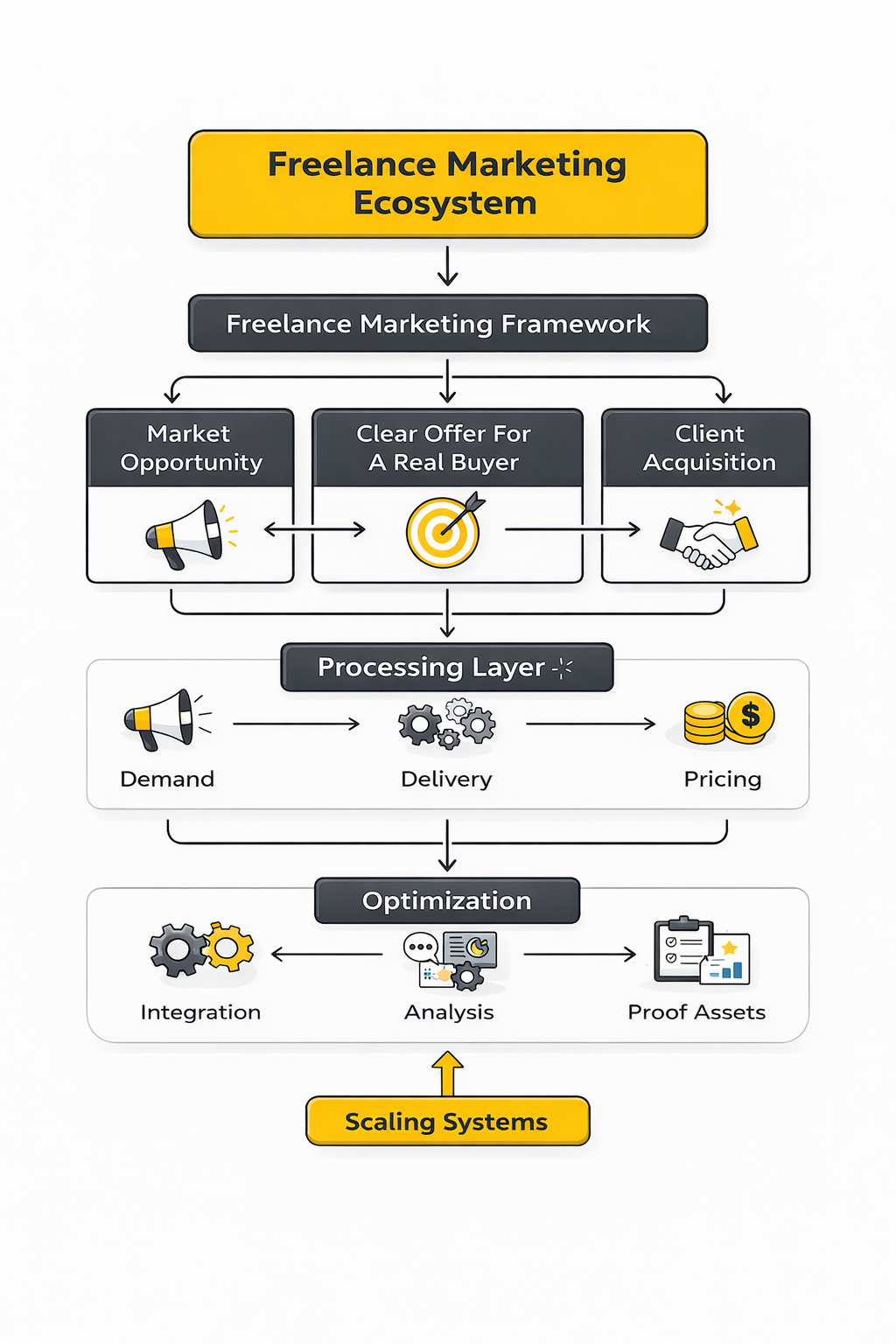
By this stage, freelance marketing stops feeling like a hustle and starts behaving like a real company. You know what you sell, who you help, how you deliver, how you protect margin, and where growth should come from. The last part of the article pulls everything together with the most common questions, edge cases, and decisions that tend to come up once you start applying this in the real world.
FAQ
Freelance marketing looks simple from the outside, but most of the important decisions are not obvious until you are already in the work. That is why the final piece of the puzzle is not another framework. It is understanding the questions that keep coming up once you start trying to build a serious solo practice.
Is freelance marketing still worth it in 2026?
Yes, but only if you approach it like a business instead of a side hustle with nicer branding. The market is still large, with Upwork’s 2025 workforce research showing skilled knowledge freelance work generated more than $1.5 trillion in U.S. earnings in 2024, but size alone does not guarantee an easy path. The money is moving toward specialists who can show judgment, speed, and commercial impact rather than just offering generic marketing help.
What is the best niche for freelance marketing?
The best niche is the one where you can understand the buyer deeply, solve an expensive problem repeatedly, and explain your value without sounding vague. That might be founder-led SaaS, ecommerce retention, local lead generation, B2B thought leadership, or lifecycle email for subscription brands. A niche becomes powerful when it gives you pattern recognition, stronger messaging, better referrals, and faster decisions on what to say yes to.
Should I be a full-service freelancer or specialize?
Specialization usually wins, especially early, because buyers trust clarity faster than breadth. A full-service positioning can work later if you have strong systems and clear proof, but in the beginning it often makes your offer harder to understand and harder to price. In freelance marketing, being known for one thing does not trap you forever. It usually gives you the traction you need to expand intelligently.
How do I get clients when I do not have many case studies yet?
Start by proving how you think, not pretending you already have a giant portfolio. A teardown, mini audit, strong point of view, sample workflow, or well-argued niche content can do a lot of work when a prospect is trying to decide whether you understand their business. Buyers often research quietly before replying, and thought leadership research from Edelman and LinkedIn makes it clear that hidden buyers consume expert content during evaluation, which is exactly why visible expertise matters before the sales call.
What services are easiest to sell as a freelance marketer?
Services connected to revenue, leads, pipeline, retention, or conversion usually sell faster than services framed as pure activity. That is why email systems, funnel optimization, paid acquisition with clear economics, CRM follow-up, and conversion-focused content tend to be easier to position than broad “brand support” without a commercial angle. This does not mean brand work has no value. It means the offer gets stronger when the buyer can quickly connect it to a business result.
Should I charge hourly, per project, or on retainer?
Hourly pricing is fine when the scope is fuzzy or the engagement is advisory, but it becomes limiting once you are consistently solving similar problems. Project pricing works well for diagnostics and sprints because it creates clarity for both sides and lets you capture the value of efficiency. Retainers make sense when the client needs continuity, execution rhythm, and ongoing judgment, which is why many strong freelance marketing businesses move from audit to sprint to retainer rather than trying to jump straight into a monthly agreement.
How much does AI change freelance marketing?
A lot, but not in the simplistic “AI replaces marketers” way. AI speeds up research, drafting, repurposing, analysis support, and production tasks, which means the cheap parts of the work get cheaper and the strategic parts become more valuable. HubSpot’s 2026 marketing research shows AI is already deeply embedded in marketing workflows, so the real advantage now is not access to tools. It is knowing how to use them without lowering quality, trust, or strategic sharpness.
What is the biggest mistake freelance marketers make?
The biggest mistake is usually selling work before they can explain the business case for the work. That creates weak offers, weak pricing, weak positioning, and delivery that feels custom even when the same problems keep repeating. Another common mistake is chasing too many client types at once, because every additional audience increases sales complexity, delivery complexity, and the mental cost of running the business.
When should I raise my prices?
Raise prices when your positioning is clearer, your process is more repeatable, your proof is stronger, and your work affects more important outcomes than it used to. Do not wait for perfect confidence, because confidence usually follows pricing discipline rather than appearing first. If your calendar is full, your delivery is tighter, and the client is buying real leverage instead of random tasks, your freelance marketing offer has probably outgrown the old number.
How do I avoid feast-or-famine cycles?
You need at least two active demand channels and one simple system for follow-up. Referrals alone can feel amazing until they slow down, and outbound alone can work until response rates drop, so the healthier approach is to combine relationship-based demand with visible authority and consistent follow-up. Feast-or-famine is often less about talent and more about operating without a pipeline discipline.
Is it better to stay solo or build a small agency?
That depends on what kind of life and business you actually want. Staying solo can be highly profitable if your offers are sharp, your systems are lean, and your pricing reflects expertise rather than hours. Building a small team can increase capacity, but it also adds management, quality control, recruiting pressure, and a completely different risk profile, so it should be a deliberate choice instead of an accidental reaction to being busy.
What tools actually matter for freelance marketing?
Only the tools that support a real operating model matter. A scheduler like Cal.com, an intake system like Fillout, a publishing workflow like Buffer, or a CRM and automation layer like GoHighLevel can help if they remove friction from selling and delivery. Tools become a problem when they replace clarity. In freelance marketing, the system matters more than the software stack.
Work With Professionals
Explore 10K+ Remote Marketing Contracts on MarkeWork.com
Most marketers spend too much time chasing clients, competing on crowded platforms, and losing a percentage of every project to middlemen. MarkeWork gives you a better way. Browse thousands of remote marketing contracts and connect directly with companies desperate to hire skilled marketers like you, without platform commissions and without unnecessary gatekeepers.
If you're serious about finding better opportunities and keeping 100% of what you earn, explore available contracts and create a profile for free at MarkeWork.com.
Pilujeme detaily
Skicujeme
Making the first draft
Chystáme scénu
Pilujeme detaily
Dokončujeme
Poslední úpravy
Ještě poslední úprava...
Dokončujeme