


- What this article covers
- Why understanding Fullstaq Marketer matters
- Conceptual framework for Fullstaq and full‑stack marketing
- Core components of the Fullstaq Marketer model
- How professionals implement this approach
- **Real‑world implications today
A Fullstaq Marketer blends multiple marketing skills into one cohesive practice, pulling from strategy, execution, analytics, and technical know‑how. As digital marketing evolves, businesses increasingly value marketers who can connect the dots across disparate channels instead of relying solely on narrow specializations. The term itself is influenced by the idea of a “full‑stack” professional from tech, where an individual handles a spectrum of functions end‑to‑end rather than focusing on a niche task.
Why This Topic Matters
Fullstaq Marketer isn’t just a buzzword — it reflects a real shift in how modern marketing teams operate. Traditional marketing roles often focus narrowly on one discipline like SEO, paid ads, or email marketing. However, companies face increasing pressure to make each customer interaction consistent and measurable across channels. A marketer who understands the big picture — from brand awareness to conversion and retention — can reduce silos, streamline planning, and improve return on marketing investment.
This matters for both businesses and individual marketers. For businesses, having someone who can integrate strategy with execution reduces dependency on multiple specialists and simplifies team org structures. For professionals, adopting a full‑stack mindset can open up leadership opportunities and make them more adaptable in fast‑moving markets.
Framework Overview
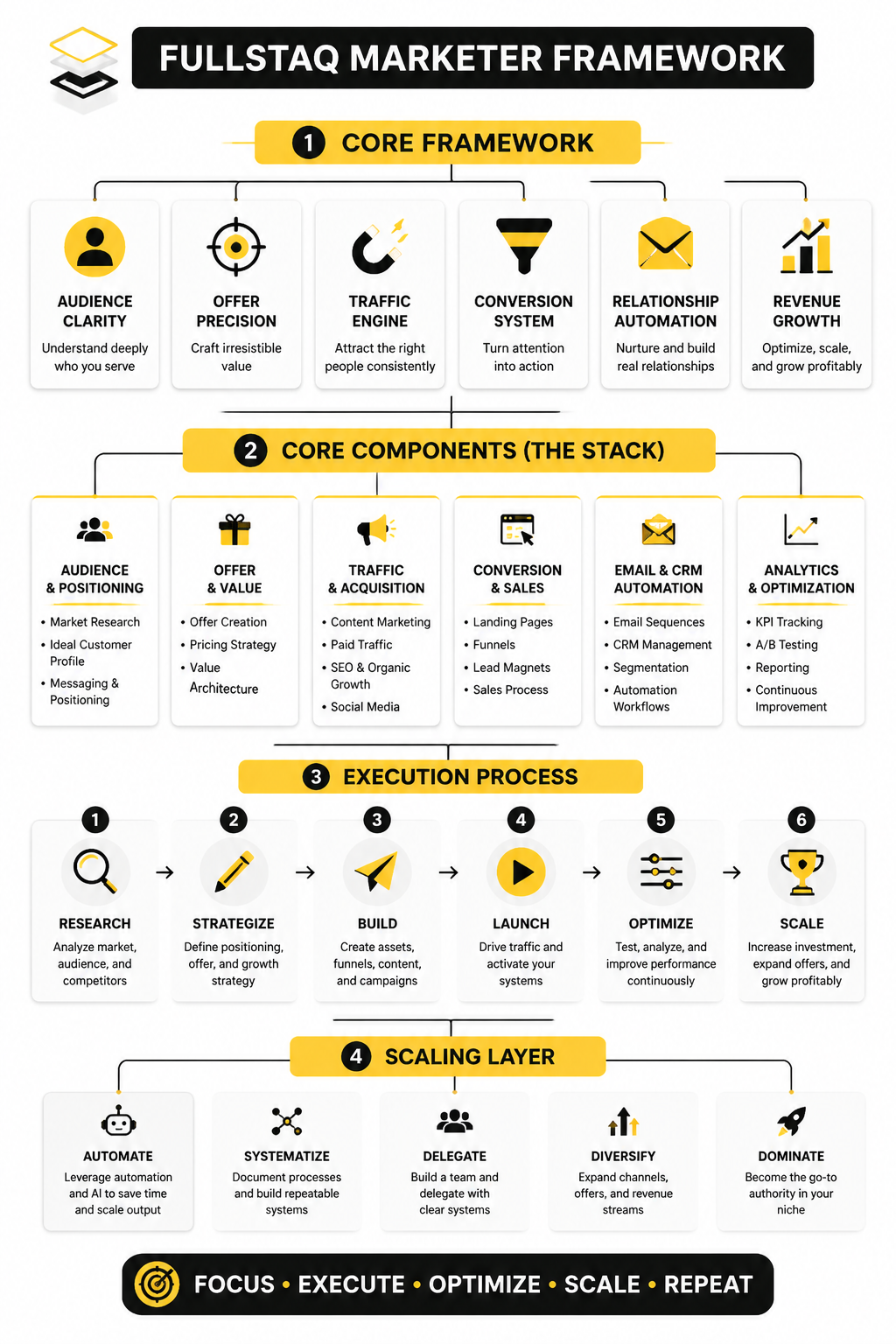
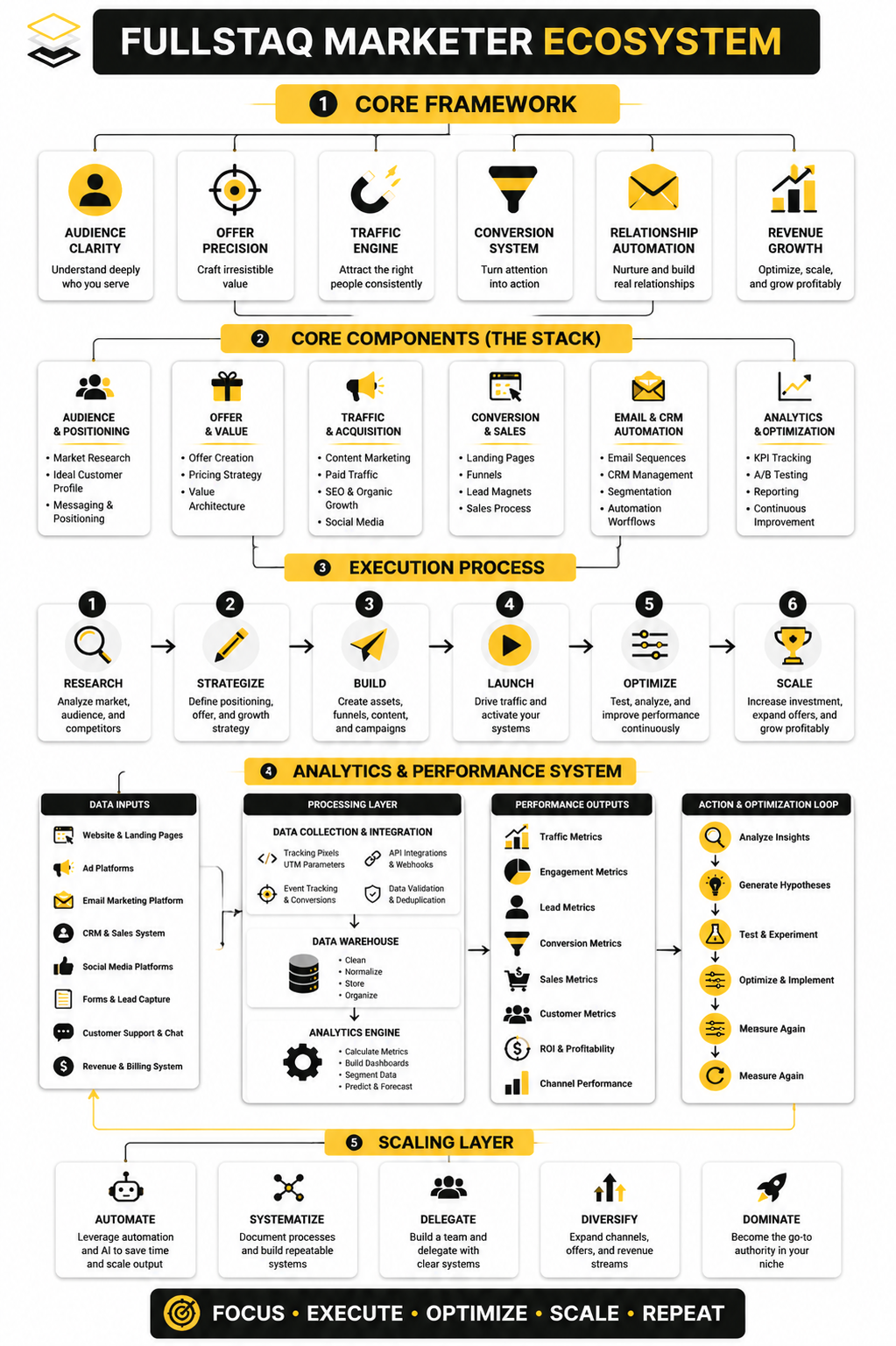
Understanding the Fullstaq Marketer concept requires breaking down the skill stack it encompasses. Think of it as a layered framework where strategy, implementation, and optimization intersect:
- Strategic Planning — defining goals, understanding audiences, and aligning marketing with business objectives.
- Channel Execution — running campaigns across SEO, content, paid media, email, social and more.
- Technical Proficiency — using tools like CRM systems, analytics platforms, and automation software to execute and track efforts.
- Data‑Driven Optimization — measuring results and adjusting tactics based on performance metrics.
- Cross‑Channel Integration — ensuring all marketing efforts communicate consistently to the target audience.
This model emphasizes ownership of the entire customer journey rather than isolated fragments of it. Fullstaq marketers blend creativity with analytics and technical operations to build cohesive marketing machines.
Core Components of a Fullstaq Marketer
A Fullstaq Marketer’s toolkit spans multiple disciplines:
- SEO and Content — driving organic discovery and engagement.
- Paid Media — managing PPC, social ads, and retargeting.
- Email Marketing and Automation — nurturing leads and driving conversions.
- Analytics and Measurement — interpreting performance data and refining campaigns.
- Growth and Funnel Strategy — designing and optimizing the path from awareness to repeat customer.
These components work together to create strategies that are not only multifaceted but also flexible and responsive to changing data. Rather than having separate teams for each channel, the Fullstaq approach seeks unified execution.
Professional Implementation
Implementing a Fullstaq Marketer strategy involves cultural and structural shifts within an organization:
- Skill Development — marketers must expand beyond specialization to build competencies across channels.
- Tool Consolidation — using integrated platforms for CRM, analytics, content management, and automation helps reduce fragmentation.
- Collaborative Workflows — teams aligned around shared goals and KPIs foster better cross‑functional execution.
- Continuous Learning — the digital landscape changes rapidly, so ongoing training and experimentation are essential.
Professionals applying this model often serve as connectors between strategy and execution, ensuring that insights from analytics inform next steps in real time. Full‑stack marketers excel in environments where agility and integration matter most.
If you want Part 2 next, continue with the first detailed section after this overview.
Deep Dive: What a Fullstaq Marketer Actually Does
To understand why the Fullstaq Marketer concept is more than a buzzword, let’s detail how this role functions in real‑world marketing teams. The modern marketing landscape demands professionals who can connect strategy with execution, not just hand tasks off to specialists. That’s exactly what full‑stack marketers bring to the table.
In practice, a full‑stack marketer doesn’t just dabble — they own multiple layers of the marketing funnel. They plan campaigns, execute across channels, track performance, optimize based on results, and refine future efforts in an integrated way. This end‑to‑end ownership is what sets them apart from traditional marketers who focus on just one discipline.
Here’s what that looks like in action:
- Campaign orchestration from start to finish: Instead of passing lead generation to one team and analytics to another, full‑stack marketers manage both and ensure seamless collaboration.
- Cross‑channel execution: They run multi‑platform campaigns — from paid social and search to email automation and content — ensuring each channel supports the same strategic objectives.
- Data measurement and optimization: This role isn’t about “doing a bit of everything.” It’s about interpreting performance data to decide what changes will improve outcomes across the funnel.
Rather than working in silos, full‑stack marketers act as bridge builders — connecting brand messaging, creative execution, audience insights, and business results so companies can adapt quickly in an evolving digital environment.
Skills That Make a Fullstaq Marketer
The breadth of skills required is why the Fullstaq Marketer is both versatile and strategic. Reports show that full‑stack marketers blend technical fluency, data interpretation, creative planning, and agile execution in their daily work.
Here are the core competencies that define the role:
- Strategic Planning & Positioning
They begin by understanding market trends and audience segments so campaigns move beyond tactics to business impact. This foundation ensures campaigns are aligned with larger goals.
- Content Creation & Organic SEO
A full‑stack marketer crafts content designed to engage audiences and improve search visibility — from blogs and video scripts to on‑page optimizations that boost discoverability.
- Paid Media & Channel Execution
Beyond organic channels, they manage paid campaigns, tuning bids, audiences, and creatives to drive traffic and conversions across platforms.
- Analytics & Performance Tracking
They track KPIs with tools like analytics dashboards and conversion event tracking, using real data to pivot strategy and optimize spend.
- Automation & Technical Execution
From email workflows to tech stack integrations, the role requires fluency with automation tools that scale campaigns efficiently while reducing manual workload.
This combination creates marketers who not only do work but understand why specific actions drive business outcomes — a key differentiator compared with traditional roles that focus narrowly on execution.
Why Organizations Want Fullstaq Marketers
Businesses value full‑stack marketers because they are impact multipliers — reducing team friction, simplifying reporting lines, and boosting time to value on campaigns. Multiple industry analyses highlight that companies now favor versatile marketers who can handle broad responsibilities without depending heavily on external agencies.
This trend is especially strong where teams must be lean and agile. Startups and mid‑size firms benefit from professionals who can pivot across functions as needs evolve — from launching a funnel to analyzing conversion bottlenecks and refining messaging in real time.
In short, full‑stack marketers combine the big‑picture perspective of strategy with the hands‑on skills of execution — turning marketing from a series of tasks into a unified growth engine.
Continue with the next section in Part 3: “Benefits and Challenges of Fullstaq Marketers.”
How to Implement a Fullstaq Marketer Approach
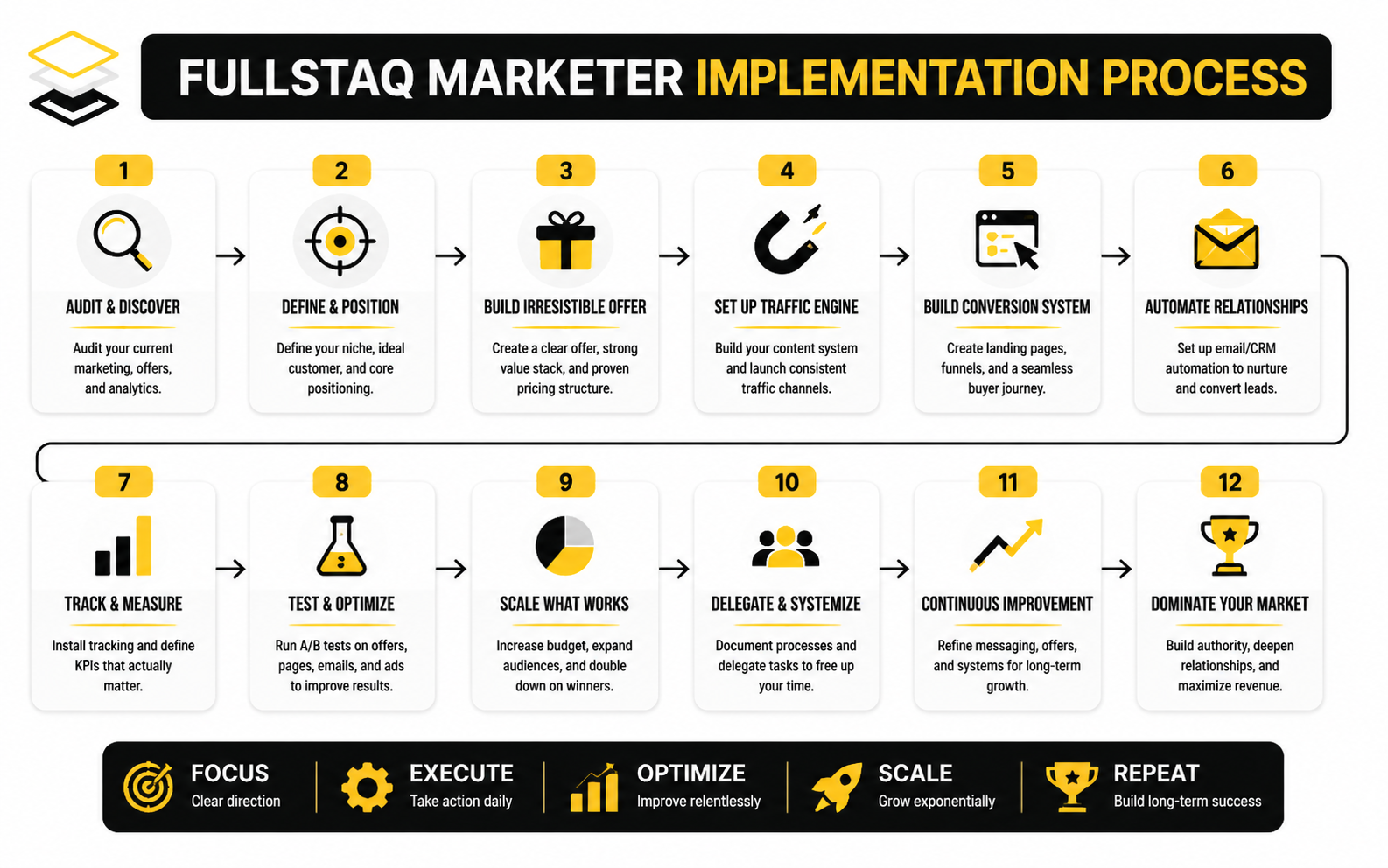
Embedding a fullstaq marketer into your organization isn’t an overnight project — it’s a structured transition that combines strategic clarity, capability building, and process redesign. Implementation turns the concept of being full‑stack into repeatable reality across teams and campaigns. Successful implementation makes strategy tangible and measurable rather than aspirational.
Step‑by‑Step Implementation Process
1. Audit Your Current Marketing Landscape
Start by mapping out what you already do versus what you should be doing to support a full‑funnel, integrated approach. For each stage of the customer journey — from awareness to retention — identify:
- Which channels are active
- Who owns each responsibility
- What tools and data sources are in use
- Where gaps or redundancies exist
This audit becomes your baseline roadmap, revealing both strengths and blind spots before you invest in training or hiring.
2. Define the Core Stack for Your Business
Not all businesses need the same “stack.” A D2C ecommerce brand will prioritize different systems than a B2B SaaS company. Define the core disciplines your fullstaq marketer will own initially, such as:
- Strategic planning & funnel mapping
- Content creation & SEO
- Paid media execution
- Email automation
- Analytics & performance reporting
This list helps you scale intentionally, avoiding overwhelm while covering the most impactful areas first.
3. Choose an Operating Model That Fits
You have three main implementation paths:
- Build in‑house: Hire or train talent to become fullstaq marketers on your payroll.
- Outsource: Partner with agencies or contractors who already practice integrated marketing.
- Hybrid: Keep a strategic owner in‑house and supplement execution with vetted external specialists.
Each model has trade‑offs in terms of control, cost, and speed to execution. Mid‑size organizations often find the hybrid model practical because it balances internal ownership with external expertise where needed.
4. Integrate Tools and Data Systems
Disconnected tools are the enemy of a full stack approach. Prioritize linking platforms so data flows across your core systems:
- Analytics (e.g., dashboards that show funnel performance across touchpoints)
- CRM and automation (to connect acquisition with lifecycle campaigns)
- Ad accounts and content publishing tools
A quick test of your integration: if it takes more than ten minutes to trace a lead from initial click to revenue in your systems, your tech stack needs refinement.
5. Centralize Planning and Reporting
Avoid siloed activity by establishing routine planning and reporting cycles that cover the entire customer journey:
- Quarterly planning sessions that map initiatives across all channels
- Shared goals and KPIs that reflect overall business outcomes (not just channel metrics)
- Unified dashboards showing funnel performance rather than isolated reports
This central rhythm ensures your fullstaq marketer — or team — works from a shared playbook, keeping execution aligned with strategy.
6. Build an Experimentation Culture
A core benefit of a full‑stack approach is rapid learning. Dedicate a portion of your marketing effort to structured experiments with clear hypotheses, methods, and success criteria. This isn’t just doing more tactics — it’s validating what truly moves metrics that matter, from acquisition quality to lifetime value.
Key Organizational Enablers
Even with a solid process, culture and leadership support matter. Two common organizational needs surfaced in industry research:
- Clarity and strategic direction: Marketers can’t own an integrated approach if leadership hasn’t defined what success looks like in measurable terms.
- Supportive technology and automation: Frequent task‑switching and fragmented tools slow down execution. Automating repetitive tasks and integrating platforms lets fullstaq marketers focus on high‑impact activities.
These enablement elements ensure your implementation isn’t just tactical but sustainable as demands evolve.
What Success Looks Like
When implemented well, a fullstaq marketer process produces:
- Fewer handoffs and faster campaign cycles
- Unified insight into how channels interact
- Better alignment between marketing and revenue goals
- A culture of testing and learning that accelerates growth
This is the stage where the fullstaq marketer stops being a concept and becomes a driver of measurable business impact.
Continue with Part 4: “Benefits and Challenges When Using Fullstaq Marketers.”
Statistics and Data That Shape Fullstaq Marketer Performance
Measuring performance isn’t optional for a fullstaq marketer — it’s foundational to making smart decisions and driving growth. Without clear analytics, even well‑designed campaigns become guesswork, and budgets that should fuel scale instead go to waste. The key is not just collecting data but interpreting it so that insights lead directly to better strategy, smarter spending, and stronger outcomes. (turn0search0)
Why Metrics Matter
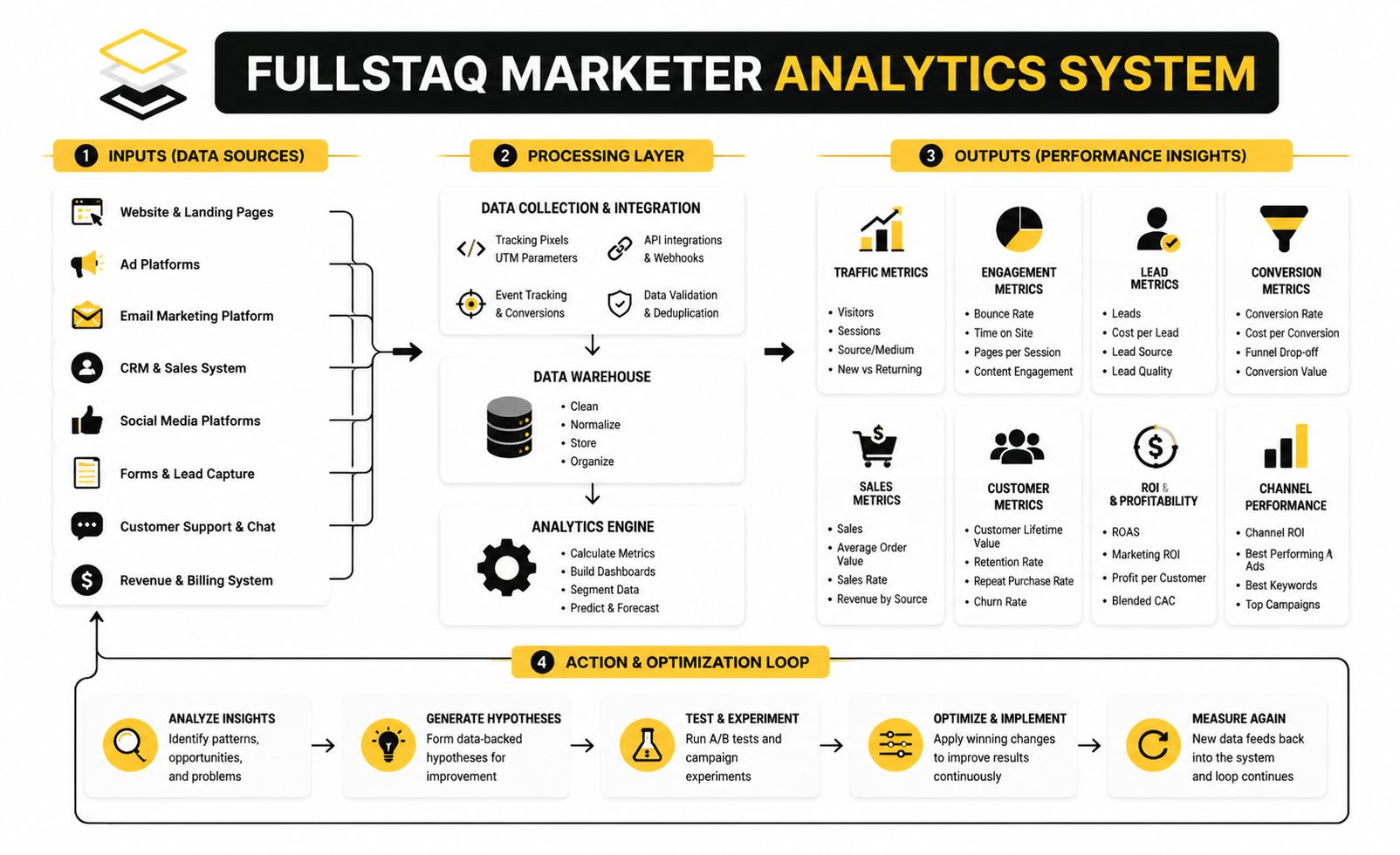
Numbers tell the story of a campaign’s effectiveness, and for fullstaq marketers, they become the basis of strategic decisions across channels:
- Efficiency: Metrics like Customer Acquisition Cost (CAC) and Marketing ROI show how much it costs to bring in customers and whether channels deliver profitable returns. A solid CLV:CAC ratio above 3:1 signals that your acquisition efforts are likely sustainable long term. (turn0search4)
- Channel Contribution: Comparing conversion rates or return on ad spend across channels helps a fullstaq marketer understand where the most valuable outcomes are coming from. These comparisons guide budget shifts and creative prioritization. (turn0search0)
- Optimization Signals: Trends in metrics like engagement, conversion velocity, and cohort retention show what’s working and what isn’t. That informs testing hypotheses and iterative improvements rather than shooting in the dark. (turn0search1)
These metrics aren’t abstract — they drive action. When CAC rises faster than revenue, it’s a clear signal to revisit targeting or messaging. When conversion rates plateau, it’s time to optimize landing pages or funnel flow.
Core Metrics Every Fullstaq Marketer Watches
Holistic Performance Indicators
- Marketing ROI / ROAS: The baseline for performance evaluation. A benchmark of roughly 5:1 marketing ROI — meaning five dollars earned for every dollar spent — is often cited as a healthy target. This frames decisions about scaling or cutting spend. (turn0search4)
- CAC: Tracks the efficiency of your customer acquisition. Rising CAC without corresponding increases in customer value signals a need to refine audience targeting or creative. (turn0search4)
- Conversion Rate by Channel: Shows which channels are delivering meaningful actions like email signups or purchases — not just clicks or impressions. (turn0search9)
- Customer Lifetime Value (CLV): Helps determine long‑term profitability by estimating how much revenue a customer drives over time. Pairing CLV with CAC gives insight into whether your costs make sense relative to value. (turn0search4)
Channel and Funnel Benchmarks
Benchmarks give context to your numbers. For instance:
- Paid search campaigns often show higher conversion rates than social channels but may come with higher costs.
- Email marketing regularly reports robust ROI due to direct audience permission and segmentation precision.
Understanding these benchmarks — and how they vary by industry and funnel stage — helps a fullstaq marketer set realistic expectations and spot underperformance early. (turn0search4)
How to Translate Metrics Into Action
Good data only matters if it informs a decision. A fullstaq marketer uses analytics to:
- Allocate Budget More Effectively: Reduce spend on channels with high CAC and low pipeline impact, and increase investment in channels that deliver efficient conversion and revenue.
- Optimize Creative and Targeting: When conversion rates lag despite strong traffic, the issue often lies in messaging or user experience — insights analytics make this obvious.
- Guide Testing Priorities: Metrics dictate which hypotheses matter most (e.g., changing email subject lines to improve open rates or tweaking audiences to boost paid search performance).
Avoiding Common Pitfalls
Many teams track too many metrics without a clear framework, which creates noise instead of insight. The smarter approach is to focus on a small set of metrics tied directly to business outcomes — and revisit them regularly to see how they evolve. (turn0search4)
By interpreting metrics through this action‑oriented lens, a fullstaq marketer turns dashboards into decision engines rather than vanity scoreboards — and that’s where measurable growth begins.
Advanced Considerations for Fullstaq Marketer Strategy
As organizations push deeper into integrated marketing models, the fullstaq marketer concept brings advanced strategic trade‑offs that go beyond basic implementation. Understanding these nuanced considerations helps leaders and practitioners make informed decisions about when, how, and where to deploy full‑stack marketing talent for long‑term impact.
Balancing Breadth and Depth
One of the core strategic trade‑offs with fullstaq marketers is the balance between breadth of capability and depth of expertise. A marketer who knows many disciplines well can accelerate execution, reduce handoffs, and maintain cohesion across campaigns. Yet there’s a risk: specialists often bring deep, highly technical insights that generalists can’t match in complex scenarios, such as advanced paid performance optimization or deep SEO engineering that requires years of focused experience. Choosing the right mix — where fullstaq marketers lead integrative strategy while specialists dive deep where it’s most needed — is a practical scaling approach that many agile teams adopt.
The Cognitive Load and Risk of Burnout
A fullstaq marketer wears many hats, and this multi‑disciplinary load can create real human costs. Constantly switching between tasks like content creation, analytics interpretation, campaign execution, and technical integrations can lead to cognitive fatigue and burnout if not managed carefully. This phenomenon isn’t just anecdotal; senior practitioners frequently highlight task switching as one of the biggest impediments to strategic thinking. To mitigate this risk, organizations should invest in workflow design, periodic role rotation, and protected strategic time, ensuring fullstaq marketers aren’t constantly pulled into execution without space for planning.
Scaling with Team Structure and Collaboration
As companies grow, a fullstaq marketer can reach a point where the scope of responsibilities exceeds what one person can handle effectively. Early‑stage teams thrive when a single marketer steers campaigns across channels, but scaling often requires collaborative team structures where fullstaq marketers act as integrators or “chief orchestrators” of strategy rather than sole executors. In this model:
- Fullstaq marketers define the blueprint — strategic frameworks, campaign maps, and measurement plans.
- Specialists and supporting roles execute high‑complexity tasks within that blueprint.
- Cross‑functional collaboration becomes the norm rather than exception.
This hybrid structure preserves the agility and cohesion of fullstaq marketing while preventing overload and enabling specialization where it matters most.
Technology and Automation Trade‑Offs
Implementing a fullstaq marketer approach also intersects with decisions about technology investment. Marrying data systems, analytics platforms, and automation tools streamlines workflows and enables deep insights. Yet not all organizations have the same technology maturity. A common pitfall is overinvesting in martech without aligning measurement frameworks or team capabilities, leading to siloed data and poor insight generation — a problem highlighted by executive surveys showing many firms struggle to link martech investments to clear ROI. Choosing the right systems — ones that integrate easily and support unified reporting — is often more important than selecting the “most advanced” tool.
Continuous Learning and Skills Evolution
A fullstaq marketer must stay current across a widening set of skills as marketing evolves. The rise of AI‑enabled tools, predictive analytics, and automation means professionals must adopt continuous learning mindsets to keep pace with both tactical execution and strategic thinking. Teams can support this by embedding ongoing training, experimentation cultures, and knowledge sharing into their regular workflows — reducing the risk that skill gaps derail performance or limit strategic impact.
Strategic Metrics and Long‑Term Value
For advanced practitioners, the value of a fullstaq marketer is not just in completing tasks across channels but in shaping strategic outcomes. This means focusing measurement on high‑value business indicators like revenue growth, customer retention, and customer lifetime value rather than superficial metrics alone. Structuring analytics so that marketing performance ties directly to revenue and growth — and empowering fullstaq marketers to interpret and act on these insights — elevates their role from service execution to business growth leadership.
By weighing these trade‑offs and designing roles and teams around strategic priorities — not just operational necessities — organizations can harness the full potential of fullstaq marketers while avoiding common scaling pitfalls.
FAQ - Built for Complete Guide
What is a fullstaq marketer?
A fullstaq marketer is someone who combines multiple marketing disciplines — like strategy, content, paid media, analytics, and automation — into a unified practice so they can own and optimize the entire customer journey rather than just one channel.
How does a fullstaq marketer differ from a traditional specialist?
Traditional specialists focus deeply on one area (e.g., SEO or email), while a fullstaq marketer blends broad knowledge across many areas to build cohesive campaigns that connect channels and drive integrated outcomes.
Do businesses of all sizes need a fullstaq marketer?
Smaller and agile teams benefit most from a fullstaq marketer because they often lack the budget for many separate specialists. Larger organizations may use fullstaq marketers as strategic integrators who coordinate between specialist units.
What skills should a fullstaq marketer have?
Key skills include understanding audience segmentation, crafting multi‑channel campaigns, using analytics tools to measure performance, and employing automation platforms to scale repeatable tasks.
What tools are essential for a fullstaq marketer?
Core tools span analytics dashboards, CRM/automation systems, social and paid ad platforms, SEO/content tools, and funnel optimization frameworks. Integration between tools is critical to ensure data flows seamlessly.
How do you measure success as a fullstaq marketer?
Success is measured by outcomes tied to business goals — like customer acquisition cost, return on marketing investment, conversion rates across channels, and customer lifetime value — not just by vanity metrics like impressions.
How does a fullstaq marketer approach experimentation?
They build structured testing into regular workflows, using hypotheses and data to refine campaigns. For example, they might test different messaging sequences or landing page designs to see which variant improves key performance indicators.
What common challenges do fullstaq marketers face?
Balancing depth and breadth can be taxing, leading to cognitive load. Access to integrated data systems and clear organizational goals are often cited as barriers when fullstaq marketers try to scale their impact.
When should an organization hire a fullstaq marketer?
Hire one when you need someone to unify strategy and execution across channels, reduce handoffs between teams, accelerate campaign cycles, and improve measurement and optimization across the marketing funnel.
Can fullstaq marketing replace specialist roles?
Not entirely. Specialist roles remain valuable for highly complex tasks. The fullstaq marketer works best as a strategic integrator and executor for broad‑based needs, while deep technical specialists support advanced requirements.
Work With Professionals
Explore 10K+ Remote Marketing Contracts on MarkeWork.com
Most marketers spend too much time chasing clients, competing on crowded platforms, and losing a percentage of every project to middlemen. MarkeWork gives you a better way. Browse thousands of remote marketing contracts and connect directly with companies desperate to hire skilled marketers like you, without platform commissions and without unnecessary gatekeepers.
If you're serious about finding better opportunities and keeping 100% of what you earn, invite readers to explore available contracts and create a profile for free at MarkeWork.com.