

General Assembly digital marketing training is built for people who want practical marketing skills, not theory that sits in a notebook. The core promise is straightforward: learn how modern campaigns work across channels, use data to make better decisions, and build the confidence to apply those skills in real work.
That matters because digital marketing is no longer one job. It is a mix of audience research, positioning, content, paid media, SEO, analytics, conversion strategy, email, automation, and reporting. General Assembly’s own digital marketing short course focuses on multichannel campaigns powered by data and customer insight, which is exactly where most beginners and career-switchers need structure first.

This article will continue in six parts:
- General Assembly Digital Marketing: What It Teaches, Who It Fits, And How To Use It
- Why Digital Marketing Training Matters Right Now
- The General Assembly Digital Marketing Framework
- Core Skills You Learn In The Course
- How To Apply The Training In Real Campaigns
- Tools, Career Paths, And Final Buying Advice
Why General Assembly Digital Marketing Gets Attention
General Assembly has become a recognizable name because it sits between traditional education and fast-moving professional training. Its Digital Marketing Short Course is positioned around job-ready application, not academic marketing theory. That makes it attractive for marketers, founders, freelancers, operators, and career changers who need a clear working model.
The timing also helps. The American Marketing Association’s 2025 skills report highlights digital marketing, analytics, proving ROI, and data privacy as major competency gaps. Those are not optional skills anymore. They are the difference between “posting content” and actually understanding whether marketing is producing growth.
This is why a course like General Assembly digital marketing can be useful when approached correctly. It should not be treated as a magic credential. It should be treated as a structured launchpad for building campaigns, reading data, improving conversion paths, and communicating results clearly.
The Big Picture
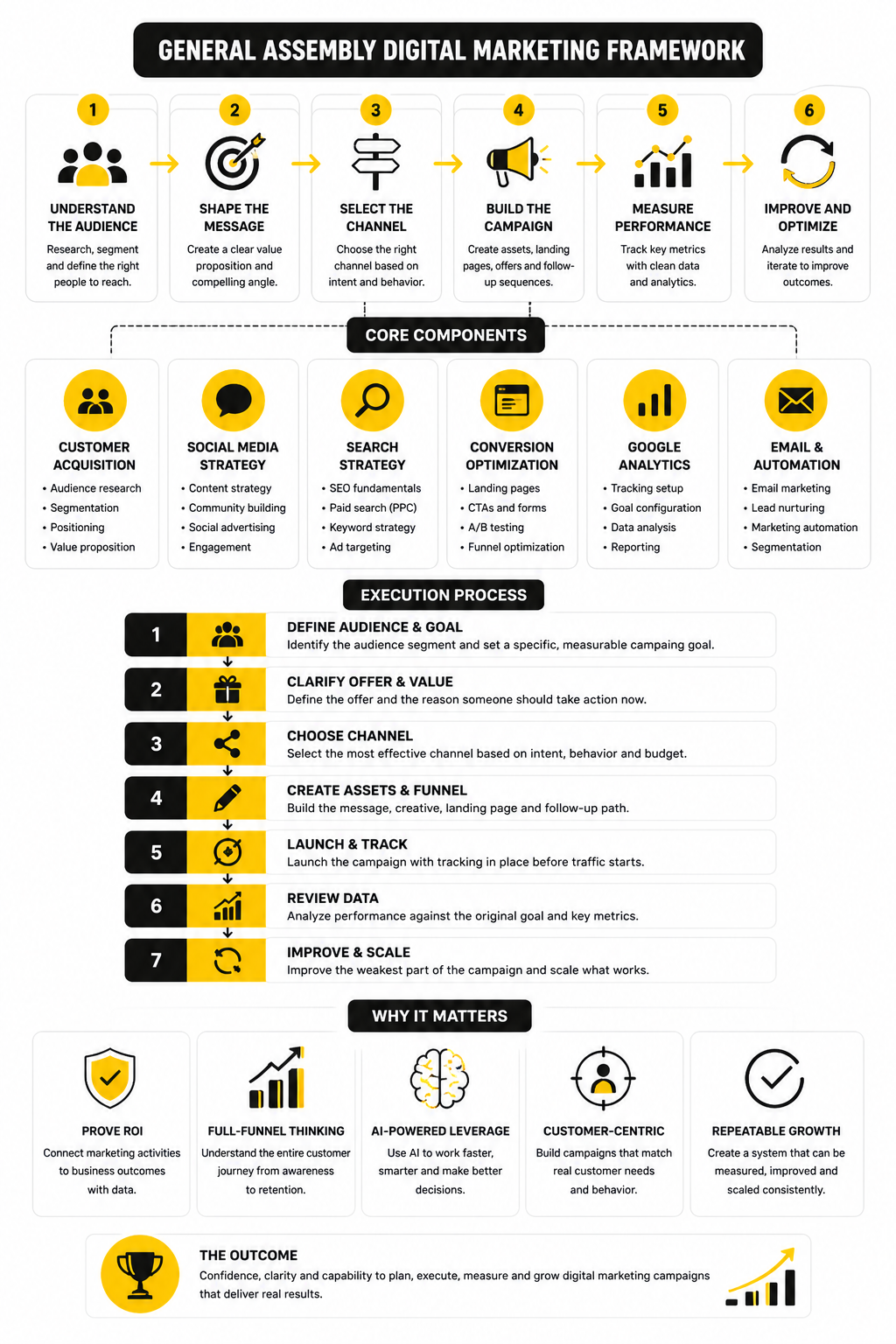
At a high level, the framework is simple. You start with the customer, define the goal, choose the channels, build the campaign, measure performance, and improve the system. That sounds obvious, but most weak marketing breaks because one of those steps is skipped.
A practical digital marketer needs to connect strategy with execution. For example, social media without positioning becomes noise. Paid ads without landing page thinking become expensive. Analytics without decision-making becomes dashboard decoration.
General Assembly’s course topics, including campaign execution, customer acquisition, social media and search strategy, conversion optimization, and Google Analytics, point toward that full-system view. That is the right foundation because marketing teams now need people who can move between creative thinking and performance thinking without getting lost.
What This Article Will Help You Decide
This article is not going to pretend that one course can replace experience. It cannot. The real question is whether General Assembly digital marketing gives you enough structure to start building useful marketing judgment faster.
The answer depends on your goals. If you want a guided entry into modern marketing, it can be a strong fit. If you already run complex paid acquisition, advanced lifecycle automation, or technical SEO programs, you may need deeper specialist training after the foundation.
The useful way to judge it is by outcomes. Can you explain a campaign strategy clearly? Can you choose channels for a reason? Can you measure what worked? Can you improve the next version based on evidence? If the course helps you do those things, then the value is practical, not just educational.
Why Digital Marketing Training Matters Right Now
Digital marketing has moved past the “learn a few channels and figure it out later” stage. Teams now need people who can connect audience research, content, paid traffic, automation, analytics, and conversion strategy without treating each one like a separate island. That is why General Assembly digital marketing training is best understood as a foundation for operating inside a more complex marketing environment.
The pressure is real because marketing teams are being asked to prove more with less guesswork. The 2025 AMA Marketing Skills Report is based on more than 1,200 marketers, more than 450 job postings, and expert interviews, and it points to digital marketing, data and analytics, proving ROI, and data privacy as major gaps. Those are exactly the areas where weak marketers get exposed quickly.
This is also why the practical side matters so much. You can memorize definitions of SEO, paid search, social media, and email, but that does not make you useful in a real business. You become useful when you can choose the right channel for the right audience, explain the tradeoff, launch cleanly, measure what happened, and improve the next version.
The Skills Gap Is Not Just Technical
The easy assumption is that digital marketing training is mostly about tools. That is only partly true. Tools change fast, but the deeper skill is knowing what decision the tool is supposed to support.
A dashboard does not automatically create insight. A campaign builder does not automatically create demand. An AI writing tool does not automatically create a sharp message. The marketer still has to understand the customer, the offer, the funnel, the creative angle, the data, and the business goal.
That is where structured learning can help. General Assembly digital marketing works best for people who need a map before they go deeper into execution. The goal is not to become an expert in every channel immediately. The goal is to stop seeing marketing as random tasks and start seeing it as a system.
AI Has Raised The Bar
AI has made basic execution easier, but it has also made average work more common. Anyone can generate a content draft, write ad variations, summarize customer research, or brainstorm campaign ideas now. That means the advantage shifts toward people who can brief AI well, judge output clearly, and connect automation to a real strategy.
The LinkedIn Work Change research frames AI as a major force reshaping work and skills, not just another productivity app. In marketing, that shows up in faster content cycles, more personalization, more testing, and higher expectations from managers and clients. Speed is no longer enough. Judgment matters more.
For someone considering General Assembly digital marketing, this is important. The course should not be viewed as a way to avoid AI or compete against it. It should help you build the marketing fundamentals that make AI useful instead of noisy.
Businesses Need Full-Funnel Thinkers
A modern marketer cannot only care about traffic. Traffic that does not convert is expensive attention. Leads that do not get nurtured are wasted opportunities. Campaigns that cannot be measured are hard to defend when budgets tighten.
That is why full-funnel thinking is becoming more valuable. A marketer needs to understand how awareness turns into interest, how interest turns into action, and how action turns into revenue or retention. Even if you specialize later, you need to understand the whole path.
This is one reason General Assembly’s focus on campaign execution, customer acquisition, social media and search strategy, conversion optimization, and Google Analytics makes sense. Those topics push learners beyond surface-level posting and into the mechanics of growth. That is the shift that matters.
The Real Value Is Confidence Through Structure
Most beginners do not struggle because they lack motivation. They struggle because digital marketing feels too wide. One person tells them to learn SEO, another says paid ads, another says email, another says analytics, and suddenly the learning path becomes a mess.
A structured course gives you sequence. You learn what fits where, what to practice first, and how different pieces connect. That reduces overwhelm and makes your next step clearer.
The practical win is confidence. Not fake confidence, but the kind that comes from being able to explain why a campaign exists, what it is supposed to achieve, how it will be measured, and what should happen after the first results come in. That is the kind of confidence worth paying attention to.
The General Assembly Digital Marketing Framework
The best way to understand General Assembly digital marketing is to treat it as a working framework, not a collection of disconnected lessons. The course topics point toward a simple flow: understand the audience, shape the message, select the channel, build the campaign, measure performance, and improve based on what the data shows. That is the right order because strong execution starts before anyone opens an ad platform or content calendar.
This matters because digital marketing is now a performance environment. The IAB reported nearly $300 billion in U.S. internet advertising revenue for 2025, with growth tied to performance-driven and AI-powered marketing. When that much money moves through digital channels, businesses do not want vague effort. They want marketers who can connect activity to outcomes.
The framework also protects you from one of the biggest beginner mistakes: confusing channel activity with strategy. Posting more often is not a strategy. Running ads is not a strategy. Building a funnel is not a strategy unless it is tied to a clear audience, offer, message, and measurement plan.
Start With The Customer And The Goal
Every practical campaign starts with two questions. Who are we trying to reach, and what action do we want them to take? If those answers are fuzzy, the rest of the work becomes expensive guessing.
General Assembly digital marketing training puts customer acquisition at the center for a reason. Acquisition is not just “getting traffic.” It is understanding which people are most likely to care, what problem they are trying to solve, and why they should choose this offer now instead of later.
A useful goal also has to be specific enough to guide decisions. “Grow awareness” may be valid, but it needs a measurable signal. “Generate qualified demo requests from mid-market operations teams” gives you much better direction for channels, copy, landing pages, and reporting.
Build The Campaign Around The Offer
Once the audience and goal are clear, the offer becomes the center of gravity. The offer is not always a discount or a product bundle. It can be a consultation, a webinar, a lead magnet, a product trial, a quote request, a free tool, or a direct purchase path.
This is where the process becomes tangible. A marketer should be able to map the journey from first touch to conversion and spot where friction might appear. If the ad promise, landing page, form, follow-up, and sales handoff do not line up, the campaign will leak attention.
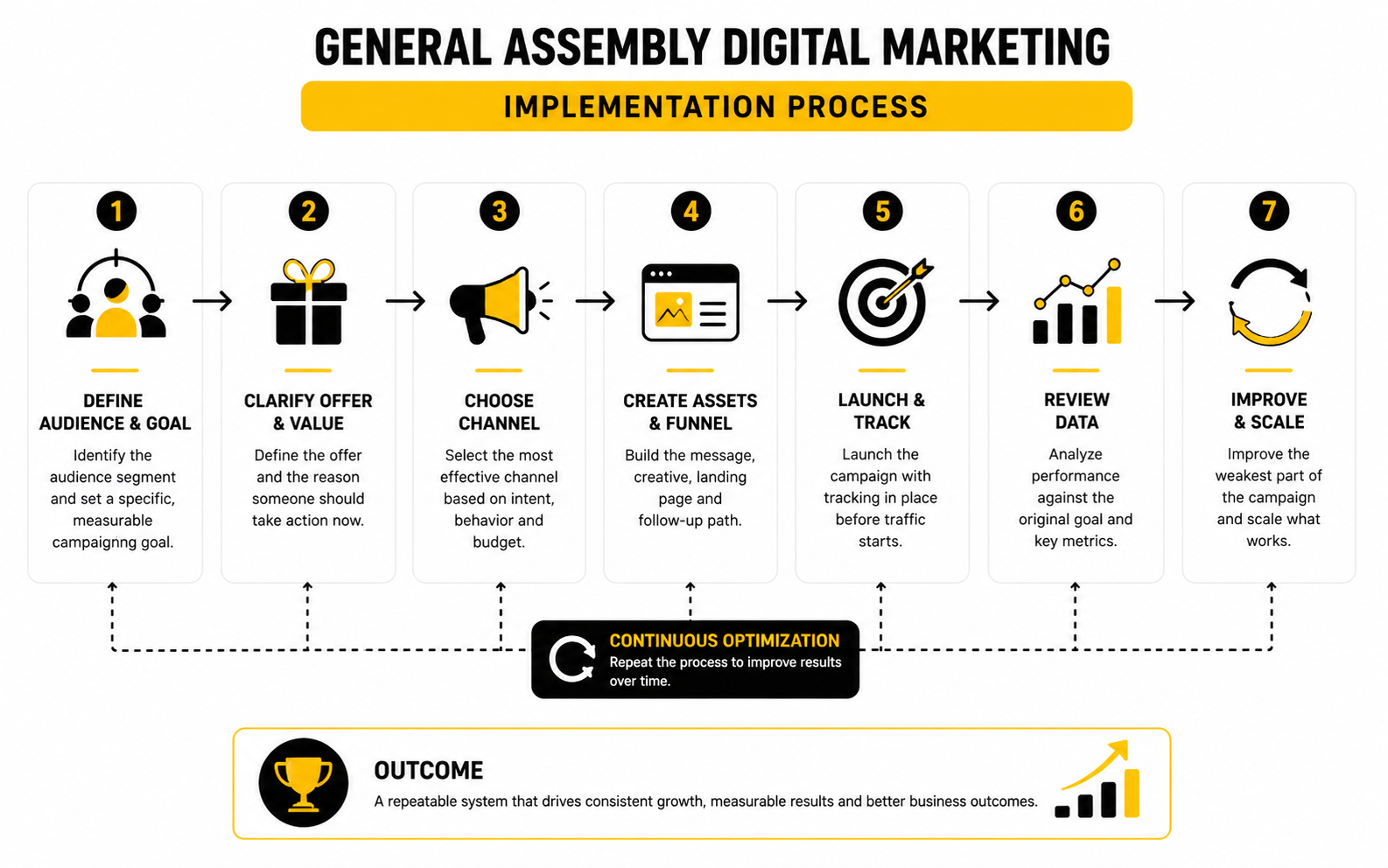
A simple implementation process looks like this:
- Define the audience segment and the campaign goal.
- Clarify the offer and the reason someone should act now.
- Choose the channel based on intent, behavior, and budget.
- Create the message, creative, landing page, and follow-up path.
- Launch with tracking in place before traffic starts.
- Review the data against the original goal.
- Improve the weakest part of the campaign before scaling.
That sequence is boring in the best possible way. It keeps you from chasing random tactics. It also gives you a repeatable way to improve, which is what real marketing work requires.
Choose Channels Based On Intent
Not every channel plays the same role. Search is often strong when people already know what they want. Social can shape demand, build familiarity, and test angles quickly. Email and automation help convert interest over time. Landing pages turn attention into action.
This is why a course that covers social media, search strategy, conversion optimization, and analytics has to be judged by how well it connects those pieces. The value is not learning channel definitions. The value is knowing when each channel makes sense and what job it should do inside the campaign.
For example, a marketer promoting a high-ticket service should not judge every channel by immediate purchases. Some channels may create the first meaningful interaction. Others may capture demand later. The smart move is to assign the right expectation to the right channel.
Measure Before You Optimize
Optimization only works when measurement is clean. If tracking is broken, the campaign teaches you the wrong lesson. That is dangerous because you may scale the wrong message, cut the wrong channel, or blame the wrong part of the funnel.
General Assembly digital marketing includes Google Analytics and conversion optimization, which are essential pieces of the process. Analytics should help you answer practical questions: where did people come from, what did they do, where did they drop off, and which actions mattered most? Without that, reporting turns into decoration.
This is also where marketers need discipline. Do not optimize everything at once. Pick the biggest constraint, make one meaningful change, and compare the result against the original goal. That habit separates professionals from people who just keep changing things until something looks better.
Statistics And Data
Data is where General Assembly digital marketing starts to become more than campaign theory. A marketer can have a clean strategy, strong creative, and a logical funnel, but the numbers decide what deserves more attention. The point is not to collect every metric available. The point is to know which signals show progress, which signals expose friction, and which signals are just noise.
The market itself explains why measurement matters. U.S. internet advertising revenue reached nearly $300 billion in 2025, growing 13.9% year over year. That kind of spend creates pressure. Businesses are not just asking whether marketing looks active. They are asking whether it produces measurable movement.
What The Numbers Should Actually Tell You
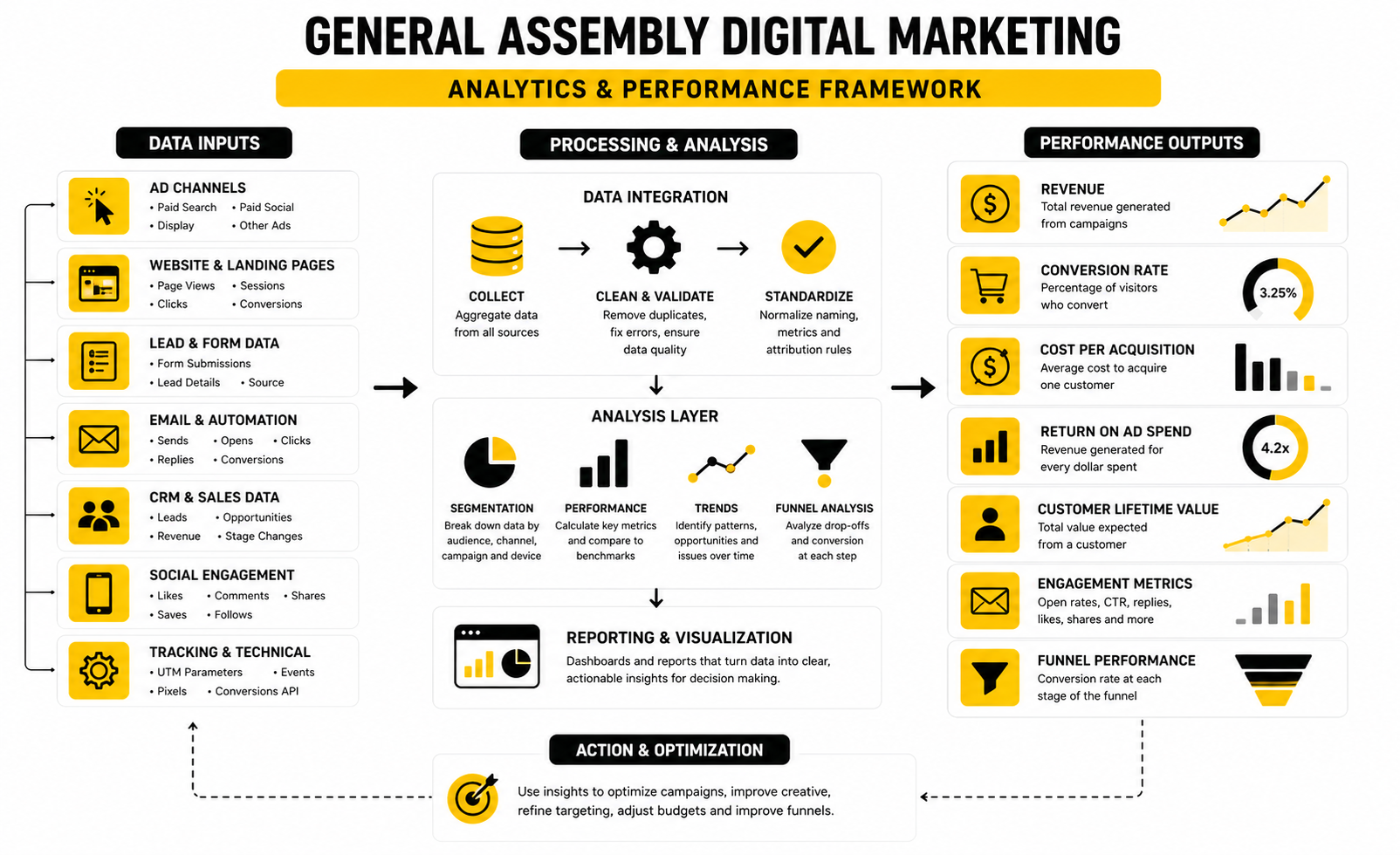
A useful analytics system answers three questions. Where did attention come from? What did people do next? Which actions created business value? If your reporting cannot answer those questions, it is not helping you make decisions.
This is why beginners should be careful with surface metrics. Impressions show exposure, but not persuasion. Clicks show curiosity, but not commitment. A high open rate can look good, but it does not automatically mean the campaign made money.
General Assembly digital marketing training becomes more valuable when you use analytics this way. You are not learning numbers for reporting theater. You are learning how to diagnose the campaign and decide what to improve next.
The Metrics That Matter Most
The right metric depends on the campaign goal. A lead generation campaign should not be judged the same way as a brand awareness campaign. A sales page should not be judged the same way as a nurture sequence.
For most practical campaigns, these are the signals worth watching:
- Traffic quality: where visitors came from, how relevant they were, and whether they matched the intended audience.
- Engagement depth: whether people consumed the page, watched the video, clicked the next step, or showed meaningful interest.
- Conversion rate: how many people took the desired action compared with the number of qualified visitors.
- Cost per result: how much it cost to generate a lead, sale, booking, or other defined outcome.
- Revenue impact: whether the campaign contributed to pipeline, purchases, repeat sales, or retention.
- Drop-off points: where people stopped moving forward and what that says about the offer, message, page, or follow-up.
Those numbers work together. Looking at one in isolation can mislead you. A low cost per click means nothing if the traffic does not convert, and a high conversion rate may not matter if the offer attracts the wrong customer.
Benchmarks Are Useful, But They Are Not The Goal
Benchmarks help you understand whether a number is roughly healthy, but they should not become the strategy. For example, the DMA’s 2025 email benchmark report shows delivery rates rising to 98% and unique click rates reaching 2.3%. That is useful context, but your own list quality, offer, industry, audience temperature, and send behavior will shape what “good” looks like.
The same logic applies across paid ads, landing pages, search, and social. A benchmark can tell you whether something deserves investigation. It cannot tell you why your audience did or did not act.
The professional move is to compare three things at once: the external benchmark, your historical performance, and the campaign’s business goal. When those three are viewed together, the data becomes practical. You can see whether the issue is the market, the channel, the creative, the offer, or the conversion path.
How To Read Performance Signals
Good marketers do not panic after one weak number. They look for patterns. A single campaign result can be affected by timing, budget, audience size, creative fatigue, tracking issues, or a mismatch between intent and offer.
If traffic is high but conversions are low, the problem may be the landing page, offer clarity, audience quality, or trust. If clicks are low but impressions are high, the message or creative may not be strong enough. If leads are coming in but sales quality is poor, the campaign may be attracting the wrong people.
This is where analytics becomes a practical skill. You move from “the campaign worked” or “the campaign failed” to a sharper question: what part of the system is limiting the result? That question is where better marketing decisions begin.
Measurement Should Drive Action
The worst use of data is reporting without action. A dashboard that does not change a decision is just decoration. Every report should lead to a next step, even if the next step is simply to keep the campaign stable and collect more data.
A practical improvement cycle looks like this:
- Confirm that tracking is working.
- Compare performance against the campaign goal.
- Identify the weakest stage in the journey.
- Form one clear hypothesis.
- Change one meaningful variable.
- Measure the result over a fair period.
- Decide whether to keep, adjust, or stop the change.
This is the discipline that makes digital marketing professional. General Assembly digital marketing can give you the structure, but the skill develops when you apply the process repeatedly. Data does not replace judgment. It sharpens it.
How To Apply The Training In Real Campaigns
At this stage, the real question is not whether General Assembly digital marketing can teach the basics. The better question is whether you can turn those basics into a repeatable way of working. That is where advanced judgment starts to matter.
A course gives you structure, language, and practice. Real campaigns add constraints: limited budget, unclear data, slow approvals, imperfect creative, competitive pressure, and customers who do not behave the way the plan predicted. The marketer who handles those constraints well becomes far more valuable than the marketer who only knows the textbook version.
Strategy Comes Before Software
Marketing tools are useful, but they can also distract beginners. A funnel builder does not fix a weak offer. An automation platform does not fix unclear messaging. A social scheduler does not fix content that nobody cares about.
This is why your first strategic tradeoff is focus. Before adding more software, decide what the campaign actually needs to improve. If the bottleneck is conversion, work on the page and offer. If the bottleneck is lead follow-up, a platform like GoHighLevel can make sense because it brings CRM, automation, pipelines, and messaging into one operating system.
The same logic applies to landing pages and funnels. If the campaign needs a sharper sales path, tools like ClickFunnels or systeme.io may be useful. But the tool should support the strategy, not become the strategy.
Scaling Creates New Problems
Small campaigns are easier because you can manually inspect almost everything. You can read the comments, review the leads, check the landing page, and make adjustments quickly. Scaling changes the game because more budget exposes weak assumptions faster.
When spend increases, creative fatigue appears sooner, audience quality can shift, and tracking problems become more expensive. A campaign that looked profitable at a small budget may struggle once it reaches a broader audience. That does not always mean the idea was bad. It may mean the first audience segment was simply easier to convert.
This is where trained marketers need patience and discipline. Scaling is not just “spend more.” Scaling means expanding the audience, testing new angles, improving conversion paths, and protecting quality while volume grows.
Privacy And First-Party Data Matter More Now
Data privacy is no longer a legal footnote. It changes how marketers collect signals, build audiences, personalize campaigns, and measure performance. The 2025 AMA Marketing Skills Report names data privacy and compliance as one of the major current competency gaps, alongside digital marketing, analytics, and proving ROI.
That matters for anyone studying General Assembly digital marketing because the old playbook of relying heavily on third-party tracking is weaker than it used to be. Marketers need to understand consent, owned audiences, email lists, CRM hygiene, and customer data quality. Those are not glamorous topics, but they make performance marketing more resilient.
This is also where email, forms, surveys, and CRM systems become strategic. A clean lead capture process built with tools like Fillout or customer communication managed through Brevo can help turn rented traffic into owned relationships. That gives the business more control over future campaigns.
AI Should Improve The Workflow, Not Replace The Thinking
AI can speed up research, ideation, content drafts, audience clustering, reporting, and creative testing. The CMO Survey found that companies using AI in marketing reported average improvements in sales productivity, lower overhead costs, and customer satisfaction in its 2025 topline report. The useful takeaway is not that AI magically improves marketing. It is that AI rewards teams with clear processes.
A beginner mistake is using AI to create more output before improving the brief. That creates volume, not quality. A better approach is to use AI for sharper inputs: better customer research summaries, stronger campaign hypotheses, cleaner reporting notes, and faster creative variations.
General Assembly digital marketing can give you the foundation to judge AI output instead of blindly accepting it. That is a big deal. The marketer who knows the audience, funnel, offer, and measurement plan can use AI as leverage. The marketer who does not know those things just produces faster noise.
Expert-Level Marketing Is About Tradeoffs
The deeper you go, the more you realize marketing is a tradeoff discipline. More automation can improve speed, but it can also make the customer experience feel generic. More targeting can improve relevance, but it can also limit reach. More testing can improve results, but it can also slow the team down if every decision needs perfect evidence.
The practical marketer learns how to choose. Sometimes the right move is a simple campaign with clean tracking. Sometimes it is a more complex automation path. Sometimes it is better to improve the offer before spending another dollar on traffic.
That is the real professional layer. General Assembly digital marketing can help you enter the field with structure, but your judgment grows by making decisions under pressure. Keep the system simple enough to manage, measured enough to improve, and strategic enough to serve the business goal.
Tools, Career Paths, And Final Buying Advice
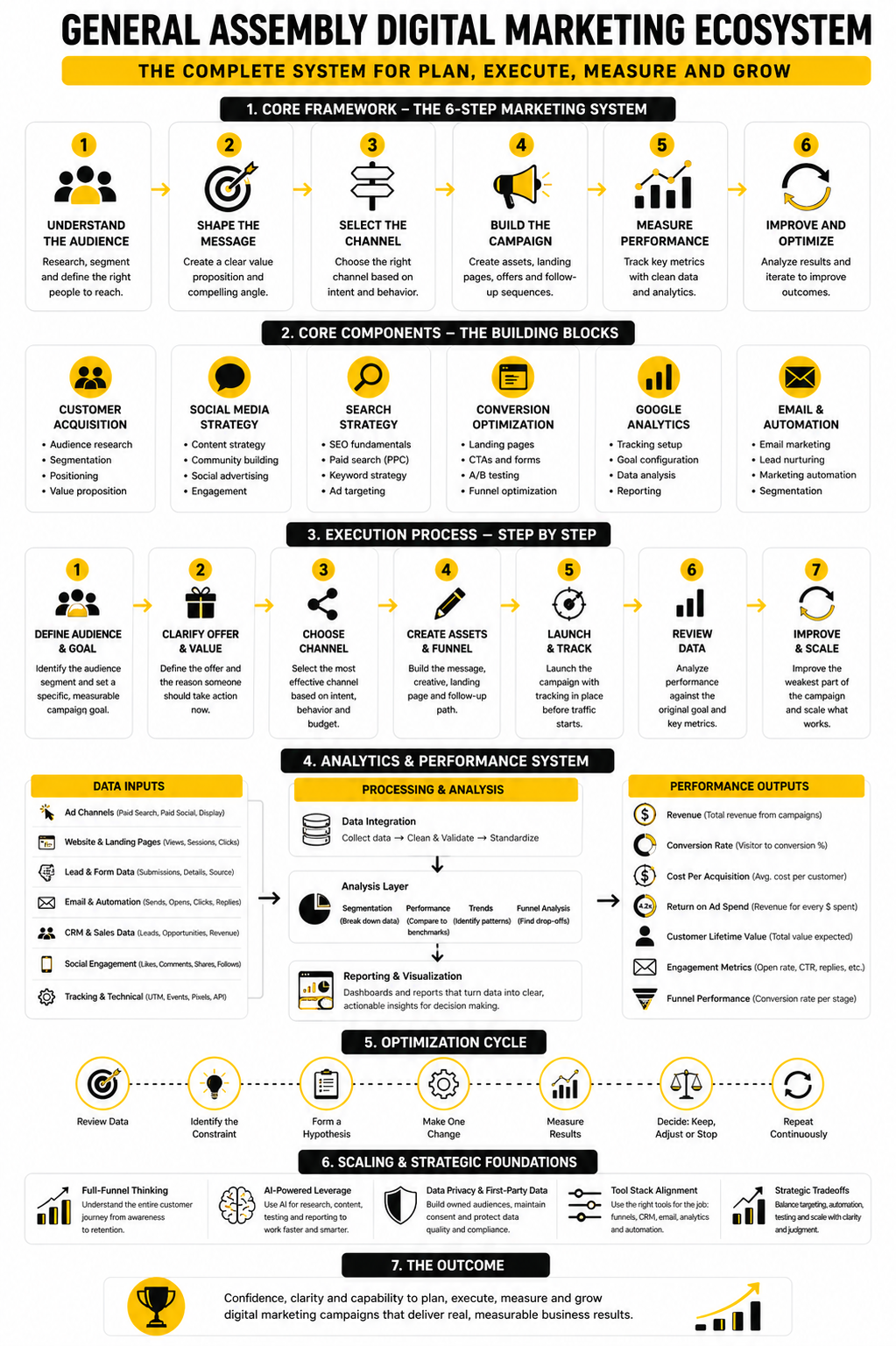
The strongest outcome from General Assembly digital marketing is not just knowing more terms. It is leaving with a practical operating system for marketing work. You should understand the customer, choose the channel, build the campaign, measure the result, and improve the system without needing every step explained again.
That matters because the career market rewards marketers who can do more than execute isolated tasks. The U.S. Bureau of Labor Statistics projects advertising, promotions, and marketing manager employment to grow 6% from 2024 to 2034, with about 36,400 openings per year. The opportunity is there, but the better roles usually go to people who can connect strategy, tools, data, and communication.
Choosing Your Marketing Tool Stack
Your tool stack should match the campaign system you are building. Do not buy software because a guru made it look exciting. Buy tools because they remove friction from a real workflow you already understand.
For funnel and sales-page work, ClickFunnels or systeme.io can help you build a more direct conversion path. For CRM, pipeline, follow-up, and automation, GoHighLevel is a strong fit when you need one system to manage leads and client communication. For social scheduling and publishing discipline, Buffer can help keep execution consistent.
The smart approach is simple. Start with the smallest stack that lets you launch, track, and improve. Add complexity only when the campaign has earned it.
Who General Assembly Digital Marketing Fits Best
General Assembly digital marketing is best for people who want a structured entry point into professional marketing. It fits career switchers, early-stage marketers, founders, freelancers, sales professionals, and operators who need to understand how digital campaigns actually work. It is especially useful if you have been learning from scattered videos and want a cleaner path.
It is less ideal if you already need highly advanced channel specialization. If you are trying to master enterprise SEO, advanced media buying, attribution modeling, or lifecycle marketing architecture, you may need specialist training after the foundation. That does not make the course weak. It just means the course should be matched to the right stage.
The best buyer is someone who will apply the lessons immediately. Build a campaign. Audit an existing funnel. Improve a landing page. Rewrite a reporting dashboard. Skills become real when they are used.
FAQ - Built for Complete Guide
Is General Assembly digital marketing good for beginners?
Yes, it can be a strong fit for beginners who want structure instead of random tutorials. The value is that it gives you a clear view of how channels, campaigns, analytics, and customer behavior connect. Beginners still need to practice outside the course because marketing skill comes from repeated application.
What does General Assembly digital marketing teach?
General Assembly’s digital marketing course has evolved toward performance marketing with AI, with emphasis on planning, executing, and optimizing campaigns across channels like paid search, social, and display. The practical focus is campaign thinking, audience targeting, creative testing, performance analysis, and data-informed improvement. That makes it more useful than a course that only explains channel definitions.
Is the General Assembly digital marketing certificate worth it?
It can be worth it if you use the certificate as proof of structured learning, not as a substitute for portfolio work. Employers and clients usually care more about whether you can explain campaigns, interpret data, and improve outcomes. The certificate helps most when it is paired with real projects.
Can this course help me get a marketing job?
It can help, especially if you are moving into entry-level digital marketing, performance marketing, content marketing, social media, or marketing coordinator roles. The course gives you language and structure, but you should also build examples of work. A small portfolio with campaign plans, landing page audits, reporting snapshots, and content strategy samples will make the learning more credible.
Does General Assembly digital marketing cover AI?
General Assembly’s current positioning says its digital marketing short course has evolved into Performance Marketing with AI. That matters because AI is now part of audience research, creative testing, reporting, and campaign optimization. The key is not just using AI tools, but learning how to apply them with judgment.
Do I need technical skills before taking it?
You do not need to be a developer, but basic comfort with spreadsheets, dashboards, web platforms, and campaign tools will help. Digital marketing is not pure technology, but it is tool-heavy. The more comfortable you are with data and experimentation, the faster the lessons will stick.
What should I learn after General Assembly digital marketing?
After the course, choose one deeper lane. Good options include SEO, paid search, paid social, email marketing, conversion optimization, analytics, marketing automation, or content strategy. Do not try to specialize in everything at once because that usually creates shallow skill.
How should I practice what I learn?
Pick one real offer and build a complete mini campaign around it. Define the audience, write the message, choose one channel, create the landing page or conversion path, set up tracking, and review the results. Even a small campaign teaches more than passive study.
What is the biggest mistake students make?
The biggest mistake is treating the course like the finish line. A course gives you structure, but the market rewards implementation. You need to turn the lessons into campaigns, audits, experiments, and portfolio pieces.
Is General Assembly digital marketing better than free YouTube learning?
It depends on how you learn. Free content can be excellent, but it is scattered and often tactic-heavy. General Assembly digital marketing is more useful if you want sequence, accountability, and a clearer professional framework.
What tools should I use while learning digital marketing?
Start with tools that support the basics: analytics, landing pages, email, CRM, and social scheduling. For example, Brevo can support email and customer communication, while Fillout can help with forms and lead capture. Keep the stack lean until your workflow proves it needs more.
What is the final verdict?
General Assembly digital marketing is a practical foundation for learning how modern campaigns work. It is not a magic shortcut, and it will not replace real campaign experience. But if you want structure, confidence, and a clearer way to think about digital marketing, it can be a smart starting point.
Work With Professionals
Explore 10K+ Remote Marketing Contracts on MarkeWork.com
Most marketers spend too much time chasing clients, competing on crowded platforms, and losing a percentage of every project to middlemen.
MarkeWork gives you a better way. Browse thousands of remote marketing contracts and connect directly with companies desperate to hire skilled marketers like you, without platform commissions and without unnecessary gatekeepers.
If you're serious about finding better opportunities and keeping 100% of what you earn, explore available contracts and create a profile for free at MarkeWork.com.