

Getting attention is not the hard part anymore. Keeping it, earning trust, and turning that trust into action is where most businesses struggle.
That is why the decision to get a copywriter matters. A good copywriter does not just “write nice words.” They clarify the offer, sharpen the message, remove friction, and help the right people understand why your product is worth choosing.

Article Outline
- Why Getting A Copywriter Matters
- The Copywriter Hiring Framework
- Core Copywriting Roles And Deliverables
- How To Choose The Right Copywriter
- Professional Implementation And Workflow
- Costs, Red Flags, FAQs, And Next Steps
Why Getting A Copywriter Matters
Most businesses do not have a traffic problem first. They have a clarity problem. People land on the website, read the offer, skim the email, or see the ad, but they do not quickly understand what is being sold, why it matters, and why they should act now.
When you get a copywriter, you are paying for more than sentences. You are paying for someone to turn raw value into clear communication. That means better positioning, stronger calls to action, tighter sales pages, cleaner email flows, and messaging that sounds like it came from a real business instead of a committee.
This matters even more now because generic content is everywhere. AI can create drafts quickly, but speed does not automatically create persuasion. The winning edge is still judgment: knowing what to say, what to cut, what proof to use, and how to make the buyer feel understood.
The Copywriter Hiring Framework
Before you hire anyone, you need a simple framework. Otherwise, you end up choosing based on vibes, portfolio polish, or who replied fastest. That is how businesses waste money on copy that sounds good but does not move the needle.
The framework is simple: define the business problem, match the copywriter to the deliverable, check their thinking process, and set up implementation properly. Each step protects you from a different mistake. You avoid hiring a brand storyteller for a direct-response funnel, a blog writer for a sales page, or a cheap generalist for a high-stakes launch.
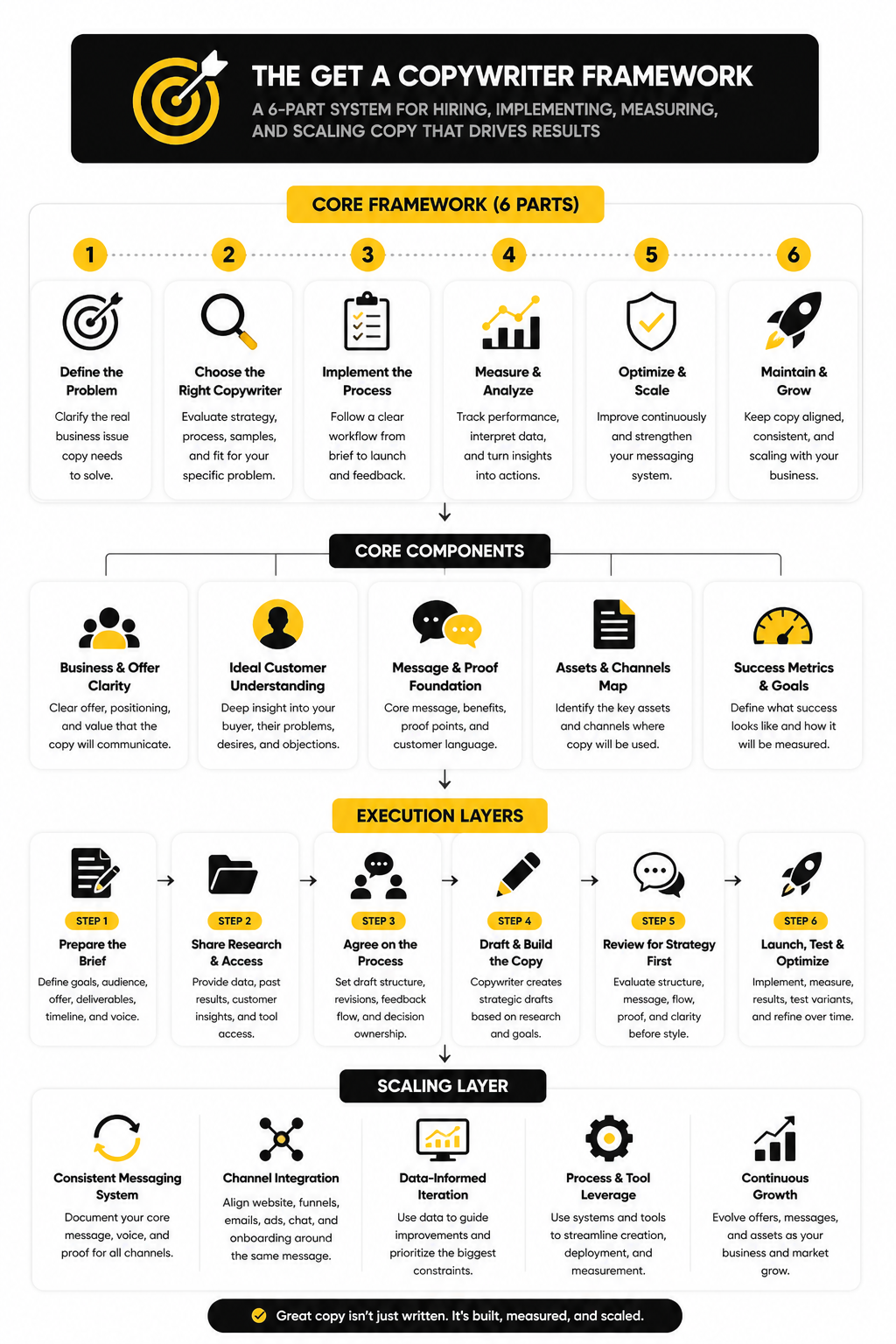
A strong hiring process also makes the copywriter better. Clear goals, real customer insight, useful proof, and honest constraints give them the raw material they need. The better your inputs, the sharper the final copy can become.
Core Copywriting Roles And Deliverables
The first mistake is thinking every copywriter does the same job. They do not. A copywriter who writes strong product pages may not be the right person for a long-form sales letter, and a conversion copywriter may not be the best fit for thought leadership or brand voice work.
That is why you should get a copywriter based on the outcome you need, not the vague idea that “we need better copy.” Start with the business asset that needs improvement. Then choose the specialist who has already solved that kind of problem before.
Website Copywriters
A website copywriter helps visitors understand your business quickly. Their work usually includes homepages, service pages, product pages, about pages, and contact page copy. The goal is not to fill space; the goal is to make the page easy to scan, easy to trust, and easy to act on.
This matters because people do not read websites like books. Web usability research has long shown that most users scan pages before they commit to reading, so structure, headlines, subheads, proof, and calls to action carry a lot of weight. A good website copywriter writes for that reality instead of pretending every visitor will carefully read every paragraph.
The best website copy is clear before it is clever. It tells the reader where they are, who the offer is for, what problem it solves, and what they should do next. If your current website sounds polished but people still leave confused, this is the type of copywriter you probably need.
Sales Page And Funnel Copywriters
A sales page copywriter focuses on persuasion across a specific buying journey. They usually work on landing pages, webinar pages, checkout pages, upsell pages, downsell pages, and full funnel messaging. Their job is to move a reader from interest to action without making the experience feel forced.
This role becomes important when paid traffic, launches, or high-value offers are involved. Small improvements in copy can matter because landing page performance varies widely by industry, and recent conversion benchmark data shows a broad median landing page conversion rate around 6.6% across analyzed pages. If a funnel is already getting traffic, stronger messaging can make the same traffic more valuable.
For this kind of project, the copywriter should understand offer structure, objections, urgency, proof, and page flow. Tools like ClickFunnels, Systeme.io, and GoHighLevel can help build the funnel, but the copy still has to do the heavy lifting. Software gives you the pages; the message gives people a reason to move forward.
Email Copywriters
An email copywriter writes campaigns, newsletters, launches, onboarding sequences, abandoned cart emails, reactivation flows, and post-purchase sequences. This is one of the most practical reasons to get a copywriter because email is where trust and revenue can compound over time. It is also where lazy writing gets ignored fast.
Strong email copy is not just about catchy subject lines. It is about relevance, timing, segmentation, offer clarity, and making each message feel like it belongs in the reader’s inbox. Email remains a major revenue channel, with recent industry reporting estimating worldwide email marketing revenue in the billions and continuing to grow.
The right email copywriter can help you turn scattered broadcasts into a proper system. Platforms like Brevo and Moosend can handle sending and automation, but the actual emails still need a human reason to exist. Better tools will not rescue weak messaging.
Ad Copywriters
An ad copywriter works on paid social ads, search ads, display ads, hooks, angles, scripts, and creative testing concepts. This role is valuable when you need to test attention fast. The copy has to be short, specific, and tied to a clear promise.
Good ad copy starts before the writing. It comes from understanding the audience’s pain, desire, awareness level, and stage of demand. A weak ad says what the product is; a strong ad makes the right person feel like the offer is relevant now.
This is also where creative volume matters. One winning angle can outperform ten generic variations, but you usually need structured testing to find it. A good ad copywriter does not just write lines; they create testable ideas.
Brand Copywriters
A brand copywriter helps define how a business sounds. They work on voice guides, taglines, campaign messaging, brand narratives, positioning language, and high-level messaging systems. This is less about immediate conversion and more about consistency, recognition, and trust.
You need this type of copywriter when your business sounds different everywhere. The website says one thing, the emails say another, the ads sound generic, and the sales team explains the offer in their own words. That creates friction because buyers cannot easily understand what the company stands for.
A strong brand copywriter creates language your whole team can use. That does not mean making everything sound cute or overly polished. It means building a voice that is clear, memorable, and aligned with the actual business.
SEO Copywriters
An SEO copywriter writes pages and articles designed to attract search demand while still being useful to humans. This includes service pages, comparison pages, buying guides, blog posts, category pages, and content refreshes. The best SEO copywriters balance search intent, readability, internal linking, and conversion.
This is important because traffic alone is not the goal. A page can rank and still fail if it does not answer the real question behind the search. When someone searches how to get a copywriter, they are not just looking for a definition; they want to know who to hire, what to expect, how much it may cost, and how to avoid choosing badly.
A good SEO copywriter thinks beyond keywords. They structure the page around intent, proof, objections, and next steps. That is the difference between content that gets impressions and content that supports revenue.
How To Choose The Right Copywriter
The right copywriter is not always the most famous, the most expensive, or the one with the prettiest website. The right copywriter is the person whose process fits your problem. That is the part most people miss when they decide to get a copywriter.
You are not buying words by the pound. You are buying judgment, structure, research, and execution. If the copywriter cannot explain how they move from raw information to persuasive messaging, you are taking a bigger risk than you need to.
Start With The Business Problem
Before you contact anyone, define what is broken. Do you need more leads from an existing website? Better conversion from a landing page? A clearer sales sequence? A stronger onboarding flow? A sharper positioning message for a new offer?
This one step changes the whole hiring process. Instead of saying, “I need copy,” you can say, “We have traffic but not enough booked calls,” or “Our email list is active, but product launches are underperforming.” That gives a serious copywriter something real to work with.
A clear business problem also helps you avoid scope creep. If the problem is the sales page, do not turn the project into a full brand strategy, email overhaul, ad campaign, and website rewrite unless those pieces are truly connected. Focus creates better copy.
Check Their Strategic Thinking
A good copywriter asks uncomfortable but useful questions. They want to know who the buyer is, what they already believe, what objections block the sale, what proof exists, and what makes the offer different. If they jump straight into writing without asking much, be careful.
You want someone who can think before they write. That means they should talk about research, message hierarchy, offer clarity, customer language, and the role each asset plays in the wider funnel. Their portfolio matters, but their explanation of the work matters more.
Ask them why they made certain copy decisions in a past project. Strong copywriters can explain the thinking behind headlines, page structure, calls to action, and proof placement. Weak copywriters usually hide behind vague phrases like “it felt more premium” or “it sounded punchier.”
Review Relevant Samples
Do not judge a copywriter only by whether you personally like their style. Judge whether their samples match the kind of asset you need. If you need a conversion-focused landing page, a beautiful brand manifesto will not tell you enough.
Look for clarity first. Can you understand the offer quickly? Does the page flow naturally? Are objections handled before they become reasons to leave? Is the call to action obvious without feeling desperate?
Relevant samples also show whether the copywriter can adapt. A good writer can keep the brand voice intact while still making the message sharper. That balance is important because copy should sound like your business, not like the copywriter showing off.
Professional Implementation And Workflow
Once you choose the right person, the work still needs a strong process. This is where many projects succeed or fall apart. Even a talented copywriter will struggle if the brief is vague, feedback is scattered, and nobody owns the final decision.
A professional workflow keeps the project moving without killing the creative thinking. It gives the copywriter enough structure to work efficiently and enough context to make smart decisions. When you get a copywriter, the process should feel collaborative, not chaotic.
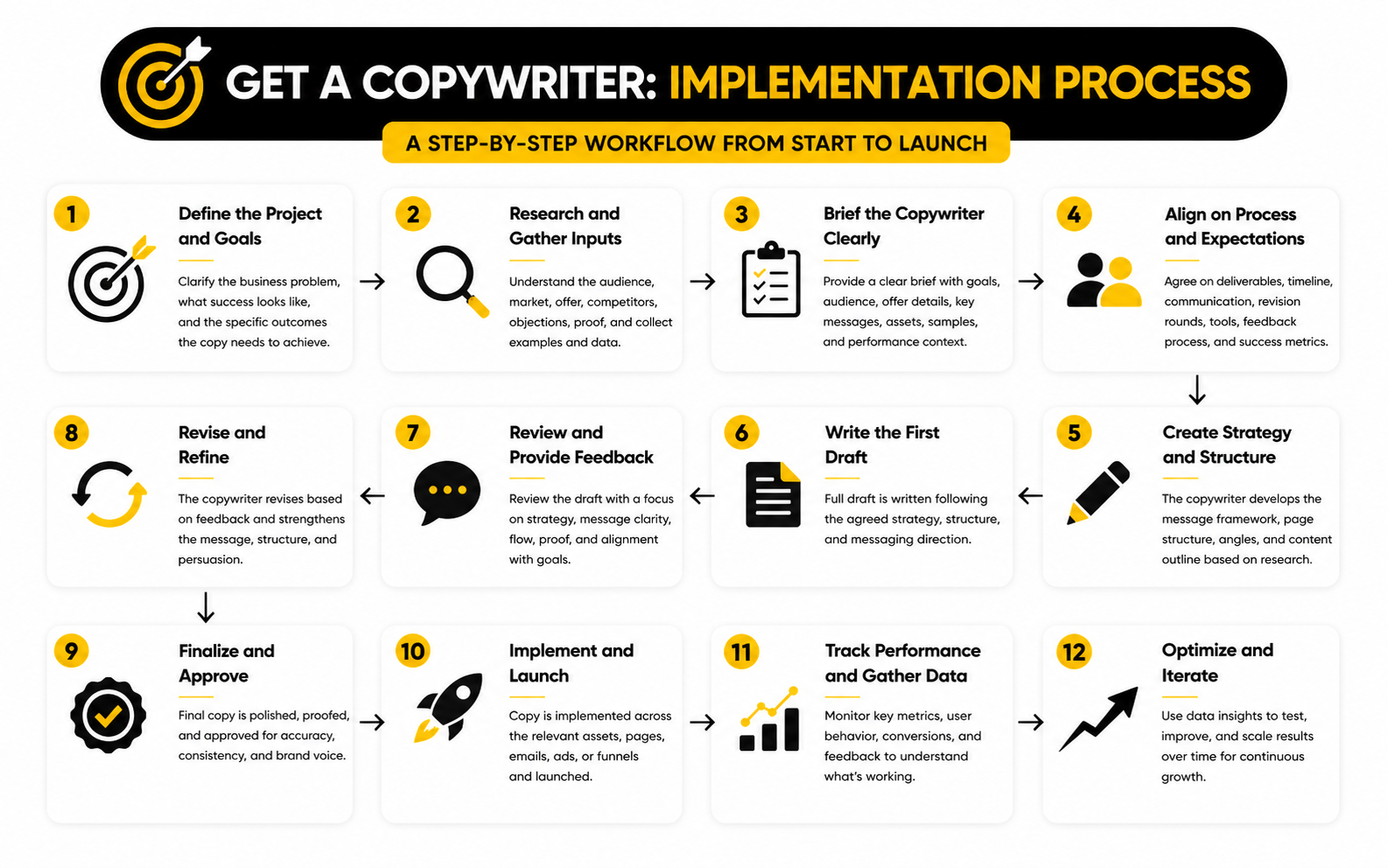
Step 1: Prepare The Brief
The brief should explain the offer, audience, goal, deliverables, timeline, brand voice, competitors, proof, and constraints. It does not need to be fancy. It needs to be honest and useful.
Share what you already know about your customers. That can include sales call notes, support tickets, reviews, survey responses, testimonials, analytics, past campaign results, and common objections. Real customer language is often more valuable than polished internal messaging.
Do not hide the messy parts. If the offer is hard to explain, say that. If customers compare you to a cheaper alternative, include it. A good copywriter can work with reality, but they cannot fix what they cannot see.
Step 2: Share Research And Access
Copywriting gets stronger when the writer can see the full picture. Give access to the website, existing funnels, email platform, CRM notes, product demos, customer reviews, ad accounts, or analytics where relevant. The goal is not to overwhelm them; the goal is to remove guessing.
This is especially important for funnel and email projects. If your sales process lives inside tools like GoHighLevel, ClickFunnels, or Systeme.io, the copywriter needs to understand how the pieces connect. A headline on one page may depend on the promise made in an ad, email, or previous step.
For content and social distribution, tools like Buffer can help manage publishing, but they do not replace message strategy. The copywriter still needs to know the audience, the goal, and the context behind each message. Otherwise, you are just scheduling content that may not deserve attention.
Step 3: Agree On The Drafting Process
Set expectations before the first draft. Decide how many drafts are included, who gives feedback, where comments should live, and what counts as a revision. This sounds boring, but it prevents most project friction.
Feedback should be specific. “Make it better” is not useful. “This section sounds too technical for a first-time buyer” is useful. “We need stronger proof here because prospects often doubt this claim” is even better.
One decision-maker should own the final direction. Group feedback can be helpful, but five people rewriting sentences in different styles will weaken the result. Protect the copy from committee chaos.
Step 4: Review For Strategy Before Style
When the first draft arrives, do not start by changing adjectives. Start with the bigger questions. Does the copy speak to the right buyer? Is the offer clear? Does the page or sequence move logically? Are the main objections handled?
Only after the structure works should you polish tone and wording. This order matters because pretty sentences cannot save a weak argument. If the strategy is wrong, cosmetic edits only make the wrong message sound smoother.
A useful review process looks at purpose first, flow second, proof third, and style last. That keeps everyone focused on business outcomes instead of personal preferences. It also gives the copywriter feedback they can actually use.
Statistics And Data That Actually Matter
Data is useful only when it changes what you do next. Random benchmarks can make a report look smart, but they will not help you get a copywriter, judge the work, or improve the result. The real goal is to connect copy decisions to measurable business movement.
This is where many teams get confused. They look at one number, panic, and start rewriting everything. Better measurement is calmer than that. It separates traffic quality, offer strength, page clarity, audience intent, and follow-up performance so you know which part of the system needs attention.
Start With The Right Baseline
A landing page conversion rate means very little without context. Lead generation, ecommerce, webinars, paid ads, organic search, and high-ticket consulting all behave differently. A page selling a $27 template should not be measured the same way as a page asking someone to book a sales call for a $10,000 service.
Still, benchmarks can help you spot whether something is clearly underperforming. Recent landing page benchmark data places the median landing page conversion rate around 6.6% across all industries, while stronger pages can sit much higher depending on the market, offer, traffic source, and buyer intent. Treat that as a comparison point, not a universal target.
The useful question is not, “Are we above average?” The useful question is, “Are we improving the right metric for this specific page?” If the page exists to generate calls, measure qualified booked calls. If the page exists to sell directly, measure completed purchases. If the page exists to start a nurture path, measure opt-ins that later engage.
Measure The Full Copy Journey
Copy does not work in isolation. A headline may increase attention, but the form may kill conversions. An email may get clicks, but the landing page may fail to close the promise. A sales page may be strong, but the traffic may be too broad.
That is why you need to track the whole path. At minimum, watch impressions, click-through rate, landing page conversion rate, form completion, email engagement, sales calls booked, close rate, and revenue. Each number tells you where the message is helping and where the system is leaking.
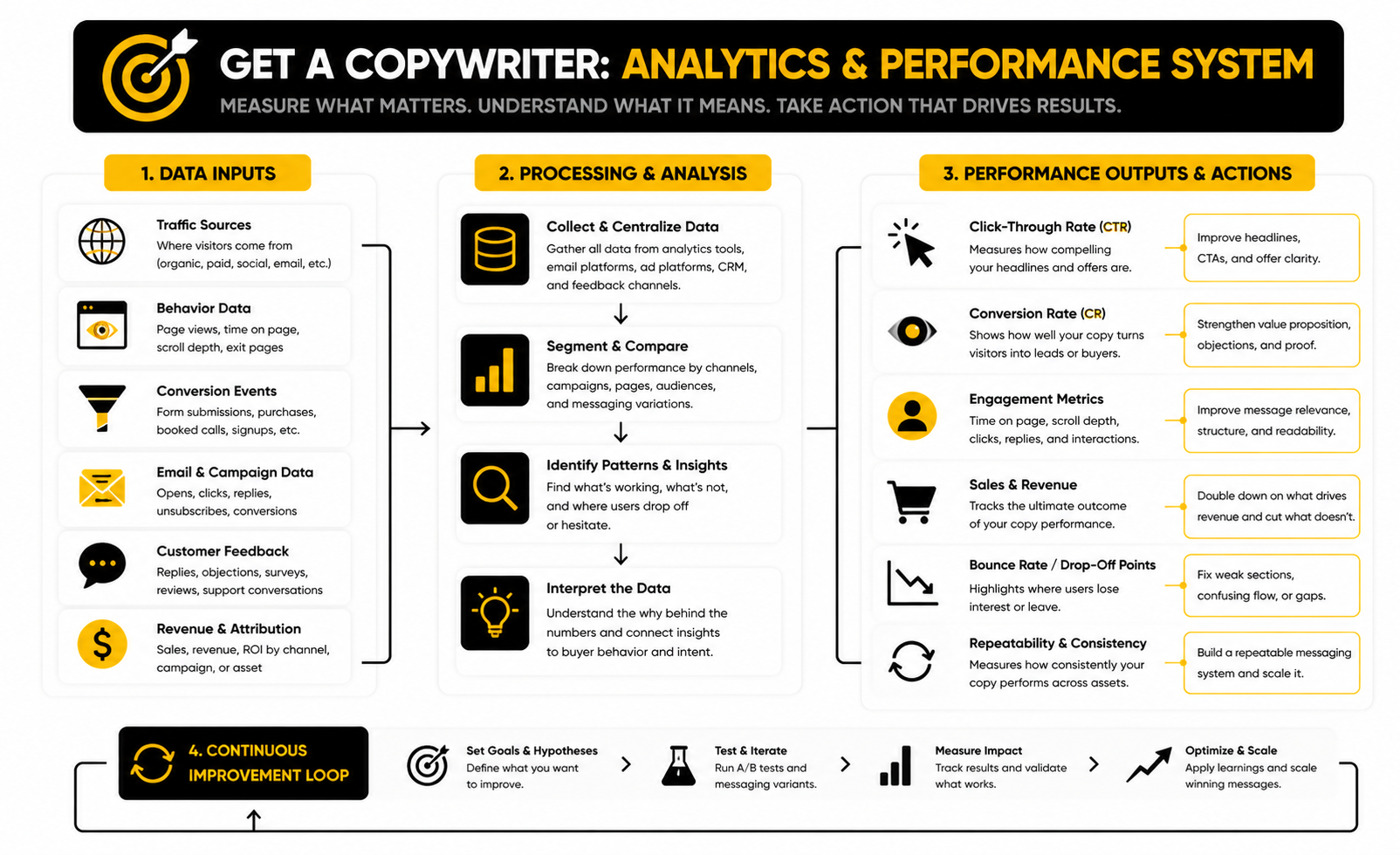
When you get a copywriter, give them access to this performance context before they write. They do not need every dashboard in your business, but they do need to know what the current numbers suggest. Copy written without performance context is often just a better-looking guess.
Read Email Metrics Carefully
Email numbers can be especially misleading. Open rates are useful for spotting deliverability or subject line problems, but they are not the final goal. Clicks, replies, conversions, unsubscribes, and revenue tell you much more about whether the message is actually working.
Recent email benchmark reporting shows average click rates can sit near 2.09% across campaigns, but that number can swing heavily based on list quality, industry, offer type, segmentation, and relationship strength. A small, warm list can outperform a huge cold list by a mile. Size is not the same as intent.
Use email data to diagnose the copy layer by layer. Low opens may point to weak subject lines, poor sender reputation, or list fatigue. Low clicks after healthy opens may mean the body copy is not creating enough desire. Strong clicks with weak sales usually means the landing page, offer, checkout, or follow-up sequence needs work.
Watch Behavior Signals, Not Just Final Conversions
Conversions matter, but behavior signals show you what happens before the yes or no. Scroll depth, time on page, heatmaps, form starts, form abandonment, button clicks, and page exits can reveal where people lose confidence. These signals are especially helpful when you do not yet have enough conversions for clean testing.
For example, if visitors reach the pricing section but do not act, the copy may need stronger value framing, better proof, or clearer risk reversal. If they leave near the top, the headline may not match the traffic promise. If they click the call to action but abandon the form, the issue may be friction, not persuasion.
This is also where analytics tools and funnel builders become practical. Platforms such as GoHighLevel, ClickFunnels, and Systeme.io can help connect pages, forms, automations, and reporting. But the tool is not the strategy. The numbers still need interpretation.
Turn Data Into Copy Decisions
Good measurement should lead to specific copy actions. If people do not understand the offer, rewrite the hero section. If they doubt the promise, add better proof. If they hesitate at the call to action, clarify what happens after they click.
Do not test tiny word changes before fixing big message problems. Changing “Start now” to “Get started” will not save a weak offer explanation. The biggest wins usually come from sharper positioning, better audience-message match, stronger proof, clearer page flow, and removing confusion.
A copywriter who understands data will not promise magic from one draft. They will look for the biggest constraint, improve the message, and help you measure whether the change worked. That is the professional way to treat copy: not as decoration, but as a business lever.
Advanced Considerations Before You Hire
By this point, the basic decision is clear: you do not get a copywriter just because you want nicer words. You get one because a specific part of the business needs clearer, sharper, more persuasive communication. The advanced part is knowing what tradeoffs you are making before money, time, and expectations get involved.
Copywriting projects can fail even when the writer is talented. They fail because the offer is unclear, the audience is too broad, the feedback process is messy, or the business expects copy to fix a strategy problem. That is why the smartest move is to understand the risks before the project starts.
Cheap Copy Can Become Expensive
Cheap copy is tempting when the budget is tight. The problem is that low-cost copy often skips the expensive parts of the work: research, positioning, customer insight, strategic structure, and careful revision. You may get words quickly, but speed means very little if the message does not help people buy.
This does not mean every expensive copywriter is good. It means price should be judged against risk. A weak email sequence for a small side project is one thing; weak copy on a paid funnel, launch page, or core service page can waste ad spend, sales opportunities, and months of learning.
Recent freelance rate data shows how wide the market can be, with UK copywriting day rates commonly discussed from junior levels around £250 to specialist levels above £1,000. That range exists because not all copy projects carry the same complexity or commercial pressure. When the asset is close to revenue, choosing only by price is usually the wrong filter.
AI Drafts Still Need Human Judgment
AI has changed the copywriting workflow, but it has not removed the need for copywriting judgment. It can help with outlines, rough variations, research organization, headline brainstorming, and editing support. But it cannot automatically know which promise your market believes, which objection matters most, or which proof will feel credible to your buyer.
The danger is not using AI. The danger is publishing AI-shaped copy with no strategic review. That is how brands end up sounding generic, overconfident, and strangely similar to everyone else in their niche.
A strong copywriter can use AI as a tool without letting it become the strategist. They still need to interview, analyze, choose, cut, prioritize, and defend the message. That is the human part. Do not skip it.
Specialists Beat Generalists When The Stakes Are High
A generalist can be useful when you need a mix of lower-risk assets, especially if the brand is still early. They can help with basic website pages, simple emails, social captions, or content updates. That flexibility has value.
But when the asset is tied directly to revenue, specialization matters more. A launch sequence, paid funnel, sales page, webinar script, or high-ticket service page needs someone who understands buying psychology, objections, proof, and conversion flow. This is where a specialist is often worth the higher fee.
The practical rule is simple. Use generalists for breadth and specialists for leverage. When one piece of copy can affect a large amount of traffic, sales calls, or revenue, hire the person who has already worked on that exact kind of asset.
Your Offer May Need Work Before The Copy
Sometimes the copywriter discovers that the real issue is not the copy. The offer may be too vague, too similar to competitors, too hard to explain, or too weak compared with the price. That can feel frustrating, but it is actually useful.
Good copy cannot create value that is not there. It can clarify value, frame value, dramatize value, and make value easier to believe. But if the offer itself is not compelling, the best copy in the world will still struggle.
This is why serious copywriters often ask about the offer before they talk about headlines. They want to know what the buyer gets, why it matters, what makes it different, what proof supports it, and what risk the buyer feels. If those answers are weak, fix the offer first.
Scaling Copy Requires A Message System
One copywriter can improve one asset. A message system improves the whole business. That system includes positioning, voice, proof points, objection handling, customer language, offer descriptions, calls to action, and approved claims.
This becomes more important as the business grows. More channels mean more chances for inconsistency. Your website, emails, ads, sales scripts, chatbot flows, onboarding messages, and social posts should not feel like they were written by six unrelated companies.
Tools can help distribute the message once the strategy is clear. You might use ManyChat for automated conversations, Chatbase for customer-facing AI support, or GoHighLevel for funnel and CRM workflows. But the system still needs a strong message at the center. Automation only scales what you already put into it.
The Best Copywriters Push Back
If a copywriter agrees with everything immediately, that is not always a good sign. You are hiring them for expertise, not obedience. They should be able to challenge weak assumptions, unclear offers, unsupported claims, and feedback that makes the copy worse.
This does not mean they should be difficult. It means they should protect the strategy. A professional copywriter can explain why a headline needs to stay direct, why a section needs proof, or why a popular internal phrase will not make sense to new buyers.
That pushback is part of the value. You do not get a copywriter just to write what you would have written yourself. You hire one to see the message through the buyer’s eyes and make the communication stronger than your internal default.
Costs, Red Flags, FAQs, And Next Steps
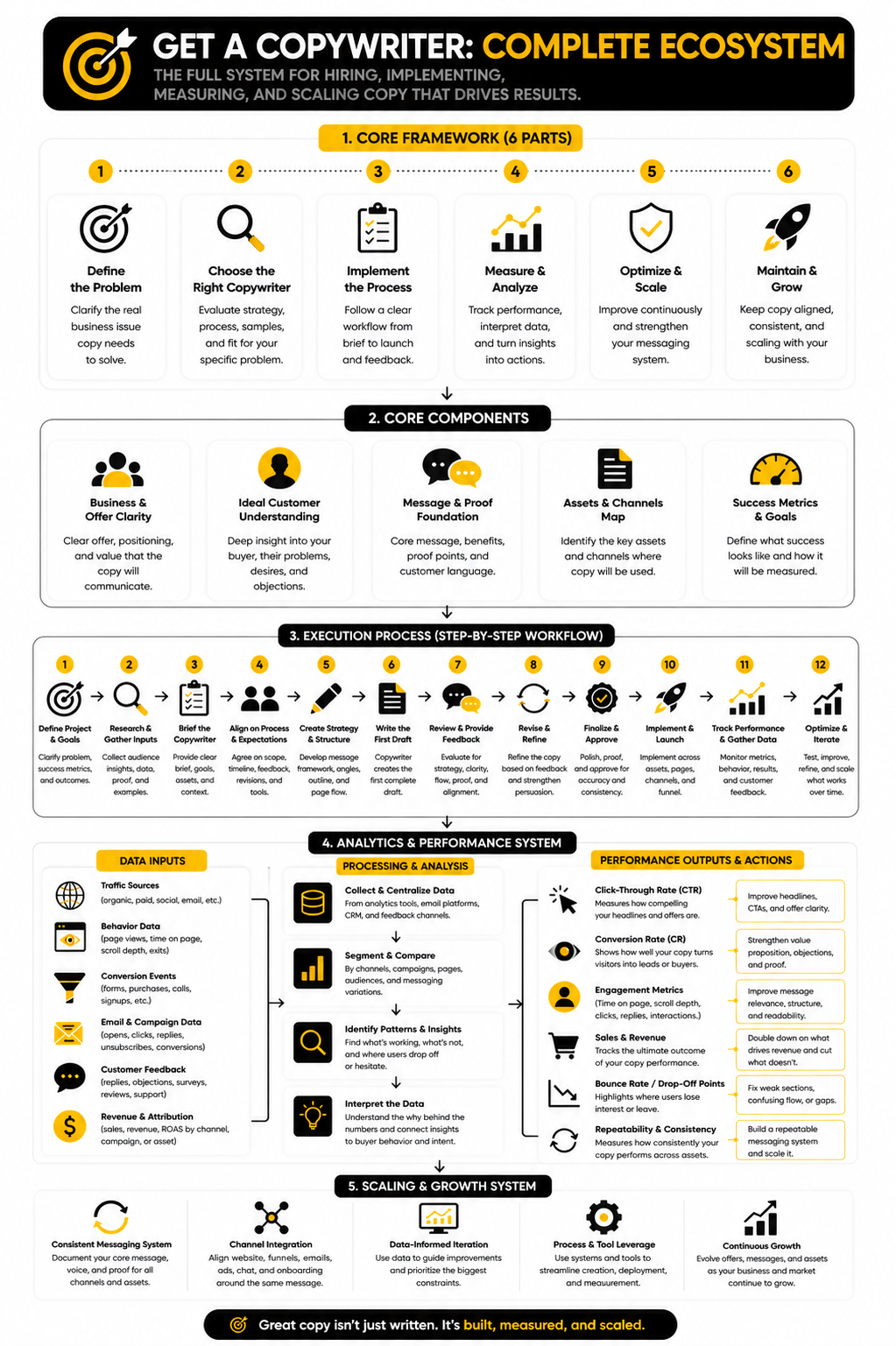
The final decision is not just whether to get a copywriter. It is whether you are ready to hire one in a way that gives the project a fair chance to work. Copy is part skill, part strategy, part process, and part business maturity.
A good hire can sharpen your message, improve your customer journey, and make your marketing assets easier to understand. A bad hire can create polished noise that looks professional but does not help the buyer move forward. The difference usually comes down to preparation, fit, and honest evaluation.
Budget For The Outcome, Not The Word Count
Word count is one of the weakest ways to price serious copywriting. A short landing page can take more strategic work than a long blog post. A single headline can carry more commercial weight than ten paragraphs of supporting copy.
Think in terms of business value instead. If the copy is attached to paid traffic, a core offer, a sales funnel, or a launch, the budget should reflect the role that asset plays. This does not mean overspending blindly, but it does mean avoiding the cheapest option when the downside of weak copy is expensive.
You should also budget for implementation. Copy may need design, page building, automation, analytics setup, testing, or email deployment. If the copywriter writes the page but nobody can launch it properly, the project is still unfinished.
Watch For Red Flags
Some red flags show up before the project starts. The copywriter may avoid asking about your customers, promise guaranteed revenue without seeing the offer, or quote instantly without understanding the scope. That usually means they are selling output, not solving a business problem.
Other red flags show up during the work. Vague timelines, defensive reactions to useful feedback, weak reasoning, and copy that sounds impressive but says very little are all warning signs. You do not need a difficult genius. You need a professional who can think clearly and communicate well.
The biggest red flag is copy that could belong to any business in your category. If your page sounds like every competitor, the buyer has no reason to care. Specificity wins. Always.
FAQ - Built For Complete Guide
What does a copywriter actually do?
A copywriter writes persuasive business communication designed to create action. That action could be a sale, a booked call, an email signup, a product demo, a reply, or a clearer understanding of the offer. The best copywriters also help with research, positioning, message structure, and objection handling.
When should I get a copywriter?
You should get a copywriter when the words are connected to a business outcome you care about. That might be a website that is not converting, a launch that needs sharper messaging, a funnel that needs better flow, or an email sequence that needs more engagement. If the asset affects revenue or trust, professional copy is worth considering.
What should I prepare before hiring one?
Prepare the offer details, target audience, customer research, testimonials, objections, past performance data, competitor context, and examples of copy you like or dislike. You do not need everything perfectly organized, but you do need enough context to help the copywriter think. The better the inputs, the stronger the first draft usually becomes.
How much does it cost to hire a copywriter?
Costs vary widely based on experience, specialization, deliverable type, and commercial risk. A simple page update may cost far less than a full sales funnel, launch sequence, or brand messaging project. Judge the fee against the value of the asset, not against the number of words.
Should I hire a freelance copywriter or an agency?
Hire a freelancer when you want direct access to the person doing the thinking and writing. Hire an agency when you need copy plus design, development, ads, analytics, and project management under one roof. Neither is automatically better; the right choice depends on complexity, budget, and how much internal support you already have.
Can AI replace a copywriter?
AI can support copywriting, but it should not replace strategic judgment. It can help with drafts, variations, outlines, and research organization. A human still needs to decide what matters, what is believable, what should be removed, and how the message should connect to the buyer’s real motivation.
How do I know if a copywriter is good?
Look at relevant samples, but also listen to how they explain their decisions. A good copywriter can talk clearly about audience, offer, proof, objections, structure, and conversion goals. If they only talk about making the copy sound better, they may not be strategic enough for high-stakes work.
What is the difference between copywriting and content writing?
Copywriting is usually written to drive a specific action. Content writing is usually written to educate, inform, attract search traffic, or build authority over time. There is overlap, but the intent is different, and that difference matters when you hire.
Should a copywriter also build the funnel?
Some copywriters can help build funnels, but many focus only on strategy and copy. If you need the full setup, make sure the project includes design, page building, tracking, automations, and QA. Tools like ClickFunnels, Systeme.io, and GoHighLevel can support the build, but someone still has to own the execution.
How many revisions should be included?
Most professional projects include one or two revision rounds. That is usually enough when the brief is strong and feedback is clear. Endless revisions often signal that the strategy was not aligned at the start, so fix the process instead of adding more rounds forever.
What results should I expect?
Expect clearer messaging, stronger structure, better alignment with buyer intent, and a more professional sales journey. Do not expect guaranteed revenue from copy alone because performance also depends on traffic quality, offer strength, pricing, trust, design, and follow-up. Strong copy improves the system, but it is not the whole system.
What is the fastest way to start?
Start by choosing the single asset closest to revenue or buyer trust. That could be your homepage, sales page, lead magnet page, email sequence, or booking page. Then define the problem, gather the raw materials, and hire based on relevant experience.
Work With Professionals
Explore 10K+ Remote Marketing Contracts on MarkeWork.com
Most marketers spend too much time chasing clients, competing on crowded platforms, and losing a percentage of every project to middlemen.
MarkeWork gives you a better way. Browse thousands of remote marketing contracts and connect directly with companies desperate to hire skilled marketers like you, without platform commissions and without unnecessary gatekeepers.
If you're serious about finding better opportunities and keeping 100% of what you earn, explore available contracts and create a profile for free at MarkeWork.com.