

A go to market strategy is where a lot of smart products go off the rails. Teams spend months polishing features, building decks, and debating positioning, then discover the real problem was never the product in isolation. It was the path to demand, the buying motion, the channel mix, and the internal alignment needed to turn interest into revenue.
That matters even more now because buyers are harder to move than they were a few years ago. B2B customers now use an average of 10 channels during the buying journey, while Forrester’s latest business buying research says providers need to rethink go-to-market design around more complex buyer behavior and lower tolerance for friction in the decision process (Forrester’s 2024 business buying findings). In plain English, a good offer is not enough anymore. You need a system for getting the right message in front of the right buyer through the right motion at the right time.
This article breaks that system down into six practical parts. The goal is not to give you another bloated framework that looks good on a whiteboard and dies in execution. The goal is to show you how a modern go to market strategy works when real budgets, real teams, and real customer behavior get involved.
Article Outline
- Why a Go To Market Strategy Matters
- The Go To Market Framework at a Glance
- Core Components of a Modern Go To Market Strategy
- Choosing Channels, Pricing, and Revenue Motion
- Launch Execution and Cross-Functional Alignment
- Measuring Performance and Improving Over Time
Why a Go To Market Strategy Matters
A go to market strategy is not the same thing as a business plan, and it is not just a launch checklist. Gartner defines it as the plan for how an organization will engage customers to persuade them to buy and gain competitive advantage, covering choices like pricing, channels, and the buying journey (Gartner’s GTM framework definition). Product Marketing Alliance frames it similarly as the integrated plan for how a product or service is positioned, priced, promoted, and distributed to a target audience (Product Marketing Alliance’s GTM guide).
The reason this matters is simple: most growth problems are really go-to-market problems in disguise. A company says pipeline is weak, but the deeper issue is bad segmentation. Another says conversion is low, but the real issue is that the message is aimed at users while the budget holder is evaluating risk. Another says adoption is disappointing, but the actual problem is that customer success, onboarding, and sales promised different outcomes.
That gap between product ambition and market reality is expensive. CB Insights has repeatedly shown that startup failure often traces back to issues like no market need, bad timing, and go-to-market breakdowns around customer acquisition and monetization (CB Insights on why startups fail). At the enterprise level, BCG argues that outdated handoffs between marketing, sales, and customer success are now a direct drag on growth, which is why more companies are redesigning go-to-market teams around unified customer experience instead of siloed functions (BCG on upgrading B2B go-to-market functions).
The practical takeaway is blunt: your go to market strategy determines whether demand gets translated into revenue or wasted motion. It shapes who you target, what promise you make, how you sell, where you show up, what you charge, and how fast the organization learns after launch. When those pieces are aligned, execution gets simpler. When they are not, even strong teams start blaming each other.
The Go To Market Framework at a Glance
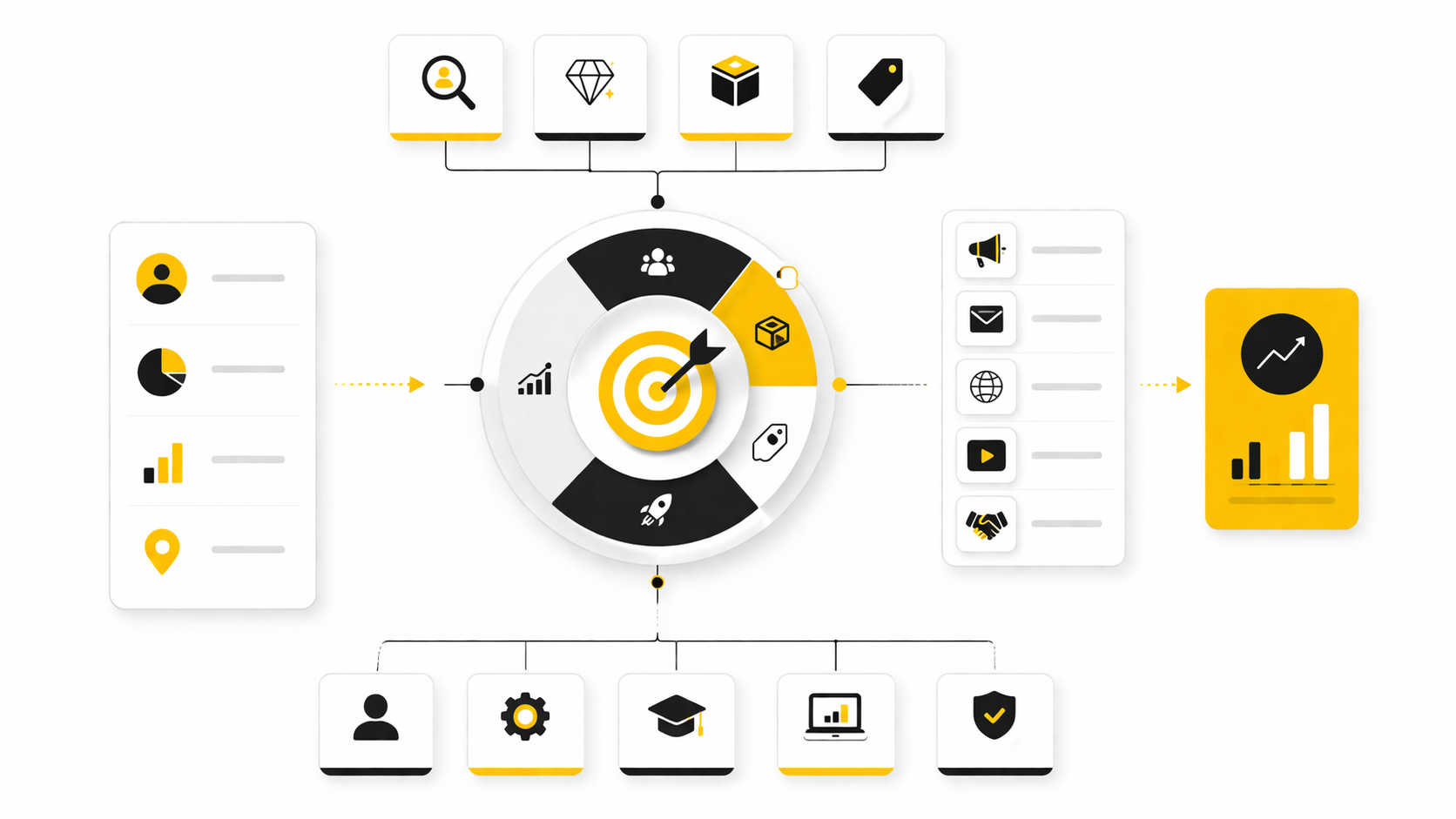
A modern go to market strategy works best when you treat it as a sequence of decisions, not a pile of tactics. First, you define the market and the buyer you actually want. Then you sharpen the positioning so the value is obvious. Then you choose the revenue motion, channel mix, pricing logic, and launch plan that make that value easy to buy. After that, you build the feedback loops that tell you what is working and what needs to change.
That sounds obvious, but most teams reverse the order. They jump into campaign ideas, sales scripts, landing pages, or partner outreach before they have nailed the market logic underneath. McKinsey’s recent B2B growth research makes the point clearly: winning teams respond to more self-directed and omnichannel buying behavior by aligning around customer needs, interaction preferences, and seamless execution across touchpoints (McKinsey on how B2B winners keep growing). In other words, the framework is not there to slow you down. It exists so you do not scale confusion.
A clean framework also helps you match your strategy to your reality. A new SaaS product entering a crowded category needs a different motion than a consumer brand expanding into retail, and both need a different playbook than a mature company launching into a new geography. HBR’s work on market entry and product rollout has shown that expansion decisions depend heavily on visible demand, distribution economics, and how much uncertainty exists around adoption timing (HBR on entering markets with limited demand) (HBR on global product rollout strategy). So the right framework is not about filling in boxes. It is about making the few decisions that most affect whether the launch compounds or stalls.
Here is the practical structure we will use throughout the rest of this article:
- Market focus: who you want, who you do not want, and where demand is most realistic.
- Buyer understanding: what the buyer is trying to solve, what blocks action, and how decisions really get made.
- Positioning and messaging: why your offer matters now, why it is different, and why it is credible.
- Revenue motion: product-led, sales-led, partner-led, demand generation-led, or some hybrid of those.
- Commercial design: pricing, packaging, onboarding, and the handoffs that shape conversion.
- Execution and learning: launch planning, enablement, measurement, and iteration.
This is also where tools start to matter, but only after the strategy is clear. For example, brands that need faster ecommerce page testing may use Replo, while teams leaning into conversational lead capture and nurturing may build around ManyChat. The tool stack is useful, but it is never the strategy. The framework comes first.
What Professional Implementation Looks Like
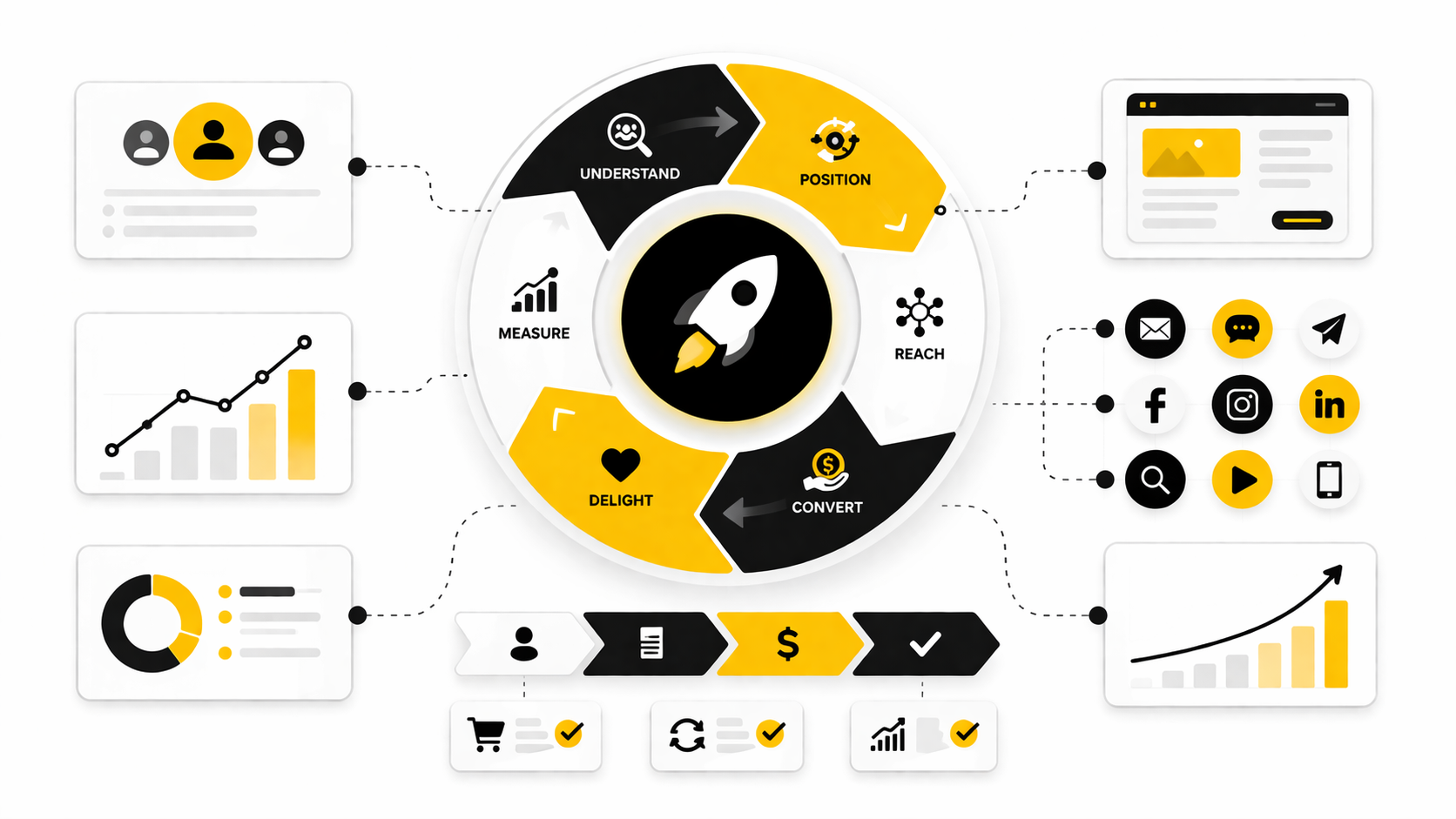
Professional implementation starts with alignment, not activity. The strongest teams get product, marketing, sales, and customer success working from the same assumptions about target customers, value proposition, and conversion path. BCG’s research on B2B go-to-market design points to the value of combining these functions more tightly so the customer experience feels coherent instead of fragmented (BCG on integrated GTM teams).
It also starts with accepting that buyer expectations have changed. Salesforce’s latest sales research shows sales leaders are redesigning around new growth levers, including usage pricing and AI-assisted selling, because the old model of pushing prospects through a linear funnel is under pressure (Salesforce State of Sales, 2026). Accenture’s recent industrial B2B buyer experience work found more than 1,600 customer pain points across the buying process, which is a brutal reminder that friction compounds fast when the commercial journey is messy.
That is why a serious go to market strategy is operational by design. It does not stop at messaging slides or a launch date. It reaches into onboarding, enablement, pricing structure, channel economics, and the post-sale experience because buyers do not care which department created the friction. They only feel whether buying from you is clear, credible, and worth the effort.
In the next part, we will move from the overview into the core components of a modern go to market strategy so you can see exactly how segmentation, positioning, buyer insight, and revenue motion fit together.
Core Components of a Modern Go To Market Strategy
The core components of a go to market strategy are not random boxes on a planning template. They are the few decisions that determine whether your launch creates traction or just creates activity. Get these right and everything downstream becomes easier, from campaign execution to sales conversations to onboarding and expansion.
What makes this harder now is that buyers are more careful, less linear, and more independent than most teams assume. Recent Salesforce research shows 78% of business buyers say their company is more careful about spending and 86% are more likely to buy when companies understand their goals, which is exactly why a go to market strategy cannot start with channels or creative ideas. It has to start with a sharper understanding of the market, the buyer, the promise, and the path to value.
Start With Market Selection, Not Market Size
A lot of go to market strategy work goes wrong at the first step because teams chase a giant total addressable market instead of a realistic starting point. A large market may look good in a deck, but it does not tell you where you can win fastest, who feels the pain most acutely, or which segment is easiest to convert. What matters is not how many potential buyers exist in theory. What matters is where demand, urgency, budget, and fit overlap.
That is why smart segmentation still matters so much. Harvard Business Review has long argued that segmentation should shape not just advertising, but also product innovation, pricing, and distribution choices, which is exactly how strong go to market strategy thinking should work in practice (HBR on why segmentation should guide more than promotion). The segment you choose influences the language you use, the objections you hear, the onboarding you need, and the economics you can support.
In practical terms, your first market should usually be narrower than your founders want and more specific than your team finds comfortable. That can mean a buyer type, a company size band, a use case, a region, a vertical, or a specific trigger event. Narrowing the field feels restrictive early on, but it is usually what gives the go to market strategy enough focus to produce signal instead of noise.
Build an ICP That Reflects the Real Buying Group
An ideal customer profile is not a polite description of who you hope will buy. It is an operating filter for who is most likely to buy, adopt, renew, and expand with the least friction. If your ICP is too vague, your pipeline fills with deals that look promising at the top and collapse later because the internal buying dynamics were wrong from the start.
That buying complexity is not theoretical anymore. Forrester’s 2024 business buying research reports that 86% of B2B purchases stall during the buying process and 81% of buyers are dissatisfied with their chosen providers. The point is hard to miss: even when a buyer enters the funnel, the decision process often breaks down because vendors fail to match how real purchase decisions happen.
So your ICP needs at least four layers. First, define firmographic fit such as size, sector, geography, and operating model. Second, define situational fit such as the trigger event that makes your product relevant right now. Third, define behavioral fit such as the signals that show intent or urgency. Fourth, define buying group fit so you understand who feels the pain, who owns the budget, who can block the deal, and who will live with the implementation after the contract is signed.
This is also where a lot of teams need better data collection than a few CRM notes and a founder’s intuition. If you are trying to tighten form flows and gather cleaner qualification data, tools like Fillout can help structure intake without adding friction. If relationship context across accounts matters more, Copper fits naturally into a go to market setup that depends on cleaner customer records and tighter follow-up.
Positioning Is the Core of the Entire Motion
Once the market and ICP are clear, positioning becomes the strategic center of the whole plan. This is the part that explains who the product is for, what problem it solves, why it matters now, and why your approach is meaningfully better than the alternatives. If this is fuzzy, no campaign, no sales sequence, and no landing page optimization is going to save the launch.
Good positioning is not copywriting decoration. It is decision architecture for the buyer. Harvard Business Review has argued that positioning questions belong at the center of strategy because they are tightly linked to narrowing the target audience and clarifying why a message works (HBR on why positioning should drive strategy). That is exactly right. Positioning tells the buyer what category you belong to, what outcome you deliver, and why they should believe you.
The strongest positioning usually does three things well. It names a painful, recognizable problem in the buyer’s world. It links your product to a specific business outcome rather than a vague improvement. Then it makes the tradeoff clear by showing what your approach prioritizes and what it deliberately does not. That last part matters more than most teams admit, because vague positioning often comes from trying to be relevant to everyone.
You can feel this in the market immediately. Messaging that tries to sound “innovative,” “AI-powered,” or “all-in-one” without tying those claims to a real use case usually dies on contact with real buyers. If you want to sharpen this part of the go to market strategy, force yourself to answer one brutally simple question: why should this exact buyer choose this exact product right now instead of doing nothing, sticking with the status quo, or buying from the obvious alternative?
Map the Buyer Journey All the Way to First Value
A go to market strategy is not finished when someone books a demo or starts a trial. It is not even finished when they sign. The real test is whether the customer reaches value fast enough to confirm they made the right decision. If that path is muddy, your go to market strategy is leaking performance no matter how strong top-of-funnel numbers look.
This is where modern buyer behavior changes the game. McKinsey’s 2024 B2B research found that decision-makers now use an average of 10 distinct channels in their buying journey, while Forrester says buyers increasingly rely on self-service and autonomous interactions before they want deeper provider involvement (Forrester’s 2024 business buying findings). That means your journey mapping has to account for content, sales touchpoints, product experience, onboarding, and support as one connected system.
A useful way to think about this is to map four moments instead of one funnel. The first is discovery, where the buyer realizes your offer might be relevant. The second is evaluation, where they compare you against alternatives and internal risk. The third is decision, where pricing, proof, procurement, and stakeholder alignment matter. The fourth is activation, where the customer gets to visible value quickly enough that the purchase feels smart.
This is exactly why product experience now sits inside go to market strategy instead of outside it. Pendo’s 2024 benchmark work is built on data from 6,800 customers and tracks metrics like feature adoption, retention, and time to value, while its 2024 software research says around 80% of built features never achieve meaningful adoption. That is a brutal reminder that a launch is not successful just because the market noticed it. A launch works when customers reach value and stay.
Turn Buyer Insight Into Message Architecture
A lot of teams gather buyer insight and then leave it sitting in interview notes, call recordings, and Slack threads. That is wasted leverage. The better move is to turn that raw insight into message architecture that every function can use, from paid media to outbound sales to onboarding emails.
At minimum, message architecture should include the buyer’s top pains, desired outcomes, common objections, proof points, and the language they already use to describe the problem. Salesforce’s business buying research shows 84% of buyers expect sellers to act as trusted advisors, but 73% say most interactions still feel transactional. That gap is often a messaging failure before it becomes a sales failure. The language feels generic because the team never translated insight into usable communication.
This is also where conversational tools can support execution when they are plugged into a clear strategy. If your go to market motion depends on automated qualification and conversational support, Chatbase can help turn structured knowledge into faster buyer interactions. If the focus is lead nurturing across social or messaging channels, ManyChat becomes far more effective when the underlying message architecture is already tight.
Make Internal Alignment Part of the Strategy, Not an Afterthought
A professional go to market strategy does not end with an external plan for customers. It also defines how the company will operate internally. Product, marketing, sales, and customer success need shared assumptions about who the buyer is, what promise is being made, what counts as a qualified opportunity, and what early customer success should look like.
This is where many launches quietly fall apart. Forrester’s 2024 work on B2B growth teams says 75% of B2B marketers report buyers are taking longer to commit than a year earlier, and it ties a big part of the problem to disconnected teams, fragmented data, and siloed execution. McKinsey’s 2025 work on executive alignment pushes the same point from another angle, finding that companies with a single customer- or growth-oriented executive role can see up to 2.3 times more growth than those with multiple overlapping roles. Different studies, same message: fragmentation kills momentum.
So internal alignment has to be designed into the go to market strategy from the beginning. That means one definition of the target customer, one shared positioning spine, one revenue logic, and one clear handoff model from awareness to pipeline to onboarding to expansion. When those foundations are missing, the market sees the confusion long before your dashboards do.
The next step is choosing how this strategy reaches the market in practice. That is where channel selection, pricing logic, and revenue motion start to matter, and it is also where a lot of teams either create leverage or accidentally add friction.
Choosing Channels, Pricing, and Revenue Motion
Once the market, ICP, and positioning are clear, the next job is deciding how the offer actually reaches buyers and how revenue gets captured. This is where a go to market strategy stops being conceptual and starts becoming commercial. You are no longer asking what the product is or who it is for. You are asking how the business will create demand, convert demand, and do it in a way that holds up economically.
This is also where a lot of teams make expensive mistakes. They copy the channel mix of a larger competitor, force a sales motion that does not match deal size, or pick pricing based on internal comfort instead of buyer value. Gartner’s go-to-market framework is useful here because it explicitly ties GTM decisions to pricing, channels, and the buying journey rather than treating them as separate workstreams.
Pick Channels That Match Buyer Behavior, Not Team Preference
Channel strategy should be built around where buyers already look for information, how much education the category needs, and how much trust the purchase requires. That sounds obvious, but plenty of go to market strategy plans still lean too heavily on the channels the internal team knows best. A founder who loves outbound wants outbound to solve everything. A content team wants content to solve everything. A paid media lead wants budget to fix what positioning did not.
The market is telling a different story. McKinsey’s B2B research shows decision-makers now use an average of 10 channels through the buying journey, which means single-channel thinking is usually too fragile for modern demand capture. Gartner also found that 61% of B2B buyers prefer a rep-free buying experience, while 73% actively avoid suppliers that send irrelevant outreach.
The practical takeaway is simple. Your channels should match buyer intent by stage. Search, category pages, comparison content, referrals, communities, and educational media often matter more early in the journey. Direct outreach, demos, proof assets, and peer validation matter more once the buyer is actively evaluating risk. The best go to market strategy does not ask which one channel wins. It builds a channel system that makes the next step feel natural.
Match the Revenue Motion to Deal Complexity
Revenue motion is one of the most important choices in the whole go to market strategy because it determines how much friction you can afford. A low-cost product with fast time to value can often lean product-led or self-serve. A complex product with multiple stakeholders, procurement review, or implementation risk usually needs a sales-led or hybrid motion. When teams get this wrong, they end up with either an overbuilt sales process for a simple offer or a self-serve funnel that cannot carry a complicated purchase.
Bain’s 2025 commercial excellence research found that the strongest B2B growth leaders delivered twice the average revenue growth of their industries in 2024, and those leaders are standing out through sharper commercial choices rather than brute-force activity. Bain’s 2024 pricing work also shows that organizations using better pricing guidance and analytics report winning more deals than they lose at a 12% higher rate than others.
That matters because revenue motion and pricing reinforce each other. A sales-led motion can support higher-touch value communication, custom packaging, and more complex negotiation. A product-led motion needs pricing and onboarding that are instantly legible. A partner-led motion requires margin logic and enablement that protect partner incentives without killing your own economics. There is no universally correct model here. There is only the model that fits the buyer, the product, and the cost of winning the customer.
Pricing Should Clarify Value, Not Create Confusion
Pricing is one of the clearest signals in your go to market strategy. It tells buyers how you think about value, what kind of customer you want, and whether the buying experience will feel simple or exhausting. Weak pricing usually comes from fear. Teams are afraid of charging enough, afraid of looking expensive, afraid of adding packaging constraints, or afraid that a clear price will narrow the audience.
That fear is expensive. Bain’s 2024 survey of 1,064 sales and marketing executives highlighted how often B2B pricing underperforms because companies still rely on weak negotiation discipline, poor packaging, and inconsistent value communication. On the consumer side, Gartner’s December 2024 findings showed that 68% of consumers feel taken advantage of when brands use dynamic pricing, which is a useful warning for any company tempted to treat pricing cleverness as strategy.
Good pricing does three things. First, it makes the value metric understandable. Second, it matches the way the customer experiences the product or service. Third, it removes unnecessary decision friction. A strong go to market strategy does not just ask what price maximizes revenue today. It asks what pricing model helps the right customer buy with confidence and expand later.
Packaging Is Often the Hidden Conversion Lever
A lot of companies obsess over headline price while ignoring packaging, even though packaging is often what shapes conversion. Buyers do not just react to cost. They react to how easy the offer is to understand, compare, justify internally, and implement. That means bundles, feature limits, service tiers, onboarding support, and contract structure all belong inside your go to market strategy.
This is one of the reasons pricing discussions get stuck. The real issue is often not price sensitivity at all. It is packaging confusion. If the buyer cannot tell which plan fits them, what is included, what changes at higher tiers, or how quickly they will get value, the commercial design is doing damage before sales even gets a chance to help.
For teams selling online or through landing-page-heavy funnels, this is where page testing and merchandising become practical. A platform like Replo can make that commercial layer easier to test without waiting on a full development cycle. The point is not the tool by itself. The point is that packaging needs to be visible, legible, and easy to act on.
Launch Execution and Cross-Functional Alignment
Once the channel, pricing, and revenue motion are set, the go to market strategy moves into execution. This is the stage where plans either become coordinated action or dissolve into a messy pile of disconnected tasks. The difference usually comes down to alignment, sequencing, and whether the team knows what must be true before launch day arrives.
A strong launch process is not glamorous, but it is decisive. McKinsey’s recent work on C-suite alignment found that companies with clearer customer- or growth-oriented leadership structures can produce meaningfully better growth outcomes, which reinforces a simple truth: execution improves when ownership is obvious. Forrester’s work on the evolution of B2B growth teams makes a related point, showing that slower buyer decisions and fragmented teams force companies to rethink how marketing, sales, and customer-facing teams coordinate.
Turn the Strategy Into an Operating Plan
A real go to market strategy needs an operating plan with owners, milestones, dependencies, and launch criteria. Without that, “we have a GTM plan” usually means there is a deck somewhere and everyone is improvising. The operating plan is what translates strategic decisions into executional clarity.
That plan should cover four things at minimum. It should define the target segment and offer in one place so every team is working from the same source of truth. It should define the launch path by stage, including pre-launch validation, launch-window activities, and post-launch follow-through. It should define handoffs between functions so leads, trials, demos, onboarding, and customer support do not get treated like separate universes. And it should define what success looks like in the first 30, 60, and 90 days.
Make the Process Tangible Before You Launch
This is the point where the execution process should become visible enough that anyone in the company can understand it. If the strategy only makes sense to the people who built the spreadsheet, it is not ready. A go to market strategy becomes real when teams can see the sequence from demand creation to revenue capture to customer activation.
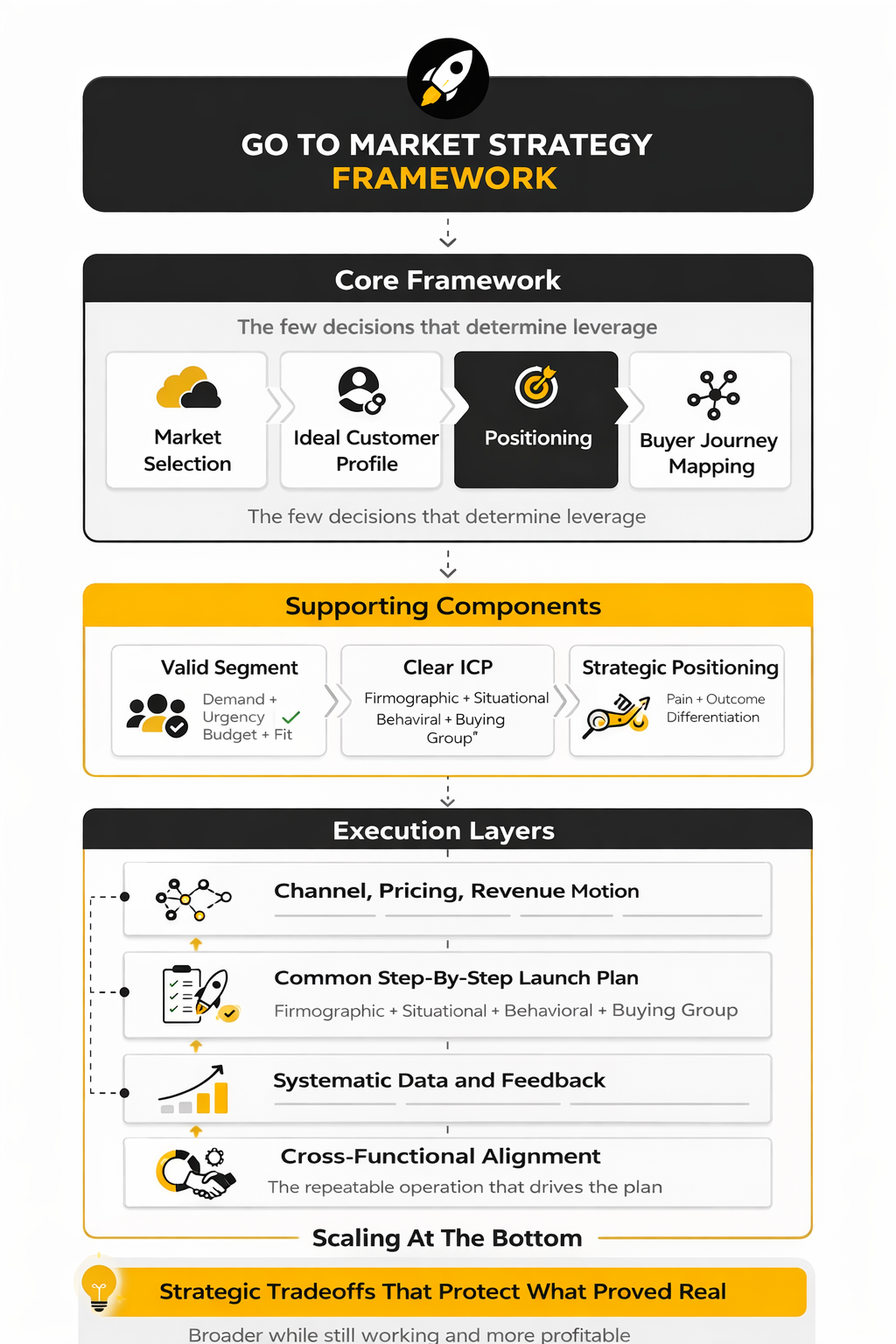
A practical launch sequence usually looks like this:
- Validate the target segment
Confirm that the initial ICP is still the right starting point using current pipeline, customer interviews, usage patterns, or early campaign signals. This is where you pressure-test whether the market is truly urgent enough to support the planned motion. It is much better to narrow harder here than to waste the next quarter generating attention from buyers who were never a fit.
- Lock the message and proof
Finalize the positioning, message hierarchy, objections, and proof assets before the team starts publishing at scale. If this step is rushed, the market sees different promises in ads, demos, sales calls, and onboarding materials. That inconsistency kills trust fast.
- Prepare the commercial path
Build the actual route the buyer will take, including landing pages, demo flow, qualification logic, pricing presentation, trial or sign-up journey, and first-value onboarding. This is where the go to market strategy becomes a customer experience rather than a planning document. It is also where friction tends to hide.
- Enable every customer-facing team
Sales, support, customer success, partnerships, and marketing all need the same narrative, same definitions, and same escalation paths. Execution breaks when each function improvises its own explanation of the product. Alignment is not a nice extra here. It is part of the launch asset.
- Instrument the funnel
Before launch, make sure the team can actually see what is happening. That includes source tracking, conversion tracking, stage progression, sales feedback, onboarding completion, and activation metrics. If the data only tells you what happened after revenue is lost, the setup is too weak.
- Launch in a way that supports learning
Not every launch needs to be huge. In many cases, a controlled rollout is smarter because it gives the team signal without overwhelming support, sales, or onboarding. The best go to market strategy is rarely the loudest one. It is the one that learns fastest without losing trust.
Build the Workflow Around Speed and Feedback
Execution quality depends heavily on how quickly the team can spot friction and respond. That means feedback loops cannot live only in quarterly reviews. Sales objections, onboarding drop-off, trial behavior, conversion patterns, and customer questions need to feed back into the go to market strategy while the launch is still active.
This is where workflow tools can help when they support a clear process. Teams coordinating lead intake, automation, and multi-step follow-up often use GoHighLevel to centralize parts of that motion. Others may need cleaner scheduling layers through Cal.com or stronger automated email infrastructure through Brevo. Again, the tool is not the answer by itself. The value comes from using it to support a defined go to market process rather than to patch over a vague one.
The larger point is that execution should shorten the distance between market feedback and team response. If you need weeks to learn that the offer is confusing, pricing is creating resistance, or onboarding is stalling activation, your operating rhythm is too slow for a modern launch.
Cross-Functional Alignment Is a Revenue Lever
A lot of teams still treat cross-functional alignment as a soft management issue. It is not. It is a revenue lever. When product, marketing, sales, and customer success share one go to market strategy, the customer gets a smoother journey and the company learns faster. When those functions drift apart, conversion falls, trust erodes, and every team starts solving the wrong problem.
That is especially important now because buyers are less forgiving. Gartner’s finding that most B2B buyers prefer more independent research and less irrelevant outreach fits the broader pattern: customers do not want to be dragged through internal chaos. They want clarity, relevance, and progress.
So the test is not whether every team attended the launch meeting. The test is whether every team can explain the same target customer, the same value proposition, the same commercial path, and the same definition of a successful first customer outcome. If they cannot, the go to market strategy is still incomplete.
The next part is where performance becomes measurable. Once execution is live, the conversation shifts from planning to evidence, and that is where the strongest teams separate signal from noise.
Performance Signals That Actually Matter
Once your go to market strategy is live, the hardest part is no longer launching. It is interpreting the data without fooling yourself. A dashboard can look busy and still hide the fact that the strategy is weak, the pricing is confusing, or the buyer journey is leaking revenue.
That is why measurement needs to follow the logic of the strategy itself. If your go to market strategy is built around a specific segment, a defined message, a chosen revenue motion, and a clear path to first value, then your analytics should tell you whether those exact assumptions are holding up. Not whether impressions are up. Not whether the team is busy. Whether the market is responding the way the plan said it would.
The Numbers Behind a Strong Go To Market Strategy
The current market context matters because it changes how you read performance. B2B buying is slower, more conflicted, and more cautious than a lot of teams want to admit. Recent Salesforce data shows 57% of sales professionals say the sales cycle is getting longer, while Gartner reported in May 2025 that 74% of B2B buyer teams show unhealthy conflict during the decision process. Forrester adds even more pressure with its 2024 finding that 86% of B2B purchases stall during the buying process and 81% of buyers are dissatisfied with their chosen providers.
Those numbers should change how you judge your go to market strategy. A longer cycle does not automatically mean the strategy is broken. More stalled deals do not automatically mean demand generation failed. In many cases, the real issue is that the strategy is colliding with more stakeholder friction, slower internal approvals, and higher buyer skepticism than teams built for.
That is why raw volume metrics can be misleading. More leads do not help if the wrong accounts are entering the funnel. More demos do not help if the buying group is misaligned. More trials do not help if activation is weak. The job of analytics is to show where the strategy is creating momentum and where it is creating motion without progress.
Measure the Funnel as a System, Not a Collection of Isolated KPIs
A serious go to market strategy needs a full-funnel measurement model. That means tracking how buyers move from awareness to engagement to evaluation to conversion to activation to retention. If you only watch top-of-funnel acquisition or closed revenue, you miss the parts of the system where strategy usually breaks down.
McKinsey’s work on modern B2B growth is useful here because it highlights how buyers now move across many touchpoints before they commit. Buyers use an average of 10 channels in the journey, which means attribution and performance analysis should be built for mixed influence rather than single-touch fantasy. A clean analytics model should show which channels create awareness, which ones drive qualified engagement, which ones accelerate opportunity movement, and which ones actually contribute to closed revenue and usable customers.
This is where a lot of teams need discipline. They want one magic metric. In reality, a go to market strategy needs a chain of evidence. You should be able to look at the data and answer a sequence of questions: are the right people showing up, are they engaging with the right message, are they converting into serious opportunities, are they reaching first value, and are they staying long enough to make the economics work?
The Core Metrics Worth Tracking First
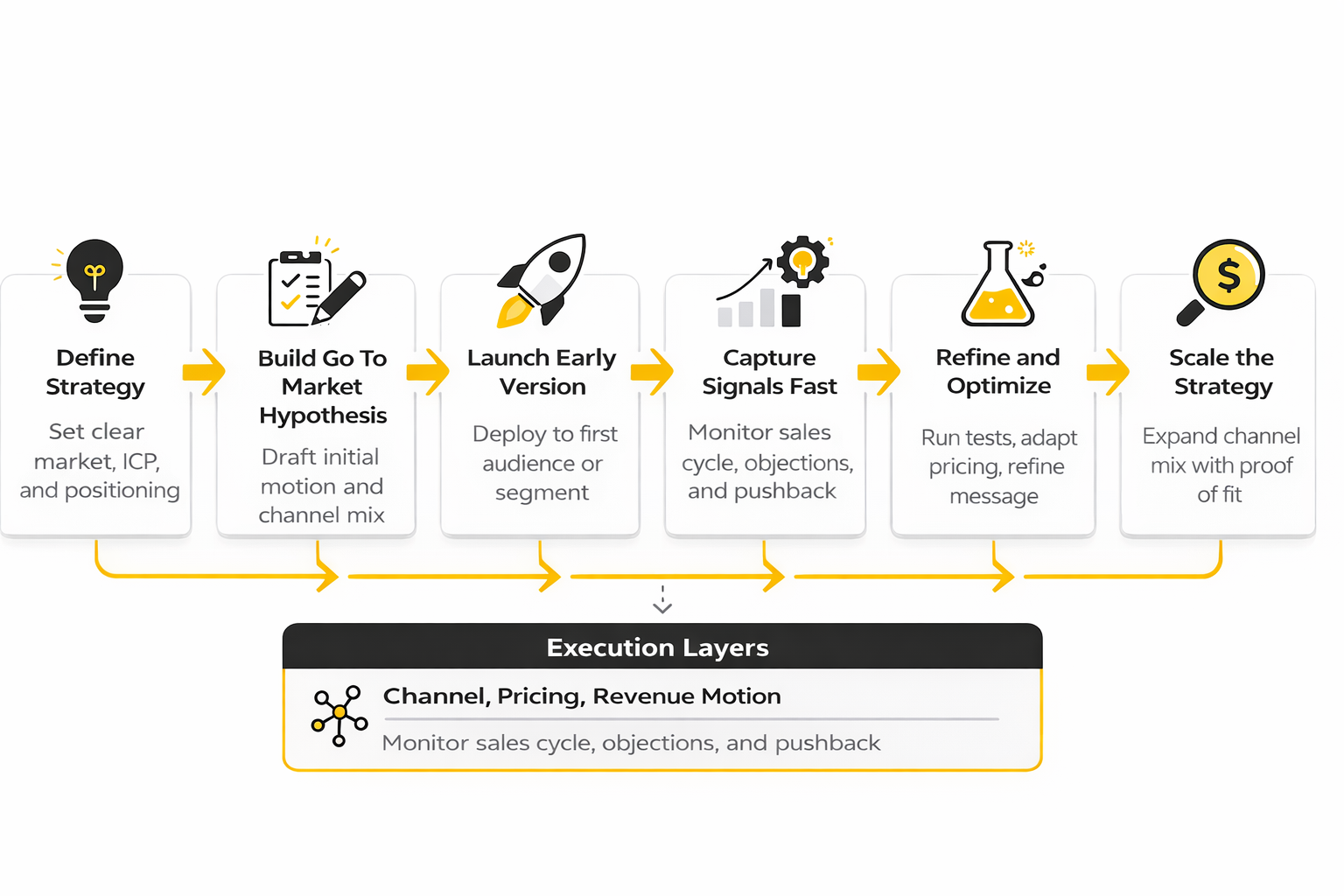
Not every metric deserves equal attention. The right move is to start with a short set of performance signals that map directly to your strategy. These are the numbers that usually tell you whether the go to market strategy is aligned with market reality or drifting away from it.
- Qualified pipeline creation
This tells you whether the market is responding with the right kind of interest, not just any interest. If traffic and lead volume are rising but qualified pipeline is flat, the strategy may have a targeting or positioning problem. A go to market strategy should be judged by the opportunities it creates with the buyers it actually wants.
- Stage-to-stage conversion
This is where hidden friction shows up. Poor conversion from first meeting to opportunity often points to bad qualification, weak messaging, or a mismatch between promise and problem. Poor conversion later in the funnel usually points to pricing, proof, procurement friction, or stakeholder conflict.
- Sales velocity
When cycles lengthen across the market, velocity becomes even more valuable because it shows whether your strategy is helping buyers move with confidence. Salesforce’s 2026 sales statistics make this especially relevant because longer cycles are now widely reported by frontline teams. If your velocity is deteriorating while top-of-funnel volume looks healthy, the issue is often strategic rather than tactical.
- Activation and time to value
For product-led and hybrid motions, this is one of the most important metrics in the entire system. Pendo’s benchmark framework tracks measures like user retention, stickiness, feature adoption, and time to value because those signals tell you whether customers are actually finding the product’s core value quickly enough to stay engaged. If your go to market strategy is bringing in users who never reach value, the acquisition engine may be working while the business model quietly weakens. (Pendo’s benchmark framework)
- Retention and expansion
These are not just customer success metrics. They are strategy validation metrics. Strong retention usually means your ICP, positioning, pricing, and onboarding were more right than wrong. Weak retention often means the go to market strategy sold to buyers who could sign, but should never have been the core target in the first place.
- CAC efficiency and payback
Revenue without efficiency is not proof that the strategy works. It may only prove that the company can spend aggressively. Paddle’s 2025 market reporting showed B2B SaaS growth staying under real pressure in early 2025, which matters because weaker growth environments punish sloppy acquisition economics faster than easy markets do. (Paddle’s Q1 2025 SaaS market report)
What Benchmarks Can and Cannot Tell You
Benchmarks are useful, but only when you read them in context. They can tell you whether your numbers look broadly healthy or fragile compared with peers. They cannot tell you whether your specific go to market strategy is right for your price point, motion, segment, and maturity stage.
That distinction matters. A self-serve SaaS product and an enterprise sales-led platform should not use the same expectations for conversion speed, payback, or time to first value. Even within SaaS, Paddle’s broader 2025 market content points out that newer AI-native businesses are often operating with very different revenue-per-employee and growth efficiency profiles than traditional software companies. (Paddle’s SaaS growth discussion) OpenView’s benchmarks, while older, are still useful for reminding operators that efficiency, retention, and expansion need to be interpreted together rather than as isolated metrics. (OpenView’s SaaS benchmarks report)
So use benchmarks to ask better questions, not to copy someone else’s model. If your trial-to-paid rate is lower than expected, the answer might be weak activation. It might also be that your trial attracts low-intent users because the offer is too broad. If your pipeline is healthy but close rates are soft, that could reflect poor sales execution. It could also mean your go to market strategy is winning attention from teams that like the story but cannot buy under current budget conditions.
How to Interpret the Data Without Overreacting
A common mistake in go to market strategy is reacting to every metric movement as if it proves a new truth. That usually leads to frantic channel switching, pricing tweaks without enough evidence, or message changes that create more confusion than clarity. Good analytics should reduce panic, not amplify it.
The better move is to read metrics in groups. If qualified pipeline is down, check whether traffic quality changed, whether conversion from visit to demo fell, and whether message engagement dropped in the same period. If opportunities are being created but sales velocity worsens, look at stakeholder complexity, procurement delays, and objection patterns before rewriting the whole strategy. If activation is weak, check onboarding friction, setup effort, and whether the product promise made in the funnel matches the product experience after sign-up.
This is exactly why product and commercial analytics need to talk to each other. Pendo’s product analytics work emphasizes building from trustworthy instrumentation upward, rather than jumping straight into conclusions from partial data. (Pendo’s product analytics framework) That principle applies directly to go to market strategy. If your data foundation is weak, your optimization decisions will usually be weak too.
The Actions the Data Should Drive
Analytics is only useful if it leads to action. A strong go to market strategy uses measurement to tighten focus, not just to create reporting theater. Each signal should push a specific kind of decision.
If conversion is weak at the top of the funnel, the likely action is to revisit targeting, positioning, or creative-message fit. If conversion is weak deeper in the funnel, the action is usually around pricing clarity, proof assets, objection handling, or stakeholder enablement. If activation is lagging, the action sits closer to onboarding, product education, or implementation support. If retention is soft, the action may be more fundamental because it often points to an ICP or promise problem, not just a lifecycle problem.
This is where systems become practical. Teams that need tighter lead tracking and funnel automation often centralize that in GoHighLevel, while businesses that need stronger email follow-up or segmentation can support that measurement loop with Brevo. The tool choice matters less than the operating discipline behind it. The point is to make the data visible enough that the team can improve the go to market strategy while the launch still has momentum.
The Real Standard: Does the Strategy Compound?
In the end, the best measurement question is not whether one campaign worked or one launch hit its number. It is whether the go to market strategy is compounding. Are you learning faster, closing more cleanly, activating customers sooner, retaining them longer, and building a more predictable path to growth over time?
That is the standard that matters because one-off wins can hide structural weakness. A great quarter can come from timing, budget bursts, or one large deal. A real go to market strategy proves itself when performance becomes more repeatable, the team gets sharper, and the economics improve instead of deteriorate.
The next part will turn these signals into practical improvement decisions so the article moves from measurement into optimization. That is where the data stops being descriptive and starts becoming strategic.
Advanced Strategic Tradeoffs as You Scale
A go to market strategy gets harder, not easier, once the first version starts working. Early traction creates pressure to widen the ICP, add channels, launch into new segments, and stack more offers on top of the original motion. That sounds like growth, but it often becomes dilution. The core tradeoff at this stage is whether expansion is actually compounding what works or quietly eroding the focus that created the initial win.
Bain’s 2025 commercial excellence research is useful here because it shows the gap between companies that scale with discipline and companies that scale with noise. Top B2B performers delivered roughly 2 times the average revenue growth of their industries in 2024, but that outperformance came with stronger repeatability, better pricing discipline, and better integration of commercial plays into execution systems. At the same time, Bain found that while more than 80% of respondents say they run structured, repeatable sales and marketing activities, 70% still struggle to integrate those plays into CRM and revenue technologies well enough to realize full value. That is the real warning: scaling a go to market strategy without operational integration usually creates complexity faster than it creates revenue.
The Biggest Risk Is Expanding Before You Have True Fit
One of the most common scaling mistakes is confusing early demand with broad market fit. A company wins with one segment, then assumes adjacent segments will respond to the same message, same pricing, same onboarding, and same sales motion. In practice, adjacent markets often look similar from the inside and behave very differently once you try to sell into them.
That is why expert-level go to market strategy work treats expansion as a new hypothesis, not a reward for early momentum. Gartner’s research on the B2B buying journey emphasizes that buyers move through a nonlinear set of buying jobs and often revisit earlier stages before making a decision, which means small differences in stakeholder structure or decision criteria can produce outsized differences in conversion. Forrester’s 2024 business buying work makes the scaling risk even clearer: 86% of B2B purchases stall during the buying process. If you broaden the target market too fast, you do not just lower efficiency. You multiply the number of ways deals can stall.
The right move is usually narrower than leadership expects. Before entering a new vertical, geography, or buyer type, you need proof that the original motion is truly understood. That means knowing which pains consistently trigger action, which objections predict deal loss, which onboarding steps correlate with retention, and which price points survive procurement pressure. Without that, scaling is usually just a more expensive version of guessing.
AI Changes the Economics, but It Does Not Remove the Need for Judgment
AI is already reshaping how companies execute go to market strategy, especially in sales productivity, pricing support, content creation, workflow automation, and experimentation speed. But the expert mistake now is assuming that AI automatically improves go-to-market quality. It can absolutely improve throughput. It can also make a weak strategy fail faster and at greater scale.
McKinsey’s 2025 work on profitable B2B growth through gen AI argues that the technology can boost revenue generation, sales productivity, and internal efficiency when it is tied to the seller journey and embedded in the commercial model. Bain reaches a similar conclusion, showing that commercial winners are deploying AI at greater scale as a force multiplier for pricing, sales, and productivity. But Gartner’s August 2025 outlook adds an important counterweight: by 2030, 75% of B2B buyers are expected to prefer sales experiences that prioritize human interaction over AI. That means the long-term advantage is not “replace humans.” It is “use AI where speed matters and humans where confidence matters.”
PwC’s 2026 CEO survey drives home the same tension from the executive side. About 30% of CEOs reported increased revenue from AI in the previous 12 months and 26% reported lower costs, but 56% said they had realized neither revenue nor cost benefits yet. That is a very practical signal for any go to market strategy: AI can help, but the gains are uneven and far from automatic. If the operating model, data quality, enablement, and customer experience are weak, AI usually magnifies inconsistency before it creates leverage.
For teams building the operational side of AI-assisted GTM, tools can help when they sit on top of a clear process. A business that wants centralized automation, lead routing, and pipeline follow-up might use GoHighLevel. A team that wants AI-assisted buyer interaction on high-intent pages might test Chatbase. The key is the same in both cases: the tool should support the strategy, not impersonate one.
Partner Ecosystems Are Growing in Importance, but They Add Control Risk
As markets get more crowded and direct acquisition gets more expensive, more companies are turning to ecosystems, alliances, implementation partners, and channel relationships to extend reach. That can be a smart move, especially when the product needs trust, category translation, or service layers that the core team cannot provide alone. But partner-led growth changes the go to market strategy in a deep way because it trades some direct control for scale.
Forrester’s 2025 view on partner ecosystems says B2B leaders need to prioritize and invest in ecosystem strategy and supporting functions if they want to keep driving growth. That is a useful strategic signal because it frames partnerships as a core growth system rather than a side program. The catch is that every partner motion introduces new execution variables: partner enablement, incentive design, lead routing, margin protection, customer ownership, and consistency of message. A sloppy partner strategy does not just underperform. It damages the customer experience by making the market hear five different versions of your value proposition.
This is where expert operators become brutally selective. They do not ask, “Can partners sell this?” They ask, “Which part of the motion becomes stronger through a partner, and which part becomes harder to control?” In some markets the answer is distribution. In others it is credibility, implementation, compliance, or local market access. The best go to market strategy is explicit about which capability is being outsourced to the ecosystem and what guardrails are required to keep the offer coherent.
Scaling Internationally Is Usually a Localization Problem in Disguise
A lot of companies treat international expansion like a demand-generation problem. They assume the new market mostly needs translated assets, some regional campaigns, and maybe a different payment option. In reality, international scaling is usually a go to market strategy redesign problem. The same product can land very differently across markets because willingness to pay, trust signals, procurement norms, channel preferences, and implementation expectations all shift.
That is why expert teams localize more than language. They localize packaging, proof, channel mix, and sometimes even the commercial motion itself. Weak international expansion happens when a company exports a home-market funnel and expects the new geography to adapt. Strong international expansion happens when the company identifies which parts of the original motion are universal and which parts must bend to local buying behavior.
This does not mean every expansion needs a full reset. It means you need to know what must remain stable. Usually that is the core value proposition and the type of customer outcome you create. What changes more often is the path by which trust is earned and the commercial design that makes buying feel low-friction in that market.
RevOps Becomes Strategic Once the GTM Machine Gets Busy
In the early stage, a company can get away with heroic improvisation. Founders remember key accounts, sales reps patch over process gaps, and product teams manually rescue onboarding. That stops working as the go to market strategy scales. Once more channels, more offers, more segments, and more team members are involved, operations becomes strategic infrastructure rather than admin.
Bain’s 2025 survey result that 70% of companies struggle to integrate sales plays into CRM and revenue technologies is one of the clearest signs of where scaling breaks. The issue is not just tooling. It is that the go to market strategy and the execution system drift apart. The team says the motion is repeatable, but the workflows, data definitions, attribution, and enablement are too fragmented to support that claim.
This is where tighter systems can pay off. Some teams use Copper when relationship context and account coordination are central to the motion. Others lean on Brevo for email orchestration or Cal.com for smoother scheduling inside the funnel. The platform choice is secondary. What matters is that RevOps keeps the real motion visible, measurable, and improvable.
The Expert Question Is Not “Can We Scale?” but “What Breaks First?”
As a go to market strategy grows, the smartest teams stop asking whether growth is possible and start asking what will fail first under load. Sometimes it is lead quality. Sometimes it is onboarding capacity. Sometimes it is pricing logic, partner inconsistency, sales enablement, or product adoption. The point is that scaling pressure exposes the weakest link in the system long before the dashboard spells it out in plain language.
Accenture’s industrial B2B buyer experience research is a good reminder of how much friction buyers actually face. Its work identified more than 1,600 customer pain points across the buying process. That number matters because it shows how easy it is for complexity to multiply as companies add motions, teams, channels, and steps. Expert go to market strategy is partly the discipline of removing friction before scale amplifies it.
So the advanced game is not endless expansion. It is controlled scaling with clear choices. You preserve the strategic spine, widen only where the evidence is strong, use AI where it improves leverage without degrading trust, build partner ecosystems where they truly increase reach, and tighten operations before complexity turns into drag. That is how a go to market strategy grows up without losing what made it work in the first place.
The final part will close the article by answering the most common practical questions teams still have, including what a good go to market strategy should include, how long it usually takes to build, and which mistakes are most expensive to ignore.
Bringing the Whole System Together
A strong go to market strategy is not a launch memo, a positioning sheet, or a demand generation calendar. It is the operating system that connects market focus, buyer understanding, commercial design, execution, measurement, and iteration into one coherent path. When those pieces reinforce each other, growth feels more predictable, teams move faster, and customers get a buying experience that makes sense.
That is the real end state most teams are chasing. Not more activity. Not more dashboards. Not more disconnected tactics. They want a go to market strategy that keeps working even as the market gets noisier, buyer expectations rise, and internal complexity starts creeping in.
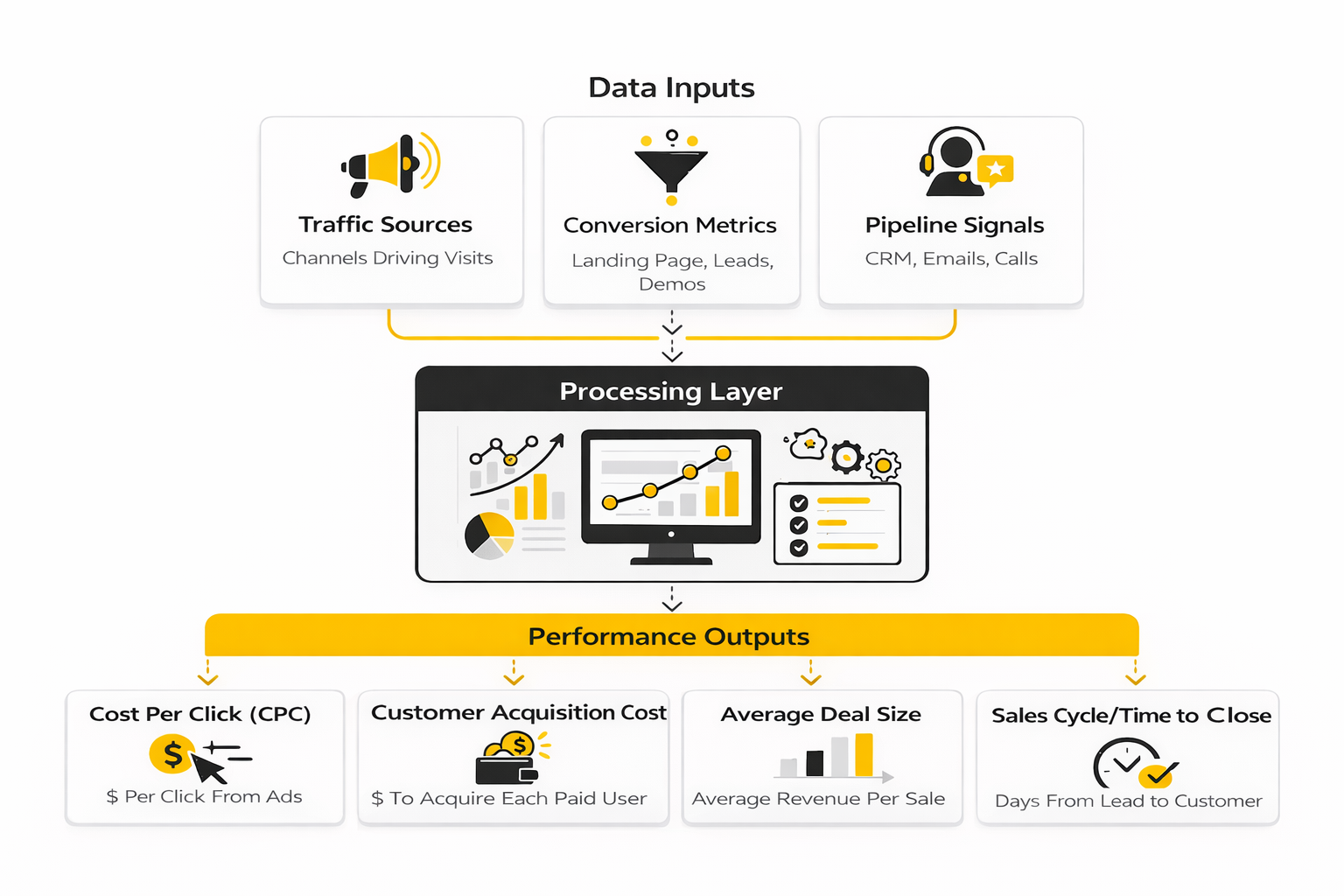
FAQ - Built for Complete Guide
What is a go to market strategy in simple terms?
A go to market strategy is the plan for how a company brings an offer to the right customers and turns interest into revenue. It covers who you are targeting, how you position the offer, which channels you use, how you price it, and what happens from first touch to first value. The simplest way to think about it is this: it is the bridge between product potential and actual market adoption.
What should a good go to market strategy include?
A good go to market strategy should include a clear target market, a realistic ideal customer profile, strong positioning, a defined buyer journey, the right revenue motion, pricing logic, channel choices, launch sequencing, and a measurement model. It also needs internal alignment, because a strategy that only marketing understands is not a real strategy. If sales, product, and customer success cannot explain the same customer and the same promise, the plan is incomplete.
How is a go to market strategy different from a marketing strategy?
A marketing strategy focuses mainly on awareness, demand creation, audience reach, and brand or campaign performance. A go to market strategy is broader because it also includes pricing, packaging, revenue motion, sales coordination, onboarding, activation, and retention logic. Marketing is part of GTM, but GTM decides how the entire commercial system works.
When does a company need a go to market strategy?
A company needs a go to market strategy any time it launches a new product, enters a new segment, expands into a new geography, changes pricing, adds a new channel, or shifts its revenue model. It is especially important when growth starts slowing and the team is tempted to throw more tactics at the problem. In those moments, the real issue is often not effort. It is that the market path is unclear.
How long does it take to build a go to market strategy?
The first working version can be built in a few weeks if the team already understands the market, the product, and the buyer. A more mature go to market strategy usually takes longer because it includes customer research, commercial design, testing, enablement, and analytics setup. The smarter question is not how fast you can finish it, but how fast you can build a version strong enough to test without creating confusion in the market.
Who should own the go to market strategy?
One person should drive it, but several functions need to shape it. In most companies that means product marketing, growth leadership, a founder, a GM, or a revenue leader owns the process while product, sales, customer success, and operations all contribute to the final plan. Shared input is essential, but shared ownership without a clear driver usually creates drift.
What are the most common go to market strategy mistakes?
The most expensive mistakes are weak segmentation, vague positioning, copying another company’s channel mix, pricing without clear logic, and launching without internal alignment. Another big mistake is judging success too early from surface metrics like traffic or lead volume while ignoring activation, sales velocity, and retention. The painful truth is that many launches do not fail because the team did too little. They fail because the team measured the wrong signals and kept scaling noise.
Should a startup use the same go to market strategy as a bigger company?
Usually no. A startup needs more focus, faster learning loops, and fewer moving parts because it has less margin for confusion and less brand trust to fall back on. Bigger companies can support more channels, more specialization, and more complex revenue motions, but even they still need a sharp go to market strategy if they want launches to work cleanly.
How do you know if your go to market strategy is working?
You know it is working when the right buyers are entering the funnel, moving through it with reasonable confidence, reaching value quickly, and staying long enough to make the economics healthy. You also see it in the internal system: messaging gets easier, objections become more predictable, handoffs improve, and the team spends less time guessing. A working go to market strategy creates clarity on both sides of the market.
What metrics matter most in a go to market strategy?
The most useful metrics are qualified pipeline creation, stage-to-stage conversion, sales velocity, activation, time to value, retention, expansion, and customer acquisition efficiency. Which one matters most depends on the motion. A self-serve or product-led model will usually care more about activation and retention earlier, while a sales-led motion may care more about opportunity quality, close rates, and cycle length.
Can AI improve a go to market strategy?
Yes, but only when the underlying strategy is already clear. AI can speed up research, message testing, automation, lead qualification, support workflows, and parts of sales execution, but it does not solve bad segmentation or weak positioning. Used well, it increases leverage. Used poorly, it scales confusion faster.
What tools actually help with go to market execution?
The useful tools depend on the motion you choose. A business building automated follow-up and funnel orchestration may lean on GoHighLevel, while a team improving high-intent page performance may test Replo. If conversational qualification matters, ManyChat or Chatbase can make sense. The important part is that the tool supports the strategy instead of replacing it.
How often should a go to market strategy be updated?
It should be reviewed continuously and meaningfully updated whenever the market, buyer behavior, pricing environment, product scope, or revenue motion changes. That does not mean rewriting the whole strategy every month. It means treating go to market strategy as a living commercial system that learns from the market instead of pretending the original launch deck was the final answer.
Work With Professionals
Explore 10K+ Remote Marketing Contracts on MarkeWork.com
Most marketers spend too much time chasing clients, competing on crowded platforms, and losing a percentage of every project to middlemen. MarkeWork gives you a better way. Browse thousands of remote marketing contracts and connect directly with companies desperate to hire skilled marketers like you, without platform commissions and without unnecessary gatekeepers.
If you're serious about finding better opportunities and keeping 100% of what you earn, explore available contracts and create a profile for free at MarkeWork.com.