

A good Google PPC agency is not just a vendor that launches ads and sends a monthly report. It is the team that turns search intent into pipeline, protects your budget from wasted clicks, fixes broken tracking before it distorts decisions, and keeps campaigns moving when Google changes the rules again. That matters even more now because paid search is still one of the biggest performance channels in digital marketing, with U.S. search advertising revenue hitting $102.9 billion in 2024 and taking 39.8% of all internet ad revenue.
The opportunity is huge, but so is the room for expensive mistakes. Alphabet’s latest annual filing shows Google advertising revenue reached $294.7 billion in 2025, with Google Search & other adding $26.4 billion year over year, which tells you two things at once: buyers still trust search when they are close to a decision, and competition inside that auction is not getting any softer. At the account level, the gap between average and elite execution is obvious in real-world benchmark data, where 16,000 U.S. campaigns produced 2025 averages of 6.66% CTR, $5.26 CPC, 7.52% conversion rate, and $70.11 cost per lead.
That is why businesses start looking for a Google PPC agency in the first place. They do not just need someone who knows the interface. They need a team that can connect strategy, tracking, copy, landing pages, bidding, and commercial goals into one system that actually scales.
Article Outline
- Why Hiring a Google PPC Agency Matters
- The Modern Google PPC Agency Framework
- Core Services That Drive PPC Results
- How Agencies Build, Optimize, and Scale Campaigns
- How to Evaluate and Choose the Right Google PPC Agency
- Frequently Asked Questions About Google PPC Agencies
Why Hiring a Google PPC Agency Matters
Most businesses do not lose money in Google Ads because search advertising stopped working. They lose money because the account was built around activity instead of economics. Plenty of campaigns still generate clicks, impressions, and even conversions while quietly producing weak lead quality, inflated acquisition costs, or reporting that cannot be trusted.
A strong Google PPC agency closes that gap by bringing operating discipline to a channel that can get messy fast. Google’s own documentation keeps pushing advertisers toward smarter automation, stronger first-party data, and cleaner measurement, including changes like the retirement of Enhanced CPC for Search and Display campaigns in 2025 and broader investment in AI-led workflows through Google Ads’ 2025 product updates. If an agency is still managing accounts like it is 2019, the client usually pays for that lag.
The value of an agency also shows up in the plumbing that most companies ignore until performance drops. Google highlights better measurement as a growth lever, and its 2025 updates note that advertisers using Google tag gateway for advertisers saw a 14% uplift in signals. That is a big deal because smart bidding, audience refinement, and budget allocation all depend on signal quality. If tracking is weak, optimization becomes guesswork dressed up as expertise.
There is also a practical trust signal in credentials, even if credentials alone are not enough. Google’s partner program requires agencies to meet standards around performance, spend, and certifications, which at least tells you the firm is operating at a level where Google can verify some baseline competence. That does not guarantee strategic skill, but it does separate real practitioners from people who watched three tutorials and changed their LinkedIn headline.
The Modern Google PPC Agency Framework
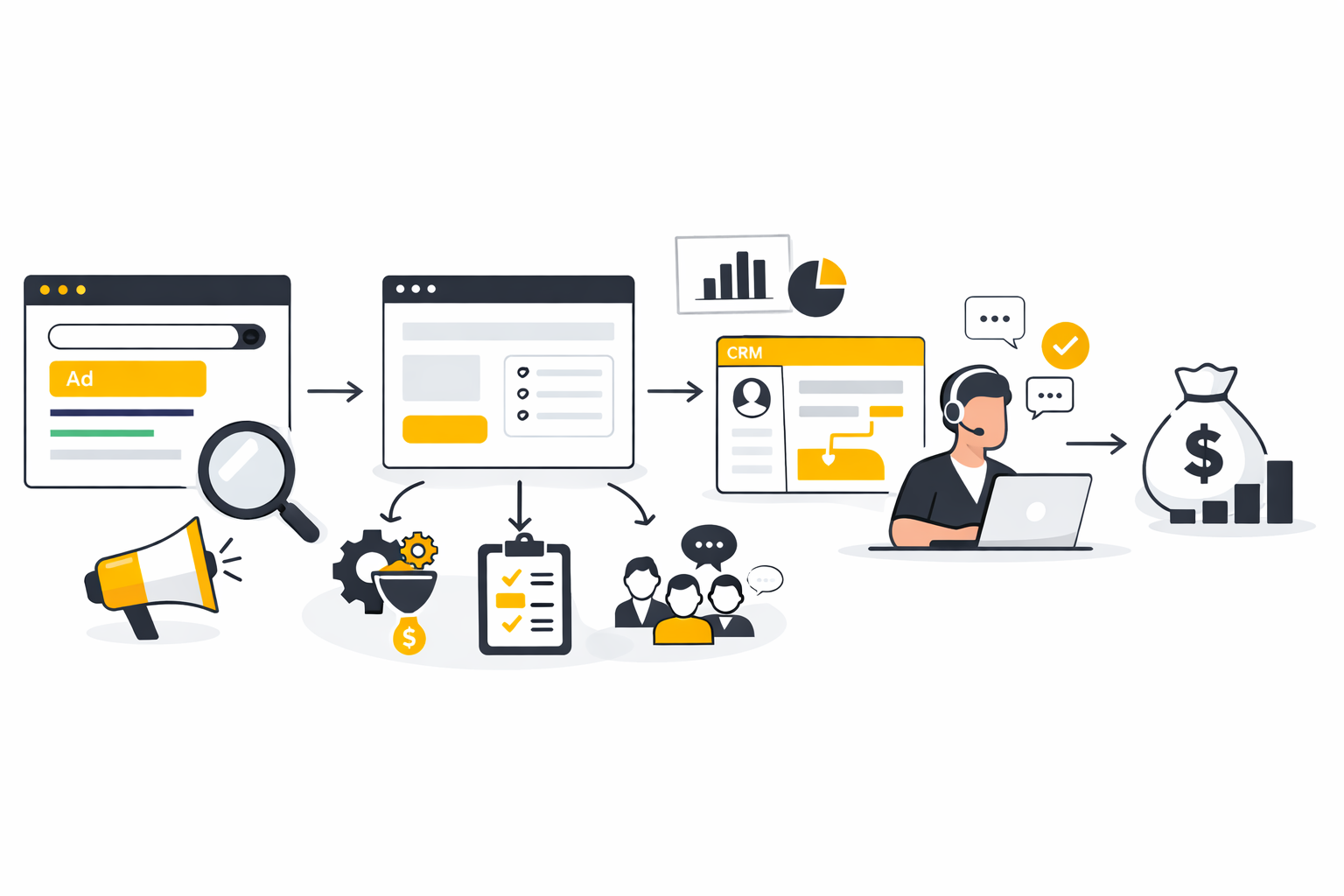
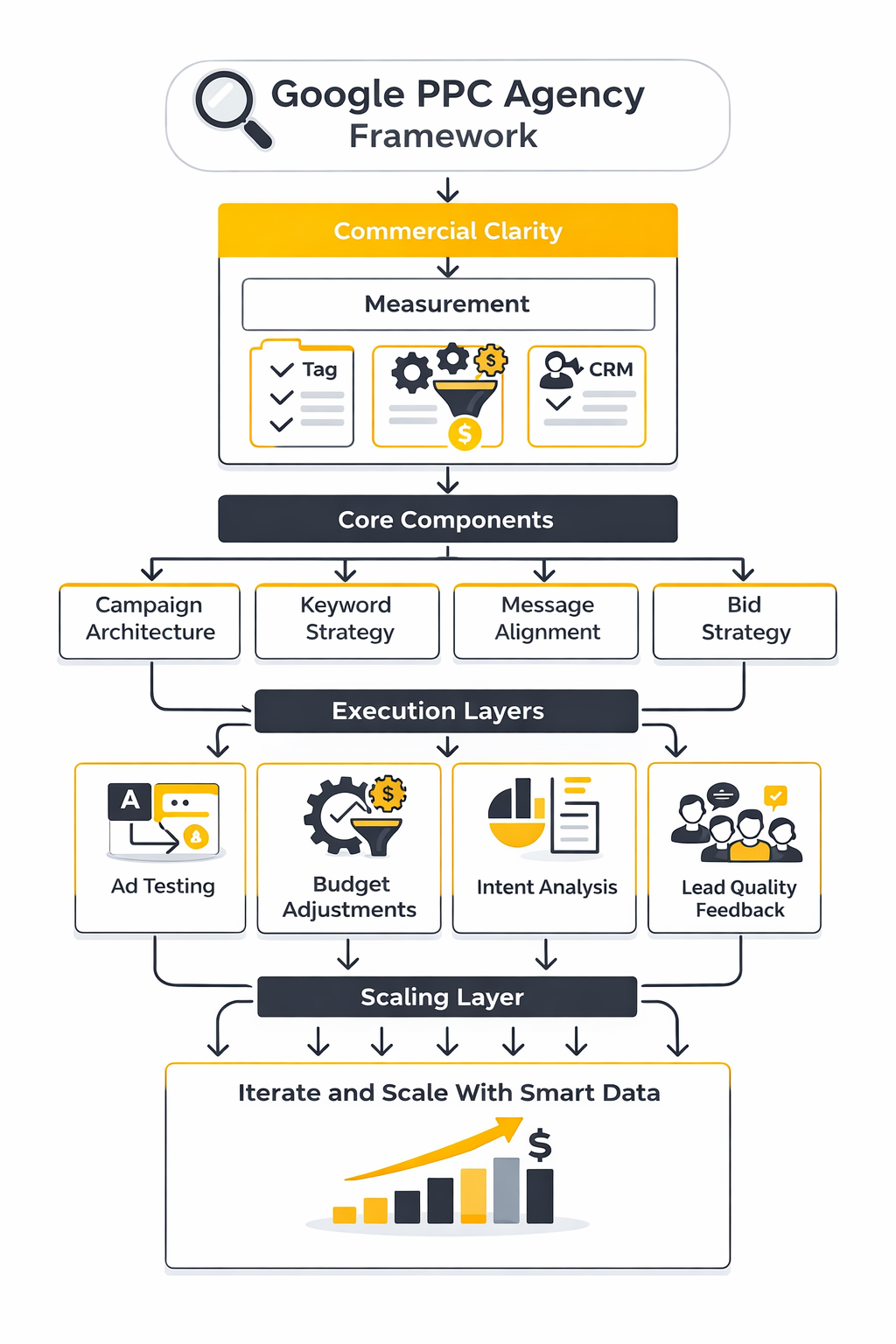
The best Google PPC agency work follows a framework, not a bag of random optimizations. First comes commercial clarity, where the agency defines what a qualified lead, profitable sale, or acceptable acquisition cost actually means. Then comes measurement, where conversion actions, offline imports, call tracking, CRM feedback, and attribution settings are cleaned up so the account can learn from the right outcomes.
Once the data foundation is stable, the agency builds structure around intent. That means campaign architecture, keyword strategy, negative keyword controls, ad messaging, landing page alignment, bid strategy, and testing priorities all support the same business goal instead of fighting each other. Google still frames ad quality around relevance and usefulness, and its explanation of Quality Score makes the point clearly: better alignment between keyword, ad, and landing page improves competitiveness inside the auction.
The final layer is iteration. A real framework is not finished when campaigns go live. It keeps cycling through search term analysis, budget reallocation, creative testing, feed improvements where relevant, audience signals, and lead-quality feedback from sales so the account gets sharper over time instead of noisier.
That is the lens the rest of this article will use. Next, we will break down the core services that actually separate a serious Google PPC agency from a freelancer who only knows how to change bids and export screenshots.
The Numbers That Actually Matter
A lot of PPC reporting looks impressive while saying almost nothing useful. A Google PPC agency can hand over charts full of clicks, impressions, and blended averages, but if those numbers are not tied to lead quality, revenue, or buying intent, they do not help you decide what to do next. Data matters only when it changes budget, creative, targeting, or sales follow-up.
That is the real job of analytics in paid search. Not to prove that activity happened, but to show whether the account is becoming more efficient, more scalable, and more commercially reliable. Once you look at the numbers through that lens, the dashboard gets simpler very fast.
Start With Market Reality, Not Internal Hope
Before you judge an account, you need a sense of the market you are buying into. Search is still one of the biggest digital ad categories, with U.S. search advertising revenue reaching $102.9 billion in 2024 and accounting for 39.8% of internet ad revenue. That alone explains why auction pressure stays high and why even well-run accounts can feel more expensive than they did a few years ago.
At the campaign level, broad benchmark data gives useful context, but only if you treat it as context rather than a verdict. Across 16,000 U.S.-based campaigns, 2025 averages came in at 6.66% CTR, $5.26 CPC, 7.52% conversion rate, and $70.11 cost per lead. Those numbers are helpful because they tell you the terrain is competitive, not because they tell you what your business should accept.
That distinction matters. A company with a high-ticket service and strong close rate may gladly pay more than the average cost per lead. Another business with weak margins can be underwater well before it reaches the benchmark. A good Google PPC agency knows when to use benchmarks as a reality check and when to ignore them because the economics of the business tell a different story.
Why Click-Through Rate Is Useful but Limited
Click-through rate is one of the first numbers people notice because it is easy to understand. If more people click, the ad probably feels more relevant than it did before. Google also makes relevance a core part of ad quality, and its Quality Score guidance explains that a higher score reflects ads and landing pages that are more relevant and useful to someone searching for that keyword.
That said, CTR is a directional metric, not a business metric. A rising CTR can mean the messaging is improving, but it can also mean the ad is attracting curiosity clicks from people who were never likely to convert. If CTR improves while qualified lead rate drops, the agency did not improve performance. It widened the top of the funnel and made the rest of the system work harder for worse outcomes.
This is why a sharp Google PPC agency treats CTR as an early signal, not a finish line. It can tell you whether message-market fit is getting stronger, whether ad relevance is improving, or whether a new offer is resonating. But on its own, it cannot tell you whether the clicks were worth buying.
Why CPC Should Change Your Strategy, Not Your Mood
Cost per click gets emotional fast because it feels like the platform is charging you more every time you blink. Sometimes that feeling is correct. Benchmark data from 2025 shows CPC increased in 87% of industries, which means most advertisers are operating in a market where traffic is not getting cheaper.
But CPC is still only one layer of the equation. A higher CPC is not automatically bad if the clicks coming in are more qualified and convert into better opportunities. In many cases, the more expensive click is exactly the one you should be buying because it sits closer to commercial intent.
The wrong reaction is to obsess over lowering CPC at all costs. The better reaction is to ask whether the account is buying the right clicks, filtering bad ones early enough, and turning those visits into qualified outcomes. That is a much more useful conversation than trying to win a cheap-click contest that does not map to revenue.
Conversion Rate Means More Than “The Page Worked”
Conversion rate is where the story starts getting more interesting. A strong conversion rate can signal that the keyword, ad, and landing page are aligned, which usually means the account is matching intent more effectively. But even here, you have to ask what the conversion actually represents.
Google has spent the last two years pushing advertisers toward more durable measurement. Its documentation on enhanced conversions for leads makes the case clearly: better data sharing improves reporting accuracy and helps recover conversions that standard offline imports can miss. That matters because a conversion rate built on weak definitions can flatter the account while teaching bidding systems to chase the wrong users.
A Google PPC agency that understands this will separate soft conversions from revenue-driving ones. It will not treat every form fill, phone call, or button click as equally valuable. Instead, it will ask which conversions represent actual sales progress and then organize the account around those signals.
Cost Per Lead Is Only Smart When Lead Quality Is Visible
Cost per lead gets treated like the headline metric in many PPC reports because it feels close to business reality. It is definitely more useful than CTR alone. But without quality filters, cost per lead can be one of the most misleading numbers in the account.
The 2025 benchmark average of $70.11 per lead is useful for orientation, but it should never be your north star by itself. A lower CPL built on poor-fit leads creates false confidence, bloats the pipeline, and wastes sales time. A higher CPL attached to qualified opportunities can be dramatically more profitable.
This is where a better Google PPC agency starts sounding different from a generic one. Instead of asking only how to reduce CPL, it asks how to improve cost per qualified lead, cost per booked meeting, or cost per sale. That shift sounds small, but it changes almost every decision inside the account.
Build the Analytics System Around Signal Quality
Once the basic metrics are in place, the next step is building the measurement system that makes those metrics trustworthy. Google Ads now gives advertisers more ways to move first-party data into the platform through Data Manager and newer data-source integrations announced in Google Ads Data Manager updates. That matters because the better your data inputs, the better the platform can optimize bids, audience selection, and downstream performance.
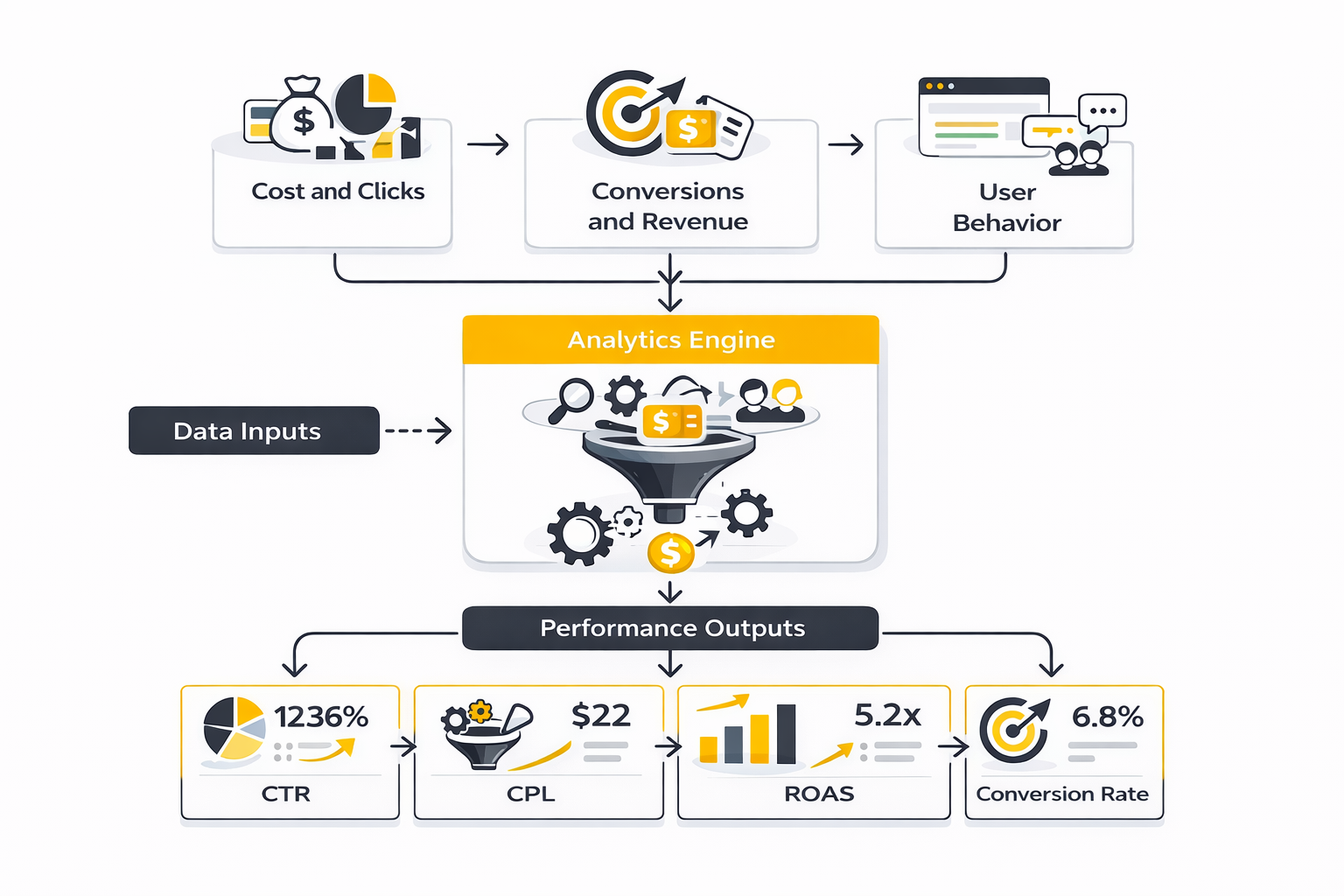
This is also where attribution becomes practical instead of theoretical. Google describes data-driven attribution as a model that assigns credit based on how people actually engage with ads across their path to conversion. For a Google PPC agency, that means you can stop over-crediting the last click and start seeing which keywords, campaigns, and touchpoints are truly helping conversions happen.
On top of that, Google has continued investing in measurement resilience. Official product updates highlight that advertisers who configured Google tag gateway for advertisers saw an average 14% uplift in observed signals. That number matters because better signal recovery does not just clean up reporting. It improves the data that automated bidding systems use to make decisions.
The Performance Signals That Actually Drive Action
When the analytics system is healthy, certain signals become far more useful than the vanity numbers most reports lead with. Search term quality is one of the biggest ones. Google’s tools like Search terms insights help advertisers see the themes and intent patterns behind traffic, which is what lets an agency decide whether to expand, exclude, or rewrite messaging.
Another strong signal is the relationship between front-end conversion rate and downstream sales acceptance. If lead volume rises but close rate falls, the account may be broadening too aggressively. If CPC rises but sales quality improves and close rate holds, the account may actually be moving in the right direction despite looking more expensive on the surface.
This is where interpretation separates a real Google PPC agency from a reporting vendor. The job is not to recite metrics. The job is to connect metrics to decisions. Pause that keyword cluster, expand that geography, tighten those negatives, change that offer, or push more budget into the segment producing real pipeline.
How to Read Benchmarks Without Letting Them Mislead You
Benchmarks are useful because they stop people from evaluating performance in a vacuum. If your CTR is far below normal, that may signal weak messaging or poor keyword alignment. If your CPC is far above category patterns, you may be in an aggressively competitive auction or carrying quality issues that make every click cost more.
But benchmarks become dangerous when they replace business judgment. A Google PPC agency should use them to frame questions, not to force decisions. A lead generation program in legal services, enterprise software, or healthcare will not behave like a local service account, and pretending otherwise is how bad expectations get baked into strategy.
The better way to use benchmark data is simple. Start with the market average, compare your own performance by campaign type and intent level, then decide whether the economics still work. That keeps the numbers honest and stops reporting from becoming a scoreboard detached from reality.
What the Best Agencies Do With the Data
The strongest agencies turn analytics into a management rhythm. They look at measurement health first, then traffic quality, then lead quality, then revenue contribution. That order matters because it stops them from making bold decisions on top of broken tracking or incomplete attribution.
They also invest in systems that make the data easier to act on. For teams managing inbound follow-up and lead-stage reporting, GoHighLevel can help centralize pipeline tracking, while scheduling infrastructure like Cal.com can make booked-meeting data easier to capture cleanly. Again, the tools are not the point by themselves. The point is reducing the gap between a click in Google Ads and a real commercial outcome.
That is what the numbers should ultimately do. Not impress you, not overwhelm you, and definitely not distract you. They should tell you what is happening, why it is happening, and what the Google PPC agency should change next.