

Growth hacking is one of those terms that gets abused fast. For some teams, it still means gimmicks, cheap traffic, and short-lived tricks that make dashboards look busy for a quarter and then collapse under churn. In practice, the modern version is much more disciplined: it is the habit of finding compounding growth opportunities through fast experimentation, sharp positioning, tighter onboarding, better retention, and smarter distribution.
That shift matters because growth got harder, not easier. Acquisition costs remain a board-level concern in B2B, while retention and expansion have become even more important to durable revenue quality, a pattern you can see in recent CAC benchmarking from HubSpot, recurring-revenue guidance from Stripe on MRR and expansion MRR, and current thinking from McKinsey on how winners keep growing. The old playbook of simply buying more reach is weaker than it used to be.
The most useful way to think about growth hacking now is as a system, not a channel. Strong teams treat the product, the message, the funnel, and the customer experience as one connected engine. That is why recent work on product-led growth from OpenView and benchmark-driven measurement from Mixpanel and Pendo keeps pointing back to the same reality: sustainable growth comes from reducing friction at the right moment, then compounding what works.
This article is built for that version of the topic. Instead of romanticizing hacks, it will break growth hacking into the real components that actually move a business: strategy, experimentation, acquisition, activation, retention, and implementation. That gives you a framework you can use whether you run a SaaS company, an ecommerce brand, a media business, or a service firm trying to create repeatable demand.

Why Growth Hacking Still Matters
Growth hacking still matters because speed of learning is now a competitive advantage in its own right. Research and practitioner literature on online experimentation keep reinforcing the same point: controlled experiments remain one of the best ways to measure causal impact in digital products, from academic overviews on online controlled experiments to engineering guidance from Google Research and long-term measurement lessons from Google’s work on short-term versus long-term effects. When markets change fast, companies that learn faster usually waste less money.
It also matters because growth is no longer just an acquisition problem. Loyalty, customer value, and expansion revenue are now central to how companies create durable results, which lines up with Bain’s work on Net Promoter and profitable growth and subscription-focused guidance from Stripe on churn. A growth strategy that ignores retention might still create noise, but it rarely creates resilience.
Finally, the term still survives because it captures something useful that traditional marketing language often misses. It implies cross-functional urgency. The best teams do not wait for marketing, product, sales, and operations to optimize in isolation; they build one loop where insights move quickly into better offers, better onboarding, and better customer outcomes.
The Six-Part Structure of This Article
This article will continue in the following order:
- Why Growth Hacking Still Matters
- The Modern Growth Hacking Framework
- Core Growth Channels and Loops
- Activation, Retention, and Revenue Expansion
- How Professionals Build a Growth Engine
- Common Mistakes, FAQs, and Final Takeaways
The structure is deliberate. It starts with the strategic foundation, then moves into the framework, then into the channels and mechanisms that create motion, and only after that gets into implementation. That order matters because teams that jump straight into tactics usually end up copying someone else’s playbook without understanding why it worked.
The Modern Growth Hacking Framework
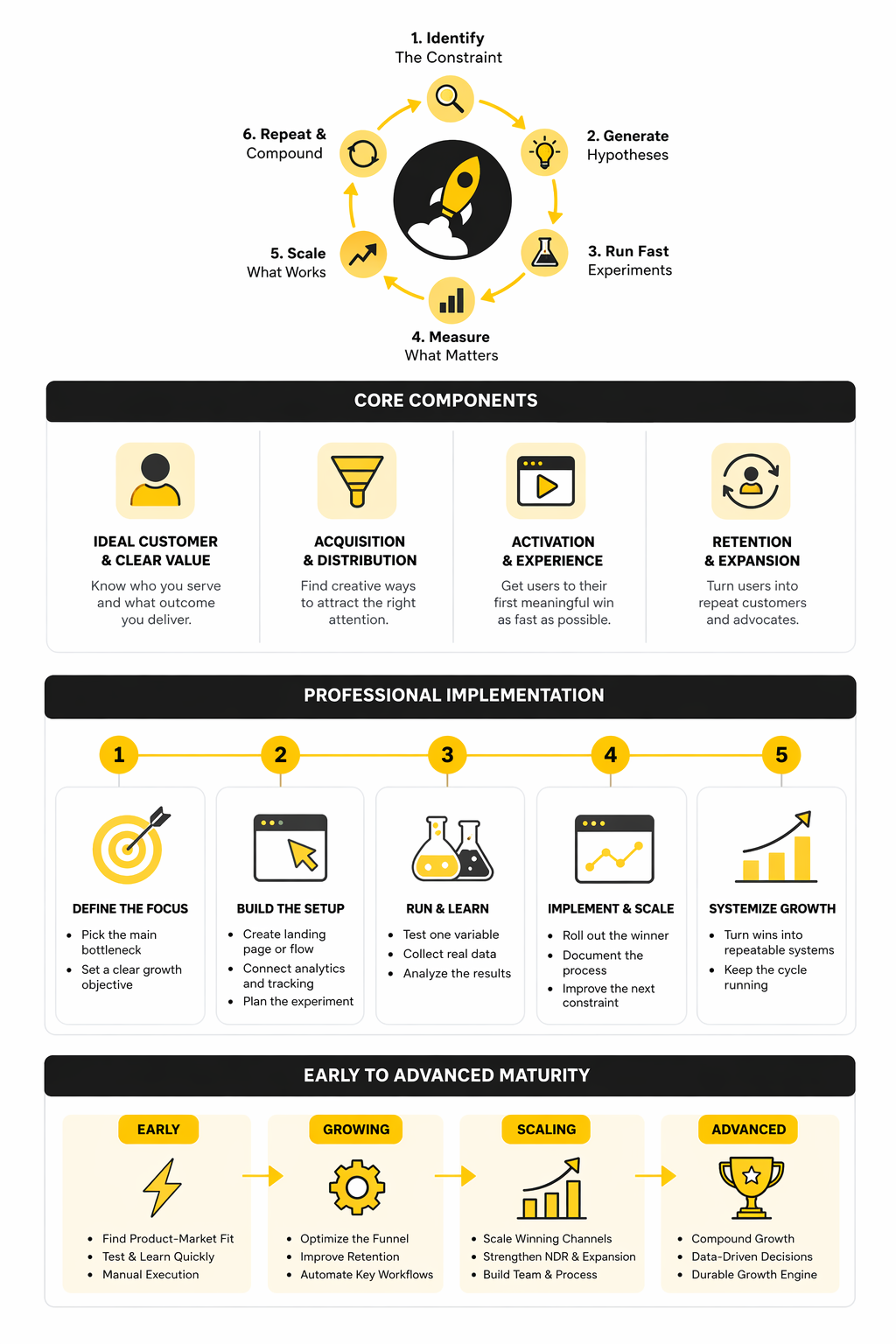
A practical growth hacking framework begins with one question: where is the real constraint? Sometimes the bottleneck is traffic, but just as often it is weak activation, poor onboarding, unclear positioning, or low retention. Benchmark tools and product analytics platforms such as Mixpanel’s retention reporting, Pendo’s product benchmarks, and OpenView’s thinking on product-led growth benchmarks are useful because they force teams to diagnose the system instead of guessing.
From there, growth hacking becomes a repeatable cycle. You identify the leverage point, form a hypothesis, ship a measured test, read the signal correctly, and turn winners into process rather than celebrating them as isolated wins. That approach lines up with modern experimentation guidance from Amplitude and Optimizely, both of which emphasize that experimentation maturity is less about random A/B tests and more about connecting tests to business value.
The rest of this article will use that definition consistently. Growth hacking is not a bag of tricks. It is a disciplined operating model for discovering, validating, and scaling the few changes that create disproportionate growth.
Core Growth Channels and Loops
Once the framework is clear, the next question is where growth hacking actually happens in the wild. The answer is not “on social media” or “through paid ads” or any other single-channel cliché. It happens inside growth loops, where one action creates the conditions for the next user, the next conversion, or the next retained customer.
That distinction matters because funnels are linear, while good growth systems are compounding. A paid click that becomes a trial is useful, but a user who creates content, invites teammates, leaves usage data behind, and improves the product’s credibility for the next buyer is far more valuable. That is why modern product and marketing teams keep moving toward loop thinking, customer evidence, and experimentation systems instead of isolated campaign reporting, a shift echoed in recent thinking on consistent growth systems from Harvard Business Review, experimentation culture from Amplitude, and benchmark-driven product analysis from Mixpanel.
In practice, growth hacking usually draws from four broad engines: acquisition loops, activation loops, retention loops, and revenue loops. The exact mix changes by business model, but the principle stays the same. You are looking for actions that create repeatable downstream effects, not just short-term spikes.
Acquisition Loops That Create Momentum
Acquisition is the part everyone sees first, which is exactly why it gets overvalued. Traffic alone is cheap to fake and easy to misread. What matters is whether your acquisition source brings in users who can actually reach value, stay, and either spend more or bring others with them.
The best acquisition loops have built-in carryover. Search-led growth can do this when strong educational content ranks, captures demand, and pushes qualified visitors into a clear next step. Social-led growth can do it when useful posts generate shares, branded searches, and audience memory instead of vanity engagement. Referral-led growth can do it when the reward is tightly connected to product value, which is why the Dropbox referral model is still discussed in serious growth circles years later: it aligned incentive, distribution, and product usage instead of stapling a coupon onto the side of the business.
This is also where tooling can help without becoming the strategy itself. A team that wants to turn social activity into repeatable traffic might use Buffer for distribution planning or Flick for social workflow support, while a team focused on lead capture might test different qualification paths with Fillout or build routing logic inside GoHighLevel. None of those tools create growth on their own. They simply make it easier to systemize what already matches your audience and offer.
Activation Is Where Most Growth Hacking Wins or Loses
A lot of companies think they have an acquisition problem when they really have an activation problem. They can get attention, clicks, and even signups, but the user never reaches the first meaningful outcome fast enough. That gap between signup and value is where a huge amount of growth hacking work should happen.
This is why onboarding matters more than the average team admits. Product benchmarks and retention studies keep reinforcing the same pattern: users stay when they experience value quickly, and they disappear when early friction is too high, a dynamic reflected in Pendo’s retention benchmarking, Mixpanel’s benchmark tooling, and Stripe’s practical guidance on subscription churn. If people do not cross the value threshold, the rest of the funnel becomes expensive theater.
For growth hacking teams, activation work usually looks less glamorous than top-of-funnel campaigns. It is clearer copy, shorter setup, smarter defaults, fewer empty states, better triggered messages, and a more intentional path to the first win. For some companies that means a tighter email sequence through Brevo or Moosend. For others it means replacing a bloated landing page with a cleaner experience built in Replo or a more focused opt-in path inside ClickFunnels.
The deeper point is simple: activation is not a UX side quest. It is one of the highest-leverage parts of growth. When activation improves, paid traffic performs better, referrals convert better, content monetizes better, and retention has a chance to happen at all.
Retention Loops Turn Growth Into Something Real
Retention is where growth hacking stops being noisy and starts becoming professional. A business with weak retention is forced to reacquire the same outcome over and over again, which raises pressure on every channel and makes “growth” look larger than it really is. A business with strong retention gets compounding behavior: repeat usage, stronger word of mouth, better monetization, more customer insight, and more resilience when acquisition channels get expensive.
This is why serious growth operators obsess over user behavior after the first conversion. They watch repeat actions, feature adoption, cohort curves, account expansion, and the moments that correlate with long-term usage. Recent experimentation and product analysis work from Amplitude, Optimizely, and Pendo all point in the same direction: the goal is not just to get more people in, but to understand which behaviors actually predict durable value.
Retention loops are often built from small, disciplined moves. Better education reduces support friction. Better support reduces failed usage. Better usage increases trust. Trust increases repeat engagement and referrals. This is one reason conversational support, self-serve resources, and guided assistance are increasingly tied into growth stacks through tools like Chatbase or structured workflow assistants such as Guideless. They are not magic, but they can reduce the dead air between user intent and user success.
Revenue Loops Often Start Before the Sale
One of the most overlooked parts of growth hacking is that monetization begins much earlier than checkout. Price clarity, offer design, proof, sales follow-up, objection handling, and account expansion all shape whether growth turns into real business performance. If those elements are weak, even great acquisition and activation work can leak out before it hits revenue.
This is why modern growth teams increasingly connect marketing systems with CRM, lifecycle messaging, and sales process instead of treating them as separate kingdoms. Practical operators use linked infrastructure so that high-intent actions trigger the right follow-up at the right moment, whether that means qualification, demo routing, nurture, or upsell. Platforms such as Copper, Cal.com, and Dub fit naturally into this layer because they help teams track intent, move faster, and attribute outcomes more cleanly.
The important thing is not the software. It is the sequence. Good growth hacking aligns the offer, the call to action, the response time, and the proof needed to get a real buying decision. When that sequence is clean, you do not just grow top-line activity. You improve the efficiency of the entire commercial system.
Not Every Channel Deserves Equal Attention
One of the fastest ways to waste time with growth hacking is to spread effort across too many channels at once. Most companies do not need twelve active channels. They need one primary acquisition motion, one strong activation path, one retention habit, and one measurable monetization system they can improve every month.
That is why channel selection should be based on fit, not trendiness. If your audience searches with urgency, search and landing pages might matter most. If your product benefits from visual proof, creator-led content or short-form demos may pull harder. If your offer needs conversation before conversion, email, chat, and outbound workflows may outperform broad-reach publishing.
The discipline here is brutally simple. Double down on channels that bring qualified users into a working loop. Cut or deprioritize channels that only create activity reports. Growth hacking becomes effective the moment you stop treating motion as evidence of progress.
The Best Growth Loops Feel Helpful, Not Manipulative
This part matters more now than it did a few years ago. Audiences are sharper, platforms are noisier, and trust is harder to win back once lost. Growth hacking that relies on dark patterns, forced invites, spammy prompts, or fake urgency can still create short-term movement, but it usually damages conversion quality and brand trust over time.
The strongest loops feel like a service. A useful resource earns attention. A better onboarding flow reduces confusion. A relevant reminder helps someone finish what they started. A referral offer gives existing users more of what they already value. When the mechanic helps the user as much as the company, the loop has a much better chance of compounding.
That is also why messaging quality still matters. Strong automation platforms, builders, and CRM systems can support growth, but the message inside the system has to be honest, clear, and relevant. Growth hacking works best when it amplifies value that already exists, not when it tries to disguise weak value with aggressive tactics.
Activation, Retention, and Revenue Expansion
The real test of growth hacking begins after someone clicks, signs up, or books a demo. This is where a company finds out whether it has built a repeatable system or just rented attention for a moment. If users do not reach value quickly, come back consistently, and move toward deeper commercial commitment, the earlier wins in acquisition start to look a lot smaller.
That is why mature growth teams treat activation, retention, and expansion as one connected sequence. Product analytics platforms keep pushing teams in this direction because the best signals rarely live in top-line traffic alone. Recent product and experimentation guidance from Mixpanel, Pendo, and Amplitude reflects the same operating reality: the biggest gains often come from helping the right users do the right thing sooner and then making that behavior easier to repeat.
How To Improve Activation Without Adding More Noise
Activation improves when the path to value gets shorter and clearer. That usually means removing fields, simplifying setup, giving better defaults, reducing decision fatigue, and tightening the message around the first meaningful outcome. Teams often overcomplicate this stage because they think more explanation is the answer, when the better answer is usually less friction and more relevance.
Good growth hacking looks at activation with brutal honesty. Where do users stall, hesitate, or disappear? Which step creates confusion, and which event strongly predicts long-term usage? Those are not abstract UX questions. They are commercial questions, because every unnecessary delay before the first win weakens the economics of the whole funnel.
This is where lifecycle and onboarding tools can be genuinely useful when they support a clear strategy. A team refining signup-to-value journeys might test email or CRM sequences in GoHighLevel, create a cleaner landing experience in Replo, or build simpler forms with Fillout. The tools are secondary. What matters is whether the user gets to value faster than before.
Retention Comes From Repeated Value, Not Clever Messaging
A lot of teams still talk about retention as if it is mainly a messaging problem. It is not. Messaging can help bring people back, but it cannot rescue a weak product experience forever. Retention is mostly the result of users getting enough real value, often enough, with low enough friction that coming back feels logical.
That is why the most effective retention work is usually behavioral. It focuses on the actions that correlate with continued success, then designs the product, education, support, and reminders around those actions. Guidance across product analytics and subscription research, including Stripe’s churn resources, Pendo’s retention benchmarks, and Optimizely’s experimentation insights, all points toward the same pattern: strong teams identify the behaviors that matter, then reinforce them systematically.
There is also a practical side to this that many companies miss. Retention is often improved through ordinary operational fixes that are not flashy at all. Better help content, faster support, clearer product education, and smarter triggered guidance can lift user confidence at exactly the moments when churn usually begins.
Revenue Expansion Should Be Designed, Not Left to Chance
Expansion revenue is where growth hacking becomes financially serious. If a business can increase customer value through better usage, better packaging, stronger proof, or better account progression, it becomes less dependent on constant new acquisition. That is one of the cleanest paths to healthier growth because it raises output without forcing the company to rebuild demand from zero every month.
The key is to stop treating upsells and expansion as accidental events. They should be tied to timing, value, and customer readiness. A user who has already reached a meaningful milestone is far more likely to expand than one who is still unclear on the basics, which is why good operators connect product milestones with sales and lifecycle follow-up rather than leaving those teams disconnected.
That connection often becomes easier when scheduling, CRM, and attribution tools are built into the process. Teams may use Cal.com to shorten time-to-conversation, Copper to manage relationship context, or Dub to track which acquisition and campaign paths are driving valuable downstream behavior. Again, the tools are not the story. The story is the system they make easier to run.
How Professionals Build a Growth Engine
Professional implementation starts with narrowing the problem. Most teams fail at growth hacking because they work on too many ideas at once, measure too many things poorly, and never decide what the actual bottleneck is. Serious teams do the opposite: they pick one growth constraint, define one success metric that matters, and run a sequence of experiments against that constraint until the system improves or the thesis breaks.
This is where discipline separates operators from enthusiasts. Growth is not built by inspirational brainstorming alone. It is built by turning assumptions into tests, tests into decisions, and decisions into repeatable operating habits.
Start With One Constraint, Not Ten Possibilities
The cleanest growth process begins with diagnosis. Is the main issue low conversion from visitor to lead, weak onboarding, poor repeat engagement, slow sales follow-up, or weak monetization after adoption? Until that answer is clear, even smart teams can spend months optimizing the wrong layer.
This is why professional growth hacking usually begins with a constraint review rather than a campaign calendar. Recent thinking from Harvard Business Review on building growth systems and McKinsey on profitable B2B growth keeps returning to the same practical truth: growth improves faster when leaders identify the few moments in the journey that create disproportionate commercial impact.
Once the main constraint is visible, the rest of the process gets simpler. The team can prioritize experiments around that specific problem instead of scattering attention across channels that feel exciting but do not move the business.
Build a Weekly Experiment Cadence
A real growth engine runs on cadence. Ideas go into a backlog, hypotheses are scored, one or two experiments get committed, implementation happens fast, and results are reviewed with enough rigor to decide what to scale, what to kill, and what to refine. Without that rhythm, growth hacking turns into random acts of marketing.
The weekly cadence matters because speed of learning compounds. You do not need dozens of simultaneous tests to build momentum. You need a reliable process that produces clean decisions often enough that the team keeps getting sharper.
A simple implementation flow usually looks like this:
- Define the constraint and the key metric.
- Gather evidence from product data, CRM behavior, customer feedback, and sales conversations.
- Write a clear hypothesis with an expected outcome.
- Build the smallest useful test that can validate or reject that hypothesis.
- Launch with tracking already in place.
- Review results against pre-decided criteria.
- Scale the win, archive the loss, or redesign the test.
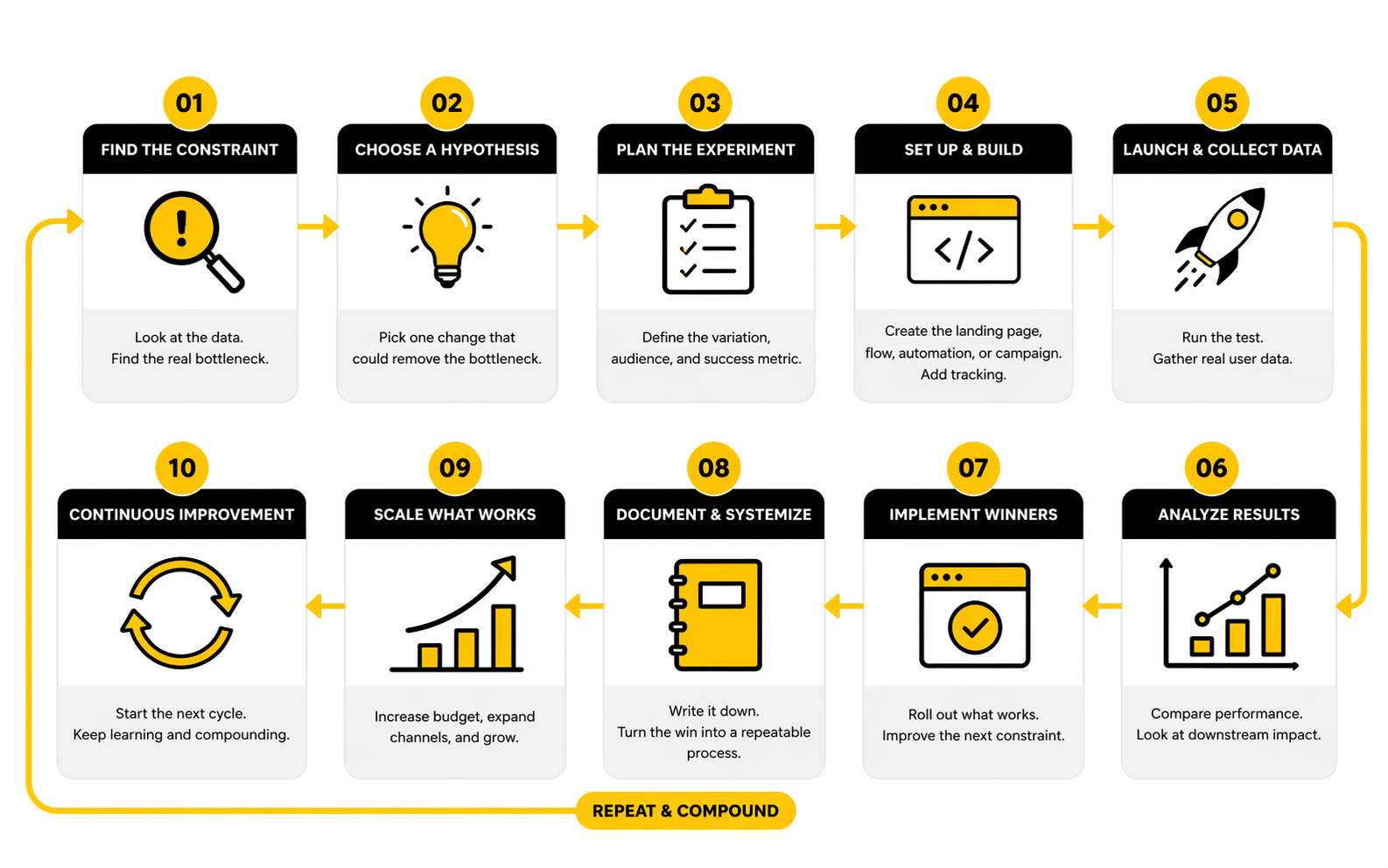
This is the point where growth hacking becomes tangible instead of theoretical. The process is not glamorous, but it is extremely effective when it is followed consistently. Teams that can execute this loop every week usually outperform teams that spend the same time debating channels without shipping anything.
Create a Measurement System That Prevents Self-Deception
The biggest danger in implementation is false confidence. A team runs a campaign, sees more traffic, and assumes progress happened. Then revenue stays flat, retention stays weak, and nobody can explain why. Professional growth work avoids that trap by deciding in advance what success means and by separating leading indicators from real business outcomes.
That means every experiment needs a clear measurement frame. What is the primary metric, what are the supporting metrics, how long will the test run, and what would count as a meaningful result? Research on experimentation culture and causal testing from Google Research and operational guidance from Optimizely keep making the same point: poorly framed experiments do not just waste time, they create the illusion of learning.
This is where many growth programs quietly break. They celebrate local lifts without checking whether those lifts create downstream value. The fix is simple in principle and demanding in practice: track the business result that matters, not just the easiest signal to screenshot in a meeting.
Keep Implementation Cross-Functional or It Will Stall
Growth hacking sounds like a marketing discipline, but implementation usually fails when it stays trapped inside marketing. The changes that unlock growth often live in onboarding, pricing, product UX, lifecycle messaging, sales response time, customer success, and data instrumentation. If those pieces sit in separate silos, the growth process becomes slow, political, and shallow.
The best growth engines are cross-functional by design. Product sees the behavioral signal. Marketing shapes the message. Sales adds frontline objections. Customer success highlights onboarding friction. Ops makes sure the workflows and tracking actually hold together. That is what makes the system durable.
In practical terms, that also means choosing tools that reduce operational drag instead of adding more fragmentation. A company might centralize follow-up and pipeline actions in GoHighLevel, manage social scheduling in Buffer, automate conversational entry points through ManyChat, or use Chatbase for always-on support and qualification. The exact stack will vary, but the principle should not: fewer handoff failures, faster execution, cleaner measurement.
Scale Only What Survives Contact With Reality
One of the most expensive mistakes in growth hacking is scaling something before it is truly proven. A landing page may lift click-through rate while hurting lead quality. A promotion may spike signups while attracting weak-fit users who churn. A message may generate replies that never turn into revenue. Professionals do not scale early noise.
They also do not assume a win is universal. A test that works for one segment, one offer, or one traffic source may fail somewhere else. That is why real implementation includes validation under slightly different conditions before a tactic gets promoted into the core playbook.
This is the part many people skip because it is less exciting than launching something new. But it is exactly where real leverage lives. When a growth team knows how to validate, operationalize, and repeat what works, growth hacking stops being a string of experiments and starts becoming a dependable engine.
What the Data Actually Tells You
At some point, every growth hacking program runs into the same problem: there is plenty of data, but not enough clarity. Dashboards fill up with clicks, sessions, signups, open rates, and assisted conversions, yet the team still cannot answer the only question that really matters: are we improving the system in a way that creates stronger business outcomes?
That is why measurement has to move beyond reporting. Good analytics should help you diagnose constraints, compare performance against reality, and decide what to do next. The point is not to collect more numbers. The point is to understand which numbers signal leverage, which ones only describe activity, and which ones are quietly warning you that growth is being overstated.
The Metrics That Matter Most
The most useful growth metrics usually sit across four layers: acquisition efficiency, activation quality, retention strength, and revenue expansion. When one layer weakens, the rest of the system starts compensating in expensive ways. More ad spend is used to cover weak conversion, more nurturing is used to cover weak onboarding, and more pipeline pressure is used to cover weak retention.
This is why modern product and revenue teams keep coming back to a small set of operating metrics instead of drowning in vanity reporting. Recent benchmark and product-measurement work from Mixpanel, Pendo, and Stripe points in the same direction: the strongest signals are the ones that connect user behavior to compounding commercial value.
A useful measurement stack for growth hacking normally includes:
- visitor-to-signup or visitor-to-lead conversion
- time to value or time to first meaningful action
- short-term and cohort-based retention
- activation rate by source, segment, or use case
- expansion revenue or net dollar retention
- payback efficiency, where relevant
- experiment win rate tied to business impact, not just local lifts
None of those metrics should be read in isolation. Their meaning changes depending on the surrounding system. A lower signup rate might be perfectly healthy if lead quality and activation improve. A higher click-through rate might be useless if downstream conversion gets worse.
Why Time to Value Deserves More Attention
One of the clearest signals in modern growth hacking is how fast users reach a meaningful outcome. Pendo’s current benchmark tool highlights that best-in-class products reach time to value in 0.2 days, which is a striking reminder that speed matters. Not because fast feels nice on a slide, but because delay creates doubt, and doubt kills momentum.
Time to value is powerful because it compresses multiple growth forces into one metric. It reflects onboarding quality, product clarity, message alignment, and setup friction all at once. If your time to value is long, the action is usually not to “improve marketing.” It is to shorten the path between intent and result.
That is also why this metric should drive implementation choices. Better defaults, clearer setup, smaller first tasks, stronger guidance, and fewer decisions are often the right response. A growth team that cuts time to value usually improves activation, retention, and referral potential at the same time.
Retention Metrics Need Context or They Mislead
Retention is one of the most abused ideas in analytics because teams often quote a number without defining the behavior behind it. Retention only becomes useful when you know what type of user you are measuring, what return window you are using, and what “coming back” actually means. Logging in is not the same as reaching value. Opening an email is not the same as using the product meaningfully.
That is why retention should be measured through cohorts and anchored to meaningful actions. Mixpanel’s long-standing retention guidance still captures the core truth well: many products see only 6% to 20% eight-week retention depending on industry, which means weak early retention is common but not harmless. The right response is not panic. It is diagnosis.
When retention is lower than expected, the action should depend on where the drop happens. If the cliff appears immediately after signup, the issue is likely activation. If the cliff shows up after first success, the issue may be ongoing use case clarity, weak product habit formation, or poor lifecycle support. The number matters, but the pattern matters more.
Benchmarks Are Useful Only When They Change Decisions
Benchmarks can be incredibly helpful, but only if they are used as a starting point rather than a substitute for thinking. A benchmark tells you where you stand relative to others. It does not tell you why you got there, whether your segment behaves differently, or what exact change will improve the result.
That is why the best use of benchmarks is directional, not emotional. Pendo’s benchmark system currently shows best-in-class guide engagement at 60.2% and NPS response rate at 25.0%. Those are useful signals because they reveal what strong engagement can look like, but they should not trigger blind copying. If your guide engagement is weak, the real question is whether the guide is shown at the right moment, solves the right problem, and leads to the right next action.
The same goes for broader product comparisons. Mixpanel’s benchmark reporting is useful because it frames questions executives and operators actually ask: what does average acquisition look like, how does retention compare, and what is best-in-class performance in this category? That is useful because it helps a team avoid both complacency and fantasy. But the action still has to come from your own behavioral data.
Experimentation Metrics Should Measure Learning Quality
A lot of teams think an experimentation program is healthy when it runs a lot of tests. That is not enough. Test volume matters early because it builds learning velocity, but more tests alone do not guarantee more value. Optimizely’s recent guidance on scaling experimentation warns against that exact trap and argues that the right program metrics are tied to business impact, test quality, and operational maturity, not raw output alone.
This matters for growth hacking because teams can become addicted to surface-level wins. A subject line improves open rate. A landing page increases clicks. A variation produces more form completions. Then nothing meaningful changes downstream. That is not experimentation maturity. That is self-deception with a nice chart.
The better measurement approach is to tie each experiment to one primary business outcome and a few guardrail metrics. Optimizely’s newer thinking on experimentation metrics and its broader material on running 127,000 experiments both reinforce the same principle: the strongest teams connect experimentation to business value, maintain quality while increasing velocity, and resist the urge to declare victory too early.
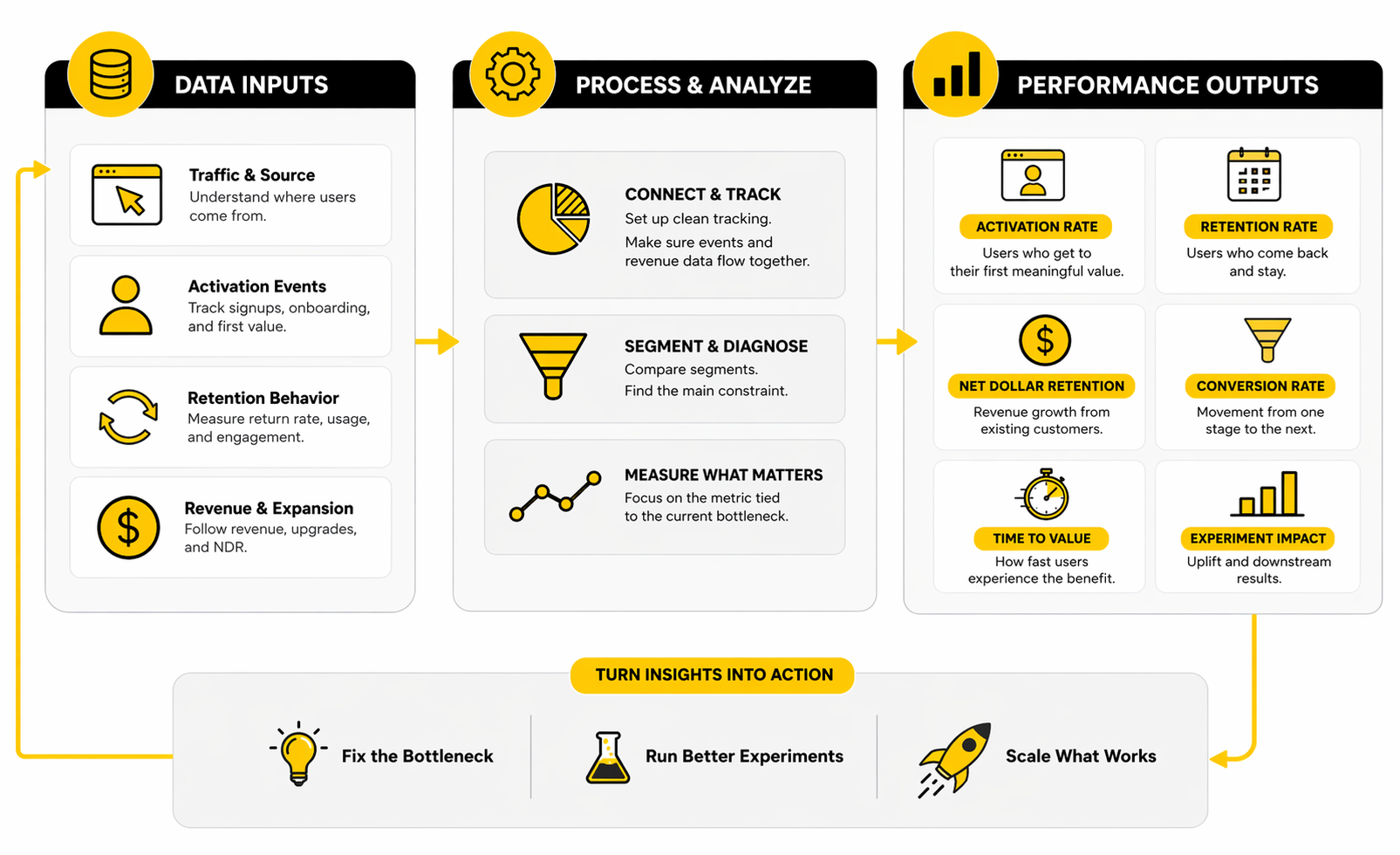
This is where the analytics system becomes practical. The visual model should show how top-of-funnel signals connect to activation, how activation feeds retention, and how retention influences expansion. When that system is mapped clearly, teams stop obsessing over isolated spikes and start asking better operational questions.
Revenue Metrics Are the Reality Check
Revenue metrics are where growth hacking gets exposed. You can make traffic look better, make response rates look better, even make lead flow look better, and still have a weak growth engine. Revenue metrics cut through that noise because they show whether the customer journey is producing durable business value.
Stripe’s recent guidance on pricing, packaging, and recurring revenue is useful here because it keeps pointing operators back to expansion quality, self-serve upgrade behavior, and net dollar retention. Its current NDR explainer makes the basic standard clear: net dollar retention above 100% means revenue from existing customers is growing, while recent pricing guidance highlights expansion MRR and upgrade behavior as some of the cleanest signals that packaging is actually working.
That interpretation matters. If acquisition is improving but NDR is weak, your growth system is not compounding. If activation looks healthy but expansion is flat, your offer design may be too narrow or your upgrade path too weak. If churn remains high, new business may be masking a deeper structural problem.
How To Read Signals Without Overreacting
One of the hardest parts of analytics is resisting dramatic conclusions from incomplete data. A weekly dip might be seasonality. A lift from one segment might not generalize. A strong campaign might pull forward demand instead of creating new demand. Good growth hacking is aggressive in experimentation but conservative in interpretation.
That is why data should be read through three filters. First, is the signal statistically or operationally trustworthy? Second, does it show up downstream, not just locally? Third, what action does it justify right now? If the answer to the third question is unclear, the metric is interesting but not yet useful.
This is also the reason experienced teams separate diagnostic metrics from decision metrics. Diagnostic metrics help explain what is happening. Decision metrics determine whether a change should be scaled, revised, or killed. That discipline protects the company from acting on noise while still keeping the growth process fast.
The Best Analytics Stack Reduces Decision Lag
An analytics system is only good if it helps the team decide faster. If data collection is fragmented across forms, landing pages, CRM records, scheduling tools, and product events, the delay between action and insight grows too long. By the time the team understands what happened, the context is already cold.
That is why implementation matters so much here. A company may use Dub to trace campaign and link performance, GoHighLevel to connect lead flow and follow-up, Buffer to manage distribution inputs, or Copper to keep relationship context close to revenue movement. The exact tool choice matters less than the operating result: faster feedback loops and fewer blind spots.
When the measurement system is healthy, the team knows what to watch, why it matters, and what action it should trigger. That is the real goal. Growth hacking is not about worshipping dashboards. It is about using numbers to make sharper decisions before waste compounds.
How Growth Hacking Changes When You Scale
What works at an early stage often breaks once the business gets bigger. A scrappy founder can improvise messaging, manually follow up with every lead, and personally interpret customer objections. That can create early traction, but it does not automatically create a scalable growth system.
This is where growth hacking becomes more demanding and more strategic. As volume increases, weak instrumentation, messy handoffs, unclear ownership, and bad-fit acquisition sources become expensive very quickly. The same experiment that felt harmless at a small scale can create serious downstream damage once hundreds or thousands of users move through the system.
The practical shift is simple: early growth hacking is often about finding motion, while scaled growth hacking is about protecting signal quality. You still want speed, but now you also need process discipline, guardrails, and tighter coordination across teams.
The Tradeoff Between Speed and Control
Every growth team says it wants to move fast. The real question is whether it can move fast without corrupting data, breaking customer experience, or creating operational mess that someone else has to clean up later. That is the tradeoff that starts to matter once growth becomes a shared company responsibility rather than a founder-led hustle.
The wrong response is to become slow and bureaucratic. The right response is to add just enough structure that velocity does not destroy trust. That means clear ownership of experiments, pre-defined guardrail metrics, rollout plans, and review standards that stop teams from scaling attractive but misleading wins.
This is one reason experimentation maturity matters so much at later stages. It is not enough to have more ideas or more tools. A company needs a way to turn fast tests into decisions the rest of the business can trust. Otherwise growth hacking starts producing internal skepticism instead of momentum.
More Channels Usually Means More Waste
A common scaling mistake is expanding channel count before the existing system is truly understood. Teams start adding paid social, partnerships, communities, outbound, webinars, affiliates, influencer campaigns, content syndication, and whatever else looks promising that quarter. On paper, it feels diversified. In practice, it often creates attribution confusion and operational drag.
Growth hacking gets stronger when channel expansion follows proof, not boredom. If one primary acquisition motion already brings qualified users into a healthy activation and retention sequence, that is the time to explore adjacent channels. If the core motion is still noisy, adding more surface area usually makes interpretation worse, not better.
This is where strong link tracking, clean CRM handoff, and disciplined campaign architecture stop being optional. Teams that want to scale distribution without losing clarity often benefit from infrastructure that keeps source data readable and conversion paths connected, whether that means cleaner attribution through Dub, more organized distribution workflows in Buffer, or tighter marketing-to-sales routing in GoHighLevel. The stack is not the strategy, but once complexity grows, weak infrastructure magnifies waste fast.
The Bigger Risk Is Optimization Myopia
One of the most dangerous things in advanced growth hacking is getting very good at improving local metrics while the broader system weakens. A team can improve click-through rate by making offers more aggressive, improve signup rate by lowering intent filters, or improve meeting volume by making qualification looser. Each local result can look like progress. Together, they can quietly degrade conversion quality, retention, and revenue efficiency.
That is why expert-level growth work requires system awareness. You are not just asking whether a change improved one metric. You are asking whether it improved the right metric without damaging the next stage of the journey. This becomes especially important as more specialists touch the funnel and each team naturally optimizes for its own scoreboard.
The fix is not complicated, but it does require discipline. Every major growth initiative should have one primary target and a few non-negotiable guardrails. If the guardrails break, the win is not a win. This is the only way to keep growth hacking from turning into siloed optimization theater.
Risks That Experienced Teams Take Seriously
At a certain level, growth hacking is less about discovering clever tactics and more about managing risk intelligently. The risks are not always obvious at the start because many of them hide inside short-term wins. A channel scales, but lead quality drops. An onboarding shortcut lifts activation, but support tickets spike. A lifecycle automation improves reactivation, but brand trust weakens because the tone feels too aggressive.
The strongest teams assume these second-order effects exist. They do not wait for a crisis to start thinking about them. They design review loops that catch damage early enough to respond before the economics of the system get distorted.
Bad Fit Is More Dangerous Than Low Volume
Low volume feels scary because the pain is visible. Bad fit is more dangerous because it often looks like progress for a while. You can pump traffic, generate demos, fill the CRM, and still be feeding the company the wrong kind of demand. That creates fake confidence, wastes team time, and makes it harder to see what truly resonates.
This is why advanced growth hacking pays close attention to segment quality and post-conversion behavior. The best question is not “Which channel brought the most leads?” It is “Which path brought customers who activated, stayed, and expanded?” Once a team starts asking that question consistently, a lot of seductive but low-quality tactics lose their appeal.
That is also where lead capture and qualification design deserve more respect. Better forms, smarter routing, and stronger qualification steps can reduce noise dramatically when they are placed at the right point in the journey. Tools like Fillout or Cal.com are useful here only when they help the business separate real opportunity from polite interest.
Automation Can Scale Strength or Scale Weakness
Automation is one of the biggest leverage points in modern growth hacking, and also one of the easiest places to make a mess. If the message is sharp, the timing is right, and the workflow matches user intent, automation can compress response time and increase consistency. If the strategy is weak, automation simply multiplies weak decisions faster.
This is why mature teams automate later than beginners expect and earlier than laggards do. They do not rush to automate chaos, but they also do not wait until the team is drowning in manual work. They look for processes that are already proving useful, then operationalize them so quality stays high as volume grows.
In practice, that might mean lifecycle sequencing through Brevo, social or conversational automation through ManyChat, or integrated pipeline workflows through GoHighLevel. The common theme is that automation should remove friction from a working system, not hide the fact that the system is not working.
Brand Damage Is a Real Growth Cost
This point gets ignored far too often. Growth hacking has a reputation problem because too many people still associate it with spammy tactics, manipulative urgency, dark patterns, and extractive funnels. Those tactics can still produce activity, but they create a tax on trust that shows up later in lower conversion quality, weaker referrals, and poorer retention.
Expert operators take brand seriously because they understand that trust affects the entire funnel. Strong positioning lowers skepticism. Clear offers reduce friction. Honest copy improves conversion quality. Helpful onboarding increases confidence. None of that is soft. It is commercially useful.
This becomes even more important as AI-assisted execution gets cheaper. When more companies can produce content, automations, and funnels quickly, the real differentiator becomes judgment. Growth hacking that feels helpful, precise, and trustworthy will age much better than growth hacking that feels clever for thirty seconds and exhausting after that.
Strategic Choices That Separate Strong Teams From Busy Teams
As the article moves toward its close, one point becomes unavoidable: most growth problems are not caused by a lack of tactics. They are caused by weak choices. Teams chase too many segments, too many offers, too many channels, and too many experiments that are disconnected from the real commercial constraint.
The strongest growth teams make harder choices earlier. They decide which audience matters most right now, which use case deserves priority, which activation event best predicts retention, and which revenue path deserves the most support. That focus is what makes everything else faster.
Pick the Constraint That Actually Matters
This sounds obvious, but it is where advanced growth work often wins or loses. If retention is weak, adding more acquisition pressure may temporarily hide the issue while making the economics worse. If the market understands the product but sales conversion is poor, publishing more content may not fix the real problem. If demos are strong but the pipeline is thin, improving onboarding is not the immediate lever.
Growth hacking becomes powerful when it is anchored to the right commercial bottleneck. That is why good operators keep returning to the same discipline: identify the true constraint, design around it, and resist the urge to spread effort across unrelated improvements just because they are easier to ship.
Build Systems You Can Teach, Not Just Systems You Can Run
There is a hidden difference between a strong operator and a strong growth organization. A strong operator can hold a lot of context in their head and improvise around it. A strong organization can teach its process, repeat it across people, and maintain quality even when the original builder is not in the room.
That is the standard worth aiming for. Your experiments should be documented clearly enough that someone else can understand the logic. Your campaign structures should be organized clearly enough that performance can be audited without detective work. Your onboarding and follow-up processes should be explicit enough that they survive team turnover.
This is also where simple documentation and guided workflow tools can help if they reduce ambiguity instead of adding another layer of software. A team might centralize repeatable process guidance through Guideless or build cleaner internal resource paths with Anything.com. The principle is what matters: make the growth system easier to run well, not more dependent on heroics.
The Goal Is Durable Leverage
That is the real expert-level takeaway. Growth hacking is not about finding a trick that explodes for six weeks. It is about building leverage that survives contact with reality. Durable leverage usually comes from tighter positioning, faster value delivery, better retention behavior, smarter expansion paths, and a process that keeps learning without losing discipline.
Once a team understands that, a lot of distracting noise falls away. Shiny tactics matter less. Signal quality matters more. Volume matters less than fit. Speed still matters, but only when it helps the business learn and improve without degrading trust or efficiency.
That is where modern growth hacking becomes genuinely valuable. Not as a collection of stunts, but as a serious operating model for building momentum that compounds.
FAQ
What is growth hacking in plain English?
Growth hacking is the process of finding repeatable ways to grow a business faster by testing ideas across acquisition, activation, retention, and revenue. In its best form, it is not about gimmicks at all. It is a disciplined operating model built around fast learning, sharp measurement, and compounding improvements.
Is growth hacking different from digital marketing?
Yes, but the difference is practical rather than ideological. Digital marketing usually focuses on channels and campaigns, while growth hacking looks at the whole customer journey, including product experience, onboarding, retention, and expansion. That is why strong growth teams often work across marketing, product, sales, and customer success instead of staying in one department.
Does growth hacking still work in 2026?
It does, but not in the cheap-tricks sense many people still imagine. The modern version works when teams focus on experimentation, faster time to value, better retention, and stronger monetization paths, not just attention grabbing. Recent guidance on experimentation maturity from Optimizely and revenue expansion from Stripe reflects exactly that shift.
What is the first thing a company should fix before trying more growth tactics?
The first job is to identify the main bottleneck in the system. If users are not activating, more traffic will not solve the problem. If retention is weak, more campaigns may only hide the issue while making the economics worse.
Which metric matters most in growth hacking?
There is no universal single metric, and that is exactly why many teams get confused. The most useful metric is usually the one tied to the current constraint, such as activation rate, time to value, retention, qualified pipeline, or net dollar retention. For subscription businesses especially, revenue-health metrics like NDR become powerful because they show whether growth is compounding or leaking.
How many experiments should a team run at once?
Fewer than most people think. One to three well-scoped experiments tied to a real business constraint usually beat a large pile of random tests with vague measurement. What matters is not raw experiment count, but whether the team can interpret results cleanly and turn winners into repeatable process.
Is growth hacking only for startups?
No, but startups often feel the benefits sooner because they need speed badly and have less room for waste. Larger companies can gain just as much, especially when they need better experimentation systems, cleaner onboarding, and better cross-functional execution. In fact, scaling businesses often need growth hacking discipline even more because complexity makes bad decisions more expensive.
Can growth hacking work without a product-led business model?
Absolutely. Product-led businesses often have obvious places to test activation and retention, but service firms, agencies, ecommerce brands, marketplaces, and sales-led SaaS companies can still use the same logic. The levers change, yet the core process stays familiar: identify the constraint, test a better path, measure downstream impact, and scale only what survives real-world use.
What role does data play in growth hacking?
Data is essential, but only when it leads to better decisions. A dashboard full of traffic and click metrics is not enough if nobody can connect those numbers to activation, retention, or revenue. Strong growth hacking uses data to diagnose problems, compare segments, interpret behavior, and decide what action should happen next.
Are benchmarks useful or distracting?
They are useful when they create better questions rather than emotional reactions. Benchmark systems from providers such as Pendo and broader SaaS reports like the 2025 SaaS Benchmarks Report can help teams understand what healthy performance might look like. But the real value comes from using benchmarks to guide diagnosis, not from copying another company’s numbers blindly.
What tools are actually worth using for growth hacking?
The right tools depend on where the constraint lives. A team focused on lifecycle and CRM execution may lean on GoHighLevel, while a team improving funnels might use ClickFunnels, Systeme.io, or Replo. The key rule is simple: tools should reduce friction in a working process, not become a substitute for strategy.
Is automation a growth hack?
Automation can be a force multiplier, but it is not a strategy by itself. If the message is weak or the timing is wrong, automation just spreads a bad decision faster. Used well, it helps teams respond faster, follow up more consistently, and preserve quality as volume grows through tools like Brevo, ManyChat, or Chatbase.
What is a common mistake beginners make with growth hacking?
The most common mistake is chasing too many channels before fixing the core system. Teams often try to publish more, spend more, automate more, and launch more offers when the real issue is weak activation, unclear positioning, or poor retention. That creates movement, but not necessarily progress.
How long should a company test before scaling a tactic?
Long enough to see whether the result survives downstream, not just long enough to create a pretty local lift. A channel that improves lead volume but damages close rate is not ready to scale. A landing page that raises signups but worsens retention is not a true win either.
What does success actually look like?
Success in growth hacking looks boring in the best possible way. The team knows the main constraint, runs a steady experiment cadence, measures the right signals, and improves the customer journey without losing trust or wasting budget. When that happens consistently, growth stops feeling random and starts feeling like a managed system.
Work With Professionals
Explore 10K+ Remote Marketing Contracts on MarkeWork.com
Most marketers spend too much time chasing clients, competing on crowded platforms, and losing a percentage of every project to middlemen. MarkeWork gives you a better way. Browse thousands of remote marketing contracts and connect directly with companies desperate to hire skilled marketers like you, without platform commissions and without unnecessary gatekeepers.
If you're serious about finding better opportunities and keeping 100% of what you earn, explore available contracts and create a profile for free at MarkeWork.com.