

Hootsuite email marketing is not about using Hootsuite as a full email service provider. It is about using Hootsuite as the social layer around your email strategy, especially when campaigns need promotion, reporting context, audience signals, and faster follow-up.
That distinction matters. Hootsuite is built for social media management, scheduling, listening, analytics, and inbox workflows, while email platforms handle subscribers, deliverability, segmentation, and campaign sending. The opportunity is in connecting both systems so social engagement and email performance stop living in separate silos.
Article Outline
This guide is structured as one complete article split into six parts. Each part builds on the previous one, so the goal is not to throw random tactics at you. The goal is to help you understand where Hootsuite fits, where it does not fit, and how to build a practical workflow around it.
- Why Hootsuite Email Marketing Matters
- The Hootsuite Email Marketing Framework
- Core Components Of The Workflow
- Professional Implementation Steps
- Common Mistakes And Smarter Alternatives
- Hootsuite Email Marketing FAQ And Final Recommendations
Why Hootsuite Email Marketing Matters
Email still does the heavy lifting when it comes to direct response, retention, and owned-audience marketing. Recent email marketing benchmarks continue to place average ROI around $36 for every $1 spent, which is exactly why smart teams do not treat email as an afterthought. But email rarely performs at its best when it is isolated from the conversations already happening on social.
Hootsuite matters because it helps teams manage the visibility side of that equation. You can plan social posts around newsletter launches, promote lead magnets, monitor campaign reactions, and respond to customer questions from one workflow. That makes Hootsuite email marketing especially useful for brands that already rely on social media to create demand before email converts that demand into action.
The most important mindset shift is simple: Hootsuite should not replace your email platform. It should support it. For example, Hootsuite’s app ecosystem includes a Mailchimp integration that can help teams view campaign activity and connect email performance with social promotion, while dedicated email platforms such as Brevo or Moosend handle the actual email sending, automation, and list management.
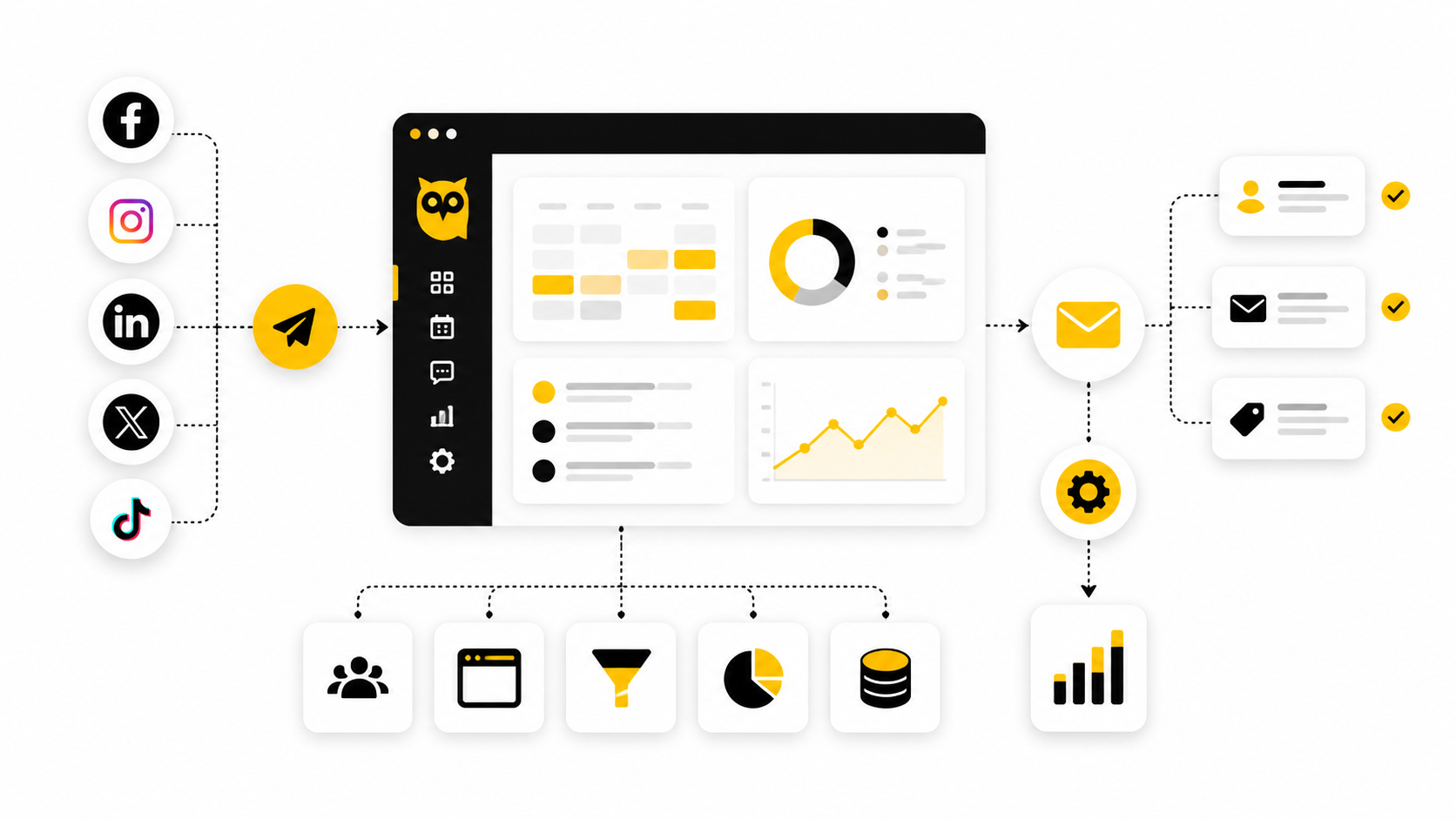
The Hootsuite Email Marketing Framework
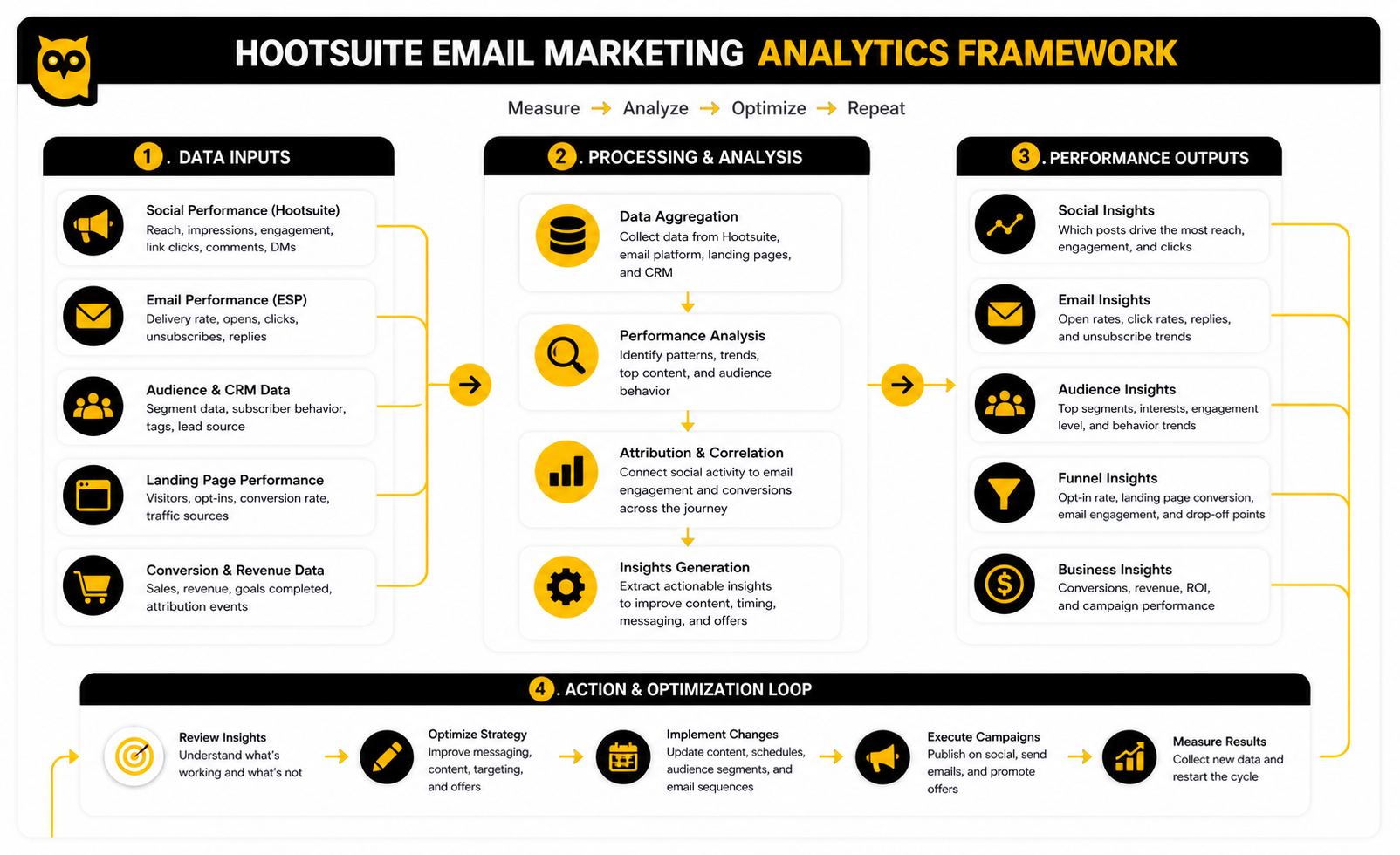
A useful Hootsuite email marketing workflow starts with one question: what role should social play before, during, and after the email campaign? Before the campaign, social can build awareness and drive signups. During the campaign, it can reinforce the message and catch objections in public conversations.
After the campaign, Hootsuite becomes useful for analysis and follow-up. You can look at which posts created engagement, which campaign angles got comments, and which questions should influence the next email sequence. This is where teams move from “we posted the newsletter link” to “we learned what our audience actually cared about.”
The framework is simple: social creates attention, email captures and converts that attention, and reporting connects the two. Tools like ManyChat can also fit when the campaign needs DM-based lead capture before sending people into an email journey. That is the bigger picture: Hootsuite helps coordinate the social layer, while your email and automation tools carry the subscriber relationship forward.
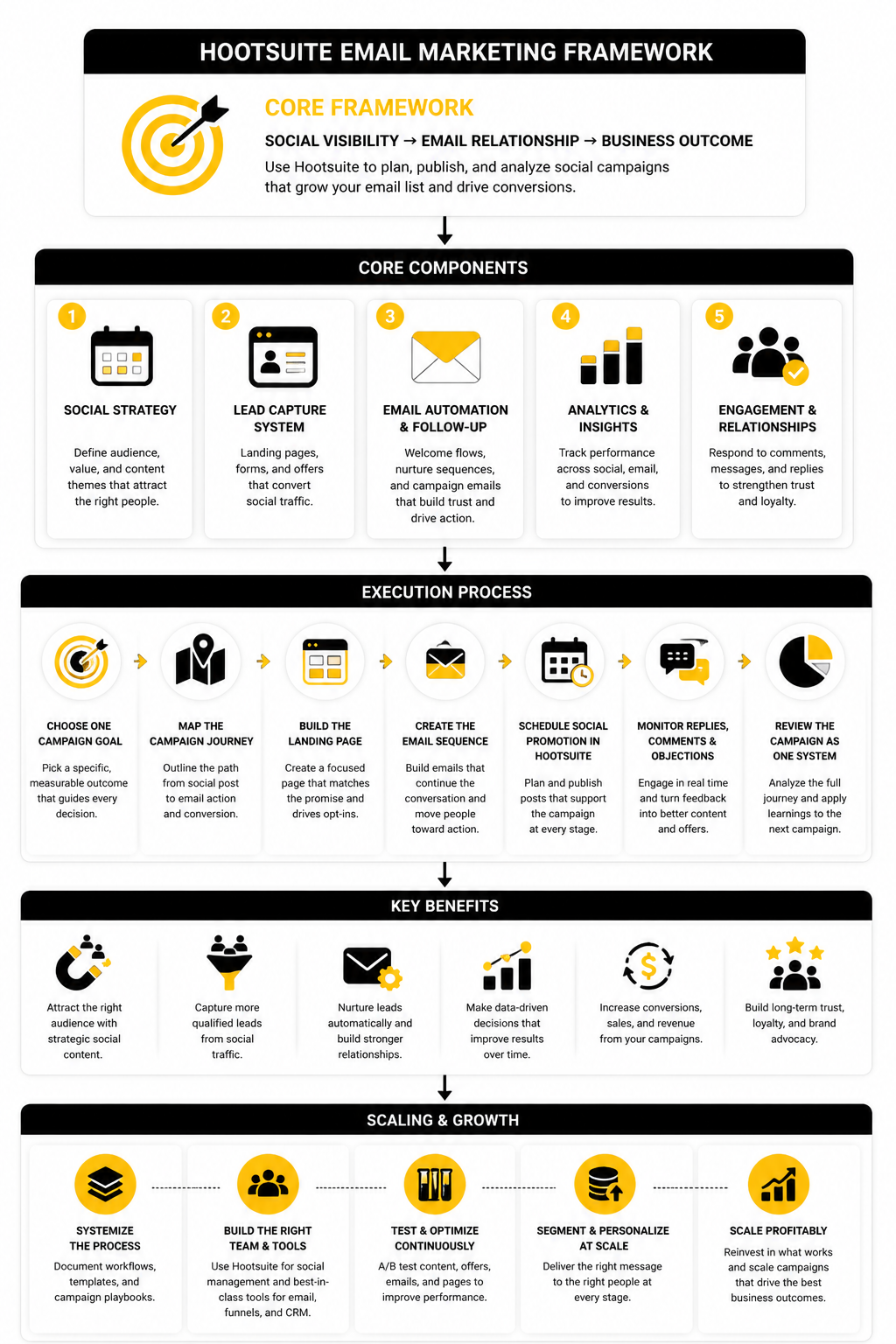
Core Components Of The Workflow
A strong Hootsuite email marketing workflow has four moving parts: the social calendar, the email platform, the lead capture path, and the reporting loop. Hootsuite handles the social calendar and campaign visibility. Your email platform handles the subscriber database, sending, automation, consent, and deliverability.
That separation is healthy. Hootsuite describes its platform as a place for scheduling, content creation, analytics, and social listening, not as a dedicated email marketing sender. The practical play is to use Hootsuite to amplify campaigns, then use tools like Brevo or Moosend to manage the actual email relationship.
The first component is campaign planning. Every email campaign should have a social runway before it goes live, not just one rushed post after the email is sent. That runway can include teaser posts, founder posts, short educational content, countdown reminders, and follow-up posts that answer objections.
The second component is lead capture. If social traffic lands on a weak page, the campaign leaks. For simple funnels, Systeme.io can be enough to build a landing page and connect email automation, while ClickFunnels makes more sense when the campaign needs a fuller funnel with upsells, order pages, and more structured conversion paths.
The third component is response management. Email campaigns often trigger questions on LinkedIn, Instagram, Facebook, and X before people ever reply to the email itself. Hootsuite’s value is that your team can monitor and respond to those conversations without hopping between every platform manually.
The fourth component is measurement. Email metrics show subscriber behavior, while social metrics show message-market reaction. When you combine both, you can see whether the campaign failed because the offer was weak, the social angle missed, the landing page underperformed, or the email follow-up did not create enough urgency.
The Social Calendar
The social calendar should not be a pile of random posts. It should map directly to the email campaign’s objective. If the goal is webinar registrations, the posts should build trust around the topic before asking for the registration.
A simple campaign calendar can include three stages. First, publish awareness content that frames the problem. Second, publish conversion content that points to the lead magnet, webinar, offer, or newsletter. Third, publish follow-up content that handles objections, shares proof, and reminds people before the deadline.
This is where Hootsuite can keep teams organized. Social posts, approvals, captions, scheduling, and performance checks can live in one workflow. That matters when several people touch the same campaign and nobody wants the classic mess of “which version is approved?”
The Email Platform
The email platform is where the real subscriber relationship lives. It should manage opt-ins, forms, segments, automations, unsubscribe handling, and deliverability. Hootsuite can support the campaign, but it should not be treated as the system of record for email marketing.
For most teams, the email platform should answer three questions clearly. Who joined the list? What did they do after joining? What should they receive next based on their behavior?
That is why the Hootsuite email marketing setup works best when Hootsuite is paired with a proper email tool. Hootsuite can help promote the campaign and monitor reactions, while the email platform sends the sequence and tracks subscriber-level engagement.
The Lead Capture Path
The lead capture path is the bridge between social attention and email ownership. It usually includes a social post, a landing page, a form, a thank-you page, and an automated email. If any one of those steps is confusing, the whole campaign gets weaker.
This is also where many brands overcomplicate things. They post too many calls to action, send people to a homepage, or ask for too much information too early. A focused opt-in page with one promise, one form, and one next step will usually beat a clever but cluttered setup.
For ecommerce and paid social campaigns, a stronger landing page builder can help. A tool like Replo fits when the campaign needs sharper product pages or advertorial-style landing pages. For service businesses and agencies that need CRM, forms, pipelines, and email follow-up in one place, GoHighLevel can fit the broader marketing system better.
The Reporting Loop
The reporting loop is what turns one campaign into a better next campaign. Without it, every campaign feels like starting from zero. You post, send, check the numbers, and then forget the lessons.
A useful reporting loop compares social engagement, landing page conversion, email opens, clicks, replies, unsubscribes, and sales outcomes. Open rates alone are not enough. Clicks alone are not enough either.
The point is to find the bottleneck. If social engagement is high but opt-ins are weak, the landing page probably needs work. If opt-ins are strong but email clicks are low, the sequence or offer positioning needs attention. If clicks are strong but sales are weak, the problem is likely the offer, pricing, checkout, or sales page.
Professional Implementation Steps
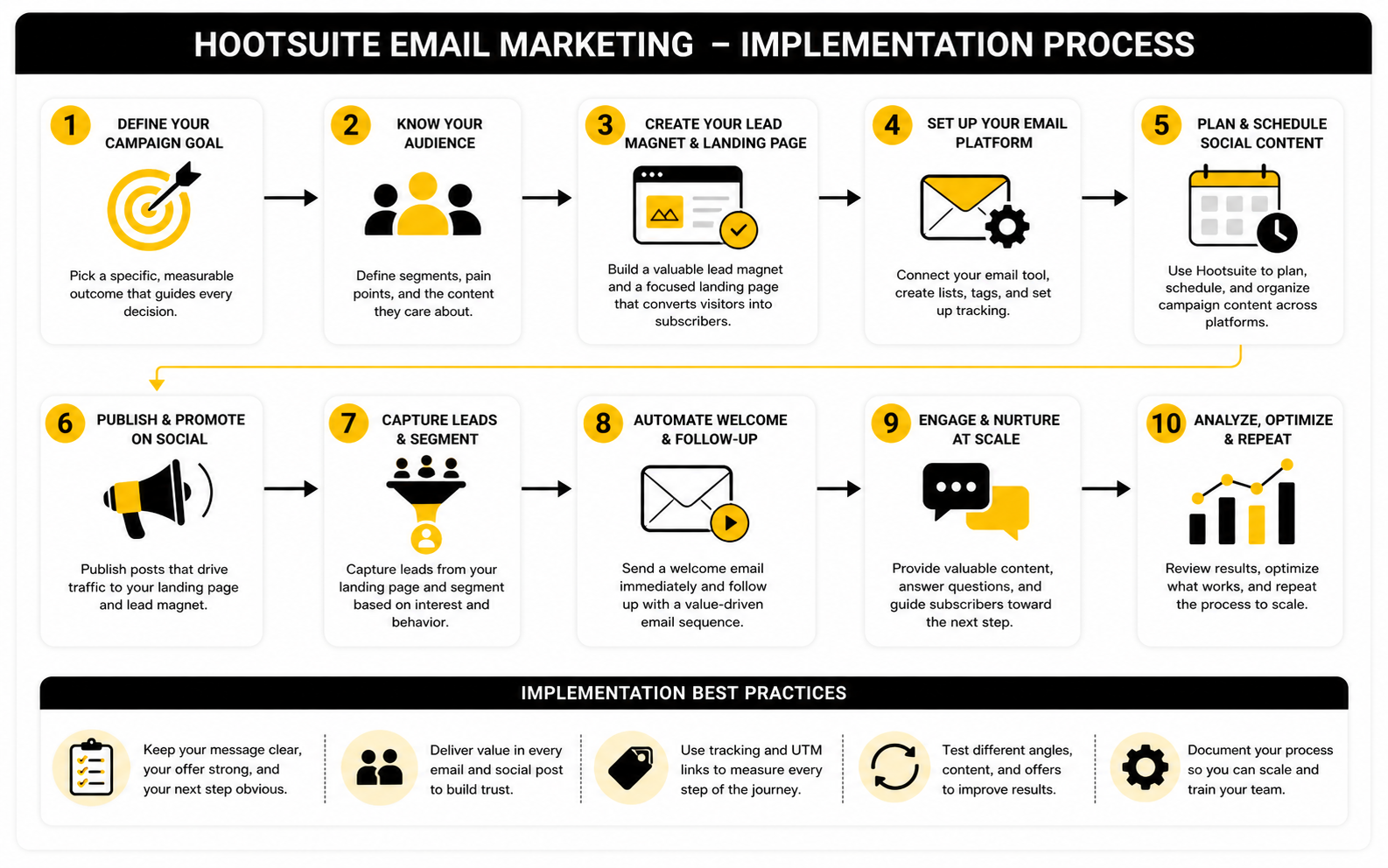
Once the workflow is clear, implementation becomes much easier. You are not trying to make Hootsuite do everything. You are building a clean handoff between social planning, lead capture, email automation, and campaign measurement.
The best setup starts with the campaign outcome, not the tool stack. Decide whether the campaign should generate newsletter subscribers, webinar registrations, demo requests, product sales, event signups, or booked calls. Then build the Hootsuite email marketing process around that one outcome.
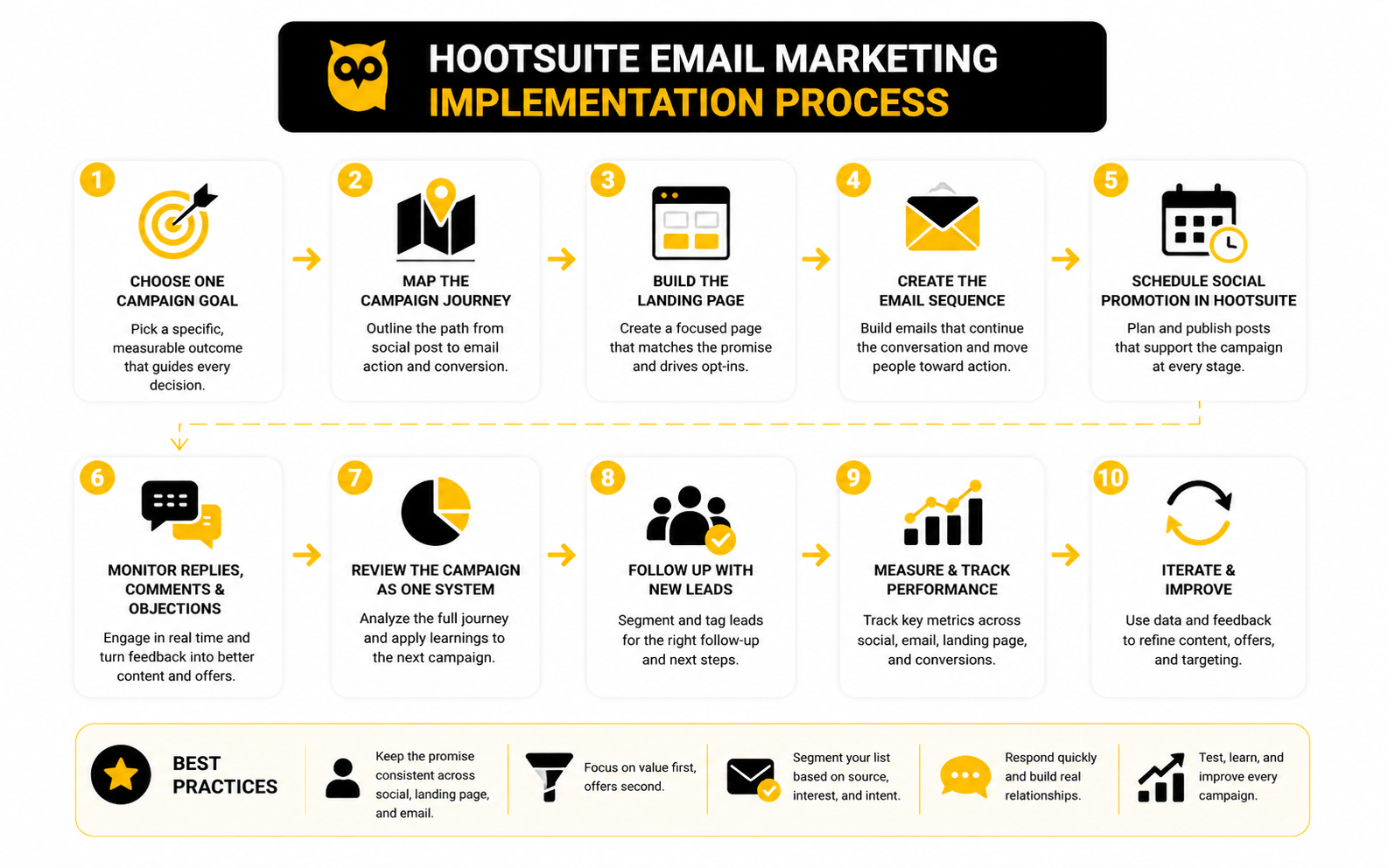
Step 1: Choose One Campaign Goal
Start with one measurable goal. Not “increase engagement.” Not “grow the audience.” Those are too vague to guide execution.
A stronger goal sounds like this: get 500 new webinar registrations, generate 100 qualified lead magnet downloads, or drive 50 trial signups from social and email combined. Once the goal is specific, every post, landing page, email, and follow-up message has a job.
This also keeps the team honest. If the goal is email list growth, then social engagement is useful only when it helps capture the right subscribers. If the goal is sales, then email clicks matter only when they move people closer to buying.
Step 2: Map The Campaign Journey
The campaign journey should show exactly how someone moves from social attention to email action. A simple path is usually enough: social post, landing page, form, confirmation page, welcome email, follow-up sequence, and final conversion step. Do not make this more complicated than it needs to be.
This is where the process becomes tangible. Hootsuite schedules and monitors the social touchpoints, while your email platform handles opt-ins and follow-up. A funnel tool like ClickFunnels can support campaigns that need structured landing pages and sales paths, while Systeme.io can work for simpler opt-in pages and automated email sequences.
Write the journey down before building anything. If the flow does not make sense on paper, it will not magically make sense inside the tools. This one step prevents a lot of wasted creative work.
Step 3: Build The Landing Page Before The Social Content
The landing page should be finished before the social calendar is finalized. That sounds obvious, but many teams do it backward. They write posts first, then realize the page does not match the promise made in the content.
The page needs one clear promise, one clear audience, and one clear action. If the social post promises a checklist, the landing page should not suddenly pitch a full consultation. If the post promotes a webinar, the landing page should make the date, topic, outcome, and registration action impossible to miss.
For product-led campaigns, a better page can make a real difference. Replo fits ecommerce teams that need polished campaign pages without waiting on heavy development work. Service businesses and agencies may prefer GoHighLevel when they want the page, form, CRM, pipeline, and follow-up workflow in one operating system.
Step 4: Create The Email Sequence
The email sequence should continue the conversation that started on social. It should not feel like a completely different campaign. The language, offer, angle, and promise should all match what originally made the person click.
A basic sequence can include a confirmation email, a value email, a proof email, an objection-handling email, and a final call-to-action email. That is enough for many campaigns. You can always add more complexity later, but the first version should be easy to understand and easy to measure.
This is where your email platform earns its keep. Tools like Brevo and Moosend are built for subscriber management, campaigns, and automation, while Hootsuite keeps the social promotion organized around the same message.
Step 5: Schedule The Social Promotion In Hootsuite
Now the campaign can move into Hootsuite. Schedule the social content around the email sequence, not randomly across the calendar. The timing should help people notice the offer before, during, and after the email push.
A practical schedule might include teaser posts before launch, announcement posts on launch day, educational posts during the campaign window, reminder posts near the deadline, and recap posts after the campaign closes. Each post should have a specific role. Some posts warm up the audience, some drive clicks, and some answer hesitation.
Keep the captions human. Hootsuite can help you organize and publish content, but it cannot save weak positioning. The offer still needs to be clear, the hook still needs to be specific, and the call to action still needs to feel worth clicking.
Step 6: Monitor Replies, Comments, And Objections
Once the campaign is live, do not disappear. Watch the replies, comments, DMs, mentions, and recurring questions. That feedback often tells you what your email copy missed.
If several people ask the same question under social posts, turn that question into an email. If people misunderstand the offer, fix the landing page. If people are interested but hesitant, create a follow-up post that handles the objection directly.
This is one of the biggest advantages of using Hootsuite email marketing as a connected workflow. Social comments give you fast qualitative feedback, while email metrics show what subscribers actually do. Together, they give you a much sharper picture than either channel alone.
Step 7: Review The Campaign As One System
After the campaign ends, review the full system instead of judging each channel in isolation. Look at the social posts, landing page conversion, email performance, replies, unsubscribes, and final business result. The goal is to find the weakest link, not to blame the channel with the lowest vanity metric.
A campaign can have average social engagement and still produce strong email revenue. It can also have great engagement and poor conversions if the offer is unclear. That is why the review should focus on movement through the journey.
End every campaign with a short internal summary. What message worked best? Which post created the most qualified clicks? Which email got the strongest response? What should be reused, removed, or rewritten next time? That is how the workflow compounds.
Statistics And Data
Measurement is where Hootsuite email marketing becomes useful instead of just busy. The goal is not to collect more dashboards. The goal is to understand which social activity creates email subscribers, which email activity creates action, and where people drop out between the two.
Email and social metrics should be read together because they answer different questions. Social data shows whether the market is noticing and reacting to your message. Email data shows whether people who already raised their hand are moving closer to the offer.
That difference matters. Email benchmarks from the DMA show delivery rates around 98% and unique click rates around 2.3%, while MailerLite’s 2025 benchmark data puts average open rates at 43.46% and click rates at 2.09%. Those numbers do not mean your campaign is good or bad by themselves. They give you a baseline so you can diagnose what needs attention.
The Metrics That Actually Matter
Start with the metrics that connect directly to the campaign journey. In Hootsuite, that usually means reach, engagement rate, link clicks, comments, shares, saves, and message volume. In your email platform, that usually means delivery rate, open rate, click rate, unsubscribe rate, reply rate, conversion rate, and revenue or pipeline generated.
Do not treat every metric equally. Reach tells you how many people had the chance to see the campaign, but it does not prove intent. Comments and DMs often reveal stronger interest because people are putting effort into the interaction.
Email clicks are usually more valuable than opens because opens have become less reliable after privacy changes. A strong open rate with a weak click rate usually means the subject line worked but the email body, offer, or call to action did not. A weak open rate with a strong click rate may mean the message is good, but the subject line or list segment needs work.
How To Read Social Benchmarks
Social benchmarks are useful, but only when you compare the right things. A B2B LinkedIn campaign, an ecommerce Instagram campaign, and a local service Facebook campaign should not be judged by the same engagement standard. Platform, industry, format, audience size, and content intent all change the numbers.
Hootsuite’s 2026 benchmark data notes that a good social engagement rate is generally in the 2% to 4% range, but the real question is whether engagement moves the right people into the email journey. A post with fewer likes can still be the winner if it drives better subscribers. A viral post can still be a distraction if it attracts the wrong audience.
For Hootsuite email marketing, the best social metric is often qualified click intent. That means looking beyond raw clicks and asking what happened next. Did those visitors subscribe, register, book, buy, or reply?
How To Read Email Benchmarks
Email benchmarks should be treated as diagnostic ranges, not universal targets. If your open rate is far below industry averages, your list quality, sender reputation, subject lines, or segmentation may need work. If your click rate is below benchmark, the problem may be the email content, the offer, the call to action, or the match between the subscriber’s expectation and the campaign promise.
The ROI picture is still strong, but it should not be used lazily. Litmus reports that many companies see email ROI between $10 and $36 for every $1 spent, with higher ranges also reported by some teams. That does not mean every email campaign will automatically print money.
The teams that get strong returns usually have better list quality, better segmentation, better offers, and tighter measurement. That is the lesson. Email is powerful because it is owned and direct, but it still needs a clean system around it.
The Measurement System To Build
The measurement system should follow the same journey your audience follows. First, measure the social post. Then measure the landing page. Then measure the email sequence. Then measure the final business outcome.
A simple campaign scorecard can track:
- Social reach by post and platform
- Engagement rate by post and format
- Link clicks from each social post
- Landing page visits and conversion rate
- New subscribers or registrants
- Email delivery, opens, clicks, replies, and unsubscribes
- Final conversions, sales, booked calls, or pipeline value
- Top questions and objections from comments, DMs, and replies
This is where Hootsuite fits nicely. Hootsuite can organize the social performance side, while tools such as Brevo, Moosend, or GoHighLevel track the email, CRM, and conversion side. The system works best when each tool reports on the job it is actually built to do.
What The Data Should Make You Do
Data is only useful when it changes the next decision. If posts get strong engagement but weak clicks, sharpen the call to action. If clicks are strong but opt-ins are weak, rebuild the landing page.
If opt-ins are strong but email engagement is weak, check whether the first email matches the promise from the social post and landing page. If email engagement is strong but revenue is weak, look at the offer, sales page, pricing, checkout, or booking flow. Do not blame Hootsuite, email, or the algorithm before checking the full path.
The most practical habit is to end every campaign with three decisions. Keep what clearly worked. Cut what created noise without movement. Test one new angle in the next campaign. That is how measurement turns into better marketing instead of another spreadsheet nobody uses.
Common Mistakes And Smarter Alternatives
The biggest mistake with Hootsuite email marketing is expecting one tool to solve a full-funnel problem. Hootsuite can help you plan, publish, monitor, and analyze social activity. It should not be treated as the place where every email, funnel, CRM, and revenue process has to live.
That sounds basic, but it is where many teams lose time. They try to force a social media management platform to behave like an email platform, then blame the setup when attribution gets messy or follow-up breaks. A better approach is to assign each tool a clear job and make the handoff between tools simple.
Mistake 1: Treating Social Engagement As The End Goal
Likes, comments, and shares are useful signals, but they are not the final outcome. A post can get attention and still fail to create subscribers, leads, or revenue. That is why every social campaign connected to email needs a clear next step.
The smarter alternative is to define the action behind the engagement. If someone comments, should they receive a reply, a link, a DM, or a prompt to join the list? If someone clicks, should they land on a lead magnet, webinar page, product page, or booking page?
This is where tools like ManyChat can support the bridge between social interaction and list growth. Used well, DM automation can turn comments and message intent into a cleaner opt-in path. Used badly, it becomes another spammy automation layer, so keep the trigger, message, and promise extremely clear.
Mistake 2: Building Too Many Campaigns At Once
Scaling does not mean launching more campaigns until the calendar looks busy. It means repeating the few campaign types that produce measurable outcomes. If every week has a new offer, new landing page, new email sequence, and new message angle, your team will struggle to know what actually worked.
The smarter alternative is to build campaign templates. Create one repeatable workflow for lead magnets, one for webinars, one for product launches, and one for nurture campaigns. Then improve those workflows instead of reinventing the whole machine every time.
This is also where approval workflows matter. Hootsuite can help larger teams manage planned content and review cycles, but the strategic discipline still has to come from the team. The tool can keep the machine organized; it cannot decide which campaigns deserve to exist.
Mistake 3: Ignoring Deliverability Until It Hurts
Deliverability is not glamorous, but it can quietly destroy a campaign. Social may drive the right people to the list, but if emails land in spam or fail authentication checks, the follow-up never gets a fair shot. That makes deliverability a strategic issue, not just a technical detail.
The smarter alternative is to handle the basics before campaign volume grows. Google’s sender guidelines require proper authentication through SPF, DKIM, and DMARC alignment for many senders, and major mailbox providers have tightened enforcement around bulk sending, unsubscribe handling, and spam complaints. If your Hootsuite email marketing system is driving serious list growth, your email infrastructure has to be ready for it.
Keep the list clean, segment new subscribers properly, and make unsubscribing easy. That last part is not just compliance housekeeping. It protects sender reputation because frustrated subscribers who cannot leave easily are more likely to mark messages as spam.
Mistake 4: Sending Everyone The Same Follow-Up
A single email sequence is easy to build, but it rarely stays effective as campaigns scale. People arrive from different platforms, different posts, different levels of intent, and different promises. Treating them all the same wastes useful context.
The smarter alternative is lightweight segmentation. You do not need a complicated maze of automation on day one. Start by segmenting based on campaign source, lead magnet, product interest, webinar registration, or buyer stage.
For agencies, local businesses, and service teams, GoHighLevel can make this easier because CRM, pipelines, forms, appointments, and follow-up can sit closer together. For teams that mainly need newsletter and automation workflows, Brevo or Moosend may be the cleaner fit.
Mistake 5: Over-Automating The Human Parts
Automation is useful when it removes repetitive work. It becomes dangerous when it removes judgment. Social comments, replies, objections, complaints, and buying questions often need context that a generic automation cannot read well.
The smarter alternative is to automate the routing, not the relationship. Let systems capture the lead, tag the source, send the first email, and notify the right person. Then let humans handle the moments where trust is actually being built.
This matters even more as AI features become normal inside social and marketing tools. Hootsuite has been adding more AI-assisted workflows for content creation, campaign analysis, and social analytics, which can save time. But speed is not the same as strategy, and AI-generated content still needs a human editor who understands the audience, the offer, and the brand voice.
Mistake 6: Choosing Tools Before Choosing The Operating Model
Tool choice should follow the operating model. A solo creator does not need the same setup as a multi-location brand. A B2B agency does not need the same workflow as a Shopify store with weekly product drops.
The smarter alternative is to choose based on campaign complexity. If you mainly need social planning and performance visibility, Hootsuite can sit at the center of the social workflow. If you need a simple funnel and email automation, Systeme.io may be enough. If you need advanced funnels, checkout paths, upsells, and launch pages, ClickFunnels may make more sense.
The expert move is not having the most tools. It is having the fewest tools that can reliably run the campaign. The cleaner the system, the easier it is to scale without losing control.
Hootsuite Email Marketing FAQ And Final Recommendations
At this point, the full system should be clear. Hootsuite is strongest when it manages the social side of the campaign: planning, scheduling, publishing, monitoring, and social analytics. Your email platform, CRM, funnel builder, and landing page tools should handle the subscriber relationship and conversion path.
That is the ecosystem view. Social creates visibility. Email builds the owned relationship. Landing pages capture intent. Automation follows up. Analytics tells you what to improve next.
FAQ - Built For Complete Guide
Is Hootsuite An Email Marketing Platform?
No, Hootsuite is not a dedicated email marketing platform. It is a social media management platform built around scheduling, publishing, monitoring, social inbox workflows, and analytics. For email sending, automation, subscriber management, and deliverability, you still need a dedicated email platform.
What Does Hootsuite Email Marketing Mean?
Hootsuite email marketing means using Hootsuite to support and coordinate the social media layer of your email campaigns. That can include promoting newsletters, driving traffic to lead magnets, monitoring campaign conversations, and reviewing social performance around an email launch. It does not mean replacing your email service provider with Hootsuite.
Can Hootsuite Send Email Campaigns?
Hootsuite is not built to send full email campaigns to your subscriber list. The better setup is to use Hootsuite for social promotion and a platform like Brevo, Moosend, or another email tool for campaign sending. That keeps your social workflow and email infrastructure clean.
Does Hootsuite Integrate With Mailchimp?
Yes, Hootsuite has supported a Mailchimp app that lets teams share and track Mailchimp email campaigns from the Hootsuite dashboard. The app directory describes features such as monitoring campaign performance, tracking list growth, and adding notes to subscriber profiles. That type of integration is useful for visibility, but Mailchimp still remains the email platform.
What Is The Best Way To Connect Hootsuite And Email Marketing?
The best way is to connect campaigns at the workflow level, not just the tool level. Start with the offer, build the landing page, create the email sequence, schedule social posts in Hootsuite, then review social and email results together. This gives you a practical system instead of a pile of disconnected dashboards.
What Metrics Should I Track For Hootsuite Email Marketing?
Track social reach, engagement, link clicks, comments, DMs, landing page conversions, email delivery, open rate, click rate, unsubscribe rate, replies, and final conversions. Do not obsess over one number in isolation. The real question is whether people move from social attention to email action and then toward the business outcome.
Is Social Engagement More Important Than Email Clicks?
No, not usually. Social engagement shows attention and message resonance, but email clicks usually show stronger intent. A post with fewer likes but more qualified opt-ins can be more valuable than a viral post that attracts the wrong audience.
Should I Use Hootsuite For Lead Generation?
Yes, Hootsuite can support lead generation by organizing and promoting the social content that drives people to your opt-in pages. It works especially well when paired with a proper landing page and email follow-up system. For simple funnels, Systeme.io can work well, while ClickFunnels can fit more advanced funnel campaigns.
Can I Use DM Automation With Hootsuite Email Marketing?
Yes, but use it carefully. A tool like ManyChat can help turn social comments or messages into lead capture flows. The key is to make the opt-in clear, useful, and permission-based instead of blasting people with generic automation.
What Is The Biggest Risk With Hootsuite Email Marketing?
The biggest risk is confusing activity with progress. Scheduling more posts does not automatically create better email results. You need a clear offer, a strong landing page, proper email follow-up, and a review process that shows where the campaign is improving or leaking.
How Do I Scale This System?
Scale by turning your best campaigns into repeatable templates. Build one proven workflow for lead magnets, one for webinars, one for product launches, and one for nurture campaigns. Then improve the messaging, segmentation, and conversion path instead of rebuilding everything from scratch every time.
Which Tools Pair Well With Hootsuite?
The best tool depends on the campaign. Brevo and Moosend fit email campaigns and automation, GoHighLevel fits agencies and service businesses that need CRM plus follow-up, and Replo fits ecommerce teams that need stronger campaign pages. Hootsuite should remain the social coordination layer.
Is Hootsuite Email Marketing Worth It?
Yes, if you understand what role Hootsuite should play. It is worth it when your team needs better social planning, cleaner campaign coordination, faster response management, and better visibility into social performance around email campaigns. It is not worth it if you expect Hootsuite to replace your email platform, CRM, landing page builder, or funnel system.
Work With Professionals
Explore 10K+ Remote Marketing Contracts on MarkeWork.com
Most marketers spend too much time chasing clients, competing on crowded platforms, and losing a percentage of every project to middlemen.
MarkeWork gives you a better way. Browse thousands of remote marketing contracts and connect directly with companies desperate to hire skilled marketers like you, without platform commissions and without unnecessary gatekeepers.
If you're serious about finding better opportunities and keeping 100% of what you earn, explore available contracts and create a profile for free at MarkeWork.com.