

A Google marketing agency can be a game-changer for businesses looking to expand their online presence, drive traffic, and increase conversions. With the digital landscape becoming increasingly competitive, leveraging the expertise of professionals who specialize in Google Ads, SEO, and data-driven marketing strategies is no longer optional—it’s essential. Businesses that fail to optimize their campaigns risk falling behind competitors who are actively engaging audiences with targeted, measurable advertising.
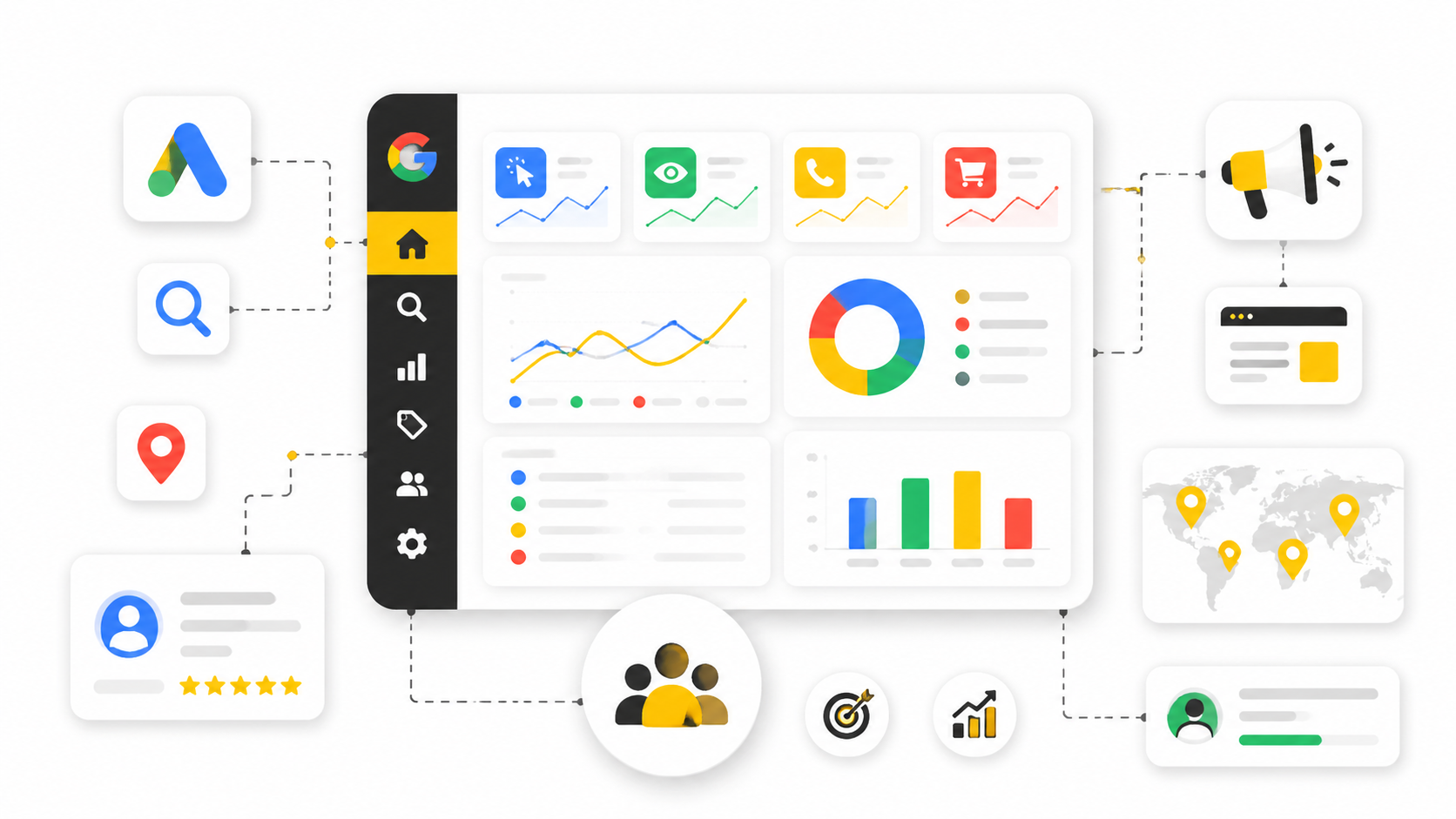
Partnering with a Google marketing agency gives companies access to tools, analytics, and experience that are often too costly or complex to manage internally. Agencies provide a structured approach to digital marketing, ensuring that every dollar spent is aligned with business objectives. From campaign setup to ongoing optimization, these experts transform marketing budgets into measurable results.
Article Outline
- Why it Matters: Understanding the Value of Google Marketing
- Framework Overview: How Agencies Structure Campaigns
- Core Components: Key Services Offered by Agencies
- Professional Implementation: Best Practices for Maximum ROI
- Case Studies: Real-World Success Stories
- Future Trends: Staying Ahead in Google Marketing
By following this structure, the article will guide readers from the foundational importance of Google marketing to advanced strategies and real-world examples of success. It will highlight the practical steps and professional insights that make hiring a Google marketing agency a strategic investment rather than just an expense.
Why It Matters: Understanding the Value of Google Marketing
Investing in a Google marketing agency goes beyond simply running ads. Google controls over 90% of the global search market, which makes it the primary gateway for potential customers. Businesses that fail to optimize their presence risk losing visibility and revenue to competitors who leverage precise targeting, bidding strategies, and data-driven insights.
Effective Google marketing ensures that your campaigns reach the right audience at the right time. A well-managed campaign not only increases traffic but also improves conversion rates, meaning you get more value from every marketing dollar. For instance, companies that invest in professional Google Ads management report up to three times higher ROI compared to self-managed campaigns.
Another reason it matters is the complexity of Google's ecosystem. From Search and Display to YouTube and Shopping campaigns, the platform requires technical expertise and strategic oversight. Agencies bring that expertise, helping businesses avoid costly mistakes and maximize the impact of every campaign.
Framework Overview: How Agencies Structure Campaigns
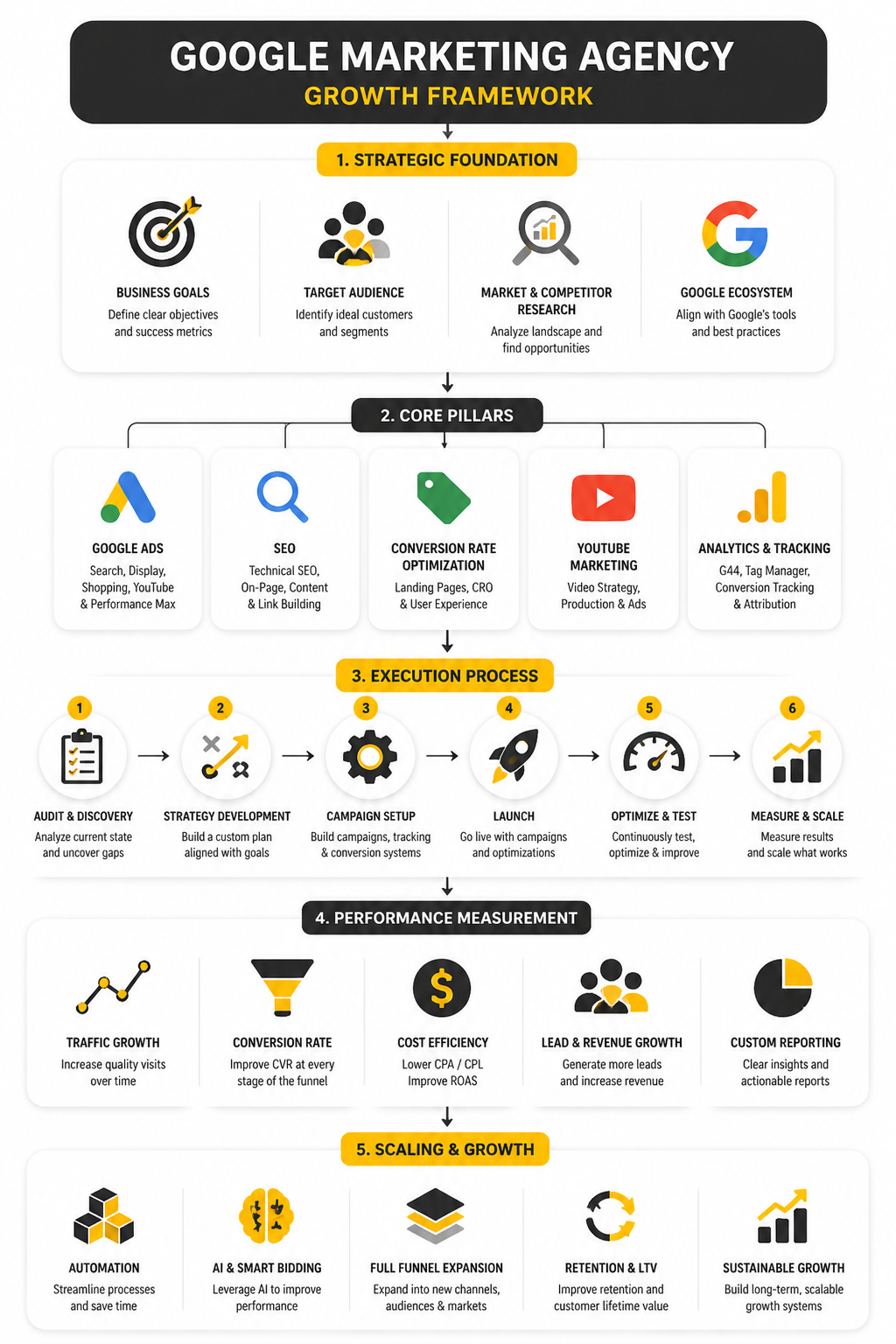
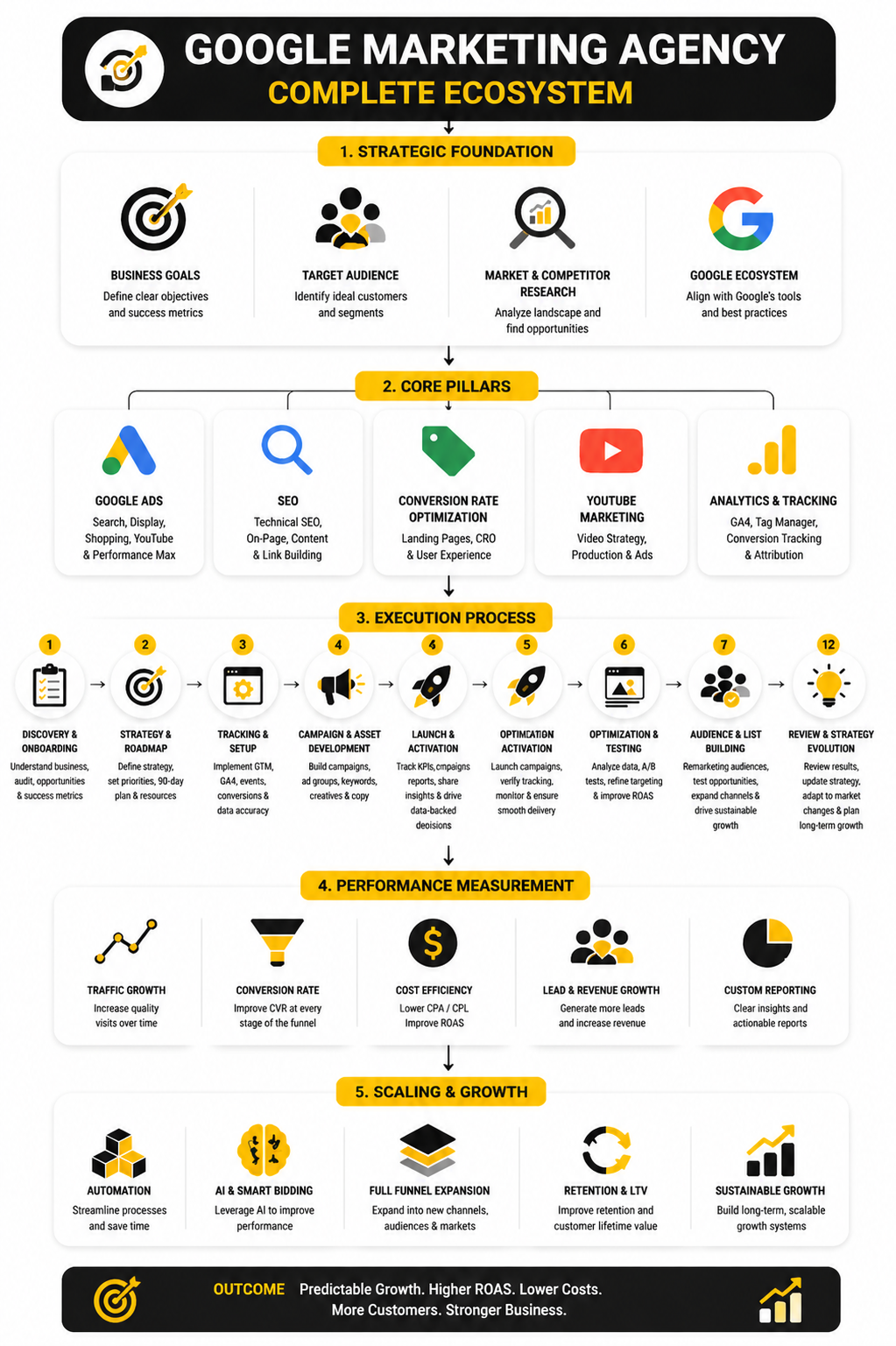
A Google marketing agency organizes campaigns into a framework that aligns with business goals. This structure typically includes:
- Audience Research – Identifying the most profitable demographics, interests, and behaviors.
- Keyword Strategy – Selecting high-intent keywords that drive quality traffic.
- Campaign Design – Crafting ad groups, ad copy, and extensions tailored to audience needs.
- Bid Management – Adjusting bids dynamically to achieve maximum ROI.
- Analytics & Reporting – Monitoring performance and providing actionable insights for continuous improvement.
This framework ensures that campaigns are not just launched but actively managed for performance. By combining research, strategy, and ongoing optimization, agencies provide a systematic approach that delivers measurable outcomes.
A structured framework allows businesses to scale campaigns efficiently. Agencies can test new strategies, allocate budgets based on performance, and adjust messaging to respond to market trends. This disciplined approach distinguishes successful campaigns from wasted ad spend and ensures long-term growth.
Agencies often integrate tools like GoHighLevel or ClickFunnels to streamline lead generation and conversion tracking, making the framework actionable in real time.
Core Components: Key Services Offered by Agencies
A Google marketing agency doesn’t just run ads—it builds a comprehensive ecosystem around your business. Their services typically cover several core components:
- Search Engine Marketing (SEM) – Optimizing paid search campaigns to ensure ads appear for high-intent queries. This involves keyword research, ad copywriting, and bid management.
- Search Engine Optimization (SEO) – Improving organic rankings on Google to complement paid efforts, driving traffic without direct ad spend.
- Display and Video Advertising – Crafting engaging banner and video campaigns that appear across the Google Display Network and YouTube, capturing attention beyond search results.
- Shopping Campaigns – For e-commerce businesses, agencies manage product feeds, optimize listings, and track conversions to maximize sales.
- Analytics and Reporting – Setting up dashboards, tracking conversions, and providing actionable insights to refine strategy over time.
Each component is designed to work together, creating a seamless marketing machine that reaches potential customers across different touchpoints. Agencies use tools like GoHighLevel for automated workflows and conversion tracking, or ClickFunnels to capture leads efficiently, ensuring no potential prospect slips through the cracks.
Professional Implementation: Bringing Strategy to Life
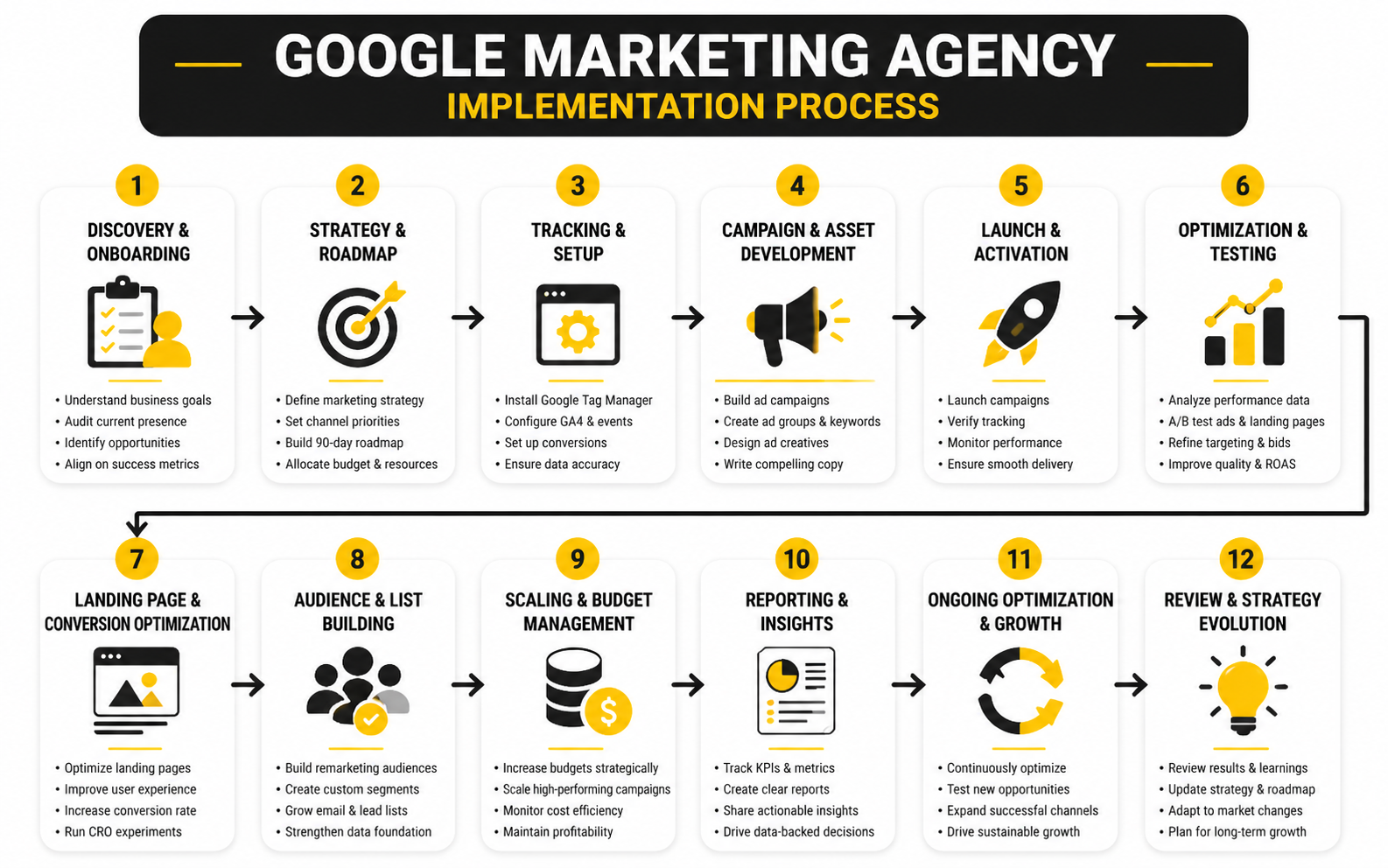
Execution is where strategy turns into results. A Google marketing agency follows a disciplined process to ensure every element performs optimally:
- Campaign Setup – Creating structured ad groups, integrating tracking pixels, and configuring conversion goals.
- Ad Copy and Creative – Designing compelling text and visual assets that resonate with your target audience.
- Targeting and Segmentation – Using demographic, geographic, and behavioral data to pinpoint high-value users.
- Bid and Budget Management – Adjusting spend dynamically based on performance metrics to maximize ROI.
- Ongoing Optimization – Monitoring campaigns daily, testing variations, and refining keywords, placements, and messaging.
- Reporting and Insights – Providing transparent dashboards that quantify success and guide future strategy.
This step-by-step process transforms marketing plans into actionable campaigns that produce measurable growth. Proper execution not only increases clicks but also ensures those clicks convert into meaningful business outcomes. By relying on expert implementation, businesses save time, reduce errors, and see faster results.
Statistics and Data: Measuring Campaign Performance
Tracking and interpreting data is the cornerstone of effective Google marketing. Without clear metrics, even the best campaigns may fail to deliver real business impact. Agencies focus on identifying the right performance signals and using them to guide strategic decisions.
Key metrics typically include:
- Click-Through Rate (CTR) – Indicates how compelling your ad is to users searching for relevant keywords. High CTR signals effective messaging and targeting.
- Conversion Rate (CVR) – Measures the percentage of visitors who complete desired actions, such as purchases or sign-ups. This metric directly reflects ROI.
- Cost Per Acquisition (CPA) – Helps businesses understand how much they spend to acquire a single customer, guiding budget allocation.
- Return on Ad Spend (ROAS) – Quantifies revenue generated relative to ad spend, showing the efficiency of marketing dollars.
- Quality Score – Google’s internal rating of ad relevance, landing page experience, and CTR. Higher scores reduce costs and improve ad positioning.
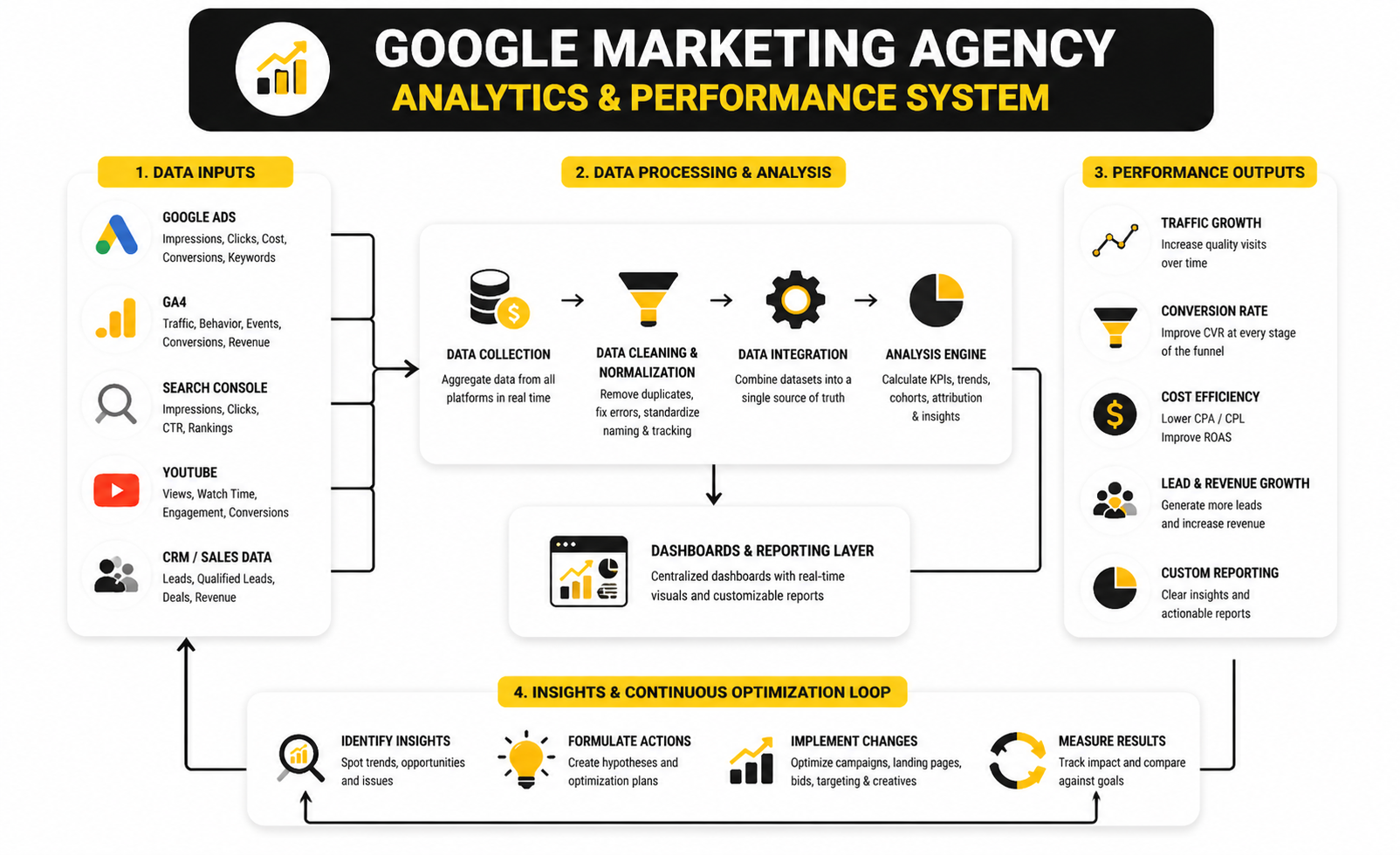
Agencies use advanced analytics platforms, often integrating tools like GoHighLevel or ClickFunnels, to visualize these metrics in real time. Dashboards allow marketers to identify trends, detect underperforming campaigns, and reallocate resources dynamically. For example, a low CTR may prompt ad copy adjustments, while an elevated CPA could trigger refined audience targeting.
Interpreting these numbers is more than checking boxes—it’s about understanding the story behind the data. Insights drive decisions such as increasing budget on high-performing campaigns, pausing low-value keywords, or testing new creative approaches. By continuously monitoring performance, a Google marketing agency ensures campaigns remain efficient, competitive, and aligned with business objectives.
Advanced Considerations: Scaling, Risks, and Strategic Tradeoffs
Once campaigns are running effectively, the next step is strategic scaling. Expanding reach without compromising ROI requires careful tradeoffs between audience size, budget, and ad frequency. A Google marketing agency manages these decisions by analyzing historical performance and predictive trends.
Scaling Strategies
- Incremental Budget Increases – Gradually raising daily spend ensures campaigns maintain efficiency and avoid overspending on untested audiences.
- Geo-Target Expansion – Testing new regions or languages based on proven campaign segments can unlock growth opportunities.
- Cross-Channel Integration – Combining Google Ads with platforms like GoHighLevel or ClickFunnels allows retargeting and nurturing to amplify results without extra acquisition cost.
Risk Management
Even well-structured campaigns have potential pitfalls. Keyword inflation, ad fatigue, or sudden shifts in search trends can degrade performance. Agencies mitigate risks through constant monitoring, A/B testing, and contingency planning. For example, they may pause underperforming ad groups while reallocating budgets to high-performing segments to maintain steady growth.
Expert-Level Insights
Advanced marketers evaluate tradeoffs between short-term ROI and long-term brand equity. Aggressive bidding on high-cost keywords might deliver immediate leads but erode profitability over time. Agencies often blend high-intent search campaigns with branding and content strategies to ensure sustainable growth. Tools like predictive analytics and AI-powered optimization, integrated with GoHighLevel, provide an edge in adjusting campaigns proactively rather than reactively.
The goal is not just to run ads, but to create a resilient, data-driven marketing ecosystem that scales intelligently while protecting margins and preserving customer trust. Strategic oversight from a professional agency is what separates sporadic wins from continuous, compounding growth.
FAQ - Built for Complete Guide
1. What is a Google marketing agency?
A Google marketing agency specializes in managing campaigns across Google’s platforms, including Search, Display, YouTube, and Shopping. They handle strategy, execution, analytics, and optimization to help businesses generate leads and sales efficiently.
2. How do agencies improve ROI on Google Ads?
Agencies increase ROI by targeting high-intent keywords, optimizing ad copy, adjusting bids dynamically, and continuously testing campaigns. They focus on converting clicks into measurable business outcomes rather than just driving traffic.
3. Are Google marketing agencies only for big companies?
No, agencies serve businesses of all sizes. Small businesses benefit from expert guidance and efficient spending, while larger enterprises leverage scale, data analytics, and advanced optimization strategies.
4. How do agencies measure campaign success?
They track metrics like CTR, conversion rate, CPA, and ROAS. Advanced agencies integrate tools like GoHighLevel to monitor performance in real time and make data-driven adjustments.
5. What is the difference between SEO and paid search?
SEO focuses on organic rankings and long-term visibility, while paid search (SEM) delivers immediate traffic through ads. Agencies often combine both to maximize reach and efficiency.
6. How often should campaigns be optimized?
Top agencies review campaigns daily or weekly, analyzing performance, testing new creative, and adjusting bids to ensure budgets are used efficiently and goals are met.
7. Can agencies manage cross-channel marketing?
Yes, they can integrate Google Ads with platforms like ClickFunnels and Replo to align display, search, and social campaigns for consistent messaging and retargeting.
8. What are the risks of running campaigns without professional help?
Businesses risk overspending, targeting the wrong audience, or missing opportunities to optimize. Poorly managed campaigns often have low CTR, high CPA, and minimal ROI.
9. How long does it take to see results?
While paid campaigns can generate traffic immediately, meaningful ROI often appears within 30–90 days as campaigns are refined and optimized. Organic SEO results typically take longer, often 3–6 months.
10. How do agencies handle budgeting for small vs. large campaigns?
Agencies scale budgets strategically, starting small to test performance, then gradually increasing spend on high-performing segments to maximize efficiency without risking wasted ad dollars.
11. Can I track leads directly from ads?
Yes, professional agencies set up tracking with tools like ClickFunnels and GoHighLevel, ensuring every lead is accounted for and can be nurtured effectively.
12. How do agencies handle ad creative fatigue?
They rotate ad copy, test multiple creatives, and refresh visual assets regularly to maintain engagement and prevent audience burnout.
Work With Professionals
Explore 10K+ Remote Marketing Contracts on MarkeWork.com
Most marketers spend too much time chasing clients, competing on crowded platforms, and losing a percentage of every project to middlemen. MarkeWork gives you a better way. Browse thousands of remote marketing contracts and connect directly with companies desperate to hire skilled marketers like you, without platform commissions and without unnecessary gatekeepers.
If you're serious about finding better opportunities and keeping 100% of what you earn, invite readers to explore available contracts and create a profile for free at MarkeWork.com.