

Freelance copywriting looks simple from the outside. You write words, send invoices, and work from anywhere. In reality, the people who build real income in this field do something far more valuable: they learn how to write words that move people to click, subscribe, book, buy, or reply.
That is exactly why this path is still worth taking. The market for persuasive writing has changed, but it has not disappeared. The latest U.S. Bureau of Labor Statistics outlook for writers and authors shows continued demand through 2034, while the 2025 B2B Content Marketing Benchmarks report from Content Marketing Institute shows many marketing teams still planning to increase content budgets. On top of that, HubSpot’s current marketing statistics roundup highlights that content marketing continues to support lead generation, nurturing, and sales.
The opportunity is real, but the path is usually misunderstood. Most beginners think they need a perfect niche, a polished website, and years of experience before they can start. What they actually need is a repeatable system for learning the craft, building proof, finding the right buyers, and turning small wins into a professional freelance business.
This article is built to give you that system. Instead of vague motivation or recycled tips, you will get a practical six-part roadmap that shows how to become a freelance copywriter in a way that is realistic, modern, and built for the market businesses are operating in now.
Article Outline
- Part 1: Why Freelance Copywriting Still Matters
- Part 2: Learn the Core Skills That Make Copy Sell
- Part 3: Build a Starter Portfolio Without Faking Experience
- Part 4: Choose Your Niche, Offers, and Pricing
- Part 5: Find Clients and Pitch Like a Professional
- Part 6: Turn Early Wins Into a Sustainable Freelance Copywriting Business
Why Freelance Copywriting Still Matters
Freelance copywriting matters because businesses still need conversion-focused writing across websites, email funnels, paid ads, landing pages, product pages, sales pages, and social campaigns. Even with AI tool
How to Become a Freelance Copywriter
Freelance copywriting looks simple from the outside. You write words, send invoices, and work from anywhere. In reality, the people who build real income in this field do something far more valuable: they learn how to write words that move people to click, subscribe, book, buy, or reply.
That is exactly why this path is still worth taking. The market for persuasive writing has changed, but it has not disappeared. The latest U.S. Bureau of Labor Statistics outlook for writers and authors shows continued demand through 2034, while the 2025 B2B Content Marketing Benchmarks report from Content Marketing Institute shows many marketing teams still planning to increase content budgets. On top of that, HubSpot’s current marketing statistics roundup highlights that content marketing continues to support lead generation, nurturing, and sales.
The opportunity is real, but the path is usually misunderstood. Most beginners think they need a perfect niche, a polished website, and years of experience before they can start. What they actually need is a repeatable system for learning the craft, building proof, finding the right buyers, and turning small wins into a professional freelance business.
This article is built to give you that system. Instead of vague motivation or recycled tips, you will get a practical six-part roadmap that shows how to become a freelance copywriter in a way that is realistic, modern, and built for the market businesses are operating in now.
Why Freelance Copywriting Still Matters
Freelance copywriting matters because businesses still need conversion-focused writing across websites, email funnels, paid ads, landing pages, product pages, sales pages, and social campaigns. Even with AI tools everywhere, companies still need someone who can understand an audience, shape a clear offer, and turn messy ideas into persuasive messaging that sounds credible and human. That gap between generic output and strategic messaging is where skilled copywriters create value.
The demand is also broader than many beginners expect. Brands still publish consistently, with HubSpot’s 2025 State of Blogging data showing that many companies that run blogs publish weekly or more often, and email remains a major revenue channel, with Litmus reporting strong email ROI patterns in 2025. When companies invest in traffic, retention, and conversion, they need stronger copy at every stage.
There is another reason this career path matters right now: it is one of the few service businesses you can start lean. You do not need inventory, office space, or a huge startup budget. You need skill, proof, outreach discipline, and a clear offer. That makes freelance copywriting attractive for people who want more control over income without waiting for permission from a traditional employer.

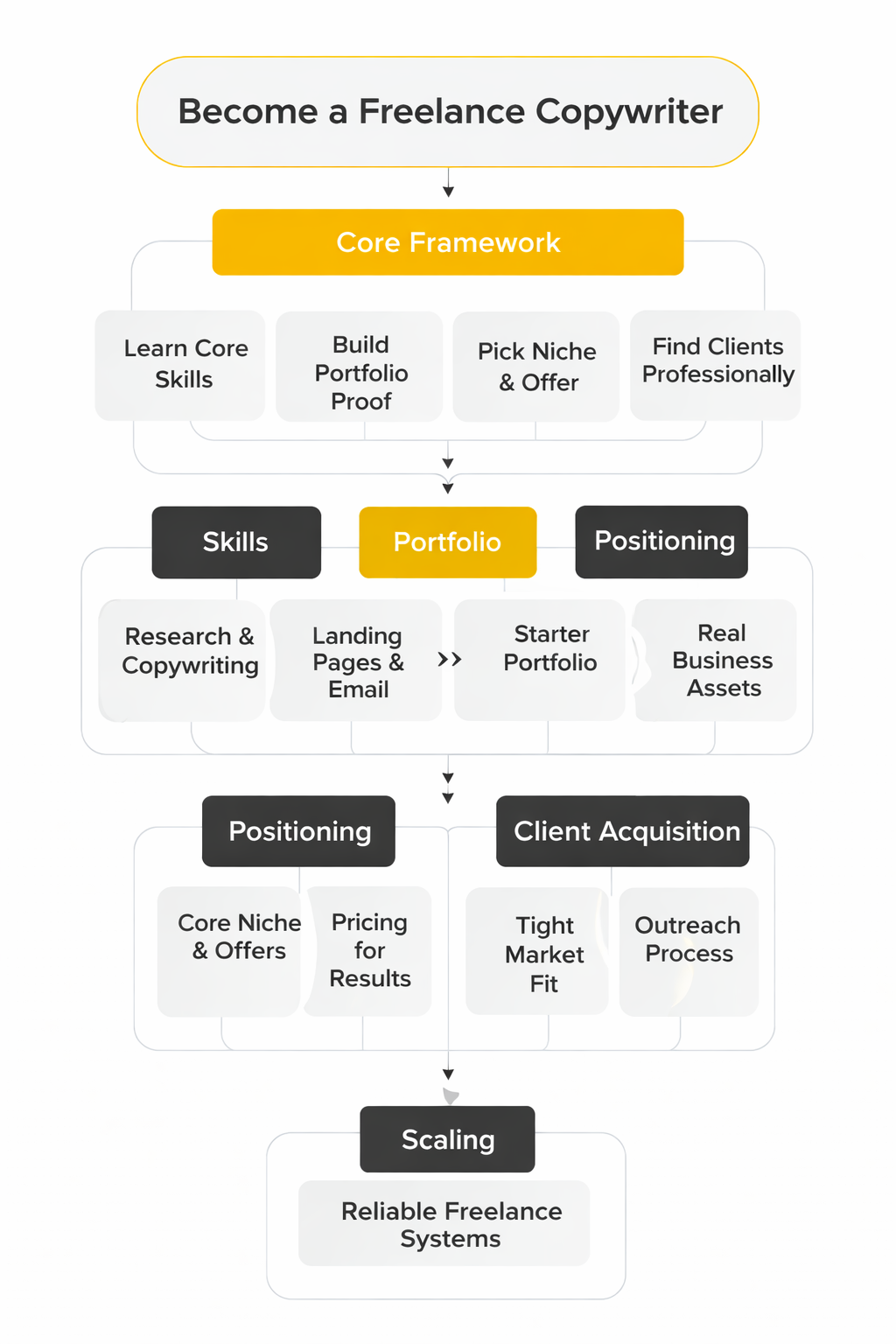
The Six-Part Framework for Becoming a Freelance Copywriter
The framework in this article is simple on purpose. First, you understand the opportunity and what clients are actually buying. Then you develop core copy skills, build a portfolio that proves you can solve business problems, define your market position, learn client acquisition, and finally install the systems that make freelancing stable instead of chaotic.
This matters because most people fail in one of two ways. They either obsess over writing craft and ignore business skills, or they chase clients before they can produce useful work. A professional freelance copywriter needs both sides working together: persuasive writing on one side, and positioning, pricing, lead generation, and delivery on the other.
That is also why the rest of this article follows a tight sequence. Each part builds on the last one, so by the end you are not just learning how to become a freelance copywriter in theory. You are building the actual operating model behind a freelance copywriting business, including the kind of simple client-facing setup you can later run through tools like Systeme.io or ClickFunnels when you are ready to capture leads and present your services professionally.
What Comes Next
In Part 2, we will move from opportunity to craft. That section will break down the specific skills freelance copywriters need to learn first, which ones matter most for getting paid, and how to practice them without wasting months on random exercises. This is where the article stops being abstract and starts becoming a career plan.
Learn the Core Skills That Make Copy Sell
If you want to figure out how to become a freelance copywriter, this is the point where the fantasy ends and the real work starts. Clients do not pay for clever sentences or a love of writing. They pay for clearer messaging, stronger conversion paths, better-performing campaigns, and copy that helps a business move a prospect from attention to action.
That distinction matters more than ever now. Marketing teams are still investing in content, email, landing pages, and owned channels, but the bar is higher because cheap content is everywhere and buyers have learned to ignore vague, generic messaging. Recent research from Content Marketing Institute shows many B2B teams still expect to increase content investment, while HubSpot’s latest marketing data shows content is still used to generate leads, nurture audiences, and support sales outcomes, which is exactly where strong copywriting earns its keep B2B Content Marketing Benchmarks, Budgets, and Trends: Outlook for 2025 HubSpot marketing statistics.
Start With Buyer Understanding, Not Word Tricks
The fastest way to stay amateur is to start with lines, slogans, and headline formulas before you understand the buyer. Strong copy almost always begins with research. You need to know what the customer wants, what they fear, what they have already tried, what language they use naturally, and what makes this offer worth paying attention to right now.
That is also why people-first thinking is not just an SEO talking point. Google’s own guidance keeps pushing creators toward helpful, reliable, people-first content because content built mainly to manipulate systems usually fails the visitor experience anyway Google’s people-first content guidance. For a freelance copywriter, that means your first job is not sounding persuasive. Your first job is understanding the problem clearly enough that the prospect feels understood.
In practical terms, this means you should spend more time reading sales pages, customer reviews, support questions, Reddit threads, product pages, founder interviews, and onboarding emails than obsessing over adjectives. Good copy often sounds simple because the thinking behind it is sharp. Bad copy sounds impressive because it is trying to hide weak thinking.
The Core Components Every Freelance Copywriter Needs
Most beginners try to learn everything at once. That usually leads to confusion, because copywriting sits across several channels and formats. A better approach is to master a few core components that show up again and again, no matter whether you are writing an email, a landing page, a product description, or an ad.
Research and Voice of Customer
Research is the skill underneath every other skill. When you know the buyer’s language, you do not have to force relevance into the page. You can build it directly into the headline, the promise, the proof, the objection handling, and the call to action.
This is one reason clear, relevant wording consistently wins. Nielsen Norman Group’s long-running usability research has shown that web users scan rather than read line by line, and that concise, scannable writing performs far better than dense promotional copy How users read on the web Concise, scannable, and objective web writing. If your research gives you the exact phrases buyers already use, your copy becomes easier to scan because it instantly feels familiar.
Headlines, Hooks, and First Impressions
A freelance copywriter has to earn attention quickly. That means learning how to write headlines and opening lines that make the next sentence worth reading. This is not about clickbait. It is about clarity, specificity, and immediate relevance.
That same principle shows up across channels. Google Ads explains that responsive search ads work by testing combinations that better match search terms, which reinforces a simple truth: copy performs better when the message closely reflects what the prospect is already looking for Google Ads responsive search ads. Good headlines do exactly that. They reduce the gap between user intent and your message.
Offer Clarity and Structure
A surprising amount of weak copy fails before persuasion even begins. The offer is fuzzy, the page structure is messy, and the reader cannot tell what is being sold, who it is for, or what to do next. That is not a style problem. It is a clarity problem.
This is why structure is one of the first professional skills you should practice. Nielsen Norman Group’s current homepage research still emphasizes guiding users toward goals with clarity and precision, and Baymard’s e-commerce research keeps showing how much user experience depends on understandable content and low-friction flows Homepage design principles Baymard product page UX research. When you learn to structure a page around promise, proof, objections, and action, your writing becomes easier to trust.
Calls to Action and Friction Reduction
A call to action is not just a button label. It is the final step in a chain of logic. If the page has done its job, the CTA feels like the natural next move. If the page has not done its job, no button wording will save it.
You also need to understand that friction is often created by vague language. Nielsen Norman Group has warned against weak information scent in links and calls to action, because vague verbs and unclear labels make users hesitate Low-information-scent mistakes in navigation and CTAs. Baymard’s form research makes the same point from another angle: unclear, confusing, or overly demanding form experiences create drop-off right where the conversion should happen Baymard form design best practices.
Editing for Readability and Conversion
Editing is where good copy starts making money. Beginners often overwrite because they want to sound professional. The problem is that readers usually reward clarity more than polish, especially in conversion environments where speed and comprehension matter.
Unbounce’s benchmark data is useful here because it connects readability to results, not just aesthetics. Its latest conversion benchmark research found median landing page conversion rates around 6.6% across industries, and pages written at a 5th to 7th grade reading level converted materially better than more complex versions average landing page conversion rate Unbounce conversion benchmark report. That does not mean you should write like a child. It means you should remove unnecessary friction, jargon, and sentence weight.
Learn One or Two Channels First
You do not need to master every kind of copy before getting paid. In fact, trying to do that usually slows you down. It is smarter to choose one or two channels where businesses clearly spend money and where the writing has a visible commercial outcome.
Email is one of the best places to start because it teaches subject lines, sequencing, offers, clarity, and calls to action in a format where performance is measured constantly. Litmus continues to report strong ROI ranges for email and keeps highlighting lifecycle email as a major retention and engagement channel, which is why businesses keep investing in it email ROI infographic State of Email in Lifecycle Marketing. If you want hands-on practice, setting up simple sequences inside tools like Brevo or Moosend can help you understand how copy behaves inside real campaigns instead of in theory.
Landing pages are another strong starting point because they force you to think about message hierarchy, offer clarity, proof, objections, and conversion friction all at once. If you can write a clear landing page and a simple email sequence, you are already learning the muscles that transfer into ads, websites, product pages, and funnels later.
A Smarter Practice Plan for Beginners
The best practice is not random daily writing. The best practice is targeted repetition on assets businesses already use. That way, every exercise builds a commercial skill instead of just filling a notebook.
A strong early practice routine looks like this:
- Rewrite weak headlines from real landing pages so they are clearer and more specific.
- Break down one email campaign per week and identify the promise, angle, proof, and CTA.
- Collect real customer language from reviews, testimonials, comments, and support questions.
- Write one landing page section at a time instead of trying to draft a full page from scratch.
- Edit aggressively for clarity, scannability, and obvious next steps.
This is also where simple publishing tools can help. If you want to test how messaging looks across channels, tools like Buffer can help you adapt short-form promotional copy for social, while funnel builders like Systeme.io give you a straightforward place to see how copy sits inside pages, forms, and automations. The tool itself will not make you a copywriter, but seeing your words in a live environment speeds up judgment.
What You Actually Need to Get Good At First
At the beginning, your goal is not becoming a master stylist. Your goal is becoming useful. That means you should focus on five things first: customer research, clear headlines, logical structure, compelling offers, and ruthless editing.
Once those skills start working together, the path of how to become a freelance copywriter gets much less mysterious. You stop guessing what clients want because you can see how businesses use copy to drive attention, trust, and action. In Part 3, the next step is turning those skills into proof by building a portfolio that looks credible without pretending you already have years of client work.
Understanding Copywriting Performance and What the Data Actually Means
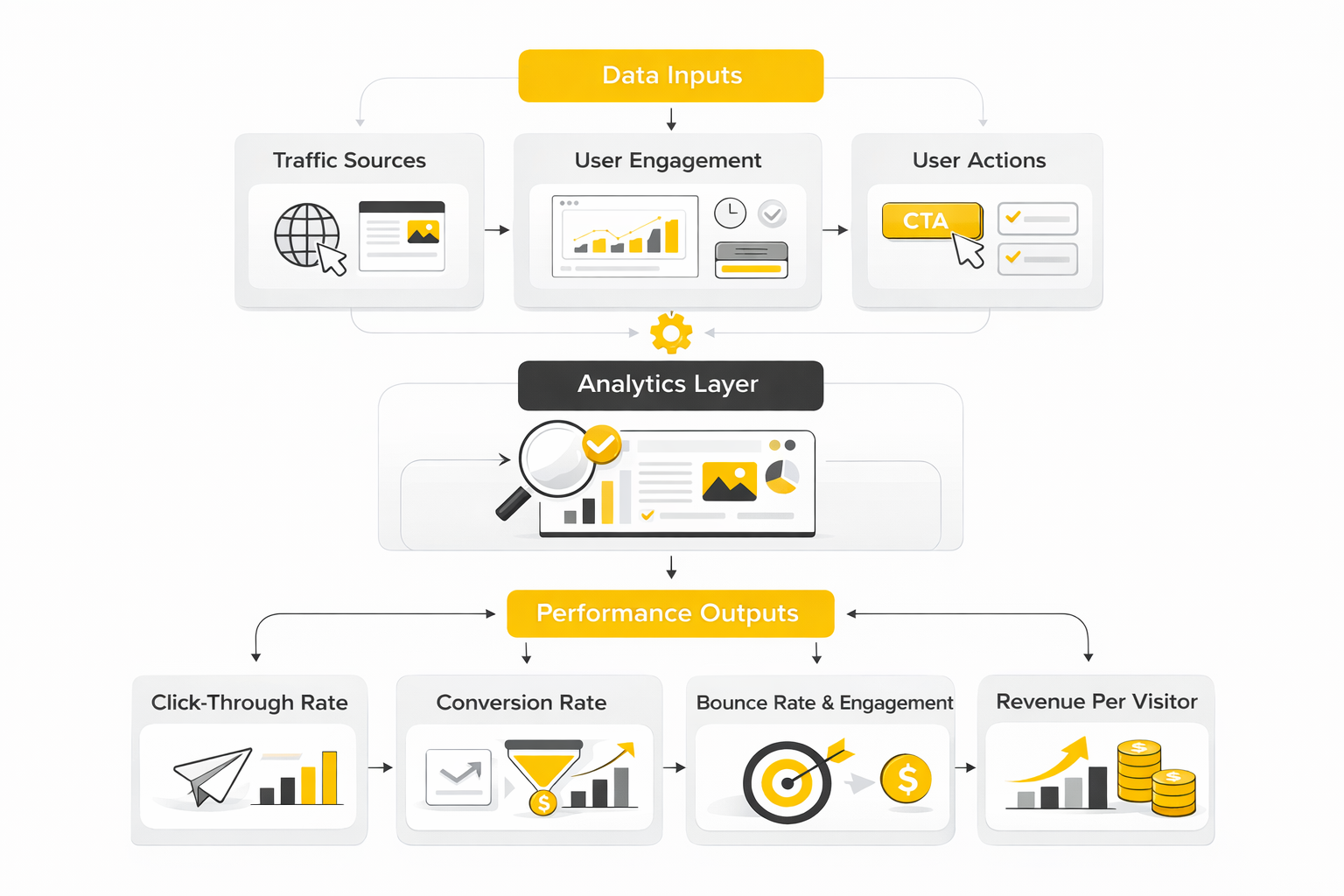
If you want to build a sustainable career and truly understand how to become a freelance copywriter, you need to move beyond writing and start thinking like a performance marketer. Businesses do not measure copy by how clever it sounds. They measure it by whether it changes behavior.
That is why professional copywriting is tightly connected to analytics. Marketing teams look at numbers that reveal whether the message attracted attention, kept people engaged, and ultimately drove revenue. When you understand these signals, your work becomes easier to position because you can talk about outcomes instead of just deliverables.
Research across the marketing industry reinforces this point. Marketing leaders consistently report that measurable outcomes such as lead generation, engagement, and conversions are the primary indicators of content success, which explains why data-driven campaigns continue to dominate modern marketing strategies HubSpot marketing statistics B2B Content Marketing Benchmarks, Budgets, and Trends: Outlook for 2025.
For freelance copywriters, learning to interpret these numbers is a competitive advantage.
The Core Metrics That Reveal Whether Copy Is Working
Not every metric matters equally. A professional copywriter focuses on signals that show movement in the customer journey, not vanity metrics that only look impressive on a dashboard.
Conversion Rate
Conversion rate measures the percentage of visitors who complete a desired action. That action might be signing up for a newsletter, booking a demo, purchasing a product, or downloading a resource.
Landing page benchmark data collected across industries shows median conversion rates around 6.6%, with higher-performing pages exceeding 11% depending on sector and traffic quality average landing page conversion rate Unbounce conversion benchmark report.
The important lesson is not the number itself. It is the relationship between messaging clarity and user action. If traffic stays constant but conversion rates improve, the copy is likely doing its job better.
Click-Through Rate
Click-through rate shows how many users moved from one step to the next. It appears across ads, emails, landing pages, and calls to action.
For example, email marketing research consistently shows strong engagement when messages align with user intent. Lifecycle campaigns in particular maintain high engagement because they respond to specific user actions rather than broadcasting generic promotions State of Email in Lifecycle Marketing.
When copywriters understand click behavior, they start seeing how headline clarity, button wording, and message hierarchy influence reader momentum.
Bounce Rate and Engagement Signals
Bounce rate reveals how often visitors leave a page without interacting further. High bounce rates usually signal that the page failed to match user expectations or deliver relevant information quickly.
Usability research from Nielsen Norman Group highlights how quickly users evaluate web pages and decide whether they are worth reading. Clear structure, scannable text, and strong information hierarchy improve comprehension and reduce abandonment How users read on the web Concise, scannable web writing.
For a freelance copywriter, these signals often point to structural problems rather than stylistic ones.
Revenue Per Visitor
This is one of the most valuable metrics for evaluating copy performance because it connects messaging directly to revenue.
Revenue per visitor shows how much income is generated for each visitor who lands on a page. If better copy improves conversion rates or average order value, the impact becomes immediately visible in this metric.
Understanding this number allows freelance copywriters to speak the language of business owners. Instead of saying “I wrote a landing page,” you can say “This page improved revenue per visitor by improving clarity around the offer.”
How Copywriters Use Data to Improve Campaigns
Data is not just something marketers analyze after a campaign ends. The best copywriters treat it as a feedback system that guides constant improvement.
This is where testing becomes essential.
A/B testing compares two versions of the same asset to see which one performs better. It might test different headlines, calls to action, layouts, or email subject lines.
Google Ads and many marketing platforms encourage this approach because performance often improves when messaging is iterated and refined based on real behavior rather than assumptions Google Ads responsive search ads.
The lesson here is simple but powerful: copywriting is partly creative and partly experimental.
Building a Simple Measurement System
You do not need an advanced analytics stack to start thinking like a data-aware copywriter. Even small campaigns can be measured effectively if you track the right signals.
A basic measurement system usually includes:
- Traffic source tracking to understand where visitors come from.
- Conversion tracking to measure completed actions.
- Engagement data such as time on page or scroll depth.
- Click tracking within emails or landing pages.
Most modern platforms already include these features. Funnel builders such as Systeme.io allow you to monitor page conversions and form submissions, while email platforms like Brevo or Moosend show open rates, click behavior, and subscriber activity.
These tools turn abstract writing decisions into measurable outcomes.
What the Numbers Should Actually Drive You To Do
Numbers only matter if they lead to better decisions. When a freelance copywriter reviews campaign data, the goal is to identify friction and opportunity.
A few examples of what the data might suggest:
- High traffic but low conversions: the headline or offer may not match visitor expectations.
- Strong email opens but weak clicks: the body copy may not reinforce the promise made in the subject line.
- Good engagement but weak final conversions: the call to action may be unclear or poorly placed.
- High bounce rates: the page may lack clarity or immediate relevance.
Each signal points toward a specific improvement rather than vague experimentation.
Why Data Literacy Makes Freelancers More Valuable
Understanding analytics changes how clients perceive your work. Instead of hiring someone who writes copy and disappears, they see someone who understands marketing performance.
That shift dramatically improves your positioning in the market. Businesses do not just need content. They need messaging that improves engagement, reduces friction, and moves prospects closer to purchase.
Learning how to become a freelance copywriter is therefore not just about mastering words. It is about understanding how those words influence measurable behavior. In the next section, the focus moves from performance metrics to positioning—how to choose a niche, define your services, and price your work in a way that reflects real business value.
Turn the Whole Process Into a Working Freelance System
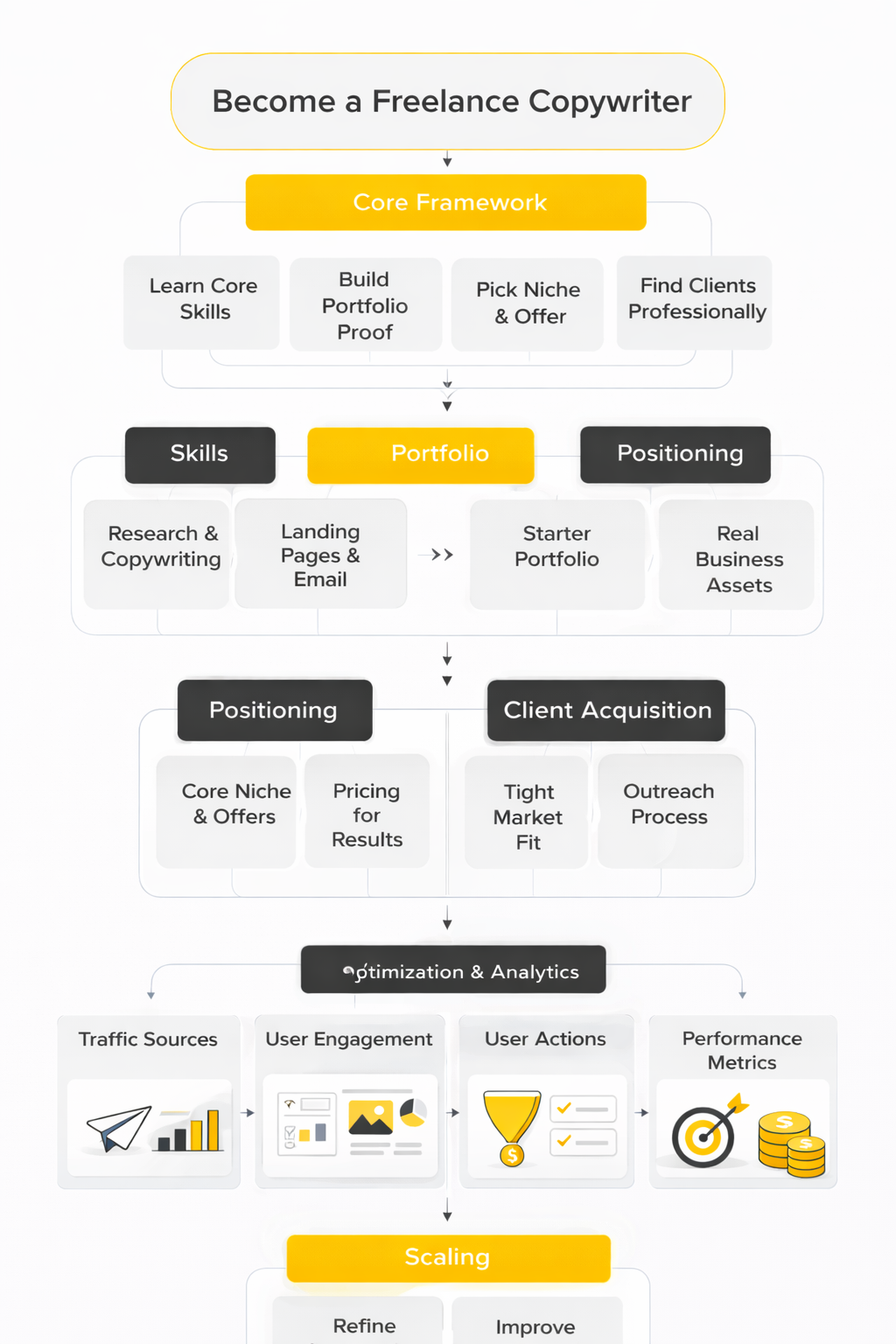
By this point, the question is no longer just how to become a freelance copywriter. The real question is how to turn all of these moving parts into a system you can run consistently. That matters because skill alone does not create a stable freelance business. Stability usually comes from combining craft, proof, positioning, outreach, and measurement into one repeatable operating model that can survive slow weeks, client delays, and changing market conditions. Writers and Authors outlook, 2024–2034 B2B Content Marketing: 2025 Benchmarks & Trends 2026 Marketing Statistics, Trends, & Data
A practical system usually works like this. First, you build skill in a few commercial formats such as landing pages and email. Then you create proof through focused portfolio pieces, define a niche and offer people can actually buy, run outreach consistently, and use performance data to improve both your copy and your client conversations. That sequence is simple, but it is powerful because each step supports the next one instead of fighting it. The State of Email in Lifecycle Marketing average landing page conversion rate Google’s people-first content guidance
This is also where beginners often overcomplicate things. You do not need a giant brand, a huge audience, or a perfect personal website before you begin. You need one clear offer, a small body of proof, a prospecting habit, and a way to explain why your writing helps businesses create better outcomes. When those pieces click together, the career starts to feel less like guesswork and more like a business. Writers and Authors outlook, 2024–2034 2026 State of Marketing Report
A Realistic 90-Day Starting Plan
The best way to keep momentum is to make the process concrete. Over the first 30 days, focus on skill-building and research-heavy practice in one or two channels. Over the next 30 days, turn that practice into portfolio assets and a simple offer. In the final 30 days, start targeted outreach, collect conversations, refine your positioning, and improve your system based on responses instead of assumptions. B2B Content Marketing: 2025 Benchmarks & Trends 2026 Marketing Statistics, Trends, & Data
That kind of plan works because it matches how real client work develops. Businesses still invest in content, email, and conversion assets, but they increasingly expect those assets to be aligned with brand trust, measurable performance, and audience relevance. A beginner who learns to think that way early has a much better chance of standing out than someone who only studies writing formulas. 2026 State of Marketing Report The State of Email in Lifecycle Marketing
If you want a lightweight setup for early lead capture or simple funnel testing, tools like Systeme.io or ClickFunnels can help you present an offer and see how messaging behaves inside real pages. For appointment flow and qualification, a simple booking setup like Cal.com or a short intake form through Fillout can keep your pipeline organized without adding unnecessary complexity.
FAQ
Is freelance copywriting still a good career in 2026?
Yes, but only if you treat it as a business skill instead of a vague creative identity. The latest U.S. Bureau of Labor Statistics outlook projects writers and authors employment to grow 4% from 2024 to 2034, with about 13,400 openings each year on average, while current marketing research still shows businesses investing in content, email, and conversion-focused assets. That does not guarantee easy money, but it does show there is still demand for people who can write clearly and persuade responsibly. Writers and Authors outlook, 2024–2034 B2B Content Marketing: 2025 Benchmarks & Trends 2026 Marketing Statistics, Trends, & Data
Do I need a degree to become a freelance copywriter?
No formal degree is required to start, and clients rarely buy copy because of your academic credentials. They usually care more about your portfolio, your thinking, your niche relevance, and whether you can help them improve messaging or conversions. A degree can help with communication skills, but it is not the gatekeeper most beginners imagine. Writers and Authors outlook, 2024–2034
How long does it take to get your first freelance copywriting client?
That depends on how quickly you build proof and start outreach, but it is usually faster for people who pick a narrow offer and contact relevant businesses directly. Waiting until everything feels perfect tends to delay results more than lack of talent does. In practical terms, a focused beginner can often spend the first few months building samples, refining positioning, and starting conversations rather than hiding in endless preparation. Google’s people-first content guidance 2026 State of Marketing Report
What kind of copy should a beginner learn first?
Email and landing pages are usually the smartest starting point because they teach headline writing, message hierarchy, offer clarity, and calls to action in formats businesses actively use. They also connect more directly to measurable outcomes than many other writing formats. That makes them easier to sell and easier to learn from once campaign data starts coming back. The State of Email in Lifecycle Marketing average landing page conversion rate
Can AI replace freelance copywriters?
AI can absolutely replace generic, low-value writing, and that is already changing the market. What it does not replace well is judgment, buyer understanding, offer positioning, strategic editing, and the ability to connect words to business goals and brand trust. Current marketing research keeps emphasizing that distinctive brand point of view and human creativity matter more, not less, as automated content becomes easier to produce. 2026 State of Marketing Report Google’s people-first content guidance
How much should a beginner freelance copywriter charge?
There is no single correct number because pricing depends on scope, complexity, market, and the commercial value of the asset. The bigger principle is that you should not price as if all writing is interchangeable, especially when a page or sequence supports lead generation, retention, or sales. Even broad freelance market data shows specialized skills tend to command stronger rates than generic work, which is why offer clarity and niche positioning matter so much. Upwork’s 2025 most in-demand skills release
Do I need a website before I start pitching clients?
No, not necessarily. A clean portfolio document, a few strong samples, and a clear explanation of your offer can be enough to start conversations. A website can help later, but it is often more important to have credible proof and a focused pitch than a polished site with no real substance behind it. Google’s people-first content guidance
What should I put in a beginner copywriting portfolio?
A small set of focused samples is usually enough if the work shows real thinking. Good portfolio pieces often include a landing page, a short email sequence, a product or service page, and a brief explanation of the business problem and your messaging approach. The goal is not to look busy. The goal is to show that you understand audience, structure, offers, and action. The State of Email in Lifecycle Marketing average landing page conversion rate
How do I know whether my copy is actually working?
You look at performance signals that connect the writing to behavior. Conversion rate, click-through rate, engagement, and revenue-related outcomes matter far more than whether someone says the copy sounds nice. When median landing page conversion rates vary by industry but still cluster around meaningful benchmarks, that tells you something important: better messaging can be measured, not just admired. average landing page conversion rate Unbounce conversion benchmark report
Should I specialize in one niche right away?
You should usually narrow faster than feels comfortable, but not so hard that you trap yourself before you have evidence. A focused niche makes you easier to trust and easier to refer, especially in a market where relevance and distinct positioning matter more than generic availability. A good middle ground is choosing one primary market and one or two adjacent offer types instead of trying to serve everyone. 2026 State of Marketing Report
What is the biggest mistake new freelance copywriters make?
The biggest mistake is confusing learning with hiding. Many beginners keep reading, watching, and organizing notes long after they already know enough to create samples and start outreach. Progress usually accelerates once you start shipping work, collecting responses, and improving through real-world feedback. Google’s people-first content guidance
Is freelance copywriting better on platforms or through direct outreach?
Platforms can help you find early opportunities, but they also create price pressure and competition around visibility rather than fit. Direct outreach is slower to learn, yet it often leads to better positioning because you can approach companies with a specific diagnosis and a more tailored offer. The strongest long-term setup is often a mix of inbound visibility, referrals, and focused outbound prospecting rather than dependence on one channel. Upwork’s 2025 most in-demand skills release 2026 State of Marketing Report
Work With Professionals
Explore 10K+ Remote Marketing Contracts on MarkeWork.com
Most marketers spend too much time chasing clients, competing on crowded platforms, and losing a percentage of every project to middlemen.
MarkeWork gives you a better way. Browse thousands of remote marketing contracts and connect directly with companies desperate to hire skilled marketers like you, without platform commissions and without unnecessary gatekeepers.
If you're serious about finding better opportunities and keeping 100% of what you earn, explore available contracts and create a profile for free at MarkeWork.com
Work With Professionals
Explore 10K+ Remote Marketing Contracts on MarkeWork.com
Most marketers spend too much time chasing clients, competing on crowded platforms, and losing a percentage of every project to middlemen.
MarkeWork gives you a better way. Browse thousands of remote marketing contracts and connect directly with companies desperate to hire skilled marketers like you, without platform commissions and without unnecessary gatekeepers.
If you're serious about finding better opportunities and keeping 100% of what you earn, explore available contracts and create a profile for free at MarkeWork.com.